Desert Island Discs

I know I’ve said this before but now that we are in the digital age, having a shed load of TV channels does not guarantee that us, the viewing public, will find anything worth watching.

The other day, after a troll through channel after channel I finally found something I thought might be actually interesting. It was a documentary on BBC Four about the long running radio show Desert Island Discs. It was actually an edition of the Arena documentary series and was first broadcast in 1982 which was the 40th anniversary of the programme.

The documentary featured some of the celebs who had been ‘stranded’ on the island and revealed some of their musical choices as well as some sequences staged for the camera.

One featured Roy Plomley reenacting the moment when, just as he was getting into bed he had an idea for a new radio show. Not wanting to forget his idea, Roy jumped up out of bed and began tapping away at his typewriter with his thoughts and ideas.

In case you have never heard of the show the format is pretty simple. Roy interviews various celebrities and asks them to choose 8 records to take with them onto a desert island. They are allowed one luxury and one book apart from the Bible and the complete works of Shakespeare which are already there.

I can’t say I listened to many episodes and as a youngster I much preferred a rival show on either Radio One or Two hosted by Brian Matthew called My Top Twelve in which a celeb, usually one from the pop world, chose his 12 favourite tracks.

What I particularly liked about Roy Plomley was his measured even voice and how he would gently prod his guests towards each new record. He would stay quietly firm when they insisted on having something that is not part of the format, like a set of books instead of just one book

Paul McCartney was one of the guests featured on the programme and one of the records he chose was Beautiful Boy, a track by John Lennon from the album Double Fantasy. Did he really like it I wondered or did he just want to play tribute to his murdered boyhood friend and fellow Beatle, John Lennon?

Some of the other celebs featured in the Arena documentary were comedians Frankie Howerd and Arthur Askey. I’ve always found both comedians to be particularly funny. Frankie Howerd died of a heart attack in 1992 and his home, Wavering Down, in the village of Cross in Somerset, was turned into a sort of museum by his partner and manager Dennis Heymer displaying Howerd’s personal effects and memorabilia. I found it fascinating to learn that most of Howerd’s comic asides to the audience were actually planned and rehearsed in advance.

Arthur Askey was the star of numerous radio shows in the 30s and 40s. He was also a regular on television until his death in 1982. He had numerous catchphrases including I thank you and Hello playmates!

Another guest was John Kenneth Galbraith an American economist who served in the administrations of various presidents from Roosevelt to Lyndon Johnson. He appears frequently in the classic documentary series The World at War. One of his musical choices was California Here I Come sung by Al Jolson. Film director Otto Preminger was also a guest and his 8 musical choices were all soundtracks from his own films and the book he chose to take to his desert island was his own autobiography.

Track 1

What would my 8 records be? Well, some time ago I did try to work out my all-time top 12 but the fact was, I could only whittle my choices down to 100. For this post though I’ve managed to choose 8 tracks although by the time this is published I might have a completely revised list.

For my first choice I’m going to go with Rock Your Baby by George McCrae because it was the track playing on the jukebox on my 18th birthday. I was working at the Refuge Assurance Company on Oxford Rd in Manchester and my colleagues took me to the pub for my first legal alcoholic drink back in 1974. Every time I hear that record, I think about that day and about the pub we went to. It was called the Salisbury and despite many changes in Manchester since then, the pub is still there. The inside has changed a little but on the outside, the Salisbury looks just like it did in 1974.

Track 2

Looking at my top 100 I was surprised to find Rock Your Baby wasn’t listed even though I had chosen nine other tracks from 1974. However, another record that I must include in my eight desert island discs is How Long by Ace. The lead singer of Ace was Paul Carrack who went on to work with other bands as well as working solo. In 1996 he released an updated version of How Long which I think is even better than the original so I think I’d choose that for my second track.

Track 3

Getting back to Paul McCartney I put one of his songs into my top 100 which I think I’ll have in my desert island discs. It was Listen to What the Man Said from when Paul was with his band Wings and was released in 1975. In 1974 I saw Paul and Wings live in concert at the Free Trade Hall in Manchester. The ticket cost me only £2, can you believe it?

Track 4

10cc were a great Manchester band and they recorded my next track, I’m Not in Love at Strawberry Studios in Stockport. It started life as an album track but fans were desperate to hear it as a single even though it was rather long for a single in those days. The track was famous for its multi-tracked backing vocals and was released in 1975 hitting the top spot in the singles chart soon afterwards.

Track 5

I love the film Back to the Future and one of my theories about successful films is that generally they always have a great musical theme or song and that is particularly true of Back to the Future. The film features the song The Power of Love by Huey Lewis and the News. Huey even has a small cameo in the film when Marty McFly auditions with his band and Huey rejects them with the comment “you’re just too damn loud”.

Track 6

Moving away from the 1970’s my sixth track would be Walking in Memphis by Mark Cohn. The song is a tribute to Elvis Presley and the lyrics are well observed. My favourite verse goes like this:

Saw the ghost of Elvis on Union Avenue

Followed him up to the gates of Graceland

Then I watched him walk right through

Now security did not see him

They just hovered around his tomb

But there’s a pretty little thing waiting for the King

Down in the jungle room.

Track 7

A very long time ago when I was either a teenager or in my early twenties, my old friend Steve and I interviewed each other for our own personal Top Twelve favourite records. We recorded our interviews on tape and added the appropriate records. I used to play my tape quite frequently but I worried about it breaking so in later years I managed to digitise the whole thing and burn it to a CD. Later I decided to update the interview by adding new contemporary comments from myself. Looking back at the music my younger self had chosen I realised that my tastes had changed and so I cut a few tracks out and added some new ones. One of the new editions was The Way it is by Bruce Hornsby and the Range.

Track 8

So here we are, just wanting that final track. I thought about going for some more modern songs rather than the predominantly 70s tracks I’ve already chosen. I also thought about going for more of a soul track or something by a more folk or country singer. Eventually I thought I’d choose a song from one of my favourite writers, Burt Bacharach, Do You Know the Way to San Jose sung by Dionne Warwick.

Paul McCartney chose as his luxury item a guitar and in a similar fashion, George Formby chose a ukulele and Liberace chose a piano. I’m not sure what I would take but I would probably go for my laptop or at least a notebook and pen.

Which book would I take? Well, I thought about taking The Great Gatsby but even though it’s an absolutely wonderful read it’s a rather short book. I’d probably go for my favourite book which has long been Dicken’s David Copperfield. It is not only an amazing read but it’s a very thick book and would keep me amused if I was stranded for a very long time.

Roy Plomley died in 1985, 17 days after he interviewed his last castaway, Sheila Steafel. Roy had presented 1791 episodes of the show over a 43-year period. He was followed as a presenter by Michael Parkinson, Sue Lawley, Kirsty Young and most recently, Lauren Laverne.

Over on the downloads page you can download an excel file of my top 100 tracks. If you use Spotify click this link to listen to my top 100 tracks: 


What to do next: Here are a few options.

Share this post on your favourite social media!

Hit the Subscribe button. Never miss another post!

Listen to my podcast Click here.

Buy the book! Click here to purchase my new poetry collection.

Click here to visit Amazon and download Floating in Space to your Kindle or order the paperback version.

Click here to visit amazon and purchase Timeline, my new anthology.


My White Jacket and my 70’s Pop Star Heroes

I really loved that white jacket although now I come to think about it, I only ever wore it once. Oh well, before we get to it, let’s take a quick look at some of my 70’s pop star heroes.

David Cassidy

I wasn’t so much a fan of David Cassidy, I just wanted to look like him. I always thought he was a pretty cool dude and although I didn’t rush out and buy his music I always kind of liked him. Cassidy was an unexpected superstar, the son of actor Jack Cassidy who crops up frequently in classic Columbo episodes.

image courtesy wikipedia

David began working as an actor and musician and was signed up by Universal studios in 1969. He worked on many TV shows of the time like Ironside and Bonanza until he was signed up for a part in a show called ‘The Partridge family‘. Cassidy and the show became a runaway hit and ten albums produced during the show’s run sold over a million copies each. David became a teen idol and his personal concerts were sell outs but a Cassidy mania, not unlike that experienced by the Beatles years earlier, caused numerous problems and culminated in a stampede at White City stadium where many people were injured and one girl fan sadly died.
In later years Cassidy was still singing and writing and appeared in many stage shows and musicals. You might even have seen him in a TV version of his life story, ‘The David Cassidy Story’.

On November 18, 2017, Cassidy was admitted to hospital with acute liver and kidney failure. He became critically ill and was put into a medically induced coma. He came out of the coma two days later in a critical but stable condition. Doctors hoped that Cassidy would survive until a liver became available for transplant, but he died of liver failure on November 21, 2017, at the age of 67.

According to Wikipedia, his daughter, Katie Cassidy, reported that his final words were “So much wasted time.”

Gary Glitter

Gary Glitter’s first big hit, back in the early seventies was ‘Rock n’ Roll’ parts 1 and 2, a double-sided single which on part 2 was mainly instrumental with group chants of ‘rock n roll’. Glitter followed this up with a string of hits throughout the early seventies with singles like ‘I’m the leader of the gang’, ‘I love you love me love’, ‘Do you wanna touch me?’ and ‘Hello hello, I’m back again’. His career faded afterwards but in the early 90’s his records were discovered by a new generation of record buyers and many modern artists have acknowledged that he was an inspiration to them in earlier years.

Back in 1976 my brother and I went to London to see him in concert. I’m pretty certain it was some sort of farewell concert but Gary soon made the first of many comebacks.

The late 1990’s saw his image become fatally destroyed by his arrest and conviction in 1999 for possession of child pornography. Some years later, in 2006, Glitter faced criminal charges and deportation from Vietnam after a court found him guilty of obscene acts with minors. Glitter was deported back to Britain and placed on the Sex Offenders’ Register for life. These convictions turned Glitter from being one of the best-loved stars in British pop history, into a hated and loathed figure.

On 5 February 2015, Glitter was convicted of attempted rape, four counts of indecent assault and one of having sex with a girl under the age of 13. On 27 February 2015, Glitter was sentenced to 16 years in prison.

On 3 February 2023, Glitter was released on licence after serving half of his sentence but on 13 March 2023, he was recalled to prison for breaching his licence conditions by allegedly viewing downloaded images of children.

David Bowie

Bowie is one of those stars who kept on making music throughout the years and constantly reinvented himself. One of the first tracks of his I ever bought was Life on Mars and a great early hit was Space Oddity. One of my personal favourites was The Laughing Gnome, originally released in 1967 in which Bowie sings with a ‘Gnome’ which was actually a speeded up vocal track.

Later Bowie created the character Ziggy Stardust and became one of the stars of the glam rock era. He changed style again with Young Americans, released in 1976. It was a big hit and even topped the US soul charts. In the 1980’s he had a hit with Under Pressure, a collaboration with Queen.

He also had numerous roles in the cinema playing an alien in the film The Man Who Fell to Earth and various others.

Bowie died while living in New York. He had contracted liver cancer and died on the 10th of January 2016.

Cliff Richard

Cliff’s career began in the 1960s and has continued almost to the present day. In the 1970s he had twice sung the UK entry for the Eurovision Song Contest and had his own TV show on the BBC.

I can’t say that I was ever a big fan of Cliff however in the late 70’s and 80s he had a string of excellent hits that I really loved, songs that included Devil Woman, Miss You Nights, Carrie and Wired for Sound.

Cliff was involved in controversy in the late 1990’s when he complained that radio stations were not playing his records and he went as far as releasing a dance version of one of his songs under a different name to prove his point. The record was popular but radio stations stopped playing it when Cliff was revealed as the singer.

In 2014, Cliff’s property was searched in relation to allegations which arose from the Jimmy Saville investigation known as Operation Yewtree. The allegations were unfounded but Cliff was unhappy that they were broadcast on the BBC news and later sued both the South Yorkshire Police and the BBC receiving substantial damages.

According to Wikipedia, Cliff is the third top selling artist in the UK behind Elvis Presley and the Beatles.  John Lennon apparently said of Cliff that before Cliff and the Shadows, there had been nothing worth listening to in British music.

Elton John

In 1967 Reg Dwight answered an advertisement in the New Musical Express. Liberty Records had placed the ad as they were looking for musical talent and when Reg arrived at Liberty’s offices, he was given a sheaf of lyrics written by Bernie Taupin and so Reg promptly began writing music to Bernie’s words. When Reg decided to perform his new songs, he decided to use a different name and so Reg became Elton John.

1973 was probably my first record buying year. Up until then I really had little interest in music. The Beatles had pretty much passed me by and I was more interested in TV and film music rather than the pop charts. For Christmas 1972 my brother and I received a shared present, a new stereo record player. Of course, having a record player meant that I needed something to play on it. That’s when I discovered Elton.

I bought lots of Elton’s records throughout the 70s but I lost interest in his music in his later years.

In 2001 Elton released the album Songs from the West Coast. The album was received warmly by the media and I remember hearing many great reviews saying how Elton had returned to his piano based roots and so on. On Wikipedia I see that the album was recorded on analogue tape as Elton felt that gave the sound a warmer feel. OK I thought, sounds like a good time to try some of Elton’s latest music. While I was waiting to pay for the CD in HMV I noticed another album of Elton’s, Made in England, in the reduced section so I grabbed that while I was there.

Anyway, Songs from the West Coast was a total disappointment for me and not only that, I thought the whole thing had a tinny sound to it, not a warm one.

A few months later I noticed Made in England lying unplayed on a shelf so I popped it into my car to give it an airing. I’m so glad I did because Made in England is the album that to me, sounds much like his classic 70’s stuff with some outstanding tracks. A fabulous album, just as good as Goodbye Yellow Brick Road.

Since then, Elton has been part of the first same sex UK marriage when he married his long time partner David Furnish and has seen his life story made into the 2019 film Rocketman starring Taron Egerton as Elton which includes a good many of Elton’s hits.

His latest album, Who Believes in Angels was released this year.

Marc Bolan

Bolan was a pop singer of the 1970s and is credited with beginning the glam rock movement by appearing on Top of the Pops, the BBC’s flagship music programme, with his group T Rex performing the single Hot Love wearing glitter make up on his face. The single was a number one hit and was followed up with my favourite Bolan/T Rex track, Get it On which spent 4 weeks at number one. Bolan and T Rex had numerous hits including Ride a White Swan, Telegram Sam, Metal Guru, Children of the Revolution and Solid Gold Easy Action. Bolan was great friends with David Bowie and Marc’s producer Tony Visconti later went on to work with Bowie.

In 1977 Bolan was involved with his girlfriend Gloria Jones. They went out to a nightclub in London, both had been drinking and Gloria was at the wheel of her mini when they crashed in south London. Gloria was injured but Marc was sadly killed. A shrine at the spot where they crashed is maintained by the T Rex Action Group.

David Essex

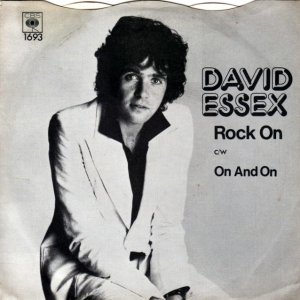
David Essex was another performer who made his name in the early seventies although in his youth he had ideas of becoming a footballer. He played the lead in the stage musical Godspell and then went on to star in the film ‘That’ll be the Day’. I remember seeing his album in a record shop and thinking what a cool dude he looked dressed in a white suit. The album was Rock On and the single went to number 3 in the UK charts in 1973. The next year David released one of my all-time favourite tracks Gonna make you a Star which went all the way up to number 1. He also appeared on the double album Jeff Wayne’s War of the Worlds and went on to star in many musicals such as ‘Godspell’ and Evita. In 2011, he joined the cast of TV soap ‘EastEnders’.

He is still writing, recording and performing today.

The White Jacket

When I saw David Essex singing ‘Rock On’ wearing a white suit on ‘Top of the Pops’ for the first time, I thought he was the epitome of seventies cool and it occurred to me that one way to transform my gangling self-conscious self into something better might be to get that very same white suit. I couldn’t afford a suit at the time so I settled for a jacket, a white jacket, and I well remember admiring myself in the mirror before my first Saturday night out wearing it, sometime back in 1973.

The first problem I encountered with the jacket came on the bus into town. I sat on the back seat and in those days, the back seats of our local buses were a little notorious for being dusty and grimy as they were over the engine and absorbed all the engine fumes. Also there were people who put their feet up on the seats leaving marks to which people like me (the twerp in the white suit) were highly susceptible. Another thing is that all my life I have been cursed with being clumsy and once I had met up with my friends I somehow managed to spill beer all down my sleeve. Anyway, the night went on, more or less successfully. I certainly remember having a good time although the white jacket failed in its primary function; that of attracting gorgeous girls.

Later on, we stopped at the kebab shop and somehow a sizeable portion of chilli sauce managed to attach itself to my jacket. Rather than feeling like David Essex, I felt a little like Alec Guinness in the film The Man In The White Suit‘, wanting to get away from everyone! I never wore the stained jacket again and it lingered sadly in the back of my wardrobe smelling of kebab, chilli sauce, beer and diesel fumes until my Mum, on a major clean up splurge, decided to throw it out.

Of course, it could have been worse: I could have gone out wearing jeans, a white t-shirt and a red jacket trying to look like James Dean. (Actually, that was another night!)

It’s only fair to mention that this post is a hugely updated version of one that I first published 10 years ago in 2015.


What to do next: Here are a few options.

Share this post on your favourite social media!

Hit the Subscribe button. Never miss another post!

Listen to my podcast Click here.

Buy the book! Click here to purchase my new poetry collection.

Click here to visit Amazon and download Floating in Space to your Kindle or order the paperback version.

Click here to visit amazon and purchase Timeline, my new anthology.


10 Great Albums (The Final 6)

I was struggling to finish my post 10 Great Albums last week. I did manage to get as far as 4 albums along with a little background for each of my choices so this week I’m going to try and finish the job with another 6 albums. To do so I thought I’d open up my Spotify account and see what I’ve got in my favourites.

The Very Best of Sting and The Police

Looking back I think that the late 70s and early 80s were the height of my record buying life. I spent many hours each week trolling through boxes of vinyl singles in record shops. I rarely bought any single while it was still in or going up the charts, choosing to buy when the record was out of the top 30 or at least dropping down and in the half price section. The Police were one of my favourite bands and I bought many of their singles. They were formed in 1977 and the lineup stayed the same until they went their separate ways.

Sting, aka Gordon Sumner was the lead singer, bass guitarist and writer. Stewart Copeland was on drums and Andy Summers played lead guitar. Their first hits were Roxanne and Can’t Stand Losing You released in 1977 from their debut album Outlandos d’Amour. They had numerous hits, all penned by Sting until their eventual break up in 1986 although they returned for a reunion tour in 2008.

Sting went on to have a successful solo career. His first album was the jazz/rock album Dream of the Blue Turtles which included one of my favourite tracks, If You Love Someone, Set Them Free.

Dance for the New World

I’ve always been a bit of a jazz fan and perhaps that’s why I like a lot of Sting’s jazz orientated work. Back in the 90’s I was a big fan of the radio station Jazz FM. Jazz FM started up in 1990 and they played a lot of modern easy listening jazz and soul. In 2004 the station was rebranded Smooth FM and began to play a mix of classic pop. Back in their Jazz FM heyday, they played a lot of tracks from Dance for the New World, an album by modern jazz pianist Rob Mullins. I loved it straight away and bought it despite it having a hefty price tag as it was a US import.

You can find out more about Rob by clicking here.

Favourite track: Dance for the New World

Aerial by Kate Bush

I don’t know about you but in the past I’ve never had any real interest in Kate Bush. I’ve never disliked her but I’ve never felt compelled to buy any of her music, in fact, her early work has always sounded good but sort of odd if you know what I mean. Her slightly screechy ‘It’s me, I’m Cathy, I’ve come home’ was interesting but I never bought a copy and ‘Babooshka Babooshka‘ was ok but again, I never felt compelled to buy Kate’s work.

Kate topped the UK singles chart in 1978 with Wuthering Heights when she was only 19. She has had various hits over the years including Running Up That Hill which first charted in 1985 and was a recent hit due to its use in a Netflix series, Stranger Things.

Some years ago I watched a documentary about Kate on BBC Four and I found myself liking the sounds and the melodies I heard. Straight afterwards I started searching on eBay for her records. Aerial is a double album full of lovely rhythms and melodies. It’s perhaps more akin to music that comes under the genre ‘chill out’ than her earlier frantic singles. I love the quick changes of direction, the way one track merges into another or into some soothing morning birdsong. The tracks on this album do not comply with the standard three-minute rule and they ebb and flow with Kate’s mood. Lovely stuff but be prepared to sit back and enjoy. This album is not something that can easily be put away.

Favourite track: Sunset.

Remote by Hue and Cry

Hue and Cry are a Scottish duo comprising brothers Pat and Greg Kane. Their first single Here Comes Everybody was released in 1986. It wasn’t a hit but it caught the attention of Virgin records subsidiary Circa Records and they signed up the duo. They released I Refuse on Circa, one of my favourite tracks and then went on to make Remote from which they released a couple of hit singles.

My favourite track on Remote: Looking For Linda.

Images by the Crusaders

I bought this album a very long time ago. I’m not sure where I first heard it but back in the late 80s I used to listen to a Manchester radio DJ called Mike Shaft who used to play a great deal of soul and funk and jazz/fusion. There was also that great track which was a hit in 1979 Street Life, featuring Randy Crawford.

When I was a budding amateur video maker I made a number of videos using this album as the soundtrack. Most of those videos are over on YouTube but I did have to substitute the Crusaders for some copyright free music. Pity because I do love this album. I used to have one of those programs where you can connect your record player to your PC and digitise your tapes and vinyls. Sadly, the result sounded really tinny but happily in recent years I was able to find Images on Spotify which I tend to play quite a lot.

Favourite track: Bayou Bottoms.

 Greatest Hits of James Taylor

I’ve got pretty a wide taste in music and I do like a good folk or country singer. I’m not sure when I first heard James Taylor but he was one of the first people to be signed by the Beatles new record label Apple. According to Wikipedia he is a six times Grammy award winner and was inducted into the rock and roll hall of fame in 2000.

Taylor started out as a singer in New York, part of a group called The Flying Machine but he fell into a cycle of drug taking and the band split up. He became hooked on heroin until his father came to New York, picked him up and took him home. Later he decided to have a new start by moving to London where he met Peter Asher who worked for Apple records and was instrumental in signing up James to Apple. He later became his manager.

Favourite track; Carolina on my Mind.

Spotify

As it’s close to the end of the year Spotify comes up with a whole lot of statistics that are pretty interesting. My top five most played tracks were a complete surprise to me, for instance my most played track in 2024 was Baker Street by Gerry Rafferty. In second place was Stuck in the Middle with You by Stealers Wheel which of course featured Gerry Rafferty.

Third was Escape, the Pinocolada Song by Rupert Holmes. I’ve always loved that song, particularly the theme and the lyrics. It’s about a couple who are bored with each other and decide to meet someone else who likes Pinocoladas and getting caught in the rain but is not into yoga and has half a brain. Guess who they meet on a blind date? Each other of course.

At number 4 was The Power of Love by Huey Lewis and the News and number 5 was Top Hat sung of course by Fred Astaire.

In complete contrast, my top artist of the year was Nora Van Elken. Well, I did say I’ve got a pretty wide taste in music although you’ll probably find no new tracks or artists in my choices this year. Oh well, perhaps I should widen my taste a little for 2025. Spotify does recommend a lot of new music for me but I’m not sure I’ve actually listened to music that much lately, except in that one spot where I need advertisement free music; in my car.

What did you listen to in 2024?


What to do next: Here are a few options.

Share this post on your favourite social media!

Hit the Subscribe button. Never miss another post!

Listen to my podcast Click here.

Buy the book! Click here to purchase my new poetry collection.

Click here to visit Amazon and download Floating in Space to your Kindle or order the paperback version.

Click here to visit amazon and purchase Timeline, my new anthology.


(Slightly Less Than)10 Great Albums

I can’t say I had any great interest in pop music until my brother and I received a record player for Christmas 1972. I always rather liked Olivia Newton-John but to be fair, my interest in her was based more on her looks rather than her singing. The very first singles I ever bought were two 45s by Olivia. Both had dropped out of the charts and my local music shop were selling them for half price so I picked up The Banks of the Ohio and What is Love for a grand total of 48 pence.

That was the start of my music collection although back then I always went for singles rather than albums which of course makes this post so much harder. Anyway, I did buy a few albums. I bought quite a few by Olivia although I can’t really say they are ones that I have loved ever since. One of the first albums I did buy was Goodbye Yellow Brick Road and that is one album I still play today.

Goodbye Yellow Brick Road by Elton John.

Goodbye Yellow Brick Road was released on October 5th, 1973, two days after my 17th birthday. I’m not certain when I bought it although I reckon it was probably the following year. Numerous singles were released from the album, notably the title track and Candle in The Wind, a song about Marilyn Monroe. Another hit was Saturday Night’s Alright for Fighting. Interestingly a big hit in the USA was Bennie and the Jets which was seen as a soul track in the USA and Elton was even invited onto the US show Soul Train to perform the song. In the UK the song was on the flip side of Goodbye Yellow Brick Road.

I saw a TV show about the making of this album on the Sky Arts channel a while ago and Elton’s guitarist Davey Johnstone told some interesting stories. Elton and his band had wanted to record in Jamaica but the facilities at the studio were basic and rudimentary so they flew to the Château d’Hérouville near Pontoise in France, where they had recorded previously for Elton’s album Honky Château . One rather surprising thing was that when Elton and his band arrived at the studio they had no songs written. Elton composed all the songs from the album while at the studio. In some cases he wrote the music, ran through it with his band and then they went into the studio and recorded. As usual Bernie Taupin wrote all the lyrics. Dee Johnstone was on bass guitar and Nigel Olsson was the drummer.

Singer Kiki Dee helped with backing vocals as did the other band members. Davey mentioned that Elton was notoriously difficult to be with when he didn’t have much to do so when everything had been recorded he left and the rest of the band got on with recording the backing vocals without Elton ‘getting on their nerves’. Presumably then Gus Dudgeon, the producer made the final mix.

I still have my original vinyl album as well as a double CD version. I lost interest in Elton in later years and I never liked his work throughout the 1980s but Goodbye Yellow Brick Road remains one of my favourite albums and something that I play frequently on long car journeys.

Favourite track: Difficult but I’d go for The Ballad of Danny Bailey.

Band on The Run by Paul McCartney and Wings.

I can’t say I’ve ever been a really big Beatles fan. Don’t get me wrong, I do like the Beatles. A few years ago I decided I was going to buy all the Beatles albums on CD but the more I bought, the less I liked them. The Beatles classic hits are wonderful of course but I found that there is a lot of other stuff on the Beatles’ albums that I just didn’t like so I just stopped buying them. In 1974 I went to see Paul McCartney and Wings at the Free Trade Hall in Manchester. Their tour had been in part to promote their album Band on the Run which had been released a few months before in November of 1973. A number of tracks had been hit singles but I’ve always particularly liked the title track Band on the Run.

Just like Elton John, McCartney wanted to record an album in an exotic location and found that his record company, EMI, had a studio in Lagos, Nigeria. Prior to leaving, McCartney and guitarist Jimmy McCullough had an argument and McCullough quit the band. Danny Seiwell the drummer also left the group on the day before the band flew to Lagos. This meant that McCartney himself would play the drums and lead guitar with his wife Linda on keyboards and Denny Laine on rhythm guitar.

The studio in Lagos was disappointing. It was a ramshackle establishment and there was only one tape machine and the control desk was faulty. Even so, the band stayed in Lagos and began to record. Lagos had just experienced a civil war and corruption and crime was commonplace. One night Paul and Linda went for a walk and were mugged at knifepoint and as well as losing valuables they also had a bag of demo tapes and lyrics stolen. On another occasion McCartney keeled over gasping for air. Everyone thought he was having a heart attack but the eventual diagnosis was a ‘bronchial spasm’.

After six weeks of recording, the band returned to the UK where the 8 track recordings were converted to 16 track and various overdubs added as well as orchestral arrangements.

Perhaps inspired by the cover for Sergeant Pepper, McCartney decided to create another noteable cover. This time Linda, Denny and Paul posed as prison escapees with various celebrities such as Michael Parkinson, boxer John Conteh and film actor Christopher Lee. Also included were TV personalities Kenny Lynch and Clement Freud.

According to Wikipedia, the album did reasonably well in the music charts then began to drop down a little. Later, buoyed by the success of two tracks released as singles, Jet and Band on the Run, the album began to rise up in the charts, hitting the top spot in the USA in June and in the UK in July.

The album sold 6 million copies and became EMI’s best selling album of the 1970’s.

Favourite track: Band on the Run.

Rumours by Fleetwood Mac.

Rumours was released in February 1977 after recording the previous year. The album was recorded with a background of relationship breakups and heavy drug use by the band members. I first came to be interested in Rumours as I loved the four singles from the album, two of which I bought as vinyl 45s. I’ve never been much of an album man but when more tracks were released as singles I thought it made more sense to buy the album rather than more singles.

The album was recorded first at the Record Plant in Sausalito which consisted of heavily soundproofed small wooden rooms and the band were not completely happy but Mick Fleetwood insisted they stay. John and Christine McVie had recently split up and would not talk to each other except for musical matters. Apparently it was only later than the group realised that many of the lyrics revolved around relationship issues.

After spending two months in Sausalito, the band decided to test some of the new songs by performing them in concert. Later, they returned to the studio, a different studio, to complete the recording sessions.

Favourite track: Go Your Own Way.

Jeff Wayne’s War of the Worlds.

Back in the late seventies when I used to work for a bus company, one of my colleagues was a guy whose name I can never remember. His nickname however was Clouseau as he was the image of Peter Sellers’ famous creation, Inspector Clouseau. Clouseau, my Clouseau, was a former disc jockey who talked non stop music. He ran a mobile disco and still dreamt of being a radio DJ. He was always giving me albums to take home and listen to and was always eager to get my opinion. Some of the music he gave was good and a lot of it just wasn’t to my taste but one album he insisted I take home and play was War of the Worlds and I loved it pretty much on first hearing it.

Jeff Wayne was a producer and musical director working with singer David Essex and he was looking for a new project, a story that he could give a musical interpretation to. His father suggested War of the Worlds and the idea caught Jeff’s interest. He acquired the musical rights to the story and even booked a recording date in advance to give himself a deadline to work to for creating the music. David Essex appears as an artilleryman as well as singing and Justin Hayward and Phil Lynott also sing. Jeff convinced Richard Burton to record the narration and the project was ready for the recording.

A prototype 48 recording system was used which apparently malfunctioned numerous times but the resulting double album was released in June of 1978. According to Wikipedia it was the UK’s 32nd best selling album of all time.

I still have my vinyl version plus the CD version. There have also been remixes, new versions and even a live concert.

Favourite Track: Forever Autumn sung by Justin Hayward.

I did mention earlier I’m more of a singles man rather than an album lover which is why I’ve only covered 4 albums rather than 6. I could add in various Greatest Hits albums from my collection to make up the 10 albums I mentioned in the title but I think I’ll save them for another post.

What are your favourite albums?


What to do next: Here are a few options.

Share this post on your favourite social media!

Hit the Subscribe button. Never miss another post!

Listen to my podcast Click here.

Buy the book! Click here to purchase my new poetry collection.

Click here to visit Amazon and download Floating in Space to your Kindle or order the paperback version.

Click here to visit amazon and purchase Timeline, my new anthology.

20 Outstanding Instrumental tracks (2024 Update)

As it’s been such a dreadful summer here in the UK, I think it’s high time for another music post. In the past I’ve done posts about Christmas chart hits, one about comedy chart hits and one listing some random hits from pop music’s vinyl past. These days I do like listening to chilled down electronic dance tracks, so I thought ‘what about a blog post featuring instrumental hits?’ Anyway, here we go. I’ve tried to find advert free videos where I can but it’s not always been possible. Some tracks are film themes, some are TV themes and some are just great pop, jazz or soul tracks. This post by the way is an older one that has been subtly updated from 19 Outstanding Instrumental Tracks to a round 20.

Theme from Rocky

One of the best things about the Sylvester Stallone movie Rocky has to be the theme tune. For a long time I used to have it as my ringtone on one of my first mobile phones. Its proper title is Gonna Fly Now composed by Bill Conti and the track made number one on the Billboard Hot 100 in 1977, the year the movie was released.

Axel F

Axel F by Harold Faltermeyer was the theme to Beverly Hills Cop, a forgettable film starring Eddie Murphy. If not for this catchy tune the film would long have been forgotton. The track made number 2 in 1985 but younger readers may remember the 2005 Crazy Frog version.

Theme from Hill Street Blues

Hill Street Blues was an outstanding TV show from the early 1980’s about a police station in an unnamed US city. The show won critical acclaim and according to Wikipedia won a total of 98 Emmy Award nominations. The show featured a lot of hand held camera work which gave the series a documentary look and the theme written by Mike Post reached number 10 in the Billboard top 100 and number 25 in the UK singles chart.

(Angela) Theme from Taxi

Angela was written by jazz pianist Bob James. The theme was written for episode 3 in the series but the producers liked it so much it became the main theme for the show.

Theme from Miami Vice

Miami Vice was an American TV cop show from the 1980’s and the theme music written and performed by Jan Hammer was released in 1985. The single reached number 5 in the UK charts.

Love’s Theme by the Love Unlimited Orchestra

Okay, that’s the film and TV themes sorted, let’s move on. Love’s Theme was by the Love Unlimited Orchestra, Barry White’s backing band. I’ve always loved this track and many years ago I frequented a bar in Manchester known as the Playground where the DJ used it as his theme tune. Every time I hear it I never fail to be transported back to those days in the 1970’s.

Apache by the Shadows

The Shadows were British singer Cliff Richard’s backing band and this worldwide hit made it to the UK number one spot in 1960.

Classical Gas by Mason Williams

Classical Gas was a track by Mason Williams and it was a one hit wonder from the year 1968. Steve, the Matty character from my novel, Floating in Space played it for me back in the 1970’s and I fell in love with it straight away.

Pepper Box by the Peppers

Pepper Box by the Peppers is a track you may think you have never heard of but as soon as you hear it, you’ll probably recognise it. It was a popular track way back in 1974 when it peaked at number 4 in the UK charts.

The Hustle by Van McCoy

The Hustle, what a great track! It just brings back memories of nightclubs back in the 1970’s. The Hustle was a single by Van McCoy and the Soul City Symphony. It went to number 1 on the Billboard chart and number 3 in the UK. Even better, here’s a clip from 1975’s Top of the Pops with Pan’s People dancing to the track.

Pick up the Pieces by the Average White Band.

I’m not totally sure how to categorise this one. I suppose it’s 70’s funk but feel free to tell me if it isn’t. It was released in 1974 but failed initially to chart in the UK. After it took off in the USA the track begin to sell in the UK and eventually made the number 6 spot.

Hocus Pocus by Focus

Hocus Pocus is a song by the Dutch rock band Focus, written by vocalist Thijs van Leer and guitarist Jan Akkerman. It was recorded and released in 1971 as the opening track of their second studio album, Moving Waves. I remember hearing it originally on the Alan Freeman radio show. Heavy rock isn’t usually my cup of tea but I kind of like this one.

Time is Tight by Booker T and the MG’s.

This track was recorded in 1968 and was used in a film called Uptight released that same year. A slightly slower version of the track was released as a single in 1969 and reached number 4 in the UK charts.

Soul Limbo by Booker T and the MG’s

Soul Limbo was a hit for Booker T and his MG’s in 1968 but is probably best known in the UK for being the theme for BBC TV’s cricket coverage.

Garden Party by Mezzoforte

Mezzoforte were a jazz fusion band formed in 1977 and their biggest hit was Garden Party which made it to number 17 in 1983.

Song for Guy by Elton John

Elton is not exactly known for instrumental works but this was released as a single in December 1978 reaching the number 4 spot in January of 1979. Elton dedicated the song to Guy Burchett, a messenger at Elton’s record company Rocket. Guy was killed in a motorcycle accident on the same day that Elton wrote the song.

Jazz Carnival by Azymuth

Azymuth are a Brazilian jazz funk band formed in 1971. Jazz Carnival was a 1980 hit for the group reaching number 9 in the UK charts.

Take Five by the Dave Brubeck Quartet

Take Five was composed by Paul Desmond and originally recorded by the Dave Brubeck Quartet in New York City on July 1, 1959 for their album Time Out. Two years later it became a hit and the biggest-selling jazz single ever. Numerous cover versions have been produced since then.

Theme from Shaft

The theme from Shaft was written and performed by Isaac Hayes and was the theme to the 1971 film starring Richard Roundtree as private eye John Shaft. The song won an Academy Award for best original song. In the UK the track reached number 4 in the music charts. I remember hearing this back in 1971 and after buying the single just playing it over and over. The flip side, Cafe Regio, was pretty good too and looking back this was the track that started off my love of soul and funk.

Fanfare for the Common Man by Emerson, Lake and Palmer

This was a 1977 hit for Emerson Lake and Palmer. It was a track from their album Works Volume I and was adapted by Keith Emerson from an original 1942 work by Aaron Copland. The single reached number 2 in the UK singles chart.


What to do next: Here are a few options.

Share this post on your favourite social media!

Hit the Subscribe button. Never miss another post!

Listen to my podcast Click here.

Buy the book! Click here to purchase my new poetry anthology.

Click here to visit Amazon and download Floating in Space to your Kindle or order the paperback version.


Tapes and Tape Recordings

I started work in 1973 and one of the first things I wanted to buy with my new found income was a cassette tape recorder. To be honest I can’t think of anything that had such a profound effect on me until the video camera or the home computer which both came along many years later.

I had a huge amount of recorded music of course. By the mid-seventies my record collection was already pretty big and I was buying vinyl records, usually 45 rpm singles, every week. My tape recorder had a built-in radio so I could record my favourite tracks straight onto tape for free and I spent a lot of time taping the new top twenty which came out every Tuesday. The other thing I could do with my tape recorder was record myself with a microphone.

I used to write some rather silly plays made up of sketches based on Monty Python and Spike Milligan and my brother Colin and I used to read the parts. One tape I digitised some years ago featured a cowboy sketch with dialogue something like this:

Colin: (Fake John Wayne voice) You’ve got a helluva chip on your shoulder.

Me: (Fake James Stewart voice) That’s not a chip, it’s a potato!

If you think that was bad, here’s another sketch, this one was a spoof on The Glenn Miller Story.

Me: (Fake James Stewart voice) You know I’m still searching, still trying to find that sound, that special sound . . .

(Colin aka Special effects man: Flushes the toilet.)

Me: (Fake James Stewart voice) That’s it! The sound, the special sound I’ve been looking for!

Later on, I bought myself a music centre which for the benefit of any younger readers was a record deck, a tape recorder and a radio all in one unit. I could then record my music onto a tape and make up music collections. They called them ‘mix tapes’ which to be fair was not a phrase I ever heard back in the seventies but I seem to hear quite a lot these days. Anyway, I used to make lots of mix tapes which became even more important when I bought my first car. To record music back then you had to actually play the record to copy it onto tape so each of my tapes in a way reflected the atmosphere in my bedroom as I played and copied one track after another, each track in turn inspiring the next and then the next and so on. I loved my mix tapes.

Probably the most famous tape in TV fiction was the tape used in Mission Impossible.

The TV show was created by producer Bruce Geller and concerned a team of special agents known as the Impossible Missions Force. They are a US government agency which takes on hostile foreign governments, South American dictatorships and criminal organisations.

A great feature of the series was the opening title sequence which involved a match being struck and then lighting a fuse shown over quick clips of the upcoming episode to the sound of the iconic theme tune written by Lalo Schifrin. Next, Jim Phelps, the head of IMF would listen to his tape-recorded instructions which, after being played, would then self-destruct. Phelps would then look through his agents’ files complete with photos and choose who he wanted for the mission. Sometimes a guest star would play one of the agents who would be introduced by Jim checking out his dossier. A team briefing would then take place and the mission would get under way.

The show was re-booted in 1996 as a film franchise starring Tom Cruise.

When I bought my music centre, I realised I could actually connect my old tape recorder into the music centre and make tape to tape copies so I began to edit my tapes, particularly those radio recordings where I could edit out things like DJs who talked too much or songs I didn’t like. I also used to review my recordings and put together what I called a Tape Review in which I spoke with a microphone and introduced various recordings.

Another tape I made was called ‘Self Portrait in Tape’ which was me yakking away into the microphone talking about my favourite books, TV shows and of course introducing some of my favourite music.

My childhood friend Steve and I were both big record buyers and music fans. We interviewed each other on tape about our music loves in the style of a radio show of the time called ‘My Top Twelve’. The show was really a rip off of Desert Island Discs in which a celebrity is interviewed and talks about their favourite music and Steve and I did the same. I reviewed my tape back in 2017 when I digitised it and transferred it to a CD. I have to say I was surprised at some of the music choices I had made back in the mid-seventies and in the CD version I did give certain tracks the chop and add some additional ones plus I added some comments in a new voiceover discussing how my musical tastes had changed.

In the 1990s I bought another music centre, a mini one with a CD player and tape recorder with which I used to copy my CDs onto tape to play in my car. My car at the time was a Rover and it had a tape player and it wasn’t until 2020 that I bought a car with a CD player and it was only then that my mix tape producing days were over.

The Watergate Tapes.

I have always understood that John F Kennedy was the first President to install a taping system in the White House though Wikipedia seems to think the practice began with Roosevelt. Many of the recordings made during Kennedy’s presidency have been released to the public including those of cabinet meetings during the missile crisis of 1962.

President Lyndon Johnson carried on the tradition of taping and recording phone calls and numerous calls have been declassified and released by the authorities. Some with a special poignancy were even recorded on Air Force One on the 22nd November, 1963, the day Kennedy was shot and Johnson elevated to the presidency.

Anyway, despite his two predecessors, the President most famous for taping in the White House was Richard Nixon and it was the ‘Watergate tapes’ that were at the heart of the Watergate scandal.

The White House under President Nixon was worried about security. When Nixon realised the FBI weren’t willing to do his bidding, he created a security team which became known as the Plumbers. It was their job to plug the leaks to the press and they were also used to get information on Nixon’s rivals in the election.

A team of five men entered the Watergate building on the night of June 16th/17th 1972. Sometime after midnight on the 17th a security guard noticed that various doors into the building had been taped, preventing them from locking. He called the Police and the five men were arrested. They all had connections to the White House. Various investigations began and the President himself was implicated but things changed when investigators became aware that conversations in the Oval Office had been recorded. Would the tapes prove or disprove that Nixon knew about the break in? Well President Nixon refused to hand over his tapes at first but when he finally succumbed to pressure and handed over some, they revealed him to be foul mouthed, bigoted and small minded.

Nixon resigned from the presidency on August 8th 1974.

The Watergate tapes can be listened to on the university of Virginia’s Miller Centre for Public Affairs. (millercenter.org)

I read on the internet that cassette tapes are making a comeback. CDs and digital recordings are of a much higher quality than cassette tapes but tapes are handy, easy to use and certainly in the old days they were pretty cheap. I’d make a music tape up and if it jammed or broke, I’d just throw it away and record a new tape. Recording a music tape was always an experience because, as I mentioned earlier, you had to record it live, you had to actually play the record or CD to copy it onto tape unlike the CD compilations I make nowadays. Those are made by just dragging and dropping a track into the CD burner file so you only get to hear it after it is made.

Tape cassette

Prior to the digital revolution, singers and musicians recorded their songs on vinyl but the vinyls were produced from master recordings made on tape in a recording studio. Pressings of a record are made from a mixing of the master tapes. These days, quite a few classic albums have had their master tapes digitised and many new mixes of old recordings have been released. I’ve got a few albums which have been rereleased in this way; they are a little like ‘director’s cut’ versions of old albums with new mixes, outtakes and alternative versions, so Paul McCartney’s Band on the Run becomes three CDs instead of one, same for Rumours by Fleetwood Mac. Two interesting albums but to be fair, I prefer the original versions.

As I write this, the Beatles are once again running high in the pop charts with a ‘new’ release. Back in the 1970s, John Lennon switched on his cassette recorder high up in his New York apartment and recorded a demo of a song he had written called Now and Then. Yoko Ono passed the tape to the surviving Beatles some years ago and Paul McCartney, Ringo Star and George Harrison tried to make it into a new song. Alas, the background hum on the tape could not be removed and neither could the sound of Lennon’s piano. Recently however, new technology has enabled Lennon’s voice to be cleaned up, Harrison’s guitar has been added as well as new additions from Paul and Ringo. The result is what people are calling the very last Beatles song ever.

Many fans think the result is wonderful and it’s certainly pleasant and interesting but hardly in the same class as the Beatles classics that we know and love.

These days I tend to listen to music via Spotify. One of the great things about Spotify is that it listens to the kind of music you choose and then suggests similar music. On my Spotify page I have various playlists I can listen to but you do need that all important Wi-Fi connection which isn’t always available. Of course, as a fully paid up member of the noble order of Northern Tightwads I still only use the free version of Spotify which means every now and then I have to put up with the bane of the music world – advertisements! (Even the Beatles video above starts with an ad!)

Perhaps that’s why I’m still listening to my mix tapes!


What to do next: Here are a few options.

Share this post on your favourite social media!

Hit the Subscribe button. Never miss another post!

Listen to my podcast Click here.

Buy the book! Click here to purchase my new poetry anthology.

Click here to visit Amazon and download Floating in Space to your Kindle or order the paperback version.

Concert Memories

I mentioned in last week’s post about, among other things, seeing Paul McCartney and Wings live on stage in 1975. Someone asked me what I remembered about the concert so this week I thought I’d talk a little more about music.
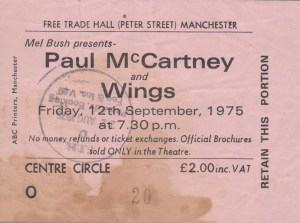
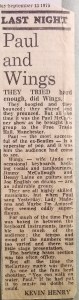
Seeing Paul McCartney and Wings at the Free Trade Hall in Manchester back in 1975 was probably just about the best concert I ever saw. I’d been into the Hall on my lunch break to buy tickets to see Kiki Dee and her band but while I was waiting, a sign went up saying that tickets for McCartney were now on sale so as well as getting tickets to see Kiki Dee, I bought tickets to see Paul as well.

I asked a girl from work to come to the concert with me but she declined. It turned out she was more interested in ballroom dancing than pop music so I dragged my brother along with me. While we were queuing to get into the venue a guy approached my brother and offered him £100 for his ticket. My brother who was and still is a pretty mercenary sort of guy was pretty keen on accepting the deal. I think I even remember him offering to go halves on the deal with me, £50 each. I had the tickets though and I declined. The young lad had told us he was Paul McCartney’s biggest ever fan and I remember thinking, perhaps rather meanly, that he might be McCartney’s big fan but unlike me, he didn’t have tickets to see McCartney in concert.

I hope my brother was glad I turned down the offer because seeing Paul and Wings that night was a fabulous experience. The band had just released Band on The Run and they performed all the hits from that album as well as many other songs. Part way through the evening the band left the stage and Paul sang alone a few of his best Beatle numbers including Yesterday, just him and his guitar and then his bandmates returned and played some more Wings hits. It was a fabulous night.
 

Back in 1975 I already had the Wings album Band on the Run, on vinyl. It was a great hit at the time and featured a cover with Paul and Linda and their other band member Denny Laine posing with various celebs including talk show host Michael Parkinson, comedian Kenny Lynch, actors James Coburn and Christopher Lee, MP Clement Freud and boxer John Conteh. A few years ago I bought a remastered CD version which in the tradition of film directors producing  DVD director’s cut film remixes, was a new version featuring outtakes and highly different versions of some of the songs. My copy has three CDs and there are other versions with even more CDs but to be honest, the original version was actually the best.

A few weeks after the Wings concert I took my friend Steve to see Kiki Dee, also at the Free Trade Hall, a venue that these days has been overshadowed by the MEN Arena. I say MEN Arena although the name of the Arena changes according to which organisation has paid to have its name up there. Originally it was called the Nynex Arena when it opened in 1995 then in 1998 it became the Manchester Evening News Arena. Today, according to the internet it is called the AO Arena, sponsored by God knows who.

Kiki Dee is probably most known for her duet with Elton John on Don’t Go Breaking My Heart, a 1976 hit for her and Elton. Her own musical performances are perhaps less popular and my favourite track of hers is I Got The Music in Me which was a hit in 1974. My copy of the single has ‘play loud’ in large letters on the disc which I used to think was an invitation to blast out the music but actually the single plays at a rather low volume so you have no choice other than to play it loud.

Back in 1976 when I went to see Kiki Dee, we had seats right at the very front and rather disconcertingly, right in front of me was a huge speaker actually about my size and I wondered if Kiki was taking that ‘play loud’ instruction a little too seriously. Just as the concert was about to begin, a guy armed with a huge stack of cameras came over, grimaced at me and returned a few minutes later with some concert staff heavies. It turned out we were in the wrong seats and we were shown to other seats in the section behind, which as much as I loved Kiki Dee, I was actually pretty happy about. Hope that photographer didn’t have hearing issues after the concert.

Another concert I went to was Michael Jackson at Roundhay Park in Leeds. That was back in 1988 when I was a coach driver. Actually, by the power of Google I see it was August 29th, 1988. I was a coach driver for a company called Charterplan. I wasn’t keen on the job but on that trip, I was happy to see that a fellow driver was a guy called Alex that I had known for years. After dropping off our passengers we decided to see if we could blag our way into the concert and eventually the security staff did let us in. The thing I remember most was a long, a very long introduction and Alex turned to me and said when is Michael going to appear? Just at that exact moment, Jackson popped up onto the stage propelled by either a rocket, compressed air or some sort of catapult. Alex wasn’t amused as he had missed Jackson’s spectacular entrance completely.

The other thing about that night was that another driver had estimated there were about 90 coaches in the coach park and there was only one exit so if one coach exited every minute then it would take 90 minutes for us all to get out. I was glad that I had told my passengers to get back to the coach ASAP and they did, all except for one guy. I waited and waited but he didn’t turn up so I pulled into the queue of buses trying to get out. The guy eventually turned up knocking on the door. He wasn’t happy but when he started to complain the entire front section of the coach gave him the slagging off of his life and he wandered shame facedly back to his seat. We were stuck in that queue for ages trying to get out. Alex told me later he had arrived home a full hour before me that night. I wasn’t amused.

That is probably it for my concert memories. I have seen Barbara Dixon at the Lowther Pavilion in Lytham. I’ve also seen Justin Hayward and John Lodge in Manchester when they had just released their BlueJays album. They had three video screens above them and I could never work out which screen to watch or just to watch the stage.

Barbara Dixon came out after her performance and signed CDs and programmes for the audience. On stage she looked like a typical female rocker but when she appeared to sign autographs, she popped on a sort of old lady’s shawl and reading glasses and looked like a little old dear.

Those are my concert memories, what are yours?


What to do next: Here are a few options.

Share this post on your favourite social media!

Hit the Subscribe button. Never miss another post!

Listen to my podcast Click here.

Buy the book! Click here to purchase my new poetry anthology.

Click here to visit Amazon and download Floating in Space to your Kindle or order the paperback version.

Let Me Take You Down: New York 1980

One day in December 1980 I was working as a bus driver and I was driving one of our old half cab buses into Manchester. My conductor, Bob, was kept pretty busy as we took a bus load of passengers into Manchester city centre for their jobs in shops, offices and other places. At one point Bob poked his head through the little window into the cab and told me that he had heard from a passenger that John Lennon had been shot in New York. It was shocking news and when we arrived in Piccadilly, we both ran to the news stand to read the news in the morning papers. There was nothing about Lennon in any newspaper and we wondered if it had been just a mad rumour. Later when we went back to the canteen for our break, we heard the news either on the TV or the radio. Lennon had indeed been shot and was dead.

I can’t claim to be a great fan of John Lennon. I liked him and his music and back then in 1980, I had a copy of one of his albums, Walls and Bridges and a few years later I bought Double Fantasy, his last album and also the last vinyl album I would ever buy but what did happen that day back in December, 1980?

It was a cold day in New York and a man called Mark Chapman took a .38 calibre revolver out of his pocket and calmly fired five shots at John Lennon who had just exited a limo outside his home in the Dakota building, just across from Central Park.

The last vinyl album I ever bought, and the last one that John Lennon made. Double Fantasy. £2.99, what a bargain.

Chapman was born on 10th May, 1955 in a place called Decatur, in Georgia, in the USA. Chapman’s home life was difficult; his father was abusive towards his mother and Chapman apparently lived in fear of him. In his early teens Chapman was involved with drugs and even once ran away from home. In 1971 he became a born again Christian and worked as a summer camp counsellor for the YMCA. He was very popular with the children at the summer camp and even won an award for his outstanding work. Later he worked with Vietnamese refugees at a resettlement camp and once again  impressed his colleagues and superiors.

After his work with the refugees finished, Mark went to college but there he began to feel depressed. He was no longer doing important work with the refugees and thought of himself as a failure. He dropped out of college to work as a security guard and then in 1977 he left home to travel to Hawaii where he intended to commit suicide. His attempt failed but he was able to gain support and help for his depression and even started to work as a volunteer at the hospital that had helped him.

Much has been written about Chapman’s love of Catcher in the Rye, a novel by JD Salinger and how the book somehow turned Chapman against Lennon and indeed inspired him to kill. I read the book many years ago and at the time I thought it rather dull and uninteresting and I remember being surprised that it could inspire anyone to do anything, let alone provoke someone to murder.

The main character, Holden Caulfield has learned he has failed all his classes at school and that he won’t be returning for the next term. He leaves and gets a train to New York where he basically wanders about feeling sorry for himself and moaning about ‘phonies’, presumably people who are false. In the December of 1980, Mark Chapman too was wandering about New York feeling sorry for himself and hating ‘phonies’. For him, the really big phoney was John Lennon.

Lennon was suffocated by the incredible fame of the Beatles, and had decided to relocate to New York in 1971. New Yorkers were not overwhelmed by his celebrity status and he found himself a large apartment in the impressive Dakota Building on the corner of Central Park West and 72nd Street. Lennon lived quietly with his wife Yoko Ono and son Sean and retired from public life during his son’s early years. His comeback album Double Fantasy was released in 1980.

Chapman had a copy of Catcher in The Rye with him when he shot Lennon on the 8th December, 1980. In his copy Chapman had signed ‘from Holden Caulfield to Holden Caulfield. This is my statement’. He had hung around the Dakota building in New York and when Lennon left for the Record Plant recording studio, he had pushed forward his copy of Double Fantasy, Lennon’s latest album, for the singer to sign.

Lennon signs Double Fantasy for his killer

Lennon wrote ‘John Lennon 1980’ on the record and handed it back to Chapman asking ‘Is this all you want?’ Chapman took the album back and Lennon jumped into a limo and was gone. A photographer named Paul Goresh was there and snapped a photo of Lennon signing the album. Chapman was excited about it and asked for a copy before Goresh left. Goresh promised to return the next day with a print.

Later the Lennons returned to the Dakota and Chapman was still there waiting. Yoko entered the building and Lennon was following when Mark Chapman pulled out his 38 revolver and fired five times at the ex-Beatle. Lennon staggered into the Dakota entrance saying ‘I’m shot’. Chapman dropped his gun and began reading the Catcher in the Rye until the police came and arrested him. Another Police car arrived and seeing that Lennon was losing a lot of blood carried him to the police car and took him directly to the Roosevelt Hospital. Staff there tried to revive Lennon but the wounds were too severe and he was pronounced dead at 11:15pm.

On a TV documentary for the ITV series First Tuesday which I found in my old VHS collection, one of Mark’s old girlfriends was interviewed. Judy Williams spoke about the Mark Chapman she knew as warm and gentle. ‘It just wasn’t Mark’ she said ‘He couldn’t have been in his right mind when he did it.’

So why did Chapman shoot John Lennon? Apparently, Chapman had been a fan of the Beatles and John Lennon’s solo music but felt that Lennon had become a fake, a ‘phoney’, someone who preached peace and love to the masses while his music made him a multi-millionaire. Chapman signed out of his security job as ‘John Lennon’ on his last day of work so it is even possible that he identified so much with Lennon that the other Lennon, the fake ‘Lennon’ had to die. Chapman also claimed at other times that he shot Lennon to promote Catcher in the Rye.
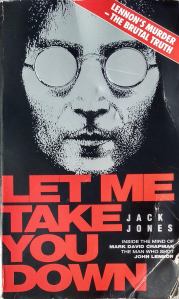
I’ve just finished reading Let Me Take You Down by Jack Jones and in the book the author prints pages and pages about Chapman and his disturbed ideas including the fantasy ‘little people’ who filled his imagination and tried to stop him going through with the killing. He had in fact visited New York on a different occasion to shoot Lennon but returned home without committing murder.

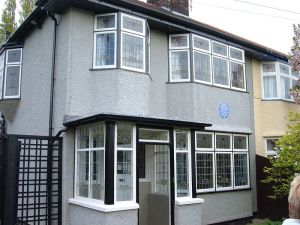
I can imagine Lennon in his room in the Dakota, looking down on New York and reflecting on how far he had come. Did he ever think of his home in Liverpool? I am sure he did. He corresponded regularly with his Aunt Mimi who brought him up at their home, Mendips, in Liverpool.

Years ago, when I used to work in Liverpool, I visited his childhood home. I had always imagined Lennon came from a rough council house background but his former home is in Woolton, a pleasant leafy suburb of Liverpool with semi-detached private houses and some rather nice pubs and shops. Not quite what I had expected.

Mendips, Woolton, Liverpool. Picture courtesy wikipedia

After reading Let Me Take You Down I dug out my old VHS documentary which uses numerous statements by Chapman, recorded secretly by the NYPD in the hours after his arrest. I listened to his various ideas about why he had to shoot John Lennon but I’m not sure we can ever understand the workings of a disturbed mind. ‘The Beatles changed the world’ Mark says at one point, ‘and I changed them.’

I like John Lennon of course and I was interested to read this book to see what really happened to him and to find out why Mark Chapman decided to shoot him. I had always thought that Chapman was just a madman and after reading this book I can see that basically, I was right. Chapman was mad. I suppose it was foolish of me to think that there was a definitive reason behind the shooting, some tangible reason, something that perhaps if Lennon or his people had been aware of, they could have taken some action to prevent the murder. At the end of the day, I don’t think there was or even that the actions of a disturbed person can be explained in simple terms. Chapman got it into his head that he had to kill John Lennon and he did.

Mark Chapman is still alive today. He is still serving his life sentence in Wende Correctional Facility in New York and first became eligible for parole in 2000. All Chapman’s applications for parole have so far been denied.

Today in 2021, Lennon’s widow, Yoko Ono, still lives in the Dakota building.

Sources:

The Man Who Shot John Lennon. First Tuesday UK TV documentary written and produced by Kevin Sim.

Let Me take You Down by Jack Jones.


What to do next: Here are a few options.

Share this post on your favourite social media!

Hit the Subscribe button. Never miss another post!

Listen to my podcast Click here.

Buy the book! Click here to purchase my new poetry anthology.

Click here to visit Amazon and download Floating in Space to your Kindle or order the paperback version.


A Brief History of the Disco Era (with a little help from Google)

I do love my music. At home when there is nothing much on the TV I like to flip through the recommendations that come my way on Spotify. In my car I listen to CDs. I have always told myself that my precious CDs were too good to be dragged about in my car so I lovingly copied them to writeable CD discs, carefully, in most cases editing out the tracks I didn’t like. I’d be my own invisible DJ making up new CD albums with a track from here, another from there and so on. Lately, I haven’t done that so much and seeing that I don’t play my CDs much at home, I decided not to copy them just to bring the original CDs themselves into my car.
The other day after a particularly bad day at work, a day that was busy, where things didn’t go so well and I was just wanting to forget about things and release all the stress that had built up, I searched for something new, some music that I hadn’t played for a while that would relax me. I chose a CD that was a 1970’s disco collection.

I cranked my motor up, turned up the volume and as I turned onto the M6 motorway heading for home, my mind went back to a better time, a younger, easy going more relaxed time. I went back to the disco era.

So when did the disco era start and what was the first disco record?

Looking on Google to answer that question gives up various results by numerous authors and music writers but the answers are invariably just the opinions of those same writers. One answer was Rock the Boat by the Hues Corporation, another was She’s a Winner by the Intruders. (Never heard of it.) It might even have been that disco classic, Never can Say Goodbye by Gloria Gaynor. When it comes down to it, there is no definitive answer.

A lot of disco music comes from the soul tracks of the early seventies by groups like the O’Jays, Harold Melvin and the Bluenotes and the Trammps. Later, traditional pop bands tried to emulate those soul groups and the resulting soul/pop sound that became disco began emerging in the early 1970s in US urban night clubs and discotheques.

Here’s another random disco fact: the word discotheque is a French word meaning a library of discs. Discotheque was used in France to describe a nightclub where playing records had replaced a live band in the 1940s during the Nazi occupation. Modern Discotheques are where disco music began and something else that I noticed on Google were comments about the disco clubs of the seventies, the most famous one must have been the Studio 54 club in New York.  Another google result mentioned that Seventies Disco was born on Valentine’s Day 1970, when David Manusco opened The Loft in New York City.

Anyway, that’s enough of Google for a while so here are some personal memories.

The record I probably most associate with disco is The Hustle, by a group called Van McCoy. I have a feeling they were just one hit wonders but I might be wrong. The Hustle seemed to me to be the perfect disco record at the time. Great tune, a great dance beat and just really well put together. Looking back at the track today in 2021, it’s still good but it’s not the work of musical genius I once thought it was.

Back in the mid seventies I used to occasionally visit the discos of Manchester, places like Pips, Saturdays, Rotters, Fagins and a dozen other clubs I can hardly remember. There was a club called Sands in Stretford which was always packed to the seams but the disco I remember the most was one I wrote about in Floating in Space, it was called Genevieve’s.

Genevieve’s was in Longsight, which was a pretty rough area of Manchester and one of the hazards of the place was that if you went there in your car, you never found it in quite the same shape as how you left it, if you found it at all.

I remember one long ago Saturday night. My friends and I had to queue up for about ten minutes to get inside but we took that as a good sign. After all, a queue meant the club was busy. A group of grizzly bouncers scrutinised us and under their intense gaze we paid the entrance fee then went on inside. We were met by the warm fireside glow of soft lighting and the loud, pulsating beat of disco music. Coloured spot lights flashed over the four dance floors, in the hub of which sat the DJ, turning slowly around in a revolving booth.

There were five bars. Two small corner bars, two long bars, and a circular bar at the far end of the club. It really was a well set out place. We headed for one of the corner bars and my mate asked “bitter Steve?” I nodded and he called out to the barmaid.

A small army of bouncers was wandering around the club and as we waited for our drinks an argument broke out at one of the slot machines. Without any questions two burly bouncers grabbed the offender and propelled him expertly to the door. Another hooligan tried to come to the rescue by jumping on the back of one of the bouncers but a third bow-tied, black suited gorilla punched him solidly in the side, twisted his arm up his back and quickly removed him also. It was the sort of place where they didn’t stand any messing and the beer tasted like 3 parts water to one part beer and your feet stuck to the floor as you walked around. No one to my knowledge ever decided to complain to the management.

Genevieve’s attracted all sorts of people. There were smartly dressed, obviously wealthy people, peeling off rolls of bills to pay for whiskies and gins and other spirits. There were many attractive, well dressed girls. The younger girls drank halves of lager, sat in groups, and danced in groups to the Motown music of the sixties. They would drop their handbags onto the floor as they converged together for the formation dance routines for ‘Jimmy Mack’ and ‘Third Finger Left Hand’.

There were groups of lads too, who held cigarette packets and lighters in their hands, or placed them down in front of them on the tables while they drank, talked and eyed up the girls.

I spent a lot of my young life in that club. Despite the watered down drinks and the frequent fights, my friends and I had a lot of fun there until one day it either closed down or we found a better place to go.

The track that really reminds me of that club was Bus Stop by the Fatback Band. It had a strong disco beat and lyrics that just seemed to consist of ‘Bus stop!’ ‘Do the Bus stop!’ ‘Are you ready? Do the Bus Stop!’

In 1977 John Travolta appeared in the ultimate disco film ‘Night Fever’ and Travolta danced away to the music of the Bee Gees and tracks like ‘Stayin’ Alive’ and the title track ‘Night Fever’. I don’t ever remember there being dancers like that in any club I ever visited but what the heck, it was still a good film.

It wasn’t enough to buy the records and dance to disco records in clubs, you had to look the part too. I had a stack of shirts with ‘penny round’ collars and matching fat ties and quite a few pairs of flared trousers. Oh, and don’t forget the 1970’s platform shoes. I must have looked about seven foot tall back in those days.

Disco came to an abrupt end in 1979 in the USA where there seemed to be an outcry against the genre. Many music fans apparently felt that the music industry had been taken over by disco and many artists who had begun to produce disco music themselves, people such as Rod Stewart, were accused of selling out. In the UK and most of Europe, disco music morphed seamlessly into new electronic music. Artists like Michael Jackson took dance music to a new level and his album Thriller which spawned a number of hit singles became one of the best selling albums of the 1980’s.

What was the last ever disco single? The easy answer is that there wasn’t one. Dance music continued into the eighties and from there to the present day. Groups like Shalamar and Colonel Abrams just carried on producing dance tracks but if I had to put my finger on any one track as being the last of the disco era, I’d vote for I’m Coming Out by Diana Ross, released in 1980 when flared trousers were making way for drainpipes and when ties and shirt collars were thinning down.

What was your favourite disco track?


What to do next: Here are a few options.

Share this post on your favourite social media!

Hit the Subscribe button. Never miss another post!

Listen to my podcast Click here.

Buy the book! Click here to purchase my new poetry anthology.

Click here to visit Amazon and download Floating in Space to your Kindle or order the paperback version.


A Kind of 70’s Music sort of Blog Post

I hope you had a good Christmas and New Year and didn’t eat too much turkey or drink too much of your favourite tipple. As usual I like to think I drank just the right amount (well, maybe slightly over) but as usual ate far too much. Anyway, one of my favourite evenings over Christmas was when Liz’s sister came over to visit from France with her French boyfriend and we settled down for a good natter, some wine and some good English Christmas food. On the menu this year was gammon with all the trimmings, roast potatoes, sprouts, carrots, little sausages wrapped in bacon and gravy and as usual we had some top music going on in the background.

Now I’m not a great present buyer at Chistmas, in fact I always despair at ever getting something for the lovely Liz that she might actually like. Despite some major failures in the past this year I did pretty well with at least one of my presents. I bought her a great CD; 100 Forgotten Hits of the 1970’s.

So I hope you can imagine the scene; the wine has been gently warmed by the roaring open fire. The Christmas tree lights are twinkling, our roast dinner is served and rather than sit in the dining room we are all cosy in the lounge by the roaring fire while the CD player tinkles away in the background.

The album kicks off with Fanfare for the Common Man by Emerson, Lake and Palmer, a great track and one I could have added to a music post from a few weeks back: 19 Outstanding Instrumental tracks. Next up was was Gudbuy T’Jane by Slade. Slade made the perennial Christmas hit Merry Christmas Everybody and Gudbuy T’Jane is an earlier hit from 1972. That particular track reminds me of years ago when my brother and I were children. My Mum had taken us into town and treated us for our birthdays. I was bought an LP by Gary Glitter (don’t say anything -it was the seventies then!) and he chose a cassette album by Slade which featured Gudbuy T’Jane, I think it was called Sladest. As time went on I began to prefer Sladest to my Gary Glitter LP. Money changed hands or items were swapped but eventually Sladest became mine. Cassette tapes of course do not last forever, the tape snaps or tape get snarled up in the cassette player and Sladest is long gone. That Gary Glitter LP is still in the loft though at my Mum’s house.

As we ate and chatted the 70’s tracks came and went. Sad Sweet Dreamer confused us for a while, we thought it was Michael Jackson but no, it was that forgotten 70’s band Sweet Sensation.

A superb track was Get Down by Gilbert O’Sullivan. O’Sullivan once had a successful career and produced some great hits, however in the mid seventies he felt that his record contract was not paying him enough despite the huge hits he had delivered. He sued MAM records and eventually won 7 million pounds from them before returning to the CBS record label in 1980. He issued one single, What’s in a Kiss, and a compilation album but then litigation kept him away from the charts until another compilation album The Berry Vest of Gilbert O’Sullivan in 2004.  In 2018, O’Sullivan released his 19th studio album Gilbert O’Sullivan. The album entered the UK album charts at No. 20, his first UK charting studio album for over 40 years.

The next track that comes to mind is There’s A Whole Lot Of Loving by Guys ‘n’ Dolls. Not an outstanding track or even one that I had bought back in my vinyl single buying days but one that took me back to the 1970’s, back to evenings at home watching Top of the Pops on TV. Music by John Miles was a particular favourite of Liz’s but I preferred Hang on In there Baby by Johnny Bristol.

Another Track was Run For Home, a song I’d not heard for years. We all racked our brains trying to remember who the band was but in the end we had to look it up. It was Lindisfarne.

Time for the usual debate with French people. Do we have dessert before the cheese or the cheese before the dessert? Well the French way is the cheese first then dessert, that way you are staying with savoury before changing to sweet. Sounded good to me.

While we were nibbling on the cheese -not before refilling the wine glasses of course- a number of tracks came up for debate. Who sang I wanna Stay with you? (Gallagher and Lyle) Who sang Girls? (The Moments and Whatnaughts) Rock me Gently? (Andy Kim). What about You’re Moving out Today? (Carole Bayer Sager).

While I was writing this post I saw an interesting article on the BBC News. They were talking about the rise in streaming music tracks. Apparently over a 100 billion music tracks were streamed in 2019 and that was 7.5% up on 2018. Vinyl is still making something of a comeback with 43 million vinyl LP’s sold in the UK in 2019. They also said that tape cassettes were making a comeback with 80,000 sold in the UK in 2019. I have to say that does surprise me.

When I was much younger tape cassettes were something I loved playing with. I’d put together albums of music and even TV recordings and play them in my car. If I ever got fed up with them I’d record another and if the tape broke then once again I’d record another and if there was something on the radio I liked, I’d record it and play it on the way to work in my car.

Even today my car is the centre of my personal music. My car is filled with CDs both ‘proper’ music CDs and ones put together on my computer. I have to say though, making a cassette was so much easier.

The cheese went down well. I was hoping for some nice french imports courtesy of our guests but it was not to be although last year, Bernie and Angela managed to smuggle my favourite cheese, Rondele Bléu over on the flight from France. On the menu this year was a tasty  cheddar, a soft blue and some brie. In our wine glasses was a nice French Merlot courtesy of French supermarket Super U which went down rather well I thought.

I’m just wondering what music to finish on. Teenage Rampage by the Sweet? Nah! Storm in a Teacup by The Fortunes? Nah! Rock on by David Essex. Funnily enough I used to love that one back in the seventies. Sounds a bit whiney these days. Come What May by Eurovision winner Vicky Leandros went down well with the ladies but no, I’m going to go with this one by Helen Reddy. I love the quirky story of the secret lover who keeps her satisfied . . .


Floating in Space is a novel by Steve Higgins set in Manchester, 1977 and available from Amazon. Click the links at the top of the page to buy or for more information.