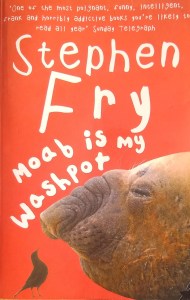
Last week I finished reading the four books I had brought with me to read here in Lanzarote and so I scoured the bookshelf in our rented villa for something else to read. I came across Moab is my Washpot by Stephen Fry. It’s an autobiography of his life up till the age of 20 but it’s not in any way a conventional autobiography. It’s a sort of full throttle, stream of consciousness monologue which Fry kicks off in his second year of public school and proceeds to tell us a great deal about his thoughts and feelings, making numerous right and left turns along the way to discuss various issues and subjects that he decides to talk about. It’s very like a sort of confessional and I wouldn’t be surprised to find that it was taken down verbatim (or perhaps tape recorded) during a session with his psychiatrist.
 Fry reveals his thoughts about homosexuality and his feelings, either obsession or lust over a boy at his school. Fry went to a public school which confusingly for our American readers is actually a private school. Actually, a private boarding school which eventually Fry was expelled from.
I’ve no idea where the title comes from although Stephen does mention various exotic authors, none of whom I’ve ever heard of so perhaps the title comes from a quotation from some esoteric book that only university bookworms are familiar with. Sprinkled throughout the book though are numerous authors I have heard of as well as many references to popular films and TV shows, all of which made the book, in my mind anyway, very relatable.
A good one comes later in the book when he is arrested for theft and declines to give his name. One of the cops calls him Stephen and he replies ‘yes’ so the cops say ahh, you’re Stephen Fry then. He compares it to a scene in The Great Escape in which Gordon Jackson as an escaped POW pretends to be a French worker and gets caught out when a gestapo man says ‘good luck’ to him in English. Jackson replies -in English- ‘thank you’ and reveals himself instantly to be an escaper. That was one of my late brother’s favourite parts of the film and one he always used to quote to me.
Anyway, Fry’s book was a real no holes barred, full throttle read.
Over the years I’ve written quite a few of these sun lounger thoughts posts which are basically the kind of thoughts that have arisen in my mind while lying on a sun lounger.
Today I found myself, after a swim and relaxing on my lounger in the sun, thinking about my old job at the Highways Agency.
 When I was a child I used to have, just like Stephen Fry, lots of daydreams and fantasies. One of them was that the school would be taken over by terrorists and that they would be methodically trying to find someone who was actually a secret agent. That secret agent of course would be me and after biding my time I would, just like Bruce Willis in the Die Hard films, sort out the terrorists one by one. My daydream would usually be shattered by one of the teachers asking me a question like ‘how many degrees in a right-angled triangle?’ and I would suddenly be brought down to earth and desperately try to answer before revealing the inevitable truth that I had not been paying attention.
When I worked at the Highways Agency, no two days would ever be the same. One day would bumble along and nothing much would happen and the next there would be crash after crash after crash.
Bad weather always plays a part in motorway crashes, the main reason being that your average driver whose journey from home to work normally takes 35 minutes, expects that same journey to take 35 minutes no matter what. Come the day when the network is covered by 3 inches of snow or a major downpour with various lanes closed due to flooding then that journey will not take 35 minutes and the average driver really cannot understand why.
If there is a major downpour many drivers tend to sensibly slow down. This slows the traffic movement down as a whole making journeys longer. Mr Average gets impatient, decides to speed up to 80 mph and either realises too late he is going to miss his junction, cuts in to his left and hits another car causing a crash on the inside lane (RTC in our Highways lingo) or possibly hits a puddle in the outside lane spins and causes a crash (Road Traffic Collision to use the full title) in lane 3.
On those summer days with perfect visibility things usually go reasonably well and that’s the time when the terrorist daydream would raise its ugly head. A team of terrorists take over the RCC (Regional Control Centre) and interrogate and torture people in order to find that ex secret agent (this is a subtle twist on the earlier daydream) who has retired from MI5 and joined the Highways Agency.
If I happened to be the radio dispatcher that day my assistant would usually nudge me and say Steve-debris incident or RTC.
The thing is, that daydream could easily have been avoided. Back in the early days when the RCC was brand spanking new, many dignitaries, councillors, police officers, firemen and other emergency services staff would be invited upstairs to a viewing area to look down on what was happening. Invariably this always happened on days when the network was calm and nothing out of the ordinary was going on, save for the odd breakdown here and there. The dignitaries used to look down and senior management would be horrified to find the dispatcher and his assistant playing solitaire on the screens.

Me at work in the Highways Control Room
Now this might have seemed a bad thing but back then we could float a solitaire game right on our command-and-control screens so if a job popped up, we would see it straight away because we were already looking at the correct screen. Anyway, management decided to delete solitaire from the system so then when things were quiet, we would either stare at the ceiling, talk to each other or, well that’s where the daydream came in.
The wall of the Highways control room (RCC) has various screens where we can highlight CCTV images of the incidents we are dealing with. In the centre is the TV screen usually set to Sky or BBC News. This being an operational control room the TV has no sound and it was sometimes quite amusing to watch the subtitles appear with the wrong word or sentence. Some of the best I’ve seen include MP Ed Miliband described as the Ed Miller Band and the BBC welcoming viewers to the ‘Chinese New Year of the whores!’
Later in life the RCC became the ROC (pronounced rock) actually the Regional Operations Centre. I’m not sure why that name change took place unless some nameless senior manager had found that his solitaire app had been deleted and unable to play a card game decided that it might be a good idea to rename the control room. As it happened, the Highways Agency was renamed Highways England and later National Highways meaning a great deal of taxpayer’s money had to be spent on new signage: on our premises, on letterheads and repainting our vehicles as well as rehashing all our uniforms.
Yep, they really shouldn’t have deleted that solitaire app!
 Rooting around in a secondhand shop in St Annes recently I picked up a hardback copy of Winston Churchill’s book My Early Life. It’s a thoroughly wonderful book written in Churchill’s inimitable style. He says in the introduction he has written a book about a vanished age and indeed he has. Churchill was born in 1974 at Blenheim Palace in Oxfordshire. He was the son of Lord Randolph Churchill who was in turn the son of the 7th Duke of Marlborough. His mother was an American, Jennie Jerome, the daughter of an American businessman. She married Lord Randolph and became Lady Churchill.
 Looking back, I must have seen the film version before I read the book. Young Winston was directed by Richard Attenborough and is a wonderful adaptation of the book. When Winston first attends school, which of course was boarding school, his headmaster was played by Robert Hardy and he directs Winston to learn some Latin. Winston doesn’t do very well and the headmaster glares down at him and informs him that if he misbehaves, he will be punished, which to a great extent was Churchill’s overall view of school. Later he comments about exams ‘they always contrived to question me about things I didn’t know. I would much rather they asked me about things I did know.
 The charge was depicted in the film Young Winston and in his book Churchill ponders about fate and a problem with his shoulder which necessitated using his revolver rather than his sword during the charge, reflecting that if he had been using his sword he might well have been killed in the latter stages when he was surrounded by the enemy.
 One of things I particularly liked about Young Winston was the music. I bought the soundtrack album in 1985. The music for the film was in the main composed by Sir Alfred Ralston. He was brought into the film by director Attenborough as the two had worked together on a previous film, ‘Oh what a Lovely War’. The soundtrack features music by Edward Elgar, notably the Pomp and Circumstance March no 4 as well as Nimrod from the Enigma Variations.
 Churchill ended up in a POW camp but resolved to escape despite also claiming to the Boers that he was a correspondent and should not have been detained. With the help of a group of Lancashire miners, Winston stowed away on a goods train and made his way back to the British lines.
 John’s book was a great read. He started out working with Alan Bennett as a comedy writer and performer but when he realised that he probably had no future as a tv comedian he got himself a job as a newspaper reporter in Liverpool and later moved over to the BBC as a radio reporter.
 My Autobiography by Charles Chaplin.
 I really do love books, especially second hand books. I think that what is so wonderful about a second hand book is that the book has told its story before to someone else, and now if you have just bought it, its going to tell it’s story to you. I spend a lot of time browsing in book shops, both physically in actual shops or on-line in virtual book stores. The thing about on-line book stores is that you have to have a starting point, it’s no fun browsing through lists of books so I tend to browse on-line only when there is a particular book I want. In an actual book store I scan through the various sections and although I tend to linger on biographies and books about film, anything can catch my eye. A while ago I was reading a book by movie director Michael Powell called ‘A Life in Movies.’ It was a pretty thick book and took a fair old while to read and when I got the end there didn’t seem to be any indication there was another volume.
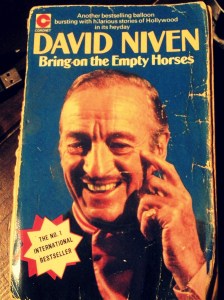 You might be thinking, looking at the picture here: Couldn’t the author have found a better picture? Looking at the picture again I suppose that particular copy is just a little tatty. That’s because it’s my travel copy. I’ve got another copy, a much nicer version that resides in my bookcase that I browse through now and again. The reason I’ve got two versions is because my travel copy goes all over the place with me. If I’m travelling somewhere on the bus or train, that slightly tatty copy goes easily into my pocket or my bag because I can read it time and time again. Not only is it the best ever book written about the golden age of Hollywood, it’s also by far the most accessible and readable book on the subject ever.
 Letters from an Unknown Author!