Three Reads from My Holiday Book Bag

It’s always good to slip out of the pool, dry yourself off and then relax in the sun with a really good book. Here are three of my latest holiday reads. (try the video version by clicking here!)

The Thief, His Wife And The Canoe

I first heard about this story on the TV news many years ago. I’d mostly forgotten about it until recently when there was an ITV drama based on the story. This was the book version and even though the story is fascinating, the book, written by a newspaper journalist wasn’t that gripping.

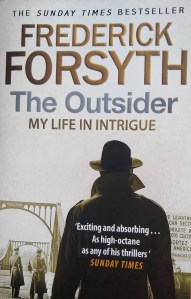
Essentially, John Darwin was facing bankruptcy after getting hugely overreached on a series of buy to let mortgages. He decided that the only way out was to fake his own death and cash in on some life insurance policies. His wife apparently tried to talk him out of the idea but John, a dominating and overpowering personality, went ahead and faked his own death. Amazingly he even went back to live with his wife, sometimes having to retreat to the bedsits next door when any friends or family came to visit. He arranged a false passport using a method explained in the book ‘Day of the Jackal’ by Frederick Forsyth and then the two, Darwin and his wife, planned to buy property in Panama and live a new life. Later, Darwin decided he wanted to return to the UK under his own name by posing as someone who had suffered with amnesia and in fact one day he disposed of his fake passport, walked into a police station and told them ‘I’ve lost my memory!’

Journalist David Leigh tracked down Darwin’s wife in Panama and managed to extract the entire story from her before she returned to the UK to face imprisonment along with John.

The result is interesting but not really a great read as perhaps the author is more used to newspaper stories rather than an entire book. Either way, it kept me interested for quite a few days.

Death of a President

I’ve read this book before many years ago but even so I thought I’d throw it in the motorhome and give it another read. The President’s widow, Mrs Jackie Kennedy asked the author, William Manchester to write the book so there would be one authorised record of what happened in Dallas when President Kennedy was assassinated. The result is a record, in fact a micro record of what happened to Kennedy and those around him, beginning a few days before the assassination and ending with his funeral and the shooting of his assassin by another assassin.

For me, who has been interested in the JFK assassination since at least 1968 when his brother, Robert Kennedy was also murdered and I was 12 years old, it’s a fascinating record. Others might think perhaps that the author has spread his research too far, that we are not interested in what the President’s pilot thought or did or how the honour guard prepared for the President’s funeral and how the President’s sister or brother-in-law reacted.

Anyway as a passionate JFK researcher, a couple of things stood out. One was a time chart that showed that JFK was shot at 12:30 and that at 12:31 and a half, motorcycle cop Marion Baker intercepted Lee Oswald, the supposed assassin, on the second floor lunchroom of the Texas School Book Depository calmly drinking a coke. That meant that Lee had, in 90 seconds, hidden his Mannlicher Carcano rifle on the 6th floor and got himself down to the second floor to meet Baker. Did he shoot the President or was he in the lunchroom all the time?

Here’s another thing. In one of my favourite JFK assassination books, Best Evidence, author David Lifton reckons that sometime between leaving Dallas and arriving at Andrews Airforce base in Washington, JFK’s body was somehow removed from his coffin and transferred to a body bag and then helicoptered to Bethesda naval base where work was done on the body prior to it being seen by the official autopsy staff. In Death of a President, William Manchester says that Mrs Kennedy spent all her time sitting near to the casket on Airforce One with many of JFK’s team of assistants and secret service personnel. So how was Kennedy’s body removed without anyone knowing?

OK, I’ve gone off into the realm of JFK assassination folklore there but to get back to normality, this was a very well researched book and gives a massively detailed look at the events surrounding a tragic day. If anything, the detail is perhaps a little too much and I could sort of imagine it as a feature film using that split screen effect that you often saw in the 1970s; Kennedy getting into the limo side by side with a shot of the assassin getting ready and so on.

Verdict; an absorbing read, very detailed.

Blue Angel: The Life of Marlene Dietrich by Donald Spoto

This was a very compelling read, a biography of Marlene Deitrich who to be fair, I didn’t know much about until this book.

Marlene was one of those people perhaps born at the wrong time. Today might be a better time for her when lifestyles of gay and lesbian people are not so much of an issue.
Marlene rose to prominence in the film world of Germany between the world wars. She was married to assistant director Rudolf Sieber and together they had a child, Maria. The couple had what we might call an open marriage and Marlene had various partners, both male and female and her husband too found himself another love. A big hit for Marlene was her performance as Lola Lola in The Blue Lamp, directed by Josef Von Sternberg in 1930. Shortly afterwards Marlene and Von Sternberg moved to Hollywood and the two made a series of films for Paramount. While she was away from Germany the Nazis rose to power. Goebbels himself asked her to come back and work in German films but when she declined, the Nazi party rejected her. Marlene became a naturalised American and even entertained the troops -the allied troops during World War II.

She had affairs with both men and women and at one point even began to wear male oriented clothes and once she was denied entry into a Paris night club for wearing trousers.

She was extremely concerned with how she looked in films and always arranged with the lighting crew for a key light to illuminate her face in a particular way, many times even bypassing the director. Alfred Hitchcock for one was not amused.

When the film work fizzled out she reinvented herself as a performer with a one woman show in Las Vegas. The clothes and lighting she organised herself, in fact at home she even had a special key light, just as she specified for her films, that she would stand under when she met journalists and even her friends.

She was always there to help her friends and still stayed close to her husband and his partner. If friends were sick or even just down, Marlene would come round and clean up and make food. She was not only a famous and beautiful star but also a proud hausfrau.

The book opens with her appearing in a short sequence in her very last film, which incidentally starred pop star David Bowie. She performed for the camera perfectly, only one take was required, then she returned to her Paris apartment and except for hospital and doctors’ appointments, she never left again until her death in 1992.

Not the best film book I’ve ever read but still an informative and intriguing read.


What to do next: Here are a few options.

Share this post on your favourite social media!

Hit the Subscribe button. Never miss another post!

Listen to my podcast Click here.

Buy the book! Click here to purchase my new poetry collection.

Click here to visit Amazon and download Floating in Space to your Kindle or order the paperback version.

Click here to visit amazon and purchase Timeline, my new anthology.

Book Bag: John Grisham

In my last few posts about books, rather than publish my usual Book Bag posts, I’ve incorporated book reviews into other types of posts; holiday memories and posts about books made into films and so on. During my last few holidays, I always seem to either have a couple of John Grisham books with me or found some in the places, usually rented villas, where we have stayed. I thought it might be an idea to write a John Grisham themed book bag post. Who actually is John Grisham then?

Let’s go over to Wikipedia and see what they have to say:

Born February 8, 1955 John Grisham is an American novelist, lawyer, and former member of the Mississippi House of Representatives, known for his best-selling legal thrillers. According to the American Academy of Achievement, Grisham has written 37 consecutive number-one fiction bestsellers, and his books have sold 300 million copies worldwide. Along with Tom Clancy and J. K. Rowling, Grisham is one of only three anglophone authors to have sold two million copies on the first printing.

Pretty impressive credentials, aren’t they? Most of the inside back covers of my copies of his books say pretty much the same thing and in the back of the last Grisham book I read, The Racketeer, there are extracts from an interview with Grisham in which he mentions his favourite book is A Time to Kill, his first book and apparently the most personal of his legal thrillers.

Let’s take a closer look at some of the books that I have read.

A Time to Kill by John Grisham

As I said earlier, this book turns out to be Grisham’s first novel and he says in the introduction how proud he was of finishing it, as back then he hardly ever finished anything. It also contains some autobiographical elements; Grisham used to be a street lawyer, similar to the character in the book.

The book is set in America’s deep south where there is or was a great deal of racial prejudice. Two white guys decide to kidnap a young black girl, tie her to a tree and repeatedly rape her. They drive her away and dump her like garbage but she survives and the police arrest the two scumbags responsible. Next, the young girl’s father Carl Lee Hailey decides to take a rifle and shoot the two guys. He is arrested and put on trial for murder and street lawyer Jake Brigance takes on the case.

The case ignites the small town of Clanton Mississippi. The Klu Klux Klan become involved as do various other groups and the stage is set for a tense murder trial which goes on while the police and the National Guard try to keep order.

It’s a very exciting read although the ending was a little underwhelming and if you find the N word offensive then this is a book which is not for you as that particular word appears numerous times on almost every page.

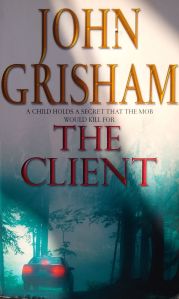
The Client

This book was a great holiday read. It’s about an eleven year old boy who witnesses a suicide but before the man kills himself (he is a lawyer defending a known murderer) he tells the boys, Mark and his little brother Ricky, where his client has hidden the  dead body of a murdered US senator. The senator was the victim of a mob ‘hit’ and Mark won’t tell the police or the FBI about the body as he is concerned for the safety of his mother and brother. When he and his mother are in hospital staying with his brother Ricky, as he has gone into shock, Mark contacts a lawyer and a big legal stand off begins with the FBI. Things eventually get settled but I can’t help wondering why the boy wouldn’t trust the FBI or even why he wouldn’t tell them about the body in the first place. Of course, if he had then there wouldn’t be a story. Either way this was a great holiday read and the narrative kept me interested all the way to the end. I didn’t realise it was also made into a film starring Tommy Lee Jones and Susan Sarandon which I must remember to look out for.

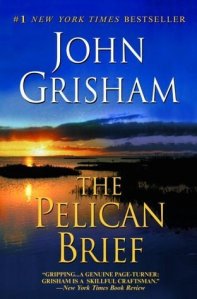
The Pelican Brief by John Grisham

This book might be the best book by Grisham I have read so far. The book opens with the murder of two US Supreme Court judges and this in a way plays into the hands of the President as he can now nominate new judges who share his political views. At the same time, law student Darby Shaw is having an affair with her law professor. She decides to look closely at the murders and develops a thesis, an idea about who may have done the murders and why. The thesis becomes known as the Pelican Brief and she passes it to the professor who in turn sends it to his friend, an FBI lawyer. It then gets passed up the chain to the head of the FBI and on to the White House where the President instructs the FBI not to investigate further.

Not long afterwards the professor is blown up in a car bomb which Darby narrowly avoids and from then on, she is on the run trying to evade death herself.

This for me was one of those unputdownable novels which was exciting and kept me interested all the way to the end.

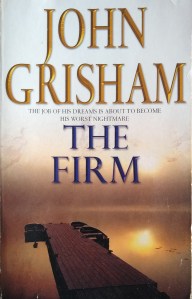
The Firm by John Grisham

There is a process by which I choose books to take with me on holiday. I like to think it’s a thoughtful process combining different genres of books, some novels, maybe the odd classic, and some biographies and autobiographies. What actually happens is that the day before our trip I’ll just grab something near to hand that I know I haven’t read yet and shove it in my suitcase. Anyway, that’s how I ended up with The Firm. Last year I read The Rainmaker by John Grisham and I thought it was a pretty good read. I must have mentioned that to Liz so she filed that away and got me a stack of Grisham novels for my last birthday. The Firm isn’t a bad read and in my case it was a nice change of pace after reading some non-fiction books.

It’s a good story but like a lot of Grisham’s works, it’s more plot driven than character driven. The characters are sort of bland templates that I’ve recognised in a lot of his novels. Anyway, characters aside, this is a really original story about a young guy who graduates from law school and gets head hunted into a firm he has never heard of but which offers tremendous financial benefits, a brand new BMW, and an ultra cheap mortgage as well as other financial bonuses. The downside, as he comes to learn later, is that the firm is just a cover operation to launder money for a big mafia crime family and the FBI wants our hero James McDeere, to help them.

Verdict: Highly enjoyable and a great holiday read but nothing more, although that didn’t stop the book from becoming a best seller as well as a hit film in the 1990’s.

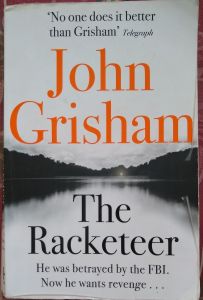
The Racketeer

This is another legal thriller about a man convicted of money laundering, which he denies by the way, sentenced to ten years in a federal institution. Naturally he is not happy but he hoped to get out by using rule 35 of the Federal Rules for Criminal Procedure which means that if the inmate can solve a crime which the federal authorities are unable to solve, then his sentence can be reduced.

The man, Malcolm Bannister, helps other inmates of the prison with their legal issues and in doing so has come across some information about the murder of a judge, in which the Police and the FBI have no clues about the culprit. He plans to barter this information for his freedom but it turns out that Bannister is actually double bluffing the FBI and has a scheme in mind in which he can gain his freedom and walk away with a considerable amount of money as well as a new identity.

Like most of Grisham’s books, this was an excellent holiday read but towards the end it almost feels as though the writer has become a little fed up with this increasingly complicated story and is rushing to get it finished. This was mostly a good read but the end was a little disappointing.

The Boys From Biloxi

This is a very oddball book indeed. It’s not a courtroom drama although courtroom battles do feature in the book. It’s actually a very long-winded story of two families, one on the wrong side of the law and one on the other. One family is part of a rough and ready area of town and owns saloons that have illegal gambling and prostitution on tap and the other family who hope to clean the town up.

A lot of the story is just reeled off like a sort of narration you might listen to in a museum (which is how one review I read described the text). The author just seems to recount a lot of the story in this same long distance way. Eventually the story becomes more fleshed out and detailed when a tornado hits the town and a lawyer with ambitions to become the district attorney helps the residents fight for compensation from insurance companies that do not want to pay out. His success with compensation claims help him to become the DA but he is murdered before he can bring the criminal family to justice. His son however goes on to clean up the town.

Again this was another great holiday read but if I had been reading it at home for twenty minutes or so before going to sleep at night, I reckon that after a few nights I would have perhaps picked up something else to read.


What to do next: Here are a few options.

Share this post on your favourite social media!

Hit the Subscribe button. Never miss another post!

Listen to my podcast Click here.

Buy the book! Click here to purchase my new poetry collection.

Click here to visit Amazon and download Floating in Space to your Kindle or order the paperback version.

Click here to visit amazon and purchase Timeline, my new anthology.

Holiday Book Bag 2024 Part 3

Parts one and two of my Book Bag were books I had taken to Lanzarote earlier in the year. This time Liz and I are tootling through France in our small motorhome. The weather has not been kind to us and rather than reading in the usual lovely sun, I’ve been reading indoors away from the rain. This year quite a few of my books are ones I have read before but I thought were due for a re-read. Anyway, here we go . . .

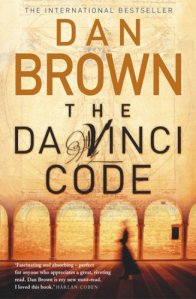
Toujours Provence by Peter Mayle

I wrote about this book a few weeks ago and you might be thinking ‘bet he’s included it here to pad out his post a bit’. Moi? As if I’d do such a thing. It’s the follow up to A Year in Provence, one of my favourite books about France by Peter Mayle. It’s a pleasant enough read but not a patch on the original.

Random Harvest by James Hilton

Wait a minute. Didn’t this guy write about this book a few weeks ago as well? Actually I did but as it was part of my book bag I thought I’d include it here anyway. A nice read, slightly different to the film starring Ronald Colman and Greer Garson. It was written before World War II and reflects the feelings of the time that perhaps more could have been done to either prevent the war or at least prepare more. A great read but I actually think I preferred the film to the book. Click here to read the full film and book review.

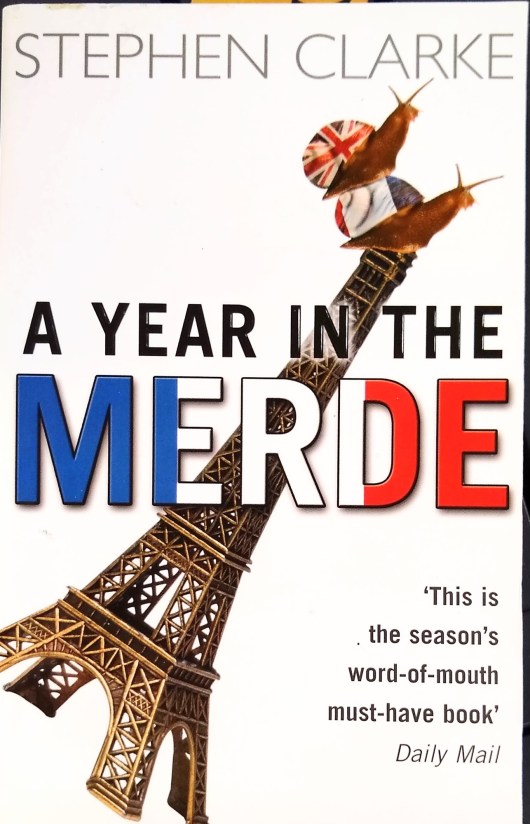
A Year in the Merde by Stephen Clarke

I read this book a few years ago and thought I’d throw it in my book bag for another read. As I remember, the first time round I absolutely loved this book. I saw it on a stall at a market once and mentioned to the seller what a great read it was. ‘Nah.’ replied the man. ‘It’s full of stereotypes!’ I wouldn’t say that at all. It’s a look at the life of a young man working in France as he tries to understand the French way of life and of course the language. The main character is engaged on a project to open an English tea room in Paris but feels that his boss and his colleagues are not that interested at all and when he eventually gets dropped by the company, he goes on to open the tea room himself. A nice read, humourous rather than laugh out loud funny and a little more biting than the Peter Mayle books. It’s a fun holiday read which goes a long way towards deciphering the French psyche.

The Kennedy Half Century by Larry J Sabato

This was billed as the ultimate Kennedy book but sadly it isn’t. It tells the story of John Kennedy and his run for the vice presidency, his years as a senator and then his presidential run. It goes on to look at his presidential years and then his murder and the last half of the book looks at how subsequent presidents have fared compared to JFK and the impact of Kennedy’s own presidency on the latter ones, all the way up to Obama.

A lot of it is interesting but there is nothing that I haven’t not only read about before but read in much more detail. The life and death of John Kennedy is one of my great interests. His murder happened on November the 22nd, 1963 when I was just seven years old and since then I’ve watched documentary after documentary and read numerous books.

The author tries to show an open mind about the assassination, looking briefly at the many theories that have been put forward over the years. Was the CIA or the mafia involved? Were the culprits the Cubans or the anti-Cubans? Was the military industrial complex behind the murder as Oliver Stone suggests in the film JFK? Perhaps it really was Oswald after all.

Looking back I think that one of the drawbacks to the book is that the author hasn’t really made his mind up what he actually thinks has happened. If he had a viewpoint himself, the narrative might have had more focus. The only real investigative effort in the book was to review the acoustical evidence, a recording made by a police officer with a microphone jammed open during the shooting and which led the House Select Committee on Assassinations to declare there was a shooter on the famous grassy knoll.

Well, maybe not says the author. Their research pinpoints a different officer with the jammed microphone and not the one selected by the HSCA which means there wasn’t another shooter after all. OK but there were clear shots of gunfire on the tape. Where did they come from? The author seems to think that they may have been noises from the officer’s motorcycle. Really?

An interesting read but the final chapters on the subsequent presidents and their relationships to JFK was actually a pretty pointless exercise that could have been summed up in just one chapter. If you would like to find out more, the book has its own website where you can read, among other things, the review of the acoustical evidence. Click here to access.

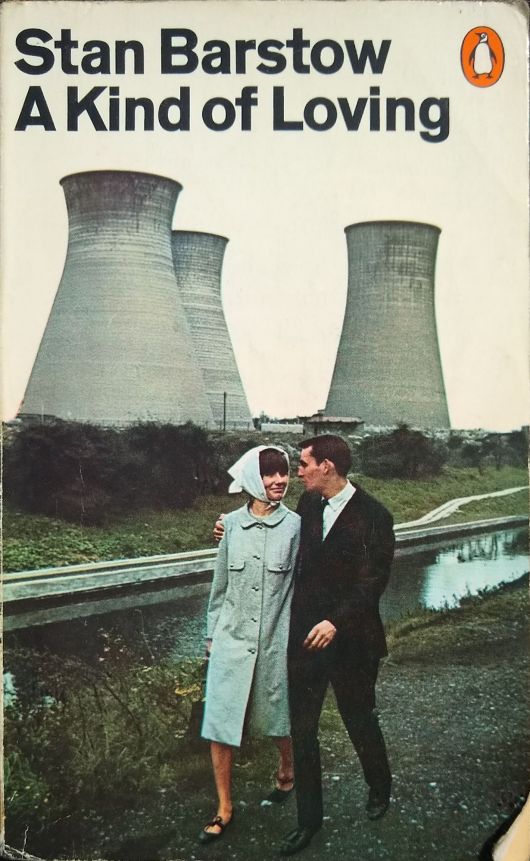
A Kind of Loving by Stan Barstow

This is another book that has been made into a successful film and also a great TV series. It’s a kitchen sink drama set in the early 1960s about a young Yorkshire lad who gets a girl pregnant and then realises he really wasn’t as in love with her as he thought he was. I’ve actually read this book quite a few times and it’s one of those that I mention when people ask me to describe Floating in Space. As much as I’m fond of Floating, this book is infinitely better. It’s a very simple story and probably one that has happened hundreds of times to hundreds of couples.

If you ever watch the TV series Long Lost Family, it shows that many people were in the same position as the couple in the book only instead of getting married, some young mothers in the 1950s and 60s were forced to give up illegitimate children for adoption.

Vic and Ingrid, the fictional couple, do get married even though Vic hopes for a last minute escape before the wedding day arrives. Not only is the main story authentic but so is the background to the book. Vic is a draughtsman in Yorkshire and his father is a miner.

The description of family life back then rings a bell with my own background in Manchester. Vic’s mother is a lot like my mother and there is a very lovely chapter when Vic goes to give blood with his father and then the two pop into the local pub for a pint. It was just like moments out with my own father, down to the banter with my mother when we both returned home. A wonderful read and so glad I brought it along to France.


What to do next: Here are a few options.

Share this post on your favourite social media!

Hit the Subscribe button. Never miss another post!

Listen to my podcast Click here.

Buy the book! Click here to purchase my new poetry anthology.

Click here to visit Amazon and download Floating in Space to your Kindle or order the paperback version.

Remembering James Dean

Back in the 1970s my Saturday ritual involved getting the bus into town and scouring book and record shops for, yes, you’ve guessed it, books and records. One day back then I was flipping through the posters in one particular shop. The posters were the music stars of the 70s; Elton John, Mick Jagger, Suzi Quatro, David Bowie and so on but one was a picture of a really good looking guy with a fifties combed back hair style. In some pictures he was dressed like a cowboy and in others in a red jacket and denim jeans. The guy behind the counter must have seen me wondering who the guy was and he told me he was a film star called James Dean. He handed me a paperback book about the actor and I took it home and read it and very soon I was trying to find out everything I could about him.

James Dean had been killed in a car crash in 1955 and had only appeared in three films and at the time of his death, only one of those films had been released. I read a great deal about Dean when I was in my late teens and from what I could find out, the biography to read was written by his best friend, William Bast. I never managed to get a copy of that book back then but Bast produced a made for TV film version, James Dean: Portrait of a friend with Stephen McHattie as Dean.

As TV biopics go, Portrait of a Friend was pretty enjoyable but I don’t think I’ve ever seen it repeated on TV. I used to have a VHS recording of the film but when I looked recently I was unable to find it. Funnily enough, not long ago I was in one of those budget shops, it might have been Poundstretchers and I saw a copy of the film on DVD. It was a very poor version, in fact it looked as though it had been copied straight from an old VHS tape but even so, it was interesting to see it again.

Watching that DVD got me interested in Dean again and so I had a search through my book collection to see what books I had on the subject.

The paperback book I bought that day in the record shop in the 1970’s was probably James Dean: A Short Life by Venable Herndon. It wasn’t a great book but an interesting introduction to Dean and who he was. It detailed his struggle for acting roles, TV work in New York, his apartment at 19 West Sixty-Eighth Street, his three films, his doomed affair with Pier Angeli and of course his death.

A similar book although bigger and with more photographs was a biography by John Howlet. I couldn’t find that particular book although I’m certain I wouldn’t have given it away or thrown it out.

A slightly different book I bought back in the 1970’s was a Japanese book about Dean. I’m not sure of the title, there are some Japanese ideograms and the name in English, James Dean, on the back cover. There is little text inside the book, basically it’s just a picture album and I guess the Japanese read books from right to left as the book starts with his last film and then finishes with his first film.

My Japanese James Dean book.

James Dean by David Dalton was another purchase back in the 1970s. It’s a much more in depth look at Dean’s life and skimming through it I came across a few pages about Dean’s last day, Friday September 30th, 1955. The author presented a short timeline of that day starting from 8am when Dean picked up his silver Porsche from Competition Motors in Hollywood to 5.45pm when he was killed in a car accident.

James Dean was competing in a car race in Salinas and had decided to drive his competition car, the Porsche, to the event as the car was brand new and Dean wanted to get some miles on the clock.

As well as my books on the famous actor I also have a box set containing his three films.

East of Eden is based on the final part of the book by John Steinbeck. It’s about two brothers who compete for the love of their father. Dean played the ‘bad’ brother and the father was played by veteran actor Raymond Massey who was continually shocked by Dean’s bad language and sullen and moody demeanour.

Rebel Without a Cause is probably the most well known of Dean’s three films. Dean plays Jim Stark, a rebellious teenager who has been in trouble at school and has either been expelled or forced to leave. The film follows him on his first day at the new school as he attempts to make friends with a group of fellow classmates but the result is that he makes more enemies. He gets involved in a ‘chicken run’ with fellow classmate Buzz in which the two have to drive a stolen car towards a cliff edge and the last one to jump out is ‘chicken’. Buzz fails to exit his car and is killed.

It’s a great film even though James Dean looks far too old to be still going to school.

His final film was Giant based on a novel by Edna Ferber. The film is set in Texas and is about millionaire ranchers and cattlemen. Dean plays Jett Rink, a sullen ranch hand who unexpectedly inherits some land, finds oil there and suddenly becomes rich. After punching ranch owner Rock Hudson, Dean, covered in oil after striking oil, drives away as Chill Wills says, ‘you should have shot that fella a long time ago. Now he’s too rich to kill.’

Another book I picked up only recently was another picture album James Dean: Portrait of Cool edited by Leith Adams and Keith Burns. It’s an album of photographs found in the Warner Bros archive and some have not been published before. Included are all sorts of documents such as casting sheets, production notes and messages. Dean’s address is listed as 3908 West Olive Avenue which I think might have been a place he shared with Dick Davalos who played his brother in East of Eden. During Rebel Without a Cause, Dean was listed as living at 1541 Sunset Plaza Drive.

1541 sunset Plaza Drive today from Google Maps.

Last Christmas Liz bought me one of my favourite presents, a copy of the Bill Bast memoir I mentioned earlier. Bill Bast shared apartments in both Hollywood and New York with Dean. In Hollywood, Bast became frustrated sharing a home with his friend. In the book, Bast accuses Dean of being untidy and moody and seemed to feel that he was subsidising Dean at one point as Bast was the only one with a job. After a dispute Bill decided to move to another apartment although the two remained friends. The book is written almost as if Dean was the love of Bast’s life and perhaps he was. In later life Bast wrote another memoir in which he claimed he and Dean had a gay relationship.

I’m not sure why someone like me, a council house boy from Northern England, should connect so closely with James Dean but back in the seventies the late star became one of my personal heroes. I remember going to a cinema on Oxford Road in Manchester to see back to back showings of East of Eden and Rebel Without a Cause on a very hot summer’s day. I bought a soundtrack album of those movies too, in the days before video and DVD.

Dean was a counterpoint to actors like Richard Burton; he mumbled and mispronounced things. I think that was what I liked about him; he was natural and imperfect. He had an image more rock star than 50’s actor. There was a great documentary about him made in the 70s and the music of the times, Bowie and Elton John featured heavily. Anyone remember that Eagles track ‘James Dean’?

Dean met his end on September 30th 1955 as he sped towards a race meeting in Salinas. He had already been stopped by the police and given a speeding ticket while driving his Porsche. In the passenger seat was his mechanic Rolf Weutherich and following behind was photographer Sandforth Roth and his friend Bill Hickman. They were towing the trailer on which the Porsche was originally mounted before Dean decided to drive.

As Dean approached the intersection of routes 466 and 41 in Chalome, a Ford station wagon turned across the path of the Porsche. “That guy up there’s gotta stop.” said Dean. The two cars collided. Rolf was thrown clear but James Dean was killed.

Today, years later, thousands of fans make pilgrimages every year to see Dean’s home in Fairmount, Indiana and to the intersection on highway 466 where he died. At his graveside in Fairmount fans chisel away bits of his gravestone for mementos and a bust of Dean by the sculptor Kenneth Kendall was ripped from its plinth. In 1977 a Japanese businessman named Seita Ohnishi had a chromium sculpture erected at the crash site on highway 466 in memory of Dean.

So why do people still hanker after James Dean all these years later? Well, I simply don’t know. As a young man I thought Dean was the epitome of cool and like many others I made him into my hero. Whilst doing some research about Jimmy Dean I came across this line on another site: “Some people are living lodestones. They get under the skin of people. You can’t explain why.” I can’t disagree.

Still, heroes come and heroes fade away. My heroes today are not the ones I used to love and worship thirty years ago. The thing is though, after writing this essay about Jimmy Dean I felt that I must find the time to look at some of his films again. Now where did I put that James Dean box set?


What to do next: Here are a few options.

Share this post on your favourite social media!

Hit the Subscribe button. Never miss another post!

Listen to my podcast Click here.

Buy the book! Click here to purchase my new poetry anthology.

Click here to visit Amazon and download Floating in Space to your Kindle or order the paperback version.


My Holiday Book Bag: Winter 2023

A long time ago I was reading a biography about Richard Burton called ‘Rich’ by Melvyn Bragg. The book used Burton’s own diaries and mentioned, amongst other things, Burton’s love of books. When Burton went on holiday he looked forward with delight to the contents of his ‘book bag’. I know it’s a pretty tenuous link but one thing I have in common with Richard Burton is a love of books and when I go on holiday, one of the delights of lying under a warm sun on my sun bed is a good, undisturbed read. I read a lot at home and on my lunch breaks at work but it’s a few minutes here and a few minutes there and whenever I get interrupted it kind of breaks the flow. Some books, as we all know, are just made for a really long, uninterrupted read so here are the books I took on holiday with me recently, all sourced from either the internet or secondhand bookshops.

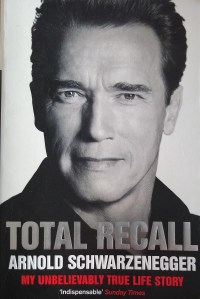
Total Recall by Arnold Schwarzenegger

This book was a Christmas gift from Liz. She knows I’m a big film fan and I do love reading about the background to films and how they are made. Arnold is from Austria and he tells us a little of his life there but mainly focuses on his desire to be a great bodybuilder and to eventually go to America. There is a lot of talk about the process of competitive bodybuilding and the different muscles, muscle definition, reps and squats and all that stuff. Arnold eventually wins various competitions and is wondering how he can compete in the USA when he gets an invitation to do just that. The bodybuilding industry is a close knit one and there seem to be various people welcoming him to California, helping him to find a place to stay and so on. He wins more competitions and makes a little money. He starts a mail order business selling magazines and pamphlets about himself and his body building techniques. He brings one of his Austrian friends over and the two begin a bricklaying and home improvement business. His big break is getting a film part as Hercules and even though the production eventually goes bust it seems to give him a taste of the film business and he wants more. He plays Conan the Barbarian in the film version of a comic book hero and pretty soon he plays the Terminator and goes on to success after success, even becoming governor of California.

I’m not sure I actually came away liking Arnold. I know this is an autobiography but it’s a very me, me, me book and Arnold is constantly bigging himself up. The final chapters about his political career are perhaps the most interesting. He had thought about running for governor but senior republicans seemed to have been more interested in another candidate. However, when Gray Davis was elected in 2000, there seems to have been something of a backlash and there is a curious precedent in Californian politics. The public can demand a recall, a new election in which the public either go for the elected governor or someone new. Arnold entered into the recall and won. He seems to have been in an odd position politically. He was a Republican but had married into the Kennedy family who are Democrats but his success as a politician seems to have come from holding the centre ground in California and bringing Republicans and Democrats and getting them to work together.

At the end of the book Arnold gives us his personal philosophy and his rules for success.

Verdict: I’m not sure whether Arnold wrote this book just to give us his story or to further promote himself but if I had to choose, I’d probably say the latter. Having said that, Mr Schwarzenegger is a man who gets things done and has a positive attitude. Perhaps I should take another look at his rules for success.

Great Expectations by Charles Dickens

This is not a book I brought on holiday but one I found on the shelves of our rented villa in Lanzarote. I started reading it when I got a little bored with Arnold Schwarzenegger and liked it so much I just carried on to the end. It is a real pleasure to read something by a master wordsmith and I enjoyed every minute even though I had read this novel years ago. Young Pip, apprenticed to be a blacksmith, is invited to the home of an eccentric rich woman, Miss Havisham, purely for her amusement. Later in his young life he finds he has ‘great expectations’ and is to inherit a remarkable property. He is taken to London to be brought up as a gentleman and although he is told that his benefactor has asked to remain a secret, he naturally assumes it is Miss Havisham. At the beginning of the book, Pip encounters Magwitch, an escaped convict on the marshes near his home. He compels Pip to bring him some food and a file. He is captured and transported to Australia and later we find, much to Mr Pip’s shock and amazement that Magwitch is the mysterious benefactor.

The book is rightfully one of Dickens’ best loved stories and is a wonderful read. I’ve always thought it had a rather ambiguous ending and in fact in my edition back home, it is one of those with various notes and background information, I am advised that Dickens felt that it was important to assure the reader that Pip had a future with Estella, the spoilt adopted daughter of Miss Havisham and so changed the ending slightly. Pip of course did want a future with Estella but I still feel the book leaves a happy ending slightly uncertain.

Verdict: An absolute classic from a master storyteller.

A Mad world, My Masters by John Simpson

This is a collection of globe trotting stories from John Simpson who has travelled the world as a journalist for the BBC. These though are travel stories with a difference, for instance in the first chapter he talks about airports, not the airports that I generally use, tourist destinations like Spain and Greece. The ones Mr Simpson mentions are airports in war torn Angola and Bosnia, and places like Kabul in Afghanistan and other places where he has had his passport and papers routinely torn up or thrown into a river by laughing revolutionaries and mercenaries. He tells us about headlong dashes to catch flights, including one somewhere in eastern Europe where he was in such a mess after weeks living rough the stewardess was reluctant to let him on board, especially as he had a first class seat. His fellow passenger in the next seat asked to be moved. Luckily John wasn’t flying on a budget airline like the ones I travel with.
On one occasion in Afghanistan with the Mujahadeen, a bearded man appears dressed in white robes. He tries to get the Mujahadeen to murder Simpson for $500. It later turned out that the man was Bin Laden. Simpson talks nonchalantly about many other encounters with revolutionaries such as Arkan, the Bosnian warlord. There are other chapters on dictators that he has met and other sometimes ordinary people who have impressed him, like the simple village priest trying to make life safer for his fellow villagers in Colombia, one of the great drug producing countries of the world.

Most of his stories are hugely fascinating although the more interesting ones are about people, either the ones he has interviewed or the ones who work with him, his fellow journalists and sound-men, cameramen and so on. Most of this book is about the days when a BBC crew consisted of a cameraman, a sound-man, a producer and sometimes even others. Today, Simpson’s crew would consist of him and one other doing the filming and editing. There are some TV journalists today that even have to film and edit themselves.

The last part of the book where the author talks about his love for middle eastern rugs and antiques and the process of bartering that goes with buying those things was perhaps not my cup of tea. Verdict: A patchy read with some very fascinating chapters as well as some not so interesting ones. Generally, though, this was indeed an excellent read.

The Firm by John Grisham

There is a process by which I choose books to take with me on holiday. I like to think it’s a thoughtful process combining different genres of books, some novels, maybe the odd classic, and some biographies and autobiographies. What actually happens is that the day before our trip I’ll just grab something near to hand that I know I haven’t read yet and shove it in my suitcase. Anyway, that’s how I ended up with the books you see above. Last year I read The Rainmaker by John Grisham and I thought it was a pretty good read. I must have mentioned that to Liz so she filed that away and got me a stack of Grisham novels for my last birthday. The Firm isn’t a bad read and in my case it was a nice change of pace after reading Dickens and John Simpson’s globetrotting memories. It’s a good story but like a lot of Grisham’s works, its more plot driven than character driven. The characters are sort of bland templates that I’ve recognised in a lot of his novels and so far I’ve only read three. Anyway, characters aside, this is a really original story about a young guy who graduates from law school and gets head hunted into a firm he has never heard of but which offers tremendous financial benefits, a brand new BMW, and an ultra cheap mortgage as well as other financial bonuses. The downside as he comes to learn later is that the firm is just a cover operation to launder money for a big mafia crime family and the FBI wants our hero James McDeere, to help them.
Verdict: Highly enjoyable and a great holiday read but nothing more, although that didn’t stop the book from becoming a best seller as well as a hit film in the 1990’s.

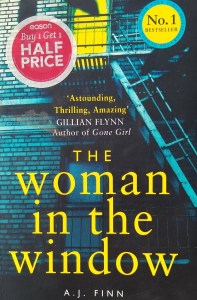
The Woman in The Window by AJ Finn

I’m not sure I would normally have picked up this book if I hadn’t run out of books to read. I saw this on the shelf in our rented villa and Liz had read it and mentioned about numerous references to old black and white films which were right down my alley, apparently.

Anyway, I thought I’d give it a go and I’m very happy that I did. It’s about a woman called Anna Fox suffering from agoraphobia who cannot venture outside her house. She is in effect almost imprisoned there but spends her time playing online chess, seeing two therapists, one physical and one psychological as well as taking medication and drinking a whole lot of Merlot. She also spends a lot of time watching old films on TV and DVD as well as watching her neighbours.

She hears a terrible scream one night although no one else seems to hear it. She questions her tenant who lives in her basement but at the time in question he was doing some work while wearing earphones.

She meets Jane Russell from across the road, not the Jane Russell from the films but a pleasant lady whom she invites in and has a glass of wine with. Later through the windows of Jane’s house, she sees her get stabbed.  Anna calls the police and tries to go across to the house but she cannot get over the road due to her agoraphobia and she ends up in the park where she is found by paramedics.

When she surfaces, we find that no one believes her story and also that Jane Russell is still alive, except, she’s a different Jane Russell to the one Anna saw murdered.

The tension builds nicely in this thriller and a number of shocks are dropped in front of the reader along the way as we find out what has caused the agoraphobia and what really happened over the road.

This was also made into a film starring Amy Adams as Anna Fox although I’ve yet to see it.

Verdict: Great read, so much so that when we left the villa, I had to take it with me to finish on the plane home. To be fair I did leave behind The Firm to replace it.


What to do next: Here are a few options.

Share this post on your favourite social media!

Hit the Subscribe button. Never miss another post!

Listen to my podcast Click here.

Buy the book! Click here to purchase my new poetry anthology.

Click here to visit Amazon and download Floating in Space to your Kindle or order the paperback version.

My Holiday Book Bag 2021

A long time ago I was reading a biography about Richard Burton, in fact it was ‘Rich,’ the biography by Melvyn Bragg. Bragg used Burton’s own diaries in his work and wrote, amongst other things, about Burton’s love of books and when Burton went on holiday he looked forward with delight to the contents of his ‘book bag.’ I know it’s a pretty tenuous link but one thing I have in common with Richard Burton is a love of books and when I go on holiday, one of the delights of lying under a warm sun on my sun bed is a good undisturbed read. I read a lot at home and on my lunch breaks at work but it’s a few minutes here and a few minutes there and whenever I get interrupted it kind of breaks the flow. Some books, as we all know, are just made for a really long, uninterrupted read.

It’s a long time since I’ve been able to produce a Holiday Book Bag post, simply because I haven’t had a holiday which has mostly been the fault of Covid 19 so here are the books I’ve brought on holiday with me to Lanzarote.

Peter Sellers by Alexander Walker

I’ve always been interested in the comedy actor Peter Sellers. It’s probably because of a documentary I saw years ago on BBC’s Arena programme, a film about Sellers which used Sellers’ home movies and what has been good about this particular book is that it has filled in the gaps that were missed in the film.

Sellers was an only child, born into a theatrical family in 1925, he was in fact the second child of Bill and Peg Sellers. Their first child, also called Peter died in infancy and because of that, the family, in particular mother Peg, lavished a great deal of love and affection on Peter. The result was that he was not a nice child, in fact he was spoilt rotten and got his own way in everything and developed many traits he would take into adulthood with him.

Peg, Sellers’ mother, had a stage act in which she used to dress in a white outfit and pose on stage while various slides were projected over her. Father Bill was a musician and Peter claimed that he had taught George Formby to play the ukulele. Sellers was called up in the second world war and Peg used her theatrical contacts to get Sellers into the entertainment unit ENSA. She even travelled about the country to be near him until he was posted overseas. After being demobbed Sellers tried to get work as a comedian and eventually got work on a radio show by impersonating the star of that show, Kenneth Horne over the phone to the producer and saying how good that new comedian Peter Sellers was. Sellers admitted the deception but the radio producer was impressed so Sellers was asked to join the cast of the show.

From there, Sellers met Spike Milligan, Michael Bentine and Harry Secombe and together the group started the Goon Show, the famous hit radio show for which Sellers provided numerous comedy voices.

The next step for Sellers was into films and his big break was getting a part in the film The Ladykillers in 1956. His film hero Alec Guinness was the star. He starred or co-starred in numerous British comedy films before appearing with Sophia Loren in The Millionairess in 1960. The Millionairess made him an international star.

The book tells of his various film roles including his most famous one, that of Inspector Clouseau, a part which he only got after Peter Ustinov turned it down. The author also recounts Peter Sellers’ odd behaviour, his numerous purchases of cars and gadgets, his wives and how his staff had to deal with his various tantrums. His final wife, Lynne Frederick even gets a good review from the author although in other books and documentaries she has not come out looking as good.

Sellers died of a heart attack in 1980, aged only 54.

I do love books about films and film making and this one was an excellent read.

Death of a Glutton by MC Beaton

This is a novel in the Hamish Macbeth series and part of my mission to read all the Macbeth books. The last few have not been great reads. Death of a Prankster wasn’t exactly riveting but this one is much better. It’s not a classic of literature by any means, it’s just a pleasant read. It follows what I have come to think of as the Agatha Christie style of a whodunnit. You know what I mean, a group of suspects gathered together by the detective, in this case Hamish Macbeth and we know one of them is the murderer. This eighth entry in the Macbeth series is about an overweight woman, a part owner in a dating agency who alienates all the potential lovebirds with her constant eating. The co-owner of the agency wants to get rid of her. Is she capable of murder or does Hamish have his eye on someone else?

A pleasant holiday read, nothing more.

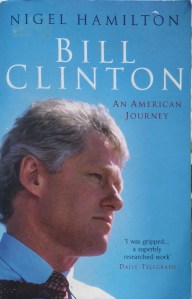
Bill Clinton: An American Journey by Nigel Hamilton

I’m a great fan of biographies and I picked this book up ages ago in one of those remainder book shops. I keep starting it and then moving on to something else so I grabbed it for this holiday book bag, determined to finish it. Bill Clinton was born Bill Blythe and took the name Clinton when his mother married Roger Clinton. It wasn’t a good choice on his mother’s part as Roger was an alcoholic and Bill had to cope with the consequences of Roger’s drinking for many years. Bill was a bright youngster. He did very well at school, he seemed to remember everything he had read, he was very intelligent and a born networker. Perhaps as a consequence of his home life he was good at sorting out feuds and disputes and when he grew tall and strong, he was able to intervene in the often violent disputes between his mother Virginia and Roger.

Bill won a scholarship to Oxford in the UK where he widened his circle of friends. Back in Arkansas he had worked on Senator Fulbright’s election team and also discovered women. Like JFK his hero, Clinton had numerous liaisons which didn’t stop when he met Hilary Rodham. She was nothing like the usual girl he became involved with. She wasn’t good looking, wore huge goggle like spectacles, had greasy hair and apparently wasn’t keen on too much deodorant. After university she went on to be part of the Senate’s Watergate Investigation staff but later joined Bill in Arkansas where he decided to run for Attorney General and later, for the Governorship. The two married and formed a wonderful political partnership that would ultimately take them to the White House.

In his election campaign President Bush thought Clinton would be easy to defeat and began to focus on the third-party candidacy of millionaire Ross Perot. Perot withdrew from the race, and then re-entered. A key moment was in the last of the debates when Bush was unable to properly answer a question from a member of the public about the personal effects of the recession. Bush was confused but Clinton answered the woman directly and had seen many issues in his home state of Arkansas concerning loss of jobs, loss of homes by people unable to pay mortgages and so on.

Another moment was when on live TV the Clintons were asked about Gennifer Flowers. Hilary jumped to her husband’s defence and asked for privacy and then told the viewers that if they didn’t like Clinton then they shouldn’t vote for him. The public did vote for Clinton and in large numbers.

Author Nigel Hamilton has produced an interesting book that is conveniently put together in bite sized and subtitled short sections. I’m not sure whether he really gets close to who Bill Clinton really is but all the information is there to make your own deductions. One of the interviewees for the book comes right out and calls Clinton an inveterate liar. He lies about many things but particularly about his personal life, his many affairs while governor and in particular his twelve year relationship with Gennifer Flowers. There are many comparisons with Clinton’s hero JFK, partly because Hamilton wrote a book about him too. I remember reading that he declined to add a second volume because he didn’t like what he had learned about Kennedy in his research. This book, subtitled An American Journey is only volume one although nowhere on the book does it state that.

The book comes to an abrupt end when Clinton wins the election. There is no description of Clinton’s joy or reaction to his victory. I suppose I’ll have to buy volume II to read about that.

An Autobiography by Agatha Christie

A while ago I was thinking that it’s about time I read something from one of the best selling authors of all time. Searching through the internet I came across Agatha Christie’s autobiography so I thought that might be a good starting point. A lot of the media stuff I do for Floating in Space portrays it as a lost world, the world of 1977 when the book is set. Agatha Christie was born in 1890 and her book truly is a portrait of a lost world. She claims she didn’t come from a rich family yet her mother and father lived in a large house. They had cooks, nannies, nurses and other servants. Her father, who she says was a very agreeable man, had a private income. His father had made investments that paid him handsomely so he was never obliged to work. He left every day for his club, returned home for lunch and then returned to his club to play whist. During the season he spent his time at the cricket club where he was president. Agatha tells various stories of her childhood in Torquay. They are all well observed tales of life in a Victorian house. Later her father dies and the family is struggling for money so they rent out the house and decamp to various places in France, including Paris. Agatha’s lifelong love of travel must stem from these early visits to the continent.

Later she leaves home and marries an airman from the newly formed Royal Flying Corps and tells of her voluntary work as a nurse in WWI. For a while she works in a pharmacy and after being introduced to various poisons gets the idea of writing a murder story. She does so and takes it to various publishers. None seem very enthusiastic about it but eventually she gets to have the work published. She is quite pleased with herself although she only makes a little money. Her first book featured Hercule Poirot, a Belgian detective. She chose a Belgian as there were then many Belgian refugees in England as Belgium had been invaded by the Germans. Later she writes more books and is buoyed when a newspaper asks to serialise one of them. She realises then how poor her publishing contract is and engages a literary agent who stays with her for many years.

To conclude then, this is a very enjoyable well observed book and has made me want to add some Agatha Christie novels to my reading list.


What to do next: Here are a few options.

Share this post on your favourite social media!

Hit the Subscribe button. Never miss another post!

Listen to my podcast Click here.

Buy the book! Click here to purchase my new poetry anthology.

Click here to visit Amazon and download Floating in Space to your Kindle or order the paperback version.

Dylan Thomas

The 27th of October was the birthday of one of my favourite writers. I love lots of writers but probably my all-time favourite is Dylan Thomas. I love the outstanding power of his writing, his incredible imagery, and the wonderful pictures he creates with his words.

Dylan also is the sort of writer I’ve always wanted to be: A bohemian, pub crawling, boozing writer who fought with himself as he laboured to paint his word pictures. Whether that was really the case I don’t know but Dylan did like his pubs and he did enjoy a drink.
The fact of the matter is that I’m nothing like Dylan, except we both share a love of words, particularly the sound of words, which is the key to the richness of Dylan’s work, especially his poetry. If you think about it, there must be a connection between the sound of a word and its meaning, a deep organic connection. After all, how did words begin? Imagine some ancient caveman, just wanting to get some concept over to his mate. What are the deepest and strongest feelings for a human being? Well, for a caveman food must be one, and love too. Surely love was present in those primordial days when every caveman went out on Saturday with his club looking for his mate. There must have been a moment when ancient man strived to say something to his mate, tried to express his feeling and a sound that was the precursor to the word love slipped uneasily from his lips.

If you have read any of Dylan’s poems and are yet to understand his magic, let me give you a tiny bit of advice: Listen to Dylan’s voice. Yes, Dylan, like many poets wrote for his own voice and if you click on to any Dylan Thomas page or search anywhere on the internet you are bound to come across some old recording of his voice. Don’t make do with lesser voices, even when we are talking about great actors like Richard Burton or Anthony Hopkins. Search out Dylan himself and you will be won over, like me, by the power of his voice.

It’s not just his poems that are rich with the power of words. Dylan wrote and performed a good many radio plays and broadcasts and my very favourite is ‘Return Journey.’ It’s about Dylan himself returning to Swansea in search of his former self ‘Young Thomas’. He visits young Thomas’ old haunts and meets with people who knew him fleetingly; the barmaid who used to serve him, journalists who worked with him and even the park keeper where Dylan and his young friends would play in the park. It’s a lovely piece where fantasy merges with reality and we slip in and out of the two as the story progresses.

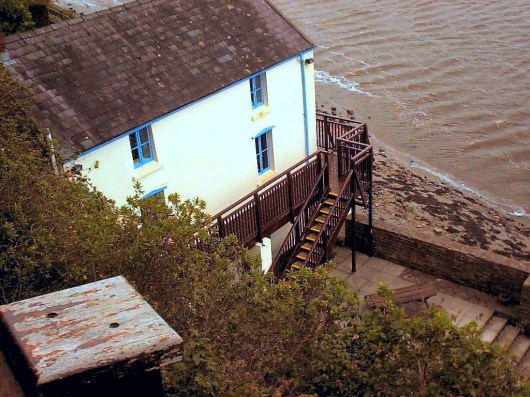
Many years ago I visited Dylan Thomas’ house in Wales. The house is in the village of Laugharne and is not far from one of his famous watering holes, the Brown’s Hotel which I’m pretty sure was bought by one of the comedians from TV’s Men Behaving Badly.

The boathouse was bought by a trust some years ago which saved the property from collapsing into the sea. It’s a lovely place and on the day I visited, we had to leave early although I can’t remember why. I came back the next day and the staff remembered I had left early previously and let me in for free. I wandered about Dylan’s old house and sucked in the atmosphere before buying various books and pamphlets about Dylan and his works.

In another old TV documentary I tend to watch now and again, the presenter, a poet himself, visited the house and ventured that he thought he could imagine the conversations of Dylan and his wife, the chit chatting, the arguing and the making up later, or so he supposed.

I took a primitive digital camera with me and took a few shots of the house and Dylan’s famous writing shed. I read somewhere recently that the shed has now been removed and taken to a museum with a duplicate shed now occupying the site.

I enjoyed my visit and Dylan’s own poem always makes me think of it:

In the mustardseed sun,
By full tilt river and switchback sea
Where the cormorants scud,
In his house on stilts high among beaks
And palavers of birds . . .

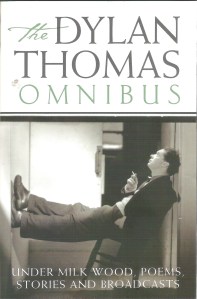
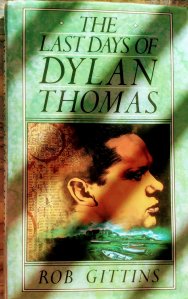
As you might have guessed from reading these posts, I really do love my books. One particular book pictured here, about the last days of poet Dylan Thomas is one I’ve had a long time but have not got around to reading until more recently. I do endlessly peruse our local secondhand shops for books but I have a feeling I bought this one from one of two online bookshops, either Abebooks or Awesome books, both of which I use especially when there is a particular book that I am after.
This book is a rather slow one but it details Dylan’s last days and ultimately his death in New York in the USA.

Dylan was a slow worker when it came to writing and there was always something, usually a pub, to draw him away from his work. In his latter days he was concerned that his talent or his inspiration had gone and that all his best work was perhaps behind him. He was short of money as usual and that is what drove him to accept an offer to go to the USA on a poetry tour by Canadian poet John Brinnin. Brinnin was the director of a poetry centre in New York and the trips Dylan undertook there were very lucrative for the always hard up poet. Thomas had a number of wealthy patrons, in fact his famous house in Laugharne was bought by for him by an admirer but money went through Dylan’s hands quickly.

He had travelled there before and on his penultimate visit had become romantically involved with a lady called Liz Reitel who worked for Brinnin at the poetry centre. When Dylan arrived for his last visit Reital was shocked to see the poet looking poorly and ‘not his usual robust self’. Dylan was in an odd mood and related a strange story of an encounter on the aircraft with a priest. Over the next few days his mood alternated between being tired and poorly and getting drunk with some moments of normality. I get the impression from the book that Dylan liked attention, he liked admirers and although he was in the middle of an affair with Liz Reitel, he was not averse to enjoying the attention he received from other women.

At the poetry centre, preparations were under way for a recital of the newly finished Under Milk Wood for which Dylan had produced some new edits and updates. Towards the end of the book Liz mentions that she was disappointed that these revisions were not included in the published versions of the play despite the fact that she personally typed them up and passed them on to Dylan’s publishers.

The recital went well and was in fact tape recorded by someone at the time with Dylan taking the part of the narrator.

The book goes on to detail Dylan’s various moods and the symptoms of whatever was ailing him.

Liz called a doctor when Dylan became unwell again and the doctor gave Dylan an injection of morphine sulphate which may or may not have helped him.

After a night of drinking at the White Horse Tavern in Greenwich Village, Dylan returned to the Chelsea hotel claiming famously that he had downed ‘eighteen straight whiskies. I think that’s the record!’

Dylan’s breathing became difficult later in the evening and an ambulance was summoned. Thomas slipped into a coma from which he never awoke and later died on the 9th of November, 1953. He was only 53 years old and died with assets of only £100.

I was always under the impression that Dylan had drunk himself to death but that may not be the case. The autopsy did not find any evidence of liver cirrhosis and his death may have been due to pneumonia and bronchitis as well as the injections he had received from the doctor. It was later thought that the morphine may have inhibited Dylan’s breathing rather than easing his pain.

This was a good read although the author’s style was not completely to my liking. One interesting thing about it was that in my copy, it was a second hand book remember, there was an inscription on the first page. The book was clearly a gift. Did the owner pass away? Did his family send for the house clearance man and clear away his belongings? Who was Kate, the lady who signed the book in 1992?

Who was the person she loved and thought the world of?

In a way it is almost like Under Milk Wood itself, where the dead come alive again at night as time passes . .


This post was compiled from my previous posts about Dylan Thomas


What to do next: Here are a few options.

Share this post on your favourite social media!

Hit the Subscribe button. Never miss another post!

Listen to my podcast Click here.

Buy the book! Click here to purchase my new poetry anthology.

Click here to visit Amazon and download Floating in Space to your Kindle or order the paperback version.


Summer Book Bag 2021

There is nothing nicer than pottering around the garden on a summer’s day, gardening, barbecuing and of course, reading. The pandemic and some sick leave have given me plenty of time to read this summer although most of the books I have bought recently have been not from my usual charity and second hand shops but from the internet.

A Right Royal Bastard

Serves Me Right

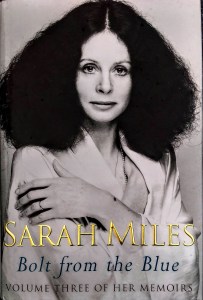
Bolt From the Blue (Three volumes of autobiography by Sarah Miles)

A long time ago I picked up A Right Royal Bastard somewhere in a charity shop. I have a feeling it was whilst walking round Skipton a few months ago but anyway, I didn’t know much about Sarah Miles except that she was a film actress and had appeared in Those Magnificent Men in their Flying Machines and also Ryan’s Daughter, that latter film being one of director David Lean’s less appealing films. Apparently, as Sarah reveals in Serves Me Right, Lean was so upset by the bad reviews he didn’t make another film until A Passage to India, many years later.
The first part of Volume I was rather dull I thought, only really becoming interesting when the author leaves home and becomes an actress. It is a very forthright and frank book and Sarah explains how she once lived with a girl who was a prostitute and wanting to know more about sex, hid in the girl’s closet while she serviced a customer. An abortion was another shocking revelation.

In volume II, Serves Me Right, Sarah goes on to talk about her dog Addo, who she was devoted to, so much so that she would not accept film roles abroad as she couldn’t bear to leave him behind. She talks about the swinging 60’s and her film debut as a ‘husky wide eyed nymphet’ in Term of Trial in 1962. She met Laurence Olivier in that film and went on to have a long affair with him.

She owned a house in London and one day an old friend from RADA turned up and quickly moved herself in. The friend, Nona, had mental health issues and paid no rent and caused Sarah a great deal of distress. Eventually she asked Nona to leave but sadly she committed suicide in the house. It wasn’t the only death she would have come into her life. She had a brief liaison with a man called David Whiting. He was a pushy individual who inveigled himself into her life first as a journalist working for Life magazine and then when he was fired as a PR man on a film her husband, screenwriter Robert Bolt was producing. Whiting was later found dead in her hotel room causing a great scandal. After the incident had died down and her infidelity was revealed, she and Bolt parted.

I’ve only just finished Bolt from the Blue, her third volume of memoirs and it was written in the same frank and forthright style as the preceding volumes. An interesting part for me was about Robert Bolt and the great time and effort he put into crafting his plays and screenplays, spending long hours in his office writing. Towards the end of his life he wrote a screenplay for the film Nixon, one that he was really proud of but Oliver Stone decided not to use it and wrote his own. Bolt also wrote a final screenplay for David Lean, Nostromo. The film was ready to shoot when Lean’s illness meant that the project would go unfinished. Alas the rest of this volume was not quite as interesting as the first two and hearing about Sarah’s homes, dogs and the problems of her spoilt and undisciplined son and his drug problem was not my cup of tea.

The last two volumes I ordered from the internet but annoyingly, Bolt from the Blue arrived as a big hardback book when I really wanted the paperback. I don’t know about you but I like my books to be compact and easy to fit into pockets and bags. I really should pay more attention to internet small print.

Death of a Gossip

Death of a Cad

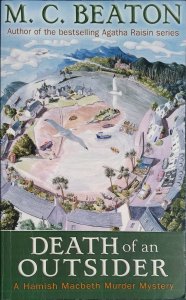
Death of an Outsider (Hamish Macbeth novels by M C Beaton)

I wrote in an earlier post about being a fan of the Hamish Macbeth TV series and finding a copy of one of the books in a charity shop. The book, Death of a Dreamer was enjoyable and quirky and quite different from the TV series. After reading that book, I wanted to read some more and no point in carrying on with the next one I thought, I might as well start from the beginning and read the novels in order. Liz obviously picked up on that and she found the first three novels for me. The first two were compiled together in one volume, Death of a Gossip and Death of a Cad. I was expecting the first one to be something special and looked forward to the introduction of Hamish himself. All the main characters in the series were there, Inspector Blair who looks down on Hamish as a simple village bobby even though he has a knack of solving the local murders and Prunella, daughter of Colonel Harbuton-Smythe, who thinks his daughter is far too good for Hamish even though Hamish clearly likes his daughter. Both the deaths of the gossip and the cad have kept me amused on my garden sun lounger for a while but both were a little contrived. The third instalment in the series though, Death of an Outsider was much better. The characters were better, the plot and the storyline all had me hooked. The setting too was interesting, not the village of Lochdubh that I was beginning to get used to but another village where Hamish was filling in, as their local constable was on holiday. I do love a good murder mystery and already I’m looking forward to number 4 in the series.
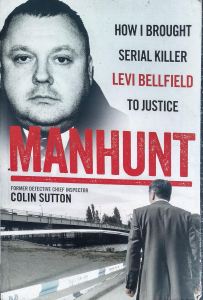
Manhunt.

I always find it interesting just how I seem to hook up with a particular book. In this case I had an email from the ITV Hub telling me about a great new series of Manhunt and how I could watch the previous one on the ITV hub.  Now what criteria ITV uses to send me an email like that I don’t know because not only had I never watched Manhunt, I’d never even heard of it. Looking at the ITV website I found that Manhunt was a three part thriller based on the real life case of killer Levi Bellfield. Having nothing more interesting lined up to watch that evening, Liz and I settled down to watch and actually got pretty interested, so much so that I immediately went to Abebooks and ordered a copy of the book that the series had been based on. It had been written, in fact written quite well by former Chief Inspector Colin Sutton who was in charge of the real life investigation of a young French student murdered in Twickenham, London.

Sutton tells the story of how the student living in London was found critically injured on Twickenham Green in 2003. She was taken quickly to hospital but died from her injuries having been hit on the back of the head, possibly with a hammer.

Sutton explains how the Metropolitan Police deal with situations like this and how an ‘on call’ team quickly attend and then hand over to a full murder investigation team led on this occasion by Sutton himself. The first things to do were to secure the crime scene and set up a mobile police station asking for anyone with information to come forward. Various people mentioned a man resembling Maradona, the famous footballer, smoking and standing by the cricket screens. The area was thoroughly searched and the cricket screens fingerprinted. The next step was to check CCTV footage from the area and the cameras soon found the victim alighting from a bus. She had spent the evening at a French bistro with friends and had left to catch her bus home. She had missed her stop and then had to walk across the Green to get home where sadly she was murdered. A small white van was noticed on various CCTV cameras and later when her mobile phone signal was last registered by the river, an underwater search by divers located her house keys and other personal items.

There was no special key to solving this case, no moment like in TV fiction when the detective spots a clue pointing to the killer, just dogged routine footwork and research. Later something approaching that TV moment did occur. At the onsite mobile police station erected on Twickenham Green, an informant had mentioned that her previous partner, Levi Bellfield could be a suspect. He was a violent man, owned a small Ford van and was familiar with the area. The investigation team were about to start on the leads generated by the public when a local PC who had taken the information asked about it. Bellfield looked like a possible murderer straight away and after a surveillance operation the police were to finally arrest him. Keeping him in custody and proving he was a murderer and finding he was linked to other murders and attempted murders was another thing altogether and the author takes us through the investigation step by step.

This was an excellent read and having time off work I was able to lie in the garden, glued to the book until I got to the end.


What to do next: Here are a few options.

Share this post on your favourite social media!

Hit the Subscribe button. Never miss another post!

Listen to my podcast Click here.

Buy the book! Click here to purchase my new poetry anthology.

Click here to visit Amazon and download Floating in Space to your Kindle or order the paperback version.

My Top Ten Books of All Time Part 2

I do love books and like everyone I have my favourites. Last week I wrote about reading a blog post asking the reader for their top 5 books of all time. I decided to go one better and work out my top ten. I gave you the first five of my top ten books of all time and this week it’s time for the other five, all in no particular order.
The Spy Who Came in from the Cold

This book is a cold war thriller from the famous spy writer John Le Carré. Leamas runs the Berlin station and his opposite number over in East Germany is bearing down hard on his agents. Back in London Control, the head of the Secret Service has an idea to deal with this man. Leamas becomes a little fed up with himself. He gets a new job in a library, he drinks too much. He gets involved with a young librarian who turns out to be a communist party member. He assaults a small shop owner and ends up in prison. When he emerges, he is approached by various persons all wanting background information for a foreign news service. Leamas becomes a defector and only then do we realise what his mission is all about. Le Carré isn’t actually one of my favourite writers but in this book his slow burning style is perfect as the plot evolves slowly and methodically. A great read.

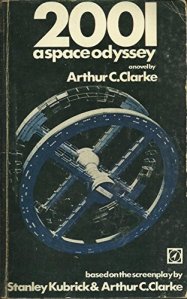
2001 A Space Odyssey

I first saw the film version of 2001 in the summer of 1968. I was only 11 at the time and I remember my Mum being surprised I had spent hours at the cinema on a lovely hot day. I watched the film in the huge movie theatre in Northenden, now a Jehovah’s Witness assembly hall. There were only a few people in the picture house that day and it was wonderful having this huge place almost to myself and seeing this incredible film in 70mm on the big screen. I recall being somewhat confused by it all, especially the jump from Neanderthal times to the future. I was so confused that I had to buy the novel by Arthur C Clarke which explained things in a way the movie did not.

The book is a wonderfully well written, plausible space adventure. It is about a mysterious monolith which appears on earth in Neolithic times and helps the ape men of the day to develop. Later, in the future, the mysterious monolith is found buried on the moon and when it is exposed to sunlight for the first time, it blasts off a signal to Saturn. Anyway, the scientists of the day decide that the monolith is part of some extra-terrestrial intelligence and set up a manned space mission to investigate. As the mission progresses, the onboard computer, HAL, decides to have something of a nervous breakdown which creates an unexpected hazard for the crew. All the technology that Clarke wrote about had its origins in science fact, both the space missions and the computer technology which make up the main parts of the story.

Verdict: The book is a wonderful read, one of the classics of science fiction.

The History of Mr Polly

This is not a science fiction story despite being penned by H G Wells. Our hero, Mr Polly finds himself in a very dull job with a very dull wife and resolves to commit suicide. Anyway, events unfold and instead of committing suicide, Polly accidentally starts a fire which threatens the whole street and he then mounts a brave rescue of an old lady. Instead of dying, Mr Polly becomes a hero and when the insurance money comes in, he leaves his wife, nicely settled with the insurance money, takes a little for himself and departs for pastures new. He sends some money to a post office in another village and gradually meanders in that direction, sleeping in fields and hedges, getting himself a tan. He works occasionally when he wants and sleeps when the mood takes him at other times.

He comes across the Potwell Inn and asks for work and right away finds himself at home. He potters about happily at the Potwell Inn, cleaning, serving and doing various odd jobs. One day the landlady’s nephew appears. He is a violent bully having been in and out of prison for years. He doesn’t like Mr Polly getting in the way so he decides to scare him off. What should Polly do, stay and help or just leave?

I first read this book many years ago and I’ve always liked its simple philosophy. If you don’t like your situation, change it says the author.

The History of Mr Polly is a lovely gentle read by a classic author.

My well thumbed copy of David Copperfield

David Copperfield by Charles Dickens.

I couldn’t tell you what my number one favourite book of all time is, but a strong contender must be ‘David Copperfield’ by Charles Dickens.

It’s a book written by a wonderful wordsmith and is rich in powerful and subtle images.

A lot of Dickens’ characters display their personal characters and traits through their names. Uriah Heep and Mr Murdstone for instance. Even when we are yet to be introduced to these fictional people we can understand a lot about them from the sound of their names. This is how Dickens works, giving us numerous hints and pointers to who these people are and what they are like.

James Steerforth though is something of an exception. He is my favourite character from within Dickens’ pages and he is neither a Heep nor a Murdstone; neither a Pickwick nor a Bumble. Apart from David Copperfield himself, he is the most human of Dickens’ creations. He is kind but can be unpleasant, caring and yet selfish, thoughtful but also unfeeling. In short, as Mr Micawber might say, he is full of human contradictions.

The best part in the book probably, for me at any rate, is the storm when David returns to Yarmouth. Dickens builds the storm slowly and each word and phrase adds a new layer to the sense of danger and foreboding and when Copperfield is finally reunited with his old friend Steerforth at the height of the storm’s ferocity, death comes between them and Steerforth is sadly drowned. Dickens reveals this in a unique way for he does not tell the reader Steerforth is dead. He leaves the reader to realise this themselves and in the process, makes the reader almost at one with the narrative.

Throughout the book, Dickens mentions in passing Steerforth’s habit of sleeping with his head on his arm. It’s referred to many times in the narrative almost as matter of non-interest. Something unimportant that the reader doesn’t really need to know, but when David Copperfield spies someone aboard a stricken ship trapped in the fierce storm who evokes some faint remembrance for him, a tiny warning bell is set off.

Finally, when the body of a drowned man is brought ashore and lies mutely on the sand, his head upon his arm, we know just from that simple bit of information, without the author telling us anything more, that Steerforth is dead. The prompts and clues that Dickens has hinted at have paid off for the reader in the most satisfying of ways.

I’ve returned to this wonderful book time and time again, to enjoy that unique almost religious feeling, that communion with the thoughts of a man who died in 1870, over a hundred and forty years ago, yet whose frozen thoughts live on in the pages of his books.

As long as people read books, Charles Dickens and his characters will live on.

The Da Vinci Code

I thought I’d finish with this book, the Da Vinci code as it’s the most recent book in my selection. It was Dan Brown’s second book and it was a publishing sensation. It was the book everyone was reading and the book that you just had to read. It was also involved in some controversy as the writers of a nonfiction book the Holy Blood and the Holy Grail, claimed that Brown had pinched their ideas. The dispute ended up in court with Brown winning his case.

The book opens with the murder of a man named Saunière in the Louvre museum in Paris. Robert Langdon is called in to help with a cryptic clue left behind by the deceased. That and other clues lead Langdon on a chase to find the murderer, a monk named Silas. Silas works for someone known only as the Teacher and together they are on a quest to find the Holy Grail. Sir Leigh Teabing explains that the grail is not a cup but a tomb containing the bones of Mary Magdalene.  Later Langdon discovers that Teabing is in fact the Teacher and he wishes to destroy the Catholic church by proving Jesus was married to Mary Magdalene.

For me this book was just an amazing read and one that I just couldn’t put down. I had also read the Holy Blood and the Holy Grail many years ago and Brown tips a nod to that book in many ways. One was naming his murder victim as Jacques Saunière who was a real individual in the Holy Blood, a man who took over a small church in the French region of Rennes-le-Château and one day became very rich. He had found something hidden in the church, perhaps it was gold, perhaps it was something to do with the mysterious Priory of Sion and their claim that Jesus and Mary produced a child who later became related to the Meringovian Dynasty of France.

Is it all true? I don’t know but Dan Brown has picked up these historical threads and woven it expertly into an unputdownable novel.


What to do next: Here are a few options.

Share this post on your favourite social media!

Hit the Subscribe button. Never miss another post!

Listen to my podcast Click here.

Buy the book! Click here to purchase my new poetry anthology.

Click here to visit Amazon and download Floating in Space to your Kindle or order the paperback version.


Michael Palin, Monty Python and a Good Lockdown Read

This week has been rather nice weather wise, apart from the last few days. On a normal week Liz and I would perhaps have started up the motorhome and driven off somewhere. Scotland perhaps or maybe even Wales. It’s a long time since I’ve been to Wales. A long, long time ago, my Grandfather and Grandmother moved to Prestatyn and lived there for quite a while. I’m not sure if my Grandfather had retired but whatever the reason, they moved to a large semi-detached house a few doors away from my Mother’s Auntie May, my Grandmother’s sister, who once upon a time ran a chip shop in the area. It might have been nice to have had a run up there to try and find their old house.

Of course, as we are currently still in ‘lockdown’ due to the Corona Virus Pandemic, that hasn’t been possible but happily due to the nice weather, we’ve been able to drag ourselves into the garden and the fresh air.

Most of the time when I’ve not been writing I’ve been watching TV or reading. In recent years I have developed some very bad reading habits. I tend to start two or three books at a time and then to concentrate on the more interesting one, and so the other ones, the slightly less interesting ones, tend to fall by the wayside.

On one of my past book posts I talked about diaries, and one diary I was reading then was the diary of Michael Palin of Monty Python fame. His diaries span a decade from 1969 to 1979 and start just as filming for the classic TV comedy show Monty Python’s Flying Circus was beginning. I’m sorry to say that I picked up something much more interesting and left the Palin diaries abandoned somewhere. Looking around for something to read recently I retrieved the book and finished it off.

The diaries begin just as Palin had given up smoking and just as the recordings of the first Monty Python TV series took place. I’m not sure how Python came together but in the introduction Palin explains how he had just finished a series called The Complete And Utter History of Everything which didn’t do very well. Palin recalls a telephone call from John Cleese commenting that as it was unlikely that any more of that series would be made, what shall we do next? Next was Monty Python. Palin never really explains the writing process for Monty Python but it appears there were three separate writing groups: Michael Palin usually wrote with Terry Jones, Cleese wrote with Graham Chapman and Eric Idle usually wrote alone. Terry Gilliam made the (apparently) funny animations for the show. The show was broadcast late on a Tuesday night which was disappointing for the Python team. They wanted it to be shown earlier for more exposure while the BBC thought it was a little risqué for earlier viewing.

I was a schoolboy in 1969 and I well remember the ritual of mithering my mother to stay up and watch it. I usually got my way as my mother soon got fed up of my moaning. One day I forgot about Monty Python completely and when I arrived at school someone came over to me, raised their hands and exclaimed ‘Nobody expects the Spanish inquisition!’ What are you on about? I thought. ‘Didn’t you see Monty Python last night?’ said my friend and with a look of disgust went over to someone else.

‘Nobody expects the Spanish Inquisition’ he said again and a group of my schoolmates collapsed into helpless laughter. Later we went on to the school assembly and I remember feeling like the odd one out, all because I hadn’t seen Monty Python.

After assembly we went into our first class, English or whatever it was. There, one of my friends approached me and asked had I seen Monty Python last night?

I thought for a moment and then said ‘Nobody expects the Spanish Inquisition!’ The two of us rolled over in laughter and thankfully I was no longer the odd one out. Believe it or not it was years before I got to see the Spanish Inquisition sketch.

It’s hard to find a clip of the Spanish Inquisition these days because it was used to end or change the pace of a number of other sketches. Anyway, here’s one of Cleese and Palin talking about it.

Michael Palin seems to have had his fair share of lunches and cocktail parties according to his diaries but he also talks about his house and his family and his writing with Terry Jones. The Pythons have lots of meetings, especially when they decide to make the Python films. John Cleese dropped out of the final Python TV series and he and the others all started their own projects. Cleese made Fawlty Towers, Eric did the Rutles, a spoof on the Beatles and Michael Palin did Ripping Yarns for the BBC which although Palin was happy with it I personally remember it as being a little slow.

The first Monty Python movie was just a film version of their best sketches but later they made Monty Python and the Holy Grail and then the Life of Brian, a spoof on the life of Christ which didn’t go down well with various religious groups. All the Pythons contributed to the writing of the films, each of them bringing in their various sketches and ideas and if the other group members approved, the ideas were incorporated into the final screenplay. Who was in charge of that it’s hard to say as it’s not really clear from the diaries. Michael Palin took over various projects including the first Python record album. Everyone else was too busy although on the eve of its release Eric Idle decided to do some work on it which Michael wasn’t too happy about. Various disputes were recorded in the diaries but the Pythons all managed to get over any disagreements.

As well as records there were also various Monty Python books and in fact, I remember buying one. It was the ‘Monty Python Bok’ I’m not sure why it was a bok rather than a book but it was very funny. The dustcover was white and when I went to buy a copy the top one had dirty fingerprints on. So did the next one and the next. Just then the shop assistant came over and explained the fingerprints were printed on, it was part of the joke!

In one diary entry Palin mentions an irate female book shop owner who complained about the fake fingerprints. Try as he may Michael could not arrange fingerprint free dustcovers for the shop owner. Well then said the woman, I will sell them without the dustcover. The thing was, under the dustcover the ‘bok’ had a fake soft porn cover. I think it was called ‘Tits N Bums’!

By the time of The Life of Brian the Pythons were trying to attract interest in the lucrative American market and Michael had various meetings and TV appearances on US TV, on one occasion travelling on Concorde to appear on the TV show Saturday Night Live with regulars John Belushi and Bill Murray. Former Beatle George Harrison came on board as a producer with his company Handmade Films and after EMI decided not to finance the film it was Harrison’s company that saved the production.

I have to say that personally, I was never a great fan of the Python films, I much preferred the quick and rapid-fire style of the TV show and its sketch format but also I felt that the films looked too real. The production values were just too good and I felt the stories were much more suited to the second-rate sets and backgrounds of, for instance, the Carry On films. Interestingly, Palin himself comments in one of his entries after seeing an historical film which looked visually outstanding that ‘this is the way we’re going to make a Python film!’

Another interesting aspect about the diaries was hearing about some things I had forgotten about like the three-day week, the Oil Crisis and the IRA bombing campaign in London. The three-day week meant power cuts on many weekdays and I remember sitting in my mum’s kitchen in candle light while my dad desperately tried to read the Manchester Evening News. Palin talks about the oil crisis and even petrol rationing in 1973 which I don’t really remember although in 1973 I was 16 and had just left school and had been released into the world clutching my four O’ levels. Palin and his friends were all from the university set of the late sixties and his university background is evident in his diaries.

Reading a diary isn’t like reading an autobiography and sometimes various things don’t quite make sense although I found Palin’s diaries much easier to read than Kenneth Williams’ diaries which I read some time ago.

The diaries are a fascinating read if you are a fan of Monty Python and even if you aren’t it is still interesting to see what a life your average TV comedy writer and performer leads. I particularly liked the making of Ripping Yarns which was a solo project for Palin (although Terry Jones contributed to the scripts) and clearly he was interested in all its aspects from the writing to the casting and the actual production. Later when discussing a new series of the show, the BBC told him they didn’t have the resources to make one. Interestingly, I watched something about the Goodies not long ago. They were waiting to make a new series and the BBC told them the exact same thing. The Goodies moved over to ITV!

One final personal memory about Monty Python. Years ago I used to work in the GM Buses control room. I was in the enquiry office taking calls from the public and we had the far corner of the control room to ourselves. Opposite me was Jed, a guy who hated the job and sat scowling at his desk waiting for his next call. Two young girls sat in the corner chatting and across from me was Mr Nasty, so called because of the various arguments he used to get into with the public. A young lad called Andy sat in the other corner.

Jed took a call quickly and efficiently, giving out bus times to the customer then quickly finishing the call. Next was Mr Nasty but a dispute started and I remember Nasty asking ‘you want a bus to the Stakehill Industrial Park in Rochdale but you don’t know where the Industrial Park is?’ ‘Why don’t I know where it is?’

This was my first week in the job and I remember wondering whether or not I had made a good move. The argument opposite me began to escalate and just then my phone rang. I picked it up and said ‘Hello, GM Buses’. A voice then asked me ‘Is this the right room for an argument?’

What? I looked around and my eye caught Andy quietly giggling to himself. I answered ‘I’ve told you once!’ just like John Cleese in the original Monty Python sketch.

I had found another Python fan.


What to do next:

Share this post on your favourite social media!

Hit the Subscribe button. Never miss another post!

Buy the book! Click here to visit Amazon and download Floating in Space to your Kindle today!