I do love books and like everyone I have my favourites. Last week I wrote about reading a blog post asking the reader for their top 5 books of all time. I decided to go one better and work out my top ten. I gave you the first five of my top ten books of all time and this week it’s time for the other five, all in no particular order.
The Spy Who Came in from the Cold
This book is a cold war thriller from the famous spy writer John Le Carré. Leamas runs the Berlin station and his opposite number over in East Germany is bearing down hard on his agents. Back in London Control, the head of the Secret Service has an idea to deal with this man. Leamas becomes a little fed up with himself. He gets a new job in a library, he drinks too much. He gets involved with a young librarian who turns out to be a communist party member. He assaults a small shop owner and ends up in prison. When he emerges, he is approached by various persons all wanting background information for a foreign news service. Leamas becomes a defector and only then do we realise what his mission is all about. Le Carré isn’t actually one of my favourite writers but in this book his slow burning style is perfect as the plot evolves slowly and methodically. A great read.
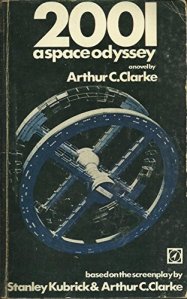 2001 A Space Odyssey
I first saw the film version of 2001 in the summer of 1968. I was only 11 at the time and I remember my Mum being surprised I had spent hours at the cinema on a lovely hot day. I watched the film in the huge movie theatre in Northenden, now a Jehovah’s Witness assembly hall. There were only a few people in the picture house that day and it was wonderful having this huge place almost to myself and seeing this incredible film in 70mm on the big screen. I recall being somewhat confused by it all, especially the jump from Neanderthal times to the future. I was so confused that I had to buy the novel by Arthur C Clarke which explained things in a way the movie did not.
The book is a wonderfully well written, plausible space adventure. It is about a mysterious monolith which appears on earth in Neolithic times and helps the ape men of the day to develop. Later, in the future, the mysterious monolith is found buried on the moon and when it is exposed to sunlight for the first time, it blasts off a signal to Saturn. Anyway, the scientists of the day decide that the monolith is part of some extra-terrestrial intelligence and set up a manned space mission to investigate. As the mission progresses, the onboard computer, HAL, decides to have something of a nervous breakdown which creates an unexpected hazard for the crew. All the technology that Clarke wrote about had its origins in science fact, both the space missions and the computer technology which make up the main parts of the story.
Verdict: The book is a wonderful read, one of the classics of science fiction.
The History of Mr Polly
This is not a science fiction story despite being penned by H G Wells. Our hero, Mr Polly finds himself in a very dull job with a very dull wife and resolves to commit suicide. Anyway, events unfold and instead of committing suicide, Polly accidentally starts a fire which threatens the whole street and he then mounts a brave rescue of an old lady. Instead of dying, Mr Polly becomes a hero and when the insurance money comes in, he leaves his wife, nicely settled with the insurance money, takes a little for himself and departs for pastures new. He sends some money to a post office in another village and gradually meanders in that direction, sleeping in fields and hedges, getting himself a tan. He works occasionally when he wants and sleeps when the mood takes him at other times.
He comes across the Potwell Inn and asks for work and right away finds himself at home. He potters about happily at the Potwell Inn, cleaning, serving and doing various odd jobs. One day the landlady’s nephew appears. He is a violent bully having been in and out of prison for years. He doesn’t like Mr Polly getting in the way so he decides to scare him off. What should Polly do, stay and help or just leave?
I first read this book many years ago and I’ve always liked its simple philosophy. If you don’t like your situation, change it says the author.
The History of Mr Polly is a lovely gentle read by a classic author.

My well thumbed copy of David Copperfield
David Copperfield by Charles Dickens.
I couldn’t tell you what my number one favourite book of all time is, but a strong contender must be ‘David Copperfield’ by Charles Dickens.
It’s a book written by a wonderful wordsmith and is rich in powerful and subtle images.
A lot of Dickens’ characters display their personal characters and traits through their names. Uriah Heep and Mr Murdstone for instance. Even when we are yet to be introduced to these fictional people we can understand a lot about them from the sound of their names. This is how Dickens works, giving us numerous hints and pointers to who these people are and what they are like.
James Steerforth though is something of an exception. He is my favourite character from within Dickens’ pages and he is neither a Heep nor a Murdstone; neither a Pickwick nor a Bumble. Apart from David Copperfield himself, he is the most human of Dickens’ creations. He is kind but can be unpleasant, caring and yet selfish, thoughtful but also unfeeling. In short, as Mr Micawber might say, he is full of human contradictions.
The best part in the book probably, for me at any rate, is the storm when David returns to Yarmouth. Dickens builds the storm slowly and each word and phrase adds a new layer to the sense of danger and foreboding and when Copperfield is finally reunited with his old friend Steerforth at the height of the storm’s ferocity, death comes between them and Steerforth is sadly drowned. Dickens reveals this in a unique way for he does not tell the reader Steerforth is dead. He leaves the reader to realise this themselves and in the process, makes the reader almost at one with the narrative.
Throughout the book, Dickens mentions in passing Steerforth’s habit of sleeping with his head on his arm. It’s referred to many times in the narrative almost as matter of non-interest. Something unimportant that the reader doesn’t really need to know, but when David Copperfield spies someone aboard a stricken ship trapped in the fierce storm who evokes some faint remembrance for him, a tiny warning bell is set off.
Finally, when the body of a drowned man is brought ashore and lies mutely on the sand, his head upon his arm, we know just from that simple bit of information, without the author telling us anything more, that Steerforth is dead. The prompts and clues that Dickens has hinted at have paid off for the reader in the most satisfying of ways.
I’ve returned to this wonderful book time and time again, to enjoy that unique almost religious feeling, that communion with the thoughts of a man who died in 1870, over a hundred and forty years ago, yet whose frozen thoughts live on in the pages of his books.
As long as people read books, Charles Dickens and his characters will live on.
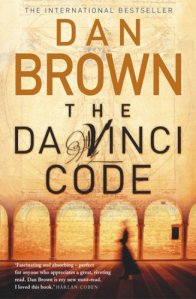 The Da Vinci Code
I thought I’d finish with this book, the Da Vinci code as it’s the most recent book in my selection. It was Dan Brown’s second book and it was a publishing sensation. It was the book everyone was reading and the book that you just had to read. It was also involved in some controversy as the writers of a nonfiction book the Holy Blood and the Holy Grail, claimed that Brown had pinched their ideas. The dispute ended up in court with Brown winning his case.
The book opens with the murder of a man named Saunière in the Louvre museum in Paris. Robert Langdon is called in to help with a cryptic clue left behind by the deceased. That and other clues lead Langdon on a chase to find the murderer, a monk named Silas. Silas works for someone known only as the Teacher and together they are on a quest to find the Holy Grail. Sir Leigh Teabing explains that the grail is not a cup but a tomb containing the bones of Mary Magdalene. Later Langdon discovers that Teabing is in fact the Teacher and he wishes to destroy the Catholic church by proving Jesus was married to Mary Magdalene.
For me this book was just an amazing read and one that I just couldn’t put down. I had also read the Holy Blood and the Holy Grail many years ago and Brown tips a nod to that book in many ways. One was naming his murder victim as Jacques Saunière who was a real individual in the Holy Blood, a man who took over a small church in the French region of Rennes-le-Château and one day became very rich. He had found something hidden in the church, perhaps it was gold, perhaps it was something to do with the mysterious Priory of Sion and their claim that Jesus and Mary produced a child who later became related to the Meringovian Dynasty of France.
Is it all true? I don’t know but Dan Brown has picked up these historical threads and woven it expertly into an unputdownable novel.
What to do next: Here are a few options.
Share this post on your favourite social media!
Hit the Subscribe button. Never miss another post!
Listen to my podcast Click here.
Buy the book! Click here to purchase my new poetry anthology.
Click here to visit Amazon and download Floating in Space to your Kindle or order the paperback version.
 Of course, as we are currently still in ‘lockdown’ due to the Corona Virus Pandemic, that hasn’t been possible but happily due to the nice weather, we’ve been able to drag ourselves into the garden and the fresh air.

 The Secret Life of Marilyn Monroe by J. Randy Taraborelli.
 My Turn by Norman Wisdom.
 Tricks of the Mind by Derren Brown.

 Once upon a time when I first started this web page, my whole focus was to promote my book, Floating in Space. Floating is a kitchen sink drama, something on the lines of Saturday Night and Sunday Morning, although not quite as good, but set in 1977. Those were the days; no Internet and no mobile phones. There were only a handful of TV channels. Jimmy Carter was the US President, Jim Callaghan was the UK Prime Minister and a pint of bitter was only 25 pence.
 It’s not always so easy to come up with a new blog post week after week. It’s even harder to find something extra special for my 300th post. Three hundred posts! I suppose to those of you who have been writing for years, 300 may not be such a big milestone but for an amateur writer like me, it’s pretty special. The crazy thing is this, a few weeks ago I was commenting on one of those online forums, praising WordPress and blogging and someone commented that if I hadn’t been blogging I might have finished my second book! Looking back I now wonder whether that guy was actually right. 300 blog posts, times my average word count per post: That comes to about 20,000 words. Yes, perhaps I could have written my next book. Then again, it’s not just the words, its the idea behind the words, the creative thrust of a book that’s important. Get that and the book should just follow. Still, that fellow had a point. Should I give up my blog posts in favour of my book? Well, if that would guarantee me producing a book then yes, great! The thing is, it’s not a lack of words that have kept my book in a constant state of unfinishedness (is that a word? If Norman Mailer can invent words then so can I.) It’s really my own laziness.
 It’s always a bitter-sweet experience when someone decides to make your favourite book into a film. It doesn’t always work out because maybe it was a big, thick, long book and they have cut out your favourite bit, or perhaps the cast wasn’t the one you imagined. It’s usually just the same in reverse. You see a great film and in the credits it says based on the book by so and so, then you rush out and get the book, and it turns out to be a little disappointing. Sometimes it’s even better than the film!
 The Film.
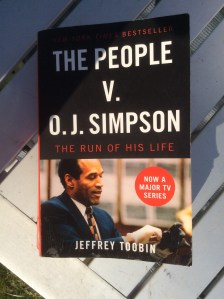
 re’s nothing I love more than a good book and as usual, here’s a quick round-up of the books I’ve taken on holiday to Lanzarote in the Canary Islands. As I’m flying I’ve not brought any hardbacks, just four paperbacks. All my books are usually sourced from the Internet or second-hand book shops but the ones below, with one exception, were gifts.
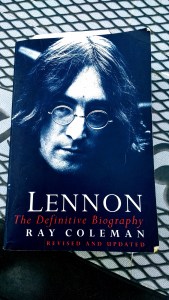 The writer has no time for music journalists who waxed less than lyrical about later Beatles’ records released in the last thirty odd years, things like The Beatles at the BBC released in 1994 or the Beatles Anthology. Reviewers who gave those records a poor reception get short shift indeed and the reader is quickly reminded of their chart topping sales. In their defence though pop music journalists tend to look forward to new music, not back to the old. More scorn is saved for Albert Goldman who wrote the book The Lives of John Lennon. Personally I thought that was rather a good book; it’s certainly more compelling than this one although it tends to focus on Lennon in a negative way whereas this book is very generous towards Lennon. It’s the book of a Lennon fan and focuses on the events in Lennon’s life in a very positive way.
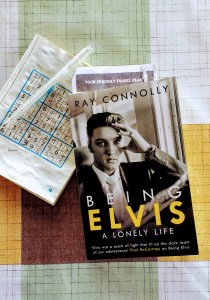 Subtitled A Lonely Life, this is a biography of Elvis Presley by another music journalist, Ray Coleman. Elvis became the King of Rock ‘n’ Roll who inspired Lennon, McCartney and a whole host of others to become musicians and pop stars. I’ve read quite a few biographies of Elvis, all much thicker than this one but this is a great holiday read being both interesting and informative. The foreword to the book was particularly insightful regarding the impact Elvis had on other musicians. The author recounts two phone calls, one to Bob Dylan and one to John Lennon where he happened to mention that he had been to Elvis’ 1968 comeback concert. Both those highly regarded stars bombarded Coleman with a series of questions about Elvis showing that despite their own success and achievements, they were still at heart Elvis fans.
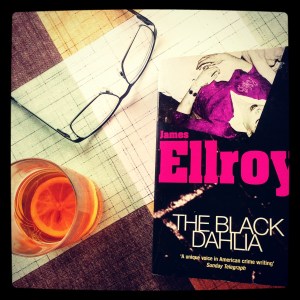 The Black Dahlia by James Ellroy.
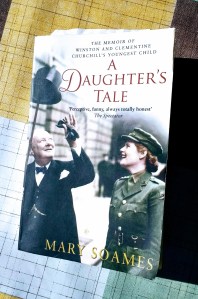 A Daughter’s Tale by Mary Soames.