Blog 703: Thoughts from a Sun Lounger

As usual Liz and I have left behind cold and unpleasant England for the much warmer climes of Lanzarote. We’re renting a place that we first found two years ago but were unable to rent last year as it was fully booked. This time Liz got in early and so here we are for four weeks. The villa is very comfortable with a great outlook, sunny on the patio all day and it has a great pool and comfy outdoor couches.

For our first night out we went along to the Gourmet Indian Restaurant where we had so much fun last year with the staff. We were rather surprised to find that this year, all the staff that had made us so welcome had now left. That is probably the same in restaurants the whole world over. Staff come and go but happily, the new staff, especially our waitress were fun and friendly and the food was just as superb as it was previously.

Last year’s Indian restaurant staff, sadly missed

Another favourite of ours is the Café Berrugo down in the Marina Rubicon. The manager Juan greeted us as warmly as usual. Last year the food wasn’t quite as good as it normally is so I wasn’t sure what to order but anyway, we went for five tapas dishes and they were all excellent, so much better than our last visit. Perhaps the café has gained a new chef during our absence, anyway, we were really impressed and happy and Juan gave us an extra shot of vodka caramel, a drink I don’t think I’ve had anywhere else except Lanzarote.

The interesting thing is that a few months back I was writing about a run of bad meals and I have to say, I much prefer this, a run of lovely meals.

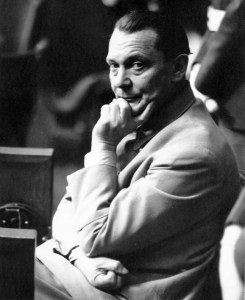
Before we left the UK we switched on our Sky box and I was pleasantly surprised to see the film Nuremburg available to watch. I was surprised because it was only on at our local cinema a few weeks previously and it was something I wanted to watch. So, we poured ourselves a glass of wine and settled down to watch. The film is the story of the Nuremburg trials held in Germany after the Second World War. Hermann Göring, played in the film by Russell Crowe, is the most prestigious prisoner in the dock. He was the number 2 in the Nazi government until the last few days of the war when Hitler, incensed by a telegram from Göring in which he asked permission to take over the Reich, ordered his arrest.

By Charles Alexander, Office of the United States Chief of Counsel – Harry S. Truman Library & Museum, accession no. 72-911 (Retrieved 2017-04-26), Public Domain, https://commons.wikimedia.org/w/index.php?curid=161339177

Even so, when Göring handed himself over to the Americans, he was perhaps thinking of the events of the First World War when the Kaiser abdicated and fled Germany and left others to run the country in defeat. Göring, perhaps thought that he was the man to take over Germany in this new defeat. Things would not turn out that way however and Göring, amongst many others, was to be put on trial for crimes against humanity.

The film is based on the story of Douglas Kelley, a psychiatrist who was tasked with examining the nazi prisoners with a view to determining whether they were competent to stand trial. Kelley also tried to get to the bottom of the nature of the evil they had practised. His theory was that they were just ordinary men rather than particularly evil men.

Kelley is played in the film by Rami Malek and the film focusses on his relationship with Göring. It was a good film though for me not in any way outstanding although Russell Crowe’s performance was excellent, I don’t think Malek’s portrayal was in the same class.

To be honest I remember a similar film, perhaps a made for TV film from some years ago which was much superior. I think it was a two part mini series also titled Nuremburg starring Alec Baldwin as supreme court justice Robert Jackson and Brian Cox as Göring.

Göring of course commits suicide rather than be hanged and in the mini series, they made much of the relationship between Göring and his American guard. Did the guard slip Göring a cyanide capsule with which to evade the hangman’s noose? It was probably more likely that Göring had it concealed all along. He was a charismatic character but at the end of the day, he went along with Hitler like many others.

Before leaving for Lanzarote, one of my friends asked me how many books I would be taking along to read. I wasn’t sure at the time but at least four I thought. So, she answered, we can expect another Book Bag post then! There will be a Book Bag post but to carry on from Nuremburg, I was surprised to see it on Sky cinema so soon after its theatrical release. I thought it might have been a Sky original production but it wasn’t so I was even more surprised to see it on Sky so soon.

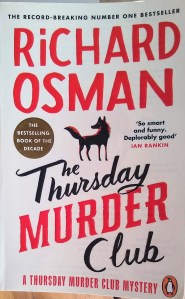
Another film I watched recently on Netflix was the Thursday Murder Club. Again, it was on TV very soon after its cinema release, in fact I think it was actually a Netflix production. I enjoyed the opening part of the film but then lost interest somewhere around the middle. I might have picked up my iPad and started surfing and then got interested again towards the end. It was a good film with an impressive cast and its one that I should watch again and perhaps pay more attention to the next time.

It just so happens that I picked up the book to read here in Lanzarote. It’s written by Richard Osman who is more famous as the frontman on the BBC’s Pointless quiz show as well as various other TV shows. The book and film are about a group of people in a retirement village who meet to discuss cold case crimes but then find a murder committed on their very doorstop. The group of mostly eighty year olds then get on with the task of solving the murder. There seem to be a lot of things going on and a great deal of characters to remember which put me off a little at first but a great device used by the writer is having alternate chapters written as diary entries by Joyce, one of the club members. She goes over the past events, adding in details of her own life along the way, talking about her neighbours and daughter amongst other things and sometimes previewing the next chapter for us.

It’s a very original and witty book and even though I’m only half way through I’m already thinking about getting the follow up book. One minor complaint though, there is a large cast of characters and things do get complicated making it not always easy to follow.

You might have seen some horror stories on the internet and social media about Lanzarote lately. I’ve seen so many posts about the dreadful weather and the rain. OK, there has been rain, quite a lot of it which is pretty unusual for Lanzarote. The thing is, when it rains back home in Manchester, it tends to rain and rain and get pretty cold at the same miserable time. Here in Lanzarote, it rains for about five minutes and then the sun comes out and dries everything. It might get cloudy again and we might have another five minute shower but it soon slips away and despite what you may have heard, Liz and I have spent each day out on the patio swimming and sunbathing and occasionally moving our towels away from the edge of the patio canopy when the rain showers have encroached a little too close.

Now, time for another read or should I do a few more laps in the pool? Decisions, decisions . . .


What to do next: Here are a few options.

Share this post on your favourite social media!

Hit the Subscribe button. Never miss another post!

Listen to my podcast Click here.

Buy the book! Click here to purchase my new poetry collection.

Click here to visit Amazon and download Floating in Space to your Kindle or order the paperback version.

Click here to visit amazon and purchase Timeline, my new anthology.

8 Random Films: Can you Guess the Connection?

I’ve done a few of these posts where I connect one film to another through either the actors or directors or other random things. This week I’m going to talk about two groups of four films and see if you the reader can guess what links them together. I’m hoping this might be a bit of a challenge, even for the most ardent film fans but anyway, here we go.

Top Hat

Top Hat was a film produced in 1935 and starred Fred Astaire and Ginger Rogers. It is one the great song and dance musicals of all time. The premise of the film is just Astaire following the girl of his dreams, Ginger Rogers, across Europe but the story is just background to the wonderful songs of Irving Berlin. Two stand out favourites are Cheek to Cheek and Top Hat, White Tie and Tails. The film was directed by Mike Sandrich who also directed 5 of Rogers’ and Astaire’s films.

Together Astaire and Rogers made 5 films together but the most successful was Top Hat.

Red River

One of my favourite westerns, Red River stars John Wayne and Montgomery Clift who have to drive a shed load of cattle from Texas to Missouri. There’s a great moment when Wayne says to Clift ‘Take ‘em to Missouri Matt!’ and the cattle drive begins. The film was produced and directed by Howard Hawks way back in 1948. Taking a quick look on Wikipedia, it was interesting to find that there were various versions of the film but the original theatrical cut was reassembled by Janus films in 2014 for the DVD release.

Singin’ In the Rain

This is another film classic, perhaps even the ultimate Hollywood musical. Released in 1952 it is set in the 1920s and stars Gene Kelly, Debbie Reynolds and Donald O’Connor. The film has some hugely famous scenes, like that unforgettable opening number where Gene Kelly splashes through puddles and sings the title song. It’s also got a super fun storyline about the transition from silent films to “talkies”. The film was directed and choreographed by Gene Kelly and Stanley Donan.

The Shining

This was a film directed by Stanley Kubrick based on the book by Stephen King. King apparently hated the film which is why he went on to produce another version years later. The film stars Jack Nicholson who gives an eerie performance as author Jack Torrance. The plot revolves around the Overlook Hotel which closes during the winter as the location becomes inaccessible due to heavy winter weather. Jack and family are chosen as caretakers to look after the hotel until it reopens in the spring. Throw in a child who ‘shines’, that is to say able to communicate with the spirit world and an evil spirit who apparently takes over Nicholson’s character and you have a pretty terrifying film.

The film was actually shot in the UK at Elstree studios although a second unit did some exterior shots in the USA. At Elstree huge sets were built to represent the interior and exterior of the hotel.

A famous scene involves Jack chopping through a door to reach his wife played by Shelley Duvall. The scene was originally shot with a fake door but Nicholson who was a former firefighter in the national guard chopped through it too quickly and so a thick solid door had to be used.

Kubrick demanded numerous takes of many scenes and Shelley Duvall in particular argued with Kubrick about retakes, dialogue and her acting style.

Ok that’s the first of four films I want to talk about. Any idea of the connection? Let me carry on with a second group of four films and the connection might finally become clear.

The Last Picture Show

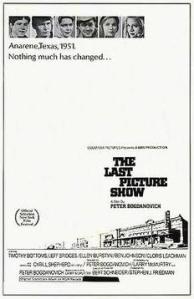
Another modern classic. This film was directed by Peter Bogdanovich and is set in a small town in northern Texas in the early 1950s. The film has an ensemble cast but the two main characters are Sonny and Duane played by Timothy Bottoms and Jeff Bridges. The two are teenagers and old friends and various things happen to them. They fall out over a girl called Jacy played by Cybill Shepherd. Ben Johnson plays ‘Sam the Lion’ who owns the bar and cinema in the town. Sam has a mentally disabled son who Sonny has befriended. Various things happen to the pair but towards the end of the film Duane enlists in the army and is due to leave town so the pair decide to visit the town cinema for the very last picture show as the cinema is about to close after Sam’s sudden death.

Crimes and Misdemeanours

This is one of Woody Allen’s darker films. There are many interlocking stories but the central theme involves Judah Rosenthal played by Martin Landau who has an affair with a woman played by Anjelica Huston. The woman -Dolores- is threatening to confront Judah’s wife and Judah, desperate to save his marriage isn’t sure what to do. He asks his brother, a gangster and he recommends violence and even murder. Other stories include a rabbi facing blindness and on a lighter level, Woody plays a documentary film maker who falls for a woman played by Mia Farrow. She in turn is romanced by Alan Alda, playing a TV producer, who Woody’s character despises. It’s one of my favourites of Woody’s films but don’t expect too many laughs.

The Green Mile

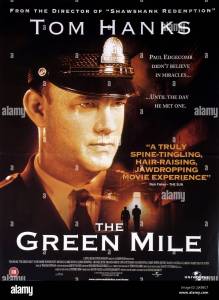
Like The Shining, this is another film based on a book by Stephen King. Tom Hanks plays the head of a death row section of an American penitentiary. One of the inmates is John Coffey, a huge black man who appears to have healing powers. He cures Tom Hanks’ bladder infection but the mood in death row is not good after sadistic Percy Wetmore joins the team and deliberately sabotages the execution of another inmate causing the prisoner to die in terrible agony. The warden’s wife is terminally ill and Hanks and his team wonder if John Coffey could cure her.

Twister

Twister is a disaster film made in 1996 which stars Helen Hunt and Bill Paxton as storm chasers. They and their team are trying to get first hand information about tornados and cyclones. The two are separated and are about to divorce but together they are in competition with another group of storm chasers. The special effects are good and I’ve always found it to be a hugely entertaining film.

Ok. That’s my final four films. Are you any the wiser? Do you have the connection yet?

Here’s the answer, the first four films were all featured in the second four films.

In The Last Picture Show the town’s small cinema is about to close down and Duane and Sonny pay a visit to see Red River.

In Crimes and Misdemeanours, Woody Allen’s character Cliff Stern invites Helley Reed played by Mia Farrow to watch Singing in The Rain on his editing machine while they eat a take away curry.

In The Green Mile, the story is told in flashback and Tom Hank’s character Paul, who was cured of the bladder infection is now 108 years old. He watches the film Top Hat and tells the story of John Coffey to his friend Elaine.

In Twister, the team of storm chasers relax and stop at a garage area. By the garage is a drive in theatre and the team enjoy snacks and coffee while the picture is playing. A storm begins to approach and strong winds quickly develop. What film was playing? Stanley Kubrick’s The Shining. The theatre is destroyed just as Jack is chopping through the door in The Shining’s most famous scene.

They were my film connections for this week. Hope you enjoyed reading and tune in again next Saturday for another post.


What to do next: Here are a few options.

Share this post on your favourite social media!

Hit the Subscribe button. Never miss another post!

Listen to my podcast Click here.

Buy the book! Click here to purchase my new poetry collection.

Click here to visit Amazon and download Floating in Space to your Kindle or order the paperback version.

Click here to visit amazon and purchase Timeline, my new anthology.
Another Film Connections Post

It’s only the end of November as I write this but in January, Liz and I will be off to Lanzarote once again to escape the cold and wintry UK. I do love the laid back (and warm) atmosphere in Lanzarote and as usual I’ll be taking a stack of books to keep me occupied while I laze about on my sun lounger in-between dips in the pool.

The other day I popped on the TV to find one of the James Bond films showing. It was Casino Royale, the film version of the very first book in the Bond series and I thought about popping my copy of the book into our suitcase with an idea of re-reading the entire series of James Bond novels. Of course knowing me I’d probably leave the book over there and that would be my tidy collection of Ian Fleming 007 novels ruined.

Fleming did a lot of his writing in a small house he owned in Jamacia which happened to be not far from another house which Noël Coward used to own. Back in WWII, Coward had the idea of making a film about the Royal Navy and so he wrote a screenplay for a film titled ‘In Which we Serve.’ It was the story of a ship. The ship is engaged in battle and is sunk and as the survivors hang on to lifeboats and debris, their thoughts meander over their past lives and the story of the ship is told in flashbacks.

It’s a very good film inspired by the story of an actual ship, HMS Kelly, which was commanded by Lord Mountbatten and Coward was justifiably proud of the finished result. He stars as the captain of the ship and along the way there are various notable British stars, some of them making their film debuts. Coward realised he needed someone to help him with the technical aspects of the film so he asked film editor David Lean to help him direct the film. Lean was happy to do so. Coward asked what sort of a credit would he want and Lean answered that he felt the film should be credited as being directed by Noël Coward and David Lean. Coward wasn’t sure about this but he agreed and the filming began with Coward dealing with the actors and Lean dealing with everything else. Lean mentioned in an interview that Coward soon got bored with directing and pretty much left the whole thing to David.

David Lean went on to have a long career as a film director and made a number of huge epics. One of them was a controversial film called Bridge over the River Kwai. This was about British prisoners of war who were forced in very inhumane conditions to build a railway through the Burmese jungle. Alec Guinness plays the senior British officer who feels that building the bridge will restore British morale and undertakes to build it to the very highest standards.

One of the prisoners decides to escape and with a great deal of luck he makes it to the British lines. He is then approached by another officer played by Jack Hawkins and asked to return to the jungle and help blow the bridge up. Many veterans of the war in Asia were very unhappy about the film as the true horror of the cruelty and deprivations unleashed against the POWs was not properly depicted.

Alec Guinness and William Holden were the stars of the film and third on the billing was Jack Hawkins. Hawkins was one of the leading  stars of British cinema in the 1950s. During the war Hawkins served in the army and when he returned to civilian life in 1946, he was soon acting on the stage. With a pregnant wife he became concerned about his future and so accepted an offer to become a contract star for Alexander Korda. He really became a star after a performance in Angels One Five, a film about an RAF station in the war. Another hit was Mandy where he played a sympathetic teacher of deaf children.

In 1953 he starred as a naval captain in The Cruel Sea. The film starts off at the beginning of World War 2 when the Jack Hawkins character is at the builder’s yard helping with the fixing up of his new escort ship, Compass Rose. His officers begin to arrive, many of whom are easily recognisable as stalwarts of the 40’s and 50’s British film industry: Donald Sinden, Denholm Elliot and Stanley Baker and later in the film Virginia McKenna appears as an officer in the WRNS.

The cast and characters are therefore introduced and then the ship goes off to war, protecting the many convoys of merchant ships, bringing the supplies so desperately needed by Britain. It’s one of the great war films of all time.

Two of my personal favourite films starring Hawkins were The Intruder, a great film in which Hawkins plays a former military officer who discovers a past member of his old tank regiment robbing his flat. He determines to find the man again and the story is told in flashback as he interviews a group of his former officers and men.

The other was The Long Arm in which we see how Scotland Yard worked back in 1956. Card files, books of fingerprints and albums containing mugshots, all of which had to be laboriously checked by hand. Some great detective work finally manages to nail the villain.

Hawkins was the epitome of the trustworthy British authority figure. In his obituary one writer wrote that Hawkins ‘exemplified for many cinemagoers the stiff upper lip tradition prevalent in post war British films. His craggy looks and authoritative bearing were used to good effect whatever branch of the services he represented.’

Hawkins himself was a three pack a day smoker and later became ill with throat cancer. In 1966 his entire larynx was removed however he was still able to appear in films with his dialogue dubbed by either Charles Gray or Robert Rietti. In the film Young Winston, he has hardly any dialogue at all.

Jack Hawkins died on the 18th July 1973. He was only 62 years old.

As I mentioned, Charles Gray was one of the actors who dubbed dialogue for Hawkins in later life. It must have been a difficult task because Hawkins has one of the most memorable voices in British cinema. Who was Charles Gray? Well you might not remember the name but Gray played one of cinema’s most notorious villains, Ernst Stavro Blofeld in the 007 film Diamonds Are Forever.

Charles Gray (Picture courtesy James Bond Movie Encyclopedia)

Diamonds Are Forever was the follow up film to On Her Majesty’s Secret Service. In that film George Lazenby had taken over the role of 007 from Sean Connery. Personally, I thought he was a great Bond but George himself was not popular with the producers. After the shoot was over he had grown his hair long and was sporting a beard. The producers wanted someone who could promote the 007 image even in their private life. Later Lazenby’s agent began to feel that the Bond franchise was finished and Lazenby decided against making another Bond film. What could the producers do? Well their knee jerk reaction was to offer Connery a large sum of money to return to the role. Connery agreed to play Bond one more time, banked a huge amount of money and pretty much appeared to sleep walk through the film.

Charles Gray played Blofeld who has taken over a huge empire run by the mysterious millionaire Willard Whyte and he plans to create a powerful laser using diamonds.

Who was the author of Diamonds Are Forever? None other than Ian Fleming of course, bringing our connections full circle.


What to do next: Here are a few options.

Share this post on your favourite social media!

Hit the Subscribe button. Never miss another post!

Listen to my podcast Click here.

Buy the book! Click here to purchase my new poetry collection.

Click here to visit Amazon and download Floating in Space to your Kindle or order the paperback version.

Click here to visit amazon and purchase Timeline, my new anthology.

Ridley Scott in 4 Films

Ridley Scott was born in South Shields, England, in 1937. He studied at West Hartlepool College of Art and later at London’s Royal College of Art, where he first began experimenting with film. While there, he contributed to the school’s magazine ARK and made a short film, Boy and Bicycle (1962), featuring his younger brother, Tony Scott.

After graduating, Scott joined the BBC as a set designer and director, working on popular series such as Z Cars and The Troubleshooters. His time in television taught him the mechanics of production and in 1968, he left the BBC to establish Ridley Scott Associates (RSA), a commercial production company. Over the next decade, he directed hundreds of adverts, developing a style of lighting, atmosphere and composition, qualities that made his transition to cinema with The Duellists (1977) both natural and visually striking.

Scott is a prolific film maker and has created some classic films. I have to say there are many of Scott’s films that I haven’t seen so in this post I’ve focussed on four particular films that I have seen and enjoyed.

Alien

Alien is a really different kind of sci-fi film. It’s not Star Trek or Star Wars and it’s not littered with sci-fi terminology. It’s a very slow burning earthy film about a spacecraft on its way back to earth with a payload of something, I’m not sure what. On the way back home, the crew are awakened from hibernation to find that the ship’s sensors have detected a beacon which maybe some sort of SOS and the company regulations state this must be investigated. Next thing we’re down on a hostile planet and one crew member has been hit in the face by some kind of creature which has attached itself to his face. Later it falls off and all is ok except that something is growing inside the crewman which bursts out of his chest in a horrible spectacular scene and suddenly, an alien creature is onboard.

It is all done really well and one by one the crew fall victim to this creature in the dark confined spaces of the ship. It’s sci-fi mixed with horror and the only survivor turns out to be Ripley played by Sigourney Weaver. Ripley is a sort of female John McClane, the Bruce Willis character from the Die Hard films. Weaver creates a really memorable character which was revived in various sequels but the real core of the film and the scene everyone remembers is probably that gruesome scene when the alien bursts out of John Hurt’s chest. Apparently, Ridley Scott didn’t tell the actors what was about to happen so the shocked faces on the actors are all really authentic.

Some years later, Scott decided to revisit the franchise with two prequel films. Both were dismal in my opinion but it makes me wonder why was Alien so good and Prometheus and Alien Covenant so bad? The effects in those two latter films were good but perhaps the actors weren’t as good as Sigourney Weaver, John Hurt and Ian Holm and the other crew members in the original, or is the classic chest buster scene so burned into cinematic lore that it can’t be topped?

The Martian

The Martian is surprisingly similar to that old film Robinson Crusoe on Mars in many ways. The crew of a Mars mission is on the surface when a major dust storm threatens to topple over their space vehicle. The crew decide to abort the mission and take off but one crew member is hit by debris and presumed dead and they leave him behind. Later, Mark Watney played by Matt Damon, awakes from unconsciousness in the desert and makes his way back to the martian base camp. The bio-data telemetry from his space suit had been damaged and so made mission control assume that he was dead. Now the martian base camp is pretty basic and although it has computer stations and food and water and so on, there is no communication to earth. The next mission is not due for four years so Watney must find a way to survive until then on the camp’s meagre supplies.

He decides to make part of the camp into an area where he can plant some potatoes and hopefully produce more food. Just like in Crusoe, Mark Watney keeps us interested in what is happening by recording his thoughts in a video diary. Not only that but back on earth, observatories notice the activity taking place on Mars and realise he is still alive.

Still unable to communicate with earth the marooned astronaut decides to dig up an old space probe, drag it back to base, plug it into a power cable and use it for communication. I won’t ruin everything for you by telling you the whole story but again, if you like sci-fi and perhaps even if you don’t, this is such a well made and enjoyable film and is well worth watching. The visual look of the film is great and the director manages to keep the viewer interested despite the fact that for much of the time there is only Matt Damon up there on the screen.

External scenes of Mars were filmed in Wadi Rum in Jordan and NASA decided to collaborate with the producers as they saw the film as promoting real space exploration. The author of the book which the film was based on was Andy Weir who tried to be as scientifically accurate as possible, researching orbital mechanics and the planet Mars as well as botany, all elements which interested Ridley Scott.

A Good Year

One of the great things about Ridley Scott is that not only is he a prolific film maker, he doesn’t just stick to one particular genre. The first time I saw this particular film I would never have guessed that it was a Ridley Scott film. It’s based on a book by Peter Mayle who wrote the wonderful A Year in Provence. Scott had wanted to make a film in Provence as he owned a house in the area. Peter Mayle was approached to write a screenplay but he declined but decided to write a novel and for Scott to buy the film rights and have a screenplay written based on the book. The screenplay was written by Marc Klein and both the book and the film incorporated some of Ridley Scott’s own ideas. The basic story is about a London stockbroker who inherits a property in France belonging to his late uncle. The stockbroker, Max, played by Russell Crowe, goes back to France and after a while begins to fall for the old place again. A gorgeous local waitress plays a large part in his feelings too. His late uncle is played by Albert Finney and his scenes are all shown in flashback.

I have to say I didn’t like this film the first time I saw it. I thought the flashback scenes were confusing because I didn’t realise they were flashbacks at first. I didn’t like Russell Crowe and thought he was miscast. I feel the role was more something perhaps Hugh Grant could have played effortlessly. Over time though I’ve warmed to this film and now it is one of my absolute favourites.

Gladiator

This is a film which really revived the kind of classic epics that Hollywood and directors like David Lean used to make. It’s a really fabulous film with these huge set pieces set in the Roman arena, beautifully photographed and acted. It concerns Russell Crowe as a Roman general, Maximus Decimus Meridius who Marcus Aurelius decides to nominate as his successor as emperor of Rome. Unfortunately, Marcus dies at the hand of his son, Commodus who quite fancies being emperor himself. Commodus has Maximus arrested and sentenced to death but Maximus fights off his executioners and escapes. He returns home to find his family murdered. Various events then see Maximus become enslaved and later a gladiator determined to seek revenge.

One of the main characters was played by Oliver Reed who died during the production. During a break from filming in Valletta, Reed had encountered a group of Royal Navy sailors and challenged them to a drinking match. He suffered a heart attack in the bar and died in an ambulance en route to the hospital.

His role had not been completely filmed and so a body double was used in some shots and in one scene Reed’s face was digitally inserted into the film. I have Gladiator on DVD so I thought I’d give it a watch just to refresh my memory. Gladiator was just as good as I remembered and the secret of the film, for me at any rate, is that even though this is a great epic in the same tradition as David Lean’s later films, at its core is a very human story about a man betrayed who longs to be reunited with his murdered family which makes his death a sort of victory.

Other Films

I could of course have mentioned many other classic Ridley Scott films. Thelma and Louise is one I have seen. I always thought it was a good film, nothing less and nothing more but watching a TV show on Sky Arts not long ago the reviewers thought it was a work of genius. It was certainly new in that it was a road movie featuring two women rather than two men. Blade Runner is another classic sci-fi drama directed by Scott and I look forward to the day I see it listed on my TV schedule.

Scott directed Hannibal, the follow up to Silence of the Lambs which I thought was a little gruesome and so apparently did Jodie Foster who declined to reprise her role as FBI agent Clarice Starling.

All the Money in the World was a pretty good film which was about the kidnapping of J Paul Getty’s grandson and his refusal to cough up a multi million pound ransom. Interestingly Kevin Spacey played Getty but after allegations of sexual misconduct Scott cut Spacey from the film and asked Christopher Plummer to play Getty,  calling for some last minute refilming of parts of the film.

I was hoping to see Ridley Scott’s Napoleon at the cinema but these days films seem to have such a short cinema showing. It doesn’t seem to be streaming anywhere so I’ll just have to look out for the DVD.

What are your favourite Ridley Scott films?


What to do next: Here are a few options.

Share this post on your favourite social media!

Hit the Subscribe button. Never miss another post!

Listen to my podcast Click here.

Buy the book! Click here to purchase my new poetry collection.

Click here to visit Amazon and download Floating in Space to your Kindle or order the paperback version.

Click here to visit amazon and purchase Timeline, my new anthology.


Favourite Directors: (Part 5) Billy Wilder

One of my favourite stories about Billy Wilder goes like this. One day, late in his career, he arrived at a Hollywood studio to pitch a new idea to a producer. The producer turned out to be a young man who clearly didn’t know much about classic cinema. He told Billy that he wasn’t familiar with his work and could he perhaps run through a few of his films for him.
Billy looked at the man and said, “Fine, after you . . .”

I’m betting that whatever this guy had produced it couldn’t compare with Billy’s dazzling line-up of classic films.

Billy Wilder was born in 1906 in Sucha Beskidzka, a town now in Poland but then part of the Austro-Hungarian empire. Billy was born Samuel but his mother had been to America and seen Buffalo Bill’s Wild West Show. She enjoyed it so much she decided to nickname her son Billy. The family later moved to Vienna, where his father Max tried his hand at various business ventures, including being part-owner of a hotel-restaurant.

The young Wilder developed a taste for sharp observation early on. He worked as a newspaper reporter in Vienna and was very keen on jazz. His articles about bandleader Paul Whiteman led to an invitation to follow the band to Berlin and Billy decided to stay on as a freelance reporter. Berlin in the 1920s was alive with ideas, cabaret, and cinema and Wilder soaked it all in. He began to mingle with people from the German film industry and soon moved into screenwriting.

Wilder received screen credit for 13 films produced in Germany between 1929 and 1933, but his promising career in Berlin was cut short. In 1933, the Nazis came to power. That year his father died and Wilder arranged for him to be buried in a Jewish cemetery in Berlin. With Hitler consolidating power and Jews being targeted, Wilder realised he had no future in Germany. After the Reichstag fire, he fled to Paris. There, he continued screenwriting and even co-directed his first film, Mauvaise Graine (1934). Shortly afterwards, he sold a script to Columbia Studios in Hollywood, and with that invitation he sailed for America.

Breaking into Hollywood

Wilder’s early days in Hollywood weren’t easy. His English was poor and he shared an apartment with fellow émigré Peter Lorre and made ends meet by hustling for work.

What Wilder did have though, was persistence and wit. He began writing screenplays with Charles Brackett, a more established writer with fluent English. The Wilder-Brackett partnership became one of the most productive in Hollywood, blending Brackett’s sophistication with Wilder’s bite. Together they worked on hits such as Ninotchka (1939), a satirical comedy famously marketed with the tagline: “Garbo Laughs!”

That success cemented Wilder’s reputation and he began to move from writing into directing. He felt screenwriters were too often mistreated by directors and the only way to protect his work was to get behind the camera himself.

Wilder the Director

Wilder’s breakthrough as a director came with Double Indemnity (1944), a dark tale of lust, greed and murder. Co-written with Raymond Chandler, the film became a defining example of film noir. Wilder used shadows, venetian blinds and Los Angeles locations to give the story a hard-edged realism. It was controversial at the time—Barbara Stanwyck plotting insurance fraud and murder was considered scandalous—but it became a critical and commercial success.

From there, the hits kept coming. Wilder had an uncanny ability to move between genres: crime thrillers, social dramas, romantic comedies and biting satires. His motto was “If you’re going to tell the truth, be funny or they’ll kill you.”

In The Lost Weekend (1945), Wilder tackled alcoholism with unflinching honesty. The film, starring Ray Milland, was one of the first Hollywood movies to show addiction as a serious disease rather than a comic weakness. It won four Academy Awards, including Best Picture and Best Director.

Then came Sunset Boulevard (1950), perhaps Wilder’s masterpiece and my personal favourite of Wilder’s films. The film begins with a dead man floating in a swimming pool, narrating his own murder—a narrative device that was bold, even shocking at the time. Gloria Swanson’s portrayal of fading silent film star Norma Desmond gave us one of cinema’s most haunting lines. Writer Joe Gillis played by William Holden is trying to get away from two guys who want to repossess his car. To evade them he drives into what he thinks is an abandoned mansion. He is surprised to find it occupied by the once famous silent film star Norma Desmond played by Gloria Swanson. He recognises her and comments “You used to be in silent pictures. You used to be big.” Norma replies, “I am big. It’s the pictures that got small.” The movie was both a scathing satire of Hollywood and a deeply human tragedy. It’s also interesting from a lot of angles; we see the famous Schwab’s drug store, once a Hollywood icon but now gone. Director Cecil B DeMille plays himself and when we see Joe and Norma spending an evening watching her old films, they are actually Gloria Swanson’s old films and one was directed by none other than Erich Von Stroheim who plays Norma’s butler and former husband.

Comedy with an Edge

Although Wilder made some of the darkest films in Hollywood, he was equally skilled at comedy. In fact, many of his comedies remain among the most beloved of all time. Some Like It Hot (1959) paired Jack Lemmon and Tony Curtis as musicians on the run, disguising themselves as women in an all-female band. Add Marilyn Monroe to the mix and you had comedy gold. The film was outrageous for its time and famously ends with Joe E. Brown’s immortal line, “Nobody’s perfect.”

Marilyn tested both Wilder and her co stars as she was notoriously late and struggled with her lines. One infamous scene required 47 takes and all Monroe had to say was ‘it’s me, Sugar’. Wilder wasn’t happy because Marilyn wanted to change scenes and dialogue which he didn’t want to do. The final result though was a classic comedy.

The film’s closing line, “Well, nobody’s perfect”, is ranked 78th on The Hollywood Reporter list of Hollywood’s 100 Favourite Movie Lines and Wilder’s tombstone pays homage to the line with the inscription, “I’m a writer, but then, nobody’s perfect”.

Two years later, Wilder directed The Apartment (1960), a film that managed to be both romantic and cynical. Jack Lemmon plays an office worker who lets his bosses use his apartment for their affairs, only to fall for Shirley MacLaine’s elevator operator. The film mixes laughter with melancholy, revealing Wilder’s genius for blending tones. It won five Academy Awards, including Best Picture, Best Director, and Best Screenplay.

Wilder also directed Sabrina (1954), with Audrey Hepburn caught between Humphrey Bogart and William Holden, and The Seven Year Itch (1955), which gave us the iconic image of Monroe’s skirt billowing over a subway grate. He seemed to have a knack for capturing cultural moments while keeping his characters grounded and relatable.

Wilder’s Style and Legacy

What made Billy Wilder so special? Partly it was his range. Few directors could move from the bleak cynicism of Ace in the Hole (1951), a savage attack on media exploitation, to the screwball energy of Some Like It Hot. He didn’t stick to one style or genre; instead, he reshaped them.

His dialogue sparkled with wit, but underneath there was always truth. Wilder had an outsider’s eye—he never forgot that he was an immigrant looking at America with both fascination and scepticism. His characters often chase the American dream but collide with its hypocrisies and disappointments.

Wilder also had a reputation for precision. He was meticulous with scripts, often refusing improvisation. “You have to have a dream so you can get up in the morning,” he once said, “but dreams don’t last long.” His films carried that same bittersweet edge.

By the end of his career, Wilder had won six Oscars and left behind a body of work that filmmakers still study. When asked how he wanted to be remembered, he reportedly quipped: “I’m a writer, but then nobody’s perfect.

The Final Word

Billy Wilder died in 2002 at the age of 95. He had outlived most of his contemporaries and watched Hollywood change beyond recognition. Yet his films remain fresh. Watch Sunset Boulevard today, or Some Like It Hot; both are hugely entertaining.

So, when that young producer asked Wilder to list his films, he was showing his ignorance of a screen legend. His legacy speaks louder than any pitch meeting. And the truth is, even if “nobody’s perfect,” Billy Wilder came pretty close.


What to do next: Here are a few options.

Share this post on your favourite social media!

Hit the Subscribe button. Never miss another post!

Listen to my podcast Click here.

Buy the book! Click here to purchase my new poetry collection.

Click here to visit Amazon and download Floating in Space to your Kindle or order the paperback version.

Click here to visit amazon and purchase Timeline, my new anthology.

My Early Life: The Book, the Film and the Soundtrack Album

I first read My Early Life by Winston Churchill many years ago. I picked up a paperback copy which tied in with the release of the film version and also along the way I got hold of the soundtrack album and later a VHS copy of the film. In this week’s blog I thought I’d take a closer look at all three.

Rooting around in a secondhand shop in St Annes recently I picked up a hardback copy of Winston Churchill’s book My Early Life. It’s a thoroughly wonderful book written in Churchill’s inimitable style. He says in the introduction he has written a book about a vanished age and indeed he has. Churchill was born in 1974 at Blenheim Palace in Oxfordshire. He was the son of Lord Randolph Churchill who was in turn the son of the 7th Duke of Marlborough. His mother was an American, Jennie Jerome, the daughter of an American businessman. She married Lord Randolph and became Lady Churchill.

Lady Churchill was a great influence on his life although in his very early years young Winston looked to his nanny, Mrs Everest, for motherly support. His father, Lord Randolph, was someone whom Winston loved and adored but never seemed to become close to. After the birth of Winston, Randolph began to suffer a debilitating disease which could have been syphilis. Others have speculated it was a brain tumour. Either way, Randolph died in 1894.

Looking back, I must have seen the film version before I read the book. Young Winston was directed by Richard Attenborough and is a wonderful adaptation of the book. When Winston first attends school, which of course was boarding school, his headmaster was played by Robert Hardy and he directs Winston to learn some Latin. Winston doesn’t do very well and the headmaster glares down at him and informs him that if he misbehaves, he will be punished, which to a great extent was Churchill’s overall view of school. Later he comments about exams ‘they always contrived to question me about things I didn’t know. I would much rather they asked me about things I did know.

In the book Winston records his schooldays with a great deal of charm and humour. He goes on to attend Harrow and as he intends to join the army goes to special army classes.  Winston seems to have enjoyed his army training and was keen to see action. He took leave with a friend and went to observe events in Cuba where revolutionaries were fighting their Spanish colonial rulers.

Winston was a second lieutenant in the 4th Hussars and spent a long time in India. He was a great lover of polo and he and his colleagues won an inter service championship in their first year in the country, a feat never achieved before by a recently arrived regiment.

Churchill was keen, as I said before, to see action and joined Bindon Blood’s Malakand Field Force and later wrote a book about the campaign. The book was popular and Churchill even received a letter of praise from the Prince of Wales. Because of his mother and father, Churchill was well connected in both political and aristocratic circles and later used his contacts and those of his mother to attach himself to General Kitchener’s campaign in the Sudan. He was part of one of the British Army’s very last cavalry charges in the battle of Omdurman in 1898.

The charge was depicted in the film Young Winston and in his book Churchill ponders about fate and a problem with his shoulder which necessitated using his revolver rather than his sword during the charge, reflecting that if he had been using his sword he might well have been killed in the latter stages when he was surrounded by the enemy.

He ponders many times too about war in the Victorian age. How it was honourable and respectable. He mentions how officers would stop for lunch before a battle and how casualties, which were sometimes considered heavy, were nothing like the heavy casualties suffered in the later world war. If technology had taken away the honour of war in 1914, how would Churchill react to war in 2025 I wonder?

The Victorian age was an age of courtesy and respect and one of my favourite stories in the book occurs when Winston was at Sandhurst. It was the custom then, if an officer wanted leave for a few hours, to sign a book and declare himself absent. One day when visiting friends Winston passed his commanding officer Major Ball, a very strict and formal officer, on the road and realised he had forgotten to sign himself out. He cut short his visit, returned to Sandhurst hoping to add his name before the Major checked the book. Sadly, he found Major Ball’s signature at the end of the page. Would he be disciplined thought Winston? What would his punishment be? Looking further up the list Winston was surprised to find that his name had been added and countersigned by none other than Major Ball himself. Winston writes that this was a clear indication of how discipline could be maintained among officers without departing from the courteous and respectful standards of the time.

Having failed to become an MP for the Oldham constituency he went to South Africa to report on the Boer war as a correspondent. He travelled on an armoured train which was attacked by the Boers and he was captured and imprisoned in a POW camp.

One of things I particularly liked about Young Winston was the music. I bought the soundtrack album in 1985. The music for the film was in the main composed by Sir Alfred Ralston. He was brought into the film by director Attenborough as the two had worked together on a previous film, ‘Oh what a Lovely War’. The soundtrack features music by Edward Elgar, notably the Pomp and Circumstance March no 4 as well as Nimrod from the Enigma Variations.

According to the sleeve notes, the pistol used by Simon Ward who played Winston in the film was Churchill’s actual Mauser and it can be seen pretty well during a sequence when Churchill travels to south Africa to report on the Boer war as a newspaper correspondent. He travels with a unit who undertake a recce on an armoured train only to find the train attacked by the Boers on their return journey. Winston played a big part in helping remove a wrecked train from the line only for himself to not only be captured but also to lose his pistol. The pistol was returned to him in later years.

Churchill ended up in a POW camp but resolved to escape despite also claiming to the Boers that he was a correspondent and should not have been detained. With the help of a group of Lancashire miners, Winston stowed away on a goods train and made his way back to the British lines.

The incident made him famous back in the UK and when he next ran for parliament in Oldham, he was duly elected. The tone of the book becomes more serious towards the final pages but overall this is an outstanding read by one of this country’s greatest sons.

The film version was almost just as good. Simon Ward gives us an admirable picture of the young Winston with just the right hint of the great man’s later style and speaking voice.

I first saw this film at the cinema where I greatly enjoyed it and I remember it coming to television some years later. The film finishes with a poignant dream sequence which, I remember reading somewhere, was based on something Churchill either said or wrote. In the dream, a much older Winston meets his father but he is not the unwell man of his later years but restored to full health. Randolph asks Winston about great events and Churchill answers telling of the two World Wars. ‘Did Joe Chamberlain ever become Prime Minister?’ asks Randolph. ‘No’ answers Winston, ‘but one of his sons did, Neville’.

Winston mentions that he has resigned his commission in the army. Randolph looks about at the many paintings and asks Winston if this is what he does. Winston answers that painting occupies much of his time. Randolph thinks for a moment and then tells Winston to ‘do the best you can’ and we see the sleeping Churchill smile at the thought.

I’ve always liked this final sequence but when I bought my VHS copy the scene was omitted. Likewise, every time I have since seen the film on television, this scene has always been removed. I’d love to know why. Perhaps the producers thought the film too long or perhaps preferred the new ending in which Winston talks briefly in a voiceover about his marriage and living ‘happily ever after’. After a search on the internet I came across a post which claimed that Carl Foreman, who wrote and produced the film, found that US audiences occasioned so little reaction to the scene that he promptly had it cut. What reaction was he expecting to see I wonder?

Perhaps it’s time for a search on eBay. I’m sure that somewhere there must be a definitive DVD version of the film and if you ever get the chance, give the book a read, it’s one of my absolute favourites.


What to do next: Here are a few options.

Share this post on your favourite social media!

Hit the Subscribe button. Never miss another post!

Listen to my podcast Click here.

Buy the book! Click here to purchase my new poetry collection.

Click here to visit Amazon and download Floating in Space to your Kindle or order the paperback version.

Click here to visit amazon and purchase Timeline, my new anthology.

The Book of the Film or the Film of the Book: James Bond 007 (Part 1)

I originally gave this post the title of Book Bag: Ian Fleming and I intended to talk about the original James Bond books written of course by Ian Fleming. As much as I tried to keep them out, the film versions kept creeping in and so I decided on a quick change to the title, as you can see above. It’s very hard to separate the films from the books especially as I keep reading rumours about the next Bond film in the media. In fact it has just been announced that Steven Knight, the writer who created the TV series Peaky Blinders, has been engaged to write the next film in the spy franchise. Bond appeared to die in the last 007 epic No Time To Die which, certainly for me, wasn’t a particularly great film. I honestly think that the producers have got the character mixed up a little with either Ethan Hunt from the Mission Impossible series, Bruce Willis from the Die Hard franchise or perhaps Jack Bauer from 24. Bond isn’t a rogue agent. He isn’t a maverick cop or spy either. He’s a former naval intelligence officer and a serving officer of the secret intelligence service who is trained to follow orders and use his initiative in certain situations. In order to get back to the original James Bond it’s time to look at the source material, namely the books by Ian Fleming and see how they compare to the films.

Casino Royale

Casino Royale is the first book in the 007 series and it’s a pretty interesting and original one too. ‘Le Chiffre’, a gambler and also a member of SMERSH, a murderous department of the KGB is engaged in a desperate effort to win a great deal of money at the casinos of Royale Les Eaux in France. Le Chiffre is desperate because he has used SMERSH funds for his personal use and his spymaster bosses will not be pleased if they find out. Britain’s secret service happens to find out about this and sends Bond to France to make sure Le Chiffre doesn’t recoup those funds as of course as we all know, James Bond 007 is a bit of an expert with the cards.

The book is interesting in another way too. Ian Fleming sold the movie rights to Casino Royale separately from the rest of the Bond books and this enabled producer Charles K Feldman to produce a movie independently from Eon productions who own the rights to the other books. Feeling that he could not compete with the mainstream movies, Feldman decided to make Casino Royale into a comedy version. David Niven starred as Sir James Bond and ironically, Ian Fleming had mooted Niven as a possible Bond when casting began for Dr No, the first movie in the series.

Eon Productions finally acquired the rights to Casino Royale ready for the debut of Daniel Craig as James Bond. I’ve got to say I didn’t like Craig at first. He didn’t look like Bond and I honestly thought he would have been better cast as one of the Bond villain’s henchmen but I did warm to him eventually and although I didn’t much care for it at first, I really do think Casino Royale is one of the better Bond films. It was released in 2006 and follows the book pretty faithfully which many of the previous films rarely do. Craig’s final Bond film was No Time to Die which I really thought was the poorest of Craig’s five outings as 007.

Live and Let Die

This was the second Bond book to be published and the action takes place in the USA and the Caribbean, which Fleming loved and bought a house there which he named Goldeneye. Live and Let Die and in fact the whole book series were recently reissued with all the politically incorrect stuff removed which makes me wonder whether there was in fact anything left to publish after that process was complete. The book was published in 1953 and comes complete with all the prejudices and sexual and racial intolerances of the era. In one segment when Bond visits Harlem, Fleming tries to reproduces the accents and slang terms of the black people of Harlem and for me it’s not one of Fleming’s best books. In the film version, Roger Moore took over the licence to kill and the result was a very tongue in cheek version of James Bond. Sorry but Roger Moore as Bond just wasn’t for me. The film did feature a great theme song from Paul McCartney which was really a little underused in the film. Another feature of the film was a power boat chase along the Bayous of Florida which was a lot of fun but not entirely serious.
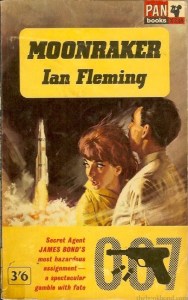
Moonraker

This was the third entry into the 007 series and the action takes place mostly in Dover. Millionaire Hugo Drax wants England to enter the space race and so he spends his own money on a rocket named the Moonraker which he intends to donate to the British government. It turns out that Drax is actually a nazi who wants to avenge defeat in the second world war by arranging for the rocket to destroy London. I read recently that Fleming wrote the book while staying in a cottage situated down by the famous chalk cliffs of Dover which was once owned by Noel Coward and later Fleming himself. It’s not a bad read at all and starts off with M asking Bond a favour as he suspects Drax to be cheating at cards and he wants Bond to see if he can sort things out as at the time, this was the mid-1950s, cheating at cards in London high society could really be a big scandal.
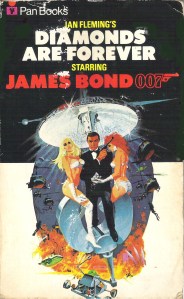
Bond beats Drax at his own game and then finds his next mission is to look into Drax and his Moonraker set up. Interestingly in Moonraker the obligatory Bond girl with the exciting name, in this case Gala Brand, decides not to succumb to Bond’s charms after all.  The movie version was a desperate attempt by the Bond producers to compete with Star Wars and was not my cup of tea at all.

Diamonds are Forever

Fleming wrote this book at Goldeye, his house in Jamaica, after doing a great deal of research about diamond smuggling. Bond’s mission is to investigate a diamond smuggling ring and he does this by impersonating a diamond smuggler called Peter Franks. Franks leads Bond to an American woman called Tiffany Case who he begins to fall for. He tracks the smuggling ring to the American Spang brothers, leaders of the Spangled Mob, a criminal gang. The finale takes place in the Spangs’ restored western town, Spectreville.
The film version marked Sean Connery’s final outing as Bond, at least in the ‘official’ Bond films anyway. Connery looks bored throughout the film which seems to begin the trend of slightly less than serious films which Roger Moore continued.

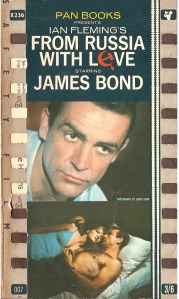
From Russia with Love

According to Wikipedia From Russia With Love was inspired by the author’s trip to Istanbul in 1955 to cover an Interpol conference for the Sunday Times. The plot is very similar to the film version and involves the KGB planning to assassinate Bond and also create a scandal involving Bond and the British Secret Service. To do this they persuade a cypher clerk, Tatiana Romanova, to pretend to defect to the west with a Spektor cypher machine. She claims she will only to defect to Bond, having fallen for him after reading his KGB file.
What was interesting about this book was that Fleming had become a little bored with Bond as well as being short of ideas and so he decided to kill off 007 at the end of the book, when he falls victim to KGB agent Rosa Klebb, who stabs Bond with a hidden blade laced with poison. Fleming later developed an idea for the next book and proceeded to revive Bond for Dr No, the next in the series.

The film version closely follows the book but adds the criminal organisation SPECTRE into the mix and is, to my mind anyway, one of the best films in the franchise. Sean Connery made his second appearance as 007 and two excellent portrayals as villains were by Robert Shaw as Red Grant and Lotte Lenya as Rosa Klebb.

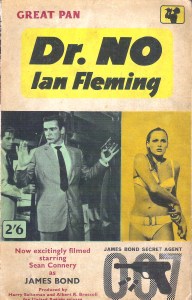
Dr No

Prior to the writing of this book, a firearms expert called Major Boothroyd wrote to Fleming explaining that an agent like Bond would never be armed with a Baretta as it was more of a ladies gun. Boothroyd recommended a Walther PPK. Fleming was so impressed he included the new gun in Dr No and also added a new character named Boothroyd as the armourer of the secret service.

In Dr No, Bond is recovering from the effects of poisoning in the previous book and so M, the head of the secret service, sends him on a routine mission to Jamaica where the head of the Jamaica station and his secretary have disappeared. Bond finds that they were investigating the secretive Dr No who owns a private island known as Crab Key. After further investigation Bond finds that Dr No is involved in the practice of ‘toppling’ missiles from a nearby US launch site.

Dr No was made into the very first Bond film in the film series with Sean Connery starring as 007. Fleming was rather apprehensive of Sean Connery at first, actually wanting David Niven to play the part. Later Fleming warmed to Connery, even adding a bit of Scottish ancestry into Bond’s back history in the later books.

Bernard Lee played M, the head of the secret service. He went on to appear in 11 Bond films in total and Lois Maxwell made her first of 14 appearances as M’s formidable secretary, Miss Moneypenny.

Tune in next week to read the concluding part of this post.


What to do next: Here are a few options.

Share this post on your favourite social media!

Hit the Subscribe button. Never miss another post!

Listen to my podcast Click here.

Buy the book! Click here to purchase my new poetry collection.

Click here to visit Amazon and download Floating in Space to your Kindle or order the paperback version.

Click here to visit amazon and purchase Timeline, my new anthology.

3 Summer Reads

A long time ago I decided that I would set myself the task of reading the entire Hamish Macbeth series of books. There are 34 books in the series, all written by author M.C. Beaton which is in fact a pen name for Marion Chesney. Marion actually wrote many books under various pseudonyms including Ann Fairfax, Jennie Tremaine, Helen Crampton, Charlotte Ward and Sarah Chester. After Marion’s death in 2019 further Hamish Macbeth novels have appeared penned by writer R.W. Green.

Hamish Macbeth is a country policeman in the small Scottish Highland village of Lochdubh. Macbeth is a very relaxed kind of fellow. Some might even call him lazy. He shies away from promotion, even giving the credit for solving crimes to others so he can stay on in his beloved village.

A few years back the BBC made a TV series based on the books. ‘Based on’ is quite an interesting use of that particular phrase because the TV series is actually nothing like the books. The series was filmed in Plockton and Macbeth is played by Robert Carlyle. Macbeth is a laid-back relaxed character, just like in the books. He is not averse to poaching the odd salmon and he likes to apply the rule of law in his own way. He avoids promotion as all he wants is to remain in Lochdubh. That is pretty much where the resemblance to the books ends which was quite a surprise to me. Most of the characters in the series are the invention of the TV writers and not M.C. Beaton who wrote the books.

I’m not sure how happy I would be if someone made a TV show out of my book and then proceeded to change all the characters, still I did enjoy Hamish Macbeth as a TV show. It was an oddball, quirky little drama which ran for only three seasons and a few years ago Liz and I visited the village of Plockton which was very small and to be honest, didn’t actually look like the place in the TV series.

Not long ago after reading Death of a Scriptwriter last year, I put down the Hamish Macbeth books and took a little break from the murders in Lochdubh but as the summer has warmed up nicely and I’ve plenty of time to sit out in the back garden reading, I thought it was a good time to pick up the series again.

Death of an Addict.

This was a little different to the usual Hamish Macbeth novel. Macbeth and another officer, Glasgow DI Olivia Chater, masquerade as drug dealers to trap a drugs cartel operating in the highlands. I have to say that I didn’t like how the book leaves the usual village life behind and to be fair, I didn’t enjoy the book as much as the previous ones.

Death of a Dustman.

All the Macbeth series are titled ‘Death of’ someone and I noticed on the internet that there is one book that differs from the others called A Highland Christmas which seems to come in between Addict and Dustman. Anyhow, I don’t have a copy so I went straight on with Death of a Dustman. All the books in my collection end with the first chapter of the next book and Addict ended with chapter one of Dustman so perhaps the Christmas book is something a little different. Anyway, the action takes place once again in the village of Lochdubh where a new councillor decides to make the village ‘green’ by promoting recycling. As a result, the local dustman causes a lot of aggro when he declines to empty bins containing the ‘wrong’ sort of rubbish and of course he ends up getting bumped off.

Things get a little far fetched towards the end but overall, Death of a Dustman was a fairly pleasant read and another look at highland village life and its various characters.

Marathon Man

I mentioned a while ago about my brother dying and when I was sorting out his things I came across this short novel. Actually it was one of my own books and I must have lent it to Colin years ago and now it has once again come back to me. I can just imagine telling him ‘I told you that you never gave me Marathon Man back!’ to which he would probably reply ‘Well what about that Cary Grant book I lent you?’ Yes, I borrowed the Grant book ages ago when I wrote a post about Cary Grant and it’s still there, part read in my bedroom.

Marathon Man was written by the screenwriter William Goldman and later made into a film using Goldman’s own screenplay. It’s a fairly short book and according to Wikipedia it was the author’s most successful thriller novel. Escaped nazi dentist Christian Szell has been living in Paraguay since the end of WWII. He has a stash of diamonds acquired while he worked in a concentration camp which are in a New York vault looked after by his father. When his father dies in a car crash Szell has to return to New York to get the diamonds. Will it be safe though? Szell thinks that a US agent working for a secret department called the Division may be about to rob him when he picks up the diamonds.

The agent is known by the code name Scylla and Szell meets with him and uses a hidden knife to stab him. Scylla manages to survive long enough to get to his brother’s New York apartment whereupon he dies from his injuries. Szell believes that Scylla must have survived long enough to give his brother, nicknamed ‘Babe’, information about the diamonds and so his men kidnap Babe and he is tortured to reveal any information. Szell is a dentist and so he tortures Babe by drilling into his teeth. Later, Babe, a student who hopes to be a marathon runner manages to get away.

The story was made into a film starring Laurence Olivier as Szell and Dustin Hoffman as Babe. This led to an interesting confrontation of acting styles with Hoffman the ‘method’ actor and Olivier the celebrated traditional actor. On one occasion when Hoffman had to appear tired out after staying awake for three days Hoffman chose to actually stay awake for three days also. Olivier, tired of these antics famously asked Hoffman ‘Dear boy, why don’t you just act?’

(I should mention here that while researching this and checking my facts -I had originally thought that Hoffman had gone running to make himself appear breathless- I found a really interesting article in the Guardian in which the author finished with a wonderful quote about acting from George Burns who once said “sincerity is everything. Fake that and you’ve got it made!”)

The film very much follows the lines of the book except that in the film, it is Szell’s brother, not his father who looks after the diamonds and also in the book, Babe is a little more ruthless and cold blooded than Hoffman portrays him on film. In fact, Babe shoots Szell dead in the book but in the film, Szell is killed by falling on his own knife.

Both the book and the film were highly successful and Olivier’s Szell is one of the most famous screen villains, particularly with his catchphrase ‘Is it safe?’ which he continually asks Hoffman’s character before commencing to torture him. It’s a film which probably put a huge amount of people off going to the dentist for years and the book is equally as scary and also superbly written.

Anyway, that’s what I’ve been reading. What are your summer reads?


What to do next: Here are a few options.

Share this post on your favourite social media!

Hit the Subscribe button. Never miss another post!

Listen to my podcast Click here.

Buy the book! Click here to purchase my new poetry collection.

Click here to visit Amazon and download Floating in Space to your Kindle or order the paperback version.

Click here to visit amazon and purchase Timeline, my new anthology.


Titanic

The story of the Titanic, the ship that hit an iceberg and sank in 1912, is one of those stories which seems to be forever in the news. It’s a story that has caught the imagination of pretty much everyone. Even the other day, just scrolling through the BBC news page, I came across an item about some new digital scan of the Titanic wreck which revealed new information about the disaster.

This week I thought I’d take a look at the story of the Titanic and how it has been represented by television and film, well at least the TV shows and films that made an imopression on me, as well as the actual story of the tragedy.

The Titanic was designed to be the new premier ship of the White Star Line. It had been built by Harland and Wolff in Belfast and built alongside its sister ship the Olympic and was launched on the 31st May 1911 and was then towed to another berth where its engines and superstructure was installed as well as its majestic interior. The sea trials of the ship were undertaken on the 2nd April 1912 just eight days prior to leaving Southampton on its maiden voyage. The Titanic was the largest ship in the world and advertised as having the passenger accommodation of ‘unrivalled extent and magnificence’. It was also billed as unsinkable even though a few days into its first journey it would end up at the bottom of the Atlantic Ocean.

The Titanic on Television.

The Time Tunnel

The Time Tunnel was a sci-fi series created by Irwin Allen in the 1960s. The best episode in the series was probably the very first one. A US senator has come to take a look at a secret time travel project and see if the huge amounts of money being spent are justified. Scientist Tony Newman, fearful that the project will be cancelled, decides to trial the new Time Tunnel apparatus and send himself back in time. He activates everything and transports himself back in time arriving in 1912 on board the  Titanic.

His colleague, Doug Phillips also goes back to the same time zone to rescue Tony. The captain of the Titanic naturally doesn’t believe his ship is doomed to sink and back in the Time Tunnel control room the technical staff have a bit of a problem bringing the two scientists back to the present (actually 1968) but manage to transfer them to another time zone and so the scene is set for the subsequent adventures.

The Titanic at the Cinema.

A Night to Remember (1958)

I’ve always liked this film. It starred Kenneth Moore as the Titanic’s second officer, Charles Lightoller, and was based on a book about the disaster. The film was released in 1958 and tells the usual story about the sinking. The ship sets off but during the journey the overworked telegraph officers fail to pass on a warning about icebergs. The ship hits the iceberg and sinks. Despite a limited budget and only 1950s era special effects, A Night to Remember is actually a really good film.

Raise the Titanic (1980)

This was a film produced by TV mogul Lew Grade who was wanting to move his TV production company ITC Entertainment into the world of cinema. He had read the original book and thought that it might be possible to make a film series about US government operative Dirk Pitt in the manner of the Bond series.

In the film Dirk Pitt played by Richard Jordan proposes a salvage operation for the Titanic as he is convinced an American named Brewster had discovered a rare radioactive element called Byzanium which was stowed in wooden shipping boxes aboard the Titanic.

A huge undersea search takes place and the Titanic is ultimately found and raised. The Byzanium is not found aboard though although it does finally emerge in a neat twist at the end.

I’ve always enjoyed Raise the Titanic. It was based on a bestselling book by Clive Cussler although the film did not emulate the book’s success.

A great deal of the budget for the film was used to create a 50 foot model which was filmed at a huge water tank at the Mediterranean Film Studios in Malta. Apparently the three million pound model remains there today rusting away although the water tank is in regular use.

Not long after the film was made the real Titanic was located and it was confirmed the ship had broken up and was lying on the sea bed in two separate sections.

Titanic (1997)

Titanic was written and directed by James Cameron. The main thrust of the story is about two passengers from wildly different social classes who fall in love on the ship although one, played by Leonardo DiCaprio, dies in the disaster and the other played by Kate Winslet survives.

A treasure hunter (Bill Paxton) and his salvage team explore the wreck of the Titanic looking for a famous necklace, the Heart of the Ocean. They discover a safe which they bring to the surface to find it only contains a sketch of an unknown woman. After it is featured on TV the woman comes forward and tells the story of meeting Jack Dawson (DiCaprio) and of course of the sinking of the Titanic.

Director Cameron and his producers built a huge outdoor set in Playas de Rosarito in Mexico with uninterrupted views of the ocean and a water tank in which the Titanic set could be tilted to film the sinking scenes. Overall, the production cost was over 200 million dollars making it the most expensive film of all time. Happily for the producers, it also became the highest grossing film of all time until the release of Avatar, another film written and directed by Cameron.

The Novel

Dreaming a story and making it into a novel or a screenplay sounds pretty fantastic but in 1898 an American writer, Morgan Robertson, wrote a story about an unsinkable ship called the Titan which sailed from England to the USA but during the journey hit an iceberg and sank. The story was published fourteen years before the Titanic disaster. I remember reading the story of this writer years ago, even that the writer saw the story played out in front of him like a movie but all the research I did on the internet for this blog seems to imply that the author was a man who knew his business where ships were concerned, felt that ships were getting bigger and bigger and that a disaster like that of the Titanic was inevitable.

Books

I only have one book in my collection about the Titanic. It’s a big glossy picture book, not about the actual ship, but about the shooting of James Cameron’s film. It documents Cameron’s twelve dives in a tiny submersible which gave him the idea of the treasure hunters looking to find the necklace the ‘Heart of the Ocean’ and his realisation as Cameron himself mentions in the book’s foreword that the main thrust of the story should be a love story with the Titanic disaster almost as a backdrop.

The book tells about the numerous models that were built of the ship both as a pristine sea going vessel and as an underwater wreck. The making of the full size set in Mexico which could be dropped via hydraulic pistons into a huge water tank was an immense undertaking and adds immeasurably to the finished film.

So what actually happened to the Titanic?

The Titanic was on its maiden voyage to the USA. It left Southampton on the 10th April 1912 and stopped at Cherbourg in France to pick up more passengers before heading out across the Atlantic to New York. Four days into the voyage it hit an iceberg. Lookouts had been sent aloft to look for icebergs but their task was difficult. It was a moonless night and pitch black. The sea was very calm which meant that the lookouts could not see waves crashing against the icebergs that they had been warned to look out for. When an iceberg was finally spotted the lookouts rang down to the bridge. The officers there ordered the ship to turn hard to port. Some reports say that the engine room was ordered to stop engines which would not have helped the turn. Either way the ship brushed the iceberg and the resulting contact made a gash along the side of the ship and water rushed in.

The ship had been designed to stay afloat with four of her watertight compartments flooded but it could not stay afloat with the flooding of six. Interestingly the compartments were not sealed at the top so that when one flooded, the water tipped over into the next and so on until the ship sank.

The bow of the Titanic courtesy Wikipedia Commons

In another documentary I watched a few years ago a theory was put forward that the three million rivets that held the steel plates of the ship together were made of poor grade metal which became brittle in the freezing sea water. When the ship impacted the iceberg, the heads of the rivets popped off and sea water flooded inbetween the steel plates of the hull.

RMS Carpathia arrived about an hour and a half after the sinking and rescued all of the 710 survivors by 09:15 on 15 April. More than 1500 people died in the freezing waters of the Atlantic.

Titanic in the News.

As I mentioned earlier, the Titanic was in the news again when a new 3d scan of the wreckage of the Titanic was revealed.


What to do next: Here are a few options.

Share this post on your favourite social media!

Hit the Subscribe button. Never miss another post!

Listen to my podcast Click here.

Buy the book! Click here to purchase my new poetry collection.

Click here to visit Amazon and download Floating in Space to your Kindle or order the paperback version.

Click here to visit amazon and purchase Timeline, my new anthology.

Texting and my Brother

My brother died this week. As you can imagine I’m pretty upset. He was the younger brother so the accepted plan was for me to die first but somehow, things didn’t work out that way. Still, to a certain extent my brother was a burger and pizza eating TV watching couch potato so perhaps him dropping dead like that was not really unexpected. He was a guy that I sometimes wanted to slap and tell him to sort himself out, to clean his flat up and wash the pots and hoover up and get himself off his lazy backside and get a job or do some training or something.

Once I made him a huge roast beef Sunday lunch. I had done loads of food so I plated up an extra portion and told him  to ‘slap this in the microwave and eat it tomorrow’. I called him the next day to remind him. ‘Remember’, I said. ‘You’ve still got that roast dinner in your fridge. Slap it in the microwave tonight.’

‘Oh that’, he said, dismissively. I ate that last night when I got home!’

Despite all that, despite him spending money recklessly, buying numerous leather jackets from catalogues, getting into debt and going everywhere in taxis and eating takeaways when he could have saved money by eating sensibly and eating healthily, Colin, my brother, was a latter day Oscar Madison (remember the Odd Couple) who was happy doing nothing but watching television and old films day after day and paying for the top satellite channels when he had no money. Despite all that and owing money left right and centre, he was my best friend and I loved him and miss him so much.

This next section is something I wrote about him a few years ago. Just reading it brought back our friendship so fully that I almost picked up my phone and texted him there and then.


I’ve written about my mother and father in my blog posts so perhaps it’s about time I wrote about the one remaining family member, my brother. My brother Colin lives in Manchester and we see each other every couple of weeks or so when we meet up in the city centre for a pint or two.

My brother Colin is a very subtle character. He won’t ask me outright if I fancy a pint with him, he’ll tend to text me and his text will usually go something like this:

Meatballs!

You’re probably thinking, now that is subtle; is it a code? No, but the correct answer is this:

Definitely!

Still completely in the dark? Well, I suppose you might not be classic movie fans like Colin and me because a lot of the time we text in movie dialogue.

My brother sent me a text a few days ago; it read simply ‘You don’t remember me do you?

Probably a little confusing to the man on the street but I knew exactly what he meant. I responded with; ‘I remembered you the moment I saw you!

My brother came back straight away; ‘by the nose huh?’

Yes, texting in movie dialogue is what we do. Picked up on the movie yet? That particular movie is one of the movie greats of all time. It starred Marlon Brando in an Oscar-winning performance, much better, much more exciting and above all, much more human than his other Oscar-winning role in The Godfather.

Here are some more texts

ME: Do you remember parochial school out on Puluski Street? Seven, eight years ago?

MY BROTHER: You had wires on your teeth and glasses. Everything.

ME: You was really a mess.

The movie was ‘On the Waterfront’ and it’s probably famous for the double act of Marlon Brando and Rod Steiger playing brothers but there are plenty of other wonderful performances and scenes. My personal favourite is when Brando and Eva Marie Saint walk together in the park and Eva drops a glove which Brando picks up but keeps hold of and eventually pulls onto his own hand and we know that Eva wants it back. The dialogue above comes round about here when Brando, playing the part of Terry Malloy, realises he knew Edie, played by Eva Marie Saint at school. He is trying to communicate with her in his oafish way and Edie begins to realise she actually likes him but, well watch the movie, believe me it’s a great scene. It finishes like this:

MY BROTHER: I can get home all right now, thanks.

ME: Don’t get sore. I was just kidding you a little bit.

I read somewhere that Elvis knew all the dialogue from Rebel Without a Cause, the James Dean movie. If so, my brother Colin and I are in good company because we know the dialogue from that film too, as well as Giant and the aforementioned On the Waterfront. One day I thought I’d try a quote on Colin that he would never get.

ME: I took everything out of that car except the rocker panels!

I sent the text off feeling pretty pleased with myself. He’ll never get that in a million years I thought. My phone bleeped a moment later and I looked down to see:

MY BROTHER:  C’mon Herb, what the hell’s that?

Top marks indeed if you remember that dialogue from The French Connection.

My brother and I do text each other a lot but we also chat on the phone too. The thing is though; we talk on the phone with East European accents. We started doing it one day then began a sort of unspoken contract to carry it on. Sometimes I’ll get a call and he might say, in his best Hungarian accent ‘ Gut Evenink my friend’

‘Gut evenink to you also my friend’ I tend to reply.

East European is the norm but sometimes we use German accents. Handy when we bounce quotes from The Great Escape off each other!

Me: I hear your German is good, and also your French . .

My Brother: Your hands UP!

The Great Escape is a firm TV movie favourite but let me finish with a 60’s classic we also frequently text about:

Me: She’s in beautiful condition!

My Brother: Blimey girl, you’re not as ugly as I thought!

Me: I saw that geezer Humphrey going off. You’re not having it off with him are you?

My Brother: I tumbled at once. Never be cheerful when you’re working a fiddle!

Me: I ain’t got my peace of mind. And if you ain’t got that, you ain’t got nothing.

My brother: It seems to me that if they ain’t got you one way, they’ve got you another.

Got the picture yet? The film is Alfie. It was directed by Lewis Gilbert who also directed some of the earlier Bond films. The script was written by Bill Naughton and adapted from his own book and play. Alfie is a fascinating film on many levels. It’s a peek back at the swinging sixties; it explores the elements of comedy versus drama, something I’ve always loved and which I looked at a while ago in a post about the TV show MASH. The film features great performances from all the principal and supporting actors. One fabulous feature is how Alfie talks directly to the camera and sometimes even says things that directly contradict something he is doing or saying to another character. In the opening sequence, Michael Caine as Alfie, addresses the audience and tells them not to expect any titles. There are none, except for the film title itself and the closing credits which feature photos of the cast and crew.

Many actors turned down the chance to play Alfie on film, including Caine’s then flat mate Terence Stamp who played the part on Broadway. Laurence Harvey, James Booth and Richard Harris all turned down the role and Alfie became a breakthrough movie for Michael Caine.

Now my brother has gone it’s too late to text him one final time. If I could though I’d perhaps text him this:

So what’s the answer? That’s what I keep asking myself. What’s it all about?


What to do next: Here are a few options.

Share this post on your favourite social media!

Hit the Subscribe button. Never miss another post!

Listen to my podcast Click here.

Buy the book! Click here to purchase my new poetry collection.

Click here to visit Amazon and download Floating in Space to your Kindle or order the paperback version.

Click here to visit amazon and purchase Timeline, my new anthology.