 My original idea for this post was to write about 90s British films but then I realised some of those 90’s films were actually from the 2000’s. I then changed tack to a blog about films written by Richard Curtis but that meant cutting out a few films that I really wanted to include. Then I thought what about films with Hugh Grant? Great but although many of the films below feature Hugh, I’ve got a personal favourite in which he doesn’t star. That of course has led to the final incarnation of this post, 5 British Rom-Coms.
4 Weddings and a Funeral 1994
I’ve always rather loved this film. In a way I tend to think of it as a sort of modern Ealing Comedy, or at least the sort of film that Ealing would be making were they still in business. The only difficulty in that respect is the rather liberal use of the ‘f’ word that the film can really do without. In the USA, or so I have read, the version screened over there has the ‘f’ word substituted by the slightly less alarming word bugger.
The plot is pretty simple. It’s about a group of friends who only seem to meet regularly at weddings. At the first wedding Charles, played by Hugh Grant, meets Carrie and falls for her only to find she is about to return to the USA. Happily he meets her again at another wedding and, sadly for Charles, he meets her again at yet another wedding, this time one in which she is the bride.
The happiness of constant weddings is shattered by the death of one of Charles’ friends but this being a rom-com, things all work out in the end. Carrie is played by Andie McDowell and the supporting actors who appear at each wedding are all well known to fans of British film and TV.
Four Weddings and a Funeral is the movie that brought fame to writer Richard Curtis and actor Hugh Grant, as the announcer mentioned last time I saw this film on the television. Strangely, he didn’t mention Mike Newell, who directed the film. Funny how the credit from a successful film doesn’t always get spread equally around.
Notting Hill 1999
Written again by Richard Curtis and starring Hugh Grant, Grant this time plays William Thacker, the owner of a bookshop in London’s Notting Hill. One afternoon at the bookshop, Hollywood film star Anna Scott played by Julia Roberts comes into the shop to browse. Not long afterwards William accidentally walks into her and spills takeaway drinks all over her. He invites her back to his place just across the road where she cleans herself up.
On another occasion the two go out for a date but William’s oddball flatmate Spike played by Rhys Ifans, happens to mention the film star’s presence to his mates at the pub and the flat is soon swamped by reporters. Anna is not amused and the two fall out and seem to go their separate ways.
There is a really lovely sequence here in which William walks along the Portabello Road and the scene transforms into winter, then autumn and finally summer showing the passage of time in a really unique way. Later, the two manage to sort things out just before Anna leaves for the USA.
Over on Wikipedia it was interesting to find that according to a 2018 interview High Grant gave to GQ magazine, the idea came to Richard Curtis after one of his friends became involved with an unnamed ‘big star’. The film was shot on location in Notting Hill and the blue door to William Thacker’s place in the film was actually a property owned by Richard Curtis.
Julia Roberts was the producer’s only choice for Anna Scott although personally, just like Andie McDowell in 4 weddings, I’ve never found her remotely attractive.
The film won a Brit Award for its soundtrack.
Sliding Doors 1998
This was a film written and directed by Peter Howitt. Howitt is probably best known for playing the part of Joey Boswell in the TV comedy series Bread. This is a really super film which is about a girl, Helen Quilley, who gets fired from her PR job. Helen, played by Gwyneth Paltrow, heads off for home. She goes to the tube station but is only seconds too late and misses her train. The film then rewinds a few minutes and when it replays, Helen manages to catch the train. The film then sets off in two separate directions with two differing storylines. In one she arrives home to find her boyfriend in bed with another woman. In the second she arrives home later and the boyfriend manages to cover up his two timing activities.
The film was made in 1998 but still looks fresh and contemporary. The only jarring things -from a 2026 point of view- are people still smoking in pubs and offices filled with huge computer monitors. It’s a lovely film and one I tend to watch quite a lot on DVD.
Bridget Jones Diary 2001
This film was based on the book by Helen Fielding and had a script written by Fielding, Andrew Davies and once again, Richard Curtis. American actress Renee Zellweger played Bridget with a very impressive British accent with her love interests played by Hugh Grant and Colin Firth.
Bridget works in publicity for a publishing company. She is 32 and worried about her weight and confides all her worries as well as her fantasies to her diary. At her mother’s Christmas party, she meets barrister Mark Darcy, a neighbour from her childhood, who she finds arrogant and rude. At work she flirts a lot with her boss Daniel Cleaver played by Grant and begins an affair with him only to find that he is a serial cheater.
Who will Bridget end up with, the slimy but nice Daniel or the boring but nice Mark? One of the film’s highlights is a drunken street fight between Daniel and Mark which plays out pretty much how two upper/middle class twits would be expected to behave.
Three sequels were made to the film, the last one was Mad About the Boy in 2025 but personally, I think the original was the best.
About a Boy 2002
This is still a rom-com but considerably darker than the other films on this list. Hugh Grant plays someone slightly different to his usual film persona. Will Freeman is a young man in his 30s who lives a rather aimless life. He does not go out to work, instead he has ample funds because of regular royalties due from a popular tune which was written by his late father. His one aim in life is to meet women and he happens to come across a young mother and feels that young single parent females would be good for him because they are mostly on the lookout for a new man. To achieve this aim he joins a group for single parents where he is the only man and after spinning a yarn about being deserted by the mother of his only child, ‘Ned’, he feels warmed by the sympathy vote of the whole group and quickly gets involved with an attractive young mother called Suzie.
Through various circumstances, this leads him to meet Marcus, the son of one of Suzie’s friends and the two begin a friendship of sorts which begins to bring a new meaning to Will’s life.
Overall, the film is perhaps a little slow and rather dark in a way but still a great film based on a book by Nick Hornby.
What to do next: Here are a few options.
Share this post on your favourite social media!
Hit the Subscribe button. Never miss another post!
Listen to my podcast Click here.
Buy the book! Click here to purchase my new poetry collection.
Click here to visit Amazon and download Floating in Space to your Kindle or order the paperback version.
Click here to visit amazon and purchase Timeline, my new anthology.

 As usual Liz and I have left behind cold and unpleasant England for the much warmer climes of Lanzarote. We’re renting a place that we first found two years ago but were unable to rent last year as it was fully booked. This time Liz got in early and so here we are for four weeks. The villa is very comfortable with a great outlook, sunny on the patio all day and it has a great pool and comfy outdoor couches.
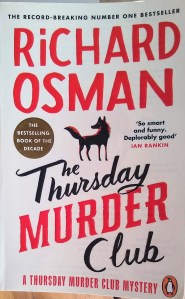 It just so happens that I picked up the book to read here in Lanzarote. It’s written by Richard Osman who is more famous as the frontman on the BBC’s Pointless quiz show as well as various other TV shows. The book and film are about a group of people in a retirement village who meet to discuss cold case crimes but then find a murder committed on their very doorstop. The group of mostly eighty year olds then get on with the task of solving the murder. There seem to be a lot of things going on and a great deal of characters to remember which put me off a little at first but a great device used by the writer is having alternate chapters written as diary entries by Joyce, one of the club members. She goes over the past events, adding in details of her own life along the way, talking about her neighbours and daughter amongst other things and sometimes previewing the next chapter for us.
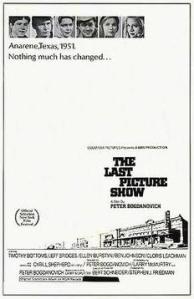 Another modern classic. This film was directed by Peter Bogdanovich and is set in a small town in northern Texas in the early 1950s. The film has an ensemble cast but the two main characters are Sonny and Duane played by Timothy Bottoms and Jeff Bridges. The two are teenagers and old friends and various things happen to them. They fall out over a girl called Jacy played by Cybill Shepherd. Ben Johnson plays ‘Sam the Lion’ who owns the bar and cinema in the town. Sam has a mentally disabled son who Sonny has befriended. Various things happen to the pair but towards the end of the film Duane enlists in the army and is due to leave town so the pair decide to visit the town cinema for the very last picture show as the cinema is about to close after Sam’s sudden death.
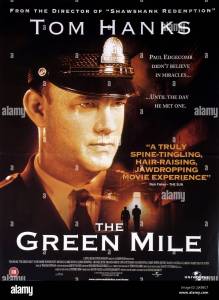 Like The Shining, this is another film based on a book by Stephen King. Tom Hanks plays the head of a death row section of an American penitentiary. One of the inmates is John Coffey, a huge black man who appears to have healing powers. He cures Tom Hanks’ bladder infection but the mood in death row is not good after sadistic Percy Wetmore joins the team and deliberately sabotages the execution of another inmate causing the prisoner to die in terrible agony. The warden’s wife is terminally ill and Hanks and his team wonder if John Coffey could cure her.

 After graduating, Scott joined the BBC as a set designer and director, working on popular series such as Z Cars and The Troubleshooters. His time in television taught him the mechanics of production and in 1968, he left the BBC to establish Ridley Scott Associates (RSA), a commercial production company. Over the next decade, he directed hundreds of adverts, developing a style of lighting, atmosphere and composition, qualities that made his transition to cinema with The Duellists (1977) both natural and visually striking.
 I’m betting that whatever this guy had produced it couldn’t compare with Billy’s dazzling line-up of classic films.
 Rooting around in a secondhand shop in St Annes recently I picked up a hardback copy of Winston Churchill’s book My Early Life. It’s a thoroughly wonderful book written in Churchill’s inimitable style. He says in the introduction he has written a book about a vanished age and indeed he has. Churchill was born in 1974 at Blenheim Palace in Oxfordshire. He was the son of Lord Randolph Churchill who was in turn the son of the 7th Duke of Marlborough. His mother was an American, Jennie Jerome, the daughter of an American businessman. She married Lord Randolph and became Lady Churchill.
 Looking back, I must have seen the film version before I read the book. Young Winston was directed by Richard Attenborough and is a wonderful adaptation of the book. When Winston first attends school, which of course was boarding school, his headmaster was played by Robert Hardy and he directs Winston to learn some Latin. Winston doesn’t do very well and the headmaster glares down at him and informs him that if he misbehaves, he will be punished, which to a great extent was Churchill’s overall view of school. Later he comments about exams ‘they always contrived to question me about things I didn’t know. I would much rather they asked me about things I did know.
 The charge was depicted in the film Young Winston and in his book Churchill ponders about fate and a problem with his shoulder which necessitated using his revolver rather than his sword during the charge, reflecting that if he had been using his sword he might well have been killed in the latter stages when he was surrounded by the enemy.
 One of things I particularly liked about Young Winston was the music. I bought the soundtrack album in 1985. The music for the film was in the main composed by Sir Alfred Ralston. He was brought into the film by director Attenborough as the two had worked together on a previous film, ‘Oh what a Lovely War’. The soundtrack features music by Edward Elgar, notably the Pomp and Circumstance March no 4 as well as Nimrod from the Enigma Variations.
 Churchill ended up in a POW camp but resolved to escape despite also claiming to the Boers that he was a correspondent and should not have been detained. With the help of a group of Lancashire miners, Winston stowed away on a goods train and made his way back to the British lines.
 Goldfinger is probably one of the best books in the Bond series and only the second 007 book that I ever read. (I’ll tell you about the first one later). I was at school at the time and for one of our assignments in English, we were asked to bring in a book which contained a really good description of a character. I chose Goldfinger as in it, Ian Fleming describes Goldfinger as a man who appeared to have been made using bits of other peoples’ bodies. This must have been in the mid-1960s and although the character of James Bond was pretty well known, the films had not begun to permeate down to the television screen.
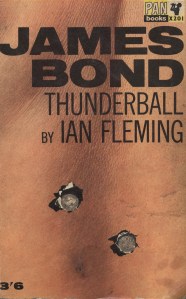 This is an interesting story and the resulting film has perhaps become the quintessential Bond film even more so than Goldfinger. The story is about a criminal underworld organisation (SPECTRE) that steals an aircraft with nuclear weapons and holds the west to ransom threatening to explode the bombs.
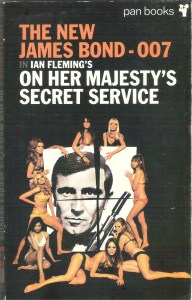 In this book the secret service find that Blofeld, the head of SPECTRE, is trying to assume the identity of the Comte Balthazar de Bleuville. Bond poses as Sir Hilary Bray of the College of Arms in order to meet with Blofeld. Interestingly, Sir Hilary gives Bond a quick resumé of Bond’s family history including the Bond family motto ‘the world is not enough’ which was used by the film producers for the title of a later 007 film unrelated to Fleming’s books.
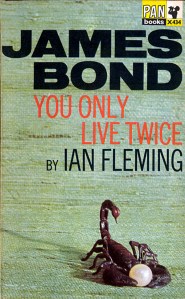 This book follows on from the previous one and we find James Bond depressed and disillusioned with his job after the death of Tracy. M considers sacking Bond but instead sends him on a diplomatic mission to meet the head of the Japanese secret service. The British want access to Russian documents which the Japanese are currently decoding. The Japanese decide to offer this information to Bond if he will assassinate a British resident who has created a garden of death, a garden full of poisonous plants which are attracting many Japanese citizens who want to commit suicide. Bond realises that this man is Blofeld and decides to keep this quiet until after he has killed him.
 Casino Royale is the first book in the 007 series and it’s a pretty interesting and original one too. ‘Le Chiffre’, a gambler and also a member of SMERSH, a murderous department of the KGB is engaged in a desperate effort to win a great deal of money at the casinos of Royale Les Eaux in France. Le Chiffre is desperate because he has used SMERSH funds for his personal use and his spymaster bosses will not be pleased if they find out. Britain’s secret service happens to find out about this and sends Bond to France to make sure Le Chiffre doesn’t recoup those funds as of course as we all know, James Bond 007 is a bit of an expert with the cards.
 This was the second Bond book to be published and the action takes place in the USA and the Caribbean, which Fleming loved and bought a house there which he named Goldeneye. Live and Let Die and in fact the whole book series were recently reissued with all the politically incorrect stuff removed which makes me wonder whether there was in fact anything left to publish after that process was complete. The book was published in 1953 and comes complete with all the prejudices and sexual and racial intolerances of the era. In one segment when Bond visits Harlem, Fleming tries to reproduces the accents and slang terms of the black people of Harlem and for me it’s not one of Fleming’s best books. In the film version, Roger Moore took over the licence to kill and the result was a very tongue in cheek version of James Bond. Sorry but Roger Moore as Bond just wasn’t for me. The film did feature a great theme song from Paul McCartney which was really a little underused in the film. Another feature of the film was a power boat chase along the Bayous of Florida which was a lot of fun but not entirely serious.
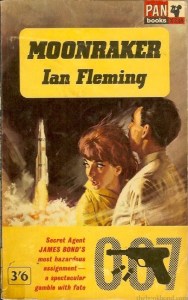 This was the third entry into the 007 series and the action takes place mostly in Dover. Millionaire Hugo Drax wants England to enter the space race and so he spends his own money on a rocket named the Moonraker which he intends to donate to the British government. It turns out that Drax is actually a nazi who wants to avenge defeat in the second world war by arranging for the rocket to destroy London. I read recently that Fleming wrote the book while staying in a cottage situated down by the famous chalk cliffs of Dover which was once owned by Noel Coward and later Fleming himself. It’s not a bad read at all and starts off with M asking Bond a favour as he suspects Drax to be cheating at cards and he wants Bond to see if he can sort things out as at the time, this was the mid-1950s, cheating at cards in London high society could really be a big scandal.
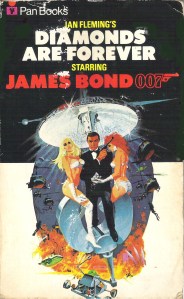 Fleming wrote this book at Goldeye, his house in Jamaica, after doing a great deal of research about diamond smuggling. Bond’s mission is to investigate a diamond smuggling ring and he does this by impersonating a diamond smuggler called Peter Franks. Franks leads Bond to an American woman called Tiffany Case who he begins to fall for. He tracks the smuggling ring to the American Spang brothers, leaders of the Spangled Mob, a criminal gang. The finale takes place in the Spangs’ restored western town, Spectreville.
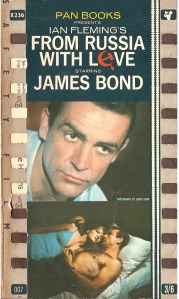 British Secret Service. To do this they persuade a cypher clerk, Tatiana Romanova, to pretend to defect to the west with a Spektor cypher machine. She claims she will only to defect to Bond, having fallen for him after reading his KGB file.
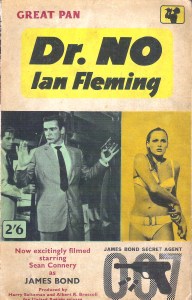 Prior to the writing of this book, a firearms expert called Major Boothroyd wrote to Fleming explaining that an agent like Bond would never be armed with a Baretta as it was more of a ladies gun. Boothroyd recommended a Walther PPK. Fleming was so impressed he included the new gun in Dr No and also added a new character named Boothroyd as the armourer of the secret service.
 Letters from an Unknown Author!