4 Things That Happened in December

John Lennon shot dead in New York December 8th 1980
One day in December 1980 I was working as a bus driver and I was driving one of our old half cab buses into Manchester. My conductor, Bob, was kept pretty busy as we took a bus load of passengers into Manchester city centre for their jobs in shops, offices and other places. At one point Bob poked his head through the little window into the cab and told me that he had heard from a passenger that John Lennon had been shot in New York. It was shocking news and when we arrived in Piccadilly, we both ran to the news stand to read the news in the morning papers. There was nothing about Lennon in any newspaper and we wondered if it had been just a mad rumour. Later when we went back to the canteen for our break, we heard the news either on the TV or the radio. Lennon had indeed been shot and was dead.

I can’t claim to be a great fan of John Lennon. I liked him and his music and had a copy of one of his albums, Walls and Bridges and a few years later I bought Double Fantasy, his last album and the last vinyl album I would ever buy but what did happen that day back in December, 1980?

It was a cold day in New York and a man called Mark Chapman took a .38 calibre revolver out of his pocket and calmly fired five shots at John Lennon who had just exited a limo outside his home in the Dakota building, just across from Central Park.

Chapman had a copy of The Catcher in the Rye, a novel by JD Salinger with him when he shot Lennon. In his copy Chapman had signed ‘from Holden Caulfield to Holden Caulfield (a reference to the main character in the story) This is my statement’. He had hung around the Dakota building in New York where Lennon lived with his wife Yoko Ono and son Sean and when Lennon left for the Record Plant recording studio, he had pushed forward his copy of Double Fantasy, Lennon’s latest album, for the singer to sign.

The last vinyl album I ever bought and the last one that John Lennon made. Double Fantasy. £2.99, what a bargain!

Lennon wrote ‘John Lennon 1980’ on the record and handed it back to Chapman asking ‘Is this all you want?’ Chapman took the album back and Lennon jumped into a limo and was gone. A photographer named Paul Goresh was there and snapped a photo of Lennon signing the album. Chapman was excited about it and asked for a copy before Goresh left. Goresh promised to return the next day with a print.

Later the Lennons returned to the Dakota and Chapman was still there waiting. Yoko entered the building and Lennon was following when Mark Chapman pulled out his .38 revolver and fired five times at the ex-Beatle. Lennon staggered into the Dakota entrance saying ‘I’m shot’. Chapman dropped his gun and began reading The Catcher in the Rye until the police came and arrested him. Another Police car arrived and seeing that Lennon was losing a lot of blood carried him to the police car and took him directly to Roosevelt Hospital. Staff there tried to revive Lennon but the wounds were too severe and he was pronounced dead at 11:15pm.

Mark Chapman is still alive today. He is still serving his life sentence in Wende Correctional Facility in New York and first became eligible for parole in 2000. All Chapman’s applications for parole have so far been denied.

King Edward 8th Abdicates December 11th 1936

The story of King Edward VIII and Wallis Simpson remains one of the most dramatic turning points in modern British history. A collision of personal desire, constitutional duty and public expectation. Edward was charming, modern and hugely popular but it seemed to me that he wasn’t strong enough to carry the weight of the monarchy on his shoulders. His deep attachment to Wallis, an American divorcee, placed him on an unavoidable collision course with the Government and the Church of England. At a time when divorce was still not really socially acceptable, the idea of a king marrying a twice-divorced woman was more than a social scandal, it was seen as a direct threat to the stability of the Crown itself.

It was all terribly inconvenient for Edward, who seemed far more interested in cocktail parties and Wallis’s company than in matters of state.

His radio address to the nation was quiet and deliberate with a hint of regret. He emphasised that he could not carry on his duties ‘without the help and support of the woman I love.’ The episode left deep rifts within the royal family and cast a long shadow over the Windsors for decades, a reminder of the delicate balance between individual freedom and constitutional responsibility.

The former King, now the Duke of Windsor, left for France and prepared for his marriage to Wallis, while his shy younger brother suddenly found himself as George VI, the new King. Edward spent the rest of his life swirling around Europe in a haze of glamour, gossip and lingering tension with the royal family. When his mother, Queen Mary, died the Duke was not allowed to bring his wife to the funeral. The next time Wallis came to England was in 1972 for the funeral of the Duke himself. Honestly, it’s one of those moments in history that still feels like a cross between a constitutional crisis and a tabloid love story.

December 16th 1984 Gorbachev visits the UK

Image courtesy Wikipedia creative commons.

When Brezhnev the leader of the Soviet Union died, a succession of old men took over the leadership and within a few years, all of those had followed Brezhnev to the grave. Mrs Thatcher, the British Prime Minister, felt it was time to try and improve relations with the USSR and so she decided to attend the Moscow funeral of Yuri Andropov in February of 1984. To build on this she invited Mikhail Gorbachev to visit the UK. She guessed that Gorbachev might be a possible future leader and a break from the old elderly Soviet leaders of the past.

Gorbachev and his wife Raisa, arrived in the UK on December 16th 1984 and Mrs Thatcher announced famously after their meeting that ‘I like Mr Gorbachev, we can do business together.’ Gorbachev spent a week in the UK visiting places that Lenin and Karl Marx had frequented. Mrs Thatcher later flew to the USA to brief her ally President Reagan who later began his own talks with Gorbachev.

Gorbachev became the General Secretary and leader of the USSR when Konstantin Chernenko died in 1985 and he began a policy of openness (glasnost) and democratisation which ultimately led to the collapse of the Soviet regime.

First episode of Coronation Street 9th December 1960

I thought I might finish with something a little lighter than Lennon and Gorbachev and King Edward 8th and so that brings me to Coronation Street. I can’t say I’m the greatest fan of TV soaps in general although I do watch Coronation Street. When you watch something like Corrie over a long period of time you do get quite attached to the characters. Soaps, I suppose, do have their place in the TV schedules.

Coronation Street was the idea of writer Tony Warren who wrote the first 13 episodes. He based the fictional suburb of Weatherfield on his home town of Salford, just over the river Irwell from Manchester. Coronation Street is a small cobbled street in Weatherfield and the stories of the various residents have entertained many of us over the years. Elsie Tanner, Annie Walker, Bette Lynch, Mavis Riley and the Jack and Vera Duckworth have long gone to be replaced gradually with new characters, some good and some not so good. I like Corrie because Manchester is my home time and it’s nice to hear the characters talk the way I talk although proper Mancunians on the show are sadly becoming fewer. These days Coronation Street is broadcast in three hourly chunks per week and as much as I enjoy it, I doubt we will ever see a moment as memorable as that one back in 1984 when Hilda Ogden returned home from hospital after the death of her husband Stan. She opened a small parcel containing Stan’s effects including his old spectacles and slowly began to cry her eyes out. Probably the saddest thing I have ever seen on television. (For some reason I couldn’t seem to add the video clip of that moment but click here to see it on YouTube.)

What to do next: Here are a few options.

Share this post on your favourite social media!

Hit the Subscribe button. Never miss another post!

Listen to my podcast Click here.

Buy the book! Click here to purchase my new poetry collection.

Click here to visit Amazon and download Floating in Space to your Kindle or order the paperback version.

Click here to visit amazon and purchase Timeline, my new anthology.

5 Things that Happened in July

I published a post quite a while ago about the month of January. January of course is cold and believe me, I hate the cold so I thought I’d get a lot of cold and chilly feelings off my chest by writing about my least favourite time of the year. Today I’m going to go the opposite way and write about the month of July, generally the warmest month of the year. In fact the warmest month ever recorded was July 2023 according to a survey by scientists at NASA, the US space agency.

The Battle of the Somme July 1916

On the first of July, 1916, the Battle of the Somme began. It was an attempt by combined French and British forces to attack the German held lines by the river Somme in northern France during the First World War. The first day was the worst day in British military history with 57,470 casualties, 19,240 of which were men who were killed. The battle continued for another four months and the total casualties for both sides were over 1.5 million. The battle ended in November of 1916 with allied forces only making an advance of some 7 miles.

In March of 1917 the German forces drew back to the Hindenburg line and began to increase U Boat attacks on British shipping in an effort to starve the British into defeat. This however only spurred the entry of the Americans into the war in April 1917.

A few years ago, Liz and I visited the Somme and we saw a crater which is supposed to be the biggest crater of the First World War. It’s called the crater of Lochnagar and back in 1916 the 179th Tunnelling Company of the Royal Engineers had burrowed under the German lines and laid down huge explosive charges. They were detonated at 07.28 on the morning of July 1st. The British expected the Germans to have been wiped out by this and a huge artillery barrage but they were sadly mistaken.

Wilson44691, CC0, via Wikimedia Commons

Today the crater is still there. I had expected it to have perhaps become a lake but no. It’s a deep depression in the ground surrounded by wooden walking boards, many of which have the names of deceased soldiers inscribed on them.

The Trent and Mersey Canal 1766

The canal system of Great Britain was probably the shortest lasting transport revolution ever. After only a few years the railway revolution began and suddenly, the canal system was old technology. Parliament authorised the construction of various canals in 1766, one of them being the Trent and Mersey Canal. Construction began in July of that year and it was designed by James Brindley to link the rivers Mersey, Trent, Severn and Thames. It was completed in 1777.

Canals were built for the efficient transport of goods and raw materials during the Industrial revolution although shortly afterwards the new railways became the primary method of transporting goods and of course passengers.

Today the canal system in the UK is primarily one of leisure and holiday boating and many people like me have become interested in canals through TV programmes like Canal Boat Diaries. The show is a sort of video diary by a boater called Robbie Cummings who takes his viewers on a gentle meander through the canals of the UK. I’ve always found it an enjoyable and relaxing show although when I last looked into hiring a canal boat it was super expensive. Maybe one day though.

Execution of the Romanov Family, July 1918

The Romanov family, Czar Nicholas II and his family, were shot and bayoneted to death on the night of the 16th/17th July 1917. The Soviets were worried that the family might be rescued by the anti-revolutionary forces known as the ‘Whites’.

After the revolution the royal family had been moved to various places but in 1917 ended up at ‘The House of Special Purpose’ in Yekaterinburg. Friendly guards had been replaced by non-Russians who were chosen to murder the family.

On the night of the 16th July, the family were told that they were to be relocated because of the impending arrival of pro-monarchist forces. They were asked to assemble in the basement where they were all shot. Many survived the shooting because of diamonds and other jewellery sewn into their clothes and so the murderers were forced to use bayonets to finish off those still alive. The bodies were then dumped into a mine shaft. Later it was realised that the shaft was not deep enough so the bodies were extricated and transferred to another one.

The bodies were discovered many years later by a local amateur researcher in 1979 but he kept his discovery a secret until the fall of the Soviet Union. The bodies were removed and identified using DNA. They were eventually laid to rest in the Peter and Paul Cathedral in St Petersburg.

Picture courtesy Wikipedia Commons

Various people have claimed to be survivors of the murders, notably Anna Anderson who claimed to be Anastasia. DNA testing later proved she was not related to the Romanov family but was actually a woman named Franziska Schanzkowska.

Others have claimed to be Tatiana, Anastasia’s sister and also Tsarevich Alexei Nikolaevich, the only son of the Tsar. Alexei suffered from haemophilia, a condition in which the blood does not clot so it is unlikely that he survived the shooting. Interestingly though, Alexei and one of his sisters were discovered separately from the rest of the family in 2007.

The Ipatiev house where the family were murdered –the house of special purpose- was demolished in 1977 by Boris Yeltsin on the orders of the Politburo as it was attracting people who came to pay their respects to the Romanovs. Later when Yeltsin became president, he ordered a memorial church to be built on the site.

A famous film Anastasia was released in 1956 starring Ingrid Bergman as Anastasia and Yul Brynner as a man trying to use her to gain access to the Romanov millions stored in a British bank. Funnily enough, it’s a film I have not seen for years but after writing this passage I noticed it was coming up on TV so I recorded it and watched it the following evening.

The Moon Landing July 1969

The moon landing was one of the very first historical events that I actually felt a part of. In July 1969 I was 12 years old and on the morning of the 20th of July my mother had woken me up as usual for school. I came downstairs in my pyjamas for breakfast and to my utter amazement there was Neil Armstrong and Buzz Aldrin walking on the moon over on mum’s black and white television set. How my mother got me away from that TV set and off to school I’ll never know because at the time I read and watched everything I could about the US space program.

Believe it or not, many people today refuse to accept that Armstrong and Aldrin actually did walk on the moon that day. Many armchair ‘experts’ will call attention to photos from the lunar surface and explain that they were fakes because of various anomalies. On TikTok I recently watched a video in which a man swears his father was a security guard at a secret base where the moon landing was filmed. On YouTube there is a video where someone tries to get Armstrong to swear on the bible that he went to the moon. Neil Armstrong declined. Why? Was it because he didn’t go to the moon? Why did he retire from NASA so early? Was he ashamed about his continuing lies?

My personal verdict: Baloney. Armstrong and Aldrin walked on the moon in July 1969 in an incredible feat of exploration and bravery and as for refusing to swear on the bible about it, why should he?

The British Grand Prix

The first ever British Grand Prix was held in 1926 at Brooklands, one of the world’s first ever purpose-built racing tracks. Brooklands had an oval configuration and was famous for its banked corners. The track was also an airfield and during the two world wars Brooklands was taken over by the military for aircraft production. After 1945 the racing circuit was in poor condition and Brooklands was sold to the Vickers-Armstrong Company as a base for aircraft production. Motor sport was unable to return to Brooklands especially as after 1951, a four-lane road was built through the track area.

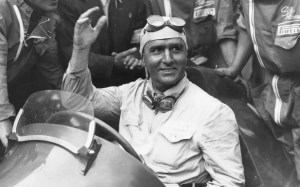
Giuseppe-Farina (Image from Motorsport Magazine fair use commons)

The current Formula One World Championship actually began at Silverstone in 1950 with the very first world championship Grand Prix. The first Silverstone British Grand Prix however was held two years earlier in 1948 when motor sport began again after the second world war. Luigi Villoresi won in 1948 in a Maserati but the 1950 race, round one in the new World Championship, was won by Giuseppe Farina.

This year, 2025, the British Grand Prix was held on the 6th of July and once again provided an exciting race with Lando Norris giving the fans another British winner after his team mate was given a controversial ten second penalty.


What to do next: Here are a few options.

Share this post on your favourite social media!

Hit the Subscribe button. Never miss another post!

Listen to my podcast Click here.

Buy the book! Click here to purchase my new poetry collection.

Click here to visit Amazon and download Floating in Space to your Kindle or order the paperback version.

Click here to visit amazon and purchase Timeline, my new anthology.

Titanic

The story of the Titanic, the ship that hit an iceberg and sank in 1912, is one of those stories which seems to be forever in the news. It’s a story that has caught the imagination of pretty much everyone. Even the other day, just scrolling through the BBC news page, I came across an item about some new digital scan of the Titanic wreck which revealed new information about the disaster.
This week I thought I’d take a look at the story of the Titanic and how it has been represented by television and film, well at least the TV shows and films that made an imopression on me, as well as the actual story of the tragedy.

The Titanic was designed to be the new premier ship of the White Star Line. It had been built by Harland and Wolff in Belfast and built alongside its sister ship the Olympic and was launched on the 31st May 1911 and was then towed to another berth where its engines and superstructure was installed as well as its majestic interior. The sea trials of the ship were undertaken on the 2nd April 1912 just eight days prior to leaving Southampton on its maiden voyage. The Titanic was the largest ship in the world and advertised as having the passenger accommodation of ‘unrivalled extent and magnificence’. It was also billed as unsinkable even though a few days into its first journey it would end up at the bottom of the Atlantic Ocean.

The Titanic on Television.

The Time Tunnel

The Time Tunnel was a sci-fi series created by Irwin Allen in the 1960s. The best episode in the series was probably the very first one. A US senator has come to take a look at a secret time travel project and see if the huge amounts of money being spent are justified. Scientist Tony Newman, fearful that the project will be cancelled, decides to trial the new Time Tunnel apparatus and send himself back in time. He activates everything and transports himself back in time arriving in 1912 on board the  Titanic.

His colleague, Doug Phillips also goes back to the same time zone to rescue Tony. The captain of the Titanic naturally doesn’t believe his ship is doomed to sink and back in the Time Tunnel control room the technical staff have a bit of a problem bringing the two scientists back to the present (actually 1968) but manage to transfer them to another time zone and so the scene is set for the subsequent adventures.

The Titanic at the Cinema.

A Night to Remember (1958)

I’ve always liked this film. It starred Kenneth Moore as the Titanic’s second officer, Charles Lightoller, and was based on a book about the disaster. The film was released in 1958 and tells the usual story about the sinking. The ship sets off but during the journey the overworked telegraph officers fail to pass on a warning about icebergs. The ship hits the iceberg and sinks. Despite a limited budget and only 1950s era special effects, A Night to Remember is actually a really good film.

Raise the Titanic (1980)

This was a film produced by TV mogul Lew Grade who was wanting to move his TV production company ITC Entertainment into the world of cinema. He had read the original book and thought that it might be possible to make a film series about US government operative Dirk Pitt in the manner of the Bond series.

In the film Dirk Pitt played by Richard Jordan proposes a salvage operation for the Titanic as he is convinced an American named Brewster had discovered a rare radioactive element called Byzanium which was stowed in wooden shipping boxes aboard the Titanic.

A huge undersea search takes place and the Titanic is ultimately found and raised. The Byzanium is not found aboard though although it does finally emerge in a neat twist at the end.

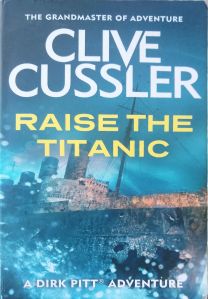
I’ve always enjoyed Raise the Titanic. It was based on a bestselling book by Clive Cussler although the film did not emulate the book’s success.

A great deal of the budget for the film was used to create a 50 foot model which was filmed at a huge water tank at the Mediterranean Film Studios in Malta. Apparently the three million pound model remains there today rusting away although the water tank is in regular use.

Not long after the film was made the real Titanic was located and it was confirmed the ship had broken up and was lying on the sea bed in two separate sections.

Titanic (1997)

Titanic was written and directed by James Cameron. The main thrust of the story is about two passengers from wildly different social classes who fall in love on the ship although one, played by Leonardo DiCaprio, dies in the disaster and the other played by Kate Winslet survives.

A treasure hunter (Bill Paxton) and his salvage team explore the wreck of the Titanic looking for a famous necklace, the Heart of the Ocean. They discover a safe which they bring to the surface to find it only contains a sketch of an unknown woman. After it is featured on TV the woman comes forward and tells the story of meeting Jack Dawson (DiCaprio) and of course of the sinking of the Titanic.

Director Cameron and his producers built a huge outdoor set in Playas de Rosarito in Mexico with uninterrupted views of the ocean and a water tank in which the Titanic set could be tilted to film the sinking scenes. Overall, the production cost was over 200 million dollars making it the most expensive film of all time. Happily for the producers, it also became the highest grossing film of all time until the release of Avatar, another film written and directed by Cameron.

The Novel

Dreaming a story and making it into a novel or a screenplay sounds pretty fantastic but in 1898 an American writer, Morgan Robertson, wrote a story about an unsinkable ship called the Titan which sailed from England to the USA but during the journey hit an iceberg and sank. The story was published fourteen years before the Titanic disaster. I remember reading the story of this writer years ago, even that the writer saw the story played out in front of him like a movie but all the research I did on the internet for this blog seems to imply that the author was a man who knew his business where ships were concerned, felt that ships were getting bigger and bigger and that a disaster like that of the Titanic was inevitable.

Books

I only have one book in my collection about the Titanic. It’s a big glossy picture book, not about the actual ship, but about the shooting of James Cameron’s film. It documents Cameron’s twelve dives in a tiny submersible which gave him the idea of the treasure hunters looking to find the necklace the ‘Heart of the Ocean’ and his realisation as Cameron himself mentions in the book’s foreword that the main thrust of the story should be a love story with the Titanic disaster almost as a backdrop.
The book tells about the numerous models that were built of the ship both as a pristine sea going vessel and as an underwater wreck. The making of the full size set in Mexico which could be dropped via hydraulic pistons into a huge water tank was an immense undertaking and adds immeasurably to the finished film.

So what actually happened to the Titanic?

The Titanic was on its maiden voyage to the USA. It left Southampton on the 10th April 1912 and stopped at Cherbourg in France to pick up more passengers before heading out across the Atlantic to New York. Four days into the voyage it hit an iceberg. Lookouts had been sent aloft to look for icebergs but their task was difficult. It was a moonless night and pitch black. The sea was very calm which meant that the lookouts could not see waves crashing against the icebergs that they had been warned to look out for. When an iceberg was finally spotted the lookouts rang down to the bridge. The officers there ordered the ship to turn hard to port. Some reports say that the engine room was ordered to stop engines which would not have helped the turn. Either way the ship brushed the iceberg and the resulting contact made a gash along the side of the ship and water rushed in.

The ship had been designed to stay afloat with four of her watertight compartments flooded but it could not stay afloat with the flooding of six. Interestingly the compartments were not sealed at the top so that when one flooded, the water tipped over into the next and so on until the ship sank.

The bow of the Titanic courtesy Wikipedia Commons

In another documentary I watched a few years ago a theory was put forward that the three million rivets that held the steel plates of the ship together were made of poor grade metal which became brittle in the freezing sea water. When the ship impacted the iceberg, the heads of the rivets popped off and sea water flooded inbetween the steel plates of the hull.

RMS Carpathia arrived about an hour and a half after the sinking and rescued all of the 710 survivors by 09:15 on 15 April. More than 1500 people died in the freezing waters of the Atlantic.

Titanic in the News.

As I mentioned earlier, the Titanic was in the news again when a new 3d scan of the wreckage of the Titanic was revealed.


What to do next: Here are a few options.

Share this post on your favourite social media!

Hit the Subscribe button. Never miss another post!

Listen to my podcast Click here.

Buy the book! Click here to purchase my new poetry collection.

Click here to visit Amazon and download Floating in Space to your Kindle or order the paperback version.

Click here to visit amazon and purchase Timeline, my new anthology.

A Tale of 4 Ships

I started this post by looking at an old one, a post about famous Pilots. That inspired me to make a sort of seagoing version. I started thinking about famous captains but I was struggling to think of any so I went with famous ships. Perhaps I could have stuck with captains after all; Captain Kirk, Captain Ahab, Captain and the Tenille and so on. Oh well, I think I’ll save that for another time so here we go with famous ships.

Victory

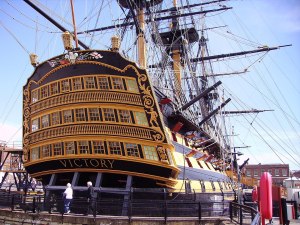
I should think that almost everyone reading this will know that HMS Victory was Nelson’s flagship at the battle of Trafalgar. The ship was one of 12 that had been ordered by the British government in 1758. The hull was laid down in 1759 and finally launched in 1765. 6,000 trees were used in the construction and 6 foot copper bolts were used to hold the construction together as well as treenails or dowels used to secure lesser elements of the ship. Once the frame was completed it was usual to let the wood dry out or ‘season’ before fitting the ship out further. Due to the end of the Seven Years’ War, the hull was left to dry for three years and the ship was finally launched in May of 1765.

By Ballista – Own work, CC BY-SA 3.0, https://commons.wikimedia.org/w/index.php?curid=749934

The ship had various adventures with the Royal Navy before becoming Admiral Nelson’s flagship in the battle of Trafalgar.

On the 21st of October, 1805, the Victory and the British Fleet began battle with the French. The British ultimately won but a sniper on the French ship Redoutable fired at Nelson hitting him with a musket ball which fatally wounded him. The musket ball was later recovered by the Victory’s surgeon William Beatty and he later had it mounted into a locket which he wore for the rest of his life. On Beatty’s death, the locket was presented to Queen Victoria.

The Victory was badly damaged in the battle and had to be towed back to England. It was repaired but was no longer a first rate ship and was relegated to various duties, even becoming a prison ship at one point. The Admiralty decided to break up the Victory and use her timbers and fittings in other ships. The public outcry was so great that the Admiralty hesitated to go ahead.

To a great extent the ship was abandoned to rot away and in 1922, the ship was found to be in such a state of disrepair that it was moved into a dry dock at Portsmouth, actually dock no 2, the oldest dry dock in the world. Restoration began after an appeal to the public for funding and dock number 2 became the Victory’s permanent home.

Bismarck

Bismarck was the first of two battleships built for Nazi Germany’s navy. Named after Chancellor Otto von Bismarck, the ship was laid down at shipyards in Hamburg in July 1936 and launched in February 1939. Final construction work was completed in August 1940, when she was commissioned into the German fleet. Bismarck and her sister ship Tirpitz were the largest battleships ever built by Germany.

In May 1941 the Bismarck planned to enter the shipping lanes of the Atlantic and attack convoys bringing much needed supplies into Britain. The Bismarck in company with the Prinz Eugen was engaged by the HMS Hood and the Prince of Wales. The Hood was destroyed in the battle while the Prince of Wales was badly damaged and forced to retreat.

The British began a relentless pursuit of the German vessel and two days later she was severely damaged by torpedoes fired by aircraft from the HMS Ark Royal. The rudder had been damaged on the Bismarck and the ship was forced to steam in a wide circle. The battleship came under further attack from the British ships and a major hit on the Bismarck’s bridge killed or disabled Captain Lindemann and Admiral Günther Lütjens. The remaining executive officer ordered the crew to abandon and scuttle the Bismarck in order to prevent the British capturing and boarding the vessel which eventually capsized and sunk.

The entire episode was made into a film in 1960 called Sink the Bismarck. Kenneth More starred as the head of the underground naval operations war room and he and his staff coordinate the hunt for the Bismarck.

Bounty

Another famous seagoing story that has been made into a feature film, several films in fact, is the story of the mutiny on the Bounty. The mutiny occurred in April 1789 and was led by Fletcher Christian who was an acting Lieutenant on board the Bounty. The Bounty’s mission was to sail to Tahiti and collect breadfruits and then deliver them to the West Indies. It may have been that a five month layover on Tahiti, where many of the men formed relationships with the native women, was at the heart of the mutiny. William Bligh, the captain of the Bounty, had at one point been a great admirer of Fletcher Christian, even promoting him to the rank of acting second lieutenant and thereby becoming his second in command. The relationship soured later though and when the ship began the journey home Christian decided to stage a mutiny. Bligh and his supporters were made to leave the ship on the Bounty’s launch, a 23 foot boat and were given food and water for 5 days. Bligh sailed to a nearby island for supplies and then made an astonishing journey in the small boat to Timor where the authorities were alerted to the mutiny.

The mutineers fled in the Bounty and returned to Tahiti but Christian realised that this would be the first place the navy would come to search for them. Sixteen crew members opted to stay on Tahiti, Christian and the rest of the mutineers together with a contingent of Tahitans then tried to settle on another island but the natives there were unfriendly and the Bounty left in search of another island. The mutineers then came across Pitcairn Island and seeing that it was marked incorrectly on naval charts decided to settle there. Numerous disagreements arose later with the Tahitans as many of the British considered them as slaves. Fletcher Christian was later murdered on the island although he was survived by a son and other children.

Today, the descendants of the mutineers still live on the island.

Various film versions of the story were made but the most famous featured Clark Gable as Fletcher Christian and Charles Laughton as Captain Bligh. In the 1960’s a version was made with Marlon Brando and Trevor Howard. Brando was so taken with Tahiti where numerous scenes were shot, he made it his home for many years. Another version, The Bounty appeared in 1984. It was a project originally started by director David Lean and writer Robert Bolt but after various disagreements with the producer, Lean backed out and the New Zealand director Roger Donaldson took over.

Titanic

The story of the Titanic is one that has captured the imagination of many over the years and even today seems to be still in the news after a deep diving mini submersible was crushed in the depths of the ocean while taking sightseers to view the wreck of the great ship.

The ship was the largest afloat and was designed to be the epitome of luxury. It was known as the ‘unsinkable’ ship and made its maiden voyage in 1912 from Southampton to New York in the USA. On the voyage the ship struck an iceberg and the hull was ruptured. The Titanic sank with a great loss of life. A major flaw however was that there were not enough lifeboats for the crew and passengers in the event of a tragedy. Another was that the 16 watertight compartments were not truly watertight and when the first one filled with water, the water then spilled over into the next one and so on until the ship sunk.

Numerous films and TV shows have been made about the sinking. Kenneth More starred in A Night To Remember, a 1958 British film about the Titanic. In the 1960’s the first episode of the time travel TV show The Time Tunnel featured a story about two American scientists who are transported back in time and arrive on board the doomed ship. A more recent film blockbuster was the 1997 Titanic directed by James Cameron. Leonardo DiCaprio and Kate Winslet star in the film that weaves a tragic love story with the fate of the famous ship. Titanic was the most expensive film ever made at the time with a budget of 200 million dollars. A huge reconstruction of the ship was made in Rosarito, Mexico and was built on a lifting platform which was able to tip the ship to simulate the sinking. The film was a great success winning 11 Oscars including one for Best Picture.

Personally I rather like Raise The Titanic, a 1980 British film version produced by Lew Grade and his ITC Entertainment company and based on the novel by Clive Cussler


What to do next: Here are a few options.

Share this post on your favourite social media!

Hit the Subscribe button. Never miss another post!

Listen to my podcast Click here.

Buy the book! Click here to purchase my new poetry anthology.

Click here to visit Amazon and download Floating in Space to your Kindle or order the paperback version.

Nothing Lasts Forever: A DNA Story

Looking back at the past is always interesting, at least I’ve always found it so. I love reading about history and I watch lots of TV history documentaries. Shakespeare once said ‘what is past is prologue’ and he was right! One area of the past I’ve been looking into recently was my own and my Christmas present to myself was a DNA test.
I got the test from the website Ancestry.co.uk and I received my testing kit just before Christmas and sent it off on the 24th December. I kept checking the website to see if the ancestry people had received it yet but nothing came up. Maybe Christmas Eve wasn’t such a great day to post something so important. Anyway, they finally got the sample and to make things exciting, on the ancestry web site you can see how things are progressing with updates like sample received, sample ready for testing, sample tested, DNA extracted, checking DNA and so on.

While I was waiting for all that to happen, I still seemed to be getting nowhere tracing my great grandfather Patrick Henry Higgins. He is mentioned on my grandfather’s marriage certificate of 1920 as being deceased so clearly he passed away sometime before that date. A distant cousin on the Ancestry site seems to think he was born in Roscommon in Ireland. Perhaps so but Patrick Henry Higginses are ten a penny in that part of the world so I turned my attention to my grandmother who was born Ellen Beresford. I vaguely remember my dad mentioning that he had relatives in the Staffordshire area and that Ellen originally came from there. I know from her marriage certificate that her father was George Beresford, a collier and Ellen was born into a mining community in Leycett, Staffordshire.

A few clicks on the internet and I find that the village of Leycett, as well as having a colliery, also had a miners’ institute, a church, a village shop with off-licence, a post office, a butcher’s, and a railway station. They also had a recreation ground built by the miners which had a cricket and football pitch and later tennis courts and a bowling green.

The colliery closed down in 1957 and by the mid-sixties the main part of the village had been demolished. The terraced houses which formed the main part of the Leycett community are now completely gone.

My grandmother Ellen

My father told me that Ellen left Staffordshire and came to Manchester when she was only young. Dad told me she was ‘in service’ to a rich family. In the census of 1911, when Ellen was 15, I found her registered as a domestic servant to the family of Mr Chilton. His occupation was registered as a beer seller and his address was the Queens Arms on Brunswick Street in Rusholme, Manchester. Brunswick Street runs from Rusholme to Ardwick and today has almost been completely redeveloped. No Queens Arms exists in 2023 which is a little surprising. Back in the late 1970’s I used to travel up and down through Ardwick and  Gorton many times when I was a trainee bus driver at the GM Buses driver training school at Hyde Road. The area was in the process of redevelopment back then and many buildings were being knocked down although it seemed to me that the pubs always seemed to escape the destruction. The Queens Arms sadly did not. Ellen and my grandad were married in Gorton Monastery in 1920 and I suppose it is not inconceivable that the two met in the Queens Arms.

I joined GM Buses in 1976 or 77 and little did I know at the time that Hyde Road was an area that my Grandparents were very familiar with.

Looking at the tips for tracing relatives it seems that the main one is talking to older relatives. My dad died in 2000 and my mother is aged 93 and stricken with dementia and is not in a position to tell me anything, although such are the quirks of memory that when I sometimes show her old pictures, she can sometime name those in the picture and tell me a little of the background. My only other relative, my dad’s sister, is someone I haven’t seen for years although I do have Facebook contact with her daughter, my cousin.

Alas, my messages to her on Facebook had not been answered for a long time although happily I did get a reply from her recently. She didn’t have much to add to our family story except she knew that George Higgins worked for the Manchester Tramways Department at Hyde Road and was injured after something hit him on the head. My brother remembered that it was something that connects the tram to the overhead electric cables. As a result of that he suffered with epilepsy for the remainder of his life. George died in 1954, two years before I was born.

Quite often, I try to rack my brains and think about the memories my dad shared with me years ago. I know he mentioned family in Staffordshire which is how I was able to trace my grandmother’s background. On the ancestry site I use, I found a record of her birth and applied to Staffordshire council for a copy of her birth certificate, hoping that might divulge some further information. One interesting thing that it revealed was that her maiden name and her married name were both Beresford

Eventually my DNA results finally arrived. I can now reveal that I am 56% Northern British and European, 19% Irish, 17% Scottish 6% Swedish and 2% Welsh. The site also threw up 24,785 DNA matches, mostly distant cousins although one of my cousins, the son of my mother’s sister, came up as my closest DNA match. Strangely, not a single person named Higgins was on the list although that only means that few on the Higgins side of the family are interested in DNA testing.

I’m not sure why but I actually wondered whether the DNA test might show up some unknown brother or sister. Perhaps I’ve been watching too much of that TV show Long Lost Family.

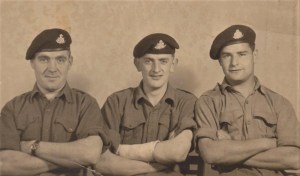
A lot of this looking back into the past makes me sometimes wonder about how impermanent our existence seems. Dad used to tell many stories about his time in the army. I honestly think his army life was probably the most exciting thing that ever happened to him. He travelled to Germany, Northern Ireland and Hong Kong. Once he mentioned that he and his best mate who went by the name of ‘Lulu’ Lownes (I’m not sure why he was nicknamed Lulu) were in Hong Kong for a night out. They jumped on a bus or tram at the traffic lights. The bus conductor wasn’t happy and when they went to pay asked them for the full fare, even though servicemen were entitled to either free or reduced fare. Lulu was so upset by this he decided to throw a punch at the conductor and the two of them, Lulu and Dad, jumped off the bus and ran off into the night despite the conductor blowing a whistle and calling for the MPs.

Dad on the left of the picture with two of his army mates.

That must have been back in the 1950s and Dad and presumably Lulu are now long gone. Probably the conductor and driver are gone too as well as the MPs who gave chase. The conductor may have reported the incident and the bus company may have in turn reported the matter to the police. The police officers who dealt with the case, if indeed there was a case, are also long dead as well as the Royal Hong Kong Police themselves as back in 1997 control of Hong Kong was returned to China.

It may be then that only myself and my brother are the only ones who know about this event and the only actual record of it may be in this blog post. One day when I am gone WordPress will send a message to my email asking me to pay the small amount for my dedicated website address, stevehigginslive.com. No answer will be forthcoming and stevehigginslive.com will presumably either revert to its original WordPress web address or just vanish into cyberspace.

One day some search engine might flag up this blog post in return to some query about Hong Kong and British servicemen and the researcher will click the link only to find something like ‘502 error: Bad gateway’ or ‘site not found’.

If the researcher is not happy with that, he may wonder who Steve Higgins was and decide to do a further search for Steve Higgins, writer and blogger. Then he might even find my YouTube page. There he will find me, just as I used to be back in the 2020’s asking the viewer to buy Floating in Space or to read my blog posts that may no longer exist.

Nothing lasts for ever.


What to do next: Here are a few options.

Share this post on your favourite social media!

Hit the Subscribe button. Never miss another post!

Listen to my podcast Click here.

Click here to visit Amazon and download Floating in Space to your Kindle or order the paperback version.

Buy the book! Click here to purchase my new poetry anthology.

Khrushchev, Gorbachev and the Power of Pizza

Khrushchev was the first Soviet leader who tried to humanise the Soviet Union. This huge monolithic state that represented tyranny and state control had been created by Stalin and though Stalin himself brought Khrushchev into his inner circle, it was Khrushchev who later rejected the brutality of the Soviet State.
Khrushchev openly criticised the Stalin era and began a new, more open era of government. Alarm bells had begun to ring in the Kremlin though and by 1964 Khrushchev’s colleagues were not so happy with what he was doing. Brezhnev organised the removal of Khrushchev and soon had taken the top spot for himself.

Brezhnev remained in power till his old age and when he died in 1982 a group of old men successively took over, Andropov 1982-84, then Chernenko 1984-85 and then in 1985 came a younger man, Mikhail Gorbachev.

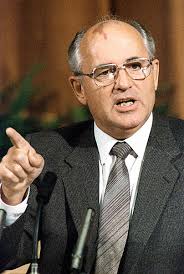
Gorbachev felt reforms were necessary and began two initiatives, Perestroika (restructuring) and Glasnost (Openness). He dealt with the issues of war in Afghanistan and the nuclear disaster of Chernobyl. His determination to bring in elected bodies such as the Congress of People’s Deputies and further democratisation of the Soviet Union seemed only to undermine his position. He once dismissed Boris Yeltsin from the Communist party but was forced to deal with him again when he was elected President of Russia.

In 1991 an attempted coup by Communist hard liners failed but this seemed to give the political impetus to Yeltsin. Yetsin banned the Communist party that had once rejected him and soon the Soviet Union collapsed underneath Gorbachev.  He gave a television address to announce that the Soviet Union would formally end at midnight on 31st December, 1991.

Image courtesy Wikipedia creative commons.

In retirement Gorbachev created the Gorbachev Foundation with the aims of publishing material on the history of Perestroika and of presenting his ideas and philosophy to the world. Ironically, although Gorbachev was revered outside of the Soviet Union, within the country his fellow citizens accused him of destroying the economy as well as the communist party.

No longer President, Gorbachev needed money to maintain his foundation and his family and so he undertook to begin lecture tours, charging large amounts of money.  He began to suffer the same fate as many of his fellow former soviet citizens, his pension, 4000 roubles per month, given him by the Russian Federation, was not index linked to inflation and by 1994 his pension cheque was worth very little.

The Foundation began to struggle and even the lecture fees were not enough to pay bills and staff wages. In order to stay in Russia Gorbachev needed money, much more money.

McDonald’s opened in Moscow in 1990 and in that same year Pizza Hut opened its Moscow doors. By 1997, Pizza Hut’s international arm was looking for new ways of reaching out to the public. It wanted a global campaign that would play in any country in the world.

What about a TV ad using Mikhail Gorbachev?

Pizza Hut’s advertising people approached Gorbachev but the negotiations took months. Partly, this represented a negotiating tactic: The longer the negotiations drew out, the higher Gorbachev’s talent fee would be. But it also represented real hesitation on Gorbachev’s part.

However it happened, the core idea of the ad remained stable throughout the long process of negotiating and filming it. It would not focus on Gorbachev but on an ordinary Russian family eating at Pizza Hut. It would be shot on location, featuring as many visual references to Russia as possible.

Gorbachev finally assented but with conditions. First, he would have final approval over the script. That was acceptable. Second, he would not eat pizza on film. That disappointed Pizza Hut.

Gorbachev held firm.

A compromise was suggested: A family member would appear in the spot instead. Gorbachev’s granddaughter Anastasia Virganskaya ended up eating the slice. Pizza Hut accepted.

The advertising concept exploited the shock value of having a former world leader appear. But the ad also played on the fact that Gorbachev was far more popular outside Russia than inside it.

Either way, the former leader of the Soviet Union would be advertising pizza. Gorbachev had lost his presidency and in a sense his country, after all the Soviet Union was gone, replaced by the Russian Federation. I wonder if Gorbachev ever thought for a moment about Nicholas II, another man forced to resign his country’s leadership. Perhaps, perhaps not.

Khrushchev ended his days living in a small dacha in Moscow constantly spied on by the KGB. He wrote his memoirs and they were smuggled out to the west although Khrushchev was forced to deny sending them to a western publisher. He died in 1971.

Gorbachev reportedly received a million dollars for the promotion. The badly needed funds enabled him to pay his staff and continue working for reform in Russia.


Floating in Space is a novel by Steve Higgins set in Manchester, 1977. Click the links at the top of the page to buy or for more information.

Bury my Heart at Wounded Knee

I can’t really remember when I became interested in Red Indians, or to be more precise, Native American Indians. In a way it was an interest in philosophy and the meaning of life that led me to them. I liked the idea of the Great Spirit and the Mother Earth. Those intrinsic ideas of nature and faith greatly appealed to me and showed me a different Indian to the one I have seen on feature films, here was a thoughtful race, in tune with nature. A speech made in 1854 by Chief Seattle has always moved me and in part says this:

This we know: the earth does not belong to man, man belongs to the earth. All things are connected like the blood that unites us all. Man did not weave the web of life, he is merely a strand in it.

What more eloquent description of the world and man’s place in it could there be?

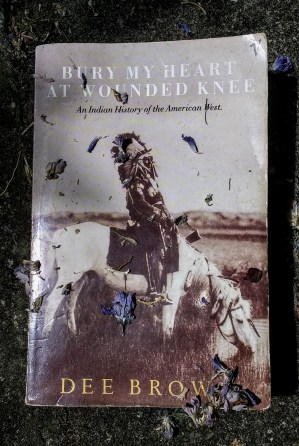
Bury my Heart at Wounded Knee is a book by Dee Brown published in 1970. It is a sad book telling a sad tale of murder, lies and ethnic cleansing. It tells the story of a proud race of people driven from their homes by invaders from Europe and forced to leave behind their homes, their memories and their traditions. Much of the book is in the actual words of the Indians whose words were taken down in treaty meetings and councils, by government stenographers.

Columbus arrived in the new world in 1492 and he described the natives at ‘tractable and peaceable’ yet in less than a decade Spaniards had looted and burned villages in their search for gold and treasure, kidnapped men, women and children for sale as slaves and destroyed entire tribes. Things were similar on the east coast of the country. Englishmen landed in 1620 and found the natives friendly and even helpful. They would probably have died during their first winter in America had the natives not showed the newcomers where and how to fish and how to cultivate and plant corn. For several years the Indians and the new white settlers lived in peace but then more and more settlers arrived and settlements in the place the newcomers called New England became more crowded.

in 1625 some of the colonists asked the Indians for more land. The Indians who knew that the land came from the Great Spirit and belonged to no one went through a ceremony to give the English more land. It was more to humour these strange men that the Indians did so but it was the first deed of Indian land to English colonists.

When Massasoit, the chief of the Wampanoags died in 1662, his people were being pushed back into the wilderness as so many more Englishmen arrived and their settlements became bigger. The New Englanders flattered the new Indian chief Metacom and crowned him ‘King’. Metacom though made new alliances with other Indian tribes and in 1675 began a war to save the tribes from extinction. The firepower of the colonists however overwhelmed the Indians and Metacom was killed and his head publicly displayed at Plymouth for the next twenty years. His wife and son were sold into slavery.

Over the next two hundred years these events were repeated time and time again as the colonists moved ever westwards. In 1829 Andrew Jackson took office as President of the United States.. He suggested setting an ample district of the country, west of the Mississippi, to be guaranteed to the Indian tribes. On May 28th 1830 Jackson’s recommendations became law. Two years later he appointed a Commissioner of Indian Affairs to see this was carried out and then on June 30th 1834 Congress passed An Act to Regulate Trade and Intercourse with the Indian Tribes and to Preserve Peace on the Frontiers. All the land west of the Mississippi and not part of Missouri, Louisiana or Arkansas would be Indian country. Also, no white persons would be able to trade in the Indian country without a licence and no white persons would be allowed to settle on Indian lands. However, a new wave of settlers surged west and formed the territories of Wisconsin and Iowa and so the Indian frontier was shifted even further west.

At the beginning of the 1860’s the American Civil War began. Perhaps the Indians hoped the white men would destroy each other but it was not to be. The colonists wanted more and more land and the Indians had to cede more and more to the newcomers until there was nothing left for them to give. One thing they would not give was the Black Hills.

The Black Hills were sacred to the Indians. Paha Sapa was the centre of the world, the place where warriors went to speak with the Great Spirit and await visions and where the spirits of their ancestors dwelt. In 1868 the Great Father, the President, considered the hills worthless and gave them to the Indians forever by treaty. Four years later the cry of ‘gold’ was raised and miners and pan handlers made a bee line for the hills. Many were killed or chased out by the Indians but by 1874 gold crazy prospectors were making such a hue and cry that the army decided to send soldiers to the area for a reconnaissance. A thousand pony soldiers of the 7th cavalry marched into the area  commanded by General George Armstrong Custer. Custer had years before slaughtered Black Kettle’s Southern Cheyennes. Red Cloud of the Oglala Sioux was not happy. He made complaints to the Great Father in Washington but their response was to send negotiators to buy the Black Hills. Councils were set up with the chiefs of all the tribes in the area but the word was firm. The Black Hills had an importance to the tribes that went beyond money. They would not sell.

The negotiators packed up and returned to Washington. Their recommendation? That congress ignore the wishes of the Indians, take the land and pay a ‘fair equivalent of the value of the hills.’ to the Indians.

On December 3rd the Commisioner of Indian Affairs ordered all Indians to report to their reservations by January 31st. This was impossible as all the tribes were at their winter lodges and many were searching for game to assist with their meagre rations. A mixed band of Oglala Sioux and Northern Cheyennes were hunting Buffalo in the Powder River area. On March the 17th they were asleep in their lodges when a company commanded by Captain James Egan charged through the sleeping camp. At the same time a second troop of cavalry came in from the left flank while a third swept away the Indians’ pony herd. Many were killed. The Indian Teepees were burned with everything inside and the survivors were left with nothing, no food or weapons and only the clothes they were wearing. Later that night while the soldiers camped, the survivors returned and stole back their horses, then without adequate food or clothing they made their way to the camp of Crazy Horse. The Oglala chief took in the survivors and gave them food and shelter.

As the weather warmed the Sioux and Cheyenne decamped in accordance with their treaty rights as hunters. Several thousand Indians of many tribes came together. After an engagement with the forces of General Crook the chiefs decided to move to the valley of the Greasy Grass, or as the Americans called it, the Little Big Horn.

Some minor battles with other US cavalry groups had occurred before the  Little Big Horn engagement, notably with Major Reno. It seems that when the Indians attacked Custer’s 7th Cavalry, Custer meant to break back south and meet up with major Reno’s forces not knowing that they had already been beaten back by Indian forces. Custer also apparently did not realise the true scale of the Indian forces. Five of the 7th Cavalry’s 12 companies were annihilated and Custer was killed, as were two of his brothers, a nephew and a brother-in-law. The total US casualty count included 268 dead and 55 severely wounded (six died later from their wounds).

After the battle the tribes hunted and feasted. Generals Crook and Terry would not attack again until reinforcements arrived. By then, many of the tribes had left for their own reservations and lands and the huge force that had existed before was gone. The Sioux were finally defeated by General Miles in 1877. Threatened with starvation the tribes were forced to finally sell the Black Hills.

One last sad story is one that gave its name to the title of Dee Brown’s book. In December of 1890 a band of Lakota Indians were escorted to the Wounded Knee creek where they camped. The next day Major Whiteside’s regiment was replaced by soldiers of the newly built up regiment once commanded by Custer and now led by Major James Forsyth. Forsyth decided to disarm the Indians and had his troops surround them. He had new Hotchkiss guns set up on a hill to cover the camp.  It is not certain what happened but the next morning one Indian was reluctant to give up his rifle. Soldiers tried to seize the rifle and a shot was heard. Perhaps it was the Indian, Black Coyote, perhaps not. Soldiers then opened fire, shooting indiscriminately. Fighting began but as only a few of the Indians had weapons they were forced to flee. Then the Hotchkiss guns on a hill overlooking the area opened fire, raking the teepees and killing women and children and anyone in their path. 153 were known to be dead but many died later from their wounds.

Bury My Heart at Wounded Knee tells of the Cheyenne, the Sioux, the Arapaho, the Brules, the Cherokees, the Shoshone and hundreds of others, their names now forgotten. It tells of chiefs like Sitting Bull, Crazy Horse, Standing Bear, Geronimo, Red Cloud, Cochise and many more. All are gone and few remembered but the Native Americans survive to this day. Many have adapted, many have changed. Most live in poverty on reservations described by observers as being like third world nations.

Today, the Sioux still ask for the return of their lands. In a 1980 ruling, the U.S. Supreme Court found that “a more ripe and rank case of dishonorable dealing will never, in all probability, be found in our history.” It authorized a settlement now worth nearly $200 million, but ruled that it had no power to return the land. The Sioux live in poverty, yet they refused the pay out.

The Hills, the Indians say, are sacred soil, Wamaka Og’naka I’cante, the heart of everything that is, and not for sale.

The fight for the return of their lands goes on.

Bury My Heart at Wounded Knee is still in print 48 years after its publication in 1970

For more information, read this article in the New York Times or this one on the PBSO news Hour page.


Enjoyed this post? Why not try my book Floating in Space set in Manchester, 1977? Watch the video below for a quick taster or click the options at the top of the page for info or to buy!


World War II Mysteries: Himmler and Borman

I noticed something on the TV the other day, a preview of a documentary about Dunkirk, the World War 2 escape of the British and Allied forces across the channel back to the UK. It boasted about newly released files from the time and it made me think, just how much do we know about this conflict that ended in 1945 and how much is still secret?

Two fascinating books illustrate the point.

The Unlikely Death of Heinrich Himmler by Hugh Thomas

Anyone who is interested in history and the events of the second world war will know that Himmler committed suicide after falling into British hands. Himmler, in case you didn’t know was one of Hitler’s leading Nazis and the ruthless head of the German secret police, the Gestapo. You may even have seen the pictures of Himmler’s corpse or even the Pathe newsreel.

The dead man looks like Himmler, as much as any corpse resembles the living person it once was but are the officials telling us all they really know about the event?
To start off with the pictures, the information released by the army said they were snapped moments after the suicide. Not true. Himmler was naked apart from a pair of British issue army socks when he died. He had been separated from his German uniform in case of hidden suicide pills or weapons but he had refused to dress in a British army uniform.

When army staff suspected he had something in his mouth he clamped his teeth down on a cyanide tablet and died while desperate medical staff tried to save him. After his death he was dressed in an army shirt for the cameras and a pair of pince-nez were also clipped to his nose, so the dead body was not photographed straight away as was claimed.

Himmler had been stopped by suspicious soldiers trying to cross a bridge with a crowd of former slave labourers. The man claimed his name was Hinziger. When the soldiers questioned the man’s papers, he and two companions tried to bluster their way out. The soldiers, members of the Black Watch, became suspicious and took the men prisoner.

Was the man really Himmler?

Himmler had been discharged from his duties by Admiral Karl Doenitz who had taken over leadership of the dying Reich after the suicide of Hitler. Hitler himself had learned of Himmler’s betrayal in his last hours for Himmler had been secretly negotiating surrender terms with the allies. Himmler thought perhaps he would have a place in post war Germany or that like others, he could do a deal with the allies in return for secrets or money. Doenitz and Goring both had similar ideas however Goring was sentenced to death at Nuremberg and Doenitz to twenty years imprisonment.

Now neither side had any need of Himmler, a mass murderer, responsible for the concentration camps and the final solution, the mass murder of Jews and others decreed undesirable by the Third Reich.

When Himmler was arrested by the British at Bremervoerde on May 22, 1945, he had disguised himself by shaving off his moustache and had donned an eye patch over his left eye. He was carrying false identity papers.

Himmler succumbed to a cyanide pill on May 23, 1945 and sometime later four British soldiers took his body from a safe house in Luneburg, bundled it into an Army truck and secretly buried it in an unmarked grave on windswept Luneburg Heath. It has never been found.

The author, Hugh Thomas, tells us the story of Himmler’s life and his rise to power and puts forward a compelling case to prove that the supposed corpse of Himmler was not Himmler at all. Prior to the end of the war Himmler, whose power as head of the SS was second only to that of Hitler, transferred huge amounts of loot to foreign bank accounts and fake businesses in order to fund Nazi war criminals in South America and elsewhere. He even contends that Germany’s postwar economic ‘miracle’ was funded by SS loot.

Files on the death of Himmler have been sealed until 2045. Why? Is it because the man who died at Luneburg was an imposter, killed by the British to disguise the fact Himmler was in their hands?

All in all, a fascinating read.

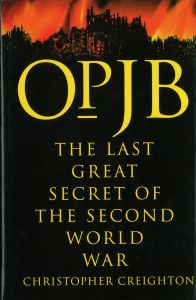
Operation James Bond by Christopher Creighton.

Now with a title like that, you might automatically think this book is a work of fiction, or at least something actually about James Bond or his creator, author Ian Fleming. Well, you’d be wrong. Fleming is involved as it happens, because in WW2 Commander Ian Fleming of the Royal Navy was assigned to Naval Intelligence and Fleming came up with an ingenious plan to spirit Martin Bormann out of Berlin and into allied hands.
According to the book, the operation was given the go ahead by none other than Prime Minister Winston Churchill and the book sports a letter from Churchill to the author giving him the go-ahead to publish his story after Churchill himself was no longer alive.

‘When I die’ wrote Churchill ‘then, if your conscience so allows, tell your story for you have given and suffered much for England. Do not seek to protect me for I am content to be judged by History.’

The author, with Ian Fleming and a small commando raiding party, entered Berlin in its death throes via the rivers Spree and Havel, spirited Bormann away in a small fleet of canoes and arrived on the West Bank of the Elbe to the safety of Allied forces there on May 11th 1945. Bormann had, according to the book, agreed to free up all the Nazi funds hidden in Swiss bank accounts in exchange for his freedom and refuge in England.

Again, according to the author, 95 percent of Nazi funds were recovered and restored to their rightful owners.

Some of the book borders on the fantastic. For instance Creighton maintains that Bormann visited the war crimes tribunal in Nuremberg and heard himself sentenced to death. Major Desmond Morton, the head of the secret M section of Naval Intelligence had escorted Bormann there, suitably disguised, to perhaps see for himself what the alternative was to assisting the allies. Aided by minor plastic surgery Bormann lived on until his late 50s when his health failed and he died aged 59. By then Bormann had been exiled to Paraguay. The secret service then arranged for his body to be interred in Berlin where it was found during excavations in 1972 so preserving the myth that he had died in Berlin.

A thoroughly imaginative and exciting story but whether it is true, remains to be seen.


Floating in Space is a novel by Steve Higgins set in Manchester, 1977. Click the links at the top of the page for more information.

The Rise and Fall of the Kennedys

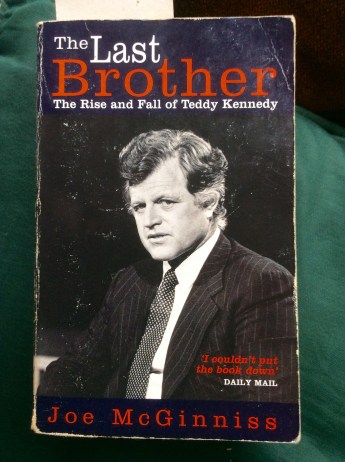
The Last brotherThe Last Brother by Joe McGinniss

The Last Brother as you can see, is subtitled, the Rise and fall of Teddy Kennedy. In a lot of ways Teddy is only incidental to the story told here because it is really the story of his father, Joe Kennedy, and his rise to success. Joe’s success lay not only in the business of banking but during the prohibition years he made a fortune in bootlegging and naturally rubbed shoulders with a number of gangsters. When he became successful, Joe wanted something more; he wanted political power. It was then that he attached himself to Franklin D Roosevelt. He helped Roosevelt’s campaign in many ways and when Roosevelt became president, he, like all presidents, had to reward those who had helped him. Joe became ambassador to the UK and it was there that his fall from grace began.

The ambassador and his family quickly became celebrities in England. In fact, Teddy Kennedy made his first public appearance as a young boy, the ‘baby’ of the Kennedy family and the son of the Ambassador, when he was invited to open pets’ corner at London Zoo.

However, In Joe’s eyes the coming war with Nazi Germany spelled the end of all he had worked for. He could not see how the UK could resist the might of the Nazis and was not slow in saying so. Kennedy advised Roosevelt that the British were finished. However, when Winston Churchill became prime minister in 1940, Churchill opened up direct communications with Roosevelt himself making Ambassador Kennedy almost superfluous.   Later, the family returned to America with Joe not perhaps in disgrace but acutely out of step, and the relationship between Churchill and Roosevelt flourished.

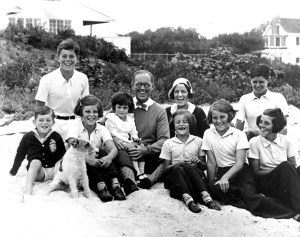
PC 8 The Kennedy Family at Hyannis Port, 1931. L-R: Robert Kennedy, John F. Kennedy, Eunice Kennedy, Jean Kennedy (on lap of) Joseph P. Kennedy Sr., Rose Fitzgerald Kennedy (behind) Patricia Kennedy, Kathleen Kennedy, Joseph P. Kennedy Jr. (behind) Rosemary Kennedy. Dog in foreground is "Buddy". Photograph by Richard Sears in the John F. Kennedy Presidential Library and Museum, Boston.

The Kennedy Family at Hyannis Port, 1931. L-R: Robert Kennedy, John F. Kennedy, Eunice Kennedy, Jean Kennedy (on lap of) Joseph P. Kennedy Sr., Rose Fitzgerald Kennedy (behind) Patricia Kennedy, Kathleen Kennedy, Joseph P. Kennedy Jr. (behind) Rosemary Kennedy. Dog in foreground is “Buddy”. Photograph by Richard Sears in the John F. Kennedy Presidential Library and Museum, Boston.

Kennedy left the Roosevelt administration but he wanted political power for himself and made sure he would find it through his financial wealth, and through his sons.

Joe Kennedy junior was the son that Joe meant to make into America’s first catholic president. His brother, John Kennedy, known as Jack by the family, was a poorly lad afflicted by Addisons disease and constant back pain. In World War 2 Jack joined the navy but began an affair with a Dutch journalist, Inga Arvad. Inga was thought to be a Nazi spy so Joe immediately arranged for Jack to be posted well away from Inga to South Carolina. Bored with his desk job in South Carolina, Kennedy volunteered for the Motor Torpedo Boat Squadrons and later took charge of his own boat, PT 109. He was awarded the Purple Heart for his bravery in rescuing his men when his torpedo boat was sliced in two by a Japanese destroyer.

Joe Kennedy Jr was not at all happy when he heard about the award. Competitiveness was drilled into the Kennedy clan from an early age and Joe did not want his younger brother to top him. Perhaps that is why he volunteered for a dangerous mission. The mission involved a radio controlled plane, full of explosives that were to be remotely steered to a target in Germany. Joe’s job was to take the aircraft into the air then bale out when the radio control was activated. Sadly the aircraft’s explosives were detonated prematurely and Joe was killed.

Jack knew then that it was he who would have to fulfil his father’s desire for the presidency.

Joe used his influence, and his money, to get Jack first a seat in congress and then a seat in the senate. In 1960 it was time for him to fulfil his father’s dream and go for the presidency. Lyndon Johnson wanted the democratic ticket that year and he began by attacking the the Kennedy candidacy. He described him as ‘a little scrawny fellow with rickets’ but soon the influence of father Joe came to bear and Johnson ceased his attacks. Johnson knew that that Joe Kennedy would pull out all the stops for his son to win but he hoped that if the vote wasn’t decisive on the first ballot he would have a chance on the second one. As it happened, John F Kennedy won the nomination on the first ballot. According to McGinnis it was Joe who wanted Johnson as JFK’s running mate; perhaps that was payback for Johnson laying off his attacks on Kennedy’s health issues.

The election was close, very close indeed and Joe decided he needed help from a rather unsavoury corner; he turned to his former prohibition gangster contacts, notably Sam Giancana to help him secure victory for his son. That help would come at a price. Giancana wanted back the casinos in Cuba that used to make millions for the mob until Castro overthrew the Batista regime, closed down the casinos and threw the gangsters out of Cuba. Giancana wanted them back.

Kennedy won the election by a narrow margin but things went wrong almost straight away. CIA backed revolutionaries were training in secret Florida locations for an assault on Cuba but the plans were in disarray and the president rejected many of them, When the attack came it was a disaster. Kennedy accused the CIA of trying to force him into a full scale US assault on Cuba and he would have none of it. Giancana would not get his casinos back. Worse, the president had engaged his brother, Robert Kennedy as attorney general and he began an assault on organised crime in the USA. One of the mafia bosses was heard to mutter in Sicilian, “who will get the stone out of my shoe?” It was more of a threat than a question.

Joe Kennedy was struck down by a stroke at the age of 88 and rendered unable to speak. The chief fixer, paymaster and head of the Kennedys was unable to carry on talks with the mafia and the time had come to remove the stone from Giancana’s shoe.

Dealey Plaza

Dallas 1963

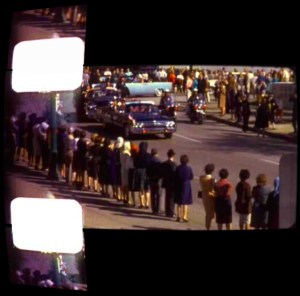
President Kennedy was assassinated in Dallas in 1963 and his presumed assassin Lee Oswald murdered days later inside the Dallas Police headquarters. At the Kennedy home in Hyannis Port nobody wanted to tell Joe. He must have known something was wrong but he could only point numbly at the TV in his room that remained firmly switched off. Ted Kennedy, who was sent to tell his father the news, struggled to get the words out until his sister Eunice blurted out the truth.

Robert Kennedy was shot in 1968 as he prepared for a late campaign for the Democratic ticket. After winning the California primary he said a few words to his supporters and was shot moments later.

Ted Kennedy now had a surplus of Kennedy advisors and aides, all willing him on to go forward and run for the presidency. He declined even though a ‘draft Ted Kennedy’ movement had started to gain momentum. Instead people looked forward to 1972 when Teddy, the last remaining Kennedy brother would restore the lost kingdom, the lost Kennedy leadership but it was not to be.

In 1969 Kennedy attended a boating regatta at a small island called Chappaquiddick. Numerous parties were planned for the weekend; one was a gathering of the so-called ‘boiler room girls’ – a group of women who had been part of Robert Kennedy’s campaign team in 1968.

Kennedy apparently left the party late in the evening, supposedly to go to the island ferry with one of the girls, Mary Jo Kopechne but instead turned across a small bridge that led to the beach. Kennedy lost control of the car and the vehicle plunged upside down into a small lake. Kennedy somehow escaped leaving Mary to die in the car. Police divers found her body the next day, her head in a small air pocket in the foot well of the upside down car. Kennedy did not report the incident until nine hours later. What happened in those nine hours is open to question but the Police seemed to gloss over the numerous inconsistencies in Kennedy’s story and eventually he received a suspended sentence for leaving the scene of an accident.

On the cover of the book is a remark from the Daily Mail reviewer that he couldn’t put the book down. I was just the same and was engrossed from beginning to end. The writer seems convinced of his central thesis, that Joe Kennedy’s pact with the mafia was a poisoned chalice that became the downfall of his sons and his family. Maybe that is true, maybe not but McGinniss puts forward an interesting theory and a fabulous read.

Joe Kennedy died in 1969, his dream of securing the presidency for his sons lay in ruins, leaving nothing but heartache and sadness. Fate had delivered many cruel blows to him but lying mute and unable to communicate while his family suffered must have been the worst.

Ted Kennedy continued in the senate until his death in 2009 from brain cancer.

What to do next:

Share this post on your favourite social media!

Hit the Subscribe button. Never miss another post!

Buy the book! Click here to purchase my new poetry anthology.

Click here to visit Amazon and download Floating in Space to your Kindle or order the paperback version.


Howard Hughes and the Watergate Tapes.

A week or so ago, August the 8th was the anniversary of the resignation of President Richard Nixon. He resigned the US presidency in 1974 after realising his battle to remain in office was finally lost. His battle for his tapes, which he believed were his personal property went on and on and was continued by his estate even after his death.

I have always understood that John F Kennedy was the first President to install a taping system in the white house though Wikipedia seems to think the practice began with Roosevelt. Many of the recordings made during Kennedy’s presidency have been released including those of cabinet meetings during the missile crisis of 1962.

Johnson carried on the tradition of taping and recording phone calls and numerous calls have been declassified and released by the authorities. Some with a special poignancy were even recorded on Air Force One on the 22nd November, 1963, the day Kennedy was shot and Johnson elevated to the presidency.

Anyway, despite his two predecessors, the President most famous for taping in the white house was Richard Nixon and it was the ‘Watergate tapes’ that were at the heart of the Watergate scandal and after reading many books on the subject I feel the Watergate scandal as it came to be known really had its roots in the turbulent year of 1968.

1968 was a landmark year for Nixon and for the USA itself. The public feeling for Vietnam had turned more and more sour as more GIs returned home in body bags. Demonstrations began; university campuses were alight with protests.

In the first primaries of the year incumbent president Johnson, who previously had a high approval rating with the public was surprised by a good showing from rival Senator Eugene McCarthy, running on a anti-war stance. His success urged Robert Kennedy to throw his hat into the ring and on the 3rd June, 1968 Johnson announced in a televised broadcast that he would not accept the nomination for president. Vietnam had overshadowed his presidency and all his other efforts, his so called ‘great society’ and his civil rights programme; all were overshadowed by the conflict in Vietnam.

Martin Luther King was shot dead in 1968 as was Senator Kennedy. Kennedy’s body was taken to Washington from California by rail and as millions waited by the tracks to watch his funeral train pass by, it must have seemed for many Americans like the end of the world.

Howard HughesFor one man though, sitting alone in a Nevada hotel suite, sealed off from the world by his Mormon minders, the death of Bobby Kennedy was an opportunity. The elderly Hughes, lying naked on a bed watching TV, his hair, long and unkempt and his finger and toenails uncut, was a far cry from the young film maker, aviator, and entrepreneur he had once been. Immediately he wrote a memo to his chief executive and public alter ego, Robert Maheu. He said basically that now Kennedy was lying dead or dying on the pantry floor of a California hotel this was a once in a lifetime opportunity to put on the payroll the entire Kennedy election team, in particular electoral strategist Larry O’Brien.  O’Brien had served under Presidents Kennedy and Johnson and would later become chairman of the Democratic National Convention. Not a thought for the dying Kennedy, just the opportunity to get hold of a ready-made election team and put his own man in the white house. At the time Hughes had the idea of promoting Governor Laxalt of Nevada for the job. Fantastic as it may seem the genesis of what would become Watergate lay in Hughes actions on that night.

Hughes was worried about the nuclear testing in Nevada and he had sent Maheau on a mission to get Johnson to move the tests elsewhere. Johnson met with Maheau, listened, tried to get the promise of a donation towards his presidential library, but would not move the nuclear tests. Hughes felt he would need to speak with whoever won the election. Becoming increasingly more paranoid, and more and more worried about the nuclear testing, he tasked Maheau with offering a million dollar bribe to the man who would move the tests elsewhere:The man who would emerge victorious in the presidential election was Richard Nixon.

It was a pretty close run battle for the presidency in 1968 but Hubert Humphrey, the democratic candidate had little election funding although Hughes cannily hedged his bets. He made donations to both opposing candidates. Humphrey was elected as the democratic candidate in a shambolic convention marred by tear gas and protests and Eugene McCarthy, running on an anti-war ticket was ignored despite his earlier success in the primarys. Humphrey won the nomination even though he had not won or even contested any of the primarys. Richard Nixon however, won the eventual presidential election with his campaign pledges of ‘bring us together’ and ‘peace with honour’, which did not mean retreating from Vietnam as perhaps some people may have thought.

Picture courtesy Wikipedia

Picture courtesy Wikipedia

Nixon though, despite his victory, was worried. The defeat by John F Kennedy in 1960 still rankled. Many thought that the Kennedy victory had been a given a helping hand by voting fraud, especially in the Chicago area controlled by Democrat Governor Daley. Nixon though, felt his defeat was due to leaks about loans to his campaign and to his brother Donald from Howard Hughes. Larry O’Brien, despite his retainer from Hughes was running the democratic campaign and Nixon felt that O’Brien must know about Nixon’s own Hughes connection. What information did he have? What was in his safe in the Democratic Campaign headquarters in the Watergate building in Washington?

The FBI and CIA had already spurned Nixon’s requests for covert surveillance and they were dragging their feet over the leaks of highly classified information from government offices. The answer, it seemed to Nixon, was the  creation of a white house covert intelligence unit that became known as the ‘Plumbers’ made up of of ex CIA and FBI members. Their job was to stop the leaks, and get Nixon the information he wanted.

Nixon wanted to know what was in Larry O’Brien’s safe in the Watergate building, what information did O’Brien have about a Nixon-Hughes connection? The plumbers would have to find out. On May 11th, 1972 the plumbers secretly entered the Democratic National Convention offices and left behind a number of bugs and listening devices. Problems arose soon afterwards when it was found the wiretapping devices were malfunctioning. There was no choice but to enter the building again. The five man team did so on the night of June 16th/17th 1972. Sometime after midnight on the 17th a security guard noticed that various doors into the building had been taped, preventing them from locking. He called the Police and the five men were arrested.

  1. James W. McCord – a security co-ordinator for the Republican National Committee and the Committee for the Re-election of the President. McCord was also a former FBI and CIA agent.
  2. Virgilio R. Gonzales – a locksmith from Miami, Florida. Gonzalez was a refugee from Cuba, following Castro’s takeover.
  3. Frank A. Sturgis – another associate of Barker from Miami, he also had CIA connections and involvement in anti-Castro activities.
  4. Eugenio R. Martinez – worked for Barker’s Miami real estate firm. He had CIA connections and was an anti-Castro Cuban exile.
  5. Bernard L. Barker – a realtor from Miami, Florida. Former Central Intelligence Agency operative. Barker was said to have been involved in the Bay of Pigs incident in 1962.

The five men were charged with attempted burglary and attempted interception of telephone and other communications. The burglary was reported in the media and it seemed at first that the incident was an unremarkable ‘third class burglary’ just as the white house press secretary Ron Zeigler described it. Zeigler announced that white house aide John Dean had made a full investigation into the matter when in fact Dean had done no such thing. Two others, E. Howard Hunt and G. Gordon Liddy who were involved in planning and arranging the break in, were also later arrested. They were the link from the burglars to the white house.

Gradually, various revelations appeared in the press, particularly those by Washington Post reporters Bob Woodward and Carl Bernstein, and this escalation of the issue, especially when reports of other abuses of power by the Nixon White House were revealed, forced the announcement of a Senate Investigation.

On February 7th 1973 the Senate voted to establish a select committee to investigate Watergate and during the hearings a surprising revelation emerged. On the 16th July 1973, testimony revealed that President Nixon had a recording system in the White House. Archibald Cox, the special counsel for investigating Watergate immediately issued a subpoena for the tapes. Nixon refused to hand them over citing executive privilege.

As you know, Nixon had to eventually hand over the tapes including one that had a mysterious eighteen minute gap. An impeachment process began and when Nixon was advised that the recommendation was likely to pass through the senate, he resigned. On August 8th, 1974, Nixon broadcast his resignation speech from the White House and stepped down at noon on the next day in favour of Gerald Ford.

One of the most interesting conversations on the Watergate tapes was, I have always thought, a conversation that took place on March 21st, 1973. John Dean felt that Watergate was fast becoming ‘a cancer within-close to the presidency, that’s growing. It’s growing daily’

John Dean: Where are the soft spots on this? Well, first of all, there’s the problem of the continued blackmail—

President Nixon: Right.

Dean: –which will not only go on now, it’ll go on when these people are in prison, and it will compound the obstruction-of-justice situation. It’ll cost money. It’s dangerous. Nobody, nothing–people around here are not pros at this sort of thing. This is the sort of thing Mafia people can do: washing money, getting clean money, and things like that. We just don’t know about those things, because we’re not used to, you know, we’re not criminals. We’re not used to dealing in that business. It’s a–

President Nixon: That’s right.

Dean: It’s a tough thing to know how to do.

President Nixon: Maybe we can’t even do that.

Dean: That’s right. It’s a real problem as to whether we could even do it. Plus, there’s a real problem in raising money. [John] Mitchell has been working on raising some money, feeling he’s got, you know, he’s got—he’s one of the ones with the most to lose. But there’s no denying the fact that the White House and [John] Ehrlichman, [Bob] Haldeman, and Dean are involved in some of the early money decisions.

President Nixon: How much money do you need?

Dean: I would say these people are going to cost a million dollars over the next two years.

Short pause.

President Nixon: We could get that.

Dean: Mm-hmm.

President Nixon: If you—on the money, if you need the money, I mean, you could get the money fairly easily.

Dean: Well, I think that we’re–

President Nixon: What I meant is, you could get a million dollars. And you could get it in cash. I know where it could be gotten.

Dean: Mm-hmm.

President Nixon: I mean, it’s not easy, but it could be done.

Could it really have been that the million dollars that Nixon was talking about was the same million dollars Hughes was offering to get the nuclear testing moved elsewhere? A paranoid old billionaire living in squalor, obsessed by germs who everything handed to him had to be wrapped in tissue paper. Could it be that Howard Hughes’ obsessions had eventually brought down the Nixon white house?

Further reading.

The Ends of Power. H.R. Haldeman

All The President’s Men. Carl Bernstein and Bob Woodward

Blind Ambition. John W. Dean

Will. G. Gordon Liddy

Citizen Hughes. Michael Drosnin


Steve Higgins is the author of Floating In Space available from Amazon.