 So just what makes us bloggers and why do we blog?
Well, if you write something, it stands to reason you will want someone to read it. It’s deep in the psyche, this need to communicate and express yourself but bloggers blog for a number of reasons. One is that we have a particular interest or passion that we just have to talk about. It might be a sporting interest or a hobby that we love. It could be a love of poetry or books.
If you spend a lot of your free time cycling for instance you might want to indulge your love of this hobby by writing about it and discussing cycling issues or sharing information and tips about cycles. I subscribe to a lot of blogs about my favourite sport, F1 racing, as well as blogs about writing and my favourite movie directors for instance.
Another reason for blogging is to promote a business. There are many photographer blogs on the web, some are from amateurs who want others to see and comment on their work, some are by professionals who are actively promoting themselves and their business.
Authors are frequent bloggers, perhaps because publishing has been turned on it’s head by the internet and the digital revolution. No longer must we writers wait for the publisher to find us, we can get our work out there straight away and build up an Internet presence which in turn benefits our self published works. Whether self publishing is a good thing I’m not so sure. I feel that personally I’ve rushed a little too quickly down the self publishing route but the experience has been good for me. I’m well aware of the state of my manuscript and it’s grammatical errors and I’m well on the way to sorting that.
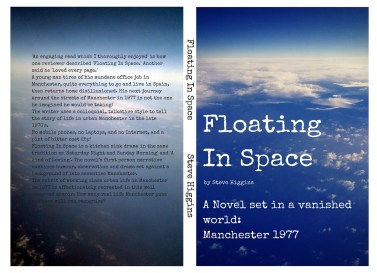
I have to say also that the print version of Floating In Space will shortly have finished it’s re sizing and grammatical revisions and will be ready to hit the market soon. Blogging for me is primarily to promote my work but I do love writing and I do love writing my little blog. One good thing about blogging is that it gets the creative juices flowing. It gets you thinking, what can I write about? What can I write about next time? So far the ideas have kept on coming and I’ve got six or seven draft blogs in the pipeline although I have to say two have them have been there so long I think they may be heading for the trash file shortly.
 Quite a few people have asked me about my novel. What’s it about? is a frequent question. Well, it’s set in the late 1970’s and it’s about a young man in South Manchester and his small group of friends. He goes from working in an insurance company to finding himself as a bus conductor in a short space of time and the background to the book tells us about life in the seventies: Music, drink, pubs and Mancunian night life.
Is it a science fiction book? No it isn’t.
 As a child growing up in the 1960’s one of my favourite television programmes was Tomorrows World, a BBC show about technology and the future. I was acutely interested in science, science fiction and all things related to the future. The future was hi-technology, gleaming metal and plastic cities, hover cars, and space travel. The movie 2001 A Space Odyssey predicted manned missions to Mars, powerful computers, and lunar space stations. But, 2001 is now thirteen years ago, so what happened? Why is 2014 not really that much different from 1968?
 That of course has its drawbacks. As a writer I have discovered a sort of word blindness when it comes to my own work. I’ve proof read my book a multitude of times but how many times have I come to put an extract on this blog only to find missed words and other errors. When the paperback proof version came
  Letters from an Unknown Author!