Saturday Nights

My book, Floating in Space, is set in the Manchester of the late seventies. There were no smartphones, no internet and no wireless networks. In fact, ‘wireless’ was an old fashioned word for the radio. I’m tempted to say that things moved at a slower pace then but that’s not true. Things just moved at a different pace. In 2025 you hear a lot about pubs closing down but back in 1977, pubs were far from closing down; at the weekend they were the place to be! That was where my friends and I met up, drank beer, listened to music and chatted up the ladies. Saturdays were the focus of our week back then but these days I’m actually not that keen on going out on a Saturday. I much prefer a weekday night out; things are a little quieter and there are fewer drunken idiots.

Having said that, Liz and I went into St Annes last Saturday to see our friends, Ray and Dean, perform as the Boogie Brothers at the Pier Inn. The Pier Inn is only a few years old and it’s a rather small little pub. The night we went in it was a hot and muggy evening and even with the door open it was hot in there so we decided to take a break and pop into Wetherspoons which we expected to be much cooler and it was. It did strike me though that most of the clientele in both those pubs were pretty similar to my own age group. OK there were a few young people but most people out that night were in my particular age bracket. Where do young people go these days on a Saturday night?

Back in 1977 Saturday nights were the culmination of the weekend for my twenty-one year old self. I always preferred it to Friday nights because things were more relaxed, there was no rushing home from work, no rushing to get your tea down your neck so you can get changed, then leg it out for the bus. Saturday, you could take your time and leisurely work up to things. Sometimes I would go out shopping and buy myself something new to wear for that evening, a shirt, or perhaps even a new pair of trousers. Then later I would have a long relaxed soak in the bath and dress unhurriedly in my room to the tune of my favourite music. In 1977 my favourite album was Elton John’s ‘Goodbye Yellow Brick Road’ and as I dressed I would mimic Nigel Olsson’s measured and rhythmic drumming to ‘The Ballad of Danny Bailey’, or ‘Candle in the Wind’.

These days I just pop into the bathroom, have a shave and a shower and throw on one of a number of short sleeved shirts that I tend to favour. Still, even back in 1977 I could sometimes get bored with the usual pubs and bars in Manchester. I remember one boozy night in which my friend Chris and I decided to go out on the train somewhere. We ended up in Nantwich if I remember correctly. We took our tent and put it up somewhere in a field or a park and proceeded to spent the night drinking in a local pub.

The next morning we woke in our tent which had partially collapsed around us. We staggered up and packed everything away and thought about making our way to the railway station. As we walked into the town various people hailed us ‘Hi Steve!’ ‘Hi Chris!’

We dropped into the local pub and the barman greeted us like old friends. ‘Great night last night wasn’t it?’ he said.  I guess it must have been.

Here are a few facts about Saturday compiled after a quick search of the internet.

Saturday is named after Saturn, the Roman God of agriculture.

Saturday is the 6th day of the week in western culture although in some places the first day of the week is considered to be Sunday, making Saturday the last day of the week.

In Hinduism, Saturday is dedicated to the planet Saturn and is considered a day for spiritual cleansing and fasting. Devotees may visit temples and perform special rituals on this day, or abstain from certain foods and activities as a form of penance.

In the UK, Saturday is the busiest shopping day of the week. Many people use this day to do their weekly grocery shopping and high streets and shopping centres are often crowded with shoppers. One of my hard and fast rules is to never go shopping on a Saturday. Tuesday works better for me, it’s much quieter.

Time for a music break. I was going to go with Saturday Night’s Alright for Fighting by Elton John but to be honest, as much as I like Elton, that song really isn’t my cup of tea these days. Here’s something much more enjoyable, Saturday Night at the Movies by the Drifters.

Talking about movies, Saturday Night Fever was a film released in 1977 starring John Travolta. Travolta plays Tony, a young man who spends his weekends drinking and dancing at a local disco. I haven’t seen the film for years until I watched it recently and was surprised to be reminded that, apart from the disco dancing interludes and the music of the Bee Gees, it is actually a gritty and dark film.

Here’s what I wrote in my book Floating in Space about Saturday nights;

“There was something about Saturday nights in Manchester. Some quality of security, of expectancy, a feeling that the night and the future were going to be good. A feeling that you might just meet some gorgeous girl and that even if you didn’t, it didn’t really matter because there was always the excitement of the people, the music, the drink, and everything else that made up the evening. And then there was always the expectancy of the next night, and the next, and on and on into the future. The past building up inside you like a great data bank, reminding you, reassuring you, like a light burning in some empty room in the corner of your mind.”

The Playground as it is today

Back in the late 70s, my friends and I used to go to a bar in Manchester called the Playground. We loved it in there. Inside the Playground, flickering multi-coloured spotlights rotated across the red carpeted room which, on Fridays and Saturdays, was generally packed. It had a small dance floor sunk low like a pit where people up on the raised bar level could look down at the gyrating girls and where also, on week day lunchtimes, a topless dancer appeared at the stroke of one o’clock to translate the soul and disco music of the time into pulsating physical motion, the eyes of jaded office workers glued to her as she did so.

There was a paltry fifty pence charge to get in, the solitary bouncer was silent but not unpleasant and the DJ, who always began the night with ‘Love’s Theme’ by the Love Unlimited Orchestra, played alternate sessions of rock, disco, and chart music. We were all mad about Jenny, the barmaid. She was lovely. She had a kind of round, open face framed by thick blonde hair and her skin was a creamy white. She served us Worthington ‘E’ and we melted into the hubbub of people on their Saturday night out while the music of the seventies drifted through us.

Yes, we had a lot of fun nights in the Playground until one night we turned up and the place was closed. We went somewhere else that night and for some reason it remained closed for a long while. Perhaps the owners had gone bust or their lease had expired. Eventually it was refurbished and opened under another name but it was never the same again. Even so, every time I walk down Oxford Road, I always stop for a moment and remember those long gone nights in the Playground.

What shall I do this Saturday night? Get dressed up and go into town?

Actually, I think I might just order a takeaway and watch television!


What to do next: Here are a few options.

Share this post on your favourite social media!

Hit the Subscribe button. Never miss another post!

Listen to my podcast Click here.

Buy the book! Click here to purchase my new poetry collection.

Click here to visit Amazon and download Floating in Space to your Kindle or order the paperback version.

Click here to visit amazon and purchase Timeline, my new anthology.


Fragments of a Life

It’s sad enough to have to lose a loved one but what is sometimes even worse is dealing with the things they have left behind; their clothes, their books, their personal items. The shampoo and shower gel in the bathroom, the uneaten items in their fridge, the notes on the coffee table; the fragments of their lives.

My brother Colin died almost two months ago and even now I find it hard to believe. Going home a couple of weeks ago I picked up two pizza bases from the shops. I bought two without thinking because I’d usually make Colin and me a couple of small pizzas for when he came round for one of our regular bi-weekly chats.

One of the first things I looked at when I went into my brother’s flat was his phone. He had two phones. One was unlocked but contained little information. No banking app or email account. The other phone was locked and I tried all of what I thought would be memorable numbers for him to use as a phone password. His date of birth….. no. My birthdate…… no. I tried my mother’s and father’s birthdates but no, the phone refused to open.

Colin and I used to speak on the phone every few days. A long time ago when mobile phones first became popular, we decided that when we would speak together on the phone, we would talk in either German or east European accents. I’m not quite sure why we did it but we maintained it over a number of years, although it could be a little embarrassing if I suddenly answered the phone in a German accent in the bar or in a restaurant.

Looking on the internet I searched for what are the most used codes for unlocking a phone. The most popular was 1-2-3-4. I trolled through the list but nothing seemed to work. 2-2-2-2….. no! 6-9-6-9….. no! About halfway through the list I got to the point where the phone would lock up for a minute after each failed attempt. Finally, I tried 3-3-3-3. I was watching a TV show at the time and was about to move on to the next suggestion when as if by magic the phone opened up.

There was no banking app which was what I was looking for in order to sort out his financial affairs. Looking through his house there didn’t seem to be any particular place for important documents. I found some in the bedroom, some in the lounge and some in the kitchen. Colin wasn’t very tidy. He was also the laziest man I have ever met. His first job after leaving school was in a high-class men’s tailors in Manchester city centre. Among the clientèle were presenters from the local TV news shows Look North and Granada Reports. Colin once told me he had served the guy who played Alec Gilroy in Coronation Street. His boss was a very well to do fellow who lived in Wilmslow and every morning he picked up Colin for work at a busy junction by the Bluebell pub. He used to drive a Rolls Royce and Colin was living at home in Handforth then and you might think that with his boss picking him up in a Rolls Royce, and waiting at a very busy junction, he would be keen to get up out of bed and get ready for work.

Well, things worked out ok for a short while but as time went on, Colin realised that getting out of bed in a morning was not for him. My mother told me that she used to sometimes throw a pan of cold water in his face to get him up but even so, he began to leave his boss stranded at the Bluebell and would arrive at work round about lunchtime. Soon he was presented with his p45.

The only other job he ever had, to my knowledge anyway, was a sales job in Rome in Italy, selling timeshares or insurance or something to English speaking people in that far away city. He didn’t last long there and made his way across Europe to a place called Nijmegen in Holland. He stayed there for quite a while and he even met his first girlfriend there, a girl called Inge with whom he stayed friends for the rest of his life.

Soon his money ran out and he was repatriated back to the UK with my mother, as usual, paying for his return.

Not long after coming home he had a nervous breakdown and that began a cycle of mental health issues that plagued him for the remainder of his life. He once told me that it all stemmed from bullying at school although I have to say, I always remember him as being such a happy and cheerful youngster. Clearly, things are not always what they seem.

He had arranged a funeral plan with a company called One Life which went bust back in 2024, however, I was sure he had taken out an insurance policy with Sun Life some time ago. I called them but they had never heard of my brother. I called another company and they said the same thing. ‘Have you tried Sun Life?’ they asked. I had but they had no record of my brother. Try again, they suggested. I tried again and this time the company came up with Colin’s policy which was actually linked to a funeral company so I was able to quickly begin the funeral arrangements.

I thought his laptop would probably tell me a lot about his affairs but it too was locked. I once again tried various numbers to no avail but I noticed that his email account was on his newly unlocked mobile phone. I clicked on the ‘forgotten passcode’ button on his laptop; a new code went to his emails and soon I had access to his laptop even though I found nothing of interest there. It’s interesting though how his digital footprints leave hints about things that he did. There was an email from Netflix reminding him to finish an episode of Star Trek he had been watching. Another was from a mail order company thanking him for his recent clothing purchases and offering him discounts on his next order.

Colin lived in a council flat and I was sure they would be keen to take over the place and get new tenants in but happily, the staff I dealt with at the housing office were friendly and sympathetic and gave me time to sort things out.

I took lots of his old clothes to the recycling centre and quite a few charity shops were the beneficiaries of his numerous DVDs although I must admit, I kept quite a few for myself. Colin was an avid buyer of leather jackets and although some of his older ones went to the recycling centre, I still have about five of his newer ones.

A charity place called The Tree of Life came and took away his washing machine, fridge freezer and microwave. I took away his big television screen on which I’ll probably watch the British Grand Prix this weekend. I went to hand his keys into the council but first I thought I’d take a last look around. I checked everywhere and picked up a few last items I thought I’d keep. I had been surprised that I hadn’t found a great big box of photographs as a long time ago Colin always used to be taking pictures.

As I took a last look around, I noticed a bin bag in the corner of a cupboard just by the door. More old clothes I thought but when I picked it up it was full of photographs, the very ones I had been looking for. I was so glad I had found those pictures as there were so many taken at home when he and my mother and father were still alive.

Colin: a self portrait

I dropped off his keys and later I found myself watching one of his old DVDs, sat in a chair wearing his aftershave, sporting one of his newly purchased T-shirts and drinking one of his leftover bottles of Pepsi Max, his favourite drink. That is the thing with death, someone dies but the world does not stop or even take a breath. The buses keep on running, the sun continues to rise and the dead man’s possessions are still there, waiting to be sold or given away or distributed to others via charity shops and other outlets.

Despite never having any money Colin had an expensive TV package from Virgin Media. He loved his black and white classic films and spent a fortune on numerous leather jackets as well as going everywhere by taxi. Until our mother died, he was forever asking me to bail him out of debt but in recent years helped by a PIP claim (Personal Independence Payment) and a small inheritance from mum he finally had some money in his pocket.

He was looking forward to getting himself a free bus pass but sadly, he was taken away much too soon. He was 64 years old.


What to do next: Here are a few options.

Share this post on your favourite social media!

Hit the Subscribe button. Never miss another post!

Listen to my podcast Click here.

Buy the book! Click here to purchase my new poetry collection.

Click here to visit Amazon and download Floating in Space to your Kindle or order the paperback version.

Click here to visit amazon and purchase Timeline, my new anthology.

The Curse of the Blank Page

This week I’ve been experiencing that blank page syndrome; you know what I mean, you stare at the paper, or the empty laptop screen and nothing comes to mind, and the paper stays like that, blank. So in an effort to boost my creative powers I took a look back at some of my old blog posts.

I see that I started this blog page back in 2014 and my first post went out on the 23rd of May. It wasn’t anything exciting, in fact it was pretty much a sort of advertisement for my book Floating in Space which had just been published on Amazon to an overwhelming gush of cyberspatial silence.

Floating in Space was my first book and I put it together many years ago. At the time, I was writing lots of science fiction and espionage stories based on my love of television shows reflecting both those genres. I had begun to realise though that for fiction to be worthwhile it has to have a basis in real experience. All I knew about sci-fi and espionage was what I had read about or seen on TV so I started to write about myself. I wrote about the insurance company where I had worked and also the bus company where I worked later after a short trip to Europe that was supposed to last for a year but ended up covering about four weeks.

After I had compiled a few essays, I thought I could put them all together into a fictional story about a young man who packs in his job as an insurance clerk, goes to Europe and returns home penniless so gets himself a job as a bus conductor. Throw in some real life experiences and a healthy dose of fiction and the result was a short novel. I have to say that I love Floating in Space. Reading it today is like taking a trip back to my younger days and it brings back all sorts of memories and I do hope that I’ve managed to communicate that time in my life in the mobile phone free and non digital late 70s to my readers.

Floating In Space available now from Amazon!

There have been plenty of times when I’ve struggled to produce an essay or a post and I started one off a few years ago which began, pretty much like this one, in a sort of rambling fashion hoping that something would come to me. I ended up writing about some training which I had undertaken at the time. Here’s an excerpt:

I’ve been on a training course this week, a pretty interesting one but unfortunately not one I can talk about much as it relates to the data protection act and the computer misuse act and all sorts of legal stuff. Still, the training reminded me of a fairly funny training story that happened nearly ten years ago. It was when I had just started at the Highways Agency and in fact I was one of the first batch of operators to be recruited for the North West, a fact that I regularly bore my colleagues with.

The HA sent us to some establishment in Salford for an induction course and I have to say, as much as I like my job, that course was pretty dull! It was fun meeting some new people and doing some interesting team building exercises but after a while, they started to get a little boring and we were all thinking when will we be able to start learning the nuts and bolts of our jobs?

One of the exercises, and to this day I don’t know the point of it, was for us to split into twos and one member of the duo went into another room where they thought of a holiday story to tell, and the other was asked to completely ignore their partner when they returned and began to relate their story. In this instance my colleague was the storyteller and I was the ignorer! So she came back in and began her story. I polished my nails, yawned in her face, checked my watch, hummed a little tune to myself and so on. After a while some inner instinct made me turn to take a quick look at her, and it was lucky I did so because later on I reckoned I had been only a split second away from taking a hefty punch to the nose, however I was able to calm her down and explain it was all part of the exercise!

Just reading that brought lots of training memories back. We did lots of role playing at Highways in fact I had to do one during the interview for the job,. In that one I had to deal with a woman on the phone who supposedly was being chased by someone while on the motorway. I’m guessing the idea was to see if I could stay calm during stressful situations. Anyway, I managed to calm the lady down, told her the police were on the way after working out her exact location by careful questioning. I got the job so I must have done reasonably well.

Photo courtesy Highways Agency

Towards the end of the induction course, boredom had truly set in. I remember one hot afternoon in this stuffy office cum training room and the lecturer going on and on about the chain of command and how issues had to be escalated to one’s line manager and one’s line manager would escalate things further if need be. I feel rather embarrassed to admit this now but I nodded serenely off into a private world of slumber. Later, and whether it was minutes or even hours later I really don’t know but I was jolted sharply back to reality by the voice of our instructor calling my name. A sea of blank faces were looking at me so I tried to think back: What was the last thing we were talking about? Oh yes, I remember now:

“I’d escalate that to my team manager.”

“Escalate what to your team manager?”

“Well, er. . .”

I glanced over to my left, perhaps hoping for some help, but one of my new colleagues, actually the lady from the storytelling incident earlier, was looking at me in disgust. Over to my right two other colleagues were in a strange sort of state. One had gone almost purple in the face as he tried to hold in a tumult of suppressed laughter and another was covering his face and making strange noises as his shoulders pumped up and down hysterically.

Finally, the lecturer, looking at me with contempt, observed that it might be better for me if I paid attention more and moved on.

Not the finest training course but not my finest hour either.

My absolute favourite training time was something I wrote about a few weeks back, bus driver training.

In those days circa 1979, we trained in old back loader manual gearbox buses sat in a small cab at the front and steering with a huge steering wheel and having to double the clutch to change from first to second gear as those old gearboxes weren’t fully synchromeshed.

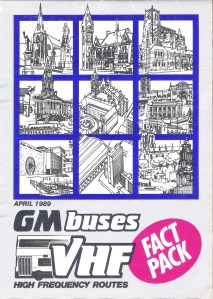
Vintage GM Bus flyer

The moment I climbed up into the cab I felt at home and I loved my time in the driving school. Every morning we used to check the bus over and top up the oil and water if required. Then our trainer would choose somewhere in the vast Greater Manchester operating area for breakfast. We might have a drive to perhaps Oldham garage or bus station. I’d start off and our trainer Bill sat behind me in the first seat. The window to the cab had been removed and Bill would give directions and off we would go. His main instruction particularly on narrower roads was to ‘ride the white line’ because our big bus needed the room, car drivers in smaller vehicles didn’t.

Bill knew all the canteen staff in all the canteens in Manchester. Sometimes we might just have tea and toast because on the next run Bill might designate Stockport as our next destination as the new canteen there always served up something good for lunch. To be honest though, I always preferred a breakfast. Back in those days the GM Buses canteens served a breakfast special which was egg, sausage, bacon, a slice of toast and a choice of either beans or tomatoes, all for a pound. My own breakfast favourite though was two eggs on two toast with beans and a sausage which is still a favourite today.

Well, I think that’s it for today’s blog post. I’m pretty pleased with myself. I started out without the faintest idea what to write and managed to write 1400+ words and I know I pinched a few from a couple of old posts but either way, I managed to break the curse of the blank page!


What to do next: Here are a few options.

Share this post on your favourite social media!

Hit the Subscribe button. Never miss another post!

Listen to my podcast Click here.

Buy the book! Click here to purchase my new poetry collection.

Click here to visit Amazon and download Floating in Space to your Kindle or order the paperback version.

Click here to visit amazon and purchase Timeline, my new anthology.


10 Classic TV Ads

Don’t you just hate TV adverts? I certainly do. There are those times when a TV advert comes in useful I suppose. Perhaps when you are watching a good film and you need to make a cup of tea or pop to the toilet. These days in the hi tech world of TV, most people are able to pause live TV and do those things anyway. I wouldn’t mind if the TV adverts were actually worth watching but these days of course they aren’t. Anyway, here are 6 classic TV ads of yesteryear that I think are rather good. Here we go . .

1.

This is an advert for Strongbow cider featuring Johnny Vaughn, who you might remember as fronting the Channel 4 breakfast show many years ago, and Jerry Hall. Jerry was an American model and was once upon a time involved with Bryan Ferry and then Mick Jagger. It’s a fun advert that has always made me laugh.

2.

A particular favourite of mine is the Ford Puma advert from 1997 featuring Steve McQueen. McQueen of course passed away from cancer in 1969 so how did he feature in the ad? Well, filmmakers shot footage of the Ford Puma in modern San Francisco and digitally inserted McQueen into the driving seat using footage from his 1968 film Bullitt. The result was a stylish short TV ad recreating a scene from the original feature film.

3.

An old TV advert I always used to enjoy involved an old guy trying to trace a copy of a secondhand book; Fly Fishing by J R Hartley. He eventually finds a copy and the book seller asks his name. “J R Hartley” he replies. What were they advertising? Yellow Pages! Strangely enough some bright spark – actually author Michael Russell – produced a spoof book; Fly Fishing by J R Hartley which became a best seller and prompted two additional sequels.

4.

Probably the funniest classic TV ads are the ones with Leonard Rossiter and Joan Collins which are promotions for Cinzano. They actually made 10 TV commercials between 1978 and 1983 which all ended with a glass of Cinzano getting spilled all over Joan.

Rossiter had a successful theatre career but is best remembered for his portrayal of the seedy landlord Rigsby in TV’s Rising Damp, still shown regularly on UK TV. Joan Collins has had a long career in TV and films including a spell in the USA starring in the TV series Dynasty. This year, 2025, she is due to portray Wallis Simpson in a new film production. Leonard Rossiter died in 1984 aged 57.

5.

A great advertising series were those for Boddingtons beer. I used to love a pint of ‘Boddies’ as we used to call it but then the brewery was taken over by another company (Whitbread, I think) and the Boddingtons bitter they produced was really not like the original Boddingtons at all. Anyway, back in the 1990s a series of adverts were produced starring Melanie Sykes speaking in a broad Manchester accent.

6.

My particular favourite Boddingtons ad was this one that starts off in Venice but ends up somewhere in Manchester.

7.

Bolton comedian Peter Kaye featured in a series of ads for John Smiths beer. Can’t say I was that keen, then or now, on John Smiths beer but the adverts were good.

8.

A great favourite for many people were the puppet ‘aliens’ used in an advert for Smash which was a powdered version of mashed potatoes. You just added liquid I presume but personally, I’m happy peeling and boiling my potatoes to make mash just as I have always done.

9.

In 2018 Elton John featured in a Christmas commercial for top end store John Lewis. According to Wikipedia there is a regular Christmas ad for the store every year. I’ve clearly missed the others but I always thought the Elton John one was pretty special.

10.

I’m going to finish with this one advertising another beer, this time Heineken. Bryan Pringle plays a sort of latter day Professor Higgins trying to teach a very well spoken lady, the exotically named Sylvestra le Touzel, to speak cockney. Bryan Pringle featured in a number of films and numerous sitcoms from the 70s to the 90s. He died in 2002.

What were your favourite TV ads?


Those were my 10 TV ads but just before I go to press I thought I’d add one final one. I know I said earlier that modern ads are just not as good these days but I recently spotted this one in which Meg Ryan and Billy Crystal were asked to recreate that famous scene from When Harry met Sally. (I’ll have what she’s having!)


What to do next: Here are a few options.

Share this post on your favourite social media!

Hit the Subscribe button. Never miss another post!

Listen to my podcast Click here.

Buy the book! Click here to purchase my new poetry collection.

Click here to visit Amazon and download Floating in Space to your Kindle or order the paperback version.

Click here to visit amazon and purchase Timeline, my new anthology.


A Slice of My Life 2024

It’s a long time since I’ve made a video for my YouTube channel and recently I’ve been trying to think about what my next project should be. When I’m stuck for a video I tend to tweak or even remake some of the short videos I use on social media to promote this page and my two books. In fact my YouTube page is made up of quite a lot of videos like that as well as numerous short video versions of my poems. Every now and again I try and put something different together. I usually make a video about our yearly trips to France in our motorhome and I’ve made a few videos about Manchester, my home town and also the place where my book Floating in Space is set.

Liz and I have just spent 5 weeks in Lanzarote and although I took my video camera over there I actually didn’t use it except to take some holiday snaps.

Last week I decided to take a little jolly out on the bus over to Stockport and see how the new bus station, currently under construction there, was coming along. Travelling to Stockport on the bus made me think about how our lives change and move on. Back in 1979 I was a coach driver for National Express but I wasn’t happy with the job. In the summer of 79 I was 22 years old and far too young and immature to do such a responsible job. Covering the long distance National Express routes wasn’t too bad but private hires were difficult as the driver had to plan his routes and to be honest I didn’t know my way about the country particularly well.

After being stuck on the same long distance bus route from Manchester to Lowestoft far too many times I packed the job in. I went to ask for my old job back at GM Buses but they gave me a big lecture about how they were fed up of training drivers only for them to resign and go driving for other companies and so I was turned away. That same afternoon I drove over to the GM Bus depot at Stockport where they were short of staff and they started me the same day. For over ten years I spent every working day in Stockport taking fares and later, driving buses. Returning in 2024 after over 30 years away was interesting, I must say.

Most of Mersey Square, the square at the very centre of Stockport, was fenced off while the builders worked on the new bus station. A huge railway viaduct spans the centre of Stockport and the bus station or bus interchange as they are now calling it is mostly on one side of the viaduct with part of it spilling over onto the other side. Someone told me it was due to open in two weeks time but looking around, that seemed to be a pretty tall order.

I shot some video in the square then walked around the construction, filming as I went. I was planning to film myself with my trusty selfie stick and chat away to the camera about my memories of Stockport but as usual, I felt a little self-conscious and just stuck to filming the new construction. I couldn’t walk through the area as of course the builders were still working so I had to walk around it.

When I got to the other side a new Stagecoach bus went past on its way into the Stagecoach garage. It was displaying the route number 192 which is a very busy bus route indeed, going down the A6 from Hazel Grove into Stockport and then on into Manchester. Back in my day there was a 192 every six minutes and each one was packed. Looking back I must have spent an awful lot of time going up and down on that bus route.

When the bus services were deregulated in 1986 the Busy Bee bus company tried to muscle in onto our route and so the service moved up to one every three minutes! Yes we would load up in Piccadilly, Manchester. An inspector would count three minutes and then you were off. Straight away there was a set of traffic lights and if you hit those on red you were in trouble as the bus behind was already following you out.

I followed the Stagecoach bus round the corner to the old GM Buses depot, now of course owned and run by Stagecoach. Inside it was full of buses and for a moment I remembered the old days when it was full of the old orange and cream of GM Buses.

I left the bus company in the early 1990s and started my own company selling motorsport memorabilia. I loved that job and spent all my day chatting to various regular people about F1 and motorsport but sadly, I didn’t make a lot of money, eventually selling all my stock to someone who had a similar business. After a failed attempt to become a TV producer I ended up short of money and went back to GM Buses. I worked for the GM coaching company known as Charterplan. After a short while there I transferred to an office job in the GM Buses control room in Ardwick, Manchester and that was the last time I set foot in Stockport, until last week.

The Comfy GillI walked round to the other side of the bus depot and there opposite, what used to be the main exit for our buses, was the Comfortable Gill. The Comfy, as we affectionately called it, was the pub where we busmen used to drink after the day’s shift was over. At one time if a driver was due to finish after last orders at 11, the landlord used to accept telephone orders for a pint so sometimes we could pull in at 11:20, park the bus in the depot and then pop over to the Comfy to find a pint waiting for us to sup while we cashed up our day’s takings. When I saw it the other day the Comfy was all closed up and looked neglected. So many of Britain’s pubs have closed down and I walked away hoping that the Comfy might be saved in the near future.

It’s always interesting to look back and have a stroll down memory lane. I can’t say working at GM Buses was a great job and looking back I wonder why I stayed so long. Of course back then I had bought a house and I had a very expensive mortgage to pay and I put in a lot of hours to pay for it. Perhaps I would have been better served by prioritising my career rather than my house. Oh well!

Liz and I went to the pictures this week. It was the first time we had visited the cinema since seeing Oppenheimer last year and although I didn’t rate it as the work of genius many people seem to think it is, Oppenheimer was certainly an excellent film and deservedly won the best picture Oscar.

The film we went to see was Wicked Little Letters set in England after the first World War. It’s about an Irish lady who comes to live in an English village. She is outspoken, very rude and swears a lot and is soon branded as the author of a very nasty series of poison pen letters. It wasn’t a bad film but what was odd was the way the 1920s were portrayed. There was a black judge, a black Asian policewoman, numerous other black people and the Irish lady was living with a black man. It was if they had substituted 1920s life with today’s multicultural society. I’m not sure why they would do that but the end result was that the entire film looked a little bit strange. Why didn’t they just set the film in the present day when different ethnic groups, as well as bad language is just the norm? Or was the director trying to make some point about society that perhaps I have missed? Wicked Little Letters isn’t a bad film in fact it’s quite amusing in a way and was actually based on a true story but that cutural shift just didn’t work for me.

Perhaps we all look back at the past in different ways.


What to do next: Here are a few options.

Share this post on your favourite social media!

Hit the Subscribe button. Never miss another post!

Listen to my podcast Click here.

Buy the book! Click here to purchase my new poetry anthology.

Click here to visit Amazon and download Floating in Space to your Kindle or order the paperback version.

The TV Shows of Gerry Anderson

Many years ago when I was still at junior school, one of my friends asked me if I had seen a new TV show about a flying car. I hadn’t but apparently it was really good and so I made a mental note to watch out for it. As a child I was pretty keen on TV. My dad used to call me ‘square eyes’ because I watched so much TV and as you might imagine I soon found the TV show my friend had told me about. It was a short puppet show about a special machine called Supercar that could not only fly but also dive under the sea. It was designed and built by Professor Popkiss and Dr Beaker and the test pilot was a guy called Mike Mercury. I loved Supercar and everything about it and even though I didn’t realise it then, I had become a huge fan of TV producer Gerry Anderson and his Century 21 Productions.

Gerry Anderson was born in 1929 and after the war earned a traineeship with the British Colonial Film Unit. Later he worked for Gainsborough Pictures and had various jobs, subsequently as a director. He and cameraman Arthur Provis formed a production company called AP Films after their two names and began producing TV shows for children. Their first project was in 1957 called The Adventures of Twizzle and was the first time Gerry worked with puppeteer Christine Glanville, musician Barry Gray and special effects supervisor Derek Meddings.

They followed up with more puppet shows, Torchy the Battery Boy and the first series I remember, Four Feather Falls, a cowboy show about a sheriff with magic guns.

Anderson married his wife Sylvia in 1960 and the two collaborated on Supercar, Gerry’s first sci-fi puppet show in 1960. The series marked the first time Gerry used the name Supermarionation to describe the process which enabled the puppet mouths to move in synchronisation with pre-recorded dialogue. All the characters in the shows had American accents so the shows could be sold to the USA and it was Sylvia who was responsible for the characters and their fashions while Gerry concentrated on other aspects of the shows.

The next series was Fireball XL5 about a spacecraft that was part of the World Space Patrol piloted by Steve Zodiac. The following show, Stingray was the first to be filmed in colour. Stingray was a submarine in the service of the WASP, the World Aquanaut Security Patrol and was piloted by Troy Tempest and his colleague ‘Phones’ who was a master at using sonar equipment. The duo discover an undersea kingdom where King Titan holds sway over his people, the Aquaphibians. Troy and Phones rescue the mute undersea girl Marina who joins them onboard Stingray. Most of the characters had sea related names like, Marina, Commander Sam Shore and his daughter, Atlanta. Atlanta was voiced by Lois Maxwell who played the original Miss Moneypenny in the James Bond films.

Stingray was probably my favourite of Anderson’s TV shows. I particularly loved the opening sequence in which Commander Shore exclaims ‘Anything can happen in the next half hour!’

Stingray was filmed in 1964 and the show fitted neatly into the expanding Anderson universe set, like all his sci-fi shows, 100 years into the future. Around this time AP Films developed a merchandising company responsible for licensing all kinds of items related to the shows, things like models and puppets and so on. I used to have a puppet of Venus, the space doctor from Fireball XL5 although I think I would have preferred a Steve Zodiac puppet. I had a Fireball XL5 rocket which could be fired into the air with a big catapult and as it came down, a parachute deployed to float it down gently. I also had quite a few Stingray models. One was a plastic kit I had to put together and another was a plastic Stingray shaped water pistol.

image courtesy flickr

There was also a comic which I absolutely loved called TV21 with comic strips of all the sci-fi Anderson shows. TV21 had a front page fashioned like a newspaper with headlines referring to the stories coming up on the inside pages.

The next project for AP Films was probably Gerry and Sylvia’s greatest success and it was called Thunderbirds. Thunderbirds was about a secret organisation called International Rescue that had a small fleet of highly advanced machines and equipment with which to perform rescue operations. Millionaire ex-astronaut Jeff Tracy was the head man and the organisation was secreted in his island home. His five sons were the Thunderbird pilots, John, Scott, Virgil, Gordon and Alan, all named after US astronauts of the 1960s. The genius behind the Thunderbird craft was Hiram Hackenbacker, known as ‘Brains’. Thunderbird’s nemesis was a secret agent known as the Hood because of his talent for disguise and in many episodes the Tracy brothers had to ask their London agent, Lady Penelope, to track him down and sort him out.

Lady Penelope Creighton-Ward lived in a huge mansion somewhere in southern England and her manservant and chauffeur was Parker, a reformed safecracker. The head of ITV Sir Lew Grade saw the first episode and was so impressed that he asked for the episodes to be extended from 30 minutes to a full hour, less TV adverts of course. Gerry wanted Fenella Fielding to voice Lady Penelope but in the end Sylvia herself took on the role.

Thunderbirds is probably my second favourite of all the Gerry Anderson series. The great thing about it and really, the secret of its success was the highly intelligent scripts which treated its audience of children not as kids but as intelligent young adults. Two scripts that spring to mind were one called The Cham Cham about a code transmitted on a musical melody and another where Parker was called upon to break into the Bank of England. Later in the episode someone is trapped inside the vault and Parker is asked to break in again to rescue the man before the air is used up in the vault. Parker though thinks that his old mate, a bank robber recently released from prison, is about to complete his life’s ambition to break into the bank and so he tries to slow down his and Penelope’s drive into London.

A successful feature film, Thunderbirds are Go, was made in 1966 and AP Films began a new life as Century 21 Productions.

The follow up TV series was called Captain Scarlet and the Mysterons. Captain Scarlet is part of an organisation called Spectrum in which all the members have code names relating to colours. The Mysterons have the power of re-animation and both Scarlet and Captain Black have been re-animated giving them powers of indestructibility. It wasn’t really my cup of tea but the puppets in the series made a step forward in having normal dimensions instead of large heads like the previous shows.

Two further puppet shows followed, Joe 90 about a young boy who becomes a secret agent by using the brain patterns of various people. His father, Professor MacLaine had designed a machine called the Big Rat (Brain Impulse Galvanoscope Record and Transfer -funny how all these old acronyms come back to me!) The Big Rat takes the brain pattern of a pilot for instance, feeds them to the professor’s young son -the Joe 90 of the title- and he is able to fly a plane.

The Secret Service was a mixed puppet/live action series about a secret agent who is shrunk down to a small size and the producers used puppets in normal sized sets. Stanley Unwin played the role of an eccentric vicar who is part of a secret organisation called BISHOP (British Intelligence Service Headquarters – Operation Priest). The series was cancelled after 13 episodes as Lew Grade didn’t think the inclusion of comedian Stanley Unwin and his gobbledegook language would work in the USA.

Gerry Anderson’s ambition was always to leave the puppet shows behind and move on to live action features and after a live action sci-fi film Doppelganger, Gerry began work on UFO. UFO was set in the 1980s and was about a secret organisation called SHADO (Supreme Headquarters Alien Defence Organisation). The Earth is under attack from UFOs and it is SHADO’s job to defend the world. The headquarters is based in the Harlington-Straker film studios with an outpost on the moon called Moonbase. Moonbase tracks the UFO’s with the help of SID (Space Intruder Detector) and launches their interceptors. Ed Bishop, previously the voice of Captain Blue in Captain Scarlet, played Ed Straker and Gabrielle Drake was the Commander of Moonbase.

I loved the series but the TV networks were unsure whether UFO was aimed at children or adults, presumably because of Gerry Anderson’s previous childrens’ shows. Anderson prepared for the second series in which the American networks had asked for more lunar based stories. Many new sets were built and then series 2 was cancelled. Gerry then offered the networks a new show, Space 1999, centred entirely on the moon.

In Space 1999, a series I never really liked, a nuclear explosion pushes the moon out of earth orbit and out into space and the series chronicled the adventures of those still living on Moonbase Alpha. Husband and wife team Martin Laudau and Barbara Bain starred in the show which ran for two seasons but during the production Sylvia and Gerry divorced.

Gerry returned to producing more TV shows for children like Terrahawks and Space Police but even though new technology and techniques helped with the puppetry and filming, without Sylvia and her characterisations, those productions were a little lame.

In the 1990s Gerry produced a new series of Captain Scarlet replacing the puppets with computer animations.

Gerry Anderson died in 2012 aged 83 while Sylvia lived to be 88. In 2015 she made a guest appearance in an episode of a new animated series of Thunderbirds are Go as Great Aunt Sylvia, a relative of Lady Penelope. She died in 2016.

The two left behind a legacy of some much-loved television shows but what was the secret of the success of Gerry and Sylvia’s original productions? Personally, I think there were a number of elements: Outstanding and intelligent scripts that treated the younger viewers as young adults. The fabulous music and theme tunes of composer Barry Gray. The wonderful characters created by Sylvia. The special effects from Derek Meddings who went on to work on the James Bond films and of course Gerry Anderson who brought all those elements together.

This year, 2023, Thunderbirds can be seen on the Talking Pictures TV channel, 58 years after it was first seen on TV.


What to do next: Here are a few options.

Share this post on your favourite social media!

Hit the Subscribe button. Never miss another post!

Listen to my podcast Click here.

Buy the book! Click here to purchase my new poetry anthology.

Click here to visit Amazon and download Floating in Space to your Kindle or order the paperback version.

Tapes and Tape Recordings

I started work in 1973 and one of the first things I wanted to buy with my new found income was a cassette tape recorder. To be honest I can’t think of anything that had such a profound effect on me until the video camera or the home computer which both came along many years later.

I had a huge amount of recorded music of course. By the mid-seventies my record collection was already pretty big and I was buying vinyl records, usually 45 rpm singles, every week. My tape recorder had a built-in radio so I could record my favourite tracks straight onto tape for free and I spent a lot of time taping the new top twenty which came out every Tuesday. The other thing I could do with my tape recorder was record myself with a microphone.

I used to write some rather silly plays made up of sketches based on Monty Python and Spike Milligan and my brother Colin and I used to read the parts. One tape I digitised some years ago featured a cowboy sketch with dialogue something like this:

Colin: (Fake John Wayne voice) You’ve got a helluva chip on your shoulder.

Me: (Fake James Stewart voice) That’s not a chip, it’s a potato!

If you think that was bad, here’s another sketch, this one was a spoof on The Glenn Miller Story.

Me: (Fake James Stewart voice) You know I’m still searching, still trying to find that sound, that special sound . . .

(Colin aka Special effects man: Flushes the toilet.)

Me: (Fake James Stewart voice) That’s it! The sound, the special sound I’ve been looking for!

Later on, I bought myself a music centre which for the benefit of any younger readers was a record deck, a tape recorder and a radio all in one unit. I could then record my music onto a tape and make up music collections. They called them ‘mix tapes’ which to be fair was not a phrase I ever heard back in the seventies but I seem to hear quite a lot these days. Anyway, I used to make lots of mix tapes which became even more important when I bought my first car. To record music back then you had to actually play the record to copy it onto tape so each of my tapes in a way reflected the atmosphere in my bedroom as I played and copied one track after another, each track in turn inspiring the next and then the next and so on. I loved my mix tapes.

Probably the most famous tape in TV fiction was the tape used in Mission Impossible.

The TV show was created by producer Bruce Geller and concerned a team of special agents known as the Impossible Missions Force. They are a US government agency which takes on hostile foreign governments, South American dictatorships and criminal organisations.

A great feature of the series was the opening title sequence which involved a match being struck and then lighting a fuse shown over quick clips of the upcoming episode to the sound of the iconic theme tune written by Lalo Schifrin. Next, Jim Phelps, the head of IMF would listen to his tape-recorded instructions which, after being played, would then self-destruct. Phelps would then look through his agents’ files complete with photos and choose who he wanted for the mission. Sometimes a guest star would play one of the agents who would be introduced by Jim checking out his dossier. A team briefing would then take place and the mission would get under way.

The show was re-booted in 1996 as a film franchise starring Tom Cruise.

When I bought my music centre, I realised I could actually connect my old tape recorder into the music centre and make tape to tape copies so I began to edit my tapes, particularly those radio recordings where I could edit out things like DJs who talked too much or songs I didn’t like. I also used to review my recordings and put together what I called a Tape Review in which I spoke with a microphone and introduced various recordings.

Another tape I made was called ‘Self Portrait in Tape’ which was me yakking away into the microphone talking about my favourite books, TV shows and of course introducing some of my favourite music.

My childhood friend Steve and I were both big record buyers and music fans. We interviewed each other on tape about our music loves in the style of a radio show of the time called ‘My Top Twelve’. The show was really a rip off of Desert Island Discs in which a celebrity is interviewed and talks about their favourite music and Steve and I did the same. I reviewed my tape back in 2017 when I digitised it and transferred it to a CD. I have to say I was surprised at some of the music choices I had made back in the mid-seventies and in the CD version I did give certain tracks the chop and add some additional ones plus I added some comments in a new voiceover discussing how my musical tastes had changed.

In the 1990s I bought another music centre, a mini one with a CD player and tape recorder with which I used to copy my CDs onto tape to play in my car. My car at the time was a Rover and it had a tape player and it wasn’t until 2020 that I bought a car with a CD player and it was only then that my mix tape producing days were over.

The Watergate Tapes.

I have always understood that John F Kennedy was the first President to install a taping system in the White House though Wikipedia seems to think the practice began with Roosevelt. Many of the recordings made during Kennedy’s presidency have been released to the public including those of cabinet meetings during the missile crisis of 1962.

President Lyndon Johnson carried on the tradition of taping and recording phone calls and numerous calls have been declassified and released by the authorities. Some with a special poignancy were even recorded on Air Force One on the 22nd November, 1963, the day Kennedy was shot and Johnson elevated to the presidency.

Anyway, despite his two predecessors, the President most famous for taping in the White House was Richard Nixon and it was the ‘Watergate tapes’ that were at the heart of the Watergate scandal.

The White House under President Nixon was worried about security. When Nixon realised the FBI weren’t willing to do his bidding, he created a security team which became known as the Plumbers. It was their job to plug the leaks to the press and they were also used to get information on Nixon’s rivals in the election.

A team of five men entered the Watergate building on the night of June 16th/17th 1972. Sometime after midnight on the 17th a security guard noticed that various doors into the building had been taped, preventing them from locking. He called the Police and the five men were arrested. They all had connections to the White House. Various investigations began and the President himself was implicated but things changed when investigators became aware that conversations in the Oval Office had been recorded. Would the tapes prove or disprove that Nixon knew about the break in? Well President Nixon refused to hand over his tapes at first but when he finally succumbed to pressure and handed over some, they revealed him to be foul mouthed, bigoted and small minded.

Nixon resigned from the presidency on August 8th 1974.

The Watergate tapes can be listened to on the university of Virginia’s Miller Centre for Public Affairs. (millercenter.org)

I read on the internet that cassette tapes are making a comeback. CDs and digital recordings are of a much higher quality than cassette tapes but tapes are handy, easy to use and certainly in the old days they were pretty cheap. I’d make a music tape up and if it jammed or broke, I’d just throw it away and record a new tape. Recording a music tape was always an experience because, as I mentioned earlier, you had to record it live, you had to actually play the record or CD to copy it onto tape unlike the CD compilations I make nowadays. Those are made by just dragging and dropping a track into the CD burner file so you only get to hear it after it is made.

Tape cassette

Prior to the digital revolution, singers and musicians recorded their songs on vinyl but the vinyls were produced from master recordings made on tape in a recording studio. Pressings of a record are made from a mixing of the master tapes. These days, quite a few classic albums have had their master tapes digitised and many new mixes of old recordings have been released. I’ve got a few albums which have been rereleased in this way; they are a little like ‘director’s cut’ versions of old albums with new mixes, outtakes and alternative versions, so Paul McCartney’s Band on the Run becomes three CDs instead of one, same for Rumours by Fleetwood Mac. Two interesting albums but to be fair, I prefer the original versions.

As I write this, the Beatles are once again running high in the pop charts with a ‘new’ release. Back in the 1970s, John Lennon switched on his cassette recorder high up in his New York apartment and recorded a demo of a song he had written called Now and Then. Yoko Ono passed the tape to the surviving Beatles some years ago and Paul McCartney, Ringo Star and George Harrison tried to make it into a new song. Alas, the background hum on the tape could not be removed and neither could the sound of Lennon’s piano. Recently however, new technology has enabled Lennon’s voice to be cleaned up, Harrison’s guitar has been added as well as new additions from Paul and Ringo. The result is what people are calling the very last Beatles song ever.

Many fans think the result is wonderful and it’s certainly pleasant and interesting but hardly in the same class as the Beatles classics that we know and love.

These days I tend to listen to music via Spotify. One of the great things about Spotify is that it listens to the kind of music you choose and then suggests similar music. On my Spotify page I have various playlists I can listen to but you do need that all important Wi-Fi connection which isn’t always available. Of course, as a fully paid up member of the noble order of Northern Tightwads I still only use the free version of Spotify which means every now and then I have to put up with the bane of the music world – advertisements! (Even the Beatles video above starts with an ad!)

Perhaps that’s why I’m still listening to my mix tapes!


What to do next: Here are a few options.

Share this post on your favourite social media!

Hit the Subscribe button. Never miss another post!

Listen to my podcast Click here.

Buy the book! Click here to purchase my new poetry anthology.

Click here to visit Amazon and download Floating in Space to your Kindle or order the paperback version.

A Few Random Thoughts about Time

Time is a pretty odd thing when you think about it. You can’t see it or touch it but it’s there just the same. As far as I understand, time is uniform, it bumbles along at exactly the same speed, year after year. There are always 24 hours in any given day and 365 days in every year, except of course for leap years. I mentioned last week about encountering each new birthday with a sense of apprehension. After all, each birthday brings me closer to my inevitable end, my dying day but it seems to me that as we get older, time seems to speed up and the months and years pass by faster and faster.

Perhaps that’s a consequence of nearing the latter stages of my journey through life. Recently when we were travelling through France motoring along through the endless country lanes of the Loire valley, it seems as if I only became aware of the speed when I reached a new village or hamlet and had to slow down. Perhaps that’s the way it is with time too, that you only notice the passing of time with some new event, something that brings time into perspective.

One of my friends has a daughter born on my birthday and the other day the child’s grandmother mentioned to me that she would be soon off to school. School already I thought? After all, I still think of that child as a baby, which clearly she no longer is. (Quick check and the little girl in question was born in 2019!)

In the boot of my car are two big yellow anoraks with reflective stripes. I put them there in case I ever break down on the motorway although they were given to me when I first joined the Highways Agency. They were compulsory clothing for being out and about seeing the motorway network first hand with our traffic officers, our area contractors and the police. I remember being out with the motorway police for a day and looking down at the speedometer as we made our way to an RTC and seeing it registering 120mph. That was an interesting day but it was actually back in 2005, 18 years ago. Can those yellow jackets really be 18 years old?

Music is another thing that always registers the passing of time. In the pub quiz that we visit every Thursday there is always a music section. The quizmaster plays 10 tracks and asks for three answers for each; the title, the artist and the year. We are helped in the year aspect as the DJ plays two tracks from each of ten decades and gives us the year endings. Now back in the 1980’s I was at the height of my love of vinyl singles. I bought singles every week, usually when they dropped out of the charts and were sold off at half price and not only that, later in the 80’s I bought my first video recorder and spent a lot of time recording my favourite music on video. What this means is that I should be spot on with the 80’s music but a lot of the time I sadly am not. Last week at the quiz, one of the tracks was Red Light Spells Danger, a hit by Billy Ocean which I was convinced was 1987. Actually it was older and was released in 1977. Fortunately Liz’s recollection was better than mine.

I have always been one for skimming through records and CDs, especially when the word ‘sale’ can be seen. Some years ago, a prime location for buying cheap CDs was Woolworths which sadly went bankrupt in 2015. In Woolworths many years ago I picked up a compilation CD. It had some really nice tracks and a few I’d never heard of but I chose it particularly because of one track, ‘Horse with no Name’ by America. I’ve always loved that song and I don’t have a copy of it so I bought the CD. Later when I had got home and played the album I was surprised to find another track that I hadn’t spotted earlier, it was Desiderata, a poem by Max Ehrman made into a pop song, of sorts, by an American guy called Les Crane.

Now not only is that poem one of my favourites but so is the musical version. It was played a lot at school by our headmaster in the morning services and as soon as I heard it again it brought memories of those long ago schooldays flooding back to me: The registrations, the morning assembly, the prayers. Back in the late sixties a lot of those morning assemblies were about Vietnam and how our headmaster, Mr Trickett wove his morning address from Vietnam to the Desiderata, I do not know but that musical version was something I loved and finding it again on a CD was like getting part of my youth back.


Quite a few years back Liz and I visited many of the war cemeteries in Northern France and like many others were moved by the many monuments to those who lost their lives in two world wars. I made a video about the many war memorials we came across and in the video commentary I spoke about the passing of time.

I have a theory about time and it’s this, it’s that time flows differently in different places. OK; sounds a bit mad doesn’t it? Let me explain further.

On many occasions when trundling through rural France I’ve come across many bunkers, fortresses and other sites. In northern France Liz and I stopped at a war grave cemetery that was picture perfect in its own way. The lawns were incredibly neat, and the hedgerows immaculately trimmed. Sadness pervaded the site like a scent coming over from the adjacent fields. Throughout there is a feeling of peace, of slowness and a feeling that time has stopped here or perhaps just slowed. That’s not strange when you think that time must have speeded up during the action of the first and second world wars, so it seems only fair that nature must compensate, that time must slow later to make up for the fast and frantic earlier time.

You can imagine the pace of things even a hundred years ago: The early morning bombardment, the whistles blowing as officers called their troops to go over the top. The advance parties who made ahead to cut the barbed wire, the troops walking apprehensively forward until they walked into the deadly machine gun fire that cut most of them down. Many found their final resting places in these cemeteries, places that are now quiet and peaceful with a silent beauty, timeless and moving with the beat of nature as a backdrop; the humming of the insects, distant cows mooing, and the birds flying past.

All the places we visited have had their moments in the spotlight of world history. They all lived through times of accelerated pace when time flowed swiftly. Perhaps it’s their time now for a quieter pace while time flows slowly.

Back to me then and my 67 birthdays. Time as I mentioned seems to speed up with age but there is still time to mention one more thing.

Time for a cup of tea!


What to do next: Here are a few options.

Share this post on your favourite social media!

Hit the Subscribe button. Never miss another post!

Listen to my podcast Click here.

Buy the book! Click here to purchase my new poetry anthology.

Click here to visit Amazon and download Floating in Space to your Kindle or order the paperback version.


Writing and What Happened in 1977

1977 was a different world. There was no internet and there were no mobile phones. The only phones were landlines and they were big and heavy with great rotary dials with which you had to laboriously dial a number. As more people wanted telephones they needed more numbers and so numbers got longer and longer. 061, the dialling code for Manchester became 0161 and the code for London which was 01 became two new codes 071 and 081

I should tell you that I’m actually quite interested in telephones, especially those big heavy ones with a dial. I used to collect them and in fact I have quite a few; my two favourites are an old Bakelite phone from the 1940s and a Trimphone from the 1970s. The Trimphone was a new style telephone created by BT. It was a wedge-shaped light phone and the handset fitted neatly across the dial. Although it’s a phone I’ve always associated with the 1970’s, it was actually first introduced in 1965 and had a warbling ring tone instead of the traditional bell. The original versions had a green dial which lit up in the dark although this was discontinued due to concerns about radiation as the phosphorous which gave off the green glow was energised by a small tube of tritium gas which was mildly radioactive. Personally, I wouldn’t have thought anything could be ‘mildly’ radioactive but happily my two trimphones do not glow in the dark.

Anyway, time for a 1970’s telephone anecdote:

Once in 1977 I had a bit of a crush on a girl named Anne. I was a bus driver and my conductor had gone out with Anne a few times before moving on to someone else. I asked my friend Des for her number and I called her up one evening. I didn’t have a phone so I had to use a call box. I dialled the number and the phone rang for quite a while and finally someone answered.

‘Can I speak to Anne’ I asked.

‘Anne?’ said the voice.

‘Yes, Anne. Tell her it’s Steve.’

‘Steve?’ said the voice.

‘Yes, Steve.’

‘Just a minute.’

I could hear someone in the background asking who is it? And someone saying it’s for Anne and I had the feeling then that Des was playing a trick on me but hopefully the girl, whoever she was, had gone to fetch Anne.

A vintage bakelite telephone bought in France

I waited for quite a while and soon the pips went on the phone and I had to put more money in. I was still hanging on when the pips went again and in went my last coin. After what seemed like ages Anne came to the phone. I told her I didn’t have any money left so I quickly asked her out, she agreed and we set a place to meet, just before the phone finally cut off. When I finally went out with Anne, she told me that the phone wasn’t hers, it was her auntie’s phone and her auntie lived around the corner so Anne’s cousin had to nip round to Anne’s house, tell her there was a phone call and bring her back to the phone!

I remember telling Des about it and he laughed his head off. ‘Why didn’t you tell me it was her Auntie’s phone, you twit?’ I said.  Des just laughed even more.

Anne was the template for the character of Anne in my book Floating in Space. Floating was set in the year 1977 and as I mentioned earlier there was no internet, there were no mobile phones and wireless was an old-fashioned name for the radio. What else happened in 1977?

Jimmy Carter was the 39th President of the USA and he had won the election the previous year, taking office on January 20th, 1977. He was a peanut farmer who defeated President Gerald Ford who had served as President after Richard Nixon resigned in disgrace in 1974. As I write this, Carter is currently the oldest living former President.

In the UK the Prime Minister was Jim Callaghan. According to Wikipedia, he was the only Prime Minister to have held all the four main offices of state; Chancellor of the Exchequer, Home Secretary, Foreign Secretary and of course, Prime Minister.

A previous Prime Minister, Anthony Eden died in 1977.

Today’s blog is my 578th post over here on WordPress. It’s my 578th time of reaching out and showing readers a little of my work and hoping it might stimulate a few of you to click the links above and perhaps buy a copy of one of my books.

Creativity is important to everyone and my creative outlet is here in these weekly pages. For others it might be painting or photography. It might be working on a car or motorbike or even a little woodwork or home improvement. Creativity can take many forms, even making a post on Facebook can be creative. If you are on holiday and take a picture of a sunset and make it into a post, that is creativity. You can even take it further, crop the picture, add a filter to the image. Add a quote, Oscar Wilde is always good for one and so is Noel Coward or the big daddy of the written word; Shakespeare. The more you add the more creative you are. You can even write more on the post, another sentence, another paragraph, even another page. Soon you are on the way to a chapter, then more chapters and in time you will find that you have written a book. You’ve become a writer which, let’s face it, is a big achievement but then you need to write more, you need more pages, more chapters and more ideas.

Some people might write more than 578 posts, others may fall by the wayside after a mere eight, after all we all have things to do, jobs, work, life. All of that gets in the way.

Perhaps it’s time to get back to 1977:

On the 16th August 1977 at 6am, it was time for Elvis Presley to get some sleep. Night and day were reversed in Elvis’ world. He spent most of the night awake doing all the things he wanted to do. If he wanted to see a film at the cinema, he paid the cinema to run a film for him and his friends at night. He ate and played games at night, like the racketball he played with his step brothers and friends before going to bed that morning.

His fiancée, Ginger Alden was with him and Elvis who had trouble sleeping, took his usual assortment of sleeping pills before turning in. Sometime around 9am, Elvis awoke and told Ginger he was going to the bathroom. His bathroom was huge and he had made it into a truly personal and private place. In the bathroom was a circular shower. One wall was mirrored and fringed with those lightbulbs that one sees on the dressing table of a stage or film star and Elvis’ toilet things were clustered around the basin. The room was carpeted in purple and as well as a circular shower there was a couch and a TV set.

Elvis may have been sat on a chair reading The Shroud of Turin by Ian Wilson or he may have been using the toilet however, sometime during the morning he keeled over and fell face down to the floor wearing only a pair of blue cotton pyjamas. Elvis Presley, the King of Rock and Roll had died.

A few months before Elvis died, my friend Chris and I decided to pack in our jobs and travel to Spain and look for work there. His sister had already made the trip and assured Chris that there was a big British contingent and plenty of jobs available in bars and restaurants. Accommodation was readily available too. Chris and I hitchhiked to London where we caught the boat train to Paris. We wandered about in Paris trying to get a ride further south but after waiting for days trying to get a lift, we caught the train down to Spain.

We had a big reunion in a place called Lloret de Mar with Chris’ sister. Two Scots guys fixed us up with a pension, a small place to live and we met them later in the bar and bought them drinks as a thank you. After a while I became a little fed up of buying them drinks, yes, they’d helped us get a place to stay but that didn’t mean I was committed to providing them with free beer for the rest of my life.

I’m not sure they appreciated being told that and afterwards even though Chris got on with them pretty well, I didn’t. The incident contributed towards a certain unpopularity on my part in the local community but at least it kept the cadgers from mythering me. Still, other newcomers to Lloret were pretty popular, they had money in their pockets and the local Brits didn’t.

Quite a few notable people died in 1977. Groucho Marx, Joan Crawford, Wernher von Braun, Roberto Rossellini, Marc Bolan and of course, Elvis Presley.

I stayed in Lloret for two weeks and it was fun. Every night was like a Saturday night but after two weeks I realised I didn’t just want Saturday nights. Sometimes I wanted a normal Tuesday night watching TV. Sometimes I wanted a Sunday night and my mother’s Sunday dinner and sometimes I wanted a rainy Thursday afternoon. After a few weeks in the sun I left Chris in Lloret, hitchhiked north through France and finally back to Manchester.

We didn’t have a telephone at home so I couldn’t call to say I was on my way back. I always remember knocking on the door of our house. Mum opened the door and said ‘What are you doing here? You’re supposed to be gone for six months. ‘It didn’t work out Mum,’ I told her.

‘Well,’ she said, ‘I don’t know what we’re going to do. I threw your old bed out!’


What to do next: Here are a few options.

Share this post on your favourite social media!

Hit the Subscribe button. Never miss another post!

Listen to my podcast Click here.

Buy the book! Click here to purchase my new poetry anthology.

Click here to visit Amazon and download Floating in Space to your Kindle or order the paperback version.

Click here to visit amazon and purchase Timeline, my new anthology.

Taking the Man out of Manchester

I do love it here in Lanzarote but lately the bad weather has given me a different viewpoint. Yes, this is a wonderful place when the sun is shining but then, so are a great many places. When the winds are blowing and the rain is coming down, Lanzarote is as miserable as anywhere else. I have often thought about upping and leaving for pastures new, especially when I spend time in the other lovely villa we habitually rent in France. I love the pool, I love the quiet, I love the relaxing patio where we barbecue food in the evening. When it’s cold and the rains pour down I often think how I’d much rather be at home, back in Manchester.

Many years ago, one of my friends was a CB radio enthusiast and he told me that the CB code for Manchester was ‘Rainy City’. Manchester is renowned for the rain so yes, I can understand that. Anyway, that got me thinking about Manchester and I thought I’d take a close up look at the place where I grew up.

When I was a youngster growing up in the suburbs of south Manchester, we were a little short of cash and every year we would take the bus into the city centre and then go north to Ancoats to a huge former mill that had become the Silvana warehouse. Silvana had everything I needed for my years in high school and everything was cheap, much cheaper than the usual stockists but actually ever so slightly different. My school uniform consisted of a green blazer and jumper and Silvana stocked them, and they were green but actually a very slightly, ever so slightly different shade of green. It was hard to tell but kids being what they were, they knew we had gone to Silvana and bought the cheap uniform. It was the same with my briefcase. It was pretty much the same as all the other kids’ briefcases but then ever so slightly different. Silvana was huge and I remember wondering what the place was like back in Victorian times when it was part of the thriving cotton mill industry.

Nowadays a lot of those same mills have either been knocked down or made into flats. One of the media guys at my former job told me he lived in a converted warehouse in the city centre and I always used to think wow, how great was that, actually living in the city centre, a stone’s throw from all the bars and restaurants and everything that made the city centre, well, the city centre.

Looking up at the Beetham Tower

Not true he told me. His apartment had been created by building thin new walls within the old warehouse and he could hear everything that went on in the apartment next door. He quickly sold up and moved on. Either way, I reckon I’d still like to have a city centre apartment.

One of the more recent iconic buildings in Manchester is the Beetham Tower. The building cost £150 million and was completed in 2006. It was Manchester’s tallest building until 2008 when the slightly taller South Tower on Deansgate Square was finished. The skyscraper towers over Deansgate, one of the trendier areas of Manchester, like a modern abstract sculpture looking down at the converted warehouses and the regenerated canal area where Manchester merges subtly into Salford. Further down in Salford is the brand new revitalised Salford Quays which is the home to Media City where the BBC and ITV have based their television studios. The new set for the TV soap Coronation Street is now in Salford and the old set can now be seen on YouTube videos looking like a sort of post-apocalyptic street full of weeds and decay waiting for the bulldozers to move in and knock down the remains before, I suppose, new apartment buildings are erected. Oh well, nothing stays the same.

When I left school in 1973 my first job was in the Refuge Assurance Company on Oxford Road. The very first day that I commenced employment there I was told the difference between assurance and insurance. I’ve often thought about that and wish I could remember what the hell that difference was. Anyway, I mention the Refuge because it was and still is probably the most beautiful building in the city. It wasn’t knocked up in a matter of weeks, it was built with reverence and dedication by craftsmen, people who cared about what they were doing. Today it is a hotel and whenever I am in Manchester I like to pop in there and have a look around. The last time I was there I was shooting the video shown below. Now in my videos I tend to occasionally use stock pictures and video clips but one of the things I try to do in those videos -and I should explain here that I like to continually update and re-edit my videos- is to replace a stock clip or photo with my own shot, when and if that particular photo opportunity turns up.

In the bar at the Refuge, I asked for a pint of lager and then asked the barman if I could film him pulling the pint. I hoped it would be perfect for a video about pubs and bars in Manchester. ‘No!’ said the barman. ‘What if I shot you without showing your face?’ I asked. ‘Well, is it for YouTube?’ ‘It might be.’ I said. ‘We have a policy of no filming in the bar sorry,’ ‘Ok’ I said. I was disappointed but then I took a seat and relaxed with my beer for a while and then . . . I took a few shots when he wasn’t looking. Pity I didn’t get the one of the pint being pulled because that was the one I really wanted.

Just across the road is a pub called the Salisbury and when I worked at the Refuge my colleagues and I used to visit there frequently for lunch as well as in the early evening for after work drinks. On my 18th birthday I had a memorable lunchtime there and as I came to work with only my sandwiches and my bus fare I have to thank the company architect and others for treating me.

Many years later working at my last job before retirement with Highways England my team were planning a night out in Manchester and didn’t know where to meet. As they wanted to dine in the ‘curry mile’ in Rusholme, a short way from the city centre I suggested the Salisbury and we duly met there before leaving to eat which meant that the Salisbury brings back memories not only from my very first job but also from my very last one.

The Manchester Central Library

Further up Oxford Road is another lovely Mancunian building, the Central Library. The library was built in 1930 and in fact Prime Minister Ramsey McDonald laid the foundation stone on the 6th May that year and King George V was on hand in 1934 to declare the library open. The building is a domed structure with a columned portico and the design apparently was based loosely on the Parthenon in Rome. I’ve always thought it to be a beautiful building and when I worked in Manchester, I used to eat my sandwiches sat upon a bench across the way in St Peter’s Square. Sadly that seating area has gone to make way for the new tram.

You might think that I’m writing this post about Manchester after another visit there however in fact I’m a few thousand miles away in Lanzarote. I’m not sure what made me think of Manchester although perhaps it was having a meal at a resort in Playa Blanca where the staff and patrons were all English and the food they served was all English pub fare.

Like they say, you can take the man out of Manchester but you can’t take Manchester out of the man.


What to do next: Here are a few options.

Share this post on your favourite social media!

Hit the Subscribe button. Never miss another post!

Listen to my podcast Click here.

Click here to visit Amazon and download Floating in Space to your Kindle or order the paperback version.

Buy the book! Click here to purchase my new poetry anthology.