Things to do During a Pandemic (Part 2)

Some people are born to do certain things. Winston Churchill was a born leader, and Clark Gable was born to play Rhett Butler in Gone with the Wind. As for me, I was born to watch TV. My old dad used to call me ‘square eyes’ because I was glued to the television, or so it seemed to him.

During this unprecedented time -I had to use that phrase because I keep hearing it so much on TV- there is not much to do in one’s own home. Those lovely few warm days have slipped away leaving us in the northern UK a little chilly. The sun is hidden behind grey clouds and it is cold so no barbecues, no more reading out on the lawn.

I’ve have done a little reading and writing and put together a few revised videos for my various internet pages, but mostly I’ve been sipping red wine and watching TV. Some of it has been good, some of it not so good. Anyway, here’s a quick look at what I’ve been watching on TV this week . . .

Young Winston.

I’m not a great fan of director Richard Attenborough but to my mind he has made two really good films: Chaplin and Young Winston. I remember seeing Young Winston at the cinema back in the seventies. Simon Ward plays the part of young Winston Churchill and he plays a good part. He even comes across with a fair approximation of Churchill’s voice, both in his portrayal and also in the many voice overs. The book is based on Winston’s own book My Early Life. I read it many years ago and it was a wonderful read as I remember and this film is a particularly good version of it.

The film tells the story of young Winston Churchill, the son of Lord Randolph, who adores his father who sadly dies young, spoiling Winston’s dreams of working with him in Parliament. The film flips backwards and forwards in time showing Winston’s first day at school and then his exploits in the army. Winston failed to get elected as the Tory candidate for Oldham but later, after making a name for himself as an army officer, correspondent and author, he returns victorious after escaping from a Boer POW camp and finally enters Parliament.

Various familiar names play their parts beautifully including Anne Bancroft as Winston’s American mother, Robert Shaw as Lord Randolph Churchill and many others in smaller roles; Robert Hardy as a prep’ school headmaster and Jack Hawkins as the headmaster of Harrow.

Randolph died at the early age of 45 apparently from syphilis although others have suggested his illness may have been a brain tumour.

This was a wonderful film, beautifully photographed and put together from a script by producer Carl Foreman. What is rather sad is that when I first saw this film there was a scene at the end where the older Churchill falls asleep and dreams of meeting his father who appears free from illness. The scene was based on a short story Churchill wrote in 1947 but for some reason that scene has been dropped from TV and DVD versions of the film which is a great shame.

Bridget Jones’ Baby.

Another film I’ve seen during the lockdown was Bridget Jones’ Baby. The film was based on the book by Helen Fielding and I have to say, I was surprised to hear the TV announcer warning me of some ‘highly offensive language’ used in the film. Bridget Jones? Offensive? Really? Yes really! Even a scene with a child swearing. OK I do swear myself now and again but some of the language in this film was actually just as the announcer suggested and was highly offensive. The other thing was that most of the actors looked really old, really haggard. Now this may have been that we were watching on our new smart TV and the picture quality is just so good these days that it can appear daunting. Sometimes, when Liz and I are at our local pub quiz, Liz will ask why am I watching the TV when its tuned to Sky Sports news? Well, a lot of the time I am just amazed that I can see some football pundit’s pores or some hair that has escaped his razor. Still, the original film in the Bridget Jones series was made in 2001 while Baby was from 2016 some fifteen years later.

Film tends to freeze an actor in time and when you see them on TV talk shows plugging their new film it can be surprising to see just how old an actor has become. A while back I was watching Tom Hanks on Graham Norton and he had grey hair! Tom Hanks? Of course, not long prior to that, I had watched Apollo 13 which was made in 1995, 25 years ago!

Bridget Jones’ Baby finally settled down but I wasn’t totally impressed.

Storyville.

BBC Four have been showing a documentary about OJ Simpson recently. I missed the first few episodes but thank heaven for catch-up TV. The documentary is in 5 parts and won an Oscar for best documentary. Episode one details Simpson’s incredible sporting career and also showed how it was important for him to be seen just as OJ rather than OJ the black athlete. He was apparently a friendly and amiable man who made many friends in the sporting world and kept himself well away from controversy and was never involved in the civil rights movement in America unlike sporting celebrities like Mohammed Ali. Later episodes show how he made a life after sport by becoming a TV sports pundit and by courting wealthy friends in Los Angeles to advise on his investments. In particular he made TV advertisements for Hertz car rentals which were highly popular and did well not only for Hertz but raised Simpson’s profile in the USA even higher.

The series also looks at the climate of race relations in Los Angeles and the activities and methods of the LAPD who clearly were not engaging or even trying to engage with the black community. A ‘them and us’ situation evolved in LA and when Rodney King, a black motorist was brutally beaten by a group of white police officers the situation become even more inflamed. The officers were taken to court but found innocent by a white jury causing riots and disturbances in the area.  This was the background of the later OJ Simpson murder trial.

Simpson divorced his wife and married eighteen year old Nicole Brown, a blonde LA waitress. Their marriage lasted seven years and was not happy, especially in the latter years when Nicole was beaten and abused by Simpson. She called the police numerous times reporting OJ for assault. On June 13th, 1994, Nicole and a waiter named Ron Goldman were found dead. A trail of blood led away from the scene and later blood was found on Simpson’s white Ford Bronco.

Simpson was not as famous in the UK as in America but I do remember seeing the crazy car chase on TV with Simpson in his white Bronco followed by a fleet of Police cars. I have to say that this series has completely gripped me so far and the portrait of Simpson himself and the racial climate in Los Angeles and the attitude of the police is compelling. If you are interested you can still find the episodes on the BBC I-player, at least you could when I wrote this a few days ago. When I tuned in to watch the final episode it was not available! 

Rocketman.

As we are cooped up at home for the duration, why not watch a good film on pay per view? It just so happens that Liz renewed her Sky sunscription recently so we were entitled to a free film. OK, settle back, pop corn at the ready, red wine poured, here we go.

Rocketman was an enjoyable film, well mostly. In parts it was a cross between a music video and a Hollywood musical featuring, of course, Elton John’s music. The first part of the film was very good while the second part seemed to just go on a little too much about Elton’s addiction to alcohol and drugs. Elton’s songs were all presented in an interesting way, some pretty much as we have heard Elton perform them in the past, others in a sort of musical fantasy production number way. I enjoyed all of them.

Elton’s relationship with lyricist Bernie Taupin was shown to be much closer than I realised; Elton, in the film, thinking of Bernie as the brother he never had. Elton’s father doesn’t come over as such a nice character and one sad moment was when Elton was reunited with him and found him to be much closer to his new sons in his new marriage than he ever was with him. Come to think of it, his mother doesn’t come out of the film as being a great mum either whereas before I always thought Elton and his mother were close.  The family member who always believed in him according to this film was his gran. Anyway, even if you don’t like the film itself the rest of the time it’s pretty much like listening to Elton’s Greatest hits, so if Elton’s music does it for you then you should like it.


What to do next:

Share this post on your favourite social media!

Hit the Subscribe button. Never miss another post!

Buy the book! Click here to visit Amazon and download Floating in Space to your Kindle today!


The Almost But Didn’t Quite Make it Stars

This is a post about actors who came close to the role of a lifetime but for whatever reason, they didn’t quite get there. The film and TV business can be a fickle one as you can see . . .

The Avengers and Elizabeth Sheperd.

The Avengers began as a TV show in 1961 starring Ian Hendry as a doctor who sets out to investigate the death of his fiancée. He is helped by a mysterious stranger called John Steed played by Patrick MacNee and together they set out to solve the crime. As the series progressed the character of Steed became more important and when Hendry left the show to pursue his film career Steed became the main character.

His new assistant was Cathy Gale played by Honor Blackman; she played a female character unlike anything seen before on British TV. She was a judo expert with a passion for leather clothes. Her many athletic judo driven fight scenes made her a huge star in the UK and Steed progressed into a typical English gentleman wearing Pierre Cardin suits with a bowler hat and umbrella.

Elizabeth Sheperd as Mrs Peel.

In 1965 the series moved over from video tape onto 35mm film and with an increased budget the producers decided to try the series in the US market for which videotape was wholly unsuitable, in fact, as was the custom at the time, many TV programmes shot on video were ‘wiped’ and the tapes re-used.

Honor Blackman left to star in the Bond film Goldfinger and so the search was on for a new female assistant for Steed. After over 40 auditions, the producers chose their new ‘Emma Peel’, it was actress Elizabeth Sheperd. Shepard shot the pilot film episode and part of the next one, but the producers decided to drop her feeling she was not right for the role. With a two-million-dollar deal with the US network ABC hanging in the balance, the producers began searching for a new Emma Peel and chose unknown actress Diana Rigg.

Diana Rigg was perfect for the new crime fighter/agent Mrs Peel and wowed TV audiences with her intelligence, her judo and karate skills, her avant-garde fashion sense and her witty banter with Steed.

Diana Rigg became famous as Mrs Peel and played the part until 1967 when she left the series to become a Bond girl in ‘On Her Majesty’s Secret Service’.

Elizabeth Sheperd appeared on Broadway in 1970 and made many appearances in TV and film but never quite achieved the fame she might have done had she made a success in the Avengers.

Voyager and Captain Janeway.

Star Trek Voyager was the fifth series in the star Trek franchise, following on from the original series, the cartoon series, Star Trek the Next Generation and Star Trek Deep Space 9. The producers decided on a female captain, Captain Janeway and French-Canadian actress Genevieve Bujold was chosen to play the part.

“I am very excited about starring in the new series” Bujold told the National Enquirer in 1994.

“But I must admit that I’ve never been a Trekkie. In fact, although I had heard of Star Trek, I had never seen any of the shows of films before now.”

“I don’t think I’ve ever seen a science fiction movie at all. But because of that I believe I’ll be able to bring a freshness to this role. I’m studying Star Trek episodes the producers sent me, so I can see how William Shatner and Patrick Stewart handled the role of captain, I want to do it right.”

“This role is a challenge, but it feels right. I am going where no woman has gone before.”

“I am 52 — a perfect age for the captain.” she declared

“52 can bring the authority with it, yet you’re still young enough to do everything that has to be done — and old enough to be wise.”

Genevieve started work on the pilot episode of Voyager, the Caretaker, then quit after a day and a half of filming. It seems that the actress was not up to the rigours of the day to day filming of a major TV series and producer Rick Berman said in 1994 that “it was immediately obvious that she was not a good fit!”

Kate Mulgrew had auditioned twice for the role, once in person and once by sending the producers a video tape. It was she the producers turned to when Bujold exited the production.

Kate played Captain Janeway throughout the run of Voyager from 1995 to 2001 and remains a firm favourite of Star Trek fans everywhere.

Indiana Jones and Tom Selleck.

The first film in the Indiana Jones series was Raiders of the Lost Ark, released in 1981. The idea for the film came from executive producer George Lucas who wanted to recreate the film serials of the 1930’s. Lucas’ friend Steven Spielberg was enlisted as director and the film was finally set for production after a deal with Universal Studios was arranged.

Spielberg wanted Harrison Ford to play Indiana Jones, but Lucas resisted the idea and wanting an unknown actor to play the role; the two auditioned many actors. Finally, they chose Tom Selleck to play the part. Selleck however had just made the pilot for the TV series Magnum PI and Universal Studios decided to pick up Selleck’s option and go ahead with the series. As filming conflicted with the shooting for Raiders, Universal declined to release Selleck for the project. George Lucas decided to give the role to Ford only 3 weeks before shooting commenced and the rest is history.

Later filming of Magnum was delayed due to strike action, so it turned out Tom could have played the part after all. The Indiana Jones role could have changed his life but even so, Selleck has had a good career in films and TV, his most famous role probably being in the movie Three men and a Baby.

Back to the Future and Eric Stoltz.

Back to the Future is a 1985 sci-fi film written and directed by Robert Zemeckis. Zemeckis co-wrote the film with Bob Gale but various film companies rejected the film until Steven Spielberg decided to produce through his Amblin Entertainment company. Zemeckis’ first choice to play Marty McFly, the time travelling youngster was Michael J Fox, but Fox was committed to a TV show called Family Ties and the show’s producers declined to release Fox. That led to Eric Stoltz being cast as Marty.

Principal photography began in November 1984 but after a few weeks Spielberg and Zemeckis decided that Eric Stoltz was not good enough in the part. They wanted someone who was less dramatic and could give a lighter touch to the part. Also, Stoltz was not good in the skateboarding scenes whereas Fox was a natural and confessed to spending much of his younger days ‘chasing girls and skateboarding.’

Spielberg went back to the producers of Family Ties and worked out a deal where Fox could star in both the film and the TV show but if a filming conflict occurred priority would be given to the TV show.  Filming continued apparently for a few weeks on the scenes at the Twin Pines Mall but only the shots with Christopher Lloyd who played Doc Brown were shot; the reverse shots with Stoltz were not done which caused some consternation with the crew. Later Stoltz’s scenes were done again with Michael J Fox.

Back to the Future and its two sequels were a worldwide hit. Eric Stoltz may have lost out on the part of Marty McFly but to date he is still in demand as an actor on film and TV.

Back to the Future and Crispin Glover.

Crispin Glover’s story is slightly different from those above. He did get the role of a lifetime and played a great part as Marty McFly’s dad, George but he was dropped from the Back to the Future sequels. He is dropped in quite a subtle way, so you don’t quite miss him although George McFly is never seen in centre stage again. Apparently, Glover asked for more money for Back to the Future II and the producers declined to cough up even though Glover was the lowest paid of the principal actors. Glover himself has said that he didn’t return because he felt that the story rewarded the characters with financial gain which was wrong. Either way, he didn’t appear in the sequels and another actor was made up to look like Glover and shot in ways where his features weren’t fully visible, in long shots and wearing sunglasses for instance. Glover sued the producers for using his image without his permission as well as unused footage from the original film and won a substantial settlement. Even so, had he appeared in the sequels he would have been much more well known today than he is.


Floating in Space is a novel by Steve Higgins set in Manchester, 1977. Click here to buy or check out the links at the top of the page for more information.

Codes, Films, Christmas and John Wayne

There are two particular films that come to mind at Christmas. I’m not talking about films that are typical Christmas films, things like It’s a Wonderful life or Scrooge or even Home Alone but films that tell the true story of Christmas, the story of Jesus himself. The two films I’m thinking of are King of Kings and The Greatest Story ever Told.

King of Kings starred Geoffrey Hunter as Jesus and in the Greatest Story it was Max Von Sydow. Max was in a way an unusual choice to play Jesus, he was pale and blue eyed and had a faint Swedish accent. Even so, he played a good part, so much so that whenever I see another portrayal of Christ, I always mentally compare it to that of Max. As for being pale and blue eyed, I suppose it is inevitable that people everywhere will envisage their religious icons in their own terms.

Geoffrey Hunter you may remember from the Star Trek pilot episode where he played Captain Pike, the original captain of the Enterprise. The producers of Star Trek, not wanting to waste the footage shot in the pilot, remade it into a two part episode where Mr Spock tries to help his former captain and is court marshalled.  In King of Kings Hunter plays a Jesus a little more forceful than that of Max Von Sydow’s but both portrayals are excellent. In King of Kings the director seems to compare the life of Jesus with that of Barrabus the rebel and freedom fighter –or terrorist, depending on your viewpoint. The two lives come together when Pontius Pilate asks the Jerusalem mob who do they wish to be freed. The mob chose Barrabus.

King of Kings was directed by Nick Ray who directed the famous Rebel without a Cause, James Dean’s iconic second film.

The Greatest Story was directed by George Stevens who made such classic films as Shane and James Dean’s last film Giant. Stevens was a director who worked the way I would work if I was a director. He shot a great deal of film then sat back, reviewed everything and put his film together one brushstroke –or film clip-  at a time. He chose Max to star as Jesus as he wanted a performer that was unknown to the general public. He might have been better in choosing unknown actors for the other roles too because the many star appearances seem to stop the viewer in his or her tracks as we spot various top actors and actresses in minor roles.

I do have a personal reason for liking this film. Once, many years ago my school friends and I were taken on a Christmas school trip to watch the film. We walked it as I remember in crocodile fashion from our Junior school Crossacres, down Wiggins hill and into Gatley, a small nearby village that boasted a lovely old cinema. That trip to watch this film did more for me than any teacher or RE lesson had ever done before or since and although I cannot claim to be overtly religious, I am certainly not an atheist and my respect for the person of Jesus has never been greater.

In Dan Brown’s thriller the Da Vinci Code, Brown looks at the ideas presented in The Holy Blood and the Holy Grail about the idea that Jesus was married and that his widow, Mary Magdalene went to France where her child began a bloodline that exits to this day. The Holy Grail apparently was not a goblet that caught drops of blood from Jesus but an actual bloodline, a dynasty of Meringovian Kings that can be traced back to Jesus himself.

In the Da Vinci Code, Brown reveals these things as something that could tear the Christian church apart, why, I don’t know. To me, the idea that Jesus married and had children means he is more human and more understanding of the human condition than I have previously thought, so this news, if indeed it is actual news, does not distress me, to me it is joyous news.

While on the subject of the Da Vinci Code, I read it some time ago and although the book has many detractors, I personally found it a gripping read, one that I found hard to put down. Its effect though is perhaps like one of those very bright and loud fireworks that capture the attention for a short while and then fizzle out. In a St Annes charity shop not long ago where I go to peruse the second hand books and DVDs, they had a sign up next to an entire row of Da Vinci Codes. No more Da Vinci Code please: We’ve got plenty!

At the Regent Cinema in Blackpool they recently had a showing of that Christmas classic It’s a Wonderful Life. Sadly I was working that day but I hope to catch up with the film soon as they are bound to show it again on TV over Christmas. Director Frank Capra is another of my favourite directors and the film successfully combines fantasy with real life and James Stewart plays such a good part. Pity I missed that showing at the Regent, I really fancied seeing the film on the big screen.

There are a whole lot of film versions of a Christmas Carol, 73 TV and film versions according to a BBC news item I saw a while ago but the definitive version is the one with Alastair Sim as Ebenezer Scrooge

A Christmas Carol was published over a hundred and seventy years ago. It’s a wonderful story by that master storyteller Charles Dickens. Within six days the entire print run of 6,000 copies had sold out. Within six weeks theatre adaptations had hit London’s theatres. In many ways the book is Dickens’ defining vision of a Victorian Christmas.

Going back to the film versions there’s one with Albert Finney, one with George C Scott, a cartoon version and even a version with Bill Murray as a modern-day Scrooge.. Don’t give any the time of day except for the definitive 1951 classic.

I must finish with one final anecdote about The Greatest Story ever Told. As I have mentioned, numerous star actors make guest appearances in the film from Sydney Poiter to Van Heflin, Angela Lansbury to Shelley Winters and many others but there is one I must mention: John Wayne as the Centurion who watches Jesus die on the cross. When Wayne uttered his immortal line, ‘truly this man was the son of God.’ Director George Stevens called ‘cut’ and asked Wayne to do the scene again but this time with more awe.

Wayne duly complied.

‘Action’ called Stevens.

‘Aww, truly this man was the son of God’ said Wayne.


Floating in Space is a novel by Steve Higgins set in Manchester 1977. Click the links at the top of the page to buy or for more information.

19 Outstanding Instrumental tracks

As we come ever closer to Christmas, I think it’s high time for another music post. In the past I’ve done posts about Christmas chart hits, one about comedy chart hits and one listing some random hits from pop music’s vinyl past. These days I do like listening to chilled down electronic dance tracks, so I thought ‘what about a blog post about instrumental hits’? Anyway, here we go. I’ve tried to find advert free videos where I can but it’s not always been possible. Some tracks are film themes, some are TV themes and some are just great pop, jazz or soul tracks. Enjoy!

Theme from Rocky

One of the best things about the Sylvester Stallone movie Rocky has to be the theme tune. For a long time I used to have it as my ringtone on one of my first mobile phones. Its proper title is Gonna Fly Now composed by Bill Conti and the track made number one on the Billboard Hot 100 in 1977, the year the movie was released.

Axel F

Axel F by Harold Faltermeyer was the theme to Beverly Hills Cop, a forgettable film starring Eddie Murphy. If not for this catchy tune the film would long have been forgotton. The track made number 2 in 1985 but younger readers may remember the 2005 Crazy Frog version.

Theme from Hill Street Blues

Hill Street Blues was an outstanding TV show from the early 1980’s about a police station in an unnamed US city. The show won critical acclaim and according to Wikipedia won a total of 98 Emmy Award nominations. The show featured a lot of hand held camera work which gave the series a documentary look and the theme written by Mike Post reached number 10 in the Billboard top 100 and number 25 in the UK singles chart.

(Angela)Theme from Taxi

Angela was written by jazz pianist Bob James. The theme was written for episode 3 in the series but the producers liked it so much it became the main theme for the show.

Theme from Miami Vice

Miami Vice was an American TV cop show from the 1980’s and the theme music written and performed by Jan Hammer was released in 1985. The single reached number 5 in the UK charts.

Love’s Theme by the Love Unlimited Orchestra

Okay, that’s the film and TV themes sorted, let’s move on. Love’s Theme was by the Love Unlimited Orchestra, Barry White’s backing band. I’ve always loved this track and many years ago I frequented a bar in Manchester known as the Playground where the DJ used it as his theme tune. Every time I hear it I never fail to be transported back to those days in the 1970’s.

Apache by the Shadows

The Shadows were British singer Cliff Richard’s backing band and this worldwide hit made it to the UK number one spot in 1960.

Classical Gas by Mason Williams

Classical Gas was a track by Mason Williams and it was a one hit wonder from the year 1968. Steve, the Matty character from my novel, Floating in Space played it for me back in the 1970’s and I fell in love with it straight away.

Pepper Box by the Peppers

Pepper Box by the Peppers is a track you may think you have never heard of but as soon as you hear it, you’ll probably recognise it. It was a popular track way back in 1974 when it peaked at number 4 in the UK charts.

The Hustle by Van McCoy

The Hustle, what a great track! It just brings back memories of nightclubs back in the 1970’s. The Hustle was a single by Van McCoy and the Soul City Symphony. It went to number 1 on the Billboard chart and number 3 in the UK. Even better, here’s a clip from 1975’s Top of the Pops with Pan’s People dancing to the track.

Pick up the Pieces by the Average White Band.

I’m not totally sure how to categorise this one. I suppose it’s 70’s funk but feel free to tell me if it isn’t. It was released in 1974 but failed initially to chart in the UK. After it took off in the USA the track begin to sell in the UK and eventually made the number 6 spot.

Hocus Pocus by Focus

Hocus Pocus is a song by the Dutch rock band Focus, written by vocalist Thijs van Leer and guitarist Jan Akkerman. It was recorded and released in 1971 as the opening track of their second studio album, Moving Waves. I remember hearing it originally on the Alan Freeman radio show. Heavy rock isn’t usually my cup of tea but I kind of like this one.

Time is Tight by Booker T and the MG’s.

This track was recorded in 1968 and was used in a film called Uptight released that same year. A slightly slower version of the track was released as a single in 1969 and reached number 4 in the UK charts.

Soul Limbo by Booker T and the MG’s

Soul Limbo was a hit for Booker T and his MG’s in 1968 but is probably best known in the UK for being the theme for BBC TV’s cricket coverage.

Garden Party by Mezzoforte

Mezzoforte were a jazz fusion band formed in 1977 and their biggest hit was Garden Party which made it to number 17 in 1983.

Song for Guy by Elton John

Elton is not exactly known for instrumental works but this was released as a single in December 1978 reaching the number 4 spot in January of 1979. Elton dedicated the song to Guy Burchett, a messenger at Elton’s record company Rocket. Guy was killed in a motorcycle accident on the same day that Elton wrote the song.

Jazz Carnival by Azymuth

Azymuth are a Brazilian jazz funk band formed in 1971. Jazz Carnival was a 1980 hit for the group reaching number 9 in the UK charts.

Take Five by the Dave Brubeck Quartet

Take Five was composed by Paul Desmond and originally recorded by the Dave Brubeck Quartet in New York City on July 1, 1959 for their album Time Out. Two years later it became a hit and the biggest-selling jazz single ever. Numerous cover versions have been produced since then.

Theme from Shaft

The theme from Shaft was written and performed by Isaac Hayes and was the theme to the 1971 film starring Richard Roundtree as private eye John Shaft. The song won an Academy Award for best original song. In the UK the track reached number 4 in the music charts. I remember hearing this back in 1971 and after buying the single just playing it over and over. The flip side, Cafe Regio, was pretty good too and looking back this was the track that started off my love of soul and funk.


Steve Higgins is the author of Floating in Space, a novel set in Manchester 1977. Click the links at the top of the page to buy or for more information.

My Top TV Moments (Part 2)

As I was away last week enjoying the delights of Southport I was a little rushed when it came to putting together a new post for this week. A couple of weeks back I wrote about my Top TV moments and looking back at my notes I see I had a few ‘moments’ left over so rather than consign them to the waste paper bin I think it’s time to welcome you to my Top TV Moments, Part 2!
24

24 was an action/espionage series which was shot in ‘real’ time, the 24 hour long episodes of each series covering a full 24 hour day. Kiefer Sutherland stars as special agent Jack Bauer of the CTU, Counter Terrorist Unit. Jack and his colleagues have to deal with various terrorist threats including in the opening season, plans to assassinate presidential candidate David Palmer. The show is full of twists and turns and other plots and villains emerge and unfold. Events are shown in real time and to emphasise this a digital clock is frequently shown with split screens depicting the various elements happening in the same time scale.

Bauer is a tough hombre who stands no messing and is perhaps similar to the Bruce Willis Die Hard character. A meme I saw on the Internet went like this ‘Jack Bauer threw a grenade and killed 50 terrorists. Then the grenade went off . . .’

Homeland

Carrie Matheson, a CIA agent who also suffers from a bipolar disorder has information that Al-Quaeda are planning a strike against the US using one of their own people. When Nicholas Brody, an army officer who has until recently been a captive in Iraq is rescued and returned to the US, Carrie believes this may be the man in question and he could have been programmed or brainwashed to act against his own country. The series builds the tension quietly and is a psychological drama rather than an action series like 24. Claire Danes as Carrie produces an outstanding performance as does Mandy Patinkin as Saul Berenson, Carrie’s mentor in the agency.

Happy Valley

A few years ago Liz and I spent part of the winter months in sunny and warm Lanzarote and to keep us occupied on those winter nights we took along the box set of Happy Valley. I have to say I wasn’t that interested at first. Sarah Lancashire who has long since moved on from the scatty part of Raquel in TV soap Coronation Street, plays Catherine Cawood a police sergeant in a small West Yorkshire town. She is divorced from her husband and the two of them are scarred by the suicide of their daughter Becky 8 years earlier. Becky had been raped and gave birth to a son Ryan who lives with Catherine and her sister, a recovering alcoholic and heroin addict. Plenty of drama in that set up alone but a kidnapping occurs and it turns out that Tommy Lee Royce, the man who raped Becky is involved. All in all, an outstanding production.

The Avengers

Not the comic book superhero Avengers but the 1960’s TV show about secret agents John Steed and Mrs Emma Peel. Steed was played throughout all the various incarnations of the Avengers by Patrick MacNee and Mrs Peel was portrayed by Diana Rigg. Mrs Peel was the leather jumpsuit wearing judo expert and together she and the charming bowler hatted Steed foiled various villains. The series was not in the same action packed mould as 24 or Homeland but had a slightly camp and comic edge to it. Mrs Peel drove a Lotus Elan as I remember while Steed preferred a vintage Bentley. When Mr Peel returned from being lost in the jungle Mrs Peel left the series to join him, handing over to Tara King, Steed’s new assistant. The two passed on the stairs to Steed’s apartment with Mrs Peel advising Tara to always stir Steed’s tea anti clockwise!

Department S

Department S was about an Interpol department that tries to solve cases that are particularly baffling. In the very first episode the team investigate an aircraft that lands at Heathrow having been missing for 6 days, although the passengers and crew have no recollection of what has happened. Department S consisted of three investigators, Stuart Sullivan, novelist Jason King and computer expert Annabelle Hurst. Jason King played by the flamboyant Peter Wyngarde was the real star and his stylish clothes preempted the fashion trends of the early 70’s. Wyngarde loved the part and I read somewhere that he even invented Mark Caine the hero of Jason King’s novels. Wyngarde later starred in a spin off series Jason King.

Across the Lake

Across the Lake was a BBC film made in 1988. It starred Anthony Hopkins as speed king Donald Campbell in the final days of his life as he tried to raise the water speed record to over 300 miles per hour. Hopkins gives a lovely performance as Donald Campbell, a man who believed himself to be living in the shadow of his father, record breaker Sir Malcolm Campbell. He decided to take his old Bluebird boat, update her and try to break the 300 mph mark on Coniston water in the lake district. The jet boat flipped over and Campbell was killed. His body was not found until 2001.

The film shows the unglamorous side to record-breaking. Waiting in poor weather, the endless delays, the mechanical issues, the press waiting for something to happen. Something drove Campbell onwards in his pursuit of records. He was short of money and had sold all sorts of rights to his name, his films of record-breaking and so on. This was all before the days of big time sponsorship in the speed and motor racing industry and Hopkins shows us a Donald Campbell undefeated, perhaps even a little desperate but still with considerable style.

The record-breaking team disperse for Christmas and then return after the holidays. They begin their preparations again until a fine January morning appeared. Campbell powered up his speedboat and did a run of 297 mph but lost his life on his second run.

Spend, Spend, Spend

Vivian Nicholson was a british woman who became famous after telling the press she was going to spend spend spend when her husband won £152,000 on the pools in 1961. Lavish spending depleted their fortune quickly and after her husband was killed in a car crash Viv was declared bankrupt. Nicholson wrote her life story with author Stephen Smith and a copy of the book was given to TV writer Jack Rosenthal who dramatised the work for the BBC’s Play for Today. The episode was broadcast in March of 1977 and stars Susan Littler as pools winner Viv Nicholson. The film tells the story of a hard working class life in Yorkshire that is transformed when she and husband Keith, played by John Duttine, win the huge amount. Three years later Keith was killed in a car accident and Viv was declared bankrupt. The film tells the story of their early life together and their inability to deal with their huge fortune.

The Magic Boomerang

There are a series of TV adverts on at the moment for ‘Quick Quid’, a loan company which invites you to apply for a quick loan (as long as you don’t mind paying their incredible interest rates that is!) There are various versions of the ad but they all go a similar way; the boiler has conked out or the car has broken down and some hapless member of the public has no money to pay to get it sorted. Suddenly that’s the clue for time to freeze while the person calls up ‘Quick Quid’ and arranges a loan. In the Magic Boomerang, a 1960’s black and white show from Australia, a young lad comes across a magic boomerang and finds that time freezes for everyone except him, just like those aforementioned adverts, while the boomerang is in the air. I remember running home from school years ago just to watch it.

Whatever Happened to The Likely Lads

The Likely lads was a TV sitcom from the 1960’s about two young Geordie lads. The follow up colour version, Whatever Happened to The Likely Lads, aired in the 1970’s and followed the antics of those same two lads. Rodney Bewes played Bob who is now happily married to Thelma and James Bolam played Terry, still footloose and fancy free. Each is jealous of the other in their own way and together they comment on the changing nature of life from pubs closing down to high rise flats but in particular their working class roots. Bob is constantly tormented by Terry as he is keen to become part of the middle class; he has a white collar job and a new house on a brand new housing estate. Terry however constantly laments the changing attitudes of the 1970’s.

Writers Dick Clement and Ian La Frenais had planned a new series meeting up with the pair in their later years but James Bolam declined to be involved. The two actors apparently fell out after making the feature film version in 1976. After the death of Rodney Bewes in 2017 James Bolam denied rumours of a rift between him and Bewes saying “I think that Rodney wanted to do some more Likely Lads and I never did . .” Such a pity, I would have loved to see the pair together in later life.

Fawlty Towers

After the success of the Monty Python series and before the appearance of the Python films, the various members of the Python team set about various other personal projects. John Cleese began writing the sitcom Fawlty Towers based on his experiences staying in a small hotel, actually the Gleneagles Hotel in Torquay, where he stayed while filming for Monty Python. He co-wrote the sitcom with his then wife Connie Booth although they had divorced by the time of the second series. The series is about hotel owner Basil Fawlty played by Cleese and his wife Sybil played by Prunella Scales. Other characters are the waitress played by Connie Booth and Manuel, a spanish waiter played by Andrew Sachs.

Only two series of six episodes each were made and the initial reception was only lukewarm but as the series gained popularity, critical acclaim began to follow. The show has won many plaudits including being ranked first on the BFI’s list of the top 100 British television Programmes and was named the greatest ever sitcom by a panel of comedy experts for the Radio Times magazine.


Floating in Space is a novel by Steve Higgins set in Manchester, 1977. Click the links at the top of the page to buy or for more information.

My Top 10 TV Moments

OK, 10 favourite TV moments. When I thought of that idea I had one particular TV moment in mind and thought I could easily come up with 9 others. I did but they are not exactly TV moments as such, they are more TV episodes or theme tunes or just generally TV stuff. Anyway if you have a spare few minutes stick with me and let’s see what I did come up with. They are in no particular order but I did save my absolute favourite until the end.

TV Moment 10

The TV show the Prisoner was produced back in 1968 and was the brainchild of its star actor Patrick McGoohan. McGoohan was fresh from the hit TV show Danger Man and he wanted to make a series about a spy who had resigned from the secret service but refused to give up his secrets. Episode number 1, Arrival, set the scene for the cult series. McGoohan, playing an unknown spy, resigns from the secret service by slamming his resignation letter down on the desk of his boss and drives back home in his Lotus 7. As he packs his belongings, he becomes aware of his home filling with gas. He slumps down unconscious and when he awakes he finds that he is in the mysterious ‘village’.

The series was filmed in the Welsh village of Portmerion. I visited the village in 1986 but when I returned a few years later they tried to charge me just to enter the village and look around. As this is against all the rules of a card-carrying tightwad like myself, I had to decline.

TV Moment 9

Do you ever wonder what happened to all those great TV western shows? Back in the sixties when I was a mere schoolboy my old dad and I regularly watched series like Branded, Bonanza, The Big Valley and many others. One of the very last western series was Alias Smith and Jones. The show was about two cowboy outlaws, Kid Curry and Hannibal Hayes. The Kid was the fastest gunslinger around and the producers used a very simple editing trick to show this. The other guy would be shown drawing and they would then cut quickly to the kid whose gun was already out of his holster and cocked, already to fire.

It was a great show but fizzled out when Pete Duel who played Hannibal Hayes committed suicide. They carried on with another actor playing Hayes but it was never the same afterwards. The show ran from 1971 to 1973.

TV Moment 8

I’ve always been a big fan of Star Trek especially the original series with Kirk, Spock and McCoy. Everything else is just a pale imitation of the original and it’s no surprise to me that the recent Star Trek films have centred on the original characters. The very best Star Trek episode ever, and it’s not just my choice, this particular episode was voted the best ever episode by Star Trek fans and also by Empire magazine, has to be City on the Edge of Forever. In this episode the Enterprise has been buffeted by waves of temporal energy and Doctor McCoy is called to the bridge to deal with casualties. This being Star Trek the antidote for any wound or disease is the wonder drug of the future, cordrazine. McCoy however accidentally injects himself with a full hypo of the drug and goes completely crazy. He escapes to the transporter room, beams down to a nearby planet where he encounters a time portal and jumps through it thereby changing the whole of time. Captain Kirk decides the only way to change time back to normal is to try and enter the time portal in the same fashion, locate McCoy and reverse whatever damage he has done. It turns out McCoy has saved social worker Joan Collins from death in a car accident which in turn has various effects, one of which delays the US entry into World War 2, enabling the Nazis to complete their atom bomb and win the war. Kirk who has fallen in love with Miss Collins has to decide what must happen, does he save her or let her die? Look it up on YouTube, it’s a great episode!

TV Moment 7

I’ve always been fascinated by the concept of time travel and another of my favourite TV shows was The Time Tunnel. The series was produced by Irwin Allen and featured two American scientists ‘lost in the swirling maze of past and future ages, during the first experiments on America’s greatest and most secret project, the Time Tunnel. Tony Newman and Doug Phillips now tumble helplessly toward a new fantastic adventure, somewhere along the infinite corridors of time’ as the opening blurb used to go. In my very favourite episode Tony and Doug arrive in Honolulu on the day of the attack on Pearl harbour. Tony lived here as a child with his mother and father and on the day of the attack, his father disappeared. The two try to warn Tony’s dad about the attack but they are not believed but they do solve the mystery of his death finding that he was fatally wounded in a control centre hit by Japanese bombs.

TV Moment 6

I might as well stay with the subject of time travel and tell you about another great TV series, Doctor Who. Doctor Who has been running since 1963 and the very first episode was broadcast on the fateful day of November 22nd of that year. When actor William Hartnell decided to leave the series the writers came up with the idea of the Doctor ‘regenerating’ in order to introduce another actor into the role. My favourite Doctor, and it’s hard to nominate one because I like them all, is probably the 1980’s version played by actor Tom Baker. Tom’s assistant back then was Sarah Jane Smith played by actress Elizabeth Sladen. She stayed with the Doctor until 1976 when he dropped her off supposedly in Croyden before he went off back to his home planet of Gallifrey. Sarah Jane returned in 1983 for the series’ 20th anniversary episode The Five Doctors.

The series was cancelled in 1989. There was the possibility of a reboot of the series in 1996 but only a one-off TV film was made. In 2005 the BBC began to produce the series once again with Christopher Eccleston in the lead role. David Tennant became the 10th Doctor after Eccleston left. In that second season of the new series Sarah Jane returned in an episode called ‘School Reunion’. It was wonderful to bring back Sarah Jane after so many years and showed that the new producers of the show were respectful of the series’ long history. Not only that, Sarah Jane has long been my favourite of the Doctor’s companions.

TV Moment 5

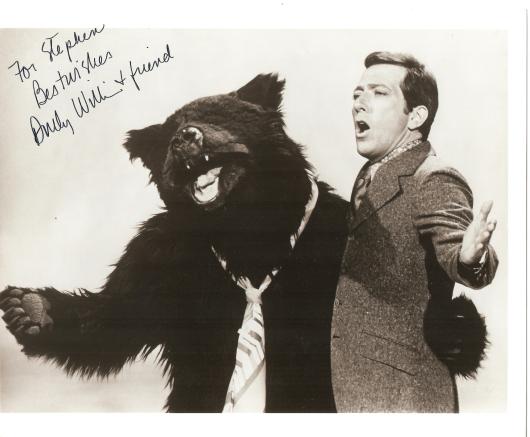
Andy Williams had a hugely popular TV series in the 1970’s and one of my favourite parts in it was a comedy sketch with Andy and a bear (OK, a guy dressed in a bear outfit) who always asked Andy for some cookies and then they went into a different comedy routine every week. Sounds a little crazy I know but I loved that show and Andy’s music ever since. I loved the bear sketches so much that I wrote a fan letter to Andy Williams care of Desilu productions in Hollywood California, who were mentioned on the credits of his show. Months later, a large envelope arrived and inside was a picture of Andy and the bear. ‘To Stephen from Andy and friend’ was the inscription.

I think it says a lot about Andy Williams, that he should make such a gesture for a faraway English schoolboy. Thanks Andy, I loved that picture so much!

Andy_Williams

TV Moment 4

That leads me smoothly onto this next section because Moon River sung by Andy featured in a great episode of Sex and the City. Sex and the City is a comedy/drama about sex and relationships and the episode in question was the one where Mr Big decides to leave New York as he has bought a vineyard in the Napa valley. Season 4 of Sex and the City was the season where all the elements of this great show seemed to just come together to produce some outstanding TV. Carrie, played by Sarah Jessica Parker gets involved with former beaux Aiden played by John Corbett. Aiden is reluctant to get involved again with Carrie as she cheated on him last time around with the super cool Mr Big played by Chris Noth, however Aiden decides to take another chance and the two embark on a new relationship. Miranda’s mother dies and although she tries to keep everything to herself, she is happy to see her friends at the church for the funeral. Miranda still has time though to help former boyfriend Steve with his testicular cancer problems.

Later Aiden realises Carrie does not want to get married and they split up. Its hard to compress a whole season into this short paragraph but if you ever see season 4 going cheap on DVD, it’s well worth getting it.

TV Moment 3

I’ve already written a blog post about my favourite TV detective, Columbo. I love so many of the episodes it’s hard to pick my favourite but it’s probably ‘Murder by the Book‘, starring my favourite murderer, Jack Cassidy. In this 1971 episode, Jack plays a writer, actually part of a writing double act who together produce a series of novels about ‘Mrs Melville’ who is an amateur detective. The thing is, Jack’s partner wants to ditch the partnership but Jack is not happy about it. He is so unhappy he decides to, yes you guessed it, bump off his co-writer. He does it in a rather ingenious way which foxes Columbo but not for long and to cap it all, the episode is directed by none other than Steven Spielberg!

TV Moment 2

Way back in my school days Monty Python was on TV late on -I think- a Thursday night. It was certainly a week night and it was certainly late as I had a running argument with my Mum about staying up to watch it. The next day talk at school would be all about the latest episode and if you had missed it, which happened to me quite a few times when I lost that long running argument, you were just socially dead for a day.

Deciding on a favourite sketch is a difficult if not impossible task. I loved the Superman/Bicycle Repair Man sketch, thought the Dirty Fork sketch hilarious, the Lumberjack Song broke me up but the one I’ve chosen here is the ‘Is this the right room for an argument’ sketch. Enjoy.

TV Moment 1

MASH was a sitcom that ran for 11 seasons and an incredible 256 episodes. In case you didn’t know MASH stands for Mobile Army Surgical Hospital and is set in the Korean War. The series follows the exploits of the doctors and nurses of the MASH, in particular Hawkeye played by Alan Alda and Trapper John played by Wayne Rodgers. The episodes feature a mixture of comedy and drama expertly mixed together by the writers and performers.

My favourite ever MASH episode was one called ‘Sometimes you Hear the Bullet.’

Hawkeye’s friend Tommy comes to visit the 4077th MASH. He’s a former journalist who wants to write the story of the Korean War from the point of view of the soldier, not the journalist which is why he has not enlisted as a war correspondent. He stays with Hawkeye for a while and the usual zany humour ensues. Tommy then has to return to the war. A side story is one where a wounded young lad (played by future film director Ron Howard) admits he is under age but joined up to prove to his girl that he was a man. In one scene he tells Hawkeye that he is out to get him some ‘gooks’ and Hawkeye replies calmly that another word for gooks is people.

Hawkeye and Trapper plan to steal Major Frank Burns’ Purple Heart- he’d had an accident and because it happened in a war zone, he is eligible for the award -and pass it on to the young lad so he can impress his girl back home. Anyway, later in the episode, Tommy the journalist returns to the MASH, only this time he is seriously wounded. He was planning on writing a book called ‘They Never Hear the Bullet’ but this time he heard the bullet. ‘Never mind’ says Hawkeye, ‘just change the name. Sometimes you hear the bullet, it’s a better title anyway.’ Tommy is anaesthetised and Hawkeye gets to work. Sadly, Tommy dies on the operating table. Colonel Blake has to remind Hawkeye about the queue of wounded and Hawkeye, tragedy etched on his face (an outstanding performance by Alan Alda) has to carry on with his next patient. Every time I watch that episode, I sob my heart out, just as I did years ago when I first saw that episode on my Mum and Dad’s old black and white TV.

I couldn’t find the episode on YouTube so here’s a clip of Alan Alda who played Hawkeye, talking about the episode.


Steve Higgins is the author of Floating in Space, a novel set in Manchester, 1977. Click the links at the top of the page to buy or for more information.


Remembering Apollo 11

I’m not one for writing topical blog posts. I pretty much write about whatever comes into my head but this week it’s the 50th anniversary of the Apollo 11 moon landing, something that made a deep impression on me as a 12 year old boy in June, 1969.

There have been lots of anniversary programmes on TV about the moon shots and Apollo 11 and for me who was once obsessed by the Apollo missions they were all pretty interesting.

One was a programme I have seen before about Neil Armstrong which involved his friends and family talking about the late astronaut. Armstrong was a quiet man who took lessons at his local aerodrome and learned to fly before he could drive. He joined the US air force and became a pilot in the Korean War before returning home to study aeronautics at university.

Later he joined NASA and became an astronaut and apparently the first his family knew about it was when NASA introduced its new trainees on the television news.

Armstrong was a talented pilot who went from testing aircraft like the experimental X15 to become part of the manned spaceflight program and later from being an unknown astronaut to perhaps the most famous man in the world. Everyone wanted to meet the first man on the moon and perhaps get his autograph.

Later on he declined to sign autographs when he found that people were selling them on.

Armstrong resigned from NASA in 1971 and decided to take up a professorship at the University of Cincinnati.

He seemed reluctant to talk about Apollo 11 and I even remember back on the 25th anniversary, the BBC ran a documentary in which Buzz Aldrin did most of the talking, explaining how Neil landed the Lunar Module Eagle on the moon’s surface.

On the way down the Eagle’s computer kept throwing up ‘1201’ and ‘1202’ program alarms. Neither Armstrong nor Aldrin knew what that was but the controllers at mission control knew. The on-board computer which had less memory than a modern mobile phone, could not deal with all the data is was receiving. Armstrong switched over to manual flight, hopped the lunar lander over a rocky area then finally dropped down safely onto the lunar surface with only a scant few seconds of fuel remaining.

Anyway, getting back to July, 1969, I don’t know if you can imagine the excitement of a twelve year old boy, getting up for school one morning to find the TV on and Neil Armstrong walking on the moon when the usual TV broadcast at that time would have been the test card!

Those black and white ghostlike TV images enthralled me that July morning and how my Mother eventually managed to pack me off to school I do not know. Back then I was glued to the BBC transmissions about the Apollo programme and I was a great fan of James Burke who gave us concise updates on what was happening in space and at mission control.

Another BBC programme I saw recently was one about the BBC broadcasts of those days and James Burke himself looked back at film from the late sixties. Video tape was apparently in short supply at the BBC back then and most of his broadcasts were deleted but many of the filmed inserts, broadcast presumably when not much was happening live, were really interesting.

In one, Burke gets inside the cramped command module and shows us just how small it actually was. Apparently in zero g: weightlessness, it appeared bigger because then one could float off into a corner that was normally inaccessible and go to sleep.

In another Burke goes aboard a NASA plane which makes a steep descent creating a few moments of weightlessness which was important for astronaut training.

I often think about that day in 1969, watching the Apollo 11 crew on the moon. The images looked ethereal and ghostly as the two astronauts bobbed about in the low gravity of the moon. I used to wonder just what it was like for Aldrin and Armstrong and what it was like also for Mike Collins, waiting patiently orbiting above in the Command Module Columbia.

Collins must have been the loneliest man in the world just then.

Later in the Apollo program, the TV pictures improved enormously but it was the pictures and cine film that the astronauts brought back which were really amazing.

You might be forgiven for thinking that with the moon landing being 50 years ago, manned space exploration has gone on to bigger and better things. Not so. The Apollo program was incredibly expensive: 25.4 billion dollars according to a quick search on Google: Money that of course the US government could well use elsewhere and after Apollo 17 the moon landing programme was shut down.

Still, think about the spin offs in technology, not only rocketry but computers and electronics and so on. I once read that the secret to the US winning the space race was computer technology and that many calculations done by the Soviets were done by teams of mathematicians using abacuses!

The space race was also part of the cold war and although the Soviets seemed to excel in the early part of the 1960’s, it was the USA that finally put a man on the moon and that man, the first man, was Neil Armstrong who went from relative obscurity to the most famous man in the world. The only other person I can really think of with a similar fame was Charlie Chaplin, whose films, in the days of silent films, went all the way around the world.

One interesting thing to finish with: On one of the BBC documentaries, one of Armstrong’s friends, or perhaps it was his brother, remembered Neil as having a regular dream when he was a child.

Armstrong dreamt that he could float in the air by holding his breath! Quite an interesting dream for a future astronaut!


Floating in Space is a novel set in Manchester, 1977. Click the links at the top of the page to buy or for more information.

Rooms, Film sets and Homes from the Corners of my Mind . .

Film sets? Rooms? What exactly is this guy going to write about rooms you might think? Well, this idea about rooms might take me a while to explain so here we go.
I’ve always been interested in really exciting rooms, usually those seen on a film where the room in question has been designed by some really top designer and put together by some award-winning prop guy and set dresser but the first room that comes to mind is one from my comic book days.

Back in the 1960s some British comics started to reprint American super hero comic strips. They did it by combining various super hero comic strips into one comic. The one that comes to mind was called Marvel after the producers of such comic books as Spiderman, the Hulk and so on.

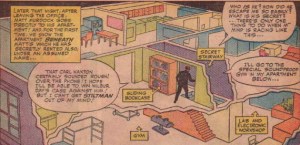
One strip that I really loved was the new super hero Daredevil. Now he, believe it or not, was a blind guy but had this ‘radar sense’ that enabled him to see in a way that no sighted person could. In the first Daredevil strip I ever read there was a cutaway drawing showing Daredevil’s flat (apartment to you US readers) and its secret ‘underground lair’ when Daredevil got his kit off and exercised in a personal gym where he honed his gymnastic skills which as you know, are required by all costumed crime fighters. It was probably the idea of the concealed rooms that interested me as a child, I always loved that in the sci fi of the 1960s.

Image courtesy berkeleyplaceblog.com

Batman too had his underground lair; it was the Batcave and there was a great moment in the 1960’s TV series when Bruce Wayne would say to his young ward Dick Grayson ‘to the Bat poles!’ Robin alias Dick would flip the switch on the bust on Bruce’s desk and the two would leap onto the bat poles in the now opened secret compartment and slide down to the Batcave.

Another underground lair was that of Doctor No, the first villain in the James Bond film series. The doc had these amazing quarters with a glass wall looking out under the ocean.

‘A million dollars’ says the doc to James Bond as he quietly enters the room.

‘You were thinking of how much it cost?’ He goes on.

Actually, I wasn’t as I knew it was a film set but it was pretty cool.

The next great room and location that comes to mind was that of Ernst Stavro Blofield in my favourite Bond movie, On her Majesty’s Secret Service. Blofield has a mountain hideaway on top of a peak in the French Alps, or was it the Italian Alps? Either way Piz Gloria was an actual skiing lodge that had just been constructed and had been lent to the film crew. The interior, which I always rather liked, particularly Blofield’s inner sanctum was really cool and presumably designed by the production designer Syd Cain.

Another room I always liked was Joe 90’s dad’s house from the TV series Joe 90. It was a very comfy old-fashioned farmhouse where Joe and his dad, professor -I nearly said professor 90 but I don’t think it was. Anyway, the two of them lived there assisted by their housekeeper until Joe went off on his secret missions. Their front room was remarkably similar to the one owned by Barnes Wallis in the film The Dambusters. Wallis’ home was a typical 1940’s English farmhouse and it all looked pretty comfortable to me.

Remember the Beatles movie Help? In the film there is a great shot of the four Beatles walking up to their respective front doors along a typical row of English terraced houses.

They turn their keys, open their doors and they each step into: -Cut to interior shot- One ultra-modern long room and we see the Beatles step inside and settle down. John has a settee or couch sunk into a low area which he has to step down into and down there, or so I imagine, he has a TV and stereo and all the mod cons of the mid-1960s. I loved that little space and if I had a big enough house it would be great to recreate it. Then again, I can just imagine coming home late at night after a few beers at the pub, walking into it in the dark and breaking my neck!

Did you ever watch the 60’s TV show The Prisoner? A secret agent resigns, returns home to find gas filling his house. He awakes, seemingly in the same room but when he opens the window, he finds himself in a village where he is apparently a prisoner. The Prisoner starred Patrick McGoohan and the show combines elements of intrigue, espionage and sci fi. It was filmed in the Welsh village of Portmerion where a long time ago I was able to visit number 6’s old house. The inside of it was of course not in Portmerion but was something assembled on a film set at Elstree or somewhere. It was small and compact and the door automatically opened as you approached.

Number 2, the administrator of the village had an ultra modern office with stylish 1960’s bubble chairs. I’ve always fancied one of those chairs: I can just imagine curling up in one and having a good read.

Another great setting was Hugh Grant’s house in the film Notting Hill. Notting Hill is an actual area of London and Grant’s house in the film was presumably an actual house. Notting Hill, and I have to say I have no actual experience of the real Notting Hill, comes over in the film as a busy, vibrant and exciting place to live. Hugh’s house is a terraced house, rather narrow but with lots of light and a rather cosy area on a landing by the stairs with a couch where Grant spends the night on one occasion in the film and looks to be a really great place to relax, maybe watch TV or write blogs and just generally have some private time.

Anyway, enough of films, it’s about time I told you about my favourite room. I had two and they were both at the first house I ever bought; my house in Didsbury, Manchester. There was a small front room which I decorated myself, slowly. There was a dado rail with different but matching wallpapers above and below, bookshelves, books and videos (VHS of course). I also kept one of the three bedrooms for myself as a music room and my stereo and records were all stored there along with a couple of comfy chairs and all the other toys, gadgets and cameras I had at the time.

Once, years later, I remember visiting the old place and I parked outside for a while feeling like an intruder. Years before, this had been my street and my house and if, back then I had glanced outside and seen a strange guy in a strange car just waiting, I might have been tempted to call the police. Times had changed, and now I was the intruder.

There was a time when I might have been tempted not to mention that story but I remember watching my favourite TV documentary of all time about the late actor, Peter Sellers. Sellers had a thing about dragging his ex-wife out and taking her on these regular tours of his old haunts, his old schools and old homes and so on. If a famous actor and comedian like Sellers did something like that then clearly parking outside my old house for a few moments can’t be so bad after all.

I enjoyed some happiness in that house but also a lot of pain and sadness too. I remember sitting there in my car and I tried to turn my mind to the happier times I had there.

Once, we had a sort of, well gathering there. I was tempted to say dinner party but really it was just a few people coming around for drinks and nibbles and things.

One guest was our solicitor, I’ll call him Phil (although his name was actually Pete!) Seriously, Phil was a really arrogant guy. In fact he had very bad eyesight and could hardly see his hand in front of his face. He rejected the use of a white stick and arrogantly pushed away anyone who tried to help him. He was a good solicitor and although he could be a bit of a pain I had a lot of respect for him.

He was sitting in the small lounge in my comfy chair when he got up to get a drink or some food or something from the other room. I was tempted to nip into the comfy chair but another guest pushed me aside and slipped into the seat. When Phil came back with a plate of nibbles he turned to sit back in the chair, obviously not seeing the girl sitting there and she slipped out of the seat just as Phil sat down again.

We were all killing ourselves laughing but Phil didn’t quite get the joke.

Later when he left, he once again declined any assistance. Pity really because the path from our front door to the street went towards the right at a 45 degree angle whereas Phil went straight ahead towards the privet hedge.

Never did get that gap in the hedge sorted.


Floating in Space is a novel by Steve Higgins set in Manchester, 1977. Click the links at the top of the page to buy or for more information.


F1 2019 and the Sky TV Era

The start of a new formula one racing season is always an exciting time. Drivers have settled into their teams, the testing of the new cars is over, the journalists are busy making their predictions and we, the fans and viewers, can finally settle down to watch the first race.

Photo by Ajeet Mestry on Unsplash

Great, but this year is the start of a new era in television. Live F1 has vanished from terrestrial TV and if you want to see the races and their qualifying sessions live you must now cough up £10 per month to subscribe to F1 on Sky and that’s on top of the charge for the basic Sky TV service. Just to rub that fact in, the very first advertisement shown on the first ad break on the qually show on terrestrial TV’s Channel 4 was an ad for Sky TV’s F1 coverage!

Today we are in a sort of elitist TV age where those willing to spend a great deal of money can see all the latest and trendiest TV shows whilst the rest of us have to make do with whatever the BBC, ITV, Channel Four and all the other Freeview channels can offer.

I have heard that Game if Thrones is something pretty exciting, in fact the other day one of my work colleagues told me she was ‘obsessed’ by the show. As far as I know it’s some kind of sci fi fantasy show with a liberal handful of sex thrown in but sadly, as it’s not available on terrestrial TV, I am not one of the lucky few who can watch it.

In a few years’ time we might get a rerun on the BBC but by then all the fuss and excitement will be over and some new show will be in the limelight. I can just imagine perhaps turning to that same work colleague and saying something about a Game of Thrones and her replying, ‘Game of what?’

Ah, the fickle nature of TV. Anyway, back to the F1 season and you might perhaps be thinking if this guy is so keen on F1 why not cough up the dough and subscribe to Sky? Subscribe? Pay for TV that traditionally has been free? My generation can of course remember the days of black and white TV, the days of only two or even one channel. TV to us is like free school milk, the NHS, the number 17 bus. TV is something one takes for granted and as for actually paying for it, surely that’s undemocratic, unBritish and simply unacceptable!

So what is happening then in the world of F1? Are Mercedes and Lewis Hamilton still at the top? Are Ferrari still challenging? Of course they are. The big story for me was the ninth place qualifying spot of Lando Norris in the McLaren. McLaren were once one of the giants of the sport but in the last few years they have slid down towards the back of the grid. Their relationship with Honda fizzled out but when they strapped a Renault engine to the back of their car they still found themselves under performing and that excuse of blaming the Honda engine was no longer acceptable. Either way, it was enough for star driver Fernando Alonso to throw in the towel and say ‘I’m off!’

Hopefully McLaren have started down the road which may one day return them to the winners circle. Another once great team, Williams are not looking good either. Paddy Lowe who contributed so much to the success at Mercedes has not been able to work the same technical magic at Williams and they have found fundamental issues with their new car, so much so that Paddy has had to take a break from the team for ‘personal reasons’.

Only Ferrari seem to have been able to keep their team viable across the changing vista of Formula one. Lotus, Brabham and many others have come and gone. Will Williams and McLaren be able to carry on? Only time will tell. Neither team finished in the points in Australia but at least the performance of McLaren was encouraging. Williams though were not looking good. During the interviews from the paddock the shouts of the fans praising F1 returnee Robert Kubica were quite evident. Kubica’s story is one of those great F1 success stories. Kubica, a rising star and Grand Prix winner had turned to rallying prior to the beginning of the 2011 season but was involved in a terrible crash in which his right arm was partially severed. Surgeons were able to sew the arm back on but the terrible injuries left Robert with reduced mobility in his hand. Now, many years later, Kubica is back on the F1 grid and with a few adjustments to his Williams steering wheel, he is back racing once again. Sadly, he is driving a car not worthy of his talents but with his feedback and the talents of the Williams engineers, maybe things can be turned around. Everyone loves a comeback story.

Valtteri Bottas took Mercedes back to the winners’ circle once again and brought home an extra point for fastest lap. That single point incidentally is something new for 2019, a point for the fastest lap. So, we might find that no longer will drivers decide to rest their engines on the final laps, in fact they will be putting the hammer down in an effort to bag that one extra point for fastest lap.

Getting back to Valtteri, the Finnish driver didn’t have such a good season last year so this win was exactly what he needed. The Ferrari’s took fourth spot for Sebastian Vettel and he didn’t look too happy about it but things could have been a lot worse.

The Red Bull team came home in third place with a great drive from Verstappen in their new Honda powered car. It looks as though Honda might be finally getting things together.

Yes, I may moan about Formula One and pay per view TV but I did manage to get to the 2pm Channel Four broadcast time without finding out who the winner was. I had steered clear of the Internet, no mean feat for cyber geek like me. I didn’t even look at my emails because that could have given rise to the possibility of seeing an e-mail about the event. I subscribe to a number of F1 web sites and their e-mail newsletters always have the winner’s name in the subject so e-mails and Internet were a no-no. TV news? No, kept well away from that too.

Yes, I managed to stay well away from the media and as a result the race was almost as enjoyable as watching it live.

Well, almost but not quite.


Floating in Space is a novel by author Steve Higgins set in Manchester, 1977. Click the links at the top of the page to buy or for more information.

Star Wars, Remakes and Dealing with Man-Flu

Our motorhome was looking a little forlorn lately, parked up on the drive all packed up ready to face the winter. The thing is, just lately the weather has been rather mild and Liz felt that we should perhaps unpack the motorhome and give it a winter drive out. So we set off for Southport, a small seaside town just a short 90 minute drive away. We parked up the motorhome, put on our glad rags and went off to dine and generally make merry.

It just so happened that this particular night turned out to be the coldest in modern UK history. Well, at least it was in Scotland so it was lucky we weren’t staying there. Southport was much warmer and our heater worked a treat. However, having to get underneath the van in the cold and rain and empty the water system wasn’t so nice, in fact I reckon that’s where I caught a chill which was soon to develop further into a major man-flu episode.

A couple of days later I was back at work. On the first day I felt fine and I wasn’t too bad when I went in on the second day but by the end of the shift I was coughing and sneezing like nobody’s business. By day 3 I was feeling so poorly I had to throw a sick note in. Anyway, home on a cold day with no energy to do anything except cough and sneeze, what was there to do but watch TV.

On a Sunday on UK TV there is always a choice of Columbo episodes because they are shown on two rival channels, ITV3 and 5USA. Which one should I watch though? Luckily, the first one started on 5USA at one o’clock and the other over on ITV3 at five past. Just enough time to start the first one, see if it was a good one then quickly check out the other one to see if that was more interesting . The 5USA one was the one for me, a classic 70s episode guest starring Robert Culp as the murderer.

A couple of hours and a hot lemon drink later Columbo had his man and it was time for a change of channels. I switched over to ITV2 to watch the first Star Wars film. I’m tempted to call it Star Wars 1 but just to confuse you, the first Star Wars film was actually the fourth episode in the series. The second and third films, all made in the late seventies are all actually pretty much more of the same thing although not quite as good as the original.

Later on writer and director George Lucas decided to make episodes 1, 2, and 3 which were actually films 4, 5, and 6. Now those latter three films were, and I don’t want to put too fine a point on this, a load of old tosh. Even if I was on my last legs I wouldn’t sit and watch any of those movies. In 2015 JJ Abrams was tasked to make a new movie following on from episode 6 which reunited the original cast of Carrie Fisher, Mark Hamilton and Harrison Ford (who I must nominate as one of the worst movie actors ever along with the equally dismal Richard Gere.)

The result seemed to me pretty much a remake of Star Wars 1 (I mean 4). It was the usual thing, droids on an unknown planet with info which the Empire wanted, or maybe the new Empire wanted because the original Empire had been defeated in the previous Star Wars film. The droids and their human helpers escaped in Harrison Ford’s old ship the Millennium Falcon and then, well, I don’t know what happened then because I either mentally or physically switched off!

Getting back to Star Wars 1, or episode 3 or whatever, I’d not seen the film for a long while and I enjoyed the sending of the droids to seek out Obi Wan Kenobe, the appearance  of Luke Skywalker, the hiring of Hans Solo and his Millennium Falcon and the trip to the rebel alliance planet, Alderon. The truth is, just like when I watched Star Wars 7, I actually got a bit bored with the whole thing and decided to change channels. Star Wars isn’t a bad film but like all the rest in the franchise they seem to flatter only to deceive.

Over on the Paramount film channel they were showing a bunch of Steve Martin films and the first up was Roxanne. While not exactly brilliant it was actually a pretty good film and despite the continual coughing and spluttering I still managed to enjoy the proceedings. Roxanne was based on the 1897 play Cyrano De Bergerac and it’s about, as you may have guessed, a man with a big nose.

(Short break here while I sort out another hot lemon drink this time with a small shot of -purely medicinal- whisky.)

Paramount decided to follow this up with ‘The Out of Towners’, which was a remake of a 1970 Neil Simon film. Sadly, the Out of Towners wasn’t that great a film and I can only hope the 1970 original was much better. The fact is, it’s hard to understand the motivation behind remaking a very average film. Do they hope to make a better version? Do they think with better actors and updated film making techniques the film will be better or funnier? The fact is that if you remake an average film you will still get an average film as the result. Not long ago I saw the new version of Flight of the Phoenix. It was OK, although I switched channels after about thirty minutes. Then again, the original version starring such heavyweight actors as James Stewart, Richard Attenborough, Hardy Kruger and Peter Finch wasn’t that brilliant either although I have watched that version through to the end.

Still, does that mean we should only remake classic films? I can’t really imagine any new version of Casablanca, for instance, bettering the original. Who could take the place of Bogart? Who could replace Ingrid Bergman? Yes, there is always the chance a mediocre movie could be remade better, I suppose.

A lot of film franchises are pretty much just a series of remakes. That is true of the Star Wars series as I have already mentioned but take a look at the Rocky films. Rocky 2 was pretty much another version of Rocky and while Rocky was a great movie, Rocky 2 was just, well, Rocky 2. Towards the end of the series Rocky star Sylvester Stallone made Rocky Balboa which was a fitting end to the series. Rocky has retired and is running his small Italian restaurant. His wife has succumbed to cancer and then he gets the chance to be involved in a computer fight with the current champion Mason ‘the line’ Dixon.

I did wonder when I saw the film whether writer and director Stallone was inspired by the 1970s computer fight between Muhammad Ali and Rocky Marciano. My dad, a great boxing fan and a great fan of Marciano was outraged by the fight as the result was a win for Ali. My dad loathed Ali even to the extent of always referring to him by his former name of Cassius Clay. When I looked up the fight on the internet I discovered that only European viewers saw Ali win the fight. American viewers saw a version in which Marciano emerged as the victor in the 13th round. I know which version my dad would have prefered.

Getting back to remakes, after a short pause for another whisky and hot lemon: Which films would be good candidates for a remake? Well, there are two that I can think of. The first is Desperately Seeking Susan, an 80’s film starring pop singer Madonna in a small role, that of an independent young girl who travels the country but keeps in touch with her friends using the personal ads in a newspaper. Step in bored housewife Rosanna Arquette who follows the personal ads, even to the extent of watching Madonna from afar when she meets with her boyfriend. There is a lot more to it of course, memory loss, mistaken identity and stolen jewels but it’s a great film and here’s the thing; substitute personal ads with modern-day social media and the film is perfect for a 21st century remake! Casting might be an issue though, after all, who could replace Madonna?

One last film that I’d remake: Capricorn One. Now you may remember in an earlier post I wrote about watching an old VHS tape of the film and finding, sadly, that the tape ran out before the end. Now the more I thought about the film it made me remember that I had the full film on VHS somewhere and after a long and dusty search of my mother’s house I finally found it, a proper VHS shop bought, full version of Capricorn One. If you haven’t seen the film and I have to say, I haven’t noticed it on the TV schedules for a long time, the film is about the first manned voyage to Mars. On launch day the crew are removed from the spacecraft and it blasts off without them. They are then taken to an abandoned air force base and find that the plan is to fake the mission using a TV studio.

Why, you may ask? Well this is where the film falls on a little shaky ground. The space missions are in danger of losing funding from the government and as the life support system has been found to be faulty, this would be a good reason for the program to be cancelled. To prevent this, this fake mission is the course of action chosen by the top brass at NASA to keep the Mars program going.

Yes, not sure that NASA would really do that sort of thing. Perhaps if they threw in something else, some sort of conflict between Russia and America where winning the Mars race was of vital political importance, well then perhaps it would be more believable.

Later on during the mission Elliot Whitter, a member of staff in mission control, discovers that the TV signals supposedly coming in from the spacecraft are coming in ahead of the spacecraft telemetry. Of course they are! They are being beamed from a TV studio out in the desert. OK, this guy has to be got rid off so how do the NASA people do it? Nab him on his way home? Grab him somewhere at Mission Control? No, they wait until he is in the middle of a pool game in a bar with his best mate, a TV news journalist played by Elliot Gould. The journalist takes a call at the bar and when he returns, two minutes later, his mate has vanished! Something fishy going on here thinks the journalist.

Although the TV journalist eventually solves the case there is no real link as to how he does it, just guesswork really so in the remade version maybe Elliot Whitter made a computer disk that leads to the TV studio at the abandoned air force base, the TV journalist gets hold of it, finds the astronauts who are now virtual prisoners and hey presto we have a proper ending to the film.

Don’t miss Capricorn One if it ever gets shown on TV because it really is a great film despite me criticising it. And if any wily film producer is thinking about a remake, my updated re written script is available, whenever you are!


Floating in Space is a novel set in Manchester, 1977. Click the links at the top of the page to buy or for more information.