
Advertisements do get on my nerves. They’re perhaps not so bad when reading a magazine, you don’t even have to look at them but TV commercials, well they are just a pain in the neck. Occasionally, if you are watching terrestrial TV and a commercial break comes on, sometimes you think OK, I’ll put the kettle on or go for a quick bathroom visit then you can sit down and you haven’t missed much. I’ve noticed lately however, that on some of the more commercial channels like ITV2 and 5USA for instance, the commercial breaks seem to go on for ever and sometimes it’s easier to just record the film or whatever you are watching and watch it later, when you can fast forward through the advertising.
Liz and I have a Sky subscription. It’s only the basic one, we don’t get sport or the movies channels, or the Formula 1 racing for that matter but we do hand over a sum of money to Sky every month in return for various TV channels. It almost seems then, that we are actually paying to see advertisements which really gets me so mad as I am paying for something which is annoying!
Still, I suppose the TV channels have to find a way to maximise their profits; they don’t put out TV shows for free of course, they do it to make money. I sometimes wonder how the world of broadcasting would have evolved without advertising; it would be so much better. Imagine all TV stations like the BBC, devoid of adverts and showing just the things we want to see. I remember once seeing an interview with Galton and Simpson, the famous comedy writers. They wrote for Tony Hancock and they wrote sitcoms like the classic Steptoe and Son. They said that sitcoms on commercial TV were essentially two 12-minute acts, with the remaining 6 minutes taken up by advertising. Writing for the BBC they said gave them an extra 6 minutes to play with. ‘Integrity time’ I think they called it.
Ray Galton and Alan Simpson met at a tuberculosis clinic in 1948 when they were both recuperating from the disease. They went on to write scripts for various radio shows before beginning a collaboration with Tony Hancock for the Hancock’s Half Hour radio show and for the later TV series. When Hancock ended their relationship, the two writers wrote a series called Comedy Playhouse. One particular episode was very popular and from this the two created Steptoe and Son, the classic BBC comedy.
Another writing partnership that I have always been fond of is Ian La Frenais and Dick Clement. They wrote the TV series The Likely Lads in the 1960’s and its 1970’s follow up Whatever Happened to the Likely Lads. I’ve always loved the Likely Lads, in particular that latter follow up series. Rodney Bewes and James Bolam played the eponymous lads and the series was set in the Newcastle upon Tyne area of north east England. The later series was funny but also had a poignant quality as the two lamented the way things had changed since the days of the 1960’s. In the film version the two take time to attend the last moments of their favourite pub, the Fat Ox, soon to be knocked down by developers. All around them they can see change as back-to-back terraced houses are knocked down in favour of new housing estates. The feature film captures all the elements of the show and there were plans for a revival of the series but the two actors, Bolam and Bewes, apparently had a falling out and Bolam declined to appear again as his character Terry. After Bewes passed away, Bolam maintained that there never was a feud but that unlike Bewes, he was not interested in doing more Likely Lads.
La Frenais and Clement wrote a pilot script for Ronnie Barker in 1973 which later became the hit comedy series Porridge. It ran for three series and was also made into a feature film. The series starred Barker and Richard Beckinsdale as two inmates of Slade prison. Barker plays Fletcher, a prisoner who knows the prison ropes and is described in the opening titles by the judge as he is handing down a prison sentence (actually a voice over by Barker himself) as an ‘habitual criminal’. Beckinsdale plays Godber, an inmate serving his first term in prison who Fletcher takes under his wing and tries to educate in the ways of prison life.
Richard Beckinsdale who sadly passed away from an undiagnosed heart problem in 1979, was one of the bright new comedy actors of his time and would surely have gone on to greater things. He also starred in the TV comedy Rising Damp, about a seedy landlord played by Leonard Rossiter with three regular guests played by Beckinsdale, Frances De La tour and Don Warrington. The classic series even now enjoys many re runs on TV.
Another of my favourite comedy writers is Spike Milligan. He wrote most of the episodes of the classic radio comedy The Goon Show which starred Peter Sellers, Harry Secombe and Milligan. The Goon show was a revolution in radio comedy and featured a sort of surreal humour allied to numerous comedy voices, mostly supplied by Sellers, and many outlandish sound effects.
 The show debuted in 1951 but the pressure of continually having to produce a new script weighed heavy on Milligan who suffered a nervous breakdown towards the end of 1952. Other writers were drafted in to help with scripts including Jimmy Grafton, (who ran a London pub where the cast originally met) Michael Bentine and others. The members of Monty Python’s Flying Circus all credit Milligan with inspiring them to work in comedy.
Milligan was a prolific writer, creating many radio and TV scripts as well as a play, The Bed Sitting Room which was also made into a film.
Back to Advertising.
I seem to have drifted off my original subject which was TV advertising. All TV adverts are not bad I suppose. Some that come to mind were the Cinzano ads featuring Leonard Rossiter and Joan Collins. Together, they made a very funny series of ads back in the 70’s. Here’s the one I think is the funniest . .
Also I have to admit liking those ones featuring the Meerkats. There’s a great one where one of the meerkats, Sergei, (sad isn’t it when you watch the TV ads that much you even know the names of the meerkats) has been left alone for a while and he is really sad. When his pal finally returns and asks did you miss me? Sergei replies Miss you? I didn’t even notice you’d gone!
Remember the one about JR Hartley? I couldn’t even remember what they were actually advertising but after a quick look on Google I see it was yellow pages. An old chap is looking for a book, Fly Fishing by JR Hartley. He finds a copy using the yellow pages but who is the guy? It’s the author himself, Mr JR Hartley!
A personal favourite was one advertising a new Ford car using Steve McQueen. McQueen’s image was pulled from the movie Bullit and digitally inserted into the ad for a new Ford Puma.
Patricia Cornwell.
Patricia Cornwell is an American writer of mystery novels mainly featuring her heroine, Kay Scarpetta. Scarpetta is a medical examiner in the US state of Virginia and solves many murder cases using forensic methods and technology. Many credit Cornwell with inspiring the rash of CSI TV shows and other books and films that feature hi tech forensics.
I have a lot of respect for Patricia and any writer who can produce numerous high-quality novels. As for me, I’m still here labouring (sometimes) on the sequel to Floating in Space so my output is just a pale shadow compared to Patricia’s. Over on Twitter where I knock out a few Tweets every day in hope of attracting some attention to my blogs and books I have a shedload of followers but not a lot of interaction. Often my Tweets go off into cyberspace sometimes without anyone even noticing. The highlight of my week therefore was not only Patricia Cornwell following me on Twitter but also liking one of my Tweets. Pity she couldn’t have given me a retweet but heck, I’ll settle for a like. Thanks Patricia!

 As usual on this blog I’ll be talking about books, films and TV and what started me off on this theme of prisons and prisoners was watching my box set of the 60’s TV series the Prisoner. Anyway, I’ll get to that shortly but first let me start with a book. It’s one I reviewed earlier in the year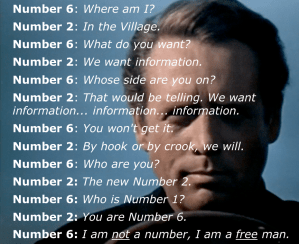

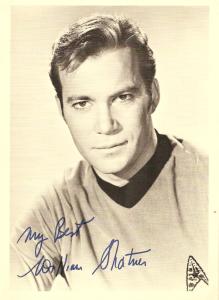 As a schoolboy I wrote to Desilu studios where I believed Star Trek was made, based on credits shown at the end of the show. After a while I received a set of glossy pictures of the show’s stars. They were all signed by the various actors, Shatner, Nimoy and so on but the signatures, I have long suspected, were made by a machine.
 When I used to work a nine to five job, I always looked forward to a bank holiday. It meant only working four days instead of five. Nowadays when I work shifts, I sometimes end up working the bank holiday but when it comes down to it, I don’t really care. It’s actually nicer having a break when the holiday resorts and seaside destinations are not packed. This bank holiday I wasn’t working but the weather in the UK, at least in the northwest where I live, was dreadful. It was cold and did nothing but rain so I spent the day watching TV.
 This week the lockdown has eased a little here in the UK. Groups of six can now meet together in public places and soon we will be able to go to the pub once again, as long as we stay outside. No doubt pubs who don’t already have beer gardens or some sort of outside area will be scrambling to get one set up. It will be nice to go down to the pub or restaurant again and take another step towards normality.

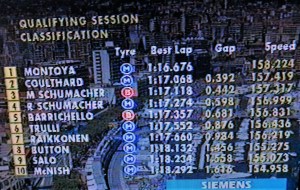 The other day I was idly watching an episode of Everybody Loves Raymond. It was the one where Ray and Debra his wife are watching their wedding video and suddenly the screen dissolves and on comes a football match. Debra is furious because Ray has taped over the wedding. Yep, those sort of things happened back then and on my video tape something similar occurred. The race video vanished into a hail of snow only to be replaced by a James Bond documentary. I was furious for a moment but then I got interested in the documentary. It focussed on Miriam D’Abo who starred in the 007 film The Living Daylights and she interviewed various ladies who had the dubious honour of being a ‘Bond Girl.’ There were plenty of clips from the Bond films, interviews and bits and pieces of behind the scenes stuff, in fact it was all pretty interesting for a Bond fan like me.
 Well, we’re at that time of year again, Christmas. This time it will be Christmas with a difference; no parties, no meals out, no pub nights. The Coronavirus has changed everything. When it comes down to it, I’m not a great Christmas fan. It was good years ago as a child, waking up with the excitement of it all; the presents, the food, the cosy evening watching classic TV. But now I find myself wishing it was all over. I find myself looking forward to my favourite time of the year, the spring when days are getting longer and warmer and the bad weather is beginning to ease and things are gradually becoming more light than dark and more warm than cold. This Christmas I will be working, even though I only work three shifts out of nine it turns out that my three days this week have fallen on the 25th, the 26th and 27th. Still, I’ve worked Christmas days before now as well as New Year’s day and Easter and other holidays. This time however, I’ve promised myself I won’t be working another one.
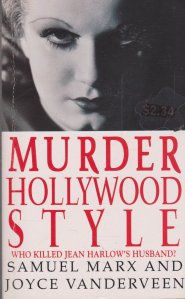 Hollywood has always fascinated me, especially Hollywood’s Golden Age. Just recently I’ve been reading Murder Hollywood Style written by Samuel Marx and Joyce Vanderdeen. Samuel Marx worked in Hollywood for many years and was a story editor and later a producer. He was a friend of Paul Bern who had married the original platinum blonde, Jean Harlow, in 1932.
 Lockdown may have finished on December 2nd in the UK but if you live in a tier 3 region, like me, it’s still going on. OK, I understand the need for the lockdown, I know we have to prevent the virus from spreading but that doesn’t stop the whole thing being a pain in the neck. No quiz nights at the pub, no restaurant meals out and so on. Not only that but why does the virus have 2 separate names? Is it Covid 19 or is it Coronavirus? And where does the 19 come from? Was there a Covid 18? Does this mean there have been 18 previous versions of this insidious plague? If so, why have we never heard of them? We, the public, need to know.
 Another old show repeated currently on the CBS justice channel is The Fugitive starring David Janssen as Dr Richard Kimble, falsely accused of the murder of his wife. The show ran for four seasons but as viewer ratings began to fall, the series was cancelled. It was then that the producers hit on what at the time was an unusual idea. Instead of the show just ending, they decided to make an actual finale. Yes, they would wrap up the story of Kimble’s wife’s murder. Kimble had been searching for the supposed one-armed man he had seen leaving the murder scene for the past four seasons, now he would finally find him!
