Travelling and Writing in France

Once again Liz and I are in France in our small motorhome. This week I thought I’d talk about our journey and also about my personal journey as a writer.

We came over on the ferry from Portsmouth to Caen after spending the night in a small pub called the Jolly Boatman somewhere in the south of England, actually Kidlington, I think. We have visited this pub once before back in May and it was nice to find that the staff remembered us even after just one visit. The trip over on the ferry was good. We paid a little extra for a top of the range cabin and it was well worth it. We had a little balcony, a tv, kettle and various cold drinks in the fridge. After a bit of a sleep and a shower, we awoke refreshed and ready to find a place to stop for the night in France.
The great thing about France is that motorhomes are welcomed with plenty of free overnight stopping places with toilet emptying facilities and fresh water. Some places require a jeton, a token that can be bought in local shops to obtain fresh water but otherwise most places are free. In England, many seaside places seem to just complain about motorhomes parking up for free but surely those motorhomers are using local shops, bars and restaurants and bringing trade into these local communities.

The Jolly Boatman

The weather wasn’t great at first so we ploughed on south towards Bordeaux in search of the sun. Liz is a great navigator and a real master of google maps and she found us some lovely stopping places, one in particular with a man made beach and a lovely swimming lake. We needed that lake to cool down as the weather became seriously hot.

When I’m away I like to have a couple of blog posts written in advance as travelling in our van I don’t always have time to write. Not only that sometimes it’s hard to get a good wifi signal to upload my posts. Recently I’ve been not only lazy but actually struggling a little  for blog post ideas. A few months ago I met up with an old friend I hadn’t seen for a while and he seemed less than convinced that I could write a new post every week. I’ll bet you use ai to write them he joked. I wasn’t amused.

To be honest, I do use ai, not to write posts but to make the quirky memes and graphics that I use to promote my blogs. This is one over to the right. I had never even thought about using ai to actually write a post. Even so, I thought as I was a bit low on ideas it might be interesting to ask ai what I should write about. It came up with a plan for a post asking me to answer various questions about my work. Anyway, here are a few of them.

Share how you got started writing and what inspired your first book.

I can’t really remember what inspired me to write. I can only say that having been a great reader, I wanted to be on the other side of the coin, so to speak: Not just reading the thoughts and ideas of others but also sending my own thoughts and ideas out there too. I like the feeling of communicating not only to others but communicating over the years. I remember reading Homer’s Odyssey and thinking that here was this man, Homer, sending me his thoughts and ideas across the centuries that lie between us and that his ideas carried on after his death.

Talk about your creative routines (or lack of them) — do you write in bursts, or steadily each day? 

I’d like to tell you that I have a routine but actually I haven’t, although I do try to create a sort of routine. What I tend to do is think a lot about writing. I’ll think of a story or a blog, usually the time in a morning when I have woken up far too early and I’ll ‘write’ a blog or a story in my head. I’ll file that away in my head and then either go back to sleep or get up and after breakfast I’ll open up my laptop and write it all down. Sometimes I’ll spend weeks writing a story in my head and when I’ve got a lot of ‘copy’ I’ll start actually writing or typing it out. Years ago I used to use a technique by a self improvement guy called Jack Black who invented something he called Mindstore, a way of using positive thinking to improve your life.

It involved creating an entire imaginary house inside your head with various rooms, just like in a real house. In the bathroom for instance, you could take a breathtaking shower that energised and restored you ready for a big meeting or interview. One room I created was a room for storing my stories and when I’m not in front of my laptop that’s the room I use to write and save my work. My website and my one deadline of 10:00am on a Saturday morning gives me a focus to work at my stories and blog posts and get them ready for publishing. Writing this week has been difficult as Liz and I are working our way across France in our little motorhome although by the time you read this we will have arrived at the lovely gîte we rent in the village of Parçay-les-Pins.

Explore what you love (and what you struggle with) about being self-published.

I love writing and I love publishing my work. I write purely for myself and I write about things I like reading about but I do get a particular buzz every time someone hits that ‘like’ button. What do I dislike about it? Well, I did hope that I could actually make money from writing but so far, that’s just a dream although I do make a few pennies every time someone buys a copy of one of my books. Anyway, I enjoy writing and I’ll carry on writing my blog for as long as I continue to enjoy it. When I no longer enjoy it, I guess I’ll just have to find something else to do. What do I struggle with? Grammar and spelling mostly but luckily, Liz is pretty hot on both of those things and it is she who goes through my work and gives it a good checking over and she’ll correct all the bad tenses and spelling mistakes that appear frequently in my blogs.

A few days ago it was our anniversary. The day before we were parked in a really lovely place with picnic tables and a lake and I thought it would be a good idea to stay and move on the next day. Liz felt that she would rather have a good restaurant anniversary meal so we set off in search of a place to eat that night. Now, the thing about the Loire is that the French don’t seem to eat out much at night. There are plenty of restaurants but most only seem to open for lunch which is the main meal of the day for the French. We tried and tried to find a place but all seemed to be only open for lunch. We found one place, conveniently near a motorhome parking spot but the menu was not only very expensive but didn’t inspire either of us. It was getting later and later and eventually we decided to stop when we saw a kebab takeaway. Takeaways are few and far between in France so we bought a couple of kebabs, parked up for the night and poured us both a glass of vin rouge.

The wine was good but the kebab wasn’t but happily we had plenty of French cheese and bread to round off the meal!


What to do next: Here are a few options.

Share this post on your favourite social media!

Hit the Subscribe button. Never miss another post!

Listen to my podcast Click here.

Buy the book! Click here to purchase my new poetry collection.

Click here to visit Amazon and download Floating in Space to your Kindle or order the paperback version.

Click here to visit amazon and purchase Timeline, my new anthology.

The Curse of the Blank Page

This week I’ve been experiencing that blank page syndrome; you know what I mean, you stare at the paper, or the empty laptop screen and nothing comes to mind, and the paper stays like that, blank. So in an effort to boost my creative powers I took a look back at some of my old blog posts.

I see that I started this blog page back in 2014 and my first post went out on the 23rd of May. It wasn’t anything exciting, in fact it was pretty much a sort of advertisement for my book Floating in Space which had just been published on Amazon to an overwhelming gush of cyberspatial silence.

Floating in Space was my first book and I put it together many years ago. At the time, I was writing lots of science fiction and espionage stories based on my love of television shows reflecting both those genres. I had begun to realise though that for fiction to be worthwhile it has to have a basis in real experience. All I knew about sci-fi and espionage was what I had read about or seen on TV so I started to write about myself. I wrote about the insurance company where I had worked and also the bus company where I worked later after a short trip to Europe that was supposed to last for a year but ended up covering about four weeks.

After I had compiled a few essays, I thought I could put them all together into a fictional story about a young man who packs in his job as an insurance clerk, goes to Europe and returns home penniless so gets himself a job as a bus conductor. Throw in some real life experiences and a healthy dose of fiction and the result was a short novel. I have to say that I love Floating in Space. Reading it today is like taking a trip back to my younger days and it brings back all sorts of memories and I do hope that I’ve managed to communicate that time in my life in the mobile phone free and non digital late 70s to my readers.

Floating In Space available now from Amazon!

There have been plenty of times when I’ve struggled to produce an essay or a post and I started one off a few years ago which began, pretty much like this one, in a sort of rambling fashion hoping that something would come to me. I ended up writing about some training which I had undertaken at the time. Here’s an excerpt:

I’ve been on a training course this week, a pretty interesting one but unfortunately not one I can talk about much as it relates to the data protection act and the computer misuse act and all sorts of legal stuff. Still, the training reminded me of a fairly funny training story that happened nearly ten years ago. It was when I had just started at the Highways Agency and in fact I was one of the first batch of operators to be recruited for the North West, a fact that I regularly bore my colleagues with.

The HA sent us to some establishment in Salford for an induction course and I have to say, as much as I like my job, that course was pretty dull! It was fun meeting some new people and doing some interesting team building exercises but after a while, they started to get a little boring and we were all thinking when will we be able to start learning the nuts and bolts of our jobs?

One of the exercises, and to this day I don’t know the point of it, was for us to split into twos and one member of the duo went into another room where they thought of a holiday story to tell, and the other was asked to completely ignore their partner when they returned and began to relate their story. In this instance my colleague was the storyteller and I was the ignorer! So she came back in and began her story. I polished my nails, yawned in her face, checked my watch, hummed a little tune to myself and so on. After a while some inner instinct made me turn to take a quick look at her, and it was lucky I did so because later on I reckoned I had been only a split second away from taking a hefty punch to the nose, however I was able to calm her down and explain it was all part of the exercise!

Just reading that brought lots of training memories back. We did lots of role playing at Highways in fact I had to do one during the interview for the job,. In that one I had to deal with a woman on the phone who supposedly was being chased by someone while on the motorway. I’m guessing the idea was to see if I could stay calm during stressful situations. Anyway, I managed to calm the lady down, told her the police were on the way after working out her exact location by careful questioning. I got the job so I must have done reasonably well.

Photo courtesy Highways Agency

Towards the end of the induction course, boredom had truly set in. I remember one hot afternoon in this stuffy office cum training room and the lecturer going on and on about the chain of command and how issues had to be escalated to one’s line manager and one’s line manager would escalate things further if need be. I feel rather embarrassed to admit this now but I nodded serenely off into a private world of slumber. Later, and whether it was minutes or even hours later I really don’t know but I was jolted sharply back to reality by the voice of our instructor calling my name. A sea of blank faces were looking at me so I tried to think back: What was the last thing we were talking about? Oh yes, I remember now:

“I’d escalate that to my team manager.”

“Escalate what to your team manager?”

“Well, er. . .”

I glanced over to my left, perhaps hoping for some help, but one of my new colleagues, actually the lady from the storytelling incident earlier, was looking at me in disgust. Over to my right two other colleagues were in a strange sort of state. One had gone almost purple in the face as he tried to hold in a tumult of suppressed laughter and another was covering his face and making strange noises as his shoulders pumped up and down hysterically.

Finally, the lecturer, looking at me with contempt, observed that it might be better for me if I paid attention more and moved on.

Not the finest training course but not my finest hour either.

My absolute favourite training time was something I wrote about a few weeks back, bus driver training.

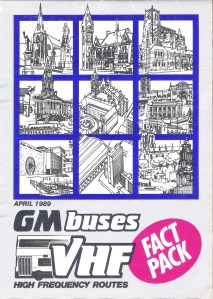
In those days circa 1979, we trained in old back loader manual gearbox buses sat in a small cab at the front and steering with a huge steering wheel and having to double the clutch to change from first to second gear as those old gearboxes weren’t fully synchromeshed.

Vintage GM Bus flyer

The moment I climbed up into the cab I felt at home and I loved my time in the driving school. Every morning we used to check the bus over and top up the oil and water if required. Then our trainer would choose somewhere in the vast Greater Manchester operating area for breakfast. We might have a drive to perhaps Oldham garage or bus station. I’d start off and our trainer Bill sat behind me in the first seat. The window to the cab had been removed and Bill would give directions and off we would go. His main instruction particularly on narrower roads was to ‘ride the white line’ because our big bus needed the room, car drivers in smaller vehicles didn’t.

Bill knew all the canteen staff in all the canteens in Manchester. Sometimes we might just have tea and toast because on the next run Bill might designate Stockport as our next destination as the new canteen there always served up something good for lunch. To be honest though, I always preferred a breakfast. Back in those days the GM Buses canteens served a breakfast special which was egg, sausage, bacon, a slice of toast and a choice of either beans or tomatoes, all for a pound. My own breakfast favourite though was two eggs on two toast with beans and a sausage which is still a favourite today.

Well, I think that’s it for today’s blog post. I’m pretty pleased with myself. I started out without the faintest idea what to write and managed to write 1400+ words and I know I pinched a few from a couple of old posts but either way, I managed to break the curse of the blank page!


What to do next: Here are a few options.

Share this post on your favourite social media!

Hit the Subscribe button. Never miss another post!

Listen to my podcast Click here.

Buy the book! Click here to purchase my new poetry collection.

Click here to visit Amazon and download Floating in Space to your Kindle or order the paperback version.

Click here to visit amazon and purchase Timeline, my new anthology.


Writing and Blog #1 of 2025

Ok, here we go. It’s 2025 and it’s time to kick off with my first proper blog post of the New Year: I settle down in front of the fire, crank up my trusty old laptop. The blank page glares at me as usual; what to write about today?

I first started posting in 2014 and that year I managed to get 2341 views which I was pretty pleased about. If I had also managed to sell 2341 copies of any of my books, I would have been even more pleased but hey, that’s another story.

Last year in 2024 I managed to accumulate a total of 14,182 visits which is pretty fantastic although I’m sure there are plenty of blogs out there that have an even larger readership. My most read post has been Manipulating the Image, a look at various aspects of photo manipulation. I’ve tried a couple of follow up posts on the same subject but that post, actually from 2022, continues to boost my readership. Why is it so popular? I really don’t know despite looking at things like subject matter, keywords, search engine optimisation and so on, I still don’t understand its popularity.

A lot of blogs on the internet seem to focus on a particular subject. Things like cycling, classic films or canal boating for instance. Those blogs always know where the next post is coming from; another cycling trip, another classic film review or canal journey. As there is no actual focus on this blog it’s sometimes hard to hone in on a new subject although generally, I stick to books, films and my little old life. Plus the occasional plug for my three books.

I have tried to occasionally write one of those ‘how to’ blog posts and impart some of my blogging knowledge to my readers and fellow bloggers but I reckon those sort of posts might be of interest only to my fellow writers. One of my previous posts was about three ways to write a poem (click here for the video version) and when it comes down to it, I think those three ways could also be used to write a blog post.

The first way was the easy way, a flash of inspiration; a great idea comes to you out of the blue and hits you square in the face and you are off and running. That is probably the best way to write a post or a poem. The second way is when something happens to inspire you. In my poetry example I wrote about a time when I returned home and went into the kitchen to make a cup of tea. While I was waiting for the kettle to boil I looked out of the window and watched the cat that belonged to the house opposite make its way across their lawn, take a good look around and then settle down under a small young tree and go to sleep in the afternoon sun.

Later subdued screams and cries were heard over the way and it turned out that the lady of the house had returned home to find her cat was sadly dead and it seemed to me that I had seen the cat resign itself to its fate, even taking a last look around before slipping away to start the next of its nine lives. Inspired by these events, shocked even, I went away and began a poem.

The third and final way of writing a poem or indeed any kind of creative work is an obvious way known to all professional writers everywhere and that is simply hard work. Unlike mere amateurs like me, the professional has no choice but to sit down and get on with things, firm in the knowledge that at a certain time their editor or publisher or Hollywood producer will be asking for that article, blog, book or screenplay.

I too have my deadline, that of 10:00am on a Saturday morning and sometimes even that is hard to work to. Sometimes I have finished a post on Friday afternoon and have passed it over to my proofreader for a quick final check, confident that all will be well for Saturday and then later find that I have forgotten to hit the schedule button or even worse, scheduled the post for the wrong day.

Coming up with a new blog post week after week just seems to get even harder and here I am on my 649th post. Six hundred and forty-nine posts! I suppose to those of you who have been writing for years, 649 may not be such a big milestone but for an amateur writer like me, it’s pretty special. The crazy thing is this, looking through my diary from a few years ago I see I was commenting on one of those online forums, praising WordPress and blogging and someone commented that if I hadn’t been blogging I might have finished my second book!

Looking back I now wonder whether that guy was actually right. 649 blog posts, times my average word count per post: That comes to over 700,000 words. I could have written another book and to be fair, that was part of the idea behind Timeline, to utilise all those old forgotten posts in a new collection of stories and blog posts. Perhaps I could have written another novel. But then again, it’s not just the words, it’s the idea behind the words, the creative thrust of a book that’s important. Get that and the book should just follow. Still, that fellow had a point. Should I give up my blog posts in favour of my book? Well, if that would guarantee me producing a book then yes, great! The thing is, it’s not a lack of words that have kept my sequel to Floating in Space in a constant state of abandonment. It’s really my own laziness.

Laziness, fear of the blank page, procrastination, they are all enemies of the writer. The only way to overcome them is just to keep on writing. If you are writing a blog post and it won’t come, switch to something else; that other post you had on the back burner or that script you had started a few years back. A great deal of my work is done like that, in small bursts of activity. A while back I had an idea for a film screenplay and worked away creating the first quarter of the work. Later I decided to turn it into a book and as I worked with the text, adding in all sorts of detail that wasn’t in the original script, the story came alive to me in a different way and I started to bring something new to the book version. Don’t hold your breath though, it’s still far from completion.

Oh well. Here’s another script story. Ages ago when I first met Liz and we began socialising in St Annes, we started frequenting Wetherspoons there. It’s a pretty friendly pub and we made friends with quite a few people. There was Big Steve who I wrote about in another post but we also met two guys, Craig and Danny (as usual, names have been changed to protect the innocent!) They were brothers in law who were married to twin sisters and they both owned and ran small hotels in St Annes. The hotels were on the same street opposite each other and the sisters were identical twins so their whole scenario seemed to scream ‘sitcom’ to me.

I used to ask them what funny things had happened to them in their work as hoteliers and being married to identical women. ‘Loads of things’ they would always say but I could never get any details. Anyway, when I had a quiet moment, I started off a pilot sitcom script using their situation, rival hoteliers married to identical sisters. It’s nothing brilliant but mildly amusing and it sat in my documents folder for a long time. Every now and again when I slipped into that blank page syndrome, I’d pull out the script and add a few more pages.

One day I noticed on one of my occasional visits to the BBC Writersroom page that a window of opportunity was coming up for a sitcom script. The BBC, rather than accepting ‘spec’ scripts all year round open a small ‘window’ of a few weeks where you can submit your work in certain areas, sometimes a film script or a play, sometimes drama, other times situation comedy. I went back to my sitcom script, pulled it quickly into some sort of shape, added an ending and bunged it off to the BBC. Then I sat down and waited, glued to my inbox, awaiting the BBC email that may or may not even arrive.

Of course, I do wonder what might happen if the BBC actually decided that my sitcom script is worth making into a pilot? Imagine if the BBC said “we’re going to make a twelve episode series!” Imagine me trying to write twelve episodes when it took me months to write one 25 minute episode! Even the great Spike Milligan had a nervous breakdown writing the numerous scripts of the radio show ‘The Goon Show’. Of course, someone at the BBC could be reading this very post. Did I say something about 12 episodes? Would I be able to write 12 episodes?

Of course! What’s 12 episodes to a top writer like me? I might even start episode 2 straight away. Well, straight away after a cup of tea. And maybe a sandwich. Better make it first thing tomorrow. Well, tomorrow afternoon might be better . .


What to do next: Here are a few options.

Share this post on your favourite social media!

Hit the Subscribe button. Never miss another post!

Listen to my podcast Click here.

Buy the book! Click here to purchase my new poetry collection.

Click here to visit Amazon and download Floating in Space to your Kindle or order the paperback version.

Click here to visit amazon and purchase Timeline, my new anthology.

Another Blog Writing Day

It’s always good to pick up my iPad and see that my scheduled post has been successfully posted but the next task is to start thinking about a new one for next week. What can I write about? Has anything interesting happened to me? Have I read a great book or watched something good on TV? No? Well, that’s me up the creek without a paddle then.

Just lately I’ve haven’t been much of an early riser. I wake up late on a Saturday morning, visit the bathroom and then make some tea and take it back to the bedroom for Liz and myself.

Next I’ll open a new page on my laptop and just start writing about anything that comes into my head. After about ten minutes and I see the page is still blank I think that perhaps the best course is just to do what I usually do this time in a morning which is to check my emails. 500 deletions later I’m back to that blank page again. Perhaps I could write about my emails? Nah, I’ve done that already.

My next move will be to drink my tea and perhaps see what Liz has tuned the TV into. This being Saturday it will usually be Saturday Kitchen. Perhaps I could write a foodie post? Nah, done that a few times already. After drinking my tea and surfing through my social media I reckon I’m ready for some breakfast, to eat rather than to write about.

Time for a wash and a shave and then I get dressed and see what is on offer for breakfast. It’s a little late so we decide to go for a bacon and egg butty. Excellent. While we eat that we crank up an episode of the TV words and numbers game Countdown to get our brains working. Countdown? Could I write about that? Well, I could give it a few lines anyway.

Countdown was the first show to be broadcast on what was then UK’s new terrestrial TV channel 4 back in 1982. It is a fairly simple format with two contestants who have to make words out of 9 random letters, the winner being the one with the longest word. They also have to choose 6 numbers and then use those to make a number chosen randomly.

Back in 1982, the show was presented by Richard Whiteley with Carol Vorderman supervising the letters and numbers stuff. Richard Whiteley continued to host the show until his death in 2005. After that various people have presented the show including Des Lynam and Anne Robinson but the current host is Colin Murray. Carol Vorderman left in 2008 and her role was taken over by Rachel Riley. Also on the current show is Suzie Dent in charge of dictionary corner along with a celebrity guest. The show is currently the longest running game show on UK TV.

Personally, I am no good at Countdown whatsoever which puts me off trying to become a contestant. Liz is pretty good but sadly has no desire to be on the show. However, if she cannot get the random number, we usually have the TV on pause until she does. I then tend to say things like ‘you’re disqualified’ which can sometimes elicit a verbal reaction and so then I usually leave the room to make more tea.

Tea, now there’s a thing. Could I write about tea? Come to think of it, I have mentioned tea a few times but it’s hardly a subject for a blog post. Here are a few comments on the subject that kicked off a past holiday post;

Even on holiday in wonderful warm Lanzarote I’m a man who needs a cup of tea, and by tea, I mean hot tea. Just think of all the workers in far off India who have worked to grow and cultivate tea leaves and package it and send it off to people like me. I wouldn’t dream of insulting those people by drinking a cup of lukewarm or even cold tea. Liz however doesn’t mind cold tea but after chatting further I found our earlier experiences have shaped our attitude to tea. She, whilst at school, worked in a café and usually found that she was so busy that she had little time to drink her cuppa and generally picked it up when it was cold.

Once, many years ago, I had a cigarette vending round. I visited pubs in Merseyside, serviced their ciggy machines, filled them with cigarettes and took away the cash. A lot of the time I was in a hurry to get going to the next site. Even so, I would never turn down a cuppa and so many times I would have to drink a steaming hot cup of tea quickly so I could move on. The faster I worked, the earlier I finished and I very soon developed the knack of drinking hot tea,

Maybe I could build that up into an entire tea related blog post but would that interest any of my readers? I’m not so sure. Come to think of it, they mention tea in one of my favourite episodes of Columbo. Columbo is hot on the trail of Robert Culp who murders a man in the lobby of a cinema and he entices him there by putting subliminal cuts into a film which make him go in search of a cool drink. Anyway, while Columbo is chatting to the projectionist he mentions he is thirsty and the projectionist offered Columbo some tea, some iced tea!

Iced tea? Jesus, what planet is this guy on? Who drinks iced tea? That is a crime against tea. Dear me. Anyway, it’s time for a break. It’s a sunny day so Liz and I pop outside and settle down on the patio with our tea. (Our hot tea.) We’re creatures of habit so we always tend to kick off a session on the patio with a sudoku puzzle. Sudokus are little number games invented by those wily Japanese and once again, it keeps our brains active while we drink our tea. Most of the time Liz will beat me but the thing is, even while I’m trying to solve that sudoku I’ll be trying to think of something to write so that’s my excuse for Liz winning. If I really worked at those little number games, really worked at them, well, then it might be a different story.

After a quick sudoku session I pick up my book for a relaxing read in the sun. I’ve currently got a few books on the go. One is about the flight of Rudolph Hess and his mystery flight to the UK in 1940 and the other is about the JFK assassination. If I were ever to appear on TV’s Mastermind I would probably choose the JFK assassination as my specialist subject:

What is the grassy knoll?

It is an area of Deally Plaza in Dallas where it has been theorised that a frontal shot was fired at the president.

Who is Lee Harvey Oswald?

He is the alleged assassin of JFK.

Who was Alek Hidell?

That was an alias used by Oswald.

What is the magic bullet?

It was a bullet fired from the Texas School Depository that supposedly hit the president and then exited his body and then hit John Connally.

Who was John Connally?

He was the governor of Texas riding ahead of JFK in the presidential limousine.

Who shot Lee Oswald?

Jack Ruby.

I can imagine doing pretty well there but then going to pieces in the general knowledge round. Having said that there is a general knowledge round in the weekly quiz we attend at the Lord Derby pub in St Annes and we tend to do reasonably well.

If the weather stays warm we might stay outside for a barbecue and these days rather than getting the coals ready, lighting them three or four times before they finally get going and getting my favourite shorts covered in coal dust and grease, we nowadays use our little portable gas barbecue. Perhaps I could write a barbecue post? Well, I could probably write a barbecue section of perhaps another foodie post but an entire barbecue post? Probably not.
While I’m on the subject of barbecuing I think it’s important to share these two universal facts regarding a traditional coal barbecue;

One. Always watch your barbecue because if you don’t it will burn itself out before you’ve had a chance to set the table and serve the salad.

Two. Never watch a barbecue because if you do it will just take ages and ages to get going and just when it finally reaches optimum cooking temperature well, it’ll probably be time for bed, which is why we now use our trusty gas barby.

Liz and I tend to start off with a big salad including a large portion of Liz’s home made coleslaw and then munch our way through a selection of sausages, kebabs, burgers and steaks all washed down with some imported red wine which we select from French supermarkets on our annual travels.

I do love a barbecue from the first satisfying hiss as the steak hits the hot metal of the barbecue to the final mouthful of burger and the last glass of red wine. As the sun goes down it’s time to clear up and go back inside for some evening TV. Should I do a little work on that blog post?

Nah, there’s always tomorrow.


What to do next: Here are a few options.

Share this post on your favourite social media!

Hit the Subscribe button. Never miss another post!

Listen to my podcast Click here.

Buy the book! Click here to purchase my new poetry anthology.

Click here to visit Amazon and download Floating in Space to your Kindle or order the paperback version.


Wet Weather Writing

Liz and I have always been pretty lucky with the weather on our holidays. This year in Lanzarote we experienced the best winter sun we have ever had. In late January and February, we had five weeks of sun with hardly a bad day. Well, we did have the odd bad day but they mostly consisted of a few hours of cloud and once, a short rain shower. This year in France we weren’t so lucky.

I can remember a lot of wet weather holidays as a child. Days in caravans reading books and comics while the rain poured down. Fish and chips in seaside cafes keeping warm and dry. A few years ago Liz and I had a very wet holiday in France. We spent a lot of time indoors in our small rented cottage. I used the time to sort out the manuscript for my book Floating in Space. The manuscript has a very disjointed history. I began the book in the 1980s, writing in longhand in a notebook. Later, I updated the story as I typed it up on my typewriter.

Later still I got hold of an old word processor. It was called a Displaywriter if I remember correctly and had floppy disks the size of old 45 rpm vinyl singles. Then came the computer revolution and once again I copied the text onto my new device. I backed up my work onto standard sized floppy discs but then came disaster, a big PC crash. My PC was under guarantee so it was shipped back to the manufacturer and came back a few weeks later all nicely repaired, updated but without all my saved files.

The big problem was the back up files, I just couldn’t find them, so once again I started from scratch and put the novel together from my typed version and my longhand originals. When I’d got to the three quarter point of the novel I found my back up disc but then I had two versions, both slightly different. That’s the thing when a writer starts rewriting, you get new ideas, you take the characters into new situations, you tell the story in a different way. So anyway, I did the only logical thing I could at that time, I threw my hands up in despair and walked away.

Later, much later, Liz and I had the wet weather holiday in France mentioned above and that was when I decided to sort the whole thing out. I went through the two versions, deleted a whole lot of stuff, rewrote the ending and managed to knit all the different sections together. I was pretty pleased with myself at the time. I’m a fundamentally lazy person so when I manage to get off my lazy behind and actually do some good work, I always feel pleased about it.

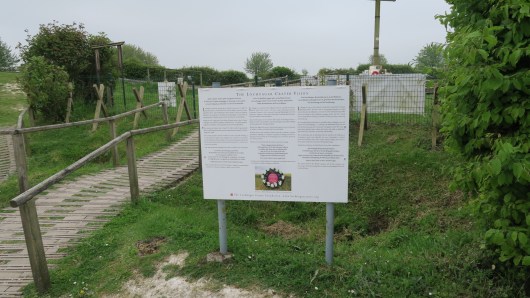
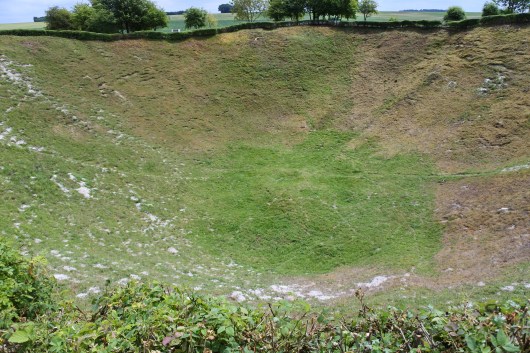
This year in France the first week was pretty good, weather wise. I particularly wanted to visit a place in France called Lochnagar. It’s the crater from the biggest explosion in WWI. In 1916 in the First World War there were two opposing forces facing each other. The German invaders on one side and the defending Allies on the other. They fought each other with guns and artillery but they also fought in another more unexpected way. Both armies were tunnelling under the front and the British dug their way under the German lines, packed a huge amount of explosives in an underground cavern, lit the blue touch paper and boom! That was the biggest explosion of the war and it left behind a pretty big crater.

Today the resulting crater is still there. Back in 1916  the 179th Tunnelling Company of the Royal Engineers tunnelled under the German lines. Explosive charges were laid and detonated at 07.28am on the morning of July 1st 1916. The explosion marked the beginning of the battle of the Somme, the bloodiest day in the history of the British Army. The British suffered 54,470 casualties on that first day including 19,240 fatalities. In return they gained just three square miles of territory. The offensive lasted till the 18th November and the total casualty list for the Allies topped 620,000.

The crater is a stark reminder of the First World War. Today visitors like me come to look and to remember. There are many memorials and even the wooden walkway around the crater contains elements that have been paid for by donations and the names of long gone soldiers are inscribed on its wooden planks. I had thought that perhaps the crater might have filled with water and become a lake but today, despite its covering of grass, it still looks an odd and unnatural part of the landscape.

Wilson44691, CC0, via Wikimedia Commons

The previous day we visited the nearby museum of the Somme battle. It was quite expensive to enter and there was a separate charge to go through and see the Somme memorial. I kept to the museum and wandered around looking at the rusty old shell casings and machine guns and helmets and thought of the young men who lost their lives in that terrible conflict. In another room I watched the old black and white films of the war which played in various languages and in a final room the last exhibit was a replica aircraft. It was a Nieuport originally piloted by Georges Guynemer during the battle of the Somme.

If I’d have been given a choice, I reckon I’d rather have been in that flimsy aircraft than down in the trenches.

After a week exploring the north of France we slipped further south to take up residence in our rented villa. As much as I love our motorhome I much prefer the luxury of a big house with a swimming pool. The weather wasn’t great but even so, the pool was heated and we did manage a few swims despite only having hot sunshine to dry us off on a few rare occasions.

The other big drawback to this holiday was the intense pain from my back. I reckon I must have suffered a slipped disc or a trapped nerve. The pain lasted about two weeks and luckily, Liz always travels with a good supply of painkillers, just in case, so never again will I be asking ‘Do we really need all these?’

You might be thinking that because of all the bad weather I did something similar to what I mentioned earlier about sorting out my book. Did I sort out another book? Did I finish the sequel? Actually, no but I did do quite a bit of work on putting together my short story collection which one day might see the light of day on Amazon. The other thing we tended to do when the weather was bad was eat. Eat in restaurants. Yes among my many loves such as writing, reading books and watching classic films there is also my love of a good restaurant.

I love everything about a restaurant. I love taking my seat and looking through the menu and that first taste of a lovely glass of wine. There is a lovely restaurant near to our villa, Le Restaurant de la Gare. You are shown to your table and given a basket of bread and a bottle of red comes over along with some water and a bottle of cider. Once settled you can then serve yourself from the buffet where you will find various cold meats and pates and numerous salad items.

One thing I could probably do without though is the waitress who has a voice which wouldn’t be out of place on a British army sergeant major. It’s a voice that you can hear miles away and even when she is inches from your head, rattling off the restaurant’s main courses, she still doesn’t tone down the volume. ‘Poisson, porc au moutarde ou steak?’ she bellows. I had the pork which turned out to be braised pork and was rather nice.

Frites ou riz? ‘Frites’, I tell her thinking that if I was married to her I would be deaf within a week.

It’s usually sad to have to return home but this year what with back pain and bad weather I was actually rather glad to be coming home. We had the most wonderful cabin on the ferry back. A really comfortable bed and a door which opened onto the rear deck where I could watch and take photographs as we left the port. It was interesting to see the pilot’s small boat running alongside us as we left Cherbourg. I had always thought that the idea was for the ferry to follow the pilot out but in these hi tech days the pilot was probably just on the radio telling the captain to keep starboard or keep port or whatever.

When we returned home, I turned on the TV to watch the celebrations and ceremonies to mark the 80th anniversary of D Day on television.

Now we are back home I see the sun has finally come out in France.


What to do next: Here are a few options.

Share this post on your favourite social media!

Hit the Subscribe button. Never miss another post!

Listen to my podcast Click here.

Buy the book! Click here to purchase my new poetry anthology.

Click here to visit Amazon and download Floating in Space to your Kindle or order the paperback version.


Random Harvest: The Film of the Book or the Book of the Film

Once again Liz and I are on holiday in France and as usual I’ve filled up my book bag with books to read. My selection this year was a mix of new books and some books from my collection which I haven’t read for years. The one I’d like to focus on this week is Random Harvest by one of my favourite writers, James Hilton.

Hilton hailed from Leigh in Lancashire, now Greater Manchester. He wrote several books and made his way to Hollywood, California where he worked as a screenwriter. He died in 1954. Searching through a box of my old books I came across Random Harvest, a book I don’t think I have ever read before. I bought it from a second hand book shop along with Goodbye Mr Chips, possibly Hilton’s most famous novel and one I have read before. I can imagine intending to read it but moving on to something else and the book was boxed up in one of numerous house moves before I had a chance to get to it.

The Film

The film version starred Ronald Colman and Greer Garson in the leading roles. The film opens with a man called Smith wandering out of an asylum on a day when there is much excitement. It is Armistice Day, 1918 and ‘Smithy’ is a man who has lost his memory during the fighting in the First World War. He wanders down to the town of Melbury and in a tobacco shop the shopkeeper realises Smithy is from the asylum. When she disappears into the back of the shop a woman played by Greer Garson explains that the shopkeeper has gone to call the asylum so that he if wants to avoid going back he must get away. The woman, Paula, befriends Smithy and hides him away and soon she finds she is falling for him. The two elope together, find a quiet village in which to settle down and get married.

Smithy, who has no memory of his former life begins to write and soon has a story accepted by a newspaper in Liverpool. He takes the train there for an interview with the editor but on a wet afternoon, slips in the road and is hit by a taxi. He is knocked unconscious and when he awakes his memory has returned but he has no memory of his time as Smithy. How did he get to Liverpool? What door to what house fits the key found in his pocket? A policeman asks his name and he replies ‘Charles Rainier’. Gathering his things he sets off to take the train home to his country estate but arrives just as his father has passed away. The family has gathered and they are all surprised but glad to see Charles who later goes on to take charge and rescue the failing family business.

The final part of the film sees Charles happy as a new Conservative MP and successful businessman but also sad that a part of his life has been lost to him. He makes various attempts to find his former life but all end in failure until one night when a strike breaks out at the Melbury factory and he has to go there to sort things out. As he walks into Melbury he comes to the tobacco shop he once entered as ‘Smithy’ and things begin to come back to him.

Colman and Greer Garson play their parts wonderfully well. The film is perhaps a little sentimental for modern viewers but it is one of those films I saw as a child and have always remembered. Reviewers at the time were not impressed but even so, the film was nominated for 7 Oscars and it was MGM’s biggest hit of 1942.

The Book

The book tells the story in an entirely different way. It begins with a chance encounter on a train with Rainier and a young man who is looking for work. The two strike up a sort of friendship and Rainier invites the young man to work for him, He explains that he was in the war, was injured and woke up in a German hospital with loss of memory. He was repatriated through Switzerland but got his memory back after a fall and a collision with a taxi in Liverpool. The time between his earlier life and waking up in Liverpool is a blank. The young man becomes Rainier’s assistant and the two sometimes talk late into the night discussing what might have happened. Later in the book, Rainier is called to intervene at a dispute at the Melbury factory and his memory begins to return. He asks a local taxi driver about the hospital. The man asks does he mean the new or the old one? Rainier thinks the old one and goes on to describe it. ‘That doesn’t sound like either of them,’ answers the man but adds, ‘would you be meaning the asylum sir?’
The book is a really interesting read and being written in the years before the second world war, gives the reader a little insight into the feelings of that time, a dissatisfaction with the League of Nations, a feeling that perhaps the First World War could have been settled sooner or even that the allies might have gone on to Berlin and perhaps parcelled up Germany into a smaller nation.

The climax of the book is Charles’ reunion with Paula who turns out to be his wife and former secretary so we find that Charles and Smithy married the same girl which worked well in the book but of course had to be told differently in the film.

Which did I enjoy more? Well I loved both works but to be fair I’ve always loved the film version and as much as I love James Hilton, I think I prefer the film. It isn’t often seen on TV and not long ago I managed to copy my VHS version to DVD but I did notice that a restored DVD version was released in 2005 which I must look out for.


What to do next: Here are a few options.

Share this post on your favourite social media!

Hit the Subscribe button. Never miss another post!

Listen to my podcast Click here.

Buy the book! Click here to purchase my new poetry anthology.

Click here to visit Amazon and download Floating in Space to your Kindle or order the paperback version.

Celebrating Charles Dickens

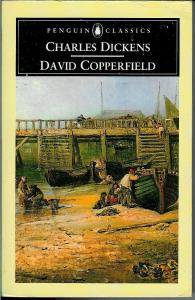
Charles Dickens is one of my writing heroes. He is a giant in the world of literature and the author of one of my favourite books of all time, David Copperfield. He was a man with an incredible imagination and was a prodigious producer of numerous books and stories. Many of his works are still loved and appreciated today and the magic of his story telling is also reflected in film and television adaptations of his work.
Dickens was born on February 7th, 1812. His father was John Dickens, a clerk in the Naval Pay Office. His mother was Elizabeth Dickens and she and her husband raised eight children including Charles, their second child. Charles and his family had a pretty idyllic life until John Dickens, who clearly lived beyond his means, was arrested for debts and incarcerated in the Marshallsea debtors’ prison in Southwark, London.

As was the custom then the younger members of the family were able to live in the prison with their mother and father but Charles, then aged 12, took lodgings nearby and was forced to leave school and work in Warren’s Blacking Warehouse where he earned six shillings a week for pasting labels on bottles of boot blacking.

It was a shocking and humiliating experience for the young Dickens. He never mentioned the experience to any of his children and only spoke about it in later life to his great friend John Forster, who later wrote the first biography of Dickens. Dickens also wrote about the experience in his novel David Copperfield in which the young Copperfield suffers the same fate.

My well thumbed copy of David Copperfield

Mr Micawber, a character in the same book, was based on his own father and eventually John Dickens was able to pay off his debts when his mother died and left him £450. He and his family were released from prison but Charles was not immediately released from his work at the boot blacking warehouse, indeed his mother wanted him to continue there but it was his father who decided that Charles should return to school. Charles was forever indebted to his father for this and forever hurt by his mother’s wish that he should continue pasting labels onto bottles of boot blacking. The experience scarred him and his later desire to work harder and earn more and more money may have been a need to make himself safe from ever being forced into such a situation again.

After two years at school, Dickens obtained employment as a lawyer’s clerk and later, he taught himself shorthand and began work as a parliamentary reporter. He became infatuated at this time with a lady called Maria Beadnall who later became the inspiration for the character of Dora in David Copperfield. Charles pursued Maria over a period of three years but the romance, if indeed there ever was one, finally fizzled out in the spring of 1833.

Dickens first foray into the world of creative fiction was a short story titled A Dinner at Poplar Walk. He had sent the story to a monthly magazine simply called, The Monthly Magazine and upon finding his story printed within its pages, reported that ‘his eyes were so dimmed with joy and pride’ that he could barely see.

In 1835 the editor of the Morning Chronicle, George Hogarth, invited Dickens to contribute to his newspaper and during various visits to the Hogarth home he became acquainted with his editor’s daughter Catherine, whom he later married in 1836.

Dickens wrote his newspaper stories under the pseudonym Boz, and he was delighted when a publisher offered to publish a collection of his works entitled Sketches by Boz. This led to another publisher asking Dickens to supply the text to go with a series of illustrations by a popular illustrator of the day, Robert Stephens. Dickens somehow managed to turn the arrangement on its head, writing a story and having Stephens illustrate Dicken’s text. The story was The Pickwick Papers and it soon became something of a publishing phenomenon.

Robert Stephens passed away soon after the first publication and Dickens recruited another artist, Hablot Knight Browne, to provide the illustrations. Readers could buy a monthly instalment priced at a shilling and Dickens worked hard to produce each edition. Other stories had been published in a similar way but they were usually well known classics. This was the first time new fiction had been produced in this way.

That then was the start of Dicken’s career. He was a busy man, editing various publications as well as writing his novels. Great Expectations was published with the author shown as Boz but in later editions this was changed to Charles Dickens.

Dickens_by_Watkins_1858

Dickens seems to have rented various houses, moving around often but he eventually bought a house in 1851, Tavistock House in Tavistock Square, London. Dickens wrote various books here starting with Bleak House. He also fancied himself as something of an actor and he had a large room made into an improvised theatre where he, along with his friends and family, produced various amateur theatricals. In 1858, Charles separated from his wife Catherine and she moved out into a property in Camden Town.

The separation was said to have been sparked by Dickens’ obsession with a young actress called Ellen Ternan and his gift of either a brooch or a bracelet to her which somehow made its way to his wife. Dickens has this image of being the perfect Victorian family man but he didn’t always live up to it. According to Wikipedia he even tried to get his wife falsely diagnosed as mentally ill in order to have her committed to an asylum. Various accusations were bandied about at the time and rumours were so bad that Dickens himself was forced to publish a statement in the press about his marital situation.

Did Dickens have an affair with Ellen Ternan? So many years later it is hard to know the truth. One night when he was living at his new home Gad’s Hill Place, Dickens made a bonfire of all his personal letters and papers, some of which may have had the answers.

Certainly, Charles was fond of Ellen Ternan. He spent a lot of time with her and even took her abroad to France and Belgium but neither admitted to having an affair but he did have something of a history of obsessions. Years earlier he had been distraught when his sister-in-law Mary Hogarth had died suddenly at the age of 17. Mary was living with the Dickens family at the time and died in Charles’ arms. He was so upset that he kept his dead sister in law’s clothes for years afterwards, occasionally taking them out to look at them. Mary became the template for many women in his books, all of whom were ‘young, beautiful and good’.

Dickens had an incredible imagination and although many of his characters were based on real people, many others sprang directly from his own mind. He was a restless man and regularly took daily and nightly walks of twenty miles and more. Presumably on those walks he brought his imagination into check and channelled his thoughts into the development of his stories.

In his later life, Charles embarked on a series of readings from his books. The readings were highly charged emotional events and the author used all his powers as an actor to delight his audiences, frequently reducing them to tears. Tickets for the reading were highly sought after and Dickens was one of the most notable and famous men of his day. Imagine George Clooney or Brad Pitt doing a series of book readings today and we can get just a faint hint of what things were like for Dickens and his public back then.

Dickens bought his final home, Gad’s Hill Place in March of 1856. He had seen the house as a child when his father had pointed the house out to him as something that he might one day own if he worked hard enough. He lived at the house with his children although one, Charles junior, elected to live with his mother in Camden Town. Strangely, his estranged wife’s sister, Georgina, stayed with Charles as housekeeper.

On June 8th 1870, Dickens had a stroke after working on his final book, The Mystery of Edwin Drood. He died the next day without regaining consciousness. Some have speculated that he died at Ellen Ternan’s house and she had him taken back to Gad’s Hill to prevent a scandal. He was laid to rest in Poets Corner at Westminster Abbey.

Charles Dickens is one of the most loved and celebrated writers of all time but I’ve got to say that some of his books I’ve found a little hard to read. I’ve tried and tried to read Pickwick Papers but I just couldn’t get through it. Not long ago I picked up Bleak House and once again I couldn’t really get started on the book. I have read A Christmas Carol, Oliver Twist, Great Expectations and my absolute favourite, David Copperfield.

My favourite character in the book, apart from Copperfield himself, is Steerforth, a friend of David Copperfield but one who ultimately betrays him. The best part in the book probably, for me at any rate, is the storm when David returns to Yarmouth. Dickens builds the storm slowly and each word and phrase adds a new layer to the sense of danger and foreboding and when Copperfield is finally reunited with his old friend Steerforth at the height of the storm’s ferocity, death comes between them and Steerforth is sadly drowned.

Dickens reveals this in a very unique way; he does not tell the reader Steerforth is dead. He leaves the reader to realise this themselves and, in the process, makes the reader almost at one with the narrative. Throughout the book, Dickens mentions in passing about Steerforth’s habit of sleeping with his head on his arm. It’s referred to many times in the narrative almost as a matter of non interest, something unimportant that the reader doesn’t really need to know, but when David Copperfield spies someone aboard a stricken ship trapped in the fierce storm who evokes some faint remembrance for him, a tiny warning bell is set off.

Finally, when the body of a drowned man is brought ashore and lies mutely on the sand, his head upon his arm, we know just from that simple bit of information, without the author telling us anything more, that Steerforth is dead. The prompts and clues that Dickens has hinted at have paid off for the reader in the most satisfying of ways.

Dickens’ books are still popular today and a recent cinema version of David Copperfield was released in 2019. It was good although I do have a fondness for the 1935 version in which WC Fields plays the part of Mr Micawber. In 1946 David Lean directed one of the best ever films of a Dickens’ story, Great Expectations. In the 1960’s Oliver Twist was made into a stage musical by Lionel Bart and the film version was released in 1968.

Dickens’ most filmed story though is probably A Christmas Carol, the story of Ebenezer Scrooge and the three ghostly visits that transform his life.

What is your favourite Dickens’ story?


Sources:

Wikipedia

Dickens by Peter Ackroyd


What to do next: Here are a few options.

Share this post on your favourite social media!

Hit the Subscribe button. Never miss another post!

Listen to my podcast Click here.

Buy the book! Click here to purchase my new poetry anthology.

Click here to visit Amazon and download Floating in Space to your Kindle or order the paperback version.

Fact or Fiction: Thoughts from a Sun Lounger

Here in our rented villa in Lanzarote it has been hugely relaxing. I did plan to do a lot of writing but instead I’ve been doing a lot of reading, swimming and drinking a lot of wine. To be fair I have done some writing. I’ve started two new short stories, one of which I have the story fully in my head and another that I’m not sure where it will end up. I’ve also worked on a couple of unfinished stories and blog posts. What has been interesting is that one of the books I’ve been reading by author John Grisham was actually John’s first novel and he says in the introduction that he was proud of his first book and also in particular, proud of finishing it as like me, he starts a lot of things but rarely sees them through to the end. Clearly, he’s sorted that problem out because he’s written a number of best selling books and all the ones that I have read, with one exception, have all been riveting page turners.
Grisham’s first book, A Time To Kill was based on his time when he was what he calls a ‘street lawyer’, someone hustling for cases. He explains in the introduction how the book was very autobiographical and inspired partly by dealing with similar cases and situations to the one he based the book on.

One of my unfinished stories was based on a radio play I wrote. I was hoping to get the BBC interested in it but sadly they declined. Pity, because I thought it was rather good and also it would have given me such a lot of pleasure to hear my work on Radio 4.

It was inspired by two things, the assassination of Bobby Kennedy and a film starring James Stewart. The film was called Call Northside 777. In the film Stewart plays a cynical newspaper reporter who is asked by his editor to investigate a small ad in the newspaper. The ad asks for someone to come forward who has information about a murder to call the eponymous phone number. Stewart finds the person running the ad is an old lady whose son is in prison for a murder she claims he didn’t commit. She works as a cleaner and is saving up to put together a reward for anyone having any information. Ultimately James Stewart proves that the woman’s son was innocent in part by having a newspaper photo enlarged. A key witness, and I’m going from memory here, had claimed she was somewhere on a particular date but a photo in the paper’s archive showed the woman with a paperboy in the background holding a newspaper and the photo was enlarged to show the date, which in turn somehow proved that part of her testimony was wrong.

The funny thing is that today a photo like that would have been taken by a digital camera and its quite possible the picture when enlarged wouldn’t show such detail yet with a film camera it’s a different story. Take something like the original Star Trek for instance, shot on 35mm film in the late sixties and still looking clear and sharp today. The following series, The Next Generation, shot on video in the 1980s is not remotely as sharp and it’s the older series which looks better on today’s HD TV sets.

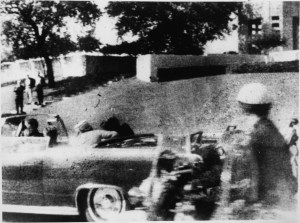
Photography has played a big part in theories surrounding the shooting of US President Kennedy in 1963. One lady, Mary Ann Moorman, took a polaroid shot of him being struck by a bullet. The photographer was on the left of the President’s limousine and many have conjectured that in the background to the President’s right, the figure of the assassin can just be seen. I’m personally not so certain but the picture does show the grassy knoll where a second shooter may have been lurking. The other shooter, the infamous Lee Harvey Oswald was over in the Texas School Book Depository. Was he shooting at the President or having a coke in the second floor lunch room?

Polaroid by Mary Ann Moorman

Next to Mary was another lady known only as the Babushka Lady. This lady has never been identified but she also filmed the assassination and her film, if ever found, would also have great footage of the grassy knoll area. The other day I saw a very clear picture of her on a JFK site I follow. The picture had been cleaned up by new AI technology which uses computer programs to clean up blurred pictures.

Going from fact to fiction, in my story it was a UK MP who gets murdered and the accused assassin’s mother who places the newspaper advertisement. In the real murder of Bobby Kennedy, the assassin Sirhan Sirhan shot Kennedy from a few feet away and various people grabbed him just as he fired his first shot. According to the autopsy, the fatal shot was fired from point blank range, possibly actually touching Kennedy’s head so how could Sirhan’s bullet, fired from a few feet away have been the fatal shot?

The JFK assassination has inspired quite a few conspiracy films. The most famous is the Oliver Stone film JFK which dramatises the investigation by New Orleans District Attorney Jim Garrison and his probe into the murder. Stone uses the Garrison investigation to take the audience through the various stages and theories of the assassination, the number of shots, the direction of the shots, the Oswald look alikes, the murder of police officer JD Tippet, the mafia connection, the intelligence connection, the background to Lee Oswald and so on. In the film Garrison played by Kevin Costner meets an informant known only as X. I’m not sure if this ever really happened but X was based on L Fletcher Prouty, an air force officer who served as Chief of Special Operations for the Joint Chiefs of Staff under President Kennedy. He gives the audience a view of the assassination from a covert intelligence CIA background.

Another film based on the assassination was Executive Action, a phrase coined by the CIA itself and referring to their capability of assassination. The film was written by three screenwriters including Mark Lane who was the author of Rush to Judgement, one of the first books to criticise the Warren Commission report on the JFK assassination. Lane also made a film version in which he interviewed many assassination witnesses.

In the film, a group of men discuss the Kennedy presidency and agree that Kennedy must be removed for various reasons, his civil rights stance, his nuclear test ban treaty and his decision to withdraw from Vietnam. Then they set out to obtain funding from various Texas oil magnates who are also not happy with President Kennedy.

Mark Lane was actually a lawyer and he defended a magazine which was sued by E Howard Hunt, one of the Watergate burglars, because the magazine claimed that Hunt was part of a JFK assassination plot. In the following trial, Mark Lane won his case and the jurors demanded action by the government to investigate further. Nothing of course happened but that’s hardly surprising according to another book I have just read called Mary’s Mosaic. It’s about a lady who was murdered by the CIA or so the author claims, because she knew too much about the JFK assassination. The book goes on to show how the CIA was able to manipulate the media into not delving too deeply or even not reporting at all, stories like these. I’ll be reviewing the book in more detail in an upcoming Book Bag post.

Anyway, that’s enough about conspiracy theories for now. Is it worth digging out that radio play for some more work or is it time for another dip in the pool? I know this is not good for my street cred as a writer but, you guessed it, time for another dip in the pool!


What to do next: Here are a few options.

Share this post on your favourite social media!

Hit the Subscribe button. Never miss another post!

Listen to my podcast Click here.

Buy the book! Click here to purchase my new poetry anthology.

Click here to visit Amazon and download Floating in Space to your Kindle or order the paperback version.

Writing Heroes and Making that YouTube Video

What makes someone want to be a writer? Is it a need to emulate our own writing heroes or something else. I mentioned in a post last week that it’s important to be creative and we can be creative in a huge number of ways, not just in traditional artistic pursuits but also in everyday things, decorating our homes for instance, posting on social media, putting together a CD music mix or many other things.

I’ve always been a writer. As a child I used to scribble stories in notebooks and I even wrote short TV and film screenplays. I used to cast the characters from the film and TV actors of the time and I even remember one in particular. I was fascinated by the espionage fiction of the time, things like The Man From Uncle and James Bond 007 and I wrote about my own secret agent, Agent 80.

I cast Steve McQueen in the role as Agent 80 and put together a dossier on his secret agent character choosing which car he would drive and what sort of a place he lived in, cutting out pictures from magazines to make up the fictional file. Back then I was really interested in espionage and sci-fi and all my writings were pretty much about things like that. Later, as an adult, I started to write about things that happened to me; working in an office and working for the bus company and the pubs and bars I used to frequent. One of my favourite essays that I produced back then was something I wrote while waiting in a pub and I scribbled down notes about two people sat opposite and their smoking ritual involving getting out the packets, taking the cigarettes, flicking the lighter and then lighting up and the way they smoked, the way their hands moved and so on.

These days a lot of people in bars place their mobile phones carefully on pub tables looking over occasionally for messages. Back when I was a young man smokers placed their drinks carefully by their cigarettes and lighters, their table becoming a sort of personal shrine saying this is my space.

Two people who became writing heroes to me were Dylan Thomas and James Hilton. I won’t go on about them too much as I’ve written about both before (click the highlighted links for previous posts) but here are some basic thoughts;

Dylan Thomas

Dylan was a hard drinking, pub going writer and it was perhaps that image which first appealed to me. The other thing which really interested me was the incredible power of his writing but add that to his spirited readings from his work and his radio broadcasts and well, I was totally hooked.

James Hilton

Hilton is the author of one of my favourite books, Lost Horizon and he is also a fellow northerner like myself. Hilton was born in Leigh in Lancashire, now part of Greater Manchester and he made a journey I would love to have taken. He went from Leigh to Hollywood, California and he wrote a number of books and screenplays that were made into classic films. He wrote Random Harvest starring Ronald Colman and Goodbye Mr Chips starring fellow Englishman, also a northerner, Robert Donat who hailed from Didsbury in Manchester.

Charles Dickens

Dickens is of course a great and famous classic writer. I’ve got to say that some of his books I’ve found a little hard to read. I’ve tried and tried to read Pickwick Papers but I just couldn’t get through it. Not long ago I picked up Bleak House and once again I couldn’t really get started on the book. I have read A Christmas Carol, Oliver Twist, Great Expectations and my absolute favourite, David Copperfield.

My favourite character, apart from Copperfield himself is Steerforth, a friend of David Copperfield but one who ultimately betrays him. The best part in the book probably, for me at any rate, is the storm when David returns to Yarmouth. Dickens builds the storm slowly and each word and phrase adds a new layer to the sense of danger and foreboding and when Copperfield is finally reunited with his old friend Steerforth at the height of the storm’s ferocity, death comes between them and Steerforth is sadly drowned.

My well thumbed copy of David Copperfield

Dickens reveals this in a very unique way, he does not tell the reader Steerforth is dead. He leaves the reader to realise this themselves and, in the process, makes the reader almost at one with the narrative. Throughout the book, Dickens mentions in passing about Steerforth’s habit of sleeping with his head on his arm. It’s referred to many times in the narrative almost as a matter of non interest, something unimportant that the reader doesn’t really need to know, but when David Copperfield spies someone aboard a stricken ship trapped in the fierce storm who evokes some faint remembrance for him, a tiny warning bell is set off.

Finally, when the body of a drowned man is brought ashore and lies mutely on the sand, his head upon his arm, we know just from that simple bit of information, without the author telling us anything more, that Steerforth is dead. The prompts and clues that Dickens has hinted at have paid off for the reader in the most satisfying of ways.

Noel Coward

Coward has really been a surprising writing hero to me. I’ve been aware of him for years through film and television and his slightly eccentric persona has always been a little amusing to me. I remember once seeing an interview with him on the stage at the BFI, (British Film Institute) Richard Attenborough was interviewing him and seemed to me to be treating him as some sort of God that had been beamed down from the heavens. Coward was puffing away on a cigarette and lapping up all the praise.

A favourite film of mine is Blithe Spirit. The film starred Rex Harrison as a journalist who wants some background for a novel and he invites a medium, Madame Arcarti to officiate at a séance at his house. Unfortunately for Rex, Madame Arcarti evokes the spirit of his dead wife who at first is only visible to him. The film and of course the stage play that came before is a wonderful witty comedy. I liked it so much I wondered if the play or the screenplay was in print. I was happy to find that it was and I bought a paperback copy which also contained two other wonderful plays, Hay Fever and Private Lives. Again, these other plays were outstandingly witty and humorous and off I went in search of more works by Coward. As I write this, I’m currently reading a collection of his autobiographies.

Coward liked to arise early in the morning and then write until lunchtime, after which he would then enjoy his lunch and relax for the afternoon. Not a bad set up really and one I could do with taking up myself. Of course, I’m not so keen on lunch as Noel, I’m more of a late breakfast kind of guy, brunch I think they call it in places like the USA. Also, I don’t get up that early. I have done in the past, in fact I once did a regular 6am shift which meant getting up very early indeed.

Anyway, after writing about these four great authors it’s got me in a creative mood. I’ve done quite a bit of writing lately but I’ve realised that I’ve been neglecting the video producing aspect of my creative side. It’s clearly high time I produced something new for my YouTube page. After all, video is important for plugging my media profile as well as the two books I have for sale on Amazon.

I got out my video camera and thought what could I do. Yes, a piece to camera. I’ve been reading up lately about Marilyn Monroe which is why the late Hollywood star has featured in quite a few recent posts. I decided I could talk about my Monroe book collection and articulate a recent post I did concerning an internet debate about Marilyn’s death. I worked out what I was going to say in my head and then shot the whole thing in one take as a sort of rehearsal. I took off my scruffy polo shirt, changed it for a nice shirt and did the whole thing again. Not bad I thought.

Next I went about editing the video. The light wasn’t good so I upped the exposure and added some contrast. I cropped a few of the shots and closed in to a tighter shot covering me and the books I mentioned in my collection. I added the titles and credits and then settled back to review the entire thing. It was a good few hours work and I was ready to upload to YouTube when I spotted something.

During the video I mentioned a BBC documentary a few times. The documentary was called Say Goodbye to The President but for some inexplicable reason I realised that in the video I had somehow managed to refer to it as Shall We Tell the President, which happens to be the title of a novel by Jeffrey Archer, which as far as I know, has nothing whatsoever to do with Marilyn Monroe.

I wonder if any of the writers mentioned above ever had problems like this?


What to do next: Here are a few options.

Share this post on your favourite social media!

Hit the Subscribe button. Never miss another post!

Listen to my podcast Click here.

Buy the book! Click here to purchase my new poetry anthology.

Click here to visit Amazon and download Floating in Space to your Kindle or order the paperback version.


Repurposing Content and Re-Editing the Edit

No work of art is ever finished, only abandoned. I read that years ago, so long ago I can’t even remember who said it, but even though my blog posts and videos can hardly be described as works of art, I still can’t leave them alone.

While sorting out my box room this week I came across yet another box of old VHS video tapes. One was marked WFA original footage.

Back in 1992 I went on a video production course at the WFA, (Workers Film Association) in Manchester and during the course I made a film about taxi drivers in Manchester. I didn’t make it myself, I was part of a team of three and we didn’t have specific roles. Although the taxi idea was mine, I wasn’t the director, we all were, so you can imagine that the final film was one where compromises were made. All three of us I can imagine, if left to our own devices as director or editor, would have all have created a different video.

The original footage ran for over two hours and was shot on super VHS. My video player actually supports super VHS and I was able to digitise the tape and copy it to my laptop. A lot of the footage was not used because of course we were all pretty new to what we were doing. There were plenty of wobbly shots, plenty of blurred ones and even some with bad sound. There is one almost entire interview without sound until the end where someone, I hope it wasn’t me, remembers to either switch on the microphone or plug it in.

I did hope to be able to add a link to this blog post for my new edit, however, an editor needs time to acquaint himself with the footage and get an idea of the finished project in his head. As I am that editor and as I like to edit in a careful organic kind of way (some might say slow) that re-edit, alas, isn’t quite ready yet so I’ll add the link to the old version below.

One of my best videos is one about the graves and cemeteries of World War I and II in northern France. It’s a sad video but the visuals are good and I put together what I thought was a pretty good narration based on some blog posts I’d written previously.

One big mistake was when I edited the video, I started with a shot I’d taken at the beginning of our trip to France. It was shot of a really huge motorhome with a trailer and then I panned over to our much smaller model, thinking at the time I’d add some jokey comment on the lines of what a fabulous motorhome -but this is ours over here!

Anyway, I added the comment and put everything together then uploaded it to YouTube. It seemed to do pretty well getting a lot of views but when I added it to a Facebook page for YouTubers and video producers, expecting a certain amount of praise, one reviewer mentioned that the jokey stuff didn’t really go with the overall tone. Looking back at the video I realised he was completely correct however by then the video had pulled in a few thousand views and I was reluctant to substitute the re-edited version as then I’d lose all those views!

Oh well, there is a much better and substantially re-edited version on Vimeo, alas without so many views.

One video that I have gone back to time and time again is a video about my home town of Manchester. Although I haven’t been into Manchester much lately, in the old pre-Covid days I used to always make time to visit the city. As a matter of fact, I’ve always enjoyed spending time in Manchester. Many years ago, I’d go into town and work my way through various second hand book shops in the older part of the city and then spend far too much time in the old HMV store on Market Street. The store there was huge with sections for CDs and music and another area for DVDs. There was probably a gaming section which is something I’ve never been really interested in but usually by the end of the afternoon I’d have a stack of books, CDs and DVDs to take home and enjoy. I mustn’t forget the other delights of Manchester too, the huge array of pubs, bars and eating places which I always tend to visit.

The narration for that video was adapted from my book Floating in Space and various blog posts I’ve written about the city over the years. In the video I’ve tried to compare the Manchester of 1977, which is when and where the story told in my book takes place, to the Manchester of today. Every now and then I go back to the city, shoot more video and add or exchange a video clip for a better one. In fact, there are probably three versions of the same video over on YouTube. Recently I made a brand-new version but I thought it might be better to perhaps leave my YouTube page as it is. Well, for now anyway.

You might wonder then why is it that TV and motion pictures never get re-edited? Actually in some cases, they have. In 2006 CBS announced that the entire original series of Star Tek was to be digitised and enhanced with new CGI effects. Even the theme music was re-recorded in digital stereo. Star Wars was re-mastered in 1997 using new digital effects and once again in 2019 and a lot of the latest Doctor Who DVD releases feature enhanced special effects.

There are plenty of films that are untouched of course. I’ve always hated the cumbersome model shots and effects in Alfred Hitchcock’s Rebecca. Pity Hitchcock isn’t around to go back and add some better ones.

My blog posts are another creative adventure that are open to a bit of re-editing. Most of my posts come to a successful conclusion but there are plenty of occasions when I realise I could have taken the post a little bit further, especially my early posts from 2014. Back then my posts were substantially shorter. In 2014 a post on my blog was on average 639 words long according to my WordPress stats page. Today, in 2023, my average post length is 1,627 words. Some of my favourite posts I have occasionally used again with the addition of new text and new images and even sometimes a link to an appropriate video. Sometimes, I’ve combined similar posts to create an entirely new one. I actually thought that I was doing something pretty revolutionary in the blogging world but in fact a quick search on the internet will reveal plenty of ‘how to’ posts on ‘repurposing’ content. There is nothing new under the sun.

For quite a while I’ve been trying to flog one of my film scripts over on Inktip, which is an American website where writers can offer their work to a variety of producers who are looking for screenplays. I’ve had a few nibbles and a number of producers have looked at my script. None however have gone as far as actually buying my work and offering to produce it which is a great pity because seeing my work as the basis of a feature film would be a big thrill for me. Anyway, when the renewal came up for my pro membership fee, my inner tightwad denied access to my credit card and my membership was terminated.

What could I do now with my screenplays? Well, one way of using that material has been to make them into something else, in fact I’ve repurposed them into short stories. I don’t tend to publish fiction over here on WordPress although quite a few times when I’ve been wondering what to write about for next week’s post, I have considered it. However, I’ve saved my fiction for my page over on Medium. Click here to take a look.

That’s pretty much it for this look at repurposed content. Just writing this post has made me realise I’ve not done much on my podcast for a while. Perhaps I could make this post into a podcast and then I could use the audio as the narration to a video version. Then I could write a blog post about how I did all that! Wow, that’s proper repurposing.


What to do next: Here are a few options.

Share this post on your favourite social media!

Hit the Subscribe button. Never miss another post!

Listen to my podcast Click here.

Buy the book! Click here to purchase my new poetry anthology.

Click here to visit Amazon and download Floating in Space to your Kindle or order the paperback version.