My Holiday Book Bag (2)

A long time ago I was reading a biography about Richard Burton, in fact it I think it was ‘Rich,’ the biography by Melvyn Bragg. Bragg used Burton’s own diaries in his work and wrote, amongst other things, about Burton’s love of books and when Burton went on holiday he looked forward with delight to the contents of his ‘book bag.’ I know it’s a pretty tenuous link but one thing I have in common with Richard Burton is a love of books and when I go on holiday, one of the delights of lying under a warm sun on my sun bed is a good undisturbed read. OK, I read a lot at home and on my lunch breaks at work but it’s a few minutes here and a few minutes there and whenever I get interrupted it kind of breaks the flow. Some books, as we all know, are just made for a really long, uninterrupted read.

DSCF0004edOK, That was the intro copied from my earlier post Holiday Book Bag part 1. You might be thinking what is this about? A Holiday book bag in January? Yes, well here’s the thing, I’ve saved up my holidays for a winter escape from the UK and believe me, there is nothing more satisfying that calling up friends in the UK from sunny Lanzarote, where we are staying for six (yes six) weeks and asking ‘What’s the weather like back in the UK?’ Especially when they answer, as you knew they would, ‘It’s freezing cold and lashing it down!’

Anyway, I’m sure it’ll still be cold in February when we return so let’s move quickly on to the book bag. There is nothing more exciting for an avid reader like me, and the aforementioned Richard Burton, to plan what to pop into a book bag. Going to Lanzarote there are some restraints of course. One, we are flying so we only have limited luggage space so straight away I eliminated my hard back books which is something of a pity as I have some cracking hardbacks ready to be read. Anyway, I’ve stuck with paperbacks, some I have purchased recently and some have come my way as Christmas presents. Here is my final list.

Charlie Chaplin by Peter Ackroyd.

Peter wrote an excellent book about one of my writing heroes, Charles Dickens and I felt that this book was going to be in the same sort of mould. Long, intense and full of detail. Actually it’s a pretty slim volume and not the intense scrutiny of Chaplin that I was expecting. However, on the credit side, it’s a thoughtful and detailed look at Chaplin, his movies and his personal life and a cracking read it is too. One hundred years ago Chaplin was the most famous man in the world. I’m not sure who would qualify for that title today as despite global communications and the Internet age, the world is separated by many different languages and cultures. A hundred years ago there was no language barrier for Chaplin, and his silent films with their universal language of comedy, went all the way round the globe and he was as famous in countries such as Russia or Africa as he was in Europe or the USA.

Albert Speer: His Battle With Truth by Gitta Sereny.

This is a classic of World War 2 literature and concerns Albert Speer who was Hitler’s architect and then rose quickly in the ranks of the Nazi hierarchy to become Armaments Minister. He was spared the fate of hanging at the Nuremberg trials after admitting that the Nazi leadership, himself included, should take responsibility for the crimes of the Third Reich. What is interesting about the Nazi years is the way Hitler himself seemed to entrance people by the power of his personality. Much has been written about his speeches to the Nazi faithful and the many Nazi rallies of the 20’s and 30’s and yet, looking back at archive film, he looks to be almost something of a madman. However, those who attended the rallies speak of his almost magnetic power as an orator. Speer himself was surprised at first seeing Hitler speak because the speech he heard that day was about unifying Germany, bringing back employment and pride to the German worker, not about death to the Jews. It struck a chord with Speer and he began to follow him. It was the same with many people and as is pointed out in this book, had Hitler died in 1937, he would perhaps have gone down in history as a great German, not the mass murderer he turned out to be. There is an embarrassment among Germans of Speers’ generation; a feeling of how could Hitler have lied to them, how could he have done those terrible things? Something repeated many times is the feeling ‘if only the Führer knew! The fact is, Hitler did know but did Speer know too? An answer, of sorts, is the conclusion to the book.

One of the great aspects of this book is that the author’s journey into Speer’s life is a personal journey and one she shares with the reader. In the final pages we hear about how the author returns home after a weekend away and sees her telephone answering machine winking with various messages. The first one is a message from Speer himself, saying he was in London for a BBC interview and wondered if Gitta and her husband wanted to meet up. The next message is one from a television news company asking her to comment on the death of Speer!

Bleak House by Charles Dickens.

David Copperfield is my favourite Dickens book and one of my favourite books ever but I’ve had difficulty getting into Dickens’ other books. I gave up on the Pickwick Papers, although I liked Oliver Twist and Great Expectations but that’s about it. Hope this will be a good read especially as it’s the only novel I have brought.

The Life of Noel Coward by Cole Lesley.

I do love biographies and this memoir of Noel Coward’s life looks good. One of the reviewers quoted on the back cover says reading this is like ‘a holiday in a rented Rolls!’ One aspect of the earlier part of the book -I’m only partway through as I write this- is Coward’s visits to Manchester where he stayed at the Midland hotel when he was in his late teens. Even then he was a self assured young man about town and on the verge of fame. He charmed many of the rich and famous of the time and was always in demand as a country manor guest for weekends at home or abroad. Noel was a man who liked to travel, especially after a long spell of hard work, and he liked, at times, to travel alone. Indeed, the author quotes from a poem by Noel which reads in part; ‘ When the dream is ended and passion has flown, I  travel alone.’ Noel always took with him on holiday a portable typewriter, lined foolscap writing pads, and his ‘bursting’ book bag. This apparently contained the latest good novels, two or three classics and always Roget’s Thesaurus and Clement Wood’s Rhyming Dictionary.  Not a bad choice! I look forward to reading more about the witty Noel Coward and his life.

The Collected Dorothy Parker by Dorothy Parker.

Dorothy Parker was a jazz age writer and she chronicled the decadent twenties and thirties in her witty stories and reviews. Born in 1893 Parker sold her first poem to Vanity Fair magazine in 1914 and was then engaged by the magazine to write captions for fashion photographs and drawings. She later became drama critic for Vanity Fair and the central figure of the famous Algonquin Hotel Round Table, a group of celebrated authors and writers. I’ve already had a glance through the first few short stories and they look very well observed and entertaining so far.

Those are my January holiday books. Check out the video version of this post below!


If you are already planning for your holidays don’t neglect your reading matter. Why not take a copy of ‘Floating In Space’ along? Click the links at the top of the page or click on the icon below . .
Floating in Space

More thoughts from a Sun Lounger

IMGA0475edOne of the most pleasurable things in life surely must be relaxing on a sun lounger. I love it when I have a refreshing dip in the pool, climb out and lie on my lounger and then slowly feel my wet body drying in the sun. Here in Lanzarote in January it’s quiet by our rented villa and the only sounds are the gentle hum of the pool machinery, the wind blowing through the trees and the birds singing. Now and again there is the distant sound of a car or motorbike, the sound becoming louder and then dying away into the distance. One thing about relaxing on a sun lounger, apart from getting a tan and recharging those batteries before going back to cold England, is how the mind wanders and with a little effort the beginnings of a blog post can take shape in my mind.
Christmas and New Year

Not a great Christmas for me this year as I was working. Christmas Eve and Christmas day in the UK was made worse by the terrible weather, particularly the rain in the north of England. I work in one of Highways England’s motorway control rooms and Christmas day was unexpectedly busy with crash after crash. Why people continue to drive at high speed when the weather conditions are atrocious, I’ll never know. On New Year’s day I was working on the early shift, starting work at 6 in the morning and it was a particularly quiet drive into work. It seems to me in recent years the rush hour has just got longer and longer and people now travel earlier to avoid the rush which seems to just expand the rush hour. Many times at five in the morning when I leave home for the 42 mile trip to work the traffic can be really busy.

I think that nowadays, people are just doing more and more travelling in order to get the job that they want. It becomes very apparent when my work colleagues discuss where to go for our work’s ‘do’. Colleagues live all over the north west; St Annes, St Helens, Preston, Wigan, Manchester and even the Wirral, so where can we go to suit everyone? It’s hard work choosing a venue but eventually we chose Liverpool which involved a two hour plus rail journey for me. A bit different from the days when I worked in Stockport and every one of my work colleagues lived in, yes, Stockport. Back in the eighties I don’t think the idea of long commutes to work had really taken off.

Travelling by Air

I sometimes wonder whether aircraft were invented by the Japanese, or at least, are modern aircraft designed for people with an oriental like body frame? For me, a six foot tall man with a considerable bulk although surely not that much bigger than the average male, travelling by air can be something of a trial. On the way here flying on a Boeing 737 courtesy of Jet2.com I remember thinking about this problem as I struggled to get comfy in my small seat and fumbled and wrestled to eat my cheese and ham toastie. The thought of all those movies and TV shows that depict air travel with big comfortable seats and lots of room flickered for a moment through my mind as I almost knocked over my plastic cup of red wine. Yes, once upon a time, back in the uncivilised 1940’s and the beginning of air travel they actually used proper plates, cups and glasses. How we have moved on since then!

Another trial was when I realised I had to use the bathroom. I didn’t really want to get up so I tried hard to hold things in but eventually I got to the point when I realised it was no use. I had to go. I had a good view of the toilet so I waited until I knew it was free and no one was waiting then I pried myself up and out of the seat. Just I was doing so a woman nipped past me and into the toilet! Not happy! Anyway, I had to wait at the front of the aircraft, in the way of everyone including the stewardess trying to serve drinks but eventually, my turn came. It was a little cramped but I got on with what I had to do. At least we didn’t hit turbulence while I was there and have a steward banging on the door telling me I had to return to my seat and strap myself in which has happened to me before. I washed my hands in the little basin but dropped the paper towel on the floor which was pretty hard to pick up and I incurred a bang on the head for my efforts.

By the time I returned to my seat I felt as though I needed another wee but with a supreme effort of will, I managed to push that thought to the back of my mind. To be honest, our flight was particularly friendly. The steward and stewardess were nice and helpful and I appreciated the complimentary tea due to French Air traffic Control having computer problems which caused delays on the part of our flight that passed over France. Also, there were many empty seats so we were able to stretch over to the empty ones and relax. Not looking forward to the flight back though so here’s a quick hint to the guys at Boeing: Put bigger seats on your planes!

The Glenn Miller Story

I think I mentioned in an earlier post about Christmases back home with my Mum and Dad and how we would gather round our coal fire to watch a family film on our old black and white TV with my brother, myself, and Bob the dog vying to be closest to the fire. One of the films we watched back then was the Glenn Miller Story. I really loved that movie when I first saw it on TV back in the 1960’s. It was on TV again over this last Christmas and I settled down to watch it, a nice glass of port in hand and a box of Christmas chocolates nearby. Sadly, the movie was a big disappointment! James Stewart, as much as I love him, was far too old to play Glenn Miller and the film was in colour, not the expected black and white.

June Alyson played Glenn’s wife and she elevated the use of the word ‘annoying’ to a new level with her constant beginning or ending of a phrase with ‘Honestly!’ I imagine the scriptwriter was fairly pleased with himself, coming up with a cute bit of business like that. Wrong! If I had been Glenn Miller and June Alyson my wife, I would have been sorely tempted to employ some appropriately placed Gaffer tape to remedy that situation.

Another moment in the film comes when Glenn comes home from work and his wife takes him upstairs and says, ‘look what just arrived’, and guess what had arrived: Two children who seemed to have arrived in time honoured fashion via the unseen stork. Of course, they may have been adopted, I really don’t know because it wasn’t really explained very well but it was a little bit like one of those moments in old episodes of Blue Peter, the children’s TV show, where Valerie Singleton or John Noakes would say, ‘and here’s one I made earlier!’

One last thing I want to tell you about the Glenn Miller story, and I do feel bad about taking the mickey out of an old favourite movie but that’s the thing about the sun and sun loungers, as your mind wanders, all sorts of old memories rise to the surface! Anyway, here goes. I must have mentioned in previous posts about how I used to have a cassette tape recorder and how many times I used to drag my poor brother into performing the skits and plays I used to write.

One time we did a skit on the Glenn Miller story and there was me in my best American accent drawling, James Stewart style, ‘that sound, that certain sound, I need to find that certain sound and I’m gonna keep on looking till I find it.’ Enter stage left my brother with a cardboard toilet tube over his mouth and he does a tremendous raspberry fart into the microphone. Cue me as James Stewart: ‘That sound, that certain sound: That’s it! I’ve found it!’


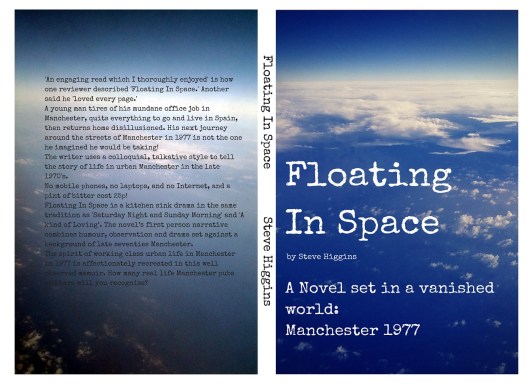
Hope you enjoyed this post. If you did why not try my novel, Floating In Space. Click the links at the top of the page for more information.

6 Great Kitchen Sink Dramas

So what exactly is a kitchen sink drama? If you’ve read through the pages on my site that deal with my book ‘Floating In Space,’ you’ll know that this is a phrase I use to describe my book. When I first added Floating In Space to Amazon through the Amazon sister site Createspace I came to a point where I had to define the genre of the book. If you’ve written something that falls easily into a particular niche then that’s not a big deal. Things like romance, thrillers, science fiction, and YA (young adult) are pretty easily definable but my novel is something on the lines of working class fiction from the sixties; books like A Kind of Loving, A Taste of Honey, Saturday Night and Sunday Morning, Alfie and Billy Liar. All of those works were made into films and three of them, Billy Liar, Alfie and A Taste of Honey were also stage plays but what exactly is ‘Kitchen sink drama’?
Wikipedia describes it as a British Cultural movement that developed in the late 1950’s and early 1960’s and enveloped the theatre, art, literature, television and film. It identifies the John Osborne play ‘Look Back in Anger’ as being the start of the movement and afterwards, many people who identified with the movement were known as ‘Angry Young Men.’ Osborne’s play was a sort of backlash against the theatre of Noel Coward and Terrence Rattigan and represented a move away from polite drawing rooms into council house back rooms.

Richard Burton starred in ‘Look Back in Anger’ and as much as I love the richness of his voice, his portrayal of the leading character of Jimmy Porter hardly represents the working class despite Burton’s own personal origins in a Welsh mining village. A much more representative working class voice, certainly for the North West of England is the character of Arthur Seaton played convincingly by Salford actor Albert Finney in the movie Saturday Night and Sunday Morning.

Saturday Night and Sunday Morning. 1960

Saturday Night and Sunday Morning is set in working class Nottingham. Arthur Seaton is a rebellious factory worker who works hard in the factory by day, but at the weekend he spends his money in the pubs and clubs of the town. He is involved with a married woman but starts to lose interest when he meets a single girl called Doreen and begins a relationship with her. My favourite line from the book and the movie is this: “I’m not barmy, I’m a fighting pit prop that wants a pint of beer, that’s me. But if any knowing bastard says that’s me I’ll tell them I’m a dynamite dealer waiting to blow the factory to kingdom come. I’m me and nobody else. Whatever people say I am, that’s what I’m not because they don’t know a bloody thing about me! God knows what I am.

A Taste of Honey. 1961

Written as a play by Shelagh Delaney when she was only eighteen, the work was first performed at Joan Littlewood’s theatre workshop in 1958. The movie version opened in 1961 adapted by Delaney herself and directed by Tony Richardson, who incidentally also directed the film version of ‘Look Back in Anger.’ The movie features outstanding performances by Dora Bryan and Rita Tushingham.

Alfie. 1966

Alfie was directed by Lewis Gilbert who directed some of the earlier Bond films. The script was produced by Bill Naughton and adapted from his own book and play. Alfie is a fascinating film on many levels. It’s a peek back at the swinging sixties; it explores the elements of comedy versus drama, something I’ve always loved and which I looked at recently in a post about the TV show MASH. Once again it’s about the working class and features great performances from all the principal and supporting actors. One fabulous feature is how Alfie talks directly to the camera and sometimes even says things that directly contradict something he is doing or saying to another character. In the opening sequence Michael Caine as Alfie addresses the audience and tells them not to expect any titles. There are none, except for the film title itself and the closing credits feature photos of the cast and crew. Many actors turned down the chance to play Alfie on film, including Caine’s then flat mate Terence Stamp who played the part on Broadway. Laurence Harvey, James Booth and Richard Harris all turned down the role, and Alfie became a breakthrough movie for Michael Caine. My favourite line from the film comes right at the end when Alfie is reflecting about his life: “What have I got? Really? Some money in my pocket. Some nice threads, fancy car at my disposal, and I’m single. Yeah… unattached, free as a bird… I don’t depend on nobody. Nobody depends on me. My life’s my own. But I don’t have peace of mind. And if you don’t have that, you’ve got nothing. So… So what’s the answer? That’s what I keep asking myself. What’s it all about? You know what I mean? “

Billy Liar. 1963

Billy Liar is based on the book by Keith Waterhouse and was directed by John Schlessinger. Tom Courtney played the title role and many faces familiar to TV viewers appear in the cast such as Wilfred Pickles, Rodney Bewes, and Leonard Rossiter. Billy has an imaginary world in which he plays out many daydreams and fantasies. His ambition though is to become a comedy scriptwriter and his friend Liz played by Julie Christie offers to go with him to London. In the final scenes however, Billy loses his nerve and contrives to miss his train, something that Liz has foreseen and has conveniently left his suitcase on the platform for him.

A Kind of Loving. 1962

This is another 60’s classic directed by John Schelssinger. Adapted from the book by Stan Barstow (one of my all time favourite books) with a script by Keith Waterhouse (who wrote Billy Liar) and Wallis Hall. The story is a very simple one; Vic Brown (Alan Bates)  is a draughtsman in a Manchester factory and he gets involved with secretary called Ingrid played by June Ritchie. When Vic learns Ingrid is pregnant, he does the ‘proper’ thing for the 1960s and offers to marry her. Sounds simple but this is a complex and fascinating film and looks at the subtleties of relationships and how the characters make their way through a series of difficult choices. For a northerner like me, it’s also nice to see places I recognise on film. St Annes On Sea looks a little grim, or did do in the 1960’s. Today it’s a lovely place to live.

Spring and Port Wine. 1969

Hollywood movie star James Mason, famous for roles like the drunken movie star in A Star is Born and the suave villain in Hitchcock’s North by Northwest, left Hollywood in 1963, settled in Switzerland and embarked on a more transatlantic career. One of those projects was Spring and Port Wine. The movie is set in Bolton and is about factory worker Rafe Crompton and his family. His daughter played by Susan George is acting strangely and Rafe struggles to dominate her, his other daughter played by Hannah Gordon and his sons, Rodney Bewes and Len Jones. It later transpires the Susan George character may be pregnant and the family rally round to help her.

The Family Way 1966

The Family Way is one of my very favourite films and like Spring and Port Wine above, features a classic movie actor, John Mills, in a very different role. Saying that, Mills’ film career was diverse to say the least and in this movie he plays Ezra Fitton whose son has just married Jenny, played by Mills’ real life daughter, Hayley. Various problems plague the newly weds, in particular a holiday that never happens due to a travel agent absconding with their funds. Hints are made during the film that Ezra’s son may not even be his son after all. When the truth dawns on Ezra his son asks what is wrong and Ezra replies with the most memorable line in the film; “It’s life lad. Sometimes it’ll make you laugh and sometimes it’ll make you bloody cry!” Time and time again, and I don’t know if you have ever found the same thing, but certain movies I love always seem to have a common denominator. In this case Spring and Port Wine, The Family Way, and Alfie were all penned by the same author, Bill Naughton.


One final kitchen sink drama: ‘Floating In Space’ by Steve Higgins. Click the icon below to go to my Amazon page or check out the links at the top of the page.

MASH and the Emotional Leap Indicator

mash-title-960x590MASH has always been one of my very favourite TV comedy programmes. You may have read in another post about how I used to record the programme back in the early seventies with my cassette tape recorder. Later when video tape recorders appeared I used to tape many episodes of the show and now, here in the DVD age I have a number of box sets of the series.

One of the things I have always loved about the show was how they could take zany and surreal humour, not unlike that of the Monty Python guys, and set it down in a real place; Korea in the 1950s. Some of the lines that came from the mouths of the characters were not only zany and funny but also very witty and clever. Apart from that, the characters themselves, Hawkeye, Trapper John, Frank Burns, Hotlips, Colonel Blake and Radar were interesting and likeable and I, like most viewers, began a strong emotional attachment with the cast.
graph4Now, you might be wondering about that other part of this post’s title, the bit about the emotional indicator. Yes, I thought you might. It’s not so easy to explain but here goes. Most TV shows and movies have a sort of standard emotional indicator that stays pretty constant throughout the show. Take a look at the graph over to the left and let’s put some numbers up. Say a baseline of zero for a standard, calm emotional level. Now, when the show gets funny that level goes up to something like 15 for instance and I’d even say that in a movie like Police Academy that 15 or higher would be a constant throughout the film, well for me certainly. The original Police Academy movie is one of my favourites and I tend to start laughing round about the start of the film with the scene in the parking lot where Steve Guttenberg says the parking lot is full and then the guy comes in and says ‘park the car dirt bag!’ I usually stop laughing round about the end credits but on a normal film there’s a constant up and down: up when the film gets funny and down to nil when we get back to normal.
Now in MASH, where surreal humour is combined with drama, it’s a different ball game. Many times not only does the viewer hit a 20 or higher and then drop down to zero,  he also drops down further, perhaps down to a -10 or lower in the really sad moments. In the graph you can see a really funny moment that comes before a really sad moment. Here’s a prime example from my favourite ever MASH episode, it was called ‘Sometimes you Hear the Bullet.’

Hawkeye’s friend Tommy comes to visit the 4077th MASH. He’s a journalist who wants to write the story of the Korean War from the point of view of the soldier, not the journalist. So he’s not a correspondent, he’s a fully signed up member of a platoon. He stops in and visits with Hawkeye for a while and the usual zany humour ensues. Tommy then has to return to the war. A side story is one where a wounded young lad (played by future film director Ron Howard) admits he is under age but joined up to prove to his girl that he was a man. In one scene he tells Hawkeye that he is out to get him some ‘gooks’ and Hawkeye replies calmly that another word for gooks is people.

Hawkeye and Trapper plan to steal Major Frank Burns’ Purple Heart- he had an accident and because it happened in a war zone he is eligible for the award -and pass it on to the young lad so he can impress his girl back home. Anyway, later in the episode, Tommy the journalist returns to the MASH, only this time he is seriously wounded. He was planning on writing a book called ‘They Never Hear the Bullet’ but this time he heard the bullet. ‘Never mind’ says Hawkeye, ‘just change the name. Sometimes you hear the bullet, it’s a better title anyway.’ Tommy is anaesthetised and Hawkeye gets to work. Sadly, Tommy dies on the operating table. Colonel Blake has to remind Hawkeye about the queue of wounded and Hawkeye, tragedy etched on his face (an outstanding performance by Alan Alda) has to carry on with his next patient. Every time I watch that episode I sob my heart out, just as I did years ago when I first saw that episode on my Mum and Dad’s old black and white TV. Now I know why; because it wasn’t a case of just dropping down from 0 to minus 36 on the emotional scale, I was already up there on +45 so I had to drop way, way down. That’s why I love MASH: Humour, drama, and tragedy, all mixed into one.

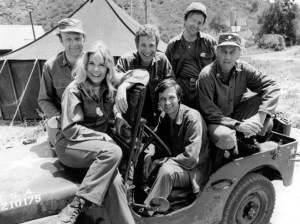
MASH_TV_cast_1974Mash ran for 11 seasons and an incredible 256 episodes. Trapper, played by Wayne Rogers, was my favourite character after Hawkeye and he left the series after season three to be replaced by Mike Farrell playing new doctor B J Hunnicut. Colonel Blake (McLean Stevenson) also left at the end of season three. His character was discharged but right at the very end of the episode news came through to the MASH that the Colonel’s aircraft had crashed with no survivors. This episode prompted an outpouring of grief and resentment from fans at the death of the character. I could understand perhaps Colonel Blake dying part way through the episode and the second part showing the sadness and grief of the rest of the characters but it seemed to me that Colonel Blake’s death was almost an afterthought, just tagged on to the end of the episode. As time went on many of the other series regulars left including Gary Burghof (Radar) and Larry Linville (Frank Burns) and for me personally, the series was never the same.

The last ever episode was aired in 1983 and became the most watched TV episode ever in the USA at the time.

Keep an eye out for Sometimes You Hear The Bullet. It’s well worth watching!


What to do next: Here are a few options.

Share this post on your favourite social media!

Hit the Subscribe button. Never miss another post!

Listen to my podcast Click here.

Buy the book! Click here to purchase my new poetry anthology.

Click here to visit Amazon and download Floating in Space to your Kindle or order the paperback version.

My 10 Best Posts of 2015

dsc_ed0287Yes, it’s that reflective time of year again, the one where we look back at the last year, review what happened and work out what will be our resolutions for the next one. We’re not necessarily going to keep those resolutions but what the heck; it’s a worthwhile exercise anyway. I planned to write a follow up novel to Floating In Space in 2015 but I stalled after two chapters. Oh well, I’ve got an extended holiday in Lanzarote to look forward to in January 2016 so I’ll have to sit down and get stuck in. Come to think of it, I had an extended holiday in Lanzarote in January of 2015 but only managed to drink a great deal of wine, eat a great deal of tapas and swim a lot. C’est la vie as they say, at least I did a lot of ground work for the sequel and I did get those two chapters down on paper so the minimum I might expect this time is, chapters three and four!

Looking back at my blogging year my anecdotal posts have thinned out a little and I’ve concentrated a little more on two of my favourite things, books and classic movies. What I’ve tried to do is perhaps link some personal moments to something about books, film or TV and give a personal slant on my subject matter. One of my goals in blogging is to emulate the talkative, colloquial style of my novel Floating In Space in my posts, so if the reader likes the posts, he might just part with some money and buy my book! Psychology, isn’t it great! Anyway, hope you have all had a fabulous Christmas and New Year. Best wishes for you in 2016 and here’s a quick run-down of my favourite posts of the year!

1: Be Nice to People on Your Way Up! Absolutely. Just remember, if things go wrong, you’ll be meeting those same people on the way down!

2: Breakfast TV and the Apollo Moon Landing. I remember this like it was yesterday, getting up for school and the Moon Landing was being shown live on TV! How my poor mother managed to pack me off to school, I’ll never know!

3: What Happened to my White Jacket and my 70’s Pop Star Heroes? This is an interesting post and it’s strange to think how much we, as youngsters, are influenced by our heroes from the world of TV and music. It was David Essex who unwittingly influenced me to buy a white jacket but it didn’t turn out to be the babe magnet I thought it might be!

4: Marilyn Monroe: Suicide, the Kennedys, and a Red Notebook. I’ve probably got more books about Marilyn in my book collection than about any other movie star. Not only is she such a fascinating character but her death is just as big a mystery as the Kennedy Assassination and I do love a mystery!

5: A few unconventional Thoughts about Time. Travelling through France and seeing the relics of past wars inspired me to write this post about time and the way it passes.

6: Sunday Lunch with my Arch Enemy. This was an updated post about Liz’s father, who sadly passed away in October, 2015.

7: Four Random Thoughts on a Sun Lounger. A little sun, a sun lounger and a notebook and it’s amazing what comes to you!

8: Why Commuting Isn’t as bad as you think! Travelling into the City centre for a management course wasn’t a complete waste of time as I came up with this post!

9: TV Movies and a Serious Case of Deja Vu! I do love my TV movies but why do we get the same ones, time after time?

10: 12 Chart Hits from a Decade when Music was Fun! A quick bit of research and here’s the result, a fun filled music video post!

Hope you enjoyed my post. You can check out my favourite posts of 2014 here and if you fancy reading more of my work why not check out my book Floating In Space? Click the links at the top of the page for more information or the icon below to go to my Amazon page.

FIScoverbuynow