Desperately Seeking the Monaco Grand Prix

I started off on this lockdown waking up at about 8 ish and now after 5 or 6 weeks of lockdown I’m waking up at 10, if I’m lucky. Of course I’m staying up much later than usual too, sometimes till 3 in the morning watching TV or listening to music on my new favourite app, Spotify.

One app I’ve found really annoying lately though is my calendar. Earlier in the year I downloaded the schedule for this year’s Formula One season to both my Outlook and Google calendars so that every other weekend my phone warbles away telling me that it’s time for qualifying or practice or for the actual race itself.

Last weekend should have been the weekend of the Monaco Grand Prix. It didn’t take place because of course the 2020 season has yet to start, affected like everything else by the Corona Virus pandemic. Pity, because I do love the Monte Carlo event even though it is essentially a race won during qualifying. It is so difficult to overtake around the narrow streets of this small but exclusive principality that make up the race track that pole position is essential.

The first Monaco race I ever watched was the 1970 event. Jack Brabham, the 3 times world champion and the only person ever to win a world championship in a car of his own manufacture, very nearly won the race. On one of the very last corners he made a mistake and slid into the barriers. Jochen Rindt driving an ancient Lotus 49 slipped past into the lead and won the race. Jochen didn’t even get the chequered flag because the race organisers were looking out for Brabham.

Try as I might, I couldn’t find a video clip on YouTube with a British commentary to show you. There are some available but none that show Jack sliding into the barriers. In those days the UK commentator wasn’t Murray Walker but Raymond Baxter who is perhaps more well known for presenting Tomorrow’s World on the BBC rather than F1. It would be so nice to hear Murray commentating once again but the clip below does show Jack miscalculating that last corner and the French commentator sounds suitably excited.

Later in the season Lotus sorted the game changing Lotus 72 and Rindt went on to amass an unbeatable points tally taking him to a championship he would tragically never live to savour. Rindt was killed in a practice accident at Monza, the home of the Italian Grand Prix.

Getting back to 2020 and even though there has been no actual racing there has been plenty of Formula 1 news. Sebastian Vettel has not had his contract renewed at Ferrari for next year and Ferrari have quickly signed up Carlos Sainz to partner Charles LeClerc. Daniel Ricciardo, once thought of as a contender for the Ferrari seat has announced he is moving to McLaren for 2021 so although not much is happening on the racetrack there has been plenty of F1 news.

Alonso is rumoured to be going to Renault for 2021 so perhaps his F1 career is not over after all. What then will Vettel do? Retire? Take a year off? Lewis Hamilton’s team mate Valtery Bottas is also out of contract at the end of this season so theoretically Mercedes could snap up Vettel and create a super team, Hamilton and Vettel, that could take on all comers. Of course 7 time world champion Hamilton might not be happy about that. He must be anxious to enter the record books as the winner of 8 titles so Vettel might have to sit out the 2021 season.

Alain Prost famously took a year off when he was sacked by Ferrari in 1991. They weren’t too keen about him being uncomplimentary about their car to the press so Ferrari being Ferrari he was quickly shown the door.

During his year off Prost must gave watched enviously as Nigel Mansell romped to the championship in his Williams and so, suitably impressed, Prost decided to begin negotiations to get himself behind the wheel of one of Frank Williams’ cars. Nigel Mansell wasn’t too impressed by this news at all so he promptly walked away and signed up for a season driving Indycars in the USA leaving Prost to head up the Williams team and win another championship.

A year later Frank decided to sign up Ayrton Senna. Then it was Prost’s turn to be unimpressed and he left Williams and retired from racing.

The other night on ITV2 there was a showing of the Senna movie which brought back all the excitement and rivalries of the late 80s F1 world. There was Ayrton looking very clean cut with a new short haircut signing up for McLaren. Ron Dennis the team boss looked happy and Alain Prost was all smiles too. By the end of the season those smiles were wearing a bit thin and a year later it was outright war between the two McLaren drivers.

The film Senna is interesting in a lot of ways. All the footage was taken from the official F1 TV feed and it is clear how Prost lost faith with McLaren and boss Ron Dennis and after two years he was off to Ferrari. When the two drivers came together in Suzuka for the Japanese Grand Prix and Senna was disqualified, Ron Dennis put in a protest even though the result had given the championship to his other driver, Prost.

Of course the film takes Senna’s point of view and Prost is portrayed as the bad guy. Even the famous interview between Jackie Stewart and Senna is only shown in part although Ayrton is clearly not amused by Jackie’s questions. A year later after winning his third title Senna would admit to purposely pushing Prost off the track as he was fuming about his pole position spot being moved to the dirty side of the track. That may not have been right but neither was purposely crashing into Alain Prost. Senna went way down in my estimation that day and as much as I admire Senna, I’ve never really subscribed to the legend that he has become in the last few years. I remember being at Silverstone in the early 1990’s and being surprised to hear him soundly booed by the fans as he came past.

Senna was killed at the San Marino Grand Prix in 1994 in an accident at the Tamburello corner. His car skated off the circuit into the barriers and although the impact was high it was survivable. Both Berger and Piquet had survived bad accidents at that same corner in the preceding years and even now I remember watching Ayrton’s crash in disbelief. I was certain that he would be OK but sadly that wasn’t the case. In a freak twist of fate the suspension arm of the car flipped back, pierced Aryton’s helmet and dealt him a mortal blow.

When Jack Brabham almost won at Monaco in 1970, future McLaren boss Ron Dennis was Jack’s chief mechanic, which is a nice link to bring us back to the Monaco Grand Prix. The first race at Monaco was in 1929 and was won by the famous British driver who mysteriously used the pseudonym ‘Williams’. The race gradually became more and more important and became a round of the European Championship in 1936. The first post war event was held in 1948 and in 1950 the race became part of the new World Championship and was won by the great Juan Manuel Fangio.

Stirling Moss won in 1956, 1960 and 1961 and another famous winner at Monaco was Graham Hill who won the event 5 times, a record until Senna surpassed it in 1993. Here is Graham tackling the tight corners of the circuit.

Now compare that to Lewis Hamilton in 2019. Much faster but then again, Lewis was driving a semi automatic Mercedes and didn’t have to do all those manual gear changes that Hill had to deal with. (The following two clips will take you to YouTube to view.)

You might think that with limited overtaking the Monaco Grand Prix can be boring. Take a look at this clip from the 1982 event.

In a lot of ways it’s amazing that the Monaco race has continued up to the present. The F1 cars of today are faster than ever before and they hurtle round these tight and twisty public roads at incredible speeds. Somehow the track seems even narrower or is it just that these modern cars are wider, their wings and fins stretching out to take advantage of every available bit of the slipstream.

The F1 teams return because the glamour of Monte Carlo; the yachts, the casinos, and the famous movie stars and celebrities all make this event the perfect opportunity for the sponsors to sell their wares and link their brand to glitz, glamour and hi technology.

I’m looking forward to the 2021 race already.

What to do next:

Share this post on your favourite social media!

Hit the Subscribe button. Never miss another post!

Buy the book! Click here to visit Amazon and download Floating in Space to your Kindle today!

Blogging by Numbers

Despite being constantly at home and within easy reach of my laptop and notebook I seem to be struggling to write anything lately. I was looking around for a new blog post and finally decided to set myself a task. Writing about numbers. Difficult I know but if I’m the top notch writer I think I am then it won’t be that hard, will it?

Back in the 1980’s I received my first debit card just like many other people. Debit cards were a new concept back then. We already had credit cards but a debit card, what was that about? Back in pre-debit card days when everything was in black and white like an old film, we used to have to go into the bank to withdraw cash. I remember queuing at the bank on a Friday lunchtime in Manchester City centre waiting to draw some cash out for that weekend’s activities. The way we did it back then was to write a cheque to yourself or as I was taught to do ‘pay bearer cash’. In 1987 debit cards were first introduced in the UK although they had been around for a while in the USA. As you can imagine I didn’t actually know that, I had to look it up so while I’ve got that Google page open here are a few interesting facts from the BBC:

The earliest known cheque was written in 1659 dated the 16th February. The Bank of England was established in 1694. The first five pound note was issued in 1793 and was the lowest denomination note until 1797 when war drained the UK bullion reserves forcing the bank of England to issue one and two pound notes. 1966 was when the first UK credit cards were issued and of course, the debit card in 1987.

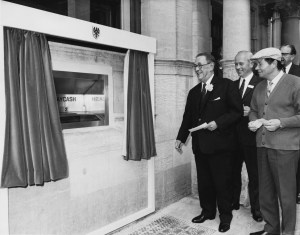
The first cash machine was put into use by Barclays Bank in 1967 and the machine was revealed with much fanfare by comedy actor Reg Varney who you may remember from the TV series On The Buses. The cash machine of 1967 was operated not by a debit card but by a voucher issued by the bank which was then entered into the cash machine.

It was interesting to hear about Reg Varney because, getting back to numbers, for my debit card secret number I decided to use the fleet number of the bus I was driving that day.

14.

Here’s another number: 14. Yes 14 was the number of the house I lived at as a child. My parents house was a council house and it was my grandad and grandmother’s house until they bought their own house and moved away to Wales. My mother managed to take the house over on the understanding that her brother and sister could continue to live there although by the time I came along they had both found their own homes.
Many years ago I came back to the house and parked outside and spent a few moments remembering the times of my childhood. I parked opposite and took the picture you can see here from the same spot where many years earlier I had first riden my two wheeled bike. The bike was really too tall for me and I could only get on it from the pavement. I spent a lot of weeks riding round the block making only left hand turns until I returned to my starting place. Eventually I got the hang of it. There used to be a hedge across the front of the garden which has now been removed to access the parking place which is also new. I do have a nice picture of me stood in that garden. Wish I could find it for this post but it’s upstairs in a box at my Mum’s house. One day I think I’ll go back and try and reproduce that picture if the present occupants will let me.

The memories that come flooding back just from looking at that picture. My friend Gary Chapman lived just around the corner and we went all over on our bikes. One Christmas, Gary’s parents bought him a set of walkie takies. He always got really great presents. I remember once complaining to my mum who promptly told me that because Gary and his family lived in a flat and not a house, they had less rent to pay so had more money for presents! A few times Gary left me one of the walkie talkies and we had a conversation later that night. Battery power was limited so we arranged to switch on at a prearranged time, 8:30 or something. Our conversations went like this:

‘Gaz, are you receiving?’

‘Gaz here. Loud and clear. Are you receiving Ste?’

‘Steve here. Loud and clear.’

‘Receiving you loud and clear Ste.’

Not long after that Gary and his family were offered a council house but it was in Gamesley, Glossop, a Manchester overspill estate. Gary moved away and I didn’t see him again for years. I met him again in the late 1980’s. A mutual friend of ours, Chris had bumped into Gary’s sister, got Gary’s phone number and we all arranged to meet up. I remember being in a bar in Manchester waiting for Gary. I was at the bar which was pretty busy, getting the beers in when I heard Gary’s voice. It was just how I remembered Gary from years ago. I could hear ‘where’s Ste?’ ‘he’s over there at the bar’. I turned round expecting to see Gary but there was just this guy stood behind me that I didn’t recognise. Where’s Gary I thought? ‘Ste?’ said the stranger. It was Gary. He looked completely different but his voice, a distinctive throaty voice, was just the same.

71.

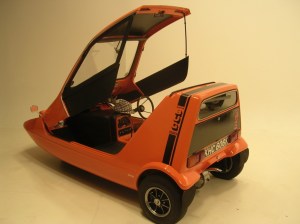
My very first car had the registration plate PDB71M. It actually caused a lot of confusion when I bought it because I traded in my motorbike, a Honda CB250 with the very similar registration PDB1M. Incredibly, checking on the Gov.UK website my motorcycle is still registered. It was a green Honda first registered in 1974. It has no tax or MOT so presumably it is languishing in the back of someone’s garage, rusting and probably neglected. My car was a Reliant Bond Bug which does not come up on a website search so presumably it went to the scrap yard many years ago. I bought it because I failed my first two attempts at the driving test and was really getting fed up. Of course we didn’t have a family car so the only driving I could do was the one hour a week on a Saturday morning that was my actual driving lesson. The Bond Bug was a three wheeler car and could be driven on a motorcycle license. After a few months regular driving I booked the test again and sailed through it.
I remember pulling up at home in my car feeling very pleased with myself. The car was small, it was an orange wedge shaped two seater and my Dad took one look at it and said ‘How are we all supposed to get in that?‘ and walked away. Presumably he thought I would be taking the family away on holiday. Sorry Dad!

126.

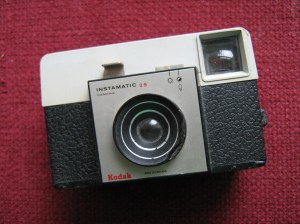
While I’m on the subject of firsts, my first camera was either a birthday or Christmas present and it was a Kodak Instamatic 126. I still have the camera. From my point of view it was a wonderful present; from my parents perspective, perhaps not, because back then in the late sixties cameras needed film and film had to be developed and printed which was fairly costly, especially if you had a child that liked taking pictures and also, whose first attempts were not so good. These days if you take some dud pictures with a digital camera- delete them! It’s no big deal. Back then it was expensive!
I remember getting a major verbal lashing from my Mum when we had gone to Boots to collect my photographs. I was using colour film and Mum had to shell out for my pictures of my action man in various poses in the back garden! (Action man? Hey, I was 12!)

I remember telling the lady in the camera shop about my photography and how I used to build all kinds of stuff out of cardboard and photograph the results. She told me about a close up lens you could buy which just fit snugly over the camera lens on my Instamatic and enabled me to get really close up shots. I’m not sure how much it was but I had to save up for it, my first ever new lens!

0063.

Back in the eighties when I received my first debit card I was a bus driver. Why I stayed in that job for so long I’ll never know but back then in the eighties there was a relentless move towards one man operated buses. Eventually I became a one man driver. It involved more money but also more work. Instead of just driving the bus you had to issue tickets and collect fares but anyone becoming a one man driver in those days was given a new staff number. I became driver double O six three, licensed to drive buses.

Just looking at those numbers together (not including by debit card number of course) gives me 1,4,7,1,1,2,6,6,3. I could add my present staff number into the mix, 6102 and there must be a lottery number in there somewhere. Is it a rollover this weekend? Excuse me, think I might just get myself a lottery ticket!


What to do next:

Share this post on your favourite social media!

Hit the Subscribe button. Never miss another post!

Buy the book! Click here to visit Amazon and download Floating in Space to your Kindle today!

James Hilton, Winston Churchill and the Lockdown

When I get stuck looking for a new idea for a blog post I sometimes look back at my old ones just to see if anything there might inspire me. Sometimes I’ll think of something I could have said about a particular subject which I didn’t say at the time so I’ll start writing about that and then I’m off. Sometimes a writer just needs something to start him off. In fact over on Twitter I sometimes use a meme that goes like this

Some old posts can also be re-purposed. That is to say an old post can be given a new lease of life by a re-write, a few new paragraphs, some new pictures and maybe a link to a relevant video. One old post I looked at tapped right into a long running daydream of mine. Imagine me, a writer from the north of England getting the chance to go and work in Hollywood, writing scripts. I can just imagine the trip over on a Jumbo Jet or whatever passes for a jumbo jet these days. Arriving in Hollywood and looking at all the sights I have read about and imagined over the years, The Brown Derby restaurant, Romanoffs, Schwabs drugstore and maybe even catching a glimpse of Pickfair, the old Fairbanks/Pickford mansion on Summit Drive, the home according to David Niven’s book Bring on The Empty Horses of many of the great stars of the golden age of Hollywood.

Alas, every single one of those places has gone eclipsed by the passage of time. Even the new owners of Pickfair, actress Pia Zadora and her millionaire husband, decided that after aquiring such an historic place, the best thing to do would be to knock it down. Termites had ruined the property, or so they claimed.

One other thing that is real enough is the bit about the writer from the north of England making his way over to Hollywood. No, it wasn’t me, it was James Hilton, the author of one of my favourite books of all time.

James Hilton is one of my personal writing heroes and yet his name may be unfamiliar to many of you reading this blog. He was a journalist and an author and made the trip from his home in Leigh, Lancashire, (now Greater Manchester) in the UK to the Hollywood hills in the United States to become a screen writer. He is probably more well known for his book ‘Goodbye Mr Chips’ which was made into a film with Robert Donat (actually another northerner from Didsbury in Manchester) but my favourite of his books and quite possibly my all-time favourite book is ‘Lost Horizon’.

Lost Horizon is a book I found in a second-hand shop many years ago. A battered 1940s paperback I paid twenty-five pence for and yet that small investment has paid me back many times over for sheer reading pleasure as Lost Horizon is a book I re read every year or so and I often pull it down from my bookshelf when a current read fails to entertain me.

Lost Horizon is a completely original idea and is about British consul Robert Conway in the dark days before World War II. Conway is helping his fellow British citizens escape from civil war in China and he and his small party escape in the last plane only to be kidnapped and taken to a distant Tibetan monastery. Conway meets the High lama and after a time it is revealed that the Tibetans  want to preserve the best of world culture and art and make it safe from the coming war.

Hilton is one of those few people who have invented a word or coined a phrase that has become part of the English language. In this case it was the name of the Tibetan monastery, Shangri-la which has since become a byword for a peaceful paradise, a distant haven. Camp David, the US President’s retreat was originally called Shangri-la until renamed by Eisenhower for his son, David.

Hilton’s journey from Leigh to Hollywood must have been a magical one and one I envy, especially as his time in Hollywood was a golden age for movie making. Lost Horizon was made into a movie by Hollywood director Frank Capra and starred Ronald Colman as the urbane British diplomat of the novel. It’s a movie that was restored some time ago and is a great DVD if you happen to see it. Colman also starred in another movie authored by Hilton; ‘Random Harvest ‘.

James Hilton settled in Hollywood and wrote a number of screenplays for classic Hollywood movies such as ‘Mrs Miniver ‘. Sadly he died from cancer in 1954.

How would Hilton have coped with the Lockdown? Pretty well I should imagine. Professional writers are not like us amateurs, they are not governed by how they feel, if they are in the mood or not, if they are feeling creative or not. They just get on with it.

A few weeks back I decided that a good project for me would be to make one of my blogs into a video. I chose one from a short while ago A Letter to my Younger Self. I opened up my laptop, clicked on my Animoto page and began. I’m still working on it. It wasn’t as easy as I had thought. I could quite easily have read the post to camera but I wanted something a little more exciting and the good thing about Animoto is that they have a great library of stock footage and photos so combined with some of my own images the result should be good.

Here’s the problem though, and this is the big issue with technology that I come across time after time. Once the designers have put together a great peice of software or an electronic device, they just cannot leave it alone. Windows Sound Recorder: they replaced it with Windows Voice Recorder and all the things I used to do on there, I can no longer do. Windows Movie Maker: my favourite video editing platform: discontinued in favour of HD Movie Maker. The old version was so much better especially when editing sound. The new version is quite different. In the past I could position and reposition sound clips with the mouse now in HD Movie Maker the user can only trim sound or use the delay option. Oh well at least Animoto, the online editing platform I use frequently is untouched, or so I thought.

Wrong! This week Animoto unleashed a new version of its editing software on its users. Does it have improved features? Yes. Is it easier to use? No. Well to be fair it’s not bad but every so often the web page seems to crash and I have to reload the page and start editing again from the point my work was saved. Perhaps that’s the fault of my laptop although it never lost the page with the old version. There are some other litle teaks I don’t like too so I might just put that project on hold for now.

This week Prime Minister Boris Johnson decided to ease the current lockdown. Now we can return to work and also travel around if we want to visit somewhere. Most businesses are still closed of course but it might mean places like Blackpool and other seaside resorts will be expecting daytrippers soon. Personally I think his advice is ill advised and we should be keeping the lockdown on for a while longer. The thing is, the devolved governments of Scotland and Wales seem to agree with me so if you are planning a trip to either of those places soon, forget it because the lockdown is still in place there.

The other night I stayed up late watching the film Darkest Hour which is about Winston Churchill and the beginning of his Prime Ministership in World War II. It paints a rather bleak picture of Winston’s premiership with the Conservative party apparently holding back from supporting him and a growing clique actually wanting to replace him with Lord Halifax. When France fell to the Nazis Halifax wanted to explore peace talks with Hitler which Churchill was violently opposed to. I’m not sure how true to life the film was and although I can imagine not everyone was 100% behind Churchill, I found some of this film a little hard to believe. There was a vote of no confidence in the commons in 1942 although Churchill won this by a resounding 475 votes to 25. In the film, conservatives still will not support Churchill in the commons until outgoing premier Neville Chamberlain signalled them to do so by placing a white hankerchief on his knee. By then Chamberlain and his policy of appeasement were totally discredited so would he really have had such sway over his fellow MPs? I doubt it.

What Churchill would think of today’s devolved government I shudder to think.

In these difficult times I take comfort from, as usual, Marcus Aurelius. I receive a regular email from The Daily Stoic and it is surprising how words of wisdom from the past can be relevant to today. One email I picked up this week went like this : All of us who are alive today are the last in an unbroken line of our ancestors who survived two world wars, the plague and much more. They kept calm, they carried on. They learned, as Marcus did, that things can only ruin your life if they ruin your character. We might not control world events, but we can control how we respond. We control whether we hold our heads high. We control whether we help our neighbours. We control whether we contribute to the panic or not.

Not only that, the important thing to remember about the Corona Virus is that . . .


What to do next:

Share this post on your favourite social media!

Hit the Subscribe button. Never miss another post!

Buy the book! Click here to visit Amazon and download Floating in Space to your Kindle today!


TV, Books and the Lockdown Blues

You might think that the lockdown is heaven sent for a writer. Stay at home and write stuff, perfect! After a few weeks though I have found not only have I not written much at all. Actually, I’ve been feeling a little bit bored, just like a great deal of the population I suppose.
Television

One thing I have done is watch a great deal of TV although a lot of it has been disappointing. Back in the late 1960s one of my favourite TV shows was The Time Tunnel. It was an American sci-fi show produced by Irwin Allen who made The Towering Inferno and the Poseidon Adventure among other things and a few weeks back I was delighted to find that it was being re-shown on the Horror channel.

In The Time Tunnel two American scientists are ‘lost in the swirling maze of past and future ages, during the first experiments on America’s greatest and most secret project, the Time Tunnel. Tony Newman and Doug Phillips now tumble helplessly toward a new fantastic adventure, somewhere along the infinite corridors of time’ as the opening blurb used to go.

The Time Tunnel starts off with a Congressman coming to investigate the growing budget of the Time Tunnel Complex and threatens to close things down unless he sees results. Scientist Tony Newman decides he must therefore travel back in time to prove that the tunnel really works and save the project. Tony ends up on the ill-fated liner Titanic. His colleague Doug follows him back to 1912 and the control room struggle to shift the two in time before the ship sinks.

One episode that I particularly remember was when the pair land in Pearl Harbour, just before the Japanese attack in 1941. Tony meets himself as a young boy and finally solves the mystery of the disappearance of his father in the attack. That was one of the better ones.

Unable to return the duo to the present, the technicians back at Time Tunnel HQ struggle every week to shift the duo to somewhere new just in the nick of time. They never seem to manage to get the pair home as there is never enough power for this process despite a huge powerhouse courtesy of the special effects department which we see a glimpse of almost every week. The other thing is that if they did get back home, there’d be no show next week.

I did love this show as a 12 year old sci-fi fan but here in 2020 I seemed to be fast forwarding through all the boring bits, of which there were plenty. Some things don’t seem to stand the test of time and the big problem with the Time Tunnel is that the stories mostly weren’t good enough and many episodes seem to revolve around what appears to be stock footage that was filmed for some other project. I’m really cheesed off that I missed the Pearl Harbour episode though.

Coronation Street, like all the TV soaps is suffering because the lockdown has prevented further filming of the series. Instead of going out six times per week, we are now only getting three episodes to satisfy us and even those are looking like they are missing something. It looks to me like the current main storyline involving controlling husband Geoff and wife Yasmin has been the focus of the last filming sessions while some other content involving the minor storylines is missing. Last Wednesday’s episode seemed to have a slightly odd narrative flow, returning to the same scene when perhaps we should have cut to something else, the cafe or the Rover’s Return pub. Still, the editors can only work with the footage they have and sooner or later there will be nothing and our favourite soaps will be on hold until staff can return safely to work. I noticed also that TV quizzes like Tipping Point and Countdown are now just re runs of older episodes.

Spotify

One other thing has made my life slightly more interesting during these slightly surreal times and that is Spotify. You might not have even heard of it but it’s a music app I’ve downloaded to my iPad. I thought originally that it was a way of downloading music. I’m not a great downloader but the previous place where I used to download music was the HMV digital site, 7Digital. It had, I first thought, gone to the heavenly resting place of defunct web sites but when I finally got connected once again after many years I found it not very interesting and so in my search for internet music I came across Spotify. Now with Spotify, you cannot actually download music, well actually you probably can if you pay for Spotify premium but as the cheapskate that you know I am, I’m happy just to listen to music. On Spotify you can set up favourites and playlists and here’s the really extraordinary thing, after a few days use Spotify starts to suggest things you might like, new music that is similar to music you have already played. Now, after only using it for a couple of weeks, I have built up some pretty substantial music playlists.

Books

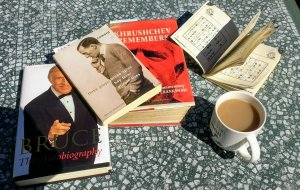
After finishing my last book, Michael Palin’s diaries, I looked around for something new to read and picked up three books. Bruce Forsyth’s autobiography, Khrushchev’s memoirs and a book of three Noel Coward plays. I’ve read the Noel Coward book before but the writer’s wit and humour never cease to amuse me. Blythe Spirit is one of Coward’s best known plays and was also made into an excellent film starring Rex Harrison. Having read that book before I tend to just flip through it and re read some of the best bits although in the end, I went through the entire book.

When Khrushchev’s memoirs become a little too serious and I fancy a change, something a little bit lighter, I turn to either Noel Coward or Bruce Forsyth. I picked up Bruce’s book at a church sale and although I didn’t expect much, it has been pretty interesting. Bruce was probably one of the last old time entertainers. He talks about the days of variety in the 1950’s and 60’s and about being in various shows and playing in theatres like the London Palladium and how he managed to break in to TV with Sunday Night at the Palladium which he compered for many years.

At one time he was travelling the country living in a caravan and performing in numerous shows. The latter part of the book is just an excuse to mention all his show biz chums and drop a lot of names but all in all, it was a good read. Bruce doesn’t tell us much about himself though, except in a chapter about his relationship with the UK press, where he proceeds to give the press a good telling off. Still, Bruce was a proper celebrity unlike some celebs these days who seem to make a career from being on TV reality shows.

The Khrushchev book is interesting but suffers like many books written in a foreign language by not reading quite as well as it should when translated into English. 20,000 Leagues under the Sea was another foreign language book I read a while ago but that was a new translation and actually read pretty well.

One brilliant foreign language book that comes to mind is Papillon by Henri Charrière. This, unlike the two books mentioned above is an amazing read, an absolutely wonderful book and one of my all time favourites. It was made into a film with Steve McQueen which comes out pretty poor when compared to the book. Still, the book is a pretty thick volume and there is probably enough material in there for a TV series, never mind a film.

One part of the book which is pretty relevant to the lockdown is when Papillon is sent to solitary confinement. In case you don’t know anything about Papillon at all, he was a Frenchman convicted of murder and sent to a penal colony in French Guiana and after numerous escape attempts and many adventures, he finds freedom in Venezuela.

When Charrière is sent to solitary confinement he wonders how he will fill a chapter about a time when nothing at all happens to him, locked away for 24 hours a day with a rule of silence. Every day he is made to stick his head out of a small door in his cell so the warders can check to see if he is still alive. If he is, he is given food which has little nutrient. Luckily, Papillon’s friends have bribed the warders to give him some extra food including some fruit, or I think it might have been a coconut, which helped to sustain him. After many months someone new takes over the solitary block and he lets the prisoners out every day to socialise. This easing of the strict regime helps Papillon and his fellow inmates no end. I can imagine feeling similar when the lockdown is eased.

Blogs

Just looking back at some of my old blogs for inspiration, I came across The Big 300, my 300th blog post and was surprised to find that this very post you are currently reading is my big 405! Still, I did start blogging way back in 2016 just as a way of promoting Floating in Space, my novel set in Manchester, 1977. You might possibly be thinking that this has been an excellent time to pen a sequel. If so, how wrong you are!


What to do next:

Share this post on your favourite social media!

Hit the Subscribe button. Never miss another post!

Buy the book! Click here to visit Amazon and download Floating in Space to your Kindle today!


Michael Palin, Monty Python and a Good Lockdown Read

This week has been rather nice weather wise, apart from the last few days. On a normal week Liz and I would perhaps have started up the motorhome and driven off somewhere. Scotland perhaps or maybe even Wales. It’s a long time since I’ve been to Wales. A long, long time ago, my Grandfather and Grandmother moved to Prestatyn and lived there for quite a while. I’m not sure if my Grandfather had retired but whatever the reason, they moved to a large semi-detached house a few doors away from my Mother’s Auntie May, my Grandmother’s sister, who once upon a time ran a chip shop in the area. It might have been nice to have had a run up there to try and find their old house.

Of course, as we are currently still in ‘lockdown’ due to the Corona Virus Pandemic, that hasn’t been possible but happily due to the nice weather, we’ve been able to drag ourselves into the garden and the fresh air.

Most of the time when I’ve not been writing I’ve been watching TV or reading. In recent years I have developed some very bad reading habits. I tend to start two or three books at a time and then to concentrate on the more interesting one, and so the other ones, the slightly less interesting ones, tend to fall by the wayside.

On one of my past book posts I talked about diaries, and one diary I was reading then was the diary of Michael Palin of Monty Python fame. His diaries span a decade from 1969 to 1979 and start just as filming for the classic TV comedy show Monty Python’s Flying Circus was beginning. I’m sorry to say that I picked up something much more interesting and left the Palin diaries abandoned somewhere. Looking around for something to read recently I retrieved the book and finished it off.

The diaries begin just as Palin had given up smoking and just as the recordings of the first Monty Python TV series took place. I’m not sure how Python came together but in the introduction Palin explains how he had just finished a series called The Complete And Utter History of Everything which didn’t do very well. Palin recalls a telephone call from John Cleese commenting that as it was unlikely that any more of that series would be made, what shall we do next? Next was Monty Python. Palin never really explains the writing process for Monty Python but it appears there were three separate writing groups: Michael Palin usually wrote with Terry Jones, Cleese wrote with Graham Chapman and Eric Idle usually wrote alone. Terry Gilliam made the (apparently) funny animations for the show. The show was broadcast late on a Tuesday night which was disappointing for the Python team. They wanted it to be shown earlier for more exposure while the BBC thought it was a little risqué for earlier viewing.

I was a schoolboy in 1969 and I well remember the ritual of mithering my mother to stay up and watch it. I usually got my way as my mother soon got fed up of my moaning. One day I forgot about Monty Python completely and when I arrived at school someone came over to me, raised their hands and exclaimed ‘Nobody expects the Spanish inquisition!’ What are you on about? I thought. ‘Didn’t you see Monty Python last night?’ said my friend and with a look of disgust went over to someone else.

‘Nobody expects the Spanish Inquisition’ he said again and a group of my schoolmates collapsed into helpless laughter. Later we went on to the school assembly and I remember feeling like the odd one out, all because I hadn’t seen Monty Python.

After assembly we went into our first class, English or whatever it was. There, one of my friends approached me and asked had I seen Monty Python last night?

I thought for a moment and then said ‘Nobody expects the Spanish Inquisition!’ The two of us rolled over in laughter and thankfully I was no longer the odd one out. Believe it or not it was years before I got to see the Spanish Inquisition sketch.

It’s hard to find a clip of the Spanish Inquisition these days because it was used to end or change the pace of a number of other sketches. Anyway, here’s one of Cleese and Palin talking about it.

Michael Palin seems to have had his fair share of lunches and cocktail parties according to his diaries but he also talks about his house and his family and his writing with Terry Jones. The Pythons have lots of meetings, especially when they decide to make the Python films. John Cleese dropped out of the final Python TV series and he and the others all started their own projects. Cleese made Fawlty Towers, Eric did the Rutles, a spoof on the Beatles and Michael Palin did Ripping Yarns for the BBC which although Palin was happy with it I personally remember it as being a little slow.

The first Monty Python movie was just a film version of their best sketches but later they made Monty Python and the Holy Grail and then the Life of Brian, a spoof on the life of Christ which didn’t go down well with various religious groups. All the Pythons contributed to the writing of the films, each of them bringing in their various sketches and ideas and if the other group members approved, the ideas were incorporated into the final screenplay. Who was in charge of that it’s hard to say as it’s not really clear from the diaries. Michael Palin took over various projects including the first Python record album. Everyone else was too busy although on the eve of its release Eric Idle decided to do some work on it which Michael wasn’t too happy about. Various disputes were recorded in the diaries but the Pythons all managed to get over any disagreements.

As well as records there were also various Monty Python books and in fact, I remember buying one. It was the ‘Monty Python Bok’ I’m not sure why it was a bok rather than a book but it was very funny. The dustcover was white and when I went to buy a copy the top one had dirty fingerprints on. So did the next one and the next. Just then the shop assistant came over and explained the fingerprints were printed on, it was part of the joke!

In one diary entry Palin mentions an irate female book shop owner who complained about the fake fingerprints. Try as he may Michael could not arrange fingerprint free dustcovers for the shop owner. Well then said the woman, I will sell them without the dustcover. The thing was, under the dustcover the ‘bok’ had a fake soft porn cover. I think it was called ‘Tits N Bums’!

By the time of The Life of Brian the Pythons were trying to attract interest in the lucrative American market and Michael had various meetings and TV appearances on US TV, on one occasion travelling on Concorde to appear on the TV show Saturday Night Live with regulars John Belushi and Bill Murray. Former Beatle George Harrison came on board as a producer with his company Handmade Films and after EMI decided not to finance the film it was Harrison’s company that saved the production.

I have to say that personally, I was never a great fan of the Python films, I much preferred the quick and rapid-fire style of the TV show and its sketch format but also I felt that the films looked too real. The production values were just too good and I felt the stories were much more suited to the second-rate sets and backgrounds of, for instance, the Carry On films. Interestingly, Palin himself comments in one of his entries after seeing an historical film which looked visually outstanding that ‘this is the way we’re going to make a Python film!’

Another interesting aspect about the diaries was hearing about some things I had forgotten about like the three-day week, the Oil Crisis and the IRA bombing campaign in London. The three-day week meant power cuts on many weekdays and I remember sitting in my mum’s kitchen in candle light while my dad desperately tried to read the Manchester Evening News. Palin talks about the oil crisis and even petrol rationing in 1973 which I don’t really remember although in 1973 I was 16 and had just left school and had been released into the world clutching my four O’ levels. Palin and his friends were all from the university set of the late sixties and his university background is evident in his diaries.

Reading a diary isn’t like reading an autobiography and sometimes various things don’t quite make sense although I found Palin’s diaries much easier to read than Kenneth Williams’ diaries which I read some time ago.

The diaries are a fascinating read if you are a fan of Monty Python and even if you aren’t it is still interesting to see what a life your average TV comedy writer and performer leads. I particularly liked the making of Ripping Yarns which was a solo project for Palin (although Terry Jones contributed to the scripts) and clearly he was interested in all its aspects from the writing to the casting and the actual production. Later when discussing a new series of the show, the BBC told him they didn’t have the resources to make one. Interestingly, I watched something about the Goodies not long ago. They were waiting to make a new series and the BBC told them the exact same thing. The Goodies moved over to ITV!

One final personal memory about Monty Python. Years ago I used to work in the GM Buses control room. I was in the enquiry office taking calls from the public and we had the far corner of the control room to ourselves. Opposite me was Jed, a guy who hated the job and sat scowling at his desk waiting for his next call. Two young girls sat in the corner chatting and across from me was Mr Nasty, so called because of the various arguments he used to get into with the public. A young lad called Andy sat in the other corner.

Jed took a call quickly and efficiently, giving out bus times to the customer then quickly finishing the call. Next was Mr Nasty but a dispute started and I remember Nasty asking ‘you want a bus to the Stakehill Industrial Park in Rochdale but you don’t know where the Industrial Park is?’ ‘Why don’t I know where it is?’

This was my first week in the job and I remember wondering whether or not I had made a good move. The argument opposite me began to escalate and just then my phone rang. I picked it up and said ‘Hello, GM Buses’. A voice then asked me ‘Is this the right room for an argument?’

What? I looked around and my eye caught Andy quietly giggling to himself. I answered ‘I’ve told you once!’ just like John Cleese in the original Monty Python sketch.

I had found another Python fan.


What to do next:

Share this post on your favourite social media!

Hit the Subscribe button. Never miss another post!

Buy the book! Click here to visit Amazon and download Floating in Space to your Kindle today!