 Liz and I are over here in sunny Lanzarote having exchanged the cold of the UK for the warmth of Lanzarote. Of course, it is still February and things aren’t perfect over here. It’s warm but there are plenty of days when gusty winds blow across the island as well as days when the sun has been obscured by clouds. Even so there are still plenty of bars to drink at, plenty of tapas to be eaten and of course we have plenty of books to read, two of which have inspired this week’s post.
The Thin Man is a book I picked up somewhere in a second hand bookshop. It was written by Dashiell Hammett and features his famous detective, Nick Charles.
Dashiell Hammett was born in May, 1924 and became a writer of detective stories after working for the famous Pinkerton National Detective Agency. In his obituary in the New York Times, they described him as ‘the dean of the hard boiled school of detective fiction.’
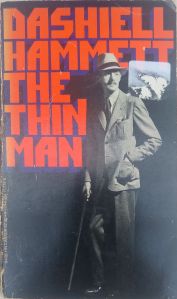
Time magazine included his novel Red Harvest, published in 1929, on their list of the 100 best English language novels. The Thin Man was made into a film in 1934 starring William Powell as Nick Charles and Myrna Loy as his wife Nora. I’ve only just started reading the Thin Man and it’s been pretty good so far. One interesting element of it though was finding out that in New York in the mid 1930’s it was possible to find an all-night delicatessen that would deliver coffee and sandwiches at 5 in the morning.
A further 5 sequels in the Thin Man film series were made finishing in 1947 with Songs of the Thin Man.
Another book by the same author is one that Liz got me for Christmas, The Maltese Falcon. I’ve only just scanned through it so far but it looks like being a good read. The book was made into a classic film in 1941 with Humphrey Bogart playing the part of detective Sam Spade. Mary Astor plays Ruth Wanderley who contacts the firm of Spade and Archer to help her track down her missing sister who she thinks might be held against her will by a man called Thursby. Miles Archer, Spade’s partner decides to take on the case but is found dead by the police later that night.
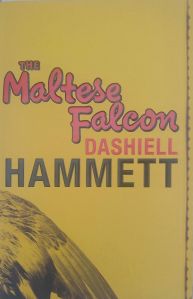
Spade begins to try and find out what has happened and meets various other characters like Joel Cairo and Kasper Gutman played wonderfully by Peter Lorre and Sydney Greenstreet. One of my favourite scenes is where Spade and Gutman meet and Gutman asks ‘are you a close mouthed man?’ Spade replies that no, he likes to talk and Gutman responds famously with ‘I’m a man who likes to talk to a man who likes to talk’.
Hammet died in 1961 of lung cancer and Raymond Chandler said this of him: ‘He was spare, frugal, hard-boiled, but he did over and over again what only the best writers can ever do at all. He wrote scenes that seemed never to have been written before.’
That brings me nicely to another of my favourite detectives, Philip Marlowe and he first appeared in the novel The Big Sleep. The book was written by Raymond Chandler and Chandler had this really fabulous talkative way of writing. You can almost imagine hearing Humphrey Bogart’s voice as you read the book. Bogart of course played Marlowe in the 1946 film version directed by Howard Hawks. Here’s a quote from the book, an example of Chandler’s descriptive style:
I sat down on the edge of a deep soft chair and looked at Mrs Regan. She was worth a stare. She was trouble. She was stretched out on a modernistic chaise-longue with her slippers off so I stared at her legs in the sheerest silk stocking. They seemed to be arranged to stare at. They were visible to the knee and one of them well beyond. The knees were dimpled, not bony or sharp. The calves were beautiful, the ankles long and slim with enough melodic line for a tone poem. She was tall and rangy and strong looking. Her head was against an ivory satin cushion. Her hair was black and wiry and parted in the middle and she had the hot black eyes of the portrait in the hall. She had a good mouth and a good chin. There was a sulky droop to her lips and the lower lip was full.
Not bad eh? Dilys Powell called his writing ‘a peculiar mixture of harshness, sensuality, high polish and backstreet poetry’ and it’s easy to see why. Mrs Regan was played by Lauren Bacall in the film version and up until now I had always thought this was the film where Bogart and Bacall met. Wrong! A quick check on Wikipedia and I see the couple met on the set of To Have and Have Not in 1944. Bacall was 19 and Bogart was 45 and married to his third wife Mayo Methot at the time. Sparks apparently flew between the couple and Bogart divorced Mayo and married Bacall the next year, 1945. Despite the great on screen chemistry together the couple only made four films together.
The film version of The Big Sleep was a brilliant adaptation of the book and some of the differences are interesting. For instance, early in the book, detective Philip Marlowe played by Bogart meets General Sternwood’s daughter Carmen. She looks at Marlowe and remarks how tall he is. In the film, Bogart of course wasn’t that tall so the dialogue is reversed ‘You’re not very tall, are you?’ comments Carmen.
 The plot of the book and film are pretty complicated, although having read the book recently I think that the book is easier to follow. During the filming the director and his stars wondered who killed the character of Owen Taylor, the Sternwood’s chauffeur. They sent a cable to Raymond Chandler asking him. Chandler told a friend later ‘Dammit, I don’t know either!’
One strange element in the film, certainly for me, is a scene where Philip Marlowe (Bogart) is watching blackmailer Geiger. Geiger has a shop that sells rare books in Hollywood and Marlowe asks for information in another bookshop opposite. There he chats to a bookseller played by Dorothy Malone who, if you are old enough, you will remember her from the Peyton Place TV series. Malone and Bogart seem to hit it off well in the film but he never returns to the bookshop and Dorothy is never seen again in the film.
Every time I watch the film, I always expect Malone to reappear but that’s one of the many dead ends the film leads us down. I think it was Hitchcock who said that every scene in a film should lead the audience somewhere and Quentin Tarantino of course said the reverse. Perhaps director Howard Hawks favoured Tarantino’s view.
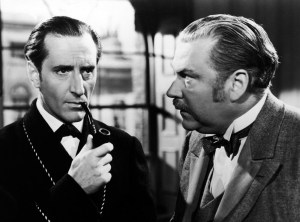
Basil Rathbone as Holmes and Nigel Bruce as Dr Watson (image via creative commons)
Perhaps the most famous literary detective is Sherlock Holmes, created by the author Sir Arthur Conan Doyle in 1887, first appearing in the story A Study in Scarlet. The stories are narrated by Holmes’ friend and companion, Doctor Watson. The Guinness Book of Records reports Holmes as the most portrayed character in film and television history.
My personal favourite Sherlock Holmes in the cinema was the version created by Basil Rathbone in a series of films beginning in 1939. 14 films were made with Rathbone as Holmes and Nigel Bruce playing the part of Dr Watson. The first two films were set in the Victorian era and were produced by Twentieth Century Fox. The later films were produced by Universal who set the films in, what was then, the present time period, that of the second world war.
Time now to move onto my favourite TV detective, the bumbling Lieutenant Columbo.
Columbo first appeared in the early 1970s as part of the Mystery Movie TV series. Each week followed a different detective trying to track down a murder case, sometimes it was MacMillan and Wife and other weeks McCloud, Banacek or various others. The most popular one by far though was Columbo.
Columbo was a homicide detective for the LAPD and he was played by Peter Falk, although the role was originally written for Bing Crosby. Crosby however thought a regular TV slot would interfere too much with his golf so he turned down the role, went back to the fairway and the part went to Peter Falk who made it his own.
If you ever see the original pilot, shot in 1968, you can see how Crosby might have fitted into the part, as Falk plays Columbo in a very Crosby like laid back way. The very first guest murderer was Gene Barry who was familiar to TV audiences after playing Amos Burke in Burke’s Law for many years. He also starred in a 1953 film version of War of the Worlds.
The pilot episode also introduced audiences to a particular feature of Columbo, in that we see who the murderer is and how he commits the crime first. Then we see Lieutenant Columbo gradually solve the clues and get his man, or woman. The essence then of a great episode comes in the clever way Columbo nails the murderer. Sometimes that moment is a bit of a non starter, other times it’s nothing short of brilliant. Sometimes, even if that final moment is not so great, it’s still been a great episode.
The Columbo of the early series is an absent-minded quirky fellow although in later episodes, Peter Falk who plays the detective, seems to downplay that quirky element.
Favourite episode? I’m not certain but it might be ‘Murder by the Book‘, starring my favourite murderer, Jack Cassidy. In this 1971 episode, Jack plays a writer, actually part of a writing double act, who together produce a series of novels about ‘Mrs Melville’ who is an amateur detective. The thing is, Jack’s partner wants to ditch the partnership but Jack is not happy about it. He is so unhappy he decides to, yes you guessed it, bump off his co-writer. He does it in a rather ingenious way which foxes Columbo but not for long and to cap it all, the episode is directed by none other than Steven Spielberg!
So who was your favourite fictional detective?

 Anyway, getting back to the Marigold Hotel. I was rather unhappy with the book at first. It had originally been published under the title These Foolish Things and was written by novelist Deborah Moggach, but to cash in on the success of the film, new editions were published with the film’s title. As I began to get into the book, I actually began to like it. The central theme seemed to be the story of the lady played by Maggie Smith in the film although in the book another layer of her story has been added which the film ignores. She is mugged and goes to see her well off son for help only to find he has been involved in some dodgy deal and has left to escape the police. She refuses to go back home but her doctor recommends a place in India where she can rest and recuperate. In fact, the Marigold Hotel which he has recommended is a business venture in which he is also a partner.
 As I write this latest blog post it’s the 20th January and Donald Trump is about to be sworn in as the 47th president of the USA. This was apparently the 60th such ceremony according to the first speaker although how that has been worked out, I’m not sure. Going by the huge amount of coverage on British TV, you might think that Trump had been elected president of the UK also.

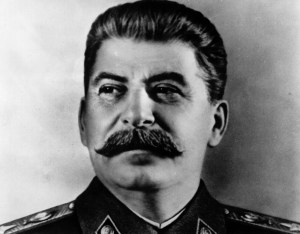

 I’m not that keen on Christmas so maybe late November would be a good time to just settle down somewhere warm and comfy, snuggle up into my duvet and perhaps wake up round about late March. I know that March can be unpredictable in terms of the weather. It’s generally windy and cold but certainly not as cold as January. Waking up in March would give me time to get my bearings before moving into April, my favourite time of year when the days are getting longer, nature is starting to revive and warmer days are coming.
 I first started posting in 2014 and that year I managed to get 2341 views which I was pretty pleased about. If I had also managed to sell 2341 copies of any of my books, I would have been even more pleased but hey, that’s another story.
 Looking back I now wonder whether that guy was actually right. 649 blog posts, times my average word count per post: That comes to over 700,000 words. I could have written another book and to be fair, that was part of the idea behind
  It seems like only yesterday that I was writing a blog post about looking back at 2023 and now, here I am looking back at 2024. I don’t intend to cover everything that happened to me in 2024 but just to mention a few things of interest and of course, a few of my own blog posts.
 In September after a disastrous debate with Donald Trump, US President Joe Biden began to realise what everyone else was thinking, namely that perhaps he was getting a little too old to be the president and so he stepped down as a candidate in favour of vice president Kamala Harris. That inspired me to write a little quirky fantasy post called
 Sting, aka Gordon Sumner was the lead singer, bass guitarist and writer. Stewart Copeland was on drums and Andy Summers played lead guitar. Their first hits were Roxanne and Can’t Stand Losing You released in 1977 from their debut album Outlandos d’Amour. They had numerous hits, all penned by Sting until their eventual break up in 1986 although they returned for a reunion tour in 2008.
 Some years ago I watched a documentary about Kate on
 It took me three attempts to pass my driving test. Still, it was difficult for me. We had no family car. I doubt if we could have afforded one even if my father had been able to drive. That meant that when I had my driving lesson of just an hour a week, by the time the next week came around I was almost back to square one again. I failed my test twice and then bought a motor bike. It was a Honda 125cc trail bike. I loved it but the day it was delivered my brother and I went to see
  It was actually a pretty eye catching car for a three wheeler. It had no doors but the roof lifted up to gain access and the side windows were plastic held on by Velcro. I always remember bringing it home and showing it off to my family with a certain amount of pride and my Dad looking at it and saying “How are we all going to get into that?” Perhaps he thought I was going to take us all away for a holiday!

 This the third instalment of a post on the theme of transformations. The very first one (
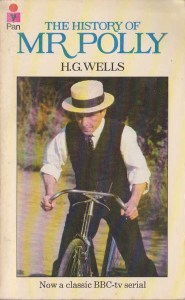 This is not a science fiction story despite being penned by H G Wells. Our hero, Mr Polly, finds himself in a very dull job with a very dull wife and resolves to commit suicide. Anyway, events unfold and instead of committing suicide, Polly accidentally starts a fire which threatens the whole street and he then mounts a brave rescue of an old lady. Instead of dying, Mr Polly becomes a hero and when the insurance money comes in, he leaves his wife nicely settled with the insurance money, takes a little for himself and departs for pastures new. He sends some money to a post office in another village and gradually meanders in that direction, sleeping in fields and hedges, getting himself a tan. He works occasionally when he wants and sleeps when the mood takes him at other times.
 A film version was made in 1949 starring John Mills as Mr Polly and Megs Jenkins as the landlady of the Inn where Polly finds happiness.
 Letters from an Unknown Author!