4 Funerals and a Pork Pie

One of my favourite memes and one I often post on Twitter (or X or whatever the hell it is called these days) is a quote attributed to John Lennon, and what it says is this; Time you enjoyed wasting was not wasted. I kind of like that quote and it’s one that I often think about when I’m pottering about either reading, watching TV or surfing the internet.

Having the odd day just pottering about is good for the soul and for me, an opportunity to indulge in numerous cups of tea and sandwiches. I really do like my sandwiches.

Last week Liz and I went to a funeral and I suppose I’m at the age now (let’s just say mid-sixties) when I tend to see more funerals than weddings.

I can’t say I knew John, the deceased, particularly well and I was surprised to find that he was a foundling, abandoned as a baby and never knowing his birth family.

The service was good and in fact the vicar struck what I thought was the perfect note, not too sad and not too light hearted. John’s son by a first marriage was brought up in Canada and he seemed a very pleasant fellow recounting stories of the fishing adventures he and his father had in Canada.

The first ever funeral I went to was my Uncle Raymond’s. Raymond was my favourite uncle and the most wonderful guy. When I first started work when I was sixteen, going on seventeen, I used to get off my bus, the 152, at the Bluebell pub in Handforth after coming home from work in Manchester and Uncle Ray was there, waiting for the pub to open. Inside he chatted to everyone, the staff, punters he had never met before and at the drop of a hat would produce the photographs from his recent cruise showing him and my Auntie Elsie sat at the captain’s table. He would come back home with us, have dinner and then take my dad out to finish the evening off.

When he died his funeral cortège took a detour past the British Legion, one of his numerous watering holes, and the staff and customers came outside to pay tribute as his coffin passed slowly by.

The funeral was sad and tearful and the wake was pretty similar. A lot of sad people, a lot of tears and my dad, who had probably lost his best friend, was devastated. I was driving that day and was asked to run some long forgotten relative home. I did so and returned a short while later. Only twenty minutes or so had passed but when I returned, I returned to a happy, noisy, enjoyable party, full of laughter and fun. I don’t know what had happened in the twenty minutes I had been gone but I came back to exactly the sort of party that my Uncle Ray would have loved.

When my Gran died the funeral service was held in Marple, I’m not sure why as it was nowhere near where my Gran lived or was buried. The journey from there to Southern Cemetery in Manchester was for me, a masterpiece of motor car management, juggling with high water temperature and having to dive into a garage to top up my car with water.

At the graveside I noticed my dad making signs to the two grave diggers and after the coffin had slipped into the ground and the final words of the vicar had faded, my dad, a former grave-digger in years gone by, had a happy and joyful reunion with two of his old co-workers, much to the dismay of my mother who stood with me and cried her heart out. (Not your finest moment, dad.) At least he thought better of introducing her to his friends which I thought he was going to do at one point.

Funerals are odd things; in a way they are not for the dead but for the living, those left behind after a loved one has died and I have to say, not only did I enjoy my mother’s funeral, although enjoy is not perhaps the right word, but it helped me more than anything to say goodbye to her.

Back to this more recent funeral and as the drinks began to flow the sadness of the occasion seemed to ebb away. The only really disappointing issue was that the funeral was scheduled for 9:30am which for someone, who since retiring no longer has to get up early, was a bit of a challenge.

The buffet was served at 12 on the dot and despite there being quite a considerable gathering there was no concerted rush for the food in fact I was the one of the first to get up. I really do love funeral food. A buffet is comprised of pretty much everything I love, pork pies, sausage rolls and of course sandwiches. There were my two favourites, cheese and ham and there were also some rather nice cheese and tomato pizza slices. The tuna sandwiches were not my cup of tea at all so I avoided them like the plague. Still there were plenty of other delights for me including a lemon drizzle cake for afters.

A pork pie selection: Terry Kearney, CC0, via Wikimedia Commons

A few years ago, I went with Liz to another funeral in Lytham. I felt distinctly out of place, an intruder even, as I did not know either the deceased or his family. There was however, a rather nice buffet which, under the circumstances, I felt it was important to do justice to. The world is full of wonderful food and some outstanding cuisines but I do think that there is nothing nicer than a pork pie. Some moist pork, some jelly, all encased in pastry, what could be nicer?

On that particular occasion the widow had seriously underestimated the demand for food and I did feel a little mean when I grabbed the last pork pie moments before a teary-eyed lady in black appeared and eyed the empty plate somewhat wistfully.

When I was introduced to her later, I could see from her expression she was trying to place me. As I smiled and offered condolences I saw the moment of realisation, and I almost heard her say in her mind ‘I recognise him- he’s the bugger who took the last pork pie!’

Some elements of this post came from a previous one so apologies to regular readers if it sounds familiar.


What to do next: Here are a few options.

Share this post on your favourite social media!

Hit the Subscribe button. Never miss another post!

Listen to my podcast Click here.

Buy the book! Click here to purchase my new poetry collection.

Click here to visit Amazon and download Floating in Space to your Kindle or order the paperback version.

Click here to visit amazon and purchase Timeline, my new anthology.


Graphic Design and More Manipulating the Image

I’m pretty keen on social media, not for social media itself (although it is nice to see what my friends are up to) but as a platform to plug my work, my blog posts and my books and videos. In this post I’m going to look at the impact of graphics and images and the sites I use to create them. All the links open up in a new page.

OK, let’s get started. The first thing to remember about blogs is that a big wall of text tends to put off readers so it’s a good idea to break up the text with a few pictures. What kind of pictures though? Well in the blog posts themselves I’ll use either my own photos or use an online stock photo site like Unsplash.  I’ll also try and render the blog title into a graphic which I’ll also use on Facebook and X (formerly known as Twitter) to promote the post. The easiest way to do that is to use a site like Quotescover where I can just type in the post title and either my name or the name of my website.

The graphic to the right was made on Quotescover.

A site I used to use was Picmonkey which a few years ago was completely free. These days it’s only available to paid users except for the app version which you can use on your phone or, like me, on my iPad. A lot of the features are unavailable to free users though and I use Picmonkey primarily to add text to a photo relevant to my post.

I’ve always liked this picture which I used on a post about my favourite music, The Soundtrack to My Life.

Another site for making graphics or pins for Pinterest is this one, Quozio. Again it’s simple and free to use, just type in a title and your name and choose a template. If you are making a quotation graphic for social media, just add the quotation and whoever said it instead. This one was a simple graphic with a clock.

When Picmonkey declined to let me make free images I had to look elsewhere to make my graphics. One site I began to use was Canva.com. I initially thought Canva was a little complicated but once I got used to it I began to make some good graphics.

Canva has a number of templates which can be personalised and a regular one I use is one for a YouTube thumbnail. What is that you might ask? Well it’s the image you see when you scroll through YouTube looking for an interesting video. A bad thumbnail can turn a viewer off watching the video and good one can pull in a new watcher.

Here are a couple of my YouTube thumbnails. My poetry videos all have a similar thumbnail, just for continuity. Click the image below to watch the video on YouTube.

This one is pretty self explanatory and takes you to my welcome video on YouTube.

Another site I’ve started to use is Adobe Express. It’s similar to Canva and again has various templates that the user can adapt and modify. A graphic I made on Adobe was from a template which I personalised. The picture of me came from Nightcafe, an AI imaging site. How does that work? Well, it creates images from a prompt, so you just describe the image you want to see in words and artificial intelligence does the rest.

How did I get a picture of myself? This is a little trickier. First the user has to upload pictures of the person you want to make an AI model of, in this case me, then you add a prompt to describe the picture you want. On Nightcafe and many other AI sites too, you can upload a picture and develop it. On Freepik you can hit the reimagine button and a different version of your picture will appear.

Sometimes I will make a picture or graphic and send it to another site to see if I can come up with a different or better version.

To make a graphic that I use on X, I added the picture of me to a graphic I had used before and removed the background. Using the animation feature I got the picture to jump into the frame and then jump out again after the text had slid in.

On my laptap I took the animation and added some sound using sound effects downloaded from Zapsplat, a site that provides music and effects for video. Here’s the resulting video.

A lot of the images I’ve created on AI are ones used to plug my blog post over on sites like Facebook and X, graphics that all say something like, ‘New Blog Post Out Now!’

This is one for a post about the Apollo 11 moon landing.

This is for a post about the western genre.

I use three main AI sites, Nightcafe, Freepik and Microsoft Designer. All three sites operate a sort of credit system whereby the user gets so many tokens to create images but after you have used your tokens, that’s it, unless you want to subscribe and pay for more. On Nightcafe, the user gets 5 tokens per day with extra tokens for various things; voting on other users creations, voting on competitions and so on. On Freepik, I’m not quite sure how things work. I’ll sign in and see I have 20 free credits, that’s one credit per picture. Even if I’ve used up my credits I can turn to the ‘reimagine’ page and produce alternative images where I usually have about 5 credits. The next time I visit, sometimes I’ll have another 20 credits, sometimes not, even so, I’ve produced some good images there.

On Microsoft Designer, you can create an image and then use it in a blog graphic or social media post where you can add text and all sorts of stuff.

To create an image you need a prompt. Here’s one I used for an image of a street poster:

A vibrant and eye-catching roadside advertising banner, announcing the release of a “new blog post “ on “www.stevehigginslive.com” The banner features a bold, modern font, with a creative design of a laptop opening up to reveal a digital world. The background is a busy city street, reflecting the urban environment where the blog post was written.

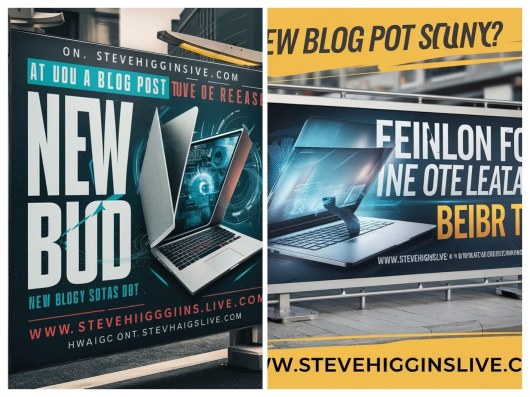
See if you can recognise the result of that prompt further down but one thing to remember is that AI images don’t always turn out the way you want them, especially when using text within the image. Here are a couple that look good but the text didn’t quite work out right.Both of the images above were supposed to say ‘New blog post out now!’ Oh well.

On Nightcafe there is now the option to make an image into a short 4 second video. Here’s one of my favourite promo pictures rendered into a gif, an animated image. The web address was added later on Picmonkey. The image prompt went like this:

Floating in a raging sea during a storm with rain hammering down, we see a bottle on its side with a message inside. The message is visible and says “New blog post out now!” Professional photography, shot on dslr 64 megapixels sharp focus 8k resolution

To finish off, here are a few of my latest graphics, all of which are out there on X in yet another attempt to liven up my posts and to bring in more readers.

OK, what AI image can I create now for my next social media post? What about an art gallery, perhaps seen from above? Light streams in dramatically from windows off to the side. It’s a wide angle shot, looking down. Art lovers are admiring a new poster advertising my blog. It should turn out something like this . .


What to do next: Here are a few options.

Share this post on your favourite social media!

Hit the Subscribe button. Never miss another post!

Listen to my podcast Click here.

Buy the book! Click here to purchase my new poetry collection.

Click here to visit Amazon and download Floating in Space to your Kindle or order the paperback version.

Click here to visit amazon and purchase Timeline, my new anthology.

A Slice of my TV Life

This week I thought I’d continue with my theme of real people in TV and film and throw in a few personal thoughts too. It’s been a quiet week. The weather in November in the UK has been the usual dull and dismal November weather and October wasn’t that great either.  Despite October being my birthday month it isn’t a month that I’m really keen on. There’s Hallowe’en for instance when perfect strangers knock on your door and ask for treats, then comes bonfire night when it’s the usual nightmare of fireworks going off at all times of the evening and night.

While I’m having a moan I might as well mention my back which has been sore for quite a while. To be fair I’m not in any kind of agony but it’s sore all the same. A few months back the doctor sent me for an x ray. Apparently, it didn’t turn out so good so then they sent me for another one. The other x ray didn’t turn out so good either but by then my back pain had eased off so I wasn’t that worried but then I got a call from the doctor asking me a whole raft of questions and suggesting a third x ray was needed.

This sounded a little odd to me, especially when I went into the doctor’s surgery to pick up the card that you need to take down to the walk in centre where they take the x ray. I must have misunderstood they told me, you don’t need another x ray. To be honest I don’t think I misunderstood at all and I tend to think that they need to get a grip at this surgery.

Until I Kill You

Anyway, let’s move on. I mentioned above about a post I published a few weeks back about real people portrayed in films and this last week I’ve watched quite a bit of TV on this theme. One particular programme was Until I Kill You. It was a true life drama in four parts and it was pretty scary. It was about a woman, Delia Balmer, who gets involved with a man called John Sweeney who turns out to be a serial killer. The couple move in together but Sweeney is a bit controlling so Delia asks him to leave. He responds by attacking her, tying her to the bed and repeatedly raping her. She is lucky in that she has a friend who is looking out for her. The friend telephones when Delia doesn’t turn up for work and doesn’t believe the story Sweeney gives and tells him so, threatening to call the police.

Later when Delia has been released, she goes to the police, reports the assault but the judge decides to parole Sweeney so he returns and tries to kill her although the next door neighbour intervenes and calls the police and ambulance. Despite stab wounds Delia survives but it is only years later when Sweeney is connected to other murders that he is finally imprisoned.

The police and the justice system don’t come out of this looking good but at least Delia was finally able to put things behind her and carry on with her life. You can stream the four part series over on ITVX.

Back to the Personal Stuff

A few days later the doctor’s surgery called and asked me to see the doctor that same day. The doctor discussed the x rays and said he had to send me for an urgent CT scan. When I asked why, he used a lot of big medical words and it was only after we were ushered out, Liz, who has some medical knowledge, told me he was saying that I might have cancer.

The first thing I thought of was I hoped that this wasn’t going to ruin our long stay in Lanzarote we have planned for next February. I started thinking about having chemotherapy and being stuck in hospital when I should be relaxing in the sun and I began to think maybe it’s time to get my things in order and write a will or something. My dad lived until he was 72 so I was kind of hoping I might have a few years left.

Sully: Miracle on the Hudson

When I was on holiday in France not so long ago, I picked up a DVD in a vide grenier, a car boot sale. The great thing about DVDs is that even if you buy a French one, as long as there is an English language option you can watch it in English. The DVD I picked up was called Sully and it falls quite easily into the theme of real people portrayed in films.

If the name Sully doesn’t quite ring a bell at least you might remember an incident that happened in New York in 2009 when a passenger airliner had to land on the Hudson River. The aircraft, piloted by Chesley ‘Sully’ Sullenberger, had just left LaGuardia airport when it was hit by a flock of birds which disabled both engines and forced the crew to ditch in the Hudson. That was pretty dramatic but you could be forgiven for thinking there wasn’t much material to make a film out of. Even so, the film, directed by Clint Eastwood was pretty exciting and concerns not only the landing in the river but the following inquest in which the civil aviation authority tries to make out that Sully could have made it back to the airport.

Various simulations seemed to show that an emergency landing at the airport was possible but at the hearing, Sully questions that the simulations were done without the human factor. The simulation pilots knew the engines would fail and were ready to turn immediately back to the airfield. Sully and his co-pilot did not. They followed procedure to restart the engines which failed and only then did they realise the only option was landing in the river.

Sully cooly asks how many attempts did the simulator pilots have before getting the landing right. The answer was 17. Sully of course only had 1 attempt.

Tom Hanks plays Sully and plays, as usual, a good part and if you happen to notice Sully on your TV listings, it’s well worth watching.

Back to the Personal Stuff

One day I received a text message asking me to come to have a CT scan at Victoria Hospital in Blackpool. I had to click on a link to confirm I was attending and that was pretty much it, until a few days later I got a confirmation letter and I realised the scan was at a drop in centre and not at the hospital. Anyway, I went along for the scan which was a very quick fire experience. I went into the scan area and lay down on a bed. I was expecting to have to strip off and get into a hospital gown but no, I lay down fully clothed, handed over my specs and wallet and the machine arch ran over me a few times and that was it.

Lord Lucan

I reckon I need another true life film or TV show to finish this post off. This week I watched a TV documentary about Lord Lucan which was pretty interesting. I tuned in thinking it was a drama but it was actually a documentary. It was an interesting documentary but a very slow and long winded one. It was in three parts and followed a Hampshire builder, Neil Berriman, who had been adopted as a baby and finds that his birth mother was the nanny murdered by Lord Lucan.

Back in November 1974 the body of Sandra Rivett was discovered in a Belgravia basement and the chief suspect was Lord Lucan, who promptly disappeared. Neil teams up with an investigative journalist and together they track Lucan down to Australia where they reckon a man using the name ‘John Crawford’, is actually Lucan. It all looked pretty likely that Crawford might actually be their man but then other evidence emerged that seemed to invalidate that claim. It was pretty interesting but to be honest, this very slow moving documentary could have easily been cut down to two or maybe even one episode. If you are interested you can stream Lucan on the BBC iPlayer.

And Finally

After about a week I noticed a report on my MY GP phone app about my scan which said ‘abnormal results, contact patient.’ No one had contacted me so I called up the surgery and asked to speak to the doctor. After about 20 mins the doctor called me back. Happily there was no need to worry, the scan had showed no trace of cancer and the ‘abnormal’ report referred to my back and the need for further treatment at the muscular skeletal unit.

I have to admit to a warm feeling of relief when I put the phone down. I wasn’t about to die after all and I could look forward to a month in Lanzarote. The only thing is, watching Sully has put me off air travel. Wonder if we could sail to Lanzarote instead?


What to do next: Here are a few options.

Share this post on your favourite social media!

Hit the Subscribe button. Never miss another post!

Listen to my podcast Click here.

Buy the book! Click here to purchase my new poetry collection.

Click here to visit Amazon and download Floating in Space to your Kindle or order the paperback version.

Click here to visit amazon and purchase Timeline, my new anthology.

Timeline and the Life of a Writer

As much as I love writing it’s not always that easy. You might think, well all Steve does is settle down and tap away on his laptop and hey presto, there’s a new blog post. The problem is that when I settle down in front of my laptop, the ideas don’t always come. Not only that, there is always the temptation to scroll through Facebook or to search for more things that I didn’t even know I wanted on eBay.
A lot of the time I think of something to write when I’m either in bed having just woken up or driving my car. What I do then is tend to write the blog or story in my head and hope to reproduce it when I’ve settled down in front of my laptop.

Looking at my little WordPress site I thought perhaps it’s about time I produced another book. I’ve had a sequel to Floating in Space in my head for a long time and I have started it. The big problem is that although I’ve started it, it doesn’t seem to have the same length as the original, it’s more of a longer short story which is no good at all. Too long for a short story and not long enough for a book.

When I became rather disenchanted with the idea of a sequel I did have a number of other stories in my head so I started writing those down and producing some short stories. Most of those I publish over on Medium.com but there are a few I’ve published over here on WordPress. In fact a few are available to download just by clicking on the download tab above.

Now I seem to have quite a few of those stories, so I thought about putting them together in a book, after all compiling a book is much easier than writing one, isn’t it? Actually, when it comes down to it, it isn’t that easy after all. I collected some of my stories together with some of my poems and then added in a selection of my blog posts. Then I had to format and index everything and finally after months of changing things round I felt I had finally got it right. The next step was to get it published.

I looked at quite a few options for self publishing but I ended up going back to what I think is the easiest one, Amazon. I uploaded my manuscript, checked and changed it a few times and finally ordered my proof copy. A quick look through that and I soon identified various problems so it was back to the manuscript, correct that and upload it again.

Over on Canva.com I created my cover then realised a sort of margin had appeared from somewhere so I had to edit that and then upload it again. Almost as soon as I thought everything was ok, some other issue would occur, A correction might have moved a new chapter to the next page so the contents page had to be revised. The text looked too bunched up so I spaced it out a little which meant another revision to the contents. Yes, I thought compiling a book rather than writing a new one would be so easy but in the end it wasn’t. A lot of that was due to me thinking I had mastered the intricacies of Microsoft word when actually, I hadn’t.

Then of course I thought that when I published I would automatically get a Kindle and a paperback version together; oh no, that would be just too easy. The Kindle version required its own manuscript too.

I thought about the title for ages and finally chose Timeline because it sounded like a good title for an anthology and also as it’s the title of one of my favourite short stories featured in the book. The only problem is that there seem to be a whole raft of books called Timeline available on Amazon including a particularly popular one by Michael Crichton. (Don’t bother with that one, try the one written by me!)

Take a look at my download page where you can download two of the stories from Timeline absolutely free.

Anyway, I’m happy to say that Timeline is now available as a Kindle download or as a traditional paperback from Amazon. I hope you will enjoy it.

Click here to go straight to Amazon.


8 Onscreen Portrayals of Real People

It’s been another cold and wet week and as usual I’ve tended to lie back on my couch and watch a lot of television and not just broadcast TV either. Lots of times when broadcast TV isn’t up to the job of entertaining me, I’m forced to crank up a recording and watch that. Just lately I’ve watched a couple of biopics, films about real people, so for this post I thought I’d continue that theme and look at films and TV shows where the actors have had to portray real people.

Barbara Windsor

One night last week I watched a documentary about the Carry On films. It was really interesting and was titled Secrets and Scandals. It showed a lot of previously unseen interviews in which the stars had a whinge about various things, in particular the fact that they didn’t get paid when the films were reshown time and time again on TV. The producers made a shed load of money but the stars were paid peanuts. One of those stars was Barbara Windsor and after I had watched the documentary, I remembered a TV film called Babs about Barbara’s life. It was made in a really interesting way and involved Barbara in later life, imagining that she was talking to her late father about various things that have happened to her. Events from her life are recreated in front of her and she turns and discusses the incidents with her dad.

Theatre director Joan Littlewood was really impressed by Babs and wanted her to play various parts for her but after working together for a short while, Barbara opted to play a part in Carry on Spying which set up her comedy persona for the rest of her life.

Barbara loved her dad but when he and her mother divorced, Barbara, as a small child, was asked to tell the courtroom about the times he had shouted and sworn and later her dad ignored her when leaving the court. Two actresses played Barbara, Honor Kneafsey in her younger days when she played in her first Carry On films and Samantha Spiro who interacts with her father throughout the film. It’s a really good film and it’s put together in a slightly unconventional way which really works.

I couldn’t find a clip on YouTube but the film can be seen on BBC iPlayer by clicking here.

Jimmy Saville

Another TV film I saw earlier in the year was The Reckoning in which Steve Coogan plays Jimmy Saville. It was another 4 part series which we had to stream and Coogan really seemed to me to capture the essence of Jimmy Saville.

I have to admit I always used to rather like Jimmy Saville. I liked his slightly comic presentations on Top of the Pops and his ‘now then, now then’ act. This film was different though and showed the dark side of Saville and the way he used his pretty considerable fame to abuse women and children and get away with it.

Stan Laurel

Steve Coogan also played Stan Laurel in the film Stan and Ollie, a film which looks at the later years of the famous comedy duo. John C Reilly played Oliver Hardy and the film shows the two when they embarked on a music hall tour of the UK in 1953. They were still hugely popular but the tour had a big impact on them, particularly Oliver Hardy. Coogan does have a look of Stan and the two actors played great parts and even recreated some of their comedy routines on stage.

Lee Harvey Oswald

In the film JFK, director Oliver Stone takes a look at the assassination of John F Kennedy. The alleged assassin was an oddball individual called Lee Harvey Oswald. Oswald in the film is played by British actor Gary Oldman. Oswald was paraded to the press in Dallas on a few occasions after his capture and Oldman perfectly captures his look and speaking voice in the film. Stone apparently urged Oldman to do his own research and he met with Marina, Oswald’s widow and some of their Dallas acquaintances. Strangely, Oswald was interviewed on camera before the assassination talking about Marxism and Communism and the differences between the two. No doubt Gary Oldman watched these too.

Winston Churchill

Gary Oldman also played another historical person in Darkest Hour in which he plays Winston Churchill. A great deal of makeup went in to putting together Winston’s visual appearance and the film looks at the outbreak of World War II and Churchill’s ascent to the premiership. Oldman achieves an interesting approximation of Churchill’s overall look and speech and the film is excellent although whether deposed PM Neville Chamberlain had as strong a hold on the conservative party after Churchill had taken over as the film makes out, is open to question. Interestingly though, even though Churchill became the Prime Minister, Chamberlain retained the party leadership and apparently had thoughts of returning to 10 Downing St in later years. He died of cancer though in 1940.

Cary Grant

Archie is a wonderful four part series and Jason Isaacs plays an outstanding part. He doesn’t try to impersonate Cary but he did manage to create a look of the late star and he caught Grant’s voice and enunciation perfectly. Most of the series follows Cary in later life when he becomes involved with and later marries Dyan Cannon. Dyan was his fourth wife and she was the mother of his only child Jennifer and she and her mother co-produced the series which is definitely well worth watching.

Cary Grant retired from films in 1966, the year his daughter was born and he and Dyan Cannon divorced in 1968. Many tried to bring him out of retirement for various films including his favourite director Alfred Hitchcock but he declined. He must have wanted to keep on working though because he did accept a position on the board of Fabergé.

He died in 1986 aged 82 and left behind an estate reputedly worth around 80 million dollars. Archie is a well made and quite fascinating piece of TV. Look out for it, it’s well worth watching.

Howard Hughes

The Aviator was a film released in 2004 starring Leonardo Di Caprio as the billionaire Howard Hughes. Looking at Wikipedia, the film had an extensive development background with other film makers vying with each other to produce biopics about Hughes. This film however finally came together with Martin Scorsese directing and with a screenplay by John Logan. Hughes famously suffered from OCD, Obsessive Compulsive Disorder and in Hughes the disease manifested itself in a fear of germs and an obsession with cleanliness. Apparently Di Caprio did a huge amount of research on OCD and the film shows how Hughes went from an eccentric millionaire film maker and pilot to someone who finally retreated into reclusive madness.

I enjoyed The Aviator although a better film about Hughes was probably a mini series based on a book by Hughes’ former business manager, Noah Dietrich. The TV mini series was called Howard, The Amazing Mr Hughes and starred Tommy Lee Jones as the famous billionaire. I’ve always thought that Jones’ portrayal was much more convincing than Di Caprio’s but I did enjoy both versions.

An interesting element in the TV show was a recreation of an incident in 1972 when Hughes appeared by telephone live on air, to speak with four journalists he personally knew, in order to denounce fake ‘diaries’ which had been published by author Clifford Irving. On the TV mini series the actual journalists played themselves.

Brian Clough

I’m not a great football fan but not long ago I picked up a DVD from the charity shop. It was The Damned United starring Michael Sheen as the 70s football manager Brian Clough. Clough was famous in the UK in the 1970s and was to be seen regularly on various TV shows and all the top impressionists of the day, people like Mike Yarwood, all did a version of Clough. The film follows Clough as he takes over Leeds United from outgoing manager Don Revie. He denounces the team as unsporting because of their brutal and physical style of play and promises a new start for the team. However, only 44 days later Clough was sacked as manager. Despite not being a football fan, the film recreates the 1970s very well and Sheen’s performance as Clough was an outstanding approximation of the real Clough. Various people sued the production company due to a number of factual errors in the film but as a non-football fan I found the film very convincing and hugely entertaining.

I could go on with many other films. James Stewart for instance played both Glenn Miller and Charles Lindbergh although the end result in both cases was someone who looked and talked just like James Stewart usually does. The same could be said for James Cagney who played George M Cohan in the film Yankee Doodle Dandy. Neither actor even tried to impersonate the real person although Stewart did wear spectacles to play Miller. Anyway, I’ll save those examples for another post.

Have a good weekend and thanks for looking in.


What to do next: Here are a few options.

Share this post on your favourite social media!

Hit the Subscribe button. Never miss another post!

Listen to my podcast Click here.

Buy the book! Click here to purchase my new poetry anthology.

Click here to visit Amazon and download Floating in Space to your Kindle or order the paperback version.

What I Ate in a Week

As usual I’ve been stressing about to what to write about in my next blog post. It’s a great feeling to have an idea, create a post, polish it, make some graphics and add pictures and a video and then to see it finally published but then I start thinking about next week. What can I write about next?

Last Saturday I dragged myself up and into the kitchen for a cup of tea. Returning to the bedroom with the tea, Liz was watching Saturday Kitchen and I began browsing through my emails. One of the guests on Saturday Kitchen was the Hollywood actor Stanley Tucci. Stanley has appeared in a number of films and you might remember him from The Devil Wears Prada. Anne Hathaway becomes the assistant to the head of a fashion magazine played by Meryl Streep. Stanley Tucci played the art director of the magazine who becomes a sort of fashion mentor to Anne.

It turns out that Tucci, currently living in London, is a bit of a food buff and amateur chef and he was in the studio to cook some food and talk about his latest book What I Ate in A Year. Wow I thought and as I looked up, a picture of a flashing light bulb appeared above my head with a sign saying ‘new blog post idea!’

I won’t be writing about a year of eating but a week sounds a little more blog post sized so here we go.

Monday

A typical breakfast for me tends to involve poached eggs either on toast or on a crumpet but I do rather like Liz’s full breakfast which she serves with a poached egg, grilled bacon, sausage, black pudding and fried tomatoes and mushrooms. That’s a pretty big meal so we don’t have that every day. We rarely eat lunch and even when I was working I used to just have a sandwich for lunch.

A must for us on a Monday night is a visit to the Ego restaurant in Lytham. They have a special Monday offer which includes two courses for a much cheaper than usual price and also £10 off a bottle of wine. We used to have the sharing board for starters but this week I plumped for the cheesy mushrooms and Liz had the scallops. For the main course I’ll sometimes go for a steak or if I’m not madly hungry I might go for something a little smaller. On our last visit I decided to go for the beef bourguignon and Liz went for a dish off the new menu, lamb kleftico, served in a rather odd way in the paper package in which it was cooked.

Tuesday

Tuesday is our usual stay at home and alcohol free night. We’ll be drinking a lot of tea especially while I’m working on a new blog post so we sometimes decide to go for a chippy tea. Our local chip shop does a cheapy Tuesday deal which consists of an extra large portion of chips, two medium sized battered fish and two side orders for which we usually get a tub of peas and a tub of curry. I’m not a great lover of fish but I do like my battered cod or hake. Another bonus is that our local chippy delivers so all I have to do is get the teapot warmed up while we wait for our food.
Wednesday

Once a month Liz and I go out with our local curry club for an Indian meal at a great Indian restaurant in St Annes called Imli. It’s a friendly place and they do a super offer which includes poppadoms and all the chutneys followed by a starter and a main served with either rice or a naan bread. I was once a bit cheeky and asked for chips with my chicken tikka bhuna curry but the portion was a little too large so I’ve reverted back to pilau rice.

Thursday

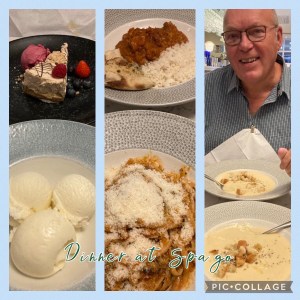
Thursday is our quiz night and we tend to eat out before going down to the pub for the quiz. This week we went down to Spagó in Lytham who have yet another special offer running on Thursdays. (Noticed a trend at all in this dining out saga?) The Spagó deal is two courses for £12.95 or three for £17.95. The only drawback here is that the wine is a little dear so I sometimes drive down and we’ll just have one glass of wine each and a large jug of water. The menu changes every week and the last time we visited I had the cauliflower soup with garlic and pesto and a main course of lamb stew with mash and carrots. The portions are a little small but perfect if you are not in the mood for a huge meal. The service is pretty good and so I have plenty of time to drop Liz off at the quiz and to park the car up somewhere for the night so I can walk down and pick it up in the morning and enjoy a few beers at the quiz.
Friday

We don’t often go out on a Friday. If I’m back in Manchester I’ll usually make some food for my brother and he’ll come round and we’ll eat and have a catch up. My favourite meal to make is probably chilli or spaghetti Bolognese. I make both those dishes pretty much using the recipes I’ve used for years, even so, sometimes the finished dish will be wonderful, other times not as good. What do I do wrong? Actually I’ve no idea. A few weeks ago I made a curry using minced chicken. As I was making it I realised I had no garlic but even so, the end dish was pretty good.

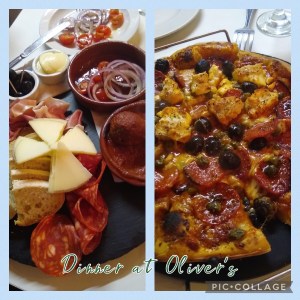
Sometimes Liz and I will stay at home on a Friday but not so long ago we met up with some friends and went to Olivers, a small place in St Annes that serves pizza and pasta. My favourite dish there is a sharing board which consists of the chef’s home made bread, olive oil, mayonnaise, parma ham, salami, cheese, olives and we always substitute the potatas bravas with a tomato and onion salad.

Saturday

Last Saturday we went to the Number Fifteen pub to watch April Moon, one of our favourite local bands. I say local although Jason and April are actually from Canada. Anyway, prior to seeing them perform we decided to eat at a new place called the Dip, Drizzle and Drink. It styles itself as a Spanish tapas bar. We’d been once before when it first opened and I wasn’t too impressed but we thought we’d give it another go now they have been running for a while. We had another sharing board which was pretty similar to the one at Olivers and followed it with a couple of tapas, meatballs for me and sizzling prawns for Liz. The prawns were a little fiery for our taste but I loved that sharing board. I don’t usually care for green olives but the ones served here were really tasty.

Sunday

I always look forward to my Sunday dinner but this week we were out again. Down at the Catholic church they had a charity night which involved betting on various filmed horse races for a few pence at a time. Sadly I only won one race although I did win two bottles of wine in the raffle. Food was served later which was a hotpot supper. It was rather yummy as usual although bread buns were substituted for the usual pastry topping. Pity as I rather like that pastry. Anyway, there was quite a bit leftover so I helped myself to seconds.

Anyway, all that food talk has made me hungry. Sandwich anyone?


What to do next: Here are a few options.

Share this post on your favourite social media!

Hit the Subscribe button. Never miss another post!

Listen to my podcast Click here.

Buy the book! Click here to purchase my new poetry anthology.

Click here to visit Amazon and download Floating in Space to your Kindle or order the paperback version.

7 Great F1 Designers

There have been some pretty exciting races in F1 these days which is great for the fans and the sport in general. After all, who wants to see the same old faces winning again and again? But in this post I’d like to look at the men behind the machines, the designers who have created the cars that are the tools that the drivers use.

John Cooper.

I could start a little further back in the history of motor sport I suppose but I’ve chosen to start with the late 1950’s and John Cooper because he made a fundamental change to racing cars that set them on to today’s path. He decided to move the engine from the front to the back.

The rear engine revolution began in 1957 when Jack Brabham drove a rear engined Cooper at the Monaco Grand Prix. Jack won the championship in 1959 and 1960 for Cooper and since then every F1 winner has sat in front of the engine, not behind. The Cooper team sadly folded in the late 1960’s but the name is remembered today by the BMW Mini Cooper.

Colin Chapman.

Colin Chapman created his Lotus company in 1952 but had started out in racing by modifying an Austin 7. Later he created the Lotus 7 and made the car available to others in kit form. The car is still available today manufactured by the Caterham company and was the car driven by Patrick McGoohan in the TV series The Prisoner.

Chapman brought aircraft engineering and techniques into motorsport and created the first monocoque chassis with the Lotus 25. His design philosophy was for cars with lightweight construction rather than big heavy cars and engines.

Maurice Philippe.

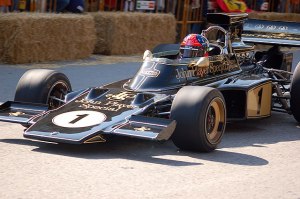
In 1970 Colin Chapman worked with designer Maurice Philippe to produce the revolutionary Lotus 72. The car featured inboard brakes and moved the radiator from the front to the sides of the car where they remain today on modern F1 cars. This produced a wedge shaped car which went on to win championships for Jochen Rindt and Emerson Fittipaldi.

Lotus produced other groundbreaking cars such as the Lotus 79 which dominated the 1978 championship. The car was the first ground effect car which used aerodynamics to produce a low pressure area under the car which literally sucked the car down to the track. Skirts were added to seal in the low pressure area but ground effect cars were later banned.

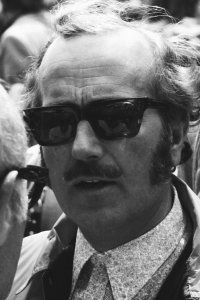
Another Chapman innovation was the dual chassis car, which had a softly sprung chassis in which the driver sat and a second chassis to which the aerodynamics were attached giving the driver a much smoother ride. Sadly the car, the Lotus 88, was banned.

Gordon Murray.

Gordon Murray was the designer for Bernie Ecclestone’s Brabham team in the late 70s and to combat the Lotus 79 he came up with the concept of the BT46b Fan car. The car had a huge fan, ostensibly used for cooling but a side effect was that it sucked the air from the underside of the car creating a low pressure area and consequently sucked the car to the track surface. The car was only used in one race despite the FIA, the F1 governing body, ruling the car was legal. Bernie Ecclestone withdrew the car fearing that as he had just been made the leader of FOCA, the Formula One Constructors’ Association, disputes about the car could derail FOCA.

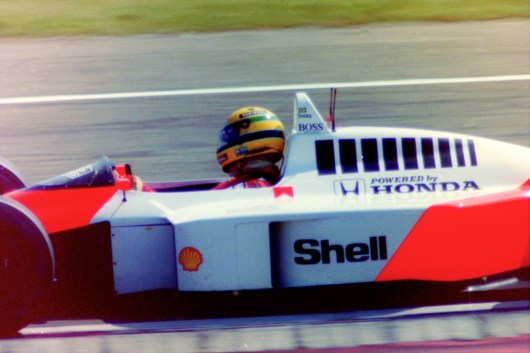
When John Barnard left McLaren, Murray was invited to join the team as technical director by Ron Dennis. Murray worked with the McLaren design team on the MP4/4 car which, coupled with the Honda engine, won 15 out of the 16 races in 1988.

Ayrton Senna in the Mp4/4 in 1988. Photo by the author

John Barnard.

Barnard first worked in F1 for the McLaren team in the early 1970s then moved to the USA to work in US racing. He was recalled back to McLaren when the team was taken over by Ron Dennis and there he produced the first carbon fibre chassis in F1 which was built for the team by Hercules Aerospace in the USA. Other teams followed and today all F1 cars are built using carbon fibre.
Barnard became the key designer of the period and in 1986 he moved to Ferrari. As he was in such great demand he was able to name his own price which included surprisingly a design office not in Marenello in Italy but in the UK. A revolutionary design by Barnard was the semi automatic gearbox where the driver changed gear from paddles on the steering wheel rather than having to reach down to a gear lever. Once again, the semi automatic gearbox and steering wheel paddles are still in use today on all the current F1 cars.

Frank Dernie

Frank worked for the Hesketh team and designed his first F1 car for them in 1976. Frank Williams later hired him to work with technical manager Patrick Head. Dernie was one of the first designers to use computers to aid design and he convinced Frank Williams to get a wind tunnel to aid their development programs. That made Williams the first team to have their own wind tunnel which is today a vital element of F1 design and development. Frank also created the active suspension concept in which a car’s suspension was controlled by a computer which set up the suspension in the optimum configuration for each corner on any given circuit. Active ride suspension was later banned for the 1994 season.

Adrian Newey.

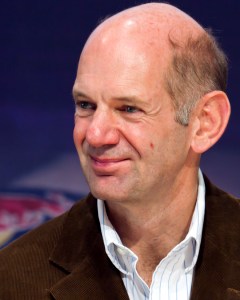
Adrian Newey has been in the news lately as he has just signed to start work for the Aston Martin team from March 2025. Newey designed cars have won 25 world championships and Adrian designed cars for March, Williams and McLaren before joining the Red Bull team in 2006.

Newey has also seen the other side of Formula One. He designed the car which Ayrton Senna was driving when he was killed at the San Marino Grand Prix in Italy in 1994. It was a tragic day for all motorsport fans but it must have been even worse for Adrian.

Millionaire Laurence Stroll purchased Aston Martin in 1920 and he has spent a great deal of money in his quest to win at the sport. Numerous talented engineers and staff members have joined the team as well as double world champion driver Fernando Alonso. Aston Martin seemed to be looking good for a while in 2023 but this year seemed to be consigned to the middle of the grid. Adrian Newey has been hailed as one of greatest designers in F1 history. Will Newey and his design talent catapult Aston Martin towards the winners’ circle? Only time will tell.


All pictures courtesy Wikipedia creative commons except for the author’s shot of Ayrton Senna in the McLaren MP4/4.


What to do next: Here are a few options.

Share this post on your favourite social media!

Hit the Subscribe button. Never miss another post!

Listen to my podcast Click here.

Buy the book! Click here to purchase my new poetry anthology.

Click here to visit Amazon and download Floating in Space to your Kindle or order the paperback version.

Another Year Older

Once again my birthday has come round and I’m another year older. In some ways I don’t mind being 68, after all I’ve put the time in, the full 68 years. A few years ago I retired. Once upon a time I loved my job, I mean really loved it, so much so I hated to have time off but in the last few years I went the other way. I hated it and after a long spell of being at home because of Covid and also helping Liz who had just had a hip replacement and needed assistance for a while, I really wasn’t keen on going back. I used up all of my remaining holidays, looked at my financial situation and realised I could retire about 6 months early. So I did! Those 6 months before my state pension kicked in were a little tough financially but what the heck, I was glad to be finished with work.
I’ve had quite a few jobs that I was glad to be saying goodbye to but there was always a new job to look forward to. This time there wasn’t and so this blog post has now become my work. It keeps me going, it keeps me creating and best of all, it keeps me thinking.

The other thing about being 68 which I’m not happy about is the state of my 68 year old body. Although much of it seems to work there is quite a lot that doesn’t. My neck is sore although happily it’s not painful (at the moment) but it doesn’t seem to turn that well. My back is the main problem though. It hurts quite a lot and sometimes it’s hard to sleep. Getting in and out of a car is difficult. I tend to get in as far as I can, aim myself at the seat and then just fall in. One day, I’m sure, I’m going to get the aim wrong and then just plonk down into the road. So far, that hasn’t happened.

Recently Pete, one of our favourite taxi drivers, has got himself a new taxi. He used to have a traditional black hackney cab. Lots of room and easy to get into. The other day he picked us up driving a car which I first thought was a Range Rover. It’s not a Range Rover and the crazy thing is that on the outside it looks pretty big but on the inside it’s actually really small and the last time we used Pete I actually hurt my back trying to squeeze in. Sorry Pete but we’ll be calling someone else next time.

image courtesy wikipedia

Of course, getting old isn’t all bad news. I’ve got a free bus pass which is quite handy. I can’t say I use it a great deal but travelling on the bus is much more comfortable than Pete’s taxi. (Sorry Pete) Also I am now eligible for those pensioners’ meal deals you sometimes see in pubs.

Not so long ago we went for Sunday lunch and I noticed the sign for the senior citizens’ meal which was almost half the normal price. Well, I thought, I’ll have some of that. We got in the queue for the carvery and the server handed me my plate. I handed him my ticket, he looked at it then took my plate back and gave me a half size one. Whoa, what’s this about I asked? It turned out that was the reason for the cheap price, it’s a smaller meal for us old age pensioners. That’s all very well but so far, despite being old, I’ve still got the same size stomach and I’ve still got a young man’s appetite. Anyway, the server gave me a really funny look when he saw me going back to my table with this small plate piled about a foot high with roast potatoes, Yorkshire pud, mash, carrots and sprouts.

Before we went on holiday to France, I went to see my physiotherapist and he gave me a real pummelling on my back muscles but advised me not to sit for too long. Try and get up every hour or so and do some exercises he said. Over in France we spent a week at a villa we rent every year and despite the pool not being too warm I tried to swim every day. The rest of the time when we  parked our motorhome by a swimming lake I took some exercise in there too but here at home there isn’t much scope to swim a lot. I don’t like swimming baths so I really need to get up and do a little walking especially when I’ve been working hard on a story or a blog post.

Looking back at some of my older posts I see that 8 years ago when I was a relatively young fellow I looked at how society has changed during my life. When I was a school kid there were no mobile phones, no internet and wireless was an old fashioned term for the radio. Mail was something that was written down on paper, put into an envelope and popped into the letterbox. I even remember when you could go into a pub and ask for a pint of mild without the barman looking at you and asking what’s that? I remember the days when we only had two TV channels and both were black and white, at least they were on our TV set. When you went out you needed cash and you had to queue up at the bank to get it and if you needed to make a phone call while you were out, you needed some change to put into a pay phone.

Number 23 anyone?

Getting back to the present, this year I removed my birthday from Facebook. Who needs all that fuss I thought? Anyway, the day before the big day I was out with friends at our local Italian restaurant and suddenly the lights went down, the staff came out with a cake singing happy birthday, and then went right past me to another table. My friends thought it was really funny. Later, same thing happened again, lights down, happy birthday and once again, the cake and the staff went to another table. My group thought this was really hilarious as they know I hate a fuss. Anyway, the third time it happened I was confident that the cake was going somewhere else but it came to me. Actually, I kind of enjoyed it.

My birthday fell on our usual Thursday quiz night. We ate in Olivers, a small place not far from home. Olivers doesn’t serve alcohol so you have to take your own. We don’t mind as it cuts those expensive restaurant wines right out of the picture and we bring some specially imported French Merlot along.

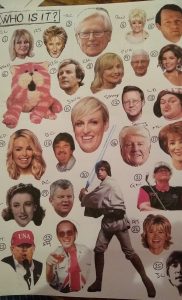
Over at the quiz everything went ok and then I noticed number 23 in the picture round. Who was that fresh faced youth looking very 1970’s? Yes that was me. Not many people got a point for that one but the team next to us thought it was a young Roger Moore. Yes, I can see the resemblance . .


What to do next: Here are a few options.

Share this post on your favourite social media!

Hit the Subscribe button. Never miss another post!

Listen to my podcast Click here.

Buy the book! Click here to purchase my new poetry anthology.

Click here to visit Amazon and download Floating in Space to your Kindle or order the paperback version.

Back to the 1960s

The 1960s seem like a long way off these days. We moved into the 1970s 54 years ago but even so, the 1960s were a revolutionary time in terms of music, the cinema and of course TV. This last Sunday afternoon after a gruelling session of blog writing, I settled down in front of the TV with a cup of tea and a cheese sandwich and what did I find? Well, a whole stack of TV shows from the 1960s still bringing in viewers today in 2024.

So, what did I watch? Well, time to settle back for some serious TV viewing.

Columbo

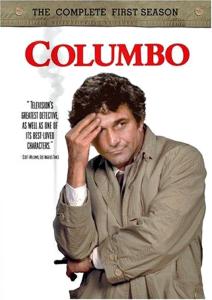
Columbo, as you probably know, differs from other TV detective shows by showing the viewer exactly who the murderer is and how he, or she, did it. The whole point is not who did it, but how Columbo catches them. The essence then of a great episode comes in the clever way Columbo nails his man, or woman. Sometimes that moment is a bit of a non starter, other times it’s nothing short of brilliant. Sometimes, even if that final moment is not so great, it’s still been a great episode.

The Columbo of the early series is an absent-minded quirky fellow although in later episodes, Peter Falk who plays the detective, seems to downplay that quirky element. The later episodes are still pretty good though and among various episodes on TV today was Any Old Port in a Storm with Donald Pleasance as the guest murderer. Pleasance plays Adrian Mancini, the part owner of a wine producing business. He is something of a wine snob and he has just been voted ‘man of the year’. That was the good news; the bad news is that his half brother is threatening to sell the business. That of course doesn’t go down well so Adrian in a fit of anger bumps him off. A whack on the head didn’t quite do the job so Adrian leaves him to suffocate in his wine cellar. Unfortunately, it happens to be a really hot day which eventually leads Columbo to the clue that bags the culprit.

That was an episode from 1973 but the original Columbo pilot first aired in 1968.

Thunderbirds

Thunderbirds was about a secret organisation called International Rescue that had a small fleet of highly advanced machines and equipment with which to perform rescue operations. Millionaire ex-astronaut Jeff Tracy was the head man and the organisation was secreted in his island home. His five sons were the Thunderbird pilots, John, Scott, Virgil, Gordon and Alan, all named after US astronauts of the 1960s. The genius behind the Thunderbird craft was Hiram Hackenbacker, known as ‘Brains’. Thunderbird’s nemesis was a secret agent known as the Hood because of his talent for disguise and in many episodes the Tracy brothers had to ask their London agent, Lady Penelope, to track him down and sort him out.

Lady Penelope Creighton-Ward lived in a huge mansion somewhere in southern England and her manservant and chauffeur was Parker, a reformed safecracker. The head of ITV Sir Lew Grade saw the first episode and was so impressed that he asked for the episodes to be extended from 30 minutes to a full hour, less TV adverts of course. Gerry wanted Fenella Fielding to voice Lady Penelope but in the end, his wife Sylvia took on the role.

One other thing, I know Thunderbirds sounds pretty sophisticated from those last two paragraphs but it was actually a puppet series aimed at children. The great thing about it and really, the secret of its success, was the highly intelligent scripts which treated its audience of children not as kids but as intelligent young adults.

Two scripts that spring to mind were one called The Cham Cham about a code transmitted on a musical melody and another where Parker was called upon to break into the Bank of England. Later in the episode someone is trapped inside the vault and Parker is asked to break in again to rescue the man before the air is used up in the vault. Parker though thinks that his old mate, a bank robber recently released from prison, is about to complete his life’s ambition to break into the bank and so he tries to slow down his and Penelope’s drive into London. Everything of course comes right in the end though.

Time for a fresh cup of tea and I’m ready for the next programme.

Batman

We are probably all familiar with the modern Batman films which all have pretty grim and dark overtones. Tim Burton directed the first modern Batman film in 1989 which starred Michael Keaton as Batman and Jack Nicholson as the Joker. Back in 1966 however there was a TV series produced by William Dozier which starred Adam West as Batman and Burt Ward as Robin.

The suave Alan Napier played the part of Alfred, the butler to Bruce Wayne (Batman’s alter ego) and numerous guest stars played the villains. Frank Gorshin was a memorable Riddler, Burgess Meredith (remember him as the trainer in the Rocky films?) played the Penguin and Cesar Romero who refused to shave off his moustache played a rather manic Joker. Julie Newmar and Eartha Kitt both played Catwoman. George Sanders and Vincent Price also appeared as guest stars and even Hollywood director Otto Preminger appeared on the show as Mr Freeze. Anyway you look at it, that is an impressive cast list.

The episodes were all two parters and in the UK were aired on Saturday and Sundays; the Saturday episode always left the Dynamic Duo in some impossible situation and the Sunday one showed how they would escape and track down the villains. The series was very light hearted unlike the modern Batman films and in fact played rather like a live action cartoon series.

The series ran for three seasons and a feature film before being cancelled. In the UK episodes are currently being broadcast on the Talking Pictures channel.

Mission Impossible

The TV show was created by producer Bruce Geller and concerned a team of special agents known as the Impossible Missions Force. They are a US government agency which takes on hostile foreign governments, South American dictatorships and criminal organisations.

In the first series the team is led by Dan Briggs played by Steven Hill but he was replaced for season 2 by Peter Graves in the part of Jim Phelps. Other regular team members were Leonard Nimoy, Martin Laudau and his wife Barbara Bain, Greg Morris and Lesley Anne Warren. Each played a team member with a particular skill, for instance Laudau and Nimoy played agents with a talent for impersonation and disguise, Greg Morris played an electronics expert and so on.

Mission Impossible ran for 7 seasons and was cancelled because, according to Wikipedia, the producers at Paramount found they could make more money by syndicating the existing series rather than making new ones.

A revival series was made in the 1980’s also starring Peter Graves. To save money the series was not filmed in Hollywood but in Australia but it only lasted two seasons and was largely unsuccessful.

A great feature of the series was the opening title sequence which involved a match being struck and then lighting a fuse shown over quick clips of the upcoming episode to the sound of the iconic theme tune written by Lalo Schifrin. Next would be Jim Phelps listening to his tape recorded instructions which after being played would then self-destruct. Phelps would then look through his agents’ files complete with photos and choose who he wanted for the mission. Sometimes a guest star would play one of the agents who would be introduced by Jim checking out his dossier. A team briefing would then take place and the mission would get under way.

The IMF used a great deal of gadgets to accomplish their missions; secret listening devices and other electronic hardware as well as incredible masks and make up to impersonate people. One particular episode that I remember was when the team had to retrieve some stolen gold from a South American dictator’s safe. They did it by drilling a small hole in the safe, heating it until the gold melted and ran out down the small hole then a little gadget sprayed the interior of the empty safe to cover the hole. Mission Impossible was staple viewing in our household in the late 1960’s and it was nice to see once again on UK TV.

From Russia with Love

I’m perhaps cheating a little here because this is a film rather than a TV show but what the heck, it popped up on ITV so I thought I’d watch it. Just lately there seem to be James Bond films popping up on TV almost every week. This film was the second in the Bond series, made in 1963 and it’s probably one of the very best. There are no super villains trying to take over the world and the plot is actually pretty sensible. SPECTRE -the Special Executive for Counter Intelligence, Revenge and Extortion- decide to offer British Intelligence a Soviet Lektor decoding machine but the catch is, the lovely Soviet consulate clerk chosen for the mission and based in the Soviet embassy in Turkey will only offer it to Bond himself.

Sean Connery played James Bond of course and the Soviet clerk was Tatiana Romanova played by Italian actress Daniella Bianchi. A great Bond villain was former Soviet agent now a part of SPECTRE, Rosa Klebb played by Lotte Lenya. The best performance though was by Robert Shaw who plays Red Grant, the killer specially trained to eliminate Bond. Bond and Grant have a hugely exciting fight in a railway carriage towards the end of the film which underlines the serious and gritty nature of the film. I don’t think I’m giving anything away when I tell you Grant wasn’t successful but Rosa Klebb nearly gets Bond with a concealed knife in her shoe.

I could have gone on and talked about Star Trek, The Saint with Roger Moore and even The Avengers with Patrick MacNee as Steed and Diana Rigg as Mrs Peel.

Yes, in some ways the 60s are done and dusted but when it comes down to it, you only have to tune in to a few vintage TV shows to relive it all again.


What to do next: Here are a few options.

Share this post on your favourite social media!

Hit the Subscribe button. Never miss another post!

Listen to my podcast Click here.

Buy the book! Click here to purchase my new poetry anthology.

Click here to visit Amazon and download Floating in Space to your Kindle or order the paperback version.

Holiday Book Bag 2024 Part 4

As usual I always take a number of books with me to read when I’m on holiday. There is nothing better than having a long pleasant read in the sun interrupted only by visits to the pool. This year we only had a swimming pool for just over a week and even then there wasn’t much sun but I still managed to get in some reading. Anyway, time to open up my book bag and see what’s in there.

The Dark Side of Camelot by Seymour Hersh

This was a book which I read a long time ago and thought it was ready for a re-read. It is essentially a book which tries to shatter the image of the long dead President Kennedy. It’s an exercise in character assassination and talks exclusively about JFK’s numerous faults without any balancing stories about what he actually did well.

The Bay of Pigs was a great disaster for Kennedy. He inherited the invasion plans from the Eisenhower administration in which Vice President Nixon was a prime mover. Nixon felt that an invasion would boost his chances in the election contest against Kennedy but the CIA seemed to be relying on the assassination of Castro to kick off the invasion but that planned murder, for whatever reason, never happened.

JFK told the CIA that US forces would not be assisting in the operation but it turned out that the CIA was relying on exactly that, intervention by US forces. The invasion was a disaster and Kennedy privately blamed the CIA who he felt were trying to force his hand in committing American forces. Hersh of course, blames Kennedy.

The most shocking element of the book probably comes from interviews with four former secret servicemen who tell numerous stories of JFK’s aides, Dave Powers and Kenny O’Donnell, bringing in call girls and prostitutes to service the President whenever his wife Jackie wasn’t around. The White House pool seems to have been a particular favourite of Kennedy’s, not for a relaxing swim but for naked skinny dipping and sex with various women, some of whom were White House secretaries.

Throw into the mix father Joe Kennedy’s booze smuggling activities and relentless spending to get his son elected and the author paints a pretty dark picture of the Kennedy White House. Still, as I said earlier, this book is a one sided view. It’s worth reading more about JFK before you make your mind up.

Ten Days to Destiny by John Costello

I’ve always been interested in the Rudolf Hess mystery. Why did Hess fly to England? Why are the Hess files sealed for so long? What was the real story? This was a book about the mystery or so I thought. Actually it’s about the various peace initiatives that were made even while Churchill, the new prime minister, had vowed to fight on and which eventually culminate in Hess arriving in the UK in the latter part of the book.

After the declaration of war in 1939 the government had to bring in Churchill who had long warned about the Nazi menace. Later, when the government realised that a national government was needed, comprising all the main parties, the opposition, the labour party led by Clement Attlee, refused to serve under Neville Chamberlain who they believed had actually caused the crisis by his policy of appeasement. Chamberlain wanted Lord Halifax to take over as prime minister and even put the question to Churchill, asking him would the country be willing to accept a leader in the Lords rather than the Commons. Churchill declined to answer and of course it was later that Chamberlain recommended Churchill to the King.

The author seems to think that part of the deal with Churchill was that Chamberlain should stay in the government and also still retain the leadership of the Conservative party. He even seems to think that Chamberlain had plans to return to number 10 Downing street at a later date. However, Chamberlain died of cancer not long afterwards.

Various others though, in particular Lord Halifax, seemed to be putting out peace feelers to representatives of Hitler who wanted to turn his attention to the Soviet Union rather than fight with the UK. Various people seemed to be trying to negotiate including Mussolini and the Pope. The flight of Hess seems to have come about because of letters intercepted by MI5 from Hess to the Duke of Devonshire. MI5 sent fake replies to Hess which encouraged him to come to the UK for unofficial talks.

Overall this was an interesting book but not not an easy one to read.

Bill Clinton: Mastering the Presidency by Nigel Hamilton

This book was the sequel to another book about Bill Clinton. The first one dealt with Clinton’s early life and his election to the presidency; this one takes us through his first four years as president. The author takes us through the years of the Clinton White House and documents the issues like Troopergate; when the former Governor Clinton’s State Troopers revealed the comings and goings of Bill’s various mistresses, as well as the disaster of his healthcare reform work which he entrusted to his wife Hillary. The public clearly weren’t keen on Clinton’s ‘co-president’ – his wife, and their healthcare proposals were rejected by Congress. The mid term elections were another disaster for Clinton and the Democrats and the book goes on to show how Clinton turned the final two years of his first term presidency around and was able to win a second term.

Unlike the book above, this one was a very easy read and each chapter comes in easily digestible bite size sections.

Encore Provence by Peter Mayle

This is the second follow up to the wonderful A Year in Provence by Peter Mayle. The first follow up was Toujours Provence and neither seem to me to have captured the essential warmth of the first book. This one, just like Toujours is a series of unconnected essays about life in France. It’s a pleasant enough read but not a patch on the original.

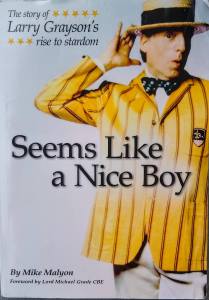
Seems Like a Nice Boy by Mike Maylon.

This is a short biography of Larry Grayson the comedian and one time host of the BBCs Generation Game. I’ve always kind of liked Larry and his camp performances. He was an old style entertainer who found fame in later life after years of summer seasons and working men’s clubs. In a lot of ways his act was similar to the stand up comedy of today; it was a chatty, observational style of comedy that concerned his many creations such as Everard and Slack Alice.

Many have speculated about his true sexuality but it’s clear that Larry enjoyed being labelled as camp rather than gay. The main relationship in his life was with his sister who became a mother figure to him when his adoptive mother died. The two lived next door to each other for many years in later life.
Larry’s career seemed to end when he stepped down from The Generation Game, assuming the BBC would find him some other TV vehicle. They never did. Larry died in 1994.

All in all, an enjoyable read with some interesting insights into the world of entertainment.


What to do next: Here are a few options.

Share this post on your favourite social media!

Hit the Subscribe button. Never miss another post!

Listen to my podcast Click here.

Buy the book! Click here to purchase my new poetry anthology.

Click here to visit Amazon and download Floating in Space to your Kindle or order the paperback version.