One of the great things about having a lazy relaxing time in France is that I have plenty of time to settle down after a meal or a swim and have a long relaxing read. Here are a few more of my holiday reads.

The Eagle has Landed by Jack Higgins

I’ve seen the film of this numerous times and although it isn’t a particular favourite I’ve always enjoyed it. My brother died earlier this year and when I cleared his flat out, I noticed this book. He had urged me a number of times to read it as he said it was rather different to the film so I brought it along on holiday and thought I’d give it a read.
It actually reminded me a little of The Day of the Jackal, in that the book focusses mainly on the preparations for the operation and the action only occupies a small portion of the book.
In the opening pages Hitler has a rant about various things but praises the operation of Otto Skorseny who brilliantly freed the Duce, Mussolini, from captivity and brought him to Hitler. He chastises Admiral Canaris for not being able to do a similar operation such as kidnapping Churchill and Himmler, always wanting to please his Führer, takes note.
Canaris feels he has to placate Hitler and following on from a comment from Himmler decides to put forward a feasibility study. He assumes Hitler will forget about the whole project but Himmler gets wind of the study which he feels could work and forces one of Canaris’ aides to follow through with the project.
Colonel Radl, the aide in question, recruits Lieutenant-Colonel Kurt Steiner and his team who are veterans of fighting in Russia and various other places but due to Steiner’s defence of an escaping jewish girl, have now been relegated to a penal unit. Radl also engages Liam Devlin, an IRA soldier, to act with a British spy who has advised the details of a visit by Winston Churchill to a remote English village.
Verdict: The author builds up all the elements of this story in a tense and exciting fashion and the result is a really enthralling read. This result was much better than the film version even though the film is a great watch. I think I might look out for more books from Jack Higgins.
Mandy by Mandy Rice-Davies and Shirley Flack

This was another of my late brother’s books. He had mentioned to me that he was interested in the Profumo scandal and in fact, many years ago, he and I went to see the film Scandal at the cinema.
This book is an autobiography of sorts by Mandy Rice Davies who wasn’t really connected directly to the Profumo affair although she was a friend and flatmate of one of the principals, Christine Keeler.
As a young girl Mandy aged 16, real name Marilyn, left home in Birmingham and caught the train into London. That same day she auditioned for a job as a dancer in a night club and after getting the job she was given lodgings for 12 weeks after which she and Christine Keeler, a fellow dancer, became flatmates. There was a strict rule at the club which was that employees could not fraternise with the club’s members. The members were all very well-off gentlemen and many of the dancers flouted the rules. Christine and Mandy were invited out by various people and taken to exclusive clubs and restaurants and met many of the rich and famous of the day.
Marilyn did a lot of modelling assignments and was encouraged to use a different name to Marilyn so after some thought she came up with Mandy. She and Christine were youngsters who sought out fun and adventure and the two befriended an osteopath by the name of Stephen Ward. Ward introduced the girls to many celebrities of the day and one day Christine confided in Mandy that she was having an affair with a government minister, John Profumo.
Mandy was called a sex worker in the famous court case but as she points out in this book, she was not a sex worker or prostitute even though she was promiscuous and had a number of affairs. Neither was Stephen Ward a pimp or someone who lived off the earnings of prostitutes. Mandy was famous for admitting in court that she had had sex with Lord Astor. When she was told that Astor had denied the claim she famously replied ‘well, he would, wouldn’t he’?
Mandy had a long affair with Peter Rachman who later became infamous as someone who rented out run down properties to immigrants and used various thugs to make sure the rent was paid. Rachman was a self-made millionaire who survived concentration camps in both Nazi Germany and the Soviet Union. He died of a heart attack aged only 43 and Mandy was shut out of his properties by Rachman’s widow. Not only that but various gifts Rachman had made to her including a brand-new Jaguar car were swiftly repossessed.
In later life Mandy married and moved to Israel and describes life there as the owner of one of Tel Aviv’s first nightclubs as well as life during the 6-day war and other conflicts.
Verdict: This was a really well written and insightful book, whether that was due to Mandy or her co-writer I’m not sure but it was a hugely interesting and enjoyable read.
 Death of a Celebrity by MC Beaton
This was another Hamish Macbeth mystery and I’m slowly ploughing on through the entire series. In this one a brash young TV presenter decides to make a new TV series exposing various scandals in Scotland and when she appears in the village of Lochdubh in search of new stories for her TV show, many people are not happy. When she gets murdered Macbeth has to find the culprit.
Verdict: This was a pleasant enough read but I began to lose interest somewhere in the middle and although the case was finally wrapped up, I didn’t find it quite as enjoyable as some of the previous entries in the series.
Young Stalin by Simon Sebag Montefiore
You wouldn’t think that new information about a character like Stalin could be forthcoming in this day and age, however, with the fall of the Soviet Union in the 1990s, the author has searched various archives in Russia and Georgia and unearthed much that is new about Josef Vissarionovitch Djhugashvili.
The future Soviet dictator was born in Georgia. His father was a shoemaker and his mother wanted him to become a priest. Stalin did study as a priest but later became an atheist and left the church to join local revolutionaries in Georgia.
 Stalin became one of the leading providers of funds for the revolutionaries. He did this by masterminding numerous bank robberies and sending the funds on to Lenin.
He eluded the Tsarist authorities many times but even so, he had to endure prison as well as exile to Siberia.
Later Stalin ran various printing presses and also edited newspapers for the revolutionaries. In 1917 he was exiled to a place close to the Arctic circle. In exile he read voraciously and became close to the hunters who used the reindeer in much the same way as the Native Americans used the buffalo. They used them for food, their used skins for clothing and protection from the cold and to a great extent worshipped these creatures for their sustenance.
When the revolution of 1917 broke out, Stalin headed for St Petersburg to link up with Lenin, even at one point disguising Lenin and helping him evade the police.
When Lenin and the Bolsheviks were able to take power from the provisional government after convincing the Soviets, councils of workers and soldiers, to side with them, Stalin was made a commissar, a minister, in Lenin’s new government.

The various faces of the young Stalin
It has always seemed to me that Stalin was the cruel and hardline man and Lenin was the thinker, the politician. In fact, Lenin was a hard and ruthless man too. When someone decreed that no more shootings would take place under the Bolsheviks it was Lenin who called for more shootings. It’s a revolution he said, people must be shot! He liked Stalin because he knew Stalin was ruthless and could get things done. Later, when he realised that Stalin craved power for himself, he tried to have him removed from the leadership but by then he was sick and dying and it was too late.
This is a book about young Stalin and so the book finishes with the October revolution and Stalin’s appointment as one of Lenin’s commissars or ministers. There is an interesting epilogue though and reveals Stalin as an old man visiting his Dacha on the Black Sea coast. He invites many former friends and comrades who he had known in the past and even laments the death of many old comrades even though they were all shot on his orders.
It also gives the chance for the author to reveal the fates of various characters that have crossed paths with Stalin during his early life.
One interesting story which I read in the author’s other book, The Court of the Red Czar, occurred in 1941 when the Nazis invaded Russia. Stalin was a great reader as I mentioned earlier and he was sure after reading Hitler’s Mein Kampf that the Nazi leader would never attack Russia when he was still fighting a war with the west. Despite many warnings, the attack came and Stalin was silent for many weeks. Eventually his generals came to see him. They wanted orders and plans to combat the Nazis. Stalin clearly thought they had come for another reason. His first words were ‘have you come to arrest me?’
It would probably have been better for them and the country if they had.
Verdict: A excellent and well researched biography.
What to do next: Here are a few options.
Share this post on your favourite social media!
Hit the Subscribe button. Never miss another post!
Listen to my podcast Click here.
Buy the book! Click here to purchase my new poetry collection.
Click here to visit Amazon and download Floating in Space to your Kindle or order the paperback version.
Click here to visit amazon and purchase Timeline, my new anthology.
 Just now we have finished our touring part of the holiday and we have come to our rented gîte where we have parked the van and are spending time in this wonderful house that we regularly rent just outside the small village of Parçay-les-Pins.
 I saw the film version of this a few years ago which was pretty good, if a little odd. It was presented in a very peculiar way in that the author, Alan Bennett, is portrayed as two people, one as himself as he appears in the story and two, as himself as he writes the story. That oddity aside it was really a rather good and original film. When I heard there was a book version I quickly went to one my usual internet book stores and promptly bought it.
 Liz and I always visit a village fête at the weekend, usually those with a vide grenier or brocante attached. A vide grenier is just a car boot sale which we both love. I usually pick up connecting leads for my laptop or iPad, after all, you can never have enough electrical leads. Brocantes are more like flea markets or antique fairs. Just the kind of place to pick up those old telephones that I still love, especially those Bakelite ones.
 I picked this book up ages ago and thought it would be a good holiday read. I’ve always liked Roger Moore even though I absolutely hate his James Bond films. I love Moore’s self-deprecating humour, plenty of which is evident in this book. The first part of the book was really interesting and entertaining but like a lot of celebrity autobiographies, this one just gets a little tedious when Roger just seems to list the films and locations and other celebrities he seems to know. On the back of the book was a review claiming this to be the best film autobiography since David Niven’s
  We came over on the ferry from Portsmouth to Caen after spending the night in a small pub called the Jolly Boatman somewhere in the south of England, actually Kidlington, I think. We have visited this pub once before back in May and it was nice to find that the staff remembered us even after just one visit. The trip over on the ferry was good. We paid a little extra for a top of the range cabin and it was well worth it. We had a little balcony, a tv, kettle and various cold drinks in the fridge. After a bit of a sleep and a shower, we awoke refreshed and ready to find a place to stop for the night in France.
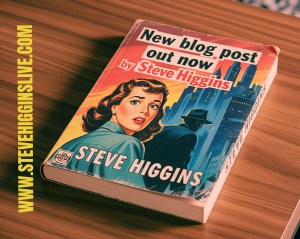 To be honest, I do use ai, not to write posts but to make the quirky memes and graphics that I use to promote my blogs. This is one over to the right. I had never even thought about using ai to actually write a post. Even so, I thought as I was a bit low on ideas it might be interesting to ask ai what I should write about. It came up with a plan for a post asking me to answer various questions about my work. Anyway, here are a few of them.
 I’m betting that whatever this guy had produced it couldn’t compare with Billy’s dazzling line-up of classic films.
 Rooting around in a secondhand shop in St Annes recently I picked up a hardback copy of Winston Churchill’s book My Early Life. It’s a thoroughly wonderful book written in Churchill’s inimitable style. He says in the introduction he has written a book about a vanished age and indeed he has. Churchill was born in 1974 at Blenheim Palace in Oxfordshire. He was the son of Lord Randolph Churchill who was in turn the son of the 7th Duke of Marlborough. His mother was an American, Jennie Jerome, the daughter of an American businessman. She married Lord Randolph and became Lady Churchill.
 Looking back, I must have seen the film version before I read the book. Young Winston was directed by Richard Attenborough and is a wonderful adaptation of the book. When Winston first attends school, which of course was boarding school, his headmaster was played by Robert Hardy and he directs Winston to learn some Latin. Winston doesn’t do very well and the headmaster glares down at him and informs him that if he misbehaves, he will be punished, which to a great extent was Churchill’s overall view of school. Later he comments about exams ‘they always contrived to question me about things I didn’t know. I would much rather they asked me about things I did know.
 The charge was depicted in the film Young Winston and in his book Churchill ponders about fate and a problem with his shoulder which necessitated using his revolver rather than his sword during the charge, reflecting that if he had been using his sword he might well have been killed in the latter stages when he was surrounded by the enemy.
 One of things I particularly liked about Young Winston was the music. I bought the soundtrack album in 1985. The music for the film was in the main composed by Sir Alfred Ralston. He was brought into the film by director Attenborough as the two had worked together on a previous film, ‘Oh what a Lovely War’. The soundtrack features music by Edward Elgar, notably the Pomp and Circumstance March no 4 as well as Nimrod from the Enigma Variations.
 Churchill ended up in a POW camp but resolved to escape despite also claiming to the Boers that he was a correspondent and should not have been detained. With the help of a group of Lancashire miners, Winston stowed away on a goods train and made his way back to the British lines.


 Goldfinger is probably one of the best books in the Bond series and only the second 007 book that I ever read. (I’ll tell you about the first one later). I was at school at the time and for one of our assignments in English, we were asked to bring in a book which contained a really good description of a character. I chose Goldfinger as in it, Ian Fleming describes Goldfinger as a man who appeared to have been made using bits of other peoples’ bodies. This must have been in the mid-1960s and although the character of James Bond was pretty well known, the films had not begun to permeate down to the television screen.
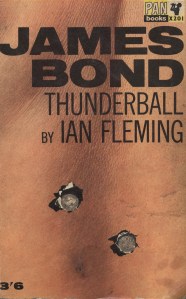 This is an interesting story and the resulting film has perhaps become the quintessential Bond film even more so than Goldfinger. The story is about a criminal underworld organisation (SPECTRE) that steals an aircraft with nuclear weapons and holds the west to ransom threatening to explode the bombs.
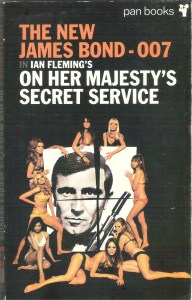 In this book the secret service find that Blofeld, the head of SPECTRE, is trying to assume the identity of the Comte Balthazar de Bleuville. Bond poses as Sir Hilary Bray of the College of Arms in order to meet with Blofeld. Interestingly, Sir Hilary gives Bond a quick resumé of Bond’s family history including the Bond family motto ‘the world is not enough’ which was used by the film producers for the title of a later 007 film unrelated to Fleming’s books.
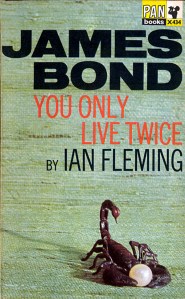 This book follows on from the previous one and we find James Bond depressed and disillusioned with his job after the death of Tracy. M considers sacking Bond but instead sends him on a diplomatic mission to meet the head of the Japanese secret service. The British want access to Russian documents which the Japanese are currently decoding. The Japanese decide to offer this information to Bond if he will assassinate a British resident who has created a garden of death, a garden full of poisonous plants which are attracting many Japanese citizens who want to commit suicide. Bond realises that this man is Blofeld and decides to keep this quiet until after he has killed him.
 Casino Royale is the first book in the 007 series and it’s a pretty interesting and original one too. ‘Le Chiffre’, a gambler and also a member of SMERSH, a murderous department of the KGB is engaged in a desperate effort to win a great deal of money at the casinos of Royale Les Eaux in France. Le Chiffre is desperate because he has used SMERSH funds for his personal use and his spymaster bosses will not be pleased if they find out. Britain’s secret service happens to find out about this and sends Bond to France to make sure Le Chiffre doesn’t recoup those funds as of course as we all know, James Bond 007 is a bit of an expert with the cards.
 This was the second Bond book to be published and the action takes place in the USA and the Caribbean, which Fleming loved and bought a house there which he named Goldeneye. Live and Let Die and in fact the whole book series were recently reissued with all the politically incorrect stuff removed which makes me wonder whether there was in fact anything left to publish after that process was complete. The book was published in 1953 and comes complete with all the prejudices and sexual and racial intolerances of the era. In one segment when Bond visits Harlem, Fleming tries to reproduces the accents and slang terms of the black people of Harlem and for me it’s not one of Fleming’s best books. In the film version, Roger Moore took over the licence to kill and the result was a very tongue in cheek version of James Bond. Sorry but Roger Moore as Bond just wasn’t for me. The film did feature a great theme song from Paul McCartney which was really a little underused in the film. Another feature of the film was a power boat chase along the Bayous of Florida which was a lot of fun but not entirely serious.
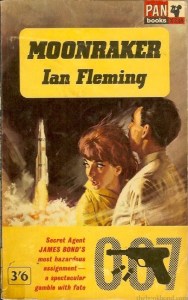 This was the third entry into the 007 series and the action takes place mostly in Dover. Millionaire Hugo Drax wants England to enter the space race and so he spends his own money on a rocket named the Moonraker which he intends to donate to the British government. It turns out that Drax is actually a nazi who wants to avenge defeat in the second world war by arranging for the rocket to destroy London. I read recently that Fleming wrote the book while staying in a cottage situated down by the famous chalk cliffs of Dover which was once owned by Noel Coward and later Fleming himself. It’s not a bad read at all and starts off with M asking Bond a favour as he suspects Drax to be cheating at cards and he wants Bond to see if he can sort things out as at the time, this was the mid-1950s, cheating at cards in London high society could really be a big scandal.
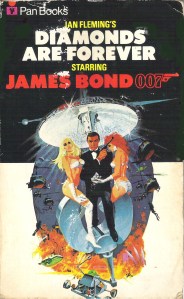 Fleming wrote this book at Goldeye, his house in Jamaica, after doing a great deal of research about diamond smuggling. Bond’s mission is to investigate a diamond smuggling ring and he does this by impersonating a diamond smuggler called Peter Franks. Franks leads Bond to an American woman called Tiffany Case who he begins to fall for. He tracks the smuggling ring to the American Spang brothers, leaders of the Spangled Mob, a criminal gang. The finale takes place in the Spangs’ restored western town, Spectreville.
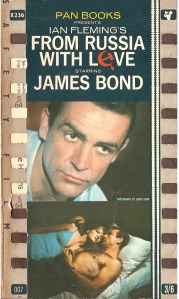 British Secret Service. To do this they persuade a cypher clerk, Tatiana Romanova, to pretend to defect to the west with a Spektor cypher machine. She claims she will only to defect to Bond, having fallen for him after reading his KGB file.
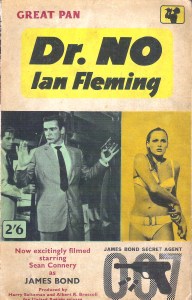 Prior to the writing of this book, a firearms expert called Major Boothroyd wrote to Fleming explaining that an agent like Bond would never be armed with a Baretta as it was more of a ladies gun. Boothroyd recommended a Walther PPK. Fleming was so impressed he included the new gun in Dr No and also added a new character named Boothroyd as the armourer of the secret service.
 A long time ago I decided that I would set myself the task of reading the entire Hamish Macbeth series of books. There are 34 books in the series, all written by author M.C. Beaton which is in fact a pen name for Marion Chesney. Marion actually wrote many books under various pseudonyms including Ann Fairfax, Jennie Tremaine, Helen Crampton, Charlotte Ward and Sarah Chester. After Marion’s death in 2019 further Hamish Macbeth novels have appeared penned by writer R.W. Green.
 I mentioned a while ago about my

 Letters from an Unknown Author!