 Usually in these Film Connections posts, I tell a sort of circular story starting with an actor or director and then find a link to another film or personality and then another until I work back to whoever I started with. This week I decided to be a little more lateral and try and link Pygmalion, the 1938 film to the first Star Trek film from 1979. I like to be different now and again but not only that (confession alert) I struggled to find a link back to Pygmalion. (Actually I did find a very tenuous link and I’m not sure as I write this that I’m going to share it but we’ll see how things go).
Pygmalion
Pygmalion is a famous play by George Bernard Shaw which was made into a film in 1938 with a script adapted by Shaw himself. Leslie Howard starred in the film as Professor Higgins. Higgins is a linguist who boasts that he can make Eliza Doolittle, a cockney flower seller, into a lady. Doolittle was played by Wendy Hiller.
Professor Henry Higgins actually makes a bet that he can take Eliza Doolittle, a Cockney flower seller with a seriously strong accent, and pass her off as a refined lady just by teaching her how to speak “properly”. What starts as a kind of experiment turns into a full-on transformation, with Eliza learning manners, speech, and confidence, but she also begins to question how she’s being treated. Is she a person or just Higgins’ project? Things get tense after her big high-society debut goes off without a hitch, because suddenly the question isn’t whether she can fit in, but where she actually belongs and whether Higgins deserves any credit (or forgiveness) at all. It’s witty, a bit biting and surprisingly emotional under all the clever dialogue.
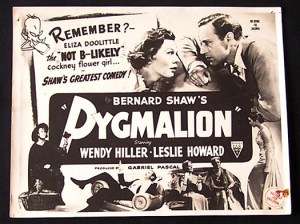 Interesting fact #1: Wendy Hiller speaks a controversial line in the film – “not bloody likely” making her the first person to swear in a British film. It’s a controversy that’s almost laughable today considering the language used in modern films. Have you ever wondered who the first person to use the F word in a British film was? (Answer at the end of the post).
Interesting fact #2: The film was edited by future director David Lean.
My Fair Lady
The musical version of Pygmalion was created by Alan Jay Learner and Frederick Lowe. They worked for a long time on the musical, even while trying to get permission from GB Shaw’s estate for the musical rights to the play. Eventually they succeeded and the production opened on Broadway after a four week try out in Philadelphia. Rex Harrison played Higgins with newcomer Julie Andrews as Eliza. The play used many scenes written by Shaw especially for the 1938 film version. When Jack Warner acquired the rights to the film, he decided he wanted a famous name to play the part of Eliza and Julie Andrews was dropped in favour of Audrey Hepburn. Audrey played a good part but personally, I’ve always thought it was a tragedy that audiences never got to see and hear Julie Andrews in such a wonderful role.
Interesting fact #3: Hepburn’s singing voice was dubbed for the film by Marni Nixon.
The Sound of Music
The Sound of Music was based on the stage musical version with music by Richard Rodgers and Oscar Hammerstein. The story was based on the real-life story of the Von Trapp family singers which was originally written in book form by Maria Von Trapp. Maria was a nun who takes a job as a governess with the Von Trapp family and later falls for their widowed father, Captain Von Trapp.
In the film version Christopher Plummer played the part of the captain and Julie Andrews starred as Maria. It was Julie’s second film after her film debut in Mary Poppins in 1964. The screenplay was written by Ernest Lehman and he particularly wanted Robert Wise to direct. At first William Wyler was assigned to direct but when he wanted a delay to complete another film, Lehman was able to get Wise to join the film. He and Lehman worked closely together to bring the story to the screen.
Personally, I’m not a great fan of musicals but I’ve always loved this film, in fact I watched it only the other day to prepare for this post. The songs are really wonderful and the story of the family and their later escape from the Nazis in Austria is really well told. Julie Andrews plays a great part but then so do all the actors including Christopher Plummer. I’ve heard both of them in interviews making a little fun of the film but I’m sure they must have been proud of it really. Four weeks after its release, the film became the number one box office hit in the USA. According to Wikipedia, by November 1966 The Sound of Music was the highest grossing film in history up to that time.
Interesting fact #4: Marni Nixon, the woman who dubbed Audrey Hepburn’s singing in My Fair Lady plays the part of a nun in The Sound of Music.
Star Trek
The director of The Sound of Music was Robert Wise who, like David Lean, was originally a film editor before turning his hand to film direction. In fact, he was an editor on that great film classic Citizen Kane. Another film he directed, one radically different to The Sound of Music, was Star Trek; The Motion Picture.
Star Trek was a TV series that lasted three seasons from 1966 to 1969 before its cancellation. It had a huge fan base and producer Gene Roddenberry tried to get the series resurrected. A cinema version was planned for the mid 70s but this was cancelled in favour of a new TV series to be known as Star Trek Phase Two. After the huge success of Star Wars, Paramount decided to change tack again and focus on a film. The basis for the film was apparently the pilot episode of the planned TV series, expanded for a cinematic film. The resulting film was good and I have always enjoyed it but it moves along at a very slow pace and does not have that something that made the TV shows tick over so well. The crew from the original show are gradually introduced. Kirk is given command of the enterprise once again, Doctor McCoy refuses to have his atoms scrambled in the transporter, Mr Scott once again takes over control of the engines and Mr Spock leaves the planet Vulcan to have his science officer status renewed. I can sum up the story by quoting Admiral Kirk; “Scotty, an object of unbelievable size is heading towards earth. Enterprise is the only starship in the area. Ready or not, she launches in 12 hours!” Or something like that.
Interesting fact #5: William Shatner who played Captain James T Kirk was great friends with Christopher Plummer and the two appeared together in Star Trek VI in which Plummer played a one-eyed Klingon general. I’ve always thought it was the absolute worst of the Trek films but having said that, it apparently won an award for the best science fiction film of the year.
Linking back to Pygmalion
If you do a search on Google for a possible link to Star Trek, the results come up for an episode of Star Trek Voyager (episode 22, season 5, Someone to Watch Over Me) in which the Doctor (the holographic Doctor who is not a real person but a computer program) decides to nurture Seven of Nine in the ways of human relations and love. Seven, in case you have never watched Voyager, is actually Annika Hansen who was captured by the Borg as a young girl and assimilated into the Borg Collective. (The Borg are an alien race by the way). Now the Voyager crew have freed Seven from the Borg, she’s not very good at person-to-person general relationships (neither would you if you had been trapped in the Borg Collective for years) so the Doctor becomes a sort of Professor Higgins to Seven’s Eliza.
That’s such a thin link back to Pygmalion I might as well not have mentioned it!
Just to finish with, I wondered earlier about the first person to use the ‘F’ word in a British film. According to Google, it was Marianne Faithful in that unforgettable (sarcasm alert) 1967 film ‘I’ll Never Forget What’s ‘Isname’ directed by Michael Winner.
1967? I wasn’t expecting that!
 My original idea for this post was to write about 90s British films but then I realised some of those 90’s films were actually from the 2000’s. I then changed tack to a blog about films written by Richard Curtis but that meant cutting out a few films that I really wanted to include. Then I thought what about films with Hugh Grant? Great but although many of the films below feature Hugh, I’ve got a personal favourite in which he doesn’t star. That of course has led to the final incarnation of this post, 5 British Rom-Coms.
 It’s always nice to see my regular post published on a Saturday at 10am but almost as soon as it goes out into the world of the internet the first thing I think about is what shall I do next?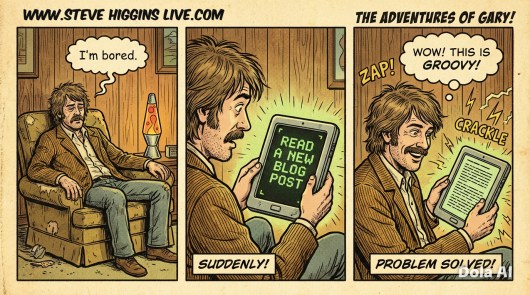
 Tv programmes of course cost money, quite a lot of money in fact. Back in the 1990s when I was fresh from a video production course and hoping to actually get a job in the TV industry (I never did) I was told an hour of television costs £100,000. What it costs nowadays is anyone’s guess but then again, it’s so easy to make a TV show in 2026. One of my favourite programmes is Canal Boat Diaries, an entirely self-shot show which has graduated from YouTube onto the BBC and can be seen quite regularly on the U-Yesterday channel. Does that mean an hour of TV is worth more or less than that 90’s figure of £100,000?
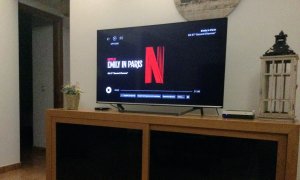 We watched The Crown last year while staying in the Loire valley even though we don’t normally watch much TV on holiday. This year in Lanzarote, we spent many an evening watching Emily in Paris, another Netflix show. I’d found it by searching on the internet for good TV shows to watch on Netflix and Emily came up so we thought we’d give it a go.
 Fry reveals his thoughts about homosexuality and his feelings, either obsession or lust over a boy at his school. Fry went to a public school which confusingly for our American readers is actually a private school. Actually, a private boarding school which eventually Fry was expelled from.
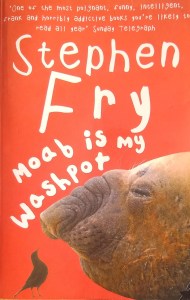 When I was a child I used to have, just like Stephen Fry, lots of daydreams and fantasies. One of them was that the school would be taken over by terrorists and that they would be methodically trying to find someone who was actually a secret agent. That secret agent of course would be me and after biding my time I would, just like Bruce Willis in the Die Hard films, sort out the terrorists one by one. My daydream would usually be shattered by one of the teachers asking me a question like ‘how many degrees in a right-angled triangle?’ and I would suddenly be brought down to earth and desperately try to answer before revealing the inevitable truth that I had not been paying attention.

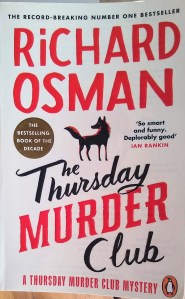 I know I’ve written about this first book already but as it’s part of this month’s holiday read, I feel I have to talk about it once again. As I mentioned in a
 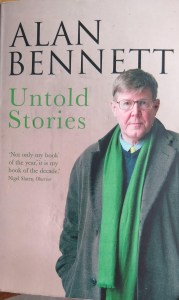 I sought this book out on the internet after reading Bennett’s The Lady in the Van which was a very enjoyable although short book. This volume is a collection of various essays and diaries by the author and it begins with the title essay, Untold Stories which is a series of observations mostly about his mother and father. He describes the life of his family in Yorkshire as he saw it evolve. It is perhaps a very ordinary story of a working class family and their fairly uneventful journey through life. It is very sharply observed and the author takes us through the lives of not only his parents but also of his two aunts as well as other family members. I found this section hugely interesting and with many parallels to my own life, especially when Bennett deals with his aging parents and he has to take them to numerous hospital appointments. His mother suffered with depression and was even hospitalised on a couple of occasions. Later in life she begins to suffer with dementia.
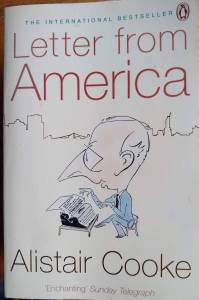 I picked this book up in a sale ages ago, in fact actually a few years ago. I think it was one of those offers like ‘buy two and get one free’. This was my free choice and as such it’s been lying around waiting to be read. It’s a collection from the author’s radio series ‘Letters from America’ which used to be broadcast many years ago on BBC Radio 4. I can’t say I’ve ever listened to the broadcast but I do remember watching a quite exceptional TV documentary series called ‘Alistair Cooke’s America’ which detailed the history of the USA.
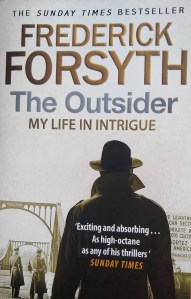 This is not one of Forsyth’s thrillers but an autobiography and it was a really interesting read. Forsyth spoke many languages and he puts this down to learning them with local people. He studied French and German at school of course but then spent the summer holidays in France learning from a French family and then later did the same with a German family and even later with a family in Spain. His observations in France were really interesting. The French welcomed Forsyth as an English hitchhiker with the union flag on his backpack but later when travelling in what had been Vichy, France, he felt the English were not as popular.
 Sometimes when I’ve had a swim and I’m lying on my lounger just drying off in the sun, I often think about my dad who died back in 2000. Not long ago I came across one of my brother’s photos. It was my dad in the back garden of our old house and he was dressed in a vest and shorts, reading the paper with his dog, a pedigree dachshund on his knee. He was not in a chair or a sun lounger but relaxing in a wheelbarrow, just how he did when he was at work and had finished his job.