I originally gave this post the title of Book Bag: Ian Fleming and I intended to talk about the original James Bond books written of course by Ian Fleming. As much as I tried to keep them out, the film versions kept creeping in and so I decided on a quick change to the title, as you can see above. It’s very hard to separate the films from the books especially as I keep reading rumours about the next Bond film in the media. In fact it has just been announced that Steven Knight, the writer who created the TV series Peaky Blinders, has been engaged to write the next film in the spy franchise. Bond appeared to die in the last 007 epic No Time To Die which, certainly for me, wasn’t a particularly great film. I honestly think that the producers have got the character mixed up a little with either Ethan Hunt from the Mission Impossible series, Bruce Willis from the Die Hard franchise or perhaps Jack Bauer from 24. Bond isn’t a rogue agent. He isn’t a maverick cop or spy either. He’s a former naval intelligence officer and a serving officer of the secret intelligence service who is trained to follow orders and use his initiative in certain situations. In order to get back to the original James Bond it’s time to look at the source material, namely the books by Ian Fleming and see how they compare to the films.
Casino Royale
 Casino Royale is the first book in the 007 series and it’s a pretty interesting and original one too. ‘Le Chiffre’, a gambler and also a member of SMERSH, a murderous department of the KGB is engaged in a desperate effort to win a great deal of money at the casinos of Royale Les Eaux in France. Le Chiffre is desperate because he has used SMERSH funds for his personal use and his spymaster bosses will not be pleased if they find out. Britain’s secret service happens to find out about this and sends Bond to France to make sure Le Chiffre doesn’t recoup those funds as of course as we all know, James Bond 007 is a bit of an expert with the cards.
The book is interesting in another way too. Ian Fleming sold the movie rights to Casino Royale separately from the rest of the Bond books and this enabled producer Charles K Feldman to produce a movie independently from Eon productions who own the rights to the other books. Feeling that he could not compete with the mainstream movies, Feldman decided to make Casino Royale into a comedy version. David Niven starred as Sir James Bond and ironically, Ian Fleming had mooted Niven as a possible Bond when casting began for Dr No, the first movie in the series.
Eon Productions finally acquired the rights to Casino Royale ready for the debut of Daniel Craig as James Bond. I’ve got to say I didn’t like Craig at first. He didn’t look like Bond and I honestly thought he would have been better cast as one of the Bond villain’s henchmen but I did warm to him eventually and although I didn’t much care for it at first, I really do think Casino Royale is one of the better Bond films. It was released in 2006 and follows the book pretty faithfully which many of the previous films rarely do. Craig’s final Bond film was No Time to Die which I really thought was the poorest of Craig’s five outings as 007.
Live and Let Die
 This was the second Bond book to be published and the action takes place in the USA and the Caribbean, which Fleming loved and bought a house there which he named Goldeneye. Live and Let Die and in fact the whole book series were recently reissued with all the politically incorrect stuff removed which makes me wonder whether there was in fact anything left to publish after that process was complete. The book was published in 1953 and comes complete with all the prejudices and sexual and racial intolerances of the era. In one segment when Bond visits Harlem, Fleming tries to reproduces the accents and slang terms of the black people of Harlem and for me it’s not one of Fleming’s best books. In the film version, Roger Moore took over the licence to kill and the result was a very tongue in cheek version of James Bond. Sorry but Roger Moore as Bond just wasn’t for me. The film did feature a great theme song from Paul McCartney which was really a little underused in the film. Another feature of the film was a power boat chase along the Bayous of Florida which was a lot of fun but not entirely serious.
Moonraker
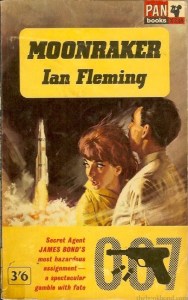 This was the third entry into the 007 series and the action takes place mostly in Dover. Millionaire Hugo Drax wants England to enter the space race and so he spends his own money on a rocket named the Moonraker which he intends to donate to the British government. It turns out that Drax is actually a nazi who wants to avenge defeat in the second world war by arranging for the rocket to destroy London. I read recently that Fleming wrote the book while staying in a cottage situated down by the famous chalk cliffs of Dover which was once owned by Noel Coward and later Fleming himself. It’s not a bad read at all and starts off with M asking Bond a favour as he suspects Drax to be cheating at cards and he wants Bond to see if he can sort things out as at the time, this was the mid-1950s, cheating at cards in London high society could really be a big scandal.
Bond beats Drax at his own game and then finds his next mission is to look into Drax and his Moonraker set up. Interestingly in Moonraker the obligatory Bond girl with the exciting name, in this case Gala Brand, decides not to succumb to Bond’s charms after all. The movie version was a desperate attempt by the Bond producers to compete with Star Wars and was not my cup of tea at all.
Diamonds are Forever
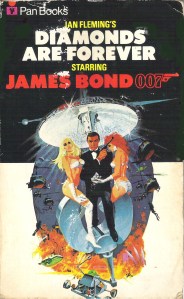 Fleming wrote this book at Goldeye, his house in Jamaica, after doing a great deal of research about diamond smuggling. Bond’s mission is to investigate a diamond smuggling ring and he does this by impersonating a diamond smuggler called Peter Franks. Franks leads Bond to an American woman called Tiffany Case who he begins to fall for. He tracks the smuggling ring to the American Spang brothers, leaders of the Spangled Mob, a criminal gang. The finale takes place in the Spangs’ restored western town, Spectreville.
The film version marked Sean Connery’s final outing as Bond, at least in the ‘official’ Bond films anyway. Connery looks bored throughout the film which seems to begin the trend of slightly less than serious films which Roger Moore continued.
From Russia with Love
According to Wikipedia From Russia With Love was inspired by the author’s trip to Istanbul in 1955 to cover an Interpol conference for the Sunday Times. The plot is very similar to the film version and involves the KGB planning to assassinate Bond and also create a scandal involving Bond and the 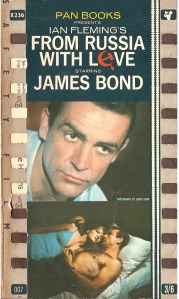 British Secret Service. To do this they persuade a cypher clerk, Tatiana Romanova, to pretend to defect to the west with a Spektor cypher machine. She claims she will only to defect to Bond, having fallen for him after reading his KGB file.
What was interesting about this book was that Fleming had become a little bored with Bond as well as being short of ideas and so he decided to kill off 007 at the end of the book, when he falls victim to KGB agent Rosa Klebb, who stabs Bond with a hidden blade laced with poison. Fleming later developed an idea for the next book and proceeded to revive Bond for Dr No, the next in the series.
The film version closely follows the book but adds the criminal organisation SPECTRE into the mix and is, to my mind anyway, one of the best films in the franchise. Sean Connery made his second appearance as 007 and two excellent portrayals as villains were by Robert Shaw as Red Grant and Lotte Lenya as Rosa Klebb.
Dr No
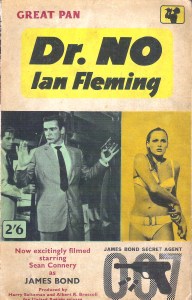 Prior to the writing of this book, a firearms expert called Major Boothroyd wrote to Fleming explaining that an agent like Bond would never be armed with a Baretta as it was more of a ladies gun. Boothroyd recommended a Walther PPK. Fleming was so impressed he included the new gun in Dr No and also added a new character named Boothroyd as the armourer of the secret service.
In Dr No, Bond is recovering from the effects of poisoning in the previous book and so M, the head of the secret service, sends him on a routine mission to Jamaica where the head of the Jamaica station and his secretary have disappeared. Bond finds that they were investigating the secretive Dr No who owns a private island known as Crab Key. After further investigation Bond finds that Dr No is involved in the practice of ‘toppling’ missiles from a nearby US launch site.
Dr No was made into the very first Bond film in the film series with Sean Connery starring as 007. Fleming was rather apprehensive of Sean Connery at first, actually wanting David Niven to play the part. Later Fleming warmed to Connery, even adding a bit of Scottish ancestry into Bond’s back history in the later books.
Bernard Lee played M, the head of the secret service. He went on to appear in 11 Bond films in total and Lois Maxwell made her first of 14 appearances as M’s formidable secretary, Miss Moneypenny.
Tune in next week to read the concluding part of this post.
 A long time ago I decided that I would set myself the task of reading the entire Hamish Macbeth series of books. There are 34 books in the series, all written by author M.C. Beaton which is in fact a pen name for Marion Chesney. Marion actually wrote many books under various pseudonyms including Ann Fairfax, Jennie Tremaine, Helen Crampton, Charlotte Ward and Sarah Chester. After Marion’s death in 2019 further Hamish Macbeth novels have appeared penned by writer R.W. Green.
 I mentioned a while ago about my
  Forsyth did his national service in the RAF and was commissioned as an Acting Pilot Officer in 1956. After leaving the RAF he became a journalist working for the news agency Reuters and later he joined the BBC. He was the perfect choice for a foreign correspondent as he spoke numerous languages including French, German and Russian. In 1967 he was reporting on the war between Biafra and Nigeria when the BBC decided they were no longer interested in that particular war. Forsyth resigned from the BBC and continued to report on the war as a freelance. He even admitted later that this was when he was recruited by MI6 as an informant.
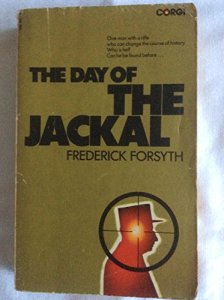 The Day of the Jackal
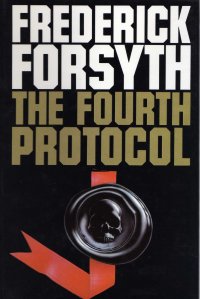 The Fourth Protocol
 John’s book was a great read. He started out working with Alan Bennett as a comedy writer and performer but when he realised that he probably had no future as a tv comedian he got himself a job as a newspaper reporter in Liverpool and later moved over to the BBC as a radio reporter.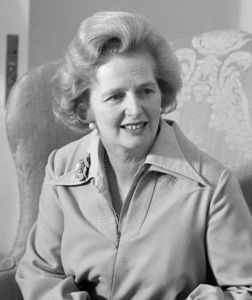

 Essentially, John Darwin was facing bankruptcy after getting hugely overreached on a series of buy to let mortgages. He decided that the only way out was to fake his own death and cash in on some life insurance policies. His wife apparently tried to talk him out of the idea but John, a dominating and overpowering personality, went ahead and faked his own death. Amazingly he even went back to live with his wife, sometimes having to retreat to the bedsits next door when any friends or family came to visit. He arranged a false passport using a method explained in the book ‘Day of the Jackal’ by Frederick Forsyth and then the two, Darwin and his wife, planned to buy property in Panama and live a new life. Later, Darwin decided he wanted to return to the UK under his own name by posing as someone who had suffered with amnesia and in fact one day he disposed of his fake passport, walked into a police station and told them ‘I’ve lost my memory!’
 For me, who has been interested in the JFK assassination since at least 1968 when his brother, Robert Kennedy was also murdered and I was 12 years old, it’s a fascinating record. Others might think perhaps that the author has spread his research too far, that we are not interested in what the President’s pilot thought or did or how the honour guard prepared for the President’s funeral and how the President’s sister or brother-in-law reacted.
 Marlene was one of those people perhaps born at the wrong time. Today might be a better time for her when lifestyles of gay and lesbian people are not so much of an issue.
 This is an autobiography by Fenella Fielding, co-written with Simon McKay, and the title comes from her part in Carry On Screaming when she played a seductive character, possibly derived from the Adams Family, Valeria. In one scene Valeria tries to seduce Harry H Corbett standing in for the absent Sid James as a detective. Valeria asks ‘do you mind if I smoke?’ and then rather than smoking a cigarette, a cloud of smoke seems to arise from her body and envelop her. Harry H Corbett adds ‘just when I was trying to give it up’ before embracing her in the smoke.
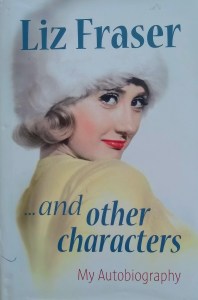 In Fenella’s book above, she mentions that she hoped her book would not go the way of a lot of other showbiz autobiographies, interesting at first but then dissolving into lists of plays and films and other celebrities. Sadly, that seems to be the way this book does go, even so I enjoyed it.
 I do love my showbiz biographies and autobiographies and one I picked up a while back was an autobiography by Dora Bryan. I love Dora from her many appearances in British films but my favourite film is probably
  This final book is the odd one out in this quartet of British comedy stars. It’s a biography rather than an autobiography. I don’t think Tony Hancock ever wrote one.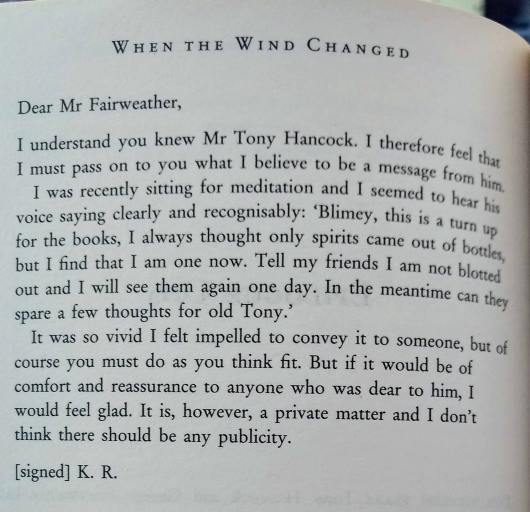
 In my last few posts about books, rather than publish my usual Book Bag posts, I’ve incorporated book reviews into other types of posts; holiday memories and posts about books made into films and so on. During my last few holidays, I always seem to either have a couple of John Grisham books with me or found some in the places, usually rented villas, where we have stayed. I thought it might be an idea to write a John Grisham themed book bag post. Who actually is John Grisham then?
 A Time to Kill by John Grisham
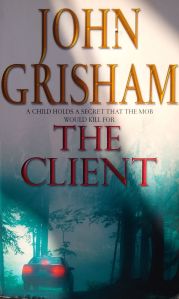 The Client
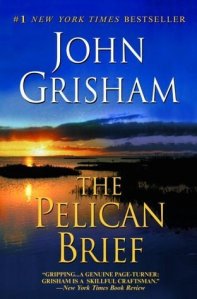 The Pelican Brief by John Grisham
 The Firm by John Grisham
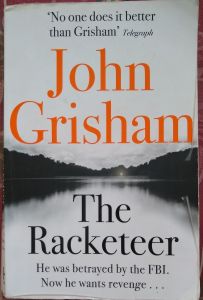 The Racketeer
 The Boys From Biloxi
 Liz and I are over here in sunny Lanzarote having exchanged the cold of the UK for the warmth of Lanzarote. Of course, it is still February and things aren’t perfect over here. It’s warm but there are plenty of days when gusty winds blow across the island as well as days when the sun has been obscured by clouds. Even so there are still plenty of bars to drink at, plenty of tapas to be eaten and of course we have plenty of books to read, two of which have inspired this week’s post.
 The plot of the book and film are pretty complicated, although having read the book recently I think that the book is easier to follow. During the filming the director and his stars wondered who killed the character of Owen Taylor, the Sternwood’s chauffeur. They sent a cable to Raymond Chandler asking him. Chandler told a friend later ‘Dammit, I don’t know either!’
 The Bay of Pigs was a great disaster for Kennedy. He inherited the invasion plans from the Eisenhower administration in which Vice President Nixon was a prime mover. Nixon felt that an invasion would boost his chances in the election contest against Kennedy but the CIA seemed to be relying on the assassination of Castro to kick off the invasion but that planned murder, for whatever reason, never happened.
 Ten Days to Destiny by John Costello
 This book was the sequel to another book about Bill Clinton. The first one dealt with Clinton’s early life and his election to the presidency; this one takes us through his first four years as president. The author takes us through the years of the Clinton White House and documents the issues like Troopergate; when the former Governor Clinton’s State Troopers revealed the comings and goings of Bill’s various mistresses, as well as the disaster of his healthcare reform work which he entrusted to his wife Hillary. The public clearly weren’t keen on Clinton’s ‘co-president’ – his wife, and their healthcare proposals were rejected by Congress. The mid term elections were another disaster for Clinton and the Democrats and the book goes on to show how Clinton turned the final two years of his first term presidency around and was able to win a second term.
 Encore Provence by Peter Mayle
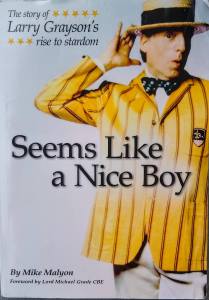 Many have speculated about his true sexuality but it’s clear that Larry enjoyed being labelled as camp rather than gay. The main relationship in his life was with his sister who became a mother figure to him when his adoptive mother died. The two lived next door to each other for many years in later life.

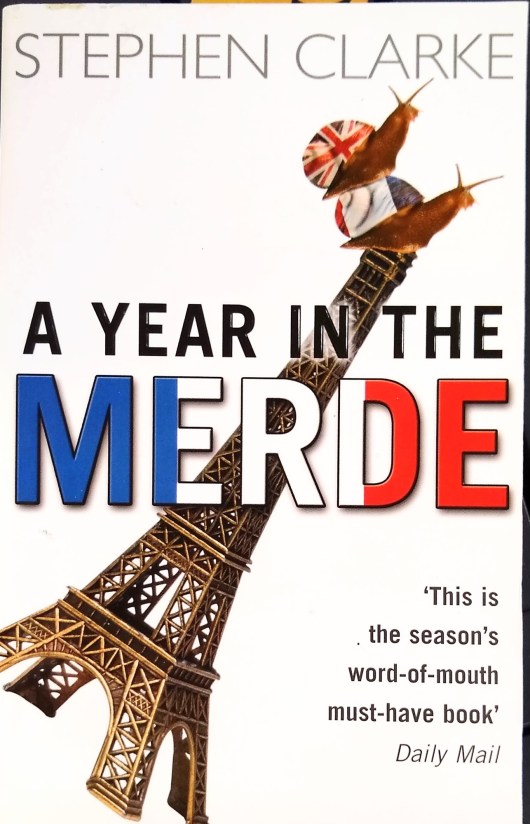

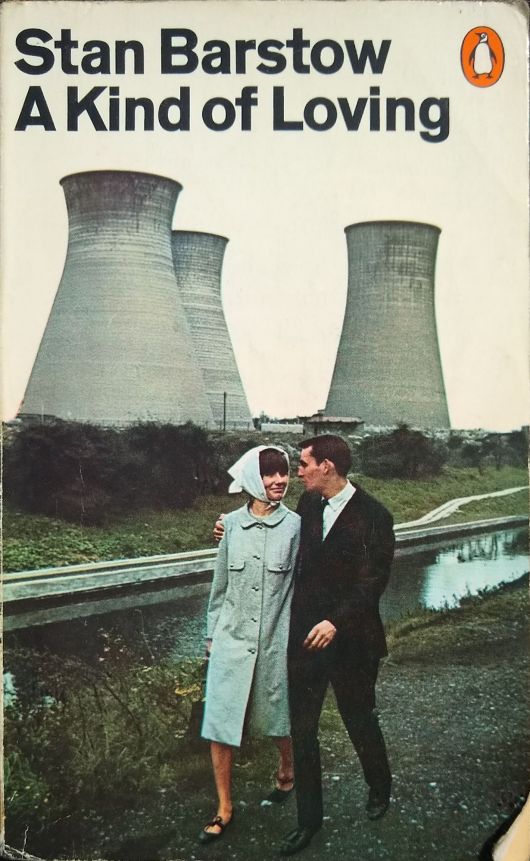 I’ve actually read this book quite a few times and it’s one of those that I mention when people ask me to describe Floating in Space. As much as I’m fond of Floating, this book is infinitely better. It’s a very simple story and probably one that has happened hundreds of times to hundreds of couples.
