My Early Life: The Book, the Film and the Soundtrack Album

I first read My Early Life by Winston Churchill many years ago. I picked up a paperback copy which tied in with the release of the film version and also along the way I got hold of the soundtrack album and later a VHS copy of the film. In this week’s blog I thought I’d take a closer look at all three.

Rooting around in a secondhand shop in St Annes recently I picked up a hardback copy of Winston Churchill’s book My Early Life. It’s a thoroughly wonderful book written in Churchill’s inimitable style. He says in the introduction he has written a book about a vanished age and indeed he has. Churchill was born in 1974 at Blenheim Palace in Oxfordshire. He was the son of Lord Randolph Churchill who was in turn the son of the 7th Duke of Marlborough. His mother was an American, Jennie Jerome, the daughter of an American businessman. She married Lord Randolph and became Lady Churchill.

Lady Churchill was a great influence on his life although in his very early years young Winston looked to his nanny, Mrs Everest, for motherly support. His father, Lord Randolph, was someone whom Winston loved and adored but never seemed to become close to. After the birth of Winston, Randolph began to suffer a debilitating disease which could have been syphilis. Others have speculated it was a brain tumour. Either way, Randolph died in 1894.

Looking back, I must have seen the film version before I read the book. Young Winston was directed by Richard Attenborough and is a wonderful adaptation of the book. When Winston first attends school, which of course was boarding school, his headmaster was played by Robert Hardy and he directs Winston to learn some Latin. Winston doesn’t do very well and the headmaster glares down at him and informs him that if he misbehaves, he will be punished, which to a great extent was Churchill’s overall view of school. Later he comments about exams ‘they always contrived to question me about things I didn’t know. I would much rather they asked me about things I did know.

In the book Winston records his schooldays with a great deal of charm and humour. He goes on to attend Harrow and as he intends to join the army goes to special army classes.  Winston seems to have enjoyed his army training and was keen to see action. He took leave with a friend and went to observe events in Cuba where revolutionaries were fighting their Spanish colonial rulers.

Winston was a second lieutenant in the 4th Hussars and spent a long time in India. He was a great lover of polo and he and his colleagues won an inter service championship in their first year in the country, a feat never achieved before by a recently arrived regiment.

Churchill was keen, as I said before, to see action and joined Bindon Blood’s Malakand Field Force and later wrote a book about the campaign. The book was popular and Churchill even received a letter of praise from the Prince of Wales. Because of his mother and father, Churchill was well connected in both political and aristocratic circles and later used his contacts and those of his mother to attach himself to General Kitchener’s campaign in the Sudan. He was part of one of the British Army’s very last cavalry charges in the battle of Omdurman in 1898.

The charge was depicted in the film Young Winston and in his book Churchill ponders about fate and a problem with his shoulder which necessitated using his revolver rather than his sword during the charge, reflecting that if he had been using his sword he might well have been killed in the latter stages when he was surrounded by the enemy.

He ponders many times too about war in the Victorian age. How it was honourable and respectable. He mentions how officers would stop for lunch before a battle and how casualties, which were sometimes considered heavy, were nothing like the heavy casualties suffered in the later world war. If technology had taken away the honour of war in 1914, how would Churchill react to war in 2025 I wonder?

The Victorian age was an age of courtesy and respect and one of my favourite stories in the book occurs when Winston was at Sandhurst. It was the custom then, if an officer wanted leave for a few hours, to sign a book and declare himself absent. One day when visiting friends Winston passed his commanding officer Major Ball, a very strict and formal officer, on the road and realised he had forgotten to sign himself out. He cut short his visit, returned to Sandhurst hoping to add his name before the Major checked the book. Sadly, he found Major Ball’s signature at the end of the page. Would he be disciplined thought Winston? What would his punishment be? Looking further up the list Winston was surprised to find that his name had been added and countersigned by none other than Major Ball himself. Winston writes that this was a clear indication of how discipline could be maintained among officers without departing from the courteous and respectful standards of the time.

Having failed to become an MP for the Oldham constituency he went to South Africa to report on the Boer war as a correspondent. He travelled on an armoured train which was attacked by the Boers and he was captured and imprisoned in a POW camp.

One of things I particularly liked about Young Winston was the music. I bought the soundtrack album in 1985. The music for the film was in the main composed by Sir Alfred Ralston. He was brought into the film by director Attenborough as the two had worked together on a previous film, ‘Oh what a Lovely War’. The soundtrack features music by Edward Elgar, notably the Pomp and Circumstance March no 4 as well as Nimrod from the Enigma Variations.

According to the sleeve notes, the pistol used by Simon Ward who played Winston in the film was Churchill’s actual Mauser and it can be seen pretty well during a sequence when Churchill travels to south Africa to report on the Boer war as a newspaper correspondent. He travels with a unit who undertake a recce on an armoured train only to find the train attacked by the Boers on their return journey. Winston played a big part in helping remove a wrecked train from the line only for himself to not only be captured but also to lose his pistol. The pistol was returned to him in later years.

Churchill ended up in a POW camp but resolved to escape despite also claiming to the Boers that he was a correspondent and should not have been detained. With the help of a group of Lancashire miners, Winston stowed away on a goods train and made his way back to the British lines.

The incident made him famous back in the UK and when he next ran for parliament in Oldham, he was duly elected. The tone of the book becomes more serious towards the final pages but overall this is an outstanding read by one of this country’s greatest sons.

The film version was almost just as good. Simon Ward gives us an admirable picture of the young Winston with just the right hint of the great man’s later style and speaking voice.

I first saw this film at the cinema where I greatly enjoyed it and I remember it coming to television some years later. The film finishes with a poignant dream sequence which, I remember reading somewhere, was based on something Churchill either said or wrote. In the dream, a much older Winston meets his father but he is not the unwell man of his later years but restored to full health. Randolph asks Winston about great events and Churchill answers telling of the two World Wars. ‘Did Joe Chamberlain ever become Prime Minister?’ asks Randolph. ‘No’ answers Winston, ‘but one of his sons did, Neville’.

Winston mentions that he has resigned his commission in the army. Randolph looks about at the many paintings and asks Winston if this is what he does. Winston answers that painting occupies much of his time. Randolph thinks for a moment and then tells Winston to ‘do the best you can’ and we see the sleeping Churchill smile at the thought.

I’ve always liked this final sequence but when I bought my VHS copy the scene was omitted. Likewise, every time I have since seen the film on television, this scene has always been removed. I’d love to know why. Perhaps the producers thought the film too long or perhaps preferred the new ending in which Winston talks briefly in a voiceover about his marriage and living ‘happily ever after’. After a search on the internet I came across a post which claimed that Carl Foreman, who wrote and produced the film, found that US audiences occasioned so little reaction to the scene that he promptly had it cut. What reaction was he expecting to see I wonder?

Perhaps it’s time for a search on eBay. I’m sure that somewhere there must be a definitive DVD version of the film and if you ever get the chance, give the book a read, it’s one of my absolute favourites.


What to do next: Here are a few options.

Share this post on your favourite social media!

Hit the Subscribe button. Never miss another post!

Listen to my podcast Click here.

Buy the book! Click here to purchase my new poetry collection.

Click here to visit Amazon and download Floating in Space to your Kindle or order the paperback version.

Click here to visit amazon and purchase Timeline, my new anthology.

Watching (and reading) the Detectives

Liz and I are over here in sunny Lanzarote having exchanged the cold of the UK for the warmth of Lanzarote. Of course, it is still February and things aren’t perfect over here. It’s warm but there are plenty of days when gusty winds blow across the island as well as days when the sun has been obscured by clouds. Even so there are still plenty of bars to drink at, plenty of tapas to be eaten and of course we have plenty of books to read, two of which have inspired this week’s post.
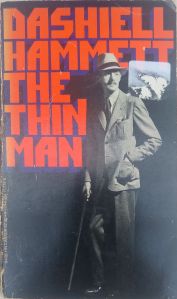
The Thin Man is a book I picked up somewhere in a second hand bookshop. It was written by Dashiell Hammett and features his famous detective, Nick Charles.

Dashiell Hammett was born in May, 1924 and became a writer of detective stories after working for the famous Pinkerton National Detective Agency. In his obituary in the New York Times, they described him as ‘the dean of the hard boiled school of detective fiction.’

Time magazine included his novel Red Harvest, published in 1929, on their list of the 100 best English language novels. The Thin Man was made into a film in 1934 starring William Powell as Nick Charles and Myrna Loy as his wife Nora. I’ve only just started reading the Thin Man and it’s been pretty good so far. One interesting element of it though was finding out that in New York in the mid 1930’s it was possible to find an all-night delicatessen that would deliver coffee and sandwiches at 5 in the morning.

A further 5 sequels in the Thin Man film series were made finishing in 1947 with Songs of the Thin Man.

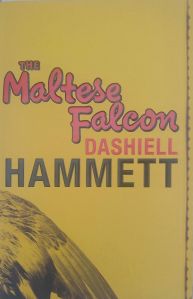
Another book by the same author is one that Liz got me for Christmas, The Maltese Falcon. I’ve only just scanned through it so far but it looks like being a good read. The book was made into a classic film in 1941 with Humphrey Bogart playing the part of detective Sam Spade. Mary Astor plays Ruth Wanderley who contacts the firm of Spade and Archer to help her track down her missing sister who she thinks might be held against her will by a man called Thursby.  Miles Archer, Spade’s partner decides to take on the case but is found dead by the police later that night.

Spade begins to try and find out what has happened and meets various other characters like Joel Cairo and Kasper Gutman played wonderfully by Peter Lorre and Sydney Greenstreet. One of my favourite scenes is where Spade and Gutman meet and Gutman asks ‘are you a close mouthed man?’ Spade replies that no, he likes to talk and Gutman responds famously with ‘I’m a man who likes to talk to a man who likes to talk’.

Hammet died in 1961 of lung cancer and Raymond Chandler said this of him: ‘He was spare, frugal, hard-boiled, but he did over and over again what only the best writers can ever do at all. He wrote scenes that seemed never to have been written before.’

That brings me nicely to another of my favourite detectives, Philip Marlowe and he first appeared in the novel The Big Sleep. The book was written by Raymond Chandler and Chandler had this really fabulous talkative way of writing. You can almost imagine hearing Humphrey Bogart’s voice as you read the book. Bogart of course played Marlowe in the 1946 film version directed by Howard Hawks. Here’s a quote from the book, an example of Chandler’s descriptive style:

I sat down on the edge of a deep soft chair and looked at Mrs Regan. She was worth a stare. She was trouble. She was stretched out on a modernistic chaise-longue with her slippers off so I stared at her legs in the sheerest silk stocking. They seemed to be arranged to stare at. They were visible to the knee and one of them well beyond. The knees were dimpled, not bony or sharp. The calves were beautiful, the ankles long and slim with enough melodic line for a tone poem. She was tall and rangy and strong looking. Her head was against an ivory satin cushion. Her hair was black and wiry and parted in the middle and she had the hot black eyes of the portrait in the hall. She had a good mouth and a good chin. There was a sulky droop to her lips and the lower lip was full.

Not bad eh? Dilys Powell called his writing ‘a peculiar mixture of harshness, sensuality, high polish and backstreet poetry’ and it’s easy to see why. Mrs Regan was played by Lauren Bacall in the film version and up until now I had always thought this was the film where Bogart and Bacall met. Wrong! A quick check on Wikipedia and I see the couple met on the set of To Have and Have Not in 1944. Bacall was 19 and Bogart was 45 and married to his third wife Mayo Methot at the time. Sparks apparently flew between the couple and Bogart divorced Mayo and married Bacall the next year, 1945. Despite the great on screen chemistry together the couple only made four films together.

The film version of The Big Sleep was a brilliant adaptation of the book and some of the differences are interesting. For instance, early in the book, detective Philip Marlowe played by Bogart meets General Sternwood’s daughter Carmen. She looks at Marlowe and remarks how tall he is. In the film, Bogart of course wasn’t that tall so the dialogue is reversed ‘You’re not very tall, are you?’ comments Carmen.

The plot of the book and film are pretty complicated, although having read the book recently I think that the book is easier to follow. During the filming the director and his stars wondered who killed the character of Owen Taylor, the Sternwood’s chauffeur. They sent a cable to Raymond Chandler asking him. Chandler told a friend later ‘Dammit, I don’t know either!’
One strange element in the film, certainly for me, is a scene where Philip Marlowe (Bogart) is watching blackmailer Geiger. Geiger has a shop that sells rare books in Hollywood and Marlowe asks for information in another bookshop opposite. There he chats to a bookseller played by Dorothy Malone who, if you are old enough, you will remember her from the Peyton Place TV series. Malone and Bogart seem to hit it off well in the film but he never returns to the bookshop and Dorothy is never seen again in the film.

Every time I watch the film, I always expect Malone to reappear but that’s one of the many dead ends the film leads us down. I think it was Hitchcock who said that every scene in a film should lead the audience somewhere and Quentin Tarantino of course said the reverse. Perhaps director Howard Hawks favoured Tarantino’s view.

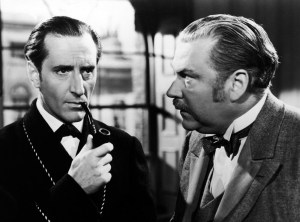
Basil Rathbone as Holmes and Nigel Bruce as Dr Watson (image via creative commons)

Perhaps the most famous literary detective is Sherlock Holmes, created by the author Sir Arthur Conan Doyle in 1887, first appearing in the story A Study in Scarlet. The stories are narrated by Holmes’ friend and companion, Doctor Watson. The Guinness Book of Records reports Holmes as the most portrayed character in film and television history.

My personal favourite Sherlock Holmes in the cinema was the version created by Basil Rathbone in a series of films beginning in 1939. 14 films were made with Rathbone as Holmes and Nigel Bruce playing the part of Dr Watson. The first two films were set in the Victorian era and were produced by Twentieth Century Fox. The later films were produced by Universal who set the films in, what was then, the present time period, that of the second world war.

Time now to move onto my favourite TV detective, the bumbling Lieutenant Columbo.

Columbo first appeared in the early 1970s as part of the Mystery Movie TV series. Each week followed a different detective trying to track down a murder case, sometimes it was MacMillan and Wife and other weeks McCloud, Banacek or various others. The most popular one by far though was Columbo.

Columbo was a homicide detective for the LAPD and he was played by Peter Falk, although the role was originally written for Bing Crosby. Crosby however thought a regular TV slot would interfere too much with his golf so he turned down the role, went back to the fairway and the part went to Peter Falk who made it his own.

If you ever see the original pilot, shot in 1968, you can see how Crosby might have fitted into the part, as Falk plays Columbo in a very Crosby like laid back way. The very first guest murderer was Gene Barry who was familiar to TV audiences after playing Amos Burke in Burke’s Law for many years. He also starred in a 1953 film version of War of the Worlds.

The pilot episode also introduced audiences to a particular feature of Columbo, in that we see who the murderer is and how he commits the crime first. Then we see Lieutenant Columbo gradually solve the clues and get his man, or woman. The essence then of a great episode comes in the clever way Columbo nails the murderer. Sometimes that moment is a bit of a non starter, other times it’s nothing short of brilliant. Sometimes, even if that final moment is not so great, it’s still been a great episode.

The Columbo of the early series is an absent-minded quirky fellow although in later episodes, Peter Falk who plays the detective, seems to downplay that quirky element.

Favourite episode? I’m not certain but it might be ‘Murder by the Book‘, starring my favourite murderer, Jack Cassidy. In this 1971 episode, Jack plays a writer, actually part of a writing double act, who together produce a series of novels about ‘Mrs Melville’ who is an amateur detective. The thing is, Jack’s partner wants to ditch the partnership but Jack is not happy about it. He is so unhappy he decides to, yes you guessed it, bump off his co-writer. He does it in a rather ingenious way which foxes Columbo but not for long and to cap it all, the episode is directed by none other than Steven Spielberg!

So who was your favourite fictional detective?


What to do next: Here are a few options.

Share this post on your favourite social media!

Hit the Subscribe button. Never miss another post!

Listen to my podcast Click here.

Buy the book! Click here to purchase my new poetry collection.

Click here to visit Amazon and download Floating in Space to your Kindle or order the paperback version.

Click here to visit amazon and purchase Timeline, my new anthology.

Celebrating Charles Dickens

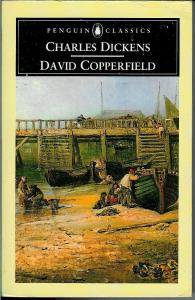
Charles Dickens is one of my writing heroes. He is a giant in the world of literature and the author of one of my favourite books of all time, David Copperfield. He was a man with an incredible imagination and was a prodigious producer of numerous books and stories. Many of his works are still loved and appreciated today and the magic of his story telling is also reflected in film and television adaptations of his work.
Dickens was born on February 7th, 1812. His father was John Dickens, a clerk in the Naval Pay Office. His mother was Elizabeth Dickens and she and her husband raised eight children including Charles, their second child. Charles and his family had a pretty idyllic life until John Dickens, who clearly lived beyond his means, was arrested for debts and incarcerated in the Marshallsea debtors’ prison in Southwark, London.

As was the custom then the younger members of the family were able to live in the prison with their mother and father but Charles, then aged 12, took lodgings nearby and was forced to leave school and work in Warren’s Blacking Warehouse where he earned six shillings a week for pasting labels on bottles of boot blacking.

It was a shocking and humiliating experience for the young Dickens. He never mentioned the experience to any of his children and only spoke about it in later life to his great friend John Forster, who later wrote the first biography of Dickens. Dickens also wrote about the experience in his novel David Copperfield in which the young Copperfield suffers the same fate.

My well thumbed copy of David Copperfield

Mr Micawber, a character in the same book, was based on his own father and eventually John Dickens was able to pay off his debts when his mother died and left him £450. He and his family were released from prison but Charles was not immediately released from his work at the boot blacking warehouse, indeed his mother wanted him to continue there but it was his father who decided that Charles should return to school. Charles was forever indebted to his father for this and forever hurt by his mother’s wish that he should continue pasting labels onto bottles of boot blacking. The experience scarred him and his later desire to work harder and earn more and more money may have been a need to make himself safe from ever being forced into such a situation again.

After two years at school, Dickens obtained employment as a lawyer’s clerk and later, he taught himself shorthand and began work as a parliamentary reporter. He became infatuated at this time with a lady called Maria Beadnall who later became the inspiration for the character of Dora in David Copperfield. Charles pursued Maria over a period of three years but the romance, if indeed there ever was one, finally fizzled out in the spring of 1833.

Dickens first foray into the world of creative fiction was a short story titled A Dinner at Poplar Walk. He had sent the story to a monthly magazine simply called, The Monthly Magazine and upon finding his story printed within its pages, reported that ‘his eyes were so dimmed with joy and pride’ that he could barely see.

In 1835 the editor of the Morning Chronicle, George Hogarth, invited Dickens to contribute to his newspaper and during various visits to the Hogarth home he became acquainted with his editor’s daughter Catherine, whom he later married in 1836.

Dickens wrote his newspaper stories under the pseudonym Boz, and he was delighted when a publisher offered to publish a collection of his works entitled Sketches by Boz. This led to another publisher asking Dickens to supply the text to go with a series of illustrations by a popular illustrator of the day, Robert Stephens. Dickens somehow managed to turn the arrangement on its head, writing a story and having Stephens illustrate Dicken’s text. The story was The Pickwick Papers and it soon became something of a publishing phenomenon.

Robert Stephens passed away soon after the first publication and Dickens recruited another artist, Hablot Knight Browne, to provide the illustrations. Readers could buy a monthly instalment priced at a shilling and Dickens worked hard to produce each edition. Other stories had been published in a similar way but they were usually well known classics. This was the first time new fiction had been produced in this way.

That then was the start of Dicken’s career. He was a busy man, editing various publications as well as writing his novels. Great Expectations was published with the author shown as Boz but in later editions this was changed to Charles Dickens.

Dickens_by_Watkins_1858

Dickens seems to have rented various houses, moving around often but he eventually bought a house in 1851, Tavistock House in Tavistock Square, London. Dickens wrote various books here starting with Bleak House. He also fancied himself as something of an actor and he had a large room made into an improvised theatre where he, along with his friends and family, produced various amateur theatricals. In 1858, Charles separated from his wife Catherine and she moved out into a property in Camden Town.

The separation was said to have been sparked by Dickens’ obsession with a young actress called Ellen Ternan and his gift of either a brooch or a bracelet to her which somehow made its way to his wife. Dickens has this image of being the perfect Victorian family man but he didn’t always live up to it. According to Wikipedia he even tried to get his wife falsely diagnosed as mentally ill in order to have her committed to an asylum. Various accusations were bandied about at the time and rumours were so bad that Dickens himself was forced to publish a statement in the press about his marital situation.

Did Dickens have an affair with Ellen Ternan? So many years later it is hard to know the truth. One night when he was living at his new home Gad’s Hill Place, Dickens made a bonfire of all his personal letters and papers, some of which may have had the answers.

Certainly, Charles was fond of Ellen Ternan. He spent a lot of time with her and even took her abroad to France and Belgium but neither admitted to having an affair but he did have something of a history of obsessions. Years earlier he had been distraught when his sister-in-law Mary Hogarth had died suddenly at the age of 17. Mary was living with the Dickens family at the time and died in Charles’ arms. He was so upset that he kept his dead sister in law’s clothes for years afterwards, occasionally taking them out to look at them. Mary became the template for many women in his books, all of whom were ‘young, beautiful and good’.

Dickens had an incredible imagination and although many of his characters were based on real people, many others sprang directly from his own mind. He was a restless man and regularly took daily and nightly walks of twenty miles and more. Presumably on those walks he brought his imagination into check and channelled his thoughts into the development of his stories.

In his later life, Charles embarked on a series of readings from his books. The readings were highly charged emotional events and the author used all his powers as an actor to delight his audiences, frequently reducing them to tears. Tickets for the reading were highly sought after and Dickens was one of the most notable and famous men of his day. Imagine George Clooney or Brad Pitt doing a series of book readings today and we can get just a faint hint of what things were like for Dickens and his public back then.

Dickens bought his final home, Gad’s Hill Place in March of 1856. He had seen the house as a child when his father had pointed the house out to him as something that he might one day own if he worked hard enough. He lived at the house with his children although one, Charles junior, elected to live with his mother in Camden Town. Strangely, his estranged wife’s sister, Georgina, stayed with Charles as housekeeper.

On June 8th 1870, Dickens had a stroke after working on his final book, The Mystery of Edwin Drood. He died the next day without regaining consciousness. Some have speculated that he died at Ellen Ternan’s house and she had him taken back to Gad’s Hill to prevent a scandal. He was laid to rest in Poets Corner at Westminster Abbey.

Charles Dickens is one of the most loved and celebrated writers of all time but I’ve got to say that some of his books I’ve found a little hard to read. I’ve tried and tried to read Pickwick Papers but I just couldn’t get through it. Not long ago I picked up Bleak House and once again I couldn’t really get started on the book. I have read A Christmas Carol, Oliver Twist, Great Expectations and my absolute favourite, David Copperfield.

My favourite character in the book, apart from Copperfield himself, is Steerforth, a friend of David Copperfield but one who ultimately betrays him. The best part in the book probably, for me at any rate, is the storm when David returns to Yarmouth. Dickens builds the storm slowly and each word and phrase adds a new layer to the sense of danger and foreboding and when Copperfield is finally reunited with his old friend Steerforth at the height of the storm’s ferocity, death comes between them and Steerforth is sadly drowned.

Dickens reveals this in a very unique way; he does not tell the reader Steerforth is dead. He leaves the reader to realise this themselves and, in the process, makes the reader almost at one with the narrative. Throughout the book, Dickens mentions in passing about Steerforth’s habit of sleeping with his head on his arm. It’s referred to many times in the narrative almost as a matter of non interest, something unimportant that the reader doesn’t really need to know, but when David Copperfield spies someone aboard a stricken ship trapped in the fierce storm who evokes some faint remembrance for him, a tiny warning bell is set off.

Finally, when the body of a drowned man is brought ashore and lies mutely on the sand, his head upon his arm, we know just from that simple bit of information, without the author telling us anything more, that Steerforth is dead. The prompts and clues that Dickens has hinted at have paid off for the reader in the most satisfying of ways.

Dickens’ books are still popular today and a recent cinema version of David Copperfield was released in 2019. It was good although I do have a fondness for the 1935 version in which WC Fields plays the part of Mr Micawber. In 1946 David Lean directed one of the best ever films of a Dickens’ story, Great Expectations. In the 1960’s Oliver Twist was made into a stage musical by Lionel Bart and the film version was released in 1968.

Dickens’ most filmed story though is probably A Christmas Carol, the story of Ebenezer Scrooge and the three ghostly visits that transform his life.

What is your favourite Dickens’ story?


Sources:

Wikipedia

Dickens by Peter Ackroyd


What to do next: Here are a few options.

Share this post on your favourite social media!

Hit the Subscribe button. Never miss another post!

Listen to my podcast Click here.

Buy the book! Click here to purchase my new poetry anthology.

Click here to visit Amazon and download Floating in Space to your Kindle or order the paperback version.

6 Great Kitchen Sink Dramas

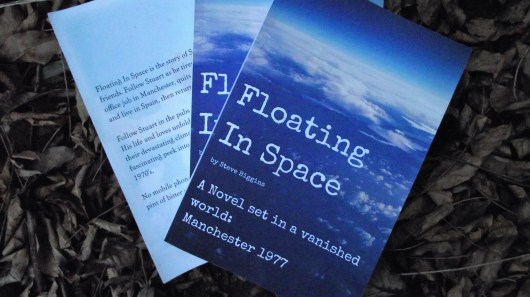
So what exactly is a kitchen sink drama? If you’ve read through the pages on my site that deal with my book ‘Floating In Space,’ you’ll know that this is a phrase I use to describe my book. When I first added Floating In Space to Amazon through the Amazon sister site Createspace I came to a point where I had to define the genre of the book. If you’ve written something that falls easily into a particular niche then that’s not a big deal. Things like romance, thrillers, science fiction, and YA (young adult) are pretty easily definable but my novel is something on the lines of working class fiction from the sixties; books like A Kind of Loving, A Taste of Honey, Saturday Night and Sunday Morning, Alfie and Billy Liar. All of those works were made into films and three of them, Billy Liar, Alfie and A Taste of Honey were also stage plays but what exactly is ‘Kitchen sink drama’?
Wikipedia describes it as a British Cultural movement that developed in the late 1950’s and early 1960’s and enveloped the theatre, art, literature, television and film. It identifies the John Osborne play ‘Look Back in Anger’ as being the start of the movement and afterwards, many people who identified with the movement were known as ‘Angry Young Men.’ Osborne’s play was a sort of backlash against the theatre of Noel Coward and Terrence Rattigan and represented a move away from polite drawing rooms into council house back rooms.

Richard Burton starred in ‘Look Back in Anger’ and as much as I love the richness of his voice, his portrayal of the leading character of Jimmy Porter hardly represents the working class despite Burton’s own personal origins in a Welsh mining village. A much more representative working class voice, certainly for the North West of England is the character of Arthur Seaton played convincingly by Salford actor Albert Finney in the movie Saturday Night and Sunday Morning.

Saturday Night and Sunday Morning. 1960

Saturday Night and Sunday Morning is set in working class Nottingham. Arthur Seaton is a rebellious factory worker who works hard in the factory by day, but at the weekend he spends his money in the pubs and clubs of the town. He is involved with a married woman but starts to lose interest when he meets a single girl called Doreen and begins a relationship with her. My favourite line from the book and the movie is this: “I’m not barmy, I’m a fighting pit prop that wants a pint of beer, that’s me. But if any knowing bastard says that’s me I’ll tell them I’m a dynamite dealer waiting to blow the factory to kingdom come. I’m me and nobody else. Whatever people say I am, that’s what I’m not because they don’t know a bloody thing about me! God knows what I am.

A Taste of Honey. 1961

Written as a play by Shelagh Delaney when she was only eighteen, the work was first performed at Joan Littlewood’s theatre workshop in 1958. The movie version opened in 1961 adapted by Delaney herself and directed by Tony Richardson, who incidentally also directed the film version of ‘Look Back in Anger.’ The movie features outstanding performances by Dora Bryan and Rita Tushingham.

Alfie. 1966

Alfie was directed by Lewis Gilbert who directed some of the earlier Bond films. The script was produced by Bill Naughton and adapted from his own book and play. Alfie is a fascinating film on many levels. It’s a peek back at the swinging sixties; it explores the elements of comedy versus drama, something I’ve always loved and which I looked at recently in a post about the TV show MASH. Once again it’s about the working class and features great performances from all the principal and supporting actors. One fabulous feature is how Alfie talks directly to the camera and sometimes even says things that directly contradict something he is doing or saying to another character. In the opening sequence Michael Caine as Alfie addresses the audience and tells them not to expect any titles. There are none, except for the film title itself and the closing credits feature photos of the cast and crew. Many actors turned down the chance to play Alfie on film, including Caine’s then flat mate Terence Stamp who played the part on Broadway. Laurence Harvey, James Booth and Richard Harris all turned down the role, and Alfie became a breakthrough movie for Michael Caine. My favourite line from the film comes right at the end when Alfie is reflecting about his life: “What have I got? Really? Some money in my pocket. Some nice threads, fancy car at my disposal, and I’m single. Yeah… unattached, free as a bird… I don’t depend on nobody. Nobody depends on me. My life’s my own. But I don’t have peace of mind. And if you don’t have that, you’ve got nothing. So… So what’s the answer? That’s what I keep asking myself. What’s it all about? You know what I mean? “

Billy Liar. 1963

Billy Liar is based on the book by Keith Waterhouse and was directed by John Schlessinger. Tom Courtney played the title role and many faces familiar to TV viewers appear in the cast such as Wilfred Pickles, Rodney Bewes, and Leonard Rossiter. Billy has an imaginary world in which he plays out many daydreams and fantasies. His ambition though is to become a comedy scriptwriter and his friend Liz played by Julie Christie offers to go with him to London. In the final scenes however, Billy loses his nerve and contrives to miss his train, something that Liz has foreseen and has conveniently left his suitcase on the platform for him.

A Kind of Loving. 1962

This is another 60’s classic directed by John Schelssinger. Adapted from the book by Stan Barstow (one of my all time favourite books) with a script by Keith Waterhouse (who wrote Billy Liar) and Wallis Hall. The story is a very simple one; Vic Brown (Alan Bates)  is a draughtsman in a Manchester factory and he gets involved with secretary called Ingrid played by June Ritchie. When Vic learns Ingrid is pregnant, he does the ‘proper’ thing for the 1960s and offers to marry her. Sounds simple but this is a complex and fascinating film and looks at the subtleties of relationships and how the characters make their way through a series of difficult choices. For a northerner like me, it’s also nice to see places I recognise on film. St Annes On Sea looks a little grim, or did do in the 1960’s. Today it’s a lovely place to live.

Spring and Port Wine. 1969

Hollywood movie star James Mason, famous for roles like the drunken movie star in A Star is Born and the suave villain in Hitchcock’s North by Northwest, left Hollywood in 1963, settled in Switzerland and embarked on a more transatlantic career. One of those projects was Spring and Port Wine. The movie is set in Bolton and is about factory worker Rafe Crompton and his family. His daughter played by Susan George is acting strangely and Rafe struggles to dominate her, his other daughter played by Hannah Gordon and his sons, Rodney Bewes and Len Jones. It later transpires the Susan George character may be pregnant and the family rally round to help her.

The Family Way 1966

The Family Way is one of my very favourite films and like Spring and Port Wine above, features a classic movie actor, John Mills, in a very different role. Saying that, Mills’ film career was diverse to say the least and in this movie he plays Ezra Fitton whose son has just married Jenny, played by Mills’ real life daughter, Hayley. Various problems plague the newly weds, in particular a holiday that never happens due to a travel agent absconding with their funds. Hints are made during the film that Ezra’s son may not even be his son after all. When the truth dawns on Ezra his son asks what is wrong and Ezra replies with the most memorable line in the film; “It’s life lad. Sometimes it’ll make you laugh and sometimes it’ll make you bloody cry!” Time and time again, and I don’t know if you have ever found the same thing, but certain movies I love always seem to have a common denominator. In this case Spring and Port Wine, The Family Way, and Alfie were all penned by the same author, Bill Naughton.


One final kitchen sink drama: ‘Floating In Space’ by Steve Higgins. Click the icon below to go to my Amazon page or check out the links at the top of the page.

David Copperfield, Steerforth, and Charles Dickens

David Copperfield, Steerforth, and Charles Dickens.