I’ve watched quite a few films recently that come into the romcom category. It’s not my favourite genre but I thought I’d put together a short list of my favourite ones so here we go.
 Four Weddings and a Funeral
I’d not seen this film for a while so it was great to see it pop up on my TV screen recently. I sometimes think of Four Weddings as a sort of modern Ealing Comedy, if Ealing were still making movies of course. There are a couple of elements that stop it from being perfect. One is the use of the F word. Why make a gentle comedy and then throw in a few gratuitous F words? I really don’t get it. The other thing is this, Hugh Grant plays a character who falls in love with a girl played by Andie McDowell. Andie McDowell, I’m sorry to say, doesn’t do it for me at all. She’s not, to me, that great looking and has a particularly irritating voice, all of which makes it a little difficult for me to identify with the Hugh Grant character, who, as I mentioned, has the hots for her.
In many ways I have a similar problem with the Steve Martin film LA Story. Steve’s character has the hots for a girl played by Victoria Tennant who is very pleasant, very nice but sadly, she doesn’t do it for me either. Happily, I can honestly say that in Casablanca I can fully identify with the Humphrey Bogart character, although whether I would have put Ingrid Bergman on the plane and stayed behind with Claude Rains, well that’s another matter.
Four Weddings and a Funeral is the movie that brought fame to writer Richard Curtis and actor Hugh Grant, as the announcer on Film 4 mentioned. Strangely, he didn’t mention Mike Newell, who directed the film. Funny how the credit from a successful film doesn’t always get spread equally around.
Notting Hill
It just so happens that this film, Notting Hill, was written once again by Richard Curtis. It’s not a movie classic, at least I used to think that but perhaps in its own way, a very minor way, perhaps it actually is. It’s a pleasant film to watch, it’s mildly amusing but it suffers, at least for me in that Julia Roberts, like Andie McDowell in the film above, just doesn’t really do it for me. Julia, in case you didn’t know is the love interest for Hugh Grant. Grant plays a young guy who owns a travel bookshop in London’s Notting Hill. One day in comes famous film star Julia. Grant gets involved with her, his middle class friends are suitably impressed and give advice when the love train comes off the rails. There are no car chases or shootings although now I come to think of it, there is a sort of car chase through the streets of London but it’s all a great deal of fun and right at the end the bookstore owner gets his film star girl.
You’ve Got Mail
This is a 1998 film based on the old James Stewart classic The Shop Around the Corner. Tom Hanks is Joe Fox who owns a massive discount book shop which is about to open just around the corner from Kathleen Kelly’s small bookstore The Shop Around the Corner. Meg Ryan plays Kathleen whose shop is a New York landmark but looks like going under when the big discount store opens. Joe and Kathleen meet but naturally they don’t like each other as it looks like Joe might put Kathleen out of business. Now it just so happens that Joe and Kathleen are internet penpals. They met on a chat site and only know each other from their chat line ‘handles’ so neither realises who the other actually is. Both are unhappy with their current partners and they decide to meet but Joe takes a peek at his date and realises it’s Kathleen.
Eventually Kathleen’s bookstore is forced to close down and she and Joe finally get it together.
Nora Ephron directed and wrote the script and the result is a really lovely film. Personally, I would have liked to see Billy Crystal in the Tom Hanks part but that’s just me. One last point, I wonder if younger viewers will understand the concept of ‘dial up’ internet?
His Girl Friday
They made rom-coms back in the old days too although this film from director Howard Hawks is probably more thought of as a screwball comedy as they used to call them back then. Cary Grant plays a newspaper editor and his top reporter and ex-wife Hildy Johnson, played by Rosalind Russell, is about to get married. Cary Grant as ex-husband Walter Burns wants to cover one last story with Hildy but he is also determined to sabotage her marriage plans. He frames Hildy’s husband-to-be, Bruce, in a theft and later sets him up with counterfeit money.
Hildy wants to help Bruce but finds that the case she is working on is actually more interesting. Eventually Walter and Hildy agree to remarry on condition that they honeymoon in Niagara Falls but Walter realises there is a strike in Albany so they divert there to honeymoon and cover the story.
There is a lot of fast-moving witty dialogue in the film and the director encouraged the actors to improvise although according to Wikipedia, Russell had a ghostwriter beef up her lines so she could insert them when she and Cary were improvising. Director Hawks wanted to produce a film with the fastest dialogue ever and he certainly succeeded.
Love Story
I wrote a post a long time ago called Unseen TV and it was about films that I hadn’t seen on TV for many years. I wonder if some TV executive had actually read it because very soon afterwards all but one of those films had appeared on terrestrial TV. Love Story is one of those films that I could have included. I can’t even remember the last time it had a showing on British television.
Love Story is a 1970’s tearjerker about a couple who fall in love and get married. Ryan O’Neal plays the son of wealthy Ray Milland who does not approve of his son’s impending marriage and threatens to cut him off financially if the wedding goes ahead. The pair get married anyway and Jenny played by Ali McGraw tries to support her new husband Oliver played by O’Neal as he goes through law school. She gets a job as a teacher to pay Oliver’s tuition bills and he eventually graduates. They have trouble conceiving but after tests they find Jenny is terminally ill.
The tagline for the film, used in all the publicity was ‘love means never having to say you’re sorry’. Yes, it was sentimental but it was well acted and well put together and I hope some British TV channel happens to read this and finally shows it again.
Definitely Maybe
This is not a film I would normally have watched but Liz chose it and we both watched it together. I’ve got to say that I didn’t pay much attention during the first part but gradually I got really interested. It’s about a divorced guy called Will, played a little lamely by Ryan Reynolds who decides to tell his 9 year old daughter the story of his life, well his love life anyway. He tells the story of the three loves of his life but uses fake names so the child won’t realise which of the stories concerns her mother. Girl 1 cheats on him when he moves to New York. Girl 2 is a girl who runs the copier where they both work on Bill Clinton’s election campaign and girl 3 is a girl who is involved with an older guy when he meets her. The older guy is a famous writer played by Kevin Kline in a really rather good cameo part. As the story unfolds we see who Will is really fond of, who turns out to be his daughter’s mother and who he will eventually end up with. It turns out that one of the girls collects inscribed copies of Jane Eyre as she is looking for a copy inscribed by her late father that she had lost. Will eventually finds the copy in a bookstore and presents it to her.
The film was written and directed by Adam Brooks and the next time I see it shown on TV I will definitely pay attention to the film’s beginning. To sum up, the film is a load of sentimental tosh but having said that, I actually kind of liked it.
What to do next: Here are a few options.
Share this post on your favourite social media!
Hit the Subscribe button. Never miss another post!
Listen to my podcast Click here.
Buy the book! Click here to purchase my new poetry anthology.
Click here to visit Amazon and download Floating in Space to your Kindle or order the paperback version.

 This will be my 592nd post and as you can imagine I sometimes struggle for new ideas. Scrolling through the internet the other day I chanced on something about Robin Williams and the post mentioned the film Dead Poets Society. It isn’t one of my favourite films but if you’ve ever seen it you might remember the poem O Captain My Captain by Walt Whitman which features a lot in the film. It got me thinking about Captains so I thought I might kick of this post with a few words about my favourite captain, James T Kirk.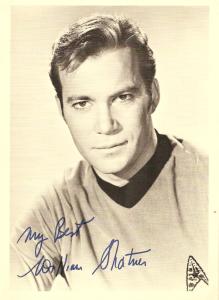
 I’m not sure which came first for me, the book or the film but I actually think it was the book. The Godfather was written by Mario Puzo and is the story of Don Vito Corleone, the head of one of the five mafia families of New York. The book opens with the wedding of Don Corleone’s daughter and Puzo sets the scene and introduces the various characters.
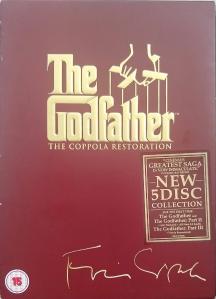 Francis Ford Coppola was the director of the film version and was also the co-writer of the screenplay along with Mario Puzo. Coppola wanted Marlon Brando to play the part of Don Corleone even though Brando at the time was rather unpopular with the producers. He was expensive, his last few films had not done well and his time wasting attitude had added huge expenses to his pictures. After the director had made the producers understand how important Brando was, they set various conditions for his employment. He would have to work for a reduced salary and put up a bond to ensure he would not delay the production. Another was that he had to have a screen test. Coppola has told the story in various interviews how he and his film crew had entered Brando’s house like ninjas and quietly set up their equipment. Brando slicked down his hair with shoe polish and stuffed cotton balls into his mouth to make the transformation into the aging mafia boss.
 Coppola decided that instead of finding the horse at the end of his bed like in the book, it would be better if Woltz awoke, was disturbed by something wet, pulls the bedclothes away to see blood and then uncovers the horse’s head. The head was the actual head of a horse, procured from a dog meat factory and Coppola mentions on the commentary to my DVD version that lots of animal lovers sent him hate mail about the horse, even though the horse had been condemned to its fate anyway.
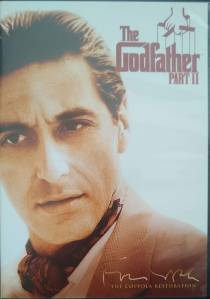 As previously mentioned, the book does have some storylines which were not used in the film but one chapter was a look at the beginnings of Vito Corleone. Born Vito Andolini in the Sicilian village of Corleone, Vito’s father was murdered by a local mafia boss and the young Vito was smuggled away to America. In America he took the name of Corleone and seemed to slip quietly into the role of mafia Don by murdering Fanucci, a New York Sicilian Godfather who preyed on his fellow Italians. Although this element of the story wasn’t used, Coppola kept the storyline for use in The Godfather Part II. The follow up film was a film classic in its own way.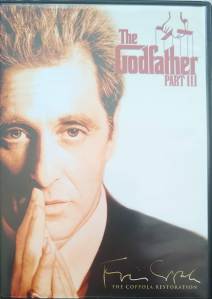

 I went to another funeral this week. It was someone I knew only very slightly and in fact Liz knew the deceased much more than me. His name was John and he was a pretty nice guy. The funeral service though seemed to me to be a little bit flat, a little lacking in soul. There was no priest or reverend at the service, just the celebrant. She read out a history of John’s life and family, someone came up to read a sad poem and his Grandson played a tune on his guitar.


 Ida Lupino, like Roddy MacDowell, was born in England, in fact both lived in the Herne Hill area of London. She wanted to be a writer rather than an actress but went into acting as she was part of a theatrical family and it seems that becoming an actor was expected of her. She appeared in many British films before moving to the USA in 1933.
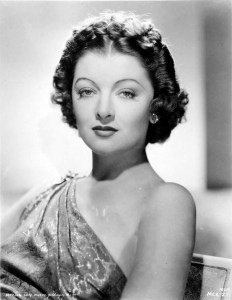 Myrna studied dance in Los Angeles. She had small parts in many silent pictures but some stills of her appeared in Motion Picture magazine and led to a contract with Warner Bros.
 I’ve always been fascinated by transformations either in fiction or in real life but what do I mean by transformations? Well, I have written about transformations before in a previous post. I talked then about Professor Higgins who helped Eliza Doolittle change from a street flower seller to a lady in George Bernard Shaw’s Pygmalion but with this new post I thought I’d start with the story of Dr Jekyll and Mr Hyde.