 This will be my 592nd post and as you can imagine I sometimes struggle for new ideas. Scrolling through the internet the other day I chanced on something about Robin Williams and the post mentioned the film Dead Poets Society. It isn’t one of my favourite films but if you’ve ever seen it you might remember the poem O Captain My Captain by Walt Whitman which features a lot in the film. It got me thinking about Captains so I thought I might kick of this post with a few words about my favourite captain, James T Kirk.
Captain James T Kirk
The first series of Star Trek starred William Shatner as Captain James T Kirk. Forget Captain pointy head Picard, Kirk is a proper Captain and after a good twenty minutes of any episode he will usually have blasted a number of aliens with his phaser (a sort of ray gun) and done some pretty serious kissing of any beautiful girl, alien, android or otherwise, within a 100 yard area. Mr Spock was played by Leonard Nimoy. He is the ship’s science officer and as a Vulcan rarely displays emotion, logic being his primary motivation. Doctor McCoy played by DeForest Kelley is a doctor of the old school and he and Spock frequently get into verbal confrontations. Together they are the chief officers of the starship Enterprise on its five year mission to go where no man has gone before.
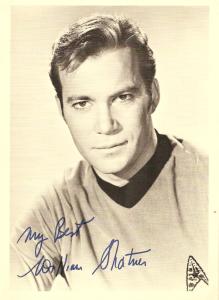
As a schoolboy I wrote to Desilu studios where I believed Star Trek was made, based on credits shown at the end of the show. After a while I received a set of glossy pictures of the show’s stars. They were all signed by the various actors, Shatner, Nimoy and so on but the signatures, I have long suspected, were made by a machine.
The original Star Trek, like many TV programmes of the sixties was shot on film and today it looks pretty sharp compared to shows from the 80’s that were shot straight to video. It was given a digital makeover a few years back with digital effects and new CGI spacecraft and is looking pretty good these days. Which was my favourite episode? Well I’d have to say it was the one that fans voted the best Star Trek episode ever; City on the Edge of Forever. The crew of the Enterprise arrive at a distant planet searching for the source of some time displacement. The source is a time portal, left among the ruins of an ancient civilisation which although abandoned, still emits waves of time displacement. In the meantime, Doctor McCoy is suffering from paranoia brought on by an accidental overdose of the wonder drug cordrazine which any Star Trek fan will tell you can cure any known Galactic ailment. McCoy in his crazed state bumbles through the time portal, back to 1930’s America (handy for that old 1930’s set on the Paramount back lot) and changes history. Kirk and Spock are forced to also go back in time, stop McCoy from changing history and restore things to the way they were. Joan Collins plays a charity worker at the core of events; does she have to die in order to restore normality?
What happened to Kirk? Well in the movie Generations, the character of Captain Kirk was sadly killed off. Generations which started off pretty well, combining the usual sci-fi elements of Star Trek with an intriguing mystery; who is the mysterious Soran and what is he up to? As it happened what he was up to wasn’t really that interesting, but the film marked the cinema handover from the original Star Trek cast to the new one. Pity really because as I mentioned above, I never really took to the Next Generation. However in the last two Star Trek films, the producers returned to the original characters, Kirk Spock, McCoy and Scott and with new actors playing the old characters, the story of Captain Kirk continues. As I write this William Shatner, who played the original Kirk is still active even though he is in his 90s. Wonder if they could get him to play Kirk one last time?
Captain Scott
Captain Scott planned to make an expedition to the north pole but then changed his mind and went for the south pole. At pretty much the same time Roald Amundsen, a Norwegian explorer, decided he also wanted to make the trip so a kind of race began. Who would get to the pole first? Amundsen decided to travel in classic fashion with teams of dogs pulling sledges. Scott decided he would use new mechanical devices, vehicles with caterpillar tracks, all of which broke down in the cold. Scott also used ponies but they were not acclimatised to the cold and fared poorly. Amundsen’s dogs turned out to be the best choice.
Why either of them would want to go to the pole is completely beyond me. All that they found there was a shed load of snow and ice which most people could have predicted anyway.
As we all know, Scott got beaten to the pole by Amundsen. The gallant British explorers then had to face the task of getting back to civilisation, however the weather worsened and the men froze to death in their tent.
You can watch the story of Captain Scott and his tragic expedition in the film Scott of The Antarctic. It is a sad film although John Mills as Scott plays a good part as usual and James Robertson Justice plays a serious role for a change, that of Captain Oates who disappears into the snow after telling his friends that he ‘might be some time.’ Oates perished like his friends but his courageous actions have never been forgotten.
Captain James Cook
Captain Cook was born in 1728 and died in 1779. He was a British explorer, navigator, cartographer, and captain in the British Royal Navy, who left behind a legacy of geographical and scientific knowledge.
He achieved the first recorded European contact with the eastern coastline of Australia and the Hawaiian Islands, and the first recorded circumnavigation of New Zealand. His mapping of the Pacific, Australia, and New Zealand changed the face of world geography. Before his famous three voyages to the Pacific and Australia, he also had made detailed maps of Newfoundland.
Cook was attacked and eventually killed by the natives in the Hawaiian Islands, during his attempt to kidnap the Hawaiian chief to reclaim the cutter stolen from one of his ships.
Captain Scarlet
Captain Scarlet was a TV puppet series made by producer Gerry Anderson in 1967. It was the first of Gerry’s puppet series to use puppets with realistic body proportions which although they looked more realistic were difficult for the puppeteers to manipulate. The idea for the series was that earth was under attack from the mysterious ‘Mysterons’, a race from the planet Mars that had been disturbed by the Zero X Mars exploration missions. The Mysterons have the power of ‘retrometabolism’, a way of reconstituting matter after an object or person has been destroyed. Captain Black has been recreated in this way and is under the control of the Mysterons. A similar thing happens to Scarlet but somehow he has broken free from Mysteron control. Scarlet is a member of Spectrum, an organisation set up to defend earth. All the agents have colour code names, hence captain Scarlet, voiced by Francis Matthews and Captain Blue, voiced by Ed Bishop.
A computer animated reboot was broadcast in 2005.
Captain Nemo
Nemo was a character in the Jules Verne novel 20.000 Leagues Under the Sea. The novel was first published in 1870 and reappears in another of Vernes books, Mysterious Island written five years later. In the first book a French scientist has joined an expedition to find a sea monster. They ship is attacked by the monster and the biologist is surprised to find the monster is an advanced submarine. He and other members of the ships company are taken prisoner where they meet the mysterious captain Nemo. Not much is ever revealed about Nemo except that he seems bent on revenge after his homeland, wherever that was, was conquered by a powerful imperialist nation.
There have been numerous film versions but my personal favourite Nemo was played by actor James Mason.
Captain America
Captain America was a comic book hero first created in the 1940s. Steve Rogers is a frail man who volunteers to use a new serum which will rapidly boost his physical powers. He combats the nazi menace with his sidekick Bucky Barnes but an accident leaves him in a state of suspended animation until he is revived in the modern era and becomes the leader of the super-hero group The Avengers. I can’t say I was ever a great fan of the captain even in my younger comic reading days. Youngsters these days may know Captain America from the current wave of super hero films. Captain America: The First Avenger was released in 2011 starring Chris Evans as the eponymous hero.
Captain and Tennille
Captain and Tennille were a husband and wife recording duo who had most of their success in the 1970s. Daryl Dragon was known as the captain because of his habit of wearing a captain’s hat when he was the keyboard player for the Beach Boys. He and his wife Toni Tennille had a number of hits throughout the 1970s although the one I particularly remember was ‘Love Will Keep Us Together’, a number one hit in the USA.
Captain Von Trapp
Never heard of captain Von Trapp? Well clearly you haven’t seen the Sound of Music. The story of the Von Trapp family of singers is actually a true story and Maria Von Trapp wrote a memoir about her experiences which was published in 1949. The book was made into a German film in 1956 and was so successful that a sequel was produced. Naturally Hollywood became interested but before that producers Leland Hayward and Richard Halliday secured the rights to make the story into a stage musical. They employed Rodgers and Hammerstein to write new songs as the German film had no original songs and just used Austrian folk songs. The musical was a huge hit and later became the famous hit film. Julie Andrews starred as Maria, the trainee nun who becomes a nanny to the Von Trapp children. Their father, Captain Von Trapp played by Christopher Plummer eventually falls for Maria and the family manage to escape from Austria just as the Nazis take hold of the country.
I’m not a great fan of musicals but I do love The Sound of Music.
Captain My Captain
O Captain My captain is a poem by Walt Whitman about the death of Abraham Lincoln. As I mentioned earlier it is perhaps most famous for being used in the film Dead Poets Society starring Robin Williams as an unconventional teacher.



 Ida Lupino, like Roddy MacDowell, was born in England, in fact both lived in the Herne Hill area of London. She wanted to be a writer rather than an actress but went into acting as she was part of a theatrical family and it seems that becoming an actor was expected of her. She appeared in many British films before moving to the USA in 1933.
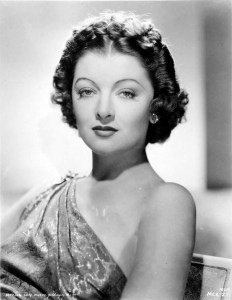 Myrna studied dance in Los Angeles. She had small parts in many silent pictures but some stills of her appeared in Motion Picture magazine and led to a contract with Warner Bros.

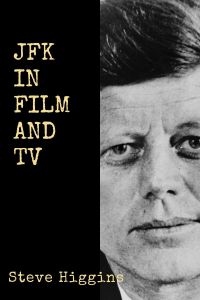 Strolling through St Annes not long ago I dropped Liz off at the hairdressers and wandered into a nearby shop that sells secondhand books, DVDs and CDs. It was there I spotted the DVD of a mini series from the 80’s called simply Kennedy with Martin Sheen playing the part of John F Kennedy. The DVD box set had been on my shelf for a while until one cold and wet evening when I thought it was time to pour a small port and settle down to watch it.
 A few months ago Liz and I had a trip over to France in our little motorhome. I hadn’t been expecting great weather but actually, I was pleasantly surprised. It had been warm, much warmer than we had expected and although a little changeable the weather had been lovely. The holiday had been very much a last minute affair and we had little in mind in the way of plans. However, there were two things I wanted during this trip. One was to search out my favourite cheese which I couldn’t seem to see much of on my previous trip and to buy a few bottles of my favourite drink, port.
 Port of course is readily available in the UK. The most popular is perhaps the ruby port although I prefer the tawny. What is port you might be asking? Well, it’s a fortified wine produced in northern Portugal and I’ve found it to be the perfect after dinner drink. Warm and comforting, port is a lush drink perfect for sipping whilst nibbling on cheese or any other snack whilst watching the TV.
 It was a cold afternoon in Manchester and I mumbled something to myself about the supposed heatwave and zipped my jacket up to my neck. At the left luggage office I took out the key that had been given to me earlier and when I opened the compartment I found a small package inside. I took the package and walked the short distance to the square. I sat down on the hard wooden bench and opened it up. Inside was a small tape player and a set of earphones. I put on the earphones and pressed play. There was a short burst of static and then a voice spoke.
 This second instalment of the franchise was directed by John Woo. It’s about a biological weapon called Chimera. Rogue agent Sean Ambrose steals the virus from its inventor by impersonating Ethan Hunt. He destroys the aircraft on which the inventor is travelling and parachutes to safety. Hunt was played once again by Tom Cruise and his mission is to regain the virus. The opening sequence sees Cruise doing some daring rock climbing which the studio wasn’t happy about. Cruise didn’t have a safety net but did apparently wear a harness. I didn’t like the heavy metal style version of the classic theme and as a matter of fact, I lost interest in the film early on.
 Both Liz and I had been suffering with bad colds and hers was getting worse with a bad headache and a loss of taste and smell. We did Covid tests and Liz was positive. My test was negative which was a surprise but then I haven’t had the headache or the loss of taste. I’m not sure when Liz was exposed to Covid, after all we haven’t been out much lately apart from some last minute shopping and a visit to quiz night at a local pub, the Lord Derby. Anyway, we were of course condemned to a minimum seven day lockdown so that meant no work on New Year’s Eve and no going out either.
 Returning home after a holiday is always a let down, even more so when you return to the cold and wet UK after the temperate climate of Lanzarote. One morning I woke to beautiful sunshine streaming in through the window and then went outside to sit in the sun by the pool while I waited for the kettle to boil. The next morning, I woke in a cold house with the wind battering at the window and made my way shivering into the kitchen to once again boil the kettle. In one of the James Bond books 007 calls tea ‘mud’ and claims it was the cause of the downfall of the British Empire. Nothing could be further from the truth because tea, at least for me, is one of the great wonders of British life and whether I am in the cold of a British winter or the warmth of the Canary Islands, I really cannot start my day without a cup of tea.
 As I write this we are on our 5th day in Lanzarote. I do love it here and it was nice to go to our favourite bar and see all our favourite bar staff there. The manager Juan was pleased to see us and greeted us in his usual fashion, calling out good morning as he does, no matter whether it is morning, afternoon or evening.
