Becoming Joe Biden

It was a Saturday afternoon, July 20th when I really thought about becoming Joe Biden. It started out as me just wondering about the man himself, 81 and wanting to embark upon another four years as president. 81? Bloody hell, relax man, leave it to some younger guy I thought.

Me, I’m only 42 but even I think about taking things easier, especially after that fall from my bike the other day. I do a lot of cycling. I do a short run every evening after work and at the weekends I take a good run over the cycle track through the local woods but this one occasion I decided to go out on a Wednesday, all because Paula my wife had gone out to some curry night and left me alone. Well, I cycled round the woodland track and a tree branch caught in the spokes of my wheel and tipped me right over onto the deck. I took a bit of a whack to the head and I’ve bruised my left thigh but other than that I’m ok. Good job I was wearing a helmet.

Anyway, back to Joe Biden. In case you didn’t know, he’s president of the USA. Theoretically the most powerful man in the world and as I lay back on the settee I wondered if, not only what would it be like to be Joe Biden but also if I could actually be Joe Biden. You know, become him, actually beam myself, my spirit, my being into his body and actually become Joe Biden.

I hope I haven’t lost you there. I know it’s a mad crazy concept but for some reason I thought that somehow, I could actually do it. Maybe it was that whack to the head but lying back on the couch on that sunny Saturday afternoon I set about doing it, actually projecting my persona into the body of President Biden. What would it be like I wondered?

So after a while I opened my eyes and to my great surprise, there I was in the oval office. It was actually more circular than oval. The carpet was a pale blue and the presidential seal was there. I was sitting behind my desk and I was tired despite waking up from a very comfortable nap. An assistant came in and she asked if there was anything that I wanted. I said yes, a cup of tea and a slice of buttered toast.

The assistant, a young woman in a dark business suit looked at me oddly. ‘What was that Mr President’ she asked.

“Tea and a slice of buttered toast if you don’t mind.”

“Not at all Mr President,” she said.

She went out and a man came in. He had a list of stuff he was reading, a sort of itinerary but I wasn’t really listening. Instead, I was thinking about what I could do on my first day as the president. After a little thought I decided that I would really like a helicopter ride. After all, the president does have a helicopter.

“I’d like a trip in the helicopter” I said.

“Mr President?”

“Yes, could you arrange that? We do have a helicopter, don’t we?”

“Well you are scheduled to be going off to Camp David this afternoon, in Marine One.”

“Marine One?”

“The presidential helicopter.”

“Of course. What time are we going?”

“Three pm Mr President.”

“Three pm. Fine. Good work.”
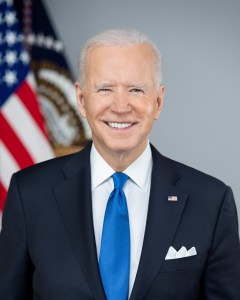
President Joe Biden poses for his official portrait Wednesday, March 3, 2021, in the Library of the White House. (Official White House Photo by Adam Schultz)

About this same time back in a small village in Lancashire in northern England, Joe Biden, the real Joe Biden had woken up from a nap in the oval office to find himself in my body, the body of Simon Harkness, a civil servant aged 42 who worked for the ministry of transport.

Joe was naturally a little confused at first, I mean there he was, the president sitting in the Oval Office, he takes a nap and finds himself in Lancashire, England. I mean, he was bound to be confused, wasn’t he?

Joe was on the couch and jumped to his feet. His surroundings were strange but not only that, he felt fitter and  stronger than he had felt for a very long time. He didn’t realise it at the time but he was an 81 year old man suddenly thrust into the body of a 42 year old. The difference was just amazing and apart from a little pain in his left thigh and what he later learned was some severe bruising, he actually felt fitter than he had felt for years.

Just then his, I mean my, wife entered the scene. She was due to go off to visit her sister and she came in chattering about the cheese sandwich she had made me and the left over casserole that only needed reheating in the microwave later.

“Who are you?” asked Joe/me.

“What?” said Paula.

Back in Washington I was getting ready to board Marine One, the presidential helicopter and I was rather enjoying it. A great many military men were saluting me and I was of course saluting back, I was the commander in chief after all.

We were all seated and ready to go.

“OK what are we waiting for?” I asked.

One of the officers looked a little pale and answered, “The First Lady, sir.”

The first lady? Of course, Biden’s wife. Now what was her name? Jill, I think.

After a while a woman came aboard and sat down and I realised it was her, Joe’s wife. She looked a little younger than Joe and soon we were buckled up and ready for take off.

In Lancashire Joe had quietly informed my wife that in fact he was Joe Biden, president of the USA and he was wondering what had happened.

“Is this something to do with that silly blog that you write Simon?”

Joe looked a little confused and before he could answer Paula told him about the sandwich and if he was eating it in the lounge to make sure he didn’t drop crumbs everywhere.

“By the way, I’ve left you a cup of tea on the kitchen table. I’m off now. Don’t forget you’re playing darts at the pub at 6.”

“I don’t suppose there’s any coffee,” said Joe.

“Don’t be silly. You know we don’t drink coffee in this house.”

She gave him a quick peck on the cheek and was gone. Joe walked through into the kitchen and took a bite of the sandwich. It was good but a corned beef on rye would have been better.

Over at Camp David I was trying to think about something I could do to help out in the world. Maybe I could call Mr Netanyahu and sort something out about Gaza. Then there was the war in the Ukraine. Was it worth calling Putin and trying to make him see sense? The thing was they had one of those really huge HD TV screens over at Camp David and I settled down to watch some US TV.

Some aide wanted to talk about the re-election campaign and I mentioned that it was a shame that in such a huge and diverse nation the best candidates were two old men who were both past it. What America needed was a younger candidate, someone like, well that woman who’s the vice president. What was her name, Camel something?

That was when Joe’s team finally seemed to be behind me. After all I told them, I’m 81, it’s time for someone new to take over, some one like, what was that woman’s name? The very next day, Sunday, we made the announcement.

Back in the UK I’m not sure how Joe managed to make it along to the pub but he turned up anyway.

The guys all welcomed him and they were asking about his fall off the bike and when he came out and told them straight, he was actually Joe Biden, well they were all a little taken aback.

“Pint of Two Hoots Simon,” called Pete, the landlord.

“Two Hoots?”

“Yes, real ale, you were knocking quite a few pints of it back last Sunday.”

“I was?”

“Go on,” said someone,“Get it down yer neck.”

“The boys say that it’s your round so that’ll be twelve pound fifty Simon,” said the barman.

“Er, I don’t think I have my wallet,” said Joe.

“Bloody hell,” said one of the lads. “Come out without his wallet!”

“Could I open up a tab. I’ll see that the White House pays the bill.”

“The bloody White House” someone else called and soon they were all laughing together.

It was round about then when I thought it might be time to get back home. It had been nice meeting Jill and a lot of other people whose names I can’t really remember so I went into a quiet corner and closed my eyes and soon there I was, back in the pub. The guys were still laughing about me leaving my wallet at home but Pete was happy for me to come in the next day and pay my tab.

I didn’t do very well at the darts. I had a slight headache so after a while I wandered off back home.

Later, I told Paula about the whole thing, about how I became Joe Biden and went to the White House but she brushed it all off saying it was something to do with that knock on the head and that I had probably dreamt it all. Even so, on the news the next day I heard that Joe Biden had decided not to run in the election and he had endorsed Kamala Harris, his vice president.

I wasn’t surprised.


For an alternative version of this post, click here.


What to do next: Here are a few options.

Share this post on your favourite social media!

Hit the Subscribe button. Never miss another post!

Listen to my podcast Click here.

Buy the book! Click here to purchase my new poetry anthology.

Click here to visit Amazon and download Floating in Space to your Kindle or order the paperback version.

The Rise and Fall of OJ Simpson

Every Thursday Liz and I visit our local pub for our weekly quiz night. It’s not a particularly tough quiz and we’ve even won it on the odd occasion but one thing we do in advance is check the internet to see if any celebrities have died as Mike, our pub quizmaster, tends to throw in a question or two about recently deceased celebs. One name that popped up on Google was that of OJ Simpson who passed away recently from cancer. I tend to watch the TV news most days so either I missed the story about OJ or perhaps these days his name isn’t as newsworthy as it once was. Simpson was 76 years old and a former US sports star, actor and allegedly a murderer.
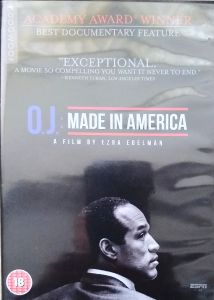
Back in 1994 Simpson’s estranged wife was brutally murdered and Simpson was the prime suspect. If he had been anyone other than a famous sports star and TV commentator, he would have been arrested but for whatever reason, he wasn’t. Later arrangements were made for OJ to come and surrender himself at Police Headquarters in Los Angeles but he did not appear. Shortly afterwards TV helicopters spotted Simpson driving down the freeway and a posse of police cars followed but kept at a distance because OJ was reported to be holding a gun to his head. This bizarre procession was broadcast live and at various intersections crowds gathered to watch and wave to OJ. When it was reported that OJ was heading to his home crowds of supporters gathered there to watch his arrival and eventually he surrendered his gun and was duly arrested.

OJ Simpson: Made in America is an outstanding documentary, released in 2016. It runs for over five hours and won an Oscar for best documentary. Episode one details Simpson’s incredible sporting career and also showed how it was important for him to be seen just as OJ rather than OJ the black athlete. He was apparently a friendly and amiable man who made many friends in the sporting world and kept himself well away from controversy and was never involved in the civil rights movement in America unlike sporting celebrities like Mohammed Ali. Later episodes show how he made a life after sport by becoming a TV sports pundit and by courting wealthy friends in Los Angeles to advise on his investments. In particular he made TV advertisements for Hertz car rentals which were highly popular and did well not only for Hertz but raised Simpson’s profile in the USA even higher.

The series also looks at the climate of race relations in Los Angeles and the activities and methods of the LAPD who clearly were not engaging or even trying to engage with the black community. A ‘them and us’ situation evolved in LA and when Rodney King, a black motorist was brutally beaten by a group of white police officers and caught on an amateur video, the situation become even more inflamed. The officers were taken to court but found innocent by a white jury causing riots and disturbances in the area.  This was the background of the later OJ Simpson murder trial.

Simpson divorced his wife and married eighteen-year-old Nicole Brown, a blonde LA waitress. Their marriage lasted seven years and was not happy, especially in the latter years when Nicole was beaten and abused by Simpson. She called the police numerous times reporting OJ for assault. On June 13th, 1994, Nicole and a waiter named Ron Goldman were found dead. A trail of blood led away from the scene and later blood was found on Simpson’s white Ford Bronco.

Simpson was not as famous in the UK as in America but I do remember seeing the crazy car chase on TV with Simpson in his white Bronco followed by a fleet of Police cars. The documentary series completely gripped me and the portrait of Simpson himself and the racial climate in Los Angeles and the attitude of the police was compelling.

I was so interested in the OJ trial I picked up a book about it and this is how I reviewed it a few years ago:

The People v OJ Simpson by Jeffrey Toobin

This fascinating book is a detailed look at the 1995 murder trial of former US football player OJ Simpson. Simpson was accused of murdering his ex-wife Nicole and her friend Ron Goldman. The pair were murdered outside Nicole’s house in the Brentwood area of Los Angeles and bloody footprints were found leading away from the scene. Simpson’s car had blood traces with matches to both Nicole’s and Goldman’s blood. There was even a low-speed police pursuit of Simpson that was broadcast live on TV bringing in a reported 95 million viewers.
The defence team managed to divert attention away from all of this evidence by playing into the troubled atmosphere in the area at the time. Motorist Rodney King, a black man had been beaten by a group of white police officers. They were all cleared of wrongdoing by a white jury despite the fact the incident was recorded on video clearly showing the officers beating up King. The defence also made great play about a ‘racist’ cop who was one of the first on the scene and even implied he could have planted damning evidence at Simpson’s home, that of a bloody leather glove that matched one found at the murder scene.

Witnesses gave newspaper and TV interviews as well as the lawyers themselves. The trial proceedings were broadcast live making the defence and prosecution teams into instant TV stars. The judge welcomed TV pundit Larry King into the courtroom and held up proceedings while King and the Judge chatted in his private chambers. The media attention led to the jury being sequestered for the length of the trial and not allowed to read newspapers, magazines or watch the TV news about the trial. A number of them were dismissed during the proceedings for various things, only 4 of the original jurors making it to the end.

Both sides were involved in the jury selection procedure asking questions ranging from sports to their views on domestic violence, all things that would be incredible in an English courtroom. Incredibly, before the trial had even started the TV news had broadcast a 999 call by Nicole requesting the police because Simpson was beating her up.

The author describes the background to the defence and prosecution teams and how they worked. One interesting thing was their use of outside companies who specialised in jury selection and analyses. The defence team followed the advice of their researchers who advised that middle aged black women tended to favour Simpson. The prosecution had the same advice but prosecutor Marcia Clark felt that that same group, middle aged black women, responded strongly to her and that her depiction of OJ as a wife beater would sway them. That was a big mistake.

This is a deeply fascinating book written by a journalist who covered the trial at the time for the New Yorker magazine.

Getting back to the present and I thought I’d watch the whole documentary, OJ Simpson: Made in America, all the way through, all five hours, over the course of a few evenings.

The first episode showed Simpson’s impressive sports career and the huge following he began to accrue. At one event in 1973 he was about to beat a record as the first player in the NFL, National Football League, to rush for more than 2000 yards. I’m not quite sure what that meant but from the video it looked equivalent to a rugby player making a try in the UK. Even the opposing team began to cheer him on. After retiring Simpson was asked to make a TV advert for the Hertz car rental company which was very popular. Simpson had become one of the most well known figures in America, loved by both black and white Americans. He had a beautiful wife, a fabulous home and wonderful children. Where could it all go wrong?

His wife made numerous calls to the police after beatings by OJ and the couple eventually split. At one point they tried to get back together but the violence began again and Nicole finally moved out.

On the evening of 12th June 1994, Nicole Simpson along with her children and various family members went for dinner at the Mezzaluna restaurant. Later, Nicole’s mother found she had left her glasses at the restaurant and waiter Ronald Goldman volunteered to return them to Nicole’s home. Later the two are found brutally stabbed to death. Simpson had left that evening on an 11.45pm flight to Chicago where he was due to play golf. However, blood stains were found on his car, a Ford Bronco and bloody footprints were left behind belonging to a type of shoe he was known to have worn.

At the trial the defence team tried to assert that one of the first detectives on the scene, Detective Mark Fuhrman, was a racist and had tried to frame OJ by leaving a bloody glove behind. It was later revealed that in the past he had given an interview to an author which she recorded in which he used disparaging language against the black community. When he was later recalled to the court he took the 5th amendment on each question, including when he was asked if he had planted the bloody glove.

Racial tensions had been bad in the area due to the Rodney King incident and there was jubilation in the black community when OJ was found innocent and shock in the white community.

OJ seemed to think he could carry on with his life as before but a civil suit by the Goldman family found him guilty and liable for damages. He was forced to sell his home and was later arrested when he forcefully tried to retrieve his sporting memorabilia which he believed had been stolen from him.

At the subsequent trial OJ was found guilty and sentenced to 33 years in prison. He was released on parole after serving 9 years.

OJ Simpson died on 10th April 2024 after suffering with prostate cancer.


What to do next: Here are a few options.

Share this post on your favourite social media!

Hit the Subscribe button. Never miss another post!

Listen to my podcast Click here.

Buy the book! Click here to purchase my new poetry anthology.

Click here to visit Amazon and download Floating in Space to your Kindle or order the paperback version.


TV, Westerns and The Outlaw

Once upon a time Howard Hughes was the richest man in the world. In today’s society being the richest man requires some serious wealth and Howard Hughes ticked all the financial boxes you can think of. He inherited his father’s tool company when he was very young. Too young in fact to take control but he found a law that said if he could prove he was capable of running the company then he could take control. He proved he could and did just that, took control. His father had designed a tool bit that was essential to America’s oil industry but instead of selling the drill bit he patented it and then rented it out. Howard Hughes though had other ambitions which did not involve oil or drilling but the profits from the Hughes Tool Company were vital for his ambitions in aviation and film making.

Hughes combined those two interests in making the WW1 movie ‘Hell’s Angels’ about fighter pilots and for the shoot he assembled the largest private air force in the world. Towards the end of the shooting, sound pictures made their appearance so what did Howard do? He reshot the entire film with sound equipment!

The_Outlaw-poster-trimAnother movie Hughes made that is famous, or perhaps infamous, was the 1943 Movie ‘Outlaw’ starring Jane Russell. Hughes appeared to be obsessed with Jane’s breasts, even to the extent of designing a new bra for her and reshooting a famous close up of her time after time. Hughes clearly had some psychological issues; he was a compulsive, obsessive man. He usually had the same meal when he went out with one of the many starlets he courted. Jane Greer recounted in a TV interview how Hughes would eat things in the same order; the peas first, then the potatoes and finally the meat. Once when they dined Hughes came back to the table and Jane noticed that his shirt was wet. Hughes had spilt something onto his shirt so he had washed the shirt in the men’s room, rinsed and squeezed it out, then put it back on.

As his mental health deteriorated, Hughes retreated into a world of blacked out penthouse suites and midnight telephone calls to his army of assistants, some of whom were private investigators keeping close tabs on anyone Hughes had an interest in, particularly starlets he had signed to personal contracts and his girlfriends like Katharine Hepburn or Jean Peters whom he later married.

Anyway, this isn’t a post about Hughes, it’s about TV and looking through my old posts I noticed a couple that caught my attention. One was about Hughes and I have to confess, I pinched the text above from that post, and another was about my life as a couch potato and avid TV viewer. A few days ago, staying at my mother’s house I once again had a few couch potato days. On the first one I was tapping away on my laptop with the TV on but no sound. On Mum’s old TV you can go through the on screen menu and choose programmes you want to watch and the TV will flip to that channel at the appointed time. It was Saturday afternoon and even though that Saturday’s post had just been published, as usual I was already worrying about the next one.

As I looked up from my laptop I could see a new film had started. I switched on the volume and was surprised to find it was The Outlaw, the Hughes film I mentioned above. I had never seen the film and everything I knew about it came from either books, documentaries or films like the Aviator, the Martin Scorsese film about Hughes himself. Hughes filmed The Outlaw in 1941 but had trouble with the film censors of the time. He had to cut half a minute from the film where the camera had lingered for too long on Jane Russell’s ample bosom. 20th Century Fox however decided not to release the film thinking perhaps it was too hot to handle. Hughes decided to build his publicity on that very idea. The film was released for a quick showing and then Hughes put the film under wraps for the next few years while his publicity people whipped up controversy and hysteria, meaning that when it opened in 1946, released finally by RKO, the film was a huge hit.

Even over half a century later people like me are still liable to be caught up in the controversy because I always thought the film was about Rio, the character played by Jane Russell and was of a risqué nature, or at least as risqué as films could get in 1941. I have to admit I missed the beginning of the film the other day and the famous scene of Jane Russell in the hay must have occurred either before I looked up from my laptop or when I was in the kitchen making a brew.

Hughes seemed to be obsessed with Jane’s breasts and wasn’t happy with the way they looked on screen, so much so he designed a new cantilevered bra for her, perhaps the first push up bra ever made. Russell later claimed that the bra was a nightmare to wear so she simply used her own but padded the cups with tissue, which apparently achieved the effect that Hughes wanted.

The action, such as it was, seemed to revolve around the friendship which blossomed between Billy the Kid and Doc Holliday which seems to make Pat Garrett very jealous as he considered himself a better friend to the Doc than Billy. It was actually a quirky sort of film. Walter Huston, father of film director John, played the part of Doc Holliday and Jack Buetel, an actor I don’t think I’ve heard of before, played Billy.

Billy the Kid has been portrayed a number of times in films, as have Pat Garrett and Doc Holliday. Paul Newman played Billy in The Left Handed Gun, a part originally earmarked for James Dean until Dean was killed in a car crash. In the 1970’s Sam Peckinpah directed Pat Garret and Billy The Kid starring James Coburn as Pat Garret and Kris Kristofferson as Billy. Bob Dylan also had a small part as well as writing the music for the film including the hit single Knockin’ on Heaven’s Door.

Billy the Kid was killed in 1881 by Pat Garrett. There were rumours however that Pat staged Billy’s death so that he would be free of pursuit by the law. That scenario was used in the end of The Outlaw, although in the film it was Doc Holliday who gets the bullet but it was Billy’s name on the gravestone.

One of my favourite cowboy/outlaw films has to be Jesse James, the 1939 film starring Tyrone Power as Jesse and Henry Fonda as his brother. The film was so successful that they made a sequel, The Return of Frank James starring Henry Fonda as Frank on track to find his brother’s killer.

Two more outlaws whose fame has lasted right down to the present day were Butch Cassidy and The Sundance Kid and the two were played by Paul Newman and Robert Redford in a film called just that: Butch Cassidy and the Sundance Kid. I saw a film programme a while back on the BBC where Paul Newman explained that screenwriter William Goldman had approached him about making the film and starring as Butch. Various people were suggested for the Sundance Kid and Newman even met with Steve McQueen about the part but eventually it was Robert Redford who won the role.

The film was released in 1969 but has a very 1970’s feel about it. There is even a musical interlude in the film where Paul Newman tries out a new fangled bicycle with Sundance’s girlfriend Etta to the tune of Raindrops Keep Fallin’ on my Head.

My two favourite westerns both star John Wayne, the quintessential cowboy hero. Wayne starred in The Searchers, directed by John Ford. Wayne stars as a civil war veteran whose niece has been kidnapped by a band of warlike Commanches. Ethan Edwards takes his adoptive nephew on a long search for the kidnapped girl until they finally rescue her.

My other favourite is The Man Who Shot Liberty Valance. Lee Marvin plays a brilliant part in that of Liberty Valance, a mean, no good bully who terrorises a western town until lawyer James Stewart manages to shoot him dead, or so we think. Later, when Stewart decides he is unwilling to base his career on being the man who shot Valance, John Wayne reveals what really happened.

Back in the fifties and sixties was probably the heyday of cowboy films and TV shows. Today it seems that the western is a genre that has been almost forgotten. As a schoolkid I was an avid watcher of The Lone Ranger, Branded, The Virginian, Bonanza, Casey Jones and many others. One of my favourites was Alias Smith and Jones, a series about two outlaws, Kid Curry and Hannibal Hayes who are on the run but have been offered an amnesty on the condition that they give up crime and go straight. They adopt new identities, that of Smith and Jones and try to live law abiding lives. It was a great series with some excellent episodes but in December 1971, Pete Duel, the actor who had played Hannibal Hayes committed suicide. Another actor was substituted in the role but the series was never as popular afterwards.

Another great western was Kung Fu. Kung Fu was an oddball western in many ways; it was about a half Chinese, half American called Kwai Chang Caine played by David Carradine. Caine becomes a Shaolin monk after he has been taken in by the monastery as an orphan. Caine has been tutored in the Buddhist religion and martial arts by master Po. When Po is murdered by the Emperor’s son, Caine retaliates and kills him. Now with a price on his head Caine flees to the USA. In the USA of the old west, Caine encounters many situations which then cause him to reflect on his own upbringing and tutoring in China, shown in many flashback sequences. Caine defends himself in many situations with his mastery of Kung Fu and the series became not only a great success but the forerunner in a world wide Kung Fu craze with many Hong Kong martial arts films also becoming popular.

The western film and TV shows seemed to have all fizzled out by the end of the 1970’s. Perhaps these days audiences prefer sci fi series like Star Wars and Star Trek. Tastes change of course and one day perhaps audiences will once again want more westerns. For now I think I’ll settle down after a busy shift, pour myself a glass of wine and wind down with my copy of John Ford’s The Searchers.


What to do next: Here are a few options.

Share this post on your favourite social media!

Hit the Subscribe button. Never miss another post!

Listen to my podcast Click here.

Buy the book! Click here to purchase my new poetry anthology.

Click here to visit Amazon and download Floating in Space to your Kindle or order the paperback version.

Locked Down Blogger Part 2

It finally happened last week. It had been rumoured and expected. It had been predicted many months ago and so here it is. I’m talking of course about the second wave of the Coronavirus epidemic and the resulting second lockdown. There was some advance notice and as a result Liz and I were able to book a table and enjoy a last meal out. We even thought what the heck and went for a second bottle of wine just like the other couple in the next table sitting a socially distanced two metres to our left.

So that’s a month coming up with no nights out at the pub, no meals out and no quiz nights. The big problem with this second lockdown is the weather. In the first one I was quite happy sitting out in the sunshine reading a book. Now we have entered November here in the north of England it seems as though it has been constantly raining. What can we find of interest then? Well the big interest for me just lately is the American election. Like many people, I thought the election was a foregone conclusion, that Trump would be out and whoever the democrats chose would be in. It just so happened that the democratic candidate was Joe Biden. Joe is getting on a little bit for the top job and wouldn’t necessarily have been my choice but then again, neither would Donald Trump. As I write this the election is still ongoing, they are still counting the votes in a few remaining states. Both candidates are claiming victory and one is claiming huge voter fraud. Biden has so far been pretty much acclaimed as the winner, having received congratulations from previous presidents Obama and George W Bush. No congratulations have been forthcoming from Donald Trump and his legal team has already initiated legal action. I’m not sure who exactly they are planning to take to court but either way, that has not stopped Joe Biden getting his transition team together and making plans for when he takes office.

I wrote something back in 2016 about the smooth transition of power in the great democracies and even wondered what would happen if ever the outgoing president refused to budge. That was just wild blogging speculation but now some commentators are saying it could actually happen. This is almost as interesting for me as Watergate.

There was a time when I thought I understood the US election, now I’m not so sure. Hillary Clinton and Al Gore both won the popular vote in previous elections but failed to get enough electoral college votes to take them to the White House. I’m even confused about the primaries, I mean I was convinced Bernie Sanders would be the democratic candidate, but he stepped down earlier in the year and then Biden seemed to become the candidate virtually unchallenged and his projected walkover victory over Trump has just not happened. Many people actually support Trump. Some give their support because they are dyed in the wool Republicans, some presumably admire him but either way, 48% of the votes were for him.

I was watching TV the other day and a female black voter was being interviewed and surprisingly, she was voting for Trump. She wouldn’t vote for Biden she said because he was a socialist, which in the USA is one step from being a communist. Maybe that explains why Trump has such a following; in many places he must be seen as the anti-socialist. Trump did well in Florida where many Cubans found home after leaving communist Cuba.

When Nixon won the election in 1968 he spotted a supporter in a crowd with a banner proclaiming Bring us together and made that a campaign slogan. Bringing Americans together is a big ask for whoever wins in 2020 but I wish him luck in doing just that.

Theoretically this should be a great time for writers. What could be a better time to write than the lockdown, after all there isn’t much else to do. A few months back I shelled out a hundred or so dollars to list my screenplay on a web site called InkTip. InkTip is a way of bringing producers and writers together. They produce a newsletter for producers listing scripts and also provide subscribers with weekly lists of producers who want scripts. My screenplay has seen a lot of action lately with various producers reading either the synopsis or the script itself but that million-dollar deal has yet to surface. I live in hope.

My screenplay was one I wrote quite a few years back and I read through it recently and had an idea for a new ending. I added the new ending, tidied everything up and that final version was the one I added to InkTip. As I reviewed it again the other day – I don’t know about you but I’m always reviewing my old stuff- I realised that it was written before today’s mobile phone, Twitter and Instagram age. Not one of the characters has a phone. I might have to spend the lockdown adding mobile phones to my screenplay and bringing it into the 21st century.

Another project I’ve been working on during the lockdown is a video covering my recent trip to the Scottish Highlands. It’s mostly GoPro video from a camera stuck to my motorhome window. I’ve added some stills and some bits where I talk straight to the camera. I had a lot of technical problems putting it together, particularly recording the voice over. The voice over is pretty important because the actual visual stuff isn’t that exciting. When I recorded it, my laptop clearly couldn’t keep up with playing video and recording sound at the same time, so I had to record my voice separately and then add it to the video. That makes it difficult because normally as I’m reading the narration I tend to react to what is on screen so I can slow down or speed up if required or just add lib if I need to.

I was feeling pretty pleased with myself when I finished it and quickly got it uploaded to YouTube. I added the video to a video creators page that I follow and got some pretty reasonable feedback. What was really annoying was when I decided to tinker with it and spotted a couple of things I hadn’t noticed. One was in the credits at the end where I credited the music as Soul Grove instead of Soul Groove. Oh, and there was one more. In one of the stills of the motorhome I hadn’t picked up that Liz was rather cheekily giving me the V sign through the window! The thing is, the video had already garnered 72 views so do I delete and add the updated version or just leave things as they are? Decisions, decisions.

I’ve has a couple of nights on my own this week, as usual keeping my mothers house ship shape and lived in. One night I thought I’d make one of my favourite dishes, bruschetta. It just so happened I had some ciabatta in the freezer as well as onions and tomatoes. So here we go, I sliced the bread and popped it in the toaster for a light toasting. While that was going on I chopped the tomatoes and onions, mixed them up with a little garlic and olive oil. I Popped the bread out, slapped on the tomato and onion mixture and settled down to eat. It was wonderful.

It was so good I decided on another Italian favourite for the second course. aglio olio peperoncino. It’s basically spaghetti with olive oil, garlic and chilli. What could go wrong with that?

The quick answer is everything, overdone spaghetti, burnt garlic and those chillies I used last week on a curry that weren’t very hot: this week they were hot!

When is my favourite Italian restaurant opening again?


What to do next:

Share this post on your favourite social media!

Hit the Subscribe button. Never miss another post!

Buy the book! Click here to visit Amazon and download Floating in Space to your Kindle or order the paperback version.

Films, Allegories and McCarthyism

In the 1950’s, Senator Eugene McCarthy, aided and abetted by the head of the FBI, J Edgar Hoover, began to accuse hundreds of Americans of being either communists or communist sympathisers. Hoover had designed President Truman’s loyalty and security program and his agents carried out background checks on federal employees. This information was supposed to be secret but in 1950 when the Korean War began, Senator McCarthy produced a list of supposed communist party members or supporters working for the state department and presented it to the press. Much of his information came from Hoover.
The House Committee on Un-American activities was probably the best known and most active government committee involved in anti-communist investigations and probably became most well known for its investigation into the Hollywood film industry. In 1947 the committee began to subpoena various film industry workers and force them to testify about their support for the communist party. They were asked ‘Are you now or have you ever been a member of the Communist Party of the United States?’

The first witnesses brought before the committee refused to answer and became known as the Hollywood 10. They all cited the constitution’s first amendment which they believed guaranteed free speech and free assembly and therefore freed them from the requirement to answer the committee’s questions. They were wrong. The communists of the USSR may have been allies in the defeat of Hitler but now that Nazi Germany lay in ruins, the red menace was the new enemy and America was scared.

The committee questioned numerous people, actors, directors, screenwriters and many others and more than 300 individuals were blacklisted by the industry. Some like Charlie Chaplin, left the country. Some screenwriters wrote under pseudonyms to find work. Larry Parks, the star of The Jolson Story, testified in tears. He was blacklisted and left the movie business after his contract with Columbia Pictures was cancelled.

Two prominent ‘friendly’ witnesses were director Elia Kazan and screenwriter Budd Schulberg.

On the Waterfront

Director Elia Kazan had originally employed Arthur Miller to write the screenplay for On the Waterfront but the two fell out over various things especially the fact that Kazan had identified eight former communists to the HUAC. Kazan then asked Budd Schulberg to write the script. There was still some difficulty in getting the film to the screen and eventually Kazan approached Sam Spiegel to act as producer. He was able to set up a deal with Columbia Studios.

The film stars Marlon Brando as dock worker Terry Malloy, brother of Charlie ‘the gent’ who is the right hand man of union boss John Friendly played by Lee J Cobb. Terry unwittingly leads fellow dockworker Joey Doyle into an ambush, thinking Doyle will be threatened to withdraw his statements to the crime commision. However Doyle is murdered leaving Terry shocked and confused. Later he becomes friendly with Joey’s sister played by Eva Marie Saint in her film debut. Charlie, played by Rod Steiger, tries to get Terry back into line in the famous scene with the two in the back of a taxi but fails. After John Friendly has Terry’s brother murdered, the local priest played by Karl Malden convinces Terry to tell everything he knows to the waterfront crime commission. Terry does so but is ostracised by his fellow dockers until Terry forces Friendly into a brutal fight. The dockers then stand with Terry when bruised and battered, he returns to work.

The film was thought to be Kazan’s response to criticism of his stand at the HUAC hearings although Schulberg later denied this, explaining how he attended actual waterfront hearings and based his film on those. Arthur Miller in his play A View from the Bridge has his character inform on two illegal immigrants but it is portrayed as a betrayal rather than the honest informing of Waterfront.

Either way, On the Waterfront is one of my very favourite films and Brando’s performance as Terry Malloy won him one the film’s eight Oscars. Forget about Don Corleone, this was Marlon Brando’s finest hour.

Spartacus

Spartacus was based on a book by Howard Fast who was jailed for his refusal to testify at the HUAC hearings. According to Wikipedia, he wrote the book while in prison. Kirk Douglas was disappointed at not getting the lead role in Ben Hur and looking round for a similar project came across Fast’s book. He purchased an option on the book with his own money. Later, financing was arranged with Universal Studios.

Dalton Trumbo wrote the script although he had been blacklisted but managed to continue working by using an alias. He had earlier been jailed for contempt of congress as he was a member of the Hollywood 10.  Kirk Douglas decided that Trumbo should be given a screen credit in his own name and this action helped to end the blacklist.

Anthony Mann was the original director but Douglas fired him after 2 weeks claiming he was scared of the scope of the picture. Douglas then hired Stanley Kubrick to direct, Kubrick having worked with Douglas previously on Paths of Glory.

The film has been said to have links not only to the McCarthy era but also to the American civil rights movement. Slavery is a central theme to the film and the fight to end segregation in America is reflected in the mixing of various races in the Gladiator school. The climatic scene where the rebels are asked to give up Spartacus and instead call out ‘I am Spartacus’, alludes to the HUAC hearings where witnesses were asked to name names.

Spartacus is a wonderful film and was restored twice, once in 1991 and again in 2015 where a version 12 minutes longer was produced as well as having a remastered soundtrack.

Kirk Douglas is excellent in the lead role and a trio of characters played by Laurence Olivier, Peter Ustinov and Charles Laughton work together so faultlessly they help elevate the film to an outstanding degree. Poor John Dall, who plays Glabrus is hopelessly outclassed by the British actors.

High Noon

High Noon is not a movie that I would have thought would be in any way related to McCarthyism or the HUAC hearings. However, the film was directed by Fred Zinneman from a screenplay by Carl Foreman. Foreman was called to testify before the HUAC . He admitted once being a communist party member but declined to name any fellow members and was therefore classed as an uncooperative witness. Realising he would be blacklisted, he later sold his partnership in the film project and moved to the UK.

John Wayne declined the lead role as he thought the film an obvious allegory of blacklisting, of which he was a fervent supporter. Gregory Peck amongst others turned down the role and it eventually went to Gary Cooper. Grace Kelly played Cooper’s new wife despite the age difference; she was 21 and Cooper 50.

Marshall Will Kane (Cooper) marries devout Quaker Amy Fowler (Kelly) however the Marshall gets word that Frank Miller, a vicious gunman who Kane had sent to prison years before has been released and is due to arrive on the noon train. At first Kane decides to leave town but then realises he will be caught out in the open with the gunmen coming after him. Not only that, the gunmen are making him run and ‘I’ve never run from anybody before’ he tells Amy.

Will returns to town but his new wife, whose extreme religious beliefs include an vehement opposition to violence, will have nothing more to do with him. As the minutes tick relentlessly down to noon he tries to get a group of deputies together, but for one reason or another they all fail him and he has to face Miller and his gang alone.

At the end of the film, reconciled with Amy, Cooper looks around disgusted by the townspeople who have shunned him and throws his Marshall’s badge to the ground.

The tension mounts up relentlessly in the film and builds to a wonderful climax. Another great aspect of the film was the music and the distinctive theme song, actually called ‘High Noon’ although mostly known as ‘Do not forsake me oh my darlin’’. It became a hit for Tex Ritter.

My brother and I watched this film a few months ago and afterwards he told me a story that our dad had told him years ago. Dad saw the film when he was in the army. Dad served in various places but wherever they were on this occasion, the film was projected in a big tent. Afterwards when the men dispersed after the showing, the theme tune had made such a big impression that they were all whistling or humming ‘Do not forsake me oh my darlin”.


Floating in Space is a novel by Steve Higgins set in Manchester 1977. Click the links at the top of the page to buy or for more information.


Bury my Heart at Wounded Knee

I can’t really remember when I became interested in Red Indians, or to be more precise, Native American Indians. In a way it was an interest in philosophy and the meaning of life that led me to them. I liked the idea of the Great Spirit and the Mother Earth. Those intrinsic ideas of nature and faith greatly appealed to me and showed me a different Indian to the one I have seen on feature films, here was a thoughtful race, in tune with nature. A speech made in 1854 by Chief Seattle has always moved me and in part says this:

This we know: the earth does not belong to man, man belongs to the earth. All things are connected like the blood that unites us all. Man did not weave the web of life, he is merely a strand in it.

What more eloquent description of the world and man’s place in it could there be?

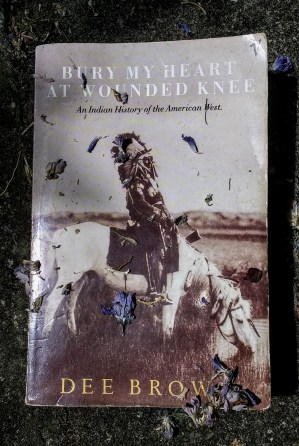
Bury my Heart at Wounded Knee is a book by Dee Brown published in 1970. It is a sad book telling a sad tale of murder, lies and ethnic cleansing. It tells the story of a proud race of people driven from their homes by invaders from Europe and forced to leave behind their homes, their memories and their traditions. Much of the book is in the actual words of the Indians whose words were taken down in treaty meetings and councils, by government stenographers.

Columbus arrived in the new world in 1492 and he described the natives at ‘tractable and peaceable’ yet in less than a decade Spaniards had looted and burned villages in their search for gold and treasure, kidnapped men, women and children for sale as slaves and destroyed entire tribes. Things were similar on the east coast of the country. Englishmen landed in 1620 and found the natives friendly and even helpful. They would probably have died during their first winter in America had the natives not showed the newcomers where and how to fish and how to cultivate and plant corn. For several years the Indians and the new white settlers lived in peace but then more and more settlers arrived and settlements in the place the newcomers called New England became more crowded.

in 1625 some of the colonists asked the Indians for more land. The Indians who knew that the land came from the Great Spirit and belonged to no one went through a ceremony to give the English more land. It was more to humour these strange men that the Indians did so but it was the first deed of Indian land to English colonists.

When Massasoit, the chief of the Wampanoags died in 1662, his people were being pushed back into the wilderness as so many more Englishmen arrived and their settlements became bigger. The New Englanders flattered the new Indian chief Metacom and crowned him ‘King’. Metacom though made new alliances with other Indian tribes and in 1675 began a war to save the tribes from extinction. The firepower of the colonists however overwhelmed the Indians and Metacom was killed and his head publicly displayed at Plymouth for the next twenty years. His wife and son were sold into slavery.

Over the next two hundred years these events were repeated time and time again as the colonists moved ever westwards. In 1829 Andrew Jackson took office as President of the United States.. He suggested setting an ample district of the country, west of the Mississippi, to be guaranteed to the Indian tribes. On May 28th 1830 Jackson’s recommendations became law. Two years later he appointed a Commissioner of Indian Affairs to see this was carried out and then on June 30th 1834 Congress passed An Act to Regulate Trade and Intercourse with the Indian Tribes and to Preserve Peace on the Frontiers. All the land west of the Mississippi and not part of Missouri, Louisiana or Arkansas would be Indian country. Also, no white persons would be able to trade in the Indian country without a licence and no white persons would be allowed to settle on Indian lands. However, a new wave of settlers surged west and formed the territories of Wisconsin and Iowa and so the Indian frontier was shifted even further west.

At the beginning of the 1860’s the American Civil War began. Perhaps the Indians hoped the white men would destroy each other but it was not to be. The colonists wanted more and more land and the Indians had to cede more and more to the newcomers until there was nothing left for them to give. One thing they would not give was the Black Hills.

The Black Hills were sacred to the Indians. Paha Sapa was the centre of the world, the place where warriors went to speak with the Great Spirit and await visions and where the spirits of their ancestors dwelt. In 1868 the Great Father, the President, considered the hills worthless and gave them to the Indians forever by treaty. Four years later the cry of ‘gold’ was raised and miners and pan handlers made a bee line for the hills. Many were killed or chased out by the Indians but by 1874 gold crazy prospectors were making such a hue and cry that the army decided to send soldiers to the area for a reconnaissance. A thousand pony soldiers of the 7th cavalry marched into the area  commanded by General George Armstrong Custer. Custer had years before slaughtered Black Kettle’s Southern Cheyennes. Red Cloud of the Oglala Sioux was not happy. He made complaints to the Great Father in Washington but their response was to send negotiators to buy the Black Hills. Councils were set up with the chiefs of all the tribes in the area but the word was firm. The Black Hills had an importance to the tribes that went beyond money. They would not sell.

The negotiators packed up and returned to Washington. Their recommendation? That congress ignore the wishes of the Indians, take the land and pay a ‘fair equivalent of the value of the hills.’ to the Indians.

On December 3rd the Commisioner of Indian Affairs ordered all Indians to report to their reservations by January 31st. This was impossible as all the tribes were at their winter lodges and many were searching for game to assist with their meagre rations. A mixed band of Oglala Sioux and Northern Cheyennes were hunting Buffalo in the Powder River area. On March the 17th they were asleep in their lodges when a company commanded by Captain James Egan charged through the sleeping camp. At the same time a second troop of cavalry came in from the left flank while a third swept away the Indians’ pony herd. Many were killed. The Indian Teepees were burned with everything inside and the survivors were left with nothing, no food or weapons and only the clothes they were wearing. Later that night while the soldiers camped, the survivors returned and stole back their horses, then without adequate food or clothing they made their way to the camp of Crazy Horse. The Oglala chief took in the survivors and gave them food and shelter.

As the weather warmed the Sioux and Cheyenne decamped in accordance with their treaty rights as hunters. Several thousand Indians of many tribes came together. After an engagement with the forces of General Crook the chiefs decided to move to the valley of the Greasy Grass, or as the Americans called it, the Little Big Horn.

Some minor battles with other US cavalry groups had occurred before the  Little Big Horn engagement, notably with Major Reno. It seems that when the Indians attacked Custer’s 7th Cavalry, Custer meant to break back south and meet up with major Reno’s forces not knowing that they had already been beaten back by Indian forces. Custer also apparently did not realise the true scale of the Indian forces. Five of the 7th Cavalry’s 12 companies were annihilated and Custer was killed, as were two of his brothers, a nephew and a brother-in-law. The total US casualty count included 268 dead and 55 severely wounded (six died later from their wounds).

After the battle the tribes hunted and feasted. Generals Crook and Terry would not attack again until reinforcements arrived. By then, many of the tribes had left for their own reservations and lands and the huge force that had existed before was gone. The Sioux were finally defeated by General Miles in 1877. Threatened with starvation the tribes were forced to finally sell the Black Hills.

One last sad story is one that gave its name to the title of Dee Brown’s book. In December of 1890 a band of Lakota Indians were escorted to the Wounded Knee creek where they camped. The next day Major Whiteside’s regiment was replaced by soldiers of the newly built up regiment once commanded by Custer and now led by Major James Forsyth. Forsyth decided to disarm the Indians and had his troops surround them. He had new Hotchkiss guns set up on a hill to cover the camp.  It is not certain what happened but the next morning one Indian was reluctant to give up his rifle. Soldiers tried to seize the rifle and a shot was heard. Perhaps it was the Indian, Black Coyote, perhaps not. Soldiers then opened fire, shooting indiscriminately. Fighting began but as only a few of the Indians had weapons they were forced to flee. Then the Hotchkiss guns on a hill overlooking the area opened fire, raking the teepees and killing women and children and anyone in their path. 153 were known to be dead but many died later from their wounds.

Bury My Heart at Wounded Knee tells of the Cheyenne, the Sioux, the Arapaho, the Brules, the Cherokees, the Shoshone and hundreds of others, their names now forgotten. It tells of chiefs like Sitting Bull, Crazy Horse, Standing Bear, Geronimo, Red Cloud, Cochise and many more. All are gone and few remembered but the Native Americans survive to this day. Many have adapted, many have changed. Most live in poverty on reservations described by observers as being like third world nations.

Today, the Sioux still ask for the return of their lands. In a 1980 ruling, the U.S. Supreme Court found that “a more ripe and rank case of dishonorable dealing will never, in all probability, be found in our history.” It authorized a settlement now worth nearly $200 million, but ruled that it had no power to return the land. The Sioux live in poverty, yet they refused the pay out.

The Hills, the Indians say, are sacred soil, Wamaka Og’naka I’cante, the heart of everything that is, and not for sale.

The fight for the return of their lands goes on.

Bury My Heart at Wounded Knee is still in print 48 years after its publication in 1970

For more information, read this article in the New York Times or this one on the PBSO news Hour page.


Enjoyed this post? Why not try my book Floating in Space set in Manchester, 1977? Watch the video below for a quick taster or click the options at the top of the page for info or to buy!


Reading about Watergate

I remember being in our usual pub quiz a few months back and one of the questions concerned Watergate. We were sitting with some friends, actually some much younger friends and one of them asked me, ‘Watergate? What’s that?’
I have to admit to being surprised as the Watergate scandal is something that every one knows about, don’t they? It’s the scandal that gave the world the ‘gate’ suffix which has been added to every scandal that has happened since. Hence Irangate, Camillagate and so on. What was Watergate about then you might ask? OK, it’s a subject that’s well worth reading about if you like American politics, which I do. I have a number of books about Watergate and President Nixon and I’ll go through them in a moment. Firstly though back to that question, what exactly was Watergate all about?

On June 17th 1972, five burglars were caught in the Democratic National Committee headquarters in the Watergate Building in Washington. Some of the five had links to the CIA or the FBI but all of them were linked to an organisation known as CREEP, the Committee to REElect the President. The President was Richard Milhous Nixon who had been defeated by John F Kennedy in 1960 but had made an extraordinary comeback to the political limelight. Just think back now to the presidential elections of recent years. Remember those defeated candidates, Dukakis, Mondale, Dole? Familiar names who had their fifteen minutes of fame and then vanished into the history books. Did any of them ever make a comeback? Well, the only one that I can think of is Richard Nixon.

Defeated in the presidential election of 1960 he then ran for governor of California only to lose that election too. He appeared before the media to concede defeat but in an emotional attack on the assembled press he finally called it a day for his political ambitions. ‘You won’t have Nixon to kick around anymore’ he said angrily. Then he was gone, off to start a new life in a legal practice. Eight years later he would once again be the Republican candidate for the presidency in the turbulent year of 1968 and this time he would win.

Nixon knew about the hard-line politics of the 1960s and 70s. He knew that others used bugging and other illegal means to get political intelligence and he wasn’t above using those tactics himself. During the Vietnam war Government employee Daniel Ellsberg leaked top-secret information that later became known as the Pentagon Papers to the press. Nixon was furious that the FBI and other security services did not seem to be up to the task of stopping those leaks. He created a security intelligence group within the White House to address the problem and they became known as the ‘plumbers’ led by former FBI agent G Gordon Liddy.

After their initial operations to investigate the leaks of secret information, they escalated their activity to include burglary and covert bugging operations. Wiretaps and listening devices were secreted in the Watergate building, presumably to harvest intelligence on the rival Democratic campaign. However, the Plumbers were required to break in again to service existing devices and set up new ones. On the 17th June 1972 they were caught by the Police.

Whether Nixon ordered that actual break in is unclear, but he did block attempts by the FBI to investigate the matter and he also warned the CIA director that a vigorous investigation of the break‐in might ‘blow the whole Bay of Pigs thing, which we think would be very unfortunate—both for C.I.A. and for the country, at this time, and for American foreign policy.’ What, I wonder, was he referring to, what knowledge did Nixon have about the Bay of Pigs that would threaten Richard Helms, the head of the CIA?

John Dean, counsel to the President was concerned about the increasing demands of the Watergate burglars for more and more money. He mentioned to Nixon that these could ultimately cost -and here Dean plucked a figure from thin air- a million dollars. Dean was shocked by the response.

President Nixon: We could get that.

Dean: Mm-hmm.

President Nixon: If you—on the money, if you need the money, I mean, you could get the money fairly easily.

President Nixon: What I meant is, you could get a million dollars. And you could get it in cash. I know where it could be gotten.

By this time, news of Watergate and wider implications of misuse of election funds had permeated into the media. The Washington Post had led the way with its reporting by two journalists, Bob Woodward and Carl Bernstein. They had produced numerous scoops because of information given to them by a high level source in the FBI, a source known only as ‘Deep Throat’ but who was later revealed to have been Mark Felt, a deputy director at the FBI.

In early 1973 the senate began its investigation with televised hearings and one of the first revelations was that Nixon routinely taped conversations in the White House. Archibald Cox who had been appointed Special Prosecutor subpoened the tapes. Nixon refused to hand them over and ordered the Attorney General to fire Cox. He resigned in protest as did the Deputy Attorney General. The Solicitor General was called upon to fire Cox which he did. The incident became known as the Saturday Night Massacre.

The revelations on Nixon’s tapes damaged his reputation severely. In an effort to stave off the release of the actual tapes, he first released transcripts. The public reaction, initially favourable, soon faded after people came face to face with the numerous ‘expletive deleted’ comments which were substituted for their President’s foul language. The Providence Journal wrote,  ‘while the transcripts may not have revealed an indictable offense, they showed Nixon contemptuous of the United States, its institutions, and its people.’

Some time later Nixon was forced to release the first batch of tapes. On 27th July 1974 the House Judiciary committee voted to recommend the first article of impeachment against the president. On August 8th, Nixon broadcast his resignation speech. The next day he resigned from office.

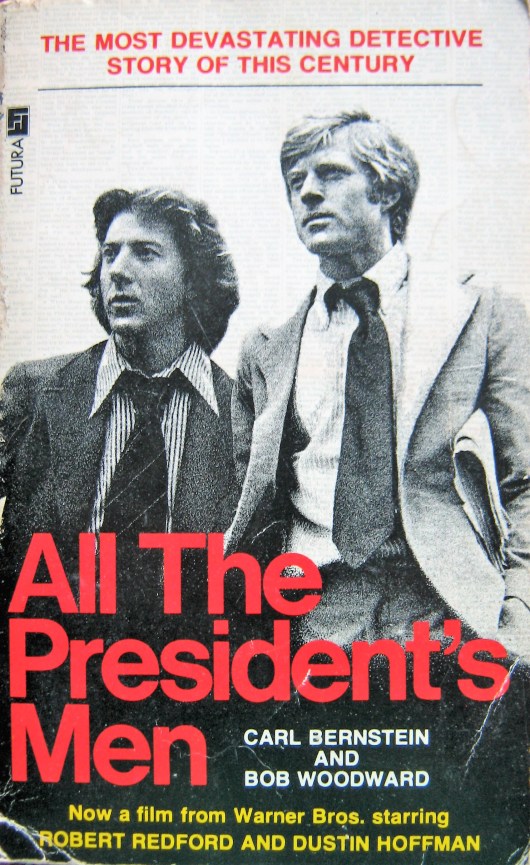
Bob Woodward and Carl Bernstein wrote the excellent book All the President’s Men, later made into a major motion picture. It is well worth reading, an excellent book of investigative journalism.

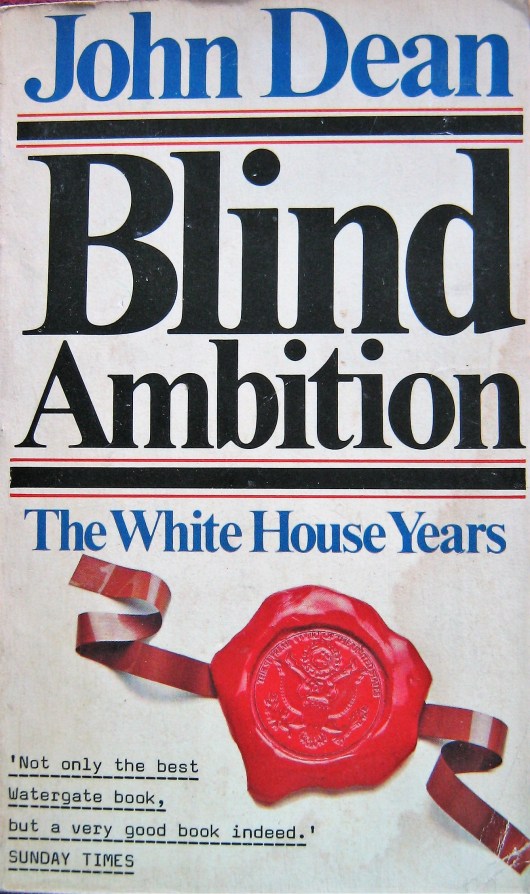
John Dean wrote his version of events in the book Blind Ambition. Dean was given a jail sentence of one to four years for obstruction of justice. He pleaded guilty and after cooperating with prosecutors his sentence was reduced to time served, a mere four months.

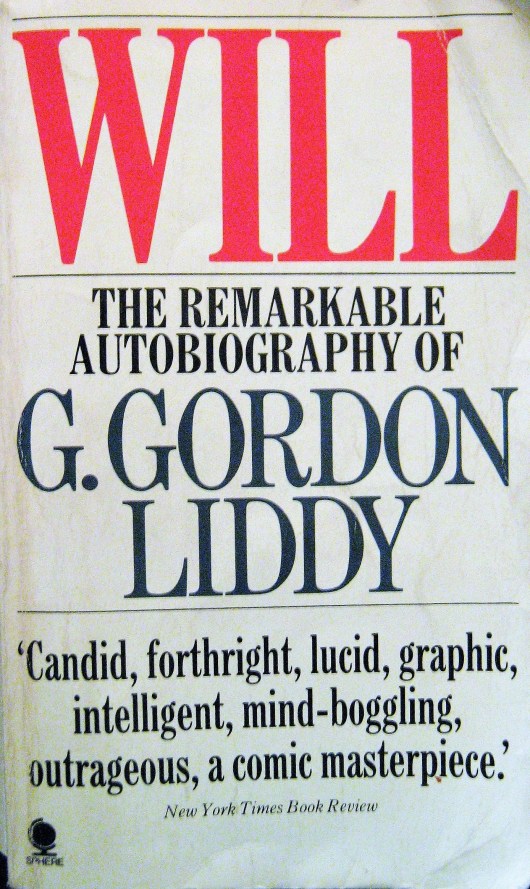
G. Gordon Liddy was a former FBI agent and the chief operative of the White House ‘Plumbers’ unit. Liddy was sentenced to 20 years imprisonment for his involvement in Watergate but this was later reduced by President Carter and Liddy was paroled after four and a half years. Liddy later became a popular radio broadcaster in the USA.

One last book about Nixon himself rather than Watergate.

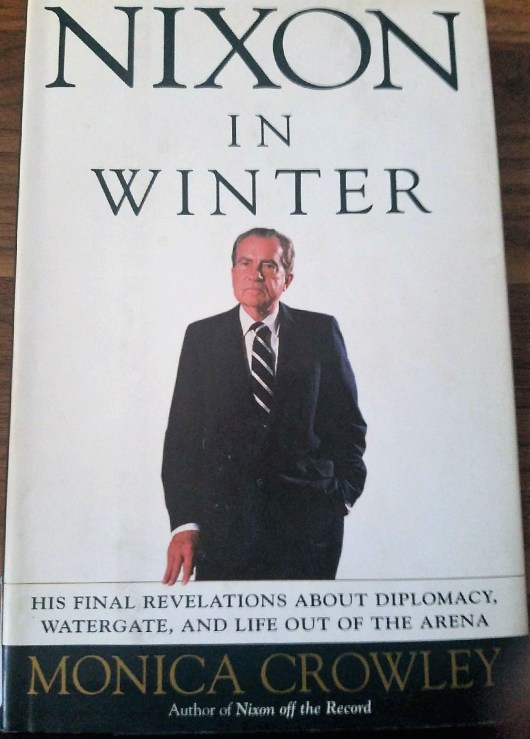
President Richard Nixon retired in disgrace to his home in San Clemente, California. He never admitted any wrongdoing during his time as President, in fact he stated ‘if the President does it, that means it’s not illegal!’ Nixon in Winter is by Nixon’s research assistant Monica Crowley who worked for the former President until his death in 1994.


Steve Higgins has written a novel ‘Floating in Space’ set in Manchester, 1977. Click the links at the top of the page to buy a copy or for more information.

Tipping Point, The Chase, and Donald Trump!

Donald Trump. Picture courtesy Wikipedia

Donald Trump. Picture courtesy Wikipedia

Just over a week ago, I settled down on a Friday afternoon in front of the TV, ready for my usual afternoon dose of Tipping Point and the Chase, only to find normal programmes had been suspended in favour of the Presidential Inauguration. When I say Presidential, I’m of course referring to President Trump of the USA so it was surprising to find the event televised live in the UK on BBC1, ITV and all the usual news stations. I don’t think I’ve ever seen the French or German elections given this much coverage, or any other foreign election or inauguration for that matter. If you have followed the election on TV you might be forgiven for thinking this had been a two-way fight between Republican Trump and Democrat Hilary Clinton. Absolutely not, in fact there were a huge number of presidential hopefuls as you can see by clicking here. Not one of them was involved in the televised presidential debates because the media, well certainly the British media, only seemed to focus on the Democrat and Republican contenders. Unless a third candidate could somehow muscle himself in onto the TV debates or somehow get some national coverage then he or she would have no chance of competing with the top two.

Anyway, Donald Trump was declared the victor in the election and duly became the Chief Executive and Commander in Chief of the United States on January 20th and all seemed to go fairly smoothly. The chap who introduced the proceedings -I’m afraid I can’t remember his name- commented on the inaugural speech of President Ronald Reagan which I quote here:
“To a few of us here today this is a solemn and most momentous occasion, and yet in the history of our nation it is a commonplace occurrence. The orderly transfer of authority as called for in the Constitution routinely takes place, as it has for almost two centuries, and few of us stop to think how unique we really are. In the eyes of many in the world, this every 4-year ceremony we accept as normal is nothing less than a miracle.”

Reagan touched on the whole essence of democracy in that speech which is essentially this, that of the leader of a nation voluntarily handing over power to the new leader, the victor of the election process. In the news the same day was a story about The Gambia’s long-term leader Yahya Jammeh who has, until now, refused to accept that Adama Barrow had defeated him in the election last December. It seems he has finally decided to hand over power as threats from other West African nations have forced him to concede defeat. It would have been interesting if Barack Obama had said, ‘sorry, no, I’m not stepping down, I’m not ready yet!’ The last President who had to be forced from office was Richard Nixon who finally accepted that the Watergate scandal had destroyed his presidency in 1973 and resigned, handing over to Vice-president Gerald Ford.

In Zimbabwe, Robert Mugabe has hung onto power since 1980 despite an abysmal record of leadership in the country. In the 2013 elections he was again victorious although Pedzisai Ruhanya, from the Zimbabwe Democracy Institute, a Harare-based think tank, had this to say; “When Mugabe used violence in 2008, he lost legitimacy, so he had to find other ways to win. What we have seen is a masterclass in electoral fraud. It is chicanery, organised theft and electoral authoritarianism.” Mugabe is now well into his nineties but can a dictator ever relinquish his power? I doubt it. Stalin continued as leader of the Soviet Union until his death in 1953 at the age of 73. When he did not arise from his bedroom one morning at his dacha in Kuntsevo, just outside Moscow, his guards were too nervous to enquire if he was alright. When they finally entered the room they found he had collapsed and assumed he was suffering from a bout of heavy drinking the previous night. The guards made him comfortable on a couch and then withdrew. When he was found unable to speak the following day, only then were the doctors summoned. Seen in that light, the events in the USA are, as Ronald Reagan said, nothing less than a miracle.

A US president can only serve two terms as the US senate, perhaps resentful of Franklin D. Roosevelt’s three terms in office, voted to limit a president to only two four-year terms. Eight years, not much time to change the world, is it?

The USA however seems a much more democratic place than the UK. Our current leader, Theresa May has taken over as Prime Minister without a single vote made by us, the citizens of the UK. Granted, Conservative MP’s have had their say but members of the Conservative party have not been consulted, nor has the country in general. The next general election in the United Kingdom is scheduled to be held on Thursday 7 May 2020, in line with the Fixed-term Parliaments Act 2011; it may be held at an earlier date in the event of a vote of no confidence or other exceptional circumstances. How Theresa May will fare with the people then, is anybody’s guess but then who would have thought Donald Trump would have been elected president?

Oh and one more thing. I had to wait until Monday for another edition of Tipping Point and The Chase. I was not happy!


If you liked this post why not try my book, Floating In Space? Click the links at the top of the page for more information or click on my promo video below.

Howard Hughes and the Watergate Tapes.

A week or so ago, August the 8th was the anniversary of the resignation of President Richard Nixon. He resigned the US presidency in 1974 after realising his battle to remain in office was finally lost. His battle for his tapes, which he believed were his personal property went on and on and was continued by his estate even after his death.

I have always understood that John F Kennedy was the first President to install a taping system in the white house though Wikipedia seems to think the practice began with Roosevelt. Many of the recordings made during Kennedy’s presidency have been released including those of cabinet meetings during the missile crisis of 1962.

Johnson carried on the tradition of taping and recording phone calls and numerous calls have been declassified and released by the authorities. Some with a special poignancy were even recorded on Air Force One on the 22nd November, 1963, the day Kennedy was shot and Johnson elevated to the presidency.

Anyway, despite his two predecessors, the President most famous for taping in the white house was Richard Nixon and it was the ‘Watergate tapes’ that were at the heart of the Watergate scandal and after reading many books on the subject I feel the Watergate scandal as it came to be known really had its roots in the turbulent year of 1968.

1968 was a landmark year for Nixon and for the USA itself. The public feeling for Vietnam had turned more and more sour as more GIs returned home in body bags. Demonstrations began; university campuses were alight with protests.

In the first primaries of the year incumbent president Johnson, who previously had a high approval rating with the public was surprised by a good showing from rival Senator Eugene McCarthy, running on a anti-war stance. His success urged Robert Kennedy to throw his hat into the ring and on the 3rd June, 1968 Johnson announced in a televised broadcast that he would not accept the nomination for president. Vietnam had overshadowed his presidency and all his other efforts, his so called ‘great society’ and his civil rights programme; all were overshadowed by the conflict in Vietnam.

Martin Luther King was shot dead in 1968 as was Senator Kennedy. Kennedy’s body was taken to Washington from California by rail and as millions waited by the tracks to watch his funeral train pass by, it must have seemed for many Americans like the end of the world.

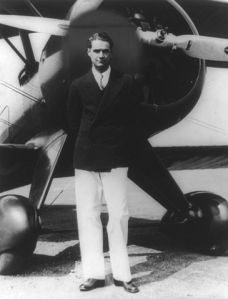
Howard HughesFor one man though, sitting alone in a Nevada hotel suite, sealed off from the world by his Mormon minders, the death of Bobby Kennedy was an opportunity. The elderly Hughes, lying naked on a bed watching TV, his hair, long and unkempt and his finger and toenails uncut, was a far cry from the young film maker, aviator, and entrepreneur he had once been. Immediately he wrote a memo to his chief executive and public alter ego, Robert Maheu. He said basically that now Kennedy was lying dead or dying on the pantry floor of a California hotel this was a once in a lifetime opportunity to put on the payroll the entire Kennedy election team, in particular electoral strategist Larry O’Brien.  O’Brien had served under Presidents Kennedy and Johnson and would later become chairman of the Democratic National Convention. Not a thought for the dying Kennedy, just the opportunity to get hold of a ready-made election team and put his own man in the white house. At the time Hughes had the idea of promoting Governor Laxalt of Nevada for the job. Fantastic as it may seem the genesis of what would become Watergate lay in Hughes actions on that night.

Hughes was worried about the nuclear testing in Nevada and he had sent Maheau on a mission to get Johnson to move the tests elsewhere. Johnson met with Maheau, listened, tried to get the promise of a donation towards his presidential library, but would not move the nuclear tests. Hughes felt he would need to speak with whoever won the election. Becoming increasingly more paranoid, and more and more worried about the nuclear testing, he tasked Maheau with offering a million dollar bribe to the man who would move the tests elsewhere:The man who would emerge victorious in the presidential election was Richard Nixon.

It was a pretty close run battle for the presidency in 1968 but Hubert Humphrey, the democratic candidate had little election funding although Hughes cannily hedged his bets. He made donations to both opposing candidates. Humphrey was elected as the democratic candidate in a shambolic convention marred by tear gas and protests and Eugene McCarthy, running on an anti-war ticket was ignored despite his earlier success in the primarys. Humphrey won the nomination even though he had not won or even contested any of the primarys. Richard Nixon however, won the eventual presidential election with his campaign pledges of ‘bring us together’ and ‘peace with honour’, which did not mean retreating from Vietnam as perhaps some people may have thought.

Picture courtesy Wikipedia

Picture courtesy Wikipedia

Nixon though, despite his victory, was worried. The defeat by John F Kennedy in 1960 still rankled. Many thought that the Kennedy victory had been a given a helping hand by voting fraud, especially in the Chicago area controlled by Democrat Governor Daley. Nixon though, felt his defeat was due to leaks about loans to his campaign and to his brother Donald from Howard Hughes. Larry O’Brien, despite his retainer from Hughes was running the democratic campaign and Nixon felt that O’Brien must know about Nixon’s own Hughes connection. What information did he have? What was in his safe in the Democratic Campaign headquarters in the Watergate building in Washington?

The FBI and CIA had already spurned Nixon’s requests for covert surveillance and they were dragging their feet over the leaks of highly classified information from government offices. The answer, it seemed to Nixon, was the  creation of a white house covert intelligence unit that became known as the ‘Plumbers’ made up of of ex CIA and FBI members. Their job was to stop the leaks, and get Nixon the information he wanted.

Nixon wanted to know what was in Larry O’Brien’s safe in the Watergate building, what information did O’Brien have about a Nixon-Hughes connection? The plumbers would have to find out. On May 11th, 1972 the plumbers secretly entered the Democratic National Convention offices and left behind a number of bugs and listening devices. Problems arose soon afterwards when it was found the wiretapping devices were malfunctioning. There was no choice but to enter the building again. The five man team did so on the night of June 16th/17th 1972. Sometime after midnight on the 17th a security guard noticed that various doors into the building had been taped, preventing them from locking. He called the Police and the five men were arrested.

  1. James W. McCord – a security co-ordinator for the Republican National Committee and the Committee for the Re-election of the President. McCord was also a former FBI and CIA agent.
  2. Virgilio R. Gonzales – a locksmith from Miami, Florida. Gonzalez was a refugee from Cuba, following Castro’s takeover.
  3. Frank A. Sturgis – another associate of Barker from Miami, he also had CIA connections and involvement in anti-Castro activities.
  4. Eugenio R. Martinez – worked for Barker’s Miami real estate firm. He had CIA connections and was an anti-Castro Cuban exile.
  5. Bernard L. Barker – a realtor from Miami, Florida. Former Central Intelligence Agency operative. Barker was said to have been involved in the Bay of Pigs incident in 1962.

The five men were charged with attempted burglary and attempted interception of telephone and other communications. The burglary was reported in the media and it seemed at first that the incident was an unremarkable ‘third class burglary’ just as the white house press secretary Ron Zeigler described it. Zeigler announced that white house aide John Dean had made a full investigation into the matter when in fact Dean had done no such thing. Two others, E. Howard Hunt and G. Gordon Liddy who were involved in planning and arranging the break in, were also later arrested. They were the link from the burglars to the white house.

Gradually, various revelations appeared in the press, particularly those by Washington Post reporters Bob Woodward and Carl Bernstein, and this escalation of the issue, especially when reports of other abuses of power by the Nixon White House were revealed, forced the announcement of a Senate Investigation.

On February 7th 1973 the Senate voted to establish a select committee to investigate Watergate and during the hearings a surprising revelation emerged. On the 16th July 1973, testimony revealed that President Nixon had a recording system in the White House. Archibald Cox, the special counsel for investigating Watergate immediately issued a subpoena for the tapes. Nixon refused to hand them over citing executive privilege.

As you know, Nixon had to eventually hand over the tapes including one that had a mysterious eighteen minute gap. An impeachment process began and when Nixon was advised that the recommendation was likely to pass through the senate, he resigned. On August 8th, 1974, Nixon broadcast his resignation speech from the White House and stepped down at noon on the next day in favour of Gerald Ford.

One of the most interesting conversations on the Watergate tapes was, I have always thought, a conversation that took place on March 21st, 1973. John Dean felt that Watergate was fast becoming ‘a cancer within-close to the presidency, that’s growing. It’s growing daily’

John Dean: Where are the soft spots on this? Well, first of all, there’s the problem of the continued blackmail—

President Nixon: Right.

Dean: –which will not only go on now, it’ll go on when these people are in prison, and it will compound the obstruction-of-justice situation. It’ll cost money. It’s dangerous. Nobody, nothing–people around here are not pros at this sort of thing. This is the sort of thing Mafia people can do: washing money, getting clean money, and things like that. We just don’t know about those things, because we’re not used to, you know, we’re not criminals. We’re not used to dealing in that business. It’s a–

President Nixon: That’s right.

Dean: It’s a tough thing to know how to do.

President Nixon: Maybe we can’t even do that.

Dean: That’s right. It’s a real problem as to whether we could even do it. Plus, there’s a real problem in raising money. [John] Mitchell has been working on raising some money, feeling he’s got, you know, he’s got—he’s one of the ones with the most to lose. But there’s no denying the fact that the White House and [John] Ehrlichman, [Bob] Haldeman, and Dean are involved in some of the early money decisions.

President Nixon: How much money do you need?

Dean: I would say these people are going to cost a million dollars over the next two years.

Short pause.

President Nixon: We could get that.

Dean: Mm-hmm.

President Nixon: If you—on the money, if you need the money, I mean, you could get the money fairly easily.

Dean: Well, I think that we’re–

President Nixon: What I meant is, you could get a million dollars. And you could get it in cash. I know where it could be gotten.

Dean: Mm-hmm.

President Nixon: I mean, it’s not easy, but it could be done.

Could it really have been that the million dollars that Nixon was talking about was the same million dollars Hughes was offering to get the nuclear testing moved elsewhere? A paranoid old billionaire living in squalor, obsessed by germs who everything handed to him had to be wrapped in tissue paper. Could it be that Howard Hughes’ obsessions had eventually brought down the Nixon white house?

Further reading.

The Ends of Power. H.R. Haldeman

All The President’s Men. Carl Bernstein and Bob Woodward

Blind Ambition. John W. Dean

Will. G. Gordon Liddy

Citizen Hughes. Michael Drosnin


Steve Higgins is the author of Floating In Space available from Amazon.


The Outlaw, Howard Hughes, and the pursuit of Money

Once upon a time Howard Hughes was the richest man in the world. In today’s society being the richest man requires some serious wealth and Howard Hughes ticked all the financial boxes you can think of. He inherited his father’s tool company when he was very young. Too young in fact to take control but he found a law that said if he could prove he was capable of running the company then he could take control. He proved he could and did just that, took control. His father had designed a tool bit that was essential to America’s oil industry but instead of selling the drill bit he patented it and then rented it out. Howard Hughes though had other ambitions that did not involve oil or drilling but the profits from the Hughes Tool Company were vital for his ambitions in aviation and the movies.

Hughes combined those two interests in making the WW1 movie ‘Hell’s Angels’ about fighter pilots and for the shoot he assembled the largest private air force in the world. Towards the end of the shooting, sound pictures made their appearance so what did Howard do? He re shot the entire film with sound equipment!

The_Outlaw-poster-trimAnother movie Hughes made that is famous, or perhaps infamous, was the 1943 Movie ‘Outlaw’ starring Jane Russell. Hughes appeared to be obsessed with Jane’s breasts, even to the extent of designing a new bra for her and re shooting a famous close up of her time after time. Hughes clearly had some psychological issues; he was a compulsive, obsessive man. He usually had the same meal when he went out with one of the many starlets he courted. Jane Greer recounted in a TV interview how Hughes would eat things in the same order, the peas first, then the potatoes and finally the meat. Once when they dined Hughes came back to the table and Jane noticed his shirt was wet. Hughes had spilt something onto his shirt so he washed the shirt in the men’s room, rinsed and squeezed it out, then put it back on.

As his mental health deteriorated, Hughes retreated into a world of blacked out penthouse suites and midnight telephone calls to his army of assistants, some of whom were private investigators keeping close tabs on anyone Hughes had an interest in, particularly starlets he had signed to personal contracts and his girlfriends like Katherine Hepburn or Jean Peters whom he later married.

The incredible thing is, despite his illness he and his company produced aircraft for the US government, including the now famous ‘Spruce Goose,’ many of which he test flew himself. However, in July, 1946, Hughes crashed while testing his XF11 reconnaissance plane. The aircraft crashed in Beverly Hills and Hughes was seriously injured. He survived but remained addicted to morphine for the rest of his life. His company also produced the Glomar Explorer, an undersea recovery craft for the CIA and it was part of a plan to raise a sunken Soviet nuclear sub in an effort to learn the USSR’s nuclear secrets

If you want to know more about Howard Hughes my favourite movie about him is not the Aviator, the Scorcese/ Di Caprio movie, good though it is, but an old TV mini-series based on a book by Noah Dietrich, ‘Howard, The Amazing Mr Hughes.’  Tommy Lee Jones gives a great performance as Hughes in the film.

Noah Dietrich was once Hughes’ chief executive and financial advisor. He resigned after becoming more and more unhappy with Hughes’ bizarre behaviour. In later years Bob Maheau, a former FBI man employed by Howard, experienced much the same thing; numerous obsessive memos, midnight phone calls and so on..

Hughes died in 1976, cocooned from the world by morphine and the close attention of his Mormon aides. Despite his wealth Hughes was emaciated and underfed, addicted to drugs which his aides rationed in order for them to manipulate him. Surely, final proof that money is not everything.

Still, better not forget this weekend’s lottery ticket, just in case!


Floating in Space is a novel set in Manchester, 1977. Click the links at the top of the page to buy or for more information!