6 Takes on Dreams

I was looking back at some of my old blog posts the other day, hoping for a little inspiration. I usually find that my older blog posts are much shorter than the current ones and sometimes I can rewrite them or extend them and actually make them into a new post. Around the same time I noticed a blog post on the BBC web site about dreams in TV and film. That sent me searching for an old blog post about dreams and so here it is, suitably rewritten and extended.

My Dream

The other day I woke up far too early. It was 6 am when I stretched out and fumbled for my phone to check the time. It was a Friday and I didn’t have a completed blog post for my usual Saturday morning deadline, the deadline that for the past few years has kept me honest as a writer. I padded off wearily to the bathroom, had a glass of water and availed myself of the facilities and went back to bed. I don’t dream that much although a few years ago my dreaming seemed to increase, so much so that I started a dream journal, a notebook just by the bedside so that when I awoke I could jot down the details of my dream. Later when I came to review the notes, I tended to find a whole lot of gibberish that not only made no sense but didn’t in any way nudge my memory and bring back those quickly forgotten dreams.

A long time ago I awoke after a crazy dream in which I was out with a friend I hadn’t seen for years, and somehow, don’t ask me how, I had lost all my clothes. We had been out drinking and were walking home then something happened and suddenly I was somewhere without any clothes. I woke up then but that wasn’t the end of it.

The next night I had a sort of follow on dream. I was wandering around with no clothes, although I had come across a blanket somehow, and with me was Michael Portillo (yes, the ex-MP who hosts a show on BBC about railway journeys). Well we ended up in this hotel and I was starting to worry. Well, who wouldn’t? No clothes, no wallet, no mobile. Who could I call? Should I try and cancel my bank cards? What happened to my keys? Where am I and what has Michael Portillo got to do with it?

Michael was standing nearby and using his influence as a famous former MP. Someone brought him a phone and he started chatting into it. Clothes were brought for him and I could hear him speaking to his bank. It actually brought to mind that sequence at the beginning of one of the Bond films where Pierce Brosnan has been in a Chinese prison, escapes and finds himself in Hong Kong. He walks into this posh hotel, his hair long and unkempt, his clothes in rags and the guy at reception says “Will you be wanting your usual suite Mr Bond?”.

Some people just have that manner about them don’t they? Me, I’d have been unceremonially kicked out of that hotel, assuming I’d even made it past the front door! I can just imagine the scene:
Your usual suite Mr Higgins? Just a moment please?”
The manager beckons to a large man looking similar to Oddjob from the Bond movie Goldfinger. The next moment Mr Higgins hurtles through the front door. As he is propelled into the street he murmurs, “that’s a ‘no’ then is it?”

TV

I mentioned earlier about the BBC post about dreams. I noticed it advertised at the bottom of a page I was looking at and I didn’t actually read it until later. A lot of the films mentioned in the post were ones I had never heard of but in the TV category was one probably everyone knows about. The return of Bobby in Dallas.

In case you have never watched an episode of Dallas here’s a quick resumé: It was about a rich family living in Dallas. The family’s money came from oil and the head of the family was Jock Ewing. The other main characters were his wife Miss Ellie, his sons JR and Bobby and their wives Sue Ellen and Pam. Larry Hagman created the famous character of JR, Patrick Duffy was Bobby, Linda Grey played JR’s wife Sue Ellen and Victoria Principal was Bobby’s wife Pam. There are more characters but those were the main ones. After season 8 Patrick Duffy decided it was time to leave and pursue other acting roles and so his character was killed off. The ratings dropped during season 9 and so Patrick was enticed back to the series, the only problem was how could he come back? His character died surrounded by friends and family so what could the writers do? Well, the answer they came up with was this: It was all a dream!

When you come to really look at it, what else could the writers do? Patrick could return as Bobby’s long lost twin brother. Or perhaps he didn’t die after all. That one would be tricky as he did die as I mentioned above, surrounded by friends and family so they could hardly try to make out he didn’t die. Maybe a double, a fake Bobby really died but that idea is a bit silly, after all Dallas wasn’t a spy or a sci fi show. So what happened was this, at the end of season 9 with Bobby dead and his wife Pam involved with another man, Pam walks into the bathroom and finds Bobby in the shower. The season ends there which was quite a finish and we had to wait for the next season to find out that Pam was having a dream and Bobby hadn’t really died after all. Some fans hated it but when it comes down to it, what else could they do?

The Novel

Dreaming a story and making it into a novel or a screenplay isn’t quite as strange as it seems. In 1898 an American writer, Morgan Robertson, wrote a story about an unsinkable ship called the Titan which sailed from England to the USA, hit an iceberg and sank. The story was published fourteen years before the Titanic disaster. I remember reading the story of this writer years ago, even that the writer saw the story played out in front of him like a movie but all the research I did on the internet for this blog seems to imply that the author was a man who knew his business where ships were concerned, felt that ships were getting bigger and bigger and that a disaster like that of the Titanic was inevitable.

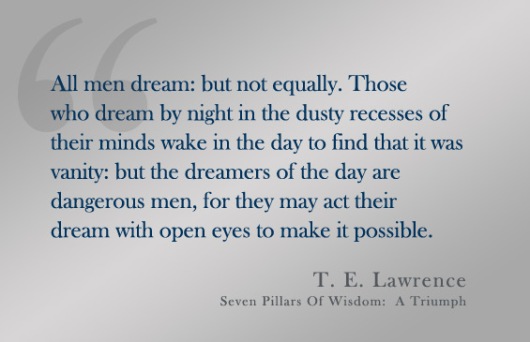
The Quote

The Hit Single (John Lennon; Number 9 Dream)

The Film

It took me a while to think of films based on dreams but then an obvious one finally came to mind; The Wizard of Oz. The film is about a young girl, Dorothy, who lives in a small town in Kansas. She decides to run away from home when her dog is about to be taken away from her. A friendly vaudeville entertainer encourages her to return home but when she tries to she is swept up in a tornado which deposits her in the land of Oz.

Once, back in the 70’s or 80’s, The Wizard of Oz had a cinema re-release and I took my mother to see it. She was a big fan of Judy Garland. When the film came on mum let out a sort of disappointed shrug and I asked her what was wrong. She told me that when she had seen the film originally it had been in colour. ‘Perhaps they couldn’t find a colour print or perhaps it wasn’t in colour after all,’ I told her. ‘I was sure it was in colour,’ she replied.

Later, when Dorothy wakes up in the land of Oz, the film goes from black and white to colour. I looked over at mum and she smiled back. ‘I was right after all,’ she said.

The change from colour to black and white also denotes that Dorothy had entered not only Oz but the world of dreams. Later in the film when she returns to Kansas, it is only then that she realises that her adventure in Oz had been a dream and that the cowardly Lion, the Scarecrow, the Tin Man and even the Wizard, were based on characters from the farm where she lived.

The Wizard of Oz was a classic film made in 1939 and was an adaptation of the book by Frank L Baum, The Wonderful Wizard of Oz. Judy Garland was forever linked to the film and in particular to one of the classic songs she sings in the film; ‘Over the Rainbow’.

To finish I think I’ll pinch a few lines from my original post.

Not so long ago I remember travelling on a luxurious aeroplane, not the cramped budget airline I usually fly on but something very special. I was in first class in a very comfy seat with lots of legroom. The hostess was handing me a drink, not in a plastic cup but a very elegant crystal glass. As I reached forward to take the drink, I slipped and went head over heels towards the floor.

I lifted my hand up to check my fall but I was back in bed at home and everything had been a dream. I looked over and Liz was scrolling down her mobile phone. ‘Bloody hell!’ she said, ‘that snoring was going right through me. Where’s my cup of tea?’


What to do next: Here are a few options.

Share this post on your favourite social media!

Hit the Subscribe button. Never miss another post!

Listen to my podcast Click here.

Buy the book! Click here to purchase my new poetry anthology.

Click here to visit Amazon and download Floating in Space to your Kindle or order the paperback version.

 

Wet Weather Writing

Liz and I have always been pretty lucky with the weather on our holidays. This year in Lanzarote we experienced the best winter sun we have ever had. In late January and February, we had five weeks of sun with hardly a bad day. Well, we did have the odd bad day but they mostly consisted of a few hours of cloud and once, a short rain shower. This year in France we weren’t so lucky.

I can remember a lot of wet weather holidays as a child. Days in caravans reading books and comics while the rain poured down. Fish and chips in seaside cafes keeping warm and dry. A few years ago Liz and I had a very wet holiday in France. We spent a lot of time indoors in our small rented cottage. I used the time to sort out the manuscript for my book Floating in Space. The manuscript has a very disjointed history. I began the book in the 1980s, writing in longhand in a notebook. Later, I updated the story as I typed it up on my typewriter.

Later still I got hold of an old word processor. It was called a Displaywriter if I remember correctly and had floppy disks the size of old 45 rpm vinyl singles. Then came the computer revolution and once again I copied the text onto my new device. I backed up my work onto standard sized floppy discs but then came disaster, a big PC crash. My PC was under guarantee so it was shipped back to the manufacturer and came back a few weeks later all nicely repaired, updated but without all my saved files.

The big problem was the back up files, I just couldn’t find them, so once again I started from scratch and put the novel together from my typed version and my longhand originals. When I’d got to the three quarter point of the novel I found my back up disc but then I had two versions, both slightly different. That’s the thing when a writer starts rewriting, you get new ideas, you take the characters into new situations, you tell the story in a different way. So anyway, I did the only logical thing I could at that time, I threw my hands up in despair and walked away.

Later, much later, Liz and I had the wet weather holiday in France mentioned above and that was when I decided to sort the whole thing out. I went through the two versions, deleted a whole lot of stuff, rewrote the ending and managed to knit all the different sections together. I was pretty pleased with myself at the time. I’m a fundamentally lazy person so when I manage to get off my lazy behind and actually do some good work, I always feel pleased about it.

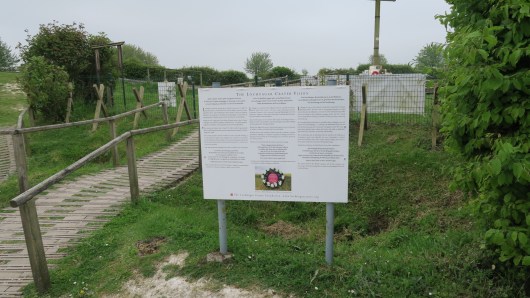
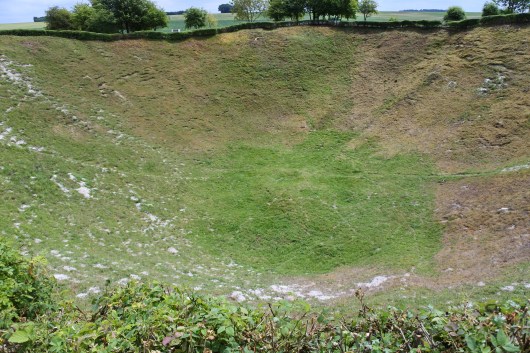
This year in France the first week was pretty good, weather wise. I particularly wanted to visit a place in France called Lochnagar. It’s the crater from the biggest explosion in WWI. In 1916 in the First World War there were two opposing forces facing each other. The German invaders on one side and the defending Allies on the other. They fought each other with guns and artillery but they also fought in another more unexpected way. Both armies were tunnelling under the front and the British dug their way under the German lines, packed a huge amount of explosives in an underground cavern, lit the blue touch paper and boom! That was the biggest explosion of the war and it left behind a pretty big crater.

Today the resulting crater is still there. Back in 1916  the 179th Tunnelling Company of the Royal Engineers tunnelled under the German lines. Explosive charges were laid and detonated at 07.28am on the morning of July 1st 1916. The explosion marked the beginning of the battle of the Somme, the bloodiest day in the history of the British Army. The British suffered 54,470 casualties on that first day including 19,240 fatalities. In return they gained just three square miles of territory. The offensive lasted till the 18th November and the total casualty list for the Allies topped 620,000.

The crater is a stark reminder of the First World War. Today visitors like me come to look and to remember. There are many memorials and even the wooden walkway around the crater contains elements that have been paid for by donations and the names of long gone soldiers are inscribed on its wooden planks. I had thought that perhaps the crater might have filled with water and become a lake but today, despite its covering of grass, it still looks an odd and unnatural part of the landscape.

Wilson44691, CC0, via Wikimedia Commons

The previous day we visited the nearby museum of the Somme battle. It was quite expensive to enter and there was a separate charge to go through and see the Somme memorial. I kept to the museum and wandered around looking at the rusty old shell casings and machine guns and helmets and thought of the young men who lost their lives in that terrible conflict. In another room I watched the old black and white films of the war which played in various languages and in a final room the last exhibit was a replica aircraft. It was a Nieuport originally piloted by Georges Guynemer during the battle of the Somme.

If I’d have been given a choice, I reckon I’d rather have been in that flimsy aircraft than down in the trenches.

After a week exploring the north of France we slipped further south to take up residence in our rented villa. As much as I love our motorhome I much prefer the luxury of a big house with a swimming pool. The weather wasn’t great but even so, the pool was heated and we did manage a few swims despite only having hot sunshine to dry us off on a few rare occasions.

The other big drawback to this holiday was the intense pain from my back. I reckon I must have suffered a slipped disc or a trapped nerve. The pain lasted about two weeks and luckily, Liz always travels with a good supply of painkillers, just in case, so never again will I be asking ‘Do we really need all these?’

You might be thinking that because of all the bad weather I did something similar to what I mentioned earlier about sorting out my book. Did I sort out another book? Did I finish the sequel? Actually, no but I did do quite a bit of work on putting together my short story collection which one day might see the light of day on Amazon. The other thing we tended to do when the weather was bad was eat. Eat in restaurants. Yes among my many loves such as writing, reading books and watching classic films there is also my love of a good restaurant.

I love everything about a restaurant. I love taking my seat and looking through the menu and that first taste of a lovely glass of wine. There is a lovely restaurant near to our villa, Le Restaurant de la Gare. You are shown to your table and given a basket of bread and a bottle of red comes over along with some water and a bottle of cider. Once settled you can then serve yourself from the buffet where you will find various cold meats and pates and numerous salad items.

One thing I could probably do without though is the waitress who has a voice which wouldn’t be out of place on a British army sergeant major. It’s a voice that you can hear miles away and even when she is inches from your head, rattling off the restaurant’s main courses, she still doesn’t tone down the volume. ‘Poisson, porc au moutarde ou steak?’ she bellows. I had the pork which turned out to be braised pork and was rather nice.

Frites ou riz? ‘Frites’, I tell her thinking that if I was married to her I would be deaf within a week.

It’s usually sad to have to return home but this year what with back pain and bad weather I was actually rather glad to be coming home. We had the most wonderful cabin on the ferry back. A really comfortable bed and a door which opened onto the rear deck where I could watch and take photographs as we left the port. It was interesting to see the pilot’s small boat running alongside us as we left Cherbourg. I had always thought that the idea was for the ferry to follow the pilot out but in these hi tech days the pilot was probably just on the radio telling the captain to keep starboard or keep port or whatever.

When we returned home, I turned on the TV to watch the celebrations and ceremonies to mark the 80th anniversary of D Day on television.

Now we are back home I see the sun has finally come out in France.


What to do next: Here are a few options.

Share this post on your favourite social media!

Hit the Subscribe button. Never miss another post!

Listen to my podcast Click here.

Buy the book! Click here to purchase my new poetry anthology.

Click here to visit Amazon and download Floating in Space to your Kindle or order the paperback version.


Holiday Book Bag 2024 Part 3

Parts one and two of my Book Bag were books I had taken to Lanzarote earlier in the year. This time Liz and I are tootling through France in our small motorhome. The weather has not been kind to us and rather than reading in the usual lovely sun, I’ve been reading indoors away from the rain. This year quite a few of my books are ones I have read before but I thought were due for a re-read. Anyway, here we go . . .

Toujours Provence by Peter Mayle

I wrote about this book a few weeks ago and you might be thinking ‘bet he’s included it here to pad out his post a bit’. Moi? As if I’d do such a thing. It’s the follow up to A Year in Provence, one of my favourite books about France by Peter Mayle. It’s a pleasant enough read but not a patch on the original.

Random Harvest by James Hilton

Wait a minute. Didn’t this guy write about this book a few weeks ago as well? Actually I did but as it was part of my book bag I thought I’d include it here anyway. A nice read, slightly different to the film starring Ronald Colman and Greer Garson. It was written before World War II and reflects the feelings of the time that perhaps more could have been done to either prevent the war or at least prepare more. A great read but I actually think I preferred the film to the book. Click here to read the full film and book review.

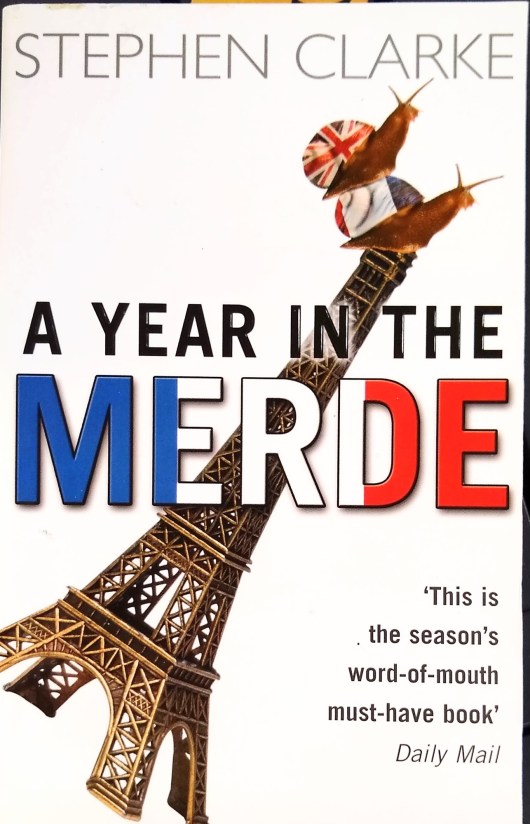
A Year in the Merde by Stephen Clarke

I read this book a few years ago and thought I’d throw it in my book bag for another read. As I remember, the first time round I absolutely loved this book. I saw it on a stall at a market once and mentioned to the seller what a great read it was. ‘Nah.’ replied the man. ‘It’s full of stereotypes!’ I wouldn’t say that at all. It’s a look at the life of a young man working in France as he tries to understand the French way of life and of course the language. The main character is engaged on a project to open an English tea room in Paris but feels that his boss and his colleagues are not that interested at all and when he eventually gets dropped by the company, he goes on to open the tea room himself. A nice read, humourous rather than laugh out loud funny and a little more biting than the Peter Mayle books. It’s a fun holiday read which goes a long way towards deciphering the French psyche.

The Kennedy Half Century by Larry J Sabato

This was billed as the ultimate Kennedy book but sadly it isn’t. It tells the story of John Kennedy and his run for the vice presidency, his years as a senator and then his presidential run. It goes on to look at his presidential years and then his murder and the last half of the book looks at how subsequent presidents have fared compared to JFK and the impact of Kennedy’s own presidency on the latter ones, all the way up to Obama.

A lot of it is interesting but there is nothing that I haven’t not only read about before but read in much more detail. The life and death of John Kennedy is one of my great interests. His murder happened on November the 22nd, 1963 when I was just seven years old and since then I’ve watched documentary after documentary and read numerous books.

The author tries to show an open mind about the assassination, looking briefly at the many theories that have been put forward over the years. Was the CIA or the mafia involved? Were the culprits the Cubans or the anti-Cubans? Was the military industrial complex behind the murder as Oliver Stone suggests in the film JFK? Perhaps it really was Oswald after all.

Looking back I think that one of the drawbacks to the book is that the author hasn’t really made his mind up what he actually thinks has happened. If he had a viewpoint himself, the narrative might have had more focus. The only real investigative effort in the book was to review the acoustical evidence, a recording made by a police officer with a microphone jammed open during the shooting and which led the House Select Committee on Assassinations to declare there was a shooter on the famous grassy knoll.

Well, maybe not says the author. Their research pinpoints a different officer with the jammed microphone and not the one selected by the HSCA which means there wasn’t another shooter after all. OK but there were clear shots of gunfire on the tape. Where did they come from? The author seems to think that they may have been noises from the officer’s motorcycle. Really?

An interesting read but the final chapters on the subsequent presidents and their relationships to JFK was actually a pretty pointless exercise that could have been summed up in just one chapter. If you would like to find out more, the book has its own website where you can read, among other things, the review of the acoustical evidence. Click here to access.

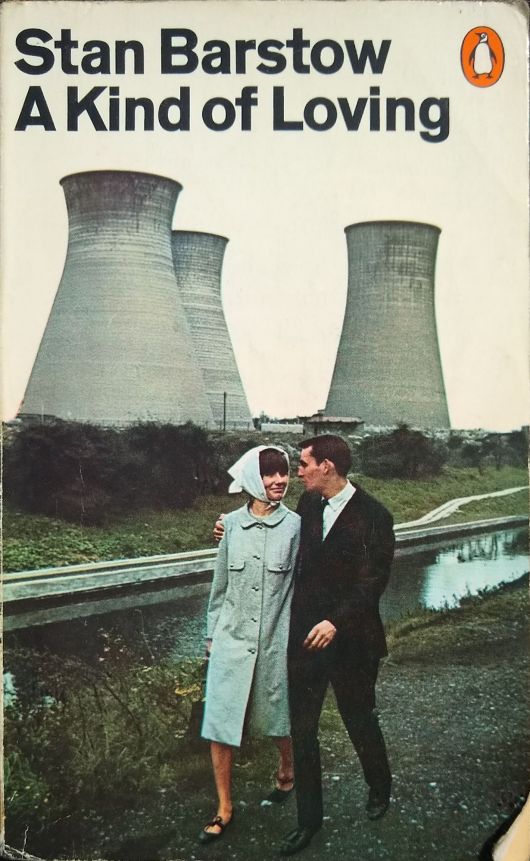
A Kind of Loving by Stan Barstow

This is another book that has been made into a successful film and also a great TV series. It’s a kitchen sink drama set in the early 1960s about a young Yorkshire lad who gets a girl pregnant and then realises he really wasn’t as in love with her as he thought he was. I’ve actually read this book quite a few times and it’s one of those that I mention when people ask me to describe Floating in Space. As much as I’m fond of Floating, this book is infinitely better. It’s a very simple story and probably one that has happened hundreds of times to hundreds of couples.
If you ever watch the TV series Long Lost Family, it shows that many people were in the same position as the couple in the book only instead of getting married, some young mothers in the 1950s and 60s were forced to give up illegitimate children for adoption.

Vic and Ingrid, the fictional couple, do get married even though Vic hopes for a last minute escape before the wedding day arrives. Not only is the main story authentic but so is the background to the book. Vic is a draughtsman in Yorkshire and his father is a miner.

The description of family life back then rings a bell with my own background in Manchester. Vic’s mother is a lot like my mother and there is a very lovely chapter when Vic goes to give blood with his father and then the two pop into the local pub for a pint. It was just like moments out with my own father, down to the banter with my mother when we both returned home. A wonderful read and so glad I brought it along to France.


What to do next: Here are a few options.

Share this post on your favourite social media!

Hit the Subscribe button. Never miss another post!

Listen to my podcast Click here.

Buy the book! Click here to purchase my new poetry anthology.

Click here to visit Amazon and download Floating in Space to your Kindle or order the paperback version.

The Queen of the Nile

The Queen of the Nile

A short story by Steve Higgins

As you read this Liz and I will be pottering about France in our motorhome so for this week I thought I’d publish another short story in pdf form.

It’s another download which can be accessed over on the download page or by clicking the link below.

Queen of the nile pdf

Hope you enjoy the story and click back next Saturday for another blog post!


What to do next: Here are a few options.

Share this post on your favourite social media!

Hit the Subscribe button. Never miss another post!

Listen to my podcast Click here.

Buy the book! Click here to purchase my new poetry anthology.

Click here to visit Amazon and download Floating in Space to your Kindle or order the paperback version.

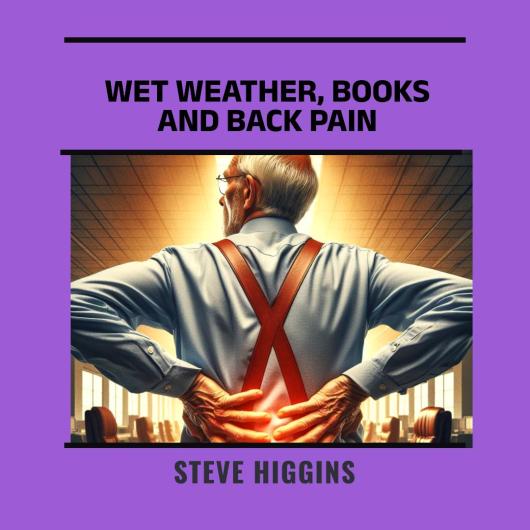
Wet Weather, Books and Back Pain

Our little motorhome has been fuelled and packed and it’s time to take another drive over to France. We decided to go over to France via Eurotunnel. The big drawback of course is that travelling from the northwest, it’s a helluva drive down to Folkestone. Not just the drive itself but we have to contend with the perils of the M6 and the M25, two of the UK’s busiest motorways.

What we did was take a break and stop at a place called the Bricklayers Arms in Sevenoaks. We parked up, had some food and drinks and entered the pub quiz. The next morning it was only a quick trip down to Folkestone and soon we were chugging smoothly along under the ocean and over to Calais.

We drove across to one of our favourite restaurants, Le Mas Fleuri. It’s a quiet family run place and the simple food is always wonderful. I have to say I sometimes wonder how the place survives as, certainly in the evenings, it is always quiet. Anyway, this time we were dining at lunchtime and we found that not long after sitting down, a steady stream of customers began coming in after us and soon the dining room was full. The French do love their lunches.

We left Lanzarote a few months ago fit and well after five weeks of swimming and sunning ourselves but the trip back via Jet2.com was on the most uncomfortable aircraft I have ever flown on and since then I’ve been suffering with a sore back. I went into our local doctor’s surgery and they told me that they now have a practice physio. The physio, who I’m sure was a very competent fellow, didn’t seem to feel it necessary to actually examine my back in any way but even so, he felt confident enough to recommend that I take some over the counter painkillers and undertake a series of exercises which he thought would help. I have been doing the exercises, not totally on a full time basis but I have done them, well some of them, but the pain has been gradually getting worse.

That’s perhaps not the best time to drive a motorhome over to France and it has been challenging to say the least. My back soon went from sore to very painful and from then on to some moments of intense agony. The pain started in my lower back, then after a few days migrated to my right hip and now seems to be remaining in my right leg. At one point the epicentre of the pain moved to an area in my lower back from where it sent out electrically charged bolts of pain down both legs to a point where it seemed like my legs would collapse. I’ve still got a lot of pain but recently, touch wood, I have not had any what I tend to call screaming agony attacks.

Luckily, since then I’ve tried to anticipate when the bad times will come and gulp down an appropriate amount of painkillers. The bad times usually come in threes; the first comes at about lunchtime when Liz is doing our late breakfast. (Sorry I can’t assist Liz, I’m in pain.) Secondly about 6pm to 6:30 when Liz is making tea (Sorry I can’t assist again) and lastly late on about 1am, our usual bedtime (Liz, any chance of a back rub?)

It’s difficult to deal with certain situations now, situations that previously I wouldn’t even think about. I’ve dropped my handkerchief/tissue on the floor. OK. How the heck am I going to get that? I can’t just bend over. I can’t reach down. It happened the other day in a restaurant and I had to kick it over to Liz and she managed to raise it up with her collapsible back scratcher and I just managed to reach it. Situation (only just) sorted. Other situations arise that I wouldn’t even think about. I need to have a wee but an electric shock is going through my right leg when I try to move. What can I do? Just hang on until the pain eases, I suppose. I suddenly have a new respect for disabled people,

These last few days it is my right leg that is throbbing quietly with an ache that gnaws at the inside of my thigh and makes it difficult to walk and also to sleep. Another interesting thing is that while I’ve been researching the issue over on Google and YouTube, looking for exercises that might help, a number of those mysterious things called ‘cookies’ have clearly latched themselves to my iPad because everywhere I go on the internet, I find little adverts from someone who has discovered the ‘real’ cure to back pain and sciatica.

I can download their quick self-help guide and even sign up (for a small fee) to their regular pain free back sessions and discover the ‘secret’ to a pain free life.

The other thing about this trip is the weather. It’s cold! We have been coming to this part of France and renting this same property in Parçay Les Pins for a number of years but this is the first time we have ever had to crank up the heating. Week one, pottering about in our motorhome was pretty warm and week two was a bit of a mixture, some warm and sunny days and some cold and overcast. Today as I write this it has been cold and wet.

We drove down to a local fête and vide grenier this morning. As it is a bank holiday Monday in France, we knew that the local supermarket was only opening until 12:30 so we popped in to update our diminishing cheese supply. There was no bread of course, the locals had come in early doors and removed all that but at least we had a few ‘bake it in the oven’ loaves for later and of course, some cheese.

Just round the corner there was a local fête taking place. The roads were closed off as usual but from what we could see when we arrived, the rain had caused people to pack up and only a few solitary stalls remained. OK we thought, might as well drive down to our local restaurant for lunch.

The Station Restaurant which we both love was closed so as the rain was easing off we went back to the fête to take a closer look at the few stalls remaining. We found that on the other side of the village square there were some classic cars and motorcycles, all gleaming and wet. The bar was open and also a full multi course restauration was being served. All we wanted was the usual sausage and chips takeaway and a glass of red so we looked at the classic cars and motorcycles, watched the display by the local dancers and then went back home for some bacon and eggs.

Yesterday we had a lovely swim when the clouds parted for a short while and a burning hot sun appeared. Somehow I don’t think today will be swimming weather.

As usual on holiday I always come armed with a stash of books and this year is no exception. A few of the books are ones I have dug out of a box at home and are ones I haven’t read for a while. One of them was Toujours Provence, a sequel to the successful A Year in Provence by Peter Mayle.

A Year in Provence has long been one of my favourite books. There are no gunfights or car chases. It’s a very gentle read, about the author and his wife deciding to move to Provence to live. The story of how they settle into their new home and their new country is told in a very easy going and humorous style. They have problems with their heating, they have a new kitchen built, they buy a great stone table for outdoor meals, the author describes the personalities of the locals as well as the restaurants and the wonderful meals they have there.

The follow up, Toujours Provence, is a slightly different book. There is no story linking the chapters together. Each chapter is like a short essay about all things French. Some are interesting and some are not and sadly, many fall into the latter category. One exception however is a chapter about writing that fits in totally with my own thoughts on the subject.

For most of the time, it’s a solitary, monotonous business. There is the occasional reward of a good sentence -or rather, what you think is a good sentence, since there’s nobody else to tell you. There are long, unproductive stretches when you consider taking up some form of regular and useful employment like chartered accountancy. There is constant doubt that anyone will want to read what you’re writing, panic at missing deadlines that you have imposed on yourself, and the deflating realization that those deadlines couldn’t matter less to the rest of the world. A thousand words a day, or nothing; it makes no difference to anyone but you. That part of writing is undoubtedly a dog’s life. What makes it worth living is the happy shock of discovering that you have managed to give a few hours of entertainment to people you’ve never met. And if some of them should write to tell you, the pleasure of receiving their letters is like applause. It makes up for all the grind.

In Peter Mayle’s case, various people have decided to not only write to him but sometimes to even seek him out and ask for his autograph on their copy of his book. One couple of complete strangers even arrived and made themselves comfortable in his house while the author himself was out on the patio. He only found them when he came inside for a glass of wine.

As for me, I’m happy with the occasional ‘like’ either on Twitter or Facebook or even here on WordPress but wait a minute, is that some sunshine breaking through the cloud? Time for a glass of wine on the patio!


What to do next: Here are a few options.

Share this post on your favourite social media!

Hit the Subscribe button. Never miss another post!

Listen to my podcast Click here.

Buy the book! Click here to purchase my new poetry anthology.

Click here to visit Amazon and download Floating in Space to your Kindle or order the paperback version.

Random Harvest: The Film of the Book or the Book of the Film

Once again Liz and I are on holiday in France and as usual I’ve filled up my book bag with books to read. My selection this year was a mix of new books and some books from my collection which I haven’t read for years. The one I’d like to focus on this week is Random Harvest by one of my favourite writers, James Hilton.

Hilton hailed from Leigh in Lancashire, now Greater Manchester. He wrote several books and made his way to Hollywood, California where he worked as a screenwriter. He died in 1954. Searching through a box of my old books I came across Random Harvest, a book I don’t think I have ever read before. I bought it from a second hand book shop along with Goodbye Mr Chips, possibly Hilton’s most famous novel and one I have read before. I can imagine intending to read it but moving on to something else and the book was boxed up in one of numerous house moves before I had a chance to get to it.

The Film

The film version starred Ronald Colman and Greer Garson in the leading roles. The film opens with a man called Smith wandering out of an asylum on a day when there is much excitement. It is Armistice Day, 1918 and ‘Smithy’ is a man who has lost his memory during the fighting in the First World War. He wanders down to the town of Melbury and in a tobacco shop the shopkeeper realises Smithy is from the asylum. When she disappears into the back of the shop a woman played by Greer Garson explains that the shopkeeper has gone to call the asylum so that he if wants to avoid going back he must get away. The woman, Paula, befriends Smithy and hides him away and soon she finds she is falling for him. The two elope together, find a quiet village in which to settle down and get married.

Smithy, who has no memory of his former life begins to write and soon has a story accepted by a newspaper in Liverpool. He takes the train there for an interview with the editor but on a wet afternoon, slips in the road and is hit by a taxi. He is knocked unconscious and when he awakes his memory has returned but he has no memory of his time as Smithy. How did he get to Liverpool? What door to what house fits the key found in his pocket? A policeman asks his name and he replies ‘Charles Rainier’. Gathering his things he sets off to take the train home to his country estate but arrives just as his father has passed away. The family has gathered and they are all surprised but glad to see Charles who later goes on to take charge and rescue the failing family business.

The final part of the film sees Charles happy as a new Conservative MP and successful businessman but also sad that a part of his life has been lost to him. He makes various attempts to find his former life but all end in failure until one night when a strike breaks out at the Melbury factory and he has to go there to sort things out. As he walks into Melbury he comes to the tobacco shop he once entered as ‘Smithy’ and things begin to come back to him.

Colman and Greer Garson play their parts wonderfully well. The film is perhaps a little sentimental for modern viewers but it is one of those films I saw as a child and have always remembered. Reviewers at the time were not impressed but even so, the film was nominated for 7 Oscars and it was MGM’s biggest hit of 1942.

The Book

The book tells the story in an entirely different way. It begins with a chance encounter on a train with Rainier and a young man who is looking for work. The two strike up a sort of friendship and Rainier invites the young man to work for him, He explains that he was in the war, was injured and woke up in a German hospital with loss of memory. He was repatriated through Switzerland but got his memory back after a fall and a collision with a taxi in Liverpool. The time between his earlier life and waking up in Liverpool is a blank. The young man becomes Rainier’s assistant and the two sometimes talk late into the night discussing what might have happened. Later in the book, Rainier is called to intervene at a dispute at the Melbury factory and his memory begins to return. He asks a local taxi driver about the hospital. The man asks does he mean the new or the old one? Rainier thinks the old one and goes on to describe it. ‘That doesn’t sound like either of them,’ answers the man but adds, ‘would you be meaning the asylum sir?’

The book is a really interesting read and being written in the years before the second world war, gives the reader a little insight into the feelings of that time, a dissatisfaction with the League of Nations, a feeling that perhaps the First World War could have been settled sooner or even that the allies might have gone on to Berlin and perhaps parcelled up Germany into a smaller nation.

The climax of the book is Charles’ reunion with Paula who turns out to be his wife and former secretary so we find that Charles and Smithy married the same girl which worked well in the book but of course had to be told differently in the film.

Which did I enjoy more? Well I loved both works but to be fair I’ve always loved the film version and as much as I love James Hilton, I think I prefer the film. It isn’t often seen on TV and not long ago I managed to copy my VHS version to DVD but I did notice that a restored DVD version was released in 2005 which I must look out for.


What to do next: Here are a few options.

Share this post on your favourite social media!

Hit the Subscribe button. Never miss another post!

Listen to my podcast Click here.

Buy the book! Click here to purchase my new poetry anthology.

Click here to visit Amazon and download Floating in Space to your Kindle or order the paperback version.

The Many Lives of Robin Hood

One of my unofficial New Year’s resolutions this year was to try and declutter, perhaps actually get rid of some of my huge DVD collection. It’s not always that easy though. Mooching around one of those cheap secondhand shops recently I picked up yet another DVD. I’ll tell you about it in more detail later but it was one of the many films made about Robin Hood and his Merry Men.

My first introduction to Robin Hood was a book I was given for Christmas as a child. There were two parts to it; one was the story of King Arthur and the Knights of the Round Table, the second part was about Robin Hood. I don’t have the book anymore and I have no idea who wrote it but I always look for it when I happen to come across a good secondhand book shop. If I ever found it, it would give me a great thrill to read that book again because I have loved the stories of King Arthur and Robin, ever since.

That unknown book had all the elements of the Robin Hood story we have come to know and love. There was Maid Marian, Friar Tuck, Little John, the Sheriff of Nottingham and much more.

The first time I saw Robin Hood on TV was the TV series starring Richard Greene as Robin. There were four series of the TV show which was first produced in 1955. I must have seen repeats shown in the 1960’s but just like that book, all the elements of the Robin Hood story were there and in particular there was a really catchy theme tune and song which even now I can still remember:

Robin Hood, Robin Hood,
Riding through the glen.
Robin Hood, Robin Hood,
With his band of men.
Feared by the bad, loved by the good,
Robin Hood! Robin Hood! Robin Hood!

Yes, they just don’t write them like that anymore.

So who is Robin Hood some of you may be asking? He is a character in old English folklore who was an outlaw who robbed from the rich and gave to the poor. He was a renowned archer and he and his men wore Lincoln Green outfits and lived in Sherwood Forest. In some stories he is of noble birth, in others he is not. In some Robin has served in the Crusades with Richard the Lionheart although many of the stories show Robin at odds with Prince John, the King’s brother, who plans to usurp the King who is away on the Crusades.

According to Wikipedia the first known reference to Robin Hood comes from a ballad from the 1370’s.

In the silent film days Hollywood brought Robin Hood to the screen starring Douglas Fairbanks Junior as the legendary hero.

The film was released in 1922 and was the first film to ever have a Hollywood première. It featured huge sets including a castle and an entire town built at the Fairbank’s studio on Santa Monica Boulevard made to look even bigger on screen with hanging models and matte paintings.

There is also a famous scene where Fairbanks, who did many of his own stunts, rode down a huge curtain at Nottingham castle, made slightly easier with a slide concealed behind the curtain.

Probably the best ever Robin Hood film is the one I mentioned earlier which I picked up on DVD at a charity shop. The Adventures of Robin Hood starred Errol Flynn as Robin, and Olivia De Havilland as Maid Marian. The film differs from many other portrayals of the Robin Hood story in that the main villain of the film is Sir Guy of Gisborne rather than the Sheriff of Nottingham. Basil Rathbone played Guy and the Sheriff  is portrayed as something of a comic figure by Melville Cooper.

Incredibly, James Cagney was supposed to play Robin but he had a major disagreement with Warner Brothers and walked off the lot, not making another film for two years. The studio turned instead to their new star, Errol Flynn. He had shot to stardom in the Film Captain Blood and shortly before production began the studio decided to film the project in their new Technicolor process.

A lot of the film was shot in California’s Bidwell Park which substituted for Sherwood Forest with some scenes shot at the Warner Ranch in Calabasas.

The film had two directors, William Keighley and latterly, Michael Curtiz who was asked to take over when the producer, Hal B Wallis, became dissatisfied with Keighley. Curtiz made a number of films with Flynn including The Charge of the Light Brigade in which Flynn and co-star David Niven fell about laughing when Curtiz called for a horde of riderless horses to enter the scene. Curtiz yelled ‘bring on the empty horses’ which Niven later used as the title of his famous book about Hollywood.

The film picks up on all the elements of the Robin Hood legends, including Friar Tuck and the meeting with Little John. The highlight of the film comes towards the end when Robin and Sir Guy battle it out in an outstanding display of swordsmanship including a famous scene where the two move off camera and we see their shadows dancing along the castle walls.

The Adventures of Robin Hood was a wonderful film and probably the best film ever made about the hero of Sherwood Forest but there are a few other entertaining Robin Hoods.

In 1991 Kevin Costner appeared in Robin Hood: Prince of Thieves. In this film Costner, as the noble Robin of Loxley, returns from the crusades to find that his father has been hung and his home laid to ruin by the Sheriff of Nottingham, played in a villainous but camp way by Alan Rickman, whose performance was universally praised. Robin was accompanied by Azeem, a Muslim who feels he has to repay Robin for saving his life. Costner as Robin, did not attempt to lose his American accent and although the film had mixed reviews, I personally have always enjoyed it.

The film featured the hit single Everything I Do, I Do it For You sung by Bryan Adams and also had a small cameo with Sean Connery playing King John. The exteriors were shot in the UK and one particular location was at Sycamore Gap, just by Hadrian’s Wall in Northumberland. The tree used in the sequence became known as the Robin Hood tree which featured in the news in 2023 when it was cut down by vandals.

A 2010 film version of Robin Hood was directed by Ridley Scott and starred Russell Crowe as Robin. Simply called Robin Hood, this film had a slightly different storyline with Crowe’s character masquerading as Robin of Loxley and was more serious in tone than the Flynn or Costner versions. During the crusades Robin Longstride comforts a dying Knight. Sir Robin Loxley asks him to return his sword to his father in England which he does. Loxley’s father asks him to continue to impersonate Robin to prevent the new King John seizing his lands. Cate Blanchett played the part of Marian and of course Robin soon brings his band of Merry Men together to fight the evil King John.

Perhaps I should also mention the Walt Disney animated version of Robin Hood that was released in 1973. The story is narrated by Alan-a-Dale who tells the story of Robin who as usual, robs from the rich to help the poor. The characters are all animals so Robin becomes a fox, Maid Marian a vixen, Little John is a bear and of course Richard the Lion Heart is a lion. The film was the first animated feature for the Disney Studios following the death of Walt Disney.

I should also mention that a few years ago I actually met Robin Hood. Well, the actor who played Robin in the 2006 BBC series, Jonas Armstrong who now lives in Lytham on the Fylde coast. I met him in the Victoria Hotel in St Annes.

All the films I have mentioned here recreate or at least try to recreate the legend of Robin Hood. All the original stories of folklore and legend are incorporated in the many Robin Hood films, from Robin and Little John meeting, to Robin’s love affair with Maid Marian. One story though that I still remember from that long lost Robin Hood book I used to have is one that I’ve never seen used in any Robin Hood film and it’s this. At the very end of Robin’s life, he is dying and he fires his bow and arrow one last time, asking to be buried wherever the arrow lands. He pulls back the bow and fires his last arrow which I’ve always thought was a fitting finale to the story of Robin Hood.

There are probably more films I could mention, Robin and Marian for instance starring Sean Connery and Audrey Hepburn as an aging Robin and Marian but I think that’s enough Robin Hood for now. Time for a cheese sandwich and a cup of tea. Wonder what’s on the TV this afternoon?

As a great believer in synchronicity, I really wasn’t surprised to see a repeat of Robin of Sherwood, the 1980s TV series!


What to do next: Here are a few options.

Share this post on your favourite social media!

Hit the Subscribe button. Never miss another post!

Listen to my podcast Click here.

Buy the book! Click here to purchase my new poetry anthology.

Click here to visit Amazon and download Floating in Space to your Kindle or order the paperback version.

F1 in 2024: A Personal View

It’s a while since I’ve done an F1 post. If Formula One motor racing isn’t for you, apologies but please tune in again next week for something different.

I’ve followed F1 since the late sixties and in fact the 1970 season was the first one that I followed in full which means that this year is my 54th season as an F1 supporter.

Back in 1970 there were 13 races in the championship season but there were also a few non championship races; The Silverstone International, The Brands Hatch Race of Champions and the Oulton Park Gold Cup. This year there are a whopping 24 races on the calendar and no non championship races at all.

As I write this there have been 5 races so far and Max Verstappen has won 4 of them. In the Australian race, he had trouble with the brakes on his car which gave Spanish driver Carlos Sainz the chance to win a race for Ferrari. One thing I have noticed in recent years is the incredible reliability of the F1 cars today. In years gone by there was the always unexpected puncture or engine blow up to throw a spanner in the works when some exceptional driver or car combination threatened to dominate the proceedings but these days, the amazing engineering of the current cars seems to make that a very rare occurrence.

Let’s take a closer look at the drivers and my personal assessment of their chances this year.

Max Verstappen

You’d have to be a fool not to put a bet on Max winning the championship this year, once again. I personally don’t care for the guy but to be fair, he isn’t the cocky upstart he once was. He has mellowed a little and even seems to be showing signs of a little maturity. Is he the genius everyone says he is? Maybe but these days F1 is all about the car and without the car a good driver is nowhere. There was a time back in the 60s or even the 70s when a great driver could take a bad car and manhandle it to the front. There was even a time when an underpowered car could do the job, provided the right driver was in the cockpit. Think of Stirling Moss at Monaco in the Cooper Climax beating those powerful Ferraris in 1961 or Jackie Stewart in the much over hyped March in the Spanish Grand Prix of 1970. In 2024 if you have a dud car, forget it.

Image courtesy Wikipedia creative commons

Lewis Hamilton

He may be a 7 times world champion but these days Lewis Hamilton is looking a little sad. He was totally shafted at the 2021 championship finale when the race director decided to re start the race after a safety car incident when if he had followed the rules, the race should have finished under a safety car. Since then the once conquering Mercedes team have been looking rather like one of those teams who tend to populate the latter half of the grid.  Hamilton won 6 titles with Mercedes and one with McLaren. Towards the end of his time with McLaren the cars were not the class of the field but even so, in his last year with his old team he won four times whereas in 2024, just coming home in fourth position is just a daydream for Lewis. Is he good? Of course he is! You can’t win 7 championships by luck but sometimes I wonder if Lewis is as quite as good as I used to think he was.

Lando Norris

Lando came home second to Max in the Chinese Grand Prix. He seemed surprised to have done so thinking that the Ferrari team would have been faster. He comes across as an amiable sort of guy and I always listen to him in post race interviews because I know it won’t be the usual stuff about thanking his sponsors and the guys back at the factory. Will he ever win a race? Back in the 1970’s there was a driver called Chris Amon who was always a driver who looked good and was thought to be a future race winner and even a champion. The fact is, Amon never won a Grand Prix and never lived up to his full potential. I sometimes wonder if Lando Norris is the Chris Amon of the 21st century.

(Update 05/05/24: Lando Norris won the Miami Grand Prix which kind of makes me wonder whether I know as much about F1 as I thought I did!)

Sergio Perez

Perez has had quite a career in F1. He started out his career at Sauber and then moved to McLaren where he wasn’t popular with team mate Jensen Button. After only a year there he moved to Force India and when it looked like his F1 career was over he became a last minute team mate to Max at Red Bull. Despite having the same car as Max, he hasn’t had the same runaway dominance that Max seems to have. Maybe as many have suggested, his car isn’t quite the car that Max has, or is it just that Max is such a better driver. I have never driven an F1 car but having spent many years as a driver, I can tell you that no two Ford Transit vans are the same, just as no two Mercedes Sprinter vans are ever the same. If there is a better car you can be certain that Max will get that car just as, back in the 1970’s, the very best Ford DFV was allocated to Ford’s top man, Jackie Stewart.

Will Sergio be with Red Bull for 2025? Some commentators think he is bound to be dumped but then he is currently second in the championship which is exactly where the Red Bull team want him to be.

Charles LeClerc

I do rather like Charles and he is another guy I don’t mind listening to in the post race interviews. If he has driven a bad race, he will always admit it and when things don’t go according to plan, he seems ready to get down and work out the problems with his engineers. He has had 5 wins so far and has signed a long term contract with Ferrari so he is due to be teamed with new signing Lewis Hamilton in 2025.

Is he a future world champion? I’d have to say no. I’d put him on a par with Gerhard Berger, one of my favourite drivers, a multiple grand prix winner but not a champion.

Fernando Alonso. Image courtesy Wikipedia.

Fernando Alonso

Alonso is a double world champion and might even have won more championships had he not been so quick to move teams as well as moving at the wrong time. At McLaren he fell out with newcomer Lewis Hamilton. He had a stint at Ferrari which didn’t produce the expected results and his move back to McLaren was a disaster as their Honda engine was late in entering the new hybrid era of F1. That engine was finally sorted and currently powers the Red Bull cars but Fernando was in the right place at the wrong time. He is currently the oldest driver on the grid but his competitive spirit shows no sign of being diminished by age.

Alex Albon

Alex is currently my favourite driver. He pushes the uncompetitive Williams from the back of the grid up to the middle and sometimes even further. He comes over as a pleasant amiable sort of guy and would be a good fit next year at either Mercedes or perhaps even back at Red Bull, from where he was dropped a few years ago. There might be other teams looking to sign him too but at the moment, the only teams capable of providing a driver with a winning racing car are possibly Red Bull (if they give Perez the chop) and Ferrari with perhaps McLaren and maybe Aston Martin in with a chance of at least a top 5 finish.

Down at the other end of the grid there are a number of drivers that I tend to look at and wonder, why are you here? Daniel Ricciardo is surely at the end of his career as a so-so F1 pilot and as for Lance Stroll, if his dad wasn’t the millionaire owner of Aston Martin, would he even have a drive? Valteri Bottas has hardly shone since leaving Mercedes but perhaps that just reflects the state of the sport; if a driver is not in a top car, he cannot make his contribution and will forever see himself in the results as p13, p14 or lower.

Lewis Hamilton’s announcement of a move to Ferrari has set off F1’s ‘silly season’. The silly season is a host of rumours and unsubstantiated reports about who will move where. A very big rumour lately concerns not a star driver but Adrian Newey, the star designer of the Red Bull team. Adrian has designed cars for various teams and has won, as a designer, 25 World Driver and Constructors’ championships. The rumours said he was about to leave Red Bull and that was actually confirmed this week. Newey is leaving Red Bull after 20 years with the team. Will he sign for Ferrari or will he pocket the huge fee currently on the table from Aston Martin? Adrian is 65 so it could be he is just planning on retiring? What will he do? Only time will tell.

For me, as long as these various moves mean that someone new and different will be winning races instead of Max all the time, then that sounds good to me.


What to do next: Here are a few options.

Share this post on your favourite social media!

Hit the Subscribe button. Never miss another post!

Listen to my podcast Click here.

Buy the book! Click here to purchase my new poetry anthology.

Click here to visit Amazon and download Floating in Space to your Kindle or order the paperback version.

Remembering James Dean

Back in the 1970s my Saturday ritual involved getting the bus into town and scouring book and record shops for, yes, you’ve guessed it, books and records. One day back then I was flipping through the posters in one particular shop. The posters were the music stars of the 70s; Elton John, Mick Jagger, Suzi Quatro, David Bowie and so on but one was a picture of a really good looking guy with a fifties combed back hair style. In some pictures he was dressed like a cowboy and in others in a red jacket and denim jeans. The guy behind the counter must have seen me wondering who the guy was and he told me he was a film star called James Dean. He handed me a paperback book about the actor and I took it home and read it and very soon I was trying to find out everything I could about him.

James Dean had been killed in a car crash in 1955 and had only appeared in three films and at the time of his death, only one of those films had been released. I read a great deal about Dean when I was in my late teens and from what I could find out, the biography to read was written by his best friend, William Bast. I never managed to get a copy of that book back then but Bast produced a made for TV film version, James Dean: Portrait of a friend with Stephen McHattie as Dean.

As TV biopics go, Portrait of a Friend was pretty enjoyable but I don’t think I’ve ever seen it repeated on TV. I used to have a VHS recording of the film but when I looked recently I was unable to find it. Funnily enough, not long ago I was in one of those budget shops, it might have been Poundstretchers and I saw a copy of the film on DVD. It was a very poor version, in fact it looked as though it had been copied straight from an old VHS tape but even so, it was interesting to see it again.

Watching that DVD got me interested in Dean again and so I had a search through my book collection to see what books I had on the subject.

The paperback book I bought that day in the record shop in the 1970’s was probably James Dean: A Short Life by Venable Herndon. It wasn’t a great book but an interesting introduction to Dean and who he was. It detailed his struggle for acting roles, TV work in New York, his apartment at 19 West Sixty-Eighth Street, his three films, his doomed affair with Pier Angeli and of course his death.

A similar book although bigger and with more photographs was a biography by John Howlet. I couldn’t find that particular book although I’m certain I wouldn’t have given it away or thrown it out.

A slightly different book I bought back in the 1970’s was a Japanese book about Dean. I’m not sure of the title, there are some Japanese ideograms and the name in English, James Dean, on the back cover. There is little text inside the book, basically it’s just a picture album and I guess the Japanese read books from right to left as the book starts with his last film and then finishes with his first film.

My Japanese James Dean book.

James Dean by David Dalton was another purchase back in the 1970s. It’s a much more in depth look at Dean’s life and skimming through it I came across a few pages about Dean’s last day, Friday September 30th, 1955. The author presented a short timeline of that day starting from 8am when Dean picked up his silver Porsche from Competition Motors in Hollywood to 5.45pm when he was killed in a car accident.

James Dean was competing in a car race in Salinas and had decided to drive his competition car, the Porsche, to the event as the car was brand new and Dean wanted to get some miles on the clock.

As well as my books on the famous actor I also have a box set containing his three films.

East of Eden is based on the final part of the book by John Steinbeck. It’s about two brothers who compete for the love of their father. Dean played the ‘bad’ brother and the father was played by veteran actor Raymond Massey who was continually shocked by Dean’s bad language and sullen and moody demeanour.

Rebel Without a Cause is probably the most well known of Dean’s three films. Dean plays Jim Stark, a rebellious teenager who has been in trouble at school and has either been expelled or forced to leave. The film follows him on his first day at the new school as he attempts to make friends with a group of fellow classmates but the result is that he makes more enemies. He gets involved in a ‘chicken run’ with fellow classmate Buzz in which the two have to drive a stolen car towards a cliff edge and the last one to jump out is ‘chicken’. Buzz fails to exit his car and is killed.

It’s a great film even though James Dean looks far too old to be still going to school.

His final film was Giant based on a novel by Edna Ferber. The film is set in Texas and is about millionaire ranchers and cattlemen. Dean plays Jett Rink, a sullen ranch hand who unexpectedly inherits some land, finds oil there and suddenly becomes rich. After punching ranch owner Rock Hudson, Dean, covered in oil after striking oil, drives away as Chill Wills says, ‘you should have shot that fella a long time ago. Now he’s too rich to kill.’

Another book I picked up only recently was another picture album James Dean: Portrait of Cool edited by Leith Adams and Keith Burns. It’s an album of photographs found in the Warner Bros archive and some have not been published before. Included are all sorts of documents such as casting sheets, production notes and messages. Dean’s address is listed as 3908 West Olive Avenue which I think might have been a place he shared with Dick Davalos who played his brother in East of Eden. During Rebel Without a Cause, Dean was listed as living at 1541 Sunset Plaza Drive.

1541 sunset Plaza Drive today from Google Maps.

Last Christmas Liz bought me one of my favourite presents, a copy of the Bill Bast memoir I mentioned earlier. Bill Bast shared apartments in both Hollywood and New York with Dean. In Hollywood, Bast became frustrated sharing a home with his friend. In the book, Bast accuses Dean of being untidy and moody and seemed to feel that he was subsidising Dean at one point as Bast was the only one with a job. After a dispute Bill decided to move to another apartment although the two remained friends. The book is written almost as if Dean was the love of Bast’s life and perhaps he was. In later life Bast wrote another memoir in which he claimed he and Dean had a gay relationship.

I’m not sure why someone like me, a council house boy from Northern England, should connect so closely with James Dean but back in the seventies the late star became one of my personal heroes. I remember going to a cinema on Oxford Road in Manchester to see back to back showings of East of Eden and Rebel Without a Cause on a very hot summer’s day. I bought a soundtrack album of those movies too, in the days before video and DVD.

Dean was a counterpoint to actors like Richard Burton; he mumbled and mispronounced things. I think that was what I liked about him; he was natural and imperfect. He had an image more rock star than 50’s actor. There was a great documentary about him made in the 70s and the music of the times, Bowie and Elton John featured heavily. Anyone remember that Eagles track ‘James Dean’?

Dean met his end on September 30th 1955 as he sped towards a race meeting in Salinas. He had already been stopped by the police and given a speeding ticket while driving his Porsche. In the passenger seat was his mechanic Rolf Weutherich and following behind was photographer Sandforth Roth and his friend Bill Hickman. They were towing the trailer on which the Porsche was originally mounted before Dean decided to drive.

As Dean approached the intersection of routes 466 and 41 in Chalome, a Ford station wagon turned across the path of the Porsche. “That guy up there’s gotta stop.” said Dean. The two cars collided. Rolf was thrown clear but James Dean was killed.

Today, years later, thousands of fans make pilgrimages every year to see Dean’s home in Fairmount, Indiana and to the intersection on highway 466 where he died. At his graveside in Fairmount fans chisel away bits of his gravestone for mementos and a bust of Dean by the sculptor Kenneth Kendall was ripped from its plinth. In 1977 a Japanese businessman named Seita Ohnishi had a chromium sculpture erected at the crash site on highway 466 in memory of Dean.

So why do people still hanker after James Dean all these years later? Well, I simply don’t know. As a young man I thought Dean was the epitome of cool and like many others I made him into my hero. Whilst doing some research about Jimmy Dean I came across this line on another site: “Some people are living lodestones. They get under the skin of people. You can’t explain why.” I can’t disagree.

Still, heroes come and heroes fade away. My heroes today are not the ones I used to love and worship thirty years ago. The thing is though, after writing this essay about Jimmy Dean I felt that I must find the time to look at some of his films again. Now where did I put that James Dean box set?


What to do next: Here are a few options.

Share this post on your favourite social media!

Hit the Subscribe button. Never miss another post!

Listen to my podcast Click here.

Buy the book! Click here to purchase my new poetry anthology.

Click here to visit Amazon and download Floating in Space to your Kindle or order the paperback version.


The Rise and Fall of OJ Simpson

Every Thursday Liz and I visit our local pub for our weekly quiz night. It’s not a particularly tough quiz and we’ve even won it on the odd occasion but one thing we do in advance is check the internet to see if any celebrities have died as Mike, our pub quizmaster, tends to throw in a question or two about recently deceased celebs. One name that popped up on Google was that of OJ Simpson who passed away recently from cancer. I tend to watch the TV news most days so either I missed the story about OJ or perhaps these days his name isn’t as newsworthy as it once was. Simpson was 76 years old and a former US sports star, actor and allegedly a murderer.

Back in 1994 Simpson’s estranged wife was brutally murdered and Simpson was the prime suspect. If he had been anyone other than a famous sports star and TV commentator, he would have been arrested but for whatever reason, he wasn’t. Later arrangements were made for OJ to come and surrender himself at Police Headquarters in Los Angeles but he did not appear. Shortly afterwards TV helicopters spotted Simpson driving down the freeway and a posse of police cars followed but kept at a distance because OJ was reported to be holding a gun to his head. This bizarre procession was broadcast live and at various intersections crowds gathered to watch and wave to OJ. When it was reported that OJ was heading to his home crowds of supporters gathered there to watch his arrival and eventually he surrendered his gun and was duly arrested.

OJ Simpson: Made in America is an outstanding documentary, released in 2016. It runs for over five hours and won an Oscar for best documentary. Episode one details Simpson’s incredible sporting career and also showed how it was important for him to be seen just as OJ rather than OJ the black athlete. He was apparently a friendly and amiable man who made many friends in the sporting world and kept himself well away from controversy and was never involved in the civil rights movement in America unlike sporting celebrities like Mohammed Ali. Later episodes show how he made a life after sport by becoming a TV sports pundit and by courting wealthy friends in Los Angeles to advise on his investments. In particular he made TV advertisements for Hertz car rentals which were highly popular and did well not only for Hertz but raised Simpson’s profile in the USA even higher.

The series also looks at the climate of race relations in Los Angeles and the activities and methods of the LAPD who clearly were not engaging or even trying to engage with the black community. A ‘them and us’ situation evolved in LA and when Rodney King, a black motorist was brutally beaten by a group of white police officers and caught on an amateur video, the situation become even more inflamed. The officers were taken to court but found innocent by a white jury causing riots and disturbances in the area.  This was the background of the later OJ Simpson murder trial.

Simpson divorced his wife and married eighteen-year-old Nicole Brown, a blonde LA waitress. Their marriage lasted seven years and was not happy, especially in the latter years when Nicole was beaten and abused by Simpson. She called the police numerous times reporting OJ for assault. On June 13th, 1994, Nicole and a waiter named Ron Goldman were found dead. A trail of blood led away from the scene and later blood was found on Simpson’s white Ford Bronco.

Simpson was not as famous in the UK as in America but I do remember seeing the crazy car chase on TV with Simpson in his white Bronco followed by a fleet of Police cars. The documentary series completely gripped me and the portrait of Simpson himself and the racial climate in Los Angeles and the attitude of the police was compelling.

I was so interested in the OJ trial I picked up a book about it and this is how I reviewed it a few years ago:

The People v OJ Simpson by Jeffrey Toobin

This fascinating book is a detailed look at the 1995 murder trial of former US football player OJ Simpson. Simpson was accused of murdering his ex-wife Nicole and her friend Ron Goldman. The pair were murdered outside Nicole’s house in the Brentwood area of Los Angeles and bloody footprints were found leading away from the scene. Simpson’s car had blood traces with matches to both Nicole’s and Goldman’s blood. There was even a low-speed police pursuit of Simpson that was broadcast live on TV bringing in a reported 95 million viewers.

The defence team managed to divert attention away from all of this evidence by playing into the troubled atmosphere in the area at the time. Motorist Rodney King, a black man had been beaten by a group of white police officers. They were all cleared of wrongdoing by a white jury despite the fact the incident was recorded on video clearly showing the officers beating up King. The defence also made great play about a ‘racist’ cop who was one of the first on the scene and even implied he could have planted damning evidence at Simpson’s home, that of a bloody leather glove that matched one found at the murder scene.

Witnesses gave newspaper and TV interviews as well as the lawyers themselves. The trial proceedings were broadcast live making the defence and prosecution teams into instant TV stars. The judge welcomed TV pundit Larry King into the courtroom and held up proceedings while King and the Judge chatted in his private chambers. The media attention led to the jury being sequestered for the length of the trial and not allowed to read newspapers, magazines or watch the TV news about the trial. A number of them were dismissed during the proceedings for various things, only 4 of the original jurors making it to the end.

Both sides were involved in the jury selection procedure asking questions ranging from sports to their views on domestic violence, all things that would be incredible in an English courtroom. Incredibly, before the trial had even started the TV news had broadcast a 999 call by Nicole requesting the police because Simpson was beating her up.

The author describes the background to the defence and prosecution teams and how they worked. One interesting thing was their use of outside companies who specialised in jury selection and analyses. The defence team followed the advice of their researchers who advised that middle aged black women tended to favour Simpson. The prosecution had the same advice but prosecutor Marcia Clark felt that that same group, middle aged black women, responded strongly to her and that her depiction of OJ as a wife beater would sway them. That was a big mistake.

This is a deeply fascinating book written by a journalist who covered the trial at the time for the New Yorker magazine.

Getting back to the present and I thought I’d watch the whole documentary, OJ Simpson: Made in America, all the way through, all five hours, over the course of a few evenings.

The first episode showed Simpson’s impressive sports career and the huge following he began to accrue. At one event in 1973 he was about to beat a record as the first player in the NFL, National Football League, to rush for more than 2000 yards. I’m not quite sure what that meant but from the video it looked equivalent to a rugby player making a try in the UK. Even the opposing team began to cheer him on. After retiring Simpson was asked to make a TV advert for the Hertz car rental company which was very popular. Simpson had become one of the most well known figures in America, loved by both black and white Americans. He had a beautiful wife, a fabulous home and wonderful children. Where could it all go wrong?

His wife made numerous calls to the police after beatings by OJ and the couple eventually split. At one point they tried to get back together but the violence began again and Nicole finally moved out.

On the evening of 12th June 1994, Nicole Simpson along with her children and various family members went for dinner at the Mezzaluna restaurant. Later, Nicole’s mother found she had left her glasses at the restaurant and waiter Ronald Goldman volunteered to return them to Nicole’s home. Later the two are found brutally stabbed to death. Simpson had left that evening on an 11.45pm flight to Chicago where he was due to play golf. However, blood stains were found on his car, a Ford Bronco and bloody footprints were left behind belonging to a type of shoe he was known to have worn.

At the trial the defence team tried to assert that one of the first detectives on the scene, Detective Mark Fuhrman, was a racist and had tried to frame OJ by leaving a bloody glove behind. It was later revealed that in the past he had given an interview to an author which she recorded in which he used disparaging language against the black community. When he was later recalled to the court he took the 5th amendment on each question, including when he was asked if he had planted the bloody glove.

Racial tensions had been bad in the area due to the Rodney King incident and there was jubilation in the black community when OJ was found innocent and shock in the white community.

OJ seemed to think he could carry on with his life as before but a civil suit by the Goldman family found him guilty and liable for damages. He was forced to sell his home and was later arrested when he forcefully tried to retrieve his sporting memorabilia which he believed had been stolen from him.

At the subsequent trial OJ was found guilty and sentenced to 33 years in prison. He was released on parole after serving 9 years.

OJ Simpson died on 10th April 2024 after suffering with prostate cancer.


What to do next: Here are a few options.

Share this post on your favourite social media!

Hit the Subscribe button. Never miss another post!

Listen to my podcast Click here.

Buy the book! Click here to purchase my new poetry anthology.

Click here to visit Amazon and download Floating in Space to your Kindle or order the paperback version.