McLaren, Big Ron and Lando

I do find it really strange that the F1 season should still be going on in December. Still, the F1 season these days is a long one. It starts off in March and winds its way around the world until it ends up in Abu Dhabi at what is essentially a twisty turny mickey mouse sort of track in the middle east.

The first full season of Formula One that I personally followed was in 1970 and so 2025 was the 55th season that I have been a motor sport fan. Back in 1970 the final race of the season was in Mexico which was round 13 on the calendar. The eventual world champion that year was Jochen Rindt who was sadly killed during practice for round 10, the Italian Grand Prix at Monza. It was thought that a brake shaft failed on the car sending Rindt’s Lotus into the barriers. The car hit a solid stanchion holding up the crash barrier and Rindt, who had not fully fastened the crotch straps on his seat harness, slid down into the cockpit in the crash and suffered a fatal neck injury.

Jochen Rindt (Picture via creative commons)

This year the final race of the season at Abu Dhabi was the 24th round of the championship which has made it a heck of a long season. Back in 1970 I was a major motor sporting fan, subscribing to various magazines and writing to my favourite drivers asking for pictures and autographs. These days I still follow the sport but I’m not quite as enthusiastic as I once was. I don’t subscribe to the Sky F1 channel and I’m content to watch the race highlights on channel Four.

Last Sunday this meant that I had to put down my phone and iPad after the race started about 1pm UK time so I could watch the later Channel Four broadcast without knowing the outcome. Lando Norris came home third which was enough to secure him the world championship by 2 points. Strangely, I actually found myself almost wanting to root for Max Verstappen. In the past I have not considered him to be a particularly likeable character but recently he seems to have matured quite a lot. The commentators on Channel four made great play about how Max has recently made up a deficit of over a hundred points to become a contender, along with Lando and Oscar Piastri, for the ultimate title in motorsport. Don’t get me wrong. I’m glad Lando turned out to be the champion but I always find myself wanting the underdog to win and this year, Max was the outsider who just could have done it. All it needed was a bad pit stop for Lando or maybe a puncture or something to drop him outside of the top three and Max would have won a really incredible victory. As it was, he won the race but Lando was able to secure the championship. It was good to see Max magnanimously congratulate the new holder of the crown and I’m gradually starting to find four times champion Max much more likeable.

picture courtesy monsterenergy.com

After the race various pundits gave their opinion of how Lando did it but there was one aspect of his win that was never mentioned and which I personally think was the key to his victory and that was loyalty. Lando joined McLaren in 2019 when the team were just middle of the grid runners hoping to move up towards the front. Lando stuck with them unlike his team mate at the time, Carlos Sainz who I bet was probably wishing he had stayed put instead of moving to Ferrari and later getting dropped in favour of Lewis Hamilton. Lewis of course is probably wishing that he had stayed put at Mercedes as this season has been his worst in F1. It turns out that Sainz has actually had a better season at Williams than Lewis has had at Ferrari.

Fernando Alonso. Image courtesy Wikipedia.

Another driver who may be looking at McLaren wishfully is another of their former drivers Fernando Alonso. Alonso is one of the all time greats of the sport, still soldiering on and looking for success in his twilight years. He is the winner of two world championships but he has a knack for being in the wrong place at the wrong time. Ron Dennis, the former boss of McLaren, enticed Alonso over to McLaren in 2007. Alonso wanted to be the undisputed number one driver there but his new team mate Lewis Hamilton had other plans. Alonso left but came back again with the promise of Honda engines in 2015. Sadly, Honda arrived late into the hybrid F1 era and their engines lacked development so after enduring a torrid time round the back end of the grid, Alonso moved on as did the great Ron Dennis who sold his shares in McLaren and retired from the sport. Ron had previously merged his old team Project 4 Racing with McLaren back in 1980 which is why all the cars were designated McLaren MP/4’s. Dennis took Bruce McLaren’s old team and made it one of the most successful in the sport taking Niki Lauda, Ayrton Senna, Alain Prost, Mika Hakkinen and Lewis Hamilton to multiple world championships.

By Matthew Lamb – FoS20162016_0626_105537AA, CC BY-SA 2.0, https://commons.wikimedia.org/w/index.php?curid=49763509

In 2007 the ‘spygate’ scandal emerged in which a former McLaren employee, Nigel Stepney, then working for Ferrari, decided to send his former colleague at McLaren, Mike Coughlan, copies of the latest technical designs at Ferrari. The FIA fined McLaren 100 million dollars for having had private information about a rival team although according to Wikipedia, they only paid half that, 50 million dollars, still a huge amount of money. No evidence that Ferrari’s designs were used on the McLaren cars was ever found. In 2017 Ron sold all his shares in the McLaren Technology Group and McLaren Automotive and effectively retired from motorsport.

The current CEO of McLaren is Zak Brown and it is he who has led McLaren back to the winners circle, winning back to back Constructors’ Championships in 2024 and 2025 and of course winning the 2025 Driver’s World Championship with Lando Norris.

In 2026 there is a big rule change coming to F1 so all the teams with their designers and engineers will be starting with a clean sheet of paper. Will McLaren still be on top? Well the Aston Martin team have paid a huge amount of money for the sport’s number 1 engineer and designer, Adrian Newey to build their new car so could Fernando Alonso at the very end of his career find himself back in the winners circle? Well, we won’t have long to wait. The first Grand Prix of 2026 opens up for practice on March 6th 2026 in Melbourne Australia. Will I be tuning in? Well I wouldn’t want to miss my 56th season, would I?


What to do next: Here are a few options.

Share this post on your favourite social media!

Hit the Subscribe button. Never miss another post!

Listen to my podcast Click here.

Buy the book! Click here to purchase my new poetry collection.

Click here to visit Amazon and download Floating in Space to your Kindle or order the paperback version.

Click here to visit amazon and purchase Timeline, my new anthology.

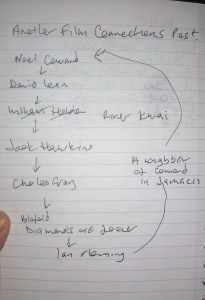
Another Film Connections Post

It’s only the end of November as I write this but in January, Liz and I will be off to Lanzarote once again to escape the cold and wintry UK. I do love the laid back (and warm) atmosphere in Lanzarote and as usual I’ll be taking a stack of books to keep me occupied while I laze about on my sun lounger in-between dips in the pool.

The other day I popped on the TV to find one of the James Bond films showing. It was Casino Royale, the film version of the very first book in the Bond series and I thought about popping my copy of the book into our suitcase with an idea of re-reading the entire series of James Bond novels. Of course knowing me I’d probably leave the book over there and that would be my tidy collection of Ian Fleming 007 novels ruined.

Fleming did a lot of his writing in a small house he owned in Jamacia which happened to be not far from another house which Noël Coward used to own. Back in WWII, Coward had the idea of making a film about the Royal Navy and so he wrote a screenplay for a film titled ‘In Which we Serve.’ It was the story of a ship. The ship is engaged in battle and is sunk and as the survivors hang on to lifeboats and debris, their thoughts meander over their past lives and the story of the ship is told in flashbacks.

It’s a very good film inspired by the story of an actual ship, HMS Kelly, which was commanded by Lord Mountbatten and Coward was justifiably proud of the finished result. He stars as the captain of the ship and along the way there are various notable British stars, some of them making their film debuts. Coward realised he needed someone to help him with the technical aspects of the film so he asked film editor David Lean to help him direct the film. Lean was happy to do so. Coward asked what sort of a credit would he want and Lean answered that he felt the film should be credited as being directed by Noël Coward and David Lean. Coward wasn’t sure about this but he agreed and the filming began with Coward dealing with the actors and Lean dealing with everything else. Lean mentioned in an interview that Coward soon got bored with directing and pretty much left the whole thing to David.

David Lean went on to have a long career as a film director and made a number of huge epics. One of them was a controversial film called Bridge over the River Kwai. This was about British prisoners of war who were forced in very inhumane conditions to build a railway through the Burmese jungle. Alec Guinness plays the senior British officer who feels that building the bridge will restore British morale and undertakes to build it to the very highest standards.

One of the prisoners decides to escape and with a great deal of luck he makes it to the British lines. He is then approached by another officer played by Jack Hawkins and asked to return to the jungle and help blow the bridge up. Many veterans of the war in Asia were very unhappy about the film as the true horror of the cruelty and deprivations unleashed against the POWs was not properly depicted.

Alec Guinness and William Holden were the stars of the film and third on the billing was Jack Hawkins. Hawkins was one of the leading  stars of British cinema in the 1950s. During the war Hawkins served in the army and when he returned to civilian life in 1946, he was soon acting on the stage. With a pregnant wife he became concerned about his future and so accepted an offer to become a contract star for Alexander Korda. He really became a star after a performance in Angels One Five, a film about an RAF station in the war. Another hit was Mandy where he played a sympathetic teacher of deaf children.

In 1953 he starred as a naval captain in The Cruel Sea. The film starts off at the beginning of World War 2 when the Jack Hawkins character is at the builder’s yard helping with the fixing up of his new escort ship, Compass Rose. His officers begin to arrive, many of whom are easily recognisable as stalwarts of the 40’s and 50’s British film industry: Donald Sinden, Denholm Elliot and Stanley Baker and later in the film Virginia McKenna appears as an officer in the WRNS.

The cast and characters are therefore introduced and then the ship goes off to war, protecting the many convoys of merchant ships, bringing the supplies so desperately needed by Britain. It’s one of the great war films of all time.

Two of my personal favourite films starring Hawkins were The Intruder, a great film in which Hawkins plays a former military officer who discovers a past member of his old tank regiment robbing his flat. He determines to find the man again and the story is told in flashback as he interviews a group of his former officers and men.

The other was The Long Arm in which we see how Scotland Yard worked back in 1956. Card files, books of fingerprints and albums containing mugshots, all of which had to be laboriously checked by hand. Some great detective work finally manages to nail the villain.

Hawkins was the epitome of the trustworthy British authority figure. In his obituary one writer wrote that Hawkins ‘exemplified for many cinemagoers the stiff upper lip tradition prevalent in post war British films. His craggy looks and authoritative bearing were used to good effect whatever branch of the services he represented.’

Hawkins himself was a three pack a day smoker and later became ill with throat cancer. In 1966 his entire larynx was removed however he was still able to appear in films with his dialogue dubbed by either Charles Gray or Robert Rietti. In the film Young Winston, he has hardly any dialogue at all.

Jack Hawkins died on the 18th July 1973. He was only 62 years old.

As I mentioned, Charles Gray was one of the actors who dubbed dialogue for Hawkins in later life. It must have been a difficult task because Hawkins has one of the most memorable voices in British cinema. Who was Charles Gray? Well you might not remember the name but Gray played one of cinema’s most notorious villains, Ernst Stavro Blofeld in the 007 film Diamonds Are Forever.

Charles Gray (Picture courtesy James Bond Movie Encyclopedia)

Diamonds Are Forever was the follow up film to On Her Majesty’s Secret Service. In that film George Lazenby had taken over the role of 007 from Sean Connery. Personally, I thought he was a great Bond but George himself was not popular with the producers. After the shoot was over he had grown his hair long and was sporting a beard. The producers wanted someone who could promote the 007 image even in their private life. Later Lazenby’s agent began to feel that the Bond franchise was finished and Lazenby decided against making another Bond film. What could the producers do? Well their knee jerk reaction was to offer Connery a large sum of money to return to the role. Connery agreed to play Bond one more time, banked a huge amount of money and pretty much appeared to sleep walk through the film.

Charles Gray played Blofeld who has taken over a huge empire run by the mysterious millionaire Willard Whyte and he plans to create a powerful laser using diamonds.

Who was the author of Diamonds Are Forever? None other than Ian Fleming of course, bringing our connections full circle.


What to do next: Here are a few options.

Share this post on your favourite social media!

Hit the Subscribe button. Never miss another post!

Listen to my podcast Click here.

Buy the book! Click here to purchase my new poetry collection.

Click here to visit Amazon and download Floating in Space to your Kindle or order the paperback version.

Click here to visit amazon and purchase Timeline, my new anthology.

Bad Meals, North Roxbury and Woody

It’s always good to pick up my iPad and see that my scheduled post has been successfully posted but the next task is to start thinking about a new one for next week. What can I write about? Has anything interesting happened to me? Have I read a great book or watched something good on TV? No? Well, that’s me up the creek without a paddle then.

It’s cold, in fact it’s bloody cold and it’s no secret that I hate the cold. I could write about the cold I suppose but then I’ve done that before. This is my 695th post so it’s no surprise that a lot of what comes to mind I’ve actually already written about.

I’ve not done anything particularly interesting lately worth writing about. As usual I’ve been dining out at a number of restaurants. As I’ve mentioned in my introductory page, dining out is one of the great experiences of life, especially for someone like me who is perhaps in the evening of his life. I’m not the sporty or athletic type, I’m more of a quieter, more relaxed type of guy.

One disappointing aspect of dining out recently was having a really poor meal at not one but two of my favourite restaurants. A restaurant I suppose is only as good as its chef and until these two restaurants gets themselves new chefs they will have to make it through life without my custom. I really do hate getting a sub-standard meal, it just really ruins my evening. After one meal last week we were going on to our usual pub quiz and to make up for the bad food I ordered a portion of cheesy chips to go with my pint. The cheesy chips weren’t that great after all and nothing, not even the winning of the quiz (actually a joint win, we tied with another team) could cheer me up.

When we returned home I picked up my iPad and one of the first items I clicked on was a routine by the comedian Peter Kay about people in a restaurant who complain about the food to themselves but smile at the waiter and tell him everything is ok. Won’t be coming here again they say when he has gone. That is probably the essence of being English. To be fair, I am quite happy to send food back when I can’t eat it but I just try and muddle through when it just isn’t very exciting.

What else have I done lately? Well, as usual I read quite a lot. I’ve recently finished a book by Mia Farrow called What Falls Away. It’s an autobiography that was really interesting and very well written. I particularly liked her memories of her youth in California with her mother and father and family. Her father was a film director, John Farrow and her mother was an actress who was most famously Jane to Johnny Weissmuller’s Tarzan. The family lived at 809 North Roxbury Drive, Beverley Hills, an exclusive area of Hollywood and it turns out a whole lot of famous people lived on that road. Her next door neighbours were the Roaches, the family of Hal Roach, a producer who was at the centre of the silent comedies of the early part of the motion picture boom. Other neighbours were Lucille Ball, Jack Benny, Peter Falk (Columbo) Ginger Rogers and in later years, Madonna.

In the latter part of the book Mia talks mostly about Woody Allen with whom she started a relationship with in 1980. I’m a huge fan of Woody and his films. The two met in 1979 and were introduced to each other by Michael Caine. Woody invited her to his New Year’s Eve Party and later, in April of 1980, Mia received a call from his secretary asking if Mia would like to meet Woody for lunch.

Mia builds up an affectionate picture of Woody and gives the reader some interesting anecdotes. Woody may look in his films as though he just throws any old thing on to wear but in real life he is super keen about his wardrobe. According to Mia he pored over Vogue magazine and many of his suits were tailor made for him.

When he came to stay at Mia’s summer house he refused to use the shower so Mia brought in a builder and had the whole thing redone to his requirements and guess what, he still wouldn’t shower there, even though he brought his own shower mat along.

Woody had a long retinue of doctors for each of his many ailments and kept their phone numbers on him at all times. He also had a thermometer on his person and when he was feeling unwell would take his temperature every few minutes.

Despite their relationship the two never married or even lived together. They both had apartments on opposite sides of Central Park in New York and the two would blink their lights and wave to each other across the park.

Woody never seemed to be interested in her large family of children, most of whom were adopted. In 1985 Mia adopted newborn baby girl Dylan. Woody appeared to find Dylan irresistible and Mia felt that this had been a breakthrough, that he was finally beginning to interact with her children. Sadly things take a darker tone here and Mia began to feel Woody’s interest in Dylan was more of an obsession.

Later, he takes an interest in Soon-Yi, another of Mia’s adopted daughters and by then a teenager. Mia is shocked when she finds Woody has become involved with Soon-Yi in a wholly inappropriate way and later is horrified when she begins to feel Dylan has been abused.

This of course is only Mia’s side of the story. Did Woody abuse Dylan? The authorities seemed to think not but in a later custody hearing they declined to give Woody visitation rights. Woody married Soon-Yi in 1997 and the couple adopted two children.

Although I love Woody Allen’s films, this book made me look at Woody in a completely different light.

Just lately I’ve been taking a long look at my blogs and I’ve generally been a little disappointed. Not by the content but after quite a few years as a blogger I was hoping to have a lot of followers and readers, sold lots of copies of my books and perhaps even made a little income from my work. I sometimes look at my stats on Google analytics as well as those on WordPress itself and wonder what more could be done to gain a larger readership. Interestingly, almost as soon as I had those thoughts, my stats took on a huge boom and I had a weekend of incredible stats, mostly coming from the USA. Why should Americans be interested in my blog posts? Well, I could also ask why is a guy from the north of England so interested in the USA? I have a great interest in Hollywood, US politics, US TV shows, the city of New York so if I’m interested in all that then why shouldn’t Americans be interested in the things that I write about?

A message appeared on my iPad from Google Analytics to tell me about a huge ‘spike’ in my readership. Well, I did run an advertisement on WordPress. I had a budget limit of $35 and about 36 hours later I received a message telling me that my ad had finished as I had hit my budget limit. Of course that could also mean I’ve sold a few extra books this month.

Wait a minute, hang on while I check my Amazon sales page!


What to do next: Here are a few options.

Share this post on your favourite social media!

Hit the Subscribe button. Never miss another post!

Listen to my podcast Click here.

Buy the book! Click here to purchase my new poetry collection.

Click here to visit Amazon and download Floating in Space to your Kindle or order the paperback version.

Click here to visit amazon and purchase Timeline, my new anthology.

The Richard Burton Centenary

This week I’ve noticed quite a few items about Richard Burton on the BBC iPlayer. I wasn’t sure why at first but it turns out that this year, 2025, is the centenary of Burton’s birth. He was born Richard Jenkins on November 10th 1925.

Why did he change his name to Burton? Well one answer on the iPlayer was given in a wonderful film called Mr Burton. Harry Lawtey plays the young Burton and Toby Jones plays his mentor, Philip Burton. Burton came from a poor mining family in Pontrhydyfen in Wales. He had thoughts of becoming a teacher but things were not working in his favour. His mother died when he was young and his father was an alcoholic. Richard went to live with his sister and her husband but financial circumstances forced him to leave school and take up a job in the local Co-op. Enter teacher Philip Burton who urged Richard to rejoin school after promising to help with his finances.

The return to school caused some resentment from his brother in law and so with the consent of his father, Richard became Philip Burton’s legal ward and just aged eighteen, changed his surname on 26 November 1943 to Burton by means of a deed poll. Richard joined the Air Cadets and was able, with Burton’s help, to study at Oxford after applying for a six month RAF scholarship.

Philip Burton made Richard work on his voice and gradually the wonderful speaking voice we are familiar with today began to appear.

Mr Burton was an excellent film and full marks go to Harry Lawtey for his portrayal. In the early part of the film I did wonder how this youthful boy with the very Welsh accent could progress to the young confident actor but Harry’s performance and the way his own voice echoes that of the real Richard Burton was outstanding.

Another programme on iPlayer was a made for TV film called Burton and Taylor and it’s about, as if you hadn’t already guessed, Richard Burton and Elizabeth Taylor.

Back in 1983 when this film is set, Burton and Taylor were probably the most famous celebrity couple in the world. The only other couple of a similar status that I can think of are Mary Pickford and Douglas Fairbanks, a couple from a completely different era. Let me see who else comes to mind; Brad Pitt and Angelina Jolie, Kurt Russell and Goldie Hawn, Tom Cruise and Nicole Kidman, Posh and Becks. Hardly in the same class are they?

Richard Burton and Elizabeth Taylor met on the set of the film Cleopatra in 1961, a movie that went down in history as one of the most expensive ever made. Taylor didn’t want to make the picture so decided to ask for a ridiculous amount of money, confident that 20th Century Fox would never pay it. However, pay it they did and the troubled movie went into production.

The Burton/Taylor TV film focusses on the later years of the pair when they had been married and divorced twice and for some reason decided to star together in a stage revival of Noël Coward’s witty play, Private Lives.

In the film, Taylor is played by Helena Bonham-Carter and Burton by Dominic West. West doesn’t really look much like Burton but captures his voice and persona well. Bonham-Carter as Liz Taylor does look surprisingly like the original and together they make a good reproduction of the famous couple.

The writer seems to believe, and whether it is true or not I don’t claim to know, that Liz Taylor engineered the theatre production of Private Lives as a way of bringing her and Burton back together again. As I mentioned earlier, they had already been married and divorced twice and the movie revealed that Liz clearly still had feelings towards Burton. On the first day of rehearsals she is surprised that Burton will not be lunching with her but spending time with his new girlfriend, Sally. Burton in turn is shocked that on the first read through it is clear that Taylor has not previously read the play. Burton of course knows it off by heart. He is the consummate professional actor and Taylor the consummate professional movie star. During the run when Taylor calls in sick, the production is halted rather than carry on with an understudy, as it becomes clear from the public reaction that the audience are not interested in the play without superstar Liz.

Burton and Taylor were clearly in love but love must have been difficult in the face of their superstar status, just as it was for Fairbanks and Pickford. I can imagine Burton’s upbringing in a mining community and Taylor, having been a star since childhood, were not personalities that could bend much for the other.

The film is interesting, enjoyable and gives the viewer a fascinating peek into the private lives of these two superstars of the past.

The Richard Burton Diaries edited by Chris Williams

Some years ago I read Melvyn Bragg’s biography of Richard Burton and that book was based partly on these diaries which have now been published and are available to everyone.

There is a lot I like about this book and a lot that I don’t like. I tend to prefer paperbacks but I bought this one from the internet and it’s a big heavy hardback and as I took the book to France to read on holiday it became a little more battered every day.

Moving on to the text and I see a lot of the big events in Burton’s life are missing as sometimes he stops writing for days and even months at a time. We don’t hear about the making of Cleopatra and his meeting and affair with Elizabeth Taylor but he does mention some of those events in retrospect.

The book starts with his schoolboy diaries which are rather like mine, brief and to the point. Later, the main diary starts in 1965 when Burton begins to write in more detail. He tells us of his immense love for Taylor and how he has given up womanising to be faithful to her but sometimes I get the feeling he isn’t being totally honest, after all Liz has free access to his diary and she frequently jots down her own comments too. Burton was rumoured to have had an affair with Genevieve Bujold during the filming of Anne of a Thousand Days but of course, gives no mention of that in his journal.

He does talk a lot about food and having lunch in places like Paris and Rome. He enjoys having money and delights in spending it on jewels for Liz, a new private jet plane and a yacht which he thinks might actually save him money as he can stay on the yacht rather than use hotels. Even so, he continues to use hotels. At one point he considers buying a barge, modernising it and touring the canals of France.

He doesn’t seem to enjoy his acting and in fact rather looks down on it as a profession, although unlike an actor like Brando who had similar thoughts, he did take pride in what he did, learning his part and his lines whereas Brando couldn’t even be bothered to learn the script for the film of Superman despite his million dollar fee.

Surprisingly there is also quite a lot of professional jealousy in the text, for instance he gives Robert Shaw a bit of a slagging off for his performance as Henry VIII in A Man for all Seasons which I thought was rather good, better or at least the equal of Burton’s Henry VIII in Anne of a Thousand Days.

A screengrab from the BBC iPlayer

Burton drinks a lot and frequently argues with Liz, sometimes he is banished to the spare bedroom and usually he regrets his drunken words and wonders why he did what he did or said what he said.

He was though a man who loved reading, devouring anything from the classics to detective novels. He even had ambitions of being a writer himself. His entries are peppered with quotations from authors and poets and of course Shakespeare.

I was really looking forward to reading this book but after the first few pages I thought it a little uninteresting. As the narrative moved from 1968 into 1970, Burton seemed to be putting more effort into his journalling and consequently it became more enjoyable to read. Later large gaps appear in the diaries and he doesn’t appear to have written anything about his breakup with Liz Taylor. The entries become less frequent and to be honest, I ended up skipping quite a few pages.

Verdict: A book that promised a lot but failed to deliver.

Still with the BBC iPlayer, there’s a great documentary about Burton titled Richard Burton: Wild Genius which is rather good and perhaps unlike the above post gives a good overall look at the great actor’s life. Burton died on 5 August 1984 at his home in Céligny, Switzerland, aged only 58. He was buried at the Old Cemetery in Céligny and his widow Sally placed a copy of Dylan Thomas’ collected poems in his coffin.


What to do next: Here are a few options.

Share this post on your favourite social media!

Hit the Subscribe button. Never miss another post!

Listen to my podcast Click here.

Buy the book! Click here to purchase my new poetry collection.

Click here to visit Amazon and download Floating in Space to your Kindle or order the paperback version.

Click here to visit amazon and purchase Timeline, my new anthology.

4 Things That Happened in November

November is not my favourite time of the year. It’s getting colder and dark evenings are drawing in. Anyway, I got to thinking about things that have happened in November in the past and so here are four things that came to mind.

The Armistice of November 1918

The Armistice that ended the First World War was signed in Compiègne in France on the 11th November, 1918. It was signed aboard a famous railway carriage in a forest clearing. The railway carriage was designated 2419D and was part of Marshal Foch’s personal train. Foch decided on the spot for the surrender as he wanted to keep the negotiations away from the prying eyes of the press. The negotiations began on November 8th and were finally finished and the document of surrender signed at 5:45am on the 11th November, 1918.

The surrender came into force at 11am and fighting continued until that time with 2,738 men dying on the last day of the First World War.

The railway carriage went back into regular service for a while but was then attached to the French Presidential Train. Afterwards it was put on display in Paris until 1927 when it was returned to the glade at Compiègne.

Marshall Foch. Photo by the author

The Second World War began in 1939 when Hitler and the Nazis invaded Poland. The railway carriage was still in Compiègne on the 22nd June, 1940 when Hitler ordered it to be brought from its shed back to the glade and it was there that he and his generals accepted the surrender of the French. Three days later the site was demolished on the orders of the Führer and the railway carriage was taken to Berlin. A statue of Marshall Foch installed years earlier by the French was left standing intentionally, so that it would appear to stand in honour of a wasteland.

After the war, the site was restored by German prisoners of war and in 1950, an identical carriage was returned to the site. Carriage number 2439 was built with the same batch as the original and was also part of Marshall Foch’s train in 1918.

The carriage is housed in a small museum and when I entered early one Saturday morning back in 2022, I was the only visitor present. The staff asked me my nationality and when I stepped into the main area, a recording began telling the story of the site in English. It was really fascinating and as I walked around, I started up my camera and took numerous pictures and video.

Outside in the Glade, the statue of Marshall Foch is still there and today looks down on a beautiful clearing. It was a calm and peaceful place and it was strange to stand on the spot where Hitler and his Nazi cronies once stood.

The Death of Dylan Thomas 1953

Dylan was a slow worker when it came to writing and there was always something, usually a pub, to draw him away from his work. In his last days he was concerned that his talent, or his inspiration, had gone and that all his best work was perhaps behind him. He was short of money as usual and so he decided to accept an offer to go to the USA on a poetry tour. It was Canadian poet John Brinnin who made the offer to Dylan. Brinnin was the director of a poetry centre in New York and the trips Dylan undertook there were very lucrative for the always hard-up poet. Thomas had a number of wealthy patrons, in fact his famous house in Laugharne was bought for him by an admirer.

He had travelled to the USA before and on his penultimate visit had become romantically involved with a lady called Liz Reitel who worked for Brinnin at the poetry centre. When Dylan arrived for what would be his last visit Reitel was shocked to see the poet looking poorly and not his usual self.

Over the next few days Dylan’s mood alternated between being tired and poorly and getting drunk with some moments of normality in-between.

I get the impression from the book The Last Days of Dylan Thomas that Dylan liked attention, he liked admirers and although he was in the middle of an affair with Liz Reitel, he was not averse to enjoying the attention he received from other women.

At the poetry centre preparations were under way for a recital of the newly finished Under Milk Wood for which Dylan had produced some new edits and updates. The recital went well and was in fact tape recorded by someone at the time with Dylan taking the part of the narrator.

Liz called a doctor when Dylan became unwell again and the doctor gave Dylan an injection of morphine sulphate which may or may not have helped him.

After a night of drinking at the White Horse Tavern in Greenwich Village, Dylan returned to the Chelsea hotel claiming famously that he had downed ‘eighteen straight whiskies. I think that’s the record!’

Dylan’s breathing became difficult later in the evening and an ambulance was summoned. He slipped into a coma from which he never awoke and later died on the 9th of November, 1953. He was only 39 years old and died with assets of only £100.

I was always under the impression that Dylan had drunk himself to death but that may not be the case. The autopsy did not find any evidence of liver cirrhosis and his death may have been due to a combination of pneumonia and bronchitis.

The Assassination of President Kennedy, 22nd November, 1963

The graphic murder of President Kennedy was the cataclysm of our age, imprinted on the minds of a generation by the flickering incarnation of amateur cine film. Despite two official investigations which concluded that Lee Oswald killed Kennedy, doubts still remain even after 62 years. Did Oswald act alone?  Was he a patsy as he himself declared?

So what are the facts of the assassination? Perhaps the only undisputed fact to emerge from the tragedy was that John F. Kennedy, the thirty-fifth president of the United States, was shot in the head and killed. President Kennedy was hit by rifle fire in Dealey Plaza, Dallas, while riding in an open topped limousine, part of a motorcade that had just turned onto Elm Street by the Texas School Book Depository. Almost every other fact, every statement, every report, every document, every exhibit, every disclosure, is open to question. Were there three shots or four? Were there more? Was the President shot from behind or from the front? Was he shot from the sixth floor of the book depository or from the so called ‘grassy knoll’?  Did twenty-four-year-old ex-marine Lee Harvey Oswald fire the shots? Was he alone or were there other assassins? Why did Jack Ruby, a local night club owner subsequently shoot Oswald? Was it to silence him, to stop him from telling what he knew? Did Ruby act out of rage or was he part of a conspiracy? Was he in the pay of the Mafia? Was the CIA involved? The questions are endless, the answers are few.

A frame from the famous Zapruder film

The President was shot at 12.30 pm, but Lee Oswald, who worked at the Texas School Book Depository, was seen by witnesses in the second floor lunch room as late as 12.15, which left him only fifteen minutes to ascend to the sixth floor, produce his rifle and take up position. Of course fifteen minutes might have been enough time for a cool and organised killer, but the President was actually due to arrive at a reception at the Dallas Trade Mart at 12.30, which meant he would pass through Dealey Plaza at about 12.25, giving Oswald only ten minutes to be in place, and he had no way of knowing the President would be late. Immediately after the shooting, patrolman Marrion Baker entered the Book Depository, drew his gun and with building superintendent Roy Truly hot on his heels, confronted a young man in the lunchroom calmly drinking a coke. Truly explained that this was Lee Oswald, an employee. Had Oswald rushed down from his ‘snipers lair’ on the sixth floor or had he been in the lunch room all the while?

Perhaps the strongest evidence linking Oswald to the murder was the supposed murder weapon, a 6.5 mm Mannlicher-Carcano bolt action rifle, a World War II vintage carbine found on the sixth floor of the book depository at 1.22 pm, almost an hour after the assassination. The officer who first found the rifle, Deputy Constable Seymour Weitzman, identified it as a 7.65 mm Mauser, and was confident enough to make a sworn affidavit to that effect. The day after the shooting, November 23rd, District Attorney Henry Wade also described the weapon as a Mauser at a televised press conference. How then does a 7.65mm Mauser become a 6.5mm Mannlicher-Carcano? I personally know nothing about guns at all but I have seen enough war films to know that a Mauser is German, and stamped clearly on the side of the Mannlicher-Carcano are the words ‘MADE ITALY’ and ‘CAL 6.5’. And surely a police officer, particularly an American policeman, would know what he was talking about concerning guns?

There is much more to talk about in the assassination, the Zapruder film, the murder of police officer JD Tippet, secret service men on the grassy knoll when no secret service men were deployed there. Was the assassin in the Texas School Book depository or was he on the grassy knoll? Were there multiple shooters?

In recent years the US authorities have been reviewing the final records ordered to be released by President Trump. Will anything be released that will prove conclusively who shot the President? I doubt it. Did Lee Oswald do it or was he like he said himself, just a patsy? Your guess is as good as mine. (Click here for a full post about the assassination.)

The Fall of the Berlin Wall 1989

It’s hard to imagine now, but for nearly three decades, the Berlin Wall divided a city and a country in two. Built in 1961, it stood as this cold, grey symbol of the divide between East and West, communism and democracy. Then, in November 1989, everything changed almost overnight. Word spread that East Germans would be allowed to cross freely into the West, and people rushed to the checkpoints. At first, the border guards didn’t even seem to know what to do, they just opened the gates. Suddenly, crowds poured through, cheering, crying, hugging strangers. Some climbed up on top of the wall, hammering at it with whatever tools they could find, breaking off chunks to keep as souvenirs.

The fall of the Berlin Wall didn’t just mark the end of a barrier; it marked the end of an era. Within a year, Germany was reunited, and the world felt like it was shifting into something new and hopeful. People around the globe watched those scenes on TV. Who brought the wall down? Well, it was US President Ronald Reagan who called for Mikhail Gorbachev to bring the wall down but really the wall came down because the East Germans wanted it down. Long time hardline East German leader Erich Honecker had died and new leader Egon Krenz decided to open the border with Czechoslovakia.

In Berlin on the 9th of November 1989, crowds gathered at the checkpoints urging the guards to open up. Eventually, overwhelmed by crowds of people, the checkpoints were opened and people began to pass through. I remember watching on TV over the next few days, Germans knocking down parts of the wall and it was only nearly a year later, on 3rd of October 1990 that East and West Germany were reunited.


What to do next: Here are a few options.

Share this post on your favourite social media!

Hit the Subscribe button. Never miss another post!

Listen to my podcast Click here.

Buy the book! Click here to purchase my new poetry collection.

Click here to visit Amazon and download Floating in Space to your Kindle or order the paperback version.

Click here to visit amazon and purchase Timeline, my new anthology.

Noël Coward in Literature, Film and Theatre

I can’t remember when I first discovered Noël Coward. I had known about him for a very long time of course but perhaps I really only discovered him after picking up a paperback copy of Blithe Spirit. Included in that slim volume were two other plays, Hay Fever and Private Lives. Together they are a lively, witty and hugely enjoyable read. A few years ago, Liz and I were on holiday in France and I took along his autobiographies to read. This is what I wrote about them back then.

I’ve spent most of this holiday reading the autobiography of Noël Coward and it’s actually three books in one. The first part is his first autobiography, Present Indicative, part 2 is an unpublished segment of his unfinished third autobiography, Past Conditional and finally his second published autobiography Future Indefinite.

Book one, Present Indicative was published in 1937 and concerns Noël’s early years, his childhood and his first tentative steps into the theatre. It’s an account of a vanished world of repertory companies, writers, actors and actresses who have long gone and whose names mean little today in the 21st century. Even so it is hugely fascinating and interesting and as always enlivened by Noël’s supremely witty text. Noël was a homosexual in a time when homosexuality was illegal and most of his private life he keeps private although armed with a little knowledge of Noël we can read between the lines and assume that Jack Wilson who comes to live with him at his home, Goldenhurst in Kent, was presumably his lover.

Book two, Past Conditional is an unpublished and unfinished autobiography that was intended to fill in the gap between his first two autobiographical books. It starts where the first one finished off, in the early 1930s and differs considerably in tone as it was written much later in the mid-1960s and Noël was able to look back at himself in the 1930s and examine himself from a greater perspective. Such a pity it was unfinished. An interesting segment concerns the death of his brother who is scarcely mentioned in the text as he and Noël were never close. The brother was clearly never part of Noël’s theatrical world and the family send him off to South Africa only for him to return and die of cancer.

The final book in the autobiographical series was Future Indefinite in which Noël recounted his time during the Second World War. He seems like many to have had a very low opinion of Prime Minister Neville Chamberlain, although to be fair to Chamberlain, he was doing his utmost to avoid the horrors of war. Sadly, and clearly unknown to Mr Chamberlain, Adolf Hitler did not want to avoid war, he was in fact wanting war very badly and happily it was Mr Churchill who understood this only too well.

In June of 1939 Noël, who was a great globetrotter, decided to take a tour of Europe in the light of Mr Chamberlain declaring peace in our time. He visited Warsaw and Danzig, Moscow, Leningrad, Helsinki, Stockholm, Oslo and Copenhagen. He found that many of those people were just waiting for Hitler to invade, particularly the Poles. In Russia he found a state that declared it had found freedom in Communism but was in fact quite the opposite as the Stalinist regime had choked any kind of criticism or free thinking whatsoever.

When war was declared Noël was asked to be part of an Anglo-French PR unit in Paris which he seems to have enjoyed for a while and then became a little bored with. He was sent on a tour of the USA to gauge opinion there on the war and was on his way back when the Nazis invaded France. He also did a tour of Australia and New Zealand to entertain troops and did charity work for various organisations helping those who were bombed out in London.

By far the most interesting part was his account of the filming of In Which We Serve, a very patriotic film showing the activities of a ship in the Royal Navy that was eventually sunk and the lives of those who served in her. In his very first autobiography, the names of the many actors and actresses he worked with meant very little to me but now I can recognise a few names, John Mills and Richard Attenborough for instance and David Lean who co-directed the film with Noël although in actual fact, Lean directed most of the film when Coward became bored with the long-winded filming process.

Coward goes on to talk about Blithe Spirit, my favourite of Coward’s plays which was made into a film in 1945. Coward was not keen on the resulting film. David Lean added an ending in which Charles Condomine, played by Rex Harrison, dies and joins his ex-wives in the spirit world. Coward complained that David Lean had f**ked up the best thing I had ever written!  Personally, I loved it.

Final verdict of the Noël Coward biographies; fascinating, always interesting and hugely entertaining.

Just recently I’ve finished reading The Letters of Noël Coward edited by Barry Day. It’s a massive volume and I’ve read it over a long period of time, sometimes turning to other books but this year I decided I would make a big effort to finish it. How the author/editor would even go about collecting Noël’s letters I really don’t know unless Noël typed his letters and kept carbon copies. Anyway, this collection goes from Noël’s youth to his final days. Some of his letters describe his theatrical successes as well as disappointments when things didn’t go so well. Coward made friends all over the world and was fond of visiting them, especially those in the warmer climes of the world when England was cold and frosty. His letters cover his love of the theatres of London and also those of Broadway. After many months of hard work Noël would travel, sometimes with friends but many times on his own and he would talk about the places he visited in his letters. Travelling was his way of relaxing although he always found time for writing new plays.

The book is a huge volume and the editor has woven Noël’s letters with some interesting text about what was happening to Noël in between his letter writing. In 1941 Noël was invited to stay at the Welsh resort of Portmeirion where, many years later, the famous TV show The Prisoner starring Patrick MacGoohan would be filmed. His friend, Joyce Carey was hoping to write a play away from the bombs that were dropping on London. Her play never materialised but Noël wrote Blithe Spirit during the five days that he was there.

The original theatre production starred Cecil Parker as Charles Condomine and Kay Hammond as Elvira. On July 18th, 1941 Noël wrote to Jack Wilson to review the performance. He praised everyone but wasn’t happy with Margaret Rutherford as Madame Arcarti. He finished by mentioning that “I need hardly say that she got a magnificent notice. So much for that.”

My first introduction to Blithe Spirit was the wonderful film version made in 1945 by David Lean. The two stars of the film, to my mind anyway, were Rex Harrison and Margaret Rutherford, although Constance Cummings as Mrs Condomine and Kay Hammond as Elvira, Mr Condomine’s late wife, were equally good.

If you don’t know the story to the play then here it is. Author Charles Condomine is writing a novel and one of the characters is a medium. To obtain information for his book, Charles asks local medium Madame Arcati round for dinner to perform a séance. The outcome is that Charles’ late wife Elvira is conjured up but only Charles can see her. Even so, she manages to cause mayhem in the Condomine household and upset Ruth, Charles’ current wife, no end.

That brings me to what you might call the punch line to this post. Last Thursday Liz and I went to see a production of Noël’s fabulous play at the Grand Theatre in Blackpool. Apart from a few pantomimes when I was a child this was my first visit to the theatre. (Having said that, I did go to a performance of Calendar Girls, the musical version, in Lytham a few years ago.) This however was a classic play written by an outstanding author at a venerable classic theatre. I was excited as we entered and found our seats.

A scene from the recent production at the Blackpool Grand Theatre

Blithe Spirit at the Blackpool Grand Theatre

The stalls were 90% full. The announcement came to take our seats, the lights went down and the performance began. It was an enjoyable performance but a couple of things struck me. Although the actors were good, they weren’t in the same class as the actors in David Lean’s film version. The action is set in the 1940s and Rex Harrison and the British actors from that period seem to have a unique smooth diction and rhythm of speech which however hard they try, actors today just really cannot reproduce. Adam Jackson-Smith as Charles Condomine was pretty good but the play needs a really good comic actor to play Madame Arcati and Susan Wooldridge was good but hardly the equal of the wonderful Margaret Rutherford.

Bridgette Amofah played Elvira quite well but in Noël’s original production the character had pale makeup with a hint of green and was followed around the stage by a green spotlight. Bridgette is a black woman so perhaps the make up wouldn’t have worked but I do feel that something could have been done with makeup and lighting to make her look a little more ghostly.

These minor things apart, I enjoyed my visit to the theatre and it was good to see that Noël Coward can still entertain the public many years after his death in 1973.


What to do next: Here are a few options.

Share this post on your favourite social media!

Hit the Subscribe button. Never miss another post!

Listen to my podcast Click here.

Buy the book! Click here to purchase my new poetry collection.

Click here to visit Amazon and download Floating in Space to your Kindle or order the paperback version.

Click here to visit amazon and purchase Timeline, my new anthology.

F1 in Numbers

A long time ago I wrote a post called Blogging by Numbers in which I wrote about various numbers that linked to the world of writing and blogging. This week I thought I’d try and do a similar thing with Formula One racing. I haven’t written much about the sport this year even though it has been quite an interesting season. Recently, Max Verstappen, who a few races ago was really out of contention for the World Championship, now seems to have caught up with the top two drivers, Norris and Piastri and it is even possible he could swipe the title from under the noses of those two, both driving for McLaren. Currently, Lando Norris leads Oscar Piastri by a single point so it looks like a three way fight for the title. Anyway, let’s take a look at those numbers.

1950

That’s a pretty good number to begin with. The world driver’s championship commenced in 1950 and the very first winner was Nino Farina who won the title after only 7 races. The very first race of the season was the British Grand Prix held at Silverstone and Farina won that one driving his Alfa Romeo.

5

Nigel Mansell German GP 1988 photo by author

The famous Red Five was Nigel Mansell’s race number. In the 1980s Nigel Mansell, Ayrton Senna, Alain Prost and Nelson Piquet were a quartet that dominated the sport for many years. Piquet won three titles in 1981, 1983 and 1987. Mansell joined Piquet at Williams Honda in 1985. Honda felt that Piquet could have won the championship in 1986 if Williams had nominated a number one driver. Frank Williams declined to do so and so Honda withdrew their engines prematurely at the end of 1987 and began a new relationship with McLaren instead. Together, McLaren drivers Prost and Senna dominated the 1988 season winning every race between them but one. Williams were forced to use the engine of a privateer, John Judd, and were hopelessly outclassed. Mansell signed for Ferrari, the last driver to be personally signed for the famous team by the Commendatore himself, Enzo Ferrari.

Designer Adrian Newey joined the team in 1990 and with a new Renault engine the Williams team began to return to form. Mansell was tempted back to Williams from Ferrari. He won the world championship in 1992 but was dismayed to find that Frank Williams had signed Alain Prost as his team mate for 1993. Mansell had been teamed with Prost at Ferrari and was not happy at the way Prost schemed behind the scenes. Mansell declined to sign for the 1993 season and instead opted to move to the USA and compete in Indycars. There the Haas team made him a gift of his new race number, Red Five.

Fangio (Picture courtesy Wikipedia)

Still on the subject of number 5, that was the total of world championships won by the Argentine driver Juan Manuel Fangio. He was the original Formula One legend, the one everyone else spent decades trying to catch. He raced in the 1950s, when cars were twitchy beasts with no seatbelts and drivers wore polo shirts instead of fireproof suits. And yet, Fangio made it look effortless. He won five World Championships with four different teams, Alfa Romeo, Ferrari, Maserati and Mercedes, an incredible effort which no other driver got close to until Alain Prost won his fourth in 1993 and finally Michael Schumacher equalled in 2001.

Decades later, when people discuss who the greatest driver of all time is, Fangio’s name still floats effortlessly to the top, a reminder that grace and talent once shared the same racing seat. Fangio retired from racing aged 47; he died in 1995 aged 84.

105

Image courtesy Wikipedia ceative commons

Lewis Hamilton currently holds the record for the most ever Formula One wins, 105. The previous record was held by Michael Schumacher at 91. Hamilton’s last win was the 2024 British Grand Prix. It was also his last win for Mercedes. In 2025, Lewis Hamilton moved to Ferrari. With the exception of a single sprint race victory, he has yet to win a full Grand Prix.

7

The record for the most world championships is held jointly by Michael Schumacher and Lewis Hamilton. Many feel that Hamilton’s 7 championships should really be an 8. The result of the final race of the 2021 season, the Abu Dhabi Grand Prix, was controversial. Title contenders Hamilton and Max Verstappen both had 369.5 points coming to the race meaning that whoever won would take the title. It would either be Verstappen’s first or Hamilton’s eighth.

What happened was that Lewis Hamilton was leading the race but on lap 53 of the 58 lap race, there was a crash and the safety car came out. Mercedes realised there was no time to restart the race and so Hamilton would win behind the safety car. The Red Bull team decided to change the tyres of their driver, Verstappen, and he rejoined the field, still in second place but with 5 lapped cars ahead of him. The race controller controversially decided that the cars in front of Max, and no others, could unlap themselves and restarted the race with a final lap remaining. According to the rules there should have been a mandatory final lap behind the safety car but this was ignored and the race restarted for one racing lap. With fresh tyres Verstappen overtook Hamilton and won, taking his first world championship.

Various protests were made by Mercedes but the race result was upheld although the race controller, Michael Masi, was later sacked.

65

65 was the tally of pole positions made by Ayrton Senna which at the time of his death in 1994 was the record. Together, Senna, Alain Prost, and Nigel Mansell dominated most of the eighties and early nineties in Formula One racing. Mansell had left the stage for Indycar racing in the United States and Prost had retired, leaving Senna to take his vacant seat at Williams, or perhaps he retired because Senna had been offered a seat at Williams. Certainly, after the intense animosity that developed between the two at McLaren you can hardly blame Prost for not wanting to work in that same situation again.

Ayrton Senna 1988. Photo by the author

Those retirements left Senna in 1994 as the Elder Statesman of Grand Prix motor racing. Now that his two closest competitors had gone perhaps Senna had hoped that he could relax, let up the pace a little bit, just as Prost had thought in 1988 before Senna began to push him harder. But a new phase had begun for Aryton Senna, a new Young Pretender had appeared to challenge him in the shape of Michael Schumacher. Schumacher had won the first two Grands Prix of the year and Senna came to Imola for the San Marino Grand Prix without a single point. “For us the championship starts here,” he told the TV cameras, “fourteen races instead of sixteen.” Further pressure mounted on Senna when fellow Brazilian Rubens Barrichello was injured in a crash and then Roland Ratzenberger was killed, the first fatality at a Grand Prix meeting since that of Riccardo Paletti 12 years before.

In the race as we all know, Senna went off the track at Tamburello and was killed when a suspension arm, crushed in the impact, flipped back and injured the Brazilian driver fatally in the head.

1

I thought I’d finish with some one hit wonders, drivers who only ever won one race. According to my research there are currently 25 drivers who have won just a single F1 race. The most recent single race winner is current Alpine driver Pierre Gasly who won the 2020 Italian Grand Prix. Gasly started the race in tenth, but gained positions due to a well-timed pit-stop prior to a safety car. Lewis Hamilton, who led the race until this point, was given a penalty for entering the pit lane when it was closed and so passed the lead to Gasly.

Jean Alesi was a hugely promising driver who sadly signed for Ferrari just as they entered a very dismal period in the Italian team’s long history. His one win came in 1995 at the Canadian Grand Prix when he was running second to Schumacher in a Benetton and the German retired with a gearbox problem.

Peter Gethin courtesy creative commons

Here is one final one hit wonder and the winner was a driver you may never have heard of but the race he won has been considered by many to be one of the most exciting of all time. Peter Gethin was driving for Yardley BRM in 1971. Back then before the arrival of the chicanes, Monza, the venue for the Italian Grand Prix, was a super fast slipstreaming event.

Gethin in his BRM won the race from Ronnie Peterson in a March 702 by an incredible by 0.01 seconds. The top five were covered by just 0.61 seconds, with François Cevert finishing third and Mike Hailwood in his debut race for Surtees finishing fourth and Howden Ganley fifth. With an average speed of 150.754 mph, this race stood as the fastest-ever Formula One race for 32 years, until 2003. The following year, 1972, chicanes were added to the Monza circuit to reduce the ever growing speeds of the cars.

Gethin retired from F1 in 1974.


What to do next: Here are a few options.

Share this post on your favourite social media!

Hit the Subscribe button. Never miss another post!

Listen to my podcast Click here.

Buy the book! Click here to purchase my new poetry collection.

Click here to visit Amazon and download Floating in Space to your Kindle or order the paperback version.

Click here to visit amazon and purchase Timeline, my new anthology.

Ridley Scott in 4 Films

Ridley Scott was born in South Shields, England, in 1937. He studied at West Hartlepool College of Art and later at London’s Royal College of Art, where he first began experimenting with film. While there, he contributed to the school’s magazine ARK and made a short film, Boy and Bicycle (1962), featuring his younger brother, Tony Scott.

After graduating, Scott joined the BBC as a set designer and director, working on popular series such as Z Cars and The Troubleshooters. His time in television taught him the mechanics of production and in 1968, he left the BBC to establish Ridley Scott Associates (RSA), a commercial production company. Over the next decade, he directed hundreds of adverts, developing a style of lighting, atmosphere and composition, qualities that made his transition to cinema with The Duellists (1977) both natural and visually striking.

Scott is a prolific film maker and has created some classic films. I have to say there are many of Scott’s films that I haven’t seen so in this post I’ve focussed on four particular films that I have seen and enjoyed.

Alien

Alien is a really different kind of sci-fi film. It’s not Star Trek or Star Wars and it’s not littered with sci-fi terminology. It’s a very slow burning earthy film about a spacecraft on its way back to earth with a payload of something, I’m not sure what. On the way back home, the crew are awakened from hibernation to find that the ship’s sensors have detected a beacon which maybe some sort of SOS and the company regulations state this must be investigated. Next thing we’re down on a hostile planet and one crew member has been hit in the face by some kind of creature which has attached itself to his face. Later it falls off and all is ok except that something is growing inside the crewman which bursts out of his chest in a horrible spectacular scene and suddenly, an alien creature is onboard.

It is all done really well and one by one the crew fall victim to this creature in the dark confined spaces of the ship. It’s sci-fi mixed with horror and the only survivor turns out to be Ripley played by Sigourney Weaver. Ripley is a sort of female John McClane, the Bruce Willis character from the Die Hard films. Weaver creates a really memorable character which was revived in various sequels but the real core of the film and the scene everyone remembers is probably that gruesome scene when the alien bursts out of John Hurt’s chest. Apparently, Ridley Scott didn’t tell the actors what was about to happen so the shocked faces on the actors are all really authentic.

Some years later, Scott decided to revisit the franchise with two prequel films. Both were dismal in my opinion but it makes me wonder why was Alien so good and Prometheus and Alien Covenant so bad? The effects in those two latter films were good but perhaps the actors weren’t as good as Sigourney Weaver, John Hurt and Ian Holm and the other crew members in the original, or is the classic chest buster scene so burned into cinematic lore that it can’t be topped?

The Martian

The Martian is surprisingly similar to that old film Robinson Crusoe on Mars in many ways. The crew of a Mars mission is on the surface when a major dust storm threatens to topple over their space vehicle. The crew decide to abort the mission and take off but one crew member is hit by debris and presumed dead and they leave him behind. Later, Mark Watney played by Matt Damon, awakes from unconsciousness in the desert and makes his way back to the martian base camp. The bio-data telemetry from his space suit had been damaged and so made mission control assume that he was dead. Now the martian base camp is pretty basic and although it has computer stations and food and water and so on, there is no communication to earth. The next mission is not due for four years so Watney must find a way to survive until then on the camp’s meagre supplies.

He decides to make part of the camp into an area where he can plant some potatoes and hopefully produce more food. Just like in Crusoe, Mark Watney keeps us interested in what is happening by recording his thoughts in a video diary. Not only that but back on earth, observatories notice the activity taking place on Mars and realise he is still alive.

Still unable to communicate with earth the marooned astronaut decides to dig up an old space probe, drag it back to base, plug it into a power cable and use it for communication. I won’t ruin everything for you by telling you the whole story but again, if you like sci-fi and perhaps even if you don’t, this is such a well made and enjoyable film and is well worth watching. The visual look of the film is great and the director manages to keep the viewer interested despite the fact that for much of the time there is only Matt Damon up there on the screen.

External scenes of Mars were filmed in Wadi Rum in Jordan and NASA decided to collaborate with the producers as they saw the film as promoting real space exploration. The author of the book which the film was based on was Andy Weir who tried to be as scientifically accurate as possible, researching orbital mechanics and the planet Mars as well as botany, all elements which interested Ridley Scott.

A Good Year

One of the great things about Ridley Scott is that not only is he a prolific film maker, he doesn’t just stick to one particular genre. The first time I saw this particular film I would never have guessed that it was a Ridley Scott film. It’s based on a book by Peter Mayle who wrote the wonderful A Year in Provence. Scott had wanted to make a film in Provence as he owned a house in the area. Peter Mayle was approached to write a screenplay but he declined but decided to write a novel and for Scott to buy the film rights and have a screenplay written based on the book. The screenplay was written by Marc Klein and both the book and the film incorporated some of Ridley Scott’s own ideas. The basic story is about a London stockbroker who inherits a property in France belonging to his late uncle. The stockbroker, Max, played by Russell Crowe, goes back to France and after a while begins to fall for the old place again. A gorgeous local waitress plays a large part in his feelings too. His late uncle is played by Albert Finney and his scenes are all shown in flashback.

I have to say I didn’t like this film the first time I saw it. I thought the flashback scenes were confusing because I didn’t realise they were flashbacks at first. I didn’t like Russell Crowe and thought he was miscast. I feel the role was more something perhaps Hugh Grant could have played effortlessly. Over time though I’ve warmed to this film and now it is one of my absolute favourites.

Gladiator

This is a film which really revived the kind of classic epics that Hollywood and directors like David Lean used to make. It’s a really fabulous film with these huge set pieces set in the Roman arena, beautifully photographed and acted. It concerns Russell Crowe as a Roman general, Maximus Decimus Meridius who Marcus Aurelius decides to nominate as his successor as emperor of Rome. Unfortunately, Marcus dies at the hand of his son, Commodus who quite fancies being emperor himself. Commodus has Maximus arrested and sentenced to death but Maximus fights off his executioners and escapes. He returns home to find his family murdered. Various events then see Maximus become enslaved and later a gladiator determined to seek revenge.

One of the main characters was played by Oliver Reed who died during the production. During a break from filming in Valletta, Reed had encountered a group of Royal Navy sailors and challenged them to a drinking match. He suffered a heart attack in the bar and died in an ambulance en route to the hospital.

His role had not been completely filmed and so a body double was used in some shots and in one scene Reed’s face was digitally inserted into the film. I have Gladiator on DVD so I thought I’d give it a watch just to refresh my memory. Gladiator was just as good as I remembered and the secret of the film, for me at any rate, is that even though this is a great epic in the same tradition as David Lean’s later films, at its core is a very human story about a man betrayed who longs to be reunited with his murdered family which makes his death a sort of victory.

Other Films

I could of course have mentioned many other classic Ridley Scott films. Thelma and Louise is one I have seen. I always thought it was a good film, nothing less and nothing more but watching a TV show on Sky Arts not long ago the reviewers thought it was a work of genius. It was certainly new in that it was a road movie featuring two women rather than two men. Blade Runner is another classic sci-fi drama directed by Scott and I look forward to the day I see it listed on my TV schedule.

Scott directed Hannibal, the follow up to Silence of the Lambs which I thought was a little gruesome and so apparently did Jodie Foster who declined to reprise her role as FBI agent Clarice Starling.

All the Money in the World was a pretty good film which was about the kidnapping of J Paul Getty’s grandson and his refusal to cough up a multi million pound ransom. Interestingly Kevin Spacey played Getty but after allegations of sexual misconduct Scott cut Spacey from the film and asked Christopher Plummer to play Getty,  calling for some last minute refilming of parts of the film.

I was hoping to see Ridley Scott’s Napoleon at the cinema but these days films seem to have such a short cinema showing. It doesn’t seem to be streaming anywhere so I’ll just have to look out for the DVD.

What are your favourite Ridley Scott films?


What to do next: Here are a few options.

Share this post on your favourite social media!

Hit the Subscribe button. Never miss another post!

Listen to my podcast Click here.

Buy the book! Click here to purchase my new poetry collection.

Click here to visit Amazon and download Floating in Space to your Kindle or order the paperback version.

Click here to visit amazon and purchase Timeline, my new anthology.


Things that Happened in October

Here I am, raring to go. Laptop at the ready, focussed, ready to write this week’s blog. The thing is after 688 posts I’m not that sure what to write about. OK, so what about . .  things that happened in October? Let’s dive in.

One thing that happened in October was me! I was born on October the 3rd, quite a considerable time ago which is annoying on a number of levels. One, I’m getting a bit knackered. My back hurts, my knees ache. It’s hard to stand up straight but what is a real pain is when you get one of those things on the internet where you have to add your date of birth and I have to scroll back through the 90s, the 80s, the 70s, the 60s and finally to the 1950s.

Anthony Eden was the prime minister when I was born. He carried on until his resignation in 1957 due to ill health. At the top of the music charts or hit parade as they called it back then was Doris Day and Whatever Will be, Will be, Que Sera Sera.

My brother Colin was also an October child. He was born on the 10th of October but sadly wasn’t around to celebrate it this year. He would have been 65. My mother too was also born in October but more about her later.

John Lennon

Lennon was born on the 9th of October in 1940. His mother and father were Alfred ‘Freddie’ Lennon and his wife Julia. Alfred was a merchant seaman and was away at sea when John was born. He apparently went absent without leave but later turned up back in Liverpool. By then Julia was involved with another man, John Dykins and actually pregnant by him. Julia’s sister, Mimi decided to take John home and look after him in order to give Julia a chance of happiness with her new love John Dykins.

The last vinyl album I ever bought, and the last one that John lennon made. Double Fantasy. £2.99, what a bargain.

Mimi told Philip Norman, author of the book Shout, the True Story of the Beatles that ‘no man wants another man’s child’. Perhaps the fact that she had no children of her own played a part too. Julia continued to visit her son at Mimi’s house at 251 Menlove Avenue until 15th of July 1958.

John was staying with Julia and John Dykins for the weekend but Julia had called round to see her sister Mimi. When she left to catch her bus home she was hit by a car and killed. John Lennon’s world had been tragically changed.

Many moons ago when I worked for a cigarette vending company, I used to visit a small pub in Woolton in Liverpool and the owners of the pub were two retired ex shell tanker drivers. They were both friendly guys but one in particular was outgoing and talkative and if he was on duty at the bar we would always have a good chat while I sorted out the cigarette machine. One day we got onto the subject of the Beatles and I was surprised to hear that John Lennon’s house was just around the corner. Woolton is a very pleasant middle class suburb of Liverpool and I remember thinking what! This is where Lennon was brought up?  Lennon’s image as a sort of working class hero led me to assume he had a background in a rough and tumble area of Liverpool, like the Dingle where Ringo lived. The truth was different. Perhaps Lennon fermented the working class hero thing, perhaps the fault was mine, I just assumed something without knowing the facts.

Driving round the corner I found Lennon’s old house, 251 Menlove Avenue. He was living here when he started his first band, the Quarrymen and also when he met Paul McCartney. Lennon’s life was one heck of a journey taking him around the world with the Beatles and finally to New York with Yoko Ono where he was shot and killed in 1980.

Marie Antoinette executed 1793

Kirsten Dunst as Marie Antoinette in the film version directed by Sofia Coppola

On October 16, 1793, Marie Antoinette, the deposed Queen of France, was executed by guillotine in Paris’ Place de la Révolution. After a swift and merciless trial before the Revolutionary Tribunal, she was found guilty of treason. Dressed in a simple white gown, her once-elaborate hair cut short, she was taken through the streets in an open cart, exposed to the jeers and insults of the crowd. Despite the humiliation she endured, she remained composed. When she accidentally stepped on her executioner’s foot while mounting the scaffold, she turned to him and said politely, “Pardon me, sir, I did not do it on purpose.” It was a final gesture of grace amid the chaos of the Revolution. Moments later, the blade fell, and with it ended the life of a woman who had once embodied the grandeur of Versailles and become the Revolution’s most reviled symbol. Her death marked both the destruction of the monarchy and the deepening ferocity of the revolutionary cause.

A famous phrase she is said to have spoken is ‘let them eat cake’ after being told that her subjects were starving and had no bread. Did she really say that? Probably not but in the original French, Marie referred to brioche, not cake. Brioche is a sort of sweet bread popular in France but either way, the phrase has been used as propaganda by the revolutionaries to show that the Queen had no time for the peasants.

Ghandi born October 2nd 1869

Mohandas Karamchand Gandhi was a leader of India’s struggle for independence and a global symbol of nonviolent resistance. Born in 1869 in Porbandar, India, he trained as a lawyer in London before developing his philosophy of satyagraha—the power of truth and peaceful protest—during his years in South Africa. Many people think his name is Mahatma but this was in fact a title bestowed upon him in 1915 and means ‘Great soul’. Gandhi became the moral and political heart of the freedom movement, leading campaigns of civil disobedience, boycotts and marches that challenged British colonial rule without resorting to violence. Gandhi’s assassination in 1948 shocked the world, but his ideals of peace, equality, and nonviolence continue to influence movements for justice and human rights across the globe. Quite a few years ago I picked up Ghandi’s autobiography and lost it before finishing it. I know I still have it somewhere and one day I will find it and finally finish it.

A biographical film about Ghandi directed by Sir Richard Attenborough was released in 1982. Attenborough had been trying to make the film since 1962 and the final production marked the realisation of a dream for the director. Ben Kingsley starred as Ghandi and the film won 8 Oscars at the Academy awards although there was some criticism of the film. I was surprised to find that the opening sequence where Ghandi is thrown off a train in South Africa was entirely fictional.

1990 East and West Germany Reunited

When the Berlin Wall fell on November 9, 1989, it marked not just the collapse of a barrier but the beginning of a profound transformation. For nearly three decades since the end of the Second World War, Germany had been divided, East and West separated by ideology, politics and a concrete wall that sprang up in 1963. The fall of the Wall was followed by a wave of hope and uncertainty as both sides faced the challenge of becoming one nation again. On October 3, 1990, reunification was officially declared, and the Federal Republic of Germany absorbed the former East German state.

The process was far from simple. Economically, the East lagged behind after years of communist rule and integrating two very different systems tested the country’s resilience. Yet, despite the struggles, rising unemployment, cultural adjustments and political growing pains, the spirit of unity prevailed and Berlin once again stood as the capital of a single, democratic Germany. Today, the reunification remains one of the most remarkable examples of peaceful transformation in modern history.

24th October 1929 Wall Street Crash

The Wall Street Crash of 1929 was a catastrophic collapse of the U.S. stock market that marked the beginning of the Great Depression. Throughout the 1920s, the American economy had boomed, and millions of people invested heavily in the stock market, even buying shares on credit. This speculation drove prices far above the real value of companies, creating a dangerous bubble. In late October 1929, confidence began to crumble. On October 24, known as Black Thursday, panic selling set in and by October 29, or Black Tuesday, the market had completely collapsed. Billions of dollars in wealth vanished overnight, leaving investors ruined and banks in crisis. The crash didn’t cause the Great Depression by itself but it exposed deep economic weaknesses and triggered a decade of mass unemployment, poverty and hardship across the United States and much of the world.

One of those who escaped disaster was Joe Kennedy, father of President John F Kennedy who apparently had invested in property, real estate as they call it in the USA, rather than stocks and shares.

Finally, bringing this blog back to a personal element, in 1929 my grandfather and grandmother had gone to Cheltenham to find work and on the 24th of October, the very day of the crash in the USA, my mother was born. She died in 2023 aged 93.


What to do next: Here are a few options.

Share this post on your favourite social media!

Hit the Subscribe button. Never miss another post!

Listen to my podcast Click here.

Buy the book! Click here to purchase my new poetry collection.

Click here to visit Amazon and download Floating in Space to your Kindle or order the paperback version.

Click here to visit amazon and purchase Timeline, my new anthology.

F1, The Crown and Watching the Box on Holiday

My original title for this post was Watching the Box in France. That however seemed to give the impression that this post was about French TV which it isn’t. Liz and I don’t normally watch much television on holiday, we are far more interested in swimming, going out for meals and barbecuing. On this holiday however, the weather was a little mixed and on quite a few evenings we settled down in the lounge of our rented house and decided to pop the TV on.

Just to backtrack a little, we rented this same house back in May and usually, the only time I put the TV on is to watch F1 racing. May is the usual month in the calendar for the Monaco grand prix, one of my favourite races of the year. There is actually plenty of talk recently about cancelling the race as nowadays, the F1 cars are faster and much bigger and so there is very little room left to overtake.

Back in the 1960s, cars were much smaller, in fact in those days there were three cars on the front row of the starting grid, the cars lining up in 3-2-3 formation. Fast forward to the present day and F1 cars and their aerodynamic fins and wings have spread out hoping to grab that extra bit of air in order to generate more downforce and push themselves down to the track so they can corner ever faster.

Many people have called for the race to be cancelled as bigger cars combined with a narrow track makes it virtually impossible to overtake which reduces the racing to just a procession of high speed cars and of course whoever is on pole position is pretty much guaranteed a win. Push that to one side and I must tell you that I happen to love the Monaco grand prix, I love the track, I love the exotic names of the corners: Saint Devote, Mirabeau and Rascasse. I love the run down to the Casino Square, the dash into the tunnel and the following tight chicane, the prize giving, the boats in the harbour, the glamour; in short, I love it all.

Back in May then I was disappointed to find that the Skybox in this lovely house did not seem to be working. I switched it on and off, rebooted it, checked the connections but all to no avail. I was forced to watch the 8 minute highlights on YouTube and quite frankly, I was gutted. OK back in England our own trusty Skybox had recorded the race but by then I knew the outcome, I knew the winners and the excitement had all been lost.

Anyway, we came here once again in September and I was looking forward to watching the Italian Grand Prix, another of my favourite races. The TV worked ok but the skybox was no more, lying abandoned and disconnected on one side. A new TV set up had been sorted with the TV connected to the internet. I quickly ascertained that in France, F1 was available on Canal+. Yes, Canal was there, ok so far. I clicked on the channel only to find that a subscription was required. I would have to pay and subscribe to Canal to watch the racing!

My inner tightwad kicked in and declined to open up my wallet so once again I had to make do with the 8 mins of YouTube highlights. Oh well, we didn’t come on holiday to watch TV but even so, I was disappointed.

The other thing we noticed on one rainy evening was that Netflix was available. Now just recently when Liz renewed her Sky package, some negotiation was involved and to sweeten the deal, Sky threw in a Netflix subscription. I have to say I haven’t looked at Netflix much but I always assumed it was just an ordinary channel like BBC1 for instance, in that there was a schedule and certain programmes were broadcast at certain times. Not so, Netflix is more like YouTube, you can watch programmes on demand but what to watch, that is the question.

Liz wanted to watch The Crown which I can’t say I was really interested in at first but after a while I realised what a really excellent production it is. The actors are really good especially the portrayals of the Queen, Princess Margaret and Winston Churchill.

The younger Queen was played by Claire Foy and Princess Margaret by Vanessa Kirkby and Margaret’s situation as the Queen’s sister was explored in a few episodes. Her love affair with Peter Townsend was doomed because Townsend was a divorcee. The Queen was advised to ask Margaret to wait until she was 25 and then she could marry. When the time came the Queen’s advisors brought up more issues and then ultimately the two lovers had to separate which of course didn’t help the sisterly relationship between the Queen and Margaret. Margaret actually could have married Townsend but that would have meant giving up her royal status so it seems to me that perhaps being a royal meant more to her than being with Peter Townsend.

Prince Philip courtesy creative commons

Before watching The Crown I had no idea of the background of Prince Philip. I always assumed he was English and a member of some family which was eligible to marry into the royals. In actual fact he was Greek and aged only eighteen months old he and his family were exiled from their homeland which left him with a lifetime fear of revolution and anything that might threaten the royal family.

His and Charles’ school days at Gordonstoun were really well done especially the interplay and flashbacks between Philip’s and his son Charles’ time there. Philip apparently loved it but Charles hated it.

A real stand out story was the one about the retirement of Churchill which was cleverly linked to the famous, or infamous painting of a portrait of Churchill by Graham Sutherland. Churchill, played by John Lithgow, was coming up to his 80th birthday and various people wanted him to retire but he was adamant that he would carry on. Churchill had various sittings for the painting with the artist and Churchill himself was an amateur painter of some merit. The two, one a professional and the other an amateur, tried to examine each other through their works. Churchill was hugely disappointed with the result which portrayed him as a very old man and came to see at last, according to The Crown anyway, that the time had come for him to retire and hand over the leadership of the country to Anthony Eden. Everything was beautifully done.

The other thing about The Crown was even the quick cutaway and establishing shots of cars driving up to the Palace or through London in the 50s and 60s, were expertly done. I’m sure there was an element of special effects involved especially in scenes of crowds in London but even so, everything looked so good.

An interesting episode concerned Lord Altrincham who was concerned enough to put forward a little criticism of her Majesty when she seemed to brand the workers at a car factory ‘ordinary’ instead of praising their work. He said himself that he didn’t blame the Queen but those who were writing her speeches and he added; “The personality conveyed by the utterances which are put into her mouth is that of a priggish schoolgirl, captain of the hockey team, a prefect and a recent candidate for Confirmation.”

In the show, Lord Altrincham is invited to the palace to meet the Queen’s secretary, however when he arrives, he finds himself face to face with the Queen.

I doubt that ever actually happened but if it did then full marks to the Queen for meeting criticism head on. Many of the Lord’s recommendations, such as making a Christmas TV broadcast, were accepted by the monarch and surely must have helped her feel not as remote from her people as she had up till then. Another broadcast which was dramatised was the one made by the Duke of Windsor when he abdicated. The Duke flips in and out of the story. The Queen Mother detested him as he had forced the mantle of kingship onto her husband when he was ill-prepared for it. Prince Charles however, did strike up a sort of friendship with the Duke. I should imagine that a former King and a future one would have much in common although how much was fiction and how much was accurate, I don’t know. Charles was played by Josh O’Connor extremely well and the Duke in his later incarnation by Derek Jacobi.

Our last evenings in our gite at Parçay-les-Pins were made all the more enjoyable by this splendid series which I’m sure everyone has watched ages ago but for me, a latecomer to Netflix, is very new.


What to do next: Here are a few options.

Share this post on your favourite social media!

Hit the Subscribe button. Never miss another post!

Listen to my podcast Click here.

Buy the book! Click here to purchase my new poetry collection.

Click here to visit Amazon and download Floating in Space to your Kindle or order the paperback version.

Click here to visit amazon and purchase Timeline, my new anthology.