 As usual Liz and I have left behind cold and unpleasant England for the much warmer climes of Lanzarote. We’re renting a place that we first found two years ago but were unable to rent last year as it was fully booked. This time Liz got in early and so here we are for four weeks. The villa is very comfortable with a great outlook, sunny on the patio all day and it has a great pool and comfy outdoor couches.
For our first night out we went along to the Gourmet Indian Restaurant where we had so much fun last year with the staff. We were rather surprised to find that this year, all the staff that had made us so welcome had now left. That is probably the same in restaurants the whole world over. Staff come and go but happily, the new staff, especially our waitress were fun and friendly and the food was just as superb as it was previously.

Last year’s Indian restaurant staff, sadly missed
Another favourite of ours is the Café Berrugo down in the Marina Rubicon. The manager Juan greeted us as warmly as usual. Last year the food wasn’t quite as good as it normally is so I wasn’t sure what to order but anyway, we went for five tapas dishes and they were all excellent, so much better than our last visit. Perhaps the café has gained a new chef during our absence, anyway, we were really impressed and happy and Juan gave us an extra shot of vodka caramel, a drink I don’t think I’ve had anywhere else except Lanzarote.
The interesting thing is that a few months back I was writing about a run of bad meals and I have to say, I much prefer this, a run of lovely meals.
Before we left the UK we switched on our Sky box and I was pleasantly surprised to see the film Nuremburg available to watch. I was surprised because it was only on at our local cinema a few weeks previously and it was something I wanted to watch. So, we poured ourselves a glass of wine and settled down to watch. The film is the story of the Nuremburg trials held in Germany after the Second World War. Hermann Göring, played in the film by Russell Crowe, is the most prestigious prisoner in the dock. He was the number 2 in the Nazi government until the last few days of the war when Hitler, incensed by a telegram from Göring in which he asked permission to take over the Reich, ordered his arrest.
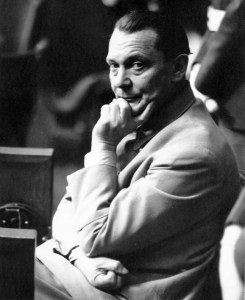
By Charles Alexander, Office of the United States Chief of Counsel – Harry S. Truman Library & Museum, accession no. 72-911 (Retrieved 2017-04-26), Public Domain, https://commons.wikimedia.org/w/index.php?curid=161339177
Even so, when Göring handed himself over to the Americans, he was perhaps thinking of the events of the First World War when the Kaiser abdicated and fled Germany and left others to run the country in defeat. Göring, perhaps thought that he was the man to take over Germany in this new defeat. Things would not turn out that way however and Göring, amongst many others, was to be put on trial for crimes against humanity.
The film is based on the story of Douglas Kelley, a psychiatrist who was tasked with examining the nazi prisoners with a view to determining whether they were competent to stand trial. Kelley also tried to get to the bottom of the nature of the evil they had practised. His theory was that they were just ordinary men rather than particularly evil men.
Kelley is played in the film by Rami Malek and the film focusses on his relationship with Göring. It was a good film though for me not in any way outstanding although Russell Crowe’s performance was excellent, I don’t think Malek’s portrayal was in the same class.
To be honest I remember a similar film, perhaps a made for TV film from some years ago which was much superior. I think it was a two part mini series also titled Nuremburg starring Alec Baldwin as supreme court justice Robert Jackson and Brian Cox as Göring.
Göring of course commits suicide rather than be hanged and in the mini series, they made much of the relationship between Göring and his American guard. Did the guard slip Göring a cyanide capsule with which to evade the hangman’s noose? It was probably more likely that Göring had it concealed all along. He was a charismatic character but at the end of the day, he went along with Hitler like many others.
Before leaving for Lanzarote, one of my friends asked me how many books I would be taking along to read. I wasn’t sure at the time but at least four I thought. So, she answered, we can expect another Book Bag post then! There will be a Book Bag post but to carry on from Nuremburg, I was surprised to see it on Sky cinema so soon after its theatrical release. I thought it might have been a Sky original production but it wasn’t so I was even more surprised to see it on Sky so soon.
Another film I watched recently on Netflix was the Thursday Murder Club. Again, it was on TV very soon after its cinema release, in fact I think it was actually a Netflix production. I enjoyed the opening part of the film but then lost interest somewhere around the middle. I might have picked up my iPad and started surfing and then got interested again towards the end. It was a good film with an impressive cast and its one that I should watch again and perhaps pay more attention to the next time.
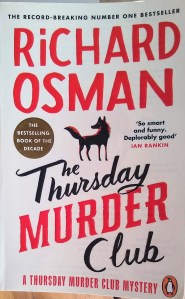 It just so happens that I picked up the book to read here in Lanzarote. It’s written by Richard Osman who is more famous as the frontman on the BBC’s Pointless quiz show as well as various other TV shows. The book and film are about a group of people in a retirement village who meet to discuss cold case crimes but then find a murder committed on their very doorstop. The group of mostly eighty year olds then get on with the task of solving the murder. There seem to be a lot of things going on and a great deal of characters to remember which put me off a little at first but a great device used by the writer is having alternate chapters written as diary entries by Joyce, one of the club members. She goes over the past events, adding in details of her own life along the way, talking about her neighbours and daughter amongst other things and sometimes previewing the next chapter for us.
It’s a very original and witty book and even though I’m only half way through I’m already thinking about getting the follow up book. One minor complaint though, there is a large cast of characters and things do get complicated making it not always easy to follow.
You might have seen some horror stories on the internet and social media about Lanzarote lately. I’ve seen so many posts about the dreadful weather and the rain. OK, there has been rain, quite a lot of it which is pretty unusual for Lanzarote. The thing is, when it rains back home in Manchester, it tends to rain and rain and get pretty cold at the same miserable time. Here in Lanzarote, it rains for about five minutes and then the sun comes out and dries everything. It might get cloudy again and we might have another five minute shower but it soon slips away and despite what you may have heard, Liz and I have spent each day out on the patio swimming and sunbathing and occasionally moving our towels away from the edge of the patio canopy when the rain showers have encroached a little too close.
Now, time for another read or should I do a few more laps in the pool? Decisions, decisions . . .

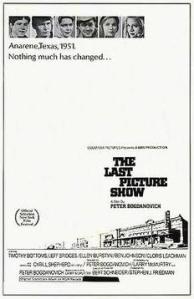 Another modern classic. This film was directed by Peter Bogdanovich and is set in a small town in northern Texas in the early 1950s. The film has an ensemble cast but the two main characters are Sonny and Duane played by Timothy Bottoms and Jeff Bridges. The two are teenagers and old friends and various things happen to them. They fall out over a girl called Jacy played by Cybill Shepherd. Ben Johnson plays ‘Sam the Lion’ who owns the bar and cinema in the town. Sam has a mentally disabled son who Sonny has befriended. Various things happen to the pair but towards the end of the film Duane enlists in the army and is due to leave town so the pair decide to visit the town cinema for the very last picture show as the cinema is about to close after Sam’s sudden death.
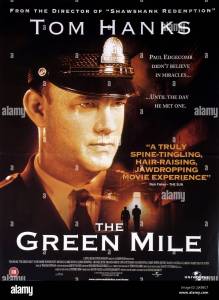 Like The Shining, this is another film based on a book by Stephen King. Tom Hanks plays the head of a death row section of an American penitentiary. One of the inmates is John Coffey, a huge black man who appears to have healing powers. He cures Tom Hanks’ bladder infection but the mood in death row is not good after sadistic Percy Wetmore joins the team and deliberately sabotages the execution of another inmate causing the prisoner to die in terrible agony. The warden’s wife is terminally ill and Hanks and his team wonder if John Coffey could cure her.
 700 is quite a milestone, certainly for me anyway. I started writing my blog posts back in 2014 and I’m quite pleased to have got to this point. 700 hundred blog posts. Anyway, after all that and a quick recount later I see that this is actually blog 701. Last week was my 700th post and I didn’t realise. It’s a bit like missing my birthday or waking up on the 2nd of January and realising you’ve missed New Year’s Day.
 have written about all kinds of things although I mainly stick to books, classic films, Formula One and me and my little life. Some of those posts I have worked quite hard on and I’ve written and rewritten them and researched and sometimes rewritten again. At other times I have found myself on a Friday staring at my laptop wondering what on earth can I write about and then, right at the last moment, I have either thought of something or remembered a post that was made up of various short elements and decided to take one of those elements and develop it into a new post.
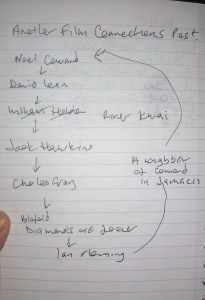 I always jot down notes for blogs, especially those where I try to connect various classic films together so for instance I’ll start with a director or an actor, let’s say Noël Coward for example and then try to go through various films and link together different actors or personalities and eventually end up back with another Noël Coward production. The links on the right are a bit thin but Coward worked with director David Lean, Lean worked with Jack Hawkins on The Bridge on the River Kwai. When Hawkins contracted throat cancer later in life and was unable to speak, his voice was dubbed by Charles Gray. Gray played Blofeld in the Bond film Diamonds are Forever. Diamonds was written by Ian Fleming who was a friend and neighbour of Coward in Jamaica.
  By the time you are reading this, Christmas and New Year will all be over. We’ll be fed up of turkey and sprouts and thinking about taking down the Christmas decorations. So before Christmas becomes a distant memory here’s a quick look at 6 Christmas films that were all shown, with perhaps just one exception, over the last few weeks.
 In March I was getting a little stuck for ideas and I had to recycle an old post,
  I’ve written many posts about books and a regular series is one in which I compare books to their filmed counterparts. In August I added a post about one of my favourite book/film series,
 One day in December 1980 I was working as a bus driver and I was driving one of our old half cab buses into Manchester. My conductor, Bob, was kept pretty busy as we took a bus load of passengers into Manchester city centre for their jobs in shops, offices and other places. At one point Bob poked his head through the little window into the cab and told me that he had heard from a passenger that John Lennon had been shot in New York. It was shocking news and when we arrived in Piccadilly, we both ran to the news stand to read the news in the morning papers. There was nothing about Lennon in any newspaper and we wondered if it had been just a mad rumour. Later when we went back to the canteen for our break, we heard the news either on the TV or the radio. Lennon had indeed been shot and was dead.

 I do find it really strange that the F1 season should still be going on in December. Still, the F1 season these days is a long one. It starts off in March and winds its way around the world until it ends up in Abu Dhabi at what is essentially a twisty turny mickey mouse sort of track in the middle east.


 It’s cold, in fact it’s bloody cold and it’s no secret that I hate the cold. I could write about the cold I suppose but then
  In the latter part of the book Mia talks mostly about Woody Allen with whom she started a relationship with in 1980. I’m a huge fan of Woody and his films. The two met in 1979 and were introduced to each other by Michael Caine. Woody invited her to his New Year’s Eve Party and later, in April of 1980, Mia received a call from his secretary asking if Mia would like to meet Woody for lunch.
 This week I’ve noticed quite a few items about Richard Burton on the BBC iPlayer. I wasn’t sure why at first but it turns out that this year, 2025, is the centenary of Burton’s birth. He was born Richard Jenkins on November 10th 1925.
 Some years ago I read Melvyn Bragg’s biography of Richard Burton and that book was based partly on these diaries which have now been published and are available to everyone.