(Slightly Less Than)10 Great Albums

I can’t say I had any great interest in pop music until my brother and I received a record player for Christmas 1972. I always rather liked Olivia Newton-John but to be fair, my interest in her was based more on her looks rather than her singing. The very first singles I ever bought were two 45s by Olivia. Both had dropped out of the charts and my local music shop were selling them for half price so I picked up The Banks of the Ohio and What is Love for a grand total of 48 pence.

That was the start of my music collection although back then I always went for singles rather than albums which of course makes this post so much harder. Anyway, I did buy a few albums. I bought quite a few by Olivia although I can’t really say they are ones that I have loved ever since. One of the first albums I did buy was Goodbye Yellow Brick Road and that is one album I still play today.

Goodbye Yellow Brick Road by Elton John.

Goodbye Yellow Brick Road was released on October 5th, 1973, two days after my 17th birthday. I’m not certain when I bought it although I reckon it was probably the following year. Numerous singles were released from the album, notably the title track and Candle in The Wind, a song about Marilyn Monroe. Another hit was Saturday Night’s Alright for Fighting. Interestingly a big hit in the USA was Bennie and the Jets which was seen as a soul track in the USA and Elton was even invited onto the US show Soul Train to perform the song. In the UK the song was on the flip side of Goodbye Yellow Brick Road.

I saw a TV show about the making of this album on the Sky Arts channel a while ago and Elton’s guitarist Davey Johnstone told some interesting stories. Elton and his band had wanted to record in Jamaica but the facilities at the studio were basic and rudimentary so they flew to the Château d’Hérouville near Pontoise in France, where they had recorded previously for Elton’s album Honky Château . One rather surprising thing was that when Elton and his band arrived at the studio they had no songs written. Elton composed all the songs from the album while at the studio. In some cases he wrote the music, ran through it with his band and then they went into the studio and recorded. As usual Bernie Taupin wrote all the lyrics. Dee Johnstone was on bass guitar and Nigel Olsson was the drummer.

Singer Kiki Dee helped with backing vocals as did the other band members. Davey mentioned that Elton was notoriously difficult to be with when he didn’t have much to do so when everything had been recorded he left and the rest of the band got on with recording the backing vocals without Elton ‘getting on their nerves’. Presumably then Gus Dudgeon, the producer made the final mix.

I still have my original vinyl album as well as a double CD version. I lost interest in Elton in later years and I never liked his work throughout the 1980s but Goodbye Yellow Brick Road remains one of my favourite albums and something that I play frequently on long car journeys.

Favourite track: Difficult but I’d go for The Ballad of Danny Bailey.

Band on The Run by Paul McCartney and Wings.

I can’t say I’ve ever been a really big Beatles fan. Don’t get me wrong, I do like the Beatles. A few years ago I decided I was going to buy all the Beatles albums on CD but the more I bought, the less I liked them. The Beatles classic hits are wonderful of course but I found that there is a lot of other stuff on the Beatles’ albums that I just didn’t like so I just stopped buying them. In 1974 I went to see Paul McCartney and Wings at the Free Trade Hall in Manchester. Their tour had been in part to promote their album Band on the Run which had been released a few months before in November of 1973. A number of tracks had been hit singles but I’ve always particularly liked the title track Band on the Run.

Just like Elton John, McCartney wanted to record an album in an exotic location and found that his record company, EMI, had a studio in Lagos, Nigeria. Prior to leaving, McCartney and guitarist Jimmy McCullough had an argument and McCullough quit the band. Danny Seiwell the drummer also left the group on the day before the band flew to Lagos. This meant that McCartney himself would play the drums and lead guitar with his wife Linda on keyboards and Denny Laine on rhythm guitar.

The studio in Lagos was disappointing. It was a ramshackle establishment and there was only one tape machine and the control desk was faulty. Even so, the band stayed in Lagos and began to record. Lagos had just experienced a civil war and corruption and crime was commonplace. One night Paul and Linda went for a walk and were mugged at knifepoint and as well as losing valuables they also had a bag of demo tapes and lyrics stolen. On another occasion McCartney keeled over gasping for air. Everyone thought he was having a heart attack but the eventual diagnosis was a ‘bronchial spasm’.

After six weeks of recording, the band returned to the UK where the 8 track recordings were converted to 16 track and various overdubs added as well as orchestral arrangements.

Perhaps inspired by the cover for Sergeant Pepper, McCartney decided to create another noteable cover. This time Linda, Denny and Paul posed as prison escapees with various celebrities such as Michael Parkinson, boxer John Conteh and film actor Christopher Lee. Also included were TV personalities Kenny Lynch and Clement Freud.

According to Wikipedia, the album did reasonably well in the music charts then began to drop down a little. Later, buoyed by the success of two tracks released as singles, Jet and Band on the Run, the album began to rise up in the charts, hitting the top spot in the USA in June and in the UK in July.

The album sold 6 million copies and became EMI’s best selling album of the 1970’s.

Favourite track: Band on the Run.

Rumours by Fleetwood Mac.

Rumours was released in February 1977 after recording the previous year. The album was recorded with a background of relationship breakups and heavy drug use by the band members. I first came to be interested in Rumours as I loved the four singles from the album, two of which I bought as vinyl 45s. I’ve never been much of an album man but when more tracks were released as singles I thought it made more sense to buy the album rather than more singles.

The album was recorded first at the Record Plant in Sausalito which consisted of heavily soundproofed small wooden rooms and the band were not completely happy but Mick Fleetwood insisted they stay. John and Christine McVie had recently split up and would not talk to each other except for musical matters. Apparently it was only later than the group realised that many of the lyrics revolved around relationship issues.

After spending two months in Sausalito, the band decided to test some of the new songs by performing them in concert. Later, they returned to the studio, a different studio, to complete the recording sessions.

Favourite track: Go Your Own Way.

Jeff Wayne’s War of the Worlds.

Back in the late seventies when I used to work for a bus company, one of my colleagues was a guy whose name I can never remember. His nickname however was Clouseau as he was the image of Peter Sellers’ famous creation, Inspector Clouseau. Clouseau, my Clouseau, was a former disc jockey who talked non stop music. He ran a mobile disco and still dreamt of being a radio DJ. He was always giving me albums to take home and listen to and was always eager to get my opinion. Some of the music he gave was good and a lot of it just wasn’t to my taste but one album he insisted I take home and play was War of the Worlds and I loved it pretty much on first hearing it.

Jeff Wayne was a producer and musical director working with singer David Essex and he was looking for a new project, a story that he could give a musical interpretation to. His father suggested War of the Worlds and the idea caught Jeff’s interest. He acquired the musical rights to the story and even booked a recording date in advance to give himself a deadline to work to for creating the music. David Essex appears as an artilleryman as well as singing and Justin Hayward and Phil Lynott also sing. Jeff convinced Richard Burton to record the narration and the project was ready for the recording.

A prototype 48 recording system was used which apparently malfunctioned numerous times but the resulting double album was released in June of 1978. According to Wikipedia it was the UK’s 32nd best selling album of all time.

I still have my vinyl version plus the CD version. There have also been remixes, new versions and even a live concert.

Favourite Track: Forever Autumn sung by Justin Hayward.

I did mention earlier I’m more of a singles man rather than an album lover which is why I’ve only covered 4 albums rather than 6. I could add in various Greatest Hits albums from my collection to make up the 10 albums I mentioned in the title but I think I’ll save them for another post.

What are your favourite albums?


What to do next: Here are a few options.

Share this post on your favourite social media!

Hit the Subscribe button. Never miss another post!

Listen to my podcast Click here.

Buy the book! Click here to purchase my new poetry collection.

Click here to visit Amazon and download Floating in Space to your Kindle or order the paperback version.

Click here to visit amazon and purchase Timeline, my new anthology.

Drive Time

I thought I’d write about cars this week. Then I added a story about my old motorbike and then one about my Mercedes van so my original title of Car Stories went out of the window. A quick change of title to Drive Time and so, let’s get started.

It took me three attempts to pass my driving test. Still, it was difficult for me. We had no family car. I doubt if we could have afforded one even if my father had been able to drive. That meant that when I had my driving lesson of just an hour a week, by the time the next week came around I was almost back to square one again. I failed my test twice and then bought a motor bike. It was a Honda 125cc trail bike. I loved it but the day it was delivered my brother and I went to see Paul McCartney and Wings at the Free Trade Hall in Manchester and the two young lads who came to deliver it were unable to give me the starter lesson they had promised.
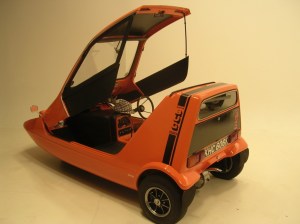
That meant many weeks bumbling about on my own in an effort to learn how to ride a motorcycle. I knew the basics, in theory, and I used to ride out of the estate, turn left and keep going left until I ended up back at home. Now I think about it, I had a number of scary escapades learning to ride that bike. Anyway, when I passed my motorcycle test that enabled me to drive a three wheeler car so I sold the bike and bought a three wheeler. I was able to build on the lessons from my instructor by practising in my little car until I finally passed my test.

I’m probably pushed to tell you the registration number of my current car but PDB 71M, the VRM (Vehicle Registration Mark) of my Bond Bug, my very first car, is still firmly anchored in my old memory bank. The Bond Bug was a sporty little three wheeler car and as I mentioned above, I could drive the Bug on my motorbike licence.

It was actually a pretty eye catching car for a three wheeler. It had no doors but the roof lifted up to gain access and the side windows were plastic held on by Velcro. I always remember bringing it home and showing it off to my family with a certain amount of pride and my Dad looking at it and saying “How are we all going to get into that?” Perhaps he thought I was going to take us all away for a holiday!

Still, we had some nice times, me and the Bond Bug but then one cold and snowy Christmas I decided to chance going out to a Christmas party in the car even though it was losing coolant. I topped it up with water and went off for a night of Christmas cheer. I walked home sensibly, I might add, but when I returned the next day I found that the car had frozen overnight and it ended up having to have an engine rebuild. That was a pretty expensive night out! Later when I passed my driving test I got myself a proper car.

I’m pretty happy with my current car generally. It’s a Skoda Scout with 147 thousand miles on the clock. But even so, it has never let me down.

My previous car was a Renault Megane convertible and I used to like being just a bit of a poser, driving round when it was sunny with the roof down and looking generally pretty cool what with my leather seats and my shades but you do get those days when things go wrong. I remember once setting off for work, top down and shades on and then just as I joined the M6 motorway the sun disappeared behind a mass of rain clouds and soon it was pouring down. Luckily I managed to get to the services and pop the roof back on.

I always wanted to take the Renault over to France and tour the Loire with the top down. Sadly the roof folded into the boot which meant that there was no where to store the gallons of French wine we tend to bring back to the UK. Pity!

Back in the 1990’s I used to have a Mercedes. Actually it was a Mercedes Sprinter Van and it wasn’t mine although it was for my use pretty much exclusively. I worked for a cigarette company and the van was a company vehicle which I used on my round, filling cigarette machines in Liverpool and collecting their cash takings.

Liverpool could be a dangerous area to be driving about with a van full of cigarettes and cash so I tended to start work early. The cleaning staff in plenty of the pubs in my area of Liverpool started work early so I used to visit them first. In some of them I went in, filled the machine, extracted the takings and gave it a quick clean before heading for my next pub. My busiest day was in Huyton. In one of the pubs the cleaners usually stopped for tea and crumpets about 11 and when I got to know them the head cleaner, a lady called Marge, asked me to give her a call when I was on my way so I’d arrive just at the right time. I used to spend ages in that pub, chatting, drinking tea and munching on toast or crumpets.

It always used to be that the top prize on a TV gameshow, especially in the heyday of the game show in the 80s, was a car; a brand new top of the range family car. The motor car is probably one of the great status symbols of our time and also one of those things that give us unprecedented freedom, certainly compared to our ancestors. Turn the clock back to the 1950s. If people wanted to get out and about and enjoy the great outdoors on a bank holiday, the only way to travel was by bus or train. Yes, public transport was crammed with people in those days, all on their way to enjoy the great British seaside destinations.

Today, we are free of all those past restrictions, no waiting for trains or buses. It’s just a simple matter to pop outside, start up the motor and you’re off. The only restriction is probably traffic congestion. How many of us spend our bank holidays stuck in some traffic jam that clogs up the roads to the holiday hotspots?

Traffic can be a nightmare in the UK but then when you consider the densely populated nature of the UK it’s hardly surprising. That’s why I just love driving on the roads of France. OK, Paris may be just like driving in the UK, if not worse but out in the country in departments like the Loire, Brittany and Burgundy the auto route and the A roads are just a joy to drive on. Forget also the drab overpriced service areas in the UK. In France it’s so nice to drive into an ‘aire’ as they call them, a lovely picnic area with toilets and picnic tables. How often have Liz and I stopped at one of these delightful places and opened our sandwiches and bottles of water to find a French couple stop at the next picnic table, cover it with a table cloth and open a hamper the size of a house complete with wine, salad, cold meats and God only knows what else.

Our motorhome parked by one of my favourite lakes in France.

It’s relatively easy in the UK to drive over to France on the ‘shuttle’. A quick trip to Folkestone, drive onto the train, handbrake on and off we chug down and under the channel.  Thirty minutes later and we are driving off in Calais. Sometimes I think about my old Bond Bug and wonder if I could have made that journey in that car. Perhaps but I don’t think it would have been quite as comfortable.

Here’s one final Drive Time story. I’d had my Skoda for quite a few years and as usual it was packed with CDs. I had them in the glove box, in the doors and I had various boxes of CDs in the passenger footwell and the boot which I’d rotate every so often. One day I noticed a small slot in the front of the stereo. Was that a slot for a memory card? Yes it was! Now it just so happens that all the music I have copied and digitised I have already placed on a micro SD card for my MP3 player. I copied all that to a standard size SD card, popped it into my stereo and now I can listen to my entire music collection without changing CDs, without rotating boxes of CDs, without having the car jam packed with CDs. I was feeling pretty pleased with myself. OK, I’d have to copy all the newer CDs in my collection that I hadn’t already transferred to the SD card but even so, I still have a huge collection of music on that card, all of which I like and all advertisement free.

The only thing is, what shall I do with all those CDs now?


What to do next: Here are a few options.

Share this post on your favourite social media!

Hit the Subscribe button. Never miss another post!

Listen to my podcast Click here.

Buy the book! Click here to purchase my new poetry collection.

Click here to visit Amazon and download Floating in Space to your Kindle or order the paperback version.

Click here to visit amazon and purchase Timeline, my new anthology.


Transformations (3)

This the third instalment of a post on the theme of transformations. The very first one (which you can read by clicking here) started off with the transformation of the common market flower seller Eliza Doolittle into a refined lady.  I hope that explains the basic idea so let’s get cracking with a few more interesting transformations.
One that came to me while lying in bed one morning was a story told to me by my mother. Walking down our old street many years ago she pointed out a tall, thin man who we used to let on to whenever we passed. He was, I assumed, very old as he had a great mop of white hair. Mum had lived on that street most of her life. She had come to Nuffield Road with her mother and father as a child and when mum grew up and married they gifted the house to her. She told me that the tall lanky man wasn’t old at all. He had gone away to war in the 1940’s and had been captured by the Japanese. He had endured a terrible time as a prisoner of war and when he returned he was a shattered man and his hair had turned snow white.

Shirley Valentine

Shirley Valentine started life as a play by Liverpool writer Willy Russell. Later the story was turned into a film with Pauline Collins starring as the eponymous heroine. Shirley Valentine was a lonely Liverpool housewife who spent a lot of her time talking to her kitchen wall. Her children had left home, she had lost touch with many of her friends and she felt alone, sitting at home all by herself when her husband was out at work.

Her husband Joe, played by Bernard Hill, demands a steak dinner every Thursday. He sets so much by this that Shirley calls it the 11th commandment; thou shalt have steak on a Thursday. The thing is, Shirley gives the steak to the neighbour’s dog and makes chips and egg for tea. I personally rather like chips and egg. If I am ever on my own on a Saturday, the first thing I think about making is chips and egg. I always think of it as the perfect Saturday evening meal. Shirley’s husband however does not like chips and egg on a Thursday; he likes steak and this is the catalyst for a big row and for Shirley going on holiday with her friend Jane and leaving Joe to fend for himself.

While on holiday Jane deserts Shirley for an affair with a man she meets on the flight over. Shirley however, begins to gain confidence in herself and far from being lonely, she begins to come out of her shell. She meets Costas, a Greek bar owner with whom she has a brief dalliance.

Shirley is at the airport ready to leave when she decides not to go. Returning to the bar she asks Costas for a job. Meanwhile Jane tells Joe that Shirley has been having an affair but she denies this saying the only affair she is having is one with herself.

The film finishes as Joe arrives in Greece to speak with her but she has changed so much he fails to recognise her at first. Shirley has finally found herself.

Educating Rita

This was a breakthrough film for Julie Walters and I remember Michael Caine who also stars in the film saying that this film would do for Julie what Alfie did for him. Maybe it did, maybe it didn’t. The film is about a Liverpool hairdresser played by Julie who wants to better herself. She decides to take an Open University course in English Literature. Her tutor played by Caine is initially confused as he has the name of Susan White on his documents and Susan explains that she has now changed her name to Rita after reading Rubyfruit Jungle by Rita Mae Brown. Frank Bryant (Caine) is not keen on taking Rita on as a student but she convinces him otherwise. Rita finds Frank has ignited her passion for literature but has to contend with her husband who wants her to be a traditional wife and produce babies. Husband and wife finally split leaving Rita to pursue her studies. She moves in with a fellow student and gradually, as she mixes with more students and studies more, she becomes less and less like her former self. Frank becomes more and more fond of her, possibly even in love with her but his position as a university lecturer is compromised by his heavy drinking.

Just like Shirley Valentine, this story began life as a play by Willy Russell and the film shared the same director, Lewis Gilbert, who also directed Alfie, mentioned above. In a lot of ways this is such a good film. Julie Walters is outstanding as Rita and Michael Caine is excellent too. The big problem for me is that while Julie plays Rita as a typical scouser with a superb Liverpool accent, the setting clearly isn’t Liverpool. Not only that but the other accents in the film all grate with Julie’s as they are a mix of various northern accents. Caine of course as the lecturer, doesn’t have to have to be a Liverpudlian but the hotchpotch of brogues, some from Manchester, some from Liverpool just seemed to jar to my ear. The film was apparently filmed in Ireland so why not make Rita and her family Irish? That would have made more sense although filming in Liverpool with a local cast would have been the better option. Perhaps production finances made that impossible.

The Incredible Hulk

Back in the days when I used to read comic books, I used to read plenty of Marvel comic strips and one was the Incredible Hulk. The origin of the Hulk (every superhero has an origin story!) is a story about a scientist called Bruce Banner who is exposed to gamma radiation during an experiment. Gamma radiation featured in quite a lot of the Marvel comics as I remember but, on this occasion, the result of exposure to gamma rays means that when Bruce gets angry, he mutates into a green skinned, muscular giant with incredible strength and while he cannot fly like other super heroes he manages to get about in some incredible jumps or leaps.

Back in the 1970’s there was a TV version starring Bill Bixby as Bruce Banner although for some reason, perhaps because he was travelling incognito, he used the name David. I can’t remember the opening episode but Bruce travels about the USA and gets involved in various incidents. He tells a lot of people to not make him angry as they won’t like him when he is angry but as you can imagine, various people just go ahead and make him angry anyway which turns him into the green skinned monster. Rather than beef Bill Bixby up with green makeup and fake muscles, the production team brought in the already muscular Lou Ferrigno. He appeared as the Hulk and when he calmed down after a good bout of rampaging and smashing stuff up, he morphed back into Bill Bixby again.

The first film version starred Eric Bana as Bruce Banner and was released in 2003. The Hulk himself was a creation of CGI, computer generated images, although director Ang Lee provided the motion capture movements and the voice of the Hulk. This being the early days of CGI the result appeared to be rather cartoon like, at least to me.

The follow up film was The Incredible Hulk starring Edward Norton as Bruce Banner who is on the run from the military and living in Brazil but still trying to continue his experiments. He does so partly by collaborating with an anonymous individual online known only as ‘Mr Blue’.

The military trace Banner to Brazil and try to capture him but fail. It’s a pretty thoughtful and interesting film until the CGI takes over and a character called Emil Blonsky is injected with a substance aimed to produce a ‘super-soldier’ causing him to become a similar mutant like the Hulk. The two engage in a CGI battle which the Hulk wins.

Later Bruce Banner begins to be able to control his mutations into the Hulk and meets with Tony Stark, alias another Marvel super-hero, Iron Man, which preps the viewer for the next super hero film.

All in all it’s not a bad film and much superior to the first one but please, less CGI in future please.

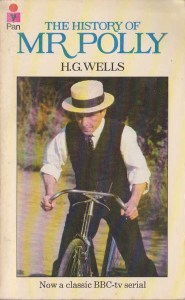
The History of Mr Polly

This is not a science fiction story despite being penned by H G Wells. Our hero, Mr Polly, finds himself in a very dull job with a very dull wife and resolves to commit suicide. Anyway, events unfold and instead of committing suicide, Polly accidentally starts a fire which threatens the whole street and he then mounts a brave rescue of an old lady. Instead of dying, Mr Polly becomes a hero and when the insurance money comes in, he leaves his wife nicely settled with the insurance money, takes a little for himself and departs for pastures new. He sends some money to a post office in another village and gradually meanders in that direction, sleeping in fields and hedges, getting himself a tan. He works occasionally when he wants and sleeps when the mood takes him at other times.
He comes across the Potwell Inn and asks for work and right away finds himself at home. He potters about happily at the Inn, cleaning, serving and doing various odd jobs. One day the landlady’s nephew, ‘Uncle Jim’ appears. He is a violent bully having been in and out of prison for years. He doesn’t like Mr Polly getting in the way so he decides to scare him off. What should Polly do, stay and help or just leave? He decides to stay and after various battles scares off Jim.

Some time later he returns to see if Miriam, his former wife is alright. He finds that Jim has drowned wearing clothes stolen from Polly so now Mr Polly is presumed to be dead. Polly leaves, content with the transformation of his life.

I first read this book many years ago and I’ve always liked its simple philosophy. If you don’t like your situation, change it.

A film version was made in 1949 starring John Mills as Mr Polly and Megs Jenkins as the landlady of the Inn where Polly finds happiness.

I might as well finish with a transformation close to home. Yes, I’m talking about me. Once I was a ‘six shifts on, three shifts off’ motorway Traffic Officer, setting signals in our control room for the travelling public and now I’m retired, a man of leisure whose only worry is ‘what can I write about next week’.

I’ve also used artificial intelligence to transform me further, well, my digital image anyway. That’s me just above, or at least a version of me that’s similar to the original.

What transformations have you experienced?


What to do next: Here are a few options.

Share this post on your favourite social media!

Hit the Subscribe button. Never miss another post!

Listen to my podcast Click here.

Buy the book! Click here to purchase my new poetry collection.

Click here to visit Amazon and download Floating in Space to your Kindle or order the paperback version.

Click here to visit amazon and purchase Timeline, my new anthology.


4 Funerals and a Pork Pie

One of my favourite memes and one I often post on Twitter (or X or whatever the hell it is called these days) is a quote attributed to John Lennon, and what it says is this; Time you enjoyed wasting was not wasted. I kind of like that quote and it’s one that I often think about when I’m pottering about either reading, watching TV or surfing the internet.

Having the odd day just pottering about is good for the soul and for me, an opportunity to indulge in numerous cups of tea and sandwiches. I really do like my sandwiches.

Last week Liz and I went to a funeral and I suppose I’m at the age now (let’s just say mid-sixties) when I tend to see more funerals than weddings.

I can’t say I knew John, the deceased, particularly well and I was surprised to find that he was a foundling, abandoned as a baby and never knowing his birth family.

The service was good and in fact the vicar struck what I thought was the perfect note, not too sad and not too light hearted. John’s son by a first marriage was brought up in Canada and he seemed a very pleasant fellow recounting stories of the fishing adventures he and his father had in Canada.

The first ever funeral I went to was my Uncle Raymond’s. Raymond was my favourite uncle and the most wonderful guy. When I first started work when I was sixteen, going on seventeen, I used to get off my bus, the 152, at the Bluebell pub in Handforth after coming home from work in Manchester and Uncle Ray was there, waiting for the pub to open. Inside he chatted to everyone, the staff, punters he had never met before and at the drop of a hat would produce the photographs from his recent cruise showing him and my Auntie Elsie sat at the captain’s table. He would come back home with us, have dinner and then take my dad out to finish the evening off.

When he died his funeral cortège took a detour past the British Legion, one of his numerous watering holes, and the staff and customers came outside to pay tribute as his coffin passed slowly by.

The funeral was sad and tearful and the wake was pretty similar. A lot of sad people, a lot of tears and my dad, who had probably lost his best friend, was devastated. I was driving that day and was asked to run some long forgotten relative home. I did so and returned a short while later. Only twenty minutes or so had passed but when I returned, I returned to a happy, noisy, enjoyable party, full of laughter and fun. I don’t know what had happened in the twenty minutes I had been gone but I came back to exactly the sort of party that my Uncle Ray would have loved.

When my Gran died the funeral service was held in Marple, I’m not sure why as it was nowhere near where my Gran lived or was buried. The journey from there to Southern Cemetery in Manchester was for me, a masterpiece of motor car management, juggling with high water temperature and having to dive into a garage to top up my car with water.

At the graveside I noticed my dad making signs to the two grave diggers and after the coffin had slipped into the ground and the final words of the vicar had faded, my dad, a former grave-digger in years gone by, had a happy and joyful reunion with two of his old co-workers, much to the dismay of my mother who stood with me and cried her heart out. (Not your finest moment, dad.) At least he thought better of introducing her to his friends which I thought he was going to do at one point.

Funerals are odd things; in a way they are not for the dead but for the living, those left behind after a loved one has died and I have to say, not only did I enjoy my mother’s funeral, although enjoy is not perhaps the right word, but it helped me more than anything to say goodbye to her.

Back to this more recent funeral and as the drinks began to flow the sadness of the occasion seemed to ebb away. The only really disappointing issue was that the funeral was scheduled for 9:30am which for someone, who since retiring no longer has to get up early, was a bit of a challenge.

The buffet was served at 12 on the dot and despite there being quite a considerable gathering there was no concerted rush for the food in fact I was the one of the first to get up. I really do love funeral food. A buffet is comprised of pretty much everything I love, pork pies, sausage rolls and of course sandwiches. There were my two favourites, cheese and ham and there were also some rather nice cheese and tomato pizza slices. The tuna sandwiches were not my cup of tea at all so I avoided them like the plague. Still there were plenty of other delights for me including a lemon drizzle cake for afters.

A pork pie selection: Terry Kearney, CC0, via Wikimedia Commons

A few years ago, I went with Liz to another funeral in Lytham. I felt distinctly out of place, an intruder even, as I did not know either the deceased or his family. There was however, a rather nice buffet which, under the circumstances, I felt it was important to do justice to. The world is full of wonderful food and some outstanding cuisines but I do think that there is nothing nicer than a pork pie. Some moist pork, some jelly, all encased in pastry, what could be nicer?

On that particular occasion the widow had seriously underestimated the demand for food and I did feel a little mean when I grabbed the last pork pie moments before a teary-eyed lady in black appeared and eyed the empty plate somewhat wistfully.

When I was introduced to her later, I could see from her expression she was trying to place me. As I smiled and offered condolences I saw the moment of realisation, and I almost heard her say in her mind ‘I recognise him- he’s the bugger who took the last pork pie!’

Some elements of this post came from a previous one so apologies to regular readers if it sounds familiar.


What to do next: Here are a few options.

Share this post on your favourite social media!

Hit the Subscribe button. Never miss another post!

Listen to my podcast Click here.

Buy the book! Click here to purchase my new poetry collection.

Click here to visit Amazon and download Floating in Space to your Kindle or order the paperback version.

Click here to visit amazon and purchase Timeline, my new anthology.


Graphic Design and More Manipulating the Image

I’m pretty keen on social media, not for social media itself (although it is nice to see what my friends are up to) but as a platform to plug my work, my blog posts and my books and videos. In this post I’m going to look at the impact of graphics and images and the sites I use to create them. All the links open up in a new page.

OK, let’s get started. The first thing to remember about blogs is that a big wall of text tends to put off readers so it’s a good idea to break up the text with a few pictures. What kind of pictures though? Well in the blog posts themselves I’ll use either my own photos or use an online stock photo site like Unsplash.  I’ll also try and render the blog title into a graphic which I’ll also use on Facebook and X (formerly known as Twitter) to promote the post. The easiest way to do that is to use a site like Quotescover where I can just type in the post title and either my name or the name of my website.

The graphic to the right was made on Quotescover.

A site I used to use was Picmonkey which a few years ago was completely free. These days it’s only available to paid users except for the app version which you can use on your phone or, like me, on my iPad. A lot of the features are unavailable to free users though and I use Picmonkey primarily to add text to a photo relevant to my post.

I’ve always liked this picture which I used on a post about my favourite music, The Soundtrack to My Life.

Another site for making graphics or pins for Pinterest is this one, Quozio. Again it’s simple and free to use, just type in a title and your name and choose a template. If you are making a quotation graphic for social media, just add the quotation and whoever said it instead. This one was a simple graphic with a clock.

When Picmonkey declined to let me make free images I had to look elsewhere to make my graphics. One site I began to use was Canva.com. I initially thought Canva was a little complicated but once I got used to it I began to make some good graphics.

Canva has a number of templates which can be personalised and a regular one I use is one for a YouTube thumbnail. What is that you might ask? Well it’s the image you see when you scroll through YouTube looking for an interesting video. A bad thumbnail can turn a viewer off watching the video and good one can pull in a new watcher.

Here are a couple of my YouTube thumbnails. My poetry videos all have a similar thumbnail, just for continuity. Click the image below to watch the video on YouTube.

This one is pretty self explanatory and takes you to my welcome video on YouTube.

Another site I’ve started to use is Adobe Express. It’s similar to Canva and again has various templates that the user can adapt and modify. A graphic I made on Adobe was from a template which I personalised. The picture of me came from Nightcafe, an AI imaging site. How does that work? Well, it creates images from a prompt, so you just describe the image you want to see in words and artificial intelligence does the rest.

How did I get a picture of myself? This is a little trickier. First the user has to upload pictures of the person you want to make an AI model of, in this case me, then you add a prompt to describe the picture you want. On Nightcafe and many other AI sites too, you can upload a picture and develop it. On Freepik you can hit the reimagine button and a different version of your picture will appear.

Sometimes I will make a picture or graphic and send it to another site to see if I can come up with a different or better version.

To make a graphic that I use on X, I added the picture of me to a graphic I had used before and removed the background. Using the animation feature I got the picture to jump into the frame and then jump out again after the text had slid in.

On my laptap I took the animation and added some sound using sound effects downloaded from Zapsplat, a site that provides music and effects for video. Here’s the resulting video.

A lot of the images I’ve created on AI are ones used to plug my blog post over on sites like Facebook and X, graphics that all say something like, ‘New Blog Post Out Now!’

This is one for a post about the Apollo 11 moon landing.

This is for a post about the western genre.

I use three main AI sites, Nightcafe, Freepik and Microsoft Designer. All three sites operate a sort of credit system whereby the user gets so many tokens to create images but after you have used your tokens, that’s it, unless you want to subscribe and pay for more. On Nightcafe, the user gets 5 tokens per day with extra tokens for various things; voting on other users creations, voting on competitions and so on. On Freepik, I’m not quite sure how things work. I’ll sign in and see I have 20 free credits, that’s one credit per picture. Even if I’ve used up my credits I can turn to the ‘reimagine’ page and produce alternative images where I usually have about 5 credits. The next time I visit, sometimes I’ll have another 20 credits, sometimes not, even so, I’ve produced some good images there.

On Microsoft Designer, you can create an image and then use it in a blog graphic or social media post where you can add text and all sorts of stuff.

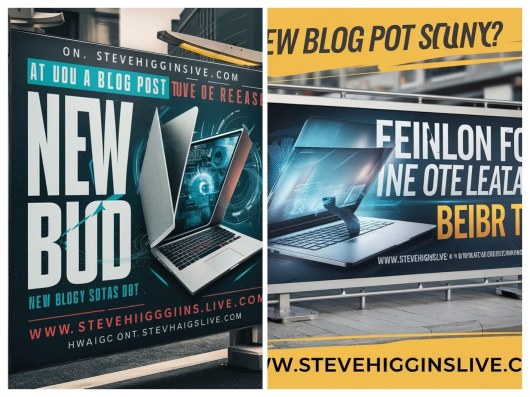
To create an image you need a prompt. Here’s one I used for an image of a street poster:

A vibrant and eye-catching roadside advertising banner, announcing the release of a “new blog post “ on “www.stevehigginslive.com” The banner features a bold, modern font, with a creative design of a laptop opening up to reveal a digital world. The background is a busy city street, reflecting the urban environment where the blog post was written.

See if you can recognise the result of that prompt further down but one thing to remember is that AI images don’t always turn out the way you want them, especially when using text within the image. Here are a couple that look good but the text didn’t quite work out right.Both of the images above were supposed to say ‘New blog post out now!’ Oh well.

On Nightcafe there is now the option to make an image into a short 4 second video. Here’s one of my favourite promo pictures rendered into a gif, an animated image. The web address was added later on Picmonkey. The image prompt went like this:

Floating in a raging sea during a storm with rain hammering down, we see a bottle on its side with a message inside. The message is visible and says “New blog post out now!” Professional photography, shot on dslr 64 megapixels sharp focus 8k resolution

To finish off, here are a few of my latest graphics, all of which are out there on X in yet another attempt to liven up my posts and to bring in more readers.

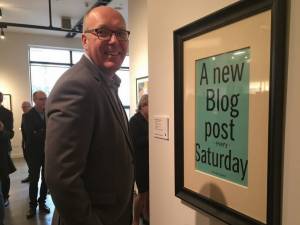
OK, what AI image can I create now for my next social media post? What about an art gallery, perhaps seen from above? Light streams in dramatically from windows off to the side. It’s a wide angle shot, looking down. Art lovers are admiring a new poster advertising my blog. It should turn out something like this . .


What to do next: Here are a few options.

Share this post on your favourite social media!

Hit the Subscribe button. Never miss another post!

Listen to my podcast Click here.

Buy the book! Click here to purchase my new poetry collection.

Click here to visit Amazon and download Floating in Space to your Kindle or order the paperback version.

Click here to visit amazon and purchase Timeline, my new anthology.

A Slice of my TV Life

This week I thought I’d continue with my theme of real people in TV and film and throw in a few personal thoughts too. It’s been a quiet week. The weather in November in the UK has been the usual dull and dismal November weather and October wasn’t that great either.  Despite October being my birthday month it isn’t a month that I’m really keen on. There’s Hallowe’en for instance when perfect strangers knock on your door and ask for treats, then comes bonfire night when it’s the usual nightmare of fireworks going off at all times of the evening and night.

While I’m having a moan I might as well mention my back which has been sore for quite a while. To be fair I’m not in any kind of agony but it’s sore all the same. A few months back the doctor sent me for an x ray. Apparently, it didn’t turn out so good so then they sent me for another one. The other x ray didn’t turn out so good either but by then my back pain had eased off so I wasn’t that worried but then I got a call from the doctor asking me a whole raft of questions and suggesting a third x ray was needed.

This sounded a little odd to me, especially when I went into the doctor’s surgery to pick up the card that you need to take down to the walk in centre where they take the x ray. I must have misunderstood they told me, you don’t need another x ray. To be honest I don’t think I misunderstood at all and I tend to think that they need to get a grip at this surgery.

Until I Kill You

Anyway, let’s move on. I mentioned above about a post I published a few weeks back about real people portrayed in films and this last week I’ve watched quite a bit of TV on this theme. One particular programme was Until I Kill You. It was a true life drama in four parts and it was pretty scary. It was about a woman, Delia Balmer, who gets involved with a man called John Sweeney who turns out to be a serial killer. The couple move in together but Sweeney is a bit controlling so Delia asks him to leave. He responds by attacking her, tying her to the bed and repeatedly raping her. She is lucky in that she has a friend who is looking out for her. The friend telephones when Delia doesn’t turn up for work and doesn’t believe the story Sweeney gives and tells him so, threatening to call the police.

Later when Delia has been released, she goes to the police, reports the assault but the judge decides to parole Sweeney so he returns and tries to kill her although the next door neighbour intervenes and calls the police and ambulance. Despite stab wounds Delia survives but it is only years later when Sweeney is connected to other murders that he is finally imprisoned.

The police and the justice system don’t come out of this looking good but at least Delia was finally able to put things behind her and carry on with her life. You can stream the four part series over on ITVX.

Back to the Personal Stuff

A few days later the doctor’s surgery called and asked me to see the doctor that same day. The doctor discussed the x rays and said he had to send me for an urgent CT scan. When I asked why, he used a lot of big medical words and it was only after we were ushered out, Liz, who has some medical knowledge, told me he was saying that I might have cancer.

The first thing I thought of was I hoped that this wasn’t going to ruin our long stay in Lanzarote we have planned for next February. I started thinking about having chemotherapy and being stuck in hospital when I should be relaxing in the sun and I began to think maybe it’s time to get my things in order and write a will or something. My dad lived until he was 72 so I was kind of hoping I might have a few years left.

Sully: Miracle on the Hudson

When I was on holiday in France not so long ago, I picked up a DVD in a vide grenier, a car boot sale. The great thing about DVDs is that even if you buy a French one, as long as there is an English language option you can watch it in English. The DVD I picked up was called Sully and it falls quite easily into the theme of real people portrayed in films.

If the name Sully doesn’t quite ring a bell at least you might remember an incident that happened in New York in 2009 when a passenger airliner had to land on the Hudson River. The aircraft, piloted by Chesley ‘Sully’ Sullenberger, had just left LaGuardia airport when it was hit by a flock of birds which disabled both engines and forced the crew to ditch in the Hudson. That was pretty dramatic but you could be forgiven for thinking there wasn’t much material to make a film out of. Even so, the film, directed by Clint Eastwood was pretty exciting and concerns not only the landing in the river but the following inquest in which the civil aviation authority tries to make out that Sully could have made it back to the airport.

Various simulations seemed to show that an emergency landing at the airport was possible but at the hearing, Sully questions that the simulations were done without the human factor. The simulation pilots knew the engines would fail and were ready to turn immediately back to the airfield. Sully and his co-pilot did not. They followed procedure to restart the engines which failed and only then did they realise the only option was landing in the river.

Sully cooly asks how many attempts did the simulator pilots have before getting the landing right. The answer was 17. Sully of course only had 1 attempt.

Tom Hanks plays Sully and plays, as usual, a good part and if you happen to notice Sully on your TV listings, it’s well worth watching.

Back to the Personal Stuff

One day I received a text message asking me to come to have a CT scan at Victoria Hospital in Blackpool. I had to click on a link to confirm I was attending and that was pretty much it, until a few days later I got a confirmation letter and I realised the scan was at a drop in centre and not at the hospital. Anyway, I went along for the scan which was a very quick fire experience. I went into the scan area and lay down on a bed. I was expecting to have to strip off and get into a hospital gown but no, I lay down fully clothed, handed over my specs and wallet and the machine arch ran over me a few times and that was it.

Lord Lucan

I reckon I need another true life film or TV show to finish this post off. This week I watched a TV documentary about Lord Lucan which was pretty interesting. I tuned in thinking it was a drama but it was actually a documentary. It was an interesting documentary but a very slow and long winded one. It was in three parts and followed a Hampshire builder, Neil Berriman, who had been adopted as a baby and finds that his birth mother was the nanny murdered by Lord Lucan.

Back in November 1974 the body of Sandra Rivett was discovered in a Belgravia basement and the chief suspect was Lord Lucan, who promptly disappeared. Neil teams up with an investigative journalist and together they track Lucan down to Australia where they reckon a man using the name ‘John Crawford’, is actually Lucan. It all looked pretty likely that Crawford might actually be their man but then other evidence emerged that seemed to invalidate that claim. It was pretty interesting but to be honest, this very slow moving documentary could have easily been cut down to two or maybe even one episode. If you are interested you can stream Lucan on the BBC iPlayer.

And Finally

After about a week I noticed a report on my MY GP phone app about my scan which said ‘abnormal results, contact patient.’ No one had contacted me so I called up the surgery and asked to speak to the doctor. After about 20 mins the doctor called me back. Happily there was no need to worry, the scan had showed no trace of cancer and the ‘abnormal’ report referred to my back and the need for further treatment at the muscular skeletal unit.

I have to admit to a warm feeling of relief when I put the phone down. I wasn’t about to die after all and I could look forward to a month in Lanzarote. The only thing is, watching Sully has put me off air travel. Wonder if we could sail to Lanzarote instead?


What to do next: Here are a few options.

Share this post on your favourite social media!

Hit the Subscribe button. Never miss another post!

Listen to my podcast Click here.

Buy the book! Click here to purchase my new poetry collection.

Click here to visit Amazon and download Floating in Space to your Kindle or order the paperback version.

Click here to visit amazon and purchase Timeline, my new anthology.

Timeline and the Life of a Writer

As much as I love writing it’s not always that easy. You might think, well all Steve does is settle down and tap away on his laptop and hey presto, there’s a new blog post. The problem is that when I settle down in front of my laptop, the ideas don’t always come. Not only that, there is always the temptation to scroll through Facebook or to search for more things that I didn’t even know I wanted on eBay.

A lot of the time I think of something to write when I’m either in bed having just woken up or driving my car. What I do then is tend to write the blog or story in my head and hope to reproduce it when I’ve settled down in front of my laptop.

Looking at my little WordPress site I thought perhaps it’s about time I produced another book. I’ve had a sequel to Floating in Space in my head for a long time and I have started it. The big problem is that although I’ve started it, it doesn’t seem to have the same length as the original, it’s more of a longer short story which is no good at all. Too long for a short story and not long enough for a book.

When I became rather disenchanted with the idea of a sequel I did have a number of other stories in my head so I started writing those down and producing some short stories. Most of those I publish over on Medium.com but there are a few I’ve published over here on WordPress. In fact a few are available to download just by clicking on the download tab above.

Now I seem to have quite a few of those stories, so I thought about putting them together in a book, after all compiling a book is much easier than writing one, isn’t it? Actually, when it comes down to it, it isn’t that easy after all. I collected some of my stories together with some of my poems and then added in a selection of my blog posts. Then I had to format and index everything and finally after months of changing things round I felt I had finally got it right. The next step was to get it published.

I looked at quite a few options for self publishing but I ended up going back to what I think is the easiest one, Amazon. I uploaded my manuscript, checked and changed it a few times and finally ordered my proof copy. A quick look through that and I soon identified various problems so it was back to the manuscript, correct that and upload it again.

Over on Canva.com I created my cover then realised a sort of margin had appeared from somewhere so I had to edit that and then upload it again. Almost as soon as I thought everything was ok, some other issue would occur, A correction might have moved a new chapter to the next page so the contents page had to be revised. The text looked too bunched up so I spaced it out a little which meant another revision to the contents. Yes, I thought compiling a book rather than writing a new one would be so easy but in the end it wasn’t. A lot of that was due to me thinking I had mastered the intricacies of Microsoft word when actually, I hadn’t.

Then of course I thought that when I published I would automatically get a Kindle and a paperback version together; oh no, that would be just too easy. The Kindle version required its own manuscript too.

I thought about the title for ages and finally chose Timeline because it sounded like a good title for an anthology and also as it’s the title of one of my favourite short stories featured in the book. The only problem is that there seem to be a whole raft of books called Timeline available on Amazon including a particularly popular one by Michael Crichton. (Don’t bother with that one, try the one written by me!)

Take a look at my download page where you can download two of the stories from Timeline absolutely free.

Anyway, I’m happy to say that Timeline is now available as a Kindle download or as a traditional paperback from Amazon. I hope you will enjoy it.

Click here to go straight to Amazon.


8 Onscreen Portrayals of Real People

It’s been another cold and wet week and as usual I’ve tended to lie back on my couch and watch a lot of television and not just broadcast TV either. Lots of times when broadcast TV isn’t up to the job of entertaining me, I’m forced to crank up a recording and watch that. Just lately I’ve watched a couple of biopics, films about real people, so for this post I thought I’d continue that theme and look at films and TV shows where the actors have had to portray real people.

Barbara Windsor

One night last week I watched a documentary about the Carry On films. It was really interesting and was titled Secrets and Scandals. It showed a lot of previously unseen interviews in which the stars had a whinge about various things, in particular the fact that they didn’t get paid when the films were reshown time and time again on TV. The producers made a shed load of money but the stars were paid peanuts. One of those stars was Barbara Windsor and after I had watched the documentary, I remembered a TV film called Babs about Barbara’s life. It was made in a really interesting way and involved Barbara in later life, imagining that she was talking to her late father about various things that have happened to her. Events from her life are recreated in front of her and she turns and discusses the incidents with her dad.

Theatre director Joan Littlewood was really impressed by Babs and wanted her to play various parts for her but after working together for a short while, Barbara opted to play a part in Carry on Spying which set up her comedy persona for the rest of her life.

Barbara loved her dad but when he and her mother divorced, Barbara, as a small child, was asked to tell the courtroom about the times he had shouted and sworn and later her dad ignored her when leaving the court. Two actresses played Barbara, Honor Kneafsey in her younger days when she played in her first Carry On films and Samantha Spiro who interacts with her father throughout the film. It’s a really good film and it’s put together in a slightly unconventional way which really works.

I couldn’t find a clip on YouTube but the film can be seen on BBC iPlayer by clicking here.

Jimmy Saville

Another TV film I saw earlier in the year was The Reckoning in which Steve Coogan plays Jimmy Saville. It was another 4 part series which we had to stream and Coogan really seemed to me to capture the essence of Jimmy Saville.

I have to admit I always used to rather like Jimmy Saville. I liked his slightly comic presentations on Top of the Pops and his ‘now then, now then’ act. This film was different though and showed the dark side of Saville and the way he used his pretty considerable fame to abuse women and children and get away with it.

Stan Laurel

Steve Coogan also played Stan Laurel in the film Stan and Ollie, a film which looks at the later years of the famous comedy duo. John C Reilly played Oliver Hardy and the film shows the two when they embarked on a music hall tour of the UK in 1953. They were still hugely popular but the tour had a big impact on them, particularly Oliver Hardy. Coogan does have a look of Stan and the two actors played great parts and even recreated some of their comedy routines on stage.

Lee Harvey Oswald

In the film JFK, director Oliver Stone takes a look at the assassination of John F Kennedy. The alleged assassin was an oddball individual called Lee Harvey Oswald. Oswald in the film is played by British actor Gary Oldman. Oswald was paraded to the press in Dallas on a few occasions after his capture and Oldman perfectly captures his look and speaking voice in the film. Stone apparently urged Oldman to do his own research and he met with Marina, Oswald’s widow and some of their Dallas acquaintances. Strangely, Oswald was interviewed on camera before the assassination talking about Marxism and Communism and the differences between the two. No doubt Gary Oldman watched these too.

Winston Churchill

Gary Oldman also played another historical person in Darkest Hour in which he plays Winston Churchill. A great deal of makeup went in to putting together Winston’s visual appearance and the film looks at the outbreak of World War II and Churchill’s ascent to the premiership. Oldman achieves an interesting approximation of Churchill’s overall look and speech and the film is excellent although whether deposed PM Neville Chamberlain had as strong a hold on the conservative party after Churchill had taken over as the film makes out, is open to question. Interestingly though, even though Churchill became the Prime Minister, Chamberlain retained the party leadership and apparently had thoughts of returning to 10 Downing St in later years. He died of cancer though in 1940.

Cary Grant

Archie is a wonderful four part series and Jason Isaacs plays an outstanding part. He doesn’t try to impersonate Cary but he did manage to create a look of the late star and he caught Grant’s voice and enunciation perfectly. Most of the series follows Cary in later life when he becomes involved with and later marries Dyan Cannon. Dyan was his fourth wife and she was the mother of his only child Jennifer and she and her mother co-produced the series which is definitely well worth watching.

Cary Grant retired from films in 1966, the year his daughter was born and he and Dyan Cannon divorced in 1968. Many tried to bring him out of retirement for various films including his favourite director Alfred Hitchcock but he declined. He must have wanted to keep on working though because he did accept a position on the board of Fabergé.

He died in 1986 aged 82 and left behind an estate reputedly worth around 80 million dollars. Archie is a well made and quite fascinating piece of TV. Look out for it, it’s well worth watching.

Howard Hughes

The Aviator was a film released in 2004 starring Leonardo Di Caprio as the billionaire Howard Hughes. Looking at Wikipedia, the film had an extensive development background with other film makers vying with each other to produce biopics about Hughes. This film however finally came together with Martin Scorsese directing and with a screenplay by John Logan. Hughes famously suffered from OCD, Obsessive Compulsive Disorder and in Hughes the disease manifested itself in a fear of germs and an obsession with cleanliness. Apparently Di Caprio did a huge amount of research on OCD and the film shows how Hughes went from an eccentric millionaire film maker and pilot to someone who finally retreated into reclusive madness.

I enjoyed The Aviator although a better film about Hughes was probably a mini series based on a book by Hughes’ former business manager, Noah Dietrich. The TV mini series was called Howard, The Amazing Mr Hughes and starred Tommy Lee Jones as the famous billionaire. I’ve always thought that Jones’ portrayal was much more convincing than Di Caprio’s but I did enjoy both versions.

An interesting element in the TV show was a recreation of an incident in 1972 when Hughes appeared by telephone live on air, to speak with four journalists he personally knew, in order to denounce fake ‘diaries’ which had been published by author Clifford Irving. On the TV mini series the actual journalists played themselves.

Brian Clough

I’m not a great football fan but not long ago I picked up a DVD from the charity shop. It was The Damned United starring Michael Sheen as the 70s football manager Brian Clough. Clough was famous in the UK in the 1970s and was to be seen regularly on various TV shows and all the top impressionists of the day, people like Mike Yarwood, all did a version of Clough. The film follows Clough as he takes over Leeds United from outgoing manager Don Revie. He denounces the team as unsporting because of their brutal and physical style of play and promises a new start for the team. However, only 44 days later Clough was sacked as manager. Despite not being a football fan, the film recreates the 1970s very well and Sheen’s performance as Clough was an outstanding approximation of the real Clough. Various people sued the production company due to a number of factual errors in the film but as a non-football fan I found the film very convincing and hugely entertaining.

I could go on with many other films. James Stewart for instance played both Glenn Miller and Charles Lindbergh although the end result in both cases was someone who looked and talked just like James Stewart usually does. The same could be said for James Cagney who played George M Cohan in the film Yankee Doodle Dandy. Neither actor even tried to impersonate the real person although Stewart did wear spectacles to play Miller. Anyway, I’ll save those examples for another post.

Have a good weekend and thanks for looking in.


What to do next: Here are a few options.

Share this post on your favourite social media!

Hit the Subscribe button. Never miss another post!

Listen to my podcast Click here.

Buy the book! Click here to purchase my new poetry anthology.

Click here to visit Amazon and download Floating in Space to your Kindle or order the paperback version.

What I Ate in a Week

As usual I’ve been stressing about to what to write about in my next blog post. It’s a great feeling to have an idea, create a post, polish it, make some graphics and add pictures and a video and then to see it finally published but then I start thinking about next week. What can I write about next?

Last Saturday I dragged myself up and into the kitchen for a cup of tea. Returning to the bedroom with the tea, Liz was watching Saturday Kitchen and I began browsing through my emails. One of the guests on Saturday Kitchen was the Hollywood actor Stanley Tucci. Stanley has appeared in a number of films and you might remember him from The Devil Wears Prada. Anne Hathaway becomes the assistant to the head of a fashion magazine played by Meryl Streep. Stanley Tucci played the art director of the magazine who becomes a sort of fashion mentor to Anne.

It turns out that Tucci, currently living in London, is a bit of a food buff and amateur chef and he was in the studio to cook some food and talk about his latest book What I Ate in A Year. Wow I thought and as I looked up, a picture of a flashing light bulb appeared above my head with a sign saying ‘new blog post idea!’

I won’t be writing about a year of eating but a week sounds a little more blog post sized so here we go.

Monday

A typical breakfast for me tends to involve poached eggs either on toast or on a crumpet but I do rather like Liz’s full breakfast which she serves with a poached egg, grilled bacon, sausage, black pudding and fried tomatoes and mushrooms. That’s a pretty big meal so we don’t have that every day. We rarely eat lunch and even when I was working I used to just have a sandwich for lunch.

A must for us on a Monday night is a visit to the Ego restaurant in Lytham. They have a special Monday offer which includes two courses for a much cheaper than usual price and also £10 off a bottle of wine. We used to have the sharing board for starters but this week I plumped for the cheesy mushrooms and Liz had the scallops. For the main course I’ll sometimes go for a steak or if I’m not madly hungry I might go for something a little smaller. On our last visit I decided to go for the beef bourguignon and Liz went for a dish off the new menu, lamb kleftico, served in a rather odd way in the paper package in which it was cooked.

Tuesday

Tuesday is our usual stay at home and alcohol free night. We’ll be drinking a lot of tea especially while I’m working on a new blog post so we sometimes decide to go for a chippy tea. Our local chip shop does a cheapy Tuesday deal which consists of an extra large portion of chips, two medium sized battered fish and two side orders for which we usually get a tub of peas and a tub of curry. I’m not a great lover of fish but I do like my battered cod or hake. Another bonus is that our local chippy delivers so all I have to do is get the teapot warmed up while we wait for our food.

Wednesday

Once a month Liz and I go out with our local curry club for an Indian meal at a great Indian restaurant in St Annes called Imli. It’s a friendly place and they do a super offer which includes poppadoms and all the chutneys followed by a starter and a main served with either rice or a naan bread. I was once a bit cheeky and asked for chips with my chicken tikka bhuna curry but the portion was a little too large so I’ve reverted back to pilau rice.

Thursday

Thursday is our quiz night and we tend to eat out before going down to the pub for the quiz. This week we went down to Spagó in Lytham who have yet another special offer running on Thursdays. (Noticed a trend at all in this dining out saga?) The Spagó deal is two courses for £12.95 or three for £17.95. The only drawback here is that the wine is a little dear so I sometimes drive down and we’ll just have one glass of wine each and a large jug of water. The menu changes every week and the last time we visited I had the cauliflower soup with garlic and pesto and a main course of lamb stew with mash and carrots. The portions are a little small but perfect if you are not in the mood for a huge meal. The service is pretty good and so I have plenty of time to drop Liz off at the quiz and to park the car up somewhere for the night so I can walk down and pick it up in the morning and enjoy a few beers at the quiz.

Friday

We don’t often go out on a Friday. If I’m back in Manchester I’ll usually make some food for my brother and he’ll come round and we’ll eat and have a catch up. My favourite meal to make is probably chilli or spaghetti Bolognese. I make both those dishes pretty much using the recipes I’ve used for years, even so, sometimes the finished dish will be wonderful, other times not as good. What do I do wrong? Actually I’ve no idea. A few weeks ago I made a curry using minced chicken. As I was making it I realised I had no garlic but even so, the end dish was pretty good.

Sometimes Liz and I will stay at home on a Friday but not so long ago we met up with some friends and went to Olivers, a small place in St Annes that serves pizza and pasta. My favourite dish there is a sharing board which consists of the chef’s home made bread, olive oil, mayonnaise, parma ham, salami, cheese, olives and we always substitute the potatas bravas with a tomato and onion salad.

Saturday

Last Saturday we went to the Number Fifteen pub to watch April Moon, one of our favourite local bands. I say local although Jason and April are actually from Canada. Anyway, prior to seeing them perform we decided to eat at a new place called the Dip, Drizzle and Drink. It styles itself as a Spanish tapas bar. We’d been once before when it first opened and I wasn’t too impressed but we thought we’d give it another go now they have been running for a while. We had another sharing board which was pretty similar to the one at Olivers and followed it with a couple of tapas, meatballs for me and sizzling prawns for Liz. The prawns were a little fiery for our taste but I loved that sharing board. I don’t usually care for green olives but the ones served here were really tasty.

Sunday

I always look forward to my Sunday dinner but this week we were out again. Down at the Catholic church they had a charity night which involved betting on various filmed horse races for a few pence at a time. Sadly I only won one race although I did win two bottles of wine in the raffle. Food was served later which was a hotpot supper. It was rather yummy as usual although bread buns were substituted for the usual pastry topping. Pity as I rather like that pastry. Anyway, there was quite a bit leftover so I helped myself to seconds.

Anyway, all that food talk has made me hungry. Sandwich anyone?


What to do next: Here are a few options.

Share this post on your favourite social media!

Hit the Subscribe button. Never miss another post!

Listen to my podcast Click here.

Buy the book! Click here to purchase my new poetry anthology.

Click here to visit Amazon and download Floating in Space to your Kindle or order the paperback version.

7 Great F1 Designers

There have been some pretty exciting races in F1 these days which is great for the fans and the sport in general. After all, who wants to see the same old faces winning again and again? But in this post I’d like to look at the men behind the machines, the designers who have created the cars that are the tools that the drivers use.

John Cooper.

I could start a little further back in the history of motor sport I suppose but I’ve chosen to start with the late 1950’s and John Cooper because he made a fundamental change to racing cars that set them on to today’s path. He decided to move the engine from the front to the back.

The rear engine revolution began in 1957 when Jack Brabham drove a rear engined Cooper at the Monaco Grand Prix. Jack won the championship in 1959 and 1960 for Cooper and since then every F1 winner has sat in front of the engine, not behind. The Cooper team sadly folded in the late 1960’s but the name is remembered today by the BMW Mini Cooper.

Colin Chapman.

Colin Chapman created his Lotus company in 1952 but had started out in racing by modifying an Austin 7. Later he created the Lotus 7 and made the car available to others in kit form. The car is still available today manufactured by the Caterham company and was the car driven by Patrick McGoohan in the TV series The Prisoner.

Chapman brought aircraft engineering and techniques into motorsport and created the first monocoque chassis with the Lotus 25. His design philosophy was for cars with lightweight construction rather than big heavy cars and engines.

Maurice Philippe.

In 1970 Colin Chapman worked with designer Maurice Philippe to produce the revolutionary Lotus 72. The car featured inboard brakes and moved the radiator from the front to the sides of the car where they remain today on modern F1 cars. This produced a wedge shaped car which went on to win championships for Jochen Rindt and Emerson Fittipaldi.

Lotus produced other groundbreaking cars such as the Lotus 79 which dominated the 1978 championship. The car was the first ground effect car which used aerodynamics to produce a low pressure area under the car which literally sucked the car down to the track. Skirts were added to seal in the low pressure area but ground effect cars were later banned.

Another Chapman innovation was the dual chassis car, which had a softly sprung chassis in which the driver sat and a second chassis to which the aerodynamics were attached giving the driver a much smoother ride. Sadly the car, the Lotus 88, was banned.

Gordon Murray.

Gordon Murray was the designer for Bernie Ecclestone’s Brabham team in the late 70s and to combat the Lotus 79 he came up with the concept of the BT46b Fan car. The car had a huge fan, ostensibly used for cooling but a side effect was that it sucked the air from the underside of the car creating a low pressure area and consequently sucked the car to the track surface. The car was only used in one race despite the FIA, the F1 governing body, ruling the car was legal. Bernie Ecclestone withdrew the car fearing that as he had just been made the leader of FOCA, the Formula One Constructors’ Association, disputes about the car could derail FOCA.

When John Barnard left McLaren, Murray was invited to join the team as technical director by Ron Dennis. Murray worked with the McLaren design team on the MP4/4 car which, coupled with the Honda engine, won 15 out of the 16 races in 1988.

Ayrton Senna in the Mp4/4 in 1988. Photo by the author

John Barnard.

Barnard first worked in F1 for the McLaren team in the early 1970s then moved to the USA to work in US racing. He was recalled back to McLaren when the team was taken over by Ron Dennis and there he produced the first carbon fibre chassis in F1 which was built for the team by Hercules Aerospace in the USA. Other teams followed and today all F1 cars are built using carbon fibre.

Barnard became the key designer of the period and in 1986 he moved to Ferrari. As he was in such great demand he was able to name his own price which included surprisingly a design office not in Marenello in Italy but in the UK. A revolutionary design by Barnard was the semi automatic gearbox where the driver changed gear from paddles on the steering wheel rather than having to reach down to a gear lever. Once again, the semi automatic gearbox and steering wheel paddles are still in use today on all the current F1 cars.

Frank Dernie

Frank worked for the Hesketh team and designed his first F1 car for them in 1976. Frank Williams later hired him to work with technical manager Patrick Head. Dernie was one of the first designers to use computers to aid design and he convinced Frank Williams to get a wind tunnel to aid their development programs. That made Williams the first team to have their own wind tunnel which is today a vital element of F1 design and development. Frank also created the active suspension concept in which a car’s suspension was controlled by a computer which set up the suspension in the optimum configuration for each corner on any given circuit. Active ride suspension was later banned for the 1994 season.

Adrian Newey.

Adrian Newey has been in the news lately as he has just signed to start work for the Aston Martin team from March 2025. Newey designed cars have won 25 world championships and Adrian designed cars for March, Williams and McLaren before joining the Red Bull team in 2006.

Newey has also seen the other side of Formula One. He designed the car which Ayrton Senna was driving when he was killed at the San Marino Grand Prix in Italy in 1994. It was a tragic day for all motorsport fans but it must have been even worse for Adrian.

Millionaire Laurence Stroll purchased Aston Martin in 1920 and he has spent a great deal of money in his quest to win at the sport. Numerous talented engineers and staff members have joined the team as well as double world champion driver Fernando Alonso. Aston Martin seemed to be looking good for a while in 2023 but this year seemed to be consigned to the middle of the grid. Adrian Newey has been hailed as one of greatest designers in F1 history. Will Newey and his design talent catapult Aston Martin towards the winners’ circle? Only time will tell.


All pictures courtesy Wikipedia creative commons except for the author’s shot of Ayrton Senna in the McLaren MP4/4.


What to do next: Here are a few options.

Share this post on your favourite social media!

Hit the Subscribe button. Never miss another post!

Listen to my podcast Click here.

Buy the book! Click here to purchase my new poetry anthology.

Click here to visit Amazon and download Floating in Space to your Kindle or order the paperback version.