Bad Meals, North Roxbury and Woody

It’s always good to pick up my iPad and see that my scheduled post has been successfully posted but the next task is to start thinking about a new one for next week. What can I write about? Has anything interesting happened to me? Have I read a great book or watched something good on TV? No? Well, that’s me up the creek without a paddle then.

It’s cold, in fact it’s bloody cold and it’s no secret that I hate the cold. I could write about the cold I suppose but then I’ve done that before. This is my 695th post so it’s no surprise that a lot of what comes to mind I’ve actually already written about.

I’ve not done anything particularly interesting lately worth writing about. As usual I’ve been dining out at a number of restaurants. As I’ve mentioned in my introductory page, dining out is one of the great experiences of life, especially for someone like me who is perhaps in the evening of his life. I’m not the sporty or athletic type, I’m more of a quieter, more relaxed type of guy.

One disappointing aspect of dining out recently was having a really poor meal at not one but two of my favourite restaurants. A restaurant I suppose is only as good as its chef and until these two restaurants gets themselves new chefs they will have to make it through life without my custom. I really do hate getting a sub-standard meal, it just really ruins my evening. After one meal last week we were going on to our usual pub quiz and to make up for the bad food I ordered a portion of cheesy chips to go with my pint. The cheesy chips weren’t that great after all and nothing, not even the winning of the quiz (actually a joint win, we tied with another team) could cheer me up.

When we returned home I picked up my iPad and one of the first items I clicked on was a routine by the comedian Peter Kay about people in a restaurant who complain about the food to themselves but smile at the waiter and tell him everything is ok. Won’t be coming here again they say when he has gone. That is probably the essence of being English. To be fair, I am quite happy to send food back when I can’t eat it but I just try and muddle through when it just isn’t very exciting.

What else have I done lately? Well, as usual I read quite a lot. I’ve recently finished a book by Mia Farrow called What Falls Away. It’s an autobiography that was really interesting and very well written. I particularly liked her memories of her youth in California with her mother and father and family. Her father was a film director, John Farrow and her mother was an actress who was most famously Jane to Johnny Weissmuller’s Tarzan. The family lived at 809 North Roxbury Drive, Beverley Hills, an exclusive area of Hollywood and it turns out a whole lot of famous people lived on that road. Her next door neighbours were the Roaches, the family of Hal Roach, a producer who was at the centre of the silent comedies of the early part of the motion picture boom. Other neighbours were Lucille Ball, Jack Benny, Peter Falk (Columbo) Ginger Rogers and in later years, Madonna.

In the latter part of the book Mia talks mostly about Woody Allen with whom she started a relationship with in 1980. I’m a huge fan of Woody and his films. The two met in 1979 and were introduced to each other by Michael Caine. Woody invited her to his New Year’s Eve Party and later, in April of 1980, Mia received a call from his secretary asking if Mia would like to meet Woody for lunch.

Mia builds up an affectionate picture of Woody and gives the reader some interesting anecdotes. Woody may look in his films as though he just throws any old thing on to wear but in real life he is super keen about his wardrobe. According to Mia he pored over Vogue magazine and many of his suits were tailor made for him.

When he came to stay at Mia’s summer house he refused to use the shower so Mia brought in a builder and had the whole thing redone to his requirements and guess what, he still wouldn’t shower there, even though he brought his own shower mat along.

Woody had a long retinue of doctors for each of his many ailments and kept their phone numbers on him at all times. He also had a thermometer on his person and when he was feeling unwell would take his temperature every few minutes.

Despite their relationship the two never married or even lived together. They both had apartments on opposite sides of Central Park in New York and the two would blink their lights and wave to each other across the park.

Woody never seemed to be interested in her large family of children, most of whom were adopted. In 1985 Mia adopted newborn baby girl Dylan. Woody appeared to find Dylan irresistible and Mia felt that this had been a breakthrough, that he was finally beginning to interact with her children. Sadly things take a darker tone here and Mia began to feel Woody’s interest in Dylan was more of an obsession.

Later, he takes an interest in Soon-Yi, another of Mia’s adopted daughters and by then a teenager. Mia is shocked when she finds Woody has become involved with Soon-Yi in a wholly inappropriate way and later is horrified when she begins to feel Dylan has been abused.

This of course is only Mia’s side of the story. Did Woody abuse Dylan? The authorities seemed to think not but in a later custody hearing they declined to give Woody visitation rights. Woody married Soon-Yi in 1997 and the couple adopted two children.

Although I love Woody Allen’s films, this book made me look at Woody in a completely different light.

Just lately I’ve been taking a long look at my blogs and I’ve generally been a little disappointed. Not by the content but after quite a few years as a blogger I was hoping to have a lot of followers and readers, sold lots of copies of my books and perhaps even made a little income from my work. I sometimes look at my stats on Google analytics as well as those on WordPress itself and wonder what more could be done to gain a larger readership. Interestingly, almost as soon as I had those thoughts, my stats took on a huge boom and I had a weekend of incredible stats, mostly coming from the USA. Why should Americans be interested in my blog posts? Well, I could also ask why is a guy from the north of England so interested in the USA? I have a great interest in Hollywood, US politics, US TV shows, the city of New York so if I’m interested in all that then why shouldn’t Americans be interested in the things that I write about?

A message appeared on my iPad from Google Analytics to tell me about a huge ‘spike’ in my readership. Well, I did run an advertisement on WordPress. I had a budget limit of $35 and about 36 hours later I received a message telling me that my ad had finished as I had hit my budget limit. Of course that could also mean I’ve sold a few extra books this month.

Wait a minute, hang on while I check my Amazon sales page!


What to do next: Here are a few options.

Share this post on your favourite social media!

Hit the Subscribe button. Never miss another post!

Listen to my podcast Click here.

Buy the book! Click here to purchase my new poetry collection.

Click here to visit Amazon and download Floating in Space to your Kindle or order the paperback version.

Click here to visit amazon and purchase Timeline, my new anthology.

My Holiday Book Bag Summer 2025

One of the great things about having a lazy relaxing time in France is that I have plenty of time to settle down after a meal or a swim and have a long relaxing read. Here are a few more of my holiday reads.

The Eagle has Landed by Jack Higgins

I’ve seen the film of this numerous times and although it isn’t a particular favourite I’ve always enjoyed it. My brother died earlier this year and when I cleared his flat out, I noticed this book. He had urged me a number of times to read it as he said it was rather different to the film so I brought it along on holiday and thought I’d give it a read.

It actually reminded me a little of The Day of the Jackal, in that the book focusses mainly on the preparations for the operation and the action only occupies a small portion of the book.

In the opening pages Hitler has a rant about various things but praises the operation of Otto Skorseny who brilliantly freed the Duce, Mussolini, from captivity and brought him to Hitler. He chastises Admiral Canaris for not being able to do a similar operation such as kidnapping Churchill and Himmler, always wanting to please his Führer, takes note.

Canaris feels he has to placate Hitler and following on from a comment from Himmler decides to put forward a feasibility study. He assumes Hitler will forget about the whole project but Himmler gets wind of the study which he feels could work and forces one of Canaris’ aides to follow through with the project.

Colonel Radl, the aide in question, recruits Lieutenant-Colonel Kurt Steiner and his team who are veterans of fighting in Russia and various other places but due to Steiner’s defence of an escaping jewish girl, have now been relegated to a penal unit. Radl also engages Liam Devlin, an IRA soldier, to act with a British spy who has advised the details of a visit by Winston Churchill to a remote English village.

Verdict: The author builds up all the elements of this story in a tense and exciting fashion and the result is a really enthralling read. This result was much better than the film version even though the film is a great watch. I think I might look out for more books from Jack Higgins.

Mandy by Mandy Rice-Davies and Shirley Flack

This was another of my late brother’s books. He had mentioned to me that he was interested in the Profumo scandal and in fact, many years ago, he and I went to see the film Scandal at the cinema.

This book is an autobiography of sorts by Mandy Rice Davies who wasn’t really connected directly to the Profumo affair although she was a friend and flatmate of one of the principals, Christine Keeler.

As a young girl Mandy aged 16, real name Marilyn, left home in Birmingham and caught the train into London. That same day she auditioned for a job as a dancer in a night club and after getting the job she was given lodgings for 12 weeks after which she and Christine Keeler, a fellow dancer, became flatmates. There was a strict rule at the club which was that employees could not fraternise with the club’s members. The members were all very well-off gentlemen and many of the dancers flouted the rules. Christine and Mandy were invited out by various people and taken to exclusive clubs and restaurants and met many of the rich and famous of the day.

Marilyn did a lot of modelling assignments and was encouraged to use a different name to Marilyn so after some thought she came up with Mandy. She and Christine were youngsters who sought out fun and adventure and the two befriended an osteopath by the name of Stephen Ward.  Ward introduced the girls to many celebrities of the day and one day Christine confided in Mandy that she was having an affair with a government minister, John Profumo.

Mandy was called a sex worker in the famous court case but as she points out in this book, she was not a sex worker or prostitute even though she was promiscuous and had a number of affairs. Neither was Stephen Ward a pimp or someone who lived off the earnings of prostitutes. Mandy was famous for admitting in court that she had had sex with Lord Astor. When she was told that Astor had denied the claim she famously replied ‘well, he would, wouldn’t he’?

Mandy had a long affair with Peter Rachman who later became infamous as someone who rented out run down properties to immigrants and used various thugs to make sure the rent was paid. Rachman was a self-made millionaire who survived concentration camps in both Nazi Germany and the Soviet Union. He died of a heart attack aged only 43 and Mandy was shut out of his properties by Rachman’s widow. Not only that but various gifts Rachman had made to her including a brand-new Jaguar car were swiftly repossessed.

In later life Mandy married and moved to Israel and describes life there as the owner of one of Tel Aviv’s first nightclubs as well as life during the 6-day war and other conflicts.

Verdict: This was a really well written and insightful book, whether that was due to Mandy or her co-writer I’m not sure but it was a hugely interesting and enjoyable read.

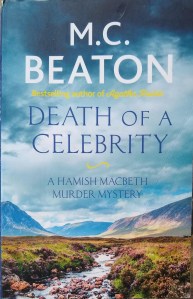
Death of a Celebrity by MC Beaton

This was another Hamish Macbeth mystery and I’m slowly ploughing on through the entire series. In this one a brash young TV presenter decides to make a new TV series exposing various scandals in Scotland and when she appears in the village of Lochdubh in search of new stories for her TV show, many people are not happy. When she gets murdered Macbeth has to find the culprit.

Verdict: This was a pleasant enough read but I began to lose interest somewhere in the middle and although the case was finally wrapped up, I didn’t find it quite as enjoyable as some of the previous entries in the series.

Young Stalin by Simon Sebag Montefiore

You wouldn’t think that new information about a character like Stalin could be forthcoming in this day and age, however, with the fall of the Soviet Union in the 1990s, the author has searched various archives in Russia and Georgia and unearthed much that is new about Josef Vissarionovitch Djhugashvili.

The future Soviet dictator was born in Georgia. His father was a shoemaker and his mother wanted him to become a priest. Stalin did study as a priest but later became an atheist and left the church to join local revolutionaries in Georgia.

Stalin became one of the leading providers of funds for the revolutionaries. He did this by masterminding numerous bank robberies and sending the funds on to Lenin.
He eluded the Tsarist authorities many times but even so, he had to endure prison as well as exile to Siberia.

Later Stalin ran various printing presses and also edited newspapers for the revolutionaries. In 1917 he was exiled to a place close to the Arctic circle. In exile he read voraciously and became close to the hunters who used the reindeer in much the same way as the Native Americans used the buffalo. They used them for food, their used skins for clothing and protection from the cold and to a great extent worshipped these creatures for their sustenance.

When the revolution of 1917 broke out, Stalin headed for St Petersburg to link up with Lenin, even at one point disguising Lenin and helping him evade the police.

When Lenin and the Bolsheviks were able to take power from the provisional government after convincing the Soviets, councils of workers and soldiers, to side with them, Stalin was made a commissar, a minister, in Lenin’s new government.

The various faces of the young Stalin

It has always seemed to me that Stalin was the cruel and hardline man and Lenin was the thinker, the politician. In fact, Lenin was a hard and ruthless man too. When someone decreed that no more shootings would take place under the Bolsheviks it was Lenin who called for more shootings. It’s a revolution he said, people must be shot! He liked Stalin because he knew Stalin was ruthless and could get things done. Later, when he realised that Stalin craved power for himself, he tried to have him removed from the leadership but by then he was sick and dying and it was too late.

This is a book about young Stalin and so the book finishes with the October revolution and Stalin’s appointment as one of Lenin’s commissars or ministers. There is an interesting epilogue though and reveals Stalin as an old man visiting his Dacha on the Black Sea coast. He invites many former friends and comrades who he had known in the past and even laments the death of many old comrades even though they were all shot on his orders.

It also gives the chance for the author to reveal the fates of various characters that have crossed paths with Stalin during his early life.

One interesting story which I read in the author’s other book, The Court of the Red Czar, occurred in 1941 when the Nazis invaded Russia. Stalin was a great reader as I mentioned earlier and he was sure after reading Hitler’s Mein Kampf that the Nazi leader would never attack Russia when he was still fighting a war with the west. Despite many warnings, the attack came and Stalin was silent for many weeks. Eventually his generals came to see him. They wanted orders and plans to combat the Nazis. Stalin clearly thought they had come for another reason. His first words were ‘have you come to arrest me?’

It would probably have been better for them and the country if they had.

Verdict: A excellent and well researched biography.


What to do next: Here are a few options.

Share this post on your favourite social media!

Hit the Subscribe button. Never miss another post!

Listen to my podcast Click here.

Buy the book! Click here to purchase my new poetry collection.

Click here to visit Amazon and download Floating in Space to your Kindle or order the paperback version.

Click here to visit amazon and purchase Timeline, my new anthology.


Reading Books and Thoughts from a Sun Lounger

I thought for this week’s post I’d do a combination post, a little of my book bag mixed with some sun lounger thoughts. Let’s see how it all pans out.

Just now we have finished our touring part of the holiday and we have come to our rented gîte where we have parked the van and are spending time in this wonderful house that we regularly rent just outside the small village of Parçay-les-Pins.
I quite often, back in England, watch that TV show about people who want to buy a new house abroad. It’s called A Place in the Sun and it’s aways interesting to watch couples look for a dream home, especially when it features a location we know a little about like France or Lanzarote for instance. Sometimes the contestants -for want of a better word- will come across what I think is a really nice place and will criticise it and start saying how they will rip the kitchen out and knock this wall down and I really want to slap the pair of them. Now and then, the show will produce something really nice and the couple will fall in love with it, put in a bid and find themselves the new owners of a fabulous house in the sun.

Sitting by the pool outside this house in France I do feel that it’s really a place that Liz and I have both fallen for. It’s an old country house with very thick walls and our bedroom is a modern extension with an en-suite bathroom. In a morning our usual routine is for me to get up, make a brew and bring it back to bed and for Liz and I to check our emails and then see who will be victorious in a card game we play together on our iPads. Those thick walls come into play here though as being so thick we don’t get much of an internet signal in the bedroom so one of us will have to reach out for our phone and switch on our internet hotspot so we can play.

Card game done it’s time for breakfast and then out to the pool for a swim, a read and some sunbathing. Here’s the first of my holiday reads;

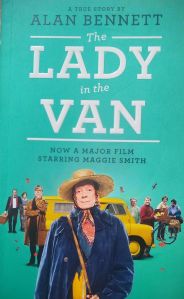
The Lady in the Van

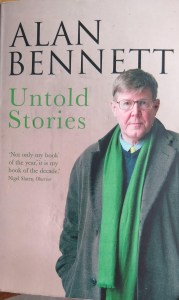
I saw the film version of this a few years ago which was pretty good, if a little odd. It was presented in a very peculiar way in that the author, Alan Bennett, is portrayed as two people, one as himself as he appears in the story and two, as himself as he writes the story. That oddity aside it was really a rather good and original film. When I heard there was a book version I quickly went to one my usual internet book stores and promptly bought it.

I was disappointed to find that it was a very slim volume, only 100 pages in fact and the author might have been better saving it for a collection of short stories. Anyway, it actually made me feel better about my own book, Floating in Space, which is also a rather thin book, though I might add, much longer than this.

Anyway, moving on to the story it was a rather good read. It’s about an oddball character, an old lady who parks outside Alan Bennett’s house in a van and stays there for some time, actually living in the van. She appeared sometime in the 1970’s and when double yellow lines appeared moved into the author’s driveway, staying there until her death in 1989.

The lady, the enigmatic Miss Shepherd, lived in her van continually throughout the year, rain or shine, hot or cold and the author tells her story using his own diary entries. It’s a funny story but also a sad one too. When the lady passes away, he is forced to go through her things in the van;

“…I realised I had to grit my teeth (or hold my nose) and go through Miss Shepherd’s possessions.
To do the job properly would have required a team of archaeologists. Every surface was covered in layers of old clothes, frocks, blankets and accumulated papers, some of them undisturbed for years, and all lying under a crust of ancient talcum powder. Sprinkled impartially over wet slippers, used incontinence pads and half-eaten tins of baked beans, it was of a virulence that supplemented rather than obliterated the distinctive odour of the van. The narrow aisle between the two banks of seats where Miss Shepherd had knelt, prayed and slept was trodden six inches deep in sodden debris, on which lay a top dressing of old food, Mr Kipling cakes, wrinkled apples, rotten oranges and everywhere batteries – batteries loose, batteries in packets, batteries that had split and oozed black gum on to the prehistoric sponge cakes and ubiquitous sherbet lemons that they lay among”

In the van he finds about £6000 in cash and a name and telephone number. Bennett calls the number to find the man at the other end has never heard of Miss Shepherd but then after he describes her, the man realises Miss Shepherd was his sister, although she had for some reason been using an assumed name. Alan Bennett had a love/hate relationship with this strange old lady for many years and came to -I was going to say like, but that’s not the right word. He came to be connected to her in a strange way until one day her social worker arrived with some clean clothes only to find her dead in the van.

To sum up, this was a lovely read even though it only lasted a couple of days for me but I think now I might look out for more of Alan Bennett’s books.

Vide Greniers and Brocantes

Liz and I always visit a village fête at the weekend, usually those with a vide grenier or brocante attached. A vide grenier is just a car boot sale which we both love. I usually pick up connecting leads for my laptop or iPad, after all, you can never have enough electrical leads. Brocantes are more like flea markets or antique fairs. Just the kind of place to pick up those old telephones that I still love, especially those Bakelite ones.
We visited a couple of vide greniers last weekend although the rain put off a great many sellers. The refreshments area was still open though and I ordered sausages and frites undercover from the rain while Liz nipped over to the covered bar across the way and ordered two glasses of vin rouge.

Over the years I’ve picked up various things at French vide greniers including pin badges, glasses and decanters as well as old telephones, cables (of course) old photos and paintings including a framed poster from the Le Mans 24 hour race. What else? A small bust of General de Gaulle which sits on my mantelpiece back home and numerous other things which took my fancy.

Plenty of times we have sheltered in makeshift bars until a rain shower has passed over and the sellers have peeled away plastic covers to reveal their goods.

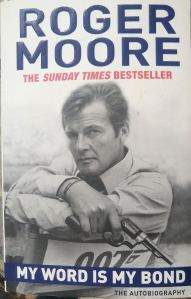
My Word is my Bond by Roger Moore

I picked this book up ages ago and thought it would be a good holiday read. I’ve always liked Roger Moore even though I absolutely hate his James Bond films. I love Moore’s self-deprecating humour, plenty of which is evident in this book. The first part of the book was really interesting and entertaining but like a lot of celebrity autobiographies, this one just gets a little tedious when Roger just seems to list the films and locations and other celebrities he seems to know. On the back of the book was a review claiming this to be the best film autobiography since David Niven’s The Moon’s a Balloon. Sorry but I can’t agree. Roger reveals numerous ‘funny’ incidents from behind the scenes of his films, all of which must have been from the ‘you had to be there’ category because I didn’t think they were that funny. His marriage to his third wife fizzles out with no explanation and the last section is just an endless list of his various travels as a UNICEF ambassador.

He seems to have had a great deal of fun making the Bond films but for me his tenure as 007 marked the series fall from serious spy films into farce. The crazy thing is that after making his first Bond film, Live and Let Die, in which he comes over as a sort of stuffed dummy rather than an action hero, he made a film called Gold. In Gold he starred as the boss of a goldmine and really looked the part of a very tough guy indeed so why he couldn’t have done that as Bond is beyond me.

I prefer to remember Roger as the star of The Saint and The Persuaders, two TV action and adventure classics I loved. Anyway, this was for the most part an entertaining read but don’t think for a moment that it comes anywhere close to David Niven’s classic book.

That’s all from me. The sun has come out so it’s time to put my laptop away and enjoy the pool.

Bye for now!


What to do next: Here are a few options.

Share this post on your favourite social media!

Hit the Subscribe button. Never miss another post!

Listen to my podcast Click here.

Buy the book! Click here to purchase my new poetry collection.

Click here to visit Amazon and download Floating in Space to your Kindle or order the paperback version.

Click here to visit amazon and purchase Timeline, my new anthology.


My Early Life: The Book, the Film and the Soundtrack Album

I first read My Early Life by Winston Churchill many years ago. I picked up a paperback copy which tied in with the release of the film version and also along the way I got hold of the soundtrack album and later a VHS copy of the film. In this week’s blog I thought I’d take a closer look at all three.

Rooting around in a secondhand shop in St Annes recently I picked up a hardback copy of Winston Churchill’s book My Early Life. It’s a thoroughly wonderful book written in Churchill’s inimitable style. He says in the introduction he has written a book about a vanished age and indeed he has. Churchill was born in 1974 at Blenheim Palace in Oxfordshire. He was the son of Lord Randolph Churchill who was in turn the son of the 7th Duke of Marlborough. His mother was an American, Jennie Jerome, the daughter of an American businessman. She married Lord Randolph and became Lady Churchill.

Lady Churchill was a great influence on his life although in his very early years young Winston looked to his nanny, Mrs Everest, for motherly support. His father, Lord Randolph, was someone whom Winston loved and adored but never seemed to become close to. After the birth of Winston, Randolph began to suffer a debilitating disease which could have been syphilis. Others have speculated it was a brain tumour. Either way, Randolph died in 1894.

Looking back, I must have seen the film version before I read the book. Young Winston was directed by Richard Attenborough and is a wonderful adaptation of the book. When Winston first attends school, which of course was boarding school, his headmaster was played by Robert Hardy and he directs Winston to learn some Latin. Winston doesn’t do very well and the headmaster glares down at him and informs him that if he misbehaves, he will be punished, which to a great extent was Churchill’s overall view of school. Later he comments about exams ‘they always contrived to question me about things I didn’t know. I would much rather they asked me about things I did know.

In the book Winston records his schooldays with a great deal of charm and humour. He goes on to attend Harrow and as he intends to join the army goes to special army classes.  Winston seems to have enjoyed his army training and was keen to see action. He took leave with a friend and went to observe events in Cuba where revolutionaries were fighting their Spanish colonial rulers.

Winston was a second lieutenant in the 4th Hussars and spent a long time in India. He was a great lover of polo and he and his colleagues won an inter service championship in their first year in the country, a feat never achieved before by a recently arrived regiment.

Churchill was keen, as I said before, to see action and joined Bindon Blood’s Malakand Field Force and later wrote a book about the campaign. The book was popular and Churchill even received a letter of praise from the Prince of Wales. Because of his mother and father, Churchill was well connected in both political and aristocratic circles and later used his contacts and those of his mother to attach himself to General Kitchener’s campaign in the Sudan. He was part of one of the British Army’s very last cavalry charges in the battle of Omdurman in 1898.

The charge was depicted in the film Young Winston and in his book Churchill ponders about fate and a problem with his shoulder which necessitated using his revolver rather than his sword during the charge, reflecting that if he had been using his sword he might well have been killed in the latter stages when he was surrounded by the enemy.

He ponders many times too about war in the Victorian age. How it was honourable and respectable. He mentions how officers would stop for lunch before a battle and how casualties, which were sometimes considered heavy, were nothing like the heavy casualties suffered in the later world war. If technology had taken away the honour of war in 1914, how would Churchill react to war in 2025 I wonder?

The Victorian age was an age of courtesy and respect and one of my favourite stories in the book occurs when Winston was at Sandhurst. It was the custom then, if an officer wanted leave for a few hours, to sign a book and declare himself absent. One day when visiting friends Winston passed his commanding officer Major Ball, a very strict and formal officer, on the road and realised he had forgotten to sign himself out. He cut short his visit, returned to Sandhurst hoping to add his name before the Major checked the book. Sadly, he found Major Ball’s signature at the end of the page. Would he be disciplined thought Winston? What would his punishment be? Looking further up the list Winston was surprised to find that his name had been added and countersigned by none other than Major Ball himself. Winston writes that this was a clear indication of how discipline could be maintained among officers without departing from the courteous and respectful standards of the time.

Having failed to become an MP for the Oldham constituency he went to South Africa to report on the Boer war as a correspondent. He travelled on an armoured train which was attacked by the Boers and he was captured and imprisoned in a POW camp.

One of things I particularly liked about Young Winston was the music. I bought the soundtrack album in 1985. The music for the film was in the main composed by Sir Alfred Ralston. He was brought into the film by director Attenborough as the two had worked together on a previous film, ‘Oh what a Lovely War’. The soundtrack features music by Edward Elgar, notably the Pomp and Circumstance March no 4 as well as Nimrod from the Enigma Variations.

According to the sleeve notes, the pistol used by Simon Ward who played Winston in the film was Churchill’s actual Mauser and it can be seen pretty well during a sequence when Churchill travels to south Africa to report on the Boer war as a newspaper correspondent. He travels with a unit who undertake a recce on an armoured train only to find the train attacked by the Boers on their return journey. Winston played a big part in helping remove a wrecked train from the line only for himself to not only be captured but also to lose his pistol. The pistol was returned to him in later years.

Churchill ended up in a POW camp but resolved to escape despite also claiming to the Boers that he was a correspondent and should not have been detained. With the help of a group of Lancashire miners, Winston stowed away on a goods train and made his way back to the British lines.

The incident made him famous back in the UK and when he next ran for parliament in Oldham, he was duly elected. The tone of the book becomes more serious towards the final pages but overall this is an outstanding read by one of this country’s greatest sons.

The film version was almost just as good. Simon Ward gives us an admirable picture of the young Winston with just the right hint of the great man’s later style and speaking voice.

I first saw this film at the cinema where I greatly enjoyed it and I remember it coming to television some years later. The film finishes with a poignant dream sequence which, I remember reading somewhere, was based on something Churchill either said or wrote. In the dream, a much older Winston meets his father but he is not the unwell man of his later years but restored to full health. Randolph asks Winston about great events and Churchill answers telling of the two World Wars. ‘Did Joe Chamberlain ever become Prime Minister?’ asks Randolph. ‘No’ answers Winston, ‘but one of his sons did, Neville’.

Winston mentions that he has resigned his commission in the army. Randolph looks about at the many paintings and asks Winston if this is what he does. Winston answers that painting occupies much of his time. Randolph thinks for a moment and then tells Winston to ‘do the best you can’ and we see the sleeping Churchill smile at the thought.

I’ve always liked this final sequence but when I bought my VHS copy the scene was omitted. Likewise, every time I have since seen the film on television, this scene has always been removed. I’d love to know why. Perhaps the producers thought the film too long or perhaps preferred the new ending in which Winston talks briefly in a voiceover about his marriage and living ‘happily ever after’. After a search on the internet I came across a post which claimed that Carl Foreman, who wrote and produced the film, found that US audiences occasioned so little reaction to the scene that he promptly had it cut. What reaction was he expecting to see I wonder?

Perhaps it’s time for a search on eBay. I’m sure that somewhere there must be a definitive DVD version of the film and if you ever get the chance, give the book a read, it’s one of my absolute favourites.


What to do next: Here are a few options.

Share this post on your favourite social media!

Hit the Subscribe button. Never miss another post!

Listen to my podcast Click here.

Buy the book! Click here to purchase my new poetry collection.

Click here to visit Amazon and download Floating in Space to your Kindle or order the paperback version.

Click here to visit amazon and purchase Timeline, my new anthology.

The Film of the Book: James Bond 007 (Part 2)

This is part 2 of a post about the books and films in the James Bond franchise. It’s recently been announced that Steven Knight, the writer who created the TV series Peaky Blinders, has been engaged to write the next film in the James Bond spy series. Bond appeared to die in the last 007 epic No Time To Die which, certainly for me, wasn’t a particularly great film. I honestly think that the producers have got the character mixed up a little with either Ethan Hunt from the Mission Impossible series, Bruce Willis from the Die Hard franchise or perhaps Jack Bauer from 24. Bond isn’t a rogue agent. He isn’t a maverick cop or spy either. He’s a former naval intelligence officer and a serving officer of the secret intelligence service who is trained to follow orders and use his initiative in certain situations. In order to get back to the original James Bond it’s time to look at the source material, namely the books by Ian Fleming, and see how they compare to the films.

Goldfinger

Goldfinger is probably one of the best books in the Bond series and only the second 007 book that I ever read. (I’ll tell you about the first one later). I was at school at the time and for one of our assignments in English, we were asked to bring in a book which contained a really good description of a character. I chose Goldfinger as in it, Ian Fleming describes Goldfinger as a man who appeared to have been made using bits of other peoples’ bodies. This must have been in the mid-1960s and although the character of James Bond was pretty well known, the films had not begun to permeate down to the television screen.
The book is in three parts, based on a quote from Goldfinger who tells Bond of a saying he learned in Chicago. ‘Once is happenstance, twice is coincidence, the third time it’s enemy action’. In a similar situation to that in Moonraker, Bond is asked to take a close look at Goldfinger by an acquaintance from the first book Casino Royale. The man reckons that Goldfinger is cheating him at cards and asks Bond if he can see how this is being done. M tasks Bond to meet with Goldfinger who is suspected of gold smuggling. Eventually, Bond is captured by Goldfinger who correctly surmises that ‘enemy action’ has begun. Later Bond is taken to the USA where he learns of Goldfinger’s plan to rob Fort Knox.

The film version was hugely popular and to a certain extent became a sort of template for future Bond films.

For Your Eyes Only

Not one of my favourite Bond books, this was a collection of short stories and some of the titles, but not the plots, were used in some of the later Bond films.

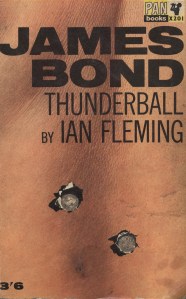
Thunderball

This is an interesting story and the resulting film has perhaps become the quintessential Bond film even more so than Goldfinger. The story is about a criminal underworld organisation (SPECTRE) that steals an aircraft with nuclear weapons and holds the west to ransom threatening to explode the bombs.
Prior to Thunderball, Fleming had been working on a screenplay with two others and when the project fell through, Fleming decided to use the material in his new novel. Later, Kevin McClory and Jack Whittingham, his two erstwhile writing partners, sued Fleming and won rights to certain elements of the story. This enabled them to years later produce the film Never Say Never Again with Sean Connery returning to the role of James Bond.

The book is well put together and as usual I found it a hugely enjoyable read. Fleming once again manages to inject the story with elements of his own life. Bond’s visit to a health clinic was inspired by Fleming’s own similar visit. In the book, Bond’s health record is revealed including details of his large intake of alcohol and cigarettes.

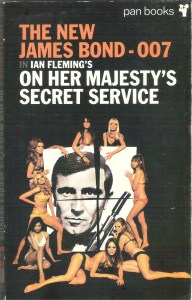
On Her Majesty’s Secret Service

In this book the secret service find that Blofeld, the head of SPECTRE, is trying to assume the identity of the Comte Balthazar de Bleuville. Bond poses as Sir Hilary Bray of the College of Arms in order to meet with Blofeld. Interestingly, Sir Hilary gives Bond a quick resumé of Bond’s family history including the Bond family motto ‘the world is not enough’ which was used by the film producers for the title of a later 007 film unrelated to Fleming’s books.
While taking a break from the search for Blofeld, Bond meets Tracy, the daughter of Marc-Ange Draco, the head of the French criminal organisation the union corse. Draco offers Bond a million pounds to marry his troubled daughter but Bond declines although he agrees to meet with her again. Later she proves instrumental in helping Bond escape from Blofeld.

In the film, George Lazenby became the new 007, sadly only lasting for one film after taking advice from his agent who felt the days of the Bond films were over. Former Avengers girl Diana Rigg portrayed Tracy. She and Bond fall for each other and are married but sadly, Blofeld takes revenge and she is murdered. Personally, I’ve always felt that this film was one of the best in the 007 film series.

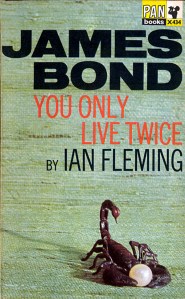
You Only Live Twice

This book follows on from the previous one and we find James Bond depressed and disillusioned with his job after the death of Tracy. M considers sacking Bond but instead sends him on a diplomatic mission to meet the head of the Japanese secret service. The British want access to Russian documents which the Japanese are currently decoding. The Japanese decide to offer this information to Bond if he will assassinate a British resident who has created a garden of death, a garden full of poisonous plants which are attracting many Japanese citizens who want to commit suicide. Bond realises that this man is Blofeld and decides to keep this quiet until after he has killed him.

At the end of the book Blofeld is dead but Bond, who has been masquerading as a Japanese fisherman, is badly hurt and suffering from amnesia. The Japanese woman who has been pretending to be his wife decides to hide Bond in order for him to stay with her. At the end of the book, Bond reads something about Russia which triggers a memory and decides he has to go there.

The only real similarity of the film to the book was that the film was also set in Japan.

The Man with the Golden Gun

This was the last novel in the Bond series and the first Bond book I ever read. It’s a rather disappointing read as Fleming had died before completing his revision of the manuscript.

The novel opens up with Bond reappearing after going missing after his last mission. In fact he has been brainwashed by the Russians into murdering the head of the secret service. His attempt fails but Bond is deprogrammed and M decides to test Bond by sending him after a notorious hitman, Francisco Scaramanga, who has eliminated numerous British agents.

Fleming’s writing process was to create a first draft and then edit and add in more detail with a second draft. Fleming had told friends that James Bond was becoming harder to write and he wanted The Man with the Golden Gun to be his last. He also wanted to finish on a high and was concerned that the book wasn’t good enough for a grand finale. He had told his editor that he had thought about spending another year back at Goldeneye in Jamacia working on the book. Sadly, he suffered a heart attack on the morning of 12th August 1964 and died.

The film version starred Roger Moore playing his usual lacklustre and slightly camp 007 but a memorable screen villain was Ian Fleming’s cousin, Christopher Lee starring as Scaramanga. Britt Ekland joined the ranks of the Bond Girls by playing Mary Goodnight, Bond’s secretary.


What to do next: Here are a few options.

Share this post on your favourite social media!

Hit the Subscribe button. Never miss another post!

Listen to my podcast Click here.

Buy the book! Click here to purchase my new poetry collection.

Click here to visit Amazon and download Floating in Space to your Kindle or order the paperback version.

Click here to visit amazon and purchase Timeline, my new anthology.

The Book of the Film or the Film of the Book: James Bond 007 (Part 1)

I originally gave this post the title of Book Bag: Ian Fleming and I intended to talk about the original James Bond books written of course by Ian Fleming. As much as I tried to keep them out, the film versions kept creeping in and so I decided on a quick change to the title, as you can see above. It’s very hard to separate the films from the books especially as I keep reading rumours about the next Bond film in the media. In fact it has just been announced that Steven Knight, the writer who created the TV series Peaky Blinders, has been engaged to write the next film in the spy franchise. Bond appeared to die in the last 007 epic No Time To Die which, certainly for me, wasn’t a particularly great film. I honestly think that the producers have got the character mixed up a little with either Ethan Hunt from the Mission Impossible series, Bruce Willis from the Die Hard franchise or perhaps Jack Bauer from 24. Bond isn’t a rogue agent. He isn’t a maverick cop or spy either. He’s a former naval intelligence officer and a serving officer of the secret intelligence service who is trained to follow orders and use his initiative in certain situations. In order to get back to the original James Bond it’s time to look at the source material, namely the books by Ian Fleming and see how they compare to the films.

Casino Royale

Casino Royale is the first book in the 007 series and it’s a pretty interesting and original one too. ‘Le Chiffre’, a gambler and also a member of SMERSH, a murderous department of the KGB is engaged in a desperate effort to win a great deal of money at the casinos of Royale Les Eaux in France. Le Chiffre is desperate because he has used SMERSH funds for his personal use and his spymaster bosses will not be pleased if they find out. Britain’s secret service happens to find out about this and sends Bond to France to make sure Le Chiffre doesn’t recoup those funds as of course as we all know, James Bond 007 is a bit of an expert with the cards.

The book is interesting in another way too. Ian Fleming sold the movie rights to Casino Royale separately from the rest of the Bond books and this enabled producer Charles K Feldman to produce a movie independently from Eon productions who own the rights to the other books. Feeling that he could not compete with the mainstream movies, Feldman decided to make Casino Royale into a comedy version. David Niven starred as Sir James Bond and ironically, Ian Fleming had mooted Niven as a possible Bond when casting began for Dr No, the first movie in the series.

Eon Productions finally acquired the rights to Casino Royale ready for the debut of Daniel Craig as James Bond. I’ve got to say I didn’t like Craig at first. He didn’t look like Bond and I honestly thought he would have been better cast as one of the Bond villain’s henchmen but I did warm to him eventually and although I didn’t much care for it at first, I really do think Casino Royale is one of the better Bond films. It was released in 2006 and follows the book pretty faithfully which many of the previous films rarely do. Craig’s final Bond film was No Time to Die which I really thought was the poorest of Craig’s five outings as 007.

Live and Let Die

This was the second Bond book to be published and the action takes place in the USA and the Caribbean, which Fleming loved and bought a house there which he named Goldeneye. Live and Let Die and in fact the whole book series were recently reissued with all the politically incorrect stuff removed which makes me wonder whether there was in fact anything left to publish after that process was complete. The book was published in 1953 and comes complete with all the prejudices and sexual and racial intolerances of the era. In one segment when Bond visits Harlem, Fleming tries to reproduces the accents and slang terms of the black people of Harlem and for me it’s not one of Fleming’s best books. In the film version, Roger Moore took over the licence to kill and the result was a very tongue in cheek version of James Bond. Sorry but Roger Moore as Bond just wasn’t for me. The film did feature a great theme song from Paul McCartney which was really a little underused in the film. Another feature of the film was a power boat chase along the Bayous of Florida which was a lot of fun but not entirely serious.
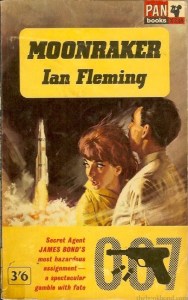
Moonraker

This was the third entry into the 007 series and the action takes place mostly in Dover. Millionaire Hugo Drax wants England to enter the space race and so he spends his own money on a rocket named the Moonraker which he intends to donate to the British government. It turns out that Drax is actually a nazi who wants to avenge defeat in the second world war by arranging for the rocket to destroy London. I read recently that Fleming wrote the book while staying in a cottage situated down by the famous chalk cliffs of Dover which was once owned by Noel Coward and later Fleming himself. It’s not a bad read at all and starts off with M asking Bond a favour as he suspects Drax to be cheating at cards and he wants Bond to see if he can sort things out as at the time, this was the mid-1950s, cheating at cards in London high society could really be a big scandal.
Bond beats Drax at his own game and then finds his next mission is to look into Drax and his Moonraker set up. Interestingly in Moonraker the obligatory Bond girl with the exciting name, in this case Gala Brand, decides not to succumb to Bond’s charms after all.  The movie version was a desperate attempt by the Bond producers to compete with Star Wars and was not my cup of tea at all.

Diamonds are Forever

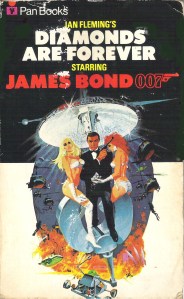
Fleming wrote this book at Goldeye, his house in Jamaica, after doing a great deal of research about diamond smuggling. Bond’s mission is to investigate a diamond smuggling ring and he does this by impersonating a diamond smuggler called Peter Franks. Franks leads Bond to an American woman called Tiffany Case who he begins to fall for. He tracks the smuggling ring to the American Spang brothers, leaders of the Spangled Mob, a criminal gang. The finale takes place in the Spangs’ restored western town, Spectreville.
The film version marked Sean Connery’s final outing as Bond, at least in the ‘official’ Bond films anyway. Connery looks bored throughout the film which seems to begin the trend of slightly less than serious films which Roger Moore continued.

From Russia with Love

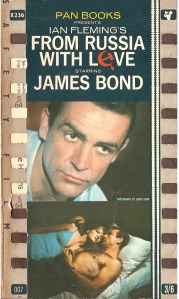
According to Wikipedia From Russia With Love was inspired by the author’s trip to Istanbul in 1955 to cover an Interpol conference for the Sunday Times. The plot is very similar to the film version and involves the KGB planning to assassinate Bond and also create a scandal involving Bond and the British Secret Service. To do this they persuade a cypher clerk, Tatiana Romanova, to pretend to defect to the west with a Spektor cypher machine. She claims she will only to defect to Bond, having fallen for him after reading his KGB file.
What was interesting about this book was that Fleming had become a little bored with Bond as well as being short of ideas and so he decided to kill off 007 at the end of the book, when he falls victim to KGB agent Rosa Klebb, who stabs Bond with a hidden blade laced with poison. Fleming later developed an idea for the next book and proceeded to revive Bond for Dr No, the next in the series.

The film version closely follows the book but adds the criminal organisation SPECTRE into the mix and is, to my mind anyway, one of the best films in the franchise. Sean Connery made his second appearance as 007 and two excellent portrayals as villains were by Robert Shaw as Red Grant and Lotte Lenya as Rosa Klebb.

Dr No

Prior to the writing of this book, a firearms expert called Major Boothroyd wrote to Fleming explaining that an agent like Bond would never be armed with a Baretta as it was more of a ladies gun. Boothroyd recommended a Walther PPK. Fleming was so impressed he included the new gun in Dr No and also added a new character named Boothroyd as the armourer of the secret service.

In Dr No, Bond is recovering from the effects of poisoning in the previous book and so M, the head of the secret service, sends him on a routine mission to Jamaica where the head of the Jamaica station and his secretary have disappeared. Bond finds that they were investigating the secretive Dr No who owns a private island known as Crab Key. After further investigation Bond finds that Dr No is involved in the practice of ‘toppling’ missiles from a nearby US launch site.

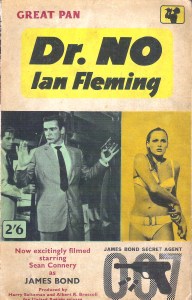
Dr No was made into the very first Bond film in the film series with Sean Connery starring as 007. Fleming was rather apprehensive of Sean Connery at first, actually wanting David Niven to play the part. Later Fleming warmed to Connery, even adding a bit of Scottish ancestry into Bond’s back history in the later books.

Bernard Lee played M, the head of the secret service. He went on to appear in 11 Bond films in total and Lois Maxwell made her first of 14 appearances as M’s formidable secretary, Miss Moneypenny.

Tune in next week to read the concluding part of this post.


What to do next: Here are a few options.

Share this post on your favourite social media!

Hit the Subscribe button. Never miss another post!

Listen to my podcast Click here.

Buy the book! Click here to purchase my new poetry collection.

Click here to visit Amazon and download Floating in Space to your Kindle or order the paperback version.

Click here to visit amazon and purchase Timeline, my new anthology.

3 Summer Reads

A long time ago I decided that I would set myself the task of reading the entire Hamish Macbeth series of books. There are 34 books in the series, all written by author M.C. Beaton which is in fact a pen name for Marion Chesney. Marion actually wrote many books under various pseudonyms including Ann Fairfax, Jennie Tremaine, Helen Crampton, Charlotte Ward and Sarah Chester. After Marion’s death in 2019 further Hamish Macbeth novels have appeared penned by writer R.W. Green.

Hamish Macbeth is a country policeman in the small Scottish Highland village of Lochdubh. Macbeth is a very relaxed kind of fellow. Some might even call him lazy. He shies away from promotion, even giving the credit for solving crimes to others so he can stay on in his beloved village.

A few years back the BBC made a TV series based on the books. ‘Based on’ is quite an interesting use of that particular phrase because the TV series is actually nothing like the books. The series was filmed in Plockton and Macbeth is played by Robert Carlyle. Macbeth is a laid-back relaxed character, just like in the books. He is not averse to poaching the odd salmon and he likes to apply the rule of law in his own way. He avoids promotion as all he wants is to remain in Lochdubh. That is pretty much where the resemblance to the books ends which was quite a surprise to me. Most of the characters in the series are the invention of the TV writers and not M.C. Beaton who wrote the books.

I’m not sure how happy I would be if someone made a TV show out of my book and then proceeded to change all the characters, still I did enjoy Hamish Macbeth as a TV show. It was an oddball, quirky little drama which ran for only three seasons and a few years ago Liz and I visited the village of Plockton which was very small and to be honest, didn’t actually look like the place in the TV series.

Not long ago after reading Death of a Scriptwriter last year, I put down the Hamish Macbeth books and took a little break from the murders in Lochdubh but as the summer has warmed up nicely and I’ve plenty of time to sit out in the back garden reading, I thought it was a good time to pick up the series again.

Death of an Addict.

This was a little different to the usual Hamish Macbeth novel. Macbeth and another officer, Glasgow DI Olivia Chater, masquerade as drug dealers to trap a drugs cartel operating in the highlands. I have to say that I didn’t like how the book leaves the usual village life behind and to be fair, I didn’t enjoy the book as much as the previous ones.

Death of a Dustman.

All the Macbeth series are titled ‘Death of’ someone and I noticed on the internet that there is one book that differs from the others called A Highland Christmas which seems to come in between Addict and Dustman. Anyhow, I don’t have a copy so I went straight on with Death of a Dustman. All the books in my collection end with the first chapter of the next book and Addict ended with chapter one of Dustman so perhaps the Christmas book is something a little different. Anyway, the action takes place once again in the village of Lochdubh where a new councillor decides to make the village ‘green’ by promoting recycling. As a result, the local dustman causes a lot of aggro when he declines to empty bins containing the ‘wrong’ sort of rubbish and of course he ends up getting bumped off.

Things get a little far fetched towards the end but overall, Death of a Dustman was a fairly pleasant read and another look at highland village life and its various characters.

Marathon Man

I mentioned a while ago about my brother dying and when I was sorting out his things I came across this short novel. Actually it was one of my own books and I must have lent it to Colin years ago and now it has once again come back to me. I can just imagine telling him ‘I told you that you never gave me Marathon Man back!’ to which he would probably reply ‘Well what about that Cary Grant book I lent you?’ Yes, I borrowed the Grant book ages ago when I wrote a post about Cary Grant and it’s still there, part read in my bedroom.

Marathon Man was written by the screenwriter William Goldman and later made into a film using Goldman’s own screenplay. It’s a fairly short book and according to Wikipedia it was the author’s most successful thriller novel. Escaped nazi dentist Christian Szell has been living in Paraguay since the end of WWII. He has a stash of diamonds acquired while he worked in a concentration camp which are in a New York vault looked after by his father. When his father dies in a car crash Szell has to return to New York to get the diamonds. Will it be safe though? Szell thinks that a US agent working for a secret department called the Division may be about to rob him when he picks up the diamonds.

The agent is known by the code name Scylla and Szell meets with him and uses a hidden knife to stab him. Scylla manages to survive long enough to get to his brother’s New York apartment whereupon he dies from his injuries. Szell believes that Scylla must have survived long enough to give his brother, nicknamed ‘Babe’, information about the diamonds and so his men kidnap Babe and he is tortured to reveal any information. Szell is a dentist and so he tortures Babe by drilling into his teeth. Later, Babe, a student who hopes to be a marathon runner manages to get away.

The story was made into a film starring Laurence Olivier as Szell and Dustin Hoffman as Babe. This led to an interesting confrontation of acting styles with Hoffman the ‘method’ actor and Olivier the celebrated traditional actor. On one occasion when Hoffman had to appear tired out after staying awake for three days Hoffman chose to actually stay awake for three days also. Olivier, tired of these antics famously asked Hoffman ‘Dear boy, why don’t you just act?’

(I should mention here that while researching this and checking my facts -I had originally thought that Hoffman had gone running to make himself appear breathless- I found a really interesting article in the Guardian in which the author finished with a wonderful quote about acting from George Burns who once said “sincerity is everything. Fake that and you’ve got it made!”)

The film very much follows the lines of the book except that in the film, it is Szell’s brother, not his father who looks after the diamonds and also in the book, Babe is a little more ruthless and cold blooded than Hoffman portrays him on film. In fact, Babe shoots Szell dead in the book but in the film, Szell is killed by falling on his own knife.

Both the book and the film were highly successful and Olivier’s Szell is one of the most famous screen villains, particularly with his catchphrase ‘Is it safe?’ which he continually asks Hoffman’s character before commencing to torture him. It’s a film which probably put a huge amount of people off going to the dentist for years and the book is equally as scary and also superbly written.

Anyway, that’s what I’ve been reading. What are your summer reads?


What to do next: Here are a few options.

Share this post on your favourite social media!

Hit the Subscribe button. Never miss another post!

Listen to my podcast Click here.

Buy the book! Click here to purchase my new poetry collection.

Click here to visit Amazon and download Floating in Space to your Kindle or order the paperback version.

Click here to visit amazon and purchase Timeline, my new anthology.


Book Bag: Frederick Forsyth

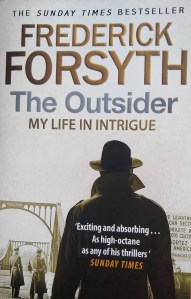
It was sad to read in the news the other day of the passing of journalist and novelist Frederick Forsyth. He was 86 years old and had published more than 25 books. I’ve read quite a few of his novels and I wrote a segment about him some time ago in a blog post about novels that were rejected by publishers. A number of his books were made into films and so many people must be familiar with his work.

Forsyth did his national service in the RAF and was commissioned as an Acting Pilot Officer in 1956. After leaving the RAF he became a journalist working for the news agency Reuters and later he joined the BBC. He was the perfect choice for a foreign correspondent as he spoke numerous languages including French, German and Russian. In 1967 he was reporting on the war between Biafra and Nigeria when the BBC decided they were no longer interested in that particular war. Forsyth resigned from the BBC and continued to report on the war as a freelance. He even admitted later that this was when he was recruited by MI6 as an informant.
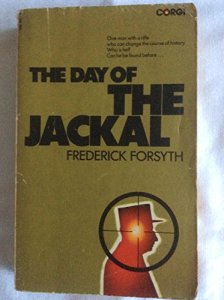
His most famous book and actually one that he struggled to get published was The Day of the Jackal. He apparently had no interest in becoming a novelist but turned to fiction as he was out of work and in dire straits financially.  The Day of the Jackal was rejected numerous times but finally one publisher decided to try a limited print run. The book took off first in the UK and then in the USA. It was a mixture of fact and fiction and Forsyth’s description of how to obtain a fake passport was used by John Darwin, the man who faked his own death in a canoe and later tried to make a new life in Panama. This true story was made into a book and TV mini series called The Thief, his Wife and a Canoe.

Forsyth followed up with The Odessa File, a book about the Odessa organisation which helped former nazis escape detection from the authorities after World War II. He wrote numerous other books but when The Day of the Jackal was re-imagined as a TV series recently on Sky TV, he earned nothing as he had already signed away the TV and film rights with the earlier screen version.

The Day of the Jackal

It was a very long time ago when I first read this book. Someone once called it an assassin’s handbook although I’m not sure that’s really fair. The book is set in the early 60s. The OAS was a terrorist organisation made up of ex-army personnel who were angered at De Gaulle’s decision to give independence to Algeria after many of their comrades had died fighting Algerian nationalists. They were trying to assassinate De Gaulle but their organisation had been penetrated by French Intelligence. To prevent any leaks the OAS top leadership decide to hole up in a hotel and arrange for a professional assassin to kill De Gaulle. The book follows the assassin, code named Jackal, as he plans the murder step by step. The French secret service however decide to kidnap a man who functioned as an aide to the leadership. Under torture he revealed the basic plot but how could the French track down the assassin?

The Jackal arranges three fake identities and the author explains meticulously how he does this. He met with a specialist rifle maker and explained how he wanted a rifle that could be dismantled and fitted into a series of metal tubes, the full import of this is only revealed on the planned day of the assassination.

The Jackal also asks for a number to ring for up to date information and the OAS arrange for an informant to seduce a member of the government and pass vital info to the Jackal.

Forsyth apparently wrote the book in 35 days and continued with a similar non stop workflow for all his subsequent books. He didn’t like the writing process and was anxious to get it all over with as quickly as possible. Even so, the result is a tense and gripping read. Forsyth’s books are heavily researched and often including real-life procedures, political contexts, or military operations. He includes authentic settings and terminology that lend a strong sense of realism to his stories. The characters in his books though are usually pretty functional, just there to carry the plot forwards although in The Jackal we find perhaps his most rounded characters, certainly in the few books that I have read.

The Day of the Jackal was made into a film in 1973 directed by Fred Zinneman.

The Odessa File

Again, it’s a long time since I have read this book but it’s really well put together with a real twist at the end. It’s about a German journalist who discovers a diary written by an old Jewish man who has committed suicide. The man was a former concentration camp prisoner and killed himself after seeing a sadistic SS officer known as ‘the butcher of Riga’ walking free in the city.

The journalist decides to try and track the SS man down and finds out that the nazis run an organisation known as the Odessa, which helps former SS men evade justice, assisting them with fake papers and even travel to friendly countries.

The journalist decides to pose as an ex-SS man seeking help from the Odessa and this leads him on a very dangerous path indeed.

The Odessa File was also made into a film starring John Voight as the journalist and the resulting publicity brought about the exposure of the real life ‘Butcher of Riga’, on whom the fictional character was based. Eduard Roschmann was arrested by Argentine police but then skipped bail and escaped to Paraguay.

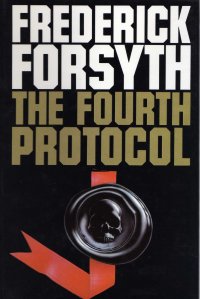
The Fourth Protocol

I started reading this book a while ago and like all of Forsyth’s other books it is a very exciting read. I was also surprised to find that it was really quite different to the film which starred Michael Caine.

In the book, a professional jewel thief robs the safe of safe of a well to do civil servant. He takes away some pretty expensive jewels but breaks a golden rule by also taking what appears to be an expensive hand crafted leather briefcase.

It turns out that hidden in the briefcase are some top secret documents which the civil servant has been passing to a member of the South African security forces.

This gentleman then organises a group of thugs to find the case but the jewel thief is alerted just in time and is able to round up some tough guys of his own to combat the thugs. After finding out the thugs were after the briefcase, he discovers the secret documents and mails them to the authorities.

Robert Preston, our local MI5 man, then has to find out where the documents came from and who has been leaking them.

Eventually, Preston discovers that the civil service man was passing the documents to a south African diplomat who was also a Russian spy.

This whole episode was glossed over in the film and in fact in the film version it is John Preston played by Michael Caine who robs the safe forcing the traitor to meet with his contact.

The main story though involves a Soviet plot to destabilise NATO by causing an atomic explosion at a US Air Force base in the UK. Components for the bomb are to be smuggled into the country, set up at a safe house just by the air force base and later detonated.

Luckily, our man Preston manages to save the day.

Once again, this is an excellent read peppered with fascinating information about the workings of spies in MI5 and MI6 and also the KGB.


What to do next: Here are a few options.

Share this post on your favourite social media!

Hit the Subscribe button. Never miss another post!

Listen to my podcast Click here.

Buy the book! Click here to purchase my new poetry collection.

Click here to visit Amazon and download Floating in Space to your Kindle or order the paperback version.

Click here to visit amazon and purchase Timeline, my new anthology.

Thatcher and Give Me 10 Seconds

On holiday one of my favourite reads was an autobiography by John Sergeant who was once a political reporter for the BBC. It was called Give Me 10 Seconds. It was called this because the BBC usually had John ready to speak to the camera for perhaps two minutes. John needed to get his broadcast together in his head and would usually ask for 10 seconds for a quick mental rehearsal. The book was a particularly warm and enjoyable read and opened my eyes to the way the BBC works.The author seems to think that the BBC was built on rather military styles. Staff didn’t get holidays but instead were allocated ‘leave’. Numerous layers of management operated the BBC empire and it seemed to me to be very similar to how things operated at my old place of work, the Highways Agency.

John’s claim to fame came when he was reporting live from outside the British Embassy in Paris in November 1990. Mrs Thatcher had just heard that Michael Heseltine’s leadership challenge had garnered 152 votes in the first round of voting and while John was presenting live on television, Mrs Thatcher emerged from the embassy with her PR man Bernard Ingham by her side. Despite Mr Ingham trying to push John aside, he stood his ground and firmly held his microphone to the Prime Minister’s face while she advised everyone that her name would be going through to the second round of voting.

John’s book was a great read. He started out working with Alan Bennett as a comedy writer and performer but when he realised that he probably had no future as a tv comedian he got himself a job as a newspaper reporter in Liverpool and later moved over to the BBC as a radio reporter.
It’s actually really fascinating to hear of the rivalry between the radio news and the tv news, as back in the late 60s the radio people really didn’t have much time for their television counterparts. These days of course, television is the senior partner in news reporting and the cameras of the BBC, SKY TV and CNN take the viewer all over the world in search of news.

Even so, in recent years, people and politicians have been highly critical of the BBC not only for the way it reports but also for what it reports. I’ve seen some interviews with politicians by journalists like Jeremy Paxman which were quite frankly just disgracefully rude. Is there bias in the BBC? I personally think that the days of impartial news reporting is over but whenever something happens in the world, and I want some more information, my first thought is to go to the BBC website.

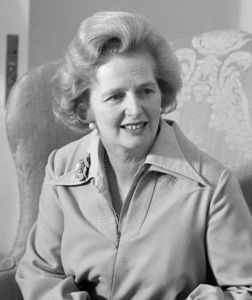
Mrs Thatcher was the first female British Prime Minister. She was born in 1925, studied chemistry at Oxford and married Denis Thatcher in 1951. She stood unsuccessfully for parliament and then settled down to have her children. Later she was finally elected in 1959 as the MP for Finchley.

Image courtesy creative commons

Mrs Thatcher was given various posts on the front bench and when the Conservatives under Edward Heath won the election in 1964, she was promoted to the Cabinet as Secretary of State for Education and Science.

The Government had to deal with numerous issues such as union demands for higher wages and the three day week and they lost the election in February 1974 but Labour could only form a minority government. They then won a later election in October that same year. Mrs Thatcher then challenged Edward Heath for the party leadership and won, taking over as leader of the opposition in 1975. She finally became Prime Minister in 1979 famously quoting the prayer of St Francis on the steps of Downing St;

Where there is discord, may we bring harmony;
Where there is error, may we bring truth;
Where there is doubt, may we bring faith;
And where there is despair, may we bring hope.

Mrs Thatcher promoted the idea of people owning their homes and even introduced policies aimed at tenants buying their own council houses. She faced up to union demands most notably with Arthur Scargill and the mining unions but became hugely popular when she stood up to the Argentinians who invaded the Falkland Islands.

She led the Conservative Party to victory in three consecutive general elections, twice in a landslide, and she ranks among the most popular party leaders in British history regarding votes cast for the winning party; over 40 million ballots were cast in total for the party under her leadership. Her electoral successes were dubbed an “historic hat trick” by the British press in 1987 and her tenure as Prime Minister was the longest continuous period in office since the 19th century.

Her downfall came in 1990 which brings us back to John Sergeant’s famous moment. Michael Heseltine decided to go ahead with his leadership challenge and Mrs Thatcher burst forth from the British Embassy in Paris to make her statement that she had passed her name forward to the next round of the contest. She had been 4 votes short of victory in the first ballot and therefore a second round was required.

Thatcher seemed certain of going forward into that second ballot but after consulting with her ministers she decided to withdraw and it was John Major and not Michael Heseltine who emerged as the new Prime Minister and leader of the Conservative Party.

Mrs Thatcher has been portrayed by numerous actresses in film and television most notably by Gillian Anderson and Meryl Streep. Streep starred as Thatcher in the film Iron Lady. She was played frequently on TV sketches and in the James Bond film For Your Eyes Only by comedian and impressionist Janet Brown.  Perhaps the most famous comedy sketch about Mrs Thatcher came on the TV show Spitting Image in which she takes the cabinet for dinner. She orders steak and the waitress asks ‘what about the vegetables?’

Thatcher looks at her cabinet and replies ‘they’ll have the same as me!’

Mrs Thatcher retired from the House of Commons at the 1992 general election. She was a Prime Minister who was loved by some and hated by others and even when she died in 2013 at the age of 87 social media memes were declaring the wicked witch is dead!

Which side of the fence are you on?


What to do next: Here are a few options.

Share this post on your favourite social media!

Hit the Subscribe button. Never miss another post!

Listen to my podcast Click here.

Buy the book! Click here to purchase my new poetry collection.

Click here to visit Amazon and download Floating in Space to your Kindle or order the paperback version.

Click here to visit amazon and purchase Timeline, my new anthology.

Three Reads from My Holiday Book Bag

It’s always good to slip out of the pool, dry yourself off and then relax in the sun with a really good book. Here are three of my latest holiday reads. (try the video version by clicking here!)

The Thief, His Wife And The Canoe

I first heard about this story on the TV news many years ago. I’d mostly forgotten about it until recently when there was an ITV drama based on the story. This was the book version and even though the story is fascinating, the book, written by a newspaper journalist wasn’t that gripping.

Essentially, John Darwin was facing bankruptcy after getting hugely overreached on a series of buy to let mortgages. He decided that the only way out was to fake his own death and cash in on some life insurance policies. His wife apparently tried to talk him out of the idea but John, a dominating and overpowering personality, went ahead and faked his own death. Amazingly he even went back to live with his wife, sometimes having to retreat to the bedsits next door when any friends or family came to visit. He arranged a false passport using a method explained in the book ‘Day of the Jackal’ by Frederick Forsyth and then the two, Darwin and his wife, planned to buy property in Panama and live a new life. Later, Darwin decided he wanted to return to the UK under his own name by posing as someone who had suffered with amnesia and in fact one day he disposed of his fake passport, walked into a police station and told them ‘I’ve lost my memory!’

Journalist David Leigh tracked down Darwin’s wife in Panama and managed to extract the entire story from her before she returned to the UK to face imprisonment along with John.

The result is interesting but not really a great read as perhaps the author is more used to newspaper stories rather than an entire book. Either way, it kept me interested for quite a few days.

Death of a President

I’ve read this book before many years ago but even so I thought I’d throw it in the motorhome and give it another read. The President’s widow, Mrs Jackie Kennedy asked the author, William Manchester to write the book so there would be one authorised record of what happened in Dallas when President Kennedy was assassinated. The result is a record, in fact a micro record of what happened to Kennedy and those around him, beginning a few days before the assassination and ending with his funeral and the shooting of his assassin by another assassin.

For me, who has been interested in the JFK assassination since at least 1968 when his brother, Robert Kennedy was also murdered and I was 12 years old, it’s a fascinating record. Others might think perhaps that the author has spread his research too far, that we are not interested in what the President’s pilot thought or did or how the honour guard prepared for the President’s funeral and how the President’s sister or brother-in-law reacted.

Anyway as a passionate JFK researcher, a couple of things stood out. One was a time chart that showed that JFK was shot at 12:30 and that at 12:31 and a half, motorcycle cop Marion Baker intercepted Lee Oswald, the supposed assassin, on the second floor lunchroom of the Texas School Book Depository calmly drinking a coke. That meant that Lee had, in 90 seconds, hidden his Mannlicher Carcano rifle on the 6th floor and got himself down to the second floor to meet Baker. Did he shoot the President or was he in the lunchroom all the time?

Here’s another thing. In one of my favourite JFK assassination books, Best Evidence, author David Lifton reckons that sometime between leaving Dallas and arriving at Andrews Airforce base in Washington, JFK’s body was somehow removed from his coffin and transferred to a body bag and then helicoptered to Bethesda naval base where work was done on the body prior to it being seen by the official autopsy staff. In Death of a President, William Manchester says that Mrs Kennedy spent all her time sitting near to the casket on Airforce One with many of JFK’s team of assistants and secret service personnel. So how was Kennedy’s body removed without anyone knowing?

OK, I’ve gone off into the realm of JFK assassination folklore there but to get back to normality, this was a very well researched book and gives a massively detailed look at the events surrounding a tragic day. If anything, the detail is perhaps a little too much and I could sort of imagine it as a feature film using that split screen effect that you often saw in the 1970s; Kennedy getting into the limo side by side with a shot of the assassin getting ready and so on.

Verdict; an absorbing read, very detailed.

Blue Angel: The Life of Marlene Dietrich by Donald Spoto

This was a very compelling read, a biography of Marlene Deitrich who to be fair, I didn’t know much about until this book.

Marlene was one of those people perhaps born at the wrong time. Today might be a better time for her when lifestyles of gay and lesbian people are not so much of an issue.

Marlene rose to prominence in the film world of Germany between the world wars. She was married to assistant director Rudolf Sieber and together they had a child, Maria. The couple had what we might call an open marriage and Marlene had various partners, both male and female and her husband too found himself another love. A big hit for Marlene was her performance as Lola Lola in The Blue Lamp, directed by Josef Von Sternberg in 1930. Shortly afterwards Marlene and Von Sternberg moved to Hollywood and the two made a series of films for Paramount. While she was away from Germany the Nazis rose to power. Goebbels himself asked her to come back and work in German films but when she declined, the Nazi party rejected her. Marlene became a naturalised American and even entertained the troops -the allied troops during World War II.

She had affairs with both men and women and at one point even began to wear male oriented clothes and once she was denied entry into a Paris night club for wearing trousers.

She was extremely concerned with how she looked in films and always arranged with the lighting crew for a key light to illuminate her face in a particular way, many times even bypassing the director. Alfred Hitchcock for one was not amused.

When the film work fizzled out she reinvented herself as a performer with a one woman show in Las Vegas. The clothes and lighting she organised herself, in fact at home she even had a special key light, just as she specified for her films, that she would stand under when she met journalists and even her friends.

She was always there to help her friends and still stayed close to her husband and his partner. If friends were sick or even just down, Marlene would come round and clean up and make food. She was not only a famous and beautiful star but also a proud hausfrau.

The book opens with her appearing in a short sequence in her very last film, which incidentally starred pop star David Bowie. She performed for the camera perfectly, only one take was required, then she returned to her Paris apartment and except for hospital and doctors’ appointments, she never left again until her death in 1992.

Not the best film book I’ve ever read but still an informative and intriguing read.


What to do next: Here are a few options.

Share this post on your favourite social media!

Hit the Subscribe button. Never miss another post!

Listen to my podcast Click here.

Buy the book! Click here to purchase my new poetry collection.

Click here to visit Amazon and download Floating in Space to your Kindle or order the paperback version.

Click here to visit amazon and purchase Timeline, my new anthology.