I’m 69 years old and I come from a generation (the so-called baby boomers generation) that expects certain things. One of those is that for the most part, television is free. I say for the most part because of course one has to buy an actual TV set, set up an aerial and pay for a TV licence. Apart from those minor things TV is comparatively free.
 Tv programmes of course cost money, quite a lot of money in fact. Back in the 1990s when I was fresh from a video production course and hoping to actually get a job in the TV industry (I never did) I was told an hour of television costs £100,000. What it costs nowadays is anyone’s guess but then again, it’s so easy to make a TV show in 2026. One of my favourite programmes is Canal Boat Diaries, an entirely self-shot show which has graduated from YouTube onto the BBC and can be seen quite regularly on the U-Yesterday channel. Does that mean an hour of TV is worth more or less than that 90’s figure of £100,000?
There was once a time when I could settle back and watch all the current F1 races live for free but sadly, those pesky money-making F1 managers combined forces with their like-minded TV producers and decided they could make a little extra dosh by setting up the Sky F1 Channel and charging people to watch live F1. No thanks. I’ll carry on putting up with the Channel Four highlights until I either get bored with F1 or win the lottery.
Perhaps it’s then a little mean of me to sit back and expect free television. Times move on and instead of the two or even three channels I remember from my youth, today we have hundreds of channels. Even so, there are many evenings when I scroll through my channel listings only to find nothing worth watching.
That brings me to Netflix. Not so long ago when Liz renewed her Sky package, some negotiation was involved and to sweeten the deal, Sky threw in a Netflix subscription. I have to say I haven’t looked at Netflix much but I always assumed it was just an ordinary channel like BBC1 for instance, in that there was a schedule and certain programmes were broadcast at certain times. Not so, Netflix is more like YouTube, you can watch programmes on demand but what to watch, that is the question.
Some time ago Liz wanted to watch The Crown which I can’t say I was really interested in at first but after a while I realised what a really excellent production it is. The actors are really good especially the portrayals of the Queen, Princess Margaret and Winston Churchill.
The younger Queen was played by Claire Foy and Princess Margaret by Vanessa Kirkby and Margaret’s situation as the Queen’s sister was explored in a few episodes. Her love affair with Peter Townsend was doomed because Townsend was a divorcee. The Queen was advised to ask Margaret to wait until she was 25 and then she could marry. When the time came the Queen’s advisors brought up more issues and then ultimately the two lovers had to separate which of course didn’t help the sisterly relationship between the Queen and Margaret.
Before watching The Crown, I had no idea of the background of Prince Phillip. I always assumed he was English and a member of some family which was eligible to marry into the royals. In actual fact he was Greek and aged only eighteen months old he and his family were exiled from their homeland which left him with a lifetime fear of revolution and anything that might threaten the royal family.
His and Charles’ school days at Gordonstoun was really well done especially the interplay and flashbacks between Philip’s and his son Charles’ time there. Philip apparently loved it but Charles hated it.
A real stand out story was the one about the retirement of Churchill which was cleverly linked to the famous, or infamous painting of a portrait of Churchill by Graham Sutherland. Churchill played by John Lithgow, was coming up to his 80th birthday and various people wanted him to retire but he was adamant that he would carry on. Churchill had various sittings for the painting and the two, both of whom were artists, tried to examine the other through their works. Churchill was hugely disappointed at the result and came to see at last, according to The Crown anyway, that the time had come for him to retire and hand over the leadership of the country to Anthony Eden. Everything was beautifully done.
The other thing about The Crown was, even the quick cutaway and establishing shots of cars driving up to the Palace or through London in the 50s and 60s, were expertly done. I’m sure there was an element of special effects involved especially in scenes of crowds in London but even so, everything looked so good.
Another episode dramatised was the broadcast made by the Duke of Windsor when he abdicated. The Duke flips in and out of various episodes. The Queen Mother detested him as he had forced the mantle of kingship onto her husband when he was ill-prepared for it. Prince Charles however, did strike up a sort of friendship with the Duke. I should imagine that a former King and a future one would have much in common although how much was fiction and how much was accurate, I don’t know.
I thoroughly enjoyed this splendid series which I’m sure everyone has watched ages ago but for me, a latecomer to Netflix, is very new.
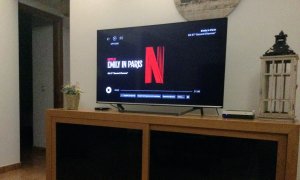 We watched The Crown last year while staying in the Loire valley even though we don’t normally watch much TV on holiday. This year in Lanzarote, we spent many an evening watching Emily in Paris, another Netflix show. I’d found it by searching on the internet for good TV shows to watch on Netflix and Emily came up so we thought we’d give it a go.
The series was created by producer Darren Star who was also the producer of Sex and the City and in some ways Emily in Paris is very similar to the early Sex and the City seasons. Emily was produced for the Paramount TV channel but made its way over to Netflix. It’s a light comedy show about a young girl, Emily, who is asked to move from Chicago to work in the Paris office of a marketing firm. The comedy comes about from highlighting the cultural differences between the USA and France and although the last season, season 5 was a little tame, the previous 4 seasons were excellent.
At the heart of the show is a love story. Emily falls for a young chef who has an apartment on the floor below her Paris flat. He falls for her too but he is engaged to another girl who befriends Emily. Later Emily gets involved with an British banker but then he falls for Emily’s other friend and then the chef’s girlfriend has a lesbian affair. See what I mean about Sex and the City?
According to Wikipedia, the show did get some criticism for stereotyping the French in general and Parisians in particular but for me I thought the depiction of the French was really quite good. Even though I speak only a little French, one of the things that is difficult for an Englishman in France is the speed at which the French speak. It’s not too bad in the Loire but especially noticeable in subtitled French films and TV shows.
What else have I watched on Netflix? Well, I did watch the film version of The Thursday Murder Club as I mentioned in another post a few weeks ago. Other than that, I haven’t watched much else. Netflix is a little overwhelming for me, I much prefer my TV in the old-fashioned way, regular broadcast times like they have on the traditional terrestrial channels.
Still, if Netflix is the TV of the future, I suppose I’d better get used to it!
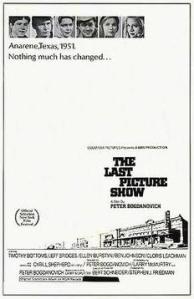 Another modern classic. This film was directed by Peter Bogdanovich and is set in a small town in northern Texas in the early 1950s. The film has an ensemble cast but the two main characters are Sonny and Duane played by Timothy Bottoms and Jeff Bridges. The two are teenagers and old friends and various things happen to them. They fall out over a girl called Jacy played by Cybill Shepherd. Ben Johnson plays ‘Sam the Lion’ who owns the bar and cinema in the town. Sam has a mentally disabled son who Sonny has befriended. Various things happen to the pair but towards the end of the film Duane enlists in the army and is due to leave town so the pair decide to visit the town cinema for the very last picture show as the cinema is about to close after Sam’s sudden death.
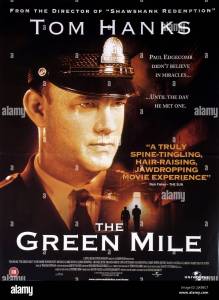 Like The Shining, this is another film based on a book by Stephen King. Tom Hanks plays the head of a death row section of an American penitentiary. One of the inmates is John Coffey, a huge black man who appears to have healing powers. He cures Tom Hanks’ bladder infection but the mood in death row is not good after sadistic Percy Wetmore joins the team and deliberately sabotages the execution of another inmate causing the prisoner to die in terrible agony. The warden’s wife is terminally ill and Hanks and his team wonder if John Coffey could cure her.
 By the time you are reading this, Christmas and New Year will all be over. We’ll be fed up of turkey and sprouts and thinking about taking down the Christmas decorations. So before Christmas becomes a distant memory here’s a quick look at 6 Christmas films that were all shown, with perhaps just one exception, over the last few weeks.

 This week I’ve noticed quite a few items about Richard Burton on the BBC iPlayer. I wasn’t sure why at first but it turns out that this year, 2025, is the centenary of Burton’s birth. He was born Richard Jenkins on November 10th 1925.
 Some years ago I read Melvyn Bragg’s biography of Richard Burton and that book was based partly on these diaries which have now been published and are available to everyone.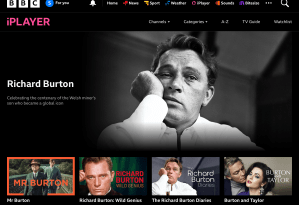
 After graduating, Scott joined the BBC as a set designer and director, working on popular series such as Z Cars and The Troubleshooters. His time in television taught him the mechanics of production and in 1968, he left the BBC to establish Ridley Scott Associates (RSA), a commercial production company. Over the next decade, he directed hundreds of adverts, developing a style of lighting, atmosphere and composition, qualities that made his transition to cinema with The Duellists (1977) both natural and visually striking.
 Just to backtrack a little, we rented this same house back in May and usually, the only time I put the TV on is to watch F1 racing. May is the usual month in the calendar for the Monaco grand prix, one of my favourite races of the year. There is actually plenty of talk recently about cancelling the race as nowadays, the F1 cars are faster and much bigger and so there is very little room left to overtake.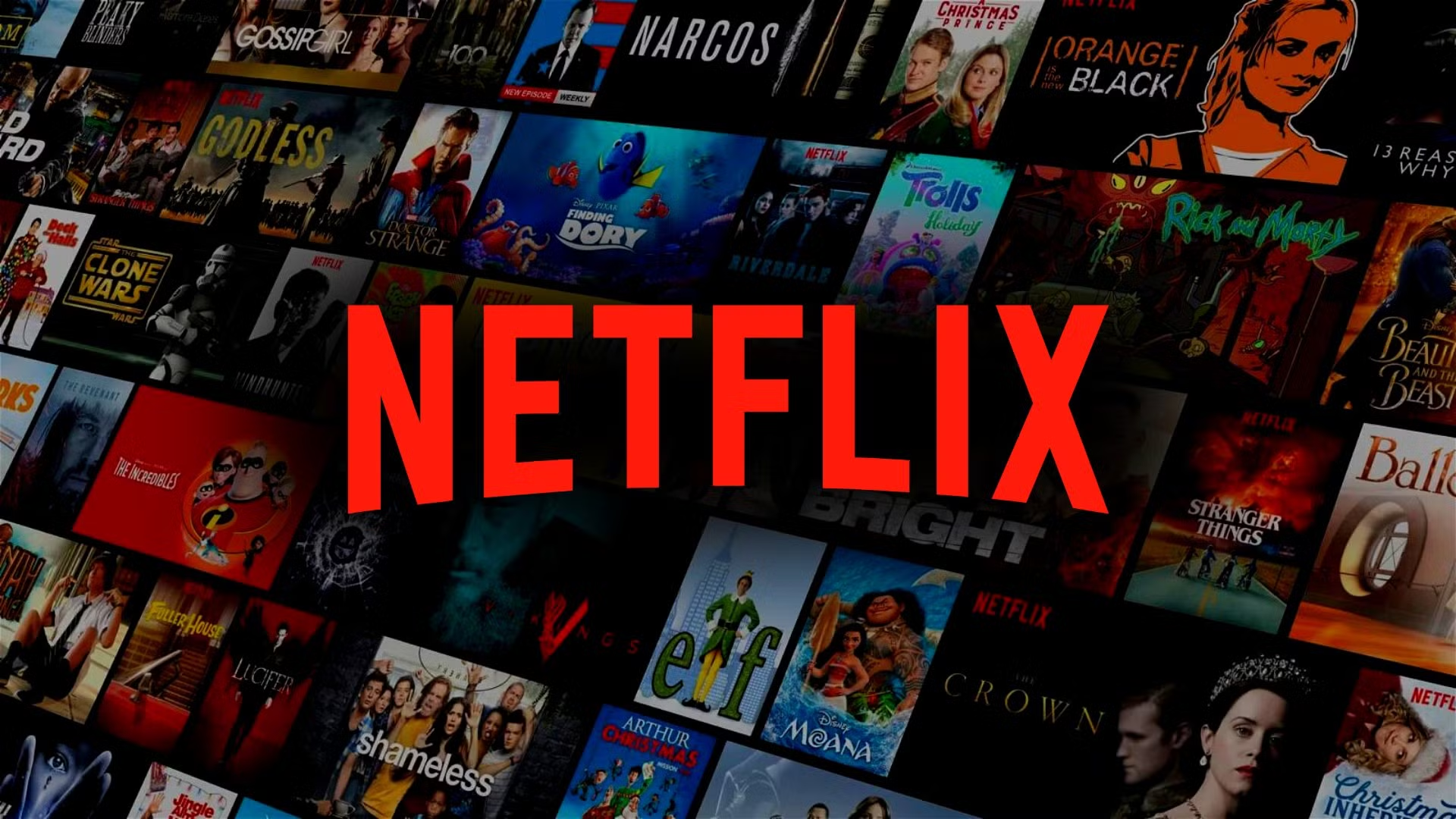

 I’m betting that whatever this guy had produced it couldn’t compare with Billy’s dazzling line-up of classic films.
 Goldfinger is probably one of the best books in the Bond series and only the second 007 book that I ever read. (I’ll tell you about the first one later). I was at school at the time and for one of our assignments in English, we were asked to bring in a book which contained a really good description of a character. I chose Goldfinger as in it, Ian Fleming describes Goldfinger as a man who appeared to have been made using bits of other peoples’ bodies. This must have been in the mid-1960s and although the character of James Bond was pretty well known, the films had not begun to permeate down to the television screen.
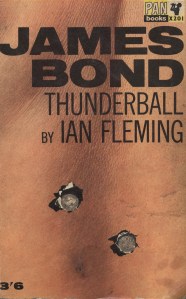 This is an interesting story and the resulting film has perhaps become the quintessential Bond film even more so than Goldfinger. The story is about a criminal underworld organisation (SPECTRE) that steals an aircraft with nuclear weapons and holds the west to ransom threatening to explode the bombs.
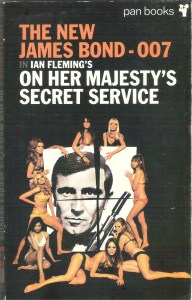 In this book the secret service find that Blofeld, the head of SPECTRE, is trying to assume the identity of the Comte Balthazar de Bleuville. Bond poses as Sir Hilary Bray of the College of Arms in order to meet with Blofeld. Interestingly, Sir Hilary gives Bond a quick resumé of Bond’s family history including the Bond family motto ‘the world is not enough’ which was used by the film producers for the title of a later 007 film unrelated to Fleming’s books.
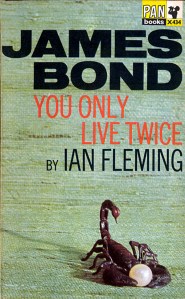 This book follows on from the previous one and we find James Bond depressed and disillusioned with his job after the death of Tracy. M considers sacking Bond but instead sends him on a diplomatic mission to meet the head of the Japanese secret service. The British want access to Russian documents which the Japanese are currently decoding. The Japanese decide to offer this information to Bond if he will assassinate a British resident who has created a garden of death, a garden full of poisonous plants which are attracting many Japanese citizens who want to commit suicide. Bond realises that this man is Blofeld and decides to keep this quiet until after he has killed him.
 Don’t you just hate TV adverts? I certainly do. There are those times when a TV advert comes in useful I suppose. Perhaps when you are watching a good film and you need to make a cup of tea or pop to the toilet. These days in the hi tech world of TV, most people are able to pause live TV and do those things anyway. I wouldn’t mind if the TV adverts were actually worth watching but these days of course they aren’t. Anyway, here are 6 classic TV ads of yesteryear that I think are rather good. Here we go . .
