Remembering Cary Grant

I’ve been a fan of Cary Grant for a very long time. I love his smooth and debonair style, his handsome and tanned good looks and that rather languid transatlantic brogue of his.

In the TV series Archie currently streaming on ITV X they seem to be saying that all of that was an invention, an invention by an Englishman called Archie Leach who transformed himself into a successful Hollywood film star named Cary Grant.

Grant was born Archibald Leach in Bristol, England in 1904. He had a poor upbringing and his mother suffered from depression and his father was an alcoholic. The young Archie was interested in the theatre and performing and his mother was keen on him having piano lessons. His older brother had died before reaching the age of one and this perhaps made his mother a little over protective of the young Archie. Even so, his mother was not a woman who was able to give or receive love easily and the older Cary Grant blamed his childhood relationship with his mother for his problems with women in later life.

When Archie was 9 years old his father placed his mother in Glenside Hospital, a mental institution, telling his son that she had gone away on a long holiday and later, that she had died.

Archie befriended a group of acrobatic dancers known as The Penders and he was able to eventually join them and there he trained as a stilt walker and became part of their act. Later the group toured America and Archie decided to stay, following in the footsteps of others before him like Charlie Chaplin and Stan Laurel who had made their way to the USA in an almost identical way.

On Wikipedia they mention that on the trip over to the USA Archie met Douglas Fairbanks and was greatly impressed by him, so much so that Fairbanks became a role model for the young Archie Leach.

In New York Archie worked in vaudeville with various comedy and theatrical groups. He joined the William Morris theatrical agency and began to pick up many theatre roles. In 1932 he had his first screen test and was given a five year contract with Paramount Pictures. B P Schulberg the general manager of Paramount decided that Archie Leach was not a good enough name for films so Archie came up with the name Cary Grant taking Cary from a stage character he had played and Grant chosen randomly from a telephone directory.

Cary Grant worked hard at his profession and in the TV series Archie they claim that Cary was a role or a part that Archie built up over time. Jason Isaacs who plays Grant says Cary would never be filmed or recorded during an interview because then he was being himself not playing at being Cary. The actor tracked down a recording of Grant made secretly by a student journalist who interviewed Cary over the phone and felt that for the first time he was hearing the real Archie who came over in the recording as very English rather than the usual mid Atlantic voice that we are used to hearing.

It seems to me that many stars who use a different name in the film world are in a way creating a character which they present to the public. You could argue that Marilyn Monroe was a similar personality and that she was a creation of Norma Jeane in the way that Cary Grant was created by Archie Leach.

A breakthrough role for Grant was starring with Mae West in the film She Done Him Wrong and the follow up, I’m No Angel. Grant went on to star in many famous films and amazingly, even though he was a star in Hollywood’s golden years, he was actually the first big star to not be a part of the studio system. He was a freelance actor, not contracted to any studio until 1937 when he signed a four-picture deal with Columbia.

In his early years in Hollywood, Grant shared a house with actor Randolph Scott leading to claims of the two being gay lovers. Still, young bachelors sharing a house with others is not uncommon. David Niven famously shared a house with Errol Flynn and we can hardly class those two as being gay.

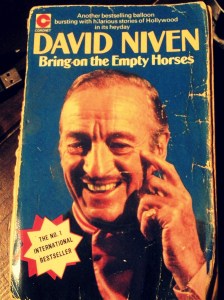
Somewhere in my fairly huge book collection I have a biography of Cary Grant but despite an intensive search I couldn’t find it. I also have a copy of David Niven’s Bring on the Empty Horses which if I remember correctly has a short chapter on Grant. Now where did I put that book?

I did do some quite considerable research to produce this blog post. Firstly, I had to watch the four episodes of the TV series Archie, currently streaming on ITV X. That wasn’t anything difficult of course, it wasn’t a chore, in fact it was very enjoyable. Archie is a wonderful four part series and Jason Isaacs plays an outstanding part. He doesn’t try to impersonate Cary but he did manage to create a look of the late star and he caught Grant’s voice and enunciation perfectly. Most of the series follows Cary in later life when he becomes involved with and later marries Dyan Cannon, Dyan was his fourth wife and she was the mother of his only child Jennifer and she and her mother co-produced the series which is definitely well worth watching.

Next, I searched for the biography I had of Cary but despite searching the entire house I couldn’t find it. Oh well, I have a few copies of Bring on The Empty Horses about the house so I thought ok, I’ll grab that and have a read of the chapter on Cary. Once again, I searched through the entire house but could I find that book? No! Eventually I started to put everything back where I had found it and it was only after idly looking in a box of books that I had only recently packed away and had earlier dismissed, that I finally found it.

Anyway, I had a break from writing to look for that book and after a while when I couldn’t find it I popped the TV on. I wasn’t altogether surprised to find there was a Cary Grant film showing. It was An Affair to Remember, a love story in which Grant’s character, a playboy type meets Deborah Kerr on a transatlantic voyage and the two fall for each other. On arrival in the USA they decide to have a 6 month break from each other as they are both in other relationships and then meet at the top of the Empire State building in New York. It’s not really my cup of tea, in fact it’s overtly sentimental but then, sometimes a small dose of sentimentality is good for you. Cary Grant plays, well, Cary Grant and Deborah Kerr plays a very English New Yorker.

I have two of Grant’s other films on DVD, To Catch a Thief and North by Northwest, both directed by Cary’s favourite director, Alfred Hitchcock.

OK, enough TV watching for now. Getting back to Bring on the Empty Horses, David Niven wrote about Cary Grant in a short section of his book called Long Shots and Close Ups where he gives his readers a quick sketch about various film people. The section on Cary is only three and a half pages and not the full chapter I was expecting but Niven clearly liked the man and in those three and a bit pages, picked up on some essential elements of Grant’s character. Niven remembers Cary Grant as an intelligent man, particularly with money and he listed people like multi millionaire Howard Hughes among his friends. Grant invested his earnings well and became one of the richest people in Hollywood. He had an obsession with his health, embarking on various health pursuits and then moving on to the next one. Niven remarks that once when Cary was taking swimming lessons to learn the crawl, Niven mentioned that Cary could already swim the crawl. Grant answered ‘yes but I want to swim the crawl perfectly!’ Cary gave up smoking by hypnotising himself and Niven also mentions his use of LSD during his treatment by a psychiatrist which is also brought up in Archie.

Cary Grant retired from films in 1966 the year his daughter was born and he and Dyan Cannon divorced in 1968. Many tried to bring him out of retirement for various films including his favourite director Alfred Hitchcock but he declined. He must have wanted to keep on working though because he did accept a position on the board of Fabergé.

He died in 1986 aged 82 and left behind an estate reputedly worth around 80 million dollars. Archie is a well made and quite fascinating piece of TV. Look out for it, it’s well worth watching.


What to do next: Here are a few options.

Share this post on your favourite social media!

Hit the Subscribe button. Never miss another post!

Listen to my podcast Click here.

Buy the book! Click here to purchase my new poetry anthology.

Click here to visit Amazon and download Floating in Space to your Kindle or order the paperback version.

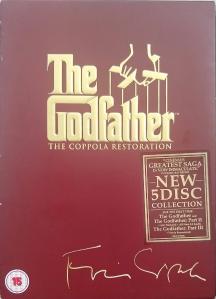
The Godfather: The Film of the Book or the Book of the Film

I’ve written a few of these ‘book or the film’ posts but in this one I’m going to stick with one particular film and book; The Godfather.

The Book

I’m not sure which came first for me, the book or the film but I actually think it was the book. The Godfather was written by Mario Puzo and is the story of Don Vito Corleone, the head of one of the five mafia families of New York. The book opens with the wedding of Don Corleone’s daughter and Puzo sets the scene and introduces the various characters.
Don Corleone is a Sicilian and apparently no Sicilian can refuse a request on the day of his daughter’s wedding. One of those with a request for the don is singer Johnny Fontane whose show business career is waning. He feels that a part in a new film will revitalise it but the producer will not cast him. The don is happy to help out his favourite godson and dispatches his advisor and stepson Tom Hagen to Hollywood to sort things out.

Another supplicant is a funeral director. Two youths have attacked and beaten his daughter and because of political connections the courts of law have only handed down suspended sentences. The father asks for Don Corleone to give him revenge but the Don declines. The funeral director has never shown the correct respect to the Don but when he does and finally calls him Godfather then, and only then, does Corleone issue orders for the youths to be brutally beaten.

Some time afterwards the Don agrees to meet fellow mafioso Sollozo who wants Corleone’s help with a drug smuggling operation. The Don declines and this sets off a violent war between the mafia gangs.

The Film

Francis Ford Coppola was the director of the film version and was also the co-writer of the screenplay along with Mario Puzo. Coppola wanted Marlon Brando to play the part of Don Corleone even though Brando at the time was rather unpopular with the producers. He was expensive, his last few films had not done well and his time wasting attitude had added huge expenses to his pictures. After the director had made the producers understand how important Brando was, they set various conditions for his employment. He would have to work for a reduced salary and put up a bond to ensure he would not delay the production. Another was that he had to have a screen test. Coppola has told the story in various interviews how he and his film crew had entered Brando’s house like ninjas and quietly set up their equipment. Brando slicked down his hair with shoe polish and stuffed cotton balls into his mouth to make the transformation into the aging mafia boss.
Paramount also wanted to shoot the film on their back lot but Coppola persuaded them to shoot on location in New York and stick to the original time frame of the book which was set in the 1930s and 40s.

Various people were auditioned for parts in The Godfather but finally the cast was resolved and shooting began with Brando as the Don, James Caan as Sonny, Al Pacino as Michael, Robert Duvall as Tom and Diane Keaton as Kay Adams.

The Book

The book is a fairly heft one and there is much in there that is not covered by the film. Johnny Fontane for instance features more in the book, while he plays only a supporting role in the film. There is a further story in the book about Lucy, a friend of Sonny’s wife with whom he is having an affair. After Sonny’s death Lucy feels she will never find not only love but sexual pleasure ever again. The reason for this is that Sonny had a rather large penis and Lucy’s corresponding anatomy is rather large, however she falls for a doctor who sorts her out with an operation which restores the anatomical status quo.

Going back to the Johnny Fontane character, there have been various stories and rumours which imply the character was based on Frank Sinatra. Like Johnny Fontane, Frank was tied to a lifetime contract with a bandleader, in this case Tommy Dorsey but Dorsey somehow relented and released Sinatra. Some say mobster Willie Moretti was instrumental in helping Sinatra free himself from the contract. Later when things weren’t going so good for Sinatra, he revived his career by appearing in the hit film From Here to Eternity for which he won a best supporting actor Oscar. In the book, Johnny Fontane is after a similar film part but the producer declines to give it to him. At the wedding of Corleone’s daughter, Fontane asks for the Don’s help, cue the famous scene where producer Jack Woltz finds his favourite racehorse’s head in his bed.

The Film

Coppola decided that instead of finding the horse at the end of his bed like in the book, it would be better if Woltz awoke, was disturbed by something wet, pulls the bedclothes away to see blood and then uncovers the horse’s head. The head was the actual head of a horse, procured from a dog meat factory and Coppola mentions on the commentary to my DVD version that lots of animal lovers sent him hate mail about the horse, even though the horse had been condemned to its fate anyway.
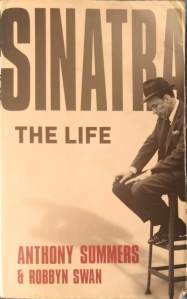
Sinatra always denied any involvement with the mafia although he did sing at the wedding of mafia boss Willie Moretti’s daughter, just like Johnny Fontane did at the Corleone wedding that opens the film. Anthony Summers, in his book about Sinatra, claims that the story was true and mafia enforcer Johnny Blue Eyes put pressure on studio boss Harry Cohn to give Sinatra the film role that rebooted his career.

Director Fred Zinnemann thought Sinatra might be good in the role so Cohn was happy to go along with the idea.

The Book

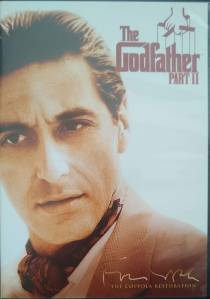
As previously mentioned, the book does have some storylines which were not used in the film but one chapter was a look at the beginnings of Vito Corleone. Born Vito Andolini in the Sicilian village of Corleone, Vito’s father was murdered by a local mafia boss and the young Vito was smuggled away to America. In America he took the name of Corleone and seemed to slip quietly into the role of mafia Don by murdering Fanucci, a New York Sicilian Godfather who preyed on his fellow Italians. Although this element of the story wasn’t used, Coppola kept the storyline for use in The Godfather Part II. The follow up film was a film classic in its own way.
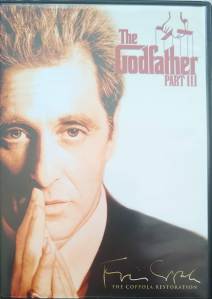

The Godfather Parts II and III

In part II there are two parallel stories. One is the story of Vito Andolini, as described above, played by Robert De Niro and another follows on from the first film. Michael is now the head of the family and gets involved with gangster Hyman Roth with investments in Cuban casinos. After the Cuban revolution Michael realises Roth is out to kill him and so has him murdered. A senate investigation looks into Michael’s activities with information provided by Frank Pentangeli, a former member of his organisation, but Michael brings pressure to bear on the informant and the investigation collapses.

In The Godfather Part III Michael’s story continues. He is reconciled with his sister after the murder of her husband in the original film. He also gets involved in a scheme in Europe where he hopes to become fully legitimate but other mafia bosses have different ideas. The Papal bank scandal and the death of Pope John Paul I are real events that are also thrown into the mix. The film was the weak element in the Godfather trilogy. In 2020 The Godfather Coda: The Death of Michael Corleone was released. It was just a re-edited version of part III and personally I still didn’t find it anywhere near as good as the other two films.

Marlon Brando worked with Coppola again on the film Apocalypse Now. He played the part of an American Colonel in Vietnam who has apparently gone insane and Martin Sheen is sent to assassinate him. Brando turned up on set hugely overweight and not knowing his lines. He then decided to re write or improvise most of his scenes and the director was forced to shoot Brando in shadow due to his weight. Basically, he pulled all the stunts that Paramount expected of him in The Godfather. Not the best way to repay a director who had resurrected his career with the role of Don Corleone.

In 1990, Brando appeared in the comedy film, The Freshman, playing a parody of Don Corleone. When the shooting over ran, Brando demanded a million dollars to film for an extra week. The producers declined to pay and Brando threatened to badmouth the film to the press. Eventually they paid.

Brando died in 2004.

In 2023 Coppola finished filming his latest project, Megalopolis, a sci fi film about the rebuilding of New York after a major disaster.

Conclusion.

I enjoyed the Mario Puzo novel and I did re-read it for this post but it seems to stray into areas which really have no relevance to the main narrative which I found slightly annoying. The film version, which I also watched recently is a modern classic which continues to entertain everytime I see it. I like both the book and the film but I’d have to say I think the film version has the edge.


What to do next: Here are a few options.

Share this post on your favourite social media!

Hit the Subscribe button. Never miss another post!

Listen to my podcast Click here.

Buy the book! Click here to purchase my new poetry anthology.

Click here to visit Amazon and download Floating in Space to your Kindle or order the paperback version.

The TV Shows of Gerry Anderson

Many years ago when I was still at junior school, one of my friends asked me if I had seen a new TV show about a flying car. I hadn’t but apparently it was really good and so I made a mental note to watch out for it. As a child I was pretty keen on TV. My dad used to call me ‘square eyes’ because I watched so much TV and as you might imagine I soon found the TV show my friend had told me about. It was a short puppet show about a special machine called Supercar that could not only fly but also dive under the sea. It was designed and built by Professor Popkiss and Dr Beaker and the test pilot was a guy called Mike Mercury. I loved Supercar and everything about it and even though I didn’t realise it then, I had become a huge fan of TV producer Gerry Anderson and his Century 21 Productions.

Gerry Anderson was born in 1929 and after the war earned a traineeship with the British Colonial Film Unit. Later he worked for Gainsborough Pictures and had various jobs, subsequently as a director. He and cameraman Arthur Provis formed a production company called AP Films after their two names and began producing TV shows for children. Their first project was in 1957 called The Adventures of Twizzle and was the first time Gerry worked with puppeteer Christine Glanville, musician Barry Gray and special effects supervisor Derek Meddings.

They followed up with more puppet shows, Torchy the Battery Boy and the first series I remember, Four Feather Falls, a cowboy show about a sheriff with magic guns.

Anderson married his wife Sylvia in 1960 and the two collaborated on Supercar, Gerry’s first sci-fi puppet show in 1960. The series marked the first time Gerry used the name Supermarionation to describe the process which enabled the puppet mouths to move in synchronisation with pre-recorded dialogue. All the characters in the shows had American accents so the shows could be sold to the USA and it was Sylvia who was responsible for the characters and their fashions while Gerry concentrated on other aspects of the shows.

The next series was Fireball XL5 about a spacecraft that was part of the World Space Patrol piloted by Steve Zodiac. The following show, Stingray was the first to be filmed in colour. Stingray was a submarine in the service of the WASP, the World Aquanaut Security Patrol and was piloted by Troy Tempest and his colleague ‘Phones’ who was a master at using sonar equipment. The duo discover an undersea kingdom where King Titan holds sway over his people, the Aquaphibians. Troy and Phones rescue the mute undersea girl Marina who joins them onboard Stingray. Most of the characters had sea related names like, Marina, Commander Sam Shore and his daughter, Atlanta. Atlanta was voiced by Lois Maxwell who played the original Miss Moneypenny in the James Bond films.

Stingray was probably my favourite of Anderson’s TV shows. I particularly loved the opening sequence in which Commander Shore exclaims ‘Anything can happen in the next half hour!’

Stingray was filmed in 1964 and the show fitted neatly into the expanding Anderson universe set, like all his sci-fi shows, 100 years into the future. Around this time AP Films developed a merchandising company responsible for licensing all kinds of items related to the shows, things like models and puppets and so on. I used to have a puppet of Venus, the space doctor from Fireball XL5 although I think I would have preferred a Steve Zodiac puppet. I had a Fireball XL5 rocket which could be fired into the air with a big catapult and as it came down, a parachute deployed to float it down gently. I also had quite a few Stingray models. One was a plastic kit I had to put together and another was a plastic Stingray shaped water pistol.

image courtesy flickr

There was also a comic which I absolutely loved called TV21 with comic strips of all the sci-fi Anderson shows. TV21 had a front page fashioned like a newspaper with headlines referring to the stories coming up on the inside pages.

The next project for AP Films was probably Gerry and Sylvia’s greatest success and it was called Thunderbirds. Thunderbirds was about a secret organisation called International Rescue that had a small fleet of highly advanced machines and equipment with which to perform rescue operations. Millionaire ex-astronaut Jeff Tracy was the head man and the organisation was secreted in his island home. His five sons were the Thunderbird pilots, John, Scott, Virgil, Gordon and Alan, all named after US astronauts of the 1960s. The genius behind the Thunderbird craft was Hiram Hackenbacker, known as ‘Brains’. Thunderbird’s nemesis was a secret agent known as the Hood because of his talent for disguise and in many episodes the Tracy brothers had to ask their London agent, Lady Penelope, to track him down and sort him out.

Lady Penelope Creighton-Ward lived in a huge mansion somewhere in southern England and her manservant and chauffeur was Parker, a reformed safecracker. The head of ITV Sir Lew Grade saw the first episode and was so impressed that he asked for the episodes to be extended from 30 minutes to a full hour, less TV adverts of course. Gerry wanted Fenella Fielding to voice Lady Penelope but in the end Sylvia herself took on the role.

Thunderbirds is probably my second favourite of all the Gerry Anderson series. The great thing about it and really, the secret of its success was the highly intelligent scripts which treated its audience of children not as kids but as intelligent young adults. Two scripts that spring to mind were one called The Cham Cham about a code transmitted on a musical melody and another where Parker was called upon to break into the Bank of England. Later in the episode someone is trapped inside the vault and Parker is asked to break in again to rescue the man before the air is used up in the vault. Parker though thinks that his old mate, a bank robber recently released from prison, is about to complete his life’s ambition to break into the bank and so he tries to slow down his and Penelope’s drive into London.

A successful feature film, Thunderbirds are Go, was made in 1966 and AP Films began a new life as Century 21 Productions.

The follow up TV series was called Captain Scarlet and the Mysterons. Captain Scarlet is part of an organisation called Spectrum in which all the members have code names relating to colours. The Mysterons have the power of re-animation and both Scarlet and Captain Black have been re-animated giving them powers of indestructibility. It wasn’t really my cup of tea but the puppets in the series made a step forward in having normal dimensions instead of large heads like the previous shows.

Two further puppet shows followed, Joe 90 about a young boy who becomes a secret agent by using the brain patterns of various people. His father, Professor MacLaine had designed a machine called the Big Rat (Brain Impulse Galvanoscope Record and Transfer -funny how all these old acronyms come back to me!) The Big Rat takes the brain pattern of a pilot for instance, feeds them to the professor’s young son -the Joe 90 of the title- and he is able to fly a plane.

The Secret Service was a mixed puppet/live action series about a secret agent who is shrunk down to a small size and the producers used puppets in normal sized sets. Stanley Unwin played the role of an eccentric vicar who is part of a secret organisation called BISHOP (British Intelligence Service Headquarters – Operation Priest). The series was cancelled after 13 episodes as Lew Grade didn’t think the inclusion of comedian Stanley Unwin and his gobbledegook language would work in the USA.

Gerry Anderson’s ambition was always to leave the puppet shows behind and move on to live action features and after a live action sci-fi film Doppelganger, Gerry began work on UFO. UFO was set in the 1980s and was about a secret organisation called SHADO (Supreme Headquarters Alien Defence Organisation). The Earth is under attack from UFOs and it is SHADO’s job to defend the world. The headquarters is based in the Harlington-Straker film studios with an outpost on the moon called Moonbase. Moonbase tracks the UFO’s with the help of SID (Space Intruder Detector) and launches their interceptors. Ed Bishop, previously the voice of Captain Blue in Captain Scarlet, played Ed Straker and Gabrielle Drake was the Commander of Moonbase.

I loved the series but the TV networks were unsure whether UFO was aimed at children or adults, presumably because of Gerry Anderson’s previous childrens’ shows. Anderson prepared for the second series in which the American networks had asked for more lunar based stories. Many new sets were built and then series 2 was cancelled. Gerry then offered the networks a new show, Space 1999, centred entirely on the moon.

In Space 1999, a series I never really liked, a nuclear explosion pushes the moon out of earth orbit and out into space and the series chronicled the adventures of those still living on Moonbase Alpha. Husband and wife team Martin Laudau and Barbara Bain starred in the show which ran for two seasons but during the production Sylvia and Gerry divorced.

Gerry returned to producing more TV shows for children like Terrahawks and Space Police but even though new technology and techniques helped with the puppetry and filming, without Sylvia and her characterisations, those productions were a little lame.

In the 1990s Gerry produced a new series of Captain Scarlet replacing the puppets with computer animations.

Gerry Anderson died in 2012 aged 83 while Sylvia lived to be 88. In 2015 she made a guest appearance in an episode of a new animated series of Thunderbirds are Go as Great Aunt Sylvia, a relative of Lady Penelope. She died in 2016.

The two left behind a legacy of some much-loved television shows but what was the secret of the success of Gerry and Sylvia’s original productions? Personally, I think there were a number of elements: Outstanding and intelligent scripts that treated the younger viewers as young adults. The fabulous music and theme tunes of composer Barry Gray. The wonderful characters created by Sylvia. The special effects from Derek Meddings who went on to work on the James Bond films and of course Gerry Anderson who brought all those elements together.

This year, 2023, Thunderbirds can be seen on the Talking Pictures TV channel, 58 years after it was first seen on TV.


What to do next: Here are a few options.

Share this post on your favourite social media!

Hit the Subscribe button. Never miss another post!

Listen to my podcast Click here.

Buy the book! Click here to purchase my new poetry anthology.

Click here to visit Amazon and download Floating in Space to your Kindle or order the paperback version.

7 Directors Who Acted in Their Own Films

I thought I’d try to write or at least start this post off by writing from memory without using Google. I could only come up with 6 directors so I added another who acted but not in his own films. I decided to exclude actor/directors like Woody Allen and Clint Eastwood but then I broke that rule by adding Orson Welles. Now that the parameters are clear for this post, well fairly clear, let’s get going . . .

Alfred Hitchcock

Hitchcock was a British director who began in the days of silent films and came to be known as the master of suspense. Blackmail made in 1929 was the first British Talkie and 10 years later producer David O Selznick lured him to Hollywood where he made many films that are now regarded as classics, films like North by Northwest, Dial M for Murder, Rear Window, The Birds and Pyscho. Hitchcock might also be seen as one of the first celebrity directors. He became popular because of his habit of appearing, however briefly, in all of his films, sitting on a bus for instance, just missing the bus in another. He also became well known by introducing his television series, Alfred Hitchcock Presents. He is probably the most famous director to appear in his own films. He never played a speaking role but he appeared in every one of his films in some small way.

Hitchcock was knighted in 1980 and died in March that same year.

Quentin Tarantino

Tarantino is an interesting filmmaker in many ways, writing and acting as well as directing. His films also seem to follow an unconventional path with many extended scenes and dialogue to fill in character background. I haven’t seen many of his films but Pulp Fiction from 1994 is one of my favourites and it involves a number of overlapping storylines. Tarantino plays the part of Jimmie, a friend of two gangsters played by John Travolta and Samuel Jackson. Travolta’s character accidentally shoots someone in the back of their car and the two turn to Jimmie for help who then calls another gangster played by Harvey Keitel who sorts out the situation.

Oliver Stone

Oliver Stone is one of my very favourite filmmakers, responsible for directing such films as Platoon, Born on the Fourth of July and JFK. In Wall Street Stone takes a close look at the American stock market and the world of stocks, shares and stockbroking. A young ambitious trader dreams of working with big time corporate trader Gordon Gekko,

The young ambitious trader is Bud Fox played by Charlie Sheen and he manages to wangle himself into the world of the high flying Gordon Gekko played by Michael Douglas who won an Oscar for his portrayal. The two find that rival stockbroker Sir Lawrence Wildman is buying Anacot Steel and they buy shares and then leak information to the press which drives up the price. In a montage of shots, Oliver Stone himself appears as an investor who is buying shares.

Stone also had a cameo in the film Dave in 1993 in which the President of the USA has a stroke and an impersonator takes over until the President is well enough to return. Stone plays himself as a ‘conspiracy theorist’ claiming that the President has been replaced by a doppelganger.

Martin Scorcese

Scorcese is one of the great filmmakers of all time having directed numerous classic films such as Goodfellas, Raging Bull, The Aviator and many others. In Taxi Driver, Scorcese follows a disturbed former Vietnam veteran called Travis Bickle played by Robert De Niro. Bickle works nights in New York City as a taxi driver and as he drives around we hear his voice on the soundtrack lamenting the moral decay of the city and his desire to rid the streets of the scum that he sees nightly. Later he plans to assassinate a political candidate but eventually shoots the pimp of a young girl. Wounded by the pimp, he falls into a coma but awakens to find he has become a hero to people in the city.

In one scene, Scorcese plays a passenger in Bickle’s cab who asks to stop below an apartment where his wife is apparently involved with another man.

Martin Scorcese continues to make films and his latest release in 2023 is Killers of the Flower Moon.

John Huston

Born in 1906, John was the son of the Walter Huston and his wife Rhea. Walter was an actor and Rhea a sports editor for various magazines. His parents divorced when he was young but Huston spent time with both his parents. He wrote stories for various magazines and decided to try his hand with the new film business starting up in Hollywood. Huston had a contract with Universal, his father’s studio, and wrote dialogue for various films but after a drunken incident driving a car which left an actress dead he left to live in Paris. Later he returned and began writing for Warner Bros with great success. After the hit film Sergeant York starring Gary Cooper for which he wrote the screenplay, he managed to convince the film company to let him direct a picture. Huston chose The Maltese Falcon and the result was an absolute classic film starring Humphrey Bogart.

In 1948 Huston directed The Treasure of The Sierra Madre. He adapted the book by B Traven for his own screenplay and also cast his father, Walter Huston, as the old time prospector who takes two others, Humphrey Bogart and Tim Holt, on a search for gold.

In the opening scenes Bogart is down on his luck in the Mexican town of Tampico and approaches a smartly dressed American asking ‘could you stake a fellow American to a meal?’

Later Bogart, as Fred C Dobbs, approaches the same man again until the man asks ‘can’t you occasionally go to someone else?’ The smart American was played by Huston himself.

Huston had various other roles as an actor, one I remember was in the 1960’s spoof version of Casino Royale. Various directors contributed to the chaotic film including Huston. He was to shoot a segment about M, the head of the Secret Service but Robert Morley was unable to play the part so Huston played it himself.

Huston directed numerous films but died in 1987 aged 81.

Orson Welles

Primarily Welles was known as an actor but he directed many films, including his very first one, Citizen Kane which has become known as one of the greatest films of all time. Welles was known for having one of the most incredible contracts in Hollywood history, not in terms of money but for the creative control that Welles had. In Citizen Kane the film opens with the death of Kane, a millionaire newspaper magnate. His last words were ‘Rosebud’. The makers of a cinema newsreel decide to find out what or who Rosebud was.

To do so they research Kane’s life; his inheritance of a huge fortune, his takeover of a newspaper, his great wealth, his power and influence, his marriage and divorce and ultimately his death. The reporters never find the answers to their questions but we, the cinema audience, have the secret revealed to us right at the end of the picture.

Citizen Kane is a wonderful piece of cinema with an outstanding visual style and the only criticism I can put forward is that for all its visual fireworks it is a film with a cold centre, a cold heart. Does the viewer feel sympathy for Kane? I’m not sure he does.

Welles went on to make many films but never again achieved the directorial success he had with Kane. He died on the morning of October 10th, 1985 from a heart attack. He left behind numerous unfinished films and screenplays.

Cecil B DeMille

Cecil was born in 1881 and is known as one of the founding fathers of American cinema. He was famous as a director of epics from the silent Ten Commandments in 1923 to Samson and Delilah and another version of The Ten Commandments, this time with sound and shot in colour in 1956.

DeMille actually appeared in many cameos doing prologues or trailers but in 1950 he starred as himself in Sunset Boulevard directed by Billy Wilder. In the film, retired silent star Norma Desmond wants to return to the screen. She has written a screenplay which she has asked Joe Gillis, a writer desperate for some income, to edit. The script is terrible but after a phone call from the studio, Desmond arrives at the Paramount lot to see DeMille. DeMille finds that the phone call was actually a request to hire her grand old car for use in a film and not, as Norma thought, a call for her to return to films.


What to do next: Here are a few options.

Share this post on your favourite social media!

Hit the Subscribe button. Never miss another post!

Listen to my podcast Click here.

Buy the book! Click here to purchase my new poetry anthology.

Click here to visit Amazon and download Floating in Space to your Kindle or order the paperback version.

A Tale of 4 Ships

I started this post by looking at an old one, a post about famous Pilots. That inspired me to make a sort of seagoing version. I started thinking about famous captains but I was struggling to think of any so I went with famous ships. Perhaps I could have stuck with captains after all; Captain Kirk, Captain Ahab, Captain and the Tenille and so on. Oh well, I think I’ll save that for another time so here we go with famous ships.

Victory

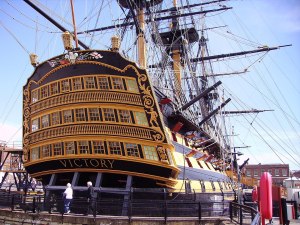
I should think that almost everyone reading this will know that HMS Victory was Nelson’s flagship at the battle of Trafalgar. The ship was one of 12 that had been ordered by the British government in 1758. The hull was laid down in 1759 and finally launched in 1765. 6,000 trees were used in the construction and 6 foot copper bolts were used to hold the construction together as well as treenails or dowels used to secure lesser elements of the ship. Once the frame was completed it was usual to let the wood dry out or ‘season’ before fitting the ship out further. Due to the end of the Seven Years’ War, the hull was left to dry for three years and the ship was finally launched in May of 1765.

By Ballista – Own work, CC BY-SA 3.0, https://commons.wikimedia.org/w/index.php?curid=749934

The ship had various adventures with the Royal Navy before becoming Admiral Nelson’s flagship in the battle of Trafalgar.

On the 21st of October, 1805, the Victory and the British Fleet began battle with the French. The British ultimately won but a sniper on the French ship Redoutable fired at Nelson hitting him with a musket ball which fatally wounded him. The musket ball was later recovered by the Victory’s surgeon William Beatty and he later had it mounted into a locket which he wore for the rest of his life. On Beatty’s death, the locket was presented to Queen Victoria.

The Victory was badly damaged in the battle and had to be towed back to England. It was repaired but was no longer a first rate ship and was relegated to various duties, even becoming a prison ship at one point. The Admiralty decided to break up the Victory and use her timbers and fittings in other ships. The public outcry was so great that the Admiralty hesitated to go ahead.

To a great extent the ship was abandoned to rot away and in 1922, the ship was found to be in such a state of disrepair that it was moved into a dry dock at Portsmouth, actually dock no 2, the oldest dry dock in the world. Restoration began after an appeal to the public for funding and dock number 2 became the Victory’s permanent home.

Bismarck

Bismarck was the first of two battleships built for Nazi Germany’s navy. Named after Chancellor Otto von Bismarck, the ship was laid down at shipyards in Hamburg in July 1936 and launched in February 1939. Final construction work was completed in August 1940, when she was commissioned into the German fleet. Bismarck and her sister ship Tirpitz were the largest battleships ever built by Germany.

In May 1941 the Bismarck planned to enter the shipping lanes of the Atlantic and attack convoys bringing much needed supplies into Britain. The Bismarck in company with the Prinz Eugen was engaged by the HMS Hood and the Prince of Wales. The Hood was destroyed in the battle while the Prince of Wales was badly damaged and forced to retreat.

The British began a relentless pursuit of the German vessel and two days later she was severely damaged by torpedoes fired by aircraft from the HMS Ark Royal. The rudder had been damaged on the Bismarck and the ship was forced to steam in a wide circle. The battleship came under further attack from the British ships and a major hit on the Bismarck’s bridge killed or disabled Captain Lindemann and Admiral Günther Lütjens. The remaining executive officer ordered the crew to abandon and scuttle the Bismarck in order to prevent the British capturing and boarding the vessel which eventually capsized and sunk.

The entire episode was made into a film in 1960 called Sink the Bismarck. Kenneth More starred as the head of the underground naval operations war room and he and his staff coordinate the hunt for the Bismarck.

Bounty

Another famous seagoing story that has been made into a feature film, several films in fact, is the story of the mutiny on the Bounty. The mutiny occurred in April 1789 and was led by Fletcher Christian who was an acting Lieutenant on board the Bounty. The Bounty’s mission was to sail to Tahiti and collect breadfruits and then deliver them to the West Indies. It may have been that a five month layover on Tahiti, where many of the men formed relationships with the native women, was at the heart of the mutiny. William Bligh, the captain of the Bounty, had at one point been a great admirer of Fletcher Christian, even promoting him to the rank of acting second lieutenant and thereby becoming his second in command. The relationship soured later though and when the ship began the journey home Christian decided to stage a mutiny. Bligh and his supporters were made to leave the ship on the Bounty’s launch, a 23 foot boat and were given food and water for 5 days. Bligh sailed to a nearby island for supplies and then made an astonishing journey in the small boat to Timor where the authorities were alerted to the mutiny.

The mutineers fled in the Bounty and returned to Tahiti but Christian realised that this would be the first place the navy would come to search for them. Sixteen crew members opted to stay on Tahiti, Christian and the rest of the mutineers together with a contingent of Tahitans then tried to settle on another island but the natives there were unfriendly and the Bounty left in search of another island. The mutineers then came across Pitcairn Island and seeing that it was marked incorrectly on naval charts decided to settle there. Numerous disagreements arose later with the Tahitans as many of the British considered them as slaves. Fletcher Christian was later murdered on the island although he was survived by a son and other children.

Today, the descendants of the mutineers still live on the island.

Various film versions of the story were made but the most famous featured Clark Gable as Fletcher Christian and Charles Laughton as Captain Bligh. In the 1960’s a version was made with Marlon Brando and Trevor Howard. Brando was so taken with Tahiti where numerous scenes were shot, he made it his home for many years. Another version, The Bounty appeared in 1984. It was a project originally started by director David Lean and writer Robert Bolt but after various disagreements with the producer, Lean backed out and the New Zealand director Roger Donaldson took over.

Titanic

The story of the Titanic is one that has captured the imagination of many over the years and even today seems to be still in the news after a deep diving mini submersible was crushed in the depths of the ocean while taking sightseers to view the wreck of the great ship.

The ship was the largest afloat and was designed to be the epitome of luxury. It was known as the ‘unsinkable’ ship and made its maiden voyage in 1912 from Southampton to New York in the USA. On the voyage the ship struck an iceberg and the hull was ruptured. The Titanic sank with a great loss of life. A major flaw however was that there were not enough lifeboats for the crew and passengers in the event of a tragedy. Another was that the 16 watertight compartments were not truly watertight and when the first one filled with water, the water then spilled over into the next one and so on until the ship sunk.

Numerous films and TV shows have been made about the sinking. Kenneth More starred in A Night To Remember, a 1958 British film about the Titanic. In the 1960’s the first episode of the time travel TV show The Time Tunnel featured a story about two American scientists who are transported back in time and arrive on board the doomed ship. A more recent film blockbuster was the 1997 Titanic directed by James Cameron. Leonardo DiCaprio and Kate Winslet star in the film that weaves a tragic love story with the fate of the famous ship. Titanic was the most expensive film ever made at the time with a budget of 200 million dollars. A huge reconstruction of the ship was made in Rosarito, Mexico and was built on a lifting platform which was able to tip the ship to simulate the sinking. The film was a great success winning 11 Oscars including one for Best Picture.

Personally I rather like Raise The Titanic, a 1980 British film version produced by Lew Grade and his ITC Entertainment company and based on the novel by Clive Cussler


What to do next: Here are a few options.

Share this post on your favourite social media!

Hit the Subscribe button. Never miss another post!

Listen to my podcast Click here.

Buy the book! Click here to purchase my new poetry anthology.

Click here to visit Amazon and download Floating in Space to your Kindle or order the paperback version.

The Forgotten Stars of Columbo

Famous faces who have appeared in the classic detective series.

If you happen to be a big fan of murder mysteries then Sunday is a great day for you. Over on 5 USA on UK Freeview TV you can watch the classic detective series Columbo to your heart’s content.

Columbo first appeared in the early 1970s as part of the Mystery Movie TV series. Each week followed a different detective trying to track down a murder case, sometimes it was MacMillan and Wife and other weeks McCloud, Banacek or various others. The most popular one by far though was Columbo.

Columbo was a homicide detective for the LAPD and he was played by Peter Falk although the role was originally written for Bing Crosby. Crosby however thought a regular TV slot would interfere too much with his golf so he turned down the role, went back to the fairway and the part went to Peter Falk who made it his own.

If you ever see the original pilot, shot in 1968, you can see how Crosby might have fitted into the part as Falk plays Columbo in a very Crosby like laid back way. The very first guest murderer was Gene Barry who was familiar to TV audiences after playing Amos Burke in Burke’s Law for many years. He also starred in a 1953 film version of War of the Worlds.

The pilot episode also introduced audiences to a particular feature of Columbo in that we see who the murderer is and how he commits the crime first. Then we see lieutenant Columbo gradually solve the clues and get his man, or woman.

Columbo appears to be bumbling along chewing on his cigars and eating chilli but we soon realise that behind this façade and his famous raincoat, is a very shrewd detective.

Roddy McDowell and Ida Lupino

Short Fuse is one of my very favourite episodes and two famous stars make guest appearances. The guest murderer is Roddy MacDowell. Roddy became a child star in the 1940’s appearing in films like How Green Was My Valley and Lassie Come Home. He also played Cornelius in the Planet of The Apes films and in the subsequent TV series. Although he appeared in many films, he also appeared in a huge number of TV series and stage productions. He died in 1998 aged 70.

In the same episode, Ida Lupino plays murderer Roddy McDowell’s aunt, unable to believe that Roddy was the murderer of her husband. She appeared in another episode too, Swan Song, in which she gets bumped off by guest murderer Johnny Cash.

Ida Lupino, like Roddy MacDowell, was born in England, in fact both lived in the Herne Hill area of London. She wanted to be a writer rather than an actress but went into acting as she was part of a theatrical family and it seems that becoming an actor was expected of her. She appeared in many British films before moving to the USA in 1933.
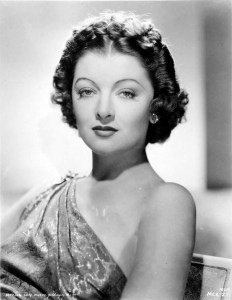
She wasn’t content to just act in films and was very critical of the parts she was offered, being suspended numerous times by Jack Warner, the head of Warner Brothers. She and her husband Collier Young formed a production company called The Filmmakers Inc in 1948. The company produced twelve films, six of which Lupino directed and five of which she wrote or co-wrote. The company closed its doors in 1955 and Lupino began directing for TV. She was one of the very first Hollywood TV and Film directors and was the only woman ever to direct an episode of The Twilight Zone. Ida Lupino died in 1995 aged 77.

Ray Milland

Milland was another British actor who found fame in Hollywood. Milland was born in Wales and served with the British Army. When his army career finished, Milland decided to become an actor. He appeared in several British films before moving to Hollywood in 1929. He worked as a stock actor for MGM then moved to Paramount in 1930. His first lead role was in The Jungle Princess in 1930 with Dorothy Lamour.

He appeared in numerous films but never thought of himself as a serious actor. A great success for him was The Lost Weekend in which he played an alcoholic. The film was directed by Billy Wilder and Milland did a great deal of research for the role and won the Oscar for that year’s best actor, which led to his contract with Paramount being rewritten and making him Paramount’s highest paid actor.

In 1954 he worked for Alfred Hitchcock on Dial M for Murder. Milland decided to retire from acting at one point but soon found he was bored and returned to Hollywood. In 1963 he made the sci-fi film The Man with X Ray Eyes. He appeared in many TV series including of course Columbo.

He was the guest murderer in The Greenhouse Jungle where he plays a man who stages a fake kidnapping of his nephew and then bumps him off to keep the ransom money. In another, Death Lends a Hand, his wife is killed by Robert Culp, one of my favourite Columbo murderers and a classic episode.

Milland died of lung cancer in 1986.

Janet Leigh and John Payne

In 1975 Janet Leigh and John Payne both starred in the episode Forgotten Lady. Both had been stars in a bygone era. Janet Leigh was born in 1927 and made her film debut in 1947. Two notable successes were The Naked Spur and Orson Welles’ Touch of Evil. She appeared with her husband Tony Curtis in Houdini in which Curtis played Harry Houdini.

Another great success for Janet and possibly the film she is most remembered for was the Hitchcock film Pyscho in 1960 however, according to Wikipedia, she was so traumatised after seeing her shower death scene that she avoided showers for the rest of her life.

Clips from one of her films Walking my Baby Back Home, were used in the Columbo episode. She appeared with her daughter, Jamie Lee Curtis in the supernatural horror film The Fog in 1980. Jamie Lee Curtis also had a small role as a waitress in the Columbo episode The Bye Bye Sky High IQ Murder Case.

Janet Leigh died aged 77 in 2004

John Payne appeared in many film noir crime films as well as many 20th Century Fox musicals, his most famous film being Miracle on 34th Street. His final role came in the Columbo episode Forgotten Lady. He died, also aged 77 in 1989.

Myrna Loy

Myrna Loy appeared in the 1972 episode Etude in Black starring guest murderer John Cassavettes. She was born in 1905 in Montana and was the daughter of a Montana rancher. Her father was also a real estate developer and her mother encouraged him to buy land in Hollywood. Some of the land he sold to Charlie Chaplin who built his studio on the plot. The Loy family made a considerable profit on the deal. Myrna’s father took his family back to Montana but when he passed away his widow returned the family to Hollywood.

Myrna studied dance in Los Angeles. She had small parts in many silent pictures but some stills of her appeared in Motion Picture magazine and led to a contract with Warner Bros.

A big success came in 1934 when she appeared in the film The Thin Man with co-star William Powell. The two proved to be a popular screen couple and appeared in 14 films together.

In the late thirties she became one of Hollywood’s busiest and most highly paid actresses but in the 1940s she devoted all her energies to war work and the Red Cross. She was busy throughout the 1950s but in the late 60s began working more in television.

She died in 1993 aged 88.

Jane Greer

Jane Greer was apparently best known for her role as Kathie Moffat in the 1947 film noir Out of the Past. It’s not a film I’ve seen but it does sound like one to look out for. Jane was a beauty contest winner and model and was spotted by Howard Hughes in an edition of Life magazine when she was 18. Hughes became obsessed with the young girl and signed her to a seven year contract. Like many of the girls he had under contract, Hughes had them watched and followed and apart from drama classes, forbade them to go out with anyone except himself.

When Greer decided to ignore Hughes, he bought the studio where she was working, RKO, and continued to try and control her. She married Rudy Vallee and Hughes was still undeterred. She told Hughes she loved Rudy. Hughes replied that she didn’t and she wasn’t going to work until she came to her senses. Jane said OK, I’ll just carry on having babies then.

Hughes later relented and Jane began to work in films again.

She appeared in a number of films in the 1940s and 50s including the 1952 remake of The Prisoner of Zenda.

In television she joined the cast of Falcon Crest and Twin Peaks in her later life before retiring in 1996. In 1975 she appeared with Robert Vaughn in the Columbo episode Troubled Waters in which Columbo finally tracks down guest murderer Vaughn.

Jane Greer died of cancer in 2001 aged 76.


All the images above were reproduced via Wikipedia Creative Commons.


What to do next: Here are a few options.

Share this post on your favourite social media!

Hit the Subscribe button. Never miss another post!

Listen to my podcast Click here.

Click here to visit Amazon and download Floating in Space to your Kindle or order the paperback version.

Buy the book! Click here to purchase my new poetry anthology.


Marilyn Monroe (and Me)

I was looking through my old scrapbook a while ago. I scanned some pages for my blog post Scrapbook Memories and quite a few of them featured Marilyn Monroe. I put my scrapbooks together years ago and even though I stopped making them in my late teens or early twenties, I continued collecting cuttings from newspapers and magazines, as well as books and videos all on the same subject:  Marilyn Monroe.

What attracted me to the persona of Marilyn Monroe? Well, apart from her obvious charms as a very attractive lady it’s her death that has always interested me. I’m a sucker for a modern mystery whether it’s the assassination of JFK, the disappearance of Amelia Aerhart or Marilyn’s own strange death. The obvious solution is that Marilyn committed suicide. She had tried suicide quite a few times before and various people along the years have saved her from death, including her acting coach Natasha Lytess and her third husband playwright Arthur Miller. Suicide is the obvious answer to her death but personally, I’m not so sure.
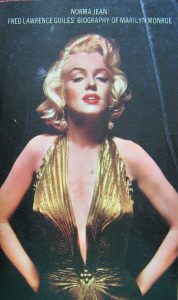
Anyway, getting back to my personal interest in Marilyn, I’m pretty certain the first book about her was what has come to be thought of the definitive biography, the one by Fred Laurence Guiles. Guiles published his book in 1969 and chronicled Marilyn’s life as Norma Jeane Mortensen and then Marilyn Monroe.

Marilyn Monroe

Norma Jeane Mortensen was born on June 1st, 1926. She had a troubled upbringing. Her mother was mentally unstable and was in and out of various institutions leaving young Norma to be taken into care. On one occasion in her late teens Norma Jeane was living with a friend of her mother’s but this friend was moving away and rather than send Norma back into a home an idea came about which seems a little mad in retrospect. The idea was for Norma to get married to a local boy, Jim Dougherty. The marriage went ahead only eighteen days after Norma’s sixteenth birthday.

When war came to the USA in 1941, Jim joined the navy. Norma was working in a war factory when an army photographer called David Conover came round looking for a photo article for a magazine. He asked Norma to pose for him and found that she had a natural affinity with the camera. She began a career in modelling which led her to bit parts in films, then a contract with 20th Century Fox and later to film stardom.

In 1946 she divorced Jim Dougherty and Fox offered her a seven-year optional contract. She changed her name to Marilyn Monroe and began her film career. All didn’t go so smoothly at first. She was dropped from her contract but she did meet an influential Hollywood agent named Johnny Hyde.

I’ve got to say that despite her best efforts I’m not sure my interest in Marilyn had a lot to do with her acting skills as in her early days she wasn’t a great actress. What she did have was looks, looks that could turn the heads of a great deal of men. One of her early film roles came about really because of her growing reputation as a model. She was cast in the last of the Marx Brothers’ films Love Happy and had one scene in which she tells Groucho that “some men are following me.” Groucho explains more in the following video.

That of course was nothing more than a walk on part but she was asked to go on a nationwide tour in the USA promoting the film. Marilyn was determined to get on and be a great actress. She was always having acting lessons, in fact she joined the famous New York Actors Studio. The studio had been founded by theatre and film director Elia Kazan and one of the famous acting coaches there was Lee Strasberg. Both Kazan and Strasberg were interested in ‘the method’, a style of acting initiated by the Russian actor Stanislavsky which involved the actor using his own experience and memories to ‘become’ the role rather than just acting a role. James Dean and Marlon Brando were two of the more famous students of the Actors Studio.

Another of my books about Marilyn was the famous biography by Norman Mailer. Mailer actually used Fred Guiles’ book as the basis of his biography but added his own insight into Marilyn’s story as well as a huge collection of photographs. Mailer was originally hired to write an introduction to what was originally intended to be just a photo album but he was so taken by the subject matter, he wrote more and more and his ‘introduction’ became the book. He later wrote other works about Marilyn.

Marilyn: Norman Mailer

Marilyn on the cover of the celebrated book by Norman Mailer

Johnny Hyde was in love with Marilyn and asked her to marry him many times. She always declined, telling him she did not love him. He continued to press her while working hard on her behalf as her agent. In October 1950 he arranged for a seven year contract at Twentieth Century Fox. He also organised some minor plastic surgery for her, apparently, she had her chin built up slightly and the tip of her nose made smaller. In December that year she was recuperating from the surgery at his Palm Springs home when Johnny died of a heart attack. Marilyn was distraught when she heard the news, even so, his family ordered her out of the house.

She moved in with her drama coach Natasha and one day tried to swallow over 30 Nembutal capsules. Luckily Natasha came home early and found her.

Fox put Marilyn into a number of pictures playing a dizzy blonde type but then she was loaned out to RKO for Clash by Night directed by Fritz Lang. It was the first film with her name over the title.

In 1954 she married baseball star Joe DiMaggio. Maggio had retired from the game that had made him famous and Joe wanted her to settle down with him and retire from the cinema. It might be that Marilyn did intend to one day enjoy a more domestic existence. My feeling though is that she could never ever give up her film star life. It had given her all she had; her fame, her money and her status. She could never say goodbye to her creation, the film star Marilyn Monroe.

In the short autobiography published after her death, My Story, which some say was ghost written or partly written by others, Marilyn said this about her fame:

I belonged to the public and the world, not because I was talented or even beautiful but because I never belonged to anything or anyone else. The public was the only family, the only Prince Charming and the only home I had ever dreamed of.

Would she give up all that for DiMaggio or anyone? I don’t think so.

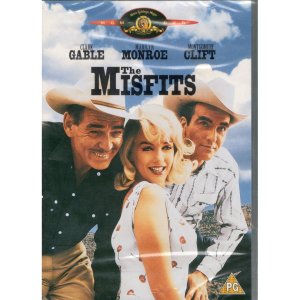
Her marriage to DiMaggio ultimately failed but Joe would continue to be a great friend. It is quite possible that in the last months of her life she was even planning to remarry him. However, before that came marriage and divorce to Arthur Miller. Marilyn idolised men like Abraham Lincoln and Albert Einstein and she put Miller into that same category. They had met years before, even before she married Dimaggio. Miller would write the screenplay for her final completed film, The Misfits, in which she played a character, Roslyn, which was based on herself. She became hugely disappointed in Miller after finding an open diary or notebook of his in which he severely criticised her. They divorced in 1961.

I’ve always thought that The Misfits was her best film and every so often I’ll take my DVD copy and give it a viewing. (I’ve actually only got two of her films on DVD, The Misfits and Some Like it Hot). Misfits was in fact her last completed film. In 1962 she began filming Something’s Got to Give in which she starred with Dean Martin. Marilyn missed a lot of the shoot due to illness and then left for New York where she appeared at a gala performance for the President’s birthday. The President was John F Kennedy and 20th Century Fox was not amused that with their film behind schedule its star had taken time off. They were already having financial problems with another production, Cleopatra. They were paying Elizabeth Taylor the unheard-of figure of one million dollars for her to play the Egyptian queen and their bank account must have been looking distinctly unhealthy. What was the answer? They fired Marilyn.

Fred Guiles first book on Marilyn was published in 1969 and mentions that towards the end of her life she was involved with an ‘easterner’. The man from the east was Robert Kennedy and since then many books and documentaries have mentioned Marilyn’s involvement with both John and Robert Kennedy. The accepted story of Marilyn’s death goes like this. Both John and Robert Kennedy ended their affairs with her, she had been sacked by 20th Century Fox and she became so despondent that she took her own life. Her body lay unclaimed in the morgue until the faithful Joe DiMaggio came and organised her funeral.

In 1966 however, a man call Frank Capell had published a book called ‘The Strange Death of Marilyn Monroe’ which called attention to various things that did not add up. Capell also claimed that Robert Kennedy was with Marilyn on the evening of her death. The FBI forwarded a report of the book to Kennedy who was then still the Attorney General and he asked that Capell’s phone be tapped.

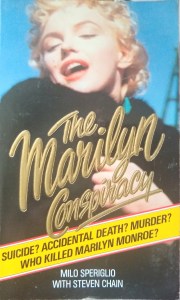
In the 1980’s a number of authors began to look further into Marilyn’s death and one in my collection is The Marilyn Conspiracy. The author, Milo Speriglio was a private detective who was asked by Robert Slatzer to investigate. Slatzer was a friend of Marilyn’s and has even claimed that he married the star only for the two to tear up the marriage licence in case it harmed her career. He said Marilyn had a red diary in which she jotted down notes from her conversations with RFK and contained many things that were secret at the time. Marilyn used to call him from a nearby phone box as she felt that her phones had been tapped.

In 1985 Anthony Summers published the book Goddess: The Secret Lives of Marilyn Monroe in which he also claimed Marilyn was involved with Robert Kennedy. He also explains that Marilyn was not depressed after all. Her dispute with 20th Century Fox had been settled and they had reinstated her to the movie Something’s Got to Give and she was discussing further film projects including a biopic about Jean Harlow.

Summer also collaborated on a BBC documentary film called Say Goodbye to the President in which private eye Fred Otash revealed that he had engaged electronics expert Bernie Spindell to bug Marilyn’s home. The reason? Union leader Jimmy Hoffa who was under investigation by Kennedy wanted derogatory information on RFK that he could use against him.

Eunice Murray, Marilyn’s housekeeper, admitted in an interview in 1985 for the documentary Say Goodbye to the President that Bobby Kennedy was at Marilyn’s house on the day of her death. Eunice’s son in law and Marilyn’s handyman, Norman Jefferies told Donald Wolfe, the author of The Assassination of Marilyn Monroe, that Bobby Kennedy arrived late on the Saturday evening with two unknown men and asked Jefferies and Murray to leave while he spoke with Marilyn alone. When they returned Marilyn was comatose in one of the guest cottages attached to her house. Jefferies and Murray called an ambulance but Marilyn died from an overdose.

I cannot for a moment imagine Bobby Kennedy as a murderer but he certainly would not want to be associated in any way with a movie star suicide. John Bates, a friend of the Kennedy family, claims that Bobby and his family spent the weekend with him at his ranch in Gilroy, south of San Francisco.

Marilyn died in 1962 and she must have something about her because here we are in 2023 still interested in her. In 2011 a film about her called My week with Marilyn was released and in 2022 came Blonde, starring Ana de Armas as Monroe. Blonde was a fictional version of Marilyn’s life. I haven’t seen it but when I looked it up on the internet it didn’t seem to have been rated highly although I’ll be looking out for it on my TV screen in the future.

Norman Mailer’s book about Monroe finished with a photo of Joe DiMaggio, grief stricken on the day of her funeral and he reckons we can perhaps surmise Marilyn’s true worth just by the look on Joe’s face that day. I cannot disagree.

Sources:

The Assassination of Marilyn Monroe by Donald Wolfe

Goddess by Anthony Summers

The Marilyn Conspiracy by Milo Speriglio with Steven Chain

Norma Jeane: The Life and Death of Marilyn Monroe by Fred Lawrence Guiles

My Story by Marilyn Monroe

Say Goodbye to the President: 1985 BBC documentary


What to do next: Here are a few options.

Share this post on your favourite social media!

Hit the Subscribe button. Never miss another post!

Listen to my podcast Click here.

Click here to visit Amazon and download Floating in Space to your Kindle or order the paperback version.

Buy the book! Click here to purchase my new poetry anthology.


Even More Random Film Connections

Back in the 1970’s. TV presenter James Burke made a TV show called Connections. It was a really fascinating series which connected various historical events to make a sort of chain which led up to something which was pretty unexpected. The episode which stands out in my memory is one about the atom bomb, various unconnected events and discoveries that together, led to the splitting of the atom. I’ve written a couple of posts in which I’ve tried to do something similar but all relating to the world of classic film so here is another collection of film connections which I hope you will find interesting.

In 1954 director Nick Ray made his classic film Rebel Without a Cause. The film remains a cult classic even today because it’s the film James Dean starred in as troubled teenager Jim Stark. The film opens with Jim’s first day at a new school. He tries his best to make friends but finds himself at odds with a gang which includes Natalie Wood as Judy, Corey Allen as Buzz, Dennis Hopper as Goon and quite a few others. The day doesn’t end well for Jim because he ends up in a deadly car race with Buzz in which the two drive towards a cliff edge and the first one to bale out is chicken. Buzz doesn’t get out in time and is killed and his friends want revenge on Jim.

Jim and Judy along with Plato, a teenager profoundly affected by loneliness and a broken family, decide to hide out in a deserted mansion. It was in fact the same mansion used in the film Sunset Boulevard, made years earlier.

Rebel was only Dean’s second film. He was killed in a car crash after his third and final film Giant.

Giant was directed by George Stevens and in it, Dean played Jett Rink, a surly ranch hand on Bick Benedict’s huge Texas ranch. Jett doesn’t get on well with Bick played by Rock Hudson but at least he has a friend in Bick’s sister Luz played by Mercedes McCambridge. When she is killed trying to ride a horse belonging to Bick’s new wife, Jett finds she has willed him a small plot of land on which he later strikes oil.

Bick’s wife was played by Elizabeth Taylor. Liz had a number of husbands but in 1957 she married for the third time to Mike Todd. Todd was an entrepreneur who was involved in various business ventures. He was also a theatrical producer and moved into films producing the classic Around The World in 80 Days starring David Niven as Phileas Fogg. Todd was killed in a plane crash in 1958. His widow, Liz, was devasted and turned to her friends Eddie Fisher and his wife Debbie Reynolds for comfort. Eddie perhaps took comfort a little too far and his friendship with Liz soon turned into an affair and he left Debbie, marrying Liz Taylor in 1959.

Eddie Fisher and Debbie Reynolds had a daughter named Carrie. Carrie was born in 1956 and went on to play Princess Leia in the Star Wars films.

In 1989 Carrie played Marie in the comedy classic When Harry Met Sally. The film follows the slow to start romance of Harry and Sally played by Billy Crystal and Meg Ryan. The two don’t seem to like each other at first but later become friends. They decide to introduce each other to their best friends Marie and Jess, played by Steven Ford, who both hit it off instantly.

The film is a really wonderful comic look at relationships with some sparklingly witty scenes and dialogue. The screenplay was written by Nora Ephron.

https://youtu.be/vmSpCLefjnw

Nora later moved into directing and one of her best films was You’ve Got Mail. The film teamed Meg Ryan with Tom Hanks once again, the pair having worked together on Sleepless in Seattle, another Nora Ephron film. Such a pity, from a personal point of view, that Billy Crystal didn’t play the Tom Hanks role in those films. Don’t get me wrong, I enjoyed both of them but I’ve always thought Billy and Meg seemed to just work together so much better. Anyway, getting back to the blog, You’ve Got Mail is a romcom about two people who get involved together in an online chat room. In the chat room they use internet ‘handles’ to hide their true identities and don’t realise that in fact they are business rivals. Tom Hanks’ character owns a big discount bookstore while Meg has a small popular childrens’ bookshop.

In real life, the two are constantly at odds as Tom is opening a massive new discount bookstore just by her small shop. In anonymous cyberspace though, their relationship seems to develop and the two decide to meet but Tom Hanks arrives for the meeting in a coffee shop, peeks through the window and sees who is waiting for him.

The film was actually based on another film The Shop Around the Corner, a 1940s classic starring James Stewart and Margaret Sullavan. In the film two employees who work together but don’t get on are actually falling for each other as anonymous pen pals.

James Stewart also stars in one of my favourite films, It’s a Wonderful Life. I love that film and my DVD copy gets watched quite a lot. The film is about George Bailey played by James Stewart who looks forward to an interesting life of travel but then finds obligations force him to stay in the small town where he has always lived. George is beset by problems and even considers suicide but then his guardian angel -literally- arrives to help him.

The secret of this film is, I think, the fact that despite the fantasy premise of the film, everyone plays their parts as if they were in a serious drama. The result is that the drama and emotion of the situation rises to the surface and we are left with a vibrant and dramatic piece of cinema.

Donna Reed plays Stewart’s love interest but another lady who sets her sights on his character, George Bailey, is Violet Bick played by the sultry Gloria Grahame. She made her film debut in 1944 and appeared in a number of films, including many film noir movies. In 1955 she appeared in the musical Oklahoma but afterwards her star began to wane a little.

She created something of a scandal in later life. After divorcing her first husband she married and later divorced one of her directors then later married TV producer Cy Howard. When they split, she married Anthony Ray who was the son of her second husband. The second husband was Nick Ray, who directed James Dean in Rebel Without a Cause.

Hope you enjoyed this interconnected tour of the classic movie world. Have a great weekend and call back next Saturday for another post.


What to do next: Here are a few options.

Share this post on your favourite social media!

Hit the Subscribe button. Never miss another post!

Listen to my podcast Click here.

Buy the book! Click here to purchase my new poetry anthology.

Click here to visit Amazon and download Floating in Space to your Kindle or order the paperback version.

More Random Film Connections

Back in the 1970’s. TV presenter James Burke made a TV show called Connections. It was a really fascinating series which connected various historical events to make a sort of chain which led up to something which was pretty unexpected. The episode which stands out in my memory is one about the atom bomb, various unconnected events and discoveries that together, led to the splitting of the atom. I’ve written a couple of posts in which I’ve tried to do something similar but all relating to the world of classic film so here are another collection of film connections which I hope you will find interesting.

Leslie Howard and Gone with the Wind

I thought I’d start with Gone with the Wind and see where it takes me. Gone with the Wind was a major film adaptation of the book by Margaret Mitchell. The book was a huge hit and producer David O Selznick bought the film rights. Production was delayed for a long while as Selznick was determined to get Clark Gable for the part of the roguish Rhett Butler. Another delay was a distribution deal with MGM which couldn’t be finalised until Selznick’s then current deal with United Artists had expired. Selznick used the delay to begin a huge search for an actress to play the part of Scarlett O’Hara, the spoilt daughter of a plantation owner in the deep south of America. Scarlet has a crush on Ashley Wilkes played by British actor Leslie Howard in possibly his most famous role. The film was one of the major hits of 1939 and was the highest earning film up to that time.

Julie Andrews and My Fair Lady

In 1938 Leslie Howard played the part of Professor Higgins in the film production of Pygmalion based on the play by George Bernard Shaw. A musical version was a big hit on the stage in the 1960s. Julie Andrews played the part of Eliza Doolittle to great acclaim on the stage but when the time came to make a film version in 1964, the producers wanted a major star and so the part went to Audrey Hepburn.

Julie Andrews only had to wait a short time for film stardom though. She appeared in The Sound of Music in 1965. The film was based on the true story of the Von Trapp family singers which was also a hit stage musical. Julie Andrews played Maria, a nun who becomes a nanny to the Von Trapp children, eventually falling for the father of the children played by Christopher Plummer. The film was the hit of 1965 replacing Gone with the Wind as the highest grossing film up to that time. The director was Robert Wise who tried to reduce the amount of sentimentality and sweetness which he had seen in the stage production.

Robert Wise and Citizen Kane

Robert Wise had a great background in the film world. He was a former film editor whose first film as a director was The Curse of the Cat People in 1944. In 1941 he was a film editor at RKO Studios and was the editor on the classic film Citizen Kane.

Orson Welles often boasted about the fabulous contract he had when he arrived in Hollywood. In a BBC interview he stated the terms were not financially brilliant but gave him unprecedented creative powers. His first film for RKO was Citizen Kane. The film opens with the death of Kane, a millionaire newspaper magnate. His last words were ‘Rosebud’. The makers of a cinema newsreel decide to find out what or who Rosebud was.

To do so they research Kane’s life; his inheritance of a huge fortune, his takeover of a newspaper, his great wealth, his power and influence, his marriage and divorce and ultimately his death.

The cinematographer was Gregg Toland, one of the film industry’s top photographers. Toland asked to work on the film and Welles replied ‘Why? I don’t know anything about making films.’ Toland countered that was exactly why he wanted to work on the film because a film by a newcomer would produce something new and original.

There are some fascinating elements to Citizen Kane, especially in the special effects department. A famous one is where the camera flies through a rooftop sign and then drops down through a skylight into a restaurant. The shot was done with a sign that came apart as the camera approached and then a fade from a model shot into the restaurant set disguised in a flash of lightning. Citizen Kane was and is a classic of the cinema.

Orson Welles and Rita Hayworth

Orson Welles in a way experienced his film career in reverse, he started at the top and steadily worked his way down, ending up as an overweight although always entertaining raconteur doing voice overs for Carlsberg TV advertisements.

Welles married Rita Hayworth in 1943. She was one of the great stars of Hollywood’s golden years. She appeared in one of her husband’s films The Lady from Shanghai in 1947 but the film that was considered her greatest success came the year before in Gilda. According to Wikipedia, the film made her into a cultural icon as a femme fatale.

Welles and Hayworth grew apart and finally separated. Rita said that Welles had no idea about married life or even settling down. When she suggested buying a house together, a natural move for a married couple, Welles said he didn’t want the responsibility.

Rita Hayworth as Gilda

After splitting with Welles, Rita became involved with Prince Aly Khan, son of the Aga Khan who later became a Pakistani diplomat. Aly was a socialite and man about town. He and Rita married in 1949 and had a daughter Princess Yasmin Aga Khan. Rita gave up her film career to be with Aly but Khan’s womanising proved fatal to the marriage. Rita moved to Nevada with her daughter in order to set up a legal residence and begin divorce proceedings. The two were finally divorced in 1953. Khan offered Rita a million dollars for her to bring up their daughter as a Muslim but Rita declined.

After her divorce Rita had no income and was forced to return to film acting. Her comeback picture was Affair in Trinidad in which she starred with Glenn Ford. Rita was contracted to Columbia Pictures and fell out with Columbia boss Harry Cohn on numerous occasions during the filming. She was even placed on suspension for a while, however the picture was very successful. Her last picture for Columbia was in 1957 when she starred in Pal Joey with Frank Sinatra. She married again, this time to singer Dick Haymes who was in severe financial trouble. The marriage lasted only a couple of years and ended when Haymes struck her in the face in a Hollywood nightclub. Rita packed her bags and left him.

In the mid 1970’s, Rita’s behaviour began to become erratic. She drank heavily and was even once removed from a TWA flight because of her drinking. It was eventually found that her symptoms were masking the real issue which was the early onset of Alzheimer’s disease. In 1981 when her condition had deteriorated, she was placed under the supervision of her daughter and the two moved into adjoining apartments together in New York. She died aged 68 in 1987. Her former husband Orson Welles, spoke of her in his very last interview, recorded the day before his own death. He called her ‘one of the dearest and sweetest women that ever lived.’

David Niven and Leslie Howard

Just to backtrack a little, in 1958 Rita appeared in Separate Tables. The screenplay was by Terence Rattigan and concerns a group of residents at a small hotel in the south of England. David Niven plays a disgraced former army officer who has been found guilty of apparently sexually harassing young women at a theatre. A news story in the local paper highlights this and he tries to stop the others from finding out, without success. Niven won an Oscar for his performance.

David Niven is one of my favourite actors and he wrote what I’ve always considered to the best book about the golden age of Hollywood, Bring on the Empty Horses.

In 1942 Niven was in England having left Hollywood to sign up with the army. He was asked to appear in what was a propaganda film at the time; The First of the Few, a story about R J Mitchell, the designer of the famous WWII aircraft, the Spitfire. Niven was under contract to Sam Goldwyn at the time but he allowed Niven to appear, in exchange for the US rights to the film. Niven played Squadron Leader Geoffrey Crisp who tells the story of his friend Mitchell beginning with the Schneider Trophy aircraft race of 1922. Later Mitchell visits Germany and sees how the Nazis are rearming and so resolves to design a powerful fighter for Great Britain. Mitchell died just as the government ordered the Spitfire into production and Niven as Crisp, ends his story just as he and his fellow pilots are scrambled into action.

Leslie Howard played the part of Mitchell as well as producing and directing. He was killed when the KLM flight he was aboard was shot down by the Luftwaffe in 1943.

Howard of course played Ashley Wilkes in Gone with the Wind which brings our connections full circle.


Thanks to Wikipedia creative commons for the use of the pictures in this post.


What to do next: Here are a few options.

Share this post on your favourite social media!

Hit the Subscribe button. Never miss another post!

Listen to my podcast Click here.

Click here to visit Amazon and download Floating in Space to your Kindle or order the paperback version.

Buy the book! Click here to purchase my new poetry anthology.

Some More Random Classic Film Connections

Back in the 1960’s I was a big fan of the Apollo moon missions and on UK TV one of the presenters was James Burke. Burke also did a TV show called Connections. It was a really fascinating series which connected various historical events to make a sort of chain which led up to something which was pretty unexpected. The episode that stands out in my memory was one about the atom bomb, various unconnected events and discoveries that together, led to the splitting of the atom. In today’s post, I’ve tried to do something similar but all relating to the world of film, so here are five fascinating connections.

Rebecca 1940

Rebecca is actually my favourite film from director Alfred Hitchcock. It was released in 1940 and was Hitchcock’s first American film. It is based on the novel by Daphne Du Maurier. The film stars Laurence Olivier as the aristocratic widower Maxim De Winter and Joan Fontaine as the shy young woman who becomes his second wife. The two meet in the south of France when De Winter is on the verge of jumping off a cliff top only to be interrupted by the shy young woman. The woman is never named in the film except for later when she becomes Mrs De Winter. This new or second Mrs De Winter seems to be living her life in the shadow of Rebecca, Maxim’s first wife. Later we find that Maxim murdered her after finding out that she was having an affair with Jack Favell played by the smooth and suave George Sanders.

I have to say I have always loved this film, the ruthlessly charming George Sanders, the gorgeous Joan Fontaine and the scary Mrs Danvers, the housekeeper dedicated to the dead Rebecca played by Judith Anderson. Joan Fontaine has never looked lovelier and the only blot on the film landscape are the rather poor models used to represent Manderley, the ancestral home of the De Winter family.

Joan Fontaine was actually the sister of Olivia De Havilland and the two seemed to have had a rather strained relationship. Olivia starred with Errol Flynn in the magnificent Robin Hood but is probably best remembered for her role in Gone With The Wind.

Gone With The Wind 1939

Gone With The Wind was actually being made at the same time as Rebecca and Hitchcock and producer David O Selznick, who produced both films, had numerous fallings out over Rebecca and Hitchcock was apparently happy that Selznick was preoccupied with GWTW which kept him away from the production of Rebecca. Selznick later made many edits and revisions to Rebecca which didn’t go down well with Hitchcock.

Gone With The Wind starred Clark Gable and much was made of a nationwide hunt for an actress to play Scarlett O’Hara. The eventual winner was Vivien Leigh. Olivia De Havilland played Melanie who marries Ashley Wilkes played by Leslie Howard.

The film is set in the American south at the time of the American Civil War and its aftermath. Scarlett O’Hara is the daughter of a plantation owner and she has the hots for neighbour Ashley Wilkes. Wilkes marries Melanie but Scarlett is unable to give up on her romantic feelings for Ashley even when she marries the roguish Rhett Butler.

Gone With the Wind is an epic film in every sense of the word and follows the fortunes of Scarlett and her family through the devastation of the civil war and into the reconstruction era afterwards.

Leslie Howard captures perfectly the slightly wimpy Ashley. Howard was not happy in Hollywood and returned to England after the filming to help with Britain’s war effort. He was a star of many English feature films but was sadly killed when flying back to England after a visit to Portugal where he was promoting the British war effort. Some have suggested that the Luftwaffe shot down Howard’s aircraft as the Germans believed the Prime Minister was on board. Others have speculated that Howard himself was the target as he had angered the Germans with his efforts to promote the British cause as well as the success of his film The First of The Few about the designer of the Spitfire aircraft.

The First of The Few 1942

David Niven plays the part of Squadron Leader Geoffrey Crisp and he tells his pilots of how his friend RJ Mitchell designed the Spitfire. He tells how Mitchell observed seagulls through his binoculars and envisaged a new high speed era of fighter aircraft. After entering an aircraft in the Schneider Trophy, Mitchell convinces Rolls Royce to design a new and powerful engine for the new breed of aircraft and eventually, the Spitfire is born. Leslie Howard played the part of Mitchell as well as producing and directing the film.

Casino Royale 1967

David Niven had left Hollywood in 1939 and returned to the UK in order to re-join the army and fight against the Nazi menace. As well as his army duties, Niven was released from time to time to appear in a few propaganda films, one of which was The First of The Few. He was attached to a commando unit named Phantom whose job was to find out enemy positions and report back to British commanders. After the war he resumed his film career starring in a British film A Matter of Life and Death which was chosen for the very first Royal Film Performance. Niven returned to Hollywood only to encounter terrible tragedy when his wife, whom he had met and married in England, fell down the steps into a cellar when the two were playing hide and seek at a Hollywood party. Niven must have been devastated but he carried on and later remarried.

In 1967 he appeared as James Bond in the Bond spoof Casino Royale. Ian Fleming, the author of the famous James Bond series, had sold the film rights to Casino Royale separately to the rest of the Bond books and producer Charles Feldman acquired them, hoping to do a deal with Eon productions who were producing the mainstream Bond series. When negotiations failed, Feldman who had recently had a big hit with the oddball comedy What’s New Pussycat, resolved to make a James Bond comedy satire and recruited Niven to star as Bond.

The film turned out to be a critical disaster. Two of the other stars in the film were Peter Sellers and Orson Welles. Peter played the part of a card playing expert and Welles was the villain, Le Chiffre, a spy who has spent a great deal of money that wasn’t his and intends to win it back in the casino. All went well during the filming but then Sellers approached the director Joe McGrath and demanded that he and Welles should not appear in the same shot. McGrath replied that the film was in widescreen and this could not be done. Sellers then threw a punch at McGrath and a fight ensued until they were split up by a stuntman. Sellers asked for a break but then disappeared from the set which might be why his character disappears abruptly from the film. Ultimately five directors and as many screenwriters contributed to the film.

As I mentioned earlier, Niven plays Bond in Casino Royale and interestingly, Ian Fleming had wanted Niven to play Bond in Doctor No, the first in the 007 films.

Another actor approached to play the part of Bond was Cary Grant. Grant was urbane and cultured and also British. He was in many ways perfect for the part of Bond. He was also close to producer Cubby Broccoli and in fact was Broccoli’s best man at his 1959 wedding. Grant was interested in playing the part but stipulated that he would only play the role once and wasn’t willing to do a series of films.

North By Northwest

Cary Grant appeared in numerous adventure films with an espionage background, in particular North By Northwest. Grant plays advertising executive Roger Thornhill who calls over a waiter in a New York hotel bar. The waiter was paging a George Kaplan and when Grant calls the waiter over, two thugs nearby assume Thornhill is really Kaplan. It turns out that Kaplan is a fake identity, created by American Intelligence agents to trap a spy played by James Mason. The film is an exciting cold war thriller and was directed by none other than Alfred Hitchcock, who directed Rebecca, bringing our connections full circle.


What to do next: Here are a few options.

Share this post on your favourite social media!

Hit the Subscribe button. Never miss another post!

Listen to my podcast Click here.

Buy the book! Click here to purchase my new poetry anthology.

Click here to visit Amazon and download Floating in Space to your Kindle or order the paperback version.