Even More Random Film Connections

Back in the 1970’s. TV presenter James Burke made a TV show called Connections. It was a really fascinating series which connected various historical events to make a sort of chain which led up to something which was pretty unexpected. The episode which stands out in my memory is one about the atom bomb, various unconnected events and discoveries that together, led to the splitting of the atom. I’ve written a couple of posts in which I’ve tried to do something similar but all relating to the world of classic film so here is another collection of film connections which I hope you will find interesting.

In 1954 director Nick Ray made his classic film Rebel Without a Cause. The film remains a cult classic even today because it’s the film James Dean starred in as troubled teenager Jim Stark. The film opens with Jim’s first day at a new school. He tries his best to make friends but finds himself at odds with a gang which includes Natalie Wood as Judy, Corey Allen as Buzz, Dennis Hopper as Goon and quite a few others. The day doesn’t end well for Jim because he ends up in a deadly car race with Buzz in which the two drive towards a cliff edge and the first one to bale out is chicken. Buzz doesn’t get out in time and is killed and his friends want revenge on Jim.

Jim and Judy along with Plato, a teenager profoundly affected by loneliness and a broken family, decide to hide out in a deserted mansion. It was in fact the same mansion used in the film Sunset Boulevard, made years earlier.

Rebel was only Dean’s second film. He was killed in a car crash after his third and final film Giant.

Giant was directed by George Stevens and in it, Dean played Jett Rink, a surly ranch hand on Bick Benedict’s huge Texas ranch. Jett doesn’t get on well with Bick played by Rock Hudson but at least he has a friend in Bick’s sister Luz played by Mercedes McCambridge. When she is killed trying to ride a horse belonging to Bick’s new wife, Jett finds she has willed him a small plot of land on which he later strikes oil.

Bick’s wife was played by Elizabeth Taylor. Liz had a number of husbands but in 1957 she married for the third time to Mike Todd. Todd was an entrepreneur who was involved in various business ventures. He was also a theatrical producer and moved into films producing the classic Around The World in 80 Days starring David Niven as Phileas Fogg. Todd was killed in a plane crash in 1958. His widow, Liz, was devasted and turned to her friends Eddie Fisher and his wife Debbie Reynolds for comfort. Eddie perhaps took comfort a little too far and his friendship with Liz soon turned into an affair and he left Debbie, marrying Liz Taylor in 1959.

Eddie Fisher and Debbie Reynolds had a daughter named Carrie. Carrie was born in 1956 and went on to play Princess Leia in the Star Wars films.

In 1989 Carrie played Marie in the comedy classic When Harry Met Sally. The film follows the slow to start romance of Harry and Sally played by Billy Crystal and Meg Ryan. The two don’t seem to like each other at first but later become friends. They decide to introduce each other to their best friends Marie and Jess, played by Steven Ford, who both hit it off instantly.

The film is a really wonderful comic look at relationships with some sparklingly witty scenes and dialogue. The screenplay was written by Nora Ephron.

Nora later moved into directing and one of her best films was You’ve Got Mail. The film teamed Meg Ryan with Tom Hanks once again, the pair having worked together on Sleepless in Seattle, another Nora Ephron film. Such a pity, from a personal point of view, that Billy Crystal didn’t play the Tom Hanks role in those films. Don’t get me wrong, I enjoyed both of them but I’ve always thought Billy and Meg seemed to just work together so much better. Anyway, getting back to the blog, You’ve Got Mail is a romcom about two people who get involved together in an online chat room. In the chat room they use internet ‘handles’ to hide their true identities and don’t realise that in fact they are business rivals. Tom Hanks’ character owns a big discount bookstore while Meg has a small popular childrens’ bookshop.

In real life, the two are constantly at odds as Tom is opening a massive new discount bookstore just by her small shop. In anonymous cyberspace though, their relationship seems to develop and the two decide to meet but Tom Hanks arrives for the meeting in a coffee shop, peeks through the window and sees who is waiting for him.

The film was actually based on another film The Shop Around the Corner, a 1940s classic starring James Stewart and Margaret Sullavan. In the film two employees who work together but don’t get on are actually falling for each other as anonymous pen pals.

James Stewart also stars in one of my favourite films, It’s a Wonderful Life. I love that film and my DVD copy gets watched quite a lot. The film is about George Bailey played by James Stewart who looks forward to an interesting life of travel but then finds obligations force him to stay in the small town where he has always lived. George is beset by problems and even considers suicide but then his guardian angel -literally- arrives to help him.

The secret of this film is, I think, the fact that despite the fantasy premise of the film, everyone plays their parts as if they were in a serious drama. The result is that the drama and emotion of the situation rises to the surface and we are left with a vibrant and dramatic piece of cinema.

Donna Reed plays Stewart’s love interest but another lady who sets her sights on his character, George Bailey, is Violet Bick played by the sultry Gloria Grahame. She made her film debut in 1944 and appeared in a number of films, including many film noir movies. In 1955 she appeared in the musical Oklahoma but afterwards her star began to wane a little.

She created something of a scandal in later life. After divorcing her first husband she married and later divorced one of her directors then later married TV producer Cy Howard. When they split, she married Anthony Ray who was the son of her second husband. The second husband was Nick Ray, who directed James Dean in Rebel Without a Cause.

Hope you enjoyed this interconnected tour of the classic movie world. Have a great weekend and call back next Saturday for another post.


What to do next: Here are a few options.

Share this post on your favourite social media!

Hit the Subscribe button. Never miss another post!

Listen to my podcast Click here.

Buy the book! Click here to purchase my new poetry anthology.

Click here to visit Amazon and download Floating in Space to your Kindle or order the paperback version.

More Random Film Connections

Back in the 1970’s. TV presenter James Burke made a TV show called Connections. It was a really fascinating series which connected various historical events to make a sort of chain which led up to something which was pretty unexpected. The episode which stands out in my memory is one about the atom bomb, various unconnected events and discoveries that together, led to the splitting of the atom. I’ve written a couple of posts in which I’ve tried to do something similar but all relating to the world of classic film so here are another collection of film connections which I hope you will find interesting.

Leslie Howard and Gone with the Wind

I thought I’d start with Gone with the Wind and see where it takes me. Gone with the Wind was a major film adaptation of the book by Margaret Mitchell. The book was a huge hit and producer David O Selznick bought the film rights. Production was delayed for a long while as Selznick was determined to get Clark Gable for the part of the roguish Rhett Butler. Another delay was a distribution deal with MGM which couldn’t be finalised until Selznick’s then current deal with United Artists had expired. Selznick used the delay to begin a huge search for an actress to play the part of Scarlett O’Hara, the spoilt daughter of a plantation owner in the deep south of America. Scarlet has a crush on Ashley Wilkes played by British actor Leslie Howard in possibly his most famous role. The film was one of the major hits of 1939 and was the highest earning film up to that time.

Julie Andrews and My Fair Lady

In 1938 Leslie Howard played the part of Professor Higgins in the film production of Pygmalion based on the play by George Bernard Shaw. A musical version was a big hit on the stage in the 1960s. Julie Andrews played the part of Eliza Doolittle to great acclaim on the stage but when the time came to make a film version in 1964, the producers wanted a major star and so the part went to Audrey Hepburn.

Julie Andrews only had to wait a short time for film stardom though. She appeared in The Sound of Music in 1965. The film was based on the true story of the Von Trapp family singers which was also a hit stage musical. Julie Andrews played Maria, a nun who becomes a nanny to the Von Trapp children, eventually falling for the father of the children played by Christopher Plummer. The film was the hit of 1965 replacing Gone with the Wind as the highest grossing film up to that time. The director was Robert Wise who tried to reduce the amount of sentimentality and sweetness which he had seen in the stage production.

Robert Wise and Citizen Kane

Robert Wise had a great background in the film world. He was a former film editor whose first film as a director was The Curse of the Cat People in 1944. In 1941 he was a film editor at RKO Studios and was the editor on the classic film Citizen Kane.

Orson Welles often boasted about the fabulous contract he had when he arrived in Hollywood. In a BBC interview he stated the terms were not financially brilliant but gave him unprecedented creative powers. His first film for RKO was Citizen Kane. The film opens with the death of Kane, a millionaire newspaper magnate. His last words were ‘Rosebud’. The makers of a cinema newsreel decide to find out what or who Rosebud was.

To do so they research Kane’s life; his inheritance of a huge fortune, his takeover of a newspaper, his great wealth, his power and influence, his marriage and divorce and ultimately his death.

The cinematographer was Gregg Toland, one of the film industry’s top photographers. Toland asked to work on the film and Welles replied ‘Why? I don’t know anything about making films.’ Toland countered that was exactly why he wanted to work on the film because a film by a newcomer would produce something new and original.

There are some fascinating elements to Citizen Kane, especially in the special effects department. A famous one is where the camera flies through a rooftop sign and then drops down through a skylight into a restaurant. The shot was done with a sign that came apart as the camera approached and then a fade from a model shot into the restaurant set disguised in a flash of lightning. Citizen Kane was and is a classic of the cinema.

Orson Welles and Rita Hayworth

Orson Welles in a way experienced his film career in reverse, he started at the top and steadily worked his way down, ending up as an overweight although always entertaining raconteur doing voice overs for Carlsberg TV advertisements.

Welles married Rita Hayworth in 1943. She was one of the great stars of Hollywood’s golden years. She appeared in one of her husband’s films The Lady from Shanghai in 1947 but the film that was considered her greatest success came the year before in Gilda. According to Wikipedia, the film made her into a cultural icon as a femme fatale.

Welles and Hayworth grew apart and finally separated. Rita said that Welles had no idea about married life or even settling down. When she suggested buying a house together, a natural move for a married couple, Welles said he didn’t want the responsibility.

Rita Hayworth as Gilda

After splitting with Welles, Rita became involved with Prince Aly Khan, son of the Aga Khan who later became a Pakistani diplomat. Aly was a socialite and man about town. He and Rita married in 1949 and had a daughter Princess Yasmin Aga Khan. Rita gave up her film career to be with Aly but Khan’s womanising proved fatal to the marriage. Rita moved to Nevada with her daughter in order to set up a legal residence and begin divorce proceedings. The two were finally divorced in 1953. Khan offered Rita a million dollars for her to bring up their daughter as a Muslim but Rita declined.

After her divorce Rita had no income and was forced to return to film acting. Her comeback picture was Affair in Trinidad in which she starred with Glenn Ford. Rita was contracted to Columbia Pictures and fell out with Columbia boss Harry Cohn on numerous occasions during the filming. She was even placed on suspension for a while, however the picture was very successful. Her last picture for Columbia was in 1957 when she starred in Pal Joey with Frank Sinatra. She married again, this time to singer Dick Haymes who was in severe financial trouble. The marriage lasted only a couple of years and ended when Haymes struck her in the face in a Hollywood nightclub. Rita packed her bags and left him.

In the mid 1970’s, Rita’s behaviour began to become erratic. She drank heavily and was even once removed from a TWA flight because of her drinking. It was eventually found that her symptoms were masking the real issue which was the early onset of Alzheimer’s disease. In 1981 when her condition had deteriorated, she was placed under the supervision of her daughter and the two moved into adjoining apartments together in New York. She died aged 68 in 1987. Her former husband Orson Welles, spoke of her in his very last interview, recorded the day before his own death. He called her ‘one of the dearest and sweetest women that ever lived.’

David Niven and Leslie Howard

Just to backtrack a little, in 1958 Rita appeared in Separate Tables. The screenplay was by Terence Rattigan and concerns a group of residents at a small hotel in the south of England. David Niven plays a disgraced former army officer who has been found guilty of apparently sexually harassing young women at a theatre. A news story in the local paper highlights this and he tries to stop the others from finding out, without success. Niven won an Oscar for his performance.

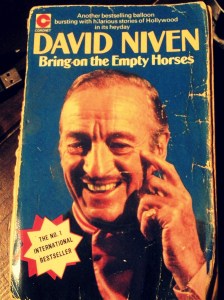
David Niven is one of my favourite actors and he wrote what I’ve always considered to the best book about the golden age of Hollywood, Bring on the Empty Horses.

In 1942 Niven was in England having left Hollywood to sign up with the army. He was asked to appear in what was a propaganda film at the time; The First of the Few, a story about R J Mitchell, the designer of the famous WWII aircraft, the Spitfire. Niven was under contract to Sam Goldwyn at the time but he allowed Niven to appear, in exchange for the US rights to the film. Niven played Squadron Leader Geoffrey Crisp who tells the story of his friend Mitchell beginning with the Schneider Trophy aircraft race of 1922. Later Mitchell visits Germany and sees how the Nazis are rearming and so resolves to design a powerful fighter for Great Britain. Mitchell died just as the government ordered the Spitfire into production and Niven as Crisp, ends his story just as he and his fellow pilots are scrambled into action.

Leslie Howard played the part of Mitchell as well as producing and directing. He was killed when the KLM flight he was aboard was shot down by the Luftwaffe in 1943.

Howard of course played Ashley Wilkes in Gone with the Wind which brings our connections full circle.


Thanks to Wikipedia creative commons for the use of the pictures in this post.


What to do next: Here are a few options.

Share this post on your favourite social media!

Hit the Subscribe button. Never miss another post!

Listen to my podcast Click here.

Click here to visit Amazon and download Floating in Space to your Kindle or order the paperback version.

Buy the book! Click here to purchase my new poetry anthology.

Some More Random Classic Film Connections

Back in the 1960’s I was a big fan of the Apollo moon missions and on UK TV one of the presenters was James Burke. Burke also did a TV show called Connections. It was a really fascinating series which connected various historical events to make a sort of chain which led up to something which was pretty unexpected. The episode that stands out in my memory was one about the atom bomb, various unconnected events and discoveries that together, led to the splitting of the atom. In today’s post, I’ve tried to do something similar but all relating to the world of film, so here are five fascinating connections.

Rebecca 1940

Rebecca is actually my favourite film from director Alfred Hitchcock. It was released in 1940 and was Hitchcock’s first American film. It is based on the novel by Daphne Du Maurier. The film stars Laurence Olivier as the aristocratic widower Maxim De Winter and Joan Fontaine as the shy young woman who becomes his second wife. The two meet in the south of France when De Winter is on the verge of jumping off a cliff top only to be interrupted by the shy young woman. The woman is never named in the film except for later when she becomes Mrs De Winter. This new or second Mrs De Winter seems to be living her life in the shadow of Rebecca, Maxim’s first wife. Later we find that Maxim murdered her after finding out that she was having an affair with Jack Favell played by the smooth and suave George Sanders.

I have to say I have always loved this film, the ruthlessly charming George Sanders, the gorgeous Joan Fontaine and the scary Mrs Danvers, the housekeeper dedicated to the dead Rebecca played by Judith Anderson. Joan Fontaine has never looked lovelier and the only blot on the film landscape are the rather poor models used to represent Manderley, the ancestral home of the De Winter family.

Joan Fontaine was actually the sister of Olivia De Havilland and the two seemed to have had a rather strained relationship. Olivia starred with Errol Flynn in the magnificent Robin Hood but is probably best remembered for her role in Gone With The Wind.

Gone With The Wind 1939

Gone With The Wind was actually being made at the same time as Rebecca and Hitchcock and producer David O Selznick, who produced both films, had numerous fallings out over Rebecca and Hitchcock was apparently happy that Selznick was preoccupied with GWTW which kept him away from the production of Rebecca. Selznick later made many edits and revisions to Rebecca which didn’t go down well with Hitchcock.

Gone With The Wind starred Clark Gable and much was made of a nationwide hunt for an actress to play Scarlett O’Hara. The eventual winner was Vivien Leigh. Olivia De Havilland played Melanie who marries Ashley Wilkes played by Leslie Howard.

The film is set in the American south at the time of the American Civil War and its aftermath. Scarlett O’Hara is the daughter of a plantation owner and she has the hots for neighbour Ashley Wilkes. Wilkes marries Melanie but Scarlett is unable to give up on her romantic feelings for Ashley even when she marries the roguish Rhett Butler.

Gone With the Wind is an epic film in every sense of the word and follows the fortunes of Scarlett and her family through the devastation of the civil war and into the reconstruction era afterwards.

Leslie Howard captures perfectly the slightly wimpy Ashley. Howard was not happy in Hollywood and returned to England after the filming to help with Britain’s war effort. He was a star of many English feature films but was sadly killed when flying back to England after a visit to Portugal where he was promoting the British war effort. Some have suggested that the Luftwaffe shot down Howard’s aircraft as the Germans believed the Prime Minister was on board. Others have speculated that Howard himself was the target as he had angered the Germans with his efforts to promote the British cause as well as the success of his film The First of The Few about the designer of the Spitfire aircraft.

The First of The Few 1942

David Niven plays the part of Squadron Leader Geoffrey Crisp and he tells his pilots of how his friend RJ Mitchell designed the Spitfire. He tells how Mitchell observed seagulls through his binoculars and envisaged a new high speed era of fighter aircraft. After entering an aircraft in the Schneider Trophy, Mitchell convinces Rolls Royce to design a new and powerful engine for the new breed of aircraft and eventually, the Spitfire is born. Leslie Howard played the part of Mitchell as well as producing and directing the film.

Casino Royale 1967

David Niven had left Hollywood in 1939 and returned to the UK in order to re-join the army and fight against the Nazi menace. As well as his army duties, Niven was released from time to time to appear in a few propaganda films, one of which was The First of The Few. He was attached to a commando unit named Phantom whose job was to find out enemy positions and report back to British commanders. After the war he resumed his film career starring in a British film A Matter of Life and Death which was chosen for the very first Royal Film Performance. Niven returned to Hollywood only to encounter terrible tragedy when his wife, whom he had met and married in England, fell down the steps into a cellar when the two were playing hide and seek at a Hollywood party. Niven must have been devastated but he carried on and later remarried.

In 1967 he appeared as James Bond in the Bond spoof Casino Royale. Ian Fleming, the author of the famous James Bond series, had sold the film rights to Casino Royale separately to the rest of the Bond books and producer Charles Feldman acquired them, hoping to do a deal with Eon productions who were producing the mainstream Bond series. When negotiations failed, Feldman who had recently had a big hit with the oddball comedy What’s New Pussycat, resolved to make a James Bond comedy satire and recruited Niven to star as Bond.

The film turned out to be a critical disaster. Two of the other stars in the film were Peter Sellers and Orson Welles. Peter played the part of a card playing expert and Welles was the villain, Le Chiffre, a spy who has spent a great deal of money that wasn’t his and intends to win it back in the casino. All went well during the filming but then Sellers approached the director Joe McGrath and demanded that he and Welles should not appear in the same shot. McGrath replied that the film was in widescreen and this could not be done. Sellers then threw a punch at McGrath and a fight ensued until they were split up by a stuntman. Sellers asked for a break but then disappeared from the set which might be why his character disappears abruptly from the film. Ultimately five directors and as many screenwriters contributed to the film.

As I mentioned earlier, Niven plays Bond in Casino Royale and interestingly, Ian Fleming had wanted Niven to play Bond in Doctor No, the first in the 007 films.

Another actor approached to play the part of Bond was Cary Grant. Grant was urbane and cultured and also British. He was in many ways perfect for the part of Bond. He was also close to producer Cubby Broccoli and in fact was Broccoli’s best man at his 1959 wedding. Grant was interested in playing the part but stipulated that he would only play the role once and wasn’t willing to do a series of films.

North By Northwest

Cary Grant appeared in numerous adventure films with an espionage background, in particular North By Northwest. Grant plays advertising executive Roger Thornhill who calls over a waiter in a New York hotel bar. The waiter was paging a George Kaplan and when Grant calls the waiter over, two thugs nearby assume Thornhill is really Kaplan. It turns out that Kaplan is a fake identity, created by American Intelligence agents to trap a spy played by James Mason. The film is an exciting cold war thriller and was directed by none other than Alfred Hitchcock, who directed Rebecca, bringing our connections full circle.


What to do next: Here are a few options.

Share this post on your favourite social media!

Hit the Subscribe button. Never miss another post!

Listen to my podcast Click here.

Buy the book! Click here to purchase my new poetry anthology.

Click here to visit Amazon and download Floating in Space to your Kindle or order the paperback version.

4 Christmas Films

I’ve had a pretty nice Christmas this year. Liz and I went to a Christmas party night in a local hotel with a huge group of friends. We had a family afternoon get together in a nearby pub and we had family over for Christmas dinner. After that it was time to relax, pour a glass of wine, break out the mince pies and settle down for some Christmas TV.

The Railway Children

I’ve always liked The Railway Children. I’ve seen it a number of times but I’ve very rarely seen it all the way through from start to finish. The film’s title sequence involves the teenage Bobbie, played by Jenny Agutter in the lounge of her home. The camera pans over various family photos and in this way the actors and their characters are introduced to us. Bobbie, short for Roberta, is the eldest daughter and has a younger brother and sister and they all live together with their parents. During Christmas their father is taken away and we think he has been arrested for some reason. Without their father, the family fortunes dwindle and they are forced to move to a country house in Yorkshire. There the children spend time watching the steam trains and visiting the railway station meeting various people including the station master played by Bernard Cribbins. They have various adventures and eventually their father is returned to the family. The Railway Children is probably the most delightful and charming film I’ve ever seen. It was written and directed by Lionel Jefferies and released in 1970. According to Wikipedia, Jefferies read the book while returning from the US to the UK en route to film Chitty Chitty Bang Bang and liked it so much he bought the film rights.

Amazing Film fact number 1: Sally Thomsett played Bobbie’s younger sister Phyllis aged 11 but in real life actress Sally was actually 20 and older than Jenny Agutter who played ‘older’ sister Bobbie. Sally’s contract forbade her to be seen smoking and drinking during the shoot.

It’s A Wonderful Life

It’s a Wonderful Life is one of those quintessential Christmas films that you can always find showing on TV at some time over the Christmas period. I love that film and come to think of it, I haven’t seen it for quite a few years. It’s about George Bailey played by James Stewart who looks forward to an interesting life of travel but then finds obligations force him to stay in the small town where he has always lived. George is beset by problems and even considers suicide but then his guardian angel -literally- arrives to help him. In order to prevent George committing suicide, the Angel shows George what life would have been like if George had never been born.

The secret of this picture is, I think, the fact that despite the fantasy premise of the film, everyone plays their parts as if they were in a serious drama. The result is that the drama and emotion of the situation rises to the surface and we are left with a vibrant and dramatic piece of cinema. The director, Frank Capra, has long been one of my favourite directors and in fact directed another of my favourite ever films, Lost Horizon.

Amazing Film Fact number 2: It’s A Wonderful Life was a box office failure when it was released in 1946. It only achieved classic status after 1974 when the film’s copyright expired and it was able to be broadcast on television without royalty fees. On TV the film found a new and enthusiastic audience.

The Greatest Story Ever Told

The Greatest Story Ever Told was directed by George Stevens who made such classic films as Shane and James Dean’s last film Giant. Stevens was a director who worked the way I would work if I was a director. He shot a great deal of film then sat back, reviewed everything and put his film together one brushstroke –or film clip- at a time. He chose Max to star as Jesus as he wanted a performer who was unknown to the general public.

Max was in a way an unusual choice to play Jesus; he was pale and blue eyed and had a faint Swedish accent. Even so, he played a good part, so much so that whenever I see another portrayal of Christ, I always mentally compare it to that of Max. As for being pale and blue eyed, I suppose it is inevitable that people everywhere will envisage their religious icons in their own terms.

He might have been better in choosing unknown actors for the other roles too because the many star appearances seem to stop the viewer in his or her tracks as we spot various top actors and actresses in minor roles.

I do have a personal reason for liking this film. Once, many years ago, my school friends and I were taken on a Christmas school trip to watch the film. We walked it as I remember in crocodile fashion from our junior school Crossacres, down Wiggins Hill and into Gatley, a small nearby village that boasted a lovely old cinema. That trip to watch this film did more for me than any teacher or RE lesson had ever done before or since and although I cannot claim to be overtly religious, I am certainly not an atheist and my respect for the person of Jesus has never been greater.

Amazing Film Fact Number 3: As I have mentioned, numerous star actors make guest appearances in the film from Sydney Poiter to Van Heflin, Angela Lansbury to Shelley Winters and many others but there is one I must mention; John Wayne as the Centurion who watches Jesus die on the cross. When Wayne uttered his immortal line, ‘truly this man was the son of God.’ Director George Stevens called ‘cut’ and asked Wayne to do the scene again but this time with more awe.

Wayne duly complied.

‘Action’ called Stevens.

‘Aww, truly this man was the son of God’ declared Wayne.

Blithe Spirit

I looked forward to watching this film with some trepidation. After all, the original version with a screenplay by Noel Coward himself and directed by David Lean was and still is a wonderful film and one of my absolute favourites. Rex Harrison plays the part of author Charles Condomine who invites Madame Arcarti into his home for a séance in order to see some of ‘the tricks of the trade’ that he assumes she will employ so that he can render these into his current novel. When the medium, played beautifully by Margaret Rutherford, conjures up the ghost or shadow of Condomine’s deceased wife neither he nor his current wife are amused. Coward himself adapted his own play for the screen and the witty dialogue presented immaculately in David Lean’s production is nothing short of a cinema gem.

Anyway, this new version starred Judi Dench as Madame Arcarti and did not in any way follow the path of Coward’s original although some of the old dialogue could occasionally be detected. Dan Stevens stars as Charles Condomine and Isla Fisher as his wife. Charles’ late wife, Elvira is played by Leslie Mann. Charles is writing a screenplay and he is suffering with writer’s block. However, on seeing what turns out to be a disastrous stage performance by Madame Arcarti, he invites her to his home where, just like the original, she evokes the spirit of Elvira. It turns out that Elvira wrote most of Charles’ books and the current Mrs Condomine isn’t amused when Elvira decides to help out with his pending screenplay.

The whole thing kept me quiet for a couple of hours but was hardly a patch on the original. For a start when current filmmakers film a story set in the past like this one which was set in the 1930’s, nothing ever looks as if it has been used before. Even though everything I’m sure was authentic; the motor cars, the furniture, the clothes and so on, everything is too good, too perfect, even down to the 30’s style haircuts and the art deco home where most of the action takes place. The other thing about the late 30s and early 1940’s is that the rhythm of the speech back then was quicker and more precise. Listen to actors like Rex Harrison, Constance Cummings and Margaret Rutherford from the original film or others from the period like David Niven, Ronald Colman and many more, their speech and delivery is so perfect and effortless, it is just a joy to listen to.

I don’t have any amazing facts about this film but the review in the Guardian was rather cutting: It can only be described as an un-reinvention, a tired, dated and unfunny period piece that changes the original plot a bit but offers no new perspective, and no new reason to be doing it in the first place.

That was a small slice of my TV viewing over the Christmas period and I can’t think of a Christmas period when my TV recordings have been so few.

Oh well, another mince pie anyone?


What to do next: Here are a few options.

Share this post on your favourite social media!

Hit the Subscribe button. Never miss another post!

Listen to my podcast Click here.

Buy the book! Click here to purchase my new poetry anthology.

Click here to visit Amazon and download Floating in Space to your Kindle or order the paperback version.

Favourite Film Directors Part 4: David Lean

The other day I was waiting in for a repairman to come and fix something. He was due sometime between 12 and 6pm so I nipped out early, did my shopping, returned home for a late breakfast and settled down to wait. I flipped on the TV and was pleasantly surprised to see the film Hobson’s Choice about to start. Hobson’s Choice was directed by David Lean and it just so happened that the previous night, sorting out various bits and pieces, I came across a lovely book about David by his widow Sandra so without further ado I thought it must be the perfect time to write a post about another of my favourite directors.

David was born in 1908 and spent his early life in Croydon (actually 38 Blenheim Crescent, Croydon) until his parents divorced. His father moved out and left the family in 1923 which must have been an upsetting moment in Lean’s young life. Another perhaps more significant moment was when an uncle gave him a camera when David was aged 10 and then Lean began to develop and print his own photographs.

In her book, David Lean: An Intimate Portrait, by Sandra Lean, his widow tells us that David was considered a ‘dud’ at school and his headmistress wondered whether he would even be able to read and write.

When he left school he began work as an apprentice at his father’s accountancy firm and at night spent his spare time at the cinema. The Gaumont film studios were nearby and Lean managed to get himself employment there starting out as a tea boy. He later became a clapperboy and gradually rose up to become a newsreel editor.

Later Lean moved on to editing feature films and was asked to work with Noel Coward on In Which We Serve. David asked to be credited as a co director on the film and Coward wasn’t too keen at first but eventually gave way. According to an interview with Lean I saw many years ago, Noel Coward soon became bored with the process of directing the film and mostly left the job to David.

Lean directed other adaptations of Coward’s plays including Blithe Spirit, filmed in colour and the highly regarded Brief Encounter, the latter winning grand prix honours at the 1946 Cannes film festival. The atmospheric exterior shots of Brief Encounter were filmed at Carnforth Railway Station in Lancashire which still exists today.

Lean married six times and three of his films featured his third wife Anne Todd. The last of the films with Todd was The Sound Barrier made in 1952 which has a screenplay by the playwright Terence Rattigan.

Hobson’s Choice, the film I mentioned earlier, is a film that shows a different side to David Lean. It’s a character driven comedy made in 1954 with excellent performances from Charles Laughton and Brenda De Banzie and a world away from the epics that David Lean later became famous for. It was hugely enjoyable to watch and one tends to forget that in his earlier years Lean made many films of a similar nature. His reputation though, at least in part, stems from a series of epics the director made starting with The Bridge on the River Kwai and including Lawrence of Arabia, Doctor Zhivago, Ryan’s Daughter and his final film which he directed, edited and wrote the screenplay for, A Passage to India.

His great collaborators were Robert Bolt who wrote and rewrote many of the screenplays used in Lean’s films, John Box his art director and production designer and Maurice Jarre who wrote the musical score for all Lean’s films from Lawrence of Arabia to his final film A Passage to India.

Sandra Lean muses that perhaps because of his parents’ divorce, David lived mostly in a series of hotels and a few rarely visited houses. He declared that ‘I have four shirts, two suitcases and the Rolls. I need no other possessions or a home’. In his later life he bought a warehouse property named Sun Wharf, situated on the banks of the river Thames at Limehouse in the east end of London. Architects, builders and decorators were brought in and the property was transformed by David, almost as if he were building a set for a new film. A similar thing happened to a property he and Sandra bought in France.

In 1970 he made Ryan’s Daughter. It’s personally not one of my favourite films and it’s hard to see why David Lean was so interested in the story. It is set in Ireland during the time of the First World War and tells the story of a married Irish woman played by Sarah Miles, (who was actually the wife of the screen writer, Robert Bolt) who has an affair with a British officer. Robert Mitchum played her husband but the only really outstanding performance was that of Sarah Miles. Many critics felt that the small scale romantic story did not fit with the film’s massive visual scale and long running time.

The film did however win two Oscars for cinematographer Freddie Young and supporting actor John Mills. The poor reception of the film prompted David to meet with the New York critics at the city’s Algonquin Hotel. I’m not sure if David wanted to reason with them or just find out why they didn’t like the film but they spent two hours attacking his production. David came away devastated and would not make a film again until A Passage to India in 1984.

He did try to make another film prior to A Passage to India. He was very interested in the story of Fletcher Christian and Captain Bligh and the mutiny on board the Bounty. He spent a few years living in Tahiti researching and making preparations for the film which included overseeing the construction of a replica of the Bounty but when Robert Bolt suffered a stroke and was unable to continue working on the script David backed out of the project. Producer Dino De Laurentis had ploughed a lot of money into the production and he agreed that a new director, Roger Donaldson, a friend of star Mel Gibson, could continue in David’s place. The film was later released as The Bounty.

In the late 1980’s David began to work on his last film, Nostromo, an adaptation of the novel by Joseph Conrad. Various scripts were produced including one by Robert Bolt. Sets were built and a budget of 46 million dollars was allocated but sadly, David Lean succumbed to throat cancer in 1991 and the production collapsed.

His work, in particular his sweeping visual style, inspired a new generation of film makers including Steven Spielberg who took over another unfinished project of David’s, Empire of the Sun.

In Sandra Lean’s book she tries hard to get at David Lean’s inner self; his actual character. He was apparently a man who accepted that some people would go out of his life and that would be that; they would be gone just like a cut in a piece of film. Once people were cut out, like his previous wives, he would never look back but whatever he was like, he was someone committed to motion pictures and Sandra quotes a speech given by Celia Johnson from In Which We Serve, in which she thinks if we substitute ships for film, we might get a true understanding of the man.

In 1987 Lawrence of Arabia was restored by film restoration expert Robert A Harris. David heard about the project and rushed to assist. Producer Don Siegel had cut elements out of the film to reduce its running time and Lean felt that now was the time to restore them. The producers could hardly say no to David Lean.

It just so happens that I have that restored version on DVD so as I’m feeling rather chilly on this December afternoon writing this, I might just dig out my copy, make a cup of tea and give it a viewing, or should I go for Blithe Spirit, the wonderfully witty play filmed by David Lean in 1945?

Which David Lean film would you watch?


What to do next: Here are a few options.

Share this post on your favourite social media!

Hit the Subscribe button. Never miss another post!

Listen to my podcast Click here.

Buy the book! Click here to purchase my new poetry anthology.

Click here to visit Amazon and download Floating in Space to your Kindle or order the paperback version.

Reviewing the Rocky Franchise

I’ve always liked the original Rocky film but something more interesting than the film itself is the story of how it came to be made. In the mid-seventies Sylvester Stallone was a bit part actor with few acting credits to his name. One day in 1975 he watched the Ali v Chuck Wepner fight in which Wepner lost but managed to stay 15 rounds with heavyweight champion Muhammad Ali. Stallone, inspired by the bout, wrote a screenplay about a washed-up fighter called Rocky who manages to stay the distance with the world champion. He passed the screenplay to his agents who took it to various producers. The screenplay was good and many producers were interested but Stallone attached one small condition to the sale, that he himself had to play the part of Rocky.

The producers who finally picked up the screenplay were Winkler-Chartoff productions. They had a contract with United Artists but UA still wanted a big name star in the title role. Burt Reynolds and James Caan were suggested but Stallone hung on and continued to insist that he played Rocky. I have always thought that Stallone was offered a million dollars to let James Caan play Rocky but according to an article I read which quoted Stallone himself, the offer went up to $340,000 and he still said no. Eventually the producers gave in and Sylvester Stallone received just $35,000 for acting and writing the screenplay plus a percentage of the profits. United Artists had a major production in the pipeline at the time, New York, New York, a big budget musical and they felt that the profits from that film would cover any losses on Rocky. In fact, the musical was a flop and those losses were covered by the success of Rocky.

The basic plot of Rocky is that World Champion Apollo Creed, played by Carl Weathers and based loosely on Muhammed Ali, is let down after planning a title bout to be held during the US Bicentennial celebrations. His opponent backs out and no other contender is available. Creed decides to rescue the fight by selecting an unknown boxer for the hugely publicised event. He chooses Rocky Balboa, a part time boxer and debt collector. The problem is, Creed thinks it will just be a demonstration match but Rocky thinks he can win.

The film was a low budget production but is still a great looking film. It was one of the first films to be shot with a Steadicam, a revolutionary camera mounting which absorbs movement. It was used in the fight scenes and the scene in which Rocky runs through the market in Philadelphia. In a sequence filmed at a skating rink, the producers had no money for any extras so they changed the script. Instead of skating with extras, Rocky and his girl Adrian bribe the cleaning staff to let them in when the rink has closed and is empty.

Joe Frazier makes a cameo appearance in the film and in fact some aspects of his life were used on the film as part of Rocky’s training regimen, running up the steps of the Philadelphia Museum of Art and punching the meat carcass in a freezer.

Rocky was released in 1976 and grossed over $5 million in the first weekend of its national release and a later box office of 225 million dollars worldwide. The film was nominated for various awards and won the Oscar for Best Picture. Stallone’s pay packet has increased with each subsequent instalment of the film franchise but even today he still isn’t happy that the producers, rather than Stallone himself, own the rights to the Rocky character.

Verdict: 10/10

Rocky II

Given the huge success of the original there was really no doubt there would be a sequel. The film starts just where the last one left off except in the original the two fighters agree that there will not be a rematch. In this sequel, Apollo Creed does a quick reversal and is immediately on at Rocky about a rematch. Rocky is not sure what to do with his new found celebrity or with his money. He buys a house and a new car. He tries his hand at TV advertising but when that fails he sinks deeper into debt and begins to consider fighting again. His manager played again by Burgess Meredith is against the idea but when Apollo ups his campaign to get Rocky to fight and publicly insults Rocky, he finally comes on board. Adrian isn’t keen on the idea and Rocky trains in a lacklustre fashion until she gives him her blessing.

The title bout begins and at the end the two fighters knock each other down together but it is Rocky who gets up to claim the win.

Stallone asked to direct the film and when John G Avildsen, the director of the original film was unavailable, he got his chance.

I’ve seen this film before and always thought that in a way it was just a remake of the original. I watched it again for this blog and rather enjoyed it.

Verdict: 7/1

Rocky III

Rocky is doing well as the heavyweight world champion. He is settled with Adrian and has a son. He takes on various contenders but is constantly hassled by Clubber Lang, played by Mr T, for a title shot. Rocky agrees to meet Clubber in the ring but his manager Mickey, played by Burgess Meredith, is not so keen. On the night of the match Mickey dies of a heart attack and Rocky loses to Clubber. Apollo Creed decides to help Rocky and takes over his training for the rematch. After a tough match he wins back his title and the film finishes with Rocky and Apollo getting together in the ring for a friendly and private bout.

Stallone wrote the screenplay and directed the film and the theme song, Eye of the Tiger won an academy award.

I had not seen this before but watched it last week and thought it was pretty good.

Verdict: 7/10

Rocky IV

Can’t say I was totally impressed with this film. Apollo Creed decides to make his comeback with a fight against Russian Boxer Ivan Drago played by Dolph Lundgren. Creed is badly beaten by the Russian and dies from his injuries. Rocky agrees to fight Drago in Russia and takes a predictable win. It was again written and directed by Stallone and he and Lundgren traded real punches in the filming which ended up with Stallone in intensive care. Stallone’s future wife Brigitte Nielson played Drago’s wife, Ludmilla. Bill Conti who wrote the musical score for all the other Rocky films was absent from this one and instead Vince DiCola produced the disappointing music.

In 2021 Stallone released a new version of the film and the re-edited and re-released film was titled Rocky Vs Drago. The new version is only slightly longer but apparently was meant to add more depth to the relationship between Rocky and Apollo Creed as well as cutting some sillier elements like the robot Rocky gives to Paulie as a gift. A review I read in the Guardian felt that Stallone only marginally succeeded.

Verdict 4/10

Rocky V

This is probably the low point in the franchise. Original director John G Avildsen returned to the director’s chair and Stallone intended it to be the last in the Rocky franchise but it’s possible that because it was badly received, he went on to make Rocky Balboa.

Rocky returns from Russia but retires from boxing due to an injury. He then finds that his brother-in-law Paulie has given power of attorney to Rocky’s accountant who has then gone on to squander Rocky’s fortune. Rocky and his wife have to sell their home to pay their debts but Rocky finds purpose in training a young fighter. The relationship later sours and the two engage in a street fight which Rocky wins.

I have to admit that this is one Rocky film that has eluded me so far. Over on Rotten Tomatoes the review went like this: “Rocky V’s attempts to recapture the original’s working-class grit are as transparently phony as each of the thuddingly obvious plot developments in a misguided instalment that sent the franchise flailing into long term limbo.”

Verdict: Rotten Tomatoes gave the film only a 29% approval rating.

Rocky Balboa

I have two of the Rocky films on DVD. One is the original Rocky and the other is this one, Rocky Balboa. It’s a really thoughtful entry into the Rocky franchise. Rocky has retired. His wife has died and he has lost a lot of his money. His income comes from a small Italian restaurant in which many of the patrons come not just for Italian food but also to meet the former heavyweight champion of the world, Rocky Balboa.

The current champion Mason ‘the line’ Dixon has been criticised for fighting easy opponents. To get some positive publicity, he decides to enter into a computer fight with Rocky. It’s a fight reminiscent of the encounter between Rocky Marciano and Muhammad Ali in the 1970’s. At the time Marciano and Ali were the sport’s only two unbeaten champions. They were filmed sparring for various rounds and the result decided by probability formulas entered into a computer. Two different outcomes were filmed, the version shown in the UK showed Ali winning which my father was not happy about as he loved boxing and was a particular fan of Rocky Marciano.

In the film Rocky is judged to have won the computer fight and so decides to renew his boxing licence. Mason, not happy about being beaten, challenges Rocky to an exhibition fight which both men want to win. Mason emerges as the winner but Rocky doesn’t seem to mind. His day is over and he receives a standing ovation from the crowd.

This was probably the very best entry into the Rocky series. Rather than just boxing, the film looks at Rocky himself as he gets older, mourns the loss of his wife, and worries about his relationship with his son. He revisits many of the locations in the original Rocky film including his old house and the pet store where he met his wife. The only problem I had with the film was that the actor playing Mason Dixon didn’t look much like a heavyweight boxer to me. Surprise, surprise, then when I found out that actor Antonio Tarver was in fact a former light heavyweight champion! Ah, not a proper heavyweight then.

Rocky Balboa was the last in the Rocky series although a spin off series began in 2015 with Creed in which Rocky mentors boxer Adonis Johnson, the son of Apollo Creed. Although Stallone apparently contributed to the story, he did not write or direct either this or the following films. He isn’t happy about the producers owning the rights to characters he created either and publicly tweeted his unhappiness about a reported spin off film about Drago, the Russian boxer in Rocky IV.

In a lot of ways, the Rocky films parallel Stallone’s own life. He turned down big money offers to let others play what was the role of a lifetime, took it on himself and was propelled to film stardom.


What to do next: Here are a few options.

Share this post on your favourite social media!

Hit the Subscribe button. Never miss another post!

Listen to my podcast Click here.

Click here to visit Amazon and download Floating in Space to your Kindle or order the paperback version.

Buy the book! Click here to purchase my new poetry anthology.

Making the YouTube Video

One of my friends asked me about my videos the other day. He wanted to know if they were easy to make and how much I planned them in advance. Anyone who knows me will know that I don’t plan anything in advance but I thought it might be interesting to show readers just how I put together a video.

The Idea/Shooting

I did a video a while ago as part of a beta testing programme I was asked to take part in. The testing was for a new update over on Animoto.com which is an online video editing site. The new addition was the facility to add a voice recording to a video which I had actually advocated quite a few times on their Facebook forum page. The video I decided to make stemmed from a blog post about writing poetry and it was called Idea, Inspiration and Effort. Those three things were what I thought was required to produce a poem and to be fair they could be applied to anything, a poem, an essay, a blog post, a novel or indeed, a video.

Everything of course starts with an idea. What shall I write about or what can I make a video about? For me I tend to shoot all sorts of video and then only later start to think about how I can put it together and use it in a finished product. For the video mentioned above over on Animoto I chose a template from their fairly wide range and then it was just a matter of adding in the stock photos or video and then the graphics. Animoto provides stock photos which I do use regularly but if possible, I always try to use photos I have taken myself. For instance, I needed a sunset shot for this video and I knew that I had a shot of a sunset taken in Greece on the island of Kalymnos so I uploaded that.

Of course, for a video like that, not much actual filming was required but normally, filming is the first step in any video. One way to prepare for a shoot is to make story boards. They are used extensively in the cinema and I’ve seen documentaries showing wonderful story boards from films like Citizen Kane to Aliens. They are simply drawings that look like comic strips showing the visual look of each different scene. Good for films using actors but not much use for documentaries or short films, well at least, not in my opinion. I tend to film first and then plan later how to use my recorded video. Others might think story boards a great help.

Reviewing the footage.

A short video like the one above is pretty easy but for my most recent video, a compilation of GoPro video shot mostly through the windscreen of my motorhome, well that was a little harder. I had a rough idea what I wanted so the next step was just to review all my footage. That involved hours and hours of going through a lot of video, a great deal of which was not very inspiring. Many times, I had left my GoPro running when I should have shut it down. Other times I pressed record at some wonderful area of French countryside, only to find that the resulting video wasn’t so wonderful.

A GoPro Hero similar to mine.

The Rough Cut

After reviewing everything, I dropped all the better shots into my video editor and the result was a video lasting well over an hour. My big mistake on a lot of our French trips is not shooting much additional video.  I may have recorded us arriving at a spectacular lake but then I hadn’t taken the camera and shot around the lake. We’d take a trek around a lovely French village and again I didn’t shoot anything in the village. However, having visited France so many times I went back over all my older video looking for interesting things.

In 2020 we parked by the river Seine one day and I had filmed the ferry going across to the other side and a huge ship chugging serenely past. I had not used that footage in previous videos so I added that into the editor. On a number of occasions, I’ve tried to shoot things that motorhomers have to deal with as routine, things like emptying the toilet and the waste water and topping up the drinking water and so on, so I added a number of clips showing all those processes.

In Rouen a few years ago we were following the directions from the Google lady on Google maps when we found ourselves heading into a tunnel which I realised we weren’t going to fit under. Luckily there was an escape road and we were able to exit but when we passed the area again this year, I recorded us travelling past and so I was able to talk about the experience.

The Final Cut

Less is more has always been my video adage so I trimmed out more and more video until I was left with some short story blocks or chapters: Travelling through the channel tunnel, heading on south through France with a quick look at where we stopped in 2020 by the Seine. Going through Rouen and avoiding the low tunnel. Various camping sites. Maintaining the motorhome and emptying the waste. A final stop and a barbecue and then returning to home via the ferry.

Voice Over

The next step was to put together the narration. Sometimes I write a narration and then tweak the video to fit the text. On this occasion I decided to do something I’d done before which was to jot down a few notes and then just narrate the voice-over as I watched the video. I actually did it quite a few times. The first and second versions had a lot of ums and ahs but by the third time I finally felt I had something reasonable. My voice-over was more confident than the first two tries and by then I pretty much knew what to say without my notes.

Sound Effects

Next I add the sound effects. Now you might think there wouldn’t be much need for sound effects on a video like this, however there were a couple. On a sequence where I showed the outdoor laundrettes which abound outside supermarkets in France, I had combined some still shots with video so I added some washing machine sounds to cover that and on another sequence, I had slowed down a wobbly shot of a microlight flying overhead. The soundtrack was distorted at the slow speed so I added the sound of a light aircraft which was similar to the sound of the microlight.

Microlight

Where do I get the sound effects? Well Liz bought me one of those sound effect CDs a few years ago but sometimes I head for a site called Zapsplat to download some free sounds.

Just to finish I think it’s important to watch the final product from beginning to end and just look for things that could be tidied up. I added a sequence showing an antique telephone during a bit on the voice-over where I talk about telephones. There were still some superfluous scenes shot through the windscreen which were either boring or too long so I trimmed those down.

Titles and Credits

The final thing is to add the titles and credits. Now being an old-fashioned film maker, I’ve always liked good intros on films. These days in the world of YouTube and TikTok, those long title sequences are not recommended. While I’m trying to get my video started with a few titles and introductions, the viewer has already clicked on to another video so these days the advice is to make those titles and credits short and sweet.

What sort of video editor do I use?

Well I actually like the professional version of the Microsoft Windows Video Editor. It’s pretty simple to use and I always make my rough cut with it. If I want to play with the soundtrack I then take the video over to Power Director where you can do some more complex edits.

Uploading to Social Media

Once you have made a video you want people to see it so it’s only natural to upload to the internet. YouTube is the obvious choice. How do you get people to watch it though? Tricky question and to be fair, I don’t really know the answer. I upload my videos and link them to various other sites. I have quite a few pages on this site here at WordPress where I showcase my videos or use them directly within a post. I also link them to Reddit, Facebook, Twitter and other places that I feel are appropriate. For instance there is a Manchester community on Reddit so I’ll link my Manchester themed videos there. I link my poetry videos to either the Reddit poetry community or to my Writeoutloud poetry page. Over on Facebook there is an amateur video page where video producers showcase their work and chat about it.

One of my big mistakes is uploading to YouTube too early. Once I’ve finished a project, I’ll continue to fiddle with it and start to wish I had uploaded version 7 rather than version 1. A good video site though less popular than YouTube is Vimeo and the good thing about their site is that it’s possible to replace your video with an updated version without losing your stats and comments. Such a pity that feature isn’t possible on YouTube.

Just as I finished this post, I clicked on a video that came up in my YouTube feed. It was about Ridley Scott and the making of Alien. Scott did something special with Alien, he took what could have been a mediocre monster movie and made it into something special. He brought some great designers and a strong cast into the project, made his case to the producers for a bigger budget and ended up with an outstanding film. Preparation and design was the key to that film and preparation and design are important even in small projects like yours, mine and a thousand others you will see on Youtube.

What will your next video project be?


What to do next: Here are a few options.

Share this post on your favourite social media!

Hit the Subscribe button. Never miss another post!

Listen to my podcast Click here.

Buy the book! Click here to purchase my new poetry anthology.

Click here to visit Amazon and download Floating in Space to your Kindle or order the paperback version.

Reviewing the Mission Impossible Franchise

It was a cold afternoon in Manchester and I mumbled something to myself about the supposed heatwave and zipped my jacket up to my neck. At the left luggage office I took out the key that had been given to me earlier and when I opened the compartment I found a small package inside. I took the package and walked the short distance to the square. I sat down on the hard wooden bench and opened it up. Inside was a small tape player and a set of earphones. I put on the earphones and pressed play. There was a short burst of static and then a voice spoke.

‘Good afternoon, Mr Higgins. In the 1970’s a television show called Mission Impossible was produced that became a minor cult TV classic. Many years later the franchise was revived with a series of feature films starring Tom Cruise. Your mission, should you decide to accept it, is to review the TV series and the subsequent films, look at the background to the films, try to understand why they have been successful and put together a blog post revealing your findings. The blog post must be ready for publication by Saturday at 10am.

This tape will self-destruct in 5 seconds.’

I put down the earphones and placed them and the tape player back in the package, moments later the package disintegrated and I dropped the remains into a rubbish bin and walked away.

The TV series 1966 to 1973

The TV show was created by producer Bruce Geller and concerned a team of special agents known as the Impossible Missions Force. They are a US government agency which takes on hostile foreign governments, South American dictatorships and criminal organisations.

In the first series the team is led by Dan Briggs played by Steven Hill but he was replaced for season 2 by Peter Graves in the part of Jim Phelps. Other regular team members were Leonard Nimoy, Martin Laudau and his wife Barbara Bain, Greg Morris and Lesley Anne Warren. Each played a team member with a particular skill, for instance Laudau and Nimoy played agents with a talent for impersonation and disguise, Greg Morris played an electronics expert and so on.

Mission Impossible ran for 7 seasons and was cancelled because, according to Wikipedia, the producers at Paramount found they could make more money by syndicating the existing series rather than making new ones.

A revival series was made in the 1980’s also starring Peter Graves. To save money the series was not filmed in Hollywood but in Australia but it only lasted two seasons and was largely unsuccessful.

A great feature of the series was the opening title sequence which involved a match being struck and then lighting a fuse shown over quick clips of the upcoming episode to the sound of the iconic theme tune written by Lalo Schifrin. Next would be Jim Phelps listening to his tape recorded instructions which after being played would then self-destruct. Phelps would then look through his agents’ files complete with photos and choose who he wanted for the mission. Sometimes a guest star would play one of the agents who would be introduced by Jim checking out his dossier. A team briefing would then take place and the mission would get under way.

The IMF used a great deal of gadgets to accomplish their missions, secret listening devices and other electronic hardware as well as incredible masks and make up to impersonate people. One particular episode that I remember was when the team had to retrieve some stolen gold from a South American dictator’s safe. They did it by drilling a small hole in the safe, heating it until the gold melted and ran out down the small hole then a little gadget sprayed the interior of the empty safe to cover the hole. Mission Impossible was staple viewing in our household in the late 1960’s.

Mission Impossible 1996

Paramount Studios had plans to make a movie version of the series but the plans never seemed to come to fruition until Tom Cruise expressed an interest. He had been a fan of the TV series and hoped to make the film version the first project for his own production company, Cruise/Wagner Productions. The project began with Sydney Pollack as director but Cruise later decided he wanted Brian De Palma. De Palma designed most of the action sequences in the film and the final script was written around these. It just so happens that recently Channel 4 in the UK decided to run all the Mission Impossible films on consecutive nights so that came in pretty handy to refresh my memory on these films.

I enjoyed Mission Impossible much more on this recent viewing than when I had first seen it. The film uses the fabulous TV theme and opens in a similar way to the TV series.

Cruise plays agent Ethan Hunt with John Voight playing Jim Phelps. Hunt is sent to stop the theft of a list of agents kept inside the American Embassy in Prague. The mission fails and Jim Phelps, the agent in charge, is wounded and all of his team are killed except for Ethan Hunt. There is clearly a double agent or mole at work and various things happen until we find out the mole was Jim Phelps which was just a little bit sneaky because all of us who watched the 1960’s TV series knew that Jim Phelps was a character in that show and therefore could not possibly be the mole. The fact that he was made me feel a little cheated by this film because they used my nerdy TV knowledge against me.

I read recently that Peter Graves was asked to play Phelps in the film but declined after seeing his character was the traitor. Other stars from the TV series weren’t happy either.

Mission Impossible II 2000

This second instalment of the franchise was directed by John Woo. It’s about a biological weapon called Chimera. Rogue agent Sean Ambrose steals the virus from its inventor by impersonating Ethan Hunt. He destroys the aircraft on which the inventor is travelling and parachutes to safety. Hunt was played once again by Tom Cruise and his mission is to regain the virus. The opening sequence sees Cruise doing some daring rock climbing which the studio wasn’t happy about. Cruise didn’t have a safety net but did apparently wear a harness. I didn’t like the heavy metal style version of the classic theme and as a matter of fact, I lost interest in the film early on.

Mission Impossible III 2006

This third instalment was directed by JJ Abrams and for the first time the writers decided to show a little of the background to the Ethan Hunt character. He has retired from the IMF and has become a trainer for new agents but is asked to take on a new mission. He is about to get married but his fiancée knows nothing of his espionage work. The IMF team kidnap villain Owen Davian who escapes but decides to take revenge on Ethan. The film is filled with high powered action sequences and although a little implausible, I kind of liked it.

Mission Impossible Ghost Protocol 2011

The IMF are tasked to stop a man only known as ‘Cobalt’ who is trying to initiate a war between the USA and Russia. Tom Cruise as Ethan, infiltrates a Moscow prison to get to a man who has links to Cobalt. Things go wrong and the IMF is closed down by the US government when Cobalt blows up the Kremlin. The IMF team however stay on the hunt for Cobalt and follow him to various parts of the world including Dubai, where Tom Cruise has to climb up the outside of the world’s tallest building, the Burj Khalifa. Cruise does all his own stunts but for a long time I just assumed that all the stuff on the outside of the Khalifa was done in a studio with a green screen and the background digitally inserted. Nope, Cruise actually swung on hidden cables outside the skyscraper. Why he should choose to risk his life in that fashion is beyond me but there it is. A good film full of action and adventure with numerous shootings and explosions.

Mission Impossible Rogue Nation 2015

This next instalment of Mission Impossible is pretty similar to the previous one. The CIA director (Alex Baldwin) asks a government committee to close down the IMF and incorporate them into the CIA which they decide to do. Ethan Hunt escapes from a criminal organisation known as the Syndicate with the help of British double agent Ilse Faust. Various exciting adventures ensue including a highly dangerous motorcycle chase and a deep underwater dive without oxygen. The IMF manage to capture the head of the Syndicate in the end. A government committee decide it would be best to reform the IMF. It’s all a little fantastic but not bad for a Saturday night on TV with a couple of beers and a pizza.

Mission Impossible Fallout 2018

After a week of watching the Mission Impossible films I’m sorry to say I missed this one which is a pity because according to the reviews it’s the best in the series. Still, sometimes it’s important to move one’s lazy behind off the couch, switch off the TV and go out and enjoy oneself. Pity there weren’t a few Mission Impossible questions in the pub quiz that night. After all this research I think I might have done pretty well.

Update

It just so happened that my brother has Fallout on DVD so he brought it round and we gave it a watch. The plot is something about plutonium and atomic bombs and the IMF guys have to swap the captured head of the Syndicate for the plutonium. The plutonium gets put into 2 atomic bombs which cannot be defused but after some highly implausible action-packed chases including a helicopter chase with both helicopters crashing, rolling down a cliff and being suspended on the edge, things finally get sorted. I reckon this would have been a good one to watch in the cinema.

Conclusion

It’s not easy to reboot a successful TV series whether it’s for the small screen or the big one but the producers of the Mission Impossible films have actually done a pretty good job. The films do have something of a link to the old TV series. They have different characters and different actors but the films have kept that opening element from the TV show with the match lighting the fuse.  They have also kept that fabulous theme tune. Then again, could they have really made Mission Impossible without the Mission Impossible theme? I don’t think so.

I did read that some of the TV actors from the original series weren’t happy with the films. Greg Morris apparently walked out of a screening when it was revealed that Jim Phelps was the traitor which was exactly why Peter Graves, the original Jim Phelps declined to reprise his old role as I mentioned earlier.

Personally, with the exception of MI2 I’ve enjoyed all the films and I look forward to the next instalment in the franchise which I believe has already been filmed.

Please step away from this blog post. It will self-destruct in 5 seconds . . .


What to do next: Here are a few options.

Share this post on your favourite social media!

Hit the Subscribe button. Never miss another post!

Listen to my podcast Click here.

Buy the book! Click here to purchase my new poetry anthology.

Click here to visit Amazon and download Floating in Space to your Kindle or order the paperback version.

10 Great War Films (Part 2)

I was reading a post called The 10 Best War Films Ever the other day. It wasn’t a list I particularly agreed with and in fact I hadn’t seen or even heard of quite a few of the films mentioned so I thought I’d have a go at making my own list. Here we go. As this post went on a bit I published part 1 last week so now here’s part 2.

Angels One Five

Angels One Five is another WWII film this time concerning the Royal Air Force. John Gregson plays a new pilot who is assigned to ‘Pimpernel’ squadron at a small airfield in the south of England. When he touches down he crashes and damages his replacement aircraft, not making a great impression on his new colleagues. The film follows Gregson’s character, nicknamed ‘Septic’ as he begins work at the station, first in the control room and then as a novice pilot.

Parts of the film were shot at RAF Uxbridge where a wartime operations room was located. Jack Hawkins and Michael Dennison also star in the film which shows life in the Royal Air Force in the dark days of 1940 during the battle of Britain.

Paths of Glory

Paths of Glory was a 1957 film directed by Stanley Kubrick. It was set in the First World War and starred Kirk Douglas as Colonel Dax. General Broulard of the general staff orders his army to attack a German position known as the Anthill. He commands General Mireau to organise the attack. Mireau says the task is impossible but changes his mind when offered a promotion. The attack predictably fails and some of the troops refuse to attack when they see their colleagues in the first wave mown down. The enraged General Mireau orders his artillery to fire on his own men but the artillery commander refuses.

Afterwards the general decides to have 100 men court martialled for cowardice but is later persuaded to have the number reduced to three. Colonel Dax, a lawyer in civilian life, volunteers to defend the men but the trial turns out to be a farce.

The Dambusters

This is one of those films that I have always loved in spite of its sometimes amateur special effects. The original Star Trek movie has been in the news lately as it has been re released with updated special effects and I often think it would be a great idea for some older films to be updated in that way too. Anyway, the Dambusters is another classic WWII film. It starts with the inventor Barnes Wallis played by Michael Redgrave who is working on an idea to breech the Ruhr dams in Germany thus disrupting the German manufacturing base in the Ruhr Valley. He works constantly in a water testing tank refining his ideas for a bouncing bomb. After a difficult process he gets his idea accepted by Bomber Command and a new squadron, 633 squadron is formed to take on the mission. Its leader is the famous Guy Gibson played by Richard Todd. Gibson and his team take on a difficult and dangerous task. The bombs must be dropped from low level at a specific height and specific distance from the dam. I’ve often felt this to be a wonderful film that not only shows the dangers of war and combat but also shows the whole process from beginning to end of the design and inception of a new wartime project. The only disappointing aspect is those poor special effects.

Platoon

OK, that’s enough of WWII, time to move on. Platoon was a film written and directed by Oliver Stone based on his own experiences in the Vietnam war. Vietnam was a different kind of war to WWII. The soldiers were younger and many were disillusioned about being in Vietnam in the first place. Charlie Sheen stars as a new recruit arriving in Vietnam and he soon learns that his life is worth less than the fellow soldiers. They have put the time in, they have fought the Vietcong and so if anyone deserves to go home safe and sound, it is them, not him.

The platoon is led by a young and inexperienced officer but the two real leaders are two company sergeants, Barnes and Elias played by Tom Berenger and Willem Dafoe. Charlie Sheen’s character, Chris Taylor, respects both men but sees Barnes as someone who is a little dangerous. In an incident at a village Barnes shoots a Vietnamese woman dead while interrogating the villagers for information. Elias arrives and breaks things up and Barnes later finds he might be the subject of an investigation into the incident. During a fire fight with the Vietcong, Barnes shoots Elias dead in order to prevent him speaking up and later Taylor shoots a wounded Barnes.

Platoon is a powerful film that won many awards including four Oscars including best picture and best director.

Born on the Fourth of July

Born on the Fourth of July was another film by director Oliver Stone and the second in his Vietnam trilogy. It tells the story of Ron Kovic who was wounded in Vietnam and left paralysed and wheelchair bound. Tom Cruise gives a great performance as Kovic, showing him go from a believer in the war to the exact opposite, someone who campaigns for an end to the killing in Vietnam. He is invalided back to the USA where the poor medical care and the state of the veterans’ hospital is graphically portrayed. Kovic goes to Dulce Villa, a haven in Mexico for wounded veterans where he spends a lot of time drinking and perhaps getting the anger out of his system. Later he joins an anti-war group and the film finishes with Ron about to address the Democratic National Convention although I thought that a better ending might have been to show him actually making his speech. Even so, Oliver Stone has produced a powerful film which gave Tom Cruise his first nomination for Best Actor and another director’s Oscar for Stone himself.

So that’s my personal Ten Best War Films. If you missed Part One last week, click here to read it. What were your favourite war movies?


What to do next: Here are a few options.

Share this post on your favourite social media!

Hit the Subscribe button. Never miss another post!

Listen to my podcast Click here.

Buy the book! Click here to purchase my new poetry anthology.

Click here to visit Amazon and download Floating in Space to your Kindle or order the paperback version.

10 Great War Films (Part 1)

I was reading a post called The 10 Best War Films Ever the other day. It wasn’t a list I particularly agreed with and in fact I hadn’t seen or even heard of quite a few of the films mentioned so I thought I’d have a go at making my own list. Here we go! As this post went on a bit I’ve split it in two and I’ll post Part 2 next week.

The Great Escape

The Great Escape was based on an actual event, a real life mass escape from a German prisoner of war camp in WWII. The film though wasn’t completely true to life, in fact I don’t think any American POWs were in the camp although Steve McQueen and James Garner played major roles. I also don’t think that any escaping POW’s tried to escape Germany on a motorcycle but hey, The Great Escape is one of those easy-going feel-good action-adventure films that is one of the most well-loved films ever made. For many years it was a staple of UK Christmas TV viewing and whether it is completely factual or not it is a great film. Richard Attenborough, Donald Pleasance, David McCallum, Gordon Jackson and many others play the British officers. Attenborough plays Roger Bartlett who has just been released by the Gestapo after being recaptured and interrogated in relation to another escape attempt. He now plans a mass escape from the camp and organises the digging of tunnels, fake identity papers, maps and clothing. After the escape fifty officers were executed by the Nazis although of course, Steve McQueen lived to fight another day.

The Colditz Story

The Colditz Story is another prisoner of war escape film also based on a true story. In WWII the Germans rounded up a bunch of the most prolific escapers and put them all together in an escape proof castle named Colditz. John Mills plays a British officer who is tasked with co ordinating escapes with various other groups of captives, French, Polish, Dutch and various others as previous escape attempts were failing due to a sort of free for all escaping culture. Various escaping officers are elected and the prisoners work together towards breaking out from the castle. Mills eventually escapes by using an idea suggested by a fellow soldier. It’s a simple idea involving dressing up as German officers. Not very original you might think but the officers plan to be leaving the Officers’ club which they hope will make them appear more natural. The chief British officer decides the plan is doomed to failure as the man who thought of it was a very tall officer who he thinks would be immediately recognised by the camp guards. I won’t tell you what happens but Colditz is a great British picture and well worth watching.

The Wooden Horse.

The Wooden Horse is similar to the two films above. It is based on a book which in turn was a true story, actually written by one of the escapees from a WWII prisoner of war camp. In fact, if I remember rightly, the escape was from the same camp as the Great Escape Stalag Luft III. One of the big problems of digging a tunnel in a POW camp was the distance that needed to be covered. There was quite a distance from the camp huts to the perimeter, then there was an area of no mans land before the outside world. Two escapers, both captured airmen, hit on an idea. They decide to make a vaulting horse and lead it out close to the camp fence. Inside are concealed two men who dig a tunnel while their comrades exercised above. This meant that only a relatively short tunnel was required. The film covers all the aspects of camp life, the boredom, the petty arguments with fellow prisoners and the eventual escape. The film stars Leo Genn, Anthony Steel and David Tomlinson as the escapees.

The Cruel Sea

It’s time to move on from POW camps and escaping and to take a look at the war at sea. The Cruel Sea is a classic WWII film based on the book by Nicholas Monsarrat. Jack Hawkins is the commander of the escort vessel Compass Rose. The film follows the story of the ship from its handover in the shipyard to the navy all the way through to its final demise at sea. The crew are new to naval warfare but bind together through various incidents at sea guarding convoys in the north Atlantic. The outstanding cast are all stalwarts of 1940s and 50s British cinema, names like Donald Sinden, Denholm Elliott, Stanley Baker and Virginia McKenna.

The Compass Rose is eventually sunk by a torpedo and as the survivors struggle to stay alive in the cold Atlantic, many succumb to their injuries. As they drift in the oily water the soundtrack replays echos of their recent dialogue, a marriage proposal hangs in the air over the groom who will never wed and a petty argument haunts the body of an unhappily married officer. Happily, some survive till daylight when a destroyer returns to rescue them. The film continues with the next vessel Jack Hawkins is charged with commanding until the war ends. Colditz and the Great Escape are pretty light hearted films compared to this one which tends to be grittier and more realistic in its portrayal of the war.

Sink The Bismarck

Continuing with the war at sea, this film follows the hunt for the battleship Bismarck by the Royal Navy again in WWII. It focuses on the Admiralty’s control centre as they attempt to track down the German battleship before it wreaks further havoc with the convoys that brought vital supplies to Britain. Kenneth Moore plays captain Shepard, the chief of operations, as he and his team attempt to find the Bismarck so British destroyers can attack and destroy the enemy. The film is perhaps a little different to other war films in that a great deal of the action focusses on the Admiralty control room showing the work of the unsung back room experts as they collate information and sightings and relay it to the ships under their command.

Don’t forget to check back next week for part 2 of this post.


What to do next: Here are a few options.

Share this post on your favourite social media!

Hit the Subscribe button. Never miss another post!

Listen to my podcast Click here.

Buy the book! Click here to purchase my new poetry anthology.

Click here to visit Amazon and download Floating in Space to your Kindle or order the paperback version.