10 Books Rejected by Publishers!

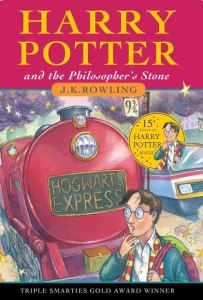
Harry Potter and the Philosopher’s Stone by JK Rowling.

Harry Potter and the Philosopher’s Stone had been written in Edinburgh cafes while author JK Rowling and her daughter lived on benefits. The book was rejected 12 times and was only published when one publisher’s daughter read the first chapter and then begged her father to produce the book so she could read the rest. The series may now have finished, but the Harry Potter franchise continues. Eight films, one theme park, and countless video games, board games and products later, Harry Potter is one of the highest grossing franchises of all time. Rowling is no longer living on state benefits and is reputedly worth 700 million pounds. I have to admit I have never read the Harry Potter books but I salute an author that has given the gift of reading to a new generation of young readers.

Gone with the Wind by Margaret Mitchell.

A number of searches on the internet brought up the magic rejection number of 38 for this novel. Rejected 38 times? Well I also found an interesting post by author Brenda Coulter in which she claimed the novel was never rejected. Margaret Mitchell apparently felt the novel would have little interest outside the South but happened to meet with someone from the MacMillan publishing group who immediately bought the publishing rights, much to the author’s surprise. The writer of the blog post went on to say this about publishing:  It just isn’t true that every talented writer will eventually be published if she works hard enough and waits long enough and believes. Novels don’t get published because their authors have faithfully paid their dues and waited their turn. Publication isn’t a bus that anyone can catch as long as they have the correct fare and show up at the right stop at the scheduled time. A novel is accepted only when some publishing house believes it can make money on the book. Period. So the difference between a published author and an unpublished one does not always boil down to talent and experience. Sometimes the difference is, quite simply, marketability.

Lolita by Vladimir Nabokov.

Lolita was rejected 5 times. One publisher wrote that the book was “…overwhelmingly nauseating, even to an enlightened Freudian … the whole thing is an unsure cross between hideous reality and improbable fantasy. It often becomes a wild neurotic daydream … I recommend that it be buried under a stone for a thousand years.” I read the book a few years back after reading a blog post about classic books I must read. I felt a little like a sort of voyeur reading the novel which is about one man’s passion, lust even, for a young girl. It was an interesting read and the excellence of the writing seemed to jar a little with the subject matter. ‘A neurotic daydream’ is probably a good description of the book.

Moby Dick by Herman Melville.

Again, this is not a book I have read but I have seen the film starring Gregory Peck. Moby Dick was initially rejected by publishers Bentley and Son who wrote back to Melville asking: “First, we must ask, does it have to be a whale? While this is a rather delightful, if somewhat esoteric, plot device, we recommend an antagonist with a more popular visage among the younger readers. For instance, could not the Captain be struggling with a depravity towards young, perhaps voluptuous, maidens?” Melville decided to keep the whale although the young voluptuous maiden idea surely has it merits. .

The Wonderful Wizard of Oz by L Frank Baum.

It’s hard to say how many times this book was rejected but the author did keep a journal he called ‘a record of failure’ detailing all his rejections. The book was first published in 1900 and by 1938 had sold over a million copies. The book was illustrated by W W Denslow and both he and Baum claimed credit for the book’s success. The publisher only agreed to publish the book when the manager of the Chicago Grand Opera House, Fred R Hamlin, committed to making The Wonderful Wizard of Oz into a musical stage play to publicize the novel. The book was famously made into a film in 1939 starring Judy Garland.
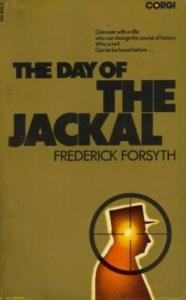
Day of the Jackal by Frederick Forsyth.

The novel was turned down by the first four publishers the author approached. Eventually Harold Harris of Hutchinson decided to take a chance on a modest print run of 8,000 copies. The Jackal became a sensation and only two years later Fred Zinneman was directing the movie version. Forsyth was a journalist in Paris in his mid-twenties and was aware of the controversy over the granting of independence to Algeria. He had befriended some of President De Gaulle’s bodyguards and had even reported from the scene of a real life failed assassination attempt, in fact an account of this real incident opens the novel. What would happen, thought Forsyth, if the terrorist group the OAS decided to employ a hitman to murder the President? The resulting novel has a gritty documentary style of realism that would influence a new wave of thriller writers.

Carrie by Stephen King.

Stephen King apparently received 30 rejections for his book before dejectedly tossing it into the trash. His wife Tabitha fished it out and urged him to try again. The book was published and became a classic of the horror genre. At the time back in 1973, King and his wife were living in a trailer, he taught English at a private school and his wife worked in ‘Dunkin Donuts’ as well as them both moonlighting in various part time jobs. Sales of the book were boosted by the film version and the paperback sold over a million copies in its first year.

The Time Traveler’s Wife by Audrey Niffenegger

This book was rejected by 25 agents but was finally published in 2003 after the author sent the manuscript to a small San Francisco based publisher where the work found its way into the hands of a sympathetic editor. I have to say that this was an odd novel and took me quite a while to get into the book and understand the fractured timeline of the time traveller. However, it was an interesting and enjoyable read although a somewhat quirky addition to the sci-fi genre. Having said that, some reviewers regard the book as more of a romance than a work of sci-fi.

Roots by Alex Haley.

Alex Haley spent eight years writing the book and received 200 consecutive rejections or at least that is what some internet sites say. Others say Haley may have had 200 rejections but that includes his other work as well. His novel Roots finally became a publishing sensation, selling 1.5 million copies in its first seven months of release and going on to sell 8 million. Such was the success of the book that The Pulitzer Prize awarded the novel a Special Citation in 1977. Again, this is another book I have yet to read but I do remember the TV series from 1977.

Floating in Space by Steve Higgins. I sent my book off to 3 traditional publishers who all declined to publish it. To be fair, my manuscript was not in great shape but I have beavered away and every now and then updated the book so now I like to think the manuscript is pretty reasonable. After those three knockbacks, paltry compared to some of the rejections mentioned above, I chose to self-publish at Amazon. Should I perhaps have tried harder, spent more time on my covering letter, sent out the manuscript to more publishers? Still, just like Brenda Coulter says: Publication isn’t a bus that anyone can catch as long as they have the correct fare and show up at the right stop at the scheduled time. It’s about marketability!
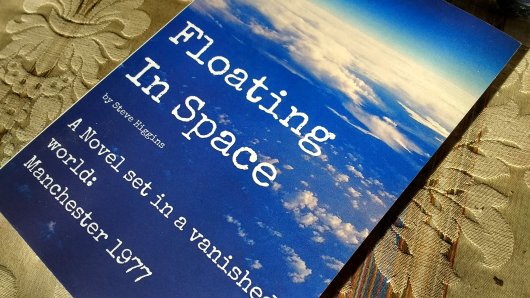
Floating in Space is a novel set in Manchester, 1977. Click the links at the top of the page to buy or for more information.

Dear Diary

Reading a published diary is not like reading a normal book, A diary isn’t an autobiography, it’s something slightly different, the thoughts of the writer at the time and not his or her later retrospective thoughts.

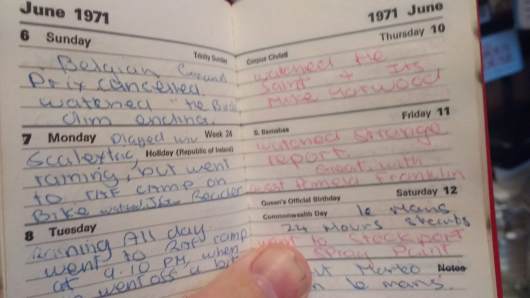
I am a diarist, though very much an irregular one. Many of my diaries have gaping pages of emptiness in them and catch up pages where I quickly skim through things that have happened to me. Other pages are just lists of my shift times and I have to say there is not much of any great literary value in any of my diaries, although they are interesting to look back on, well at least to me. My oldest diary dates back to 1971 and a great deal of it concerns the television programmes I had watched. No wonder my old Dad used to call me ‘square eyes’!

Just taking in a random page from 1971 I see the Belgian Grand Prix was cancelled that year. I think there were safety concerns regarding the very fast Spa Fancorchamps circuit. I was a big fan of the Saint with Roger Moore and Strange Report was a TV show from the time with Anthony Quayle. I see that the Le Mans 24 hour race that year was won by Helmet Marko who these days is one of the big bosses at the Red Bull formula one team.

Exciting stuff from 1971!

I recently read the diary of Kenneth Williams which was interesting but in some ways difficult to keep track of. I did think at the time it was the only diary I have read but now I think of it I have also read Albert Speer’s Spandau: The Secret Diaries, a series of thoughts and essays he had smuggled out of Spandau prison where he served his 20 year sentence. Also, in a Southport charity shop, always a great place for second-hand books, I picked up Monty Python member Michael Palin’s diaries. Anyway, firstly I’ll start with Kenneth Williams’ diary. I reviewed the book for this year’s Holiday Book bag post and it went something like this:

The Kenneth Williams Diaries edited by Russell Davies.

I’ve always rather liked Kenneth Williams, the slightly over the top star of many a Carry On film as well as many radio comedy shows. However, it did feel rather odd reading his private thoughts through his diary. This is not an autobiography where the author tells us the story of his life and keeps things in some sort of order, it’s a diary, a record of the author’s day to day thoughts and sometimes it’s hard to keep track of what is happening. In a lot of the diary entries Kenneth refers to people by their initials rather than their name. The habit of using initials can be rather annoying as the editor will mention in one of the many footnotes that SB for instance refers to his friend and fellow performer Stanley Baxter. Later on SB will turn up again and I find myself flipping back through the footnotes because I have forgotten who SB was.

In the diaries, Williams talks about his private life mostly in a sort of code. He does talk about his many trips to Morocco where he went in search of young men, something he was willing to indulge in the secret world of gay men abroad.  A lot of this activity gave him little pleasure and it seems to me he was unhappy with his sexuality and perhaps he envied his friend the playwright Joe Orton, who accepted himself in a way Williams never could.

The diaries are actually pretty famous because they reveal Kenneth Williams as being so very different to the persona he revealed to the world. All of Williams’ moods are revealed in the book, his anger, his sadness and his disappointments as well as his happier times. It’s interesting to read about world events in the entries, for instance the Moon landing in 1969 causes Williams to moan about the TV being all about the moon! I was 13 at the time, very interested in the Apollo programme and couldn’t get enough of moon landing TV.

The three-day week is mentioned in 1973 along with various entries about power cuts and industrial action, a time I remember well, sitting in my Mum’s kitchen lit by a candle and my dad trying in vain to read the newspaper.

I did expect to read a lot about Barbara Windsor, his great friend from the Carry On films but there is little about her although actress Maggie Smith is talked about constantly, his admiration for her very evident.

I did wonder whether Kenneth Williams wrote the diaries expecting them to be published when he died but that same issue he dealt with in a 1972 entry where he claims that the writing of a diary is only something to jog the memory. He goes on to say; ‘One puts down what one wants, not what others want. That is what is so delightful about a diary, it is what the self wants to say.’

The strange thing is that the diary reminds me a lot of my diary which I write in these days only infrequently. I started it as something just to get me writing and I still write in it on those occasions when ideas for a story or a blog fail to materialise. A diary can just be a record of your daily life but it also is a confidante, something you can turn to when something has annoyed or upset you or just when your thoughts are so overwhelming you have to get them out onto paper or your computer screen. I ended up feeling an affinity for Williams, a similarity whereas before reading this book I thought we had nothing in common at all.

Kenneth Williams seemed to have many sad moments where he wished he had a confidante, perhaps that is another reason he wrote in his diary. Many entries detail his dissatisfaction with his life and his sadness. ‘What’s the point?’ is how he ends many entries, including his very last one on the 14th April, 1988.

I did not know about Williams’ theatre career, or even that he had one and it was interesting to read about what an actor and performer’s life is like; it seems to be mostly waiting for things to turn up, waiting for one’s agent to ring or for calls from film or TV producers. When the phone does not ring it can be a worrying time, as it seemed to be for Kenneth Williams, thinking about his tax bill or other bills that need paying.

A fascinating read and not quite what I expected.

Spandau: The Secret Diaries by Albert Speer.

Albert Speer was Hitler’s armaments minister and favoured architect and this book is made up of diary entries he had secretly smuggled out of Spandau prison where he was incarcerated for 20 years after the Second World War. Speer admits he was one of those people seduced by the power of Hitler’s personality. Looking back at Hitler today in grainy old black and white films it is hard to understand how this strange and dour man who ranted and raved while speech making could seduce anyone. However, many have testified to the startling power of his personality. I remember watching that interesting BBC documentary ‘The Nazis: A warning from History’. In one segment various people were interviewed who declared their youthful love for Hitler; a young girl who looked into his eyes and saw goodness. An old man who testified he had once seen the great side of Hitler. Sadly Hitler let them down and many more like them. Speer maintained that he knew nothing of concentration camps and the final solution but author Gitta Sereny claimed in her book Speer: His battle with Truth that Speer knew more than he let on.

Getting back to the Secret Diaries. Speer talks about his imprisonment, his relationships with his fellow prisoners and his walks. Speer paced round and round the prison garden and as he counted down the miles he walked, he traced his steps across other parts of the world and imagined walking from Berlin and on to Heidelberg and from there on to Siberia. It is quite a few years since I read this book but the time is right for a re-read I think.

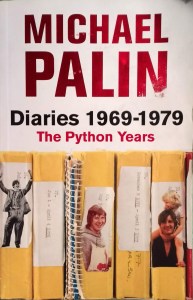
Michael Palin: Diaries 1969-1979 The Python Years.

I get the idea from some of Michael Palin’s comments in the book that he plans to publish more of his diaries. I’ve not finished it yet but so far its been pretty interesting, especially being a fan of the TV show Monty Python. Anyway, Palin started his diaries soon after packing in smoking. Perhaps it was a way of helping get over his tobacco addiction, perhaps not. The diaries also begin just as Monty Python, the comedy TV show was starting and Palin mentions this in his introduction, his aim not to record the start of the ground breaking comedy but more to record things about his new family, his wife having recently given birth to their first child.

A number of similarities between myself and Palin struck me early on, firstly, he gives us a quote from one of his schoolboy diaries which is amazingly similar to the one from my 1971 diary shown above. Another was his interest in the moon landings of 1969. Kenneth Williams may have been annoyed about the continued TV coverage of Apollo 11 but Palin and myself were more than happy to see it all.  Palin stayed up till 5am to watch the TV pictures from the Sea of Tranquility and I remember vividly being got up for school by my mother and being both amazed and excited about the TV broadcast presented to me while I ate my cornflakes. School mornings were never the same again.

My Diaries.

My diaries are definitely not for publishing. Looking back at them I notice that whenever something interesting has happened to me I have never written about it at the time, it has always been some time later when I have set down my feelings about the incident, whatever it may have been.The diary may be a confessional for some people but for me, I started writing a diary as a way of making myself write when I couldn’t think of anything else to write about. In the early 2000’s I started writing a diary on my laptop only to lose all my recollections from 2005 to 2006 when the file somehow became corrupted and refused to open. I was quite excited when the latest version of Microsoft Word came out because it gives you the option to repair a damaged file. Alas, that option would not work on my diary file. Then of course there are my big boxes of pre-2000 diaries. What shall I do with this lot I wonder? Will they add something to social history or grace the rubbish tip when I’m gone?

The latter, probably. . .


What to do next: Here are a few options.

Share this post on your favourite social media!

Hit the Subscribe button. Never miss another post!

Listen to my podcast Click here.

Buy the book! Click here to purchase my new poetry collection.

Click here to visit Amazon and download Floating in Space to your Kindle or order the paperback version.

Click here to visit amazon and purchase Timeline, my new anthology.

Writing, Marketing and the Incredible Truth about Google.

Once upon a time when I first started this web page, my whole focus was to promote my book, Floating in Space. Floating is a kitchen sink drama, something on the lines of Saturday Night and Sunday Morning, although not quite as good, but set in 1977. Those were the days; no Internet and no mobile phones. There were only a handful of TV channels. Jimmy Carter was the US President, Jim Callaghan was the UK Prime Minister and a pint of bitter was only 25 pence.
 I had taken a number of essays based vaguely on my early life, knitted them together, added something of a storyline and finally, after lots of re-writing and editing, realised a lifetime’s ambition of creating a book and becoming a writer. It’s exciting to produce something, some small piece of work which people actually read, although to be completely honest, pretty much everything I write is for me, for my own personal pleasure and even if nobody ever read anything I wrote, the actual writing itself still gives me a lot of pleasure. Having said that, every time I sell a paperback or a Kindle, every time someone adds a ‘like’ to one of my posts it does make me feel really good.

Back in the old days like 1977, when everything was, you know, black and white and digital publishing was unheard of, an author would have to submit his manuscript to a publisher and nine times out of ten would be flatly rejected. Publishers are experts on literature, or so I suppose but even the best of them have rejected books like the Day of the Jackal by Frederick Forsyth, or the Harry Potter books for instance. Maybe they are not such geniuses as we thought.

Either way, even Frederick Forsyth would be taken aback a little I think, if he had to write a weekly blog, plan posts for Facebook and Twitter and make short videos for his YouTube page. Things just aren’t what they used to be!

Not long ago I picked up an e-mail from the people at Google and they offered me a substantial amount of credit to start using Google ads again. I have to admit, I’d not advertised on Google for a long time but creating an ad these days isn’t as easy as it sounds. One of the important aspects is to know your audience. Your audience? Well, I’m not sure I do know my audience. I’m guessing, and this is purely guesswork, that people like me would like the things I write so I suppose we’re looking at middle aged book readers, interested in a humorous take on life, which is what Floating really is.

For the past three years I have concentrated my social media promotions on Twitter. OK, I have a Facebook writer page and a Pinterest account and a Google+ account but it’s Twitter where I have really pushed myself. So much so that I am the proud possessor of over 6,000 followers. Sounds good doesn’t it? If every one of those 6,000 people were fans of my blog and each and every one bought a copy of Floating in Space I’d be quids in. The fact is, out of those 6,000, I’d say only a handful are genuine fans. The rest want to be friends with me for one reason -because I have 6,000 followers and every time someone Tweets one of my Tweets I am honour bound by the unwritten Twitter users code to Tweet them back, Tweet them to my 6,000+ followers.

Anyway, the reason I mention Twitter is that over on the Twitter analytics tab there are some really interesting tools that tell you all sorts of statistical stuff about your Twitter account but one tool in particular will give you the lowdown on your audience, your Twitter audience that is. So, a quick click over to Twitter and I see something like this;

That’s my audience sorted so back to Google Ads to see if I can add those details provided by Twitter and you get these drop down boxes that seem to go on forever in the search to identify your audience: What is their location? Are they parents, homeowners, car owners and so on and so on? Even on the parenting box you can choose one or two or more children.

Then you look at language spoken, income bracket and a multitude of other choices with which you can target your potential customer. Then you are looking at what sort of results are you after? Sales leads, purchases, web site clicks, video clicks, post likes?

This might be the point at which you, the reader, might be thinking that me, the author, is going to answer those questions. You might be thinking this is one of those how to do it posts with step by step instructions to get more book purchases and more readers. Now, or pretty soon, you might think, Steve is going to reveal all, some trick to Google Ads. You might even be thinking ‘wow, Steve is really clued in to all this technical marketing stuff!’

No, not gonna happen, it’s more the other way around: I’m sitting here waiting for someone to tell me what to do!

Just while I’m on the subject of Google it is pretty amazing how much Google is involved in your life, or can be, if you let it. If you search for something on the Internet, you probably use Google. If you upload videos to YouTube, that is part of Google.

A while ago I upgraded from my old banger mobile phone to a top notch internet savvy smartphone. I added Google onto my phone, logged in and found that straight away, Google was saving all my contacts on to my Google profile. Helpful, in fact very helpful because when I changed phones I no longer had to save my contacts to my SIM card. I could just log in to Google again on my new phone and there they were, all my contacts just waiting.

Here’s another thing, your Google timeline. I don’t know if you ever look at it or even know what it is but when you get a chance, check it out because what you will find is this, all your movements in great detail.

On the day I left for my holidays in France for instance, we left home at 8:57am, drove 307 miles in 5 hours and 21 mins. Travelled on Eurotunnel then drove 2 hours and 31 minutes through France to our hotel which was 4 minutes and 150 yards away from a restaurant on the Rue du Mont Perreux. And there was me, annoyed at myself for not jotting the car mileage down before we left home.

A while ago I was in Manchester with my brother and Google showed all our movements, what pubs we were in, how far we had walked to each pub, and how much time we had spent in each establishment. The only thing it didn’t record was what we drank, but now I think about it, in Wetherspoons I used the Wetherspoon app to order drinks so those details will be there, recorded for posterity in my phone memory somewhere.

Last weekend Liz and I went into Lytham for the Christmas lights switch on and when I looked, Google had once again faithfully recorded our movements. There were the times we had walked to the bus stop; the time and distance we had travelled on the bus (16 mins and 4.2 miles.) However, there was one missing element. After watching the festivities in Lytham we went to the Red Fort restaurant and now I think of it, I was unable to ‘check in’ there because I had no signal.

When I checked Google later it asked me if the Ego restaurant, one of my many regular watering holes and a mere stone’s throw from the Red Fort, was a ‘missing place’ Sorry Google, this time we fancied a curry at the Red Fort.

One more thing about Google. The whole genre of detective fiction will have to be changed. I watching a murder documentary the other day on TV and the killer’s movements were traced meticulously by Police investigators. A lot of their work involved tracking down CCTV cameras, trawling through recorded footage and establishing the timeline of the suspect. Then there was more legwork, interviewing people and taking witness statements. Such a pity the murderer didn’t have Google on his phone as his movements would have been there, minute by minute.

Good thing they didn’t have the Internet in Columbo’s day. Google would have ruined many an episode!


Floating in Space is a novel set in Manchester, 1977. Click the links at the top of the page to buy or for more information.

Bright Lights, A Princess and Murder

I’ve been interested in the JFK assassination since I was a schoolboy and one of my earliest memories dates back to 1968 when JFK’s brother Bobby was shot at the Ambassador hotel after winning the California presidential primary. I was 12 years old at the time and I remember being so very shocked by his murder. The shooting of RFK and the circumstances surrounding his murder are probably even more questionable than the murder of JFK in Dallas but the mainstream media seem to look down on anyone who questions the accepted theories in both cases and the phrase they have coined for those of us who dismiss the tired old mainstream ‘lone nut’ ideas, is ‘conspiracy theorist’, and it really does annoy me.

It’s one of those phrases that pour scorn and ridicule without proper debate or discussion but having said that, there are some people who call out conspiracy without even thinking. I mean, seriously, can anyone actually doubt that Neil Armstrong and Buzz Aldrin landed on the moon in 1969? Was it all a hoax just to win the space race?

And as for 9/11, can people really think that the CIA and George Bush actually engineered the Twin Towers attack in New York just for an excuse to begin the second gulf war? Surely not!

That of course brings me in a roundabout way to Princess Diana. She was killed in a Paris car crash in 1997. She was estranged from her former husband and father of her two sons Prince Charles and was involved at the time with Dodi al Fayed, son of Mohammed al Fayed, the owner of Harrods. The crash was an accident wasn’t it? So why talk about conspiracy? What conspiracy?

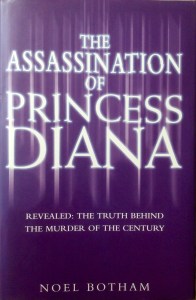
Many years ago I remember seeing a BBC documentary about the accident and it raised more questions than answers and so one day, in my favourite new Blackpool secondhand bookshop what did I spy but a book about Diana’s death. The Murder of Princess Diana  by Noel Botham.

In the book the author alleges that Diana’s death was not an accident but was engineered by the British secret service. What happened then on the night of August 30th and the early morning of the 31st, 1997?

Diana was in Paris with her boyfriend Dodi al Fayed. The two of them were spending time together but had been hunted down mercilessly by the paparazzi, desperate for pictures of the couple. Diana felt that she was under constant surveillance and in fact British security services did monitor the phone calls of the Royals for supposedly ‘security’ purposes. Some years earlier, mobile phone recordings of Diana and one of her lovers had been revealed to the public in the so-called ‘Squidgy’ tapes. Ken Wharfe, Diana’s former bodyguard told a UK inquest in 2008 that the tapes had been recorded by GCHQ, the UK government’s secret listening station and deliberately leaked. They were apparently broadcast on a loop until an amateur radio ham picked up the messages and passed them to the media.

The princess’s friends suspected the “Squidgy” tapes were leaked to smear her at a time when her failing relationship with the Prince of Wales was at its most acrimonious. From then on, the Princess was very concerned with eavesdropping and hired private security consultants to sweep her apartments for bugs and listening devices.

August 30th around 4:30 p.m.: Diana and Dodi Fayed arrive at the Ritz Hotel in Paris, owned by Dodi’s father, Egyptian businessman Mohamed al Fayed. They enter through the back door and are shown to the Imperial Suite.

5:40  to 6:30 p.m.: Reportedly, Fayed ventures to Repossi jewellers and two rings are later delivered to the Imperial Suite. Perhaps they are gifts, perhaps Dodi is considering marriage.

Around 7 p.m.: Diana and al Fayed exit the Ritz through the rear entrance and are driven to his residence, near the Arc de Triomphe.

9:50 p.m.:  The couple return to the hotel and head for its L’Espadon restaurant, after forgoing reservations at Benoît Paris because of continued paparazzi attention. Diana reportedly orders Dover sole, vegetable tempura and a mushroom and asparagus omelette. Dodi began to feel suspicious that photographers might be posing as restaurant patrons and requested their food be delivered to their room.

August 31st 12:20 a.m.: With bodyguard Trevor Rees-Jones, al Fayed and Diana reportedly attempt to evade photographers by leaving the hotel through its rear entrance to return to his apartment. They enter the backseat of a black Mercedes S280 to be driven by Ritz security employee Henri Paul.

12:23 a.m.: The Mercedes, in an attempt to outrun photographers, collides with a concrete pillar in the Pont de l’Alma tunnel. Bodyguard Trevor Rees-Jones was the only passenger in the Mercedes to be wearing a seatbelt. He was also the only one to survive the crash.

Fayed and Paul died at the scene. Following the accident, Dr. Frédéric Maillez who happened to be driving by, stopped and tended to Diana before the arrival of the emergency services.

In Noel Botham’s book, he notes that the paparazzi carried on photographing the scene while the doctor worked to save Diana; some even poked their lenses inside the smashed car. Finally help arrived and Diana was taken away in an ambulance.

Approximately 2:00 a.m.: Diana arrives at Pitié-Salpétrière Hospital, undergoing surgery minutes later.

4:00 a.m.: The princess, who celebrated her 36th birthday the previous month, is pronounced dead.

That then, was the timeline of events. It looked like a simple car crash especially when Police revealed that Henri Paul, the Ritz security man and Dodi’s driver that night was revealed to have had a blood alcohol level that was more than 3 times the legal limit. However, despite that he appears relaxed and normal on the Ritz CCTV images. Not only that, no one appeared to notice Henri as having been drunk or intoxicated. In the book, the author reveals that Henri’s autopsy indicated that he had a high reading for carbon monoxide in his blood which would have been totally incompatible with someone driving a car. According to tests carried out by two French medical experts hours after the Paris crash, the levels of carbon monoxide in Mr Paul’s blood ranged between 12 and 21 per cent. That compares to a normal reading of around two to four percent.

With that carbon monoxide level, Henri Paul would have been unconscious and totally unable to drive a car. There was however another death that night, a man who was depressed and took his own life by inhaling his car’s exhaust fumes. Could the blood sample have come from this unknown male the author asks?

Another factor was a Fiat Uno which was ahead of Diana’s Mercedes which according to the Police was untraceable. In fact the car was traced to a journalist with connections to the security services. The Fiat Uno blocked the Mercedes in the Alma Tunnel and Henri Paul swerved to the left to avoid it although his front wing clipped the Fiat.

Ahead of the Mercedes was a scooter with a pillion passenger and some reports claim that an incredibly bright light was flashed by the pillion passenger back towards the Mercedes which would have blinded the occupants and forced the driver to crash. This same scenario was featured in an MI6 file according to former agent Richard Tomlinson. Tomlinson had seen an MI6 secret plan to assassinate Slobodan Milosevic which used the exact scenario of the crash that led to Diana’s death. When Tomlinson tried to give this information to the magistrate in charge of the French inquiry into the incident, he was arrested at gun point by the DST, the French secret service, beaten up and interrogated for eighteen hours.

Police said they were unable to trace the Fiat Uno but Mohamed al Fayed claimed the owner was a journalist, James Andanson, with connections to the various security services. He had boasted to friends about inside knowledge of Diana’s death but he was found dead in 2000. He had driven to a remote spot and set himself and his car on fire, a gruesome way to commit suicide but that was the official verdict. A few weeks after his death an armed raid was carried out on the agency for which Andanson had worked. The only material and records removed were Andanson’s.

Ultimately, if we believe that Diana was deliberately murdered then we have to ask the question why? Who would want to murder Diana? What would be the point? To enable Charles to marry Camilla? In present day UK do the marriages of the Royals have any relevance anymore? After all, this is the 21st century and the days of royal murders and plots to change the succession are all part of history, ancient history.

Author Noel Botham claims that a certain element of the British secret service was used by a sinister hard core of palace watchdogs under oath to defend the royal family against scandals, whether that is the case I do not know but the author clearly believes that. Mohamed al Fayed has gone further, naming the Duke of Edinburgh as the author of the plot to kill Diana. Is al Fayed a grieving father making wild accusations or do his claims have some substance?

I have to say this book was an interesting read, not just the conjecture about assassinations but also the background to Charles and Diana and Camilla. The incredible love story, the blossoming of the princess, the failure of the Royal marriage, Diana’s efforts to outdo the Royals in revenge for Charles’ betrayal of her with Camilla. All in all, a fascinating read.


The Assassination of Princess Diana by Noel Botham.

Click here for a fascinating pdf file on the results of Operation Paget, the Metropolitan Police Investigation into the various conspiracy claims in 2004.


Steve Higgins is the author of Floating in Space, a novel set in Manchester, 1977. Click the links at the top of the page to buy or for more information.


Woody, Marcus and such Small Portions!

I’ve just returned from yet another jaunt to France, a short one this time, six days in Liz’s motorhome, meandering around the Loire area, which we both love. One of our aims was to spend our nights ‘wild camping’, that is to say camping wherever we could without using commercial camping sites.

France is actually very motorhome friendly with many municipal sites providing free camping and toilet emptying facilities free of charge with optional charges for things like fresh water or electrical hook up and so on. We found a lovely spot by a lake, actually a plan d’eau, called Lac du Homme. In the summer when we visited it was a busy bustling place with a bar and restaurant and many spots for bathing and picnicking. The french take their picnics seriously and always bring huge hampers of food, always covering the many wooden and stone picnic tables with table cloths before opening up their bundles of cutlery, plates and food. At the Lac du Homme there were also quite a few areas with barbecue facilities dotted about, all that was needed were the hot coals and some steaks and burgers to cook.

Now in early October a last burst of summer had come and the restaurant and bar were boarded up for the winter. Most of the time we had the lake to ourselves, joined only by the few occasional visitors. The last two days were so hot we even ventured out onto the man-made beaches for a refreshing dip into the cold, very cold, waters.

One of the great things about being at this quiet lake was not only the quiet, calm and relaxing atmosphere but also the chance to read. I read a great deal but at home and at work I tend to read in short bursts, on my dinner breaks at work, in quiet moments in a morning or before I go to sleep. Holidays are when you can really get to grips with a book, really read it through without having to put the book down and go back into work. On this short break I finished off a book I was reading at work, ‘The Assassination of Princess Diana’ (more about that in an upcoming post) and started on one of the P G Wodehouse Jeeves and Wooster books. It was amusing and interesting and thoroughly English but it wasn’t quite my cup of tea.

One other book I read was one of last year’s reads, Meditations by Marcus Aurelius. Marcus was an emperor of Rome and when he was compelled to go out with his armies to do battle he spent many hours alone in his tent compiling a series of philosophic writings that became known as the Meditations. Marcus was concerned with the force of nature, the force that drives the universe and all its  workings. Nature for him was probably more akin to God than what we understand nature to be but his thoughts and ideas are very moving, even more so as they were written prior to the year 180, nearly 2000 years ago. A lot of his thoughts are about life and death, simple things like a man who enjoys a long life and a man who experiences a short one both lose the same thing when they die. Death is a natural state he explains. Why fear it when everyone who has ever lived before us, has experienced it. To those of us who hunger for fame (potential authors perhaps) Marcus asks what is the point? One day you will die, one day those who remember you will die so one day your fame will vanish when no one remembers you. Time, says Marcus, is like a river, for as soon as something happens, the river of time carries it away, then some other event comes, also soon to be washed away.

In the opening of Annie Hall, one of Woody Allen’s most popular films, he talks about life in this way: “There’s an old joke, two elderly women are at a Catskill mountain resort, and one of ’em says, “Boy, the food at this place is really terrible.” The other one says, “Yeah, I know; and such small portions.” Well, that’s essentially how I feel about life – full of loneliness, and misery, and suffering, and unhappiness, and it’s all over much too quickly.” Woody Allen and Marcus Aurelius, both philosophers in their own ways.

I’ve spent a lovely couple of hours this week watching To Rome with Love, one of Woody Allen’s more recent films. Woody, if you have read one of my earlier posts about directors, is my all-time favourite director. I love his subtle observations about life and love, and his humour. What is a little sad lately, is that Woody’s image and persona have been challenged by his adopted daughter Dylan, who claims Woody assaulted her when she was young, 7, I think, and that he should be arrested and prosecuted. Woody stands by an investigation into the charges from 1975 that exonerated him but of course now, in the age of digital media, Dylan is able to go straight to the people with social media and put forward her case.

Someone who has defended Woody Allen is Moses Farrow, Woody and Mia’s adopted son. He has claimed in a blog post that his mother Mia was abusive and domineering and referring to the details of Dylan’s claims that there was no railway in the attic-supposedly where the attack took place- and that the attic was only a crawl space, not a place where father and daughter could play.

Many actors and actresses have come forward saying they will never work with Woody again and his reputation seems to sink lower every day and the body of work he has produced is now, by association, tainted. There is even a possibility that his latest film may not be released. I am a big fan of Woody Allen and although these revelations did not put me off watching To Rome with Love, it does set off a small alarm bell in the back of one’s mind. Did Woody do it? Did he molest the young Dylan? Well, two people know for sure: One is Dylan and the other is Woody. Woody claims Dylan’s claims were fabricated by Mia Farrow, his one-time partner and the mother of Dylan as part of a war of hate aimed at Woody because he became involved with another of Mia’s step daughters, Soon-Yi, and in fact, later married her. Mia, according to Woody, has brain washed Dylan with her abuse claims, so if that is true, then only Woody himself knows the truth. It seems to me that if Woody was an abuser then he would have abused other women and as no one else has come forward then that means Woody is innocent -doesn’t it?

Anyway, I don’t expect to see Jimmy Saville on old episodes of Top of the Pops, or Gary Glitter for that matter. Their actions and behaviour have airbrushed themselves out of history. Still, I will be very sad if they stop showing Woody’s films on TV.

Getting back to our trip to France, it was my birthday while we were away and it was nice to celebrate it in the sunny Loire valley instead of cold and rainy England. On our previous motorhome trip we had a lot of issues with mobile wi-fi which can be a bit of a pain when you have a blog deadline for Saturday morning. I wasn’t happy with Virgin media because my mobile data didn’t work in France, despite an expensive phone call to Virgin. Anyway, they sent me a new SIM card and I was happy to find that on this trip my mobile phone connected to the internet without problems. I even found that I could connect my iPad to my mobile and use my mobile internet on my pad, so much easier than writing a blog post on your phone. Of course I had written my last post about Comics and Superheros in advance and had it scheduled but even so, I always like to tinker with my posts right up to that last moment.

After we returned, Liz and I went to a birthday meal for Liz’s sister-in-law who has a similar birth date to me. One of the other guests, a young girl, asked me about my birthday and how old I was. I was reluctant to say but finally answered 62. “62?” She said, “I didn’t think you were that old!”

Maybe that’s a good thing, that I look younger than I actually am and in fact that comment was really a boost for my personal image but there’s no getting away from that figure of 62. Still, here is one last quote from Marcus;

When you arise in the morning, think of what a precious privilege it is to be alive – to breathe, to think, to enjoy, to love.


Floating in Space is a novel by Steve Higgins set in Manchester, 1977. Click the links at the top of the page to buy or for more information.

Holiday Book Bag Video Version

Eagle-eyed readers will have surely spotted the lack of the usual video version to my summer book bag 2018. Alas, I filmed three versions, all of which suffered from hesitation, repetition and deviation, so much so that not only would I not have lasted long on the radio show ‘Just a Minute’ but any addition to YouTube would be sorely lacking, particularly in the area of presentation.

However, due to the miracle of technology, particularly in the field of editing, a fairly reasonable video version has been made available for my long-suffering YouTube audience and I feel it only fair that they should not suffer alone and that my WordPress followers should also be invited to watch.

If any viewer is unduly affected by this video, a free counselling service is available. Please contact your local healthcare provider immediately should any adverse symptoms occur.

Summer Holiday Reflections


I know I’ve waxed lyrical about lying on a sun lounger but another favourite pastime of mine on my French holidays is just sitting outside of an evening and watching the sun go down, a glass of wine not too far away of course. As the sun dips down over the horizon it’s time for the local bats to make an appearance and whip across the patio whizzing from the trees to I don’t know where but making a fleeting but strong impression on my mind.

The pool is all covered up and the barbecue cools quietly in the corner as I take a sip of my red wine. All is well in the world. Well, it was, a few days ago when I wrote that, now it’s just another holiday memory.

The last few days of a holiday are always the worst, a countdown to packing up and getting ready to leave, checking what time the ferry sails and considering which route to take to the port, what time to leave and so on.

After a pleasant trip to Caen we boarded our ferry, had some food and settled down in our cabin for a nap before the long drive up north in England.

Driving.

Leaving Portsmouth we headed to Southampton and then north on the A34 dual carriageway. Leaving the port was a little like a grand prix start as various vehicles of all shapes and sizes passed through the passport checks and then sprinted away to the motorway. A large contingent of that traffic made their way up the A34 and up ahead of me as well as behind were a great number of cars. The A34 is an unlit dual carriageway and we all motored along at a good pace, 65 to 70 mph. After a while the traffic thinned out and up ahead of me were two pilots or pathfinders, lighting up the dark road ahead. Gradually, one pilot turned off leaving just one car ahead, then he turned off too and it was just me, leading the pack. Now being in front on a dark unfamiliar road at night is not so easy. There was plenty of traffic on the other side so use of my full beam headlights was limited and gradually my pace slowed a little.

Once someone behind decided to take a look at taking the lead but once off my tail in the outside lane he slowed right down and I overtook him back and once again I took on the pathfinder role. Later a guy doing well in excess of 80 came hurtling past, lit up the road for me but then disappeared over the horizon but after a while another vehicle came to the front, overtook and upped the pace a little and we carried on as before, my pathfinder lighting up the road for me.

Personally, I think that unlit motorways and A roads in the UK are an unnecessary hazard and I honestly think that perhaps Highways England would be better spending their money on street lighting rather than so-called Smart Motorways. However, the journey home was a good one, the rain held off and road closures were few. We motored up north serenely taking in the M40, the M42, the M6, the M55 and finally home. There were a number of mandatory 50 mph sections on the M6 due to roadworks but in a way they were helpful, almost like the safety car in a Grand Prix when, on a long journey, the driver can relax, check engine temperatures and oil pressure and so on before resuming 70 mph again.

Telephone Boxes.

Back in 1977, the year in which Floating in Space is set, there was a long row of telephone boxes just by Piccadilly gardens in Manchester. Telephone boxes were once everywhere but today, when the mobile phone is the main instrument of communication, telephone boxes are few and far between.

In a small village in France, we came across this once lonely and unused telephone box, now transformed into a small library. Take away a new book to read but remember to leave your old ones behind for other phone callers  -sorry, readers- to use.

Writing.

One of my objectives on this holiday was of course to produce more writing and push one or more of my numerous writing projects towards completion. As you may have guessed if you have ever read any of my other post-holiday posts, that goal was not met although I did manage to knock out my usual Saturday posts whilst I was away and stack up a few draft posts into the bargain. My one deadline, that of a Saturday morning at 10:00 AM UK time is really what motivates me and keeps me going. Pity I don’t have a similar deadline for my books!

I am always wary of blogs that give tips for writing or blogging. They ask you to subscribe and then hit you with a full blogging/writing course with a bargain price tag thrown in towards the end of their patter. One great writing blog that I do enjoy is one by Kristen Lamb and one post that pinged into my inbox the other day was this one:

Is Your Story STUCK? 5 Reasons Your Novel is Breaking Down

One of the tips for writing when you get stuck was this, instead of writing so much then flipping back and forth changing and editing, try writing a fast draft. Yes, head down, laptop open and just steam ahead. No stopping to check or to edit or to rearrange. Full speed ahead, nail that draft and then look back, rearrange things and edit. Great idea, I just need to get into full steam ahead mode first. Of course one thing is worth remembering:

No unfinished-but-perfect book has ever hit the New York Times best-seller list, but a lot of crappy finished ones have.

Last year I remember reading about Noel Coward, either in his autobiography or some other biography. Coward spent a lot of his time in the winter months at his house ‘Firefly’ in Jamaica. There, Coward would go to his study at 8 AM and write through the morning until 12 when he would join his friends for a swim and then lunch. Ian Fleming had a house nearby, ‘Goldeneye’ where he wrote many of the James Bond books.

Perhaps that’s the answer to my writing issues! I need to spend the winter in Jamaica!


Steve Higgins is the author of Floating in Space, a novel set in Manchester, 1977. Click the links at the top of the page to buy or for more information!

Holiday Book Bag Summer 2018

Well in advance of this year’s summer holiday I took an intensive inventory of my books, separated those I had not yet read as well as separating the hardbacks from the softcovers and sorted out my holiday book bag for this summer. I particularly favoured hardbacks because during the year I don’t tend to read those, after all, it’s so much easier to pop a paperback book in your pocket to read at work rather than lug a heavy hardback book about. On reflection that was really rather forward thinking of me. Where the heck I put those books though I do not know, so instead I grabbed a few nearby paperbacks at the last minute and that is what I took to France to read. All were sourced from second hand book shops or charity shops.

What did you take to read on holiday this year?

The Kenneth Williams Diaries edited by Russell Davies.

I’ve always rather liked Kenneth Williams, the slightly over the top star of many a Carry On film as well as numerous radio comedy shows. However, it did feel rather odd reading his private thoughts through his diary. This is not an autobiography where the author tells us the story of his life and keeps things in some sort of order, it’s a diary, a record of the author’s day to day thoughts and sometimes it’s hard to keep track of what is happening. In a lot of the diary entries Kenneth refers to people by their initials rather than their name. The habit of using initials can be rather annoying as the editor will mention in one of the many footnotes that SB for instance refers to his friend and fellow performer Stanley Baxter. Later on SB will turn up again and I find myself flipping back through the footnotes because I have forgotton who SB was.

In the diaries, Williams talks about his private life mostly in a sort of code. He does talk about his many trips to Morocco where he went in search of young men, something he was willing to indulge in in the secret world of gay men abroad.  A lot of this activity gave him little pleasure and it seems to me he was unhappy with his sexuality and perhaps he envied his friend the playwright Joe Orton, who accepted himself in a way Williams never could.

The diaries are actually pretty famous because they reveal Kenneth Williams as being so very different to the persona he revealed to the world. All of Williams’ moods are revealed in the book, his anger, his sadness and his disapointments as well as his happier times. It’s interesting to read about world events in the entries, for instance the Moon landing in 1969 causes Williams to moan about the TV being all about the moon! I was 13 at the time, very interested in the Apollo programme and couldn’t get enough of moon landing TV.

The three day week is mentioned in 1973 along with various entries about power cuts and industrial action, a time I remember well, sitting in my Mum’s kitchen lit by a candle and my dad trying in vain to read the newspaper.

I did expect to read a lot about Barbara Windsor, his great friend from the Carry On films but there is little about her although actress Maggie Smith is talked about constantly, his admiration for her very evident.

I did wonder whether Kenneth Williams wrote the diaries expecting them to be published when he died but that same issue he dealt with in a 1972 entry where he claims that the writing of a diary is only something to jog the memory. He goes on to say; ‘One puts down what one wants, not what others want. That is what is so delightful about a diary, it is what the self wants to say.’

The strange thing is that the diary reminds me a lot of my diary which I write in these days only infrequently. I started it as something just to get me writing and I still write in it on those occasions when ideas for a story or a blog fail to materialise. A diary can just be a record of your daily life but it also is a confidante, something you can turn to when something has annoyed or upset you or just when your thoughts are so overwhelming you have to get them out onto paper or your computer screen. I ended up feeling an affinity for Williams, a similarity whereas before reading this book I thought we had nothing in common at all.

Kenneth Williams seemed to have many sad moments where he wished he had a confidante, perhaps that is another reason he wrote in his diary. Many entries detail his dissatisfaction with his life and his sadness. ‘What’s the point?’ is how he ends many entries, including his very last one on the 14th April, 1988.

I did not know about Williams’ theatre career, or even that he had one and it was interesting to read about what an actor and performer’s life is like; it seems to be mostly waiting for things to turn up, waiting for one’s agent to ring or for calls from film or TV producers. When the phone does not ring it can be a worrying time, as it seemed to be for Kenneth Williams, thinking about his tax bill or other bills that need paying.

A fascinating read and not quite what I expected.

Blessing in Disguise by Alec Guinness.
This is an autobiography by the actor Alec Guinness, well, I bought it thinking it was that but actually it is a collection of random thoughts and episodes in the actor’s life that don’t always go together. The beginning of the book is about Guinness’ younger days but then he leaps forward through his life describing other times and incidents and it all leaves the reader wondering what happened after that or what did he do before this? It is all very well written but there are endless dull chapters focussing very acutely on some unheard of person in the theatre and then some very few lines about people I actually wanted to hear about. He mentions having dinner with Sophia Loren who then disappears from the page. Richard Burton and other film notables are mentioned all too briefly. Guinness’ wife also makes various oblique entries into the book but who she really is, how Alec met her and how they married is never revealed. Star Wars is mentioned towards the end of the book but if you are interested in any filming anecdotes or behind the scenes stories, well, none are to be found here.

Well written but ultimately disapointing.

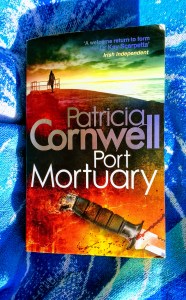
Port Mortuary by Patricia Cornwell.

Port Mortuary features Patricia Cornwell’s forensic heroine Kay Scarpetta who first appeared in the book Postmortem published in 1990. I remember reading a newspaper article about Cornwell and her books in the mid 1990’s, they seemed pretty interesting so I bought the first one, Postmortem and began to read. Kay Scarpetta is the Chief Medical Examiner of Virginia and uses modern forensic sciences and technologies to solve murders. Working with her is police homicide detective Pete Marino and together they embark on solving a series of murders. The series of books are well written if a little gruesome and are said to have influenced a host of similar books and TV series such as CSI where forensic technolgy and science are used to solve crimes. Scarpetta has an Italian background and in the earlier books cooks a lot of Italian dishes. (There is even a companion cook book; ‘Secrets from Scarpetta’s Kitchen’.)

Later on in the series, things get a little weird. Benton Wesley, an FBI profiler is murdered but reappears in a later book alive, having been in a FBI witness protection programme. Scarpetta’s niece becomes a computer expert at the FBI, leaves to start her own internet company, becomes a multi millionaire, buys a helicopter and morphs into a sort of James Bond sci-fi hi-tech lesbian character. That was when I stopped reading the books.

Anyway, fast forward to the present day and I find Port Mortuary at a charity shop and think OK, let’s see whats happening to Scarpetta these days. Sometime after I stopped reading the books, Cornwell decided to write in the third person rather the first and Port Mortuary is the book where she decides to revert back to the first person way of story telling. A lot has changed since I last read the books. Pete Marino no longer works for the police and joins Scarpetta at the National Forensic Academy, an institution founded by her millionaire niece, Lucy. Scarpetta is also a Colonel in some kind of military forensic set up and while she is on duty, Pete and Lucy fly in to tell her about a murder that has occurred that threatens the whole National Forensic Academy. They fly back in Lucy’s helicopter and the narrative goes through all the pre flight checks and helicopter terminology which was interesting but not neccessarily important. Then again, every other page seems to mention technology and brand names like Scarpetta’s iPad and iPhone. It’s almost as if Apple were on a sort of product placement mission.

I clicked onto goodreads to check out what sort of reviews were being left there and many people were saying things like ‘not as good as the older books’ and some complained about all the superfluous detail that wasn’t required. Personally, I like all that extra detail. Maybe Cornwell went a little overboard with her gadgetry and helicopter stuff but isn’t that the mark of a good writer? That little extra descriptive detail that adds to the background and the imagery?

Anyway, the book is a hi-tech murder mystery, well written and enjoyable although I got a little lost with the plot towards the end. Also there were perhaps a little bit too much of Kay Scarpetta’s internal monologues. A great sun lounger read but I still feel the first ten or eleven books in the series are better than the later ones.

(Chaos is the latest book in the series, published in 2016)

A Kentish Lad by Frank Muir.

One thing I really love about second hand books are inscriptions. On my copy of Frank Muir’s book this is written on the title page: ‘To Derek, lots of love, Ruth. Christmas, 1998.’  Who was Derek I wonder, who was Ruth? Why was Derek’s Christmas gift loitering on the shelves of a St Annes charity shop? I’ll never know but to me it makes the book all that more interesting.

A while back I wrote a post about the Essential Englishman which was a few remarks about film actors who have portrayed a certain type of Englishman, debonair, urbane and eloquent and the actors I chose were David Niven, Robert Donat, Rex Harrison and so on. Had I extended my terms of reference to include TV personalities I would have had to have included Frank Muir, the eloquent bow-tied and nattily turned out star of TV shows like Call my Bluff.

This enjoyable and amusing autobiography charts Frank’s days as a schoolboy in Broadstairs in the south of England to his life as a TV executive and TV personality in the 1970s and eighties. It is written in an amusing and self deprecating way, always seeing the funny side of life and a very jolly read it is too. I particularly enjoyed the first part of the book when Muir talked about his war years at the parachute training school at Ringway, now Manchester Airport and then his first forays into the world of show business and his script writing partnership with Denis Norden. A highlight was his first trip to France in the late 1940s revealing a different sort of trip to the one I have currently undertaken in 2018. Later, Muir paints a fascinating portrait of the radio days of the 1950s when the UK was tuned to the radio for their favourite musical and comedy shows.

The book’s latter half is perhaps not quite as enjoyable as the first but on the whole a pleasant, interesting and enjoyable read.

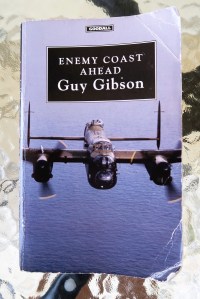
Enemy Coast Ahead by Guy Gibson.

Guy Gibson? Sound familiar? Well if you have ever seen the classic movie the Dambusters you will know that Wing Commander Guy Gibson was the leader of the force that attacked the dams of the Third Reich during the Second World War and scored a decisive victory for the Allies, destroying the manufacturing capability of the Ruhr Valley for a considerable time. This book is Gibson’s own account of his time in Bomber Command and his is a fascinating story. To start with he talks about the so called phoney war and how people thought it might be over very quickly and how the RAF was hopelessly unprepared for war. He tells of air raids in 1939 where crews became lost, when crews were told strictly not to drop bombs on civilian homes and so bombs were returned back to base in dangerous conditions, unreleased on enemy targets. As time went on, the crews became more familiar with what they had to do, they got used to navigating and night time flying and Gibson here shows a different world to that portrayed in films like the Dambusters.

The aircrews were all young men who worked hard at what they did and worked hard also at drinking, partying and chasing girls, pretty much like young men today, although for these men, they partied like there was no tomorrow because in some cases, there wasn’t.

In the foreward to the book, Gibson dedicates this volume to all those aircrews lost in action in the various squadrons he was attached to and the list makes grim reading, almost all the names he lists are noted as missing in action, presumed killed. The odd one here and there is noted as POW, prisoner of war.

A fascinating book, written by a brave man telling a story you may have heard before from a completely different angle. A classic book of Second World War literature.


One last book, Floating in Space, a novel set in Manchester, 1977. Click the links at the top of the page to buy or for more information.

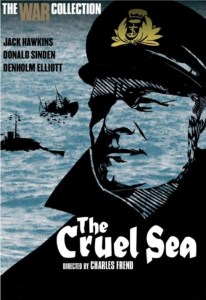
The Cruel Sea

When I was writing my post ‘The Book of the Film or the Film of the Book’ a while ago, I did consider including ‘The Cruel Sea’ as not only is it one of my favourite films, it is a pretty good book too. I didn’t include it because I couldn’t find my copy of the book, which I hadn’t read for years and also I hadn’t seen the film for years either.

In one of those odd coincidences that always happen when I set my mind on a subject and leave ideas churning over in the upstairs room in my head, I was scouring through a charity shop in St Annes when I came across the DVD of the film. It was one of those free newspaper DVDs that seem to cost anything from a pound upwards at a car boot sale but was happily on sale here for a paltry 30 pence.

After a busy late shift at work I settled down with a glass of red in one hand and a ham sandwich in the other, compulsory on these occasions of course, and began watching.

The film starts off at the beginning of World War 2 when the Jack Hawkins character is at the builder’s yard helping with the fixing up of his new escort ship, Compass Rose. His officers begin to arrive, many of whom are easily recognisable as stalwarts of the 40’s and 50’s British film industry: Donald Sinden, Denholm Elliot, and Stanley Baker and later in the film Virginia McKenna appears as an officer in the WRNS.

The cast and characters are therefore introduced and then the ship goes off for its sea trials and crew training and soon the Compass Rose is escorting its first convoy. Nothing much happens at first as this is the early part of the war but when the Nazis over run France and the ports of northern France come available to the enemy, many U-Boats converge on the convoys and a great deal of merchant ships, along with the supplies so desperately needed by Britain, are lost.

The boredom of those early dull convoys contrasts sharply with the terror and mayhem waged by the U-boats later on. The film reveals the desperate tragedy of abandoning ship in the middle of the Atlantic, the oil and grease, not to mention the cold, are terrible. Many escort vessels could not stop for survivors as they would become easy prey to the unseen U-Boats, though some did, others returning later in the light of day as the attacks usually came at night.

Leave was a great relief for the naval crews. On one trip back to England the film shows the crew at home, some enjoying some home comforts, others struggling with failing marriages, a situation made worse by the war. One crewmate takes his friend the engineer home to meet his sister. On a later voyage the engineer tells his mate how he has fallen for the sister and plans to ask her to marry him. Later, the Compass Rose is sunk by a torpedo and as the survivors struggle to stay alive in the cold Atlantic many succumb to their injuries. As they drift in the oily water the soundtrack replays echos of their recent dialogue, a marriage proposal hangs in the air over the groom who will never wed and a petty argument haunts the body of an unhappily married officer. Happily, some survive till daylight when a destroyer returns to rescue them.

It must have been difficult living during the war, trying to get on with your own personal life when everything was wrapped up in the war effort. Manchester was a target for enemy bombers because of its industrial strength and also because of its airport at Ringway, now Manchester International Airport. My mother used to tell me stories of air raid shelters and late night cocoa when the air raid warnings were on and everyone trooped into the shelter. Everyone except my granddad who always said ‘If I’m going to die, I’ll die in my bed!’ She told and still tells stories of gas masks, bomb craters and how you could tell the differing sounds of German and British aircraft.

I’ve often wondered what happened if your house was bombed? Were you given new housing? What happened to your mortgage? Did you still have to pay it? Imagine being stuck with a 25 year mortgage and a house that was just a pile of rubble.

One other observation about films in the 40’s and 50’s: People seemed to have a different pattern of speech back then, a different and faster rhythm than today with clearer and more precise diction. Is that the case or is that just the way the actors and actresses of the time were taught to speak. Speech today seems slower and less precise and sprinkled with regular use of words like ‘awesome’!

Back to the Cruel Sea and Captain Ericson alias Jack Hawkins is given another ship which he captains until the end of the war. The producer, Sir Michael Balcon said that Hawkins was always the first choice for the Cruel Sea, even going so far as to say that without Hawkins he wouldn’t have made the film. The finished picture was the hit British film of 1953.

Hawkins was the epitome of the trustworthy British authority figure. In his obituary one writer wrote that Hawkins ‘exemplified for many cinemagoers the stiff upper lip tradition prevalent in post war British films. His craggy looks and authoritative bearing were used to good effect whatever branch of the services he represented.’

Hawkins himself was a three pack a day smoker and later became ill with throat cancer. In 1966 his entire larynx was removed however he still appeared in films with his dialogue dubbed by either Charles Gray or Robert Rietti. He died in 1973.

Just as I was writing this post, one thought came back to me about the book of the Cruel Sea. It was written by Nicholas Montsarrat and on the last page, when the war is over, the captain who has always hated his safety vest, hurls it into the sea. The vest sank like a stone!


Steve Higgins is the author of Floating in Space, a novel set in Manchester, 1977. Click the links at the top of the page to buy or for more information!

The Film of the Book or the Book of the Film (Part 2)

It’s always  a bitter-sweet experience when someone decides to make your favourite book into a film. It doesn’t always work out because maybe it was a big, thick, long book and they have cut out your favourite bit, or perhaps the cast wasn’t the one you imagined. It’s usually just the same in reverse. You see a great film and in the credits it says based on the book by so and so, then you rush out and get the book and it turns out to be a little disappointing. Sometimes it’s even better than the film!
You can read the Film of the Book part 1 by clicking here. Meanwhile, here are a few more of my film/book experiences.

Rebecca (the film)

Rebecca was directed by Alfred Hitchcock and released in 1940. Laurence Olivier plays Max De Winter and Joan Fontaine is particularly good as the shy, unworldly new wife of the rather grand Max De Winter.

Max and his new wife, who is never named in the novel as she is also the narrator, meet in the south of France, marry and return to Max’s grand country house Manderley, in Cornwall. There they settle into country life rather uneasily, as lurking always in the background is the spectre of Max’s late wife Rebecca who died in a boating accident.

Also lurking in the background is the housekeeper of Manderley, Mrs Danvers. She was devoted to Rebecca and her presence seems to cloak the house in a sinister gloom. George Sanders plays his usual suave smooth talking self; in this film he is the apparent lover to the late Rebecca. A number of incidents occur making the new wife believe her husband resents her and prefers Rebecca. Nothing could be further from the truth as we find out when Rebecca’s body is discovered in the cabin of her sunken boat just off the coast. Max reveals he had an argument with Rebecca, struck her and she fell, hitting her head on some heavy fishing tackle. He carried her dead body to her boat, took to sea and scuttled the small vessel, creating the lie of her death at sea. Now the body has come to light, George Sanders’ character comes forward with a letter from Rebecca, inviting him to visit on the day of her death and with this he decides to blackmail De Winter as this shows she could not have contemplated suicide.

There is a nice twist at the end which I won’t give away but Rebecca is a wonderful film, well worth looking out for on one of the many movie channels available these days.

One disappointing aspect of the film was the rather cheap model of Manderley used at the beginning and end of the film. If I was Hitchcock I would have been tempted to revisit the film in the 1960’s and add some better model effects.

Rebecca (the book) by Daphne Du Maurier

The book is written in the first person by the unnamed new wife of Max De Winter. It’s a very good read indeed and I enjoyed it very much, so much so I had to take it out of my work’s bag (I’d been reading at work during my dinner breaks) and take it into the garden on a lovely sunny day as I was so keen to get to the end. It is very similar to the film although in the book De Winter actually shoots his wife unlike the film where De Winter strikes her and she falls and hits her head. The ending is also rather abrupt but an excellent read, well worth picking up if you see a copy for sale.

Serpico (the film)

Al Pacino stars in the true story of Serpico, a New York City cop who tried to fight the culture of bribery and corruption in the NYPD in the 60’s and early 70’s. This 1973 film is directed by Sidney Lumet and is shot in a gritty natural style. It starts with Serpico being shot in the face and then on his way to hospital it flashes back to tell the story of rookie cop Frank Serpico and his graduation to detective and his refusal to take bribes. It is shot and acted in a very natural documentary style and the film portrays Serpico’s ongoing disappointment with his superiors and those he trusts to look into the situation very well indeed. A brilliant example of 70’s moviemaking at its best.

Serpico (the book) by Peter Maas

It’s a long while since I read the book and despite a lengthy search I couldn’t get my hands on it for a read through for this post. It was a fascinating read as I remember, reading more like a work of fiction than the true story it really was.

Serpico (the DVD)

Since I couldn’t say much about the book I just want to throw in a quick comment about the DVD. One thing I love about DVDs are those special versions with extended features, documentaries and so on. On the DVD of Serpico there is an interview with the producer Dino De Laurentiis where he tries to explain the character of Serpico this way; He and Serpico go to a screening of a film in New York. They are checking out possible directors or something, anyway, the theatre is empty and ignoring the no smoking sign, De Laurentiis decides to light up. ‘Wait a minute’ says Serpico, ‘you can’t smoke in here.’ De Laurentiis replies ‘what does it matter? There is no one here but us.’

Serpico points to the no smoking sign and replies ‘look, you just can’t smoke here’ and makes the producer put out his cigarette. That, says Dino on the DVD, was when he began to understand what Serpico was about. There were no grey areas with him, everything was black and white.

The Big Sleep (the book) by Raymond Chandler 

The Big Sleep, which refers to death in American gangster speak was the first of Raymond Chandler’s novels to feature his famous detective Philip Marlowe. Marlowe was described by one reviewer as ‘a 20th-century knight who treads the mean streets of Hollywood and Santa Monica, and who also visits the houses of the stinking rich, with their English butlers, corrosive secrets and sinister vices.’ I couldn’t have put it better myself. In the Big Sleep Marlowe is summoned to the house of General Sternwood whose daughter is being blackmailed by a seedy bookseller.

Sternwood, a crippled old man spends his time in a heated conservatory and seems to draw strength from the overwhelming heat. He engages Marlowe who sets off on a trail of blackmail and murder. I have to say the film rather confused me and it was only after reading the novel that I began to understand some of the intricacies of the plot.

The Big Sleep (the film)

Director Howard Hawks was also aware of the complexity of the novel. He once asked Raymond Chandler who had shot the chauffeur. Chandler replied that he had no idea.

The movie version from 1946 stars Humphrey Bogart and Lauren Bacall and I used to think that this was the film where Bogart and Bacall met although in fact it was actually another movie, ‘To Have and Have Not‘, also directed by Howard Hawks. By the time of ‘The Big Sleep’ their romance was in full swing. Later Bogart left his wife Mayo and he and Bacall were free to marry.

The opening of the film where Bogart meets the general is brilliant. The wayward daughter remarks he is not very tall. ‘I try to be’ Bogart replies. Later, the other daughter played by Bacall says she doesn’t like Bogart’s manners. He replies ‘I’m not crazy about yours. I didn’t ask to see you. I don’t mind if you don’t like my manners. I don’t like them myself. They’re pretty bad. I grieve over them on long winter evenings.’

My advice, get yourself the DVD, pour yourself a large glass of red, press play and relax and enjoy.

The Silence of the Lambs (the Film)

The film was released in 1991 and it’s one of those films that seemed to naturally self-publicise itself, one of those word of mouth films that everyone at the time was talking about. It’s a gruesome film in parts and not really my usual sort of film but what is appealing is the slow relentless process the FBI makes to track down the killer and the procedures and techniques they use. Jodie Foster plays FBI trainee Clarice Starling. She is sent by the head of the FBI’s Behavioural Science Unit to interview captured serial killer Hannibal Lector played by Anthony Hopkins, in the hope he might give some clue or insight into helping with the capture of a new serial killer known as Buffalo Bill.

Hopkins gives a chilling portrayal of the psychotic serial killer and Jodie Foster and the other principals were given much acclaim for their performances. The film was only the third to win Oscars in the top 5 categories: Best Picture, Best Actor, Best Actress, Best Director, and Best Adapted Screenplay. It is perhaps the only horror film ever to win the best picture award.

The Silence of the Lambs (the Book) by Thomas Harris

The book, like the film, focusses on the FBI and their attempts to trace the killer known as Buffalo Bill. Trainee agent Clarice Starling builds up a relationship with imprisoned murderer Doctor Hannibal Lector where Lector dribbles out bits of information in exchange for personal details about Clarice herself. Clarice, the vulnerable young FBI agent is a sort of counterpoint to the evil Murderer Dr Lector.

The book like the film is more of a horror story than a detective novel. I felt drawn to the passages that were chilling and gruesome in a strange way, almost like when a spider appears and I’m compelled to watch it even though I hate spiders. The relationship between Lector and Starling is intriguing and is really more of a focus than the capture of the Buffalo Bill and I did find myself wondering whether Lector might want to murder Clarice or perhaps his interest in her is something different.

I read the follow up book, Hannibal, expecting more of the same but it was even more gruesome and had a strange implausible ending. Since then I’ve steered clear of Mr Harris’ books but Silence is a great read.


Floating in Space is a novel set in Manchester, 1977. Click the links at the top of the page to buy or for more information.