Titanic

The story of the Titanic, the ship that hit an iceberg and sank in 1912, is one of those stories which seems to be forever in the news. It’s a story that has caught the imagination of pretty much everyone. Even the other day, just scrolling through the BBC news page, I came across an item about some new digital scan of the Titanic wreck which revealed new information about the disaster.
This week I thought I’d take a look at the story of the Titanic and how it has been represented by television and film, well at least the TV shows and films that made an imopression on me, as well as the actual story of the tragedy.

The Titanic was designed to be the new premier ship of the White Star Line. It had been built by Harland and Wolff in Belfast and built alongside its sister ship the Olympic and was launched on the 31st May 1911 and was then towed to another berth where its engines and superstructure was installed as well as its majestic interior. The sea trials of the ship were undertaken on the 2nd April 1912 just eight days prior to leaving Southampton on its maiden voyage. The Titanic was the largest ship in the world and advertised as having the passenger accommodation of ‘unrivalled extent and magnificence’. It was also billed as unsinkable even though a few days into its first journey it would end up at the bottom of the Atlantic Ocean.

The Titanic on Television.

The Time Tunnel

The Time Tunnel was a sci-fi series created by Irwin Allen in the 1960s. The best episode in the series was probably the very first one. A US senator has come to take a look at a secret time travel project and see if the huge amounts of money being spent are justified. Scientist Tony Newman, fearful that the project will be cancelled, decides to trial the new Time Tunnel apparatus and send himself back in time. He activates everything and transports himself back in time arriving in 1912 on board the  Titanic.

His colleague, Doug Phillips also goes back to the same time zone to rescue Tony. The captain of the Titanic naturally doesn’t believe his ship is doomed to sink and back in the Time Tunnel control room the technical staff have a bit of a problem bringing the two scientists back to the present (actually 1968) but manage to transfer them to another time zone and so the scene is set for the subsequent adventures.

The Titanic at the Cinema.

A Night to Remember (1958)

I’ve always liked this film. It starred Kenneth Moore as the Titanic’s second officer, Charles Lightoller, and was based on a book about the disaster. The film was released in 1958 and tells the usual story about the sinking. The ship sets off but during the journey the overworked telegraph officers fail to pass on a warning about icebergs. The ship hits the iceberg and sinks. Despite a limited budget and only 1950s era special effects, A Night to Remember is actually a really good film.

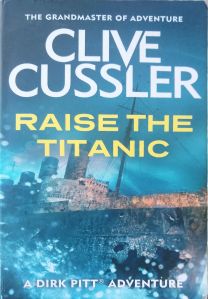
Raise the Titanic (1980)

This was a film produced by TV mogul Lew Grade who was wanting to move his TV production company ITC Entertainment into the world of cinema. He had read the original book and thought that it might be possible to make a film series about US government operative Dirk Pitt in the manner of the Bond series.

In the film Dirk Pitt played by Richard Jordan proposes a salvage operation for the Titanic as he is convinced an American named Brewster had discovered a rare radioactive element called Byzanium which was stowed in wooden shipping boxes aboard the Titanic.

A huge undersea search takes place and the Titanic is ultimately found and raised. The Byzanium is not found aboard though although it does finally emerge in a neat twist at the end.

I’ve always enjoyed Raise the Titanic. It was based on a bestselling book by Clive Cussler although the film did not emulate the book’s success.

A great deal of the budget for the film was used to create a 50 foot model which was filmed at a huge water tank at the Mediterranean Film Studios in Malta. Apparently the three million pound model remains there today rusting away although the water tank is in regular use.

Not long after the film was made the real Titanic was located and it was confirmed the ship had broken up and was lying on the sea bed in two separate sections.

Titanic (1997)

Titanic was written and directed by James Cameron. The main thrust of the story is about two passengers from wildly different social classes who fall in love on the ship although one, played by Leonardo DiCaprio, dies in the disaster and the other played by Kate Winslet survives.

A treasure hunter (Bill Paxton) and his salvage team explore the wreck of the Titanic looking for a famous necklace, the Heart of the Ocean. They discover a safe which they bring to the surface to find it only contains a sketch of an unknown woman. After it is featured on TV the woman comes forward and tells the story of meeting Jack Dawson (DiCaprio) and of course of the sinking of the Titanic.

Director Cameron and his producers built a huge outdoor set in Playas de Rosarito in Mexico with uninterrupted views of the ocean and a water tank in which the Titanic set could be tilted to film the sinking scenes. Overall, the production cost was over 200 million dollars making it the most expensive film of all time. Happily for the producers, it also became the highest grossing film of all time until the release of Avatar, another film written and directed by Cameron.

The Novel

Dreaming a story and making it into a novel or a screenplay sounds pretty fantastic but in 1898 an American writer, Morgan Robertson, wrote a story about an unsinkable ship called the Titan which sailed from England to the USA but during the journey hit an iceberg and sank. The story was published fourteen years before the Titanic disaster. I remember reading the story of this writer years ago, even that the writer saw the story played out in front of him like a movie but all the research I did on the internet for this blog seems to imply that the author was a man who knew his business where ships were concerned, felt that ships were getting bigger and bigger and that a disaster like that of the Titanic was inevitable.

Books

I only have one book in my collection about the Titanic. It’s a big glossy picture book, not about the actual ship, but about the shooting of James Cameron’s film. It documents Cameron’s twelve dives in a tiny submersible which gave him the idea of the treasure hunters looking to find the necklace the ‘Heart of the Ocean’ and his realisation as Cameron himself mentions in the book’s foreword that the main thrust of the story should be a love story with the Titanic disaster almost as a backdrop.

The book tells about the numerous models that were built of the ship both as a pristine sea going vessel and as an underwater wreck. The making of the full size set in Mexico which could be dropped via hydraulic pistons into a huge water tank was an immense undertaking and adds immeasurably to the finished film.

So what actually happened to the Titanic?

The Titanic was on its maiden voyage to the USA. It left Southampton on the 10th April 1912 and stopped at Cherbourg in France to pick up more passengers before heading out across the Atlantic to New York. Four days into the voyage it hit an iceberg. Lookouts had been sent aloft to look for icebergs but their task was difficult. It was a moonless night and pitch black. The sea was very calm which meant that the lookouts could not see waves crashing against the icebergs that they had been warned to look out for. When an iceberg was finally spotted the lookouts rang down to the bridge. The officers there ordered the ship to turn hard to port. Some reports say that the engine room was ordered to stop engines which would not have helped the turn. Either way the ship brushed the iceberg and the resulting contact made a gash along the side of the ship and water rushed in.

The ship had been designed to stay afloat with four of her watertight compartments flooded but it could not stay afloat with the flooding of six. Interestingly the compartments were not sealed at the top so that when one flooded, the water tipped over into the next and so on until the ship sank.

The bow of the Titanic courtesy Wikipedia Commons

In another documentary I watched a few years ago a theory was put forward that the three million rivets that held the steel plates of the ship together were made of poor grade metal which became brittle in the freezing sea water. When the ship impacted the iceberg, the heads of the rivets popped off and sea water flooded inbetween the steel plates of the hull.

RMS Carpathia arrived about an hour and a half after the sinking and rescued all of the 710 survivors by 09:15 on 15 April. More than 1500 people died in the freezing waters of the Atlantic.

Titanic in the News.

As I mentioned earlier, the Titanic was in the news again when a new 3d scan of the wreckage of the Titanic was revealed.


What to do next: Here are a few options.

Share this post on your favourite social media!

Hit the Subscribe button. Never miss another post!

Listen to my podcast Click here.

Buy the book! Click here to purchase my new poetry collection.

Click here to visit Amazon and download Floating in Space to your Kindle or order the paperback version.

Click here to visit amazon and purchase Timeline, my new anthology.

4 Showbiz Stories

I started this post off with three ‘showbiz’ autobiographies of actresses/comediennes of the stage and screen. Despite trawling through my book collection I couldn’t see a fourth so I added one which is the odd one out; a biography, rather than an autobiography and a male actor/comedian rather than a female. Either way, all four are stars who made their respective names in the 1950s and 1960s era of radio, TV and film and together make up a quartet of much loved British comedians.

Fenella Fielding: Do You Mind If I Smoke?

This is an autobiography by Fenella Fielding, co-written with Simon McKay, and the title comes from her part in Carry On Screaming when she played a seductive character, possibly derived from the Adams Family, Valeria. In one scene Valeria tries to seduce Harry H Corbett standing in for the absent Sid James as a detective. Valeria asks ‘do you mind if I smoke?’ and then rather than smoking a cigarette, a cloud of smoke seems to arise from her body and envelop her. Harry H Corbett adds ‘just when I was trying to give it up’ before embracing her in the smoke.
Simon met Fenella at a London Pilates class in 2011. The two became friends and began meeting regularly for coffee. McKay realised that Fenella was a wonderful raconteur and asked if he could record her stories. Fenella agreed and later they used the transcriptions as the basis for a themed evening, An Evening with Fenella Fielding. Later the conversations became an audio book and finally this printed version. It was hugely enjoyable and rather than being a standard story of her life, the book talks about various things in no particular order.

Fenella describes her early life in Clapton and her first forays into the acting world. She won a scholarship to RADA but her parents, who were keen at first, don’t seem to have realised what RADA was, that their daughter was becoming an actress which they seem to have seen as just one step away from prostitution.

Anyway despite only completing one year at RADA, Fenella did manage to become an actress. After one particular success on the stage she began to pick up various small parts on television and on film and as I mentioned above, her most famous part was in Carry On Screaming. She devotes a whole chapter to Kenneth Williams who of course could be a very difficult man to work with. She also played a part in Doctor in Clover and was heard as the village announcer in the TV series The Prisoner. In fact a great deal of her work was voiceovers for various things especially TV adverts.

This was a lovely read and came over as very chatty and talkative, based as it was on recorded conversations.

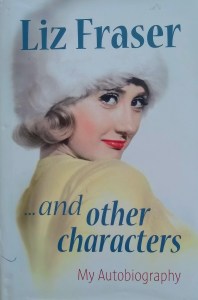
Liz Fraser …. and other characters

In Fenella’s book above, she mentions that she hoped her book would not go the way of a lot of other showbiz autobiographies, interesting at first but then dissolving into lists of plays and films and other celebrities. Sadly, that seems to be the way this book does go, even so I enjoyed it.

Liz was brought up in Southwark, in London. Her mother ran a small shop, one of those shops that used to sell everything that Tesco might sell these days from bags of coal, wood bundles to fresh food. Her father was a travelling salesman but died in 1942 aged only 40.

Like Fenella, Liz attended RADA and afterwards won her breakthrough part in I’m All Right Jack which starred Peter Sellers as a union official. She tells the story of playing minor parts in small plays and eventually got some walk on parts on TV. One day her mother said to her “Was that you last week, walking past Peter Cushing?” It was!

Liz worked on TV shows that were live back in the day. On an episode of Dixon of Dock Green she forgot her line but the crew had a ‘cut key’ which cut out the broadcast sound while they called out the line to the hapless Liz.

To get the part in I’m All Right Jack Liz had to lie about her age as the producers wanted someone younger which led to a career long confusion about her age.

She appeared with Peter Sellers in various films and she reveals that although she liked Sellers she had to fight off his amorous advances several times. Liz shares lots of anecdotes about various people she worked with including Tony Hancock, Benny Hill and Sid James.

She tells about appearing in a few of the Carry On films but like many others is critical of the producers. There was only a one off payment for each film and despite the enduring popularity of the Carry On films, the actors earned nothing from their later success on TV. In later life Joan Sims had a lot of financial difficulty but was helped by actors’ charity organisations. Liz herself was very thoughtful, investing in property and stocks and shares which sustained her during the times when acting work was thin on the ground.

She doesn’t share much about her personal life although her first husband features in a chapter called I Married a Thief. Peter Yonwin was something of a fantasist and their marriage soon broke down.

One shocking disclosure was an incident one night after appearing in a pantomime. Liz took an acquaintance home thinking she could deal with any problem man only to be raped. She doesn’t expand on the incident but seems to just mention it quickly and then move on as if perhaps by talking about it however briefly she could perhaps exorcize this dreadful ordeal.

Liz’s second husband, a TV producer, died of cancer and Liz suffered with cancer herself. She enjoyed fast cars and finishes by talking about her old age.

Liz Fraser died in 2018 aged 88.

According to Dora

I do love my showbiz biographies and autobiographies and one I picked up a while back was an autobiography by Dora Bryan. I love Dora from her many appearances in British films but my favourite film is probably A Taste of Honey. The screenplay was by Shelagh Delaney and director Tony Richardson, adapted from Delaney’s own play which she famously wrote when she was only 18.

Dora Bryan gives an outstanding performance; at times comic but always supremely natural. Dora grew up on an Oldham housing estate. She was a great performer as a child and so her mother took her to dancing school and further encouraged by her mother, she joined Oldham Repertory before moving to London to develop her stage career. She had a great career on the stage as well as on film and TV and appeared in many successful West End productions. The first part of the book is very interesting but then as I mentioned earlier, this becomes one of those books in which the latter part seems to wander off into lists of productions and theatre and TV personalities. Even so, it was a lovely read.

When the Wind Changed (The Life and Death of Tony Hancock) by Cliff Goodwin

This final book is the odd one out in this quartet of British comedy stars. It’s a biography rather than an autobiography. I don’t think Tony Hancock ever wrote one.
Back in his day Tony Hancock was a giant among television performers. Pub landlords complained that their establishments used to empty because people would drink up and rush home to watch Hancock’s Half Hour. I can’t even imagine that happening today to any contemporary comedian not withstanding the emergence of TV recording devices.

Hancock’s half hour was first broadcast on the radio in 1954 and then transferred to television in 1956.

Hancock’s co star on television was Sid James and Hancock decided to part with Sid believing that the public had begun to think of the two of them as a sort of double act. His final comedy series for the BBC was called Hancock but even without Sid James, it was a great success.

An interesting TV interview at this time saw Hancock as a guest on Face to Face, an intensive interview which revealed Tony Hancock to be a different man to the bumbling buffoon of his radio and TV shows, in fact the entire transcript of the interview is repeated in the book. Many felt that this interview made him more and more self-critical which led to him dispensing with many who were important to his professional life such as Sid James and his scriptwriters Galton and Simpson.

After a minor car crash Hancock had to use an autocue for perhaps his most famous TV episode, The Blood Donor. After that, he used the autocue more and more finding it too hard apparently to continue to learn scripts.

His drinking increased. He left his wife for his mistress Freddie Ross who worked as his publicist. Freddie and Hancock eventually married but their relationship later broke down also.

Hancock committed suicide in 1968. He took an overdose of pills and left behind a note which said ‘things seemed to go wrong too many times.’

This is such a fascinating and well written book and if you are interested in actors and performers as I am, it is well worth seeking out.

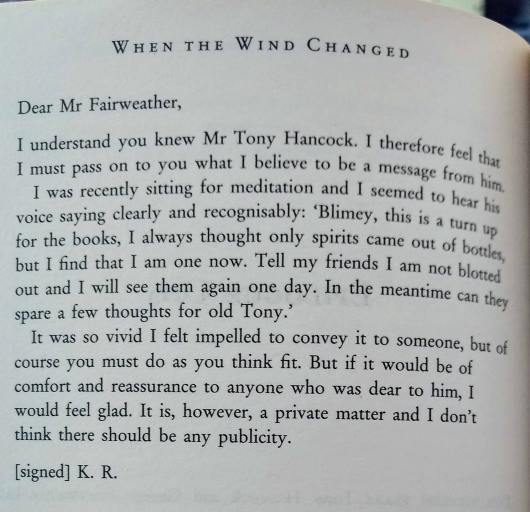
There are a couple of postcripts to the book but one was so intriguing I have to mention it here. George Fairweather was a great friend of Tony Hancock. When Hancock was delighted to find he had been chosen for the royal command performance he told George that he wished his late father could have been there to see it. George commented that perhaps his father would see it and Hancock replied dismissively that ‘only spirits come out of bottles’.

22 days after Hancock’s death, George received a typed letter with no name or address. It said simply that the writer had received a message from Hancock in the afterlife and wished to pass it on. The message is reproduced below.


What to do next: Here are a few options.

Share this post on your favourite social media!

Hit the Subscribe button. Never miss another post!

Listen to my podcast Click here.

Buy the book! Click here to purchase my new poetry collection.

Click here to visit Amazon and download Floating in Space to your Kindle or order the paperback version.

Click here to visit amazon and purchase Timeline, my new anthology.

Book Bag: John Grisham

In my last few posts about books, rather than publish my usual Book Bag posts, I’ve incorporated book reviews into other types of posts; holiday memories and posts about books made into films and so on. During my last few holidays, I always seem to either have a couple of John Grisham books with me or found some in the places, usually rented villas, where we have stayed. I thought it might be an idea to write a John Grisham themed book bag post. Who actually is John Grisham then?

Let’s go over to Wikipedia and see what they have to say:

Born February 8, 1955 John Grisham is an American novelist, lawyer, and former member of the Mississippi House of Representatives, known for his best-selling legal thrillers. According to the American Academy of Achievement, Grisham has written 37 consecutive number-one fiction bestsellers, and his books have sold 300 million copies worldwide. Along with Tom Clancy and J. K. Rowling, Grisham is one of only three anglophone authors to have sold two million copies on the first printing.

Pretty impressive credentials, aren’t they? Most of the inside back covers of my copies of his books say pretty much the same thing and in the back of the last Grisham book I read, The Racketeer, there are extracts from an interview with Grisham in which he mentions his favourite book is A Time to Kill, his first book and apparently the most personal of his legal thrillers.

Let’s take a closer look at some of the books that I have read.

A Time to Kill by John Grisham

As I said earlier, this book turns out to be Grisham’s first novel and he says in the introduction how proud he was of finishing it, as back then he hardly ever finished anything. It also contains some autobiographical elements; Grisham used to be a street lawyer, similar to the character in the book.

The book is set in America’s deep south where there is or was a great deal of racial prejudice. Two white guys decide to kidnap a young black girl, tie her to a tree and repeatedly rape her. They drive her away and dump her like garbage but she survives and the police arrest the two scumbags responsible. Next, the young girl’s father Carl Lee Hailey decides to take a rifle and shoot the two guys. He is arrested and put on trial for murder and street lawyer Jake Brigance takes on the case.

The case ignites the small town of Clanton Mississippi. The Klu Klux Klan become involved as do various other groups and the stage is set for a tense murder trial which goes on while the police and the National Guard try to keep order.

It’s a very exciting read although the ending was a little underwhelming and if you find the N word offensive then this is a book which is not for you as that particular word appears numerous times on almost every page.

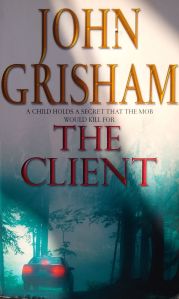
The Client

This book was a great holiday read. It’s about an eleven year old boy who witnesses a suicide but before the man kills himself (he is a lawyer defending a known murderer) he tells the boys, Mark and his little brother Ricky, where his client has hidden the  dead body of a murdered US senator. The senator was the victim of a mob ‘hit’ and Mark won’t tell the police or the FBI about the body as he is concerned for the safety of his mother and brother. When he and his mother are in hospital staying with his brother Ricky, as he has gone into shock, Mark contacts a lawyer and a big legal stand off begins with the FBI. Things eventually get settled but I can’t help wondering why the boy wouldn’t trust the FBI or even why he wouldn’t tell them about the body in the first place. Of course, if he had then there wouldn’t be a story. Either way this was a great holiday read and the narrative kept me interested all the way to the end. I didn’t realise it was also made into a film starring Tommy Lee Jones and Susan Sarandon which I must remember to look out for.

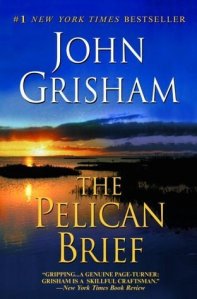
The Pelican Brief by John Grisham

This book might be the best book by Grisham I have read so far. The book opens with the murder of two US Supreme Court judges and this in a way plays into the hands of the President as he can now nominate new judges who share his political views. At the same time, law student Darby Shaw is having an affair with her law professor. She decides to look closely at the murders and develops a thesis, an idea about who may have done the murders and why. The thesis becomes known as the Pelican Brief and she passes it to the professor who in turn sends it to his friend, an FBI lawyer. It then gets passed up the chain to the head of the FBI and on to the White House where the President instructs the FBI not to investigate further.

Not long afterwards the professor is blown up in a car bomb which Darby narrowly avoids and from then on, she is on the run trying to evade death herself.

This for me was one of those unputdownable novels which was exciting and kept me interested all the way to the end.

The Firm by John Grisham

There is a process by which I choose books to take with me on holiday. I like to think it’s a thoughtful process combining different genres of books, some novels, maybe the odd classic, and some biographies and autobiographies. What actually happens is that the day before our trip I’ll just grab something near to hand that I know I haven’t read yet and shove it in my suitcase. Anyway, that’s how I ended up with The Firm. Last year I read The Rainmaker by John Grisham and I thought it was a pretty good read. I must have mentioned that to Liz so she filed that away and got me a stack of Grisham novels for my last birthday. The Firm isn’t a bad read and in my case it was a nice change of pace after reading some non-fiction books.

It’s a good story but like a lot of Grisham’s works, it’s more plot driven than character driven. The characters are sort of bland templates that I’ve recognised in a lot of his novels. Anyway, characters aside, this is a really original story about a young guy who graduates from law school and gets head hunted into a firm he has never heard of but which offers tremendous financial benefits, a brand new BMW, and an ultra cheap mortgage as well as other financial bonuses. The downside, as he comes to learn later, is that the firm is just a cover operation to launder money for a big mafia crime family and the FBI wants our hero James McDeere, to help them.

Verdict: Highly enjoyable and a great holiday read but nothing more, although that didn’t stop the book from becoming a best seller as well as a hit film in the 1990’s.

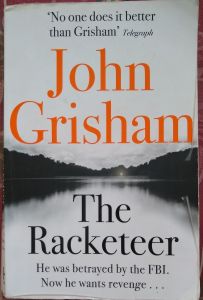
The Racketeer

This is another legal thriller about a man convicted of money laundering, which he denies by the way, sentenced to ten years in a federal institution. Naturally he is not happy but he hoped to get out by using rule 35 of the Federal Rules for Criminal Procedure which means that if the inmate can solve a crime which the federal authorities are unable to solve, then his sentence can be reduced.

The man, Malcolm Bannister, helps other inmates of the prison with their legal issues and in doing so has come across some information about the murder of a judge, in which the Police and the FBI have no clues about the culprit. He plans to barter this information for his freedom but it turns out that Bannister is actually double bluffing the FBI and has a scheme in mind in which he can gain his freedom and walk away with a considerable amount of money as well as a new identity.

Like most of Grisham’s books, this was an excellent holiday read but towards the end it almost feels as though the writer has become a little fed up with this increasingly complicated story and is rushing to get it finished. This was mostly a good read but the end was a little disappointing.

The Boys From Biloxi

This is a very oddball book indeed. It’s not a courtroom drama although courtroom battles do feature in the book. It’s actually a very long-winded story of two families, one on the wrong side of the law and one on the other. One family is part of a rough and ready area of town and owns saloons that have illegal gambling and prostitution on tap and the other family who hope to clean the town up.

A lot of the story is just reeled off like a sort of narration you might listen to in a museum (which is how one review I read described the text). The author just seems to recount a lot of the story in this same long distance way. Eventually the story becomes more fleshed out and detailed when a tornado hits the town and a lawyer with ambitions to become the district attorney helps the residents fight for compensation from insurance companies that do not want to pay out. His success with compensation claims help him to become the DA but he is murdered before he can bring the criminal family to justice. His son however goes on to clean up the town.

Again this was another great holiday read but if I had been reading it at home for twenty minutes or so before going to sleep at night, I reckon that after a few nights I would have perhaps picked up something else to read.


What to do next: Here are a few options.

Share this post on your favourite social media!

Hit the Subscribe button. Never miss another post!

Listen to my podcast Click here.

Buy the book! Click here to purchase my new poetry collection.

Click here to visit Amazon and download Floating in Space to your Kindle or order the paperback version.

Click here to visit amazon and purchase Timeline, my new anthology.

8 Fictional Presidents

Donald Trump, the 47th president of the US, has been in the news quite a lot recently. He’s cutting down on the number of federal employees. He has stopped federal help for electric cars, he’s made it known he wants the USA to take over Gaza and he is also negotiating with Russia to stop the war in the Ukraine. He doesn’t seem to have involved President Zelensky in these talks despite Zelensky being the president of the Ukraine. Trump has even cast doubt on Zelensky’s right to be the president as, because of the war, Ukraine hasn’t held any elections. This is quite rich really as Putin, the leader of Russia, has not only rigged the Russian elections but has changed the law in Russia so he can continue as president and has also allegedly bumped off Alexei Navalny, his major political opponent.
It’s a story that you couldn’t write and that got me thinking about fictional presidents so I thought I’d start with a book I’ve just read here in sunny Lanzarote.

President Duncan

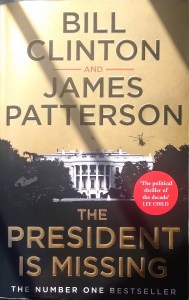
The President is Missing by Bill Clinton and James Patterson has been a good holiday read. A helter skelter fast paced read but moves along quickly and has nicely laid out short chapters to enable me to pause, jump in the pool to cool off and then resume reading.
President Duncan has a lot of problems on his hands. His wife has recently died of cancer and he is suffering from some sort of blood disease. On top of that the Speaker of the House has started hearings regarding rumours that the President spoke to a known terrorist on the phone and even helped him to escape capture.

Not only that but the President agrees to meet an unknown woman who knows a secret password known only to the President and his trusted advisors. She asks the President to meet her colleague at a football game without security and the President agrees and dismisses the Secret Service. Happily the Secret Service are hanging about closely and save the President from an assassin’s bullet but now he has to deal with a threat concerning a computer virus that will shut down every computer in the USA including those that deal with nuclear strikes.

One of the reviews on the back cover was from someone who likened the book to the film Airforce One, and to be honest, I felt the same way, even picturing the President as Harrison Ford, who played the President in that film.

The book was a great holiday read although I did wonder what part Bill Clinton played in the writing process. Did he just provide background to James Patterson or did he contribute towards the storyline too?

Anyway, the book was a great holiday read.

President James Marshall

Clearly I have to follow on with Airforce One, an action packed film starring Harrison Ford as President James Marshall. In this film the President leaves Russia in his aircraft, Airforce One after a joint US/Russian mission to capture a terrorist named General Ivan Radek. Unknown to the President, a group of Radek sympathisers have joined the aircraft posing as journalists. They take over the Airforce One but it looks as though the President has got away in an escape pod. However, the President was unwilling to leave his family behind and he has hidden himself in the cargo hold. The film then unfolds in the manner of a Die Hard film with the President bumping off the terrorists and managing to contact the White House and also to free his colleagues pretty much in the way that Bruce Willis might have done.

Not a great cinema experience but I kind of enjoyed it.

President Jordan Lyman

Seven Days in May was a political thriller released in 1964 and directed by John Frankenheimer. Kirk Douglas plays United States Marine Corps Colonel “Jiggs” Casey who works for Four Star General James Mattoon Scott, a highly-decorated officer played by Burt Lancaster. Jiggs thinks that Scott might be planning a coup to remove the President who has just signed a nuclear disarmament treaty with the Soviet Union, a deal which is highly unpopular with the military. Jiggs discovers that a military group known as ECOMCON has been assigned to seize radio and television networks. He manages to see the President and convince him of the threat. The President, still somewhat sceptical, organises a small group of staff to investigate.

Interestingly, President Kennedy authorised the producers to film scenes at the White House. He had read the book that the film was based on and as he had dealt with critical members of the military himself, was perhaps worried that the fictional scenario could be a real possibility.

The President was played by Frederic March who was one of the great cinema actors of the 1930s and 40s. He was the original Norman Maine in the first version of A Star is Born made in 1936 and even starred with Greta Garbo in Anna Karenina in 1935.

Presidents Palmer, Taylor and Logan

The TV series 24 first appeared in 2001 on US television. Each episode lasted for an hour and is told in real time with a digital clock on screen updating the viewer. The first series is set on the day of the US presidential primary in California. Jack Bauer, a maverick agent of the CTU Counter Terrorism Unit, is detailed to protect presidential hopeful David Palmer from an assassination attempt. Palmer was played by Dennis Haysbert as a potential black US president.

Season 2 details how Bauer, played by Kiefer Sutherland, must prevent a nuclear bomb from exploding and assist David Palmer, now the US president, in finding the culprits. Jack is assisted by a team of agents at the CTU hi-tech control room who are adept at computer manipulation, taking over feeds from CCTV cameras, hacking into other public computers and researching various information to help Jack.

Allison Taylor is the first female president of the USA. She first appeared in the episode Redemption which was a bridging episode between series 6 and 7 as series 7 was delayed due to a writers’ strike in Hollywood. Taylor was played by actress Cherry Jones and almost seemed to be a precursor to a real life female president. As it happened, Hilary Clinton was defeated at the polls and Donald Trump became the president in 2017. (Personally, I always like President Taylor. She always reminded me a little of Captain Janeway from the TV series Star Trek Voyager.)

President Logan was played by Gregory Itzin and first appeared in season 4. He was the Vice President but was later sworn in as President when the previous President was injured in a terrorist attack. As President, Logan becomes involved in the murder of former President Palmer and is eventually forced to resign. Later, he tries to help President Taylor with a peace treaty with the Russians but again, some dodgy dealings lead him to commit suicide. Some thought the character was inspired by real life President Richard Nixon. Whether that was true or not I’m not sure but Logan was a very tricky President indeed.

I thoroughly enjoyed 24. Jack Bauer was an uncompromising agent who was convinced that the end justified the means and would shoot anyone, threaten anyone, good or bad who got in his way. The series was a very slick hi tech espionage show which combined spies, shoot outs and computer science in an exciting TV series.

Presidents Kane and Kennedy

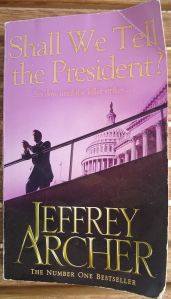
Shall We Tell the President was a novel by Jeffrey Archer first published in 1977. In the book Edward Kennedy has become the US President and FBI agents become aware of a plot to kill the President.

I read this book many years ago but recently came across this new edition, rewritten by the author himself. In real life Ted Kennedy never made it to the White House, his challenge cut short by the ghost of what happened to Mary Jo Kopechene at Chappaquiddick. In this rewrite then, the author puts his own fictional president, President Kane in charge at the White House.

The FBI learn of a plot to murder the President. A Greek waiter, an illegal immigrant, learns of the plot whilst working as a waiter at a restaurant in Washington DC. He calls the FBI and the two agents assigned to the case report quickly to their superior. Soon, one of the agents and their boss, as well as the informant are dead leaving only one agent who by chance has survived a murder attempt. He has six days to track down the assassins.

The book kept me interested but I can’t say it was a great read and I thought some of the dialogue was a little poor, in particular the FBI agent who kept referring to his new girlfriend constantly as ‘pretty lady’ was a little cringeworthy to say the least. Sorry Mr Archer but I’d have to give this one a five out of ten.

Just off the top of my head without using Google, that’s about all the fictional presidents I can come up with for now. Which was your favourite?


What to do next: Here are a few options.

Share this post on your favourite social media!

Hit the Subscribe button. Never miss another post!

Listen to my podcast Click here.

Buy the book! Click here to purchase my new poetry collection.

Click here to visit Amazon and download Floating in Space to your Kindle or order the paperback version.

Click here to visit amazon and purchase Timeline, my new anthology.

Curry, Tapas and a Read in the Sun

Over on the front page of this site you will find a whole lot of stuff about me. It tells you that I have always wanted to be a writer, that I enjoy writing as well as Formula One racing, classic cinema and books. In one segment it mentions that I like dining out, in fact it says that dining out is one of the great experiences of life and so I thought I’d start with that, great experiences and see where that leads me.

One of the great experiences of life, as far as I’m concerned anyway is a pretty simple one. It involves lying on a sunbed and relaxing on a hot, or even just warm day. Throw in a dip in the pool and that sensation of lying in the sun while you dry off is made even more satisfying.

Of course, doing that in the UK at any time of the year is not always possible, especially in February which is why for perhaps the last ten years, if you want to get hold of me at this time of the year, you’ll find me in Lanzarote.

What can I tell you about this place? Looking over on Wikipedia I see the Canary Islands emerged from the sea bed during a volcanic eruption about 15 million years ago. There is apparently some evidence the Phoenicians were the first settlers here although the first known records of the islands come from Pliny the elder, the Roman scholar.

After the fall of the Western Roman Empire, nothing is recorded about the Canary Islands until 999, when the Arabs arrived at the islands. In 1336, a ship arrived from Lisbon under the guidance of Genoese navigator Lancelotto Malocello, who used the alias ‘Lanzarote da Framqua’ which is where the island’s name comes from. Today Lanzarote is part of Spain.

When we first came here round about ten years ago, we hired a car and drove round the island. We visited the volcano which was pretty much what you’d expect a volcano to look like, although the drive down a very narrow winding road in a coach towards the centre of it was a little scary. Otherwise, apart from the usual touristy stuff, there wasn’t that much to see and we quickly realised that the Marina Rubicon in Playa Blanca is by far our favourite place. Our rented villa is on the bus route and only five minutes walk from both the bus stop and the local shop so renting a car is not a particular concern.

What else do I do on Lanzarote? Well I read a lot of books.

Crossfire by Jim Marrs

I do love a JFK assassination book and this is a good one. It covers pretty much everything there is to know about the assassination from Oswald to Ruby, the Texas School Book Depository, the Grassy Knoll, the CIA, the FBI, the Warren Commission, the House Select Committee on assassinations and everything in between. Who really did it? I’m not sure. Was Lee Oswald the killer or just a patsy? Again I’m not sure but a lot of the evidence against Oswald was compromised. The officers who found the assassin’s rifle said it was a Mauser, not a Manlicher Carcarno. Later all but one of the officers said they were mistaken. The one who said he wasn’t mistaken was later murdered.

Who were the people on the Grassy Knoll with Secret Service IDs when all the SS were in the President’s motorcade? The shells found at the scene where the fleeing Oswald supposedly shot officer Tippet  were marked by a police officer. Later, when asked to identify the shells, his marks weren’t there. I could go on and on. Maybe Oswald did it, maybe he didn’t. Perhaps he was a patsy as he claimed. Will the records which President Trump will release show what really happened? I doubt it but either way, the JFK assassination is such an fascinating mystery.

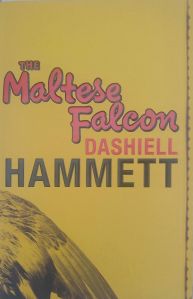
The Maltese Falcon and The Thin Man by Dashiell Hammett

I absolutely loved this book. I mentioned it last week in a post about detectives but it really is a fabulous read and the film with Humphrey Bogart follows it closely, especially the dialogue.  If you have never read it or seen the film, it’s about Sam Spade, a detective who happens on a group of people all after the mysterious Maltese Falcon statuette worth untold millions and at the same time seeks to find his partner’s murderer.

The only real difference between the film and the book is that in the book, Caspar Gutman’s daughter makes a brief appearance but not in the film. In the film Gutman infers that Miss Wanderley has stolen a thousand dollar bill and Bogart as Sam Spade demands that Gutman confesses to stealing it or stands for a frisk. In the book, Spade surprisingly thinks Miss Wanderley has got the note and forces her to strip naked to show that she didn’t steal it. Only then does he challenge Mr Gutman.

I have to say I have found the works of Raymond Chandler a much better read but this particular story I loved almost as much as the film.

Another book by Hammett, The Thin Man, wasn’t as good. Detective Nick Charles is no longer a detective but many others seem to think he is and he seems to feel compelled to look into a case of murder, even though he doesn’t seem that interested. Perhaps that was why I lost interest early on and kept putting this book down in favour of others.

Going back to the thing I mentioned earlier, the one about dining being one of the great experiences of life, well, only a few minutes walk from our rented villa, just next to the shop I told you about is a really fabulous Indian restaurant. No need to get the bus to the Marina or the centre of Playa Blanca as we can just walk to the restaurant. The funny thing is, Liz and I are part of a curry club and once a month we meet at a curry house in St Annes and settle down for a curry and some chit chat. I was actually thinking of perhaps going every two months or even leaving the curry club altogether. Well, I like curry but I’d had all I really wanted to eat in that particular restaurant and, nice though it is, I perhaps fancied going to the Chinese on that day or the local Italian.

Now however, I seem to be once again hooked on curry. Our local curry house here in Lanzarote, The Indian Gourmet, is a very friendly place. We have established our favourite table. The staff know that Liz hates coriander and they have marked us down as preferring medium rather than hot as regards curry strength. The chef always comes out to see if we have enjoyed his creation and always recommends what we can try next time and so on. The curry house then has become our sort of go to place if we want to eat out and don’t fancy travelling far.

The Client by John Grisham

Time for another book and this one was a great holiday read. It’s about an eleven year old boy who witnesses a suicide but before the lawyer kills himself, he tells the boys -Mark and his little brother Ricky- where the dead body of a murdered US senator has been hidden. The senator was the victim of a mob ‘hit’ and Mark won’t tell the police or the FBI about the body as he is concerned for the safety of his mother and brother. When he and his mother are in hospital staying with his brother Ricky, as he has gone into shock, Mark contacts a lawyer and a big legal stand off begins with the FBI. Things eventually get settled but I can’t help wondering why the boy wouldn’t trust the FBI or even why he would tell them about the body in the first place. Of course if he had then there wouldn’t be a story. Either way this was a great holiday read and the narrative kept me interested all the way to the end. I didn’t realise it was also made into a film starring Tommy Lee Jones and Susan Sarandon which I must remember to look out for.

Another of our favourite places is the Berruga Tapas bar which we have been visiting for years. Sadly, a lot of our favourite staff members have moved on in the intervening year since our last visit. The boss is still here though, Juan who always remembers us and greets us warmly and the food is still the same mix of Spanish tapas and English snack food like burger and chips and so on. It’s a rough and ready sort of place but it’s also a lot of fun. And we do like the freebie at the end of the night; a shot of vodka caramel in an ice cold glass.

So, what will we be having tonight? Tapas or curry or something new perhaps?


What to do next: Here are a few options.

Share this post on your favourite social media!

Hit the Subscribe button. Never miss another post!

Listen to my podcast Click here.

Buy the book! Click here to purchase my new poetry collection.

Click here to visit Amazon and download Floating in Space to your Kindle or order the paperback version.

Click here to visit amazon and purchase Timeline, my new anthology.

Watching (and reading) the Detectives

Liz and I are over here in sunny Lanzarote having exchanged the cold of the UK for the warmth of Lanzarote. Of course, it is still February and things aren’t perfect over here. It’s warm but there are plenty of days when gusty winds blow across the island as well as days when the sun has been obscured by clouds. Even so there are still plenty of bars to drink at, plenty of tapas to be eaten and of course we have plenty of books to read, two of which have inspired this week’s post.
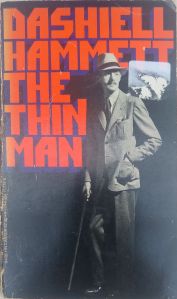
The Thin Man is a book I picked up somewhere in a second hand bookshop. It was written by Dashiell Hammett and features his famous detective, Nick Charles.

Dashiell Hammett was born in May, 1924 and became a writer of detective stories after working for the famous Pinkerton National Detective Agency. In his obituary in the New York Times, they described him as ‘the dean of the hard boiled school of detective fiction.’

Time magazine included his novel Red Harvest, published in 1929, on their list of the 100 best English language novels. The Thin Man was made into a film in 1934 starring William Powell as Nick Charles and Myrna Loy as his wife Nora. I’ve only just started reading the Thin Man and it’s been pretty good so far. One interesting element of it though was finding out that in New York in the mid 1930’s it was possible to find an all-night delicatessen that would deliver coffee and sandwiches at 5 in the morning.

A further 5 sequels in the Thin Man film series were made finishing in 1947 with Songs of the Thin Man.

Another book by the same author is one that Liz got me for Christmas, The Maltese Falcon. I’ve only just scanned through it so far but it looks like being a good read. The book was made into a classic film in 1941 with Humphrey Bogart playing the part of detective Sam Spade. Mary Astor plays Ruth Wanderley who contacts the firm of Spade and Archer to help her track down her missing sister who she thinks might be held against her will by a man called Thursby.  Miles Archer, Spade’s partner decides to take on the case but is found dead by the police later that night.

Spade begins to try and find out what has happened and meets various other characters like Joel Cairo and Kasper Gutman played wonderfully by Peter Lorre and Sydney Greenstreet. One of my favourite scenes is where Spade and Gutman meet and Gutman asks ‘are you a close mouthed man?’ Spade replies that no, he likes to talk and Gutman responds famously with ‘I’m a man who likes to talk to a man who likes to talk’.

Hammet died in 1961 of lung cancer and Raymond Chandler said this of him: ‘He was spare, frugal, hard-boiled, but he did over and over again what only the best writers can ever do at all. He wrote scenes that seemed never to have been written before.’

That brings me nicely to another of my favourite detectives, Philip Marlowe and he first appeared in the novel The Big Sleep. The book was written by Raymond Chandler and Chandler had this really fabulous talkative way of writing. You can almost imagine hearing Humphrey Bogart’s voice as you read the book. Bogart of course played Marlowe in the 1946 film version directed by Howard Hawks. Here’s a quote from the book, an example of Chandler’s descriptive style:

I sat down on the edge of a deep soft chair and looked at Mrs Regan. She was worth a stare. She was trouble. She was stretched out on a modernistic chaise-longue with her slippers off so I stared at her legs in the sheerest silk stocking. They seemed to be arranged to stare at. They were visible to the knee and one of them well beyond. The knees were dimpled, not bony or sharp. The calves were beautiful, the ankles long and slim with enough melodic line for a tone poem. She was tall and rangy and strong looking. Her head was against an ivory satin cushion. Her hair was black and wiry and parted in the middle and she had the hot black eyes of the portrait in the hall. She had a good mouth and a good chin. There was a sulky droop to her lips and the lower lip was full.

Not bad eh? Dilys Powell called his writing ‘a peculiar mixture of harshness, sensuality, high polish and backstreet poetry’ and it’s easy to see why. Mrs Regan was played by Lauren Bacall in the film version and up until now I had always thought this was the film where Bogart and Bacall met. Wrong! A quick check on Wikipedia and I see the couple met on the set of To Have and Have Not in 1944. Bacall was 19 and Bogart was 45 and married to his third wife Mayo Methot at the time. Sparks apparently flew between the couple and Bogart divorced Mayo and married Bacall the next year, 1945. Despite the great on screen chemistry together the couple only made four films together.

The film version of The Big Sleep was a brilliant adaptation of the book and some of the differences are interesting. For instance, early in the book, detective Philip Marlowe played by Bogart meets General Sternwood’s daughter Carmen. She looks at Marlowe and remarks how tall he is. In the film, Bogart of course wasn’t that tall so the dialogue is reversed ‘You’re not very tall, are you?’ comments Carmen.

The plot of the book and film are pretty complicated, although having read the book recently I think that the book is easier to follow. During the filming the director and his stars wondered who killed the character of Owen Taylor, the Sternwood’s chauffeur. They sent a cable to Raymond Chandler asking him. Chandler told a friend later ‘Dammit, I don’t know either!’
One strange element in the film, certainly for me, is a scene where Philip Marlowe (Bogart) is watching blackmailer Geiger. Geiger has a shop that sells rare books in Hollywood and Marlowe asks for information in another bookshop opposite. There he chats to a bookseller played by Dorothy Malone who, if you are old enough, you will remember her from the Peyton Place TV series. Malone and Bogart seem to hit it off well in the film but he never returns to the bookshop and Dorothy is never seen again in the film.

Every time I watch the film, I always expect Malone to reappear but that’s one of the many dead ends the film leads us down. I think it was Hitchcock who said that every scene in a film should lead the audience somewhere and Quentin Tarantino of course said the reverse. Perhaps director Howard Hawks favoured Tarantino’s view.

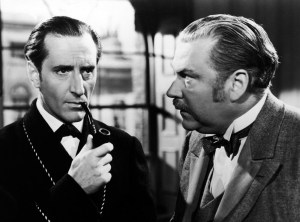
Basil Rathbone as Holmes and Nigel Bruce as Dr Watson (image via creative commons)

Perhaps the most famous literary detective is Sherlock Holmes, created by the author Sir Arthur Conan Doyle in 1887, first appearing in the story A Study in Scarlet. The stories are narrated by Holmes’ friend and companion, Doctor Watson. The Guinness Book of Records reports Holmes as the most portrayed character in film and television history.

My personal favourite Sherlock Holmes in the cinema was the version created by Basil Rathbone in a series of films beginning in 1939. 14 films were made with Rathbone as Holmes and Nigel Bruce playing the part of Dr Watson. The first two films were set in the Victorian era and were produced by Twentieth Century Fox. The later films were produced by Universal who set the films in, what was then, the present time period, that of the second world war.

Time now to move onto my favourite TV detective, the bumbling Lieutenant Columbo.

Columbo first appeared in the early 1970s as part of the Mystery Movie TV series. Each week followed a different detective trying to track down a murder case, sometimes it was MacMillan and Wife and other weeks McCloud, Banacek or various others. The most popular one by far though was Columbo.

Columbo was a homicide detective for the LAPD and he was played by Peter Falk, although the role was originally written for Bing Crosby. Crosby however thought a regular TV slot would interfere too much with his golf so he turned down the role, went back to the fairway and the part went to Peter Falk who made it his own.

If you ever see the original pilot, shot in 1968, you can see how Crosby might have fitted into the part, as Falk plays Columbo in a very Crosby like laid back way. The very first guest murderer was Gene Barry who was familiar to TV audiences after playing Amos Burke in Burke’s Law for many years. He also starred in a 1953 film version of War of the Worlds.

The pilot episode also introduced audiences to a particular feature of Columbo, in that we see who the murderer is and how he commits the crime first. Then we see Lieutenant Columbo gradually solve the clues and get his man, or woman. The essence then of a great episode comes in the clever way Columbo nails the murderer. Sometimes that moment is a bit of a non starter, other times it’s nothing short of brilliant. Sometimes, even if that final moment is not so great, it’s still been a great episode.

The Columbo of the early series is an absent-minded quirky fellow although in later episodes, Peter Falk who plays the detective, seems to downplay that quirky element.

Favourite episode? I’m not certain but it might be ‘Murder by the Book‘, starring my favourite murderer, Jack Cassidy. In this 1971 episode, Jack plays a writer, actually part of a writing double act, who together produce a series of novels about ‘Mrs Melville’ who is an amateur detective. The thing is, Jack’s partner wants to ditch the partnership but Jack is not happy about it. He is so unhappy he decides to, yes you guessed it, bump off his co-writer. He does it in a rather ingenious way which foxes Columbo but not for long and to cap it all, the episode is directed by none other than Steven Spielberg!

So who was your favourite fictional detective?


What to do next: Here are a few options.

Share this post on your favourite social media!

Hit the Subscribe button. Never miss another post!

Listen to my podcast Click here.

Buy the book! Click here to purchase my new poetry collection.

Click here to visit Amazon and download Floating in Space to your Kindle or order the paperback version.

Click here to visit amazon and purchase Timeline, my new anthology.

Changing the Narrative

Once again as we have for the past ten or so years, Liz and I have escaped the dismal cold of January in the UK and flown over to sunny and warm Lanzarote, leaving behind the dark nights, the cold and the rain.

Noel Coward did a similar thing every winter and went off to the Caribbean or anywhere he fancied really. Perhaps the cold is just not for us writers. Certainly not for me at any rate. Anyway, its nice to think I have something at least in common with a great writer like Coward.

Our day started last Sunday with my alarm going off at the utterly inconceivable time of 5:30am. Well, there was a time when I used to have to get up even earlier, happily, not any more. A quick wash and shower, a much-needed cup of tea and soon our driver was knocking at the door.

A pleasant surprise awaited us at the airport. On previous trips we have had to endure the hell of passing through security, taking out all our numerous electronic devices and putting them in plastic trays to be X rayed. This year, thanks to new technology, we didn’t have to do that. No longer was I running about, beltless, hanging on to my trousers while trying to grab my various belongings from numerous trays and pack them again in my cabin bag. This year the experience was much more civilised.

On the aeroplane I settled down and opened up my book to read. I have, as usual, plenty of reading matter with me but the book I chose to read on the flight was The Best Exotic Marigold Hotel as it was a fairly slim volume and fitted easily into my shoulder bag. I chose this book as it is the basis for the film of the same name, one of my favourite films.

It came as a bit of a surprise then to find that the book was almost completely different to the film. Yes, there is a Best Marigold Hotel just like the film and it is about a bunch of retired British people who take up residence there but after that, the similarity ends.

It’s almost like watching one of those James Bond films where Ian Fleming’s original story has been evolved out of recognition. Take Moonraker for example. The book is about a German officer who has been hospitalised in WWII during the Battle of the Bulge. Some German troops had been dressed in captured allied uniforms to confuse the enemy and Drax was injured while in British uniform. When fully recovered Hugo Drax continues the deception. He builds up a great business empire but decides to take his revenge on Britain by building a rocket, the Moonraker, which he intends to drop on England. In the film Bond investigates the disappearance of a space shuttle only to find Hugo Drax wants to wipe out the earth population and replace it with a master race.

The problem with film is that it is a group project and various people have an input on the final script. Screen writer William Goldman wrote a wonderful book about his screen writing career called Adventures in the Skin Trade. He described a typical screenplay development something like this. I should point out that I’m going by memory only as my copy of his book is thousands of miles away.

Goldman writes a script and gets a director interested in the project. The director likes the idea but he thinks the ending is not right so the author produces a second draft. The director is happy and brings a big star on board. The star likes the screenplay but is not happy that his character is killed at the end. Goldman produces a third draft and the big star is happier but thinks this and that needs changing. Goldman rewrites and comes up with draft number 4. At this point the Big Star decides to sign up with another project and he is out. The director is not happy so he drops out too. Enter director number 2. He likes the screenplay but thinks a few changes are required. The writer comes up with draft number 5. Enter big star number 2. He likes the screenplay but wouldn’t it be better if his character got the girl instead of the other guy? New draft please!

Come to think of it, wouldn’t it be great if we could order a new draft of our lives. Could I rewrite the bit where I spent 17 years working for the bus company? What about the time when I wanted to be a newspaper reporter? Maybe I could have walked down to the Manchester Evening News and perhaps asked if there were any jobs going?

Another production, actually a TV series, is another example of how producers can change the characters from a book. Hamish Macbeth is actually completely different to the books on which the series was based which was a little of a surprise to me and most of the characters in the series are the invention of the TV writers and not M.C. Beaton who wrote the books. I’m not sure how happy I would be if someone made a TV show out of my book and then proceeded to change all the characters, still I did enjoy Hamish Macbeth as a TV show. It was an oddball quirky little drama which ran for only three seasons. Macbeth was played by Robert Carlyle and he is the village bobby in the small fictional village of Lochdubh. Macbeth is a laid-back relaxed character. He is not averse to poaching the odd salmon and he likes to apply the rule of law in his own way. He avoids promotion as all he wants is to remain in his beloved village. Back in 2022 Liz bought me a whole stack of the Macbeth books and they are all an enjoyable and easy read.

Anyway, getting back to the Marigold Hotel. I was rather unhappy with the book at first. It had originally been published under the title These Foolish Things and was written by novelist Deborah Moggach, but to cash in on the success of the film, new editions were published with the film’s title. As I began to get into the book, I actually began to like it. The central theme seemed to be the story of the lady played by Maggie Smith in the film although in the book another layer of her story has been added which the film ignores. She is mugged and goes to see her well off son for help only to find he has been involved in some dodgy deal and has left to escape the police. She refuses to go back home but her doctor recommends a place in India where she can rest and recuperate. In fact, the Marigold Hotel which he has recommended is a business venture in which he is also a partner.

Various other people decide to go and stay in the hotel too. Some correspond to the characters in the film and some do not. All in all, it was actually quite an enjoyable read and kept me entertained during our flight and for my first few days stretched out on my sun lounger enjoying the warm sunshine of the Canary Islands.

Come to think of it, I’ve changed my own narrative too, exchanging the cold of the UK for the warmth of the Canaries.

Now, what can I change next?


What to do next: Here are a few options.

Share this post on your favourite social media!

Hit the Subscribe button. Never miss another post!

Listen to my podcast Click here.

Buy the book! Click here to purchase my new poetry collection.

Click here to visit Amazon and download Floating in Space to your Kindle or order the paperback version.

Click here to visit amazon and purchase Timeline, my new anthology.

Writing and Blog #1 of 2025

Ok, here we go. It’s 2025 and it’s time to kick off with my first proper blog post of the New Year: I settle down in front of the fire, crank up my trusty old laptop. The blank page glares at me as usual; what to write about today?

I first started posting in 2014 and that year I managed to get 2341 views which I was pretty pleased about. If I had also managed to sell 2341 copies of any of my books, I would have been even more pleased but hey, that’s another story.

Last year in 2024 I managed to accumulate a total of 14,182 visits which is pretty fantastic although I’m sure there are plenty of blogs out there that have an even larger readership. My most read post has been Manipulating the Image, a look at various aspects of photo manipulation. I’ve tried a couple of follow up posts on the same subject but that post, actually from 2022, continues to boost my readership. Why is it so popular? I really don’t know despite looking at things like subject matter, keywords, search engine optimisation and so on, I still don’t understand its popularity.

A lot of blogs on the internet seem to focus on a particular subject. Things like cycling, classic films or canal boating for instance. Those blogs always know where the next post is coming from; another cycling trip, another classic film review or canal journey. As there is no actual focus on this blog it’s sometimes hard to hone in on a new subject although generally, I stick to books, films and my little old life. Plus the occasional plug for my three books.

I have tried to occasionally write one of those ‘how to’ blog posts and impart some of my blogging knowledge to my readers and fellow bloggers but I reckon those sort of posts might be of interest only to my fellow writers. One of my previous posts was about three ways to write a poem (click here for the video version) and when it comes down to it, I think those three ways could also be used to write a blog post.

The first way was the easy way, a flash of inspiration; a great idea comes to you out of the blue and hits you square in the face and you are off and running. That is probably the best way to write a post or a poem. The second way is when something happens to inspire you. In my poetry example I wrote about a time when I returned home and went into the kitchen to make a cup of tea. While I was waiting for the kettle to boil I looked out of the window and watched the cat that belonged to the house opposite make its way across their lawn, take a good look around and then settle down under a small young tree and go to sleep in the afternoon sun.

Later subdued screams and cries were heard over the way and it turned out that the lady of the house had returned home to find her cat was sadly dead and it seemed to me that I had seen the cat resign itself to its fate, even taking a last look around before slipping away to start the next of its nine lives. Inspired by these events, shocked even, I went away and began a poem.

The third and final way of writing a poem or indeed any kind of creative work is an obvious way known to all professional writers everywhere and that is simply hard work. Unlike mere amateurs like me, the professional has no choice but to sit down and get on with things, firm in the knowledge that at a certain time their editor or publisher or Hollywood producer will be asking for that article, blog, book or screenplay.

I too have my deadline, that of 10:00am on a Saturday morning and sometimes even that is hard to work to. Sometimes I have finished a post on Friday afternoon and have passed it over to my proofreader for a quick final check, confident that all will be well for Saturday and then later find that I have forgotten to hit the schedule button or even worse, scheduled the post for the wrong day.

Coming up with a new blog post week after week just seems to get even harder and here I am on my 649th post. Six hundred and forty-nine posts! I suppose to those of you who have been writing for years, 649 may not be such a big milestone but for an amateur writer like me, it’s pretty special. The crazy thing is this, looking through my diary from a few years ago I see I was commenting on one of those online forums, praising WordPress and blogging and someone commented that if I hadn’t been blogging I might have finished my second book!

Looking back I now wonder whether that guy was actually right. 649 blog posts, times my average word count per post: That comes to over 700,000 words. I could have written another book and to be fair, that was part of the idea behind Timeline, to utilise all those old forgotten posts in a new collection of stories and blog posts. Perhaps I could have written another novel. But then again, it’s not just the words, it’s the idea behind the words, the creative thrust of a book that’s important. Get that and the book should just follow. Still, that fellow had a point. Should I give up my blog posts in favour of my book? Well, if that would guarantee me producing a book then yes, great! The thing is, it’s not a lack of words that have kept my sequel to Floating in Space in a constant state of abandonment. It’s really my own laziness.

Laziness, fear of the blank page, procrastination, they are all enemies of the writer. The only way to overcome them is just to keep on writing. If you are writing a blog post and it won’t come, switch to something else; that other post you had on the back burner or that script you had started a few years back. A great deal of my work is done like that, in small bursts of activity. A while back I had an idea for a film screenplay and worked away creating the first quarter of the work. Later I decided to turn it into a book and as I worked with the text, adding in all sorts of detail that wasn’t in the original script, the story came alive to me in a different way and I started to bring something new to the book version. Don’t hold your breath though, it’s still far from completion.

Oh well. Here’s another script story. Ages ago when I first met Liz and we began socialising in St Annes, we started frequenting Wetherspoons there. It’s a pretty friendly pub and we made friends with quite a few people. There was Big Steve who I wrote about in another post but we also met two guys, Craig and Danny (as usual, names have been changed to protect the innocent!) They were brothers in law who were married to twin sisters and they both owned and ran small hotels in St Annes. The hotels were on the same street opposite each other and the sisters were identical twins so their whole scenario seemed to scream ‘sitcom’ to me.

I used to ask them what funny things had happened to them in their work as hoteliers and being married to identical women. ‘Loads of things’ they would always say but I could never get any details. Anyway, when I had a quiet moment, I started off a pilot sitcom script using their situation, rival hoteliers married to identical sisters. It’s nothing brilliant but mildly amusing and it sat in my documents folder for a long time. Every now and again when I slipped into that blank page syndrome, I’d pull out the script and add a few more pages.

One day I noticed on one of my occasional visits to the BBC Writersroom page that a window of opportunity was coming up for a sitcom script. The BBC, rather than accepting ‘spec’ scripts all year round open a small ‘window’ of a few weeks where you can submit your work in certain areas, sometimes a film script or a play, sometimes drama, other times situation comedy. I went back to my sitcom script, pulled it quickly into some sort of shape, added an ending and bunged it off to the BBC. Then I sat down and waited, glued to my inbox, awaiting the BBC email that may or may not even arrive.

Of course, I do wonder what might happen if the BBC actually decided that my sitcom script is worth making into a pilot? Imagine if the BBC said “we’re going to make a twelve episode series!” Imagine me trying to write twelve episodes when it took me months to write one 25 minute episode! Even the great Spike Milligan had a nervous breakdown writing the numerous scripts of the radio show ‘The Goon Show’. Of course, someone at the BBC could be reading this very post. Did I say something about 12 episodes? Would I be able to write 12 episodes?

Of course! What’s 12 episodes to a top writer like me? I might even start episode 2 straight away. Well, straight away after a cup of tea. And maybe a sandwich. Better make it first thing tomorrow. Well, tomorrow afternoon might be better . .


What to do next: Here are a few options.

Share this post on your favourite social media!

Hit the Subscribe button. Never miss another post!

Listen to my podcast Click here.

Buy the book! Click here to purchase my new poetry collection.

Click here to visit Amazon and download Floating in Space to your Kindle or order the paperback version.

Click here to visit amazon and purchase Timeline, my new anthology.

Transformations (3)

This the third instalment of a post on the theme of transformations. The very first one (which you can read by clicking here) started off with the transformation of the common market flower seller Eliza Doolittle into a refined lady.  I hope that explains the basic idea so let’s get cracking with a few more interesting transformations.

One that came to me while lying in bed one morning was a story told to me by my mother. Walking down our old street many years ago she pointed out a tall, thin man who we used to let on to whenever we passed. He was, I assumed, very old as he had a great mop of white hair. Mum had lived on that street most of her life. She had come to Nuffield Road with her mother and father as a child and when mum grew up and married they gifted the house to her. She told me that the tall lanky man wasn’t old at all. He had gone away to war in the 1940’s and had been captured by the Japanese. He had endured a terrible time as a prisoner of war and when he returned he was a shattered man and his hair had turned snow white.

Shirley Valentine

Shirley Valentine started life as a play by Liverpool writer Willy Russell. Later the story was turned into a film with Pauline Collins starring as the eponymous heroine. Shirley Valentine was a lonely Liverpool housewife who spent a lot of her time talking to her kitchen wall. Her children had left home, she had lost touch with many of her friends and she felt alone, sitting at home all by herself when her husband was out at work.

Her husband Joe, played by Bernard Hill, demands a steak dinner every Thursday. He sets so much by this that Shirley calls it the 11th commandment; thou shalt have steak on a Thursday. The thing is, Shirley gives the steak to the neighbour’s dog and makes chips and egg for tea. I personally rather like chips and egg. If I am ever on my own on a Saturday, the first thing I think about making is chips and egg. I always think of it as the perfect Saturday evening meal. Shirley’s husband however does not like chips and egg on a Thursday; he likes steak and this is the catalyst for a big row and for Shirley going on holiday with her friend Jane and leaving Joe to fend for himself.

While on holiday Jane deserts Shirley for an affair with a man she meets on the flight over. Shirley however, begins to gain confidence in herself and far from being lonely, she begins to come out of her shell. She meets Costas, a Greek bar owner with whom she has a brief dalliance.

Shirley is at the airport ready to leave when she decides not to go. Returning to the bar she asks Costas for a job. Meanwhile Jane tells Joe that Shirley has been having an affair but she denies this saying the only affair she is having is one with herself.

The film finishes as Joe arrives in Greece to speak with her but she has changed so much he fails to recognise her at first. Shirley has finally found herself.

Educating Rita

This was a breakthrough film for Julie Walters and I remember Michael Caine who also stars in the film saying that this film would do for Julie what Alfie did for him. Maybe it did, maybe it didn’t. The film is about a Liverpool hairdresser played by Julie who wants to better herself. She decides to take an Open University course in English Literature. Her tutor played by Caine is initially confused as he has the name of Susan White on his documents and Susan explains that she has now changed her name to Rita after reading Rubyfruit Jungle by Rita Mae Brown. Frank Bryant (Caine) is not keen on taking Rita on as a student but she convinces him otherwise. Rita finds Frank has ignited her passion for literature but has to contend with her husband who wants her to be a traditional wife and produce babies. Husband and wife finally split leaving Rita to pursue her studies. She moves in with a fellow student and gradually, as she mixes with more students and studies more, she becomes less and less like her former self. Frank becomes more and more fond of her, possibly even in love with her but his position as a university lecturer is compromised by his heavy drinking.

Just like Shirley Valentine, this story began life as a play by Willy Russell and the film shared the same director, Lewis Gilbert, who also directed Alfie, mentioned above. In a lot of ways this is such a good film. Julie Walters is outstanding as Rita and Michael Caine is excellent too. The big problem for me is that while Julie plays Rita as a typical scouser with a superb Liverpool accent, the setting clearly isn’t Liverpool. Not only that but the other accents in the film all grate with Julie’s as they are a mix of various northern accents. Caine of course as the lecturer, doesn’t have to have to be a Liverpudlian but the hotchpotch of brogues, some from Manchester, some from Liverpool just seemed to jar to my ear. The film was apparently filmed in Ireland so why not make Rita and her family Irish? That would have made more sense although filming in Liverpool with a local cast would have been the better option. Perhaps production finances made that impossible.

The Incredible Hulk

Back in the days when I used to read comic books, I used to read plenty of Marvel comic strips and one was the Incredible Hulk. The origin of the Hulk (every superhero has an origin story!) is a story about a scientist called Bruce Banner who is exposed to gamma radiation during an experiment. Gamma radiation featured in quite a lot of the Marvel comics as I remember but, on this occasion, the result of exposure to gamma rays means that when Bruce gets angry, he mutates into a green skinned, muscular giant with incredible strength and while he cannot fly like other super heroes he manages to get about in some incredible jumps or leaps.

Back in the 1970’s there was a TV version starring Bill Bixby as Bruce Banner although for some reason, perhaps because he was travelling incognito, he used the name David. I can’t remember the opening episode but Bruce travels about the USA and gets involved in various incidents. He tells a lot of people to not make him angry as they won’t like him when he is angry but as you can imagine, various people just go ahead and make him angry anyway which turns him into the green skinned monster. Rather than beef Bill Bixby up with green makeup and fake muscles, the production team brought in the already muscular Lou Ferrigno. He appeared as the Hulk and when he calmed down after a good bout of rampaging and smashing stuff up, he morphed back into Bill Bixby again.

The first film version starred Eric Bana as Bruce Banner and was released in 2003. The Hulk himself was a creation of CGI, computer generated images, although director Ang Lee provided the motion capture movements and the voice of the Hulk. This being the early days of CGI the result appeared to be rather cartoon like, at least to me.

The follow up film was The Incredible Hulk starring Edward Norton as Bruce Banner who is on the run from the military and living in Brazil but still trying to continue his experiments. He does so partly by collaborating with an anonymous individual online known only as ‘Mr Blue’.

The military trace Banner to Brazil and try to capture him but fail. It’s a pretty thoughtful and interesting film until the CGI takes over and a character called Emil Blonsky is injected with a substance aimed to produce a ‘super-soldier’ causing him to become a similar mutant like the Hulk. The two engage in a CGI battle which the Hulk wins.

Later Bruce Banner begins to be able to control his mutations into the Hulk and meets with Tony Stark, alias another Marvel super-hero, Iron Man, which preps the viewer for the next super hero film.

All in all it’s not a bad film and much superior to the first one but please, less CGI in future please.

The History of Mr Polly

This is not a science fiction story despite being penned by H G Wells. Our hero, Mr Polly, finds himself in a very dull job with a very dull wife and resolves to commit suicide. Anyway, events unfold and instead of committing suicide, Polly accidentally starts a fire which threatens the whole street and he then mounts a brave rescue of an old lady. Instead of dying, Mr Polly becomes a hero and when the insurance money comes in, he leaves his wife nicely settled with the insurance money, takes a little for himself and departs for pastures new. He sends some money to a post office in another village and gradually meanders in that direction, sleeping in fields and hedges, getting himself a tan. He works occasionally when he wants and sleeps when the mood takes him at other times.

He comes across the Potwell Inn and asks for work and right away finds himself at home. He potters about happily at the Inn, cleaning, serving and doing various odd jobs. One day the landlady’s nephew, ‘Uncle Jim’ appears. He is a violent bully having been in and out of prison for years. He doesn’t like Mr Polly getting in the way so he decides to scare him off. What should Polly do, stay and help or just leave? He decides to stay and after various battles scares off Jim.

Some time later he returns to see if Miriam, his former wife is alright. He finds that Jim has drowned wearing clothes stolen from Polly so now Mr Polly is presumed to be dead. Polly leaves, content with the transformation of his life.

I first read this book many years ago and I’ve always liked its simple philosophy. If you don’t like your situation, change it.

A film version was made in 1949 starring John Mills as Mr Polly and Megs Jenkins as the landlady of the Inn where Polly finds happiness.

I might as well finish with a transformation close to home. Yes, I’m talking about me. Once I was a ‘six shifts on, three shifts off’ motorway Traffic Officer, setting signals in our control room for the travelling public and now I’m retired, a man of leisure whose only worry is ‘what can I write about next week’.

I’ve also used artificial intelligence to transform me further, well, my digital image anyway. That’s me just above, or at least a version of me that’s similar to the original.

What transformations have you experienced?


What to do next: Here are a few options.

Share this post on your favourite social media!

Hit the Subscribe button. Never miss another post!

Listen to my podcast Click here.

Buy the book! Click here to purchase my new poetry collection.

Click here to visit Amazon and download Floating in Space to your Kindle or order the paperback version.

Click here to visit amazon and purchase Timeline, my new anthology.


Holiday Book Bag 2024 Part 4

As usual I always take a number of books with me to read when I’m on holiday. There is nothing better than having a long pleasant read in the sun interrupted only by visits to the pool. This year we only had a swimming pool for just over a week and even then there wasn’t much sun but I still managed to get in some reading. Anyway, time to open up my book bag and see what’s in there.

The Dark Side of Camelot by Seymour Hersh

This was a book which I read a long time ago and thought it was ready for a re-read. It is essentially a book which tries to shatter the image of the long dead President Kennedy. It’s an exercise in character assassination and talks exclusively about JFK’s numerous faults without any balancing stories about what he actually did well.

The Bay of Pigs was a great disaster for Kennedy. He inherited the invasion plans from the Eisenhower administration in which Vice President Nixon was a prime mover. Nixon felt that an invasion would boost his chances in the election contest against Kennedy but the CIA seemed to be relying on the assassination of Castro to kick off the invasion but that planned murder, for whatever reason, never happened.

JFK told the CIA that US forces would not be assisting in the operation but it turned out that the CIA was relying on exactly that, intervention by US forces. The invasion was a disaster and Kennedy privately blamed the CIA who he felt were trying to force his hand in committing American forces. Hersh of course, blames Kennedy.

The most shocking element of the book probably comes from interviews with four former secret servicemen who tell numerous stories of JFK’s aides, Dave Powers and Kenny O’Donnell, bringing in call girls and prostitutes to service the President whenever his wife Jackie wasn’t around. The White House pool seems to have been a particular favourite of Kennedy’s, not for a relaxing swim but for naked skinny dipping and sex with various women, some of whom were White House secretaries.

Throw into the mix father Joe Kennedy’s booze smuggling activities and relentless spending to get his son elected and the author paints a pretty dark picture of the Kennedy White House. Still, as I said earlier, this book is a one sided view. It’s worth reading more about JFK before you make your mind up.

Ten Days to Destiny by John Costello

I’ve always been interested in the Rudolf Hess mystery. Why did Hess fly to England? Why are the Hess files sealed for so long? What was the real story? This was a book about the mystery or so I thought. Actually it’s about the various peace initiatives that were made even while Churchill, the new prime minister, had vowed to fight on and which eventually culminate in Hess arriving in the UK in the latter part of the book.

After the declaration of war in 1939 the government had to bring in Churchill who had long warned about the Nazi menace. Later, when the government realised that a national government was needed, comprising all the main parties, the opposition, the labour party led by Clement Attlee, refused to serve under Neville Chamberlain who they believed had actually caused the crisis by his policy of appeasement. Chamberlain wanted Lord Halifax to take over as prime minister and even put the question to Churchill, asking him would the country be willing to accept a leader in the Lords rather than the Commons. Churchill declined to answer and of course it was later that Chamberlain recommended Churchill to the King.

The author seems to think that part of the deal with Churchill was that Chamberlain should stay in the government and also still retain the leadership of the Conservative party. He even seems to think that Chamberlain had plans to return to number 10 Downing street at a later date. However, Chamberlain died of cancer not long afterwards.

Various others though, in particular Lord Halifax, seemed to be putting out peace feelers to representatives of Hitler who wanted to turn his attention to the Soviet Union rather than fight with the UK. Various people seemed to be trying to negotiate including Mussolini and the Pope. The flight of Hess seems to have come about because of letters intercepted by MI5 from Hess to the Duke of Devonshire. MI5 sent fake replies to Hess which encouraged him to come to the UK for unofficial talks.

Overall this was an interesting book but not not an easy one to read.

Bill Clinton: Mastering the Presidency by Nigel Hamilton

This book was the sequel to another book about Bill Clinton. The first one dealt with Clinton’s early life and his election to the presidency; this one takes us through his first four years as president. The author takes us through the years of the Clinton White House and documents the issues like Troopergate; when the former Governor Clinton’s State Troopers revealed the comings and goings of Bill’s various mistresses, as well as the disaster of his healthcare reform work which he entrusted to his wife Hillary. The public clearly weren’t keen on Clinton’s ‘co-president’ – his wife, and their healthcare proposals were rejected by Congress. The mid term elections were another disaster for Clinton and the Democrats and the book goes on to show how Clinton turned the final two years of his first term presidency around and was able to win a second term.

Unlike the book above, this one was a very easy read and each chapter comes in easily digestible bite size sections.

Encore Provence by Peter Mayle

This is the second follow up to the wonderful A Year in Provence by Peter Mayle. The first follow up was Toujours Provence and neither seem to me to have captured the essential warmth of the first book. This one, just like Toujours is a series of unconnected essays about life in France. It’s a pleasant enough read but not a patch on the original.

Seems Like a Nice Boy by Mike Maylon.

This is a short biography of Larry Grayson the comedian and one time host of the BBCs Generation Game. I’ve always kind of liked Larry and his camp performances. He was an old style entertainer who found fame in later life after years of summer seasons and working men’s clubs. In a lot of ways his act was similar to the stand up comedy of today; it was a chatty, observational style of comedy that concerned his many creations such as Everard and Slack Alice.

Many have speculated about his true sexuality but it’s clear that Larry enjoyed being labelled as camp rather than gay. The main relationship in his life was with his sister who became a mother figure to him when his adoptive mother died. The two lived next door to each other for many years in later life.

Larry’s career seemed to end when he stepped down from The Generation Game, assuming the BBC would find him some other TV vehicle. They never did. Larry died in 1994.

All in all, an enjoyable read with some interesting insights into the world of entertainment.


What to do next: Here are a few options.

Share this post on your favourite social media!

Hit the Subscribe button. Never miss another post!

Listen to my podcast Click here.

Buy the book! Click here to purchase my new poetry anthology.

Click here to visit Amazon and download Floating in Space to your Kindle or order the paperback version.