It’s always good to pick up my iPad and see that my scheduled post has been successfully posted but the next task is to start thinking about a new one for next week. What can I write about? Has anything interesting happened to me? Have I read a great book or watched something good on TV? No? Well, that’s me up the creek without a paddle then.
 It’s cold, in fact it’s bloody cold and it’s no secret that I hate the cold. I could write about the cold I suppose but then I’ve done that before. This is my 695th post so it’s no surprise that a lot of what comes to mind I’ve actually already written about.
I’ve not done anything particularly interesting lately worth writing about. As usual I’ve been dining out at a number of restaurants. As I’ve mentioned in my introductory page, dining out is one of the great experiences of life, especially for someone like me who is perhaps in the evening of his life. I’m not the sporty or athletic type, I’m more of a quieter, more relaxed type of guy.
One disappointing aspect of dining out recently was having a really poor meal at not one but two of my favourite restaurants. A restaurant I suppose is only as good as its chef and until these two restaurants gets themselves new chefs they will have to make it through life without my custom. I really do hate getting a sub-standard meal, it just really ruins my evening. After one meal last week we were going on to our usual pub quiz and to make up for the bad food I ordered a portion of cheesy chips to go with my pint. The cheesy chips weren’t that great after all and nothing, not even the winning of the quiz (actually a joint win, we tied with another team) could cheer me up.
When we returned home I picked up my iPad and one of the first items I clicked on was a routine by the comedian Peter Kay about people in a restaurant who complain about the food to themselves but smile at the waiter and tell him everything is ok. Won’t be coming here again they say when he has gone. That is probably the essence of being English. To be fair, I am quite happy to send food back when I can’t eat it but I just try and muddle through when it just isn’t very exciting.
What else have I done lately? Well, as usual I read quite a lot. I’ve recently finished a book by Mia Farrow called What Falls Away. It’s an autobiography that was really interesting and very well written. I particularly liked her memories of her youth in California with her mother and father and family. Her father was a film director, John Farrow and her mother was an actress who was most famously Jane to Johnny Weissmuller’s Tarzan. The family lived at 809 North Roxbury Drive, Beverley Hills, an exclusive area of Hollywood and it turns out a whole lot of famous people lived on that road. Her next door neighbours were the Roaches, the family of Hal Roach, a producer who was at the centre of the silent comedies of the early part of the motion picture boom. Other neighbours were Lucille Ball, Jack Benny, Peter Falk (Columbo) Ginger Rogers and in later years, Madonna.
 In the latter part of the book Mia talks mostly about Woody Allen with whom she started a relationship with in 1980. I’m a huge fan of Woody and his films. The two met in 1979 and were introduced to each other by Michael Caine. Woody invited her to his New Year’s Eve Party and later, in April of 1980, Mia received a call from his secretary asking if Mia would like to meet Woody for lunch.
Mia builds up an affectionate picture of Woody and gives the reader some interesting anecdotes. Woody may look in his films as though he just throws any old thing on to wear but in real life he is super keen about his wardrobe. According to Mia he pored over Vogue magazine and many of his suits were tailor made for him.
When he came to stay at Mia’s summer house he refused to use the shower so Mia brought in a builder and had the whole thing redone to his requirements and guess what, he still wouldn’t shower there, even though he brought his own shower mat along.
Woody had a long retinue of doctors for each of his many ailments and kept their phone numbers on him at all times. He also had a thermometer on his person and when he was feeling unwell would take his temperature every few minutes.
Despite their relationship the two never married or even lived together. They both had apartments on opposite sides of Central Park in New York and the two would blink their lights and wave to each other across the park.
Woody never seemed to be interested in her large family of children, most of whom were adopted. In 1985 Mia adopted newborn baby girl Dylan. Woody appeared to find Dylan irresistible and Mia felt that this had been a breakthrough, that he was finally beginning to interact with her children. Sadly things take a darker tone here and Mia began to feel Woody’s interest in Dylan was more of an obsession.
Later, he takes an interest in Soon-Yi, another of Mia’s adopted daughters and by then a teenager. Mia is shocked when she finds Woody has become involved with Soon-Yi in a wholly inappropriate way and later is horrified when she begins to feel Dylan has been abused.
This of course is only Mia’s side of the story. Did Woody abuse Dylan? The authorities seemed to think not but in a later custody hearing they declined to give Woody visitation rights. Woody married Soon-Yi in 1997 and the couple adopted two children.
Although I love Woody Allen’s films, this book made me look at Woody in a completely different light.
Just lately I’ve been taking a long look at my blogs and I’ve generally been a little disappointed. Not by the content but after quite a few years as a blogger I was hoping to have a lot of followers and readers, sold lots of copies of my books and perhaps even made a little income from my work. I sometimes look at my stats on Google analytics as well as those on WordPress itself and wonder what more could be done to gain a larger readership. Interestingly, almost as soon as I had those thoughts, my stats took on a huge boom and I had a weekend of incredible stats, mostly coming from the USA. Why should Americans be interested in my blog posts? Well, I could also ask why is a guy from the north of England so interested in the USA? I have a great interest in Hollywood, US politics, US TV shows, the city of New York so if I’m interested in all that then why shouldn’t Americans be interested in the things that I write about?
A message appeared on my iPad from Google Analytics to tell me about a huge ‘spike’ in my readership. Well, I did run an advertisement on WordPress. I had a budget limit of $35 and about 36 hours later I received a message telling me that my ad had finished as I had hit my budget limit. Of course that could also mean I’ve sold a few extra books this month.
Wait a minute, hang on while I check my Amazon sales page!
 Just now we have finished our touring part of the holiday and we have come to our rented gîte where we have parked the van and are spending time in this wonderful house that we regularly rent just outside the small village of Parçay-les-Pins.
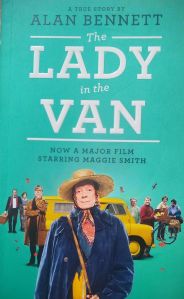 I saw the film version of this a few years ago which was pretty good, if a little odd. It was presented in a very peculiar way in that the author, Alan Bennett, is portrayed as two people, one as himself as he appears in the story and two, as himself as he writes the story. That oddity aside it was really a rather good and original film. When I heard there was a book version I quickly went to one my usual internet book stores and promptly bought it.
 Liz and I always visit a village fête at the weekend, usually those with a vide grenier or brocante attached. A vide grenier is just a car boot sale which we both love. I usually pick up connecting leads for my laptop or iPad, after all, you can never have enough electrical leads. Brocantes are more like flea markets or antique fairs. Just the kind of place to pick up those old telephones that I still love, especially those Bakelite ones.
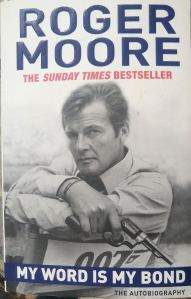 I picked this book up ages ago and thought it would be a good holiday read. I’ve always liked Roger Moore even though I absolutely hate his James Bond films. I love Moore’s self-deprecating humour, plenty of which is evident in this book. The first part of the book was really interesting and entertaining but like a lot of celebrity autobiographies, this one just gets a little tedious when Roger just seems to list the films and locations and other celebrities he seems to know. On the back of the book was a review claiming this to be the best film autobiography since David Niven’s
  Rooting around in a secondhand shop in St Annes recently I picked up a hardback copy of Winston Churchill’s book My Early Life. It’s a thoroughly wonderful book written in Churchill’s inimitable style. He says in the introduction he has written a book about a vanished age and indeed he has. Churchill was born in 1974 at Blenheim Palace in Oxfordshire. He was the son of Lord Randolph Churchill who was in turn the son of the 7th Duke of Marlborough. His mother was an American, Jennie Jerome, the daughter of an American businessman. She married Lord Randolph and became Lady Churchill.
 Looking back, I must have seen the film version before I read the book. Young Winston was directed by Richard Attenborough and is a wonderful adaptation of the book. When Winston first attends school, which of course was boarding school, his headmaster was played by Robert Hardy and he directs Winston to learn some Latin. Winston doesn’t do very well and the headmaster glares down at him and informs him that if he misbehaves, he will be punished, which to a great extent was Churchill’s overall view of school. Later he comments about exams ‘they always contrived to question me about things I didn’t know. I would much rather they asked me about things I did know.
 The charge was depicted in the film Young Winston and in his book Churchill ponders about fate and a problem with his shoulder which necessitated using his revolver rather than his sword during the charge, reflecting that if he had been using his sword he might well have been killed in the latter stages when he was surrounded by the enemy.
 One of things I particularly liked about Young Winston was the music. I bought the soundtrack album in 1985. The music for the film was in the main composed by Sir Alfred Ralston. He was brought into the film by director Attenborough as the two had worked together on a previous film, ‘Oh what a Lovely War’. The soundtrack features music by Edward Elgar, notably the Pomp and Circumstance March no 4 as well as Nimrod from the Enigma Variations.
 Churchill ended up in a POW camp but resolved to escape despite also claiming to the Boers that he was a correspondent and should not have been detained. With the help of a group of Lancashire miners, Winston stowed away on a goods train and made his way back to the British lines.
 Goldfinger is probably one of the best books in the Bond series and only the second 007 book that I ever read. (I’ll tell you about the first one later). I was at school at the time and for one of our assignments in English, we were asked to bring in a book which contained a really good description of a character. I chose Goldfinger as in it, Ian Fleming describes Goldfinger as a man who appeared to have been made using bits of other peoples’ bodies. This must have been in the mid-1960s and although the character of James Bond was pretty well known, the films had not begun to permeate down to the television screen.
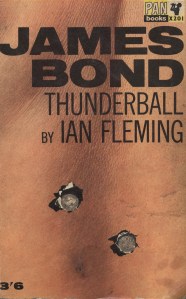 This is an interesting story and the resulting film has perhaps become the quintessential Bond film even more so than Goldfinger. The story is about a criminal underworld organisation (SPECTRE) that steals an aircraft with nuclear weapons and holds the west to ransom threatening to explode the bombs.
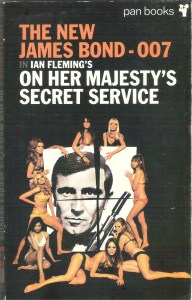 In this book the secret service find that Blofeld, the head of SPECTRE, is trying to assume the identity of the Comte Balthazar de Bleuville. Bond poses as Sir Hilary Bray of the College of Arms in order to meet with Blofeld. Interestingly, Sir Hilary gives Bond a quick resumé of Bond’s family history including the Bond family motto ‘the world is not enough’ which was used by the film producers for the title of a later 007 film unrelated to Fleming’s books.
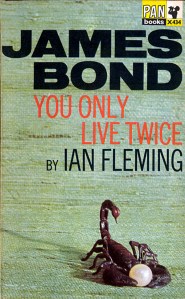 This book follows on from the previous one and we find James Bond depressed and disillusioned with his job after the death of Tracy. M considers sacking Bond but instead sends him on a diplomatic mission to meet the head of the Japanese secret service. The British want access to Russian documents which the Japanese are currently decoding. The Japanese decide to offer this information to Bond if he will assassinate a British resident who has created a garden of death, a garden full of poisonous plants which are attracting many Japanese citizens who want to commit suicide. Bond realises that this man is Blofeld and decides to keep this quiet until after he has killed him.
 Casino Royale is the first book in the 007 series and it’s a pretty interesting and original one too. ‘Le Chiffre’, a gambler and also a member of SMERSH, a murderous department of the KGB is engaged in a desperate effort to win a great deal of money at the casinos of Royale Les Eaux in France. Le Chiffre is desperate because he has used SMERSH funds for his personal use and his spymaster bosses will not be pleased if they find out. Britain’s secret service happens to find out about this and sends Bond to France to make sure Le Chiffre doesn’t recoup those funds as of course as we all know, James Bond 007 is a bit of an expert with the cards.
 This was the second Bond book to be published and the action takes place in the USA and the Caribbean, which Fleming loved and bought a house there which he named Goldeneye. Live and Let Die and in fact the whole book series were recently reissued with all the politically incorrect stuff removed which makes me wonder whether there was in fact anything left to publish after that process was complete. The book was published in 1953 and comes complete with all the prejudices and sexual and racial intolerances of the era. In one segment when Bond visits Harlem, Fleming tries to reproduces the accents and slang terms of the black people of Harlem and for me it’s not one of Fleming’s best books. In the film version, Roger Moore took over the licence to kill and the result was a very tongue in cheek version of James Bond. Sorry but Roger Moore as Bond just wasn’t for me. The film did feature a great theme song from Paul McCartney which was really a little underused in the film. Another feature of the film was a power boat chase along the Bayous of Florida which was a lot of fun but not entirely serious.
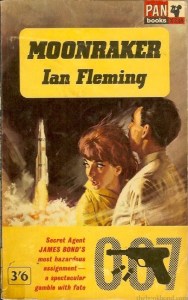 This was the third entry into the 007 series and the action takes place mostly in Dover. Millionaire Hugo Drax wants England to enter the space race and so he spends his own money on a rocket named the Moonraker which he intends to donate to the British government. It turns out that Drax is actually a nazi who wants to avenge defeat in the second world war by arranging for the rocket to destroy London. I read recently that Fleming wrote the book while staying in a cottage situated down by the famous chalk cliffs of Dover which was once owned by Noel Coward and later Fleming himself. It’s not a bad read at all and starts off with M asking Bond a favour as he suspects Drax to be cheating at cards and he wants Bond to see if he can sort things out as at the time, this was the mid-1950s, cheating at cards in London high society could really be a big scandal.
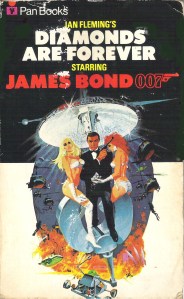 Fleming wrote this book at Goldeye, his house in Jamaica, after doing a great deal of research about diamond smuggling. Bond’s mission is to investigate a diamond smuggling ring and he does this by impersonating a diamond smuggler called Peter Franks. Franks leads Bond to an American woman called Tiffany Case who he begins to fall for. He tracks the smuggling ring to the American Spang brothers, leaders of the Spangled Mob, a criminal gang. The finale takes place in the Spangs’ restored western town, Spectreville.
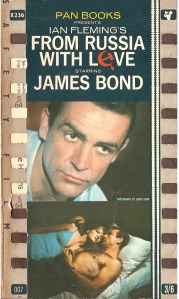 British Secret Service. To do this they persuade a cypher clerk, Tatiana Romanova, to pretend to defect to the west with a Spektor cypher machine. She claims she will only to defect to Bond, having fallen for him after reading his KGB file.
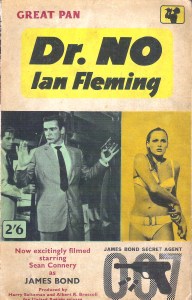 Prior to the writing of this book, a firearms expert called Major Boothroyd wrote to Fleming explaining that an agent like Bond would never be armed with a Baretta as it was more of a ladies gun. Boothroyd recommended a Walther PPK. Fleming was so impressed he included the new gun in Dr No and also added a new character named Boothroyd as the armourer of the secret service.
 A long time ago I decided that I would set myself the task of reading the entire Hamish Macbeth series of books. There are 34 books in the series, all written by author M.C. Beaton which is in fact a pen name for Marion Chesney. Marion actually wrote many books under various pseudonyms including Ann Fairfax, Jennie Tremaine, Helen Crampton, Charlotte Ward and Sarah Chester. After Marion’s death in 2019 further Hamish Macbeth novels have appeared penned by writer R.W. Green.
 I mentioned a while ago about my
  Forsyth did his national service in the RAF and was commissioned as an Acting Pilot Officer in 1956. After leaving the RAF he became a journalist working for the news agency Reuters and later he joined the BBC. He was the perfect choice for a foreign correspondent as he spoke numerous languages including French, German and Russian. In 1967 he was reporting on the war between Biafra and Nigeria when the BBC decided they were no longer interested in that particular war. Forsyth resigned from the BBC and continued to report on the war as a freelance. He even admitted later that this was when he was recruited by MI6 as an informant.
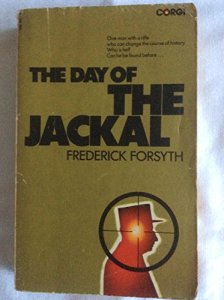 The Day of the Jackal
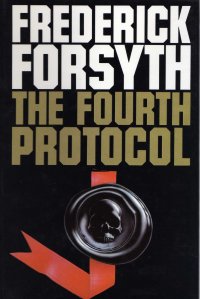 The Fourth Protocol
 John’s book was a great read. He started out working with Alan Bennett as a comedy writer and performer but when he realised that he probably had no future as a tv comedian he got himself a job as a newspaper reporter in Liverpool and later moved over to the BBC as a radio reporter.

 Essentially, John Darwin was facing bankruptcy after getting hugely overreached on a series of buy to let mortgages. He decided that the only way out was to fake his own death and cash in on some life insurance policies. His wife apparently tried to talk him out of the idea but John, a dominating and overpowering personality, went ahead and faked his own death. Amazingly he even went back to live with his wife, sometimes having to retreat to the bedsits next door when any friends or family came to visit. He arranged a false passport using a method explained in the book ‘Day of the Jackal’ by Frederick Forsyth and then the two, Darwin and his wife, planned to buy property in Panama and live a new life. Later, Darwin decided he wanted to return to the UK under his own name by posing as someone who had suffered with amnesia and in fact one day he disposed of his fake passport, walked into a police station and told them ‘I’ve lost my memory!’
 For me, who has been interested in the JFK assassination since at least 1968 when his brother, Robert Kennedy was also murdered and I was 12 years old, it’s a fascinating record. Others might think perhaps that the author has spread his research too far, that we are not interested in what the President’s pilot thought or did or how the honour guard prepared for the President’s funeral and how the President’s sister or brother-in-law reacted.
 Marlene was one of those people perhaps born at the wrong time. Today might be a better time for her when lifestyles of gay and lesbian people are not so much of an issue.
 The story of the Titanic, the ship that hit an iceberg and sank in 1912, is one of those stories which seems to be forever in the news. It’s a story that has caught the imagination of pretty much everyone. Even the other day, just scrolling through the BBC news page, I came across an item about some new digital scan of the Titanic wreck which revealed new information about the disaster.
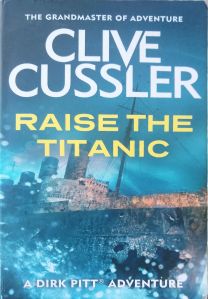 This was a film produced by TV mogul Lew Grade who was wanting to move his TV production company ITC Entertainment into the world of cinema. He had read the original book and thought that it might be possible to make a film series about US government operative Dirk Pitt in the manner of the Bond series.
 I only have one book in my collection about the Titanic. It’s a big glossy picture book, not about the actual ship, but about the shooting of James Cameron’s film. It documents Cameron’s twelve dives in a tiny submersible which gave him the idea of the treasure hunters looking to find the necklace the ‘Heart of the Ocean’ and his realisation as Cameron himself mentions in the book’s foreword that the main thrust of the story should be a love story with the Titanic disaster almost as a backdrop.

