 Once again Liz and I are on holiday in France and as usual I’ve filled up my book bag with books to read. My selection this year was a mix of new books and some books from my collection which I haven’t read for years. The one I’d like to focus on this week is Random Harvest by one of my favourite writers, James Hilton.
Hilton hailed from Leigh in Lancashire, now Greater Manchester. He wrote several books and made his way to Hollywood, California where he worked as a screenwriter. He died in 1954. Searching through a box of my old books I came across Random Harvest, a book I don’t think I have ever read before. I bought it from a second hand book shop along with Goodbye Mr Chips, possibly Hilton’s most famous novel and one I have read before. I can imagine intending to read it but moving on to something else and the book was boxed up in one of numerous house moves before I had a chance to get to it.
The Film
The film version starred Ronald Colman and Greer Garson in the leading roles. The film opens with a man called Smith wandering out of an asylum on a day when there is much excitement. It is Armistice Day, 1918 and ‘Smithy’ is a man who has lost his memory during the fighting in the First World War. He wanders down to the town of Melbury and in a tobacco shop the shopkeeper realises Smithy is from the asylum. When she disappears into the back of the shop a woman played by Greer Garson explains that the shopkeeper has gone to call the asylum so that he if wants to avoid going back he must get away. The woman, Paula, befriends Smithy and hides him away and soon she finds she is falling for him. The two elope together, find a quiet village in which to settle down and get married.
Smithy, who has no memory of his former life begins to write and soon has a story accepted by a newspaper in Liverpool. He takes the train there for an interview with the editor but on a wet afternoon, slips in the road and is hit by a taxi. He is knocked unconscious and when he awakes his memory has returned but he has no memory of his time as Smithy. How did he get to Liverpool? What door to what house fits the key found in his pocket? A policeman asks his name and he replies ‘Charles Rainier’. Gathering his things he sets off to take the train home to his country estate but arrives just as his father has passed away. The family has gathered and they are all surprised but glad to see Charles who later goes on to take charge and rescue the failing family business.
The final part of the film sees Charles happy as a new Conservative MP and successful businessman but also sad that a part of his life has been lost to him. He makes various attempts to find his former life but all end in failure until one night when a strike breaks out at the Melbury factory and he has to go there to sort things out. As he walks into Melbury he comes to the tobacco shop he once entered as ‘Smithy’ and things begin to come back to him.
Colman and Greer Garson play their parts wonderfully well. The film is perhaps a little sentimental for modern viewers but it is one of those films I saw as a child and have always remembered. Reviewers at the time were not impressed but even so, the film was nominated for 7 Oscars and it was MGM’s biggest hit of 1942.
The Book
 The book tells the story in an entirely different way. It begins with a chance encounter on a train with Rainier and a young man who is looking for work. The two strike up a sort of friendship and Rainier invites the young man to work for him, He explains that he was in the war, was injured and woke up in a German hospital with loss of memory. He was repatriated through Switzerland but got his memory back after a fall and a collision with a taxi in Liverpool. The time between his earlier life and waking up in Liverpool is a blank. The young man becomes Rainier’s assistant and the two sometimes talk late into the night discussing what might have happened. Later in the book, Rainier is called to intervene at a dispute at the Melbury factory and his memory begins to return. He asks a local taxi driver about the hospital. The man asks does he mean the new or the old one? Rainier thinks the old one and goes on to describe it. ‘That doesn’t sound like either of them,’ answers the man but adds, ‘would you be meaning the asylum sir?’
The book is a really interesting read and being written in the years before the second world war, gives the reader a little insight into the feelings of that time, a dissatisfaction with the League of Nations, a feeling that perhaps the First World War could have been settled sooner or even that the allies might have gone on to Berlin and perhaps parcelled up Germany into a smaller nation.
The climax of the book is Charles’ reunion with Paula who turns out to be his wife and former secretary so we find that Charles and Smithy married the same girl which worked well in the book but of course had to be told differently in the film.
Which did I enjoy more? Well I loved both works but to be fair I’ve always loved the film version and as much as I love James Hilton, I think I prefer the film. It isn’t often seen on TV and not long ago I managed to copy my VHS version to DVD but I did notice that a restored DVD version was released in 2005 which I must look out for.
 One of my unofficial New Year’s resolutions this year was to try and declutter, perhaps actually get rid of some of my huge DVD collection. It’s not always that easy though. Mooching around one of those cheap secondhand shops recently I picked up yet another DVD. I’ll tell you about it in more detail later but it was one of the many films made about Robin Hood and his Merry Men.
 Back in the 1970s my Saturday ritual involved getting the bus into town and scouring book and record shops for, yes, you’ve guessed it, books and records. One day back then I was flipping through the posters in one particular shop. The posters were the music stars of the 70s; Elton John, Mick Jagger, Suzi Quatro, David Bowie and so on but one was a picture of a really good looking guy with a fifties combed back hair style. In some pictures he was dressed like a cowboy and in others in a red jacket and denim jeans. The guy behind the counter must have seen me wondering who the guy was and he told me he was a film star called James Dean. He handed me a paperback book about the actor and I took it home and read it and very soon I was trying to find out everything I could about him.
 The paperback book I bought that day in the record shop in the 1970’s was probably James Dean: A Short Life by Venable Herndon. It wasn’t a great book but an interesting introduction to Dean and who he was. It detailed his struggle for acting roles, TV work in New York, his apartment at 19 West Sixty-Eighth Street, his three films, his doomed affair with Pier Angeli and of course his death.
 Another book I picked up only recently was another picture album James Dean: Portrait of Cool edited by Leith Adams and Keith Burns. It’s an album of photographs found in the Warner Bros archive and some have not been published before. Included are all sorts of documents such as casting sheets, production notes and messages. Dean’s address is listed as 3908 West Olive Avenue which I think might have been a place he shared with Dick Davalos who played his brother in East of Eden. During Rebel Without a Cause, Dean was listed as living at 1541 Sunset Plaza Drive.

 It’s a long time since I’ve made a video for my YouTube channel and recently I’ve been trying to think about what my next project should be. When I’m stuck for a video I tend to tweak or even remake some of the short videos I use on social media to promote this page and my two books. In fact my YouTube page is made up of quite a lot of videos like that as well as numerous short video versions of my poems. Every now and again I try and put something different together. I usually make a video about our yearly trips to France in our motorhome and I’ve made a few videos about Manchester, my home town and also the place where my book Floating in Space is set.
 Most of Mersey Square, the square at the very centre of Stockport, was fenced off while the builders worked on the new bus station. A huge railway viaduct spans the centre of Stockport and the bus station or bus interchange as they are now calling it is mostly on one side of the viaduct with part of it spilling over onto the other side. Someone told me it was due to open in two weeks time but looking around, that seemed to be a pretty tall order.
 I walked round to the other side of the bus depot and there opposite, what used to be the main exit for our buses, was the Comfortable Gill. The Comfy, as we affectionately called it, was the pub where we busmen used to drink after the day’s shift was over. At one time if a driver was due to finish after last orders at 11, the landlord used to accept telephone orders for a pint so sometimes we could pull in at 11:20, park the bus in the depot and then pop over to the Comfy to find a pint waiting for us to sup while we cashed up our day’s takings. When I saw it the other day the Comfy was all closed up and looked neglected. So many of Britain’s pubs have closed down and I walked away hoping that the Comfy might be saved in the near future.
 Four Weddings and a Funeral
 I’m not sure which came first for me, the book or the film but I actually think it was the book. The Godfather was written by Mario Puzo and is the story of Don Vito Corleone, the head of one of the five mafia families of New York. The book opens with the wedding of Don Corleone’s daughter and Puzo sets the scene and introduces the various characters.
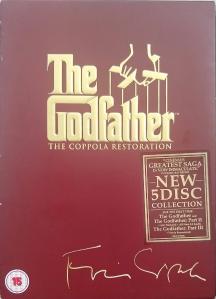 Francis Ford Coppola was the director of the film version and was also the co-writer of the screenplay along with Mario Puzo. Coppola wanted Marlon Brando to play the part of Don Corleone even though Brando at the time was rather unpopular with the producers. He was expensive, his last few films had not done well and his time wasting attitude had added huge expenses to his pictures. After the director had made the producers understand how important Brando was, they set various conditions for his employment. He would have to work for a reduced salary and put up a bond to ensure he would not delay the production. Another was that he had to have a screen test. Coppola has told the story in various interviews how he and his film crew had entered Brando’s house like ninjas and quietly set up their equipment. Brando slicked down his hair with shoe polish and stuffed cotton balls into his mouth to make the transformation into the aging mafia boss.
 Coppola decided that instead of finding the horse at the end of his bed like in the book, it would be better if Woltz awoke, was disturbed by something wet, pulls the bedclothes away to see blood and then uncovers the horse’s head. The head was the actual head of a horse, procured from a dog meat factory and Coppola mentions on the commentary to my DVD version that lots of animal lovers sent him hate mail about the horse, even though the horse had been condemned to its fate anyway.
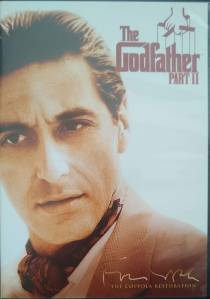 As previously mentioned, the book does have some storylines which were not used in the film but one chapter was a look at the beginnings of Vito Corleone. Born Vito Andolini in the Sicilian village of Corleone, Vito’s father was murdered by a local mafia boss and the young Vito was smuggled away to America. In America he took the name of Corleone and seemed to slip quietly into the role of mafia Don by murdering Fanucci, a New York Sicilian Godfather who preyed on his fellow Italians. Although this element of the story wasn’t used, Coppola kept the storyline for use in The Godfather Part II. The follow up film was a film classic in its own way.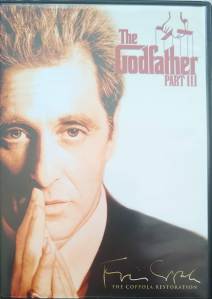



 Ida Lupino, like Roddy MacDowell, was born in England, in fact both lived in the Herne Hill area of London. She wanted to be a writer rather than an actress but went into acting as she was part of a theatrical family and it seems that becoming an actor was expected of her. She appeared in many British films before moving to the USA in 1933.
 Myrna studied dance in Los Angeles. She had small parts in many silent pictures but some stills of her appeared in Motion Picture magazine and led to a contract with Warner Bros.
 Letters from an Unknown Author!