My Early Life: The Book, the Film and the Soundtrack Album

I first read My Early Life by Winston Churchill many years ago. I picked up a paperback copy which tied in with the release of the film version and also along the way I got hold of the soundtrack album and later a VHS copy of the film. In this week’s blog I thought I’d take a closer look at all three.

Rooting around in a secondhand shop in St Annes recently I picked up a hardback copy of Winston Churchill’s book My Early Life. It’s a thoroughly wonderful book written in Churchill’s inimitable style. He says in the introduction he has written a book about a vanished age and indeed he has. Churchill was born in 1974 at Blenheim Palace in Oxfordshire. He was the son of Lord Randolph Churchill who was in turn the son of the 7th Duke of Marlborough. His mother was an American, Jennie Jerome, the daughter of an American businessman. She married Lord Randolph and became Lady Churchill.

Lady Churchill was a great influence on his life although in his very early years young Winston looked to his nanny, Mrs Everest, for motherly support. His father, Lord Randolph, was someone whom Winston loved and adored but never seemed to become close to. After the birth of Winston, Randolph began to suffer a debilitating disease which could have been syphilis. Others have speculated it was a brain tumour. Either way, Randolph died in 1894.

Looking back, I must have seen the film version before I read the book. Young Winston was directed by Richard Attenborough and is a wonderful adaptation of the book. When Winston first attends school, which of course was boarding school, his headmaster was played by Robert Hardy and he directs Winston to learn some Latin. Winston doesn’t do very well and the headmaster glares down at him and informs him that if he misbehaves, he will be punished, which to a great extent was Churchill’s overall view of school. Later he comments about exams ‘they always contrived to question me about things I didn’t know. I would much rather they asked me about things I did know.

In the book Winston records his schooldays with a great deal of charm and humour. He goes on to attend Harrow and as he intends to join the army goes to special army classes.  Winston seems to have enjoyed his army training and was keen to see action. He took leave with a friend and went to observe events in Cuba where revolutionaries were fighting their Spanish colonial rulers.

Winston was a second lieutenant in the 4th Hussars and spent a long time in India. He was a great lover of polo and he and his colleagues won an inter service championship in their first year in the country, a feat never achieved before by a recently arrived regiment.

Churchill was keen, as I said before, to see action and joined Bindon Blood’s Malakand Field Force and later wrote a book about the campaign. The book was popular and Churchill even received a letter of praise from the Prince of Wales. Because of his mother and father, Churchill was well connected in both political and aristocratic circles and later used his contacts and those of his mother to attach himself to General Kitchener’s campaign in the Sudan. He was part of one of the British Army’s very last cavalry charges in the battle of Omdurman in 1898.

The charge was depicted in the film Young Winston and in his book Churchill ponders about fate and a problem with his shoulder which necessitated using his revolver rather than his sword during the charge, reflecting that if he had been using his sword he might well have been killed in the latter stages when he was surrounded by the enemy.

He ponders many times too about war in the Victorian age. How it was honourable and respectable. He mentions how officers would stop for lunch before a battle and how casualties, which were sometimes considered heavy, were nothing like the heavy casualties suffered in the later world war. If technology had taken away the honour of war in 1914, how would Churchill react to war in 2025 I wonder?

The Victorian age was an age of courtesy and respect and one of my favourite stories in the book occurs when Winston was at Sandhurst. It was the custom then, if an officer wanted leave for a few hours, to sign a book and declare himself absent. One day when visiting friends Winston passed his commanding officer Major Ball, a very strict and formal officer, on the road and realised he had forgotten to sign himself out. He cut short his visit, returned to Sandhurst hoping to add his name before the Major checked the book. Sadly, he found Major Ball’s signature at the end of the page. Would he be disciplined thought Winston? What would his punishment be? Looking further up the list Winston was surprised to find that his name had been added and countersigned by none other than Major Ball himself. Winston writes that this was a clear indication of how discipline could be maintained among officers without departing from the courteous and respectful standards of the time.

Having failed to become an MP for the Oldham constituency he went to South Africa to report on the Boer war as a correspondent. He travelled on an armoured train which was attacked by the Boers and he was captured and imprisoned in a POW camp.

One of things I particularly liked about Young Winston was the music. I bought the soundtrack album in 1985. The music for the film was in the main composed by Sir Alfred Ralston. He was brought into the film by director Attenborough as the two had worked together on a previous film, ‘Oh what a Lovely War’. The soundtrack features music by Edward Elgar, notably the Pomp and Circumstance March no 4 as well as Nimrod from the Enigma Variations.

According to the sleeve notes, the pistol used by Simon Ward who played Winston in the film was Churchill’s actual Mauser and it can be seen pretty well during a sequence when Churchill travels to south Africa to report on the Boer war as a newspaper correspondent. He travels with a unit who undertake a recce on an armoured train only to find the train attacked by the Boers on their return journey. Winston played a big part in helping remove a wrecked train from the line only for himself to not only be captured but also to lose his pistol. The pistol was returned to him in later years.

Churchill ended up in a POW camp but resolved to escape despite also claiming to the Boers that he was a correspondent and should not have been detained. With the help of a group of Lancashire miners, Winston stowed away on a goods train and made his way back to the British lines.

The incident made him famous back in the UK and when he next ran for parliament in Oldham, he was duly elected. The tone of the book becomes more serious towards the final pages but overall this is an outstanding read by one of this country’s greatest sons.

The film version was almost just as good. Simon Ward gives us an admirable picture of the young Winston with just the right hint of the great man’s later style and speaking voice.

I first saw this film at the cinema where I greatly enjoyed it and I remember it coming to television some years later. The film finishes with a poignant dream sequence which, I remember reading somewhere, was based on something Churchill either said or wrote. In the dream, a much older Winston meets his father but he is not the unwell man of his later years but restored to full health. Randolph asks Winston about great events and Churchill answers telling of the two World Wars. ‘Did Joe Chamberlain ever become Prime Minister?’ asks Randolph. ‘No’ answers Winston, ‘but one of his sons did, Neville’.

Winston mentions that he has resigned his commission in the army. Randolph looks about at the many paintings and asks Winston if this is what he does. Winston answers that painting occupies much of his time. Randolph thinks for a moment and then tells Winston to ‘do the best you can’ and we see the sleeping Churchill smile at the thought.

I’ve always liked this final sequence but when I bought my VHS copy the scene was omitted. Likewise, every time I have since seen the film on television, this scene has always been removed. I’d love to know why. Perhaps the producers thought the film too long or perhaps preferred the new ending in which Winston talks briefly in a voiceover about his marriage and living ‘happily ever after’. After a search on the internet I came across a post which claimed that Carl Foreman, who wrote and produced the film, found that US audiences occasioned so little reaction to the scene that he promptly had it cut. What reaction was he expecting to see I wonder?

Perhaps it’s time for a search on eBay. I’m sure that somewhere there must be a definitive DVD version of the film and if you ever get the chance, give the book a read, it’s one of my absolute favourites.


What to do next: Here are a few options.

Share this post on your favourite social media!

Hit the Subscribe button. Never miss another post!

Listen to my podcast Click here.

Buy the book! Click here to purchase my new poetry collection.

Click here to visit Amazon and download Floating in Space to your Kindle or order the paperback version.

Click here to visit amazon and purchase Timeline, my new anthology.

January, Don’t You Just Hate It?

I might as well start off this post by coming out and saying what I think straight off the bat; I don’t like January. I don’t like it at all because the thing is, I just hate the cold. I reckon it would be rather nice to just hibernate for the entire winter period just like many creatures do.

I’m not that keen on Christmas so maybe late November would be a good time to just settle down somewhere warm and comfy, snuggle up into my duvet and perhaps wake up round about late March. I know that March can be unpredictable in terms of the weather. It’s generally windy and cold but certainly not as cold as January. Waking up in March would give me time to get my bearings before moving into April, my favourite time of year when the days are getting longer, nature is starting to revive and warmer days are coming.

January 1970

Recently while pottering about trying to sort out the tons of ‘stuff’ I seem to have accumulated over the years I came across my schoolboy diary from 1970. As this post will be published on the 18th of January, I thought I’d take a look and see what I had written. Back in 1970 the 18th was a Sunday and all I decided to record was “Watched Captains Courageous and Randall and Hopkirk”.

Randall and Hopkirk was a TV show first broadcast in 1969 through until March 1970. It was an action and adventure drama despite the slightly tongue in cheek premise. Randall and Hopkirk are private investigators but Randall is helped by his partner Marty Hopkirk who is murdered in the first episode but comes back as a ghost to help his partner find his murderer. Marty stays on and continues to help Jeff Randall for the entire series of 26 episodes. It was later remade with comedians Vic Reeves and Bob Mortimer in 2000. Personally, I prefer the original.

Captain Courageous was a film starring Spencer Tracy based on a book by Rudyard Kipling. The story follows the adventures of spoiled brat Harvey Cheyne Junior, the son of a railway tycoon. Harvey falls overboard from his father’s yacht and is saved from drowning by Portuguese fisherman Manuel Fidello played by Tracy. The boy demands to be returned home but the fishing vessel is on a three month fishing expedition and will not return early. The captain offers to sign Harvey on as a crewman until they return and under the tutorship of Manuel he begins to learn about fishing. Harvey becomes close to Manuel and is devasted when he is drowned. Returning home, he is reunited with his father as a changed person.

January 1649

This week I watched an interesting documentary about Charles the 1st. Back in January 1649 parliament was deliberating about what to do with Charles who had been defeated by the Parliamentarians. The parliament was known as the ‘rump’ parliament because any MP who was suspected of supporting the king was prevented from entering. Parliament voted to put the King on trial but the upper house, the Lords, declined to support this and then promptly gave themselves a holiday. Parliament then went ahead without the Lords.

King Charles was put to death on the 30th January, 1649.

January 1965

Another great British leader died in January 1965, Sir Winston Churchill. Churchill was an army officer, an MP, an author and a Prime Minister. Nothing I can write in a short post, even one dedicated fully to his life can do justice to this great man’s many achievements but let’s have a go. Churchill was born at Blenheim Palace on November 30th 1874. His father was Lord Randolph Churchill, his mother Lady Randolph was formerly Jennie Jerome from the USA, the daughter of Leonard Jerome, an American businessman.

Churchill began his military career with the 4th Hussars but later left to become a politician. He failed to be elected as MP for Oldham then went to South Africa to serve as a journalist. He was captured by the Boers and later escaped which brought him much publicity which must have helped him when he stood again as a Conservative candidate for Oldham in the 1900 general election. This time he emerged as the victor. Later Churchill became a Liberal and later still moved back to the Conservatives. The years between 1929 and 1939 became Winston’s Wilderness years when he was out of office but began to warn against the rise of the Nazis. On the 13th December he was visiting New York when he was knocked down by a car which incidentally inspired my story Timeline, the title story of my new book.

Churchill’s warnings about Nazi Germany proved correct and with the outbreak of war in 1939 he returned as a government minister and later succeeded Chamberlain as Prime Minister when Chamberlain was forced to resign as the Labour party declined to serve in a national government headed by him.

As well as serving as a politician, Churchill wrote many books and one, My Early Life, was made into a film, Young Winston. I’ve always loved that film but it annoys me no end when I see it on TV these days as for some reason a final scene in which Churchill falls asleep and dreams of meeting his late father, is cut out.

January 2003

Looking at my diary for 2003 I see I was suffering with a sore neck that January. I was off sick from work and my boss was not happy. While off sick I had written a screenplay and wasn’t sure what to do with it. I was living in Merseyside at the time so decided to send it to Phil Redmond, the producer of the Liverpool soap Brookside, thinking that he might like it enough to either give me some advice or even a job on the writing team. I had sent it with a self-addressed return envelope and guess what, I received it back in the post only a few days later minus any sort of feedback or a job offer.

January 1986

In January 1986 the spacecraft Challenger was ready to be launched into space. It was a unique mission in that school teacher Christa McAuliffe had been selected to broadcast lessons from space. The flight was the 25th shuttle mission and the 10th flight for Challenger itself. The mission was originally scheduled for July but the date was put further and further back until NASA finally decided on the 28th January. The temperature of -8 degrees was a record low for a shuttle launch and many engineers were unhappy. Their cause for concern was the shuttle’s O ring seal in a joint between the shuttle and the solid rocket boosters. In cold temperatures it was thought that the rubber rings might not be flexible enough to seal the joints. Sadly they were correct. Hot pressurised gas was released which burned into the external propellant tank which then exploded 73 seconds into the flight. All the astronauts were killed.

January 2025

To finish on a somewhat lighter note, today as I write this I was in Manchester. I decided I needed a few items of shopping so I walked into the nearby civic centre. It was still pretty cold despite the melting snow so I wrapped up well.  I had a woolly jumper on, my anorak and a baseball cap and gloves. Happily, it wasn’t quite as cool as I had originally thought. At the civic I popped into the cheap bookshop there but after a few minutes I realised that it was far too hot and I had to get out. Instead of walking further to Asda, I popped into the Iceland store a few hundred yards away from the book shop. After about 5 minutes I realised that in there too, the management had for some reason decided to crank the heating up to a level usually experienced in a Sahara Desert heatwave.

I grabbed the few things I wanted then headed for the till. Sweat was running down my face but there were two people at the till, both with enough shopping to last the entire winter. I opened my jacket and then heard some wonderful words, “can you come this way please?” Yes, a new till was opening up and me with my 4 or 5 items was through and soon out into the open air.

January, don’t you just hate it?


What to do next: Here are a few options.

Share this post on your favourite social media!

Hit the Subscribe button. Never miss another post!

Listen to my podcast Click here.

Buy the book! Click here to purchase my new poetry collection.

Click here to visit Amazon and download Floating in Space to your Kindle or order the paperback version.

Click here to visit amazon and purchase Timeline, my new anthology.

Things to do During a Pandemic (Part 2)

Some people are born to do certain things. Winston Churchill was a born leader, and Clark Gable was born to play Rhett Butler in Gone with the Wind. As for me, I was born to watch TV. My old dad used to call me ‘square eyes’ because I was glued to the television, or so it seemed to him.

During this unprecedented time -I had to use that phrase because I keep hearing it so much on TV- there is not much to do in one’s own home. Those lovely few warm days have slipped away leaving us in the northern UK a little chilly. The sun is hidden behind grey clouds and it is cold so no barbecues, no more reading out on the lawn.

I’ve have done a little reading and writing and put together a few revised videos for my various internet pages, but mostly I’ve been sipping red wine and watching TV. Some of it has been good, some of it not so good. Anyway, here’s a quick look at what I’ve been watching on TV this week . . .

Young Winston.

I’m not a great fan of director Richard Attenborough but to my mind he has made two really good films: Chaplin and Young Winston. I remember seeing Young Winston at the cinema back in the seventies. Simon Ward plays the part of young Winston Churchill and he plays a good part. He even comes across with a fair approximation of Churchill’s voice, both in his portrayal and also in the many voice overs. The book is based on Winston’s own book My Early Life. I read it many years ago and it was a wonderful read as I remember and this film is a particularly good version of it.

The film tells the story of young Winston Churchill, the son of Lord Randolph, who adores his father who sadly dies young, spoiling Winston’s dreams of working with him in Parliament. The film flips backwards and forwards in time showing Winston’s first day at school and then his exploits in the army. Winston failed to get elected as the Tory candidate for Oldham but later, after making a name for himself as an army officer, correspondent and author, he returns victorious after escaping from a Boer POW camp and finally enters Parliament.

Various familiar names play their parts beautifully including Anne Bancroft as Winston’s American mother, Robert Shaw as Lord Randolph Churchill and many others in smaller roles; Robert Hardy as a prep’ school headmaster and Jack Hawkins as the headmaster of Harrow.

Randolph died at the early age of 45 apparently from syphilis although others have suggested his illness may have been a brain tumour.

This was a wonderful film, beautifully photographed and put together from a script by producer Carl Foreman. What is rather sad is that when I first saw this film there was a scene at the end where the older Churchill falls asleep and dreams of meeting his father who appears free from illness. The scene was based on a short story Churchill wrote in 1947 but for some reason that scene has been dropped from TV and DVD versions of the film which is a great shame.

Bridget Jones’ Baby.

Another film I’ve seen during the lockdown was Bridget Jones’ Baby. The film was based on the book by Helen Fielding and I have to say, I was surprised to hear the TV announcer warning me of some ‘highly offensive language’ used in the film. Bridget Jones? Offensive? Really? Yes really! Even a scene with a child swearing. OK I do swear myself now and again but some of the language in this film was actually just as the announcer suggested and was highly offensive. The other thing was that most of the actors looked really old, really haggard. Now this may have been that we were watching on our new smart TV and the picture quality is just so good these days that it can appear daunting. Sometimes, when Liz and I are at our local pub quiz, Liz will ask why am I watching the TV when its tuned to Sky Sports news? Well, a lot of the time I am just amazed that I can see some football pundit’s pores or some hair that has escaped his razor. Still, the original film in the Bridget Jones series was made in 2001 while Baby was from 2016 some fifteen years later.

Film tends to freeze an actor in time and when you see them on TV talk shows plugging their new film it can be surprising to see just how old an actor has become. A while back I was watching Tom Hanks on Graham Norton and he had grey hair! Tom Hanks? Of course, not long prior to that, I had watched Apollo 13 which was made in 1995, 25 years ago!

Bridget Jones’ Baby finally settled down but I wasn’t totally impressed.

Storyville.

BBC Four have been showing a documentary about OJ Simpson recently. I missed the first few episodes but thank heaven for catch-up TV. The documentary is in 5 parts and won an Oscar for best documentary. Episode one details Simpson’s incredible sporting career and also showed how it was important for him to be seen just as OJ rather than OJ the black athlete. He was apparently a friendly and amiable man who made many friends in the sporting world and kept himself well away from controversy and was never involved in the civil rights movement in America unlike sporting celebrities like Mohammed Ali. Later episodes show how he made a life after sport by becoming a TV sports pundit and by courting wealthy friends in Los Angeles to advise on his investments. In particular he made TV advertisements for Hertz car rentals which were highly popular and did well not only for Hertz but raised Simpson’s profile in the USA even higher.

The series also looks at the climate of race relations in Los Angeles and the activities and methods of the LAPD who clearly were not engaging or even trying to engage with the black community. A ‘them and us’ situation evolved in LA and when Rodney King, a black motorist was brutally beaten by a group of white police officers the situation become even more inflamed. The officers were taken to court but found innocent by a white jury causing riots and disturbances in the area.  This was the background of the later OJ Simpson murder trial.

Simpson divorced his wife and married eighteen year old Nicole Brown, a blonde LA waitress. Their marriage lasted seven years and was not happy, especially in the latter years when Nicole was beaten and abused by Simpson. She called the police numerous times reporting OJ for assault. On June 13th, 1994, Nicole and a waiter named Ron Goldman were found dead. A trail of blood led away from the scene and later blood was found on Simpson’s white Ford Bronco.

Simpson was not as famous in the UK as in America but I do remember seeing the crazy car chase on TV with Simpson in his white Bronco followed by a fleet of Police cars. I have to say that this series has completely gripped me so far and the portrait of Simpson himself and the racial climate in Los Angeles and the attitude of the police is compelling. If you are interested you can still find the episodes on the BBC I-player, at least you could when I wrote this a few days ago. When I tuned in to watch the final episode it was not available! 

Rocketman.

As we are cooped up at home for the duration, why not watch a good film on pay per view? It just so happens that Liz renewed her Sky sunscription recently so we were entitled to a free film. OK, settle back, pop corn at the ready, red wine poured, here we go.

Rocketman was an enjoyable film, well mostly. In parts it was a cross between a music video and a Hollywood musical featuring, of course, Elton John’s music. The first part of the film was very good while the second part seemed to just go on a little too much about Elton’s addiction to alcohol and drugs. Elton’s songs were all presented in an interesting way, some pretty much as we have heard Elton perform them in the past, others in a sort of musical fantasy production number way. I enjoyed all of them.

Elton’s relationship with lyricist Bernie Taupin was shown to be much closer than I realised; Elton, in the film, thinking of Bernie as the brother he never had. Elton’s father doesn’t come over as such a nice character and one sad moment was when Elton was reunited with him and found him to be much closer to his new sons in his new marriage than he ever was with him. Come to think of it, his mother doesn’t come out of the film as being a great mum either whereas before I always thought Elton and his mother were close.  The family member who always believed in him according to this film was his gran. Anyway, even if you don’t like the film itself the rest of the time it’s pretty much like listening to Elton’s Greatest hits, so if Elton’s music does it for you then you should like it.


What to do next:

Share this post on your favourite social media!

Hit the Subscribe button. Never miss another post!

Buy the book! Click here to visit Amazon and download Floating in Space to your Kindle today!


Four Writers’ Homes

Clouds Hill

TE Lawrence’s home was a small cottage called Clouds Hill. I read somewhere recently that the house had now been refurbished and open to the public. It is a small place and I remember seeing a TV documentary about Lawrence where someone who visited in the past advised that guests were generally left to their own devices, that food was eaten from tins left in the cupboard and that a lot of classical music was played.
Lawrence of course was more popularly known as Lawrence of Arabia, the man who organised the Arab revolt during the First World War. As the feature film by David Lean tells us, Lawrence was dismayed by having to lie to the Arab people, telling them that Great Britain would honour their claims for freedom at the end of the conflict when in fact the UK had every intention of holding on firmly to the Arab lands.

Churchill was impressed by Lawrence and invited him to attend the Paris peace talks.

Lawrence later wrote his classic book, Seven Pillars of Wisdom upon which the film Lawrence of Arabia was based.

A number of elements of the book have interested scholars ever since. The book is a work of history but also a great work of literature and readers have wondered ever since about whether the work was accurate, especially as in one infamous chapter, Lawrence relates how he was captured and beaten by a sadistic Turkish officer.

In that same TV documentary, Lawrence’s brother addresses the camera and sheepishly tells the viewer that not many people can understand how someone can enjoy pain. That was in response to a 1960’s newspaper report about a man who claimed Lawrence paid him to be beaten regularly. Clearly Lawrence was a complicated man. In later life he hid from the public by using the names John Ross and later T E Shaw. He was fatally injured in 1935 after a motorcycle accident.

After a little research I find that the property is now owned by the national trust and is open regularly for visitors. Find out more at https://www.nationaltrust.org.uk/clouds-hill

Chartwell

Nothing that I can add to the mountains of books and articles written about Winston Churchill can make much of a difference, but anyway, here we go. Can there ever have been someone who was not only a great politician but also a great writer and also one of the giants of history? I have always felt a tiny spark of excitement when even now I read Churchill’s words on when he attained the premiership in the dark early days of World War II. ‘I felt,’ he wrote ‘as if I was walking with destiny.’

The amazing thing is that only a few years previously Churchill was a has been, a man written off as a former chancellor who had crossed the floor of the house once too often and now was distrusted by everyone.

As it happened, his dire warnings about Nazi Germany and the impending war made him the obvious choice to succeed Neville Chamberlain, whose policies of appeasement had perhaps led Britain towards the path of war.

Churchill’s home, Chartwell had been bought largely from the proceeds of his books. Indeed he was fond of commenting ‘all this, came from my pen.’

During the time of his so called wilderness years he spent a lot of time at Chartwell and even built some of the walls there with his own hands. He painted there and prior to World War II many informants came to him to reveal information with which he used to call attention to the tragic state of unreadiness of the UK for war.

This is also a national trust property. You can find more about visiting Chartwell here: https://www.nationaltrust.org.uk/chartwell

The Boathouse

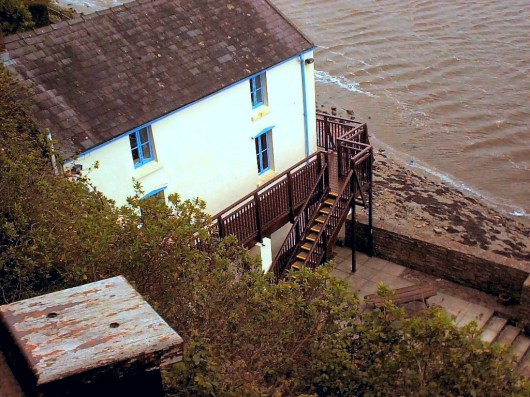
It’s a long time since I visited Dylan Thomas’ house in Wales. The house is in the village of Laugharne and is not far from one of his famous watering holes, the Brown’s Hotel which I’m pretty sure was bought by one of the comedians from TV’s Men Behaving Badly.

The boathouse was bought by a trust some years ago which saved the property from collapsing into the sea. It’s a lovely place and on the day I visited, we had to leave early although I can’t remember why. I came back the next day and the staff remembered I had left early previously and let me in for free. I wandered about Dylan’s old house and sucked in the atmosphere before buying various books and pamphlets about Dylan and his works.

In another old TV documentary I tend to watch now and again, the presenter, a poet himself, thought he could imagine the conversations of Dylan and his wife, the chit chatting, the arguing and the making up later, or so he supposed.

I took a primitive digital camera with me and took a few shots of the house and Dylan’s famous writing shed. I read somewhere recently that the shed has now been removed and taken to a museum with a duplicate shed now occupying the site.

I enjoyed my visit and Dylan’s own poem always makes me think of it:

In the mustardseed sun,
By full tilt river and switchback sea
Where the cormorants scud,
In his house on stilts high among beaks
And palavers of birds . . .

Click the following link for more information on the boathouse: https://www.dylanthomasboathouse.com/

Mendips.

Lennon is a different kind of writer of course. He did publish a couple of books of his doodlings, one was called In his own Write if I remember correctly but mostly his creative urge went towards his music. Early on, he and fellow Beatle Paul McCartney agreed that all their songs would be known as Lennon and McCartney songs, even though some were written totally by Lennon and some totally by McCartney. Sometimes McCartney would finish off Lennon’s song, other times Lennon would sort out a problem song McCartney couldn’t finish. It was a great collaboration, perhaps the greatest in pop history.

Picture courtesy wikipedia

All the Beatles were from Liverpool of course. Lennon was brought up by his aunt Mimi in the Liverpool suburb of Woolton.

Many years ago I used to have a cigarette vending machine round and one of my sales areas was Woolton. One of the pubs I used to service there was a small modest place, owned by two former Shell tanker drivers. They had retired and pooled their retirement money to buy this small pub. They made little money they told me, in fact neither of them ran the pub, they employed a manager to do so.

One was a quiet chap, the other a pretty talkative fellow. The manageress never spoke to me much but the talkative owner was always in the bar and he usually made me a cup of tea and we would have a bit of a natter and then I would be off on my way to service some other pub.

One day we started talking about Lennon and my friend mentioned that Lennon had lived just around the corner from that very pub. Later I followed the directions given to me and found myself parked outside a typical 1950’s looking suburban semi-detached house. Surely Lennon came from a deprived background, a rough and tumble council estate? But no, there was a blue plaque on the wall denoting Lennon had indeed lived here. It was somehow not what I was expecting.

Since I last visited here I see that the house is now owned or at least managed by the national trust along with Paul McCartney’s former home. Click this link for more information: https://www.nationaltrust.org.uk/beatles-childhood-homes


Floating in Space is a novel by Steve Higgins. Click the links at the top of the page to buy or for more information.