As a child growing up in the 1960’s one of my favourite television programmes was Tomorrows World, a BBC show about technology and the future. I was acutely interested in science, science fiction and all things related to the future. The future was hi-technology, gleaming metal and plastic cities, hover cars, and space travel. The movie 2001 A Space Odyssey predicted manned missions to Mars, powerful computers, and lunar space stations. But, 2001 is now thirteen years ago, so what happened? Why is 2014 not really that much different from 1968?
Movies like 2001, produced in 1968, were made in the sure knowledge that the incredible leaps in manned space flight made since 1960, and the technology that made it all possible, would continue. How wrong they were. When Neil Armstrong stepped out onto the surface of the Moon in 1969 the space race was over. It was a case of mission accomplished and the Apollo programme was cut short when Apollo 17 made the last manned trip to the Moon. To a great extent, space exploration, or at least manned space exploration stopped there. Space travel had become too expensive even for the Americans. The NASA space programme continued with Skylab and the development of the space shuttle, but none of those projects went further than orbiting the Earth, and that feat had been accomplished easily on the Mercury and Gemini programs.
Take a look at your kitchen and think to yourself how different is it from the kitchen of thirty years ago? Apart from advancements in electronics, probably in the form of your microwave and your freezer, the answer is not much. Step back further and look at your home. Are your living in a gleaming metal and plastic ‘future home’ or is it a modernised terraced house. Terraced houses are over a hundred years old but many people live in them happily today. Differently from our counterparts of a hundred years ago of course. Bathrooms have been added, and extensions with kitchens and indoor toilets, but terraced houses all the same.
Many writers and film makers have chosen to look at the future as a separate place altogether from the present and this has been their mistake. The future is the continuation of the past. Cities, homes, society itself is all an evolution of what has gone before.
Heathrow Airport was recently in the news because of protests about a possible new runway. New Runway? Why is a runway even necessary when the Harrier Jump jet has been taking off and landing vertically since the 1960’s? The answer is two words, arrested development. Perhaps VTOL has suffered, like Concorde, in not being American. There is no doubt in my mind that had Concorde been an American aircraft instead of an Anglo-French craft the skies above us would have been substantially populated with supersonic passenger aircraft. The United States is the land of opportunity, especially commercial opportunity. The space programme of course was also American but perhaps commercial exploitation in visiting the moon was limited. The great technological advances in the last thirty years have come in computer orientated technology that is full of commercial applications like, pc’s, laptops, tablet computers, mobile phones, and of course the internet.
Having a book published has been the dream of many people, including me but today, with the advent of internet technology, that dream is easy to realise. My Book, ‘Floating In Space’ is one that I have been working on, off and on, for thirty years. I found it, uncompleted on an old disc, reacquainted myself with it, finished it off and now you can read it as a kindle e-book available on amazon. There were no meetings with publishers, no discussions, no chats with an editor, no re-writes. It was just a case of upload the files, proof read then press a button and it’s live on-line.
That of course has its drawbacks. As a writer I have discovered a sort of word blindness when it comes to my own work. I’ve proof read my book a multitude of times but how many times have I come to put an extract on this blog only to find missed words and other errors. When the paperback proof version came (in the wrong size: I’d made it far too big!) more errors jumped out at me and my girlfriend Liz, a fully paid up member of the Grammar Police has pointed out so many punctuation issues I sometimes feel like taking it off the market. Anyway, the good thing is that in the digital world, errors can quickly be resolved. A quick update, press the save button and we are all sorted.
Lets see, where’s my ‘Writers and Artists yearbook’? Maybe its time to check out that list of publishers again!
I tried smoking once when I was about nineteen. I hated it, failed to see what people enjoy about it and never smoked again. Missing from pubs and bars these days is the odour of cigarette smoke thanks to the smoking ban which came into force in 2007. I’ve always liked that pipe and cigar smell in old pubs but cigarettes and their smoke do nothing for me and I’m glad pubs are now a smoke free zone.
I used to be a cigarette salesman. More accurately I had a cigarette vending machine round and some places really did make me laugh. I used to service a site in Liverpool and prior to the smoking ban they had a rule that you couldn’t smoke at the bar, in fact there was a white line painted on the floor and smokers could not pass this line. So all those who liked to lean against the bar and have a smoke, well they just took two steps back, enjoyed their cigarette, then stepped back up to the bar once they had finished.
It’s interesting to chart the progress of anti smoking through my old job. We used to give out a lot of promotional stuff in former days. Lambert and Butler bar towels or Rothmans ash trays and so on. Once the cigarette publicity ban kicked in promotional items like that were no longer legal. Even on the front of the machine itself there was usually an advertising panel with picture adverts for Benson and Hedges or some other brand. . It was replaced by a bland picture of a match and a flame.
cigarette machine
As cigarettes were hit by bigger and bigger taxes, the price of a packet rose steadily. In parts of my sales area in Liverpool, drug dealers converted to selling bandit cigarettes. No longer were they the scum of society. Smokers, particularly those retired or on low incomes, looked on the bandit ciggymen as Robin Hood figures, out to save the oppressed from expensive cigarettes. At one pub in Kirkby where my sales were pretty low, a bandit dealer had stooped to selling fake cigarettes which fell apart when lit! ‘Steve!’ came the call, ‘can you come and fill our machine up!’ Easy profits had clearly led to the desire for even easier and bigger takings.
Cigarette machines have now been banned in pubs in the UK so my former colleagues in the vending industry have all been made redundant. Whatever you think of tobacco and cigarettes all those people were working legally in the UK and paying a hefty bill to the taxman. The ban on cigarettes and the restrictions and high taxes on tobacco have opened the field to many criminal elements from those individuals seeking extra cash who travel abroad, buy cigarettes in bulk then return to sell them in the UK to those organised gangs who smuggle tobacco into the UK for big profits and less risk than drugs.
Today in this lovely summer of 2014, the smokers, banished from the interior of the pub have laid claim to the pub gardens and outside seating areas. They are bound together as part of a small social community; the smokers! Fancy taking your pint outside on a sunny evening? No thanks, the pub terrace is full of smokers! Pubs are free of irritating smoke but is smoking on the decrease? I’m not so sure!
If you liked this blog, why not buy my book! Click the icon below!
Well, you can’t beat a good wedding but weddings are hard work, what with the planning, the arranging, the compromises, the cost, the logistics, and of course all the attendant stress that comes ready built in; very hard work indeed!
The wedding I went to at the weekend had a lot of great elements and the one important thing that only nature can provide; good weather! I shouldn’t complain really but I was sweltering in my three piece suit and a couple of degrees cooler would have been nice but that would be quibbling. The day was wonderful and one that all went to plan as far as I could see anyway.
Another fact that comes built in at a wedding are tears. I am referring to tears of joy of course and the bride and her Mum did their fair share as well as others. I doubt if there was a dry eye in the place during the speeches when it’s traditional to ponder in public about the subject of love and loved ones, those who are with us and those departed. On this occasion, the mother of the bride did a speech herself as her husband had passed away some years ago and her performance as she balanced emotions and stage fright was outstanding.
The one disaster, well for me anyway, came part way into the evening when I took a glass of red wine to my mouth, inexplicably missed and as a result poured red wine all down my shirt. Anyway, I nipped round the corner to my room, luckily we were staying at the venue and soaked the shirt in cold water which I think was the correct remedy for the situation, changed shirt (to a less formal shirt I should add) and was back at the reception within fifteen minutes. My fiancée Liz, and also the mother of the bride, who seems to like me in my three piece attire was not amused that I had ditched my splendid outfit (jacket waistcoat and tie had seemed a little superfluous by this time) but of course you can’t please all the people all of the time.
The only other problem came earlier. The wedding cupcakes were painstakingly assembled in the reception room by bridesmaids and friends only to be told of a rule, well a law actually, that food could not be placed on the tables until licensing hours! First I’ve heard of that so the cakes had to be hastily removed! The thing is the wedding was in Cumbria and my experience of Cumbria people is that they don’t necessarily care about things like rules or laws.
A couple of years ago Liz and I stayed in the small town of Wigton. We had rented a small cottage for a few days and the first day we went to the local chippy for some old fashioned fish and chips, then decided to wash it down with a pint in the pub next door. When we stepped inside there were a number of locals smoking away, happily flouting new anti-smoking laws. We ordered our beer and one of the group asked if we minded them smoking and if we did then they would go outside. Actually we did mind them smoking but being British and not wanting to upset the regulars of a pub we reckoned we would be visiting regularly during our stay we said ‘OK, go ahead and smoke.’ Just as we were about to ask if the pub served food a couple of other locals arrived with fish and chips from the chippy, sat down at a table to eat and called over pleasantly for two pints of bitter! Yes, that’s the way they do things in Cumbria!
Not long ago I asked my Mum what had happened to her wedding pictures as I don’t remember seeing any. She replied, rather shame facedly, that after a row with my Dad she had taken her wedding pictures and ripped them up! Still, she continued in her marriage to my Dad, happily I might add, until his death in 2000. My wedding pictures are still intact in a box somewhere in the loft although my marriage ended in divorce many years ago. So, perhaps my advice to Tania and Alex should be to rip up their wedding pictures! Not so easy in the digital internet age!
If you liked this post then why not try my novel, Floating In Space? Click the links at the top of the page for more info!
The 22nd of November 2013 was the fiftieth anniversary of one of the most shocking events of the twentieth century, the assassination of President John F Kennedy. I personally expected a deluge of TV documentaries about the assassination but in fact on UK TV there really weren’t that many. A re-showing of the Oliver Stone movie, JFK. A documentary about media response to the assassination which was really the media looking at themselves. But that was really it, there were no probing or investigative programmes, perhaps in 2013 it was far too late for that.
In 1988, twenty-five years after John Kennedy’s death, a veritable wave of documentaries were broadcast on British television, including a rare showing on channel four of the 1966 film of Mark Lane’s ‘Rush to Judgement’. On ITV a documentary by producer Nigel Turner called ‘The Men who Killed Kennedy’ was aired, claiming fantastically that assassins from the French underworld killed the President. That particular film, which had its merits despite its incredible conclusions, was similar to many other films, books, and articles, in that they all challenged the establishment view, framed in the report of the Warren Commission, that the lone killer was a man called Lee Harvey Oswald.
In 1995, BBC TV’s ‘Timewatch’ gave us a view of Oswald that brought us full circle. Heavily influenced by the book ‘Case Closed’ by Gerald Posner, the film said look, Oswald really did it after all. So, have you had your fill of conspiracy theories? Have you heard enough of CIA plots and Watergate and Iran-Contra? Enough of the ‘grassy knoll’, the Book Depository, and Dealey Plaza? Has perhaps our interest in the fate of President Kennedy been diminished by revelations of the apparently numerous indiscretions in his private life?
Whatever the truth of John Kennedy’s private life, his graphic death was the cataclysm of our age, imprinted on the minds of a generation by the flickering incarnation of amateur cine film. For many the case is not closed and has never been even remotely resolved despite two official investigations, the last of which -by the House Select Committee on Assassinations- concluded, ambiguously, that the President was killed “probably” by the result of a conspiracy.
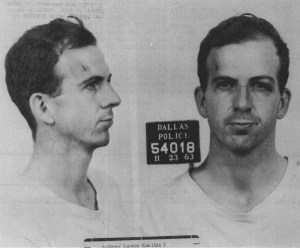
So what are the facts of the assassination? Perhaps the only undisputed fact to emerge from the tragedy was that John F. Kennedy, the thirty-fifth president of the United States, was shot in the head and killed. President Kennedy was hit by rifle fire in Dealey Plaza, Dallas, while riding in an open topped limousine, part of a motorcade that had just turned onto Elm Street by the Texas School Book Depository. Almost every other fact, every statement, every report, every document, every exhibit, every disclosure, is open to question.
Were there three shots or four? Were there more? Was the President shot from behind or from the front? Was he shot from the sixth floor of the book depository or from the so called ‘grassy knoll’? Did twenty-four year old ex-marine Lee Harvey Oswald fire the shots? Was he alone or were there other assassins? Why did Jack Ruby, a local night club owner subsequently shoot Oswald? Was it to silence him, to stop him from telling what he knew? Did Ruby act out of rage or was he part of a conspiracy? Was he in the pay of the Mafia? Was the CIA involved? The questions are endless, the answers are few.
Image courtesy wikipedia
Lee Oswald was a young man with an extraordinary background. He was not the ‘lone nut’ as described by the Warren Commission, the investigative body set up by President Johnson to examine the assassination. An ex radar operator at a top-secret US base in Japan, Oswald had spent years in Soviet Russia as a supposed defector. He was known to the FBI and had connections with military intelligence and the CIA. He appeared to be involved in left-wing Cuban politics and supported Fidel Castro. The Warren Commission concluded that Oswald shot the President but failed to answer the important question -why? Why should a left-wing activist shoot a liberal minded president who in the words of his critics had gone ‘soft’ on communism and Cuba?
But as we examine the accepted elements of the murder more and more inconsistencies occur. The President was shot at 12.30 pm, but Oswald, who worked at the book depository, was seen by witnesses in the second floor lunch room as late as 12.15, which left him only fifteen minutes to ascend to the sixth floor, produce his rifle and take up position. Of course fifteen minutes might have been enough time for a cool and organised killer, but the President was actually due to arrive at a reception at the Dallas Trade Mart at 12.30, which meant he would pass through Dealey Plaza at about 12.25, giving Oswald only ten minutes to be in place, and he had no way of knowing the President would be late. Immediately after the shooting patrolman Marrion Baker entered the Book Depository, drew his gun and with building superintendent Roy Truly hot on his heels confronted a young man in the lunchroom calmly drinking a coke. Truly explained that this was Lee Oswald, an employee. Had Oswald rushed down from his ‘snipers lair’ on the sixth floor or had he been in the lunch room all the while?
image courtesy wikipedia
Perhaps the strongest evidence linking Oswald to the murder was the supposed murder weapon, a 6.5 mm Mannlicher-Carcano bolt-action rifle, a World War II vintage carbine found on the sixth floor of the book depository at 1.22 pm, almost an hour after the assassination. The rifle had been purchased mail order by an ‘Alek Hidell’ and sent to Dallas post office box number 2915, rented by Oswald. When arrested, Oswald was carrying an identity card in the name of ‘Hidell’. To this day there is dispute over whether Oswald’s palm print was found on the rifle. All pretty damning you might think, but the officer who first found the rifle, Deputy Constable Seymour Weitzman, identified it as a 7.65 mmMauser, and was confident enough to make a sworn affidavit to that effect.
The day after the shooting, November 23rd, District Attorney Henry Wade also described the weapon as a Mauser at a televised press conference. How then does a 7.65mm Mauser become a 6.5mm Mannlicher-Carcano? I personally know nothing about guns at all but I have seen enough war films to know that a Mauser is German, and stamped clearly on the side of the Mannlicher-Carcano are the words ‘MADE ITALY’ and ‘CAL 6.5’. And surely a police officer, particularly an American policeman, would know what he was talking about concerning guns?
Abraham Zapruder, a local businessman took his cine camera to work that day to film the Presidential parade but what he recorded instead was a Presidential murder. In doing so he contributed arguably the most important piece of evidence in the whole case. His film gave investigators a filmed record and a timetable for the shooting. Examination of the film by FBI experts revealed the time between the first shot to hit the President and the shot that struck his head was 4.8 to 5.6 seconds. It was first thought that there were four shots, one shot hitting Kennedy in the throat, a second completely missing and hitting the kerb, a third hitting Governor Connally also seated in the Presidential car, and a fourth shattering Kennedy’s skull. Given that it takes 2.3 seconds to operate the bolt action rifle, four shots will not fit the time frame for one assassin and one rifle so the Warren Commission came up with the so called ‘magic bullet’ theory, that the second of three shots hit both Kennedy and Connally. This view has been blasted from a number of angles, firstly the bullet itself emerged as almost completely pristine, while one which had passed through the flesh and bone of two human bodies would have been severely deformed. Secondly, in the Zapruder film Governor Connally is seen to turn around as Kennedy is hit then appears to be hit himself as he turns to face front again.
Expert riflemen were called in to test the murder weapon. They were unable to duplicate Oswald’s supposed feat of marksmanship and complained of difficulty operating the rifle’s bolt mechanism and even the trigger. The telescopic sight could not be properly aligned and had to be rebuilt with metal shims added to make it accurate, which means of course that the rifle was tested in a configuration not available to Oswald. Also, test firing was done at still, rather than moving targets. The assassin would also have had to track the President as he passed behind an oak tree, resight his target and then shoot. So did Lee Oswald really do the shooting? What about the shot to the Presidents head which knocked him back and to the left indicating a shot from the right front -the grassy knoll area? And what about the bystanders who rushed up the grassy knoll including a motorcycle patrolman who tried to ride his bike up there? They felt the final shot came from the knoll as did railroad workers on the triple underpass, as did Abraham Zapruder the amateur cine cameraman, as did Mary Woodward of the Dallas Morning News, as did Lee Bowers positioned behind the grassy knoll atop a 14-foot railroad tower, as did many others. So, if other gunmen were involved, who were they? Who paid them? Who organised them? Who stood silently in the wings and watched while the President was killed?
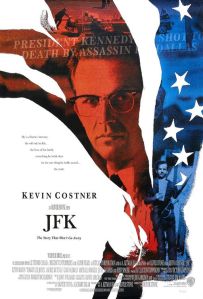
JFK movie poster
Oliver Stone’s blockbuster movie from 1991, JFK. was a recreation of New Orleans District Attorney Jim Garrison’s investigation into the murder of the president and before filming had even been completed the US media had begun -if you’ll excuse the pun- to throw stones at Stone. In conclusion the movie offers us the theory that the American ‘military-industrial complex’ was responsible for the crime, the theory running like this; Lyndon Johnson took over the reins of the presidency following JFK’s death. He continued with Kennedy’s cabinet and Kennedy’s policies, all except one -Vietnam.
Not wishing to become embroiled in a guerrilla war in south-east Asia Kennedy had already ordered home from Vietnam one thousand troops. Johnson reversed that decision and thus began the disastrous American adventure that was the Vietnam War. Extreme right-wing elements opposed to John Kennedy’s policies of peace ‘removed’ Kennedy in favour of Johnson. Sound fantastic? To be fair to JFK, everything presented as fact was factual, and everything that was conjecture was presented as such, but the real life investigation by Jim Garrison concluded that the CIA were the real culprits.
After the disaster of the Bay of Pigs, the CIA-backed invasion of Cuba by Cuban exile brigades during which the CIA had attempted to force Kennedy into committing American troops into the assault, Kennedy had vowed to splinter the CIA into “a thousand pieces and scatter it to the winds”. The CIA had become almost autonomous from the elected government, pursuing its own policies around the globe. It had developed a capability -revealed during the 1970’s in senate hearings- known as ‘executive action’, a capability of political assassination. The ‘company’ as the CIA calls itself, was involved with mafia hoodlums to murder Fidel Castro. Castro is alive and well today, but did the CIA collude with the mafia to murder its own commander-in-chief, the President of the United States?
Jim Garrison’s investigation came to nothing but in 1991 lawyer, writer, and JFK investigator Mark Lane was involved as defence attorney in a libel case instigated by CIA man and ex Watergate burglar Howard Hunt. The hub of the case was a newspaper article claiming Hunt was in Dallas on the day of the President’s murder. Hunt denied this, claiming to be in Washington at the time. In court Lane introduced testimony that indeed placed Hunt as part of a CIA team in Dallas on the day in question. Leslie Armstrong, forewoman of the jury said afterwards “Mr Lane was asking us to do something very difficult -he was asking us to believe that John Kennedy had been killed by our own government. Yet, when we examined the evidence, we were compelled to conclude that the CIA had indeed killed President Kennedy!”
A shocking and significant breakthrough in the JFK murder you might think? Leslie Armstrong went on to call for action to be taken by the proper authorities in the government. Nothing was done. The US Justice Department did not stir, nor has any other organ of the forces of law and order in the United States. The US media continues to ignore the countless revelations that have appeared in the years since John F Kennedy was killed, yet conspiracy theories are abundant in Europe and the UK. Watergate and the Iran-Contra scandals have shown us the dark underbelly of the American establishment, could it be that some secret influence is at work, hidden from public perception, preventing serious examination of the crime of the century?
President Obama has recently been elected to another four years in office, and in accordance with US law they will constitute his last term. Obama’s presidency has been largely unremarkable but he still has a chance to offer something significant to his fellow Americans and to the world. He can appoint a special prosecutor and special investigators and direct the CIA and FBI to answer pertinent questions. Not about how many shots, or from what direction, or any of the other thousand and one questions regarding the minutiae of the assassination but who was responsible? Who gave the orders? Who really killed President Kennedy? Still, perhaps even that would be fifty years too late.
What to do next: Here are a few options.
Share this post on your favourite social media!
Hit the Subscribe button. Never miss another post!
Forget the blue skies and the swimming pool
Your desk is all ready so don’t act like a fool.
Forget the pavement cafes and Mademoiselles
As your computer fires up with a thousand e-mails
Enough to numb the pain
And the nagging desire for a glass of red wine;
Act cool.
Briefings, meetings and folders to review
Memoranda and consultations to plough through
Forget the camembert and French bread
Close the door on the plat du jour
Its not even lunch and I can’t resist
The thought of a cool aperitif;
As if . .
Revised protocols need to be sorted
And I see the new software is unsupported
I’ll enjoy my lunch in the works canteen
A ham sandwich and a cup of tea
And the memory of a French bistro won’t even arise
All bustle and chatter and joie de vivre
No, not for me . .
I couldn’t tell you what my number one favourite book of all time is but a strong contender must be ‘David Copperfield’ by Charles Dickens.
My well thumbed copy of David Copperfield
It’s a book written by a wonderful wordsmith and is rich in powerful and subtle images.
A lot of Dickens’ characters display their personal characters and traits through their names. Uriah Heep and Mr Murdstone for instance. Even when we are yet to be introduced to these fictional people we can understand a lot about them from the sound of their names. This is how Dickens works, giving us numerous hints and pointers to who these people are and what they are like.
James Steerforth though is something of an exception. He is my favourite character from within Dickens’ pages and he is neither a Heep nor a Murdstone; neither a Pickwick nor a Bumble. Apart from David Copperfield himself, he is the most human of Dickens’ creations. He is kind but can be unpleasant, caring and yet selfish, thoughtful but also unfeeling. In short, as Mr Micawber might say, he is full of human contradictions.
The best part in the book probably, for me at any rate, is the storm when David returns to Yarmouth. Dickens builds the storm slowly and each word and phrase adds a new layer to the sense of danger and foreboding and when Copperfield is finally reunited with his old friend Steerforth at the height of the storm’s ferocity, death comes between them and Steerforth is sadly drowned. Dickens reveals this in a unique way for he does not tell the reader Steerforth is dead. He leaves the reader to realise this themselves and in the process makes the reader almost at one with the narrative.
Throughout the book, Dickens mentions in passing about Steerforth’s habit of sleeping with his head on his arm. It’s referred to many times in the narrative almost as matter of non interest. Something unimportant that the reader doesn’t really need to know, but when David Copperfield spies someone aboard a stricken ship trapped in the fierce storm who evokes some faint remembrance for him, a tiny warning bell is set off.
Finally, when the body of a drowned man is brought ashore and lies mutely on the sand, his head upon his arm, we know just from that simple bit of information, without the author telling us anything more, that Steerforth is dead. The prompts and clues that Dickens has hinted at have paid off for the reader in the most satisfying of ways.
I’ve returned to this wonderful book time and time again, to enjoy that unique almost religious feeling, that communion with the thoughts of a man who died in 1870, over a hundred and forty years ago, yet whose frozen thoughts live on in the pages of his books.
As long as people read books, Charles Dickens and his characters will live on.
If you enjoyed this post, why not try my book? Click the icon below;
The 2014 formula one season is well under way and like me, many people must speculate about those who race these incredible machines at such high speeds. Measuring high speed lap times against car control and the desire to go ever faster is the juggling act performed by the Grand Prix drivers every time they step into their high-tech carbon fibre cockpits. The consequences of a mistake can range from an embarrassing spin in the gravel trap to a cruel death.
This year, 2014, marks the twentieth anniversary of the death of Ayrton Senna, one of the greatest racing drivers of all time. Aryton was killed on the 1st of May 1994 at the San Marino Grand Prix at Imola in Italy. Anyone who knows anything about motor sport can tell you that. The date lingers in the back of the collective mind of all racing fans, along with other tragedies of the sport, like the deaths of Gilles Villeneuve and Jim Clark to name but two. Clark’s death is unexplained to this day. His formula two Lotus left the track at an easy, straight section of road. The facts of Villeneuve’s accident are well known -he crashed into a slow moving car- but his death is perhaps only really explained under close analysis. Villeneuve was on a slowing down lap, on his way back to the pits after a handful of fast qualifying laps but still, he kept the hammer down, his right foot pressed down to the floor when there was no real need for absolute speed. So why? Why was he going so fast?
One answer is simply that was the way he drove; fast. Foot down to the floor. Full stop. Another was that he was still estranged from team mate Didier Pironi, who he thought had unfairly beaten him in the previous Grand Prix at San Marino in Italy. The two had diced together for the length of the race, team leader Villeneuve thought they were putting on a show, Pironi thought they were racing. When Pironi took the chequered flag it was an act of betrayal, or so Villeneuve thought and when they arrived at Zolder for what would be Villeneuve’s last Grand Prix, Villeneuve was still seething. And so perhaps that state of passion was a factor on his last lap.
For Ayrton Senna in 1994 that intense rivalry with a fellow driver seemed to be a thing of the past. Together, Senna, Alain Prost, and Nigel Mansell dominated most of the eighties and early nineties in formula one racing. Mansell had left the stage for Indycar racing in the United States and Prost had retired leaving Senna to take his vacant seat at Williams, or perhaps he retired because Senna had been offered a seat at Williams –it depends on which story you believe. Certainly after the intense animosity that developed between the two at McLaren you can hardly blame Prost for not wanting to work in that same situation again.
So now, the Young Pretender had become the Elder Statesman of Grand Prix motor racing and his two closest competitors had gone. Perhaps he even hoped that he could relax, let up the pace a little bit, just as Prost had thought in 1988 before Senna began to push him harder. But a new phase had begun for Aryton Senna, a new Young Pretender had appeared to challenge him in the shape of Michael Schumacher. Schumacher had won the first two Grands Prix of the year and Senna came to Imola without a single point. “For us the championship starts here” he told the TV cameras, “fourteen races instead of sixteen.” Further pressure mounted on Senna when fellow Brazilian Rubens Barrichello was injured in a crash and then Roland Ratzenberger was killed, the first fatality at a Grand Prix meeting since that of Riccardo Paletti 12 years before.
Many sources have said that after these twin disasters Ayrton did not want to race in the Grand Prix. It is hard to believe, Senna -not wanting to race? The man for whom racing was everything? Could it be that he was finally becoming more like his once deadly rival Alain Prost? Prost had always put his own life before winning motor races and as a consequence had driven a dismal race at the rain soaked 1988 British Grand Prix and completed only a token lap at the similarly affected 1990 Australian Grand Prix. Events may have pushed Ayrton’s thinking from the neutrality and detachment of the past towards a greater concern, a concern beyond the continual winning of races.
Whatever his inner feelings he started the San Marino Grand Prix in his usual fashion, leading into the first corner from pole position. Behind him though, JJ Lehto stalled his Benneton and was hit from behind by Pedro Lamy. Lesser events had stopped races in the past but on this occasion the organisers sent out the new safety car and the grid cruised round after it in formation for five laps while the crash debris was removed.
At the end of the fifth cruising lap the safety car pulled off, the lights turned to green and Senna, Schumacher and the rest floored their throttles. The Williams was not handling well and it felt nervous through Tamburello, that evocatively named but most dangerous of corners. Still, Senna kept ahead of Schumacher, he kept the hammer down. On lap six the Williams entered deep into Tamburello and Schumacher saw the spray of sparks as the car bottomed out and side stepped slightly. Senna caught and corrected the Williams and throttled onwards for the charge down to Tosa, the next bend. Both Senna and team mate Damon Hill knew their cars were nervous and to a certain extent unsuited to the bumpy surface at Imola. Someone like Alain Prost might have eased off slightly, settled for second or third, collected some points, and used the rest of the San Marino Grand Prix as part of a learning curve, collecting mental and electronic data to develop the car into another Williams race winner. For Ayrton Senna, a third defeat by Michael Schumacher was not acceptable. Putting points on the scoreboard held no interest for him either, except for the ten points that came for a win.
The next time round Ayrton entered Tamburello at 192 mph. We know his exact speed from his car’s electronic management system, which records such data. Tremors went through the car as it bottomed out again on the undulating track surface. This time Senna couldn’t catch the Williams, or perhaps something failed on the car. Later on the steering column was found to be fractured. Did it fail before the crash or was it damaged in the impact?. Some have speculated that his tyres were not up to pressure after many laps circling the track at low speed. We will never know. Whatever happened, the car went straight on towards the tyre barrier masking the concrete wall that lay behind. Senna’s last act was to slow the car down to 131 mph, but it was not enough.
I have never met Ayrton Senna. The last time I had seen him, in person, was at the Silverstone tyre tests of 1991 and even then he was a blur of yellow in the red and white of his McLaren. To understand someone we have never known is not an easy task. Sometimes we can only do so by looking into ourselves and searching for similar experiences. A long time ago, I must have been eight or nine, my Mother took me to visit my Grandmother. Sitting alone in the lounge while the two women gossiped in the kitchen, I became fascinated by my Grandmother’s new fireplace. It was a coal fire and the fire glowed dormantly behind a glass door. A real fire was not new to me, indeed we had one at home but the glass door seemed to attract me, so much so that I reached forward and held my hand a fraction of an inch from the glass. On an impulse I reached out further and put my hand on the glass. As you can imagine, I recoiled in agony having burnt my hand.
That moment, in 1994, as I watched my television images in disbelief, I came to think of that small boy, reaching out towards the glass door that enclosed a coal fire almost as one with Ayrton Senna, reaching towards the barriers of absolute speed, touching the zenith of his car control and going ever so slightly over his limits. He had done it before and had come back from the brink. Indeed it may have even been vital to him to occasionally push and go over his limits just to fix in his own mind where those limits lay. Ayrton was a man who could learn from his mistakes and could go on to better and faster things, but on that tragic day fate stepped in and stopped the process. A suspension arm crushed in the impact sprang back and hit Ayrton, piercing his most vulnerable point, the visor of his helmet.
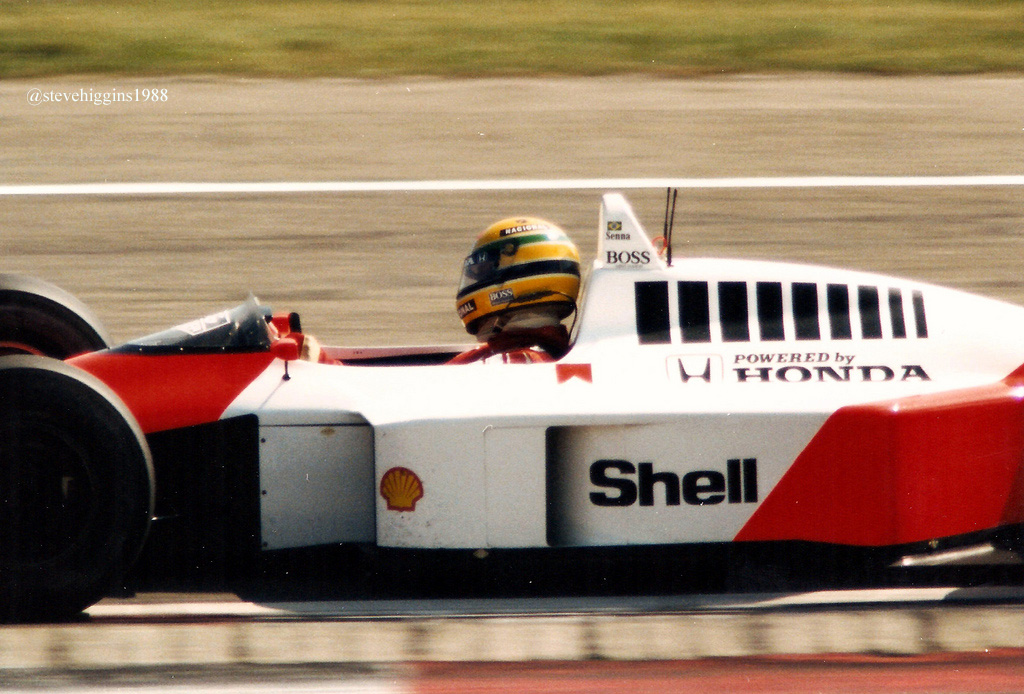
Senna at the German GP 1988. Photo by the author.
Prost and Stewart, two of the all time greats of motor sport were men who came closer than anyone to touching the glass -without ever being burned. Perhaps that was their secret. Stewart was a man in absolute control of his skills as a racing driver, both on and off the track. After three world championships and twenty-seven grand prix wins Stewart was able to say goodbye to it all without ever looking back. What other driver can boast of doing that? Schumacher retired again after a disappointing comeback only for tragedy to strike while skiing. The careers of both Nelson Piquet and Gerhard Berger fizzled out inconsistently at Benneton. Mansell called it a day after joining McLaren and then realising that their epic run of success had run out of steam. Alain Prost retired after cantering to his fourth championship. It was clear that in Prost’s final year he was no longer willing to push hard. The motivation of his youth had evaporated with the grand prix seasons and with the relentless high-speed sprints of formula one. The day had arrived, as it will no doubt one day arrive for Hamilton, Alonso, and Vettel, when he was no longer trying to touch the glass.
If you enjoyed this post why not try my book Floating in Space, a novel set in Manchester 1977. Click the links at the top of the page for more information.
Sunday, yesterday as I write this was Fathers day in the UK and I thought I’d take a few minutes to look back at my Dad who died in, well, I was going to write the year but was it 2000 or 2001? Can you believe that, I can’t even remember the year he died!
The thing is, the year isn’t really important, what matters is that he’s no longer here and what’s worse is that me and my old Dad spent a lot of time not getting on with each other and that was a lot of wasted time, time that neither of us will ever get back.
My Dad and I were from different generations. Dad was born in 1928 and he was part of the World War II era. A time of shortages, of national emergency and an uncertain time when you weren’t sure if you or your loved ones were going to make it through that next air raid. Christmas for my Dad, he once told me, was an apple and an orange and maybe, just maybe, an out of the blue present like a tin of lead soldiers that were, of course, second-hand. Anyway, perhaps that’s why he couldn’t really relate to TV obsessed youngsters like me and my brother who were given a pillow case full of gifts on Christmas morning. In the seventies when I was a teenager my long hair and my denim outfits didn’t sit well with my Dad either who used to put a tie on to take the dog for a walk!
Anyway, the good thing is that when something really dreadful happened to me in my late twenties I told him about it rather than my Mum and instead of the usual moans and groans I had come to expect, when the chips were down he stood up and supported me. I’ll always remember him saying to me ‘don’t worry about your Mum, I’ll talk to her.’ It always seems to me looking back that that was the start of our relationship proper.
I describe my Dad pretty accurately in my kindle book ‘Floating In Space’. He was a big man but he was quiet and cat-like too. Everything he did had the same qualities of quiet and calm. He worked for the Manchester Highways department building roads and pavements and every day of his working life, come rain or shine, he set out for work on his old pushbike. One day the gears on his bike stripped and he took it in to the bike shop for a repair. They couldn’t fix it there and then so Dad had to borrow my bike to get to work the next day. What he didn’t know was that at the time there was a new craze -the chopper bike- and as I couldn’t afford an actual chopper bike, I had bought a chopper seat for my bike and fitted it the previous day. Looking back that bike looked pretty ludicrous and later I reverted to the normal seat but I can still see my Dads face as he pulled my bike out of the out house where it was stored and then me and my brother watched as this middle aged man set out for work on his hybrid chopper bike!
For fathers day many years ago I bought him an apple tree to plant in his back garden. When I turned up late on the Sunday my Mum was really pleased to see me and said that my Dad apparently was feeling a little neglected that day as until then, neither me nor my brother had turned up to see him.
We planted the tree in the back garden and years later, whenever I looked at that tree it reminded me of him. Of his quiet ways, of his ‘lets get on with it’ nature, of his spirit so like my Mum’s really of never letting anything get them down. Imagine my feeling one day last year when I looked out of my Mum’s back window to see the tree had been chopped down! I was seething and was all ready to get on the phone and give Manchester City Council some major grief when Mum told me she had asked for the tree to be cut down. What on earth for I asked?
Well, my Mum is a little unsteady on her feet and the tree was crowding her washing line and she was worried about falling over. So, she got the council to chop it down. It was clear she didn’t see the tree as I saw it, as a sort of living, growing, monument to the man I had given it to many years ago. Still, last time I was there, only last week, there were green shoots growing from the stump. The tree had beaten the man from the council and its indomitable spirit was still alive. I am sure my Dad, who loved nature in all its forms, would have smiled.
If you liked this post why not try my novel, ‘Floating In Space’ set in Manchester 1977? Click the links at the top of the page for more information.
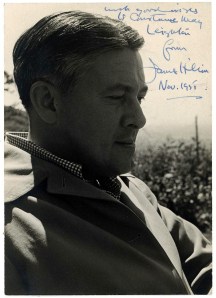
James Hilton is one of my personal writing heroes and yet his name may be unfamiliar to many of you reading this blog. He was a journalist and an author and made the trip from his home in Leigh, Lancashire, in the UK to the Hollywood hills in the United States to become a screen writer. He is probably more well known for his book ‘Goodbye Mr Chips’ which was made into a film with Robert Donat (actually another northerner from Didsbury in Manchester) but my favourite of his books and quite possibly my all-time favourite book is ‘Lost Horizon’.
Lost Horizon is a book I found in a second-hand shop many years ago. A battered 1940s paperback I paid twenty-five pence for and yet that small investment has paid me back many times over for sheer reading pleasure as Lost Horizon is a book I re read every year or so and I often pull it down from my bookshelf when a current read fails to entertain me.
Lost Horizon is a completely original idea and is about British consul Robert Conway in the dark days before World War II. Conway is helping his fellow British citizens escape from civil war in China and he and his small party escape in the last plane only to be kidnapped and taken to a distant Tibetan monastery. Conway meets the High lama and after a time it is revealed that the Tibetans want to preserve the best of world culture and art and make it safe from the coming war.
Hilton is one of those few people who have invented a word or coined a phrase that has become part of the English language. In this case it was the name of the Tibetan monastery, Shangri-la which has since become a byword for a peaceful paradise, a distant haven. Camp David, the US President’s retreat was originally called Shangi-la until renamed by Eisenhower for his son, David.
Hilton’s journey from Leigh to Hollywood must have been a magical one and one I envy, especially as his time in Hollywood was a golden age for movie making. Lost Horizon was made into a movie by Hollywood director Frank Capra and starred Ronald Colman as the urbane British diplomat of the novel. It’s a movie that was recently restored and is a great DVD if you happen to see it. Colman also starred in another movie authored by Hilton :‘Random Harvest ‘.
Hilton settled in Hollywood and wrote a number of screenplays for classic Hollywood movies such as ‘Mrs Miniver ‘. Sadly he died from cancer in 1954.
WordPress of course is an American site and I wonder sometimes if a bored Hollywood production executive may decide to sit down one day with his Ipad and search idly across the site in search of movie ideas. My own book; ‘Floating In space’ could easily be relocated from Manchester to Los Angeles and I am available for writing the screenplay.
Well, may keep my flight bag packed, just in case . . .
If you enjoyed this post, why not try my novel, Floating In Space? Click the links at the top of the page for more information.
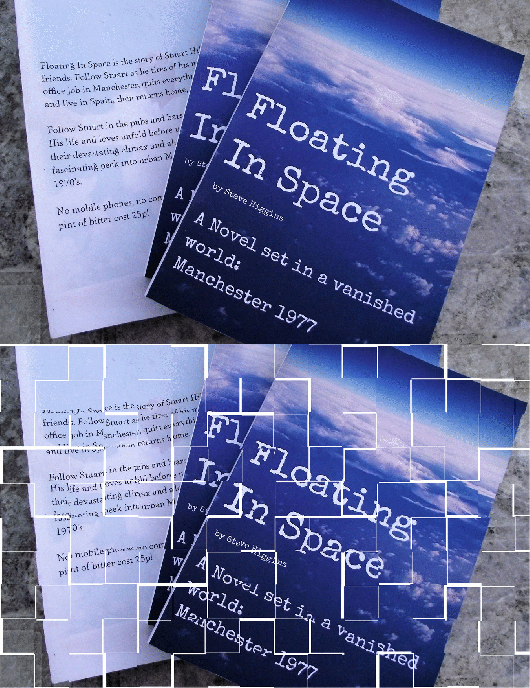
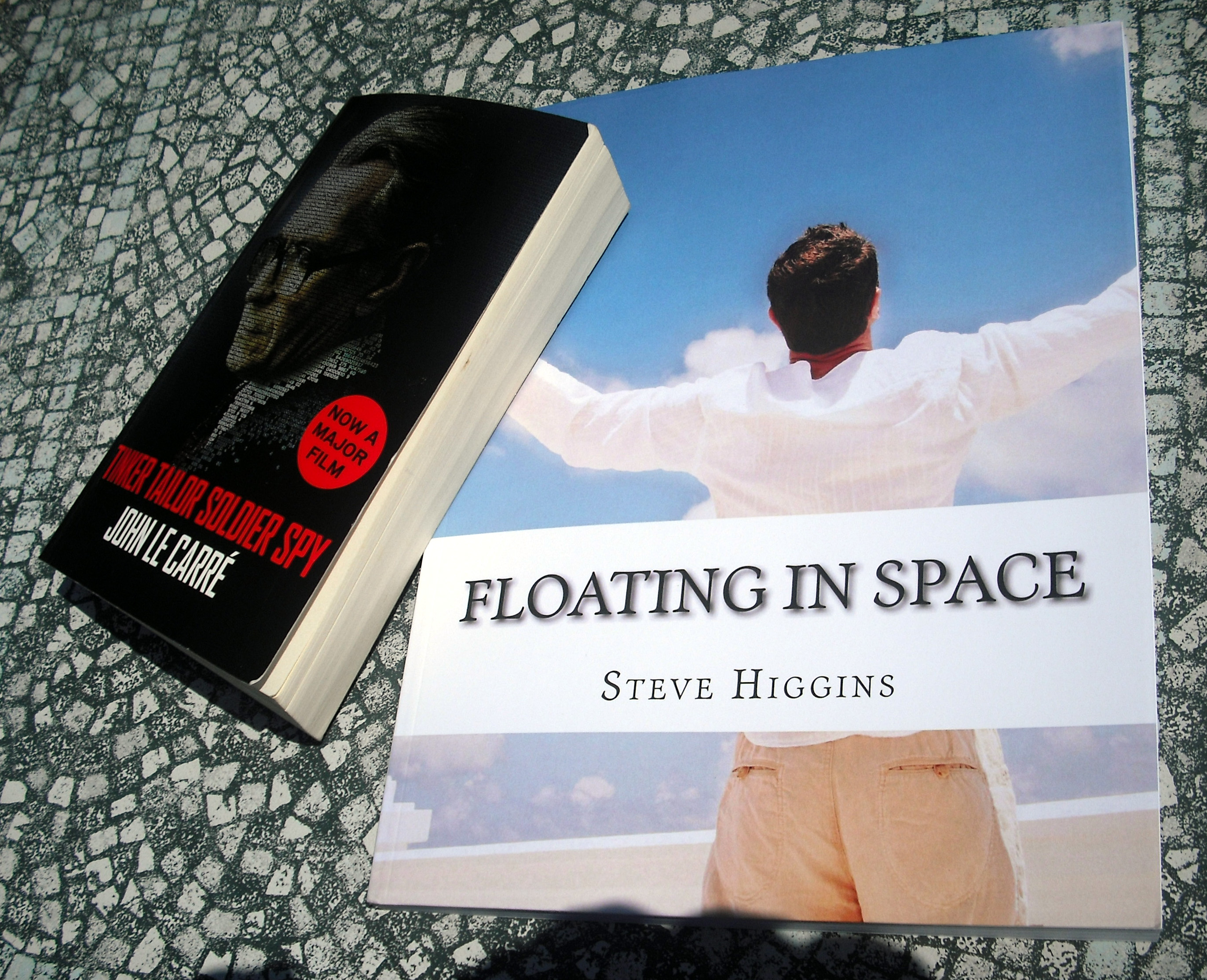
Well, actually it does, especially when we are talking about paperbacks. Paperbacks that we want to stuff in our beach bags for a good holiday read, or the novel you have in with your sandwiches for a lunch time read.
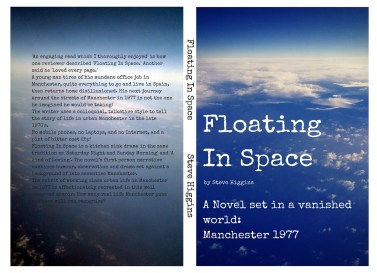
When the parcel came from http://www.createspace.com I was over the moon and couldn’t wait to look. Pity I’d cocked up on the self publishing front as that guy from the Reginald Perrin sit com might say.
Oh well. My book comes complete with a notes section at the back to explain some distinctly 1977 terms, TV shows and some now forgotten events so while I was trying to keep the page numbering intact it looks like I’ve made the book too big!
 As a child growing up in the 1960’s one of my favourite television programmes was Tomorrows World, a BBC show about technology and the future. I was acutely interested in science, science fiction and all things related to the future. The future was hi-technology, gleaming metal and plastic cities, hover cars, and space travel. The movie 2001 A Space Odyssey predicted manned missions to Mars, powerful computers, and lunar space stations. But, 2001 is now thirteen years ago, so what happened? Why is 2014 not really that much different from 1968?
 That of course has its drawbacks. As a writer I have discovered a sort of word blindness when it comes to my own work. I’ve proof read my book a multitude of times but how many times have I come to put an extract on this blog only to find missed words and other errors. When the paperback proof version came (in the wrong size: I’d made it far too big!) more errors jumped out at me and my girlfriend Liz, a fully paid up member of the Grammar Police has pointed out so many punctuation issues I sometimes feel like taking it off the market. Anyway, the good thing is that in the digital world, errors can quickly be resolved. A quick update, press the save button and we are all sorted.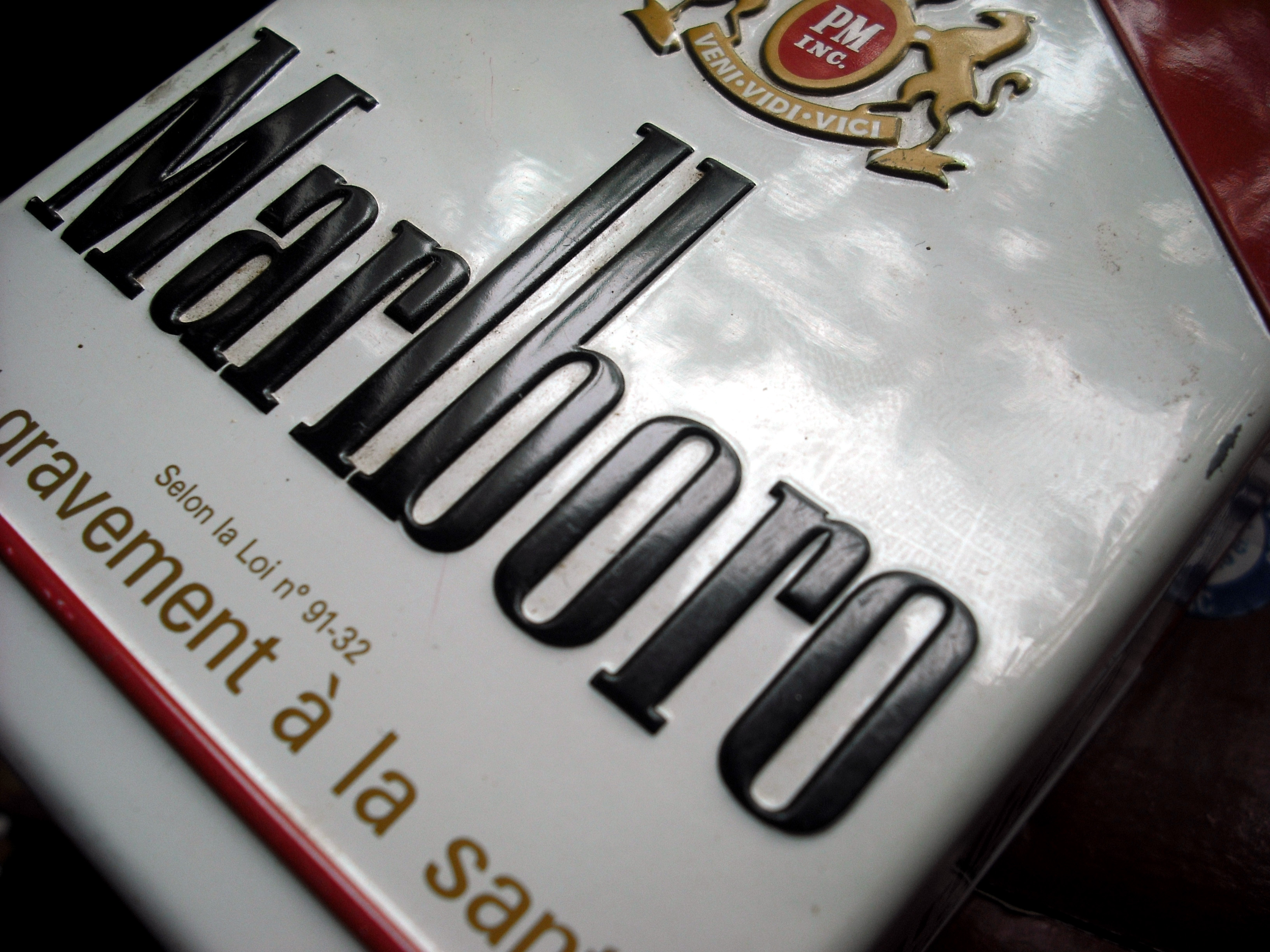









 Letters from an Unknown Author!