Airports and Things

These last few weeks have seen something of a heatwave in the UK and of course we Brits are just not equipped to cope with extreme heat, well not in the UK anyway. In Spain the buildings are built to keep out the heat where as in the UK, our houses are insulated and are made to hang on to the heat throughout the cooler parts of the year as well as the usual dismal summers.

When I was a child a great lure for me on a hot summer’s day was the airport. My friends and I used to cycle to Manchester Airport and sometimes lurk around the terraces that used to welcome ‘plane spotters’ or more often than not, we used to ride around the back of the airport and wander down secret (or so we thought) lanes and avenues that backed onto the runway. We always headed for a popular spot, an old world war 2 pillbox where we would meet and observe the aircraft. I remember spending many happy hours there, jotting down all sorts of thoughts in my childhood notebooks while listening to the appealing drone of light aircraft or the exciting blast of jet engines. I sometimes imagined that the reason I so loved that light aircraft droning sound was that perhaps I was a World War One fighter ace in a previous life when that sound would have been so much a part of my existence.

Some time later, I think I was in my twenties, I knew someone who had an ambition to be a pilot and was taking lessons at Blackpool Airport. He used to alleviate his tuition costs by taking friends or colleagues on his training flights if they would drive him up to Blackpool.

On the day that I joined James (as usual, names have been changed to protect the innocent) as an eager passenger, I drove up to Blackpool Airport pretty excited. James advised that on the day he would be doing some instrument tests which involved flying the aircraft on instruments alone.

I stepped into the back of the small plane and strapped myself in. It was a hot day and the aircraft had a huge glass cockpit making it warmer still. I was at a point when I thought I would have to get out and cool off but just then the instructor turned up. He was an older chap and brought his big woolly dog along as he enjoyed, well so I was told, flying. Fido was led in to the rear seat with me and we eyed each other warily as he was strapped in.

The engine was started, we taxied out on to the runway and a few moments later we were aloft. It was exhilarating to look down on Blackpool and the tower, a place where I had spent many happy holidays as a child. After a while James had to put on a rather odd-shaped helmet which blocked out the view through the windscreen and he could only see his instruments. The small plane flew higher and higher, Blackpool Tower becoming the merest pinprick in the distance. Then the engine stopped.

image courtesy wikipedia.

image courtesy Wikipedia.

I’m not sure if you have ever seen one of those World War Two films when German Stuka bombers hurtle down at their targets with a banshee type wail. I only mention that because it seemed very much akin to our current situation and not only that, the pilot was lucky on this occasion that it wasn’t me issuing the wail, but as we hurtled towards the ground, Fido and I eyed each other with mutual fear in our eyes.

“Now come on James” said the instructor. “What have we forgotten?”

Fido pawed the back of the pilot’s seat in a vain attempt to jog his memory but our downward path continued. If you ever happen to see that rather old film ‘The Sound Barrier’ you might get some idea of our situation hurtling down towards the earth with Blackpool Tower looming ever closer in our windscreen.

“You’ve forgotten something haven’t you? The instructor might have been talking to a learner driver who had not put his hand brake on at the traffic lights.

“What if I mentioned the mixture?”

If that was a hint it was certainly in a much better class than his previous comments but either way the pilot got the message, adjusted the engine mixture and our tiny aircraft’s propeller burst into renewed life and not long later we touched down rather bumpily back in Blackpool.

“Watch out” said the instructor, “Fido gets a bit excited when we land.”

If this was a typical flight with his master then it was clear to me why Fido was excited when he landed but anyway, the dog gave me a look which said in its canine way “We made it!” and hopped out of the plane. James completed his flying studies and left our company. He went on, I assume, to a career in aviation and we never met again but I have learnt one thing.

Next time, if on the way to Spain, the engines of our jet airliner conk out I’ll be shouting to the pilot “What about the mixture!?”

Much has changed with aircraft and airports since those far off days. Also when I was a child, my father who never owned and could not drive a car, took us, my mother and brother and Bob our dog, on long walks around the area. Many times we would end up at a lovely old pub called the Romper where my brother and I would get crisps (chips to you American readers) and a glass of fizzy pop before setting off on the walk back home. There would usually be somewhere to buy some fresh eggs or vegetables which we would have later. The road that took us to the Romper has now been enveloped by the ever-expanding airport and the Romper itself is also quite different. I fondly remember it as having comfy old chairs inside and no pumps at the bar: The barstaff used to fill a jug direct from the casks of ale and pour beer from that. The last time I went into the Romper was at least ten years ago. It was a posh and polite bar and eating house. Nothing stays the same.

Airports have been in the news a lot lately because the government has decided to approve the building of a third runway at Heathrow, despite this meaning the destruction of 700 houses and the entire village of Sipson. It’s pretty probable that noise pollution will increase as well as increased greenhouse gas emissions.

It’s a similar situation at Manchester airport where, as I said earlier, the airport seems to be expanding all the time. A new complaint at Manchester is that where motorists have been able to drop off and pick up passengers freely, a new charge of £3 has come into effect. Three pounds, just to drop your friends or relatives off for their flight!

Personally, I’d advocate a string of smaller airports around the country which would mean people wouldn’t have to travel so far to big airports like Heathrow or Manchester. Liz and I used to use Blackpool airport quite frequently. It’s a fairly small place, very handy for us and those in the local area and it was a little like a friendly bus station until Jet2 stopped flying from there and the location returned to helicopter and light aircraft use.

If you look back at the history of aviation, you’ll see that in the 1960’s Hawker Siddeley developed the Harrier Jump Jet, a fighter aircraft which could take off and land vertically! So why has that concept not been taken up by the commercial aviation world? Imagine airports with VTOL aircraft. No lengthy runways taking up space. What are today’s generation of boffins up to? Get working on vertical take off and landing guys!

This seems to be an appropriate point to plug, no not Floating in Space but one of the videos on my YouTube page. You might breathe a sigh of relief, regular readers, to know that it’s not another video about that aforementioned novel (wonderful read though it is) but a re-edit of my second most popular video, a look at Manchester Airport back in 1986.

The original has had 7.8 thousand views which is pretty impressive but as it is enhanced by the top 20 chart music of the time, all of which is copyright protected of course, no royalties are payable to me. Naturally, that was quite a motivation for me to re-edit the film with some new copyright free music. Just as I had finished YouTube announced that as I have less than 1000 followers I am no longer eligible to be a YouTube ‘partner’ and therefore ineligible for any royalties.

My old friend Steve, now longer with us, introduces various aspects of the airport, a place he loved and knew a great deal about. A few years later I took the original video and edited him out, substituted some new video and added a lot of Steve’s introductions into my voice over narration. He wasn’t happy. Not long ago when I copied the video to DVD ready to convert to digital for yet another re-edit, my laptop would not accept the digital data. I sometimes think that maybe his spirit was watching over making sure that particular version never made it to YouTube. Oh well, perhaps I’ll leave it for another day, a day when I’m eligible for YouTube royalties!


Floating in Space is a novel set in Manchester, 1977. Click the links at the top of the page to buy or for more information.

Motorhomes, Weddings and the Curse of Mobile Wi-Fi!

Holidaying in a motorhome is a great adventure; the open road, the open country, the sense of freedom, the feeling of self reliance. The joy of stopping where and whenever you like and switching on the gas, making tea and watching the sausages sizzle satisfyingly in the frying pan. Believe me, it’s a great feeling.

The flip side is baking in the 90 degree plus heat of a French summer and finding that your motorhome provides no shelter, in fact, it’s even hotter inside than outside.

The good thing though is that you can drive away, find a nearby lake or plan d’eau, park up and jump straight into the cool water.

On this eleven day trip we have meandered slowly through the towns and villages of north-eastern France. On our first night we parked up outside our favourite French restaurant in Zutkerque, Le Mas Fleuri, where we ate and drank heartily of the simple but wonderful food they serve. Monsieur Le Patron assured us that he would open his doors at 8 in the morning so we could avail ourselves of his restaurant toilets. What a lovely gesture indeed.

The next evening we arrived in Berny-Rivière and visited another old watering hole, Chez Micheline, where we had a superb pâté to start with and for me a rather tame pizza which was a poor choice on my part. It was the night when the French won the World Cup and they drove around beeping their car horns and waving excitedly back at us when we beeped ours. The TV in the restaurant bar was tuned naturally to the football station and everyone there was clearly overjoyed. The atmosphere was wonderful.

Grave of Wilfrid Owen, Ors, France.

Travelling through north-eastern France you cannot help but recognise many of the names on the road signs. Cambrai, Arras, the Marne, Verdun and so on, all are famous names from the First World War and as you travel further, it is inevitable that you will see signs for military cemeteries. The country is littered with these cemeteries, some huge and impressive and some small but all quiet, silent and filled with a sadness for a generation lost in the carnage of war. At each one we visited there are many graves labeled simply ‘A Soldier of the Great War. Known unto God.’ Soldiers whose remains were unrecognisable in death, their documents and serial numbers blown to pieces in one of the many artillery bombardments on the Western Front.

We went to the village of Ors to find the grave of Wilfred Owen, one of the outstanding poets of the First World War. He is buried in the village cemetery at Ors where there are a number of soldiers’ graves. It was sad to see that he died on the 4th of November, 1918, only a matter of days before the armistice. He was only 25 years old and interestingly for me, was a member of the Manchester Regiment. Manchester of course being my home town. We left Ors saddened by the events of a hundred years ago.

One interesting aspect of using a motorhome is how you become aware of your consumables, not only power but water. Power was not a great problem due to our solar panel but water was an issue, especially as we drank more and more in the high temperatures. It was great to find that in France, motorhomes are welcome in many places and there are plenty of municipal motorhome sites where you can dump waste water, empty your toilet and top up your drinking water.

On our first stop at one of these sites we set about our first toilet emptying. I successfully removed the toilet container, emptied it, swilled it out, added some fresh water and the toilet liquid that helps break down the waste. It was all a little pongy but not too bad. The next day when we were preparing to leave, a French motorhome arrived next to us. We murmured a few bonjours at each other and the French driver set about emptying his toilet, however we weren’t prepared for the horrendous stench of what smelled like the entire contents of a Paris suburb being flushed away. We rapidly battened down the hatches and fled.

The one disaster of this holiday was our mobile internet connection. I had got myself a mobile router arranged and a data SIM courtesy of Three.co.uk. I tried everything out in the UK and everything seemed OK. Fast forward to France and nothing worked. In desperation I made an expensive call to the Three network and when I finally got through they assured me my SIM was registered OK, roaming was set up so everything should work, only it didn’t. Next step was to buy a French data SIM card, slip it into my router and hope for the best. Did that work? No. We tried the SIM in Liz’s iPad and finally got a connection. The router was at fault then. Back in the UK I had a moaning email all ready to complain to the manufacturer but then I thought I’d have one last try. Going through the instructions once again using a magnifying glass -they were written in very tiny type for some reason- I noticed a password I hadn’t seen earlier, typed it in and my little wi-fi router finally connected. If you happened to be on the Fylde coast that day and heard a piercing scream, well you can perhaps guess who was responsible.

The objective of our trip to France was the wedding of Liz’s nephew Michael to his bride Anaïs in Alsace. The wedding venue was high on the top of a mountain, well it seemed like a mountain to me. Actually it was a very big hill accessible only by a mountain track normally used only by goats. It was a bit of a scary trip uphill but we somehow made it and a very nice time was had by all. The bride and groom made their vows, a number of speeches were forthcoming, happily for me there were even a few in English. A great deal of alcohol was consumed as was a large barbecue consisting of three medium sized pigs and a small lamb and plenty of salad and wine. This being France a halt was called during the proceedings for the serving of the cheese then after a suitable period the music and dancing commenced.

The Bride and Groom watch a special dance performed by their guests.

At the wedding one surreal event occurred which I must tell you about but first I need to introduce this week’s classic film which is Romancing the Stone. Not a classic in the same sense as Casablanca perhaps but still a pretty good film, well worth watching the next time it comes up on TV. If you’ve not seen the film it stars Michael Douglas as Jack Colton, an American adventurer in Colombia who is helping out novelist Joan Wilder, played by Kathleen Turner, whose sister has been kidnapped by a nasty drug cartel. At one point in the film the couple are lost in an unfriendly village full of aggressive gun-toting individuals. They are directed to the house of one fellow in an attempt to get transportation. Negotiations are going decidedly nowhere and fingers are on triggers when the gang boss eyes the novelist and asks ‘Joan Wilder? Are you Joan Wilder the novelist?’

OK, fast forward to France at the wedding on the top of the mountain and Michael, the groom if you remember, introduces me to one of his French friends and this fellow does a double take and asks ‘Steve? Steve Higgins, writer and blogger?’ I was so surprised I nearly tripped backwards and went splat right into the buffet table. I mean writing a blog post every week hardly makes you famous does it?

Anyway, when I had calmed down it turned out that many moons ago Laurent, as the French chap was called, and I had both commented on some long forgotten family Facebook thread and he had checked out my profile and found my Facebook writers’ page titled ‘Steve Higgins writer and blogger‘. ‘Have you read Floating in Space?’ I asked. ‘I will when the french version is available’ he replied.  Yes, he might have to wait a while for that one!


Floating in Space is a novel set in Manchester, 1977. Click the links at the top of the page to buy or for more information.

Videos, Blog posts and the Search for Content.

It doesn’t get any easier, the search for words and ideas for a weekly blog post. And it just goes on and on, just like marketing. You write a book, self publish it on Amazon, then realise that if you want to sell a few copies you need to promote your book more and more on social media. After all, before people can make a decision about whether to buy or not, they need to know more about your product, and if they’ve never heard of it at all there is only you who can tell them about it.

One of the ways in which I have worked is to show the public something interesting through either my blog posts or videos and hope people may think, ‘hey that was interesting. Wonder what this guy’s book is like? That’s the theory anyway. In practice coming up with varied content week after week is hard work. Sometimes I have to cheat a little. Cheat did he say? Well a little bit. Sometimes I take an old blog post and liven it up a little, rewrite it and add some new images and graphics and hey presto, new blog post!

Sometimes I’ll take content from a stalled project and use it for something else, like another blog post. Back in 2017 I was in Manchester, the location of the events in my book, Floating in Space, and shot some video of the town as it looks these days. I had a vague idea of talking about the city and how it has changed during the last 40 odd years and looking at some of the pubs and bars I used to frequent. Back home I saw that my footage wasn’t brilliant and there didn’t seem to be enough useable video to work with. One big problem for me is that when I visit Manchester, the lure of my old pubs and haunts is just too great and I tend to have to go and visit them and of course, have a pint or two in them too. Then there are new venues that need to be tried out and evaluated. This process of evaluating is very important, especially to a top blogger and chronicler of Manchester, like me! The thing is, after a few pints, which of course are essential to the evaulating process, I’m not necessarily in the mood, or the state, for shooting video!

Making a documentary film, even the short ones I make, is pretty hard. I started off putting a rough cut together then working out a narration but things just wouldn’t come together. A better way, I found, was to sit down and write something and then try to select images that fit together with my words. Editing, especially the way I work, can be a slow process. After that particular video project stalled for the umpteenth time I realised my Saturday blog deadline was fast approaching and that I had little worth publishing. That’s when I decided to take my narration and re-purpose it into, yes, you’ve guessed it, another blog post.

My post Manchester 41 Years On, was a nostalgic look back down memory lane and a sort of appreciative look at present day Manchester. It combined a lot of text from Floating in Space, written quite a few years back now with some new fresh words inspired by my recent visit to the old home town. I liked it so much that I determined to get back into the editor’s chair and sort out that video!

After numerous re-edits I finally got things in some sort of order. I did have a version with some background music but it was annoying so that had to be removed. My narration wasn’t perfect but after a session with the old sound mixer and the snipping out of those many errs and ahhs, things seem a little better. Not Oscar nomination material I suppose, but a pretty reasonable short video. Take a look and see what you think!

By the way, this post came direct from French mobile internet hell! Stay tuned and I’ll tell you more next week!


Steve Higgins is the author of Floating in Space, a novel set in Manchester, 1977. Click the links at the top of the page to buy or for more information.

Rumours, Motorhomes and the Red Carpet Treatment

Motorhomes.

As you read this I will hopefully be making my way to France via the channel tunnel in Liz’s tidy little motorhome. This is not -as you might be thinking- my summer holiday. In fact its my pre-summer holiday! Yes, we are off to a wedding in the Alsace region of France and have decided to make the trip in the motorhome and make things into a mini holiday, a nice precursor to our main holiday also in France later in the year.

We have already had a trip to Scotland in the motorhome but this trip to France is one I’m really looking forward to. I really do love driving through France, exploring sleepy french villages, antique shops and of course, restaurants. If no restaurants appear on the horizon, which I seriously doubt very much, we can always park up and slap some sausages into the frying pan. Things taste so much better when cooked out on the road.

The forecast in France is not looking that great for the first few days which might come as something of a shock to our system as for the last few weeks the UK has been in the middle of a major heat wave. Garden hoses and sprinklers will soon be banned I’m sure and apart from having some trouble sleeping in the warm nights things have been very nice in the UK. We’ve had plenty of barbecues and for most of the time I have been wandering about in the same pair of shorts and an old vest, occasionally interchanged with a smart pair of shorts and a smart polo shirt when I have ventured out into town.

The weather has had quite an impact on our laundry as I have given up wearing socks for the duration of the heat wave. Shoes have been replaced by sandals and jeans have been pushed firmly to the back of the wardrobe. When the washer has been taken for a spin it’s so hot that the washing is dry in no time at all.

Many people have mocked me in the past for buying a convertible motor car. ‘When is he going to use that in rainy UK’ they may have thought? Yet how I laugh when I motor serenely by, roof down, sunglasses firmly fixed in place as I offer a cool wave to my friends, boiling in their conventional motor vehicles. I have heard some talk of ‘air con’ but what on earth is that? Must be bad for you and it really can’t compare to having the roof off your car and being bathed in fresh, warm, natural air, can it?

The Red Carpet Treatment.

Last week our friend Veli who runs the Anotolia Turkish Restaurant in St Annes invited us to the launch of his new venture the Anatolia Sea View Restaurant down on the seafront. Veli must have some good contacts because also in attendance were the local mayor, the local MP and various minor celebrities from the north-west, including Bobby Ball whom UK readers may remember from the comedy duo Cannon and Ball back in the 80s. Anyway, it was nice to step along the red carpet and be handed a glass of bubbly by our favourite waiter Zoltan and nibble at various Turkish delicacies from the buffet.

Rumours.

I never used to be a great album buyer, in fact back in the 70’s and 80’s I was always a singles man but I do have a few vinyl albums in my collection. In the CD age I have built up quite a substantial CD album collection and it’s always nice to pick up a CD version of a classic vinyl album and I did plan at one time to gradually update my album collection from vinyl to CD like that, record by record. Then again, by the time I’ve finished I can imagine the CD will probably be defunct and some new technology will have replaced it.

What is interesting these days though is how bands tend to update their work and issue new versions of their classic stuff. We can now get classic albums ‘re-mastered‘ and with other versions of the original tracks. That is all very well but what it really means is that the record company can now add on a few extra quid to the price tag.

On the BBC a while ago I watched that late night show about classic albums and the subject happened to be Rumours, the hit Fleetwood Mac album. Rumours, in case you didn’t know, was released in 1977 and reached the top of both the US and UK charts. Four tracks from the album were released as singles and all did well in the charts. The BBC show revealed how the album was made and the personal relationship issues that fuelled the creative song writing. Following on from that I decided to do a search on Ebay for Rumours and spotted a ‘new’ version of the album for sale.

The version I saw on Ebay was remastered and claimed to be a deluxe and special version but after further searches and examinations, I now see that for a few quid you can get, quite cheaply, the basic CD version of the original album. Also available, a little pricier, is the ‘re-mastered’ version. For a little more money the remastered 2 disc version can be bought and for even more money, a remastered special 3 disc version. The 3 disc version was too pricey for me but after a few Ebay bidding excursions I managed to get hold of a reasonably priced 2 disc version. Now I had planned to save it for our journeys in France however, in France, as much as I enjoy driving there I do have to concentrate on what I’m doing because it involves driving on the wrong side of the road. In the UK I feel I’m something of an ‘automatic’ driver because I rarely think about my driving, I’m just on my personal auto pilot and my inner driver takes over. Not something that’s a good idea in France.

So, on my last block of night shifts before journeying away, I cranked up the old motor, slipped CD1 into the player and set off for work. It was good. Not quite as good as my Fleetwood Mac Greatest Hits CD but good all the same. CD2 was similar but was mostly alternative versions of the same tracks. Verdict: It was an OK album but not head over heels brilliant. Glad I didn’t fork out for the  3 disc version!

Anyway, here’s one of my favourite tracks.


Steve Higgins is the author of Floating in Space set in Manchester, 1977. Click the links at the top of the page to buy or for more information.

The Cruel Sea

When I was writing my post ‘The Book of the Film or the Film of the Book’ a while ago, I did consider including ‘The Cruel Sea’ as not only is it one of my favourite films, it is a pretty good book too. I didn’t include it because I couldn’t find my copy of the book, which I hadn’t read for years and also I hadn’t seen the film for years either.

In one of those odd coincidences that always happen when I set my mind on a subject and leave ideas churning over in the upstairs room in my head, I was scouring through a charity shop in St Annes when I came across the DVD of the film. It was one of those free newspaper DVDs that seem to cost anything from a pound upwards at a car boot sale but was happily on sale here for a paltry 30 pence.

After a busy late shift at work I settled down with a glass of red in one hand and a ham sandwich in the other, compulsory on these occasions of course, and began watching.

The film starts off at the beginning of World War 2 when the Jack Hawkins character is at the builder’s yard helping with the fixing up of his new escort ship, Compass Rose. His officers begin to arrive, many of whom are easily recognisable as stalwarts of the 40’s and 50’s British film industry: Donald Sinden, Denholm Elliot, and Stanley Baker and later in the film Virginia McKenna appears as an officer in the WRNS.

The cast and characters are therefore introduced and then the ship goes off for its sea trials and crew training and soon the Compass Rose is escorting its first convoy. Nothing much happens at first as this is the early part of the war but when the Nazis over run France and the ports of northern France come available to the enemy, many U-Boats converge on the convoys and a great deal of merchant ships, along with the supplies so desperately needed by Britain, are lost.

The boredom of those early dull convoys contrasts sharply with the terror and mayhem waged by the U-boats later on. The film reveals the desperate tragedy of abandoning ship in the middle of the Atlantic, the oil and grease, not to mention the cold, are terrible. Many escort vessels could not stop for survivors as they would become easy prey to the unseen U-Boats, though some did, others returning later in the light of day as the attacks usually came at night.

Leave was a great relief for the naval crews. On one trip back to England the film shows the crew at home, some enjoying some home comforts, others struggling with failing marriages, a situation made worse by the war. One crewmate takes his friend the engineer home to meet his sister. On a later voyage the engineer tells his mate how he has fallen for the sister and plans to ask her to marry him. Later, the Compass Rose is sunk by a torpedo and as the survivors struggle to stay alive in the cold Atlantic many succumb to their injuries. As they drift in the oily water the soundtrack replays echos of their recent dialogue, a marriage proposal hangs in the air over the groom who will never wed and a petty argument haunts the body of an unhappily married officer. Happily, some survive till daylight when a destroyer returns to rescue them.

It must have been difficult living during the war, trying to get on with your own personal life when everything was wrapped up in the war effort. Manchester was a target for enemy bombers because of its industrial strength and also because of its airport at Ringway, now Manchester International Airport. My mother used to tell me stories of air raid shelters and late night cocoa when the air raid warnings were on and everyone trooped into the shelter. Everyone except my granddad who always said ‘If I’m going to die, I’ll die in my bed!’ She told and still tells stories of gas masks, bomb craters and how you could tell the differing sounds of German and British aircraft.

I’ve often wondered what happened if your house was bombed? Were you given new housing? What happened to your mortgage? Did you still have to pay it? Imagine being stuck with a 25 year mortgage and a house that was just a pile of rubble.

One other observation about films in the 40’s and 50’s: People seemed to have a different pattern of speech back then, a different and faster rhythm than today with clearer and more precise diction. Is that the case or is that just the way the actors and actresses of the time were taught to speak. Speech today seems slower and less precise and sprinkled with regular use of words like ‘awesome’!

Back to the Cruel Sea and Captain Ericson alias Jack Hawkins is given another ship which he captains until the end of the war. The producer, Sir Michael Balcon said that Hawkins was always the first choice for the Cruel Sea, even going so far as to say that without Hawkins he wouldn’t have made the film. The finished picture was the hit British film of 1953.

Hawkins was the epitome of the trustworthy British authority figure. In his obituary one writer wrote that Hawkins ‘exemplified for many cinemagoers the stiff upper lip tradition prevalent in post war British films. His craggy looks and authoritative bearing were used to good effect whatever branch of the services he represented.’

Hawkins himself was a three pack a day smoker and later became ill with throat cancer. In 1966 his entire larynx was removed however he still appeared in films with his dialogue dubbed by either Charles Gray or Robert Rietti. He died in 1973.

Just as I was writing this post, one thought came back to me about the book of the Cruel Sea. It was written by Nicholas Montsarrat and on the last page, when the war is over, the captain who has always hated his safety vest, hurls it into the sea. The vest sank like a stone!


Steve Higgins is the author of Floating in Space, a novel set in Manchester, 1977. Click the links at the top of the page to buy or for more information!

Writing and the Big 300!

It’s not always so easy to come up with a new blog post week after week. It’s even harder to find something extra special for my 300th post. Three hundred posts! I suppose to those of you who have been writing for years, 300 may not be such a big milestone but for an amateur writer like me, it’s pretty special. The crazy thing is this, a few weeks ago I was commenting on one of those online forums, praising WordPress and blogging and someone commented that if I hadn’t been blogging I might have finished my second book! Looking back I now wonder whether that guy was actually right. 300 blog posts, times my average word count per post: That comes to about 20,000 words. Yes, perhaps I could have written my next book. Then again, it’s not just the words, its the idea behind the words, the creative thrust of a book that’s important. Get that and the book should just follow. Still, that fellow had a point. Should I give up my blog posts in favour of my book? Well, if that would guarantee me producing a book then yes, great! The thing is, it’s not a lack of words that have kept my book in a constant state of unfinishedness (is that a word? If Norman Mailer can invent words then so can I.) It’s really my own laziness.

Laziness, fear of the blank page, procrastination, they are all enemies of the writer. The only way to overcome them is just to keep on writing. If you are writing a blog post and it wont come, switch to something else; that other post you had on the back burner or that  script you had started a few years back. A great deal of my work is done like that, in small bursts of activity. A while back I had an idea for a film screenplay and worked away creating the first quarter of the work. Later I decided to turn it into a book and as I worked with the text, adding in all sorts of detail that wasn’t in the original script, the story came alive to me in a different way and I started to bring something new to the book version. Don’t hold your breath though, its still far from completion.

On a number of occasions I get an idea for a scene, a single scene for a screenplay or even a book. Just a scene, not a book or screenplay idea, just an idea for a short scene. Occasionally I’ll write something and see an opening for that scene, a little space that the scene will fit in and perhaps take one of the characters from A to C when before there was a yawning chasm at B!

The other day my brother and I were talking about war pictures and I said that war films don’t really do it for me but then, my brother reeled off a number of war films that I love. World War 2 Films like The Wooden Horse, First of the Few, The Cruel Sea, The Great Escape, and The Dambusters. Then there are modern classics like Platoon and Born on the Fouth of July from director Oliver Stone. Platoon is a particular favourite of mine; it was written and directed by Stone and based on his personal experiences in Vietnam, which made it all the more relevant and emotional.

Anyway, I’m talking about war films for a reason, which is this. My scene, the one that I’m waiting for a story to fit it into, is from a war film. It goes like this:

EXTERIOR. WORLD WAR 2 BATTLEFIELD. SHELLS ARE BURSTING ALL AROUND. MACHINE GUN FIRE RAKES THE AREA AND A WOUNDED SOLIDER STUMBLES INTO A FOX HOLE. SOLDIERS RUN TO HIS AID. THEY TURN HIM OVER AND LIFT HIS HEAD UP.

THE SOLDIER COUGHS AND TRIES TO SPEAK.

SOLDIER 1: Take it easy son. Don’t try to talk.

SOLDIER 2: HE LIGHTS A CIGARETTE AND SLIPS IT INTO THE WOUNDED SOILDIER’S MOUTH.

THE WOUNDED SOLDIER COUGHS AND CHOKES.

SOLDIER 1: What did I tell you kid? Don’t try and talk. The medic’s on the way over. Save your strength.

THE WOUNDED SOLDIER COUGHS EVEN MORE.

SOLDIIER 2: Sarge, I think he’s trying to tell us something.

SOLDIER SPITS OUT THE CIGARETTE.

CLOSE UP:

(By the way, I did mention it was a comedy scene , didn’t I?)

WOUNDED SOLDIER: I don’t . .smoke..

Oh well. Here’s another script story. Ages ago when I first met Liz and we began socialising in St Annes, we started frequenting Wetherspoons there. It’s a pretty friendly pub and we made friends with quite a few people. There was Big Steve who I wrote about in another post but we also met two guys, Craig and Danny (as usual, names have been changed to protect the innocent!) They were brothers in law who were married to twin sisters and they both owned and ran small hotels in St Annes. The hotels were on the same street opposite each other and the  sisters were identical twins so their whole scenario seemed to scream ‘sitcom’ to me.

I used to ask them what funny things had happened to them in their work as hoteliers and being married to identical women. ‘Loads of things’ they would always say but I could never get any details. Anyway, when I had a quiet moment I started off a pilot sit com script using their situation, rival hoteliers married to identical sisters. It’s nothing brilliant but mildly amusing and it sat in my documents folder for a long time. Every now and again when I slipped into that blank page syndrome, I’d pull out the script and add a few more pages.

Not long ago I noticed on one of my occasional visits to the BBC Writersroom page that a window of opportunity was coming up for a sitcom script. The BBC, rather than accepting ‘spec’ scripts all year round open a small ‘window’ of a few weeks where you can submit your work in certain areas, sometimes a film script or a play, sometimes drama, other times situation comedy. I went back to my sitcom script,  pulled it quickly into some sort of shape, added an ending and bunged it off to the BBC. Now I sit glued to my inbox with bated breath, awaiting the BBC email that may or may not even arrive.

Of course, I do wonder what might happen if the BBC actually decided that my sitcom script is worth making into a pilot? That would be fun having my work made into a TV show. Imagine if it was succesful! Imagine if the BBC said we’re going to make a twelve episode series! Imagine me trying to write twelve episodes when it took me months to write one 25 minute episode! Even the great Spike MIlligan had a nervous breakdown writing the numerous scripts of the radio show ‘The Goon Show’. Of course, someone at the BBC could be reading this very post. Did I say something about 12 episodes? Would I be able to write 12 episodes?

Of course! What’s 12 episodes to a top writer like me? I might even start episode 2 straight away. Well, straight away after a cup of tea. And maybe a sandwich. Better make it first thing tomorrow. Well, tomorrow afternoon might be better . .


Steve Higgins is the author of Floating in Space, a novel set in Manchester, 1977. Click the links at the top of the page to buy or for more information!

The Film of the Book or the Book of the Film (Part 2)

It’s always  a bitter-sweet experience when someone decides to make your favourite book into a film. It doesn’t always work out because maybe it was a big, thick, long book and they have cut out your favourite bit, or perhaps the cast wasn’t the one you imagined. It’s usually just the same in reverse. You see a great film and in the credits it says based on the book by so and so, then you rush out and get the book and it turns out to be a little disappointing. Sometimes it’s even better than the film!
You can read the Film of the Book part 1 by clicking here. Meanwhile, here are a few more of my film/book experiences.

Rebecca (the film)

Rebecca was directed by Alfred Hitchcock and released in 1940. Laurence Olivier plays Max De Winter and Joan Fontaine is particularly good as the shy, unworldly new wife of the rather grand Max De Winter.

Max and his new wife, who is never named in the novel as she is also the narrator, meet in the south of France, marry and return to Max’s grand country house Manderley, in Cornwall. There they settle into country life rather uneasily, as lurking always in the background is the spectre of Max’s late wife Rebecca who died in a boating accident.

Also lurking in the background is the housekeeper of Manderley, Mrs Danvers. She was devoted to Rebecca and her presence seems to cloak the house in a sinister gloom. George Sanders plays his usual suave smooth talking self; in this film he is the apparent lover to the late Rebecca. A number of incidents occur making the new wife believe her husband resents her and prefers Rebecca. Nothing could be further from the truth as we find out when Rebecca’s body is discovered in the cabin of her sunken boat just off the coast. Max reveals he had an argument with Rebecca, struck her and she fell, hitting her head on some heavy fishing tackle. He carried her dead body to her boat, took to sea and scuttled the small vessel, creating the lie of her death at sea. Now the body has come to light, George Sanders’ character comes forward with a letter from Rebecca, inviting him to visit on the day of her death and with this he decides to blackmail De Winter as this shows she could not have contemplated suicide.

There is a nice twist at the end which I won’t give away but Rebecca is a wonderful film, well worth looking out for on one of the many movie channels available these days.

One disappointing aspect of the film was the rather cheap model of Manderley used at the beginning and end of the film. If I was Hitchcock I would have been tempted to revisit the film in the 1960’s and add some better model effects.

Rebecca (the book) by Daphne Du Maurier

The book is written in the first person by the unnamed new wife of Max De Winter. It’s a very good read indeed and I enjoyed it very much, so much so I had to take it out of my work’s bag (I’d been reading at work during my dinner breaks) and take it into the garden on a lovely sunny day as I was so keen to get to the end. It is very similar to the film although in the book De Winter actually shoots his wife unlike the film where De Winter strikes her and she falls and hits her head. The ending is also rather abrupt but an excellent read, well worth picking up if you see a copy for sale.

Serpico (the film)

Al Pacino stars in the true story of Serpico, a New York City cop who tried to fight the culture of bribery and corruption in the NYPD in the 60’s and early 70’s. This 1973 film is directed by Sidney Lumet and is shot in a gritty natural style. It starts with Serpico being shot in the face and then on his way to hospital it flashes back to tell the story of rookie cop Frank Serpico and his graduation to detective and his refusal to take bribes. It is shot and acted in a very natural documentary style and the film portrays Serpico’s ongoing disappointment with his superiors and those he trusts to look into the situation very well indeed. A brilliant example of 70’s moviemaking at its best.

Serpico (the book) by Peter Maas

It’s a long while since I read the book and despite a lengthy search I couldn’t get my hands on it for a read through for this post. It was a fascinating read as I remember, reading more like a work of fiction than the true story it really was.

Serpico (the DVD)

Since I couldn’t say much about the book I just want to throw in a quick comment about the DVD. One thing I love about DVDs are those special versions with extended features, documentaries and so on. On the DVD of Serpico there is an interview with the producer Dino De Laurentiis where he tries to explain the character of Serpico this way; He and Serpico go to a screening of a film in New York. They are checking out possible directors or something, anyway, the theatre is empty and ignoring the no smoking sign, De Laurentiis decides to light up. ‘Wait a minute’ says Serpico, ‘you can’t smoke in here.’ De Laurentiis replies ‘what does it matter? There is no one here but us.’

Serpico points to the no smoking sign and replies ‘look, you just can’t smoke here’ and makes the producer put out his cigarette. That, says Dino on the DVD, was when he began to understand what Serpico was about. There were no grey areas with him, everything was black and white.

The Big Sleep (the book) by Raymond Chandler 

The Big Sleep, which refers to death in American gangster speak was the first of Raymond Chandler’s novels to feature his famous detective Philip Marlowe. Marlowe was described by one reviewer as ‘a 20th-century knight who treads the mean streets of Hollywood and Santa Monica, and who also visits the houses of the stinking rich, with their English butlers, corrosive secrets and sinister vices.’ I couldn’t have put it better myself. In the Big Sleep Marlowe is summoned to the house of General Sternwood whose daughter is being blackmailed by a seedy bookseller.

Sternwood, a crippled old man spends his time in a heated conservatory and seems to draw strength from the overwhelming heat. He engages Marlowe who sets off on a trail of blackmail and murder. I have to say the film rather confused me and it was only after reading the novel that I began to understand some of the intricacies of the plot.

The Big Sleep (the film)

Director Howard Hawks was also aware of the complexity of the novel. He once asked Raymond Chandler who had shot the chauffeur. Chandler replied that he had no idea.

The movie version from 1946 stars Humphrey Bogart and Lauren Bacall and I used to think that this was the film where Bogart and Bacall met although in fact it was actually another movie, ‘To Have and Have Not‘, also directed by Howard Hawks. By the time of ‘The Big Sleep’ their romance was in full swing. Later Bogart left his wife Mayo and he and Bacall were free to marry.

The opening of the film where Bogart meets the general is brilliant. The wayward daughter remarks he is not very tall. ‘I try to be’ Bogart replies. Later, the other daughter played by Bacall says she doesn’t like Bogart’s manners. He replies ‘I’m not crazy about yours. I didn’t ask to see you. I don’t mind if you don’t like my manners. I don’t like them myself. They’re pretty bad. I grieve over them on long winter evenings.’

My advice, get yourself the DVD, pour yourself a large glass of red, press play and relax and enjoy.

The Silence of the Lambs (the Film)

The film was released in 1991 and it’s one of those films that seemed to naturally self-publicise itself, one of those word of mouth films that everyone at the time was talking about. It’s a gruesome film in parts and not really my usual sort of film but what is appealing is the slow relentless process the FBI makes to track down the killer and the procedures and techniques they use. Jodie Foster plays FBI trainee Clarice Starling. She is sent by the head of the FBI’s Behavioural Science Unit to interview captured serial killer Hannibal Lector played by Anthony Hopkins, in the hope he might give some clue or insight into helping with the capture of a new serial killer known as Buffalo Bill.

Hopkins gives a chilling portrayal of the psychotic serial killer and Jodie Foster and the other principals were given much acclaim for their performances. The film was only the third to win Oscars in the top 5 categories: Best Picture, Best Actor, Best Actress, Best Director, and Best Adapted Screenplay. It is perhaps the only horror film ever to win the best picture award.

The Silence of the Lambs (the Book) by Thomas Harris

The book, like the film, focusses on the FBI and their attempts to trace the killer known as Buffalo Bill. Trainee agent Clarice Starling builds up a relationship with imprisoned murderer Doctor Hannibal Lector where Lector dribbles out bits of information in exchange for personal details about Clarice herself. Clarice, the vulnerable young FBI agent is a sort of counterpoint to the evil Murderer Dr Lector.

The book like the film is more of a horror story than a detective novel. I felt drawn to the passages that were chilling and gruesome in a strange way, almost like when a spider appears and I’m compelled to watch it even though I hate spiders. The relationship between Lector and Starling is intriguing and is really more of a focus than the capture of the Buffalo Bill and I did find myself wondering whether Lector might want to murder Clarice or perhaps his interest in her is something different.

I read the follow up book, Hannibal, expecting more of the same but it was even more gruesome and had a strange implausible ending. Since then I’ve steered clear of Mr Harris’ books but Silence is a great read.


Floating in Space is a novel set in Manchester, 1977. Click the links at the top of the page to buy or for more information.

The Speech of Chief Seattle

quotescover-JPG-93The President in Washington sends word that he wishes to buy our land. But how can you buy or sell the sky? The land? The idea is strange to us. If we do not own the freshness of the air and the sparkle of the water, how can you buy them?

Every part of the earth is sacred to my people. Every shining pine needle, every sandy shore, every mist in the dark woods, every meadow, every humming insect. All are holy in the memory and experience of my people.

We know the sap which courses through the trees as we know the blood that courses through our veins. We are part of the earth and it is part of us. The perfumed flowers are our sisters. The bear, the deer, the great eagle, these are our brothers. The rocky crests, the dew in the meadow, the body heat of the pony, and man all belong to the same family.

The shining water that moves in the streams and rivers is not just water, but the blood of our ancestors. If we sell you our land, you must remember that it is sacred. Each glossy reflection in the clear waters of the lakes tells of events and memories in the life of my people. The water’s murmur is the voice of my father’s father.

The rivers are our brothers. They quench our thirst. They carry our canoes and feed our children. So you must give the rivers the kindness that you would give any brother.

If we sell you our land, remember that the air is precious to us, that the air shares its spirit with all the life that it supports. The wind that gave our grandfather his first breath also received his last sigh. The wind also gives our children the spirit of life. So if we sell our land, you must keep it apart and sacred, as a place where man can go to taste the wind that is sweetened by the meadow flowers.

Will you teach your children what we have taught our children? That the earth is our mother? What befalls the earth befalls all the sons of the earth.

This we know: the earth does not belong to man, man belongs to the earth. All things are connected like the blood that unites us all. Man did not weave the web of life, he is merely a strand in it. Whatever he does to the web, he does to himself.
One thing we know: our God is also your God. The earth is precious to him and to harm the earth is to heap contempt on its creator.

Your destiny is a mystery to us. What will happen when the buffalo are all slaughtered? The wild horses tamed? What will happen when the secret corners of the forest are heavy with the scent of many men and the view of the ripe hills is blotted with talking wires? Where will the thicket be? Gone! Where will the eagle be? Gone! And what is to say goodbye to the swift pony and then hunt? The end of living and the beginning of survival.

When the last red man has vanished with this wilderness, and his memory is only the shadow of a cloud moving across the prairie, will these shores and forests still be here? Will there be any of the spirit of my people left?

We love this earth as a newborn loves its mother’s heartbeat. So, if we sell you our land, love it as we have loved it. Care for it, as we have cared for it. Hold in your mind the memory of the land as it is when you receive it. Preserve the land for all children, and love it, as God loves us.

As we are part of the land, you too are part of the land. This earth is precious to us. It is also precious to you.
One thing we know – there is only one God. No man, be he Red man or White man, can be apart. We are all brothers after all.

* * * *

The speech of Chief Seattle above follows on from last week’s post where I reviewed Bury my Heart at Wounded Knee by Dee Brown.

The speech is controversial in many ways. It clearly was not recorded but jotted down at the time so, as many people have said, the speech can hardly be verbatim.  It has been added to and tidied up over the years. Whatever has happened to the text, the result is a highly eloquent plea from across the years for us to consider this planet on which we all live. Even if Chief Seattle’s speech was only half as good as the one above, it shows the Chief to have been a particularly wise and thoughtful man.


Steve Higgins is the author of Floating in Space set in Manchester, 1977. Click the links at the top of the page to buy or for more information.

Bury my Heart at Wounded Knee

I can’t really remember when I became interested in Red Indians, or to be more precise, Native American Indians. In a way it was an interest in philosophy and the meaning of life that led me to them. I liked the idea of the Great Spirit and the Mother Earth. Those intrinsic ideas of nature and faith greatly appealed to me and showed me a different Indian to the one I have seen on feature films, here was a thoughtful race, in tune with nature. A speech made in 1854 by Chief Seattle has always moved me and in part says this:

This we know: the earth does not belong to man, man belongs to the earth. All things are connected like the blood that unites us all. Man did not weave the web of life, he is merely a strand in it.

What more eloquent description of the world and man’s place in it could there be?

Bury my Heart at Wounded Knee is a book by Dee Brown published in 1970. It is a sad book telling a sad tale of murder, lies and ethnic cleansing. It tells the story of a proud race of people driven from their homes by invaders from Europe and forced to leave behind their homes, their memories and their traditions. Much of the book is in the actual words of the Indians whose words were taken down in treaty meetings and councils, by government stenographers.

Columbus arrived in the new world in 1492 and he described the natives at ‘tractable and peaceable’ yet in less than a decade Spaniards had looted and burned villages in their search for gold and treasure, kidnapped men, women and children for sale as slaves and destroyed entire tribes. Things were similar on the east coast of the country. Englishmen landed in 1620 and found the natives friendly and even helpful. They would probably have died during their first winter in America had the natives not showed the newcomers where and how to fish and how to cultivate and plant corn. For several years the Indians and the new white settlers lived in peace but then more and more settlers arrived and settlements in the place the newcomers called New England became more crowded.

in 1625 some of the colonists asked the Indians for more land. The Indians who knew that the land came from the Great Spirit and belonged to no one went through a ceremony to give the English more land. It was more to humour these strange men that the Indians did so but it was the first deed of Indian land to English colonists.

When Massasoit, the chief of the Wampanoags died in 1662, his people were being pushed back into the wilderness as so many more Englishmen arrived and their settlements became bigger. The New Englanders flattered the new Indian chief Metacom and crowned him ‘King’. Metacom though made new alliances with other Indian tribes and in 1675 began a war to save the tribes from extinction. The firepower of the colonists however overwhelmed the Indians and Metacom was killed and his head publicly displayed at Plymouth for the next twenty years. His wife and son were sold into slavery.

Over the next two hundred years these events were repeated time and time again as the colonists moved ever westwards. In 1829 Andrew Jackson took office as President of the United States.. He suggested setting an ample district of the country, west of the Mississippi, to be guaranteed to the Indian tribes. On May 28th 1830 Jackson’s recommendations became law. Two years later he appointed a Commissioner of Indian Affairs to see this was carried out and then on June 30th 1834 Congress passed An Act to Regulate Trade and Intercourse with the Indian Tribes and to Preserve Peace on the Frontiers. All the land west of the Mississippi and not part of Missouri, Louisiana or Arkansas would be Indian country. Also, no white persons would be able to trade in the Indian country without a licence and no white persons would be allowed to settle on Indian lands. However, a new wave of settlers surged west and formed the territories of Wisconsin and Iowa and so the Indian frontier was shifted even further west.

At the beginning of the 1860’s the American Civil War began. Perhaps the Indians hoped the white men would destroy each other but it was not to be. The colonists wanted more and more land and the Indians had to cede more and more to the newcomers until there was nothing left for them to give. One thing they would not give was the Black Hills.

The Black Hills were sacred to the Indians. Paha Sapa was the centre of the world, the place where warriors went to speak with the Great Spirit and await visions and where the spirits of their ancestors dwelt. In 1868 the Great Father, the President, considered the hills worthless and gave them to the Indians forever by treaty. Four years later the cry of ‘gold’ was raised and miners and pan handlers made a bee line for the hills. Many were killed or chased out by the Indians but by 1874 gold crazy prospectors were making such a hue and cry that the army decided to send soldiers to the area for a reconnaissance. A thousand pony soldiers of the 7th cavalry marched into the area  commanded by General George Armstrong Custer. Custer had years before slaughtered Black Kettle’s Southern Cheyennes. Red Cloud of the Oglala Sioux was not happy. He made complaints to the Great Father in Washington but their response was to send negotiators to buy the Black Hills. Councils were set up with the chiefs of all the tribes in the area but the word was firm. The Black Hills had an importance to the tribes that went beyond money. They would not sell.

The negotiators packed up and returned to Washington. Their recommendation? That congress ignore the wishes of the Indians, take the land and pay a ‘fair equivalent of the value of the hills.’ to the Indians.

On December 3rd the Commisioner of Indian Affairs ordered all Indians to report to their reservations by January 31st. This was impossible as all the tribes were at their winter lodges and many were searching for game to assist with their meagre rations. A mixed band of Oglala Sioux and Northern Cheyennes were hunting Buffalo in the Powder River area. On March the 17th they were asleep in their lodges when a company commanded by Captain James Egan charged through the sleeping camp. At the same time a second troop of cavalry came in from the left flank while a third swept away the Indians’ pony herd. Many were killed. The Indian Teepees were burned with everything inside and the survivors were left with nothing, no food or weapons and only the clothes they were wearing. Later that night while the soldiers camped, the survivors returned and stole back their horses, then without adequate food or clothing they made their way to the camp of Crazy Horse. The Oglala chief took in the survivors and gave them food and shelter.

As the weather warmed the Sioux and Cheyenne decamped in accordance with their treaty rights as hunters. Several thousand Indians of many tribes came together. After an engagement with the forces of General Crook the chiefs decided to move to the valley of the Greasy Grass, or as the Americans called it, the Little Big Horn.

Some minor battles with other US cavalry groups had occurred before the  Little Big Horn engagement, notably with Major Reno. It seems that when the Indians attacked Custer’s 7th Cavalry, Custer meant to break back south and meet up with major Reno’s forces not knowing that they had already been beaten back by Indian forces. Custer also apparently did not realise the true scale of the Indian forces. Five of the 7th Cavalry’s 12 companies were annihilated and Custer was killed, as were two of his brothers, a nephew and a brother-in-law. The total US casualty count included 268 dead and 55 severely wounded (six died later from their wounds).

After the battle the tribes hunted and feasted. Generals Crook and Terry would not attack again until reinforcements arrived. By then, many of the tribes had left for their own reservations and lands and the huge force that had existed before was gone. The Sioux were finally defeated by General Miles in 1877. Threatened with starvation the tribes were forced to finally sell the Black Hills.

One last sad story is one that gave its name to the title of Dee Brown’s book. In December of 1890 a band of Lakota Indians were escorted to the Wounded Knee creek where they camped. The next day Major Whiteside’s regiment was replaced by soldiers of the newly built up regiment once commanded by Custer and now led by Major James Forsyth. Forsyth decided to disarm the Indians and had his troops surround them. He had new Hotchkiss guns set up on a hill to cover the camp.  It is not certain what happened but the next morning one Indian was reluctant to give up his rifle. Soldiers tried to seize the rifle and a shot was heard. Perhaps it was the Indian, Black Coyote, perhaps not. Soldiers then opened fire, shooting indiscriminately. Fighting began but as only a few of the Indians had weapons they were forced to flee. Then the Hotchkiss guns on a hill overlooking the area opened fire, raking the teepees and killing women and children and anyone in their path. 153 were known to be dead but many died later from their wounds.

Bury My Heart at Wounded Knee tells of the Cheyenne, the Sioux, the Arapaho, the Brules, the Cherokees, the Shoshone and hundreds of others, their names now forgotten. It tells of chiefs like Sitting Bull, Crazy Horse, Standing Bear, Geronimo, Red Cloud, Cochise and many more. All are gone and few remembered but the Native Americans survive to this day. Many have adapted, many have changed. Most live in poverty on reservations described by observers as being like third world nations.

Today, the Sioux still ask for the return of their lands. In a 1980 ruling, the U.S. Supreme Court found that “a more ripe and rank case of dishonorable dealing will never, in all probability, be found in our history.” It authorized a settlement now worth nearly $200 million, but ruled that it had no power to return the land. The Sioux live in poverty, yet they refused the pay out.

The Hills, the Indians say, are sacred soil, Wamaka Og’naka I’cante, the heart of everything that is, and not for sale.

The fight for the return of their lands goes on.

Bury My Heart at Wounded Knee is still in print 48 years after its publication in 1970

For more information, read this article in the New York Times or this one on the PBSO news Hour page.


Enjoyed this post? Why not try my book Floating in Space set in Manchester, 1977? Watch the video below for a quick taster or click the options at the top of the page for info or to buy!


Another Slice of My Life

A while ago I published a post called ‘A Slice of my Life‘ which was in fact a homage to a similar post by one of my favourite bloggers, a fellow from the USA. You might be thinking OK, Steve’s run out of ideas, he’s got to pinch something from some other blogger. Well you’re free to think that if you want but I’m sticking to my version, that I was so impressed by that rival blog I produced a ‘homage’. In music terms we could say I ‘sampled’ his post which is when you get a great record that has pinched something from a much better original. (Did he say ‘pinched’ I hear you asking?)

Anyway, as I’m a little short of ideas, I though I’d revisit that theme again, this time, no pizza involved.

This week Liz and I visited a psychic event. It was some kind of charity function and consisted of three mediums who demonstrated their psychic powers to a small audience. Liz and I and another couple arrived early and grabbed front row seats although sadly the bar was closed for the duration of the event. Pity because I quite fancied a pint of lager, however it was thought that activity at the bar might disturb the vibrations from the ‘other side’. Oh well.

The event kicked off with the first medium. Unfortunately this particular lady looked very like a character from a short-lived sit com that Liz and I both loved. It was called Early Doors and revolves around a small public house in Manchester called the Grapes and the group of regulars who drink there. Two of the characters are Eddie and Joan who always sit in the corner and discuss issues like temporary traffic lights, Joan’s mother’s cats and ‘chippy’ teas. Joan was the absolute spitting image of our first medium and it was all I could do to keep a straight face. Anyway, this lady started off by picking up vibrations from a lady who had passed over to the other side. No one seemed to recognise this lady until our medium focussed on a lady in the audience who she was ‘drawn’ to. Eventually the lady in the audience recognised her father from the vague descriptions given and seemed pretty impressed with the information given from the other side.

The next lady started off with another vague description but no one wanted to be a part of it. No one had relations overseas or knew a stocky gentleman who had passed over with throat issues so that one really died the death, if you know what I mean. Everything then stopped for a tea break. Now, you might get the idea from these remarks that perhaps I’m not a believer in psychic or mediums or indeed the afterlife. No, not true. I do believe the human spirit survives death but when the psychic looks like a character from your favourite sit-com, her credibility goes right out of the window.

One of the great things about my current semi-retired status is that I only work three shifts and then can look forward to six lovely days off. This weekend my three days on centred over the bank holiday weekend, which in one way was a bit of a pain, in others not so. It’s great to have time off like other people but when the whole country gets the same day off and the roads are crammed with traffic and when you get to your destination and that is crammed with people I sometimes think, what the heck, I’d rather be working and have time off on some quieter day when everyone else is at work.

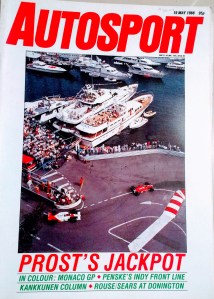
The bit that was the pain was the fact that it was the Monaco Grand Prix weekend which was live on terrestrial TV’s channel 4. The Monaco Grand Prix is a sort of leftover from the days of classic motor sport. It is really rather wonderful to see Hamilton, Vettel and Alonso race on what is  essentially the same track as Fangio, Moss and Clark drove on many years ago. F1 race tracks today are frankly rather boring and the tracks that are pretty exciting are few and far between. Years ago the British Grand Prix alternated between Silverstone and Brands Hatch. Brands is a twisty up and down track and Silverstone, being a former airfield, is flat and full of long straights. In recent years the owners have added a number of twists and turns so Silverstone is not really the track it used to be, perhaps they are trying to make it more like Brands Hatch! Here’s a radical idea: Why not alternate with Brands just like we used to do?

Monaco though is the same as it always was but rather difficult for modern grand prix cars. They are too fast for the tight circuit and their wings and fins that seem to stretch out to hug the downforce are so vulnerable to getting knocked and bumped in close quarter racing. I have to hand it to Max Verstappen though. He started from the back of the grid after a shunt in practice but fought his way through to 9th. Pretty impressive.

Anyway, off the track Monaco is full of glitz and glamour. It’s great to see the former F1 stars who lurk in the paddock coming back to the old venue not as drivers but as visitors, lapping up the champagne, the yachts, the Michelin starred restaurants and so on. One day I will shell out some of my hard-earned cash and go to Monaco for the race and have a very expensive drink in the Tip Top bar where Graham Hill and other stars of my youth used to drink. (Nowadays it’s a glass of organic tomato juice and off to bed early for Graham’s modern counterparts.)

Anyway, as I mentioned, I had to work over the weekend on the late shift so I had to avoid e-mails (numerous F1 website newsletters that might give away the race results) TV, (don’t want to see the results on the news) and friends (always ready to spill the results I don’t want to know) just so I could get home and watch the race on video without any advance knowledge spoiling the results for me.

I’ve spent some time this week as usual with my old mum. She is 89 this year and the days when she would cook my favourite tea, wash all my clothes, and make my bed with crisp fresh sheets are long gone. Now she has to put up with my cheat’s roast beef (boil in the bag beef and frozen roasties) and other meals I produce. Pity she doesn’t care for chilli because I used to make a pretty top-notch chilli.

Today my Mum and I have conversations like this:

ME: Mum, I’m off to work. I’ll see you later at about ten thirty.

MUM: What time are you back?

ME: Ten thirty.

MUM: Are you coming back here tonight?

ME: Yes, at ten thirty.

MUM: What time are you coming back?

ME: Ten thirty . .

Old age comes to us all eventually but I did find myself wondering this week if perhaps I could get one of those mediums to contact the living. My Mum for instance . .

After the bank holiday was over, Liz and I decided to head up north to Scotland for a short road trip in Liz’s motorhome. One of the great things about driving a motorhome is that other motorhome drivers always let on with a quick wave as you pass by. It’s like you’re part of a special group or fraternity, us motorhomers against the world.

The weather was gloriously hot and sunny and we motored serenely north and after a few sightseeing stops finally parked up in the car park of a welcoming pub called the Kings Arms in Ballantrae. Ballantrae is a small village and the only time I had ever heard of it before was in the Robert Louis Stevenson book, The Master of Ballantrae. I happened to mention this to my brother over the phone and being the classic movie buff he is he immediately brought up the movie version with Errol Flynn which was actually Flynn’s last film for Warner Brothers.

Motorhome life can be interesting. The next night we stopped out in the country by Loch Doon. We parked up with a rather lovely view of the Loch and set up our little barbecue and soon we were tucking into a veritable feast of steak, burger, sausage and salad. As the evening wore on and the sun began to sink behind the hills a number of midges, those tiny flies appeared. Time to pack up and settle down inside. Once inside we found midges trying to gain entry through any available area and we had to quickly lock down the vents, windows and pretty much everywhere. I don’t know if you have ever seen Hitchcock’s film The Birds where birds suddenly go on the attack but that pretty much summed up our situation and we fought off those midges with anything we could lay our hands on.

The next morning all was quiet on the loch but the midgies were gathered there on the outside of our motorhome resting before no doubt renewing their attack on us later. Time to make a quick getaway!


Enjoyed this post? Why not try my book Floating in Space set in Manchester, 1977? Watch the video below for a quick taster or click the options at the top of the page for info or to buy!