A couple of things inspired this week’s post which is about artists and their paintings. Artist David Hockney is eighty something years old this year and has just opened a new exhibition of his work in Paris. He was invited by the art museum, Fondation Louis Vuitton, to mount a retrospective of his work focussing on the last 25 years of his artistic output as well as featuring some of his early works and some new ones too.

I remember once watching a documentary about Hockney many years ago with my father and it featured some of his paintings which were done in a rather childish way and my dad looked at me and asked ‘were these what he did as a child?’ Clearly, David Hockney didn’t do it for my dad.
My favourite works of David Hockney were actually not paintings but his Cameraworks in which David took numerous pictures of his subject and then created really inspired collages from the prints.
On 15 November 2018, Hockney’s 1972 work Portrait of an Artist (Pool with Two Figures) sold at Christie’s auction house in New York City for $90 million (£70 million), becoming the most expensive artwork by a living artist sold at auction. Hockney will be 88 in July of this year.
LS Lowry is a northern painter who is famous for his stylised pictures of Salford and Manchester and their mills and factories. He spent most of his life in Pendlebury in Salford and I remember reading a story about him years ago in which another north west painter took Lowry on a visit to the countryside. They set up their easels and brushes looking out on a beautiful rural scene and began to paint. After a while the painter, it might have been Sheila Fell although I’m not sure, got up to look at Lowry’s canvas and was surprised to see not the beautiful surrounding countryside but a northern street that might have been Salford or Manchester.
Clearly, you could take the man out of Salford but not Salford out of the man.
Not long ago I heard about a new film starring Tomothy Spall as Lowry and Vanessa Redgrave as his mother. The film was called Mrs Lowry and Son and to be fair, I found it rather disappointing. It’s not Lowry’s life story but focusses on his relationship with his mother who according to the film was bed bound and was looked after by Lowry who then went up to the attic to paint when she had gone to sleep. She died before her son found fame as a painter.
Today, his name is remembered at the Lowry Art Gallery in Salford Quays where many of his paintings are exhibited.
Jack Vettriano was a painter who I had always thought was an American as his paintings have a sort of cinematic style which I mistakenly assumed came from the USA. In fact, Vettriano was a Scottish painter and gained international recognition with his work The Singing Waiter which became one of the bestselling art prints in the UK. Liz bought me a framed print for a Christmas or birthday present some years ago which hangs in our dining room in St Annes. According to Wikipedia, the original was sold in 2004 to a private bidder for £744,500.
Vettriano was a self-taught artist and his paintings frequently show elegantly dressed figures in ambiguous or intimate settings and his works have met with a mixed reception with some critics dismissing him as populist, whatever that means. Personally, I have always loved his work and my art page over on Pinterest is filled with many of his pictures. He himself said his paintings were inspired by “25 years of sexual misbehaviour”.
Vettriano had homes in Scotland, London and the south of France and he passed away at his home in Nice earlier this year on March 1st.
Many people have compared Vettriano’s work with that of another artist, Edward Hopper. Hopper was an American artist. He was born in 1882 in Nyack, New York. He studied at the New York School of Art where he developed his particular style with an emphasis on solitude, light and shadow. I’ve always thought that his work has a sort of art deco style, similar to magazine illustrations of the 1920s.
Hopper made his first sale in 1913 when he was 31. He hoped this might have been the start of numerous sales but his work took many years to catch on with buyers. His most famous work is Nighthawks which he finished in 1942. He worked for many years as an illustrator for magazines and advertising companies. In 1918 he was awarded the US Shipping Board prize for a war poster titled Smash the Hun. Sales began to take off in 1923 and the resulting financial stability enabled Hopper to continue to create art. He died in 1967.
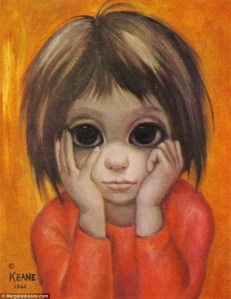 An artist that suffered criticism in the same way as Jack Vettriano was Margaret Keane. I think I had seen her pictures floating about the internet but I knew nothing about her until watching a film about her life. The film Big Eyes starred Amy Adams as Margaret who is an illustrator at a furniture factory. At an outdoor art show she meets painter Walter Keane. The two hit it off and later marry. Keane rents wall space in a nightclub to exhibit his and Margaret’s paintings but he gets into a fight after finding the paintings are displayed by the bathrooms. The fight becomes headline news in a local newspaper and the resulting publicity brings people in to see the pictures that started the fight.
The newspaper stories mistakenly credit Walter as the artist responsible for the popular pictures of people with oversized eyes. Walter convinces Margaret to go along with the deception as he thinks he can market the paintings better while Margaret creates more. The two open a gallery together and sell cheap prints of Margaret’s paintings which are hugely popular. Later the two split up and Margaret has to sue to be recognised as the artist of her Big Eyes pictures.
The film was directed by Tim Burton who is a great fan and collector of Margaret’s work. Like Vettriano, some in the art world have been critical of Margaret’s work but it has been praised by none other than Andy Warhol saying “I think what Keane has done is just terrific. It has to be good, if it was bad, so many people wouldn’t like it.”
Margaret Keane died in 2022 aged 94.
I think I might finish with a few of my favourite pictures.
I’ve always rather liked this painting of Lenin by Isaak Brodsky which shows Lenin in front of the Smolny Institute which was a girls’ school until taken over by the Bolsheviks in the Russian October Revolution. Brodsky was born in 1884 in the Ukraine and painted Lenin and many other Soviet politicians.
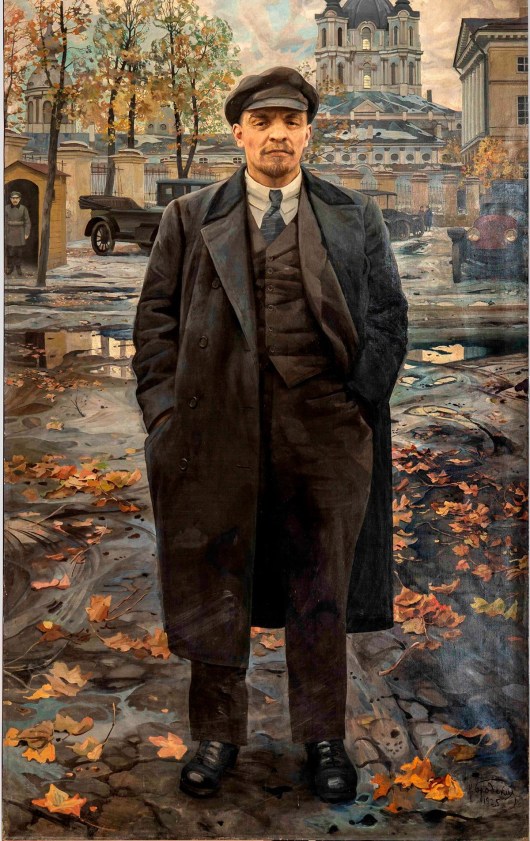
Oleh Isaak Brodsky – http://www.art-in-exile.com/forums/39783-post61.htmlh, Domain Publik, https://commons.wikimedia.org/w/index.php?curid=1398898
Edvard Munch was born in 1863 and painted the famous picture known as The Scream in 1893. The Scream has become a hugely powerful image symbolising the anxiety of the human condition.
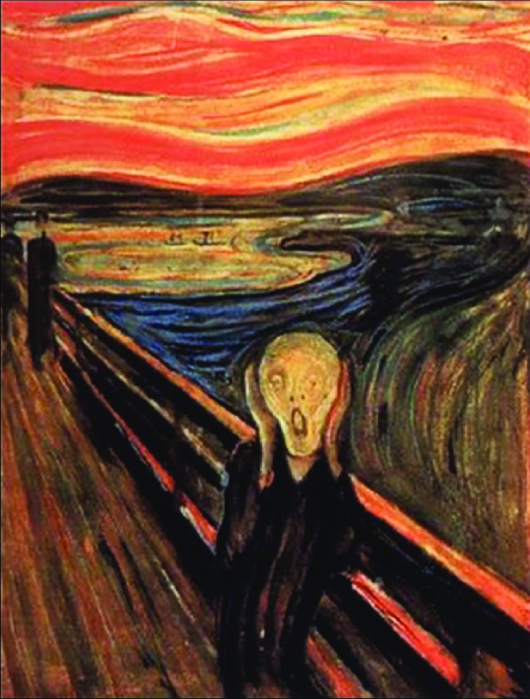
The-Scream-1893-National-Gallery-Oslo-Edvard-Munch-creative-commons
Vincent Van Gogh was a Dutch painter born in 1853 and described in Wikipedia as one of the most influential figures in western art. He died in 1890 after shooting himself in the chest. The wound was not immediately fatal but he succumbed to infection. His last words were apparently ‘the sadness will last forever.’ My favourite of his paintings is Cafe Terrace at Night painted in 1888.

Finally, I wondered what must be the most famous painting ever and it surely must be the Mona Lisa. The artist was Leonardo Da Vinci and it was produced sometime between 1503 and 1506 and is a portrait of an Italian noblewoman named Lisa del Giodono. According to Wikipedia it is “the best known, the most visited, the most written about, the most sung about and the most parodied work in the world.”

creative commons
It currently hangs in the Louvre in Paris.
What is your favourite painting?
Thanks to Wikipedia for all the facts and figures used above.




 This is an autobiography by Fenella Fielding, co-written with Simon McKay, and the title comes from her part in Carry On Screaming when she played a seductive character, possibly derived from the Adams Family, Valeria. In one scene Valeria tries to seduce Harry H Corbett standing in for the absent Sid James as a detective. Valeria asks ‘do you mind if I smoke?’ and then rather than smoking a cigarette, a cloud of smoke seems to arise from her body and envelop her. Harry H Corbett adds ‘just when I was trying to give it up’ before embracing her in the smoke.
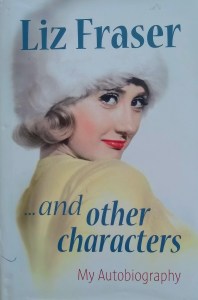 In Fenella’s book above, she mentions that she hoped her book would not go the way of a lot of other showbiz autobiographies, interesting at first but then dissolving into lists of plays and films and other celebrities. Sadly, that seems to be the way this book does go, even so I enjoyed it.
 I do love my showbiz biographies and autobiographies and one I picked up a while back was an autobiography by Dora Bryan. I love Dora from her many appearances in British films but my favourite film is probably
  This final book is the odd one out in this quartet of British comedy stars. It’s a biography rather than an autobiography. I don’t think Tony Hancock ever wrote one.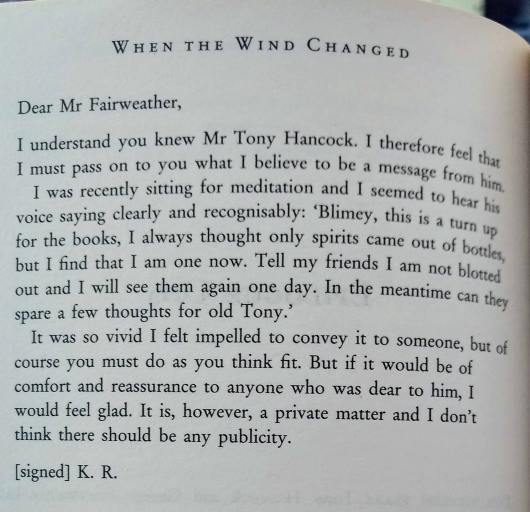
 I know I’ve said this before but now that we are in the digital age, having a shed load of TV channels does not guarantee that us, the viewing public, will find anything worth watching.

 In my last few posts about books, rather than publish my usual Book Bag posts, I’ve incorporated book reviews into other types of posts; holiday memories and posts about books made into films and so on. During my last few holidays, I always seem to either have a couple of John Grisham books with me or found some in the places, usually rented villas, where we have stayed. I thought it might be an idea to write a John Grisham themed book bag post. Who actually is John Grisham then?
 A Time to Kill by John Grisham
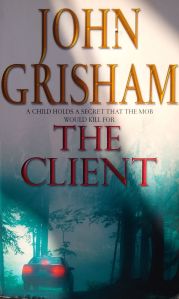 The Client
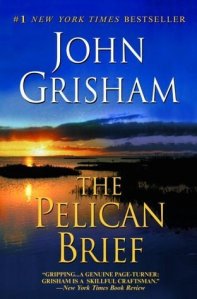 The Pelican Brief by John Grisham
 The Firm by John Grisham
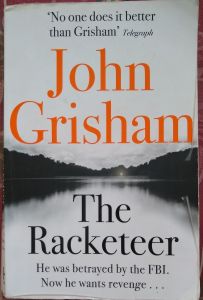 The Racketeer
 The Boys From Biloxi

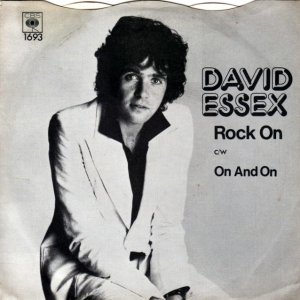 David Essex was another performer who made his name in the early seventies although in his youth he had ideas of becoming a footballer. He played the lead in the stage musical Godspell and then went on to star in the film ‘That’ll be the Day’. I remember seeing his album in a record shop and thinking what a cool dude he looked dressed in a white suit. The album was Rock On and the single went to number 3 in the UK charts in 1973. The next year David released one of my all-time favourite tracks Gonna make you a Star which went all the way up to number 1. He also appeared on the double album Jeff Wayne’s War of the Worlds and went on to star in many musicals such as ‘Godspell’ and Evita. In 2011, he joined the cast of TV soap ‘EastEnders’.
 Donald Trump, the 47th president of the US, has been in the news quite a lot recently. He’s cutting down on the number of federal employees. He has stopped federal help for electric cars, he’s made it known he wants the USA to take over Gaza and he is also negotiating with Russia to stop the war in the Ukraine. He doesn’t seem to have involved President Zelensky in these talks despite Zelensky being the president of the Ukraine. Trump has even cast doubt on Zelensky’s right to be the president as, because of the war, Ukraine hasn’t held any elections. This is quite rich really as Putin, the leader of Russia, has not only rigged the Russian elections but has changed the law in Russia so he can continue as president and has also allegedly bumped off Alexei Navalny, his major political opponent.
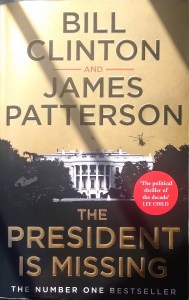 The President is Missing by Bill Clinton and James Patterson has been a good holiday read. A helter skelter fast paced read but moves along quickly and has nicely laid out short chapters to enable me to pause, jump in the pool to cool off and then resume reading.
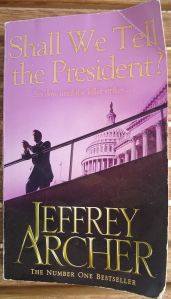 Shall We Tell the President was a novel by Jeffrey Archer first published in 1977. In the book Edward Kennedy has become the US President and FBI agents become aware of a plot to kill the President.
 Over on the front page of this site you will find a whole lot of stuff about me. It tells you that I have always wanted to be a writer, that I enjoy writing as well as Formula One racing, classic cinema and books. In one segment it mentions that I like dining out, in fact it says that dining out is one of the great experiences of life and so I thought I’d start with that, great experiences and see where that leads me.
 Crossfire by Jim Marrs
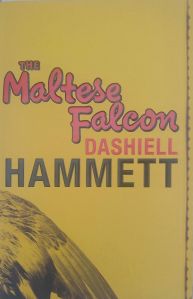 I absolutely loved this book. I mentioned it last week in a post about
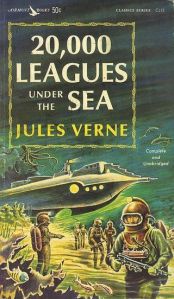 20,000 Leagues Under the Sea
