Today marks my 700th blog post, and I reckon it’s probably the perfect time to take a look back and perhaps even re-evaluate exactly what I’ve been doing over the past 12 or so years.
 700 is quite a milestone, certainly for me anyway. I started writing my blog posts back in 2014 and I’m quite pleased to have got to this point. 700 hundred blog posts. Anyway, after all that and a quick recount later I see that this is actually blog 701. Last week was my 700th post and I didn’t realise. It’s a bit like missing my birthday or waking up on the 2nd of January and realising you’ve missed New Year’s Day.
Seven hundred and one. It’s a number that made me stop for a moment when I began writing this morning; it’s not quite as round and flashy as 700, but somehow more meaningful. Like that first step after reaching a mountain top, it feels like a quiet, intentional nod to where I’ve been and a fresh start for where I’m heading next.
The whole point of this blog, at least when I first set out blogging, was to have a sort of platform to talk about my book Floating in Space. I wanted to introduce myself to the world, promote my book and then settle back and enjoy the millions of pounds that would surely pour in.
As you might imagine, the millions haven’t appeared and although I have had a little success initially with Floating, my other books Timeline and A Warrior of Words have yet to make their mark even though there are links to them within this website as well as more links at the end of every weekly post.
Timeline is a collection of blog posts and short stories and I have to say I really feel quite proud of my posts. I  have written about all kinds of things although I mainly stick to books, classic films, Formula One and me and my little life. Some of those posts I have worked quite hard on and I’ve written and rewritten them and researched and sometimes rewritten again. At other times I have found myself on a Friday staring at my laptop wondering what on earth can I write about and then, right at the last moment, I have either thought of something or remembered a post that was made up of various short elements and decided to take one of those elements and develop it into a new post.
Blogging has so taken over my life I’ve noticed that even when I’m not sitting in front of my laptop I find myself writing a post in my head at various odd moments. For instance, a few weeks back Liz and I went to a Christmas party at a hotel in Blackpool. There were about fifty in our group and the hotel and its entertainment area was filled to capacity. We had a three course meal which was excellent followed by a cabaret style entertainment and then the usual disc jockey playing music. Something came to me while we were eating and when I looked up from my food I realised that a lady opposite was talking to me and I hadn’t heard a word. I sort of started nodding and murmuring yes and getting very funny looks back. It turned out she was actually asking for something, the salt or pepper or something that was right by me. Oh well. The really annoying thing is that whatever I had thought of went right out of my head.
Occasionally, and I do mean occasionally, I’ll have a whole raft of ideas come to me and straight away I am able to pump out two or even three rough drafts of a new post. Then over the next few weeks I’ll work on each one and gradually finalise them for publication. I love it when lots of ideas come especially when we are about to go travelling and then I usually set them up to publish on subsequent Saturday mornings while I enjoy my holiday.
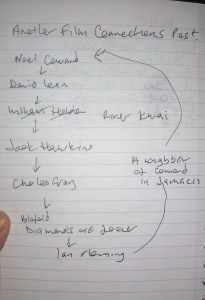 I always jot down notes for blogs, especially those where I try to connect various classic films together so for instance I’ll start with a director or an actor, let’s say Noël Coward for example and then try to go through various films and link together different actors or personalities and eventually end up back with another Noël Coward production. The links on the right are a bit thin but Coward worked with director David Lean, Lean worked with Jack Hawkins on The Bridge on the River Kwai. When Hawkins contracted throat cancer later in life and was unable to speak, his voice was dubbed by Charles Gray. Gray played Blofeld in the Bond film Diamonds are Forever. Diamonds was written by Ian Fleming who was a friend and neighbour of Coward in Jamaica. Click here for the full post.
Sometimes when I wake early in the morning or the middle of the night, I’ll begin to write a blog post in my head. When I’m done and ready to go back to sleep, I’ll save it. In my head I have a house I created after reading a book called Mindstore. Mindstore is a technique for personal improvement designed by a man called Jack Black and it involves creating a house with various rooms for certain activities. The house has a video room in which one can prepare for a job interview for instance by rehearsing the interview and then viewing the future result -the getting of the job- on the video screen.
In my house I created a room where I can store the posts I write in those early mornings and so far it seems to have worked.
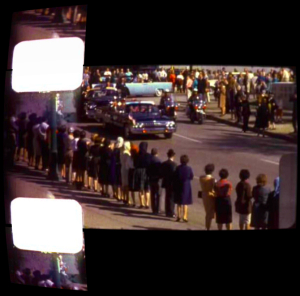
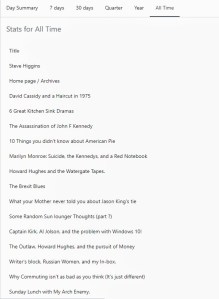
In 2024 my readership hit an all time high, in fact since 2014 when I began blogging, my stats have begun a steady climb upwards but this last year, 2025, readership has dipped a little bit. Have my posts not been as good? My all time most read post was one from a few years ago. It was called Manipulating the Image and was about exactly that. I talked about an Instagram model called Olivia Casta and a claim that her face was a creation of artificial intelligence. That led to Lee Oswald, the alleged assassin of President Kennedy and his claim that a picture of his with the murder weapon was manipulated and then I went on to outline other similar stories of image manipulation.
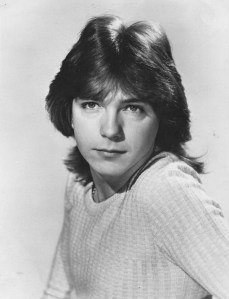
My next most read post was actually my introductory page and then a post from quite a few years back about David Cassidy and a Haircut in 1975.
Quite why a post has had so many hits I’m not sure but that is something that really gets under my skin. I get lots of readership highs and lots of lows but what makes the highs? Why does one post do better than another? Posts aside the big question is do my successful posts link to bigger sales of my books? When it comes down to it, in the world of sales and marketing, I’m just an amateur but what can I do except just carry on blogging until I don’t want to blog any more.
The flip side is I actually really like writing and one aspect of my stats that was really pleasing is that the page dedicated to my book Timeline has recently been pretty popular but then, is that because people like the idea of a collection of blogs and short stories or is because I recently used one of my Timeline videos in an advertisement?
I’ll tell you what, I bet Charles Dickens never had this trouble. Not only that, I need to start thinking about blog #701. (Or is that blog 702?)
 I’ve always been fascinated by transformations either in fiction or in real life but what do I mean by transformations? Well, I have written about transformations before in a previous post. I talked then about Professor Higgins who helped Eliza Doolittle change from a street flower seller to a lady in George Bernard Shaw’s Pygmalion but with this new post I thought I’d start with the story of Dr Jekyll and Mr Hyde.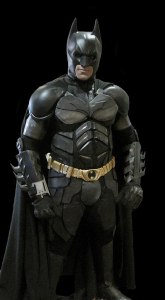

 Coming in third in my all-time most read posts was one from 2014 about the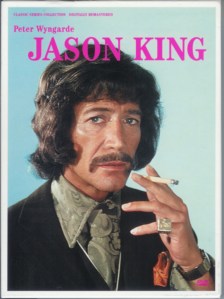
 Monty Python team. The diary talks about Palin giving up smoking, making the first series of Monty Python and various other film and TV projects. It was interesting especially the peripheral things Palin mentions, the Apollo 11 moon landings, the strikes, the three day week and so on and it also brought back a lot of memories of my schooldays when my fellow pupils and I were great fans of Monty Python.
 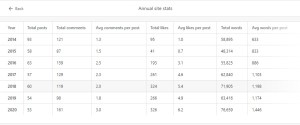 There are plenty of other stats that I’ve gleaned from my WordPress stats page. In my first year of blogging, 2014, I wrote 58,895 words. That figure has gradually expanded and this year, up to the 26th of December as I write this, I published 76,659 words (plus however many words are in this post). Average words per post in 2014 were only 633 words so these days at an average of 1446 words per post the reader is getting real value for money. I say value for money but as SteveHigginsLive.com is an entirely free service that’s not strictly true but I like to think I am doing something towards keeping readers amused during this locked down, mask wearing, hand sanitising time.
 Well, there goes another year. 2019. Was it a good one for you? Hopefully, it was. For me, 2019 was probably the year I became a carer. OK, I’d looked after my mother before but it was only this year that I became aware of how much help she really needed. Anyway, time for a quick look back focussing on my blog posts from this last year. All the links open up into another page to reunite you with my past posts.



 So just what makes us bloggers and why do we blog?
 Quite a few people have asked me about my novel. What’s it about? is a frequent question. Well, it’s set in the late 1970’s and it’s about a young man in South Manchester and his small group of friends. He goes from working in an insurance company to finding himself as a bus conductor in a short space of time and the background to the book tells us about life in the seventies: Music, drink, pubs and Mancunian night life.
 Letters from an Unknown Author!