Confessions of an Armchair Formula One Fan

F1 fanI’m not a great sports fan but I do like my motor sport. I first started following Formula One back in 1970 when I was a school boy.

1970 was a pretty exciting year for formula one racing. Colin Chapman and his Lotus team had unveiled their new Lotus 72, a revolutionary ground-breaking car that set the standard for formula one cars for years to come. Jochen Rindt won the World Championship but sadly he was killed in practice for the Italian Grand Prix at Monza. His points score was never overtaken and so he took the crown posthumously. In fact three F1 drivers were killed that year, Rindt, Bruce Mclaren, the founder of the Mclaren F1 team, and Piers Courage who drove for Frank Williams, a black year indeed for motorsport.

Jack_BrabhamBack in the early 70s there wasn’t great TV coverage but I do remember watching the Monaco Grand Prix live on the BBC and I will always remember that moment when the potential winner, old hand Jack Brabham, slipped into the barrier on one of the last corners letting Jochen Rindt through to win.

A few years later the BBC was not happy about the explosion of advertising on Grand Prix cars and the crunch came when the cars of John Surtees displayed advertising for Durex. The BBC pulled the plug and F1 effectively vanished from British TV screens for a long while. Towards the end of the seventies the BBC began to broadcast the odd race now and again and then their show ‘Grand Prix’ with long time commentator Murray Walker began in 1978 although I don’t think they broadcast the entire season until 1979.

For most of the seventies I had to depend on BBC radio to find out what had happened at the Grand Prix. In 1978 I listened to a report from the Italian Grand Prix about a crash just after the start in which Ronnie Peterson was injured. Ronnie had broken both legs and been taken to hospital. I was glad to hear he was OK. Ronnie was one of those drivers who appeared to me to be destined for a world championship. If someone had told me in the early seventies that Niki Lauda would be a three times champion I would have laughed out loud. He didn’t look or sound like a champion, unlike Ronnie, his team mate at the STP March team in 1972. The next day I picked up a newspaper and was shocked to find Peterson had died during the night from a fat embolism resulting from his broken bones.

Senna, Mansell, and Prost were the great drivers of the eighties and Gerhard Berger sometimes looked like a future champion although he never made the cut. He survived a terrible crash at Imola in 1989 when he hit the wall at Tamburello and his Ferrari burst into flames. I was watching the race live and thinking how could anyone survive that but moments later a marshal’s van drove up and quickly put the fire out. Berger survived with only 1st degree burns to his hands.

Mansell won a great race at Silverstone in 1987, probably one of my favourite races. It was a gamble on Mansell’s part, turning up the boost on his Honda turbo engine to catch Piquet and on the last lap he should have ran out of fuel. According to his dashboard he had, but his Williams somehow kept running to the end finally grinding to a halt on the slowing down lap.

Alain Prost Mclaren 1988 German Grand Prix

Alain Prost Mclaren 1988 German Grand Prix

Alain Prost retired after a comeback season with Williams when he walked to his final world championship in 1993. In 1994 the Grand Prix circus came to Imola for the San Marino Grand Prix and I remember well watching the race live on TV when Senna crashed, again at Tamburello. Someone said to me ‘he’s dead’ but I disagreed, Berger’s crash was worse and he survived. Sadly, Senna did not.

Television has had a great influence on formula one racing. In the nineties Bernie Ecclestone seemed to be trying a lot of tweeks to get more viewers, especially after one rainy Saturday qualifying round when hardly any drivers went out on track. Naturally really because they could not hope to improve on the previous day’s dry running. That spelled the end of Friday qualifying and from then on, only times set on a Saturday counted towards the grid. That tweeking resulted in an interesting knockout qualifying format which is enjoyable and good for the sport but it hasn’t stopped the rulers of F1 trying to fiddle with it even more and that interference has cast a cloud over the first part of the 2016 season.

Bernie Ecclestone

Bernie Ecclestone (image courtesy Wikipedia)

Formula One team bosses are currently in something of a panic. Investors have poured millions of pounds into F1, not because they like the sport but because they find their investment can pay off big style in these days of multi million pound global TV and advertising deals. Reports of failing interest in the sport however has rung alarm bells and throughout the motorsporting media there have been calls to make F1 more interesting. Why are the cars not louder? Why are Mercedes winning all the time? Should we bring back refuelling? Is the high tech aspect ruining the driver input? There are even calls for Bernie Ecclestone, the aging F1 emperor to hand over to someone else. Only time will tell what will happen.

It sometimes makes me smile when I compare Formula 1 to other sports like cricket. Can you just imagine if Ecclestone and his investors had a stake in cricket and the TV viewing figures were down? What would happen then? Increase the number of overs? Maybe have an extra ball in each over, seven instead of six? Change the wooden ball to a rubber one? Add an extra stump?

Maybe they will resolve the issues, maybe not. F1 racing goes from terrestrial channels to Sky pay per view in 2019. Will I be subscribing? I’m not so sure . . .


If you liked this post why not try my book? Click the links at the top of the page for more information.

The Secrets of a Schoolboy Correspondent to the Stars!

A schoolboy correspondentNeil Armstrong, the commander of Apollo 11 stepped out onto the moon in July 1969. He and his crew, Buzz Aldrin and Mike Collins, came home to incredible global adulation and spent a lot of time touring the world and cementing global understanding that the USA had well and truly won the space race. I can’t imagine what it was like to receive that sort of world-wide adulation but for Armstrong his work with NASA was over. He resigned and became a university professor. People at the university of Cincinnati looked at him with wonder. He signed autograph after autograph then realised that many people were using these as a source of income. For every schoolboy who took his signature, venerated it and saved it in some secret safe place, there were others making a buck from every photo or scrap of paper he signed. So, one day, he stopped doing it.

That’s the thing about the famous; people want to connect with them. Today many people see their hero or heroine and they want to take a ‘selfie’ with them on their smart phone. Facebook and other social media are littered with these sorts of pictures, but in earlier times fans wanted autographs. In fact, they still do. Take a look at ebay and you’ll find many hits for the autographs of movie, TV and sports stars. Rare ones cost many thousands of pounds and if you are lucky enough to have an autograph signed by Neil Armstrong, well it’s worth about £8, 500. Autographs by Neil Armstrong are pretty rare and very collectable, partly because he stopped signing autographs!

You might be wondering where I got that figure from, well it’s from the PFC40 autograph index, a listing of autograph values to help collectors. Top of the list is James Dean’s autograph. Dean was famous for only a short while before his death in a car crash at the age of 24 and it’s the rarity of his signature that gives it such a strong price, showing in the index at £18,500! I wish I had the autograph of James Dean or Neil Armstrong in my collection but here are a few of the ones I do have.

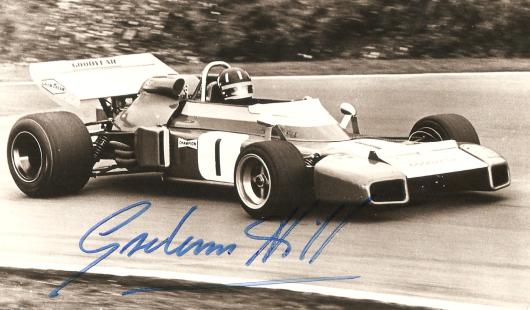
Graham HillGraham Hill can’t really lay claim to being the greatest driver ever, but without a doubt he is one of the greatest motor sporting personalities to ever grace the racetrack. I wrote to him in the seventies and he responded with a card and his signature and it’s one of the prize autographs in my collection. Jackie Stewart, my favourite ever F1 driver and quite frankly, in my opinion, the greatest ever driver, sent me a card with only a machine printed signature. (Little bit disappointed there Jackie!) I have a number of signatures of F1 drivers in the seventies, Bruce McLaren, (founder of the McLaren F1 team) Denny Hulme (world champion 1967) Jack Brabham (world champion 1959, 1960 and 1966) Jackie Oliver, (he drove for BRM in 1970) and John Surtees (world champion 1964.)
Jack_Brabham

Three time world champion Jack Brabham

One of my colleagues who has a daughter who lives in Australia showed me something a while ago. A programme from the 2013 Australian GP signed by all the drivers. Knowing I’m a big Formula One fan my friend thought he had a sure fire sale but sadly, the programme looks a little as if a schoolboy has scribbled all over the pages and the autographs are just undecipherable swirls of a felt tipped pen. It was hugely disappointing and a ‘no sale’ for my friend. Perhaps in the age of the computer, people, well at least Formula One drivers, have forgotten how to write and how much more satisfying are the signatures in my collection than the ones on that programme.

william_shatner

Captain Kirk from Star Trek

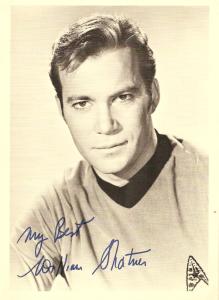
As a school kid I spent a lot of time writing to my schoolboy TV heroes and I have signed pictures from Patrick Macnee who played the debonair John Steed in the Avengers, and Linda Thorson who played Steed’s sidekick Tara King. I wrote to the producers of Star Trek in the USA and they sent me colour pictures of William Shatner who played Captain Kirk and Leonard Nimoy, who was Mr Spock.

Tara King

Linda Thorson as Tara King

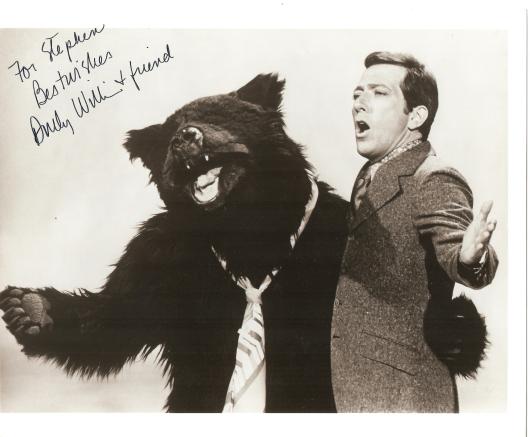
My very favourite autograph of all though is another one from the seventies. I wrote a fan letter to Andy Williams who had a hugely popular TV show which aired on the BBC. My favourite part of the show was a comedy sketch with Andy and a bear (OK, a guy dressed in a bear outfit) who always asked Andy for some cookies and then they went into a different comedy routine every week. I loved the bear sketches so much that I wrote to Andy Williams care of Desilu productions, who were mentioned on the credits of his show, in Hollywood California. Months later, a large envelope arrived and inside was a picture of Andy and the bear. ‘To Stephen from Andy and friend’ was the inscription.

I think it says a lot about Andy Williams, that he should make such a gesture for a far away English schoolboy. Thanks Andy, I loved that picture so much!
Andy_Williams

If you liked this post, why not try my book, Floating In Space? Click the links at the top of the page for more information.

Lost Horizon, Samsara, and a Visit to the Doctor

samsaraDon’t you hate it when you wake up with a tune in your head and can’t seem to get a handle on it? No matter what you do the half remembered tune is playing away in the back of your mind and you cannot concentrate on anything else because you desperately need to identify that tune. It happened to me recently and I was stuck with a tune tinkling away in the background of my head, annoying me no end when eventually a line of the lyric came to me and I was able to track the song down using google. It was a song called  ‘The World is a Circle’ and it came from a musical version of Lost Horizon.
 

I must have mentioned Lost Horizon by author James Hilton many times in this blog. It’s one of my favourite books and it was made into a classic movie by Hollywood director Frank Capra which is well worth getting on DVD. Surprisingly, the film was remade in the seventies as a musical. It was, perhaps, one of those movies generated by the huge popularity of the Sound of Music but sadly it wasn’t a success despite some great songs by Burt Bacharach and Hal David and it was they who wrote ‘The World is a Circle.’

Lost Horizon is about a community in the Tibetan highlands hidden in a secret valley known as Shangi-la. There the people led by the High Lama, Father Perrault, decide to make the valley into a place of safekeeping for great art, literature and music, fearing it could all be lost in a catastrophe like a world war. The religion of the valley is a mixture of Christianity and Buddhism and that is where the lyrics of the song come from. Samsara, in the Buddhist way is the cycle of life; birth death and rebirth, represented by the circle. That circular vision of life is not always so easy to explain but it brings to mind a little anecdote that I think is worth sharing . .

A long time ago, years ago in fact I had this really bad pain down my right arm. It didn’t get any better, in fact it got worse and worse so I called in for an appointment at the doctors. I got to see Doctor Kowalski (as usual names have been changed to protect the innocent.) The thing with Doctor Kowalski was that anyone could see him any time because he wasn’t a doctor who was much in demand. Why not you might ask? No one really wanted to see him because all he wanted was to get you into his office and get you out again.
I sat down and the doctor smiled and asked ‘how can I help you?’
‘Well’, I began, ‘It’s this pain down the side of my arm . .’
I stopped because Doctor Kowalski was already writing out a prescription. Already, and this was before he examined me and before I even finished speaking. Moments later I was on my way out of his surgery and the next patient was already on his way in. All I had to show for it was a prescription for pain killers.

Dr Kowalski must have looked good on the surgery stats as it looked like he dealt quickly with a lot of people but as we all know, statistics don’t always tell the full story.
A few days later the pain was as bad as ever so I went back but I asked to see Doctor Edwards. Now Doctor Edwards was one of the most popular doctors in the surgery. Why? Because he actually listened to you! He was fully booked up for a while and it took me a week to get in to see him but when finally I sat down in his office, he listened attentively, asked a few questions, took a look at my arm and then sent me for an X ray. It turned out I had a nerve trapped in my neck which was referring pain to my arm and I needed to see the physiotherapist but the waiting time was about six weeks so I decided to go to a private physio.

The fee was something like £50 an hour and my first session was pretty good. A good check-up and a great shoulder and back massage which did me no end of good. The next week I went back but this time the physio said, think I’ll try you on the ‘machine’. He explained quickly what it was: Something which stimulated the muscles and increased blood flow which apparently was a good thing for my condition.

I lay back on his couch and this machine with lots of suckers was attached to various points on my neck and shoulder and went to work. I was on it for thirty minutes. It did nothing for me but lightened my wallet by £25 and I noticed that in the other room another patent was getting the helpful massage I had been expecting. When it came to booking the next appointment I decided that a free day in my busy schedule wasn’t available.

Anyway, a week or so later I got to see the NHS physio. She was a lady, a little old lady in fact. When I walked in to see her she offered me a seat then shouted at me to ‘sit up straight!’ No wonder I had neck and back issues because my posture was dreadful! She may have been a little old lady but she gave me some stick, not only verbally but she did a lot of work on my neck with her hands and eventually the pain in my arm slipped away and I gradually returned to normal.

At the end of my treatment she told me not to bother going to the doctor again; ‘Come straight to me and I’ll sort you out but for heavens sake, sit up straight. Get your posture right and you’ll be fine!’ ‘OK,’ I said, ‘thanks.’

Some months went by and I began to get the same symptoms again so I went into the doctors surgery and asked to see the physio. The lady on the desk said no, I had to see the doctor first. I told her what the physio had said, go straight to her but the receptionist was adamant- I could only see the physio with a referral from the doctor. As I was dejectedly leaving the surgery I saw the physio and went over and told her what happened. She took me back to the reception, gave the receptionist there some first class stick and booked me in the next week to see her. Happy days!

About six to eight months later I once again began getting the neck and arm problems so I returned to the surgery. The receptionist advised me (with far too much smugness, I thought) that the physio had retired and a new younger model had taken over and this one would not see me without first seeing the doctor.

I made an appointment, went into to see the doctor and found myself with Dr Kowalski, pen in hand, ready to write me out a prescription for painkillers!

See, the world is a circle after all!


If you enjoyed this post, why not try my book? Click the links at the top of the page or here to go straight to Amazon!

A Brief History of TV Spies

quotescover-JPG-40Now that the X Files has returned to our TV screens I thought I might just take a quick look at TV spies and secret agents. I’ve always been interested in espionage, and the earliest TV spy show I can remember was the Man from Uncle. In case you don’t remember, the show starred David McCallum as Ilya Kuryakin and Robert Vaughn as Napoleon Solo. It was one of those slick and smooth TV shows from the USA and I even read somewhere that Ian Fleming, the creator of James Bond, had a hand in producing the series format.

Solo and Kuryakin were agents of UNCLE (United Network Command for Law and Enforcement) and used a various array of gadgets in their persecution of criminal organisation THRUSH (Can’t remember what THRUSH stood for!) They had pens that were communicators; ‘open channel D please‘ was something we used to hear our heroes say frequently, explosive devices hidden in the heels of their shoes and I loved every moment of it. The Head of UNCLE, Mr Waverly was played by film actor Leo G Carroll and he worked in a secret headquarters in New York accessed via a dry cleaning store. There was even a spin off series called the Girl from Uncle which starred Stephanie Powers.

1000501009DVDFLT_33df324They recently remade the Man from Uncle into a big screen movie but looking at the trailer, a lot of the best elements were not there; the music, the suave Robert Vaughn, the boyish David McCallum. To be fair I should save my judgement until I’ve seen the film but can you really recreate  something like the Man from Uncle on the screen, years later? I’m not so sure.
In the sixties and seventies there were plenty of crime and espionage series, things like The Avengers with Patrick MacNee as John Steed and his lovely sidekicks Cathy Gale, (Honor Blackman) Emma Peel, (Diana Rigg) and Tara King (Linda Thorson.) The Avengers was a thoroughly British tongue in cheek espionage show which was revived in the eighties as ‘the New Avengers‘ with Joanna Lumley as Steed’s new assistant, Purdey. Back in the sixties though there were other shows like Danger Man with Patrick McGoohan and the Prisoner, which was a sort of secret agent show with a twist. It starred McGoohan as a former agent trapped in a mysterious village. Perhaps he was the character from Danger Man, perhaps not, but those who ran the village wanted information and Patrick McGoohan’s character, number 6, wasn’t ready to give it!

In the 1970’s there was the Six Million Dollar Man starring Lee Majors as astronaut Steve Austin. Austin is injured in a testing accident but as they said in the opening titles, ‘gentlemen, we can rebuild him, we have the technology to make the world’s first bionic man!’ Steve Austin with his bionic legs could run faster than before, see better and hear better because of ‘bionic’ technology and he became a super agent for his boss Oscar Goldman.

In 1979 the BBC produced a TV version of Tinker, Tailor, Soldier, Spy, the novel by John Le Carre. A little slow and at times even tedious, it was a view of the other side of the spy world: Shabby men in overcoats and rain macs. The thankless tasks of checking files and sifting information to find a ‘mole’, an agent in the UK working for Moscow centre. The series was remade into a feature film in 2011 which I found rather dull although plenty of great reviews of the film can be found on the internet.

In the 90’s US TV brought us the X Files, a mix of spies, espionage, crime and sci-fi. Personally I rather liked the series but I always had the feeling that the writers had written themselves into a sort of hole and didn’t know the way out. What was the big alien secret? Who was the cigarette smoking man? Yes, I don’t think the writers ever knew. My all time favourite episode of the X-Files was a two parter where agent Mulder is somehow morphed into the body of a CIA man and the CIA man morphs into Mulder’s body.

In 2001, a new fast moving spy drama hit the TV screens; 24. I loved 24 with its  high tech control rooms and the ease at which staff members sent maps, CCTV images, Satellite pictures, and all sorts to Jack Bauer’s gadgets. The idea of 24 was that a complete story covering a full twenty four hours was told in real time, each episode being an hour of the day. Funny though, no one ever had a sleep in those twenty four hours!

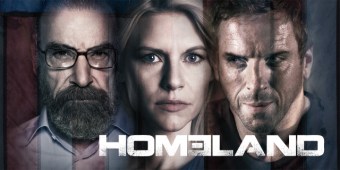
Homeland

Homeland

Recently I picked up a DVD of the US series Homeland. It was season 1 when UK TV is just showing season 4 and the series was fantastic. Great acting, some tight direction. Excellent camera work and some really taut and intelligent writing. It’s more of a psychological drama than an action series and I love it. The only problem is I’m three series behind. Do I wait for re-runs or do I get series 2 on DVD?

Anyway, getting back to the X-Files, what do you think of new 2016 series? All the original stars are present, it was made by the original production team and even used the same opening titles so you’d think the result would be pretty good. Actually Mulder looks a little tired. Scully isn’t quite so alluring as she used to be and the first episode seemed to play up all the aspects I didn’t like about the original, especially the ‘conspiracy’ and ‘alternate government’ paranoia stuff. I wasn’t hooked enough to watch episode 2 but wonder of it’s worth doing a quick ebay search for the Man from Uncle on DVD. 1960’s version, of course!


If you liked this post why not try my book Floating in Space? Click the links at the top of the page for more information or click the picture below to go straight to amazon.


My 10 Best Posts of 2015

dsc_ed0287Yes, it’s that reflective time of year again, the one where we look back at the last year, review what happened and work out what will be our resolutions for the next one. We’re not necessarily going to keep those resolutions but what the heck; it’s a worthwhile exercise anyway. I planned to write a follow up novel to Floating In Space in 2015 but I stalled after two chapters. Oh well, I’ve got an extended holiday in Lanzarote to look forward to in January 2016 so I’ll have to sit down and get stuck in. Come to think of it, I had an extended holiday in Lanzarote in January of 2015 but only managed to drink a great deal of wine, eat a great deal of tapas and swim a lot. C’est la vie as they say, at least I did a lot of ground work for the sequel and I did get those two chapters down on paper so the minimum I might expect this time is, chapters three and four!

Looking back at my blogging year my anecdotal posts have thinned out a little and I’ve concentrated a little more on two of my favourite things, books and classic movies. What I’ve tried to do is perhaps link some personal moments to something about books, film or TV and give a personal slant on my subject matter. One of my goals in blogging is to emulate the talkative, colloquial style of my novel Floating In Space in my posts, so if the reader likes the posts, he might just part with some money and buy my book! Psychology, isn’t it great! Anyway, hope you have all had a fabulous Christmas and New Year. Best wishes for you in 2016 and here’s a quick run-down of my favourite posts of the year!

1: Be Nice to People on Your Way Up! Absolutely. Just remember, if things go wrong, you’ll be meeting those same people on the way down!

2: Breakfast TV and the Apollo Moon Landing. I remember this like it was yesterday, getting up for school and the Moon Landing was being shown live on TV! How my poor mother managed to pack me off to school, I’ll never know!

3: What Happened to my White Jacket and my 70’s Pop Star Heroes? This is an interesting post and it’s strange to think how much we, as youngsters, are influenced by our heroes from the world of TV and music. It was David Essex who unwittingly influenced me to buy a white jacket but it didn’t turn out to be the babe magnet I thought it might be!

4: Marilyn Monroe: Suicide, the Kennedys, and a Red Notebook. I’ve probably got more books about Marilyn in my book collection than about any other movie star. Not only is she such a fascinating character but her death is just as big a mystery as the Kennedy Assassination and I do love a mystery!

5: A few unconventional Thoughts about Time. Travelling through France and seeing the relics of past wars inspired me to write this post about time and the way it passes.

6: Sunday Lunch with my Arch Enemy. This was an updated post about Liz’s father, who sadly passed away in October, 2015.

7: Four Random Thoughts on a Sun Lounger. A little sun, a sun lounger and a notebook and it’s amazing what comes to you!

8: Why Commuting Isn’t as bad as you think! Travelling into the City centre for a management course wasn’t a complete waste of time as I came up with this post!

9: TV Movies and a Serious Case of Deja Vu! I do love my TV movies but why do we get the same ones, time after time?

10: 12 Chart Hits from a Decade when Music was Fun! A quick bit of research and here’s the result, a fun filled music video post!

Hope you enjoyed my post. You can check out my favourite posts of 2014 here and if you fancy reading more of my work why not check out my book Floating In Space? Click the links at the top of the page for more information or the icon below to go to my Amazon page.

FIScoverbuynow


Why Commuting isn’t as bad as you think (It’s just different)

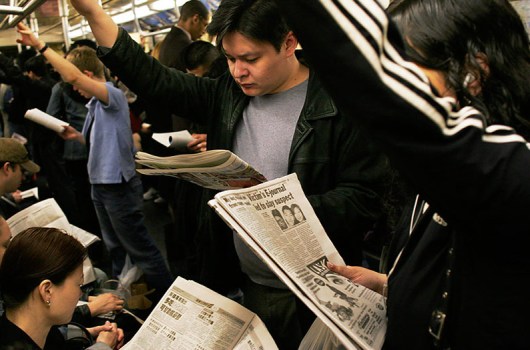
NYC_subway_riders_with_their_newspapers

Commuters reading newspapers? Nah, not in the 21st century! Commuters are more likely to be glued to tablets or smartphones! (Image courtesy Wikipedia)

It’s a long time since I’ve been a commuter. Now I come to think of it, it’s been a very long time. My first job after leaving school was at an Insurance company in Manchester and I travelled to work either by bus or by train. Going by rail was slightly more expensive as I remember it but the advantage of going by rail was that the railway station was only a stone’s throw from where I worked. That was quite handy after work as it was nice to pop into the pub, either the Salisbury or the Beef and Barley for a few pints then nip round the corner to the station when I was ready to go home. I remember it well: The walk to the station and then finding my usual spot on the platform. There were plenty of other regulars who travelled with me, not that I ever got to know them but day after day we waited together on that platform. We boarded the train together and slipped into our own favoured seats. On the journey back I particularly remember one young girl, slightly older than me with lovely long legs. Wish I’d got to know her!

In my current job I work shifts so the rush hour is something I rarely embrace. This week however I went to a training course in Manchester which started at 9 am so once again I joined the ranks of the commuter.

The 07:27 from St Annes on Sea to Preston where I had to change trains was a pretty nice trip. Busy but not excessively so. Everyone knew their place and seemed calm and organised. No one played loud music or hogged seats by leaving bags or coats on them. In Preston I nipped smartly across to the next platform and was just in time for my connection to Manchester. This train was pretty busy but once again seasoned commuters filled the train and as it was the trans-Pennine express to Manchester Airport, it was a much comfier train with roomier seats.

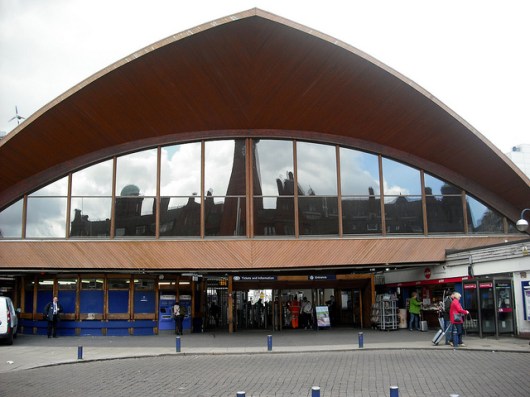
Oxford Road Station. Photo by the author

Oxford Road Station. Photo by the author

The train stopped at Oxford Road, my old stop from my insurance days and a great many people left the train there. After that we rumbled on through the centre of Manchester, bumping and squeaking over the old track, looking down on Oxford Rd and passing behind my old office and on to Piccadilly station.

The journey back was something of a different nature. Those who had come on the train from the airport were a little surprised by the rampant hordes waiting for them on the platform at Piccadilly. Many had returned from trips abroad and sat scanning newspapers for news of the home country. Coffees and teas littered the tables and some had left bags and cases on the seats. Then the train slid to a halt. Some looked idly up to see where the train had stopped just in time to see the doors open and a mass of humanity surge in like a tidal wave. The afternoon rail trip brought passengers of a different nature. People playing loud music, people taking up two seats who gave them up reluctantly as ever more people crammed into the carriage. Many people seemed glued to their mobile phones, oblivious to the outside world and blocking it out with their earphones. Back in the seventies commuters read books or magazines on the train. Nowadays, they listen to music or watch video on smartphones or tablets, plastic earpieces plugged into their heads.

The trip back home involved a long wait, usually half an hour for my connecting train in Preston. In the early evening this train was invariably rather like an old bus that had been dragged from the back of the garage to help out in the rush hour. It was dark going home and the conductor garbled the name of the approaching stations over the rather raucous tannoy. I listened incomprehensively and peered through the gloom of the window to try and spot a familiar landmark. One evening I nearly exited at Ansdell and Fairhaven by mistake. I was glued to my book and glanced up to see what I thought was my station coming up. The lady next to was watching a video and didn’t appear to see or hear me trying to get past her. She had her earphones set firmly in her ears blocking out any unwanted sound and I had to shout to get her to see me and let me past. The train doors closed just as I got to them but luckily I was a station early and St Annes was the next stop. Looking around I seemed to have been the only person reading a book. Almost everyone was concentrating on a smartphone or tablet.

Times have changed since the late seventies.


What to do next:

Share this post on your favourite social media!

Hit the Subscribe button. Never miss another post!

Buy the book! Click here to visit Amazon and download Floating in Space to your Kindle or order the paperback version.

How to deal with Laptop Failure and the Rules of Writing

quotescover-JPG-23Take a look at the picture just below. Not a particularly outstanding picture I know but that house is the one where I grew up. I took the picture a while ago after a sort of nostalgic drive around the old neighbourhood. Yes, the house with the white door, that’s my old home. It’s changed a bit since I lived there. The privet hedge has gone and the car space is new. One amazing thing I found out on that visit is that the walk to my old junior school, which seemed to be a heck of a walk as I remember it; surely at least a thirty minute walk, was actually more of a ten minute walk: Well, it was a long time since I walked to my junior school. I stopped in the road, took my picture, became lost in thought for a moment as a thousand memories crowded my mind, then drove off.

14nuffieldThose memories and other ones always come back every time I look at that picture. I happened to be looking at it because my new laptop finally arrived and all my files had been moved over by the guys in the computer shop and I was just checking through them. It’s been over a week since my trusty old laptop overheated and expired and I’ve missed it. I’ve not been separated from my e-mails because I have a tablet, actually a Blackberry Playbook which is good but there’s a lot I just can’t do on a pad. Writing is difficult; in fact, it’s not unlike writing a text on a mobile phone and there’s no way I could write a blog post using it.
It was quite a shock, my laptop failing as most of my digital life is stored there. Luckily I have a portable drive on which I store my files although I mostly save completed works; fully edited videos, fully written blogs, that sort of thing. The half-finished ones, and believe me I have plenty; half-finished scripts, fragments of poems, ideas for blog posts; they were all there on the hard drive of that old laptop.

I felt a little like Carrie in Sex and the City. Remember that episode when Carrie’s laptop –an apple mac actually- conks out? Her boyfriend Aiden vainly hits the control alt and delete keys and makes things worse and Carrie, a writer with a column in a New York newspaper had lost all her work. Now I know how she felt.

Just looking at the clip above brought it all back. I was just as wound up as Carrie. My laptop couldn’t be repaired but not long ago I’d picked up a laptop that had a broken screen at a car boot sale. It was a sort of impulse buy but at least the computer guys could fix it and transfer my data over. I’d had the other laptop four years and it lasted longer than my previous two laptops. Wonder how long laptop number four will last?

One more connection with that picture and it’s to do with writing. Creative writing. I subscribe to a lot of blogs and groups and on Facebook there’s this writer’s group I’m a member of and members are always, naturally, posting stuff about writing. One post I read recently was ‘never start a novel off with the beginning of a day.’ Why the heck not I thought? It seems to me a pretty normal way to start a novel: The hero wakes up and the writer describes the surroundings and introduces the characters naturally as we meet them and so on. In fact, my novel, Floating In Space, starts off in exactly that way with my main character, Stuart Hill, waking up and getting ready for work.

Another thing you see on this writers’ page are graphics. You’ve probably seen the sort of thing I mean all over the internet. This particular one was about rules of writing. Rules? What rules? Well it said that if you’re describing something, some incident, your description shouldn’t last longer than the actual event! Now that just sounds bonkers to me on a whole lot of levels. Where did the writer get that information? Who decided on that ‘rule’? The only rules that I stick to as a writer are the rules of grammar, and believe me, a lot of the time, either accidentally or on purpose, I bend those rules too! One more thing; did Dickens and F Scott Fitzgerald and Hemingway and all the other great authors adhere to these ‘rules’? Did they even know about them? I doubt it!

Anyway, I decided to comment on this graphic. I said that it didn’t matter whether the real event was long or short-lived, it’s the importance of the event to the narrative that matters, and that all depends on the author. The person who posted the item replied by adding a comment that included a link to a police report that showed that when shocking events happen, people don’t always take much in. Anyway, what that meant I don’t know so I added another comment about how the writer should take control of the reader and make events either important or unimportant depending entirely on his vision of the novel.

Straight away another comment came back at me saying it was the reader in charge, not the writer. Well, of course the reader is in charge as to whether he reads your book or not, but as soon as he does decide to read, it’s the author who is in control, it’s the author who shows the reader what he wants to show him, hides what he wants to hide, and reveals in whatever way he wants, whatever he wants to reveal. Anyway this annoyed the other guy no end and a sort of internet argument began. The sort of thing you’ve seen before probably. After a while I stepped back before things got nasty. I do hate those internet arguments you see in the comments section of posts and anyway, I’m convinced I am right and the other guy was a complete plonker. Tempted as I was to say that on the post, I’m happy to say I resisted!

That of course brings me back to the picture of my old home. The photo only took a moment to take but it’s nice to think about that house and all the happy times I had there. Not only that, my Grandma and Grandad lived there before us. They moved to Prestatyn in Wales and my Mum and Dad took over the house when they were first married. I could go on and on about that house: about how I learned to ride a two-wheeler bike just in front of it: About the soap box cart I made with my friends with some wood and parts of an old pram and how we careered through the streets with it. One time my friend Gary Chapman was given a set of walkie talkies by his dad for Christmas and he and I used to chat to each other at night as our houses were pretty close together. I could tell you much more but the thing is, if I did go on and on I’d go over my allotted time.

Dear me, can’t go breaking the writing rules can we?


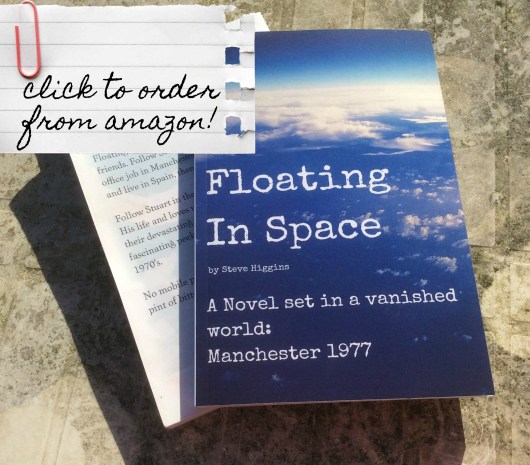
If you liked this book, why not try my novel, Floating In Space, set in Manchester in 1977? Click the links at the top of the page for more information or click the image below to go straight to amazon.


Sunday Lunch with My Arch Enemy.

I published this post some time ago but sadly, my arch enemy passed away a few days ago on the 22nd October. He wasn’t really my arch enemy just a lovely old man who liked to engage in some cheerful banter. Sunday lunch will sadly never be the same again. RIP Harry.

quotescover-JPG-20Sunday afternoon and my arch enemy is about to arrive. Zoe, Liz’s daughter has picked him up and I can hear them at the front door. I’ve lit the coal fire and done a quick tidy up and Zoe is showing him through. In the hallway he asks “Is the Mad Monk in?”

That’s me by the way, the Mad Monk.

“Bloody hell Zoe,” I say. “I had that door locked to keep the riff raff out!”

“Stephen,” he says using my Sunday name as he comes into the lounge. “We don’t mind slumming it with the riff-raff. Anyway, how lovely to see you!”

“Always a pleasure to see you, Harry,” I reply.

Harry is just approaching ninety years of age and all his faculties are in order although his memory is perhaps not as good as it used to be.

“Take a seat Harry,” I say. “What can I get you? A glass of water? Lemonade? A cup of tea perhaps?”

Harry turns to Zoe, a fake look of disdain on his face.

“Pillock!” he murmurs.

Liz brings him a glass of French sherry..

“That’s more like it,” he says.

The women go off into the kitchen to sort the dinner and Harry and I chat about various things. Once Liz and Zoe come back though, we resume battle.

“Harry went for a brain operation the other day,” I announce, matter of factly. “It was free but they charged him £2000 search fees.”

“Dear me, I wish you’d try some new jokes Stephen,” comments Harry. “If you had a brain you’d be dangerous,”

Over seventy five years ago when war broke out Harry decided the army wasn’t for him so he went on a wireless operators course in Preston then signed up in the merchant navy as a ‘sparks’.

His first voyage took him down through the Mediterranean to the Persian Gulf and Iraq. One day while his ship was being refuelled he went for a walk and he heard a voice call his name. He turned to find one of his old schoolmates hailing him. Frank and Harry went to school together, both went to sea and bumped into each other in Basra, along the Shatt-Al-Arab river,  a place Harry called the ‘arsehole of the world.’

Harry had no money on him but his friend Frank treated him to a meal and a few beers and they didn’t see each other again until Harry’s fiftieth birthday, many years later.

“That doesn’t surprise me Harry,” I say. “That poor fella, having to pay for everything. No wonder he didn’t want to see you again.”

“Stephen. What you don’t realise is how hurtful insinuations like that are to a sensitive man like me.”

“I’ve not noticed your sensitive side Harry.”

“Well, you will in a minute if you don’t top my wine up, garcon!”

The wine is topped up and Liz calls for a ‘skivvy’ to help in the kitchen.

“That’s a good word for you Stephen, skivvy. Off you go and if you do a good job there might be a tip in it for you!”

Atlantic convoys during World War 2 were a lifeline for the UK. Bringing in food and supplies and munitions as we fought alone against the Nazis after the fall of France. U boats were a deadly menace to our ships and Harry told me once how he lay on his bunk shivering with fear during an attack. If a ship went down there was no one to help. Other ships couldn’t stop for survivors as they too might be torpedoed. After a while though Harry told me you just got used to the threat and got on with your job. He told me of trips to the Middle East taking tanks and equipment for the Middle Eastern campaigns. A trip from Argentina to the UK with a cargo of rice. A visit to Rio and a trip to New York.

We eat our Sunday dinner with little let up in the banter. Later when it’s time to go Harry turns to Liz and says, “Lovely meal darling.” Then with a wink he says, “pity about the company though.”

So, let me finish Harry with the toast that you so often give to me,

“May your shadow never grow less.”

A Sci-Fi DVD and an Incredible Moment of Self Discovery

Something incredible happened to me this week: I found out I wasn’t the oddball nerd I thought I was in my youth, or at least I was but I found out there were others like me, I wasn’t alone and the nerdy things I used to do were done by many others!
So what nerdy things did I do? Well, here’s one example. In the seventies, before the age of the video recorder I had a small audio cassette recorder and did all sorts of things with it as a teenager. I wrote a number of comedy plays which my poor brother was roped into and we performed these little comedy sketches to the microphone. I did enjoy making the sound effects. One that comes to mind was my brother being sick which involved him making a retching sound then pouring a bucket of water down the toilet! I also used to record some of my favourite radio and TV programmes. I bought a second hand radio cassette recorder which enabled me to record the top twenty every week (dud records edited out of course) but TV presented another challenge. I would record a show using the microphone placed near to the TV speaker. Trial and error found the correct spot; not too close, not too far away and my family were sworn to silence during the recordings, not that that would stop my brother, or even my dad making some small comment towards the end of the show!

Photo0033So, how did this realisation that I was not alone in my nerdiness – or even a nerd at all- come about?
This realisation came about because of a gift. My brother, I might add, who is not a man known for his giving of gifts, had been given some DVDs that were of no interest to him so he passed them to me. They were BBC DVDs of the long running TV series, Doctor Who. Now I have been a Doctor Who fan for many years. I faintly remember the original Doctor Who, the grumpy bad tempered chap played by William Hartnell. The very first episode of Doctor Who, ‘An Unearthly Child’, is one of the highlights of my DVD collection and interestingly it was broadcast on the 22nd November 1963, the day of the John F Kennedy assassination. Because of the tragedy the BBC re ran the episode the following week which is perhaps why the original has survived. The thing is, back in the 60s when digital recordings and home video were just a gleam in some inventor’s eye, the archives at the BBC were getting a little crammed so what did they decide to do about it? Two things, One; they would wipe the tapes and reuse them for other shows and two, they would simply get rid of them!

Crazy, but of course, the value of these old TV shows was not understood then and many hours of classic TV was lost in this way. Not just Doctor Who but Not Only But Also, the Peter Cook and Dudley Moore shows, Doomwatch, Hancock and many others, all lost.

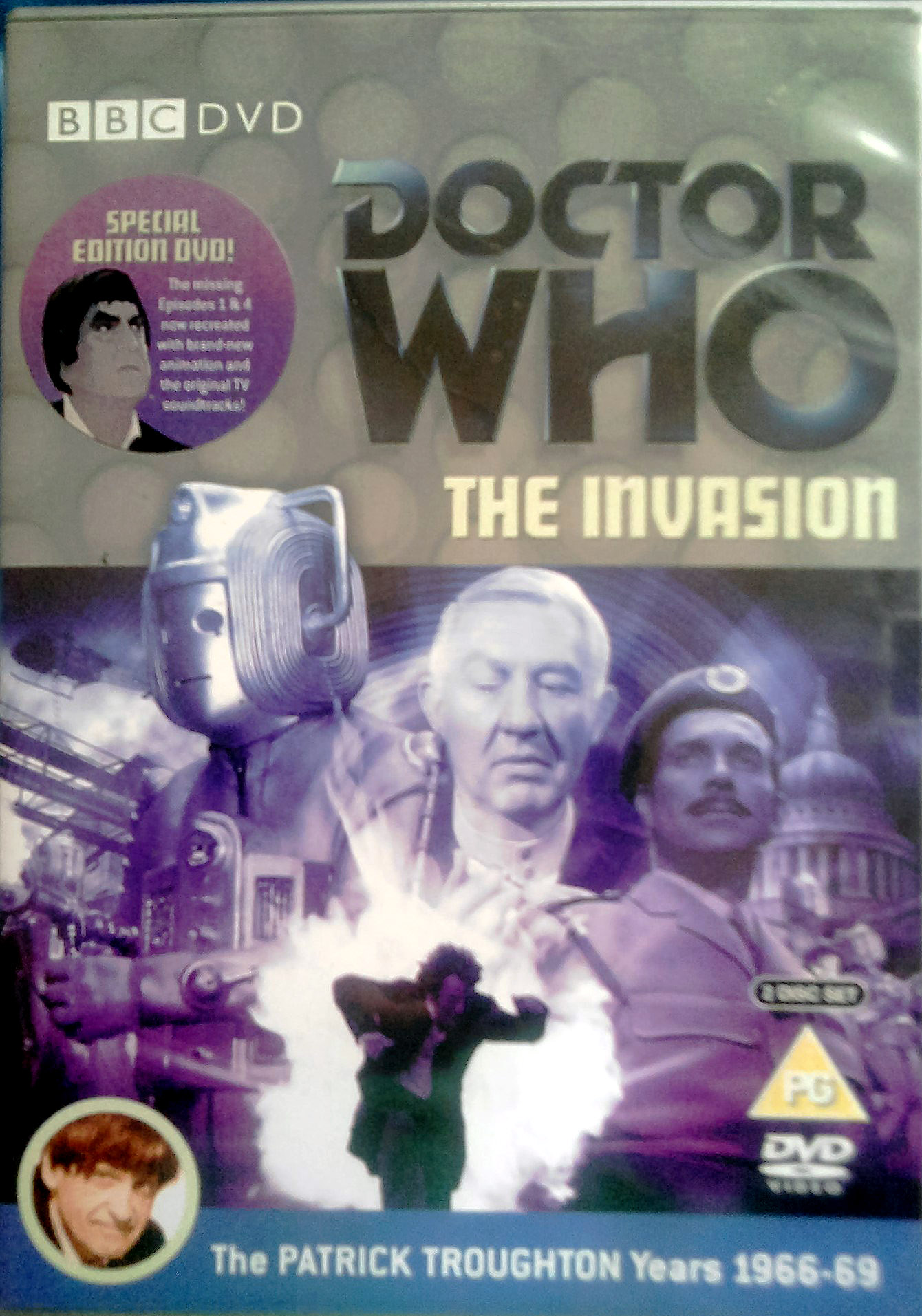
Anyway, one of the DVDs my brother gave me was ‘the Invasion’ from 1968 with the second Doctor Who, Patrick Troughton. The Invasion was made up of eight half hour shows and two of the eight had been lost or junked. Now many TV shows of the time, recorded on video were copied onto film by a telecine machine so the tape could be reused and the show broadcast again or sent to other parts of the world for broadcasting on foreign networks such as South Africa, Canada and so on. Many of these telecine recordings survive. Some have even known to have been rescued from tips or skips by BBC employees and even members of the public. Recently a lost episode of Doctor Who was found in Nigeria!

Anyway, here’s the punch line to this whole blog: When the BBC guys decided to reconstruct the missing episodes guess where they got the audio from? From audio recordings made by members of the public! Yes, Doctor Who fans who as youngsters recorded their favourite shows on audio cassettes, just as I did by placing  a microphone by the TV. So there we have it, conclusive proof that I wasn’t a nerd after all, or at least the nerdy activities of my youth were the same nerdy activities that other youngsters were involved in too!


If you enjoyed this post, why not buy one of my books? Click the links at the top of the page to buy or for more information!

5 Incredible Trigger Points to my Personal Timeline!

quotescover-JPG-44Time moves on as we go about our daily lives but there are always connections back to the past. The things we see, the things we hear, in fact anything we come across, even something as vague as a scent can be a trigger point that takes us back to a time and place we loved, or sadly, perhaps even hated. Memories are intrinsic to our personal selves, they are what makes us who we are.

I don’t know if you remember that TV series from a long time back with James Burke. It was called Connections and it showed how unrelated events from the past were connected to things in the present. Anyway, here’s my take on some personal connections to the past.

1.
Some time ago, and I’m going back a few years because this incident took place in Woolworths in St Annes and Woolworths, that shop that was always there in my youth went bankrupt and disappeared a few years ago. Anyway, I have always been one for skimming through records and CDs, especially when the word ‘sale’ can be seen. In Woolworths I picked up a compilation CD. It had some really nice tracks and a few I’d never heard of but I chose it particularly because of one track, ‘Horse with no name’ by America. I’ve always loved that song and I don’t have a copy of it so I bought the CD. Later when I had got home and played the album I was surprised to find another track that I hadn’t spotted earlier, it was Desiderata, a poem by Max Ehrman made into a pop song, of sorts, by an American guy called Les Crane.
Now not only is that poem one of my favourites but so is the musical version. It was played a lot at school by our headmaster in the morning services and as soon as I heard it again it brought memories of those long ago schooldays flooding back to me: The registrations, the morning assembly, the prayers. Back in the late sixties a lot of those morning assemblies were about Vietnam and how our headmaster, Mr Trickett wove his morning address from Vietnam to the Desiderata, I do not know but that musical version was something I loved and finding it again on a CD was like getting part of my youth back.

2.
I’ve related this story in another blog but this is a great connection so I’ll tell it quickly again. In 1992 I decided to have a last stab at my ambition to break into the TV and film world. I enrolled on a video production course in Manchester. It was only a short course and it was aimed at unemployed people which at the time, I was. Anyway, I had to make a presentation about TV and film and why I wanted to work in video and happily I was accepted. On the course we were split into small groups of three and were tasked to make a short film. After some discussion with my new colleagues we chose as our subject taxi drivers in Manchester. We made a quick outline of what to do, what to film and so on and after familiarisation with our fairly bulky camera and various training modules we went off to make our film. It’s not easy to make a film with two other people: All three of us all had our own ideas about the direction of the film, how to edit it together and so on but we discussed everything, tried to work each other’s viewpoints into the video and eventually came up with a pretty good rough cut. At this point we had to present the cut to the assembled video school and take questions and comments from the audience which was something of an ordeal but we survived and went on to fine tune our cut.
When the video was finished I tried to get TV companies interested in making a full length version for TV but without success, in fact you can read how I fared with Channel 4 here but I still have the video and what is so wonderful about the digital world is that now I’ve uploaded it to youtube, everyone can take a look at our film about taxi drivers in Manchester in the early nineties. In the time before the internet, my tape would be languishing in a cupboard with only ever having been seen by a few friends. Now the video is on the internet it’s my very own connection back to the nineties!

3.
While we were on holiday last week in the Cher region of France we came across a marker by the road. There are many such markers by French villages telling us about battles and incidents of the first and second world wars. We had actually stopped to consult our map as we wandered down a quiet country lane when we saw the plaque. It was showing us that the dividing line between occupied and unoccupied France in the Second World War was here. Sadly, I didn’t have my camera on hand to snap a picture and I can’t even really tell you where we were, except we were close to the village of Germigny L’Exempt. Marshall Petain was the leader of unoccupied France during World War 2 and General de Gaulle the leader of the free French forces. When Nazi Germany was defeated France was reunited under the provisional government of De Gaulle. Petain was tried as a traitor and sentenced to life imprisonment. He died in 1951 and is buried at the Cimetière communal de Port-Joinville on the Île d’Yeu, a small island off the French Atlantic coast where he served his sentence. I wonder what Petain himself thought of the situation, did he think of himself as a traitor or was he doing what he thought was right under the circumstances? Anyway, there it was, a quick stop on a country lane to check the map and a small connection with the 1940’s.
4.
Visiting historic places and sites is a great way of connecting to the past. As I have said, there are many sites in France relating to the two world wars. One that we visited in northern France some years ago was a great concrete structure where the invading Nazis were planning to fire V1 and V2 rockets at the UK. Happily, daring raids by the RAF made this impossible but the structure is still there today. As you stand and stare as a tourist today, you can only imagine the heroism of all those who fought for a free world in the past.

Eperleques, France

Eperleque, France

5.
To finish with, another more personal connection. When I lived in Didsbury, back in the mid-eighties, I had a much shorter commute to work than I do now. I worked in Stockport and it took me about fifteen minutes or less to get to work, unlike the forty five minutes of motorway driving it takes me now. Back then I was still a great record collector spending a lot of my free time flipping through vinyl singles in record shops and making up my own cassette tapes to play in my car. I had a favourite tape back then and it was a compilation of TV themes, dialogue from movies, and bits and bobs I had recorded from the radio world. Not so long ago I bought myself some software that lets you record analogue sound from records and tapes and convert them to a digital format and one of the first things I converted was that favourite tape from the eighties. I burned the compilation to a CD and now, here in 2015, I’m travelling into work listening to the same favourites I used to play in my car all those years ago!


Hope you enjoyed this post! If you did why not try my book? Available in paperback or Kindle versions from Amazon! Click the links at the top of the page for more information!