 Donald Trump, the 47th president of the US, has been in the news quite a lot recently. He’s cutting down on the number of federal employees. He has stopped federal help for electric cars, he’s made it known he wants the USA to take over Gaza and he is also negotiating with Russia to stop the war in the Ukraine. He doesn’t seem to have involved President Zelensky in these talks despite Zelensky being the president of the Ukraine. Trump has even cast doubt on Zelensky’s right to be the president as, because of the war, Ukraine hasn’t held any elections. This is quite rich really as Putin, the leader of Russia, has not only rigged the Russian elections but has changed the law in Russia so he can continue as president and has also allegedly bumped off Alexei Navalny, his major political opponent.
It’s a story that you couldn’t write and that got me thinking about fictional presidents so I thought I’d start with a book I’ve just read here in sunny Lanzarote.
President Duncan
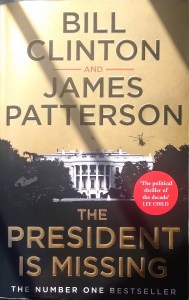 The President is Missing by Bill Clinton and James Patterson has been a good holiday read. A helter skelter fast paced read but moves along quickly and has nicely laid out short chapters to enable me to pause, jump in the pool to cool off and then resume reading.
President Duncan has a lot of problems on his hands. His wife has recently died of cancer and he is suffering from some sort of blood disease. On top of that the Speaker of the House has started hearings regarding rumours that the President spoke to a known terrorist on the phone and even helped him to escape capture.
Not only that but the President agrees to meet an unknown woman who knows a secret password known only to the President and his trusted advisors. She asks the President to meet her colleague at a football game without security and the President agrees and dismisses the Secret Service. Happily the Secret Service are hanging about closely and save the President from an assassin’s bullet but now he has to deal with a threat concerning a computer virus that will shut down every computer in the USA including those that deal with nuclear strikes.
One of the reviews on the back cover was from someone who likened the book to the film Airforce One, and to be honest, I felt the same way, even picturing the President as Harrison Ford, who played the President in that film.
The book was a great holiday read although I did wonder what part Bill Clinton played in the writing process. Did he just provide background to James Patterson or did he contribute towards the storyline too?
Anyway, the book was a great holiday read.
President James Marshall
Clearly I have to follow on with Airforce One, an action packed film starring Harrison Ford as President James Marshall. In this film the President leaves Russia in his aircraft, Airforce One after a joint US/Russian mission to capture a terrorist named General Ivan Radek. Unknown to the President, a group of Radek sympathisers have joined the aircraft posing as journalists. They take over the Airforce One but it looks as though the President has got away in an escape pod. However, the President was unwilling to leave his family behind and he has hidden himself in the cargo hold. The film then unfolds in the manner of a Die Hard film with the President bumping off the terrorists and managing to contact the White House and also to free his colleagues pretty much in the way that Bruce Willis might have done.
Not a great cinema experience but I kind of enjoyed it.
President Jordan Lyman
Seven Days in May was a political thriller released in 1964 and directed by John Frankenheimer. Kirk Douglas plays United States Marine Corps Colonel “Jiggs” Casey who works for Four Star General James Mattoon Scott, a highly-decorated officer played by Burt Lancaster. Jiggs thinks that Scott might be planning a coup to remove the President who has just signed a nuclear disarmament treaty with the Soviet Union, a deal which is highly unpopular with the military. Jiggs discovers that a military group known as ECOMCON has been assigned to seize radio and television networks. He manages to see the President and convince him of the threat. The President, still somewhat sceptical, organises a small group of staff to investigate.
Interestingly, President Kennedy authorised the producers to film scenes at the White House. He had read the book that the film was based on and as he had dealt with critical members of the military himself, was perhaps worried that the fictional scenario could be a real possibility.
The President was played by Frederic March who was one of the great cinema actors of the 1930s and 40s. He was the original Norman Maine in the first version of A Star is Born made in 1936 and even starred with Greta Garbo in Anna Karenina in 1935.
Presidents Palmer, Taylor and Logan
The TV series 24 first appeared in 2001 on US television. Each episode lasted for an hour and is told in real time with a digital clock on screen updating the viewer. The first series is set on the day of the US presidential primary in California. Jack Bauer, a maverick agent of the CTU Counter Terrorism Unit, is detailed to protect presidential hopeful David Palmer from an assassination attempt. Palmer was played by Dennis Haysbert as a potential black US president.
Season 2 details how Bauer, played by Kiefer Sutherland, must prevent a nuclear bomb from exploding and assist David Palmer, now the US president, in finding the culprits. Jack is assisted by a team of agents at the CTU hi-tech control room who are adept at computer manipulation, taking over feeds from CCTV cameras, hacking into other public computers and researching various information to help Jack.
Allison Taylor is the first female president of the USA. She first appeared in the episode Redemption which was a bridging episode between series 6 and 7 as series 7 was delayed due to a writers’ strike in Hollywood. Taylor was played by actress Cherry Jones and almost seemed to be a precursor to a real life female president. As it happened, Hilary Clinton was defeated at the polls and Donald Trump became the president in 2017. (Personally, I always like President Taylor. She always reminded me a little of Captain Janeway from the TV series Star Trek Voyager.)
President Logan was played by Gregory Itzin and first appeared in season 4. He was the Vice President but was later sworn in as President when the previous President was injured in a terrorist attack. As President, Logan becomes involved in the murder of former President Palmer and is eventually forced to resign. Later, he tries to help President Taylor with a peace treaty with the Russians but again, some dodgy dealings lead him to commit suicide. Some thought the character was inspired by real life President Richard Nixon. Whether that was true or not I’m not sure but Logan was a very tricky President indeed.
I thoroughly enjoyed 24. Jack Bauer was an uncompromising agent who was convinced that the end justified the means and would shoot anyone, threaten anyone, good or bad who got in his way. The series was a very slick hi tech espionage show which combined spies, shoot outs and computer science in an exciting TV series.
Presidents Kane and Kennedy
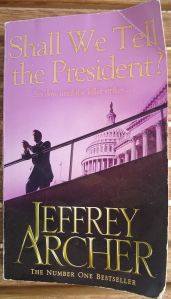 Shall We Tell the President was a novel by Jeffrey Archer first published in 1977. In the book Edward Kennedy has become the US President and FBI agents become aware of a plot to kill the President.
I read this book many years ago but recently came across this new edition, rewritten by the author himself. In real life Ted Kennedy never made it to the White House, his challenge cut short by the ghost of what happened to Mary Jo Kopechene at Chappaquiddick. In this rewrite then, the author puts his own fictional president, President Kane in charge at the White House.
The FBI learn of a plot to murder the President. A Greek waiter, an illegal immigrant, learns of the plot whilst working as a waiter at a restaurant in Washington DC. He calls the FBI and the two agents assigned to the case report quickly to their superior. Soon, one of the agents and their boss, as well as the informant are dead leaving only one agent who by chance has survived a murder attempt. He has six days to track down the assassins.
The book kept me interested but I can’t say it was a great read and I thought some of the dialogue was a little poor, in particular the FBI agent who kept referring to his new girlfriend constantly as ‘pretty lady’ was a little cringeworthy to say the least. Sorry Mr Archer but I’d have to give this one a five out of ten.
Just off the top of my head without using Google, that’s about all the fictional presidents I can come up with for now. Which was your favourite?
 Liz and I are over here in sunny Lanzarote having exchanged the cold of the UK for the warmth of Lanzarote. Of course, it is still February and things aren’t perfect over here. It’s warm but there are plenty of days when gusty winds blow across the island as well as days when the sun has been obscured by clouds. Even so there are still plenty of bars to drink at, plenty of tapas to be eaten and of course we have plenty of books to read, two of which have inspired this week’s post.
 The plot of the book and film are pretty complicated, although having read the book recently I think that the book is easier to follow. During the filming the director and his stars wondered who killed the character of Owen Taylor, the Sternwood’s chauffeur. They sent a cable to Raymond Chandler asking him. Chandler told a friend later ‘Dammit, I don’t know either!’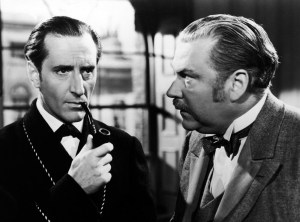
 This the third instalment of a post on the theme of transformations. The very first one (
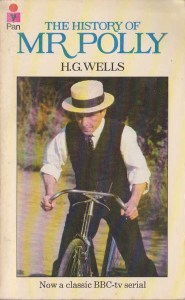 This is not a science fiction story despite being penned by H G Wells. Our hero, Mr Polly, finds himself in a very dull job with a very dull wife and resolves to commit suicide. Anyway, events unfold and instead of committing suicide, Polly accidentally starts a fire which threatens the whole street and he then mounts a brave rescue of an old lady. Instead of dying, Mr Polly becomes a hero and when the insurance money comes in, he leaves his wife nicely settled with the insurance money, takes a little for himself and departs for pastures new. He sends some money to a post office in another village and gradually meanders in that direction, sleeping in fields and hedges, getting himself a tan. He works occasionally when he wants and sleeps when the mood takes him at other times.
 A film version was made in 1949 starring John Mills as Mr Polly and Megs Jenkins as the landlady of the Inn where Polly finds happiness.
 It’s been another cold and wet week and as usual I’ve tended to lie back on my couch and watch a lot of television and not just broadcast TV either. Lots of times when broadcast TV isn’t up to the job of entertaining me, I’m forced to crank up a recording and watch that. Just lately I’ve watched a couple of biopics, films about real people, so for this post I thought I’d continue that theme and look at films and TV shows where the actors have had to portray real people.
 Stan Laurel
 Olivia de Havilland was one of the great film stars of Hollywood’s golden age. Amazingly she died only fairly recently in 2004 having lived to be 104 years old. She appeared in eight classic films with fellow star Errol Flynn, including The Adventures of Robin Hood in which she played Maid Marian to Flynn’s Robin Hood. Flynn claimed in later years to have been in love with Olivia but nothing ever happened between the couple, or so they both said.
 Once again Liz and I are on holiday in France and as usual I’ve filled up my book bag with books to read. My selection this year was a mix of new books and some books from my collection which I haven’t read for years. The one I’d like to focus on this week is Random Harvest by one of my favourite writers,
  The book tells the story in an entirely different way. It begins with a chance encounter on a train with Rainier and a young man who is looking for work. The two strike up a sort of friendship and Rainier invites the young man to work for him, He explains that he was in the war, was injured and woke up in a German hospital with loss of memory. He was repatriated through Switzerland but got his memory back after a fall and a collision with a taxi in Liverpool. The time between his earlier life and waking up in Liverpool is a blank. The young man becomes Rainier’s assistant and the two sometimes talk late into the night discussing what might have happened. Later in the book, Rainier is called to intervene at a dispute at the Melbury factory and his memory begins to return. He asks a local taxi driver about the hospital. The man asks does he mean the new or the old one? Rainier thinks the old one and goes on to describe it. ‘That doesn’t sound like either of them,’ answers the man but adds, ‘would you be meaning the asylum sir?’
 One of my unofficial New Year’s resolutions this year was to try and declutter, perhaps actually get rid of some of my huge DVD collection. It’s not always that easy though. Mooching around one of those cheap secondhand shops recently I picked up yet another DVD. I’ll tell you about it in more detail later but it was one of the many films made about Robin Hood and his Merry Men.
 Back in the 1970s my Saturday ritual involved getting the bus into town and scouring book and record shops for, yes, you’ve guessed it, books and records. One day back then I was flipping through the posters in one particular shop. The posters were the music stars of the 70s; Elton John, Mick Jagger, Suzi Quatro, David Bowie and so on but one was a picture of a really good looking guy with a fifties combed back hair style. In some pictures he was dressed like a cowboy and in others in a red jacket and denim jeans. The guy behind the counter must have seen me wondering who the guy was and he told me he was a film star called James Dean. He handed me a paperback book about the actor and I took it home and read it and very soon I was trying to find out everything I could about him.
 The paperback book I bought that day in the record shop in the 1970’s was probably James Dean: A Short Life by Venable Herndon. It wasn’t a great book but an interesting introduction to Dean and who he was. It detailed his struggle for acting roles, TV work in New York, his apartment at 19 West Sixty-Eighth Street, his three films, his doomed affair with Pier Angeli and of course his death.
 Another book I picked up only recently was another picture album James Dean: Portrait of Cool edited by Leith Adams and Keith Burns. It’s an album of photographs found in the Warner Bros archive and some have not been published before. Included are all sorts of documents such as casting sheets, production notes and messages. Dean’s address is listed as 3908 West Olive Avenue which I think might have been a place he shared with Dick Davalos who played his brother in East of Eden. During Rebel Without a Cause, Dean was listed as living at 1541 Sunset Plaza Drive.

 It’s a long time since I’ve made a video for my YouTube channel and recently I’ve been trying to think about what my next project should be. When I’m stuck for a video I tend to tweak or even remake some of the short videos I use on social media to promote this page and my two books. In fact my YouTube page is made up of quite a lot of videos like that as well as numerous short video versions of my poems. Every now and again I try and put something different together. I usually make a video about our yearly trips to France in our motorhome and I’ve made a few videos about Manchester, my home town and also the place where my book Floating in Space is set.
 Most of Mersey Square, the square at the very centre of Stockport, was fenced off while the builders worked on the new bus station. A huge railway viaduct spans the centre of Stockport and the bus station or bus interchange as they are now calling it is mostly on one side of the viaduct with part of it spilling over onto the other side. Someone told me it was due to open in two weeks time but looking around, that seemed to be a pretty tall order.
 I walked round to the other side of the bus depot and there opposite, what used to be the main exit for our buses, was the Comfortable Gill. The Comfy, as we affectionately called it, was the pub where we busmen used to drink after the day’s shift was over. At one time if a driver was due to finish after last orders at 11, the landlord used to accept telephone orders for a pint so sometimes we could pull in at 11:20, park the bus in the depot and then pop over to the Comfy to find a pint waiting for us to sup while we cashed up our day’s takings. When I saw it the other day the Comfy was all closed up and looked neglected. So many of Britain’s pubs have closed down and I walked away hoping that the Comfy might be saved in the near future.
