Back in the 1970’s. TV presenter James Burke made a TV show called Connections. It was a really fascinating series which connected various historical events to make a sort of chain which led up to something which was pretty unexpected. The episode which stands out in my memory is one about the atom bomb, various unconnected events and discoveries that together, led to the splitting of the atom. I’ve written a couple of posts in which I’ve tried to do something similar but all relating to the world of classic film so here are another collection of film connections which I hope you will find interesting.

Leslie Howard and Gone with the Wind
 I thought I’d start with Gone with the Wind and see where it takes me. Gone with the Wind was a major film adaptation of the book by Margaret Mitchell. The book was a huge hit and producer David O Selznick bought the film rights. Production was delayed for a long while as Selznick was determined to get Clark Gable for the part of the roguish Rhett Butler. Another delay was a distribution deal with MGM which couldn’t be finalised until Selznick’s then current deal with United Artists had expired. Selznick used the delay to begin a huge search for an actress to play the part of Scarlett O’Hara, the spoilt daughter of a plantation owner in the deep south of America. Scarlet has a crush on Ashley Wilkes played by British actor Leslie Howard in possibly his most famous role. The film was one of the major hits of 1939 and was the highest earning film up to that time.
Julie Andrews and My Fair Lady
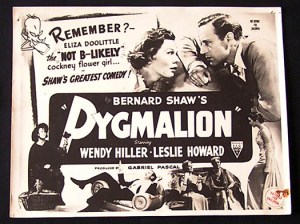
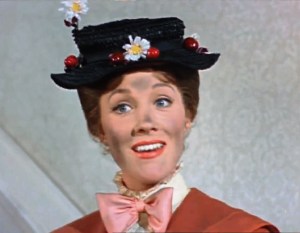 In 1938 Leslie Howard played the part of Professor Higgins in the film production of Pygmalion based on the play by George Bernard Shaw. A musical version was a big hit on the stage in the 1960s. Julie Andrews played the part of Eliza Doolittle to great acclaim on the stage but when the time came to make a film version in 1964, the producers wanted a major star and so the part went to Audrey Hepburn.
Julie Andrews only had to wait a short time for film stardom though. She appeared in The Sound of Music in 1965. The film was based on the true story of the Von Trapp family singers which was also a hit stage musical. Julie Andrews played Maria, a nun who becomes a nanny to the Von Trapp children, eventually falling for the father of the children played by Christopher Plummer. The film was the hit of 1965 replacing Gone with the Wind as the highest grossing film up to that time. The director was Robert Wise who tried to reduce the amount of sentimentality and sweetness which he had seen in the stage production.
Robert Wise and Citizen Kane
Robert Wise had a great background in the film world. He was a former film editor whose first film as a director was The Curse of the Cat People in 1944. In 1941 he was a film editor at RKO Studios and was the editor on the classic film Citizen Kane.
Orson Welles often boasted about the fabulous contract he had when he arrived in Hollywood. In a BBC interview he stated the terms were not financially brilliant but gave him unprecedented creative powers. His first film for RKO was Citizen Kane. The film opens with the death of Kane, a millionaire newspaper magnate. His last words were ‘Rosebud’. The makers of a cinema newsreel decide to find out what or who Rosebud was.
To do so they research Kane’s life; his inheritance of a huge fortune, his takeover of a newspaper, his great wealth, his power and influence, his marriage and divorce and ultimately his death.
The cinematographer was Gregg Toland, one of the film industry’s top photographers. Toland asked to work on the film and Welles replied ‘Why? I don’t know anything about making films.’ Toland countered that was exactly why he wanted to work on the film because a film by a newcomer would produce something new and original.
There are some fascinating elements to Citizen Kane, especially in the special effects department. A famous one is where the camera flies through a rooftop sign and then drops down through a skylight into a restaurant. The shot was done with a sign that came apart as the camera approached and then a fade from a model shot into the restaurant set disguised in a flash of lightning. Citizen Kane was and is a classic of the cinema.
Orson Welles and Rita Hayworth
Orson Welles in a way experienced his film career in reverse, he started at the top and steadily worked his way down, ending up as an overweight although always entertaining raconteur doing voice overs for Carlsberg TV advertisements.
Welles married Rita Hayworth in 1943. She was one of the great stars of Hollywood’s golden years. She appeared in one of her husband’s films The Lady from Shanghai in 1947 but the film that was considered her greatest success came the year before in Gilda. According to Wikipedia, the film made her into a cultural icon as a femme fatale.
Welles and Hayworth grew apart and finally separated. Rita said that Welles had no idea about married life or even settling down. When she suggested buying a house together, a natural move for a married couple, Welles said he didn’t want the responsibility.

Rita Hayworth as Gilda
After splitting with Welles, Rita became involved with Prince Aly Khan, son of the Aga Khan who later became a Pakistani diplomat. Aly was a socialite and man about town. He and Rita married in 1949 and had a daughter Princess Yasmin Aga Khan. Rita gave up her film career to be with Aly but Khan’s womanising proved fatal to the marriage. Rita moved to Nevada with her daughter in order to set up a legal residence and begin divorce proceedings. The two were finally divorced in 1953. Khan offered Rita a million dollars for her to bring up their daughter as a Muslim but Rita declined.
After her divorce Rita had no income and was forced to return to film acting. Her comeback picture was Affair in Trinidad in which she starred with Glenn Ford. Rita was contracted to Columbia Pictures and fell out with Columbia boss Harry Cohn on numerous occasions during the filming. She was even placed on suspension for a while, however the picture was very successful. Her last picture for Columbia was in 1957 when she starred in Pal Joey with Frank Sinatra. She married again, this time to singer Dick Haymes who was in severe financial trouble. The marriage lasted only a couple of years and ended when Haymes struck her in the face in a Hollywood nightclub. Rita packed her bags and left him.
In the mid 1970’s, Rita’s behaviour began to become erratic. She drank heavily and was even once removed from a TWA flight because of her drinking. It was eventually found that her symptoms were masking the real issue which was the early onset of Alzheimer’s disease. In 1981 when her condition had deteriorated, she was placed under the supervision of her daughter and the two moved into adjoining apartments together in New York. She died aged 68 in 1987. Her former husband Orson Welles, spoke of her in his very last interview, recorded the day before his own death. He called her ‘one of the dearest and sweetest women that ever lived.’
David Niven and Leslie Howard
Just to backtrack a little, in 1958 Rita appeared in Separate Tables. The screenplay was by Terence Rattigan and concerns a group of residents at a small hotel in the south of England. David Niven plays a disgraced former army officer who has been found guilty of apparently sexually harassing young women at a theatre. A news story in the local paper highlights this and he tries to stop the others from finding out, without success. Niven won an Oscar for his performance.
David Niven is one of my favourite actors and he wrote what I’ve always considered to the best book about the golden age of Hollywood, Bring on the Empty Horses.
In 1942 Niven was in England having left Hollywood to sign up with the army. He was asked to appear in what was a propaganda film at the time; The First of the Few, a story about R J Mitchell, the designer of the famous WWII aircraft, the Spitfire. Niven was under contract to Sam Goldwyn at the time but he allowed Niven to appear, in exchange for the US rights to the film. Niven played Squadron Leader Geoffrey Crisp who tells the story of his friend Mitchell beginning with the Schneider Trophy aircraft race of 1922. Later Mitchell visits Germany and sees how the Nazis are rearming and so resolves to design a powerful fighter for Great Britain. Mitchell died just as the government ordered the Spitfire into production and Niven as Crisp, ends his story just as he and his fellow pilots are scrambled into action.
Leslie Howard played the part of Mitchell as well as producing and directing. He was killed when the KLM flight he was aboard was shot down by the Luftwaffe in 1943.
Howard of course played Ashley Wilkes in Gone with the Wind which brings our connections full circle.
Thanks to Wikipedia creative commons for the use of the pictures in this post.
 ge has transformed me too. In the picture over on the right you can see me as I was when I was aged 19 or 20. It was taken in France by my best friend Chris. Now I am older, at least older on the outside. On the inside I’d have to say that I haven’t really changed that much. You might think that now I’m probably much wiser with different ideas and different thoughts. Actually though, I’m pretty much the same on the inside with similar ideas and similar thoughts.
 James Bond has been in the news this week. The books by Ian Fleming are apparently being rewritten as they might be considered offensive to a modern generation of new readers and the producers are still looking for a new actor to play their famous secret agent. OK, time for another James Bond 007 post.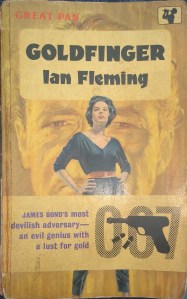


 David was born in 1908 and spent his early life in Croydon (actually 38 Blenheim Crescent, Croydon) until his parents divorced. His father moved out and left the family in 1923 which must have been an upsetting moment in Lean’s young life. Another perhaps more significant moment was when an uncle gave him a camera when David was aged 10 and then Lean began to develop and print his own photographs.
 The film did however win two Oscars for cinematographer Freddie Young and supporting actor John Mills. The poor reception of the film prompted David to meet with the New York critics at the city’s Algonquin Hotel. I’m not sure if David wanted to reason with them or just find out why they didn’t like the film but they spent two hours attacking his production. David came away devastated and would not make a film again until A Passage to India in 1984.
 Frank Sinatra and Die Hard.
 I’ve always liked the original Rocky film but something more interesting than the film itself is the story of how it came to be made. In the mid-seventies Sylvester Stallone was a bit part actor with few acting credits to his name. One day in 1975 he watched the Ali v Chuck Wepner fight in which Wepner lost but managed to stay 15 rounds with heavyweight champion Muhammad Ali. Stallone, inspired by the bout, wrote a screenplay about a washed-up fighter called Rocky who manages to stay the distance with the world champion. He passed the screenplay to his agents who took it to various producers. The screenplay was good and many producers were interested but Stallone attached one small condition to the sale, that he himself had to play the part of Rocky.
 It was a cold afternoon in Manchester and I mumbled something to myself about the supposed heatwave and zipped my jacket up to my neck. At the left luggage office I took out the key that had been given to me earlier and when I opened the compartment I found a small package inside. I took the package and walked the short distance to the square. I sat down on the hard wooden bench and opened it up. Inside was a small tape player and a set of earphones. I put on the earphones and pressed play. There was a short burst of static and then a voice spoke.
 This second instalment of the franchise was directed by John Woo. It’s about a biological weapon called Chimera. Rogue agent Sean Ambrose steals the virus from its inventor by impersonating Ethan Hunt. He destroys the aircraft on which the inventor is travelling and parachutes to safety. Hunt was played once again by Tom Cruise and his mission is to regain the virus. The opening sequence sees Cruise doing some daring rock climbing which the studio wasn’t happy about. Cruise didn’t have a safety net but did apparently wear a harness. I didn’t like the heavy metal style version of the classic theme and as a matter of fact, I lost interest in the film early on.
 I was reading a post called The 10 Best War Films Ever the other day. It wasn’t a list I particularly agreed with and in fact I hadn’t seen or even heard of quite a few of the films mentioned so I thought I’d have a go at making my own list. Here we go. As this post went on a bit I published part 1 last week so now here’s part 2.
