 A while back I did a post about the kitchen sink dramas that emerged in the 1960’s but I thought I’d look now at some later films that have continued that tradition of focusing on working class life. I’m not really sure that today in the 21st century the working class still exist. Modern UK is, to a great extent a classless society. Then again, perhaps it’s just a society of the haves and the have nots. That concept relates particularly well to the 1980’s. The decade of Thatcherism and Yuppies and inner city riots. Kitchen sink dramas were almost exclusively northern, set in places like Manchester, Liverpool and Lancashire with strong no nonsense northern characters. Here are four films from the 1980’s that fit that category.
Educating Rita (1983)
This was a breakthrough film for Julie Walters and I remember Michael Caine who also stars in the film saying that this film would do for Julie what Alfie did for him. Maybe it did, maybe it didn’t. The film is about a Liverpool hairdresser played by Julie who wants to better herself. She decides to take an Open University course in English Literature. Her tutor played by Caine is initially confused as he has the name of Susan White on his documents and Susan explains that she has now changed her name to Rita after reading Rubyfruit Jungle by Rita Mae Brown. Frank Bryant (Caine) is not keen on taking Rita on as a student but she convinces him otherwise. Rita finds Frank has ignited her passion for literature but has to contend with her husband who wants her to be a traditional wife and produce babies. Husband and wife finally split leaving Rita to pursue her studies. She moves in with a fellow student and gradually, as she mixes with more students and studies more, she becomes less and less like her former self. Frank becomes more and more fond of her, possibly even in love with her but his position as a university lecturer is compromised by his heavy drinking.
In a lot of ways this is such a good film. Julie Walters is outstanding as Rita and Michael Caine is excellent too. The big problem for me is that while Julie plays Rita as a typical scouser with a superb Liverpool accent, the setting clearly isn’t Liverpool. Not only that but the other accents in the film all grate with Julie’s as they are a mix of various northern accents. Caine of course as the lecturer, doesn’t have to have to be a Liverpudlian but the hotchpotch of brogues, some from Manchester, some from Liverpool just seemed to jar to my ear. The film was apparently filmed in Ireland so why not make Rita and her family Irish? That would have made more sense although filming in Liverpool with a local cast would have been the better option. Perhaps production finances made that impossible.
Shirley Valentine (1989)
Like Educating Rita, this was a film based on a play written by Willy Russell. In this one Liverpudlian Shirley is getting a little bored with her life. Unlike Rita in the film above it’s not learning that Shirley wants, it’s a good holiday. She is getting a bit fed up of waiting hand and foot on her husband and when the chance comes to go to Greece with her friend she wonders if she could really do it, really leave her husband behind and swan off to the sun? A couple of things make her decide that it is really time to put herself first. The first one is when her husband gets really annoyed when she serves chips and egg instead of steak for their Thursday evening meal. Surely she knew Thursday was steak night? The other is when her daughter comes home and like her dad, expects to be waited on so off Shirley goes to Greece. Things don’t go quite to plan when her mate finds herself a man on the flight over and leaves Shirley to her own devices. After a few days Shirley finds her confidence and begins to enjoy things alone. She meets Costas, a bar owner and spends time with him on his small boat and when the time comes to leave, Shirley decides she is going to stay.
Like Michael Caine in Alfie, Shirley talks straight to the camera and reveals she is in love. Not with Costas but with herself. At the end of the film her husband arrives in Greece and the two sip wine together by the sea. Will Shirley return with him? The film leaves the question open.
Shirley Valentine is a much better film than Educating Rita. Shirley and her husband played by Pauline Collins and Bernard Hill come across as authentic Liverpudlians and the whole film, especially Shirley talking to the camera, works very well. Both films were directed by Lewis Gilbert who directed amongst other things, the Michael Caine classic Alfie. With some better casting in the smaller roles, Educating Rita would have been just as good.
Rita, Sue and Bob Too (1987)
Like the two films above, this too was based on a play, in fact it was two plays that were adapted and merged together into a screenplay by the play’s author Andrea Dunbar. Andrea was raised on the Buttershaw council estate in Bradford, West Yorkshire and became pregnant at 15. This event inspired her first play The Arbor. It was written originally as a classroom assignment and encouraged by her teacher, Andrea developed the work into a full blown play. The film was filmed on the Buttershaw estate where Andrea continued to live, despite several residents threatening her because of the negative portrayal of the area in the film.
In the film, two babysitters Rita and Sue, begin an affair with Bob for whom they have been babysitting. Bob’s marriage later breaks down when his wife finds out. Sue later gets involved with an Asian taxi driver called Aslam who becomes violent. He attacks Sue but Rita arrives and the two both turn on the taxi driver, disabling him long enough for the two to escape. They flee to Bob’s house where Aslam turns up and pleads for Sue to forgive him. Bob arrives and then the Police, who have been called by the neighbours. The Police leave in pursuit of Aslam and Bob decides to have a bath. When he goes into the bedroom, the two girls are in bed waiting for him.
This is really an incredible film on many levels. It is funny but also shows northern council estates for what they are, a mix of rough and ready characters, some of whom take pride in their homes and the way they conduct themselves and some who do not. The tone of the film shifts quickly from humour to drama and back again and the documentary style of filming gives the film a gritty realism.
Gregory’s Girl (1981)
Gregory’s Girl was a low-budget movie made in 1981 and was written and directed by Bill Forsyth. The film is a gentle comedy about a young lad who fancies a girl who has just joined his school football team. The film was one of those special films where so many things come together to make a truly great and memorable film, in fact it is ranked number 30 in the British Film Institute’s list of the top 100 British films.
It reminds me so much of my own schooldays in so many ways even though it was filmed in Lanarkshire in Scotland. The hairstyles in the film were similar to those of myself and my friends back in 1973, the year I left school (armed with only four O levels to take on the world). The school ties and jackets were similar to mine, as were the classrooms and lead actor John Gordon Sinclair’s clumsy and shy manner both on and off the football field was just like mine.
Gregory lives on a new estate just like the one my family moved into in the mid 1970’s. He develops a crush on a new girl who has just joined the school football team and eventually he plucks up the courage to ask her for a date. He borrows his friend’s jacket and off he goes to meet her although things don’t turn out quite how he planned. Gregory’s Girl isn’t as gritty as the films I’ve mentioned above but for me it’s like a nostalgic trip back to my schooldays. Look out for the film on TV or you can even find the complete film on YouTube.
 My brother and I usually go out into Manchester every few weeks. We get something to eat and have a few beers and a good natter. It’s always nice to visit our old haunts in Manchester and to find new ones. There always seems to be a new venue popping up and the only flip side to new venues in Manchester seems to be the extraordinary prices they like to charge for food and drink. Maybe, being the fully paid up tightwad that I am, I should stick to the old, less trendy and cheaper places that I know.
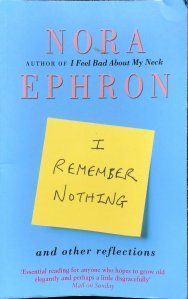 After watching the documentary film I felt even more determined to find out more about Nora so I went to abebooks on the internet and after some research ordered a copy of I Remember Nothing, a book by Nora that seemed to be a memoir. The book starts out as a sort of memoir, telling humorous stories about this and that, and her life without really giving much away. Nora wanted to be a journalist and after working for the Kennedy White House for a short while she joined the staff of the magazine Newsweek. In her book she tells the story of how Newsweek did not hire female writers and offered her a job as a mail girl. She doesn’t appear to have been upset by this despite it being blatantly sexist. She just got on with her job, still determined to be a journalist. In her book Nora makes the whole episode sound quite amusing, especially when she later writes a parody column during a newspaper strike and as a result gets invited to write for the New York Post. Over on Wikipedia, there is a slightly different story in which Ephron gets involved with a class action lawsuit filed against Newsweek for sexual discrimination.
 The first thing to remember about films is this, they are not a public service, they are made to make money. They start life as a business proposition. Producers start by asking would the public want to see this? Would they pay to see this? Suppose we got famous film star Mr X to star opposite film actress Miss X? One sure fire way of making the public want to see something is by making the film again. How can they make it again? By making the sequel! Sequels can be good, they can be bad but sometimes they can be downright ugly . .
 Every now and then, the film industry will make a film about itself, yes, a movie about the movie industry. There a quite a few I could include in a post like this but here are three of my favourites.
 I thought for a minute of changing the title of my whole website to that which you can see above: The Ramblings of a Locked Down Blogger. Maybe even the crazy ramblings! Still, in a few weeks or perhaps months, the lockdown and Coronavirus will just be a bad memory. In fact, my first post lockdown restaurant visit has already been booked and my table and meal are actually only a matter of hours away.
 Another original film I saw lately was Big Eyes. It’s based on a true story of an artist, Margaret Keane, who turns out some popular and charming pictures, all of people with big eyes. Margaret is a woman who can paint but is not so good at selling and marketing her work. She meets future husband Walter who seems to be a bit of a whiz at the promotion lark. He decides to rent space on a local nightclub wall to get attention for both Margaret’s and his paintings. Surprise, surprise, it is Margaret’s paintings of the doe eyed girls that get all the attention but Walter decides to play the part of the artist as some people have mistakenly thought that anyway. Margaret plays along but gradually becomes very unhappy having to constantly deny her own work.
 2001 set the standard for the sci-fi movie with its depiction of spacecraft drifting slowly and silently through space. The first Star Trek movie was heavily influenced by 2001 which made it look a little dated when the movie Star Wars was released and did the opposite thing, showing spacecraft whooshing across the screen at lightning speeds.
 In the 1950’s, Senator Eugene McCarthy, aided and abetted by the head of the FBI, J Edgar Hoover, began to accuse hundreds of Americans of being either communists or communist sympathisers. Hoover had designed President Truman’s loyalty and security program and his agents carried out background checks on federal employees. This information was supposed to be secret but in 1950 when the Korean War began, Senator McCarthy produced a list of supposed communist party members or supporters working for the state department and presented it to the press. Much of his information came from Hoover.
 Robinson Crusoe on Mars
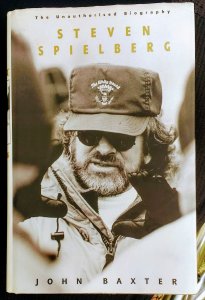 Not so long ago I thought about doing a post about the film director Steven Spielberg. I’d already done a couple of ‘favourite director‘ posts but the thing with Spielberg is that he’s not exactly one of my favourite directors so any post would be not really be complimentary so I didn’t want to get into writing something negative.
 Letters from an Unknown Author!