This is number three in my Favourite Director series. Stanley Kubrick is one of the cinema’s great visual artists and a particularly memorable cinema moment for me was watching Kubrick’s classic sci-fi film 2001 on a hot weekday afternoon during the school summer holidays of 1968.
I was only 11 when I first saw 2001 and I remember my Mum being surprised that I had spent hours at the cinema on a lovely hot day. I watched the film in the huge movie theatre in Northenden, a suburb of Manchester, now a Jehovah’s Witness assembly hall. There were only a few people in the picture house that day and it was wonderful having this huge place almost to myself and seeing this incredible film in 70mm on the big screen. I recall being somewhat confused by it all, especially the jump from Neanderthal times to the future, until I bought the novel by Arthur C Clarke which explained things in a way the movie did not.
2001 is a particularly visual film. Kubrick cut out a lot of dialogue because he wanted the film to stand as “basically a visual, nonverbal experience” that “hits the viewer at an inner level of consciousness, just as music does, or painting.”
According to Wikipedia, despite the few people in the cinema with me that day in 1968, the movie went on to become the highest grossing North American movie of that year.
 2001 set the standard for the sci-fi movie with its depiction of spacecraft drifting slowly and silently through space. The first Star Trek movie was heavily influenced by 2001 which made it look a little dated when the movie Star Wars was released and did the opposite thing, showing spacecraft whooshing across the screen at lightning speeds.
As I mentioned above, I was rather confused by the film and there were quite a few moments when I was wondering what was actually happening, for instance the jump from Neanderthal times to the future, the moment when the monolith sends its deep space signal and various other things too. All the technology that Kubrick displayed had its origins in science fact, both the space missions and the computer technology which make up the main parts of the story.
If you have never seen the film or read the book (shame on you) 2001 is about a mysterious monolith which appears on earth in neolithic times and helps the ape men of the day to develop. Later, in the future, the mysterious monolith is found buried on the moon and when it is exposed to sunlight for the first time, it blasts off a signal to Jupiter. (In the book the destination is Saturn, it was changed for the film as director Stanley Kubrick thought that the special effects department would struggle to create Saturn’s rings).
Anyway, the scientists of the day decide that the monolith is part of some extraterrestrial intelligence and set up a manned space mission to investigate. As the mission progresses, the onboard computer, HAL, decides to have something of a nervous breakdown which creates an unexpected hazard for the crew.
The film came about because Kubrick wanted to make the definitive science fiction film and he wrote to Aurthur C Clarke, one of the foremost sci-fi writers of the time and asked him to collaborate on the screenplay. Stanley liked Clarke’s short story ‘the Sentinel’ and the two worked together to formulate the final script. Other works of Clarke’s were added to the timeline and while the two wrote the script together, the novel version was written by Clarke simulateously as he worked on the screenplay. The two, book and screenplay do differ slightly.
Huge amunts of research was done to find the best way to show space travel on the screen and for it to be scientifically accurate. One interesting feature was a huge centrifuge built on the set at Shepperton Studios in the UK which represented how the spacecraft duplicated artificial gravity by rotating. The huge set cost around one million dollars in total. The centrifuge enabled Kubrick to shoot the actors from various positions including a 360 complete arc of the set as the astronauts did their daily fitness jog.
Kubrick was born on the 26th July in 1928. He lived with his family in the Bronx, New York and after leaving high school became a photgrapher for Look magazine. During his time there he became interested in motion pictures and in 1950 he decided to make a short film about boxer Walter Cartier based on a series of photos he had taken for the magazine. In 1951 he resigned from Look to concentrate on making films. His first theatrical feature was Fear and Desire which he produced, directed, photographed and edited. That film was largely financed by his uncle.
An incredible leap in film making for Stanley came in 1956 when he was asked to direct Paths of Glory by the producer and star, Kirk Douglas, based on a true story of the French army in the first World War. The film showed the trenches in a different light to many films that came before and in particular, Kubrick’s tracking shots through the trenches were a revelation. Paths of Glory is a powerful film and well worth watching if you ever get the chance to see it.
Kirk Douglas later asked Stanley to take over the director’s chair on Spartacus, after he sacked original director Anthony Mann. Spartacus is perhaps the only film on which Stanley did not have full editorial control.
Stanley Kubrick acquired the film rights to Vladimir Nobokov’s controversial novel Lolita and decided to film in England. He moved his entire family to the UK where they would set up home. Kubrick first worked with Peter Sellers on Lolita and was so impressed with him, he asked him to play multiple roles in his next film Dr Strangelove. Dr Strangelove was a cold war film about a US bomber crew that decides to drop the atom bomb on Russia. Sellers played various roles, the US President, A British air force officer, and Dr Strangelove, an ex-nazi scientist. He was also supposed to play a US air force pilot but dropped out of that role which went to American actor Slim Pickens.
It almost seems as if every picture Stanley Kubrick made was something new in cinema, something that broke new ground. In Barry Lyndon Kubrick had to create new filming techniques because he decided to film in completely, or almost completely, natural light. Barry Lyndon was the film version of William Makepeace Thackeray’s novel The Luck of Barry Lyndon, about an 18th century rogue and adventurer. The film was shot on location in England and Ireland and many of the shots were set up to resemble various 18th century paintings. New techniques and lenses were introduced to allow the director to shoot in candle light although diffused artificial light was used as well.
Kubrick ventured into the horror genre with The Shining based on the book by Stephen King. A writer played by Jack Nicholson decides to take a job looking after the Overlook Hotel during the winter season when the hotel is closed and snowbound. During the stay the character descends into madness amidst various supernatural events and his wife and son played by Shelley Duval and child actor Danny Lloyd struggle to stay alive when Jack turns into a homicidal maniac.
Apart from second unit location shots, the film was shot entirely in England at Elstree Studios and featured extensive filming with the Steadicam, a new device which allowed for smooth hand held filming. Kubrick was apparently super keen on getting the exact shot he wanted which resulted in multiple re-takes. Today the film is considered to be a horror classic although Stephen King apparently hated the film.
Stanley Kubrick’s final film was Eyes Wide Shut starring Tom Cruise and Nicole Kidman. Sadly, Kubrick died of a heart attack on the 7th March 1999 only days after screening the almost completed film to producers Warner Brothers.
Kubrick made other films which I have not mentioned here. One particularly controversial film was A Clockwork Orange which sparked great debate about violence, not only violence itself but how it had been handled by the cinema. Utimaltely, Kubrick withdrew A Clockwork Orange from British cinemas and it was not available in the UK until after Kubrick’s death.
Stanley Kubrick was one of the most talented and influential directors in the history of the cinema and he leaves behind an amazing portfolio of motion pictures.
A lot of the information here was from the splendid book Stanley Kubrick: A life in Pictures by his widow, Christianne Kubrick, well worth reading if you ever see a copy.
 In the 1950’s, Senator Eugene McCarthy, aided and abetted by the head of the FBI, J Edgar Hoover, began to accuse hundreds of Americans of being either communists or communist sympathisers. Hoover had designed President Truman’s loyalty and security program and his agents carried out background checks on federal employees. This information was supposed to be secret but in 1950 when the Korean War began, Senator McCarthy produced a list of supposed communist party members or supporters working for the state department and presented it to the press. Much of his information came from Hoover.
 Some people are born to do certain things. Winston Churchill was a born leader, and Clark Gable was born to play Rhett Butler in Gone with the Wind. As for me, I was born to watch TV. My old dad used to call me ‘square eyes’ because I was glued to the television, or so it seemed to him.
 Robinson Crusoe on Mars
 There are two particular films that come to mind at Christmas. I’m not talking about films that are typical Christmas films, things like It’s a Wonderful life or Scrooge or even Home Alone but films that tell the true story of Christmas, the story of Jesus himself. The two films I’m thinking of are King of Kings and The Greatest Story ever Told.
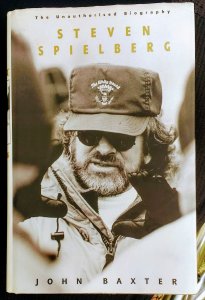 Not so long ago I thought about doing a post about the film director Steven Spielberg. I’d already done a couple of ‘favourite director‘ posts but the thing with Spielberg is that he’s not exactly one of my favourite directors so any post would be not really be complimentary so I didn’t want to get into writing something negative.
 It’s a book written from first-hand experience for starters. The author, British born movie actor David Niven arrived in Hollywood in the early 1930’s. He had decided to try his luck in the movie business and he had come to the right place because Hollywood, California was the centre of the film making universe.
 I’ve had a little time on my hands this week, looking after my elderly mother. Nothing particularly exciting presented itself on terrestrial TV so I thought, the perfect time to pour a glass of red and crank up a few Bond DVDs.