The other day I was looking through one of those writer’s pages I subscribe to. One particular page is for writers to talk about stuff, you know, publishing, agents, even actual writing but writers being a self-indulgent selfish lot, they usually just post links to their new books. Being similarly selfish I tend to add links to my new blog posts but on this occasion, I noticed something different, someone had asked a question. What are your 5 favourite books of all time?
Straight away I jotted down four, I struggled for a fifth and then remembered I had already started a post about my top 100 books of all time. It was waiting there quietly in my drafts folder and I’m sorry to say I was well short of a 100. I had got as far as 21 books and so for the purposes of this blog post, I’ve whittled it down to 10. I’ll give you five this week and five the next so here we go, in no particular order . .
The Great Gatsby by F Scott Fitzgerald
What can I say about this modern classic that hasn’t be said before? I’ve tried reading other books by Fitzgerald, but they haven’t really hooked me. This one though is nothing short of wonderful. It’s a sad haunting book and the text is so lovely, so lyrical it could almost be a poem, especially the very last page.
Gatsby is an enigma. A millionaire rumoured to have made his money during prohibition who holds lavish parties in the New York neighbourhood of West Egg. The bright and beautiful of New York are drawn to these parties like moths to a flame and one day, or so Gatsby hopes, Daisy, his lost love, will come too.
Things don’t work out as Gatsby has planned because Daisy has a husband and children. A hot summer in New York adds to the tension and Fitzgerald presents the jazz age to the reader with warmth and nostalgia. Read this book and revel in the author’s lyrical elegance.
Billy Liar by Keith Waterhouse
I’ve always loved this book. It’s a very northern book, written by Keith Waterhouse and it’s about a young lad who fantasises a lot. So much so that he has a whole fantasy world up there in his head. It’s called Ambrosia. In Ambrosia the army traditionally salute with the left hand, a tribute to survivors of the revolution who all lost their right arms in battle. Billy fantasises about writing a great novel, the one like mine that he is always going to start tomorrow. He has two girlfriends on the go, both of whom he has proposed to and has given them both the same ring. He wants to be a TV scriptwriter and has gone as far as sending his scripts to a TV comedian. He dreams of going to London to work. The book was a successful film and someone once told me they saw the stage version which used a revolving stage for Billy to enter into Ambrosia.
Lost Horizon
James Hilton is one of my personal writing heroes and yet his name may be unfamiliar to many of you reading this blog. He was a journalist and an author and made the trip from his home in Leigh, Lancashire, (now Greater Manchester) in the UK to the Hollywood Hills in the United States to become a screen writer. He is probably more well known for his book ‘Goodbye Mr Chips’ which was made into a film with Robert Donat (actually another northerner from Didsbury in Manchester) but my favourite of his books and quite possibly my all-time favourite book is ‘Lost Horizon’.
Lost Horizon is a book I found in a second-hand shop many years ago. A battered 1940s paperback, I paid twenty-five pence for and yet that small investment has paid me back many times over for sheer reading pleasure as Lost Horizon is a book I re read every year or so and I often pull it down from my bookshelf when a current read fails to entertain me.
Lost Horizon is a completely original idea and is about British consul Robert Conway in the dark days before World War II. Conway is helping his fellow British citizens escape from civil war in China and he and his small party escape in the last plane, only to be kidnapped and taken to a distant Tibetan monastery. Conway meets the High Lama and after a time it is revealed that the Tibetans want to preserve the best of world culture and art and make it safe from the coming war.
Hilton is one of those few people who have invented a word or coined a phrase that has become part of the English language. In this case it was the name of the Tibetan monastery, Shangri-la which has since become a byword for a peaceful paradise, a distant haven. Camp David, the US President’s retreat was originally called Shangri-la until renamed by Eisenhower for his son, David.
Lost Horizon was made into a movie by Hollywood director Frank Capra and starred Ronald Colman as the urbane British diplomat of the novel. It’s a movie that was restored some time ago and is a great DVD if you happen to see it.
A Year in Provence by Peter Mayle
You might possibly be wondering about this book and how it got into my top ten. OK, it isn’t one of the classics and it isn’t exactly by a world-renowned author but what the heck, I’ve always liked it and it’s one of my favourite books. Books come in all shapes and sizes and while some books focus on strong and emotive subjects like love, life, tragedy and the universe, some books lift you up in other ways. I’ve always had a dream of living in France in a big old country house and in this book the author and his wife move to a village in Provence. In a quietly amusing way the author documents his new life which involves things like dining out, sorting out a new boiler and engaging French workmen to remodel his house. They once made it into a rather badly received TV series but the book is a gentle, relaxing summer read.
A Kind of Loving by Stan Barstow
Whenever I plug my own short novel, Floating in Space, I usually try to link it to classic kitchen sink novels of the past like this one. The sixties were a great time for working class novels and many of them were made into films.
The story is a very simple one; Vic Brown is a draughtsman in a Yorkshire factory and he gets involved with a secretary called Ingrid. When Vic learns Ingrid is pregnant, he does the ‘proper’ thing for the 1960’s and offers to marry her. Sounds simple but this is a complex and fascinating book and looks at the subtleties of relationships and how the characters make their way through a series of difficult choices. For a northerner like me, it’s also nice to read about things and places I can directly relate to. The first part of the book where Vic, who narrates the book, talks about a family wedding brings back so many memories of similar weddings when I was a child. Barstow was a Yorkshire writer and A Kind of Loving was the first part of a trilogy. My well thumbed copy has all three parts in one volume.
What to do next:
Share this post on your favourite social media!
Hit the Subscribe button. Never miss another post!
Buy the book! Click here to visit Amazon and download Floating in Space to your Kindle or order the paperback version.
My life in 2500 words? Really? My whole life, everything? Is that possible? Well, hang on a minute, give me a chance. I’ve been reading a book by Nora Ephron called I Feel Bad about my Neck and its really just a series of essays. In fact, Nora would be a great blogger because all her essays are nice blog sized pieces which could all easily be humorous blog posts. Her book is a little bit of a cheat really, it reminds me of a book by Spike Milligan I read years ago, A Bit of a Book I think it was called. It was full of little drawings and sketches which could easily be flipped through and other things like blank pages entitled the blank of England.
It was all very humorous but I read the book in about thirty minutes. Nora’s book is one I tend to read at work on my lunch breaks and if I had taken it on holiday, I would have easily read it in a few hours. Anyway, I shouldn’t really be bad mouthing Nora because her book is pretty funny and one of the essays was called The Story of My Life in less than 3500 Words which has inspired this blog post. Some of course would say that this blog post is a blatant rip off of Nora’s book but I can assure you it isn’t. Well, not that much anyway.
This won’t be my whole life of course, I’ll probably leave many things out, especially the bad bits and the boring moments but here we go.
I was born in 1956, way back in the mid-20th century in Manchester in the north of England. I was born in October which has always rather annoyed me. Why couldn’t I have been born in July or August or better still earlier in the year, sometime in the spring? I don’t like October; in fact, I never have. I don’t like the fireworks coming up in November and the endless weeks of bangers going off at unexpected times of the day and night and neither do I like Hallowe’en where complete strangers have the cheek to knock on my door and ask for treats. Not only that I don’t like the cold which is why I would much prefer a warmer time of the year for my birthday. It’s not much to ask and I would enjoy it much more.
(I’m starting to worry now about fitting everything in. Here we are, two paragraphs in and I’ve not mentioned much except my birthday.)
I went to school in Wythenshawe in the south of Manchester and I’d like to tell you that I excelled in various things and won various prizes and stuff like that. The fact is I didn’t although I did get picked for the school high jump team once. I had managed to jump an incredible six foot and to be honest I’m not sure how I did it. I could say I discovered an innate skill for high jumping but well, that’s another of those things I’d like to tell you, despite it actually being untrue. One day I did this amazing jump, I’m not sure how and the next thing I was asked to join our team at a local school for some sort of athletics competition.
The big problem with that was that the match was on a Thursday and on Thursdays I used to like to be at home for my favourite TV show which at the time was Thunderbirds. I did mention to the other members of my team that the possibilities of me arriving at the rival school for the high jump was pretty non-existent but my fellow team members, who I might add at this point were all older and bigger than me and actually now I think of it, rather hostile explained a lot about team spirit and stuff like that and how much better it would for me to be on time.
This is me when I was a pretty good looking guy. Later my looks went all downhill.
Some threatening behaviour was involved which made me think more about the team spirit thing and so I turned up ready for the jump. The annoying thing was at this school, the name of which escapes me, the high jump was set up on a sort of uphill slope which made it a little difficult for me to get up to speed for the correct lift off for the jump. To cut a long story short, I failed my jump, I was eliminated and was never asked to join the team again. To this day I remember the look on our team captain’s face as he shook his head mumbling ‘Six feet?‘ The flip side is that I was free on a Thursday for Thunderbirds.
I liked junior school but after that, school just went downhill for me and I left aged 16 clutching my four O levels. I should confess that actually one of those O levels was a CSE grade 1 which counted, so I was told, as an O level pass. Still I am now 64 years old and never once in my entire life, not once, have I been asked for proof of my 4 O levels, not in any job ever. So now I think of it, I just might as well have told my employers I had ten O levels or maybe even just upgraded them to A levels. Of course, that’s the kind of knowledge that only comes with experience and nowadays, no one is interested in whether I have 4 or 12 O levels or even whether I have any at all.
When I was at school I wanted, among other things to be a journalist. I went along to our careers teacher, Mr Sherriff, imparted this information and waited for his advice. I remember him asking me how I was going to do that. Him asking me? Wasn’t it supposed to be the other way round? Wasn’t he supposed to tell me that I could go on a course or maybe apply to the Manchester Evening News to be a trainee reporter? The next few minutes are a bit of a blur but I remember leaving his office after being told that I would soon receive a letter telling me about my coming interview. Now the Manchester Evening News had been mentioned, mostly by me and I remember telling all my friends I was soon to be interviewed for a reporter’s post with the News. My schoolmates were impressed, in fact very impressed because all Mr Sherriff ever did was get pupils a job with Barclays bank. A few days later Mr Sheriff called me back and handed me a letter. I had an interview arranged for 3 o’clock on a Thursday afternoon. I remember hoping that I would be back in time for Thunderbirds. Did I know where Barclays bank was asked Mr Sherriff? It didn’t matter because he gave me a handout detailing its location in Manchester city centre. Barclays bank I asked? What about the Manchester Evening News?The Manchester Evening News don’t have trainee reporters blared Mr Sherriff and quickly dismissed me.
I went for the interview. It was all very pleasant but I didn’t get the job although I wasn’t particularly upset about it. Once again my Thursdays were free for Thunderbirds although by this time, I was probably watching the next Gerry Anderson series, Captain Scarlet and the Mysterons. I wasn’t a great fan of Captain Scarlet although I do remember getting a model of an SPV, Captain Scarlet’s Spectrum Pursuit Vehicle for either Christmas or my birthday so I must have been at least somewhat interested in it.
After a quick look on the internet I see that by 1973 when I left school, Gerry Anderson was making the live action series The Protectors so that’s my Captain Scarlet memory right out of the window.
I’ve always been a fan of Gerry Anderson, all the way from Fireball XL5 to UFO. I didn’t like Space 1999, I much preferred Star Trek but before leaving Gerry I just want to say a last word about Thunderbirds. It’s really more of an observation than anything but I just want to get it off my chest. It’s something which has been annoying me ever since I first saw the show as a schoolboy, and it’s this:
Thunderbirds was a sci-fi puppet show from the 1960’s. A secret organisation known as International Rescue is based on former astronaut Jeff Tracy’s island home. His five sons pilot the Thunderbird vehicles and Alan Tracy, as you might know, is the pilot of Thunderbird 3, which is a space ship. Thunderbird 3 launches from underground, blasting off right through the circular opening of the island’s Round House. Now to access the craft, Alan sits down on the settee in the Tracy Island main house. His Dad, Jeff Tracy, flicks a switch and Alan and the settee drop down into an underground complex. OK? With me so far?
Well this is where the problem arises. As you can see from the video above, Alan and the settee drop down on a sort of hydraulic pole, just behind him we see another settee, being pushed up towards the lounge on another hydraulic pole, where it pops into the vacant slot where Alan’s settee was moments earlier. However, as Alan’s settee is going down on the first hydraulic pole, and the alternate settee is on a second hydraulic pole to his rear; there is no way that second settee is going to pop into the vacant slot left by the first. Also, what if Alan was watching TV when the call came in and he goes off on the departing settee with the remote control? It could be halfway to trajectory insertion when Jeff wants to switch over to Sky Sport and he says, “Who’s got the remote?”
Not only that, imagine if Alan was on his way to an emergency launch which came in while Grandma was in the kitchen making everyone a cup of tea and a slice of toast?
THE SCENE. INTERIOR. DAY. TRACY ISLAND LOUNGE.
JEFF TRACY
This is a job for Thunderbird 3.
ALAN TRACY
OK Dad. Ready for launch.
JEFF TRACY
Off you go Alan.
ALAN TRACY
Bye Dad, tell Grandma I’ll have a brew later.
JEFF TRACY
Look Alan, those tea bags don’t grow on trees you know. We have them imported from the UK.
ALAN TRACY
Gee whizz Dad, never thought of that. Only thing is, that rocket on collision course with the sun, don’t you think that has to take priority?
JEFF TRACY
Well . . . Sometimes I fancy an extra cuppa anyway so I guess I could always finish yours off. Hot diggedy dog Alan, you’re right. Off you go and I’ll sort your brew out.
ALAN TRACY
Thanks Dad.
JEFF PRESSES A SWITCH AND THE SETTEE DROPS AWAY ON ITS HYDRAULIC POLE INTO THE CAVERNOUS SECRET WORLD BENEATH THE TRACY HOME.
JEFF TRACY
Right, that’s that. Think I might have a gander at Sky Sports. Where the heck is the remote? Grandma! Grandma! Where has the old biddy got to? Bet she’s got the damned remote, she’s always watching daytime TV.
JEFF GOES OFF STAGE RIGHT TO LOOK FOR GRANDMA.
GRANDMA ENTERS STAGE LEFT WITH A TRAY OF TEA AND TOAST.
GRANDMA
Jeff! Alan! Now where have those two got to? Where have they moved the settee to? Sure it used to be just hereeeeeeeeeeeeeee!
Yes, when you look closely, that Thunderbird 3 launch procedure has a major health and safety issue!
This where I have to make a confession and reveal the stuff above about Thunderbirds I wrote for an earlier post a few years back but it’s nice to see that it has slotted in so nicely.
Anyway back to the story of my life. My first job was as a clerk in the estates department of an insurance company, Refuge Assurance Ltd. Now on my very first day the first thing I was told was the difference between Assurance and Insurance. I’ve often thought about that. I wish I could remember what the hell that difference was. It’s bothered me for quite a while. Anyway, I worked in the Estates department which I have to say was actually really interesting. Our company owned a lot of property in central Manchester and I used to collect the rents and enter it all in a big ledger. Once, we were told in hushed tones about the impending arrival of a million-pound cheque. As it happens, I’ve written about that before but just in case you didn’t read that earlier post, this is what happened:
As I was only a mere teenage accounts clerk, I was running low on the pecking order to see this cheque, although it was actually my job to process it as I did with all the other cheques that came into the department. In due course, one of the very senior managers came down with the cheque and with great reverence it was handed to my boss Mr Ross. Mr Ross perused the cheque for a while along with a small clique of other managers and then conveyed it to the senior clerk, Mr Elliott. After marvelling at this great artefact for a few moments, he then passed the cheque to me. Numerous staff members from our and neighbouring departments also came to take a peek at this financial wonder which I believe, was the result of the company either selling off our sister company, Federated Assurance, or doing some fabulous property deal.
Anyway I did my job and duly entered the cheque into the ledger then put it in the safe ready to go down to banking prior to 3pm, as in those days, banks closed at 3pm. ‘Good heavens!’, declared one of the senior managers, ‘we can’t just leave the cheque there, all afternoon.’ I don’t know what they thought was likely to happen to it but I was despatched on a special journey to the bank for this very special cheque. Actually, that suited me quite well. After paying the cheque into the local bank I sauntered round the corner to the sandwich shop, ordered sausage on toast and after a quick gander through the Daily Express, made my way quietly back to work. Just as I arrived back in the office, I realised that the senior management staff were still there, waiting for news. What had happened? Were there any problems? They seemed rather disappointed when I told them that no cataclysm had occurred, the bank had not come to a standstill but the million-pound cheque had been routinely deposited. Thinking back, I’m not sure I liked the way they were looking at me, perhaps they knew all along I’d been to the sarnie shop!
Anyway, getting back to the cheque, it was actually not really that impressive. It was not printed but hand written in a very scrawling, looping, and altogether unreadable hand and it occurred to me that the payee, Refuge Assurance Company limited, could quite easily be changed to Stephen Higgins Esquire had there been some tippex handy. As this was an accounts department you might think we had a great deal of tippex, however tippex was completely Verboten. It was never used, and in the event of a mistake being made, the procedure was to strike a line through the error, sign your name, date it and then add the correct figure. Looking back, I’m starting to wonder whether that’s why management were so keen to get that cheque into the bank, did they see me eyeing it up with a greedy sort of look on my face?
A few years later I handed in my resignation. Just before that a colleague who had a degree but as a clerk was completely useless, also handed in his notice. After our resignations we compared notes. He looked very pleased with himself because the company had offered him more money to stay on. I lied and told him they had offered me more money too although actually they didn’t offer me a bean. As a matter of fact, looking back, they seemed rather happy to see the back of me.
Well, I’d like to tell you more about myself, how I left the Insurance world behind and went on to greater success. I’d like to tell you that. I would. But the truth is . .
I’m already over 2500 words!
What to do next:
Share this post on your favourite social media!
Hit the Subscribe button. Never miss another post!
Buy the book! Click here to visit Amazon and download Floating in Space to your Kindle or order the paperback version.
Last week was my birthday week and Liz suggested a trip up to the Scottish Highlands. The Scottish Highlands I thought, is it hot there? Can you sunbathe and swim in the sea? Well, you can although I wouldn’t advise it in October. The thing is with the current lockdowns in place all over the country and indeed the world, jetting off to somewhere warm isn’t much of an option. Anyway, our much under used motorhome was sitting on the drive just waiting for an opportunity for a run out so off we went.
Traffic was quiet on the M6 north so we made good time, arriving at our designated stopping place in the early evening. Park4Night is a great app to use for motorhomers telling us about handy stopping places nearby. We stopped in Lanark for the night just by the Loch and used a local chip shop to get our tea. Fish, chips and mushy peas seemed to take a hell of a long time and a great deal of commotion seemed to be aroused in the back office of the chip ship. However, finally our food arrived and we nipped off smartly back to our stopping place by the loch. Communicating in a Lanark chippy wasn’t easy, especially for the Italian guy who took my order. He had to go from Scottish/English to Mancunian/English which must be hard for any foreigner, especially so for an Italian living in Scotland. That is probably why I ended up with baked beans with my chips instead of peas. Beans with fish and chips is an insult to any northerners palate so the beans were stowed away for breakfast. The fish and chips were good though.
The next day, despite the rain, we made our way steadily to Loch Lomond where we stopped for the night. The Balloch House inn apparently welcomes motor home stop overs as long as they use the pub so we booked in for our evening meal. My meal, actually my birthday meal was nice but Liz’s wasn’t so good. New social distancing rules meant we could only stay for 90 mins in the Balloch House but round the corner we found a nice socially distanced pub serving some great beers.
Mallaig
Day 3 found us arriving at Mallaig, the quiet fishing village where we could board the small ferry to the Isle of Skye. Skye was a spectacular place, starkly beautiful and it reminded me so much of Lanzarote with deep valleys and great hills and mountains reaching into the sky. We found an excellent parking spot, again recommended by Park4Night which was conveniently just across from a fantastic chip shop. Fish, chips and peas was our evening meal again, although this particular chip shop served haddock rather than cod. The food was excellent and though it was a little pricey, the portions were huge. The view from the car park across the bay at Broadford was one we could only really appreciate the next morning.
The view across the bay.
The rain finally eased off the next day and we explored Skye bathed in warm autumn sunshine. We made a quick stop to pick up some Isle of Skye black pudding and after some more exploring we left the island over the bridge to the mainland and went in search of Plockton.
The splendour of Skye
Plockton is a small highland village where the TV series Hamish Macbeth was filmed. Macbeth is played by Robert Carlyle and he is the village bobby in the small fictional village of Lochdubh. Macbeth is a laid-back relaxed character. He is not averse to poaching the odd salmon and he likes to apply the rule of law in his own way. He avoids promotion as all he wants is to remain in his beloved village. The TV series is actually completely different to the books on which the series was based which was a little of a surprise to me and most of the characters in the series are the invention of the TV writers and not M.C. Beaton who wrote the books. I’m not sure how happy I would be if someone made a TV show out my book and then proceeded to change all the characters, still I did enjoy Hamish Macbeth as a TV show. It was an oddball quirky little drama which ran for only three seasons. I’m sure I once picked up a copy of one of the Hamish Macbeth books. Pity I can’t remember what I did with it otherwise I’d add a review.
I’m always surprised when I come across a location that I have seen before on TV because film seems to make things look bigger. Plockton was small and narrow in real life although on television it looks considerably more spacious. Years ago I visited Portmerion, the Welsh location for the TV show The Prisoner. The Prisoner was a hit TV show in the late sixties starring Patrick McGoohan as number 6, a former spy who resigns and who is whisked to a secret village where number 2 constantly asks the question ‘why did you resign?’.
It was a great series featuring elements of sci-fi and espionage and although outwardly a thriller there is much more to The Prisoner, and its counterculture and fantasy themes gave it a cult following which has continued to the present day. All the exteriors were shot in Portmerion and when I visited in 1986 or 87, number 6’s cottage was used as a shop by the Prisoner Appreciation Society. Like Plockton everything seemed smaller but I did recognise a lot of places used in the TV show.
Hamish Macbeth is completely different. I love the oddball characters like TV John, so named as he was the first in the village to get a TV set. The other villagers who meet regularly in the village pub are just as oddball as John but Hamish himself, torn between two women, Isobel the local journalist and Alexandra the author, is probably my favourite. He expertly solves various minor crimes and issues in the village, making sure visiting officers get all the credit so he can escape promotion and remain quietly in the village he so loves.
Plockton itself is a tiny village with a small harbour. We parked up at the car park while I went for a wander about. I found the row of cottages where Isobel, the town reporter lived but the village pub, a white building in the TV show eluded my searches. There was a pub, a grey building with an outside seating area looking over the bay, but it wasn’t the one I knew from the television. As we drove off, we passed another couple of pubs, neither of which was the TV village pub but I could imagine having a pleasant evening in Plockton with a nice pub crawl thrown in too.
Travelling south on the A82 (I think) we came across a monument to the commandos of World War 2. The commandos trained in the Scottish Highlands and the memorial is not far from Achnacary Castle where the commandos were based. The memorial is a sculpture by Scott Sutherland and as usual in these sort of places, I was humbled by the courage of these courageous men who fought and died to preserve freedom. In comparison, I’ve been rather lucky. I’ve not been called to fight in any wars, I’ve not suffered prejudice or been sent to a prison camp, in fact I’ve enjoyed a pretty easy life really. It’s not been that exciting and a lottery win would have been very welcome but at least I’ve been safe.
Coming further south towards Loch Lomond once again we found another lovely stopping place. A few other people stopped also for a photo opportunity at the Loch Tulla viewpoint. We took photos as well but we were lucky enough to be able to put the kettle on and have a steaming hot cup of tea and a corned beef sandwich.
Ah, the joys of having a motor home.
What to do next:
Share this post on your favourite social media!
Hit the Subscribe button. Never miss another post!
Buy the book! Click here to visit Amazon and download Floating in Space to your Kindle or order the paperback version.
My brother and I usually go out into Manchester every few weeks. We get something to eat and have a few beers and a good natter. It’s always nice to visit our old haunts in Manchester and to find new ones. There always seems to be a new venue popping up and the only flip side to new venues in Manchester seems to be the extraordinary prices they like to charge for food and drink. Maybe, being the fully paid up tightwad that I am, I should stick to the old, less trendy and cheaper places that I know.
Of course, just lately with Manchester and the whole world dealing with a major pandemic I can’t see any new venues popping up, in fact, it looks like things might go the other way, with places closing down. Pubs, bars and restaurants have been the hardest hit during the pandemic and with the new restrictions, like the 10pm closing times, many more venues will sadly close.
These days, rather than go out into Manchester, my brother will come round to visit and we watch something on TV together while we chat.
Years ago, when I was a schoolboy, I was never that good at mathematics. In particular I was always frustrated by the particular rules that we had to remember. You know the ones I mean, the sum of the sides of a triangle equals the hypotenuse and stuff like that.
Here’s one rule that I have discovered myself. The sum of all the new TV channels does not necessarily equal anything worthwhile watching. Back in the old days when things were black and white and there were only 2 channels, there was actually something usually worth watching. Still, perhaps I’m looking back with rose tinted spectacles. I’m sure there was rubbish on the TV back then; maybe we just don’t remember it.
Anyway, with a chilli on the go in my slow cooker and a few bottles of Becks chilling in the fridge and nothing looking interesting to watch on TV, I dug out an old VHS copy of the Errol Flynn film Gentleman Jim.
I’m not sure how true to life this film was but it supposedly told the story of Gentleman Jim Corbett and his fight with John L Sullivan ‘himself’. John L was, according to Wikipedia, the first world champion of gloved boxing, reigning until Gentleman Jim defeated him in a bout fought under the new Marquess of Queensbury rules in 1892.
Looking at John L Sullivan’s picture on the internet it’s surprising just how authentic Ward Bond, who played him in the film, actually looked. My brother and I both remarked that our dad, who died in 2000, twenty years ago this November, loved this film. He liked both Errol Flynn and was a great boxing fan. His favourite boxer was Rocky Marciano, the undefeated champion who was sadly killed in a plane crash not long after ‘fighting’ Mohammed Ali in a TV computer bout. I remember my dad being outraged at the result which gave the win to Ali. Funnily enough, the version shown in the USA gave the result to Marciano which would have pleased dad enormously.
In my favourite Hollywood book Bring on the Empty Horses, David Niven paints an excellent portrait of Flynn. You always knew where you were with Errol, wrote Niven -he always let you down.
Flynn hailed from Tasmania, an island state of Australia. In Australia he became involved in a film production called In theWake of the Bounty, a documentary film about the mutiny on the Bounty that featured reconstructions with Flynn as Fletcher Christian. After this he made his way to the UK where he became an actor and spent many years in repertory in Northampton. He was fired from Northampton rep but was spotted by producer Irving Asher and given a part in a film made at Teddington Studios in 1934. The film was Murder in Monte Carlo which has since been lost but apparently Asher, who worked for Warner Brothers, sent word to Hollywood recommending Flynn for a contract. After a successful screen test Flynn was given the starring role in the swashbuckling adventure, Captain Blood after Robert Donat turned down the role. The film was a great success and made stars of Flynn and co-star Olivia de Havilland.
David Niven recounts many tales about Flynn. The two shared a house together in Hollywood after Flynn separated from wife Lilli Damita, ‘Tiger Lil’ as Flynn used to call her.
During the making of ‘The Charge of the Light Brigade‘ which Warner brothers decided to set in India rather than the Crimea, Flynn, the new star started to get a little big headed. One big brute of an extra decided to waggle a lance under the behind of Flynn’s horse to teach Flynn a lesson. The horse consequently threw Flynn off. He got up, dusted himself down and proceeded to teach the big guy a lesson of his own by beating him into a pulp.
Flynn had a yacht named the Zaca and weekends on the boat included sailing trips full of wine, women and song. Many young girls appeared on the boat, none of whom produced any ID which was unfortunate for Flynn as he was later charged with statutory rape. The accusing girls appeared in the courtroom wearing school uniforms and in pigtails but happily for Flynn the court saw through that and he was acquitted, although the image that the press painted of him was not one that he was happy with.
In later life Flynn was bankrupt and became a floating shadow of his former self, sailing the seas in the Zaca. Later he made a great Hollywood comeback playing his great friend John Barrymore in ‘Too much Too Soon.’
In Bring on the Empty Horses, Niven describes a poignant moment after writing his chapter on Flynn. Niven, living then in the South of France, took a walk along the coast and came across something sadly familiar. It was the abandoned remains of the Zaca lurking quietly in a boat yard.
Gentleman Jim was made in 1942 and was one of Flynn’s favourite films. He took extensive boxing training taking lessons from Mushy Callaghan, a former welterweight champion who worked as a stuntman and boxing advisor after retiring from the ring. During the film Flynn collapsed from a mild heart attack. He had just failed the medical to join the army having suffered from malaria in his younger days as well as having a heart murmur. The production was closed down for a week while Flynn recovered. After the war Flynn was often criticised for not joining the forces but Warner Brothers would not admit that their star, visually a picture of health and vitality, suffered from health issues.
The film is a lot of fun and it was interesting to watch the scenes of John L Sullivan in training. Training in those days apparently consisted of chopping down trees and swigging bottles of beer. Jim Corbett, in a crazy way anticipating the style of Ali many years later, beats Sullivan by his speed and footwork. Alan Hale plays the Irish American head of the Corbett family whose antics in trying to control his brawling clan are always amusing and Alexis Smith plays Flynn’s love interest. Over on Wikipedia Smith is quoted as telling Flynn to takes things easy ‘don’t you want to live a long life?’ Flynn replied that he was not interested in the future, just the present.
By the end of the 1950’s Errol Flynn no longer had a contract with Warner Brothers and his attempt to co-produce a film about William Tell had ended in financial disaster. He was involved with a young girl, 17-year-old Beverly Aadland and in a severe financial state. His health had suffered after decades of alcohol and possibly drug abuse. Beverly was with him when he died in 1959 aged only 50 after a meeting to arrange the leasing out of the Zaca.
I’d not seen Gentleman Jim for many years and I enjoyed it immensely. The chilli was another story though. I’d made an outstanding chilli about a month ago and this latest one was a little tame, not quite right. Pity but at least Errol Flynn still has the power to entertain and that scene where John L Sullivan hands over his world championship belt always brings a tear to my eye.
What to do next:
Share this post on your favourite social media!
Hit the Subscribe button. Never miss another post!
Buy the book! Click here to visit Amazon and download Floating in Space to your Kindle or order the paperback version.
It’s always worth just having a peek in your junk mail. You never know what may be found there. I tend to look when I’m expecting an important e-mail and it hasn’t turned up in the usual place, my inbox for instance. I’m always pretty amazed at what I might find there: Invitations to join groups. Blogging advice. Video seminars. How to make money with bitcoin. Russian women who want to meet me and so on.
I’m always surprised at the volume of Russian women who want to meet me and just lately an increasing number of Ukrainian ladies have expressed similar feelings too. I can’t really say that I’ve ever thought of myself as good looking but perhaps when the light catches me in a particular way, something is visible which just catches the eye of Russian women.
A few years ago, I wrote back to one of these ladies who claimed to have seen me on an international dating site and tried to explain I thought she was the victim of a scam and that I had never been on a dating site. The lady in question wrote back with a three-page email detailing her life in a remote region of Russia and how my photograph had so enthralled her she had decided to join me in the USA at the earliest opportunity. I’m sorry to say I didn’t reply although I was tempted to say I would be waiting at JFK in New York whenever she wanted. Funnily enough, she’s not the only person to think I live in the USA.
One day I was scanning through the junk folder and there it was. An e-mail from Barack Obama. That’s right, former President of the USA Barack Obama. Obama clearly wanted my help. He was urging me to vote for Joe Biden. I’m not sure how he had heard about me, maybe he has read one of my blog posts. Of course, if he had, I’m guessing he would have spotted that I’m English although perhaps it isn’t completely clear from my blog posts that I actually live in England, although now I think about it, it actually is.
Joe Biden. Pic courtesy Wikipedia
Don’t get me wrong, I’d be happy to vote for Joe as a favour to Mr Obama, even though I do wonder whether or not Joe is getting a little long in the tooth for the top job at the White House. I say Mr Obama but as we are now on email terms, maybe I should just call him Barack? He could call me Steve or even Ste if he wanted, after all we are now friends, well, email friends, sort of.
Of course, I’m not actually eligible to vote in the USA which could cause a problem with our friendship but I thought I’d keep that to myself until after I’d asked Barack to maybe plug my book, Floating in Space. After all, one favour deserves another and like I said, I am willing to vote for Biden, if I could.
I’m wondering now whether the issues from the last election regarding President Putin came about because he had also received an email from the democrats urging him to vote for their candidate which at the time was Mrs Clinton. I don’t know Putin personally but I can see him being the sort of guy who might take offence at that and maybe cause him to vote for Trump. Putin of course, not being American can’t vote for Trump either but again, I wouldn’t want to be the guy who has to tell him that. One thing that might get in the way is that I don’t actually speak Russian although I do happen to know that the Russian word for no is niet. Putin however, strikes me as the kind of guy who doesn’t want to hear niet, nein, non or basically anything in the negative.
Tell him what he doesn’t want to hear and next thing you know you’d be hearing reports of the English blogger getting hit by a poisoned dart or being invited for a cup of coffee and then suddenly suffering from a bout of radiation poisoning! Putin is not a man who takes dissent lightly and if you don’t believe me try asking Alexei Navalny. Good job I’m not a coffee drinker is all I can say about that.
Donald Trump. Picture courtesy Wikipedia
This week I watched the first presidential debates between Biden and Trump and like many people I really wasn’t impressed. I’m not sure what the population is in the USA these days but it must be pretty big. All those millions of Americans and this is it? These two guys are the best on offer? Actually, that’s not necessarily true because believe it or not there are 1207 candidates in this year’s election. 1207? That’s right, 1207 although the media for some reason will only focus on two.
On a completely different topic, this past week Liz and I went to the funeral of a virtual friend of ours, Johnny Two Sheds. Now neither of us have ever met Johnny but we have both chatted to him out there in cyberspace on various Facebook pages relating to Lytham and St Annes. Liz spoke with him much more than me and the two of them had a great deal of cheeky banter over the years particularly on one page which is more dedicated to cheeky banter than to actual news worthy items on the Fylde coast.
Johnny alas was banned by Facebook because as you may have guessed Johnny ‘Two Sheds’ was not his real name. He rose again on Facebook with the name Johnny Phoenix but sadly passed away some weeks ago. Due to the current regulations, only thirty people were allowed at his funeral although it was nice to see his coffin arrive at the country church in Wrea Green escorted by a paramedic motorcycle rider and the street outside lined by his fellow paramedics.
Johnny’s brother was there to answer one important question. Actually I felt a little nervous about posing the question so I gave Liz a nod and she obligingly did the honours. Did Johnny have two sheds? Apparently, he did.
What to do next:
Share this post on your favourite social media!
Hit the Subscribe button. Never miss another post!
Buy the book! Click here to visit Amazon and download Floating in Space to your Kindle or order the paperback version.
A while back I wrote a post about my movie connections. Every time I see a great film it registers up there in the old grey matter and at some point I’ll take a closer look at the credits of those films and see if there was a connection. In the case of that particular post the connection was Terence Rattigan. Rattigan was a playwright who wrote many film scripts and adapted many of his own plays for the screen and in the course of my often extensive TV viewing I’ve come across a number of great films all written by him.
In another similar mental exercise, I examined another group of films and the common denominator turned out to be Nora Ephron. Now some of you out there may never have heard of Nora. Who was she anyway? Well Nora was a journalist, a screenwriter and a director. She’s probably most famous for penning the brilliant comedy When Harry met Sally.
Photo by David Shankbone -, courtesy Wikipedia
When Harry met Sally is one of my all time favourite films and one that I wasn’t keen on at first. It didn’t impress me that first time at the cinema, the second time I saw it on TV I thought, hey, this isn’t so bad and I made a particular effort to seek it out a third time. After that third viewing, I loved it so much I bought the DVD version.
I was sad to hear of Nora’s passing in 2012 and made a mental note to find out more about her. Naturally, being me, a lazy semi-retired English blogger and occasional maker of YouTube videos, I never did.
A few weeks ago and eight years after making that mental note I was scanning idly through the TV listings and noticed a documentary film about Nora called Everything is Copy. The writer and director, Jacob Bernstein turned out be Nora’s son so he was clearly qualified to make a documentary about his mother. It wasn’t the greatest documentary film I’ve ever seen but it was certainly interesting. The film told the story of Nora’s life through various interviews. One surprising one was with Carl Bernstein, the famous Washington Post reporter whose articles on Watergate with Bob Woodward revealed the Watergate scandal to the world and eventually forced President Nixon to resign.
Nora was married to Bernstein and after becoming pregnant for a second time with their other son Max, Nora discovered he was having an affair with Margaret Jay, a British journalist and friend. Nora used the experience to write a book called Heartburn which was later made into a film starring Jack Nicholson and Meryl Streep. I have to say I’ve not seen the film or read the book but once again I’ve made a mental post it note and stuck it firmly up there in my brain for further attention.
After watching the documentary film I felt even more determined to find out more about Nora so I went to abebooks on the internet and after some research ordered a copy of I Remember Nothing, a book by Nora that seemed to be a memoir. The book starts out as a sort of memoir, telling humorous stories about this and that, and her life without really giving much away. Nora wanted to be a journalist and after working for the Kennedy White House for a short while she joined the staff of the magazine Newsweek. In her book she tells the story of how Newsweek did not hire female writers and offered her a job as a mail girl. She doesn’t appear to have been upset by this despite it being blatantly sexist. She just got on with her job, still determined to be a journalist. In her book Nora makes the whole episode sound quite amusing, especially when she later writes a parody column during a newspaper strike and as a result gets invited to write for the New York Post. Over on Wikipedia, there is a slightly different story in which Ephron gets involved with a class action lawsuit filed against Newsweek for sexual discrimination.
I Remember Nothing is an amusing book although it’s a little short on copy for someone for whom everything is copy. I enjoyed it enormously although had I been reading it on holiday, I could have got through it in an afternoon by the pool. Even so, the book has some great stories, in particular I liked the one about when Nora was nearly an heiress and thought she was about to inherit a formidable sum of money. There is another one about Christmas dinner and the one about when a meal was named after her in a posh restaurant. All of the stories are nice blog post sized stories which if I were devious enough, I could easily steal for the days when I have no idea what to write about.
When Nora was married to Bernstein, she put together a screen version of All the President’s Men which was ultimately rejected (William Goldman eventually wrote the script) but her version was seen by someone else who offered her the chance to write the script for a television movie and that was how her screen career started.
Nora wrote the screenplay for When Harry met Sally in 1986 and apparently imagined herself in the role of Sally, and Rob Reiner, who directed the film, as Harry. Nora wrote the screenplay after interviewing Reiner and producer Andy Scheinman and various others about their lives.
There is one scene from When Harry met Sally that has become a classic. It’s the one where Harry and Sally are eating in what looks like a diner or cafe and Sally shows Harry how easy it is to fake an orgasm by demonstrating it there and then in the cafe. According to Wikipedia, the cafe was actually Katz’s Delicatessen at 205 East Houston street in Manhattan. Also, just while I’m in the mood for dishing out useless information, the lady in the film who says to the waiter, ‘I’ll have what she’s having‘ when Meg Ryan, who played Sally, had finishing orgasming was actually director Rob Reiner’s mother and the line was suggested by Billy Crystal who played Harry.
Personally, I’d be hard pushed to tell you my favourite scene in the film although the one where Harry tells his best friend about his divorce is a major contender. Harry says he only knew about the split when the moving men came to his house to shift his wife’s stuff. One of the movers wore a t-shirt with the legend ‘don’t f’**k with Mr Zero’ on his chest and Harry’s friend asks ‘are you saying Mr Zero knew you were getting divorced before you did?’
I thought the pairing of Meg Ryan and Billy Crystal was wonderful and I could never understand why the producers of films like You’ve Got Mail and Sleepless in Seattle paired Meg with Tom Hanks. Then again, Nora actually directed both those films so maybe she just preferred Tom Hanks.
Here’s one of the crazy things I love about movie connections. Ages ago, I caught a film on TV about a woman who wrote a cookery blog. Can you imagine that, a film, an actual motion picture about blogging? Who could do that, who could make a picture like that? I missed a few minutes at the beginning of the picture and made a mental note (yes, another one) to make sure to record it next time it was shown. No, I didn’t record it the next showing but to answer my last question, who would make a picture about blogging, the answer was, surprise surprise, Nora Ephron.
In 2009 she released Julie and Julia, a film based on an actual blog by Julie Powell, an American who decides to cook her way through the cookbook of Julia Child, a 1950’s American cook played by Meryl Streep. As Julie blogs about her cooking the film flashes back to the life of Julia. It’s a great film and the only film I can think of which focusses on blogging.
Nora died in 2012 from pneumonia, a complication of the leukaemia she was suffering from. She had not shared her illness with friends or family, thinking it might impede her career. However, in I Remember Nothing, she left a list of things she would miss when she had departed:
They include Spring, a walk in the park, reading in bed, the view out of the window, Paris, butter and taking a bath.
She was 71 years old.
What to do next:
Share this post on your favourite social media!
Hit the Subscribe button. Never miss another post!
Buy the book! Click here to visit Amazon and download Floating in Space to your Kindle or order the paperback version.
I really hated work this week. I hated it for a number of reasons even though I only worked one day. Now as I’m semi-retired I only work three days anyway so one day, well, you might think ok, that’s not so bad, wish I only worked one day this week. Wrong! I actually wish I’d not worked any days. The first day I was poorly with a bad tummy. Day two I was still poorly although not quite as bad and day three I was feeling a little better so I went back to work. I was actually feeling bad about having those two days off, yes guilty about taking sick leave. Maybe I should have called in sick the third day and then after my six days off (yes, I get six days off) I’d be fully ready to start work again. Come to think of it, that would mean fifteen days off wouldn’t it? (Six plus three plus six, see what I mean?)
Oh well, I still hated that one day either way. The funny thing is, I was recently looking at my horoscope and it said something about how I needed to get rid of something in my life to make room for something new. Is the cosmos hinting that I should just pack the job in? Would a great new job then come my way? It’s a nice thought but I’m not convinced. I tend to look at horoscopes for entertainment rather than to see into the future so I’ll just keep sending out my CV for now.
After my one day at work I thought I’d spend a couple of days at my mother’s house and make sure everything was ok. The garden was looking good. I had planned on giving the lawn a trim but I thought, what the heck, it’ll be ok for another week. More time for me to write and work on my various projects.
One long running project is the sequel to Floating in Space. It’s called the Girl in the Yellow Coat and it’s about a character that made a fleeting appearance in Floating, a girl in, guess what, a yellow coat. As I’ve not worked on it for a while, I started reading through what I had written so far, which then made me look back at Floating and read some of that. I love my writing, I really do. I’m not claiming it’s brilliant or anything but the thing is it’s written for me, I write it purely for myself so I’m bound to like it. The other thing is that a lot of my work is based on real things, real events and real people and sometimes when I read it I remember the real things that inspired the story. It’s like a walk down memory lane, looking back on things I’d actually forgotten about and people who I hadn’t thought about for years. Maybe that’s why I’m not making much headway on the book; I’m too busy reminiscing about stuff to get creative.
Another project I’m working on is making another version of one of my most popular YouTube videos; it’s called Manchester Airport 1986 and follows my late friend Steve and myself talking about spotting aircraft in and around the airport. I was never a real plane spotter myself but as a child living a stone’s throw from the airport, it was fun to tag along with my friends who were. I did love watching the big jet planes taxi out to the runway and blast off to their various destinations around the globe and people like Steve, Paul, Phil and various others all jotted down aircraft numbers into their notebooks. In the video, Steve and I visit a quiet country lane round the back of the airport where plane spotters gather and many other places like the Tatton Arms pub, ideally situated on the runway approach path and the old and original Airport Hotel. I say original because various other places have sprouted up in the area using that name.
On a whim on Saturday afternoon I decided to drag my brother out and cajoled him into filming with my video camera while I drove to the old locations. What about a sort of then and now video I thought, comparing the airport of 1986 to the huge place it has become now? Going into the airport itself I knew it was going to be different but I wasn’t prepared for just how different it actually was. There are three terminals at Manchester now and T2 was closed because of Covid 19. Anyway we wandered around and filmed various things although many areas seemed to be coned off and everywhere there were double yellow lines. Manchester Airport is not a car friendly environment and cars are discouraged from stopping or loitering. Nowadays you even have to pay to use the drop off and go areas.
I did manage to find the entrance to the multi storey car park which looked familiar. Back in 1986 Steve and I went to the top level and joined various other plane spotters watching aircraft but last Saturday I thought I’d save that for another day. I went off in search of that small lane round the back of the runway. That was easier said than done. Back in the 1980’s there was an old country pub called the Ship in Styal village, a posh village that is actually over the county border in Cheshire. It was a sleepy old pub and sometimes my friends and I would visit on a Friday or Saturday night.
On this particular Saturday afternoon the tiny car park was now three times as big as I remembered and was packed. The small lane was also crammed with parked cars making it hard to squeeze past. There is an old water mill further down that lane. We visited it once on a school trip. It’s nothing really exciting but today I could only imagine that all these visitors were either visiting the pub or the mill, after all there is nothing else in the village except the pub, the water mill and a small shop.
Eventually we managed to get past but in the old days the road carried on and eventually came to a steep hill just by the Valley Lodge hotel. Nowadays the road ahead seemed to have become a sort of pedestrianised walking area and traffic was forced off to the right. This must have been the old lane where we filmed in 1986 but the airport had grown and gradually encroached on and swallowed up some of the surrounding land. High barbed wire fences kept the public away and there were no longer any rough graveled parking bays to stop in. Eventually we came across a new and unfamiliar road which led us back into the airport itself.
The Tatton Arms looked similar to how it used to look but now it is now part pub and part bistro. We stopped for a moment, took a few pictures and left. Change is inevitable of course but I don’t think I was quite prepared for the scale of the change.
Getting back to Floating in Space, the main character, Stuart, is bored with his nine to five office job. He yearns for something different and lives for the weekend. The book starts off like this:
The countdown starts on Friday afternoon at four thirty when my colleagues and I pour out from the Regal Assurance building and stream and scatter for the cars, buses, and trains that carry us away to different and better lives. The countdown is for the weekend, and the weekend is one long high-energy cassette that plays on the hi-fi of life until that moment, that far distant moment, when the alarm bell rings for Monday morning and there are five days before you can rewind the tape and play it again.
That of course was 1977. In 2020 Stuart, like me might have been tempted to go into Manchester for a night out but Manchester is a hot spot as far as the Coronavirus is concerned. Bolton, a Manchester suburb has been forced back into lockdown because of a spike in Covid cases so for the time being I thought it might be better to just stay in and stay safe. That’s how I came to settle down in front of the TV with a can of Guinness and a packet of Doritos. I combed through my old VHS box looking for something I hadn’t watched for years. I picked up a couple of documentaries which looked interesting and then came across my Ally McBeal DVDs.
It’s a long time since I have seen Ally McBeal. It was a hit US show in the 1990’s and is something that I’ve never seen repeated even on all the new TV channels that have sprouted up, seemingly overnight. Ally was a Boston lawyer played by Calista Flockhart. She starts work at Cage and Fish, a Boston legal firm. The senior partners, John Cage and Richard Fish are two oddball characters presiding over a wacky company that has unisex toilets and on most nights everyone goes into a bar in the same building where resident singer Vonda Shepard regularly performs, sometimes handing the microphone over to the office staff. Barry White makes an appearance there as does Sting and other pop icons. The series is a comedy but with elements of drama, sentimentality and music all mixed in together.
My favourite character was John Cage played by Peter MacNicol. He was a shy character, unsure of himself who falls for Ally and fantasises about Barry White singing ‘You’re the First, My Last, My Everything’ in order to bulk up his confidence. In the first episode Ally loses her job at another firm because of sexual harassment, bumps into Richard Fish who immediately hires her and sets about suing the sexual harasser.
So that was my Saturday, getting lost at the airport, a place I used to know like the back of my hand. Staying in on a Saturday night and watching Ally McBeal, a TV show that was cancelled in 2002. What shall I do this Saturday I wonder?
What to do next:
Share this post on your favourite social media!
Hit the Subscribe button. Never miss another post!
Buy the book! Click here to visit Amazon and download Floating in Space to your Kindle or order the paperback version.
I do love old pictures. I’m not talking about films or movies, I mean actual pictures, old photographs. It’s amazing what we can do with old photographs these days in the world of digital images. We can scan them, remove blemishes, colourise black and white pictures, in fact we can do almost anything. I remember a recent documentary by director Peter Jackson which involved the restoration of old silent films from the trenches in World War 1. The films were cleaned and digitised, colourised and in some cases a lip reader was employed to try and surmise what those long dead soldiers were saying while the hand held camera was cranked. Computers removed the jerky motions and the result was genuinely amazing. I found myself so interested that I remembered a gadget I had bought a while back, a slide scanner with which I planned to scan and digitise my old colour slides. The results weren’t great and in fact I didn’t have quite as many slides as I thought I had but the results were interesting. I played with the device for a while, scanned a number of slides then moved on to some other project.
I dug the slide scanner out the other day and noticed that it was also possible to scan negatives. There is a holder supplied into which the negative strip fits securely. On the control panel a small box is selected for negative scan rather than colour slide and in a matter of seconds a digital image is produced.
I’ve scanned a lot of my old pictures although I’ve usually scanned them from a printed picture. This way, scanning from the original negative felt really interesting. One problem is that as the image is magnified any stray dust or hairs show up like a sore thumb so it’s important to clean the negatives first. I usually wipe them with a soft cloth which I normally use to clean my lenses then brush them with a small blower brush which sweeps free any dust and blows the offending material away.
I didn’t have any World War 1 material to restore but I did have a huge stack of photographs from the German Grand Prix of 1988. I was quite a keen photographer back then. I had an Olympus OM10 and graduated to an Olympus OM2 SP. SP stood for spot programming which was quite a significant piece of technology for 1988. SLR cameras come with built in light meters but what they do is take an average reading from the light coming into the camera and depending on your set up suggest either a shutter speed or lens aperture or even both. If the subject is evenly lit then that’s no problem but if your subject is in shadow with perhaps bright light from a window coming in stage left then the resulting picture might be too dark. With spot programming a light reading could be taken from the face of the subject so the face, the focal point of the shot would be exposed perfectly.
At the race track I didn’t have time to take spot meter readings, I probably had the camera set to auto or just used a similar setting for most of my shots. Not too fast a shutter as I didn’t want to freeze the cars, I did want a suggestion of speed. In the late 80s and early 90s I spent a lot of time at the Oulton Park circuit in Cheshire. Back then I knew every inch of Oulton Park. I knew where I could get close to the cars and where to get the most effective shots. I’d pick a point for my shot and get focussed then follow the cars round until they hit that exact spot and then fire the shutter. I must have hundreds of pictures of racing cars and one of the great things about the digital revolution is that now, instead of lying unseen in an album, my photographs have been seen by thousands of people over on the picture sharing site Flickr.
Ayrton Senna in his McLaren Honda. Practice laps for the German Grand Prix
Getting back to Formula 1, I tended to visit Silverstone for the British Grand Prix on Friday practice or Saturday qualifying, soak up the atmosphere and then go home to watch the race on Sunday at home on my TV. Visiting the 1988 German Grand Prix gave me a chance to see everything; practice, qually and visit the stalls selling motorsport memorabilia and, this being Germany, sample a sausage or two. The Grand Prix was held at Hockenheim which has a great stadium section where most of the spectators gather then the track snakes off into the German countryside. Somewhere in that countryside is a sad memorial to Jim Clark, killed here in 1968 at a Formula 2 event.
I journeyed to Hockenheim on a coach trip by a company specialising in sporting events. I had to get a train or coach into London then find the coach company and board ready for the trip to Germany.
The weather was excellent and just thinking about the trip brought back a number of things. 1988 was the first year of the Senna/Prost rivalry. It was also the year Williams lost their Honda engines to McLaren. Honda terminated their contract a year early with Williams because they were not amused that Frank Williams had let an inter team battle with their two drivers, Mansell and Piquet, hand the championship to Alain Prost at McLaren in 1986. Such a pity as if Williams and McLaren had both used Honda engines in 1988 there would have been an epic three-way battle between Senna, Prost and Mansell with Patrese in the second Williams perhaps getting into the action too. Sadly, it wasn’t to be.
Nigel Mansell in the Williams
During the practice session I had a ticket letting me wander about various enclosures. I was near where the cars came in to the stadium section and every time a Ferrari went through this big Italian guy would stand up and ring a big brass bell he was carrying. Ding a ding a ding a ding he rang, every time either Gerhard Berger or Michelle Alboretto came through. Every time I moved to the next spectator enclosure I would get settled, line up my shots then it would come: ding a ding a ding a ding! That Ferrari fan must have been following me about.Well, that’s my excuse for all those jerky shots!
I had spent a lot of money buying myself an Olympus OM2 SP but perhaps I should have spent some extra money on my lenses. I had a great Olympus 50mm lens and a great wide-angle lens too but my zooms and telephoto lenses were a little on the cheap side and I think if I had shelled out a little more money that would have been reflected in my pictures.
My first scans were not that good. I’d cleaned the film as I mentioned but perhaps there had been some dust or hairs in the camera. It was only later after I had spent time cleaning up each individual scan that I realised the dust might be in the scanner!
I’m tempted now to delete them all and rescan them. Oh well, might keep me out of mischief for a while. Meanwhile, here’s a video slideshow using some of the pictures. I’ve added in some snippets of the 1988 TV commentary just to liven things up a little.
I was going into work the other day and remembered that I didn’t have anything to read. I do like to have a read on my break so I looked around and picked up The Big Sleep. If you haven’t read the book by Raymond Chandler you must surely have seen the film with Humphrey Bogart and Lauren Bacall. I love the opening scene where Bogart meets with General Sternwood and has separate encounters with his two daughters. Sternwood, an old former general lives in a sort of greenhouse where the heat that keeps his tropical plants alive makes Bogart wilt. That was a great opening and sets the scene for the rest of the film.
When I sat down on my break and flipped open the book, a small cutting fell out. It was a newspaper cutting dated November 14th 1995 from the Daily Express. An Actor Bombs went the headline and went on to tell the story of an actor:
An out of work actor was amazed when his agent rang and offered a part in a Shakespearean play. All he had to say was ‘My Lord, I hear a cannon.’
For weeks the actor rehearsed his line, giving it a variety of interpretations. Walking down the street (My Lord, I hear a cannon.) In the bath (My Lord, I HEAR a cannon.) In the shaving mirror (My LOOOORD, I hear a cannon)
The day came and the actor strode on to the stage and turned to the audience
The cannon went off with a terrifying bang and he shouted ‘What the *** was that?’
That newspaper clip really made me laugh and sometimes we all need a good giggle. That’s one of the things I love about second hand books; who put the clipping in the book? Did they find it as amusing as I did? I hope so.
Anyway getting back to The Big Sleep. The book was written by Raymond Chandler and he had this really fabulous talkative way of writing. You can almost imagine hearing Humphrey Bogart’s voice as you read the book. Here’s a quote from the text, an example of Chandler’s descriptive style:
I sat down on the edge of a deep soft chair and looked at Mrs Regan. She was worth a stare. She was trouble. She was stretched out on a modernistic chaise-longue with her slippers off so I stared at her legs in the sheerest silk stocking. They seemed to be arranged to stare at. They were visible to the knee and one of them well beyond. The knees were dimpled, not bony or sharp. The calves were beautiful, the ankles long and slim with enough melodic line for a tone poem. She was tall and rangy and strong looking. Her head was against an ivory satin cushion. Her hair was black and wiry and parted in the middle and she had the hot black eyes of the portrait in the hall. She had a good mouth and a good chin. There was a sulky droop to her lips and the lower lip was full.
Not bad eh? Dilys Powell called his writing ‘a peculiar mixture of harshness, sensuality, high polish and backstreet poetry’ and it’s easy to see why. Mrs Regan was played by Lauren Bacall in the film and up till now I had always thought this was the film where they had met. Wrong! A quick check on Wikipedia and I see the couple met on the set of To Have and Have Not in 1944. Bacall was 19 and Bogart was 45 and married to his third wife Mayo Methot at the time. Sparks apparently flew between the couple and Bogart divorced Mayo and married Bacall the next year, 1945. Despite the great on screen chemistry together the couple only made four films together.
The film version of The Big Sleep was a brilliant adaptation of the book and some of the differences are interesting. For instance, early in the book detective Philip Marlowe played by Bogart meets General Sternwood’s daughter Carmen. She looks at Marlowe and remarks how tall he is. In the film, Bogart of course wasn’t that tall so the dialogue is reversed ‘You’re not very tall are you?’ comments Carmen.
Carmen was played in the film by Martha Vickers and Chandler felt that she seemed to overshadow the performance of female lead Lauren Bacall. For that reason many of Vickers’ scenes were cut. Release of the film was delayed by Warner Brothers and in fact another of Bacall’s films shot after The Big Sleep, Confidential Agent, was released first. Reaction to Confidential Agent was so good Jack Warner, the studio head, decided to beef up Bacall’s part in The Big Sleep so new scenes were shot and added to the film including a new ending.
The plot of the book and film are pretty complicated, although having just read the book I think that the book is easier to follow. During the filming the director and his stars wondered who killed the character of Owen Taylor, the Sternwood’s chauffeur? They sent a cable to Raymond Chandler asking him. Chandler told a friend later ‘Dammit, I don’t know either!’
One strange element in the film, certainly for me, is a scene where Philip Marlowe (Bogart) is watching blackmailer Geiger. Geiger has a shop that sells rare books in Hollywood and Marlowe asks for information in another bookshop opposite. There he chats to a bookseller played by Dorothy Malone who, if you are old enough, will remember her from the Peyton Place TV series. Malone and Bogart seem to hit it off well in the film but he never returns to the bookshop and Dorothy is never seen again in the film.
Every time I watch the film I always expect Malone to reappear but that’s one of the many dead ends the film leads us down. I think it was Hitchcock who said that every scene in a film should lead the audience somewhere and Quentin Tarantino of course said the reverse. Perhaps director Howard Hawks favoured Tarantino’s view. Over on YouTube I found a clip from that scene. It was titled, The Big Sleep, best scene ever. I wouldn’t go that far myself but see what you think.
As I write this I have spent the day at my Mother’s house in Manchester. She is suffering from dementia and is being looked after nearby but sadly, because of Covid 19, I am unable to visit. Lately, every time I have visited her house with intentions to sort out the garden it has done nothing but rain. Today dawned nice and sunny, at least it was when I awoke at the ridiculous time of 6:30 am. After looking through my e-mails and planning my daily social media broadside into Twitter cyberspace I arose, had a wash, made a quick breakfast and got cracking. I mowed the lawn, trimmed the hedges and cleared the sharp and unruly brambles that have appeared at the end of the garden. I strimmed the path and finally, everything seems to look neat and tidy.
The apple tree in the corner, a birthday present from me to my dad who died 20 years ago this year is looking well but unlike last year I couldn’t see any apples. My mum used to make apple pies from the apples from this tree but after my dad died I came home to visit one day and was shocked to see the council had chopped down the tree. I was absolutely fuming and while I silently planned what I would do to the nameless official who had perpetrated this tragedy, my mum mentioned casually that it was she who arranged to have the tree chopped down. What on earth for I asked? She had been worried that the tree, which grew at an odd angle might trip her up.
Today the tree has grown again, this time straight up and I can look forward to one day making apple pies again.
While I am on the subject of trees I might as well mention my lemon trees. I do love taking a stone or a pip from a fruit and growing something. I’ve grown quite a few lemon trees and I have two now, both grown from pips and both growing strong. They look good, I keep them well watered and fed but, no lemons. Liz bought me another lemon tree a while back. It was small but it came with about three small lemons. After a short while each of those lemons dropped off but no more have grown. It seems as though when it comes to lemons, I’ve got the kiss of death but if I could just grow a lemon, just one, it would really make my day.
My brother is planning to join me later. I’ve got a couple of lagers in the fridge and a chilli on the go in the slow cooker (gardening, blog writing and cooking: it’s been a busy day!) Tuesday, not much on TV tonight. Think I might just dig out my DVD of The Big Sleep!
What to do next:
Share this post on your favourite social media!
Hit the Subscribe button. Never miss another post!
Buy the book! Click here to visit Amazon and download Floating in Space to your Kindle or order the paperback version.
I remember once staying at a caravan site somewhere in France. It was only a short stay, just a matter of days. I think we had travelled from the Loire up towards Calais and had a few days to spare before going onboard the shuttle for our trip under the channel and back to the UK. As I lay reading on my deck chair, an impressive motorhome pulled up opposite us in the camping area. This huge motorhome backed into place. The driver ambled out and set up his deck chairs, table and awning. Then he rolled out a huge TV dish, linked up to some distant satellite and finally sat down to relax.
The Germans had arrived.
I remember thinking that perhaps I wouldn’t mind a set up like that myself. Fast forward a few years and Liz and I have our own motorhome. Not quite like the German version, in fact it’s a pretty small motor home. It’s based on a Ford Transit, has a small bathroom and toilet, a kitchen area with a fridge and three ring cooker and a permanent double bed. Sometimes I feel like I’m living in someone’s wardrobe as there isn’t much space but it’s been fun pottering about France, Belgium and even Spain on a couple of occasions.
I do find myself worrying though, have we enough drinking water? Where can we empty our toilet? Luckily in France, there are numerous municipally owned aires de camping car where we can stop, sort those things out and camp for the night. In England, motorhomes are seen as pariahs. Nobody wants them on their doorstep. In lovely St Annes where we live, there is motorhome parking by the sea front but every time I click onto the St Annes Facebook page there are complaints about motorhomes. They have taken over the car park some say. A local restaurant owner says his customers can’t park because of the motorhomes. I sometimes visit that particular restaurant but I never drive there, I like my wine too much! Anyway, don’t motorhomes bring revenue to the town? Don’t motorhomers use shops and bars and restaurants, just like normal people?
One highlight of the French countryside is the local fair which usually includes a vide grenier; a car boot Sale or literally ‘empty loft’ to you. At these events there is always a bar serving draught beer (pression) or wine. At the food counter there is usually a barbecue which involves sausages cooked on the hot coals or rillettes, a sort of pâté served sometimes with warm bread.
Personally I love the frites; chips to you and me or fries to our American friends. There are generally three women on the serving desk, sometimes more. One will ask you what you want, in our case something like deux barquettes de frites, two trays of chips. The first lady will repeat this to the second lady who will pass this on the lady running the caisse, the cash till. She will ask for perhaps three euros which will be echoed by the other women. The cash will be handed over and finally the change will be passed via the three women. All this time no attempt will be made by either of the women to actually serve the frites, that job will be handled by three other women who will barack the group of chatting men, the chefs, because they have cooked too many sausages and not enough frites!
A quiet camping place by a lake at Les Sentiers du Rochereau
Another problem we have run into in Europe is filling our gas cylinder. We use LPG and have a refillable tank of gas. In France though LPG is called GPL and on our first trip in the motorhome we must have passed numerous petrol stations looking for one that sold LPG when we must have passed plenty of garages advertising GPL!
Our first European LPG top up took place in Spain and it was here I realised that the connections for gas in Europe are different to those in the UK. Despite not speaking much Spanish except for buenos dias and vino tinto, we managed to get the filling station staff to assist us. They had a connection convertor and we were able to fill up. Now Liz has picked up a handy conversion pack so now we are able to happily top up our gas wherever we are.
In a previous post I complained about the slowness of the service at a French McDonalds. The great thing about the motorhome is that we can stop, switch on the gas, fry up a couple of sausages and make tea in the time that the French McDonalds’ staff are still thinking about what to do. I’m not knocking French McDonalds, the concept of fast food is lost on them. Then again, if you’re in France why would you want to go to McDonald’s anyway? I think we went there last year because we wanted to make use of the free Wi-Fi.
In France my expert navigator, Liz, will usually sniff out a welcoming plan d’eau, a lake where you can swim and relax. Lac De Hommes is one we have visited frequently over the last two years. The first year was great, we found ourselves a nice corner parking spot and camped over for a few nights. We spent our time reading quietly by the lakeside, popping in for a swim whenever it became too warm. Later we either barbecued or ate salads parked in our small corner. The following year we arrived to find that barriers had been erected over our parking area with a height limit that prevented us from parking. Clearly, someone not a fan of motorhomes had taken over management of the site.
Sunset at Les Sentiers du Rochereau
Still, there are other lakes we have found and some just waiting to be found and happily, just around the corner from that particular lake is the small village of Gizeux, where there is a small aire de camping car a short walk from a nice village bar. When we went in 2019 the bar had sadly closed but my spies in the area have recently advised me that it is now open for business once again.
Another lake we found recently was at Brûlon in the department of Sarthe. A lovely lake with a man made beach. There is a campsite there but we chose to ‘wildcamp’ in a nice spot ideal for relaxing and a short walk to the beach. Also nearby was a cafe which served restaurant style food with a rather lovely house red.
The lake at Brûlon.
The day will come, soon I hope, when we can return to France.
What to do next:
Share this post on your favourite social media!
Hit the Subscribe button. Never miss another post!
Buy the book! Click here to visit Amazon and download Floating in Space to your Kindle or order the paperback version.
 page is for writers to talk about stuff, you know, publishing, agents, even actual writing but writers being a self-indulgent selfish lot, they usually just post links to their new books. Being similarly selfish I tend to add links to my new blog posts but on this occasion, I noticed something different, someone had asked a question. What are your 5 favourite books of all time?
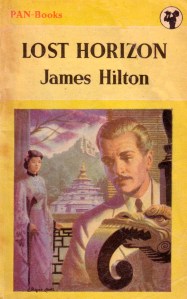 Lost Horizon
 A Year in Provence by Peter Mayle
 My life in 2500 words? Really? My whole life, everything? Is that possible? Well, hang on a minute, give me a chance. I’ve been reading a book by Nora Ephron called I Feel Bad about my Neck and its really just a series of essays. In fact, Nora would be a great blogger because all her essays are nice blog sized pieces which could all easily be humorous blog posts. Her book is a little bit of a cheat really, it reminds me of a book by Spike Milligan I read years ago, A Bit of a Book I think it was called. It was full of little drawings and sketches which could easily be flipped through and other things like blank pages entitled the blank of England.
 Last week was my birthday week and Liz suggested a trip up to the Scottish Highlands. The Scottish Highlands I thought, is it hot there? Can you sunbathe and swim in the sea? Well, you can although I wouldn’t advise it in October. The thing is with the current lockdowns in place all over the country and indeed the world, jetting off to somewhere warm isn’t much of an option. Anyway, our much under used motorhome was sitting on the drive just waiting for an opportunity for a run out so off we went.
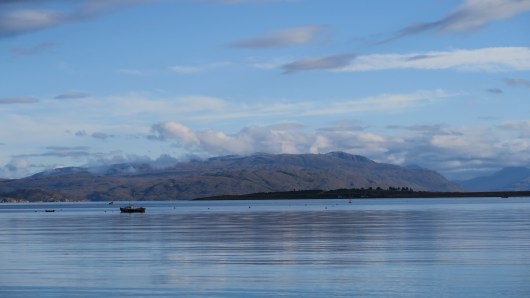

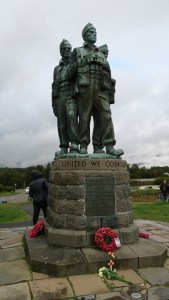 Plockton itself is a tiny village with a small harbour. We parked up at the car park while I went for a wander about. I found the row of cottages where Isobel, the town reporter lived but the village pub, a white building in the TV show eluded my searches. There was a pub, a grey building with an outside seating area looking over the bay, but it wasn’t the one I knew from the television. As we drove off, we passed another couple of pubs, neither of which was the TV village pub but I could imagine having a pleasant evening in Plockton with a nice pub crawl thrown in too.
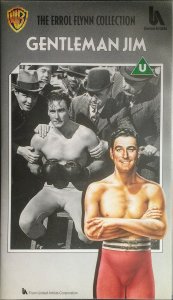 My brother and I usually go out into Manchester every few weeks. We get something to eat and have a few beers and a good natter. It’s always nice to visit our old haunts in Manchester and to find new ones. There always seems to be a new venue popping up and the only flip side to new venues in Manchester seems to be the extraordinary prices they like to charge for food and drink. Maybe, being the fully paid up tightwad that I am, I should stick to the old, less trendy and cheaper places that I know.
 It’s always worth just having a peek in your junk mail. You never know what may be found there. I tend to look when I’m expecting an important e-mail and it hasn’t turned up in the usual place, my inbox for instance. I’m always pretty amazed at what I might find there: Invitations to join groups. Blogging advice. Video seminars. How to make money with bitcoin. Russian women who want to meet me and so on.

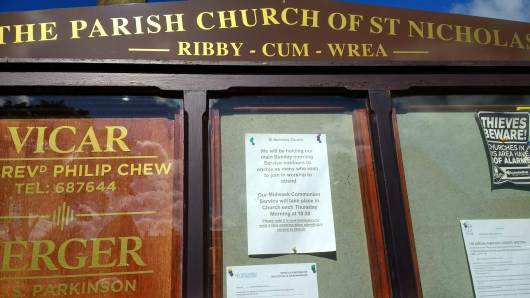

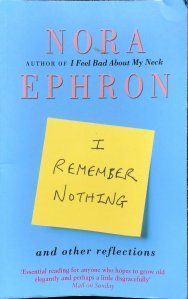 After watching the documentary film I felt even more determined to find out more about Nora so I went to abebooks on the internet and after some research ordered a copy of I Remember Nothing, a book by Nora that seemed to be a memoir. The book starts out as a sort of memoir, telling humorous stories about this and that, and her life without really giving much away. Nora wanted to be a journalist and after working for the Kennedy White House for a short while she joined the staff of the magazine Newsweek. In her book she tells the story of how Newsweek did not hire female writers and offered her a job as a mail girl. She doesn’t appear to have been upset by this despite it being blatantly sexist. She just got on with her job, still determined to be a journalist. In her book Nora makes the whole episode sound quite amusing, especially when she later writes a parody column during a newspaper strike and as a result gets invited to write for the New York Post. Over on Wikipedia, there is a slightly different story in which Ephron gets involved with a class action lawsuit filed against Newsweek for sexual discrimination.
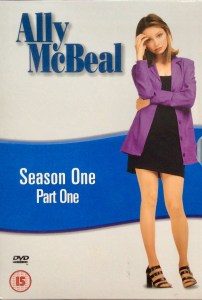 That of course was 1977. In 2020 Stuart, like me might have been tempted to go into Manchester for a night out but Manchester is a hot spot as far as the Coronavirus is concerned. Bolton, a Manchester suburb has been forced back into lockdown because of a spike in Covid cases so for the time being I thought it might be better to just stay in and stay safe. That’s how I came to settle down in front of the TV with a can of Guinness and a packet of Doritos. I combed through my old VHS box looking for something I hadn’t watched for years. I picked up a couple of documentaries which looked interesting and then came across my Ally McBeal DVDs.
 I do love old pictures. I’m not talking about films or movies, I mean actual pictures, old photographs. It’s amazing what we can do with old photographs these days in the world of digital images. We can scan them, remove blemishes, colourise black and white pictures, in fact we can do almost anything. I remember a recent documentary by director Peter Jackson which involved the restoration of old silent films from the trenches in World War 1. The films were cleaned and digitised, colourised and in some cases a lip reader was employed to try and surmise what those long dead soldiers were saying while the hand held camera was cranked. Computers removed the jerky motions and the result was genuinely amazing. I found myself so interested that I remembered a gadget I had bought a while back, a slide scanner with which I planned to scan and digitise my old colour slides. The results weren’t great and in fact I didn’t have quite as many slides as I thought I had but the results were interesting. I played with the device for a while, scanned a number of slides then moved on to some other project.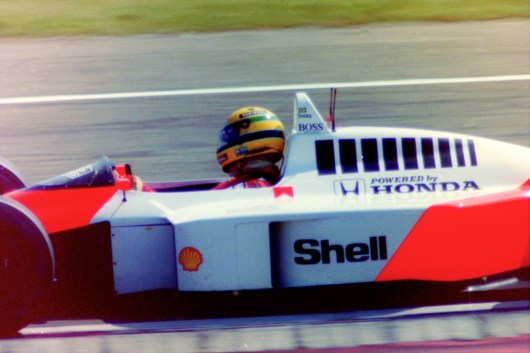

 When I sat down on my break and flipped open the book, a small cutting fell out. It was a newspaper cutting dated November 14th 1995 from the Daily Express. An Actor Bombs went the headline and went on to tell the story of an actor:
 Today the tree has grown again, this time straight up and I can look forward to one day making apple pies again.
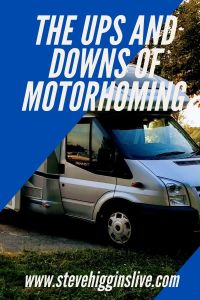 I remember once staying at a caravan site somewhere in France. It was only a short stay, just a matter of days. I think we had travelled from the Loire up towards Calais and had a few days to spare before going onboard the shuttle for our trip under the channel and back to the UK. As I lay reading on my deck chair, an impressive motorhome pulled up opposite us in the camping area. This huge motorhome backed into place. The driver ambled out and set up his deck chairs, table and awning. Then he rolled out a huge TV dish, linked up to some distant satellite and finally sat down to relax.

 Letters from an Unknown Author!