The F1 season starts later this month in Bahrain, in fact the race teams are already gathering there for the pre season testing, getting ready to shake down the new cars and sort out any teething issues before the actual racing. Of course, I’m assuming that despite Covid 19 we will have something of a normal F1 season once again. One of my favourite events, the Monaco Grand Prix traditionally takes place in May and even though the hi tech F1 cars outgrew this road circuit many years ago, they still come here and race fans can hobnob with the rich and famous and look enviously at the harbour when it will be choc-a-block with millionaires’ yachts.
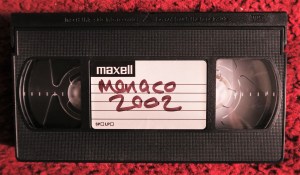
The other day I was once again going through my old VHS tapes, selecting ones to keep, ones to copy to DVD and ones to throw out. One tape was marked Monaco 2002 qually and I was tempted to dispose of it straight away but I put it to one side and then later when the TV schedules declined to offer up anything interesting I thought why not give it a watch?
I have to say I couldn’t quite remember off the top of my head who was winning and who was losing in 2002 or even who was driving for who.
The video started off talking about what was portrayed as a controversial event in the previous race in Austria. Michael Schümacher and Rubens Barrichello were both driving for Ferrari at the Austrian Grand Prix. Rubens, the popular Brazilian was fastest in qually, fastest in the warm up and led the race. At the very last corner he came out ahead of Michael but then lifted off for a moment and it was Schümacher who took the chequered flag. Schümacher and Rubens came to the podium and Michael was not popular, facing a barrage of booing from the crowd. Michael, clearly embarrassed, pushed Rubens on to the top spot but that would not change the result; Rubens had handed the race win to Michael.
I started to fast forward through the TV ads but then saw one that always used to make me laugh. Here it is:
Back to Monaco and the TV coverage back then had passed to ITV and Jim Rosenthal was the TV anchor. He quizzed pundit Tony Jardine and guest and FIA chief Max Mosley about the Austrian Grand Prix. They weren’t happy at all that Rubens had handed the win to Schümacher. Are they bringing the sport into disrepute asked Jim. Max and Tony seemed to think so. The ITV web site was apparently flooded with complaints. Some drivers were interviewed and one I thought was interesting was the comment by Jacques Villeneuve. He said that we all knew that Ruben’s contract said he was number 2 and had to give way to the number 1 driver who was Schümacher. We all knew also that in Schümacher’s contract it said that the number 2 driver had to give way to him so why should we be surprised at what had happened in the race? Schümacher said Villeneuve should act like a man, accept what has happened, stand up on the number 1 spot and accept the boos.
Funny thing is that nowadays, Villeneuve is always in the F1 websites saying something controversial so perhaps I’d forgotten he was a straight talker even back then. Yes, that whole episode was a big scandal back in 2002 although I really don’t know why. Motor racing is a team sport and Ferrari has always been known to give team orders so why was everyone getting upset? Even Stirling Moss, who drove in an era when team orders were pretty much de rigueur felt compelled to say he had lost respect for Michael Schümacher. The thing is, as the two had led the race and Michael of course knew that Rubens would move over, then the two were hardly racing were they, as Ferrari Team Boss Ross Brawn pointed out. If there had been no team orders then Rubens would have had Michael up his exhaust pipes pushing him until he found a way past. To me the whole thing was a fuss over nothing but as I remember, the whole thing rumbled on and on for quite a while.
Anyway, I soon fast forwarded to the action, the actual qualifying which was I have to say, pretty exciting. There was a time when, as an ardent F1 fanatic, I knew race results and team personnel off by heart. Who won at Monaco in 1970? Jochen Rindt of course. 1971? Jackie Stewart. 72? Jean Pierre Beltoise in the rain. What about 1977? Was it Lauda? No, Jody Scheckter. 86? Prost? Yes, Alain Prost. 2002? 2002, there’s a question.
Time to fast forward again but then another advert caught my eye. I haven’t seen it for years but I’ve always found it rather funny. It starred the northern comedian, Peter Kaye.
Getting back to the qually; as I said before, it was all pretty exciting, especially as I couldn’t remember who was driving for whom, never mind who came out on top. Schümacher soon set the top time then David Coulthard driving for McLaren went fastest. Hakkinen his team mate, who was as you may remember, a double world champion, wasn’t doing so well but then Juan Pablo Montoya, one of my favourite drivers claimed the top spot. The cars began to get faster as the track ‘rubbered in’ and got faster. Coulthard went fastest again, in fact there were ten changes of pole sitter until Juan Pablo the Columbian driver finally claimed the top spot. I’ve always liked Juan Pablo. He was a man who told it like it was, he didn’t go in for PR led team speak and I was looking forward to seeing his post qually interview but then something happened, something that always used to happen back in the VHS age.
 The other day I was idly watching an episode of Everybody Loves Raymond. It was the one where Ray and Debra his wife are watching their wedding video and suddenly the screen dissolves and on comes a football match. Debra is furious because Ray has taped over the wedding. Yep, those sort of things happened back then and on my video tape something similar occurred. The race video vanished into a hail of snow only to be replaced by a James Bond documentary. I was furious for a moment but then I got interested in the documentary. It focussed on Miriam D’Abo who starred in the 007 film The Living Daylights and she interviewed various ladies who had the dubious honour of being a ‘Bond Girl.’ There were plenty of clips from the Bond films, interviews and bits and pieces of behind the scenes stuff, in fact it was all pretty interesting for a Bond fan like me.
Pity about the Grand Prix but what the heck, pause to get a bottle of lager and a few nibbles and who cares? Wonder who did win the 2002 Monaco Grand Prix though?
(If you’re interested David Coulthard won with Schümacher coming home second!)
 The lockdown isn’t over yet but at least we can finally see the light at the end of the tunnel. As much as I like staying at home and watching my favourite films and TV shows I miss visiting my favourite bars and restaurants. Our motorhome has been left quietly on the drive awaiting the day when we can once more drive off for a short or even a long break. We did take it on a run to the shopping centre a few weeks ago but that really doesn’t count.
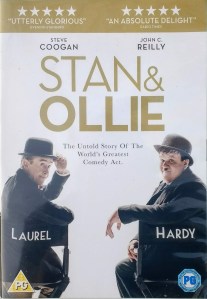 Stan and Ollie
 I’ve been looking through my poetry work lately and I started to think that I could write a blog about writing a poem. Now I’ve started I’m not sure how this is going to work out but anyway, let’s give it a shot.
 A major disaster happened to me this week. Not an actual disaster like a car crash or anything but for a writer and blogger it was the blogging equivalent.
 Round about then I realised the delivery guy had not left any wine. A quick call and happily the driver was nearby with an order for someone else so the wine came shortly after. Luckily, another bottle of red was already warming by the fire but with so much food, that second bottle came in pretty handy.
 Can music really make a good film? Can a really great theme lift a good or even mediocre film up into the lofty heights of the great films? I’m not sure but that’s today’s blog theme and here are a few examples.
 My Autobiography by Charles Chaplin.
 Stan, The Life of Stan Laurel by Fred Lawrence Guiles.
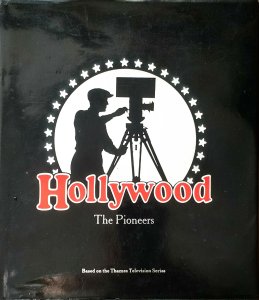 Hollywood.
 Anyway you look at it, this whole Coronavirus thing is quite frankly, a bit of a bummer. I might even go the whole hog and say a lot of a bummer. Of course, there is the tragic side of the virus, people dying in their hundreds and indeed thousands across the globe. Some fools even protest and say it’s a conspiracy and that the government is trying to control us! If they are it’s no mean feat for governments across the world to agree and work together, even if it’s just to keep us lot, the public, under their thumb. That control does come at a price though. Already businesses are closing and going under. Many pubs and restaurants may not survive and those who are self-employed may suffer the most as in many ways they fall outside the various schemes the government has concocted to help workers.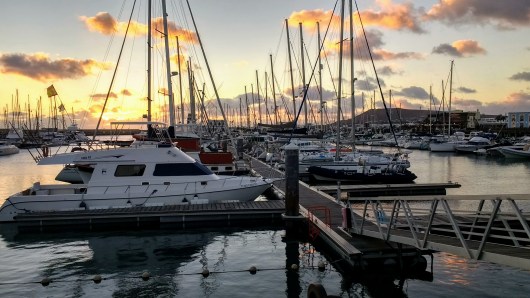
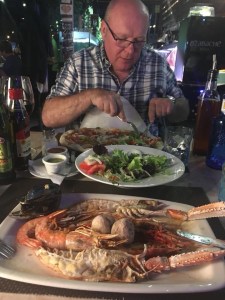
 Travelling to work on Christmas day afternoon was interesting. I expected the roads to be quiet, after all, Christmas day is not usually a day for travelling, especially when we are in the middle of a pandemic. The lockdown then was a bit of an odd situation, especially where I work because my workplace is right where three different counties meet, Cheshire, Greater Manchester and Merseyside and all three were in different states, or tiers of the lockdown. Now that we are all locked down the situation has at least been clarified.
 The record keepers of the regiment may not have cared about my Dad but he certainly cared about his regiment. He was very proud of his army service. He served in Northern Ireland, Germany and Hong Kong, and told me many stories about his army life. In fact some time ago when I posted a picture of him on Facebook showing him at work for the council highways department, one of his old work mates replied mentioning the stories he used to tell his workmates about his army sergeant major.
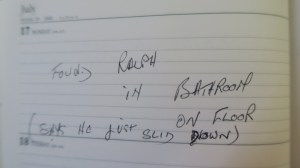 As the diary comes to April the daily entries become briefer, sometimes just one sentence about the weather. Dad’s handwriting seems to become a little less firm. It is still the same hand, sloping gently to the right but it somehow seems perceptibly weaker. On July 17th there is an entry in my Mum’s hand. She always wrote in capitals for some reason. FOUND RALPH IN BATHROOM ON FLOOR she says. He went to the doctor and they found nothing. Another entry on July 20th, again in Mum’s hand, FOUND RALPH ON FLOOR IN KITCHEN. He was taken to hospital and on the 26th July a brain scan found that he had a tumour on his brain.
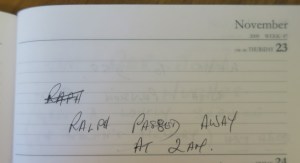 In the diary Dad’s last ever entry was on June 2nd. It says he took Bouncer for a walk and went to visit my brother who lived not far away. Underneath my Mum has arrowed across to May 31st, so it looks like Dad wrote his entry on the wrong date. His eyesight was failing, He was due to have an eye operation for cataracts but the operation was cancelled because of his tumour.
 A while back I did a post about the
