Now that lockdown is easing I’ve spent quite a bit of time at my mother’s house in Wythenshawe which is a suburb of south Manchester. Wythenshawe is the site of a huge council estate once known as the garden estate because each house had a front and back garden unlike the terraced houses in Hulme and Salford where most of Wythenshawe’s tenants came from back in the 1920’s and 30’s when the estate was first started.
My mum went into a care home just after Christmas. She had been in hospital since early December suffering from a bad chest infection. For the past two or three years dementia has taken its toll on her but her increasing immobility had make it much harder for me and my brother to look after her despite having the assistance of carers coming at various times throughout the day.
Anyway, I tidied the garden of her house up as best I could and made a start on sorting out mum’s things ready for the inevitable time when we must give the house up. Recently I came across a plastic handle of some sort that was incredibly familiar but I couldn’t work out what is was. Later I found a blue plastic brush which fitted on the handle and it was then I realised this was a back brush that has always lived in our bathroom for as long as I can remember. When that memory came back to me I felt reluctant to throw the brush away. After all, I’m sure we had that brush in the bathroom when I was a schoolboy in the 1960s making it something over fifty years old.
Wythenshawe doesn’t have such a great reputation but from my point of view it isn’t really such a bad place. It isn’t, as far as I know, a haven of drug dealers and gangsters and the streets are fairly safe to walk, even late at night but when a place gets a bad reputation it’s hard for some people to see past that. I’m not sure what kind of reputation Manchester itself has in the world at large. Personally I think it’s a great city but then again, on a recent episode of the TV show Come Dine With Me, the announcer mentioned that Manchester had been voted the UK’s rudest city! Oh well.
Years ago I worked in Liverpool servicing and repairing cigarette vending machines. It was actually a pretty good job except that I had to get up early every day. The machines were all sited in pubs and bars so I tried to do the majority of my work before the pubs opened as naturally, I didn’t want everyone and his dog knowing what I was up to and that I had a van full of cash and cigarettes.
The cigarette machines were fairly reliable but they did break down now and again but as long as they were kept in good order callbacks as we called them, were minimal. At least they were on my round. I discovered early on that the big problem with vending machines are coins. Coins are dirty and greasy and sometimes sticky and every time a coin goes through the coin mechanism, it leaves behind dirt. That dirt will build and build until one day the machine just won’t work and then an irate pub landlord would be on the phone saying ‘Steve, we’ve got a big night on tonight, you’ll have to come out and sort the machine!
What I used to do on my regular visits was spend a few moments at each machine and give that coin mechanism (coin mex is what we used to call them) a quick check and clean and those few extra moments prevented the dreaded callbacks.
Every fourth week I had to work a weekend for my team mates and cover any problem calls that came in. I rarely had callbacks, they were always for my team mates who couldn’t be bothered to clean those machines. One weekend I got a call from some pub in the outskirts of Liverpool. I can’t remember exactly where it was but it was a semi country area, off towards Ormskirk I think. This was pre-google maps so I had to troll through my A to Z and find it. I remember cursing my team mate Joey about it. I had called him to have a moan and he said I had to be there before 11am or the Landlord wouldn’t let us in until the pub was open. I got there in time but it turned out the landlord was on holiday and the relief manager, actually a manageress, was a pretty amenable lady.
We chatted as I struggled to get the jammed coins free and she said it was clear from my accent I wasn’t from Liverpool. It turned out we were both Mancunians and she asked me whereabouts in Manchester I hailed from. When I said Wythenshawe she nearly fell over. ‘Oh my God’ she said, ‘it’s rough round there!’
I spent some time trying to reassure her about Wythenshawe and explain that it wasn’t such a bad place. Trying to change the subject I asked her where she hailed from and she replied ‘Moss Side’. ‘What!’ I exclaimed. Here was someone who thought my home town was bad when she comes from a place that makes it look like paradise!
Moss Side is an inner city area of Manchester and quite frankly, it is a very rough area indeed with more than its fair share of villains, drug dealers and other unsavoury characters.
Back in 1992 I studied video production and media techniques at the WFA media centre in neighbouring Hulme, and when I say neighbouring I really mean next door. We were in teams of three making short videos and after a week or two of filming in Manchester we moved on to editing. I loved editing and we spent a lot of time in the basement working in what was then state of the art editing suites. After further work there we had to put together a rough cut to show the rest of the school. Our video rough cut went down pretty well. It was a short documentary about taxi drivers in the city centre. One driver who we interviewed mentioned that certain places in the city were dangerous to visit, especially late at night. Places he said like, wait for it, Moss Side!
We were on a small stage and my two colleagues had nominated me to answer questions as the taxi idea had been mine. One woman condemned the taxi driver immediately for being racist as Moss Side does have a large black and Asian community but be fair I said, there was no mention of race, just people who did a runner when they arrived at their destination, people who wanted a taxi ride for free which obviously, didn’t go down well with the taxi drivers.
We weathered the storm which was only minor anyway and went back to our editing. My colleagues wanted to cut out the offending taxi driver but I wanted to leave him in. I can’t remember if I got my way but here’s the finished video if you want to check.
Nowadays, Moss Side has been regenerated and looks much nicer than it used to. Is it still a rough area of the city? Maybe yes, maybe no. Looking at the screenshot further back up the page about a Moss Side shooting I’m not so sure. I suppose it all depends on your point of view. Even though, I wish I could show the video to that Merseyside pub manager!
What to do next:
Share this post on your favourite social media!
Hit the Subscribe button. Never miss another post!
Buy the book! Click here to visit Amazon and download Floating in Space to your Kindle or order the paperback version.
I thought for a minute of changing the title of my whole website to that which you can see above: The Ramblings of a Locked Down Blogger. Maybe even the crazy ramblings! Still, in a few weeks or perhaps months, the lockdown and Coronavirus will just be a bad memory. In fact, my first post lockdown restaurant visit has already been booked and my table and meal are actually only a matter of hours away.
It will be nice to socialise again and also to dress up. I’ve spent the last two months wearing the same small selection of jeans, shorts, tee shirts and sweaters. Will I still be able to fit into my smart shirts and trousers I wonder? Well, I’ll soon find out.
I have been watching a quite inordinate amount of TV during the lockdown. That has not been any hardship on my part, in fact it could be argued that watching TV is my default position. I do love TV but not any TV; I am quite choosy in what I watch. I love films and only a small fraction of the films I love have I seen at the cinema. The other 99% I have seen on my television set with constant supplies of either tea or red wine near at hand.
At my mother’s house where I come to tidy up and keep the garden in order, I have just recently been trying to sort through my vast supplies of VHS video tapes. Any VHS films I have can be just junked as they will be either shown again on TV or are available on DVD.
Documentaries are a different matter. Films are shown time and time again but great documentaries are seldom shown again. It’s the same with made for TV films. A great film I have on VHS is Across the Lake, a made for TV film starring Anthony Hopkins as record breaker Donald Campbell. I have not watched it for ages but it’s a great film, well written and with an excellent performance by Anthony Hopkins documenting Campbell’s last and fatal attempt at the world water speed record. Why the BBC don’t think of showing these outstanding made for TV films again I really don’t know.
You can see the entire film on YouTube but here’s a short clip:
One thing I love in films is originality. There are a thousand films with car chases and shoot outs and murders but it’s great to see something new. One DVD I watched recently is The King of Comedy. Even though it’s directed by Martin Scorcese it’s not a gangster film, it’s something very different. Robert de Niro stars as a wannabe stand up comedian who wants to get on a show hosted by Jerry Lewis. Jerry plays a TV comedian who is pretty much Jerry Lewis himself. He turns in this outstanding performance as a TV host who is kidnapped by De Niro and held hostage in return for De Niro getting a stand up spot on Lewis’ show. De Niro is helped by a Jerry Lewis obsessed fan played by Sandra Bernhard turning in another great performance. This is a film that is funny, dramatic and completely original. Keep a look out for it on your favourite TV film channel.
Another original film I saw lately was Big Eyes. It’s based on a true story of an artist, Margaret Keane, who turns out some popular and charming pictures, all of people with big eyes. Margaret is a woman who can paint but is not so good at selling and marketing her work. She meets future husband Walter who seems to be a bit of a whiz at the promotion lark. He decides to rent space on a local nightclub wall to get attention for both Margaret’s and his paintings. Surprise, surprise, it is Margaret’s paintings of the doe eyed girls that get all the attention but Walter decides to play the part of the artist as some people have mistakenly thought that anyway. Margaret plays along but gradually becomes very unhappy having to constantly deny her own work.
Big Eyes is, incredibly, a true story. Margaret eventually leaves Walter and has to sue to be finally acknowledged for her own talent. Margaret’s paintings are captivating although art critics are divided on her true worth as an artist. It’s worth noting though that Andy Warhol said this about her work: ‘It has to be good. If it were bad, so many people wouldn’t like it.’
I’ve also been editing my own films during the lockdown. My friend Steve and I made a video about Manchester Airport in 1986 and it’s my second most watched film on YouTube with 16,000 viewings. In 2018 I realised that if I took out all the pop music used on the soundtrack the video would be eligible for monetising, that’s YouTube’s word for getting royalties from your video. I added some copyright free music, tidied a few bad cuts in the video and reposted it to YouTube. Rather annoyingly, YouTube decided just then that video producers have to have a minimum of 1000 followers to get royalties and as I only have about 220 that’s another income stream that has been denied to me.
When trolling through my VHS tapes I found another version of that same video. Yes, even 30 years ago I was still tinkering with my videos and re-editing them. Anyway, I took this one and re-made it again adding some sound effects and new music. Could YouTube stand a third version of the same video? I’m not sure but then again, some mainstream directors like to tinker with their own work when the time comes for the DVD version. I’ve got quite a few ‘directors cut’ DVDs in my collection like Aliens and Apocalypse Now to name but two.
During lockdown I’ve also been listening to my favourite podcasts. The BBC Radio 5 Live F1 podcast is a constant disappointment. When F1 races are on, the 5 Live people assume that listeners know what happened in the race. That’s not the case, I usually listen when I’ve missed the Channel Four broadcast on TV so I listen in for a race report not a load of F1 chit chat. When there are no races, like during the lockdown, I actually do want to hear some F1 chit chat, some gossipy stuff about which driver’s contract is about to expire, which designer is moving teams, will Vettel retire or go to the new Aston Martin F1 team? Stuff like that. No, they don’t even bother to do a podcast when there is no racing.
Instead I’ve been listening to my new favourite podcast, The Slowdown, a poetry podcast that usually lasts about 5 minutes, not too long, not too short. The presenter, US poet Tracy K Smith has such a wonderful voice she seems to make any poem sound good. Wonder if I could get her to read one of mine?
What to do next:
Share this post on your favourite social media!
Hit the Subscribe button. Never miss another post!
Buy the book! Click here to visit Amazon and download Floating in Space to your Kindle
Things don’t always go as planned, especially when an unexpected pandemic hits the country so instead of presenting what might have been another holiday book bag, here’s the pandemic version instead: A review of the books I’ve been reading lately, all sourced as usual from second hand book shops or the internet.
A Right Royal Bastard by Sarah Miles.
Sarah Miles is a famous actress from the 60s and 70s. She appeared in films like Ryan’s Daughter and The Servant. A Right Royal Bastard is the first volume in her autobiography and is mostly about her childhood. I suppose normally you might expect a film star to devote a chapter or two to his or her childhood but here Sarah gives us pretty much a complete volume devoted to hers.
After the opening chapter I expected the book to move on but no, Sarah Miles tells us everything she can think of about her childhood and her schooling as well as her background and her family. I have to say I was getting a little bored but after a few chapters the book finally began to get interesting.
It’s a very frank book indeed and I wonder if it was a confessional experience for the author. Sarah tells us about her first period and then later about her first sexual experience. The story about when she was almost raped was shocking but then she proceeds to tell us about the time she shared a flat with a prostitute. One memory from that time was when she agreed to hide in a wardrobe during one her flatmate’s encounters with a male client. Sarah and that particular lady later have a bath together and Sarah soon begins to suspect that perhaps someone has got the hots for her.
Later she falls in love with James Fox. He is in the army at the time and when he goes off to join his regiment Sarah finds she is pregnant and suffers a dreadful back street abortion.
Sarah emerges from these pages as utterly different from what I had imagined, she always looks so prim and proper in her films. The book finishes with her first big part in a film and I have to say, I did find myself wishing I had the second volume. I’ll have to look out for it.
Alan Turing: The Enigma.
I’ve been reading this book for a long time and the lockdown was the perfect opportunity to finish it off and finally put it aside. This book is well researched which must have been difficult as Turing was not well known or even famous during his lifetime and his greatest achievements were made in the greatest of secrecy during wartime. The first part of the book I found slow but tedious and it finally livened up when Alan Turing joins the staff at Bletchley Park and sets about decoding the secret messages from Nazi Germany; then it gets interesting.
Turing joined the Government Code and Cypher School in 1938 which was the UK’s code breaking organisation. In 1939 the British cypher experts were given details of code breaking by their Polish colleagues including details of the Nazi Enigma code machine and their methods of decoding the Enigma messages.
Turing recognised the importance of a machine the Poles used to help break the codes and he designed and made his own improved version known as the Bombe. In 1941 Turing and his colleagues appealed directly to Winston Churchill for more resources to help their work and Churchill, recognising the importance of what they were doing responded immediately. As a result, more than 200 bombe machines were in operation by the end of the war.
German naval Enigma messages were even more difficult to break and Turing worked hard on these codes, finally breaking them with a statistical technique that was later known as sequential analysis. It was later estimated that the work at Bletchley Park shortened the war by 2 years and saved countless lives.
Turing worked at Manchester university after the war. In 1952 he became involved with a young unemployed man named Arnold Murray who was later involved in a robbery at Turing’s home in Wilmslow. During the inquiries Turing acknowledged a homosexual relationship with Murray and was prosecuted, homosexuality being illegal at the time. He was found dead two years later in 1954 and it is thought he took his own life using cyanide although it may have been that his death was accidental.
Apart from the wartime work decoding Enigma messages I actually found this book rather heavy going. Towards the end when Alan is working in Manchester I found myself skipping through long passages about mathematical theory but I was glad to have finally reached the end. One interesting thing was that Alan lived in Wilmslow during this latter part of his life. I once lived in Wilmslow too and travelled into Manchester every day on the bus, a journey of about an hour. Alan did the same journey by bicycle so he must have been pretty fit.
Over on Goodreads readers seemed to be all in favour of the book but sadly it just wasn’t my cup of tea.
Khrushchev Remembers.
This book has a remarkable history. Khrushchev was ousted from the Soviet leadership in 1964 in favour of Brezhnev and he was retired to a small dacha with a pension. There Khrushchev fell into a deep depression but his son suggested he record his memoirs on audio tape which he did. The KGB kept an eye on Khrushchev and demanded he turn the tapes over to them which he also did. His son however had copies secretly smuggled into the west and they were published in the form of this book. My copy is quite an old one and has a commentary by Edward Crankshaw putting Khrushchev’s memories into perspective.
The book is a fascinating read and the author takes us through his early life and we see him move ever closer to the centre of power which in Khrushchev’s early years meant closer to Stalin. Khrushchev in some ways thinks of Stalin as a good comrade and communist but in others as what he really was, a ruthless dictator. Khrushchev survives the years of Stalin’s purges when many disappeared after a knock on the door in the middle of the night. Khrushchev defends the Nazi-Soviet pact saying the Soviets knew it would never last but that it gave them time to build up defences against Hitler. Hitler finally attacked Russia with Operation Barbarossa in 1941 and for a time Stalin disappeared from view. He was finally urged into action by his generals and I have read elsewhere that when they first approached him he asked ‘have you come to arrest me?’
It would have probably been better for the Soviets if they had but they rallied around their leader and went on to defeat Hitler, and Stalin consolidated even more power. Stalin died in 1953 and he was left lying on the floor for a day as his staff were too scared to approach him. Beria, head of Stalin’s secret police initially grabbed power but Khrushchev was able to overcome him and have him arrested by the military.
In 1964 it was time for Brezhnev to snatch power himself. Khrushchev did not resist. His contribution he said, was the smooth change of power without murders or arrests.
‘Could anyone have dreamed of telling Stalin that he didn’t suit us anymore and suggesting he retire? Not even a wet spot would have remained where we had been standing. Now everything is different. The fear is gone, and we can talk as equals. That’s my contribution. I won’t put up a fight.’
Brezhnev reversed many of Khrushchev’s reforms and the world and the Soviets had to wait for Gorbachev for more enlightened leadership. To sum up, this was a great read and very interesting but one in which I was glad of the commentary to put the author’s views in perspective.
That was my lockdown book bag. What books do you have in yours?
What to do next:
Share this post on your favourite social media!
Hit the Subscribe button. Never miss another post!
Buy the book! Click here to visit Amazon and download Floating in Space to your Kindle
Wait just a minute! Letters to Younger Selves? Haven’t we had this post already I can hear you thinking? In fact not just once; there was Letters to My Younger Self and then we had A Video to My Younger Self? Hasn’t this guy got any new ideas? OK, I know where you’re coming from but bear with me for a short while. I did do a post a while back which was about me writing a letter to my younger self. Then the other week I told you about how I put together a video version for my YouTube channel. This week I want to tell you about what happened when I actually uploaded the video.
Now I did say the original letters post wasn’t my own idea. I got it from one of those blog writing prompts that can easily be found in either Google or your search engine of choice. After uploading my video I always do a search for it and if it comes up near the top of the search then I’ve feel I done a pretty good job in terms of tags and meta data (all that technical stuff) and choosing a good post title. A search for A letter to My Younger Self gave up some surprising results, in fact it seemed to me that everyone and his dog had been making a short video on this same subject. Even more surprising was that a lot of these short videos were by Formula One drivers. I’m guessing that at some time there was some kind of trend for this subject, perhaps a promotion around the hashtag #DearMe but when it comes down to it, I might as well admit, I don’t know.
Anway, I thought it might be interesting to showcase a few of the videos I came across so let’s start with Fernando Alonso, frustrated former Ferrari driver who jumped ship thinking Honda were going to create a world beating engine for his new Mclaren team, only they didn’t. Hard luck Fernando.
(I should point out here that F1 being the multi million dollar global industry it is, they wouldn’t for a minute let these videos play on my cheap nasty amateur blog post. Press play then you have to click the button that says ‘Play on YouTube’. Annoying I know but hey, that’s big business for you.)
Many people think that Fernando is one of, if not the greatest driver of all time. Those people are of course completely wrong and this then is the perfect time to introduce someone who actually is the greatest driver ever. Jackie Stewart, winner of 27 Grands Prix from 99 starts, three World Championships and now one of the Formula One world’s elder statesmen.
South African Jody Scheckter was once the enfant terrible of Formula One, especially when he spun and caused a huge pile up at the beginning of the British Grand Prix back in 1973. A lot of people weren’t happy but Scheckter went on to drive for Ferrari and win a World Championship in 1979.
Emerson Fittipaldi was one of my favourite drivers of the 1970’s. He took over from the late Jochen Rindt at Lotus and won three world Championships before electing to drive for his brother’s new F1 team. Things didn’t work out so well for the Fittipaldi brothers and Emerson retired for a while but then made a comeback in American Indycars winning the Indycar title in 1989.
Someone who did what Emerson did, only in reverse, was Mario Andretti. He was a champion in the US and had a few one off drives for Colin Chapman, head of he Lotus team who tried numerous times to lure Andretti over to F1. Andretti finally dipped his toe into F1 and won the world title for Lotus in 1978. He was the last American to date to win an F1 race. He won numerous races in all types of racing disciplines in the USA including 4 Indycar championships and numerous other races and awards. He is probably as synonymous with motor sport in the USA as Stirling Moss was in the UK.
I think that’s probably enough from the F1 world so I’ll finish with some other famous people. The first non F1 person I came across was Caroline Kennedy, the daughter of the assassinated president. It’s pretty brief and the good news is that all these next videos can be played within this post!
Still with the Presidential theme here’s something from former first lady Michelle Obama.
Art Garfunkel, former singing partner of Paul Simon did one too . .
And finally, here’s one which isn’t by a celebrity. I came across this one after hours of trolling through Google and YouTube. Many videos I found were of young people talking to their even younger selves so really they didn’t have much to say. I think that the whole theme is better suited to someone older, someone in their later years looking back to their youth. Anyway, here’s a pretty inspiring video.
Finally it’s time to plug my own video once again. Here’s a slightly edited version with a few subtle sound effects added . .
What to do next:
Share this post on your favourite social media!
Hit the Subscribe button. Never miss another post!
Buy the book! Click here to visit Amazon and download Floating in Space to your Kindle or order the paperback version.
Not long ago I came across a blog post about the best documentary films of all time and looking through it I noticed one about Marlon Brando. When I was younger I was very interested in Brando. I thought he was a great actor, one of the greatest in fact even though I think his stature has become diminished by his poor choice of roles in his later life.
Brando’s earlier films are a list of classic cinema greats and if he had perhaps died early like James Dean I’m sure many writers and cinema fans would have wondered what would have happened if Brando had lived, what great movies would he have made? Actually the answer is, not very many.
Anyway, before I get to Brando let’s look at some other examples of movie actor documentaries.
Peter Sellers as he filmed it.
The BBC Arena team made this film about Peter Sellers in 1995. It was created largely from cine film shot by Sellers himself, who was a lifelong camera enthusiast. The original documentary was made in 1995 and if I remember correctly, Sellers’ widow, Lynne Frederick had died and left behind a lot of Sellers’ effects, including his home movies which is how the film came to be made.
Normally, I’d say that you have to be interested in movie people and how movies are made to like this documentary but this film is so special I don’t think that rule applies.
The original film was in three parts and began with Sellers’ early days and his early films. The first cine films we see are black and white movies and as Sellers’ career takes off, his cine equipment also improves and he upgrades to colour and then on to sound. His own images show his young self as a sort of ‘spiv’, a Flash Harry sort of character with his double-breasted and shoulder padded jackets. An uneasy relationship with his mother emerges, as does a rather spoilt and volatile personality. His first wife talks about their early days and their life together and friends like Spike Milligan talk happily about successes like the Goon show and their beginnings in show business. Milligan had a 8mm camera and Sellars a 16mm one. Of course ‘Peter was richer,’ comments Milligan. ‘Richer by 8 millimetres!’
Sellers’ cine film is blended with interviews from various people who played a part in Sellers’ life.
Sellers as Group Captain Mandrake in Dr Strangelove.
A fascinating section concerned Casino Royale, the spoof James Bond film. Various directors were involved but Joe McGrath shot one segment with Peter Sellers and Orson Welles. McGrath was a TV director relishing the move into feature films, that is until Sellers told him he didn’t want to be in the same shot as co-star Welles. A heated debate ensued which became physical. Sellers said he was going off to calm down. He never returned and if you ever see the completed movie, you’ll understand why Sellers’ character abruptly disappears too!
Sellers claimed to have no personality of his own and ‘borrowed’ them from the characters he impersonated. It’s interesting to watch the TV interviews included in the film where Sellers seems to mimic the Yorkshire tones of Michael Parkinson and again, in other snippets he is taking on the accents and style of his interviewers.
The film overall has a sort of melancholy feeling which I feel accurately represents Sellers’ persona. He was a sad character, disappointed in his life and loves. He was not happy with his last wife, Lynne Frederick and he even junked many of his cine films prior to his death as they didn’t seem to match his expectations. The mood of the film is further enhanced by a wonderful soundtrack full of sad saxophones and jazz tones.
There are some that put down documentaries that are full of so-called ‘talking heads’ but personally, if the talking head has something interesting to say, I like to hear them. However, in 2002 the BBC re edited the film by taking the soundtracks from the ‘talking heads’ and combined them with Sellers’ self filmed visuals. The result is now available as a BBC DVD. The original is much better though, in fact you can see all three parts on the video sharing site Vimeo:
Becoming Cary Grant.
The BBC does do a good documentary and a few months back I settled down to watch a documentary about the film star Cary Grant: Becoming Cary Grant.
Grant was the smooth talking and sophisticated star of many a Hitchcock film, indeed the documentary revealed ‘Hitch’ to be his favourite director. Grant and Hitchcock were both immigrants from the UK.
Cary Grant was born Archibald Leach in Bristol in the southwest of England. He had a rather sad childhood during which his mother disappeared. Various explanations were put to the young Archie including the lies that she had gone on holiday and later that she had died. In fact his father had his wife committed to an asylum where she languished until her rich and famous son returned to her much later. In fact, Grant did not learn that his mother was still alive until he was thirty-one years old.
Archie’s father remarried but Archie was not included in the new family. Instead he was sent to live with his grandparents. At school he developed a love of theatre and spent much time helping and later working at small theatres in Bristol. When he was only 11 he began working with a small troupe known as the Pender Troupe and when they went to undertake a new tour in the USA, the young Archie went with them, following in the footsteps of other performers like Charlie Chaplin and Stan Laurel.
In the USA, Archie toured the vaudeville circuit with the Pender Troupe and decided to stay on in the USA when the troupe returned home. He and some others formed their own troupe and Archie spent a lot of time doing various acts like stilt walking and unicycle riding. Gradually he moved on to better roles in various theatre productions and even had a screen test in the early 1930s, which was shown on the documentary. Archie, now using the name Cary Grant comes over as a loud-voiced individual, making many faces for the camera. Of course, as a vaudeville actor he was used to talking loudly and making exaggerated expressions but he soon learned to tone down his performance for the cameras.
The documentary uses text from Grant’s unpublished autobiography and it is clear an experience in later life had a great effect on him. Grant took part in a form of psychoanalysis using LSD which enabled him to confront issues from his early life which the actor felt had unduly affected his relationships as an adult, particularly with women, in fact he was married five times.
The film was interesting but focused mainly on the unpublished autobiography and many of his friendships and relationships that I have read about in other books were not even mentioned. A great part of the film also was Grant’s collection of home movies which were used throughout the film although many times what we were seeing was not properly explained. Towards the end of the film Grant’s daughter was interviewed and visits Cary’s old home. In one scene we see her visiting the patio shown in a earlier shot on one of Cary’s home movies. More interviews and perhaps some more location footage would have benefited this film enormously. Still, it was interesting and can be found on the BBC i-Player if you missed the original broadcast.
Listen to Me Marlon
After reading about this Brando documentary I did a quick search on eBay, found a very cheap copy for a couple of pounds including free delivery, and sat down to enjoy it. It is different to the two films above because rather than home movie or the written word, the prime source of the film is audio tapes that Marlon recorded for himself. The big problem there is that while many are good recordings, others are not only poor quality, but Marlon’s non acting speaking voice is rather difficult to understand. He has a strange lisping, mumbling voice completely unlike the strong voice of many of his roles.
On top of that a droning piano accompanies much of Marlon’s recordings and many times I found myself rewinding to find out what he had actually said.
The Brando that emerges from this film is a sad man made sad perhaps by memories of a drunken mother and a violent father. In an early sequence Marlon senior joins his son the film actor on a TV show and the voice on one of Marlon’s tapes tell us how both of them were acting, one playing the loving son, the other playing the caring father. Marlon spent a lifetime looking to psychoanalysis for help, feeling inadequate despite his fame and success as an actor. It seems also that he despised his craft even though it gave him financial security to do and live however he wished.
Acting he reveals was the first time he did anything that he was praised for and the first to see his talent was Stella Adler, an actress who trained and nurtured him as an actor.
Brando appeared in a number of classic films including A Streetcar named Desire, Viva Zapata, and the Oscar winning On The Waterfront. Some of his later choices of film roles were just frankly disappointing especially during the 1960s. By the end of that decade he was persona non grata in Hollywood and when Francis Ford Coppola decided he wanted Brando to play Don Corleone in The Godfather, alarm bells were ringing in the executive offices at Paramount. Not only was Brando held in low esteem as an actor he also had a reputation as a troublemaker who caused delays and added more dollars to production schedules and costs.
I’m not sure Brando ever really appreciated what Coppola did for him. As well as giving him an Oscar winning role Coppola rehabilitated Brando in the film industry and made him a bankable star once again. Later, when Brando appeared in Apocalypse Now, he appeared on set massively overweight forcing Coppola to shoot him in darkness and shadows. Brando complained about the script too and began rewriting his own dialogue. On his personal audio tapes Marlon rants on about his treatment by the director but really, it was Francis Coppola who should have been complaining.
Listen to me Marlon was fascinating but ultimately a disappointing film. If I ever do a blog post about the best documentaries ever I’m sorry to say I won’t be including this one.
What to do next:
Share this post on your favourite social media!
Hit the Subscribe button. Never miss another post!
Buy the book! Click here to visit Amazon and download Floating in Space to your Kindle
Lockdown has been eased slightly here in the UK but even so, the day when things will be back to normal seems pretty distant. Even then I keep seeing things in the media about the ‘new normal’. What will the new normal be like? I don’t know but one day we will all be back out again, going back to bars and restaurants and flying to Europe and even further afield for our holidays. Still, I can imagine everything being ever so slightly different though with much more handwashing and social distancing.
I did consider calling this post How not to Smash up your Laptop. I didn’t but read on and you’ll begin to understand why. I have actually been fairly industrious this week, well, industrious by my standards that is. I have finally finished my latest video project and I have gradually come up with a few ideas for blogs and made some headway on my other writing projects. When I see my blog post deadline looming, I am not usually that worried because I tend to have a half-written blog post in the pipeline but when I have no ideas at all and no partly written blog posts, well, that is a worry so it has been good to get myself ahead again, if only by one or two blog posts.
A while back I decided that as my writing wasn’t coming along too well, I should set myself the task of making something new for my YouTube channel. There are actually plenty of videos over there on my channel but they are all short and simple one or two minute videos either of me reading poetry or me extolling the virtues of Floating in Space to the reading public.
I felt that my loyal band of video followers could do with something slightly different and while looking around for ideas I began to wonder if I could perhaps make one of my blogs into a video. After a look through my older posts I came across A Letter to my Younger Self. It was a post inspired by one of those blog post prompts that I tend to use when I’m short of ideas. What would you tell your younger self? What advice could you give?
My younger self needed not only advice but a good kick up the rear end although I didn’t quite go that far in the finished video. As we are still under lockdown I couldn’t go out and shoot anything new but I do have plenty of assorted video that I have accumulated over the years. To make things easier I decided to make the video on Animoto which does have plenty of stock clips that I knew I could use. Not only that, I have used Animoto for several years and I’m pretty confident using it. The alternative was using the windows HD movie maker. I have the Pro version but even so it’s not nearly as user friendly as the old Windows Movie Maker.
OK here we go. I logged on to Animoto but found that I was now one of the few people chosen to use the new beta 3 version of Animoto. Why oh why must our favourite software be continually changed? The first big problem I came across was that when using a vertical image in Animoto, it couldn’t be fully zoomed out; it would only fit on the screen to its width, I couldn’t zoom back and display the full image.
I contacted Animoto and they said you can zoom out using the scale bar. No you can’t I said. Yes, you can they said. I had only just started the project and already I was ready to smash my laptop into small pieces. A few days later after a lot of moaning on various Animoto forums the technical people sorted that issue out and yes, I could finally zoom fully out. Anyway, I ploughed on and when I had an initial basic cut, I made a rough narration and uploaded that to the project so I could get the pictures and video clips to fit in together. This seemed to take a hell of a long time and I found myself continually moving on to some other project or sometimes just surfing through eBay for something to buy that in fact I didn’t really need.
Just to give you a fuller picture of the issue, over lockdown I have ordered 3 DVDs, 3 lots of razor blades for the various razors I use, a bargain box of Terry’s chocolate oranges, a 1/43rd model of a bus I used to drive in 1987, a couple of books and various other things I’m too embarrassed to mention. One other thing I ordered, not from eBay but from Wowcher, was a set of face masks, quite handy I thought for venturing out shopping during the current situation. On Wowcher you order your item and are then given a voucher code which you use on the actual site that sells your item. I sorted that out, entered my code and ordered my face masks.
A week later I received an email saying the company had received my voucher from Wowcher and was ‘processing’ my order. After another week I got another email this time to confirm my order had now become ‘fully processed’. Later another email landed in my inbox advised that the item was now with the Royal Mail. At this rate I might just get the face masks in time for Christmas shopping.
Over on Twitter I tend to schedule my posts for the next few days but just lately Twitter doesn’t seem to want to display my scheduled tweets on my laptop. In fact I get a page looking something like this.
Now this can be a problem because there is no point in scheduling a post for 12:03 on Thursday if I’ve already set one to pop up at a similar time. Emails to Twitter and posts on various forums got me nowhere fast and once again I had to use all my willpower to prevent the violent smashing up of my laptop. The only solution was to schedule the posts using my iPad which happily displays the relevant scheduling page without any issues.
OK. Days have passed, even weeks and after getting my video cut near to perfection it was time to download the result and narrate a much more confident voiceover. Here’s when some more technology issues began to slow me down.
I noticed that when I recorded the voiceover, the recording seemed to be jumping and missing out various words. So, I clicked over to Google and searched for information about optimising sound recordings. I found I had set my recordings to DVD quality and maybe my laptop just couldn’t cope with that. OK, time to reset to CD quality and finally that was another problem sorted. (I’m happy to report I resisted the temptation to just smash my laptop to smithereens again.)
I noticed then that when I had my narration on my computer screen and scrolled down as I read, the microphone was picking up the clicks on the scroll button. I couldn’t print off the narration as I had no ink in the printer so what I did was upload the narration to my OneDrive and open it up on my iPad and read it from there. On my iPad I was asked to log in to OneDrive. I did but they wanted further confirmation. They wanted a passcode entered which they sent to my mobile. Off I went in search of the mobile. I entered the pass code but I was too late. It had expired! I did it again but this time the password was wrong!
(Steve don’t do it. Don’t smash the laptop to smithereens!)
No I didn’t. Instead I recorded the first section of the voiceover, paused, scrolled the text and recorded some more. Brilliant!
OK, final narration added, time for a few quick changes here and there and that was it. The big problem with editing is that when you are replaying your work over and over, it’s easy to miss the odd error. A few things I missed were some text on the screen that was in dark blue but wasn’t easy to see against a dark background and some other similar bits and pieces. I like to leave the finished video for a few days then take another look and then those minor errors are much easier to see.
In the old days of editing video, the editor began at the beginning and just carried on adding the next clip and then the next and so on. Today, working in digital video, the approach is slightly different. A scene can be easily compiled into a rough cut but then the editor can go back and change clips earlier in the video, trimming a bit here or re-ordering things there. Another great thing about modern video editing is that you can save your project so if, at a later date, you want to change something, you don’t have to start all over again. You just open up your saved project, change whatever you want and create a video file for the new version.
I’ve often thought about how wonderful it would to be a professional video editor but then I always see myself at work and the boss comes in and says ’can you have that ready by this afternoon?’. I doubt if I would last long at that company when I handed in the finished product two weeks later.
One of my favourite video editing stories is about Charlie Chaplin. Exactly a hundred years ago in 1920, Chaplin had just completed his first major film as a director, The Kid. He was in the middle of a messy divorce from his first wife Mildred Harris and thinking she was about to seize the unreleased film, Chaplin smuggled the negative to Salt Lake City where he completed the edit in his hotel room. Despite this, The Kid was released to rave reviews and became the second highest grossing film of 1921. I doubt whether A Letter to my Younger Self will get a similar response but it I do love messing about with video or as Liz tends to say twatting about on my laptop!
By the way, that’s the laptop I didn’t smash into a thousand pieces.
Willpower, wow! . .
What to do next:
Share this post on your favourite social media!
Hit the Subscribe button. Never miss another post!
Buy the book! Click here to visit Amazon and download Floating in Space to your Kindle today!
I started off on this lockdown waking up at about 8 ish and now after 5 or 6 weeks of lockdown I’m waking up at 10, if I’m lucky. Of course I’m staying up much later than usual too, sometimes till 3 in the morning watching TV or listening to music on my new favourite app, Spotify.
One app I’ve found really annoying lately though is my calendar. Earlier in the year I downloaded the schedule for this year’s Formula One season to both my Outlook and Google calendars so that every other weekend my phone warbles away telling me that it’s time for qualifying or practice or for the actual race itself.
Last weekend should have been the weekend of the Monaco Grand Prix. It didn’t take place because of course the 2020 season has yet to start, affected like everything else by the Corona Virus pandemic. Pity, because I do love the Monte Carlo event even though it is essentially a race won during qualifying. It is so difficult to overtake around the narrow streets of this small but exclusive principality that make up the race track that pole position is essential.
The first Monaco race I ever watched was the 1970 event. Jack Brabham, the 3 times world champion and the only person ever to win a world championship in a car of his own manufacture, very nearly won the race. On one of the very last corners he made a mistake and slid into the barriers. Jochen Rindt driving an ancient Lotus 49 slipped past into the lead and won the race. Jochen didn’t even get the chequered flag because the race organisers were looking out for Brabham.
Try as I might, I couldn’t find a video clip on YouTube with a British commentary to show you. There are some available but none that show Jack sliding into the barriers. In those days the UK commentator wasn’t Murray Walker but Raymond Baxter who is perhaps more well known for presenting Tomorrow’s World on the BBC rather than F1. It would be so nice to hear Murray commentating once again but the clip below does show Jack miscalculating that last corner and the French commentator sounds suitably excited.
Later in the season Lotus sorted the game changing Lotus 72 and Rindt went on to amass an unbeatable points tally taking him to a championship he would tragically never live to savour. Rindt was killed in a practice accident at Monza, the home of the Italian Grand Prix.
Getting back to 2020 and even though there has been no actual racing there has been plenty of Formula 1 news. Sebastian Vettel has not had his contract renewed at Ferrari for next year and Ferrari have quickly signed up Carlos Sainz to partner Charles LeClerc. Daniel Ricciardo, once thought of as a contender for the Ferrari seat has announced he is moving to McLaren for 2021 so although not much is happening on the racetrack there has been plenty of F1 news.
Alonso is rumoured to be going to Renault for 2021 so perhaps his F1 career is not over after all. What then will Vettel do? Retire? Take a year off? Lewis Hamilton’s team mate Valtery Bottas is also out of contract at the end of this season so theoretically Mercedes could snap up Vettel and create a super team, Hamilton and Vettel, that could take on all comers. Of course 7 time world champion Hamilton might not be happy about that. He must be anxious to enter the record books as the winner of 8 titles so Vettel might have to sit out the 2021 season.
Alain Prost famously took a year off when he was sacked by Ferrari in 1991. They weren’t too keen about him being uncomplimentary about their car to the press so Ferrari being Ferrari he was quickly shown the door.
During his year off Prost must gave watched enviously as Nigel Mansell romped to the championship in his Williams and so, suitably impressed, Prost decided to begin negotiations to get himself behind the wheel of one of Frank Williams’ cars. Nigel Mansell wasn’t too impressed by this news at all so he promptly walked away and signed up for a season driving Indycars in the USA leaving Prost to head up the Williams team and win another championship.
A year later Frank decided to sign up Ayrton Senna. Then it was Prost’s turn to be unimpressed and he left Williams and retired from racing.
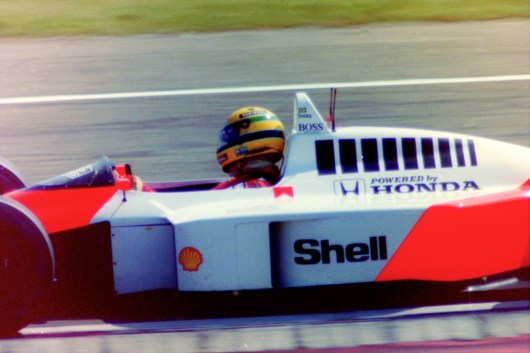
The other night on ITV2 there was a showing of the Senna movie which brought back all the excitement and rivalries of the late 80s F1 world. There was Ayrton looking very clean cut with a new short haircut signing up for McLaren. Ron Dennis the team boss looked happy and Alain Prost was all smiles too. By the end of the season those smiles were wearing a bit thin and a year later it was outright war between the two McLaren drivers.
The film Senna is interesting in a lot of ways. All the footage was taken from the official F1 TV feed and it is clear how Prost lost faith with McLaren and boss Ron Dennis and after two years he was off to Ferrari. When the two drivers came together in Suzuka for the Japanese Grand Prix and Senna was disqualified, Ron Dennis put in a protest even though the result had given the championship to his other driver, Prost.
Of course the film takes Senna’s point of view and Prost is portrayed as the bad guy. Even the famous interview between Jackie Stewart and Senna is only shown in part although Ayrton is clearly not amused by Jackie’s questions. A year later after winning his third title Senna would admit to purposely pushing Prost off the track as he was fuming about his pole position spot being moved to the dirty side of the track. That may not have been right but neither was purposely crashing into Alain Prost. Senna went way down in my estimation that day and as much as I admire Senna, I’ve never really subscribed to the legend that he has become in the last few years. I remember being at Silverstone in the early 1990’s and being surprised to hear him soundly booed by the fans as he came past.
Senna was killed at the San Marino Grand Prix in 1994 in an accident at the Tamburello corner. His car skated off the circuit into the barriers and although the impact was high it was survivable. Both Berger and Piquet had survived bad accidents at that same corner in the preceding years and even now I remember watching Ayrton’s crash in disbelief. I was certain that he would be OK but sadly that wasn’t the case. In a freak twist of fate the suspension arm of the car flipped back, pierced Aryton’s helmet and dealt him a mortal blow.
When Jack Brabham almost won at Monaco in 1970, future McLaren boss Ron Dennis was Jack’s chief mechanic, which is a nice link to bring us back to the Monaco Grand Prix. The first race at Monaco was in 1929 and was won by the famous British driver who mysteriously used the pseudonym ‘Williams’. The race gradually became more and more important and became a round of the European Championship in 1936. The first post war event was held in 1948 and in 1950 the race became part of the new World Championship and was won by the great Juan Manuel Fangio.
Stirling Moss won in 1956, 1960 and 1961 and another famous winner at Monaco was Graham Hill who won the event 5 times, a record until Senna surpassed it in 1993. Here is Graham tackling the tight corners of the circuit.
Now compare that to Lewis Hamilton in 2019. Much faster but then again, Lewis was driving a semi automatic Mercedes and didn’t have to do all those manual gear changes that Hill had to deal with. (The following two clips will take you to YouTube to view.)
You might think that with limited overtaking the Monaco Grand Prix can be boring. Take a look at this clip from the 1982 event.
In a lot of ways it’s amazing that the Monaco race has continued up to the present. The F1 cars of today are faster than ever before and they hurtle round these tight and twisty public roads at incredible speeds. Somehow the track seems even narrower or is it just that these modern cars are wider, their wings and fins stretching out to take advantage of every available bit of the slipstream.
The F1 teams return because the glamour of Monte Carlo; the yachts, the casinos, and the famous movie stars and celebrities all make this event the perfect opportunity for the sponsors to sell their wares and link their brand to glitz, glamour and hi technology.
I’m looking forward to the 2021 race already.
What to do next:
Share this post on your favourite social media!
Hit the Subscribe button. Never miss another post!
Buy the book! Click here to visit Amazon and download Floating in Space to your Kindle today!
Despite being constantly at home and within easy reach of my laptop and notebook I seem to be struggling to write anything lately. I was looking around for a new blog post and finally decided to set myself a task. Writing about numbers. Difficult I know but if I’m the top notch writer I think I am then it won’t be that hard, will it?
Back in the 1980’s I received my first debit card just like many other people. Debit cards were a new concept back then. We already had credit cards but a debit card, what was that about? Back in pre-debit card days when everything was in black and white like an old film, we used to have to go into the bank to withdraw cash. I remember queuing at the bank on a Friday lunchtime in Manchester City centre waiting to draw some cash out for that weekend’s activities. The way we did it back then was to write a cheque to yourself or as I was taught to do ‘pay bearer cash’. In 1987 debit cards were first introduced in the UK although they had been around for a while in the USA. As you can imagine I didn’t actually know that, I had to look it up so while I’ve got that Google page open here are a few interesting facts from the BBC:
The earliest known cheque was written in 1659 dated the 16th February. The Bank of England was established in 1694. The first five pound note was issued in 1793 and was the lowest denomination note until 1797 when war drained the UK bullion reserves forcing the bank of England to issue one and two pound notes. 1966 was when the first UK credit cards were issued and of course, the debit card in 1987.
The first cash machine was put into use by Barclays Bank in 1967 and the machine was revealed with much fanfare by comedy actor Reg Varney who you may remember from the TV series On The Buses. The cash machine of 1967 was operated not by a debit card but by a voucher issued by the bank which was then entered into the cash machine.
It was interesting to hear about Reg Varney because, getting back to numbers, for my debit card secret number I decided to use the fleet number of the bus I was driving that day.
14.
Here’s another number: 14. Yes 14 was the number of the house I lived at as a child. My parents house was a council house and it was my grandad and grandmother’s house until they bought their own house and moved away to Wales. My mother managed to take the house over on the understanding that her brother and sister could continue to live there although by the time I came along they had both found their own homes.
Many years ago I came back to the house and parked outside and spent a few moments remembering the times of my childhood. I parked opposite and took the picture you can see here from the same spot where many years earlier I had first riden my two wheeled bike. The bike was really too tall for me and I could only get on it from the pavement. I spent a lot of weeks riding round the block making only left hand turns until I returned to my starting place. Eventually I got the hang of it. There used to be a hedge across the front of the garden which has now been removed to access the parking place which is also new. I do have a nice picture of me stood in that garden. Wish I could find it for this post but it’s upstairs in a box at my Mum’s house. One day I think I’ll go back and try and reproduce that picture if the present occupants will let me.
The memories that come flooding back just from looking at that picture. My friend Gary Chapman lived just around the corner and we went all over on our bikes. One Christmas, Gary’s parents bought him a set of walkie takies. He always got really great presents. I remember once complaining to my mum who promptly told me that because Gary and his family lived in a flat and not a house, they had less rent to pay so had more money for presents! A few times Gary left me one of the walkie talkies and we had a conversation later that night. Battery power was limited so we arranged to switch on at a prearranged time, 8:30 or something. Our conversations went like this:
‘Gaz, are you receiving?’
‘Gaz here. Loud and clear. Are you receiving Ste?’
‘Steve here. Loud and clear.’
‘Receiving you loud and clear Ste.’
Not long after that Gary and his family were offered a council house but it was in Gamesley, Glossop, a Manchester overspill estate. Gary moved away and I didn’t see him again for years. I met him again in the late 1980’s. A mutual friend of ours, Chris had bumped into Gary’s sister, got Gary’s phone number and we all arranged to meet up. I remember being in a bar in Manchester waiting for Gary. I was at the bar which was pretty busy, getting the beers in when I heard Gary’s voice. It was just how I remembered Gary from years ago. I could hear ‘where’s Ste?’ ‘he’s over there at the bar’. I turned round expecting to see Gary but there was just this guy stood behind me that I didn’t recognise. Where’s Gary I thought? ‘Ste?’ said the stranger. It was Gary. He looked completely different but his voice, a distinctive throaty voice, was just the same.
71.
My very first car had the registration plate PDB71M. It actually caused a lot of confusion when I bought it because I traded in my motorbike, a Honda CB250 with the very similar registration PDB1M. Incredibly, checking on the Gov.UK website my motorcycle is still registered. It was a green Honda first registered in 1974. It has no tax or MOT so presumably it is languishing in the back of someone’s garage, rusting and probably neglected. My car was a Reliant Bond Bug which does not come up on a website search so presumably it went to the scrap yard many years ago. I bought it because I failed my first two attempts at the driving test and was really getting fed up. Of course we didn’t have a family car so the only driving I could do was the one hour a week on a Saturday morning that was my actual driving lesson. The Bond Bug was a three wheeler car and could be driven on a motorcycle license. After a few months regular driving I booked the test again and sailed through it.
I remember pulling up at home in my car feeling very pleased with myself. The car was small, it was an orange wedge shaped two seater and my Dad took one look at it and said ‘How are we all supposed to get in that?‘ and walked away. Presumably he thought I would be taking the family away on holiday. Sorry Dad!
126.
While I’m on the subject of firsts, my first camera was either a birthday or Christmas present and it was a Kodak Instamatic 126. I still have the camera. From my point of view it was a wonderful present; from my parents perspective, perhaps not, because back then in the late sixties cameras needed film and film had to be developed and printed which was fairly costly, especially if you had a child that liked taking pictures and also, whose first attempts were not so good. These days if you take some dud pictures with a digital camera- delete them! It’s no big deal. Back then it was expensive!
I remember getting a major verbal lashing from my Mum when we had gone to Boots to collect my photographs. I was using colour film and Mum had to shell out for my pictures of my action man in various poses in the back garden! (Action man? Hey, I was 12!)
I remember telling the lady in the camera shop about my photography and how I used to build all kinds of stuff out of cardboard and photograph the results. She told me about a close up lens you could buy which just fit snugly over the camera lens on my Instamatic and enabled me to get really close up shots. I’m not sure how much it was but I had to save up for it, my first ever new lens!
0063.
Back in the eighties when I received my first debit card I was a bus driver. Why I stayed in that job for so long I’ll never know but back then in the eighties there was a relentless move towards one man operated buses. Eventually I became a one man driver. It involved more money but also more work. Instead of just driving the bus you had to issue tickets and collect fares but anyone becoming a one man driver in those days was given a new staff number. I became driver double O six three, licensed to drive buses.
Just looking at those numbers together (not including by debit card number of course) gives me 1,4,7,1,1,2,6,6,3. I could add my present staff number into the mix, 6102 and there must be a lottery number in there somewhere. Is it a rollover this weekend? Excuse me, think I might just get myself a lottery ticket!
What to do next:
Share this post on your favourite social media!
Hit the Subscribe button. Never miss another post!
Buy the book! Click here to visit Amazon and download Floating in Space to your Kindle today!
When I get stuck looking for a new idea for a blog post I sometimes look back at my old ones just to see if anything there might inspire me. Sometimes I’ll think of something I could have said about a particular subject which I didn’t say at the time so I’ll start writing about that and then I’m off. Sometimes a writer just needs something to start him off. In fact over on Twitter I sometimes use a meme that goes like this
Some old posts can also be re-purposed. That is to say an old post can be given a new lease of life by a re-write, a few new paragraphs, some new pictures and maybe a link to a relevant video. One old post I looked at tapped right into a long running daydream of mine. Imagine me, a writer from the north of England getting the chance to go and work in Hollywood, writing scripts. I can just imagine the trip over on a Jumbo Jet or whatever passes for a jumbo jet these days. Arriving in Hollywood and looking at all the sights I have read about and imagined over the years, The Brown Derby restaurant, Romanoffs, Schwabs drugstore and maybe even catching a glimpse of Pickfair, the old Fairbanks/Pickford mansion on Summit Drive, the home according to David Niven’s book Bring on The Empty Horsesof many of the great stars of the golden age of Hollywood.
Alas, every single one of those places has gone eclipsed by the passage of time. Even the new owners of Pickfair, actress Pia Zadora and her millionaire husband, decided that after aquiring such an historic place, the best thing to do would be to knock it down. Termites had ruined the property, or so they claimed.
One other thing that is real enough is the bit about the writer from the north of England making his way over to Hollywood. No, it wasn’t me, it was James Hilton, the author of one of my favourite books of all time.
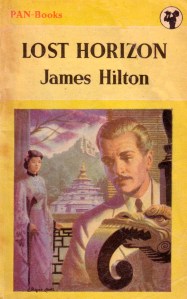
James Hilton is one of my personal writing heroes and yet his name may be unfamiliar to many of you reading this blog. He was a journalist and an author and made the trip from his home in Leigh, Lancashire, (now Greater Manchester) in the UK to the Hollywood hills in the United States to become a screen writer. He is probably more well known for his book ‘Goodbye Mr Chips’ which was made into a film with Robert Donat (actually another northerner from Didsbury in Manchester) but my favourite of his books and quite possibly my all-time favourite book is ‘Lost Horizon’.
Lost Horizon is a book I found in a second-hand shop many years ago. A battered 1940s paperback I paid twenty-five pence for and yet that small investment has paid me back many times over for sheer reading pleasure as Lost Horizon is a book I re read every year or so and I often pull it down from my bookshelf when a current read fails to entertain me.
Lost Horizon is a completely original idea and is about British consul Robert Conway in the dark days before World War II. Conway is helping his fellow British citizens escape from civil war in China and he and his small party escape in the last plane only to be kidnapped and taken to a distant Tibetan monastery. Conway meets the High lama and after a time it is revealed that the Tibetans want to preserve the best of world culture and art and make it safe from the coming war.
Hilton is one of those few people who have invented a word or coined a phrase that has become part of the English language. In this case it was the name of the Tibetan monastery, Shangri-la which has since become a byword for a peaceful paradise, a distant haven. Camp David, the US President’s retreat was originally called Shangri-la until renamed by Eisenhower for his son, David.
Hilton’s journey from Leigh to Hollywood must have been a magical one and one I envy, especially as his time in Hollywood was a golden age for movie making. Lost Horizon was made into a movie by Hollywood director Frank Capra and starred Ronald Colman as the urbane British diplomat of the novel. It’s a movie that was restored some time ago and is a great DVD if you happen to see it. Colman also starred in another movie authored by Hilton; ‘Random Harvest ‘.
James Hilton settled in Hollywood and wrote a number of screenplays for classic Hollywood movies such as ‘Mrs Miniver ‘. Sadly he died from cancer in 1954.
How would Hilton have coped with the Lockdown? Pretty well I should imagine. Professional writers are not like us amateurs, they are not governed by how they feel, if they are in the mood or not, if they are feeling creative or not. They just get on with it.
A few weeks back I decided that a good project for me would be to make one of my blogs into a video. I chose one from a short while ago A Letter to my Younger Self. I opened up my laptop, clicked on my Animoto page and began. I’m still working on it. It wasn’t as easy as I had thought. I could quite easily have read the post to camera but I wanted something a little more exciting and the good thing about Animoto is that they have a great library of stock footage and photos so combined with some of my own images the result should be good.
Here’s the problem though, and this is the big issue with technology that I come across time after time. Once the designers have put together a great peice of software or an electronic device, they just cannot leave it alone. Windows Sound Recorder: they replaced it with Windows Voice Recorder and all the things I used to do on there, I can no longer do. Windows Movie Maker: my favourite video editing platform: discontinued in favour of HD Movie Maker. The old version was so much better especially when editing sound. The new version is quite different. In the past I could position and reposition sound clips with the mouse now in HD Movie Maker the user can only trim sound or use the delay option. Oh well at least Animoto, the online editing platform I use frequently is untouched, or so I thought.
Wrong! This week Animoto unleashed a new version of its editing software on its users. Does it have improved features? Yes. Is it easier to use? No. Well to be fair it’s not bad but every so often the web page seems to crash and I have to reload the page and start editing again from the point my work was saved. Perhaps that’s the fault of my laptop although it never lost the page with the old version. There are some other litle teaks I don’t like too so I might just put that project on hold for now.
This week Prime Minister Boris Johnson decided to ease the current lockdown. Now we can return to work and also travel around if we want to visit somewhere. Most businesses are still closed of course but it might mean places like Blackpool and other seaside resorts will be expecting daytrippers soon. Personally I think his advice is ill advised and we should be keeping the lockdown on for a while longer. The thing is, the devolved governments of Scotland and Wales seem to agree with me so if you are planning a trip to either of those places soon, forget it because the lockdown is still in place there.
The other night I stayed up late watching the film Darkest Hour which is about Winston Churchill and the beginning of his Prime Ministership in World War II. It paints a rather bleak picture of Winston’s premiership with the Conservative party apparently holding back from supporting him and a growing clique actually wanting to replace him with Lord Halifax. When France fell to the Nazis Halifax wanted to explore peace talks with Hitler which Churchill was violently opposed to. I’m not sure how true to life the film was and although I can imagine not everyone was 100% behind Churchill, I found some of this film a little hard to believe. There was a vote of no confidence in the commons in 1942 although Churchill won this by a resounding 475 votes to 25. In the film, conservatives still will not support Churchill in the commons until outgoing premier Neville Chamberlain signalled them to do so by placing a white hankerchief on his knee. By then Chamberlain and his policy of appeasement were totally discredited so would he really have had such sway over his fellow MPs? I doubt it.
What Churchill would think of today’s devolved government I shudder to think.
In these difficult times I take comfort from, as usual, Marcus Aurelius. I receive a regular email from The Daily Stoic and it is surprising how words of wisdom from the past can be relevant to today. One email I picked up this week went like this : All of us who are alive today are the last in an unbroken line of our ancestors who survived two world wars, the plague and much more. They kept calm, they carried on. They learned, as Marcus did, that things can only ruin your life if they ruin your character. We might not control world events, but we can control how we respond. We control whether we hold our heads high. We control whether we help our neighbours. We control whether we contribute to the panic or not.
Not only that, the important thing to remember about the Corona Virus is that . . .
What to do next:
Share this post on your favourite social media!
Hit the Subscribe button. Never miss another post!
Buy the book! Click here to visit Amazon and download Floating in Space to your Kindle today!