Blogging, Editing and Re-Editing

One of my workmates asked me recently if I had written a new blog post lately. Yes, I answered, a new post every Saturday.

‘Every Saturday?’ asked my friend. ‘You can’t write a new one every Saturday!’

Well, that’s what I do, a new post every Saturday.

It’s not so easy knocking out a new post every week and just lately I’ve noticed in a few of the blogs I follow that other bloggers must also feel the pressure to produce new content.

How do we get the ideas? How do we keep on writing week after week?

Well I have to admit that just lately I have faltered a little and I have started looking at blog post prompts that various bloggers have left scattered about the four winds of the Internet.

Write a post about your favourite book: Done that one!

Write about your favourite sporting event: Done that one!

Write a post linking various videos together: Done that too!

Write a post about your favourite music: Done that one too.

Not long ago I found a whole set of prompts about cookery and incorporated them into a post like a series of questions: What do you like to eat? What’s your favourite recipe? What was the first meal you cooked yourself? That particular post was pretty popular and I even found a whole new set of followers who post regularly about food on their food themed web sites. As that is pretty much the only food blog I’ve produced they must be pretty fed up now with my regular content. Sorry guys but then again, I do have quite a few posts about restaurants. This is one of my favourites about Giorgio, the worst waiter ever.

Another way to produce new content is to take an old post and add a little more material to it and perhaps even spice it up with a few pictures or videos. I have done that a few times most noticeably with a post about annoying elements of the 21st century. It started life as 10 annoying things and every now and again I’ll brush it off and add some new annoying thing. I think now I’m up to 16 annoying things!

Somebody once said that no work of art is ever finished, just abandoned. That is really how I feel about my blogs and my videos. I’m forever watching my old videos and thinking ‘that bit isn’t right, I’ll just change it!’

One of my best videos is one about the graves and cemeteries of World War I and II in northern France. It’s a sad video but the visuals are good and I put together what I thought was a pretty good narration based on some blog posts I’d written previously.

One big mistake was when I edited the video I put in a shot I’d taken at the start of our trip to France. It was a really great motorhome with a trailer and then I panned over to our much smaller model, thinking at the time I’d add some jokey comment about ours being smaller in the narration.

Anyway, I added the comment and put everything together then uploaded it to YouTube. It seemed to do pretty well getting a lot of views but when I added it to a Facebook video page expecting a certain amount of praise, one reviewer mentioned that the jokey stuff didn’t really go with the overall tone. Looking back at the video I realised he was completely correct however by then the video had pulled in a few thousand views (some free promo credit with Google ads had helped there!) and I was reluctant to substitute the re-edited version as then I’d lose all those views! Oh well, there is a more subdued version on Vimeo, alas without so many views.

One video idea lately came from a post I wrote about cameras. In Cameras then and Cameras now, I looked back at my SLR case with my Olympus film cameras and compared it to my current camera gear. I took a few photographs for the blog and thought hey, why not make this into a video?

I powered up my trusty Canon G7X and ran through my film camera case, pointing out all the relevant bits and pieces then did the same for my current camera bag and my video case. When I came to review the footage the sound wasn’t so very good, probably because I was behind the camera talking rather than in front. Oh well, I re-recorded my narration which is sometimes a good thing as I can snip out all the ums and ahs which I invariably produce. The end result seemed a bit flat somehow. Anyway, I added all the usual music and captions and uploaded it to YouTube. Somehow it just wasn’t punchy or snappy enough. Take a look at it here.

The other day I decided to remake the video this time using the online editing site www.animoto.com

The result was visually much better with some eye catching fades and cuts which the animoto templates provide but my narration still sounded a bit flat even after I tweaked the sound using my sound mixer so I recorded another narration. I think this one is better, at least it’s a little more dynamic.

Oh well, another work of art about to be abandoned!


If you enjoyed this post then why not try my book, Floating in Space, a nvel set in Manchester, 1977.

Click the links at the top of the page to buy or for more information.
Rooms, Film sets and Homes from the Corners of my Mind . .

Film sets? Rooms? What exactly is this guy going to write about rooms you might think? Well, this idea about rooms might take me a while to explain so here we go.

I’ve always been interested in really exciting rooms, usually those seen on a film where the room in question has been designed by some really top designer and put together by some award-winning prop guy and set dresser but the first room that comes to mind is one from my comic book days.

Back in the 1960s some British comics started to reprint American super hero comic strips. They did it by combining various super hero comic strips into one comic. The one that comes to mind was called Marvel after the producers of such comic books as Spiderman, the Hulk and so on.

One strip that I really loved was the new super hero Daredevil. Now he, believe it or not, was a blind guy but had this ‘radar sense’ that enabled him to see in a way that no sighted person could. In the first Daredevil strip I ever read there was a cutaway drawing showing Daredevil’s flat (apartment to you US readers) and its secret ‘underground lair’ when Daredevil got his kit off and exercised in a personal gym where he honed his gymnastic skills which as you know, are required by all costumed crime fighters. It was probably the idea of the concealed rooms that interested me as a child, I always loved that in the sci fi of the 1960s.

Image courtesy berkeleyplaceblog.com

Batman too had his underground lair; it was the Batcave and there was a great moment in the 1960’s TV series when Bruce Wayne would say to his young ward Dick Grayson ‘to the Bat poles!’ Robin alias Dick would flip the switch on the bust on Bruce’s desk and the two would leap onto the bat poles in the now opened secret compartment and slide down to the Batcave.

Another underground lair was that of Doctor No, the first villain in the James Bond film series. The doc had these amazing quarters with a glass wall looking out under the ocean.

‘A million dollars’ says the doc to James Bond as he quietly enters the room.

‘You were thinking of how much it cost?’ He goes on.

Actually, I wasn’t as I knew it was a film set but it was pretty cool.

The next great room and location that comes to mind was that of Ernst Stavro Blofield in my favourite Bond movie, On her Majesty’s Secret Service. Blofield has a mountain hideaway on top of a peak in the French Alps, or was it the Italian Alps? Either way Piz Gloria was an actual skiing lodge that had just been constructed and had been lent to the film crew. The interior, which I always rather liked, particularly Blofield’s inner sanctum was really cool and presumably designed by the production designer Syd Cain.

Another room I always liked was Joe 90’s dad’s house from the TV series Joe 90. It was a very comfy old-fashioned farmhouse where Joe and his dad, professor -I nearly said professor 90 but I don’t think it was. Anyway, the two of them lived there assisted by their housekeeper until Joe went off on his secret missions. Their front room was remarkably similar to the one owned by Barnes Wallis in the film The Dambusters. Wallis’ home was a typical 1940’s English farmhouse and it all looked pretty comfortable to me.

Remember the Beatles movie Help? In the film there is a great shot of the four Beatles walking up to their respective front doors along a typical row of English terraced houses.

They turn their keys, open their doors and they each step into: -Cut to interior shot- One ultra-modern long room and we see the Beatles step inside and settle down. John has a settee or couch sunk into a low area which he has to step down into and down there, or so I imagine, he has a TV and stereo and all the mod cons of the mid-1960s. I loved that little space and if I had a big enough house it would be great to recreate it. Then again, I can just imagine coming home late at night after a few beers at the pub, walking into it in the dark and breaking my neck!

Did you ever watch the 60’s TV show The Prisoner? A secret agent resigns, returns home to find gas filling his house. He awakes, seemingly in the same room but when he opens the window, he finds himself in a village where he is apparently a prisoner. The Prisoner starred Patrick McGoohan and the show combines elements of intrigue, espionage and sci fi. It was filmed in the Welsh village of Portmerion where a long time ago I was able to visit number 6’s old house. The inside of it was of course not in Portmerion but was something assembled on a film set at Elstree or somewhere. It was small and compact and the door automatically opened as you approached.

Number 2, the administrator of the village had an ultra modern office with stylish 1960’s bubble chairs. I’ve always fancied one of those chairs: I can just imagine curling up in one and having a good read.

Another great setting was Hugh Grant’s house in the film Notting Hill. Notting Hill is an actual area of London and Grant’s house in the film was presumably an actual house. Notting Hill, and I have to say I have no actual experience of the real Notting Hill, comes over in the film as a busy, vibrant and exciting place to live. Hugh’s house is a terraced house, rather narrow but with lots of light and a rather cosy area on a landing by the stairs with a couch where Grant spends the night on one occasion in the film and looks to be a really great place to relax, maybe watch TV or write blogs and just generally have some private time.

Anyway, enough of films, it’s about time I told you about my favourite room. I had two and they were both at the first house I ever bought; my house in Didsbury, Manchester. There was a small front room which I decorated myself, slowly. There was a dado rail with different but matching wallpapers above and below, bookshelves, books and videos (VHS of course). I also kept one of the three bedrooms for myself as a music room and my stereo and records were all stored there along with a couple of comfy chairs and all the other toys, gadgets and cameras I had at the time.

Once, years later, I remember visiting the old place and I parked outside for a while feeling like an intruder. Years before, this had been my street and my house and if, back then I had glanced outside and seen a strange guy in a strange car just waiting, I might have been tempted to call the police. Times had changed, and now I was the intruder.

There was a time when I might have been tempted not to mention that story but I remember watching my favourite TV documentary of all time about the late actor, Peter Sellers. Sellers had a thing about dragging his ex-wife out and taking her on these regular tours of his old haunts, his old schools and old homes and so on. If a famous actor and comedian like Sellers did something like that then clearly parking outside my old house for a few moments can’t be so bad after all.

I enjoyed some happiness in that house but also a lot of pain and sadness too. I remember sitting there in my car and I tried to turn my mind to the happier times I had there.

Once, we had a sort of, well gathering there. I was tempted to say dinner party but really it was just a few people coming around for drinks and nibbles and things.

One guest was our solicitor, I’ll call him Phil (although his name was actually Pete!) Seriously, Phil was a really arrogant guy. In fact he had very bad eyesight and could hardly see his hand in front of his face. He rejected the use of a white stick and arrogantly pushed away anyone who tried to help him. He was a good solicitor and although he could be a bit of a pain I had a lot of respect for him.

He was sitting in the small lounge in my comfy chair when he got up to get a drink or some food or something from the other room. I was tempted to nip into the comfy chair but another guest pushed me aside and slipped into the seat. When Phil came back with a plate of nibbles he turned to sit back in the chair, obviously not seeing the girl sitting there and she slipped out of the seat just as Phil sat down again.

We were all killing ourselves laughing but Phil didn’t quite get the joke.

Later when he left, he once again declined any assistance. Pity really because the path from our front door to the street went towards the right at a 45 degree angle whereas Phil went straight ahead towards the privet hedge.

Never did get that gap in the hedge sorted.


Floating in Space is a novel by Steve Higgins set in Manchester, 1977. Click the links at the top of the page to buy or for more information.


A Letter to my Younger Self

Steve, how are you? I’m just trying to visualise myself when I was 16. Yes, you’re ok. I know how hard things are for you just now, dealing with that overpowering shyness that has dogged you for so long and will continue to hold you back for a very long time.

What can I tell you, what do you need to know?

Well, here a few things that might be important to you.

It’s too late to tell you now that choosing metalwork over art at school was a big, big mistake. You hated metalwork I know and only chose it because of a crazy idea that it might just somehow help you get into motorsport. Wrong. It didn’t and it never would. You couldn’t drive when you were 16 and neither could your Dad. You’d probably be interested to know that the big stars of the future in motorsport were all helped by their fathers. Lewis Hamilton and Jensen Button, names that won’t mean much to you now but they became F1 stars because their fathers loved motorsport and started their sons off in go-karting and up through the racing levels until they reached the giddy heights of F1.

You should have stuck to art because you loved it and you were good at it. Remember all those times when Mr Markland would point out your painting or collage and show it to all the other pupils and comment on how good it was? Remember how good that felt? Remember too that time when you saw Mr Markland in the corridor and he told you that you were heading the wrong way to the new art room and you answered that you were doing metalwork instead. He never spoke to you again. That hurt, I know.

Anyway, at 16 it’s too late to rectify that, well, not too late. Your Dad wanted you to go on to college; you could have studied art there.

Why not give it a go Steve? I know, it would all be so new with strange places and new people but it might be worth it.

Here’s another thing. Remember when you told the careers teacher you wanted to be a journalist and he got you a job interview –at Barclays bank?

Mr Sheriff, the careers teacher said you had no chance at the Manchester evening news but what about other papers? There used to be a local one if I remember, that might have been a possibility. Did you ever think of trying for a job as a junior reporter? Maybe you could have even tried to study journalism at college. You were the top of the class in English if you remember.

Anyway, don’t think that people like Mr Sherriff have all the answers. They don’t and their advice isn’t always good. Some people just want to do the absolute minimum of work in their job and then get off for home as soon as possible. Others care about their jobs and their work and someone a little more dedicated might have listened more and given you better advice.

Try to focus on what you really want to do Steve.

Think about your job, well your future job. A job takes up so much of your time, so much of your life, it might be worth spending some time, a lot of time in fact, working out what you want to do and what you want to be involved in. At various times you wanted to work in motorsport, be a journalist, a screenwriter and a film director. Sit down and have a serious word with yourself Steve and think on this; you know that you love writing, you always have, even just for the personal pleasure of crafting a piece of writing work so maybe journalism was the job for you after all.

I’ve had some dreadful jobs and for some crazy reason I stayed far too long working for the bus company because I hadn’t got a clue how to get out of that job, how I could improve myself and go and try to do something that I would really enjoy. In a word Steve, focus. Focus and stop daydreaming and work out what you really want to do and go for it. And by the way, get your hair cut!

Oh and by the way Steve, get all that hair tidied up!

One final thing: Build a few bridges with your Dad. You and he are from different generations, different backgrounds. Make a few adjustments and try to get on with him because when he’s gone you’ll regret all that wasted time when you didn’t get on together.

One final word about your Mum. She’s very fond of saying ‘never mind’ but sometimes you should mind and mind so much that you work hard to do better and better until you get the job you want and the life you want.

One last thing, one day you might just think it is OK to fill your car’s leaky radiator with tap water on a cold and frozen New Year’s Eve just so you can get to a party. I know you really thought your car would be OK, believe me, it won’t and a little antifreeze will save you a hell of a lot of money!


Floating in Space is a novel set in Manchester, 1977. Click the links at the top of the page to buy or for more information.

7 Questions for a Self-Published Author

Question 1:

How did you come to write your book?

I’ve always been a writer, even as a school kid I was writing stories and screenplays. I used to write scripts and do all the casting. Not sure whether Steve McQueen would have appreciated the roles I was planning for him though.

Later on when I was in my 20s I tried to move away from all the sci-fi and espionage stuff I was writing and write about something more personal to me, something that I had a personal connection with so I started writing about life working on the buses, which is what I was doing at the time.

I wrote about working as a bus conductor and driver and jotted down my observations about the people I met and carried on my bus. Then there were other stories about my personal life, drinking in pubs, chatting up girls in nightclubs, listening to music and so on. Later I realised I could bring all this stuff together even though it was just a series of essays then, and even make it into a book, which I eventually did.

Question 2

How did you go about publishing the finished book?

I had the book turned down by three publishers, not really a great amount.  I wrote a blog post a while ago about books rejected by publishers and I found out that Day of the Jackal was rejected 4 times, Gone with the Wind 38 times and The Time Traveller’s Wife 25 times. Publishers are only human of course but these days writers don’t need them, we can just publish online, just like I did at Amazon using their website Createspace which is now kdp.amazon.com

Question 3

Tell me about the problems of marketing and getting your book noticed by the public.

Well, that was the hard part, writing it was easy in comparison!

Building up a presence on Twitter, Facebook and YouTube was a gradual process and the same is also true for my blog on WordPress which I started really just to promote the book. I started off with essays about how I wrote the book and videos of me talking about the book and so on.

I read somewhere that over 5000 books are published every day on Amazon, an incredible figure so how can anyone compete with that? Well, just by getting out onto social media and plugging away with tweets, new blog posts, videos on YouTube and so on.

Question 4

Tell me about your website and your blog

Well, it was originally created just to promote my book and get my message out there to potential readers but it’s also a challenge, a writing challenge. My big problem is that I’m lazy and I need a big push to get me writing so having a deadline, 10:00am on a Saturday morning, is something that gets me motivated as a writer. I know that I have to write something by then.

I even feel like a sort of writing professional because I have my deadline, my one deadline, and I’m always working towards that, trying to get something ready to post for my followers.

Question 5

What sort of posts will we find on your blog?

Generally I try to write stuff that is similar to my book, little bits of fluff, anecdotes with a funny twist, things like that. The idea is that if people like the blogs, they should like my book, Floating in Space which is written in a similar style. A typical blog post, and one of my favourites, is the one about hoodies (Hoodies and a Shaggy Dog Story) and an incident where an old lady’s handbag was snatched. Another favourite was called the Cat Wars and was about a crazy situation that built up when I was looking after my neighbour’s cat.

The only problem now is that I’m running out of anecdotes but I still manage to write about two other favourite themes, second-hand books and classic films.

Question 6

What about video, do you use video in your blogs and marketing?

Any internet post on social media performs better with images, a 37% percent increase in engagement and even more so with video.

Here are a few stats:

100 million hours of video are watched each day on Facebook.

500 million people watch Facebook videos every day.

Facebook videos receive 135% more organic reach on average than a photo.

2 thirds of content on Instagram is now video as opposed to pictures but video has to be snappy. If viewers are not hooked in the first few seconds, they just click away from your video to something more interesting.

I use video on my website to try and engage readers and all my adverts, because I do use advertising every now and then, are all video based.

A lot of years ago, in the 1990’s I really wanted to get into TV and video and I went on a video production course at the WFA media centre in Manchester. Subsequently, I made a few attempts to make some things for TV, all of which ended in failure but as a result I do have a bit of technical knowledge with video editing and production which has helped me a lot.

Luckily, today’s technology today makes it pretty easy to create simple videos and I use them a lot in my blog posts.

Question 7

What are your plans for the future regarding writing and blogging?

Well, more of the same really. I’m actually very slow at producing video content so I need to maybe speed up a little with my video production.

I really need to work more on my follow up book.

I’ve written some screenplays that were rejected so I plan on turning those into a book. The big problem is just me, being motivated and just getting myself geared up to work and write!


Floating in Space is a novel set in Manchester, 1977. Click the links at the top of the page to buy or for more information.


Cars and A Not So Worldwide Web

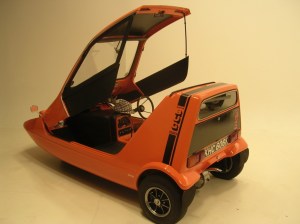
I’m probably pushed to tell you the registration number of my current car but the registration of my very first car is still firmly anchored in my old memory bank.  It was PDB 71M, A Bond Bug, and for those of you who don’t know, a Bond Bug was a sporty little Reliant three wheeler car and I bought one because I failed my driving test twice and I could drive the Bug on my motorbike licence.

It was actually a pretty eye catching car for a three wheeler. No doors but the roof lifted up to gain access and the side windows were plastic held on by Velcro. I always remember bringing it home and showing it off to my family with a certain amount of pride and my Dad looking at it and saying “How are we all going to get into that?” Perhaps he thought I was going to take us all away for a holiday!

Still, we had some nice times, me and the Bond Bug but then one cold and snowy Christmas I decided to chance going out to a Christmas party in the car even though it was losing coolant. I topped it up with water and went off for a night of Christmas cheer. I walked home sensibly I might add, but when I returned the next day I found that the car had frozen overnight and it ended up having to have an engine rebuild. That was a pretty expensive night out! When I eventually  passed my driving test I got myself a proper car.

The other day I was tapping away on my laptop with the TV on in the background and I heard someone during a TV interview say that he wanted cars, personal cars as we know them, to be phased out in the next 10 years! Whoa! What was that? I grabbed the TV remote to rewind but accidentally switched off the TV and when I powered it up again the TV channel and the interviewee had disapeared. I don’t  know who that guy was but he was on cloud cuckoo land if he really thought it was feasible to take away motor cars from the general public.

The motor car is probably one of the great status symbols of our time and also one of those things that give us unprecedented freedom, certainly compared to our ancestors. Turn the clock back to the 1950s: If people wanted to get out and about and enjoy the great outdoors on a bank holiday the only way to travel was by bus or train. Yes, public transport was crammed with people in those days, all on their way to enjoy the great British seaside destinations.

Today, we are free of all those past restrictions, no waiting for trains or buses. It’s just a simple matter to pop outside, start up the motor and you’re off. The only restriction is probably traffic congestion. How many of us spend our bank holidays stuck in some traffic jam that clogs up the roads to the holiday hotspots? Either way, if that unknown politician really thinks the private motor car can be pushed aside he is in for a rude awakening.

I changed my car this week. I was sad to see my old car go because, well I’ve always liked it. It’s a very comfortable car, the reclining seat suited me very well and I had wanted a convertible car for a long time. It was so lovely in the summer to sit back, press a button and see the roof fold back into the boot. Air conditioning? Who needs it when your roof comes off!

Bye old car!

What is really annoying is that my 2006 car, for which I paid something in the region of £6000 some years back, 2011 I think, is now, according to webuyanycar.com, worth the paltry sum of £260!

To be fair, it does have a lot of mileage under the bonnet, 140,000 miles to be exact.

I did wonder about changing the car, then I thought why bother, why not wait until it finally dies the death. True, the ride had become a little rougher than usual but after a flat caused me to sort out a new tyre, the ride became smooth once again. I wavered then, should I change cars?

Then the passenger window jammed and not long after the boot jammed. I couldn’t free the window but found that the boot could be opened with the key, a physical key contained within the car’s key card. Opening the boot in this way was a real pain in the neck as the keyhole was located under the boot and sometimes, especially in the dark, it was hard to get the key in the slot. On one occasion I opened up the key card and out popped the battery so I had to rummage about under the car in the dark to find it.

Anyway, another car caught my fancy being sold by a friend at a very reasonable price. Normally I tend to stick with vehicles from a dealer because as I know very little about cars and anything mechanical, I like to buy something with a warranty and someone who will take away my old vehicle.

This new purchase meant I had to sell my trusty old motor myself so this being 2019 I nipped outside, took a few pictures on my mobile phone and put a short advert on Facebook. I sold the car the same day, not for a great price but much more than webuyanycar were offering!

All I had to do then was clear out my stack of personal stuff from the car, endless boxes of CDs, waterproof jackets, wellies and all sorts of other stuff I didn’t even know I was carrying.

There was one thing I left behind. Secreted somewhere in the car I was sure was a member of the spider family. He was a pretty active fellow, spending a lot of his spare time spinning a web across my driver’s mirror. I was sure he would continue to do a sterling job in that respect for the new owner.

Presently, that same day, the new owner arrived. She was actually a foreign lady although she arrived with an entourage of friends who, it seemed to me, were the real owners. They took a quick glance at the car and seemed happy. They were a little surprised to find the boot required a key but I did mention that in the advert. They were also concerned about the mileage and the seized window but again, I had mentioned that in the ad.

The cash was handed over and off my little car went. Hope they take care of it.

The owner of my new car was away for the weekend but she had left the keys and log book for me.

This being 2019 I was able to tax and insure my car online although I wasn’t too happy about the insurance. I can’t ever remember an insurer charging me to change my insurance to a new car. There has always been something to pay of course as usually I’ve moved up to a better, newer and more expensive car but a transfer fee? Well, I’m afraid I may be changing insurers when that policy comes up for renewal.

The next day I picked up my new car and settled into it. The boxes of CDs were transferred over, as well as the wellies and waterproofs and so on.

The great thing about my new car is that it can handle 5 CDs at once and when you are in CD mode the next CD plays as the last one finishes.

Ages ago I compiled my top 100 all-time favourite tracks so I wonder now if I could get all 100 on 5 CDs and play them back to back? 20 tracks on each CD, is that feasible? Oh well, time to get the laptop out and give it a try.

Once I had got my CDs set up I settled back and sorted out my seat and made myself familiar with all the controls. The cigarette lighter/charger was hard to find but a glance through the instruction book and there it was.

A few days later I was ready to take my new motor on its first trip to work. The CDs were all ready, I had fuelled up the previous day. I started the engine, slipped the lever into first gear and checked the mirror. What was this? On my wing mirror was a large and intricate spider’s web!

Our local spider was clearly reluctant to leave sunny St Annes!


Floating in Space is a novel set in Manchester, 1977. Click the links at the top of the page to buy or for more information.

Cameras Then, and Cameras Now . .

I still have my old camera bag, well, camera case actually. I have often wondered just how much money I would make if I sold it on eBay. Would I be impressed I wonder of the value of my once expensive film cameras? Or would I be disappointed to find these great cameras are now comparatively worthless?

I was always rather proud of my aluminium camera case. It made me feel like someone who was serious about cameras and who knew something about photography. There was my Olympus OM10 complete with the manual adapter which transformed the camera from an amateur’s automatic device to a professional tool. The OM10 cost a lot of money as I remember and so did the bits and pieces that went with it. A wide angle lens which always delivered some super sharp shots. Then there was my 200mm telephoto lens, my medium 80 to 150 zoom and my 3 times converter that made my 200mm lens into a 600mm although it struggled in that configuration for light so large apertures and slow shutter speeds were the norm.

Also in the case is my Olympus OM2SP complete with spot programme technology. As you may probably know, a modern camera tends to average out the light that comes into the lens giving a slightly false reading or at least an overall reading which when shooting scenes with dark and bright elements can cause confusion. The spot meter in the OM2SP means the user can choose a single spot from which to take a light reading and set the camera accordingly so that the point of interest would always be perfectly lit.

To assist further on the quest for the perfect picture my case also had a wide variety of filters. A small number of screw on filters which screwed directly onto the front of the lens and another set, my Cokin filters which were square filters that slotted into a holder which screwed onto the front of the lens.

My old 1980’s camera case

There was more also. My cable release, vital for those late night long exposures. Long exposures, now I think of it, were photographs I used to love taking. One of my favourites was shooting someone in the dark, whirling a sparkler or a torch round and round while the shutter was open then I’d fire a hand held flash to freeze the person and then close the shutter. I’m not even sure you could do that on a modern digital camera but anyway it was a fun picture to take.

Also in the case is my motor wind, a vital addition for capturing the fast action of the cars at my nearest race track, Oulton Park in Cheshire. If you look at the outside of the case still adorned with motor sport stickers from the 1980’s, you can see how much I was into car racing back then.

My current SLR camera bag

Fast forward to the present day and there is not much in my SLR camera bag. My Nikon D100 and zoom lens, a medium zoom, a spare battery and a lens cloth and that is about it. Filters are available today but it’s probably just easier to add a filter with image editing software after you have downloaded your snaps to your laptop.

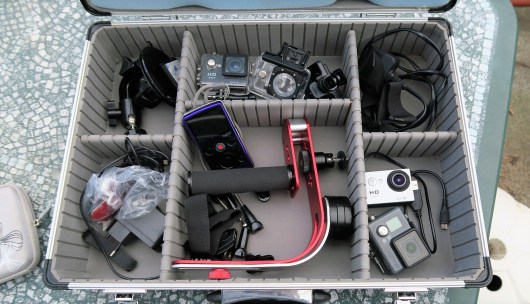
My video case has a little more to it. It contains quite a few cameras, my three action cameras and batteries and my Canon G7X. Also in there is my trusty Panasonic mobile phone sized video camera. Most of the other gear consists of things like mini tripods and devices for attaching the cameras to something, bike handlebars, car doors and so on. I have a fairly new gadget I’ve only used once so far, you can see it in the lower centre of my video case, it’s a device like the professional steadicam, a weighted handle that absorbs movement when you are moving to give a smoother camera pan.

My video camera bag.

Oh and plenty of cables, charging cables, connecting cables and well all sorts of various cables. Now I come to think of it, I’ve probably got cables I don’t even need.

I do love my old Olympus but to be fair, I love my modern cameras more. Even so, I wonder if it’s worth putting one last roll of film through my Olympus before eBay beckons?

What to do next: Here are a few options.

Share this post on your favourite social media!

Hit the Subscribe button. Never miss another post!

Listen to my podcast Click here.

Buy the book! Click here to purchase my new poetry collection.

Click here to visit Amazon and download Floating in Space to your Kindle or order the paperback version.

Click here to visit amazon and purchase Timeline, my new anthology.


RIP Niki Lauda

It was sad to hear about the passing of Niki Lauda last week. He died after contracting pneumonia after a lung transplant. He was 70 years old.

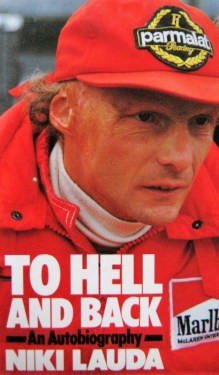
One of my favourite motor racing books is his autobiography titled To Hell and Back. This is what I wrote in one my reviews.

If someone had said to me at the end of 1973 when Jackie Stewart had just retired that Niki Lauda would be the next great champion of formula one, I would have laughed in his face. In my eyes it was obvious who the next great driver was. It was Ronnie Peterson. Had I tested those theories with a substantial cash wager I would have found myself out of pocket because Lauda won two world championships, retired, then made a comeback and won a third championship. The story of Lauda’s dreadful crash at the Nurburgring has been told many times, it’s even been made into the movie ‘Rush’ directed by Ron Howard. To Hell and Back is Niki’s story in his own words and a great story it is too. On his return to F1 at Monza after his terrible crash, Lauda drove out onto the track and was so scared he began to shake uncontrollably. Nevertheless, he carried on, overcame his fears and became a motorsport legend.

Things weren’t too great at Ferrari when he returned either. They had already replaced him with Carlos Reuteman, the Argentinian driver and Niki was understandably not amused. He returned to racing at the Italian Grand Prix that same year, 1976 and came home fourth, an incredible feat of endurance for a man who only months earlier had been given the last rites. At the championship decider, the Japanese Grand Prix, Lauda withdrew from the race in torrential rain after deciding the conditions were too dangerous to continue. James Hunt came third and therefore became the 1976 World Champion by a single point.

Lauda won the championship again in 1977 then left Ferrari. After two years with Bernie Ecclestone’s Brabham outfit he retired but was lured back to F1 again by Ron Dennis the boss of McLaren in 1982. Lauda won the championship for a third time in 1984 but this prompted a salary disagreement between the two men. Lauda claimed that he had only asked for a token £1 salary as a driver and the rest of his reported $3 million dollar salary was for his publicity value. Now he was world champion he reasoned, his salary should be upped considerably, after all his publicity value was the same if not more but now he was a world champion driver. Ron Dennis disagreed and Lauda took his financial issue straight to team sponsors Marlboro. They coughed up the extra cash but Alain Prost then became Ron Dennis’ favoured driver. Lauda retired at the end of 1985.

Lauda took a lot of risks in his early career, financial risks rather than racing ones. He took out a £30,000 bank loan to buy his way into the March team’s Formula 2 car. They were impressed and quickly elevated him to the F1 team. In 1973 he borrowed more money to buy his way into the BRM team. Lauda was good but the team were near to the end of their days, however when team mate Clay Reggazoni moved to Ferrari he told Enzo Ferrari how good Lauda was and Ferrari signed Lauda too and Lauda was happily able to repay his loans. Later in life he was able to start his own airline, Lauda Air which he sold in 1999 but then went on to start another airline.

In 2013 director Ron Howard made the Hunt/Lauda championship battle into the movie Rush.

Niki worked as a consultant to Ferrari and as team principal for the Jaguar F1 team and most recently he was a non executive director for the Mercedes F1 team. Until his lung transplant he was a familiar face in the Mercedes pit along with Toto Wolff, the Mercedes Team Boss and has been credited with luring Lewis Hamilton away from the Mclaren team.

Niki Lauda was one of the legends of Formula One and it was nice to see Niki remembered at Monaco this year by the F1 drivers and teams who all wore red caps in his memory.


Floating in Space is a novel about beer and cigarettes, pubs and pool tables, discotheques, loud music and cheesy chat up lines. Click the links at the top of the page to buy or for more information.

Adventures with Data Protection

I spend a lot of time these days looking after my mother who will be 90 later this year. Her memory is not what is was, in fact sometimes she’ll have breakfast, fall asleep in the chair and wake up wanting her breakfast. My brother and I think of it as her reset mode, as if someone has pressed control alt and delete on her personal memory bank and all that has gone before has been wiped clean.

Her hearing aids are a big problem too, despite the note written large on her table which says ‘DON’T HIDE AWAY YOUR HEARING AIDS. LEAVE THEM WHERE YOU CAN SEE THEM.’ We tend to spend a lot of mornings searching for her hearing aids because she cannot remember where she put them, unless we were there when she took them out, and even then we are only human and sometimes forget ourselves.

Both her hearing aids need new earpieces and the doctor referred her to Specsavers which is only a short walk away so happily I can push her there in her wheelchair and do away with the nightmare of trying to get her in and out of my car.

The other day I called Specsavers and asked if they had the referral yet. They couldn’t find it but were very helpful and said if I contacted the doctor’s surgery and they had the referral to hand then they could either fax or e-mail it to Specsavers and then provided me with the necessary fax numbers and email addresses.

The Doctors’ surgery was not though helpful at all though. The referral had gone through, yes. E-mail? No, it had to go through proper channels. Fax it? Fax? They hadn’t had a fax machine for years implying that I, that top notch technology savvy writer and blogger, was a good few light years behind the times.

My mother did have a letter about an appointment which needed to be booked via something called the NHS gateway. Was that the referral I asked? Could be . . .

I then called the NHS booking gateway, supplied the reference numbers and asked to book the appointment. Could my Mum confirm some details? Not really, she’s having trouble with her hearing aid. OK they said we’ll sort it out. After a moment, they said, yes it’s all sorted, we’ll send you a letter about it.

Is it for Specsavers I asked?

Sorry, we can’t tell you because of data protection.

What was the date and time?

Sorry, can’t tell you because of data protection.

The thing is, I tried to explain, it will be me taking Mum for the appointment so I could do with knowing the where and when as that could be pretty helpful.

Sorry, can’t tell you because of data protection.

OK, what if I put Mum on the phone? OK but we have to verify her identity. Right so I put Mum on the phone and the guy asks her can you confirm your name?

MUM: What?

GUY: Can you confirm your name?

MUM: What?

ME: He’s asking your name!

MUM: OK It’s (Ooops, sorry data protection, can’t reveal that on this blog!)

GUY: What is your date of birth?

MUM: What? Speak up!

GUY: What is your date of birth?

ME: Your date of birth Mum!

MUM: It’s (whooa, can’t reveal that here on this blog post because of data protection!)

GUY: What is your post code?

MUM: What!

ME: Your postcode?

MUM: Er . . .

ME: (Whispering) It’s (whooa, can’t reveal that here on this blog post because of data protection!)

GUY: Just a minute, I heard you telling her the answer!

ME: She’s a deaf old lady and couldn’t remember it!

GUY: Well, we’ll send your Mum a letter with the date of the appointment.

ME: It would just be so helpful if you could tell me when it is because I am the one who will be taking her for the appointment!

GUY: Sorry, can’t reveal that because of data protection!

The really good thing is that not long afterwards Specsavers called me back to say they had received the referral and that my Mum was booked in for (Ooops, sorry data protection, can’t reveal that on this blog!)


Floating in Space is a novel about beer and cigarettes, pubs and pool tables, discotheques, loud music and cheesy chat up lines. Click the links at the top of the page to buy or for more information.


4 Simple Secrets of Self Publishing

One of the bylines I use on Twitter is ‘hear it straight from a self-published author’ so I thought it might be an idea to write a post about just that, about being a self-published author.

1. The first thing to remember in the world of self-publishing is that it’s just you, no one else, just you.

You are the writer, the editor and the proofreader all rolled into one and there is only you to tell you that that bit is good and that other bit is not so good and that the book is too long or too short, or anything else for that matter. Sometimes you might find you need a little help, particularly in the area of proofreading. After I wrote my book and then rewrote it a few times I personally began to develop a sort of word blindness and I tended to see only the words I thought I had written and not the ones I actually had written. Spelling and grammar checkers will pick up things like repeated words, bad spelling and so on but a really good idea is to get someone to proofread your work. How many mistakes Liz has spotted in my work I shudder to think!

2. Once you have clicked the button at Amazon to publish then another thought may begin to enter your head: Who is going to buy your epic work? How will they even know about it?

The answer is marketing, and who will be marketing your book? Well, for a self published author, it’s going to be you! Yes, that’s your cue to start Facebooking, Tweeting and Blogging so you can get your message out to all those eagerly waiting readers; a new book is available, come and get it.

A thousand websites are out there that will tell you about the intricacies of marketing and blogging. Some will drop a tiny sliver of free info onto your doorstep, others want you to sign up for their webinars and their courses all guaranteed to sell your book, at a price of course.

For me there are a few select websites that I read regularly and I do follow their advice,  particularly when I decide to shell out some money and actually advertise. Apart from advertising, I publicise Floating in Space in all the usual places I have mentioned plus I have a raft of videos to bombard the public with, some short and snappy and others that go into more detail. Then of course, there is this humble blog, going out once a week in the hope that these short missives about life, the universe, books and classic films will hopefully entice a few people to buy my book and bring me in a few sales. Will you be a best seller and make lots of money? Some writers do of course but when £5 a month drops into my bank account, sometimes more, sometimes less, I count myself very happy indeed.

Got yourself an author blog? No? Get yourself one ASAP. An author blog is a way of communicating straight to the book buying public. WordPress is a great way to start, fairly easy and free. The only thing I pay for at WordPress is my website address, http://www.stevehigginslive.com

3. Have you self-published at amazon?

Well if you have, having your author page at amazon is very important too. Get yourself a good bio sorted and some juicy stuff about your book. Another place that’s important is Goodreads. Take some time to set up your author page there too and try to interact with readers and other authors. Take a look at my Goodreads page here.

4. One last thought.

Ok, you’ve gone down the self-publishing route but that doesn’t mean you have to stay self-published. Keep on researching publishers and keep on sending off your manuscripts!

Oh and one other thing, just because you have found these four ‘secrets’ published on the Internet, that doesn’t mean that they are right, or good or even worthwhile listening to. I am just like a thousand other writers knocking out works like this that float off into the internet. I have no editor to tell me my post wasn’t helpful or interesting or generally up to much. I just have me and some grammatical support from my lovely proofreader who labours away correcting my tenses and spelling and other errors for no monetary gain at all, although I do take her out for a meal now and again.

So if you fancy becoming a self published author and blogger, join the club. Floating in Space is currently rated by Amazon as the 520,413th most popular book on their site. Almost a year ago it had hit the dizzy heights of 4,536th most popular so that is quite a fall, maybe it’s time to consult my head of marketing (me) and maybe sort out a new video from my personal video producer (me) for a new ad campaign!


Floating in Space is a novel set in Manchester, 1977. Click the links at the top of the page to buy or for more information.


6 Great British Films You May Never Have Heard Of!

The Night my Number Came up (1955) starring Michael Redgrave, Sheila Sim, Alexander Knox and Denholm Elliot. Directed by Leslie Norman.

A senior Royal Air Force officer (Michael Redgrave) is at a dinner party in Hong Kong and a naval Commander played by Michael Hordern, talks about a dream he had in which the Air Marshal and a group of 5 other companions were flying from Bangkok in a Dakota which crashed on a rocky shore. The Air Marshal is due to fly to Tokyo the following day but he is not unduly bothered as many of the details differ from his planned flight including using a different kind of aircraft, a Consolidated Liberator.

When technical issues ground the planned aircraft a Dakota airliner, like the one seen in the dream, is substituted, and a number of other passengers arrive to make the total number of people on board 13, the same number of people as in the dream. As the flight proceeds, other circumstances change so that eventually most of the details correspond to the dream. When the aircraft runs low on fuel due to becoming lost in bad weather the pilot manages to bring the aircraft down in emergency landing in a snowfield in the mountains and all on board survive. The naval commander hears about the missing plane and arrives at the RAF base to direct search parties to the correct area.

The director, father of the film critic Barry Norman, builds the tension in the aircraft as more and more people come to know about the dream and gradually become more and more anxious. It was interesting to find out when I researched the film that it was based on a real incident in the life of British Air Marshal Sir Victor Goddard. All in all, an excellent film with good performances from Michael Redgrave, Alexander Knox and a young Denholm Elliot.

The Dead of Night (1945) starring Mervyn Johns. A series of short stories that combine together. Each instalment had a different director.

This is probably one the great horror movies of the 1950’s, in fact, one of the great movies full stop. It’s a series of short stories all linked together by the central character played by Mervyn Johns. His character architect Walter Craig, arrives at a house in the countryside where he has been consulted on some building work. The house seems all too familiar to him and then he then realises that everything that happens he has already lived through in a dream, a nightmare in fact. As more guests arrive for the weekend he recognises them from the dream and is convinced something terrible is about to happen. When he confides this story to the others, they in turn all relate a supernatural story before the central theme reaches a terrifying climax. Two stories that were particularly good were one in which an unbalanced ventriloquist (Michael Redgrave) believes his dummy is alive and another where a woman played by Googie Withers buys an antique mirror for her husband and finds that the mirror has an hypnotic effect on the man.

An outstanding film and one that was highly rated by director Martin Scorcese and was voted the 35th best horror film of all time by Time Out magazine.

The Intruder (1953) starring Jack Hawkins. Directed by Guy Hamilton.

Another classic 50’s film starring Jack Hawkins. Hawkins plays Colonel Merton, an ex-army officer who returns home one night to find his London flat being burgled by a petty thief. Merton confronts the man played by Michael Medwin, only to find that the intruder is in fact Ginger Edwards, one of the men from his old command. He is shocked to see one of his former soldiers reduced to crime. He tries to talk to Ginger but accidentally knocks over his phone in another room which leads Ginger to think he has called the Police. When there is a knock at the door Ginger bolts and makes a hasty departure. Merton then decides to visit some of his old army comrades – Ginger mentioned he was in touch with one of them – in order to track the man down. Each old comrade tells a story about Ginger which all nicely link together to show how circumstances have worked against their old friend. A lovely film with excellent performances and a number of familiar faces from British film and TV, among them Dennis Price, Dora Bryan and George Cole.

The Long Arm (1956) starring Jack Hawkins and directed by Charles Friend.

This is a brilliant film, it really is. It’s a sort of CSI London from the 1950’s. Like the present day CSI series, this film shows the crime detection process using the then start of the art technology. Jack Hawkins is a police inspector and is called on to look at a robbery in London. The theft was from a safe manufactured by a company called Rock. There is little to go on and Jack returns to his 1950’s suburban home feeling rather disappointed. Happily his typical 1950’s housewife is there waiting for him, his tea is ready and his evening bottle of beer also all ready too. Hawkins spends a little time with his son before bed time and tells him all about his current case and the lack of clues. Well, says the boy, perhaps the thief is a super thief who has never been caught. This revolutionary thought rings a bell for Hawkins and he goes back down to Scotland Yard straight away for a meeting with the records guy played by Geoffrey Keen. Together they trawl through the card file (no computers back in the 1950’s!) of unsolved cases and find one relevant link. A set of robberies all from  safes manufactured by, yes you’ve guessed it, Rock.

OK next up is a visit to the Rock factory for more investigation but then the robber makes a fatal mistake. While fleeing from the scene of his latest heist the robber runs over and kills a passerby. Later the abandoned murder car is found and 1950’s style forensic technology uncovers various clues. The most interesting one is a rolled up newspaper used to clean the window. A fascinating look at newspapers and how they are produced and distributed follows and the police are soon on the trail of their man. I won’t give away the ending but the film kept me on my toes throughout and Guy Hamilton who directed some of the early Bond films throws in a little action to bring the film to a climax.

No Highway in the Sky (1951) starring James Stewart, Marlene Dietrich, Glynis Johns. Directed by Henry Koster.

James Stewart plays an aircraft technical expert Theodore Honey who is trying to solve the mystery of a crash involving a new aircraft, the Rutland Reindeer, which has crashed in Canada. Honey theorises that the crash was a result of metal fatigue and sets up an experiment which involves the tailplane of the aircraft subjected to continual vibration in a controlled environment. When Mr Honey flies home on another Reindeer he is shocked to find that the aircraft is an early production model and is fast approaching the flight time that he has theorised the tailplane will fail. Mr Honey decides to warn the crew and also a famous film star aboard played by Marlene Dietrich. Consternation reigns in the cockpit but the pilot has no choice but to carry on. On arrival at Gander the pilot consults with experts in London and the aircraft is cleared to fly on. In a desperate act, Honey retracts the undercarriage and wrecks the plane to stop it from flying.

Stewart plays Mr Honey as a slightly eccentric character, very similar to his character in the film Harvey. Marlene Dietrich takes quite a liking to him as does the stewardess and they are both eager to help and support him and his young daughter when his theory is attacked from all sides. Needless to say, he is proved right in the end.

Last Holiday (1950) starring Alec Guinness. Directed by Henry Cass.

Guinness plays a pleasant mild-mannered salesman called George Bird who has no friends or family and finds out he only has a few weeks to live. He decides to spend the time he has left by going to a rather posh residential hotel where the residents find him a sort of enigma. His star rises here as he becomes involved with the residents and staff and people start to wonder about him. Who is he? Is he rich? Lucrative job offers come his way as well as love but only one person knows his secret, a member of staff that he confides in. In the end Mr Bird finds out he was wrongly diagnosed but the film ends on a sad note when he is killed in a car crash. Penned by author J.B.Priestley, it’s another wonderful British picture full of excellent performances with a whiff of sadness and poignancy about it.  Guinness’ performance is excellent and the underlying sense of inevitability is further enhanced by a haunting musical theme that we hear throughout the film.

If I had written this a few years back I might have been tempted to add this to a blog like Unseen TV which was a post about cinema and TV films which rarely get an airing on terrestrial TV. However, I am happy to see that all of the above films can be found on the new freeview channel 81 Talking Pictures.


Floating in Space is a novel set in Manchester, 1977. Click the links at the top of the page to buy or to find out more!