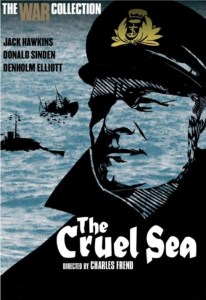
 When I was writing my post ‘The Book of the Film or the Film of the Book’ a while ago, I did consider including ‘The Cruel Sea’ as not only is it one of my favourite films, it is a pretty good book too. I didn’t include it because I couldn’t find my copy of the book, which I hadn’t read for years and also I hadn’t seen the film for years either.
In one of those odd coincidences that always happen when I set my mind on a subject and leave ideas churning over in the upstairs room in my head, I was scouring through a charity shop in St Annes when I came across the DVD of the film. It was one of those free newspaper DVDs that seem to cost anything from a pound upwards at a car boot sale but was happily on sale here for a paltry 30 pence.
After a busy late shift at work I settled down with a glass of red in one hand and a ham sandwich in the other, compulsory on these occasions of course, and began watching.
The film starts off at the beginning of World War 2 when the Jack Hawkins character is at the builder’s yard helping with the fixing up of his new escort ship, Compass Rose. His officers begin to arrive, many of whom are easily recognisable as stalwarts of the 40’s and 50’s British film industry: Donald Sinden, Denholm Elliot, and Stanley Baker and later in the film Virginia McKenna appears as an officer in the WRNS.
The cast and characters are therefore introduced and then the ship goes off for its sea trials and crew training and soon the Compass Rose is escorting its first convoy. Nothing much happens at first as this is the early part of the war but when the Nazis over run France and the ports of northern France come available to the enemy, many U-Boats converge on the convoys and a great deal of merchant ships, along with the supplies so desperately needed by Britain, are lost.
The boredom of those early dull convoys contrasts sharply with the terror and mayhem waged by the U-boats later on. The film reveals the desperate tragedy of abandoning ship in the middle of the Atlantic, the oil and grease, not to mention the cold, are terrible. Many escort vessels could not stop for survivors as they would become easy prey to the unseen U-Boats, though some did, others returning later in the light of day as the attacks usually came at night.
Leave was a great relief for the naval crews. On one trip back to England the film shows the crew at home, some enjoying some home comforts, others struggling with failing marriages, a situation made worse by the war. One crewmate takes his friend the engineer home to meet his sister. On a later voyage the engineer tells his mate how he has fallen for the sister and plans to ask her to marry him. Later, the Compass Rose is sunk by a torpedo and as the survivors struggle to stay alive in the cold Atlantic many succumb to their injuries. As they drift in the oily water the soundtrack replays echos of their recent dialogue, a marriage proposal hangs in the air over the groom who will never wed and a petty argument haunts the body of an unhappily married officer. Happily, some survive till daylight when a destroyer returns to rescue them.
It must have been difficult living during the war, trying to get on with your own personal life when everything was wrapped up in the war effort. Manchester was a target for enemy bombers because of its industrial strength and also because of its airport at Ringway, now Manchester International Airport. My mother used to tell me stories of air raid shelters and late night cocoa when the air raid warnings were on and everyone trooped into the shelter. Everyone except my granddad who always said ‘If I’m going to die, I’ll die in my bed!’ She told and still tells stories of gas masks, bomb craters and how you could tell the differing sounds of German and British aircraft.
I’ve often wondered what happened if your house was bombed? Were you given new housing? What happened to your mortgage? Did you still have to pay it? Imagine being stuck with a 25 year mortgage and a house that was just a pile of rubble.
One other observation about films in the 40’s and 50’s: People seemed to have a different pattern of speech back then, a different and faster rhythm than today with clearer and more precise diction. Is that the case or is that just the way the actors and actresses of the time were taught to speak. Speech today seems slower and less precise and sprinkled with regular use of words like ‘awesome’!
Back to the Cruel Sea and Captain Ericson alias Jack Hawkins is given another ship which he captains until the end of the war. The producer, Sir Michael Balcon said that Hawkins was always the first choice for the Cruel Sea, even going so far as to say that without Hawkins he wouldn’t have made the film. The finished picture was the hit British film of 1953.
Hawkins was the epitome of the trustworthy British authority figure. In his obituary one writer wrote that Hawkins ‘exemplified for many cinemagoers the stiff upper lip tradition prevalent in post war British films. His craggy looks and authoritative bearing were used to good effect whatever branch of the services he represented.’
Hawkins himself was a three pack a day smoker and later became ill with throat cancer. In 1966 his entire larynx was removed however he still appeared in films with his dialogue dubbed by either Charles Gray or Robert Rietti. He died in 1973.
Just as I was writing this post, one thought came back to me about the book of the Cruel Sea. It was written by Nicholas Montsarrat and on the last page, when the war is over, the captain who has always hated his safety vest, hurls it into the sea. The vest sank like a stone!
 It’s not always so easy to come up with a new blog post week after week. It’s even harder to find something extra special for my 300th post. Three hundred posts! I suppose to those of you who have been writing for years, 300 may not be such a big milestone but for an amateur writer like me, it’s pretty special. The crazy thing is this, a few weeks ago I was commenting on one of those online forums, praising WordPress and blogging and someone commented that if I hadn’t been blogging I might have finished my second book! Looking back I now wonder whether that guy was actually right. 300 blog posts, times my average word count per post: That comes to about 20,000 words. Yes, perhaps I could have written my next book. Then again, it’s not just the words, its the idea behind the words, the creative thrust of a book that’s important. Get that and the book should just follow. Still, that fellow had a point. Should I give up my blog posts in favour of my book? Well, if that would guarantee me producing a book then yes, great! The thing is, it’s not a lack of words that have kept my book in a constant state of unfinishedness (is that a word? If Norman Mailer can invent words then so can I.) It’s really my own laziness.
 It’s always a bitter-sweet experience when someone decides to make your favourite book into a film. It doesn’t always work out because maybe it was a big, thick, long book and they have cut out your favourite bit, or perhaps the cast wasn’t the one you imagined. It’s usually just the same in reverse. You see a great film and in the credits it says based on the book by so and so, then you rush out and get the book and it turns out to be a little disappointing. Sometimes it’s even better than the film!
 The President in Washington sends word that he wishes to buy our land. But how can you buy or sell the sky? The land? The idea is strange to us. If we do not own the freshness of the air and the sparkle of the water, how can you buy them?
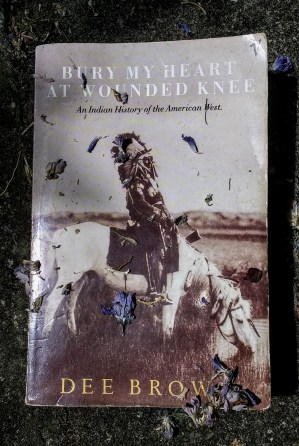 I can’t really remember when I became interested in Red Indians, or to be more precise, Native American Indians. In a way it was an interest in philosophy and the meaning of life that led me to them. I liked the idea of the Great Spirit and the Mother Earth. Those intrinsic ideas of nature and faith greatly appealed to me and showed me a different Indian to the one I have seen on feature films, here was a thoughtful race, in tune with nature. A speech made in 1854 by Chief Seattle has always moved me and in part says this:
 A while ago I published a post called ‘
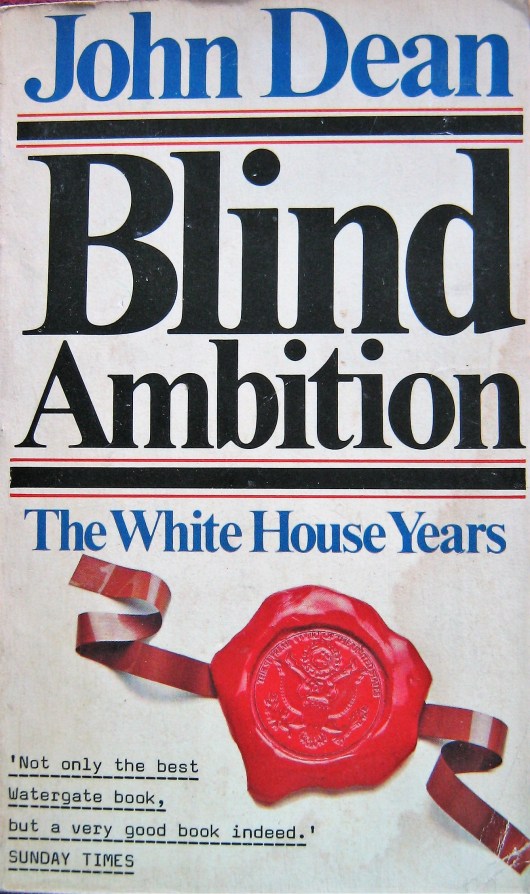
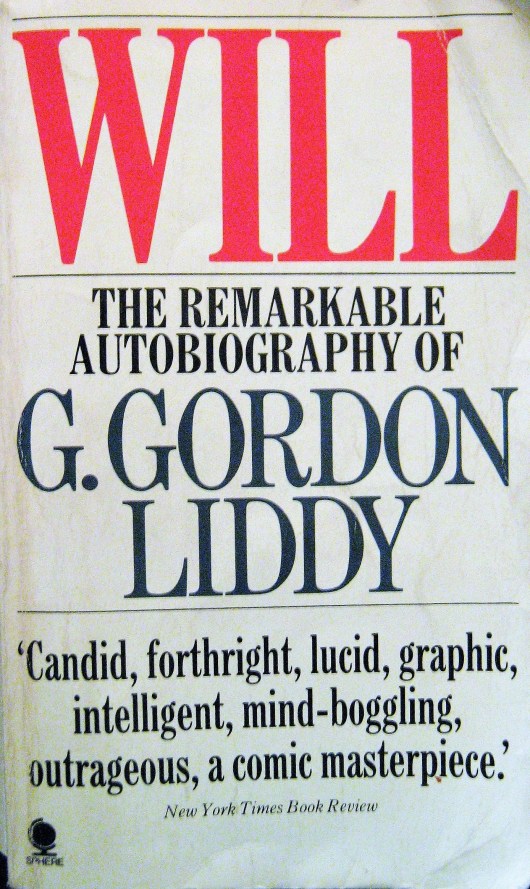
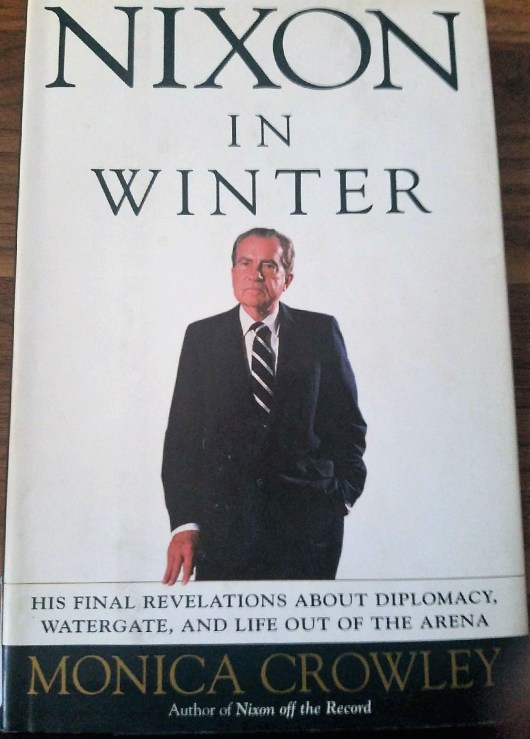
 I remember being in our usual pub quiz a few months back and one of the questions concerned Watergate. We were sitting with some friends, actually some much younger friends and one of them asked me, ‘Watergate? What’s that?’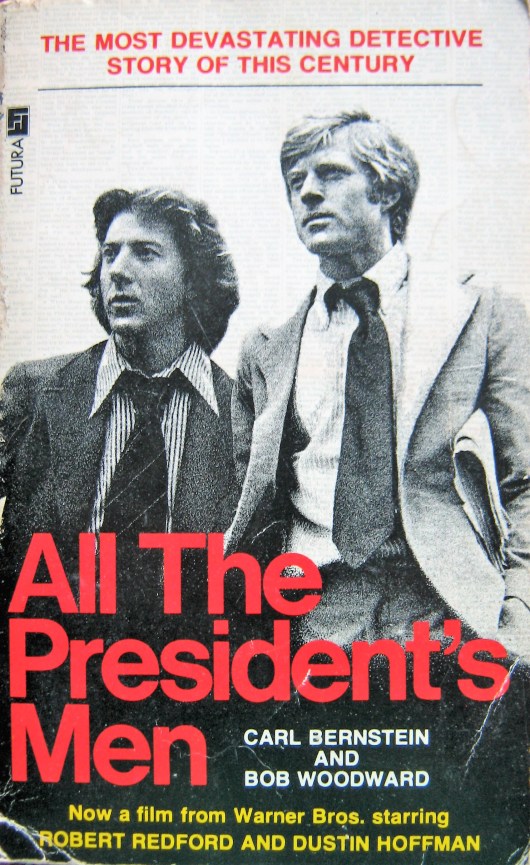
 I’ve written about my mother and father in my blog posts so perhaps it’s about time I wrote about the one remaining family member, my brother. My brother Colin lives in Manchester and we see each other every couple of weeks or so when we meet up in the
  A lot has changed in Manchester city centre, at least on the surface, but to a great extent it’s still the same city as it always was. My book, Floating in Space is, as you probably know if you have ever visited this web page before, set in Manchester in 1977 and I thought it might be interesting to take a look at the city, some 41 years later.

 Letters from an Unknown Author!